REACTIONS OF ALKYNE AND NITRILE LIGANDS IN TUNGSTEN (II) COMPLEXES
Ross J. Beattie
A dissertation submitted to the faculty at the University of North Carolina at Chapel Hill in partial fulfillment of the requirements for the degree of Doctor of Philosophy in the
Department of Chemistry.
Chapel Hill 2016
Approved by:
ABSTRACT
Ross J. Beattie: Reactions of Alkyne and Nitrile Ligands in Tungsten (II) Complexes (Under the direction of Joseph L. Templeton)
The examination of light atom-light atom and metal-light atom multiple bonds is of great importance to the fields of both organic and inorganic chemistry. Group VI transition metals are particularly well suited to the investigation of these systems with extensive reports for both catalytic and stoichiometric systems. The [Tp′W(CO)(NCMe)(RC≡CH)]+ cation provides a platform for the examination of the reactivity of the alkyne and nitrile fragments.
When standard electrophiles are added to the neutral Tp′W(CO)(N=CHMe)(HC≡CH) complex they add to the nitrogen, forming cationic imine complexes [Tp′W(CO)(N(R)=CHMe)(HC≡CH)]+. This reactivity is unavailable for large electrophiles where sterics prevent access to nitrogen. When [CPh3][BF4] is added to Tp′W(CO)(N=CHMe)(HC≡CH) it rapidly oxidizes and couples to the 1-azavinylidene ligand at the β-carbon site forming the cationic imido complex [Tp′W(CO)(NCH(Me)CPh3)(HC≡CH)]+.
[Tp′W(CO)(N=CHR)(C≡CR)]-. This anionic complex can also be dimerized through the azavinylidene β-carbon but selectivity is eroded.
Deprotonating the neutral azavinylidene acetylene complex yields the anionic acetylide complex. By protonating this species Tp′W(CO)(N=CHMe)(C=CH2) can be observed by NMR spectroscopy. This vinylidene complex isomerizes at room temperature to the carbyne nitrile complex Tp′W(CO)(N≡CR)(CCH3). The carbyne α-carbon is protonated by strong acids, resulting in the formation of a carbene complex with an agostic interaction of the α-carbon proton.
ACKNOWLEDGEMENTS
There are many people who have contributed monumentally to my success throughout my time here at UNC, and it is an honor to have the opportunity to thank them here. Firstly, I would like to thank Professor Joe Templeton, who has taught me countless lessons both in chemistry and in life. I can’t imagine a more supportive and caring guide for this journey. I also need to thank my labmates Drs. Katie Lavoie and Alex Lapides, without whom this 5 years would have been much less enjoyable. Thank you as well to former labmates and in particular Dr. Chris Turlington, Dr. Brian Frauhiger for making this lab such a welcoming and wonderful place. I am glad to call you all my friends.
Professors Maurice Brookhart and Alexander Miller have been a tremendous help throughout this process, I have always appreciated that your doors are always open, and thank you both for all of the wonderful insights that you have provided. I would also like to thank Professors Cindy Schauer, and Simon Meek for serving on my committee and for the many helpful discussions along the way.
TABLE OF CONTENTS
LIST OF TABLES………..…………..ix
LIST OF FIGURES……….……….xi
LIST OF SCHEMES………..xvi
LIST OF ABBREVIATIONS AND SYMBOLS……….xviii
CHAPTER 1: MULTIPLE BOND TRANSFORMATIONS UTILIZING THE [Tp′W(CO)]n+FRAGMENT...1
1.1 Introduction………..………1
1.2 Nitrile Activation……….3
1.3 Alkyne Activation………8
1.4 Summary…………..………..15
1.5 References………..16
CHAPTER 2: REGIOSELECTIVITY OF ADDITION TO THE AZAVINYLIDENE LIGAND IN Tp′W(CO)(η2-HC≡CH)(N═CHMe): ELECTROPHILIC ADDITION VERSUS OXIDATION AND RADICAL COUPLING………...21
2.1 Introduction………21
2.4 Experimental………..33
2.5 Supplemental Information……….41
2.6 References………..77
CHAPTER 3: THE FORMATION OF NEW C-C BONDS THROUGH THE OXIDATION AND DIMERIZATION OF THE 1-AZAVINYLIDENE LIGAND……….79
3.1 Introduction………....79
3.2 Results………83
3.3 Discussion………..93
3.4 Conclusion.………..101
3.5 Experimental………102
3.6 Supplemental Information………...….…...108
3.7 References………133
CHAPTER 4: ALKYNE REACTIVITY IN THE Tp′W(CO)(η2-HC≡CH)(N═CHMe) FRAGMENT: A SERIES OF SURPRISING SRUCTURAL ISOMERS…..………...136
4.1 Introduction………..136
4.2 Results………..138
4.3 Discussion………142
4.4 Experimental………146
4.6 References………157
CHAPTER 5: NUCLEOPHILIC ADDITIONS TO CATIONIC Tp′W(CO)(η2-HC≡CR) (R = H, Ph) COMPLEXES AND ACTIVATION OF THE η2-ALKYNE LIGAND……….160
5.1 Introduction………..160
5.2 Results and Discussion………162
5.3 Conclusion.………..171
5.4 Experimental………172
5.5 Supplemental Information………...176
LIST OF TABLES
Table 2.1. Recorded integrations for the minor methyl signal
and corresponding rate constants, activation barriers, and half-lives………..57
Table 2.2. Crystal data and structure refinement for 2………58
Table 2.3. Bond Lengths for 2……….59
Table 2.4. Bond Angles for 2………..59
Table 2.5. Crystal data and structure refinement for 3………61
Table 2.6. Bond Lengths for 3……….62
Table 2.7. Bond Angles for 3………..62
Table 2.8. Crystal data and structure refinement for 5………64
Table 2.9. Bond Lengths for 5……….65
Table 2.10. Bond Angles for 5………...………..……...………..66
Table 2.11. Atomic Occupancy for 5………..67
Table 2.12. Crystal data and structure refinement for 6………..68
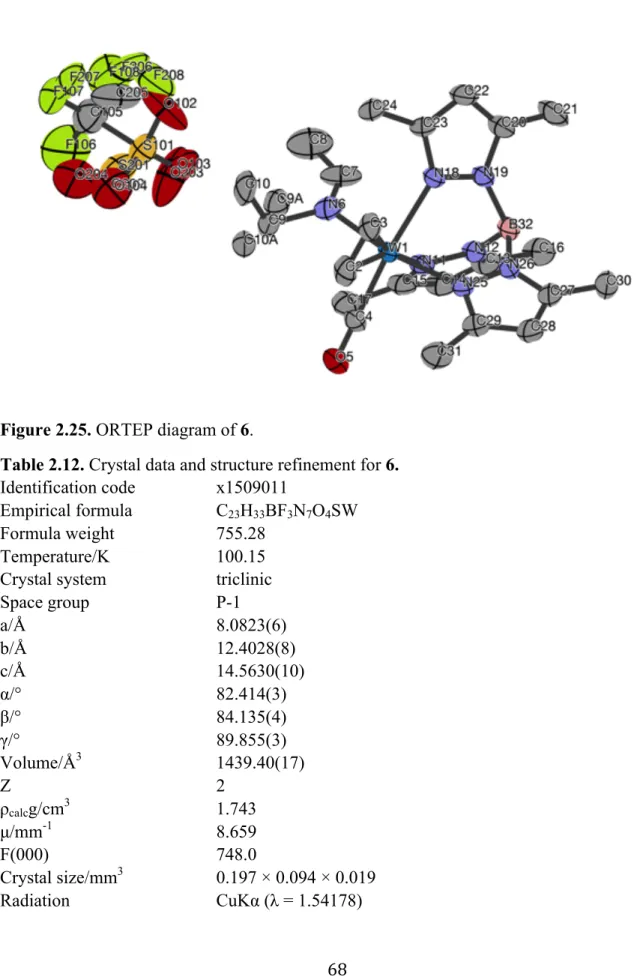
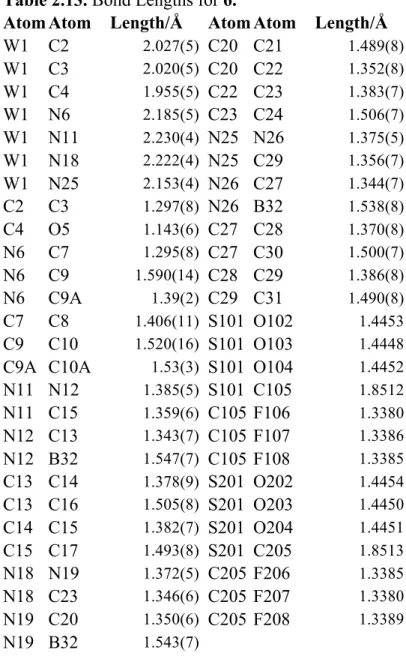
Table 2.13. Bond Lengths for 6………...69
Table 2.14. Bond Angles for 6………...………..……...………..69
Table 2.15. Atomic Occupancy for 6………..71
Table 2.16. Crystal data and structure refinement for 7………..72
Table 2.17. Bond Lengths for 7………...73
Table 2.18. Bond Angles for 7………...………..……...………..74
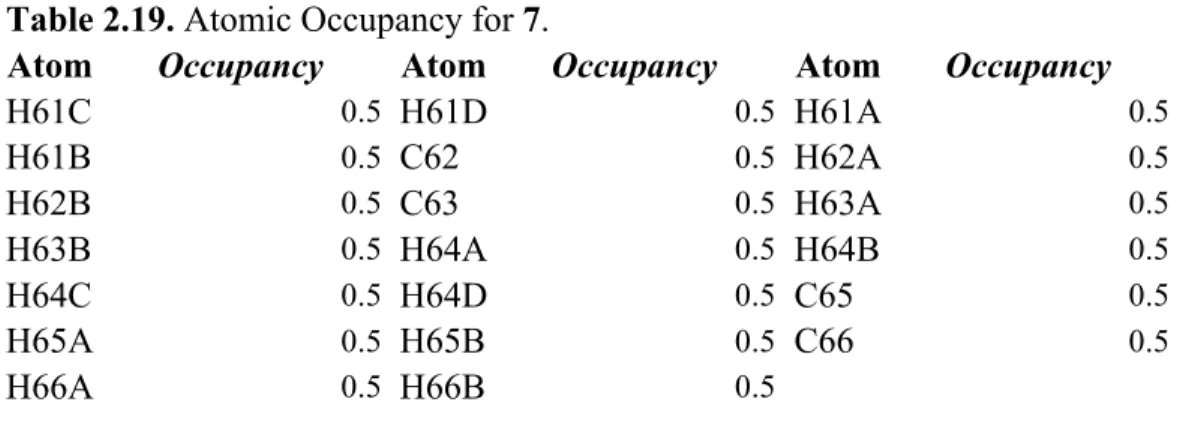
Table 2.19. Atomic Occupancy for 7………..76
Table 3.1. Recorded integrations for the minor methyl signal and corresponding rate constants, and activation barriers………127
Table 3.3. Bond Lengths for 2………...129
Table 3.4. Bond Angles for 2………130
Table 5.1. Crystal data and structure refinement for 6………..186
Table 5.2. Bond Lengths for 6………...187
Table 5.3. Bond Angles for 6………187
Table 5.4. Crystal data and structure refinement for 7………..189
Table 5.5. Bond Lengths for 7………...190
Table 5.6. Bond Angles for 7………191
Table 5.7. Crystal data and structure refinement for 9………..193
Table 5.8. Bond Lengths for 9………..194
LIST OF FIGURES
Figure 1.1 (a) E.O. Fischer’s first carbene (top) and carbyne (bottom) complexes. (b) One of Schrock’s olefin metathesis catalysts.
(c) Nishibayashi’s best N2 reduction catalyst.………...1 Figure 1.2. Moieties resulting from the homocoupling of nitriles
bound to metal.………...………...4 Figure 1.3. (a) The π-orbital interactions for the CO and 1-azavinylidene
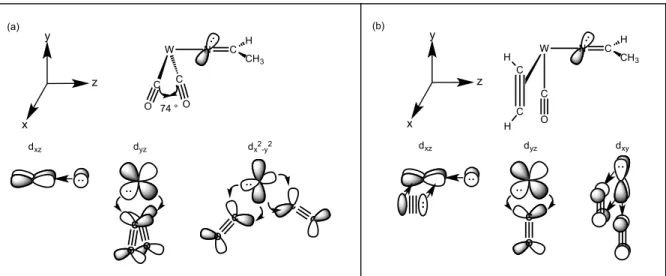
ligands in the Tp′W(CO)2(N=CHCH3) complex, including the deflection of the C-W-C angle to maximize backbonding overlap with the filled dxy orbital. (b) The π-orbital interactions for the CO, 1-azavinylidene, and alkyne ligands in the Tp′W(CO)(HC≡CH)(N=CHCH3) complex, including the 3-center-4-electron bonding scheme between the nitrogen lone pair, the
alkyne and the vacant dxz orbital………6
Figure 1.4. (a) Nitrile alkyne cross metathesis catalyst. (b) Alkyne cross
metathesis catalyst……….9 Figure 2.1. 1-Azavinylidenes (metalloimines) vs. 2-azavinylidenes (aminocarbynes)……..21 Figure 2.2. dπ interactions for 3. The dxy shows the 3-center-4-electron
bonding schemefor the alkyne and azavinylidene. The dyz anddxz show
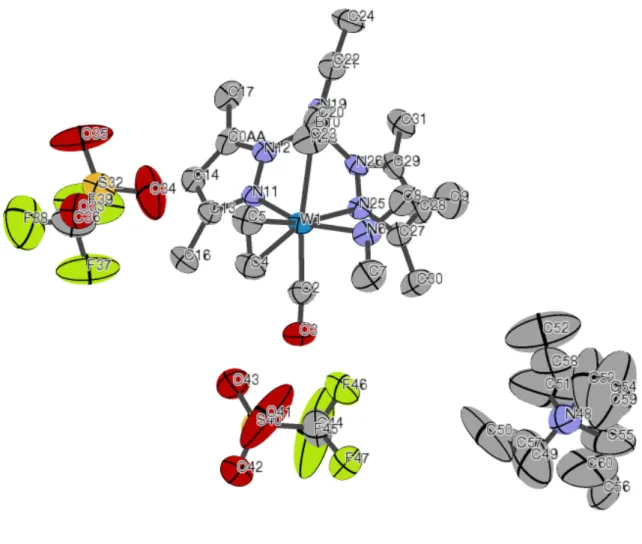
the backbonding interactions of thecarbonyl and acetylene………23 Figure 2.3. ORTEP diagrams for the [TpʹW(C2H2)(CO)(NCCH3)][BF4]
(2, left) and TpʹW(C2H2)(CO)(NCHCH3) (3, right) with all hydrogens
except the azavinylidene proton omitted for clarity………24 Figure 2.4. 1 and 2-D 1H and 13C NMR spectra of the trityl addition product.
a) HMBC data showing the central trityl carbon, coupling to the β-carbon proton and the orthoprotons of the phenyl rings. b) 13C proton coupled spectra
showing the 1-azavinylidene β-carbon with sp3 coupling………27 Figure 2.5. ORTEP diagram for the S,R diastereomer of
[TpʹW(C2H2)(CO)(NCH(CH3)CPh3)][BF4] (7) with non-relevant hydrogens
and [BF4]- counterion omitted for clarity……….28
Figure 2.6. Cyclic voltammagrams of 3 and the two trityl salts showing that oxidation by trityl is thermodynamically downhill, while the methoxy trityl
oxidation is uphill………29
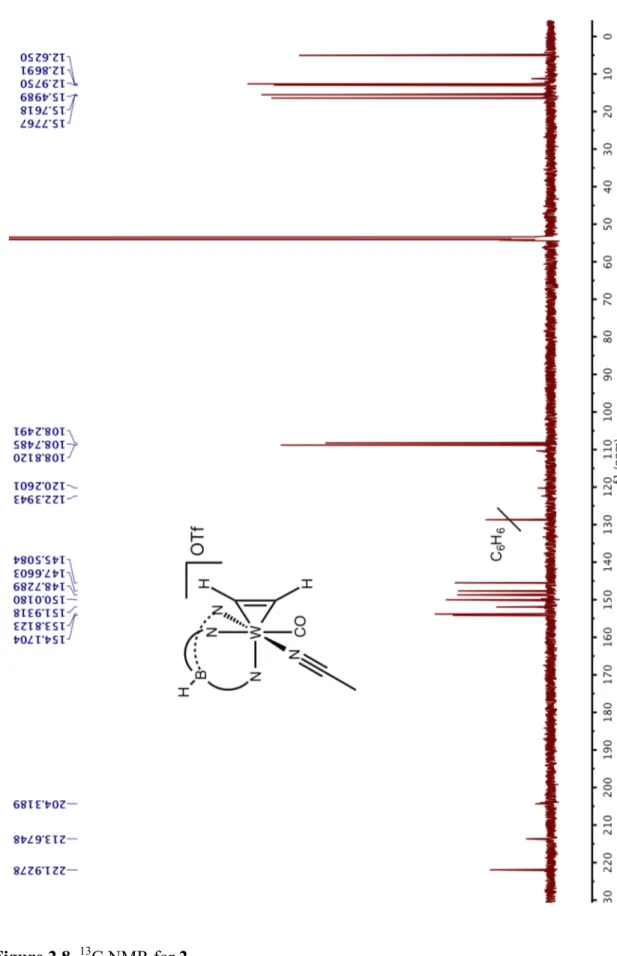
Figure 2.8. 13C NMR for 2.………...42
Figure 2.9. 1H NMR for 3………...43
Figure 2.10. 13C NMR for 3.………...44
Figure 2.11. 1H NMR for 4……….45
Figure 2.12. 13C NMR for 4.………...46
Figure 2.13. 1H NMR for 5……….47
Figure 2.14. 13C NMR for 5.………...48
Figure 2.15. 1H NMR for 6……….49
Figure 2.16. 13C NMR for 6.………...50
Figure 2.17. 1H NMR for 7……….51
Figure 2.18. 13C NMR for 7.………...52
Figure 2.19. HMBC of 7……….53
Figure 2.20. 1H NMR for 8……….54
Figure 2.21. 13C NMR for 8.………...55
Figure 2.22. ORTEP diagram of 2………..56
Figure 2.23. ORTEP diagram of 3………..61
Figure 2.24. ORTEP diagram of 5………..64
Figure 2.25. ORTEP diagram of 6………..68
Figure 2.26. ORTEP diagram of 7………..72
Figure 3.1. Vinylidene ligands vs. 1-azavinylidene ligands………...79
Figure 3.4. Reactions of CPh3BF4 with various azavinylidene acetylene derivatives………86
Figure 3.5. The 16 different stereocenter combinations for a molecule with 4 chiral centers grouped by equivalence (color within each box), enantiomer (boxes), and symmetry (rows)………..89
Figure 3.6. List of the possible diastereomers formed by dimerization and the 1H NMR signals for the bridge protons of 12……….90
Figure 3.7. The major vs. minor isomers of 9-11………...91
Figure 3.8. Newman projection across the bridge carbons of 2………..97
Figure 3.9. Cyclic voltammograms for complexes 1, 5, and 6 vs. Fc/Fc+………..95
Figure 3.10. dπ interactions for 1,5, and 6. The dxy shows the 3-center-4- electron bonding scheme for the alkyne and azavinylidene………97
Figure 3.11. dπ interactions for 9, 10, and 11. The dxy lacks the 3-center- 4-electron bonding scheme for the acetylide and azavinylidene……….97
Figure 3.12. 1H NMR for 2………...108
Figure 3.13. 13C NMR for 2.……….109
Figure 3.14. COSY NMR spectrum for 2……….110
Figure 3.15. HSQC NMR spectrum for 2……….111
Figure 3.16. HMBC NMR spectrum for 2………112
Figure 3.17. 1H NMR for the reaction mixture of 2 the imine and nitrile cations…………113
Figure 3.18. 1H NMR spectrum for 5………114
Figure 3.19. 13C NMR for 5.……….115
Figure 3.20. 1H NMR spectrum for 6………116
Figure 3.21. 1H NMR spectrum for 8………117
Figure 3.22. 13C NMR for 8.……….118
Figure 3.23. 1H NMR spectrum for 9………119
Figure 3.25. 1H NMR spectrum for 10..………121
Figure 3.26. 1H NMR spectrum for 11..………122
Figure 3.27. 1H NMR spectrum for 12..………123
Figure 3.28. 1H NMR spectrum for 13..………124
Figure 3.29. 1H NMR spectrum for 14..………125
Figure 3.30. ORTEP diagram of 2………128
Figure 3.31. The dimer bridge methyl signal expansion for the simulated spectra with Linewidth = 1.7 Hz, and coupling constants of 3JXX’ = 10 Hz, 3J A3X = 6.5 Hz, 4JA3X’ = -0.2 Hz, and 5JA3A3’ = 0 Hz (top) and experimental spectra (bottom)……….131
Figure 3.32. The dimer bridge proton signal expansion for the simulated spectra with Linewidth = 1.7 Hz, and coupling constants of 3JXX’ = 10 Hz, 3J A3X = 6.5 Hz, 4JA3X’ = -0.2 Hz, and 5JA3A3’ = 0 Hz (top) and experimental spectra (bottom)……….132
Figure 4.1. The vinylidene proton signals at various temperatures 293 K – 193 K……….139
Figure 4.2. (a) The carbene methyl 1H NMR signal in C6D6. (b) The carbene α-agostic proton 1H NMR signal in CD2Cl2………..141
Figure 4.3. Illustration of the W dπ-orbitals and their π-interactions for 2………...142
Figure 4.4. (a) Structural isomers with the empirical formula TpʹWC5H6NO. (b) Structural isomers with the empirical formula [TpʹWC5H7NO][X]………144
Figure 4.5. 1H NMR spectrum of 3 at 193 K………149
Figure 4.6. 1H NMR spectrum of 3 at 293 K………150
Figure 4.7. 13C NMR spectrum of 3 at 203 K………...151
Figure 4.8. 1H NMR for 4……….152
Figure 4.11. 13C NMR for 5.……….155
Figure 4.12. Graph showing the natural logarithm of the concentration of 3 versus time and the rate constants calculated from the slopes of the linear fits for three sets of experimental conditions………...………156
Figure 5.1. (a)* The coupling between the azavinylidene CH2 diastereotopic protons and the NH proton of 4. (b)* The coupling between the azavinylidene CH and the neighboring methyl group of 2. (c) The coupling between the two geminal protons on the η2-vinyl 5. *Coupling for minor isomer also visible………163
Figure 5.2. ORTEP diagram of Tp’W(CO)(PhC2H)(NCBH3) 6. The hydrogens have been omitted except where structurally relevant………...164
Figure 5.3. ORTEP diagram for [Tp′W(CO)(PhCCH)(NHC(CH3)NHPh)][BF4] 7. Hydrogens and counterions have been omitted where not structurally relevant…………...165
Figure 5.4. ORTEP diagram for [Tp′W(CO)(HCCH)(OC(NH2)Ph)][OTf] 9. Counterion and hydrogens omitted except where structurally relevant……….166
Figure 5.5. 1H NMR spectrum of the mixture of 2, 4, and 5………176
Figure 5.6. 1H NMR for 6………...177
Figure 5.7. 1H NMR for 9………...178
Figure 5.8. 13C NMR for 9………...………...179
Figure 5.9. 1H NMR for 10..………...180
Figure 5.10. 1H NMR for 12………...181
Figure 5.11. COSY NMR spectrum of 12………182
Figure 5.12. 1H NMR for 13………...183
Figure 5.13. 1H NMR for 14………...184
Figure 5.14. 13C NMR for 14…………...………...185
Figure 5.15. ORTEP diagram of 6………186
Figure 5.16. ORTEP diagram of 7………189
LIST OF SCHEMES
Scheme 1.1. The catalytic hydrogenation of nitrile by a ruthenium
catalyst reported by Beller et. Al..………...3 Scheme 1.2. A generic scheme for the McMurry coupling reaction………...4 Scheme 1.3. Transformation from nitrile to imido complexes on the
Tp′W(CO)2 fragment………..5
Scheme 1.4. The stepwise reduction of nitrile to amine, and stepwise
oxidation of amine to nitrile………...7 Scheme 1.5. Generic Pauson-Khand reaction………...…8 Scheme 1.6. The stepwise reduction of a metal alkynyl ligand to a metal
alkyl ligand by sequential electrophile and nucleophile addition.……..……….10 Scheme 1.7. Accessing the η2-vinyl species on the Tp′W(CO)
2 fragment………….……...10 Scheme 1.8. Additional reactivity accessible for alkynes with β-carbon protons…………...11 Scheme 1.9. Activation of a bound alkyne by amine addition and rearrangement………….12 Scheme 1.10. (a) The exocyclic cyclization, and (b) the endocyclic cyclization,
initiated by deprotonation to form the η2-allenyl species………13 Scheme 1.11. Synthesis of various diastereomers of the alkyne complex by
modulating addition order. By using enantiopure starting material specific
stereoisomers were made……….14 Scheme 2.1. Known electrophile additions to Tpʹ(CO)(L)(NCHMe) with
and without adjacent alkyne……….22 Scheme 2.2. Redox, rotation, and coupling of the 1-azavinylidene
ligand and the trityl cation………...30 Scheme 2.3. Treating the 1-azavinylidene complex with various
cationic fragments leads to two different reactivity patterns………...32 Scheme 3.1. (a) A typical McMurry coupling promoted by titanium(III).
(b) Imine coupling to yield an ethylenediamine. (c) Imine coupling to
enediimido bridge………81 Scheme 3.3. Deprotonation of alkyne to form the anionic acetylide complex………87 Scheme 3.4. Dimerization of the acetylide complexes to form neutral
dimers with either I2 or nitrobenzene as the oxidant………88 Scheme 3.5. The proposed mechanism of coupling, leading to the dimer 2………...93 Scheme 3.6. Alternative 2 e- oxidation and proton transfer decomposition pathway……….94 Scheme 3.7. The proposed mechanism of coupling for 11, leading to the dimer 14………..99 Scheme 4.1. The proposed mechanism for the acetic acid catalyzed
isomerization from 3 to 4 through a tungsten (VI) intermediate………...143 Scheme 5.1. The reported addition of amine to the nitrile to form the amidine
complex, followed by the addition of excess amine in water leading to
nucleophilicattack of the alkyne and cyclization………...161 Scheme 5.2. First two steps of nitrile reduction by hydride addition then protonation……162 Scheme 5.3. The product mixture resulting from the addition of lithium
triethylborohydride includes the deprotonation product (2), the hydride addition at the imine carbon (amido complex), and the hydride addition
LIST OF ABBREVIATIONS AND SYMBOLS
° degree(s)
⊥ perpendicular
|| parallel
α Greek alpha: crystallographic angle
β Greek beta: crystallographic angle
γ Greek gamma: crystallographic angle
δ Greek delta: denotes chemical shift reference scale
η Greek eta: ligand hapticity
κ Greek kappa: denotes coordination to metal by x atoms
ν Greek mu: IR absorption band frequency
π Greek pi: denotes bond
θ Greek theta: general angle
σ Greek sigma: denotes coordination to a metal via a single atom
νXY Greek nu: denotes infrared absorbance band corresponding to the stretching of the bond between atoms X and Y
Å angstrom(s)
Ar general aromatic
BAr'4 tetrakis(3,5-trifluoromethylphenyl)borate
br broad
C Celsius
cm-1 wavenumber
d doublet
ΔG° standard Gibbs energy
ΔG‡ Gibbs energy of activation
eq equatorial (NMR data)
eq equation
equiv equivalents
Et ethyl, -CH2CH3
h hour(s)
Hz Hertz
IR infrared
xJ
YZ magnetic coupling between atoms X and Y through a distance of x bonds
kcal kilocalorie
L general ligand, usually 2 e- donor
M general metal atom
m multiplet
m meta
Me methyl, -CH3
min minute(s)
mol mole
MS mass spectroscopy
nBu n-butyl, -C4H9
NMR nuclear magnetic resonance
o ortho
ORTEP Oak Ridge Thermal Ellipsoid Plot
OTf triflate, trifluoromethane sulfonate: CF3SO3-
p para
Ph phenyl, -C6H5
R general alkyl group
R, RW crystallographic refinement quality indicators
s singlet (NMR data)
s second
t triplet
tBu tertiary butyl, -C(CH 3)3
THF tetrahydrofuran
TMS trimethylsilyl, -Si(CH3)3
Tp hydridotrispyrazolylborate
Tp' hydridotris(3,5-dimethylpyrazolyl)borate
Chapter 1: Multiple Bond Transformations Utilizing the [Tp′W(CO)]n+ Fragment
1.1 Introduction:
The ability of tungsten and the other group VI metals to form multiple bonds with
ligands is well known in the literature and has been utilized extensively in the development
of several critical areas of multiple bond chemistry. As of 2000, 55 % of the metal-main
group multiple bond complexes recorded in the Cambridge Structure Database contained
group VI metals.1 The history of groundbreaking chemical discoveries for group VI
metal-main group mulitiple bonding includes the discovery of the first metal carbene and metal
carbyne complexes by E.O. Fischer (figure 1.1(a)).2,3 The development of Schrock catalysts
for olefin metathesis,4 for which Schrock earned a share of the 2005 Nobel Prize in
Chemistry, is based on tungsten or molybdenum (figure 1.1(b)). Recently, the most active N2
reduction catalysts, molybdenum pincer complexes developed by Nishibayashi, were shown
W COCO OC CO OC C O CH3 CH3 Mo N O O CF3 F3C F3C F3C
W COCO Cl CO OC C Ph Mo P P P Ph Cl N
(a) (b) (c)
to be capable of producing over 50 equivalents of ammonia per metal center (figure 1.1(c)).5,6
Although these are some of the most noteworthy group VI metal systems to date, there is a
tremendous breadth and depth of multiple bond transformation chemistry for these metals,
both catalytic and stoichiometric. The focus of this thesis is the examination and activation
of triple-bond-containing nitrile and alkyne moieties, and therefore that will be the focus of
1.2 Nitrile Activation:
Nitrile activation at metal centers has primarily involved nitrile reduction and
functionalization chemistry. Efforts toward reduction have produced efficient catalytic
processes utilizing heterogenous catalysts for the cost effective production of primary
amines.7,8 There have also been developments in homogeneous catalysis from early systems
using ruthenium triarsenide complexes which were shown to produce ethylamine from a
metal bound acetonitrile when treated with sodium borohydride, along with ~30 %
unidentified by-products,9 to more current work which has shown effective reduction for a
range of functionalized nitriles with turnover frequencies over 5500 h-1.10 This system used a
[Ru(cod)(methylallyl)2] starting material treated with diphenylphosphinoferrocene as a
bidentate ligand to form the catalyst in situ leading to full conversions of the nitrile substrates
to their primary amines with catalyst loadings as low as 0.125 %.
Nitrile functionalization in the literature is dominated by nucleophile addition to the
nitrile carbon and frequently the transfer of a proton to the nitrogen. This reactivity has been
known since the late 1870s when the Pinner reaction was first developed to add alcohols to
nitriles using an acid catalyst, generating iminoesters, or amidines.11,12 As the literature for
Ru + Fe PPh2
PPh2
C N
R H2N CH2
R H2 (50 bar), 10 % mol KOtBu, Toluene, 140 C, 10 min
18 examples
0.5 % mol 0.5 % mol
nucleophilic addition to metal-bound nitriles has expanded, this reactivity has been shown to
hold true for a wide variety of carbon and heteroatom nucleophiles.13,14
Nitriles have also been shown to be capable of accomplishing homocoupling
reactions to form a
variety of products.
These reactions are
loosely based on the
McMurry coupling which reduces ketones to alkenes.15 The McMurry coupling reaction is
hypothesized to go through a radical-radical coupling step that is promoted by oxygen
binding to titanium. This radical coupling forms the initial bond between the ketone carbons,
which can then be further reduced by releasing
titanium oxide to yield the alkene (shown in
scheme 1.2). This reactivity has been applied
to nitriles using a number of different
transition metals as reaction promoters, and
yielding a variety of bridging and cyclic
products as shown in figure 1.2. These are
also proposed to go through a radical coupling mechanism supported by the nitrogen-bound
metal and creating a new C-C bond through the nitrile β-carbons. This process is also useful
for imine homocouplings which produce ethylenediamines,16,17 piperazines,16,18–20 and
alkyldiamine rings.16,21
In Tp′W(CO) systems the reactivity of nitriles can be broken into two distinct
manifolds, as has been beautifully reviewed,22 based on the type of ancillary ligand in the
O R R 2 R O O R R R Ti Ti R R R R
Ti(III) - 2 Ti=O
Scheme 1.2. A generic scheme for the McMurry coupling reaction. N N M M R R N N M M R R N N M R R
final coordination site. The first is facilitated by the Tp′W(CO)2 fragment, or similar systems
where the second ancillary ligand is also a σ-donor without any π-donor capability. The
second reactivity manifold uses the Tp′W(CO)(RC≡CR) fragment to support nitrile
reactivity, which is impacted dramatically by the π-donor ability of the adjacent alkyne
ligand.
Starting from the [Tp′W(CO)3(NCR)]+ complex (scheme 1.3),23 a hydride can be
added to the nitrile causing the loss of one carbonyl ligand, and forming the neutral
1-azavinylidene complex Tp′W(CO)2(NCHR).24 This complex can also be formed through
photolysis of Tp′WH(CO)3 in solution with nitrile.24 These 1-azavinylidene complexes can
then be subjected to attack by an electrophile at the β-carbon of the nitrile forming the imido
complex [Tp′W(CO)2(N=CHRE)]+.24 For the electrophile addition at the azavinylidene
carbon the reactivity is the same as what would be expected for a vinylidene with
nucleophilic character at the β-carbon. This similarity is the result of the full donation of the
nitrogen lone pair in order to satisfy the 18 e- formalism. Since the lone pair is fully bonded
to the metal through π-donation, it is not available to react with an electrophile.24 X N N N B H W
OC COCO N C R
N N N B H W OC CO CO H Nu --CO Photolysis +nitrile -CO N N N B H W OC CO N C R
Nu
R = Me, Ph Nu- = H-, Et-, -OMe
E+X
-N -N N B H W OC CO N C E R Nu X
R = Me, Ph Nu- = H-, Et-, -OMe
E+ = H+, +CPh 3
For the Tp′W(CO)(PhC≡CMe) fragment the nitrile complex is stabilized by the 4 e
-donor capabilities of the alkyne ligand, allowing the isolation of cationic
[Tp′W(CO)(PhC≡CMe)(N≡CR)]+ complex.25 This cationic complex can then be reacted
with a nucleophile (either hydride or cyanide) to access the neutral 1-azavinylidene complex
Tp′W(CO)(PhC≡CMe)(N=CNuR).26 This complex features an unusual 3-center-4-electron
bonding scheme for the alkyne, the 1-azavinylidene lone pair, and the vacant metal dπ orbital
(see figure 1.3. (b)). This electronic flexibility results in greater accessibility to the nitrogen
lone pair as a reaction site on the complex. Because of this, when
Tp′W(CO)(RC≡CR)(N=CNuR) is treated with small electrophiles, such as a proton, the
reaction results in the electrophile addition at the nitrogen to yield
[Tp′W(CO)(PhC≡CMe)(NE=CNuR)]+ (scheme 1.3)26 as opposed to addition to the nitrile
carbon, as is seen in the dicarbonyl case above (scheme 1.4). This alternating addition of
nucleophile and electrophile can be repeated, isolating, first, the neutral amido complex
C O W C C C H H O
N C H CH3 y z x C O
dxz dyz dxy
W
C C
O
N C H CH3 y z x C O
dxz dyz
O (a) (b) C O O C 74 °
dx2-y2
Tp′W(CO)(PhC≡CMe)(NH=CNu2R), and then the cationic amine complex
[Tp′W(CO)(PhC≡CMe)(NH2CNu2R)]+.26 If different nucleophiles are used for the two
nucleophile additions, a chiral center is formed at the amido carbon with high
diastereoselectivity.26 By treating the amine complex with acid in the presence of nitrile, the
cycle can be turned over, producing a free alkyl ammonium cation, and reforming the
cationic nitrile complex [Tp′W(CO)(RC≡CR)(N≡CR)]+ (scheme 1.4). The reverse of this
stepwise process, the stepwise oxidation of benzylamine to form the cationic benzonitrile
complex, has also been reported (scheme 1.4).27
+ W N N N CO B N H R Ph Me Nu -W N N N CO B N H Nu R Ph Me + W N N N CO B N H Ph Me H R Nu Nu -W N N N CO B N H Ph Me H R Nu Nu W N N N CO B N H Ph Me H R Nu Nu + H H+ +nitrile -[HNH2CNu2R]+
B -H+ H+ B -I2, NEt3 AgBF4
R = Ph, CH3 Nu = H-, CN -B = KH, n-BuLi
1.3 Alkyne Activation:
The use of alkynes as building blocks for organic synthesis has long been utilized as a
way to access unsaturated organic products, and these reactions are frequently promoted by
binding to transition metals. These reactions range widely from simple nucleophilic
additions to yield functionalized alkenes,28 to cyclizations forming heteroatomic ring
systems,29 to the synthesis of complex natural products.30 Much of this work has been
reviewed in depth with
the macroscopic trend
for these reactions
leaning toward
cyclization reactions
incorporating a wide variety of functionalities into newly formed cyclic products.31–33 Of
particular note in this class of reactions is the Pauson-Khand reaction, which typically forms
five member rings from an alkyne, an alkene and a CO which is obtained from the Co2(CO)8
catalyst (scheme 1.5).34 This chemistry has expanded tremendously since it was first reported
in the early 1970s, and has been adapted to work with the extreme complexities of natural
product synthesis.30,35,36
Another major manifold for the activation of alkynes is metathesis. Alkyne cleavage,
and particularly alkyne cross metathesis reactions have become important tools in synthetic
organic and polymerization chemistry over the past 15 years. A few successful systems for
alkyne cross metathesis, and even nitrile alkyne cross metathesis have been reported based on
tungsten and molybdenum alkylidyne and nitride catalysts (figure 1.4).37–39 These systems
have not been as fully developed as those for olefin metathesis.40 Beyond the realm of R1
R2
R4
R3
R5 R6
+ Co2(CO)8
R1
R2
R3 R4
R5
R6 O
metathesis reactions, alkyne cleavage reactions have remained an active and promising
field.41–45
Alkynes are also frequently activated through rearrangements at metal centers from η2
binding modes to end-on η1 conformations, either through deprotonation to form an acetylide
complex as has been investigated extensively for group VI metals by the work of
Ipaktschi,46–49 or by isomerization to form vinylidene complexes as is seen more frequently
in late transition metal systems.50–52 These acetylide complexes can be converted to
vinylidene complexes through the addition of an electrophile to the electron-rich acetylide β
-carbon.47,53–56 The vinylidene complexes can then be treated with another equivalent of
electrophile which adds again at the β-carbon to access the metal-carbon triple bonded
carbyne complex.57–62 Alternatively, the vinylidene complexes are also subject to
nucleophilic attack at the α-carbon forming a vinyl complex.54,56,58 A metal carbene complex
can be formed either by the treatment of the carbyne complex with a nucleophile, which adds
at the α-carbon,63–65 or by the addition of an electrophile to the β-carbon of the vinyl
species.55,66,67 By adding a nucleophile to the carbene carbon, an alkyl complex is formed Mo N O O O Si Ph Ph Ph Si Ph Ph Ph Si Ph Ph Ph W C O O O CF3 CF3 CF3 F3C
F3C F3C
R
(a) (b)
completing the reduction of the alkynyl ligand.68,69 This full reactivity scheme is shown in
scheme 1.6.
For Tp′W(CO) complexes alkyne activation work has primarily focused on the
functionalization of alkynes through nucleophile addition. This reactivity takes advantage of
the 4-electron donor motif of the alkynes70 and the relatively electron-poor metal center to
stabilize unusual binding modes for
intermediate structures in the during
these functionalization reactions.
[Tp′W(CO)2(RC≡CR)]+ complexes
have been shown to add nucleophiles
at the less sterically hindered alkyne
carbon forming η2-vinyl
complexes.71 For terminal alkynes
these complexes can even be formed
with bulky nucleophiles like PhLi
and P(OMe)3 (see scheme 1.7).
LnM C C R
E+
LnM C C
E
R E+
LnM C C
E R E
Nu
-LnM C
C Nu
R E
E+
LnM C
C Nu R E E Nu -Nu
-LnM C
C Nu
R E E
Nu
Scheme 1.6. The stepwise reduction of a metal alkynyl ligand to a metal alkyl ligand by sequential electrophile and nucleophile addition.
X N N N B H W OC CO Ph H N N N B H W OC CO R R Nu Nu
-Nu- = H, Me, Ph, P(OMe)3
R = H, Me, Ph X N N N B H W OC CO Ph Ph H -N -N N B H W
OC COCO
H
hv HCCH
Alkynes with β-carbon protons are capable of additional rearrangements, such as the
formation of allyl systems, through the transfer of a methyl group proton, after the formation
of the η2-vinyl species (see scheme 1.8). In the case of terminal alkynes like butyne,
1-hexyne, or 3-phenyl-1-propyne, a β-carbon proton can be removed from the neutral η2-vinyl
species to form an anionic η2-allenyl species, (see scheme 1.8), which is identified in the IR
spectrum by CO stretching frequencies around 1880 and 1670 cm-1. This species is then
restored to an η2-vinyl species by the addition of methyliodide.72 This sort of η2-vinyl
species can also be accessed briefly through the photolysis of Tp′W(CO)3H in the presence of
alkynes including acetylene.73
Terminal alkynes in the [Tp′W(CO)2(RC≡CH)]+ family have also been shown to be X N N N B H W OC CO R CH3 H -N -N N B H W OC CO C C R H HH H
R = Me, Ph
N N N B H W OC CO
CH2R
H H BuLi N N N B H W OC CO C C C H H R H Li
(see scheme 1.9) most likely through an η2-vinyl intermediate.74 These reactions require at
least two equivalents of primary amine so that one equivalent may serve as the base that
deprotonates the coupling amine during rearrangement to form the vinyl amido.
In the related Tp′W(CO)(I)(RC≡CR) system, the ability of the 4-electron donor
alkynes to form η2-allenyl complexes has also supported the development of alkyne
functionalization chemistry. By treating the 1-phenylpropyne sequentially with base to form
the η2-allenyl species, then with 1,5-diiodopentane the complex
Tp′W(CO)(I)(PhC≡C(CH2)5I) is formed.75 This complex can then be deprotonated at the β
-carbon using potassium hydride or potassium tert-butoxide, forming the η2-allenyl species,
which leads to an intramolecular ring closure of the alkane chain to form a cyclopentane ring
with release of iodide. This same strategy can be used by starting with the parent acetylene
complex and functionalizing it to access the complex Tp′W(CO)(I)(MeC≡C(CH2)nI) where n
= 5 or 7. The β-methyl group can then be deprotonated with lithium diisopropylamide
(LDA) leading to an intramolecular ring closure forming either a cyclooctyne or cyclodecyne
ring with the release of iodide (see scheme 1.10).75
X
N N
N B H
W
OC CO
Ph
H
xs NH2R
N N
N B H
W
OC CO N
R
Ph
+ [NH3R]+
This ease of functionalization combined with chirality at the metal center of the
Tp′W(CO)(I)(RC≡CR) complexes led to the development of diastereoselective and
stereoselective functionalizations of the alkyne fragments. The diastereoselectivity was first
realized for the complexes Tp′W(CO)(I)(PhC≡CCH2R) where R = Me, or CH2Ph (Bz). By
treating these with base the η2-allenyl species is formed, and this anionic intermediate can be
treated with either BzBr or MeI to create a stereocenter at the alkyne β-carbon. The same
product, Tp′W(CO)(I)(PhC≡CCH(Me)Bz), can be accessed by two distinct routes. When the
1H-NMR spectra for these two reactions are compared, each pathway results in the formation
of a different diastereomer with different chemical shifts despite both reactions sequences Scheme 1.10. (a) The exocyclic cyclization, and (b) the endocyclic cyclization, initiated by deprotonation to form the η2-allenyl species.
W N N N CO B I H Ph
H2C
I Base W N N N CO B I H Ph C H (a) (b) W N N N CO B I H
(CH2)nI
CH3 LDA W N N N CO B I H
(CH2)n
pure starting material for these reactions,77 it became possible to assign the diastereomers
formed, and through photolysis of the optically pure complexes, the enantiopure alkynes
were isolated.78
+ W N N N CO B I H Ph CH3 (1)BuLi (2)BzBr (1)BuLi (2)MeI W N N N CO B I H Ph
H2C CH3
W N N N CO B I H Ph
H2C Bz
(1)BuLi (2)MeI (1)BuLi (2)BzBr W N N N CO B I H Ph C Bz W N N N CO B I H Ph
C CH3
H3C
Bz H
H
S,S or R,R diastereomers S,R or R,S diastereomers
1.4 Summary:
Here we have described the greater context for the activation chemistry of alkynes
and nitriles at transition metal centers, and particularly in fragments utilizing the
[Tp′W(CO)]n+ fragment. Using this as the backdrop for the rest of this work, we will
describe explorations of the regioselectivity of addition reactions to nitriles and the effect of
oxidation chemistry on the regioselectivity of those reactions with and without spectator
alkyne ligands. A study on acetylene activation to observe a series of isomers of the
acetylene complex including a metal vinylidene and a carbyne complex is discussed. Lastly,
various nucleophilic addition reactions at both the nitrile and alkyne ligands are examined
REFERENCES
(1) Cundari, T. R. Chem. Rev.2000, 100 (2), 807–818.
(2) Fischer, E. O.; Maasboel, A. Angew. Chem.1964, 76 (14), 645–646.
(3) Fischer, E. O.; Kreis, G.; Kreiter, C. G.; Mülle, J.; Huttner, G.; Lorenz, H. Angew.
Chem.1973, 85 (14), 618–620.
(4) Schaverien, C. J.; Dewan, J. C.; Schrock, R. R. J. Am. Chem. Soc.1986, 108 (10), 2771–2773.
(5) Arashiba, K.; Miyake, Y.; Nishibayashi, Y. Nat. Chem.2011, 3 (2), 120–125.
(6) Arashiba, K.; Kinoshita, E.; Kuriyama, S.; Eizawa, A.; Nakajima, K.; Tanaka, H.; Yoshizawa, K.; Nishibayashi, Y. J. Am. Chem. Soc.2015, 137 (17), 5666–5669.
(7) Biggs, B. S.; Bishop, W. S. Org. Synth.1947, 27, 18.
(8) Robinson, J. C.; Snyder, H. R. Org. Synth.1943, 23, 71.
(9) Rhodes, L. F.; Venanzi, L. M. Inorg. Chem.1987, 26 (16), 2692–2695.
(10) Enthaler, S.; Addis, D.; Junge, K.; Erre, G.; Beller, M. Chem. – Eur. J.2008, 14 (31), 9491–9494.
(11) Pinner, A.; Klein, F. Berichte Dtsch. Chem. Ges.1877, 10 (2), 1889–1897.
(12) Pinner, A.; Klein, F. Berichte Dtsch. Chem. Ges.1878, 11 (2), 1475–1487.
(13) Kukushkin, V. Y.; Pombeiro, A. J. L. Chem. Rev.2002, 102 (5), 1771–1802.
(14) Michelin, R. A.; Mozzon, M.; Bertani, R. Coord. Chem. Rev.1996, 147, 299–338.
(15) The McMurry Coupling and Related Reactions - Organic Reactions - Takeda - Wiley Online Library
http://onlinelibrary.wiley.com.libproxy.lib.unc.edu/doi/10.1002/0471264180.or082.01/a bstract;jsessionid=4DC0847944F3B4BC303835E47B5622B5.f04t03 (accessed Aug 17, 2016).
(16) Annunziata, R.; Benaglia, M.; Caporale, M.; Raimondi, L. Tetrahedron Asymmetry
2002, 13 (24), 2727–2734.
(17) Kitajima, K.; Nagatomo, R.; Fujimoto, T. Tetrahedron2015, 71 (6), 977–981.
(19) Periasamy, M.; Srinivas, G.; Suresh, S. Tetrahedron Lett.2001, 42 (40), 7123–7125.
(20) Shono, T.; Kise, N.; Shirakawa, E.; Matsumoto, H.; Okazaki, E. J. Org. Chem.1991, 56
(9), 3063–3067.
(21) Taniguchi, N.; Hata, T.; Uemura, M. Angew. Chem. Int. Ed.1999, 38 (9), 1232–1235.
(22) Vogeley, N. J.; Templeton, J. L. Polyhedron1, 23 (2–3), 311–321.
(23) Malarek, M. S.; Logan, B. A.; White, J. M.; Young, C. G. Organometallics2004, 23
(18), 4328–4331.
(24) Feng, S. G.; White, P. S.; Templeton, J. L. J. Am. Chem. Soc.1994, 116 (19), 8613– 8620.
(25) Feng, S. G.; Templeton, J. L. J. Am. Chem. Soc.1989, 111 (16), 6477–6478.
(26) Feng, S. G.; Templeton, J. L. Organometallics1992, 11, 1295–1303.
(27) Gunnoe, T. B.; White, P. S.; Templeton, J. L. J. Am. Chem. Soc.1996, 118 (29), 6916– 6923.
(28) Hutchings, G. J. J. Catal.1985, 96 (1), 292–295.
(29) Antoniotti, S.; Genin, E.; Michelet, V.; Genêt, J.-P. J. Am. Chem. Soc.2005, 127 (28), 9976–9977.
(30) Chuang, K. V.; Xu, C.; Reisman, S. E. Science2016, 353 (6302), 912–915.
(31) Omae, I. Appl. Organomet. Chem.2008, 22 (3), 149–166.
(32) Hashmi, A. S. K. Chem. Rev.2007, 107 (7), 3180–3211.
(33) Sohel, S. M. A.; Liu, R.-S. Chem. Soc. Rev.2009, 38 (8), 2269–2281.
(34) Khand, I. U.; Knox, G. R.; Pauson, P. L.; Watts, W. E.; Foreman, M. I. J. Chem. Soc.
[Perkin 1]1973, No. 0, 977–981.
(35) Brummond, K. M.; Kent, J. L. Tetrahedron2000, 56 (21), 3263–3283.
(36) Blanco-Urgoiti, J.; Añorbe, L.; Pérez-Serrano, L.; Domínguez, G.; Pérez-Castells, J.
Chem. Soc. Rev.2004, 33 (1), 32–42.
(38) Geyer, A. M.; Wiedner, E. S.; Gary, J. B.; Gdula, R. L.; Kuhlmann, N. C.; Johnson, M. J. A.; Dunietz, B. D.; Kampf, J. W. J. Am. Chem. Soc.2008, 130 (28), 8984–8999.
(39) Wiedner, E. S.; Gallagher, K. J.; Johnson, M. J. A.; Kampf, J. W. Inorg. Chem.2011,
50 (13), 5936–5945.
(40) Hoveyda, A. H.; Zhugralin, A. R. Nature2007, 450 (7167), 243–251.
(41) Ragupathi, A.; Sagadevan, A.; Lin, C.-C.; Hwu, J.-R.; Hwang, K. C. Chem. Commun.
2016, 52 (79), 11756–11759.
(42) Wang, Z.; Fan, W.; Deng, G.-J.; Zhou, W. Tetrahedron Lett.2015, 56 (40), 5449–5452.
(43) Park, S.; Jeon, W. H.; Yong, W.-S.; Lee, P. H. Org. Lett.2015, 17 (20), 5060–5063.
(44) Dighe, S. U.; Batra, S. Adv. Synth. Catal.2016, 358 (3), 500–505.
(45) Dutta, U.; Lupton, D. W.; Maiti, D. Org. Lett.2016, 18 (4), 860–863.
(46) Ipaktschi, J.; Mirzaei, F.; Demuth-Eberle, G. J.; Beck, J.; Serafin, M. Organometallics
1997, 16 (18), 3965–3972.
(47) Ipaktschi, J.; Demuth-Eberle, G. J.; Mirzaei, F.; Mueller, B. G.; Beck, J.; Serafin, M.
Organometallics1995, 14 (7), 3335–3341.
(48) Ipaktschi, J.; Mirzaei, F.; Reimann, K.; Beck, J.; Serafin, M. Organometallics1998, 17
(23), 5086–5090.
(49) Ipaktschi, J.; Munz, F. Eur. J. Inorg. Chem.2006, 2006 (10), 2078–2082.
(50) Bruneau, C.; Dixneuf, P. H. Acc. Chem. Res.1999, 32 (4), 311–323.
(51) Metal Vinylidenes and Allenylidenes in Catalysis; From Reactivity to Applications in
Synthesis; Dixneuf, P., Ed.; Bruneau, C., Series Ed.; WILEY-VCH: Weinheim, 2008.
(52) Bruce, M. I.; Swincer, A. G. In Advances in Organometallic Chemistry; Stone, F. G. A., Robert, W., Eds.; Academic Press, 1983; Vol. Volume 22, pp 59–128.
(53) Lugan, N.; Kelley, C.; Terry, M. R.; Geoffroy, G. L.; Rheingold, A. L. J. Am. Chem. Soc.1990, 112 (8), 3220–3221.
(54) Senn, D. R.; Wong, A.; Patton, A. T.; Marsi, M.; Strouse, C. E.; Gladysz, J. A. J. Am.
Chem. Soc.1988, 110 (18), 6096–6109.
(56) Davison, A.; Selegue, J. P. J. Am. Chem. Soc.1980, 102 (7), 2455–2456.
(57) Kelley, C.; Lugan, N.; Terry, M. R.; Geoffroy, G. L.; Haggerty, B. S.; Rheingold, A. L.
J. Am. Chem. Soc.1992, 114 (17), 6735–6749.
(58) Reger, D. L.; Swift, C. A. Organometallics1984, 3 (6), 876–879.
(59) Birdwhistell, K. R.; Tonker, T. L.; Templeton, J. L.; Kenan, W. R. J. Am. Chem. Soc.
1985, 107 (15), 4474–4483.
(60) Gill, D. S.; Green, M. J. Chem. Soc. Chem. Commun.1981, No. 20, 1037–1038.
(61) Beevor, R. G.; Green, M.; Orpen, A. G.; Williams, I. D. J. Chem. Soc. Chem. Commun.
1983, No. 12, 673–675.
(62) Mayr, A.; Schaefer, K. C.; Huang, E. Y. J. Am. Chem. Soc.1984, 106 (5), 1517–1518.
(63) Terry, M. R.; Kelley, C.; Lugan, N.; Geoffroy, G. L.; Haggerty, B. S.; Rheingold, A. L.
Organometallics1993, 12 (9), 3607–3617.
(64) Enriquez, A. E.; White, P. S.; Templeton, J. L. J. Am. Chem. Soc.2001, 123 (21), 4992– 5002.
(65) Fischer, E. O.; Clough, R. L.; Besl, G.; Kreissl, F. R. Angew. Chem. Int. Ed. Engl.1976,
15 (9), 543–544.
(66) Bell, R. A.; Chisholm, M. H.; Couch, D. A.; Rankel, L. A. Inorg. Chem.1977, 16 (3), 677–686.
(67) Bruce, M. I.; Swincer, A. G. Aust. J. Chem.1980, 33, (7), 1471–1483.
(68) Brookhart, M.; Liu, Y.; Buck, R. C. J. Am. Chem. Soc.1988, 110 (7), 2337–2339.
(69) Kiel, W. A.; Lin, G. Y.; Constable, A. G.; McCormick, F. B.; Strouse, C. E.; Eisenstein, O.; Gladysz, J. A. J. Am. Chem. Soc.1982, 104 (18), 4865–4878.
(70) Templeton, J. L. In Advances in Organometallic Chemistry; Stone, F. G. A., Robert, W., Eds.; Academic Press, 1989; Vol. Volume 29, pp 1–100.
(71) Feng, S. G.; Templeton, J. L. Organometallics1992, 11 (6), 2168–2175.
(74) Feng, S. G.; White, P. S.; Templeton, J. L. Organometallics1995, 14 (11), 5184–5192.
(75) Wells, M. B.; White, P. S.; Templeton, J. L. Organometallics1997, 16 (9), 1857–1864.
(76) Collins, M. A.; Feng, S. G.; White, P. A.; Templeton, J. L. J. Am. Chem. Soc.1992, 114
(10), 3771–3775.
(77) Caldarelli, J. L.; White, P. S.; Templeton, J. L. J. Am. Chem. Soc.1992, 114 (26), 10097–10103.
(78) Wells, M. B.; McConathy, J. E.; White, P. S.; Templeton, J. L. Organometallics2002,
Chapter 2:Regioselectivity of Addition to the Azavinylidene Ligand in Tp′W(CO)(η2 -HC≡CH)(N═CHMe): Electrophilic Addition versus Oxidation and Radical Coupling§
2.1 Introduction:
The importance of vinylidenes and 1-azavinylidenes (also called metalloimines) as
intermediates in chemical transformations is outpaced only by the variety of reactions in
which they are implicated.1-5 Well-established reactivity patterns are in place for these
ligands regarding the addition of electrophiles and nucleophiles that follow effective atomic
number guidelines, and there are relatively few exceptions.1,5,6 Note that the moniker
azavinylidene has sometimes been used
to refer to 2-azavinylidenes or
aminocarbynes which are bound to the
metal through carbon rather than
nitrogen (see Figure 2.1).
For vinylidenes, the standard reactivity pattern is for nucleophilic attack to occur at
the α-carbon and for electrophilic attack to take place at the β-carbon, as predicted by simple
electron-counting rules.5-9 Sometimes, such as for IrCl(PR
3)2═C═CH2 and
ReCl(dppe)2═C═CHPh, the metal is the preferred site for electrophile addition, particularly
when increasing the coordination number is acceptable; the total electron counts for these
metals remain unchanged.10, 11 In the case of CpRh(PR′3)═C═CHR, due to the atypical d
M N C R
R M C N
R R 1-azavinylidene 2-azavinylidene
orbital energy levels of the CpRh(PR′3) fragment, the HOMO resides primarily on the α
-carbon, as does a partial negative charge.7 This unusual charge distribution for an
LnM═C═CR2 moiety results in electrophilic attack at the α-carbon.12-14
For 1-azavinylidenes, the
disposition of the lone pair on nitrogen is
the key determinant dictating the
regiochemistry of electrophile addition:
will the electrophile add at the α-nitrogen
or at the β-carbon? In systems that
require donation of the nitrogen lone pair
to the metal center in order to adhere to
the18-electron rule, such as in complexes with the Tp′W(CO)2 fragment, electrophiles addto
the β-carbon since the nitrogen lone pair is tied to the metal and is unavailable to react.15
Stated another way, the reactivity for 1-azavinylidene bound to the Tp′W(CO)2 fragment is
identical with that typically observed for vinylidenes. However, once an adjacent alkyne with
π-donor potential is installed, the electron density of the system is enriched, and the α
-nitrogen lone pair is the preferred site for electrophile addition (Scheme 2.1).
In complexes containing an adjacent alkyne ligand, the nitrogen lone pair is involved
in a three-center bonding scheme (counting the η2-alkyne as a single center). An η2-alkyne
can bind to a metal center through σ donation using the filled alkyne π∥ orbital and can also
donate electron density into a dπ orbital from the filled alkyne π⊥orbital.16 In this system the
cis-alkyne combines with the nitrogen lone pair and the vacant metaldxy orbital to participate
in a three-center–four-electron bond, as shown in Figure 2.2. This three-center interaction N N N B H W OC CO
N C R R+ E
+ N N N B H W OC CO
N C R R E + N N N B H W CO
N C R R+ E
+ N N N B H W CO N + E R R (a) (b)
Scheme 2.1. Known electrophile additions to Tpʹ(CO)(L)(NCHMe) with and without adjacent
makes the nitrogen lone pair redundant and
therefore accessible to external reagents,
making the α-nitrogen the preferred site for
the addition of electrophiles.17, 18
The use of one-electron oxidants to
promote coupling reactions is prevalent in
the literature, with applications ranging
from polymerization to simple
stoichiometric couplings across the fields of
organic and inorganic chemistry alike.19 The
trityl cation is an excellent example of this
type of reagent and has been used in a wide
variety of applications as a one-electron oxidant and as an electrophile. As an oxidant the
CPh3+ fragment has been used in several systems to initiate polymerizations,20 do hydride
abstractions,21 cause dimerizations,22, 23 create new C–C bonds in organic systems,24 and
create new C–C bonds with ligands in organometallic systems.25 By oxidizing and then
adding to the oxidized fragment, the trityl cation is completing a net electrophile addition.
However, this change in mechanism allows access to reactivity patterns unavailable for
simple electrophilic additions. Here we report an 1-azavinylidene complex with an adjacent
variable electron donor acetylene ligand16, 17, 26 that allows cationic fragments to add to the
1-azavinylidene ligand at the α-nitrogen through simple electrophilic addition or to the β
-carbon by accessing the oxidation, radical–radical coupling pathway.
W
C
C
C
H
H O
N C H
CH3
z
y
x
C
O
dxy dyz dxz
Figure 2.2. dπ interactions for 3. The dxy
shows the 3-center-4-electron bonding scheme for the alkyne and azavinylidene. The dyz and
dxz show the backbonding interactions of the
2.2 Results and Discussion:
Access to our azavinylidene reagent complex begins with the synthesis of the cationic
acetonitrile tungsten(II) complex. By stirring the previously reported parent acetylene
complex [Tp′W(CO)2(HC≡CH)][OTf]27 (1; Tp′ = hydridotris(3,5-dimethylpyrazolyl)borate)
overnight in a 1/1 dichloromethane/acetonitrile mixture, quantitative replacement of one of
the carbonyl ligands by acetonitrile is observed. This transformation, maintaining the
acetylene as a “four-electron” donor, is accompanied by a color change from a bright kelly
green to a deep ocean blue. The cationic carbonyl nitrile acetylene complex 2 is identified in
the 1H NMR spectrum by the decrease in symmetry from the Cs structure of 1 to the C1
complex containing a chiral metal center. Three independent sets of signals for each pyrazole
ring (two CH3 groups and one H) result, and this increase in the number of Tp′ signals is
accompanied by an observable signal for each of the two acetylene protons as facile
acetylene rotation in 1 gives way to a preferred alignment of the alkyne parallel to the metal–
Figure 2.3. ORTEP diagrams for the [TpʹW(C2H2)(CO)(NCCH3)][BF4] (2, left) and
TpʹW(C2H2)(CO)(NCHCH3) (3, right) with all hydrogens except the azavinylidene proton
carbonyl axis with a significantly higher alkyne rotational barrier (see Figure 2.2). A new
methyl signal corresponding to the bound acetonitrile ligand appears near 3 ppm. These
assignments are confirmed by X-ray crystallography (see Figure 2.3).
Analogous to previous work reflecting stepwise reduction of coordinated nitrile
ligands in the presence of ancillary alkyne ligands,17 this complex can be subjected to
hydride addition at the β-carbon of the nitrile ligand to yield the neutral carbonyl
azavinylidene acetylene species 3 shown in eq 1. The 1H NMR spectrum of 3 shows the
expected quartet and doublet splitting pattern for the β-carbon proton and methyl group.
Additionally, the color changes to orange indicating that the alkyne and the nitrogen are now
both providing electron density to the vacant dxy orbital and pushing the LUMO to higher
energy.17 The color change is accompanied by an upfield shift of ∼60 ppm for the acetylene
13C NMR signals, reflecting the reduced role of the acetylene π
⊥ electron pair donation into
the metal.28 The 1H NMR spectrum reveals two isomers for this complex in a 4:1 ratio
resulting from the two possible orientations of the 1-azavinylidene ligand in the xy plane (see
Figure 2.2). The major isomer has the 1-azavinylidene methyl group away from the Tp′
backbone, and the minor isomer has the methyl group pointing toward the Tp′ rings on the
basis of known chemical shift variations for ligands cis to Tp′ pyrazole rings.17, 29 This OTf W N N N CO B N H H H OTf N N N B H W OC CO H H MeCN (1) W N N N CO B N H H H H
[Li][HBEt3]
A bright orange crystal of this complex was grown by slow evaporation, and an X-ray
crystal structure confirmed the expected acetylene and 1-azavinylidene alignments congruent
with simple electronic considerations for the d4 WII metal center. The acetylene ligand is
oriented parallel to the carbonyl ligand so as to maximize back-bonding interactions, and the
plane of the 1-azavinylidene ligand, defined by the β-substituents on carbon, is oriented
perpendicular to the metal–carbonyl axis so that the nitrogen lone pair interacts with the
empty dxy orbital of the tungsten(II) metal center. The structure reveals a nearly linear W–N–
C angle for the 1-azavinylidene of 169.8°. This indicates that the 1-azavinylidene is
participating in a three-center–four-electron bonding scheme, where both the acetylene π⊥
electrons and the nitrogen lone pair donate electron density into the empty metal dxy orbital.
By addition of tetrafluoroboric acid to 3, the 1-azavinylidene nitrogen can be protonated to
form the blue WII imine cation 4 analogously to the literature precedent shown in Scheme
1b.17 This completes the reduction of the N–C triple bond to a double bond, and the result is a
simple two-electron-donor imine occupying the site adjacent to carbonyl and acetylene
ligands.
The use of bulkier electrophiles was examined to probe access to the reactive nitrogen
lone pair. Treating 3 with 1 equiv of methyl triflate slowly turns the starting material from
orange to blue over the course of 24 h. This reaction produces the methyl imine complex 5.
The addition of ethyl triflate to 3 also leads to the imine product but requires 72 h of heating
at 35 °C in order to push the reaction to a majority of the ethylated product. Adding
trimethylsilyl triflate to 3 did not form any appreciable amount of addition product after 5
days at 35 °C. Though complexes 5 and 6 have been fully characterized (see section 2.4), the
-nitrogen and the lack of reaction with a bulky trimethylsilyl electrophile hint at the
importance of steric considerations for addition at nitrogen.
Reacting the 1-azavinylidene starting material 3 with trityl cation, [CPh3][BF4],
causes an immediate color change from orange to a light olive green. NMR spectra show
complete conversion of the starting material to a new species with incorporation of the trityl
group into the complex. This new species is most easily detected in the 1H NMR spectrum by
an upfield shift of the acetylene protons of about 0.5 ppm and by the disappearance of the
two isomers of 3 to form a single product. A similar “three H doublet and one H quartet”
pattern is observed as is observed for 3, demonstrating retention of the CHCH3 unit. In order
to determine the connectivity of the trityl group, 2-D NMR spectroscopy techniques were
required. The observation of cross-peaks for the 1-azavinylidene β-carbon proton and the
central carbon of the trityl
group in the HMBC spectrum
and the 1JCH value of 135 Hz
indicative of sp3 character for
the former 1-azavinylidene β
-carbon, shown in Figure 2.4,
led to the assignment of the
new species as the tungsten
imido complex 7, resulting
from trityl addition to the β
-carbon of the 1-azavinylidene.
W N N N CO B N H H H H W N N N CO B N H BF 4 H H H H3C
CPh3
[CPh3][BF4]
a) b)
1JCH = 135 Hz
3 7
Figure 2.4. 1 and 2-D 1H and 13C NMR spectra of the trityl addition product. a) HMBC data showing the central trityl carbon, coupling to the β-carbon proton and the
This assignment was
confirmed when a hexagonal olive
green plate grown from layering the
NMR sample with pentane yielded
the single-crystal X-ray structure
shown in Figure 2.5. The structure
was determined absolutely (with a
Flack parameter of 0.003(3)) to be
the S,R diastereomer, though the
reaction solution is an equal mixture of the S,R and R,S diastereomers.
Additionally, if the major isomer were responsible for the product, then the trityl
group must add to the 1-azavinylidene ligand from above the Tp′ ligand in order to form the
S,R or R,S diastereomer. Since the size of the trityl group makes this improbable, and we see
single diastereomeric products, we postulate that the trityl reagent can only access the
1-azavinylidene β-carbon when the methyl group is pointing toward the Tp′ ligand. In other
words, the imido radical must rotate to the minor isomer position after oxidation in order to
form the trityl addition imido product. This sort of diastereoselective addition at the β-carbon
has been observed for imines bound to a chiral metal center for nucleophiles in systems
analogous to 4, as well as others.17, 30, 31
Addition of an electrophile invariably leads to decreased dπ electron density available
for back-bonding, and proton addition to nitrogen increases the CO frequency from 1886
cm–1 for 3 to 1946 cm–1 for 4. Far more dramatic is the increase from 1886 to 2109 cm–1
when the triphenylmethyl fragment is added to the β-carbon, effectively oxidizing the metal Figure 2.5. ORTEP diagram for the S,R
diastereomer of
[TpʹW(C2H2)(CO)(NCH(CH3)CPh3)][BF4] (7)
with non-relevant hydrogens and [BF4]
by two electrons. This shift of over 200 cm–1 is a reflection of not only the now electron-poor
d2 tungsten but also the π-acidity of the acetylene ligand, which appears to be a stronger π
-acid than a carbonyl ligand in analogous dicarbonyl systems on the basis of comparisons of
average CO stretching frequencies.32
Since the trityl reagent is a
well-known 1e– oxidant, cyclic
voltammograms (CVs) of 3 and
[CPh3][BF4] were conducted in a
three-compartment cell with a glassy-carbon
working electrode, a platinum-wire
counter electrode, and a Ag/AgNO3 (0.01
M AgNO3; 0.1 M tetra-n
-butylammonium hexafluorophosphate
([TBA][PF6]) in acetonitrile) reference
electrode. CVs were performed in
dichloromethane (0.1 M [TBA][PF6]) under a constant flow of argon. The scan rate was 100
mV/s in all cases. CVs comparing 3 with E1/2 = −0.03 V and [CPh3][BF4] with E1/2 = 0.06 V
are shown in Figure 2.6. These experiments revealed that the oxidation of 3 by the trityl
cation has a driving force of 90 mV, implying that the first step of our coupling reaction is
likely a 1e– oxidation of 3. Since the imido product is formed rapidly with no observed
byproducts, the reaction likely proceeds through a radical cage coupling mechanism
(Scheme 2.2).
The proposed radical cage mechanism is further supported by the rapid reaction rate
(visibly complete within 5 s) and the absence of observable Gomberg dimer, which signifies
that little if any diffusion out of the radical cage occurs in this system. The rate of rotation
interconverting isomers for the 1-azavinylidene starting material 3 was calculated on the
basis of spin saturation NMR experiments to have ΔG⧧ = 17.4 kcal/mol at 293 K,
corresponding to a half-life of 1.1 s. Since the rate of rotation should increase upon oxidation
of the complex and loss of double-bond character, the fact that the starting material has a rate
on the time scale of the proposed radical cage collapse suggests that the oxidized form could
rotate before radical collapse, allowing the two radicals to form a single product.
By switching to [CPh2(C6H4OMe)][BF4] with an E1/2 = −0.14 V (Figure 2.6), the
oxidation potential for the cation is decreased by 200 mV, which makes the net oxidation of
3 110 mV uphill. However, the reaction of 3 with the 4-methoxy trityl salt results in
reactivity identical with that of the parent trityl cation, quickly forming the analogous
4-methoxy trityl addition product 8. The 1H NMR for 8 displays the same one H quartet and
three H doublet as seen in 7, as well as similar upfield shifts of the acetylene protons. There
is also the convergence of the two isomers of the starting material to a single isomer of 8,
which mirrors the behavior observed for 7. The 13C NMR shows signals for the central trityl
carbon and the β-carbon of the 1-azavinylidene at 64 and 76 ppm, respectively, and the IR
W N N N CO B N H H H H
-e- W
N N N CO B N H + H H CPh3 H CH3 +
[CPh3][BF4] W
N N N CO B N H BF 4 H H H
H3C
CPh3
stretching frequency for the carbonyl ligand is elevated to 2101 cm–1, all of which are
analogous to those for 7. This reactivity, given the uphill first step, shows that the formation
of the coupled product after the initial oxidation is fast and irreversible, which accounts for
the minimal decrease in rate despite the larger initial barrier. Even though only small
amounts of the radical pair are created, the intermediates will continually pool toward the
2.3 Conclusion:
In summary, while the addition of electrophiles at either the α-nitrogen or the β
-carbon has been observed previously in independent systems, the ability of Tp′W(CO)(η2
-HCCH)(N═CHMe) to undergo net addition of an electrophile at either site demonstrates the
flexibility of the 1-azavinylidene moiety when an ancillary alkyne ligand is present (Scheme
2.3). The electronically preferred addition site is the lone pair on nitrogen, which can be
accessed by a proton or methyl or ethyl group. However, the oxidation potential of the trityl
cation leads to a rapid oxidation of the metal center, diastereoselective addition to the
1-azavinylidene β-carbon, and the formation of a WIV complex with a linear imido ligand.
W N N N CO B N H H H H W N N N CO B HN H BF 4 H H H HBF4 MeOTf, EtOTf W N N N CO B N H BF 4 H H H
H3C
CPh2R [CPh2R][BF4]
4
3
W N N N CO B RN H OTf H H H7 R = Ph
8 R = PhOMe
5 R = Me

![Figure 2.3. ORTEP diagrams for the [TpʹW(C 2 H 2 )(CO)(NCCH 3 )][BF 4 ] (2, left) and TpʹW(C 2 H 2 )(CO)(NCHCH 3 ) (3, right) with all hydrogens except the azavinylidene proton omitted for clarity](https://thumb-us.123doks.com/thumbv2/123dok_us/8319048.2204658/45.918.147.787.652.971/figure-ortep-diagrams-nchch-hydrogens-azavinylidene-omitted-clarity.webp)