THE ARCHAEOLOGY OF COLONIAL MAYA LIVELIHOODS AT TAHCABO, YUCATÁN, MEXICO
Maia Dedrick
A dissertation submitted to the faculty at the University of North Carolina at Chapel Hill in partial fulfillment of the requirements for the degree of Doctor of Philosophy in the
Department of Anthropology.
Chapel Hill 2019
Approved by:
© 2019 Maia Dedrick
ABSTRACT
Maia Dedrick: The Archaeology of Colonial Maya Livelihoods at Tahcabo, Yucatán, Mexico (Under the direction of Patricia A. McAnany and C. Margaret Scarry)
Farmers rarely feature prominently in accounts of Spanish colonialism. When they do, it is often because they assisted in staging rebellions. However, in Yucatán, Mexico, and elsewhere, the vast majority of the population consisted of farmers, who lived in places with long histories. The everyday decisions that they made about how to support the well-being of their households and communities influenced colonial trajectories. This dissertation tracks common farmers’ livelihood strategies at Tahcabo, Yucatán, throughout the Colonial period as a way of understanding how they negotiated colonial impositions and restrictions.
The research presented in this dissertation included interviews with current farmers, site survey, and excavation within residential and garden areas. Interviews provided
information about the factors that farmers consider as they make agricultural decisions, and in particular how they use and understand dry sinkholes called rejolladas—landscape features often employed as gardens when located within settlements. The results of
excavation within the rejolladas of central Tahcabo demonstrated some consistency in their specialized use through time. Excavations also took place at Colonial period residential areas located near the edges of town, where non-elite or recently arrived farmers lived.
ACKNOWLEDGEMENTS
Beginning graduate school, I never could have imagined the quality or quantity of guidance, assistance, and friendship that collaborators and advisors would provide me with on the path to completing the dissertation. I am simply awestruck by the generosity and goodwill I have encountered. At the University of North Carolina at Chapel Hill, I received mentoring from the most committed advisors, Patricia A. McAnany and C. Margaret Scarry. They both listened with great care and attention during scheduled and unscheduled meetings, providing guidance that left me feeling reinvigorated to tackle the tasks at hand. In the field, the lab, or the classroom, they also taught methods and techniques by explicit instruction and by example. I cannot count the number of times they have read and provided feedback on my work. This dissertation would not have been possible without what I learned from them.
Committee members Silvia Tomášková, Anna Agbe-Davies, Rudi
and one-on-one meetings. Rudi encouraged my fascination with ethnography, validating some of my observations while pushing me to engage further with relevant scholarship.
Iván took on the role of mentor during the summer of 2012, when he welcomed our team to his house for the first time and explained the political landscape of Yucatán. Since then, he and his family have hosted us on innumerable occasions, and he was onsite in Yucatán during excavation. Iván even provided me with office space in Mérida during the spring of 2015 when he directed the Archivo General del Estado de Yucatán. His wife, Norma, has played an integral role in the success of our project, and his children have all contributed meaningfully to the project and research as well, including this dissertation.
Iván is a professor at the Universidad de Oriente, from which he has recruited a host of talented and dedicated interns and project members. Those who made themselves truly indispensable to the success of this dissertation project were Lourdes Chan Caamal and Alex Tuz Bacab, involved since 2013, and José Miguel Kanxoc Kumul, involved since 2015, all now graduates of the licenciatura program in Lingüística y Cultura Maya. They participated in interviews and coding, oral history recordings, translation and transcription, survey, and excavation, as well as countless community activities and events. On each occasion they acted as mentors and friends as I bumbled about in a place still somewhat unfamiliar to me with fairly inadequate language skills. Two years in a row, they taught weeklong summer workshops in Yucatec Mayan language for Tahcabo children and young adults. Another professor at the university, Javier Hirose López, was generous with his time and helpfully invited me on a field trip with his students to visit a rejollada and nature trail they maintain.
recommendation. I then corresponded with scientist Ivón Mercedes Ramírez Morillo, who assured me that their staff would be able to assist with plant surveys, and also to press and identify the plants after collection. Soon thereafter, scientist José Luis Tapia Muñoz and Gregorio Amílcar Castillo Herrera joined me on a two-day excursion to Tahcabo to conduct the rejollada plant surveys. It was amazing to have their help and expertise employed for the benefit of this project. The scientists and the facilities they have built, including the
herbarium, botanical garden, and floral database, are impressive scientific resources. Staff of the Centro INAH Yucatán allowed me to make use of the resources of the Ceramoteca during February of 2015, even lending me a desk so that I could work on my own materials. I thank Sylviane Boucher and Yoly Palomo Carrillo, responsables of the Ceramoteca, as well as Rafael Burgos Villanueva, who shared helpful publications with me. Ceramicist Sara Dzul Góngora assisted with some of the identifications, which was a
tremendous relief. Later on, I was so grateful that Teresa Ceballos Gallareta took over the role of ceramic analyst for the project, and she did a wonderful job. Yuko Shiratori and Soccoro Jiménez Álvarez examined pottery from Tahcabo over the course of two days at the Universidad Autónoma de Yucatán and their ideas made a huge impression on me during our short time working together. Yuko had analyzed several sherds from Tahcabo on an earlier occasion as well, and helped with two packed weeks of fieldwork, which was fantastic. Early on during my research, Alfredo Barrera Rubio invited Patricia McAnany and Iván Batún Alpuche to participate in a Mesa Redonda del Mayab, and I benefited from the experience. He also kindly shared a copy of his dissertation.
Jones. All of our work was conducted under permits from the Instituto Nacional de Antropología e Historia (INAH; Oficio 401.B(4)19.2013/36/2262 and Oficio
401.B(4)19.2016/36/0400), and we thank the President of the Consejo de Arqueología, María de los Ángeles Olay Barrientos, and the Delegate for Centro INAH Yucatán, Eduardo López Calzada. Funding for this work was provided by grants from the National Science
Foundation, the Wenner-Gren Foundation, the Society of Ethnobiology, the National Geographic Society, and the University of North Carolina at Chapel Hill.
and Ofelia Reyes Dzul Balam allowed me to excavate on their properties. We have also been grateful to collaborate with schoolteachers in Tahcabo, especially, in the secondary school, Manuel Chan and Angel Mendoza Rodríguez, and in the local high school (telebachillerato), Eva Noguera.
In Tahcabo, I had the pleasure of working with a number of community members over the course of site survey and excavation. They included Manuel Jesús Aguayo, Omar Puc Sulu, Roger Alejandro Balam Chimal, Victoriano Balam, Guadalupe Balam, Eider Gadiel Rosado Chan, Alexis Un Dzul, Rodolfo Un, Ulices Chi Cupul, Jorge Tuz Chan, Demetrio Balam Sulu, Manuel Rajón, René Gómez Gómez, and María Medina Cab. For their hard work and astute observations, I am truly grateful. During the laboratory seasons,
personnel from Tahcabo included Nelia Natalia Balam Sulu, Alma Yesenia Rosado Ávila, Ulices Chi Cupul, Alexis Un Dzul, María Medina Cab, Aldo Israel Meneses Chi, Wilberth Antonio Un Ucan, Gema Natalia Ac Pot, Margarita Calvajal Mallares, Rosaura Balam Sulu, Rebeca Ávila Aguayo, Delia Concepción Rosado Aguayo, and Selena Rubí Meneses
Pacheco. They cleaned enormous amounts of pottery and sorted endless bags of heavy fractions from flotation. My lab directors, Dianely Candelaria Estrella Valencia (Universidad de Oriente) and Floricely Guadalupe Dzul Rosado (Instituto Tecnológico de Tizimín), were project critical, and I would have been lost without their capable help.
refrigerator in case I should have funding to process more of them in the future. I also had the pleasure of eating with doña Nelia (Luci) Sulu during a month in the summer of 2018 and on occasions in 2015. I have also been invited to eat absolutely delicious food in a number of homes across Tahcaboon both special and more everyday occasions, and for those
experiences and the wonderful hospitality of Tahcabo residents I am truly grateful.
National and international personnel contributed immensely to this project, bringing as they did backgrounds in archaeology and an ability to coach team members who had less archaeological experience. Here I mention those who spent a month or longer working with me. My first brave volunteer, Paige Paulsen, spent a month, including the Thanksgiving holiday, conducting survey, and asked probing and insightful questions about mapping which helped me to improve procedures. She returned for a week of excavation during the spring of 2016 when, unfortunately, the whole team fell ill. M.K. Smaby arrived before the excavation permit did and instead helped to direct the development of the Tahcabo heritage trail,
brought professionalism and expertise, which she managed to use to contribute greatly to the team, even as I assigned her to dig less-than-exciting units.
During the 2017 season I was lucky enough to have my trusty and dedicated
volunteers Drew Montgomery, Carly Pope, and Morgan Russell, each of whom spent months and months working for the project. Carly and Morgan stayed on as laboratory personnel over the summer of 2017, and I never would have finished this dissertation without them. Carly created the laboratory organizational system, spreadsheets included, and I couldn’t have been happier to encourage her enthusiasm for such work. Morgan brought a true love for archaeological research and eventually for Yucatán, and Tahcabo in particular, making every community event that much more fun. Ramón Folch González joined us for a month and shared his vast knowledge of the archaeology of Mexico, while Benardo Vila regaled us with stories of his archaeological work in Spain and the United Arab Emirates. Gabriel Pouliot arrived in May that year, and Miguel returned as well when the excavation team was thin, and they helped Carly and me to complete the final month of excavation and recording, when (of course!) we found all of our very most interesting contexts.
ended up in Chicago, she continued to play that role as a student at Northwestern University. I thank Amanda Logan of Northwestern for allowing me to use her laboratory facilities for starch grain processing and analysis, and macrobotanical study, and for sponsoring my visiting status at Northwestern (with support from Matthew Johnson and Nancy Hickey) so that I could check out library books during the months I spent writing, which was a true blessing. Amanda also encouraged me to consider the concept of slow violence as a useful concept for framing my research. Cynthia Robin was also generous with her time. I also wish to thank Joel Palka for providing me with space in his lab at the University of Illinois at Chicago in 2016, where I could write and use a loaned microscope.
The graduate students and faculty of the Department of Anthropology at
Northwestern University welcomed me into their community, allowing me to participate in a myriad of departmental events, meet with faculty members to seek advice, and have a home-away-from-home institution when I lived in Chicago. The writing group that the department sponsored provided encouragement to spend more time writing with friends and less time alone in my apartment. In particular, I thank Kacey Grauer, Kat Catlin, and Beth Derderian, as well as the other visitor to the university, Laura Goffman, for sharing writing time with me. I also thank Elizabeth Lenaghan for allowing me to participate in two of Northwestern’s two-week dissertation-writing boot camps, during which I learned a great deal about myself as a writer and got great tips for how to keep moving forward.
Vail, Dylan Clark, and Khristin Landry-Montes were wonderful to work with in Chapel Hill and in Yucatán, and each of them provided me with a lot of moral support and guidance, for which I am grateful. Workout and hang out buddies from the department included David Cranford, Mary Beth Fitts, Meg Kassabaum, Erin Stevens Nelson, Anna Semon, Caela O’Connell, Andrew Ofstehage, Sara Juengst (the hedgehog-related 5k!), Laura Wagner, and Bill Westermeyer. I received support from many other wonderful UNC graduate students, including Liz Berger, Ashley Peles, Jami Powell, Lindsay Bloch, Taylor Livingston, Brittany Chamberlain, Justine Williams, Joe Wiltberger, Martha King, Guy Duke (U of Toronto), Mallory Melton (UCSB), Sophie Dent, Geoffrey Hughes, Anna Graham, Gabby Purcell, Colleen Betti, Achsah Dorsey, Eric Thomas, Kailey Rocker, Grace Riehm, Christine Mikeska, Sierra Roark, Maja Jeranko, Julio Gutierrez, Ana Ramirez, and Lucía Stavig.
Of course, I need to thank my family. My partner Andrew supported my work on this project over many years, and had the good sense to insist we adopt a dog just as I was
finishing lab analysis, in time to have a wonderful companion throughout the writing process. Birdie (the dog!) was a comfort and encourager of all things outdoors during the months I spent in our apartment working on this dissertation. I was so glad to be able to do so mostly in Chicago so that I could be with them. My parents, Polly and Russell, have always been supportive of my pursuit of archaeology, visited Tahcabo, and even learned the word
TABLE OF CONTENTS
LIST OF TABLES ... xx
LIST OF FIGURES ...xxii
CHAPTER 1: LIVELIHOOD STRATEGIES UNDER COLONIALISM IN YUCATÁN, MEXICO ... 1
Implementation of Spanish Colonialism in Northern Yucatán ... 4
Useful Concepts ... 7
Organization of the Dissertation ... 11
CHAPTER 2: COLONIAL PERIOD HISTORY AND ARCHAEOLOGY IN THE NORTHERN YUCATÁN PENINSULA ... 15
Colonial Policies and Taxation ... 16
Reducción... 16
Encomienda... 20
Limosnas and Obvenciones ... 23
Repartimiento ... 24
The Bourbon Reforms ... 26
Strategies for Survival and Well-Being ... 28
Mobility ... 28
Drawing on the Extended Family... 30
Landscape History ... 32
Rural Livelihoods ... 32
Food History ... 37
Droughts and Demography ... 41
Archaeological Evidence ... 43
Colonial Lives and Livelihoods in the Northern Maya Lowlands ... 45
Colonial Lives and Livelihoods in Belize and the Petén ... 50
Tahcabo’s Colonial History ... 55
Insights from Nineteenth-Century Population Records ... 58
An Introduction to Tahcabo’s Archaeology ... 61
Central Tahcabo ... 61
Along the Grid ... 64
CHAPTER 3: PROJECT HISTORY AND METHODS ... 69
Project Development and Initial Purpose ... 71
Field Methods ... 74
Initial Surface Collection and Mapping... 74
Systematic Survey ... 76
Botanical Survey ... 79
Ethnographic Interviews ... 80
Excavation ... 83
Laboratory Methods ... 90
Ceramic Study ... 91
Analysis of Other Artifacts ... 95
Animal Bone Study ... 96
Flotation Samples and Macrobotanical and Heavy Fraction Study ... 97
AMS Dates ... 102
Soil Carbon Isotopes... 103
Starch Grains ... 105
Pollen ... 108
Conclusion ... 111
CHAPTER 4: SETTLEMENT HISTORY AND LANDSCAPE INTERACTIONS ... 113
Settlement History ... 117
Early Preclassic (ca. 2000-1000 BC) ... 117
Middle Preclassic (ca. 1000-300 BC) ... 118
Late Preclassic (ca. 300 BC – AD 250) ... 119
Early Classic (ca. AD 250-600) ... 122
Late to Terminal Classic (ca. AD 600-1100) ... 126
Postclassic (ca. AD 1100-1540) ... 132
Colonial (ca. AD 1547-1821) ... 137
Landscape Interactions ... 139
Geology and Hydrology ... 139
Soil Study ... 142
Agricultural Management and Food Production ... 147
Conclusions ... 158
CHAPTER 5: REJOLLADA STRATEGIES AND INFLUENTIAL LANDSCAPES ... 160
Strategies for Rejollada Use ... 163
Introduction to the Interviews ... 163
The Plant Surveys... 164
Contexts: Rejollada Characteristics, Climate, and Government Programs ... 167
Resource Access: Rejolladas, Natural Capital, and Human Capital ... 170
Livelihood Strategies: Family Needs, Animal Needs ... 173
Responding to the Landscape ... 176
Rejolladas as Influential Landscapes ... 179
Introduction to Rejollada Excavations ... 179
Characteristics of Rejollada Stratigraphy ... 182
Description of Features ... 189
Soil Carbon Isotopes... 196
Pollen ... 198
Interpretations and Conclusions ... 206
CHAPTER 6: COLONIAL PERIOD RESIDENCES AND EVIDENCE FOR CHANGING LIVELIHOOD STRATEGIES AT TAHCABO... 211
Description of Each Residential Area ... 215
Early Colonial House ... 216
Middle Colonial House ... 236
Late Colonial House ... 243
AMS Dates ... 258
Distribution of Rarer Colonial Period Ceramic Types across Residences ... 262
Ceramic Forms and Rim Diameters ... 266
Form Definitions ... 267
Form Analysis ... 267
Rim Diameter Study ... 271
Charred Seed Results Compared ... 279
Interpretations and Conclusion ... 282
CHAPTER 7: COMPARATIVE PERSPECTIVES AND LIVELIHOOD OUTCOMES ... 286
Early Colonial Household... 286
Livelihood Portfolio ... 286
Early Colonial Comparisons ... 290
Strategies for Household Well-Being ... 300
Outcomes of Early Colonial Period Strategies amid Slow Violence ... 303
Middle Colonial Household ... 305
Livelihood Portfolio ... 305
Comparisons to Nearby Sites ... 307
Strategies for Household Well-Being ... 309
Outcomes of Middle Colonial Strategies amid Slow Violence ... 311
Late Colonial Household ... 312
Livelihood Portfolio ... 312
Strategies for Household Well-Being ... 314
Rejollada Use ... 319
Conclusion ... 322
CHAPTER 8: CONCLUSION ... 323
The Slow Violence of Colonialism ... 323
Resilience and Autonomy ... 325
Farmers and Historical Trajectories ... 327
Future Research ... 329
APPENDIX A: TABLE OF SURFACE-COLLECTED CERAMICS ... 332
APPENDIX B: TABLE OF PLANTS DOCUMENTED IN REJOLLADAS DURING PLANT SURVEYS AND INTERVIEWS ... 337
APPENDIX C: ORIGINAL INTERVIEW QUESTIONS (IN ENGLISH) ... 343
APPENDIX D: EXCAVATION FORMS ... 344
APPENDIX E: REJOLLADA EXCAVATION UNIT WALL PROFILES ... 349
APPENDIX F: TABLES OF CHRONOLOGICAL ASSESSMENTS FOR EXCAVATED CERAMIC TYPES, BY TERESA CEBALLOS GALLARETA ... 365
APPENDIX G: STUDY OF EXCAVATED CERAMICS ... 369
APPENDIX H: TABLES OF SPECIAL FINDS AND CHIPPED STONE DEBITAGE .... 397
APPENDIX I: FAUNAL REPORTS, STRUCTURE 206, BY NAYELI G. JIMÉNEZ CANO ... 404
APPENDIX J: POLLEN REPORT, BY JOHN G. JONES ... 437
LIST OF TABLES
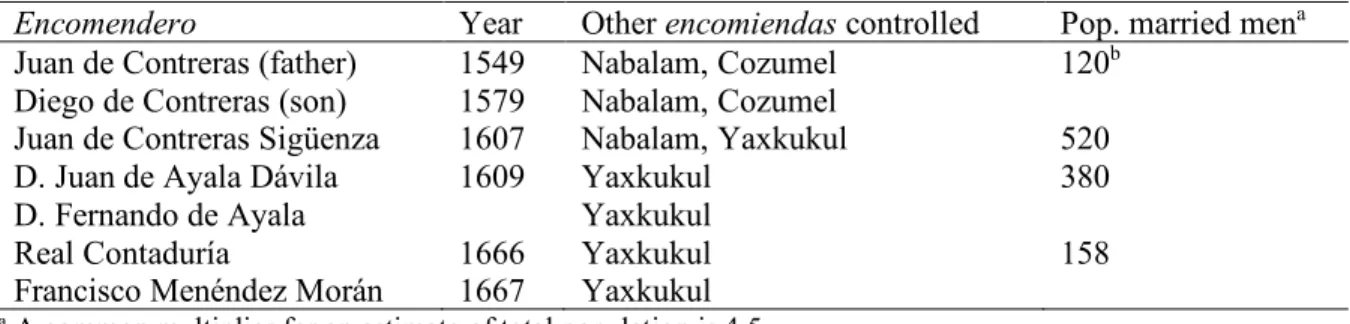
Table 2.1. Recorded encomenderos of Tahcabo, indicating the total population of married men for all towns controlled by a single
encomendero (adapted from García Bernal 1978:Appendix 1)... 56
Table 2.2. Population estimates for Tahcabo, Calotmul, and nearby ranchos and haciendas (adapted from AGEY 1841a; AGEY 1841b; Dumond and Dumond 1982; García Bernal 2005; Patch 1993). ... 59
Table 2.3. Dimensions of rejolladas within the town limits of Tahcabo. ... 66
Table 3.1. Timeline of project activities. ... 70
Table 3.2. Characteristics considered during the 2012 site selection process. ... 73
Table 3.3. PACOY surface artifact collection criteria. ... 74
Table 3.4. Counts, average weights, percentages, and densities of ceramics by residence.... 92
Table 3.5. Samples sent to the Laboratory for Stable Isotope Science at the University of Western Ontario after 2016 rejollada excavations. ... 104
Table 3.6. Samples sent to John G. Jones for pollen analysis. ... 109
Table 4.1. Chronology of the northern Maya lowlands leading up to the Colonial period (based on Andrews and Robles Castellanos 2018; Brown and Bey 2018; Appendix F). ... 114
Table 4.2. Chronology of Tahcabo’s earthenware ceramic groups (i.e. designation level above type-variety) as estimated by Teresa Ceballos Gallareta. ... 115
Table 5.1. Plant species growing in three or more of the six rejolladas studied, along with information about the number of rejolladas in which they were found, whether or not they are species introduced during the Colonial period or more recently, and their uses. ... 165
Table 5.2. Summary table of data from rejollada excavations. ... 184
Table 5.3. Summary table of dated rejollada features. ... 190
Table 5.4. Counts of sherds across rejollada unit excavation levels. ... 193
Table 5.6. Pollen counts from Tahcabo sediment samples organized by rejollada, with the depth of each sample (in cm below the surface)
indicated in the header. ... 201
Table 6.1. Residential excavation summary table. ... 212
Table 6.2. Summary of counts, weights, and percentages of ceramic sherds from each residence by type, organized chronologically. ... 213
Table 6.3. Studied animal bone from Units C11 and G15, early colonial Structure 206. .... 232
Table 6.4. AMS dates from Colonial period residential units. ... 259
Table 6.5. Percentage by count of colonial wares for studied contexts. ... 262
Table 6.6. Percentage by weight of colonial wares for studied and weighed contexts. ... 263
Table 6.7. Counts of rarer colonial sherds across Tahcabo residences. ... 264
Table 6.8. Percentage (by count) of colonial rim sherds of each form, by residence. ... 268
Table 6.9. Counts of colonial rim sherds representing each form, by residence. ... 268
Table 6.10. Percentage (by count) of forms for colonial rim sherds drawn, by residence. .. 268
Table 6.11. Counts of forms for colonial rim sherds drawn, by residence. ... 268
Table 6.12. Plant taxa found within the richest Colonial period midden contexts at residences in Tahcabo. ... 281
LIST OF FIGURES
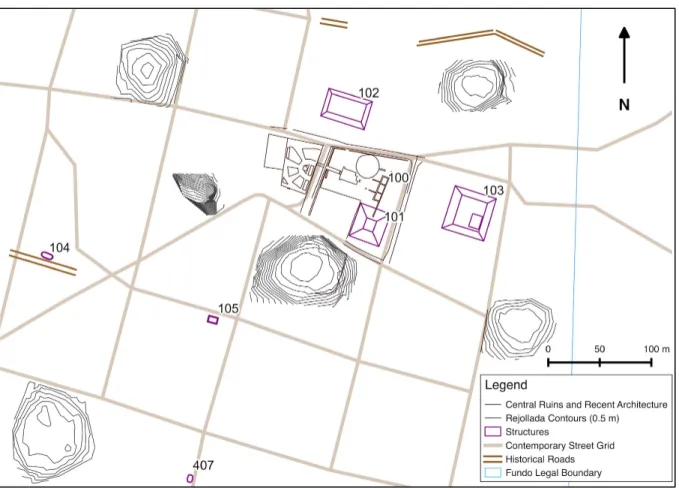
Figure 1.1. Location of Tahcabo relative to nearby cities, towns, and archaeological sites. ... 3 Figure 2.1. Archaeological structures in central Tahcabo and along the street grid. ... 62 Figure 2.2. Artist’s reconstruction of the colonial, ramada-style church
at Tahcabo (drawing by M.K. Smaby). ... 63 Figure 2.3. Tahcabo’s street grid with rejolladas and cenotes labeled. ... 66 Figure 2.4. View into Tahcabo’s Cenote A. At the bottom there is an
overhang with water beneath (photograph by Patricia A. McAnany). ... 67 Figure 3.1. Locations of original project sites. ... 73 Figure 3.2. Western survey quadrant in the town land (fundo legal) of Tahcabo. ... 77 Figure 3.3. Southern survey quadrant in the town land (fundo legal) of Tahcabo. ... 77 Figure 3.4. Northern survey quadrant in the town land (fundo legal) of Tahcabo. ... 78 Figure 3.5. Idealized schematic of the excavation strategy for residential
platforms. Black lines denote the structure, while gray lines outline excavation trenches set according to an arbitrary grid oriented to the
cardinal directions. ... 86 Figure 3.6. Photograph of the flotation machine, showing giraffe-like
PVC pipe into which water would flow from a hose and exit through the showerhead toward the sample. There are two metal spouts on the
right, one of which fits over a mosquito net inserted into the tank. ... 98 Figure 3.7. Flotation machine with mosquito net inserted. Below spout
there will be a colander resting on a bucket, which holds the veil fabric
used to collect the light fraction... 99 Figure 4.1. Map of sites mentioned in the settlement history section of this chapter. ... 116 Figure 4.2. Distribution of Middle Preclassic to Early Classic period sherds at Tahcabo. .. 126 Figure 4.3. Distribution of Late to Terminal Classic period sherds from
Figure 4.5. Distribution of Colonial period sherds from surface collections at Tahcabo. ... 139 Figure 4.6. Geological map of the northern Yucatán peninsula of Mexico
(after Munro-Stasiuk et al. 2014 and Fedick 2014). ... 140 Figure 4.7. Representation of a cross-sectional view of a rejollada with
diverse vegetation. (Drawing by M.K. Smaby) ... 155 Figure 5.1. Locations of rejollada excavation units (trench size
exaggerated for ease of view). ... 183 Figure 5.2. Rejollada D, Feature 1, dating to the Early Preclassic period
(arrow 20-cm long). ... 191 Figure 5.3. Rejollada B, Feature 1. Darker soil in center of unit is the
location of Feature 2. ... 192 Figure 5.4. Drawing of bottom 13-cm of human burial, designated
Rejollada B, Feature 2. ... 194 Figure 5.5. Drawing of top 13-cm of human burial, designated
Rejollada B, Feature 2. ... 195 Figure 5.6. Comparison of carbon isotope ratios with depth for soils
sampled from three rejolladas at Tahcabo. VPDB (Vienna Pee-Dee
Belemnite) refers to the standard used in calculating the ratios. ... 197 Figure 5.7. A view into Rejollada D (photograph by Patricia A. McAnany)... 207 Figure 6.1. Locations of Colonial period residences in relation to other
Tahcabo features. ... 216 Figure 6.2. Structure 206 in relation to other features in northern Tahcabo. ... 217 Figure 6.3. Early architecture that survives on top of Structure 206. ... 219 Figure 6.4. Cache at south side of Structure 206 ... 220 Figure 6.5. Colonial period ceramic densities in the first 10 cm below
the surface, Str. 206. ... 222 Figure 6.6. Colonial period ceramic densities from 10-20 cm below
Figure 6.8. Animal bone densities between 10-20 cm in depth at Structure 206. ... 225 Figure 6.9. Projectile point densities and special finds found at all depths
at Structure 206. ... 226 Figure 6.10. Special finds and colonial ceramic and animal bone densities,
0-10 cm below the surface in Units G14 and G15. ... 228 Figure 6.11. Special finds and colonial ceramic and animal bone densities,
10-20 cm below the surface in Units G14 and G15. ... 229 Figure 6.12. Special finds and colonial ceramic and animal bone densities
20-30 cm and 30-40 cm beneath the surface in Unit G15. ... 230 Figure 6.13. Two projectile points of the 50 found at early colonial Structure 206. ... 234 Figure 6.14. Special finds from Structure 206: A) spindle whorl fragment;
B) copper alloy axe fragment. ... 235 Figure 6.15. Examples of ceramic fishing line or net weights found at
early colonial Structure 206... 235 Figure 6.16. Structure 317 in relation to other features in western Tahcabo. ... 237 Figure 6.17. Colonial period ceramic densities within 10 cm of the surface at Str. 317. .... 239 Figure 6.18. Colonial period ceramic densities 10-20 cm below the surface at Str. 317. .... 240 Figure 6.19. Groundstone tools from middle colonial Structure 317. ... 241 Figure 6.20. Location of special finds at middle colonial Structure 317. ... 242 Figure 6.21. Stucco and ceramic beehive plug from a Colonial period
context at Str. 317. ... 243 Figure 6.22. Structures 407 and 403 in relation to nearby features in southern Tahcabo. ... 244 Figure 6.23. Select groundstone tools from late colonial Structure 403.
Fragment in top left corner was one of several fragments of a metate with tripod feet. ... 246 Figure 6.24. Colonial period ceramic densities in the first 10 cm below
Figure 6.27. Special finds from late colonial Structure 403: A) iron
scissors, and B) iron key. ... 251 Figure 6.28. Silver Spanish ½ real coin from the late colonial Structure 403. ... 251 Figure 6.29. Excavation in progress behind standing Structure 407. ... 252 Figure 6.30. Colonial ceramic sherd densities within 10 cm of the surface
at mixed colonial Structure 407. ... 253 Figure 6.31. Colonial ceramic sherd densities 10-20 cm below the surface
at mixed colonial Structure 407. ... 254 Figure 6.32. Animal bone densities at mixed colonial Structure 407. ... 256 Figure 6.33. Special find distribution at mixed colonial Structure 407. ... 256 Figure 6.34. Nearly complete Yuncu Unslipped pot in context at Structure 407. ... 257 Figure 6.35. Percentages (by count) of colonial rim sherds of each form, by residence. .... 269 Figure 6.36. Count of colonial rim sherds of each form, by residence. ... 270 Figure 6.37. Log-scale counts of colonial rim sherds of each form, by residence. ... 270 Figure 6.38. Rim diameters of jars and bowls by residence, for vessels drawn. ... 272 Figure 6.39. Rim diameters of jars and bowls by ceramic type, for vessels drawn. ... 273 Figure 6.40. Long-necked jar rim sherds from early Colonial period Structure 206... 275 Figure 6.41. Examples of transitional vessels with Postclassic forms and
Colonial pastes from early colonial Structure 206... 276 Figure 6.42. Vessels with flattened and grooved rims from middle colonial
CHAPTER 1:
LIVELIHOOD STRATEGIES UNDER COLONIALISM IN YUCATÁN, MEXICO Accounts of Spanish colonialism in Latin America often focus on the activities of indigenous elites and Spanish colonizers. They imply a trajectory in which Spanish authorities imposed a program of colonization to which indigenous and diasporic peoples adjusted, or from which they fled. However, those who faced colonization experienced it variably and played a part in shaping colonial outcomes. Farmers, often overlooked in historical accounts, could preempt and respond to colonial policies and officials in ways that undercut political decisions and reduced the output of sought-after commodities. Even when subjected to the stark power differentials and violence of Spanish colonialism, farmers exerted agency, though the ways in which they did so warrant further study and theorization.
Today in the northern Yucatán peninsula of Mexico, referred to as the northern Maya lowlands, soils are too shallow to plow. Farmers instead conduct shifting field agriculture well-suited to the tropical landscape and maintain gardens near their homes. To some, it may seem that this type of farming has gone on uniformly and unchanged for centuries. Shallow soils and poor preservation in northern Yucatán have hindered the archaeological detection of changing cultivation strategies (e.g., Dahlin et al. 2005), which have been amply
demonstrated elsewhere in the Maya area. Yet agricultural practices and farmers’ wider economic strategies were also diverse and dynamic in the northern Maya lowlands
of non-elite rural farmers changed throughout the Colonial period (ca. AD 1547-1821), and how Spanish colonial conditions and policies constrained farmers’ options.
To track farmer’s responses to colonial policies, I chose to focus on the inhabitants of a single town, Tahcabo, Yucatán (Figure 1.1). Tahcabo, currently a community of about 500 people, has been continuously occupied since at least the Late Preclassic period (ca. 300 BC to AD 250; Batún Alpuche et al. 2017), with populations fluctuating through time. At points during the Colonial period, Tahcabo’s population grew to be much larger than it is today. As a result, reasonably well-preserved residential areas exist at the edges of town, beyond the area where people now live. My excavations for this dissertation took place within and around such residences. While wealthier and established households more commonly lived centrally in Yucatecan communities (Alexander 2012:17), those living at some distance from the town square more likely consisted of newly arrived, newly formed, or non-elite
households—those often understudied by both archaeologists and historians.
Research at Tahcabo conducted as part of the archaeological project PACOY (see Chapter 3) has been envisioned since its inception as community archaeology, entailing collaboration between researchers and town residents as well as between investigators from Yucatán and the United States. Through dialogue and participation in research, community members and academic collaborators from both countries have contributed to the
development of this study in terms of its theory, method, and content.
Implementation of Spanish Colonialism in Northern Yucatán
Implementation of Spanish colonialism varied by region, as colonial officials were internally diverse and adapted their agendas to local histories, politics, and landscapes. Yucatán is considered to have been conquered by 1547, though rebellions and the presence of unconquered zones continued to interrupt colonial interests for centuries (Andrews 1981:3; Farriss 1984:14). In Yucatán, there were no precious metals to mine, and few
commodities for which Spaniards could seize the means of production. Instead, communities in the northern Maya lowlands generally retained control of production, while colonial officials did all they could to extract goods from them. Key commodities that Spaniards wished to obtain included cotton (Gossypium sp.) cloth, beeswax, and maize (Zea mays). To understand the difficult circumstances imposed on farmers and their constricted livelihood opportunities during the Colonial period, the major systems of colonial extraction in Yucatán are now described.
By 1549, colonial officials in Yucatán had established encomienda, a system in which the Spanish Crown granted territories to Spanish conquistadors, then referred to as
encomenderos. Encomienda territory assignments, which did not respect previously
established divisions, contributed to political change over the following century (Alexander 2004:39; Farriss 1984:149; Quezada 2014). The encomendero extracted taxes and labor from the people in his assigned area, even as populations dwindled due to disease. These were heavy taxes assessed per tributary (first defined as a married Maya male, but later expanded to include every adult) in goods such as raw cotton, cotton cloth and thread, honey, beeswax, poultry, and maize. By the late 1600s there was a trend toward paying tribute in currency rather than in products (García Bernal 1978:388-394).
Repartimiento de bienes was another system that extracted goods from rural communities. Perpetuated by encomenderos, friars, and royal provincial governors, repartimiento de bienes involved advancing cash or goods to a community, and in return receiving deeply discounted community-produced commodities. The practice was generally illegal throughout the Colonial period, except for several decades during the mid-1700s (1731-1782; Farris 1984:43). An early example described in historical accounts is that Tahcabo’s first encomendero, Juan de Contreras, brought cacao (Theobroma cacao) to the community and demanded large quantities of raw cotton in return (Quezada 2014:93).
community activities, such as celebrations for the feast day of a town’s patron saint (Farriss 1984:326).
Historian Nancy Farriss (1984:355) called the Bourbon Reforms of the late eighteenth to early nineteenth centuries the “second conquest of Yucatán.” These reforms involved the assignment of elected positions, filled with people of Spanish descent, for each municipal seat (Farriss 1984:376; Kaeding 2013:193-201). Community taxes were transferred to the royal Treasury, where they eventually alleviated the Crown’s financial needs rather than supporting indigenous communities (Farriss 1984:359). The bishop auctioned off communal lands that had supported community initiatives. Overall, rural communities faced additional assaults on their autonomy during the late Colonial period. At the same time, Spanish-descendant entrepreneurs were encouraged to start businesses, such as haciendas, across the countryside, which encroached on community lands and attracted rural wage laborers who often ended up in conditions of debt peonage. Terrible droughts and locusts at the end of the eighteenth century (ca. 1769-1774) pushed people to take up jobs at newly established haciendas in exchange for food rations, as maize prices soared (Espinosa Córtes et al. 1987; Peniche Moreno 2009).
sustain claims over desired resources (Wilk 1997:120). Displaced farmers could have sought out opportunities to return to their previous places of residence, or to claim resources that became available within congregación communities. As the human population of Yucatán declined, forests likely grew and the number of animals available to hunt may have
increased. Introduced plants, animals, technologies, and goods contributed to opportunities for experimentation and innovation. Through time, as people adopted Catholicism and developed hybrid religious practices associated with community organizations, they may well have wished to stay, build their access to resources, and contribute to their social networks. Nonetheless, the conditions of colonialism were harsh in rural Yucatán, and even as late as the year 1784, a community not far from Tahcabo threatened to leave the area altogether, claiming that the local Spanish official made them produce so much cotton “that they had no time to raise food for themselves” (Farriss 1984:78).
Useful Concepts
The challenges that farmers faced under colonialism, including the specific policies outlined above, can be conceptualized as “slow violence” (Nixon 2011). Slow violence refers to structural violence (Galtung 1969) that is diffuse and difficult to represent, but most often imperils poor communities, and accumulates in impact. Farming communities faced
those she identified were at play in rural Mexico and in many other areas, where colonial policies challenged autonomy and resilience in food production and other areas of life through assaults on several fronts. James Scott (1976:56-90) draws on his work in Southeast Asia to outline five major reasons that colonialism often leads to food insecurity for small-scale cultivators. They include: (1) market instabilities; (2) weakening of village and kin-group redistribution and risk-sharing practices; (3) loss of secondary food resources; (4) deterioration of landowner-tenant relations; and (5) increased taxes on the cultivating class. Some of these factors also played a role in creating conditions of food insecurity in rural Yucatán, though farmers implemented strategies that defied or lessened the impacts of others.
In this dissertation, I frame farmers’ economic decision-making practices in terms of “livelihoods.” A livelihood encompasses activities that people undertake for their well-being, helpfully linking food preparation to crafting, agriculture, and other endeavors, such as hunting. By referring to what could be called the ecosystem of household activities, the concept of livelihood provides space to consider how the intensification of some pursuits may lead to decreased allocation of time to others, in a way that incorporates the
contributions of diverse household constituents. To clarify, in this dissertation when I refer to farmers, I include in the category all people living in rural households that engage in farming as a major component of their livelihood portfolios. Households vary in composition, and larger households often have an advantage since they can mobilize more labor to pursue diversified livelihood strategies (Clark 1989; Wilk 1997).
The sustainable livelihoods framework from rural development studies centers the farming household as the unit of analysis, though it can be applied at different scales
available to them and accessed through local institutions, to understand which livelihood strategies farmers select and the extent to which they are sustainable (Chambers and Conway 1992; Ellis 2000; Scoones 1998, 2009). Contexts can include trends in the following areas: policy, demography, history, climate, macro-economic conditions, agroecology, and terms of trade (Scoones 1998:Figure 1). Assets considered in the framework include natural capital, such as rejolladas and other landscape features; economic or financial capital, in goods, currency, and credit; human capital, including the availability of labor, as well as skills and knowledge; and social capital, or networks of social support. Strategies available to farmers include increased or decreased investment in particular activities, diversification of the overall livelihood portfolio, and mobility or migration (Scoones 1998:9). A sustainable livelihood “can cope with and recover from stresses and shocks, maintain or enhance its capabilities and assets, while not undermining the natural resource base” (Scoones 1998:5). In other words, it is resilient. This model provokes consideration of how rural farmers within a single community and across a region make decisions based on their particular local governments, household configurations, social networks, and available resources.
Households are basic social and economic units relatively easily tracked in
developed ecological and social strategies to negotiate colonialism and reduce the risk of food insecurity that it often provokes (e.g., Acabado 2018; Langlie 2018; Rosenzweig and Marson 2018:95; Scarry 1993; VanDerwarker et al. 2013). As colonialism enacted slow violence on rural communities, farmers responded with foot-dragging, labor pooling, deception, and feigned ignorance, among many other options (Liebmann and Murphy 2010:4). In fact, “the colonial landscape was a patchwork of domination, resistance,
accommodation, and negotiation, as indigenous peoples exerted a variety of strategies in their attempts to adapt to the colonizing and evangelizing efforts of the Spaniards” (Liebmann and Murphy 2010:7). The long-term histories and landscapes of indigenous peoples, as well as the strategies they implemented all played a role in shaping colonial trajectories, and help to explain the diversity of local circumstances that occurred simultaneously under Spanish colonialism (Alexander 2004; Oland 2009, 2012, 2016; Overholtzer 2013:492).
Just as farmers in Tahcabo crafted agricultural strategies while considering the constraints imposed on them by colonial demands, they also were evaluating their
ramifications of their decisions for the relationships that they negotiated to achieve success in cultivation (Ingold 2011:63-64; Richard 2018:37; Tsing 2015:32). As a result, while farmers have agency when it comes to what and how they plant and pursue other activities, they decide how to allocate effort and resources while based within webs of relationship.
Organization of the Dissertation
To investigate how farmers in the northern Maya lowlands responded to colonial policies, I draw on evidence from archaeological research (including site survey, excavation, and laboratory analyses), interviews, and historical documents to identify the livelihood strategies selected through time. Before presenting the results of archaeological study, I first provide background information in Chapter 2 on the specific mechanisms by which direct and slow violence were enacted in rural Yucatán. Some of these can be understood as involving the imposition of coerced trade inequities, or “antimarkets,” which systematically disadvantaged rural, and usually indigenous populations (Pezzarossi 2015a). As colonial policies shifted through time, so did rural innovations designed to cope with them. The chapter presents information from the historical literature about the livelihood strategies pursued and food produced by rural populations, and it outlines demographic and climate trends that may have influenced strategy selection. The introduction of previous
Chapter 3 provides a timeline of research activities and introduces the broader archaeological project to which this research contributed. It outlines the methods employed in the field and laboratory, resulting in datasets analyzed in Chapters 4-6 and included as appendices. Chapter 4 provides a regional settlement history, focusing on the site survey and demographic trends of Tahcabo leading up to the Colonial period, but also incorporating the results of previous research relevant to farmers’ livelihoods. An overview of preceding time periods provides a background for what took place after the Spanish invasion. In addition, the settlement history presents context relevant to understanding earlier finds and features
encountered within the rejollada excavation units. The chapter concludes with a summary of contemporary regional farming practices and landscapes.
Chapter 5 documents the results of interviews conducted with current residents of Tahcabo about how they use rejolladas, within which plant surveys also took place. The interviews produced information about the factors that farmers consider when making cultivation decisions and the specific characteristics of the landscape features. The same chapter also details the results of excavation undertaken within rejolladas, highlighting important contexts encountered as well as the results of soil sample (pollen and soil carbon isotope) analyses. The findings show some parallel uses of specific rejolladas for specialized purposes in the past and today. However, the rejollada excavation results also suggest the intensive use of the features during the Early Classic period, without evidence for
corresponding intensification during the Colonial period, when populations grew to similar sizes. Colonial policies may have restricted rejollada use.
animal remains) that provide insights into trends in livelihood activities. In order to understand the significance of the Tahcabo findings in regional and temporal context, I compare them to the results of archaeological investigations at other sites in Chapter 7. In that chapter I also respond to the research questions in some depth. Chapter 8 concludes with an account of the impacts of slow violence and the challenges of maintaining a sustainable livelihood in the shadow of repressive colonialism. Finally, I demonstrate the opportunities for resilience and autonomy available to commoner households and their constituents, and reflect on the ways that farmers shaped Colonial period historical trajectories.
The primary livelihood strategies detected through excavation and finds analysis consisted of mobility and participation in food sharing. Farmers employed these techniques, among others, to maintain subsistence autonomy throughout the Colonial period. During the early Colonial period, one extended-family household at Tahcabo pursued livelihood
CHAPTER 2:
COLONIAL PERIOD HISTORY AND ARCHAEOLOGY IN THE NORTHERN YUCATÁN PENINSULA
This chapter explores what we know of daily life and livelihoods among rural
populations during the Colonial period (ca. AD 1547-1821) in the Maya area, with a specific focus on the northern Yucatán peninsula of Mexico. The archaeological and historical information presented complement each other—and, as Sheptak and colleagues (2010:150) point out, “Documentary archives are a part of the archaeological record.” As long as historical documents are contextualized as artifacts created by people with certain identities and objectives, they can work well in concert with other archaeological data. Most of the historical information drawn on here comes from the accounts of Spanish colonizers.
Spaniards first made landfall in the Yucatán peninsula during the 1510s. By the mid-1500s, the population of Yucatán is thought to have dropped by about 70% due to Spanish pathogens (Gerhard 1993:136; Hoggarth et al. 2017:89), though estimates vary (Cook and Borah 1974; Farriss 1984; García Bernal 1978). Spaniards created a tiered settlement hierarchy in which the city of Mérida, founded in 1542, presided over its villas (Campeche, Valladolid, and Bacalar in the first decades). They referred to these as the Spanish
The following subsections explain in greater depth the various colonial policies and illegal practices (e.g., repartimiento) imposed on communities across Yucatán in order to provide a fuller account of the slow violence they enacted. The chapter continues by addressing historical accounts of the livelihood opportunities available to indigenous and rural communities as they negotiated the impacts of colonial policies, based on secondary sources. It moves on to discuss what we know about the Colonial period activities of indigenous peoples across the Maya area based on archaeological evidence, and concludes with an overview of documentary evidence related to Tahcabo as well as a presentation of the town’s prominent archaeological and landscape features.
Colonial Policies and Taxation Reducción
While reducción could involve gathering populations scattered across the landscape into previously occupied town centers, it could also involve moving entire communities to already established areas, especially the new cabeceras, or inventing new town centers where none had previously existed (Fernández Tejedo 1990:75; Quezada 2014:57). When Tizimín became a doctrina in 1563, Franciscans began transferring pueblos so that by 1582, in Tizimín’s sprawling northern district, which had once contained 81 villages, there were now just 31 congregación towns (Quezada 2014:71). These missionized towns were referred to as visitas—pueblos where friars visited to evangelize but did not reside, and which were
assigned to a particular doctrina. By the mid-1560s, 190 pueblos had been established across Yucatán (Quezada 2014:58). The number of doctrinas had also grown (Hanson 2008:357; Quezada 1993:Table 5; Scholes et al. 1938:55-62). With each doctrina established, additional resettlement occurred.
Because people did not wish to leave their homes and patios, where they kept bees and domestic animals, nor their gardens, orchards, fields, or hunting grounds, Franciscans resorted to violent tactics such as burning houses and cutting down orchards to get them to move (Quezada 2014:57). The report (relación) written by encomendero Juan de Urrutia attests that populations around Chancenote experienced particular destruction, for example in the town of Temaza, where he said that friars burned more than 170 homes in addition to their well-maintained church, and then set fire to the fruit trees in front of the houses before moving everyone to Chancenote, the cabecera (de la Garza et al. II:247). These tactics were recorded in several relaciones that encomenderos composed about their encomienda
congregación process imposed by friars had caused many to flee, others to become sick, and had left everyone unhappy because they no longer lived in their preferred places (e.g., de la Garza et al. 1983 II:186; Quezada 2014:58).
As indigenous peoples were moved into doctrinas and visitas, friars forced them to construct churches and other public buildings. In encomendero Diego de Contreras’ Relación de Nabalam, Tahcabo y Cozumel, he writes that the constituents of his encomiendas
complained not only about reducción and being forced out of their preferred locations of residence, but also about the large buildings they had to construct for the friars (de la Garza et al. 1983 II:186). Specifically, he wrote, “…and these religious people have made many buildings and monasteries in the towns and county seats, and they are more fortresses within which to defend 6,000 Spaniards than anything else, because in each monastery resides no more than 2-3 friars…,” after which he complains that the labor of construction has led to the death of many indigenous people (de la Garza et al. 1983 II:186 [my translation]).
López Medel’s ordenanzas provide a great deal of insight into Spanish expectations for reducción communities in northern Yucatán, whether or not they were met (Ancona 1889:538-558). While he outlined the basic expected layout of a community on a gridded road system where everyone would live next to each other and not move to other
communities without the express permission of the authorities, his detailed mandates went so far as to describe how families were to eat meals together. With regard to livelihoods, López Medel ordered that residents of reducción communities not travel to other communities or gather in large groups—even traders were allowed no more than 30-40 days away from their home communities. He argued that bows and arrows should be burned, because they caused indigenous peoples to go out into the woods to hunt, which, as he saw it, distracted them from their obligations in the community. He indicated that town residents should not plant fields or have forested areas within town limits, and that community representatives should learn how to keep cattle and then go about teaching others how to do so. Since cotton cloth was so valuable, he suggested that men should help women with its production, and in particular that single men should take up weaving and accept pay for their work producing this commodity (Ancona 1889:555). In terms of daily practices, López Medel ordered compliance with Catholic ritual observance and banned polygamy, bride-price, slavery, and traditional ceremonies.
(Scholes et al. 1938:48-50). During peak missionization, personnel were few and far between. The redevelopment of towns to include churches and gridded streets would have taken some time, especially with divided missionary attention (Millet Cámara et al. 1993). Though little specific information has been found about the establishment of gridded town plans, Restall (1997:105) noted a record from Calkiní (see Barrera Vásquez 1957:111-112) indicating that after three years of construction under the guidance of a Franciscan friar, the road had been opened in 1582—perhaps a reference to the establishment of a Spanish grid in the town, along which the congregated populace would have established their residences. Until the eighteenth century, few Spaniards or people of Spanish descent lived dispersed across the countryside, leaving openings for indigenous farmers to shape their lives and livelihoods in ways distinct from Spanish preferences and expectations.
Encomienda
magistrates from the audiencias of Guatemala and New Spain updated the schedules (Chamberlain 1948:286; García Bernal 1978:198; Hanson 2008:308).
The Crown eventually ruled that encomenderos had to live in a city or villa in the province where their encomiendas were located (Chamberlain 1948:238; Simpson 1982:131). The rule disallowing Spaniards to live in encomienda communities sought to protect
indigenous communities from the worst Spanish abuses, protect Spaniards from uprisings, and maintain coherent military forces in Spanish settlements (Chamberlain 1948:238). In addition, the 1542 laws indicated that encomenderos were not to enslave indigenous peoples, but were instead supposed to pay them fair wages for any moderate labor beyond tribute quotas (Simpson 1982:130). Production of tribute goods took place within rural
communities, so labor drafts were rare in the region, and personal service was abolished by the crown in 1549 and the law enforced in 1552 with López Medel’s inspection (Quezada 2014:46). Perhaps to assuage encomenderos who were angry about the prohibition of service, when López Medel adjusted the encomienda taxation schedule, he increased maize quotas and expanded the array of items demanded in tribute to include chili peppers (Capsicum sp.), beans (Phaseolus sp.), ceramic vessels, wooden buckets, salt, and henequen (Agave sisalana) rope (Fernández Tejedo 1990:52, 140; Hanson 2008:312-313; Pech 1969[1562]:232; Scholes and Adams 1938:II:112-113).
A tributary was originally defined in 1549 as a married male, but in 1583 the
be collected from each tributary, whereas others were considered the responsibility of the entire community. In the 1560s, each tributary was expected to produced cotton cloth, maize, and a turkey or chicken, while community-generated goods included beeswax, honey, beans, chili peppers, ceramic vessels, and henequen rope (García Bernal 1978:383; Scholes and Roys 1948:152). One can imagine that a town’s gobernador had to manage relationships among different specialized producers in his jurisdiction to achieve the correct quantities of each good. The encomendero paid for the transportation of the goods to the villa or city in which he resided, and there were set prices to guide how much a load should cost based on its value. Specifically, the transportation of commodities such as cotton cloth and beeswax (paid in Spanish reales) cost more than that of domestic goods (paid in cacao beans during the early Colonial period; García Bernal 1978:382).
Limosnas and Obvenciones
Conversion in Yucatán began as traditional community leaders expressed their acceptance of the faith in baptismal ceremonies for which the relevant encomenderos acted as padrinos (godfathers; Hanson 2008:360; Pech 1969[1562]:233). Early on, indigenous donations to the church entailed subsistence goods for the friars (López Cogolludo 1957[1688]:255; Quezada 2001a:76). At first, encomenderos paid for the costs of
constructing and maintaining the churches, but eventually that responsibility was transferred to each town’s cabildo (Hanson 2008:358). Another expense that began to be exacted by the church in the year 1581 was an annual tax of one real for each adult man and woman, called the emolumento (Fernández Tejedo 1990:131-132). At the same time, it became common for indigenous populations to make donations to the local visita and regional doctrina churches in the form of maize, beeswax, sandals, and cotton cloth (Quezada 2001a:76).
Repartimiento
Repartimiento de bienes, a system that forced indigenous communities to sell commodities cheaply, though illegal during most of the Colonial period, was practiced widely among Spaniards in positions of power, such as royal provincial governors and priests (Patch 1993:30). Its purpose was simply to maximize the profits of a Spaniard at the expense of the indigenous producers. Early evidence of this practice, mentioned in the introduction, included records that Juan de Contreras, first encomendero of Tahcabo, forced residents of his encomiendas to buy cacao beans in exchange for highly-desired cotton during the 1550s (Quezada 2014:93). More records of the practice exist for later times, predominantly during the seventeenth and eighteenth centuries, and the targeted commodities consisted primarily of beeswax, honey, and raw cotton or cotton cloth. In these cases, Spaniards provided goods, cash advances, and even indulgences in exchange for cheap and often under-weighed commodities (Farriss 1984:44; Patch 1993:30-31, 91). The timing of these activities coincided with encomienda tribute payments, and town gobernadores were also held accountable for repartimiento payments (Patch 1994:104). If community leaders needed to acquire commodities in order to meet their various quota obligations, they bought them at high prices or on credit from Spaniards who controlled the trade (Patch 1993:88).
The royal governors worked to impose repartimiento of commercial goods through different government officials, eventually settling on war captaincies to carry out
yielded “between 43,539 and 44,354 patíes [measure of cloth requiring six pounds of raw cotton], 1,028 mantas, 15,705 pounds of thread, and between 68,282 and 68,882 pounds of wax” (Patch 1993:83). By the mid-1600s, repartimiento posed an enormous obstacle to well-being within indigenous communities.
As Kaeding (2013:51) argues in his dissertation, “With repartimiento abuses, we see clear evidence of alienation from the fruits of labor.” Coercion in this process is clear, as it involved an intentional act of indebting a community and enforcing subsequent debt repayment (Patch 1994:95). The activity also involved forced market integration. For these reasons, Pezzarossi (2015b:357) uses it as a prime example of an antimarket in the colonial Spanish Americas, as it “drew in and entrapped Maya communities in unequal relations of production, exchange, and debt.” Repartimiento created artificial markets for the
commodities that Spaniards obtained from indigenous populations (Larson and Wasserstrom 1983:62). As communities experienced the need for currency to pay tribute and taxes, repartimiento served as a source of expensive loans (Baskes 2005). In this way, the system could be seen as a precursor to indebted labor on haciendas, with the distinction that indigenous populations retained control of the means of production under repartimiento.
Spanish colonists. Women often suffered sexual abuse in such arrangements (Clendinnen 1982:432). Indigenous people who participated in repartimiento of service were paid, but at bargain rates (Patch 1993:30). Others, who stayed in their communities, spent one day per week working there on various projects (Patch 1993:29). This particular system began in the 1560s and lasted 200 years (Quezada 1997:129).
The Bourbon Reforms
Late in the eighteenth century, the Bourbon reforms transformed rural communities. One tax not yet mentioned was called the comunidad, or community tax (Patch 1993:29). Beginning at the end of the sixteenth century, tributaries paid one real each for this tax, and the amount increased to four reales each by 1668 (García Bernal 1978:389). Most income was spent on festivals and church upkeep, for candles, fees of the cleric, and saint
adornments (Farriss 1980:165). This communal resource could also provide grain in case of shortages and famine (Farriss 1980:165). With the Bourbon reforms, community leaders lost control over the community taxes, which were transferred to the royal Treasury in 1777 (Farriss 1984:359). From that point forward, local leaders had to request funds from the Treasury, and such requests were often denied. Instead, people of Spanish descent designed and implemented community projects that they deemed necessary. Few of these projects worked well, with one possible exception consisting of the implementation of cemeteries outside of towns at the turn of the nineteenth century (Farriss 1984:366).
At the same time, the bishop auctioned off lands previously governed by communities called cofradías (religious confraternities or brotherhoods). Cofradía estates, called
indigenous elites, who used their profits in part for the annual celebration of the patron saint (Alexander 2003:198; Farriss 1984:267). Archaeological evidence from Yaxcabá showed that estancias had been managed by a permanent population of producers (Alexander 1997). After the church appropriated these estates, there were few resources available to
communities with which to pay for their festivals.
In 1812, repúblicas de indios were transformed into municipios governed by town councils (Farriss 1984:376). Spaniards and Spanish creoles (people of Spanish descent), now distributed across the countryside in contrast to the early Colonial period, occupied these positions, known as subdelegados and jueces españoles. This move, also considered part of the Bourbon reforms, further undermined communities’ traditional leadership (Kaeding 2013:193-201).
The Bourbon reforms made land grabs easier, as land between communities was re-classified from Crown land to vacant land (terreno baldío), available for sale (Bracamonte y Sosa 1984). Haciendas in many cases doubled or tripled in size (Farriss 1984:373). The Bourbon reforms restricted encomiendas and promoted comercio libre, or free trade, among the Spanish colonies (Alexander 2003:195; Farriss 1984; Patch 1993; Wolf 1982). At this point the production of exportable goods such as sugar (from sugarcane, Saccharum officinarum), henequen cordage, meat, lard, hides, salt, maize, beans, and logwood
Strategies for Survival and Well-Being Mobility
Nancy Farriss (1984) argues for the importance of mobility as a strategy that Maya populations used to survive and achieve some degree of freedom throughout the Colonial period. She argues that while there were few protections against exploitation in Yucatán, the biggest threat to Spaniards was that the local peoples on which they depended would leave the area altogether (Farriss 1984:73). Because of that, migration could be seen to some extent as a check on power. Reasons that people might flee included famines, epidemics, political conflicts, high taxes, and debt.
Farriss (1984:73) writes that the colonial Spaniards “in exasperated moments suspected the Maya of deliberately cultivating poverty so that they could escape easily, unencumbered as they were with worldly goods.” According to Farriss’ assessment of historical documents, the few items a family needed to survive included a grinding stone, a chopping tool such as a machete (which could have been purchased in Spanish markets installed in villages; Farriss 1984:45, 156), and seeds for new crops. The rest they could harvest from the woods—knowledge of hunting and gathering supported families until they were able to plant field crops once again (Farriss 1984:73). In other words, at least by Spaniards’ assessments, early colonial populations generally had the flexibility to move. Of course, rebellions and reducción raids had likely made mobility a necessary survival strategy.
Farriss (1984:199-214) describes the different types of movement that Maya
congregated communities, because the lands to which people held rights were located far away from the towns where they were resettled, and it made sense for families to live closer to their land holdings. Shift, on the other hand, refers to movement from one town to another town or to a city, while flight refers to passage to areas across the frontier and outside of colonial control. Populations implemented the survival strategies of drift, dispersal, and flight at different rates throughout the Colonial period.
During the early Colonial period (defined here as ca. 1540-1730; see Patch 1993:137; Scholes and Roys 1948:228), people fled across the frontier, where they practiced traditional religion, and hunted and collected in the forest (Alexander 2006:450; Farriss 1984:75; Scholes and Roys 1948:228). Populations continued to use escape as a strategy throughout the seventeenth century, especially amid the repartimiento abuses mentioned above (see also García Bernal 2005:180-182). Populations from one community also drifted to others, where debts from their previous places of residence were less likely to be traced and where limited economic opportunities could be found. For example, by 1583, approximately 2,000
indigenous people lived in the city of Tizimín, a mere 12 km from the research site of Tahcabo (Quezada 2014:67-68). Colonial documents indicate that people arriving at new towns would be warmly welcomed by those sharing a surname (Restall 1997:18, 48; Tozzer 1941:Sec. XXIV). On the other hand, Farriss (1984:220-22) makes the point that while newcomers to town were welcomed, integration into communities and their forms of support could still be difficult (see below, “Community Support”).
with commercial goods (Morgan-Smith 2019; Rugeley 2009:18). This development created another option of moving to a private estate, which offered consistent food rations in times of drought. However, laborers on haciendas and ranchos often became indebted for various reasons (Alexander 2003:194; Morgan-Smith 2019).
Drawing on the Extended Family
The extended family, which in Yucatán consisted of three generations of
patrilaterally-related kin, provided risk reduction advantages that the nuclear family could not. The shared housing of a traditional extended family consisted of either a single large house or a cluster of smaller dwellings (Farriss 1984:134). As Farriss (1984:133) puts it, the nuclear family “was not the most efficient unit, nor did it afford any protection against illness or injury of self or spouse and the other usual vicissitudes of human life, not least of which is old age.” Advantages of the extended family included shared agricultural work, hunting trips, and domestic chores including garden maintenance, child care, and use of objects such as tools and utensils. Thus, at least early on, Spanish clergy’s demands that people live in nuclear families often went unmet. As nuclear house lots developed, food sharing and other advantages of the extended family were likely preserved to some extent, as nuclear
Clendinnen (1982:436) put it, “the friars were too remote from the villages, both physically and culturally, to offer a serious alternative to traditional ways of thinking and traditional authority structures.” Nonetheless, the requirement of a set tribute amount from each married man would likely have put stress on the extended family (Farriss 1984:170; Scott 1976:46), and later census documents indicate shrinking numbers of average household residents through time, to be considered further below.
Community Support
Farriss (1984:328) famously argued that “the Maya saw survival as a collective enterprise.” She details that the community saints were guardians of the community as a whole, and that major spirits had to be petitioned through the extended family corporate group (Farriss 1984:328). Together, communities celebrated and sustained their relationships with the saints through annual events. One must not take the corporate nature of communities too far and imagine that everyone got along—surely drama abounded within small towns. In addition, there was complexity of social status—Restall (1997:Table 7.1) outlined eight social strata based on documents from the indigenous community of Ixil. Nonetheless, populations came together through shared efforts at least once per year in the name of the saints and the well-being of all. This work was the responsibility of Maya cofradías.
Cofradías required donations of time and goods for the maintenance of the church and the saints, but also provided new opportunities for class distinction including the