O R I G I N A L A R T I C L E
Analysis of Nausea in Clinical Studies of Lubiprostone
for the Treatment of Constipation Disorders
Byron Cryer1• Douglas A. Drossman2•William D. Chey3•Lynn Webster4• Sepideh Habibi5•Martin Wang6
Received: 22 September 2016 / Accepted: 11 July 2017 / Published online: 28 August 2017
ÓThe Author(s) 2017. This article is an open access publication
Abstract
Background Lubiprostone is a ClC-2 chloride channel activator approved for the treatment of chronic idiopathic constipation (CIC) and opioid-induced constipation (OIC) in adults and irritable bowel syndrome with constipation (IBS-C) in women. Lubiprostone is generally well toler-ated, with nausea being the most common adverse event. Aims To characterize nausea with lubiprostone using pooled results from clinical studies in patients with CIC, OIC, or IBS-C.
Methods Data from three 3- and 4-week placebo-con-trolled studies and three long-term open-label studies were pooled for the CIC analysis. The OIC and IBS-C analyses each used pooled data from three 12-week
placebo-controlled studies and one 36-week open-label extension study.
Results The populations included the following numbers of patients: CIC, 316 (placebo) and 1113 (lubiprostone 24 mcg twice daily [BID]); OIC, 652 (placebo) and 889 (lu-biprostone 24 mcg BID); and IBS-C, 435 (placebo) and 1011 (lubiprostone 8 mcg BID). The incidence of nausea in lubiprostone-treated patients ranged from 11.4 to 31.1%, with the highest incidence in patients with CIC. Among patients with any nausea, most reported only mild or moderate severity (96.5–99.1% across indications) and only one event (83.6–88.7%); most events occurred within the first 5 days of treatment.
Conclusions Nausea was the most common adverse event following the treatment with lubiprostone. Event rates varied by indication and dose, and the majority of nausea adverse events were mild to moderate in severity. Nausea events predominantly occurred early in the treatment per-iod in all of the pooled study populations.
Electronic supplementary material The online version of this article (doi:10.1007/s10620-017-4680-1) contains supplementary material, which is available to authorized users.
& Byron Cryer
[email protected] Douglas A. Drossman
[email protected] William D. Chey
[email protected] Lynn Webster
[email protected] Sepideh Habibi [email protected] Martin Wang [email protected]
1 Internal Medicine, Veterans Affairs North Texas Health Care System, University of Texas Southwestern Medical School, 5323 Harry Hines Blvd, Dallas, TX 75390, USA
2 UNC Center for Functional GI and Motility Disorders, University of North Carolina at Chapel Hill, 55 Vilcom Center Drive, Suite 110, Chapel Hill, NC 27514, USA 3 Internal Medicine, University of Michigan School of
Medicine, 3912 Taubman Center SPC 5362, Ann Arbor, MI 48109, USA
4 PRA Health Sciences, 3838 S 700 E Suite 202, Salt Lake City, UT 84106, USA
5 Drug Safety, Sucampo Pharma Americas, LLC, 4520 East-West Highway, Bethesda, MD 20814, USA
6 Biostatistics, Sucampo Pharma Americas, LLC, 4520 East-West Highway, Bethesda, MD 20814, USA
Keywords LubiprostoneNauseaIrritable bowel syndrome with constipationOpioid-induced constipation
Chronic idiopathic constipation
Introduction
Lubiprostone is an orally active ClC-2 chloride channel activator indicated for the treatment of chronic idiopathic constipation (CIC) in adults (24 mcg twice daily [BID]), opioid-induced constipation (OIC) in adults with chronic non-cancer pain (24 mcg BID), and irritable bowel syn-drome with constipation (IBS-C) in womenC18 years old (8 mcg BID) [1,2]. Structurally, lubiprostone is a prostone; mechanistically, it acts locally within the gastrointestinal tract to promote intestinal secretion by activating ClC-2 chloride channels, resulting in the addition of fluid to stool and more rapid transit time [2]. In healthy adults, lubiprostone slows gastric emptying and decreases small bowel transit time [3]. The overall safety profile of lubiprostone is consistent among clinical studies; lubipro-stone is generally well tolerated, with most adverse events (AEs) reported as mild or moderate in severity [4–6]. Nausea was generally the most frequently reported AE in individual studies of patients receiving lubiprostone [5–16]. The clinical profiles of patients who are more likely to experience nausea with lubiprostone and the character-istics of lubiprostone-related nausea have not been well delineated.
The purpose of this article is to analyze the incidences of nausea in pivotal and long-term open-label safety studies of lubiprostone in patients with CIC, OIC, and IBS-C. This comprehensive characterization of nausea may serve to identify patients who are at greater risk of experiencing nausea after treatment with lubiprostone, inform clinicians about the expected timing and severity of nausea when it does occur, and provide data on the likelihood that treat-ment may continue following reduction or temporary interruption of dosing.
Methods
Included Studies
In these post hoc analyses, data from the clinical devel-opment program for each indication (Table1; Figure S1) were combined. Only data for patients assigned to receive placebo or the currently approved doses of lubiprostone were included in the present analyses (Figure S1). All randomized controlled trials (RCTs) analyzed in these post hoc analyses fulfilled criteria on the Jadad scale assessing the quality of studies [17]. For CIC treatment, data were
from six studies. Three of the CIC studies were random-ized, double-blind, placebo-controlled trials lasting 3–4 weeks [5, 7, 8], and two were open-label 24- and 48-week extension studies [9, 10]. The sixth CIC study included 4 weeks of active treatment, a 3-week randomized withdrawal, and a 48-week open-label period [6]. Lubiprostone was administered at 24 mcg BID in all of the studies except the 3-week study, in which patients were treated with 24, 48, or 72 mcg (total dose). For OIC treatment, data were from three randomized, double-blind, 12-week, placebo-controlled studies (registered on Clini-calTrials.gov as NCT01298219 [11], NCT00595946, and NCT00597428) and one 36-week open-label extension study (NCT00620061) [16]. In all of these OIC studies, patients were treated with 24 mcg BID lubiprostone. For IBS-C treatment, data were from three randomized, dou-ble-blind, 12-week, placebo-controlled studies (NCT00380250 and NCT00399542 [13], and a third study [14]) and one 36-week open-label extension study (con-tinuation of NCT00380250 and NCT00399542) [15]. In one of the IBS-C studies [14], patients were treated orally with 8, 16, or 24 mcg BID lubiprostone; the treatment dose was 8 mcg BID in all of the other studies. In all of the studies, patients were instructed to take their medications with the morning and evening meals.
Patient Criteria
Patient criteria specific to the clinical studies have been described previously [5–16]. In all of the lubiprostone development programs (CIC, OIC, and IBS-C), patients were required to beC18 years of age and to meet criteria with respect to the maximum weekly frequency of spon-taneous bowel movements (SBMs) and symptoms of con-stipation. ‘‘Spontaneous’’ was defined as a bowel movement occurring without the use of laxatives or stool softeners within the prior 24-h period. Signs and symptoms of constipation comprisedC1 of the following, which had to be present forC25% of the SBMs during each week of the baseline washout period: hard or very hard stools, sensation of incomplete evacuation (for CIC and OIC studies), and/or moderate to very severe straining associ-ated with the SBMs. Exclusion criteria included docu-mented mechanical obstruction; organic bowel disorders; constipation secondary to a documented cause; clinically significant cardiovascular, liver, lung, neurologic, or psy-chiatric disorder; or significant laboratory abnormalities.
continued opioid treatment during the study. Patients had \3 SBMs per week and signs and symptoms of constipa-tion during the baseline washout period. Patients with a history of chronic constipation (C90 days) could be included if they experienced an exacerbation in constipa-tion after the initiaconstipa-tion of opioid therapy. Patients receiving
opioid treatment for cancer-related pain, abdominal pain, or scleroderma, or for the management of drug addiction were excluded. ‘‘Study 1’’ (NCT01298219) in patients with OIC excluded patients who were receiving opioids of the diphenylheptane class (e.g., methadone). Specific inclusion criteria for IBS-C studies were that patients meet Rome II Table 1 Study design summary
Study Design Treatment (n=)* Duration of treatment (week)
Dosing instructions
CIC
RTU0211SC9921 Double-blind Randomized
Placebo (33) LUB 24 mcg (29) LUB 48 mcg (32) LUB 72 mcg (33)
3 Before meals, w/C8 oz of water
RTU0211SC0131 Double-blind Randomized
Placebo (122)
LUB 24 mcg BID (120)
4 w/food andC8 oz of water
SPI0211SC0232 Double-blind Randomized
Placebo (118)
LUB 24 mcg BID (119)
4 w/food andC8 oz of water
RTU0211SC01S1 Open-label LUB 24 mcg BID (306) 24 w/food andC8 oz of water RTU0211SC01S2
(period 1)
Active treatment Randomized
withdrawal
LUB 24 mcg BID (128) Placebo (42)
LUB 24 mcg BID (45)
4 3
w/food andC8 oz of water
RTU0211SC01S2 (period 2)
Open-label LUB 24 mcg BID (248) 48 w/food andC8 oz of water
SPI0211SC02S3 Open-label LUB 24 mcg BID (324) 48 w/food andC8 oz of water
OIC
OBD-1033 Double-blind Randomized
Placebo (220)
LUB 24 mcg BID (219)
12 w/food andC8 oz of water
OBD-631 Double-blind Randomized
Placebo (217)
LUB 24 mcg BID (222)
12 w/food andC8 oz of water
OBD-632 Double-blind Randomized
Placebo (213)
LUB 24 mcg BID (224)
12 w/food andC8 oz of water
OBD-06S1 Open-label LUB 24 mcg BID as needed (439)
36 w/food
IBS-C
SPI/0211SIB-0221 Double-blind Randomized
Placebo (48) LUB 8 mcg BID (52) LUB 16 mcg BID (49) LUB 24 mcg BID (45)
12 w/food andC8 oz of water
SPI/0211SIB-0431 Double-blind Randomized
Placebo (193) LUB 8 mcg BID (395)
12 (double-blind) 4 (randomized
withdrawal)a
w/food andC8 oz of water
SPI/0211SIB-0432 Double-blind Randomized
Placebo (194) LUB 8 mcg BID (385)
12 w/food andC8 oz of water
SPI/0211SIB-05S1 Open-label LUB 8 mcg BID (520) 36 w/food andC8 oz of water
BIDtwice daily,CICchronic idiopathic constipation,IBS-Cirritable bowel syndrome with constipation,LUBlubiprostone,OICopioid-induced constipation
* Number of patients treated
Diagnostic Criteria for IBS assessed using the Rome II Modular Questionnaire Criteria for IBS, have abdominal discomfort/pain of at least mild severity, and experience any two of the following:\3 SBMs per weekC25% of the time,C25% of SBMs associated with moderate or greater straining, andC25% of SBMs associated with hard or very hard stool consistency. For two of the studies, patients with no SBMs during the baseline period did not have to meet the straining or stool consistency criteria. Patients were excluded from the IBS-C studies if they had diarrhea-pre-dominant or alternating IBS, certain gastrointestinal or abdominal surgeries, known or suspected organic disorders of the small or large bowel, mechanical bowel obstruction or pseudo-obstruction, significant unexplained weight loss, unexplained rectal bleeding, and/or a diagnosis of consti-pation other than IBS.
Assessments
Adverse events were noted and recorded at each study visit. Nausea was considered a treatment-emergent AE if it occurred after the initiation of treatment in patients without nausea at baseline or if it was present at baseline and subsequently worsened. The incidence, severity (mild, moderate, and severe), and duration of treatment-emergent AEs of nausea were categorized, as well as whether the events of nausea were associated with study discontinua-tion. The prebaseline nausea profile for patients in each of the three indications was determined by medical history and use of concomitant medications.
Statistical Analysis
Patients who entered the treatment period of a specific study and received C1 dose of study medication were included in the analyzed study population. Data were pooled in two ways: data from RCTs only and ‘‘all trials.’’ Only patients who received lubiprostone were included in the ‘‘all trials’’ analyses, because comparisons between placebo and active treatment for ‘‘all trials’’ would be inappropriate due to the substantially shorter exposure to placebo compared with lubiprostone administered in open-label extension studies. The incidence of nausea was summarized descriptively, and differences between the placebo and lubiprostone groups were determined by the Fisher’s exact test for the RCT analyses only. A Cox proportional hazards regression model was used for anal-ysis of incidence rates for the time to the first occurrence of nausea in RCTs for each indication. Categorical variables analyzed for their effects on the Cox proportional hazard ratios included treatment (active vs placebo), age (C65 vs \65 years), and sex. Kaplan–Meier analysis was used to evaluate the cumulative occurrence of nausea AEs over
time. Conditions that could predispose patients to nausea [18] were coded using standard preferred terms and used to search patient medical history.
Results
Baseline Characteristics of Patient Populations
A summary of analyzed populations is listed in Table2. The RCT CIC study population consisted of 240 patients who received placebo and 239 who received lubiprostone (24 mcg BID); for OIC, 652 and 663 patients, respectively, received those treatments. For IBS-C, the 832 patients in the lubiprostone group received an 8-mcg BID dose and 435 received placebo. The ‘‘all trials’’ populations con-sisted of 1113 patients with CIC, 889 with OIC, and 1011 with IBS-C. Most patients in each clinical development program were women.
For each indication, the percentages of patients in RCTs reporting nausea at baseline or who had received treatment for nausea before randomization were statistically similar between patients who received placebo and lubiprostone. However, patients with OIC had a higher incidence of pretreatment nausea than those with CIC or IBS-C (Table2).
Nausea Incidences During Treatment
The crude incidence of treatment-emergent nausea in the RCT populations was significantly higher in patients who received lubiprostone (24 mcg BID for CIC and OIC; 8 mcg BID for IBS-C) compared with placebo for each indication (CIC, 29.3 vs 6.3%, respectively; OIC, 13.4 vs 6.4%; IBS-C, 10.9 vs 6.4%; Table2). The crude incidences of nausea in the RCT and ‘‘all trials’’ lubiprostone-treated patients were similar within each indication (Table2).
than observed for RCTs. Similar incidences of mild, moderate, and severe nausea were observed in the lubiprostone-treated ‘‘all trials’’ OIC population compared with the RCT population. The lubiprostone-treated ‘‘all
trials’’ IBS-C population reported similar nausea rates by severity compared with the RCT population.
The percentage of patients discontinuing treatment owing to nausea in RCTs was low but significantly greater Table 2 Patient background and summary of nausea incidence by indication
CIC OIC IBS-C
Placebo Lubiprostone 24 mcg BID
Placebo Lubiprostone 24 mcg BID
Placebo Lubiprostone 8 mcg BID
n=240 n=239 n=652 n=663 n=435 n=832
Randomized controlled trials
Sex,n(%)
Male 25 (10.4) 28 (11.7) 244 (37.4) 247 (37.3) 31 (7.1) 75 (9.0) Female 215 (89.6) 211 (88.3) 408 (62.6) 416 (62.7) 404 (92.9) 757 (91.0) Exposure to lubiprostone,
median (range), mcg/day
0 46.3 (18.0–51.4) 0 43.3 (2.0–129.6) 0 14.18 (0–50.5)
Pretreatment nausea,n(%)
Medical history of nausea 8 (3.3) 10 (4.2) 60 (9.2) 56 (8.4) 8 (1.8) 26 (3.1) Prior treatment for nausea 1 (0.4) 1 (0.4) 16 (2.5) 21 (3.2) 3 (0.7) 7 (0.8) Treatment-emergent nausea,n(%)
Crude incidence 15 (6.3) 70 (29.3)* 42 (6.4) 89 (13.4)* 28 (6.4) 91 (10.9) Milda 8 (3.3) 46 (19.2)* 24 (3.7) 53 (8.0)* 21 (4.8) 53 (6.4) Moderatea 7 (2.9) 19 (7.9)§ 11 (1.7) 29 (4.4) 6 (1.4) 33 (4.0)§ Severea 0 5 (2.1)§ 7 (1.1) 7 (1.1) 1 (0.2) 5 (0.6) Leading to discontinuation 0 12 (5.0)* 0 17 (2.6)* 3 (0.7) 10 (1.2)
CIC OIC IBS-C
Lubiprostone 24 mcg BID Lubiprostone 24 mcg BID Lubiprostone 8 mcg BID
n=1113 n=889 n=1011
All trials
Sex,n(%)
Male 146 (13.1) 333 (37.5) 89 (8.8)
Female 967 (86.9) 556 (62.5) 922 (91.2)
Exposure to lubiprostone, median (range), mcg/day
43.4 (0.8–204.0) 40.8 (2.0–129.6) 14.8 (0–50.5)
Pretreatment nausea,n(%)
Medical history of nausea 23 (2.1) 81 (9.1) 26 (2.6) Prior treatment for nausea 7 (0.6) 22 (2.5) 7 (0.7) Treatment-emergent nausea,n(%)
Crude incidence 346 (31.1) 124 (13.9) 115 (11.4)
Milda 184 (16.5) 71 (8.0) 63 (6.2)
Moderatea 123 (11.1) 44 (4.9) 43 (4.3)
Severea 39 (3.5) 9 (1.0) 9 (0.9)
Leading to discontinuation 97 (8.7) 19 (2.1) 13 (1.3)
BIDtwice daily,CICchronic idiopathic constipation,IBS-Cirritable bowel syndrome with constipation,OICopioid-induced constipation *P\0.001, Fisher’s exact test
P
\0.01, Fisher’s exact test § P\0.05, Fisher’s exact test
in patients who received lubiprostone 24 mcg BID com-pared with placebo in the CIC and OIC studies. On the other hand, patients who received lubiprostone 8 mcg BID had similar rates of discontinuation to placebo (Table2). In the CIC and IBS-C studies, no AEs of nausea met the criteria to be considered as serious events (e.g., hospital-ization). In the OIC studies, one patient treated with lubiprostone experienced a serious AE of nausea; however, this event was considered unrelated to study medication by the study investigator.
In patients who reported severe nausea, 40–80% of patients in each group had a history of medical conditions predisposing them to nausea, though few had a medical history of preexisting nausea (Table3). Discontinuations due to severe nausea were more common in the longer ‘‘all trials’’ analysis of lubiprostone than in the shorter RCTs.
Patients Reporting a Single Nausea Event or Persistent Nausea
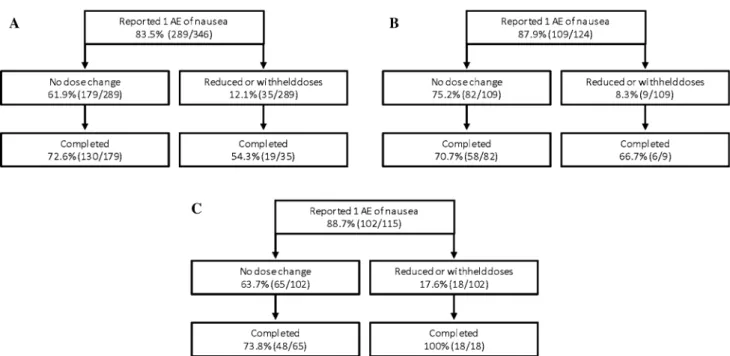
Among lubiprostone-treated patients in the ‘‘all trials’’ populations who reported any AE of nausea (CIC [24 mcg BID], n =346; OIC [24 mcg BID], n =124; IBS-C [(8 mcg BID], n=115), 83.5–88.7% reported only one
nausea event (Fig. 1a–c). More than 70% (70.7–73.8%) of patients reporting a single event of nausea who did not have a dose adjustment completed the full treatment per-iod. Across the three indications, 8.3–17.7% of patients who reported a single nausea event required lubiprostone dose reduction to once daily or a temporary interruption of lubiprostone treatment, which allowed the majority of these patients to complete the full treatment period. Among patients who reported C1 event of nausea (CIC, n =69; OIC, n=18; IBS-C, n=10), 55% with CIC, 78% with OIC, and 100% with IBS-C remained in the study.
Temporal Pattern of Nausea
In the ‘‘all trials’’ population, 64.3% of overall nausea events (393/611) occurred during the first 5 days of treat-ment with lubiprostone (CIC, 77.2% [267/346]; OIC, 45.2% [56/124]; IBS-C, 49.6% [70/141]). In RCTs, the median (range) for the first report of nausea was 2 (1–27), 5 (1–84), and 3 (1–90) days for the CIC, OIC, and IBS-C studies, respectively (Fig.2). Median values for the first report of nausea in the long-term extension studies ranged from 2 to 8.5 days.
Table 3 Medical history of nausea, history of medical conditions predisposing to nausea, and discontinuations due to nausea in patients who reported severe nausea
Patients,n CIC OIC IBS-C
Placebo Lubiprostone 24 mcg BID
Placebo Lubiprostone 24 mcg BID
Placebo Lubiprostone 8 mcg BID
n=0 n=5 n=7 n=7 n=1 n=5
Randomized controlled trials
Medical history of nausea NA 0 3 1 0 1 History of predisposing
conditionsa
NA 2 5 5 0 4
Discontinuation due to nausea NA 1 0 2 1 1
CIC OIC IBS-C
Lubiprostone 24 mcg BID Lubiprostone 24 mcg BID Lubiprostone 8 mcg BID
n=39 n=9 n=9
All trials
Medical history of nausea 2 1 1
History of predisposing conditionsa 21 7 6
Discontinuation due to nausea 20 2 1
BIDtwice daily,CICchronic idiopathic constipation,IBS-Cirritable bowel syndrome with constipation,NAnot applicable,OICopioid-induced constipation
Sex, Age, and Body Mass Index as Predictors of Nausea
In the CIC, OIC, and IBS-C RCTs, comparisons between patients who received lubiprostone or placebo found that nausea rates were not significantly different between women or men, or for those aged\65 orC65 years of age or with body mass index (BMI)\25 orC25 (allPvalues [0.394; Table4). Rates of severe nausea were low overall. Rates of nausea by sex, age, and BMI were also analyzed within the group of patients in RCTs who received
lubiprostone treatment. In patients with CIC who received lubiprostone, a significantly higher rate of nausea was observed in women compared with men (P =0.007), and in patients aged\65 versusC65 years of age (P=0.028) (Table4). There were no significant differences in the rates of severe nausea in any of these subgroups. In patients with OIC who received lubiprostone, there were no significant differences in the rates of nausea by sex, age group, or BMI, although there was a significantly higher rate (P=0.050) of severe nausea in women compared with men (Table4). In patients with IBS-C who received lubiprostone, the rates of nausea (P=0.0140) and severe nausea (P=0.0160) were significantly higher in patients with BMI \25 compared with those with BMI C25 (Table4).
Discussion
The pooled (‘‘all trials’’) analyses indicated that most patients experienced no nausea during treatment with lubiprostone. When nausea did occur, it was usually a single event, and the typical onset was within the first 5 days of treatment. The majority of nausea AEs were mild or moderate in severity and did not result in discontinuation of treatment. Although the rates of severe nausea were low, a higher rate of severe nausea was observed in patients with IBS-C with a BMI\25 and in women with OIC. Fur-thermore, nausea may be more common in women Fig. 1 Treatment continuation among lubiprostone-treated patients who reported only one AE of nausea in theachronic idiopathic constipation,
bopioid-induced constipation, andcirritable bowel syndrome with constipation studies.AEadverse event
Table 4 Nausea incidence by sex, age group, and body mass index
CIC OIC IBS-C
Placebo Lubiprostone 24 mcg BID
Pvalue* Placebo Lubiprostone 24 mcg BID
Pvalue* Placebo Lubiprostone 8 mcg BID
Pvalue*
Randomized controlled trials
Patients with nausea,n
15 70 42 89 28 91
Sex,n(%)
Male 0 2 (2.9) 0.007 14 (33.3)
31 (34.8) 0.639 2 (7.1) 5 (5.5) 0.250
Female 15 (100)
68 (97.1) 28 (66.7)
58 (65.2) 26 (92.9)
86 (94.5)
Age group,n(%)
\65 years 14 (93.3)
68 (97.1) 0.028 37 (88.1)
84 (94.4) 0.821 26 (92.9)
82 (90.1) 0.292
C65 years 1 (6.7) 2 (2.9) 5 (11.9) 5 (5.6) 2 (7.1) 9 (9.9) BMI
\25 10
(66.7)
37 (52.9) 0.117 10 (23.8)
23 (25.8) 0.501 13 (46.4)
51 (56.0) 0.014
C25 6 (33.3) 33 (47.1) 32 (76.2)
66 (74.2) 15 (53.6)
40 (44.0)
Patients with severe nausea,n
0 5 7 7 1 5
Sex,n(%)
Male 0 0 1.000 4 (57.1) 0 0.050 0 1 (20.0) 0.377 Female 0 5 (100) 3 (42.9) 7 (100) 1 (100) 5 (80.0)
Age group,n(%)
\65 years 0 5 (100) 1.0000 6 (85.7) 6 (85.7) 0.390 1 (100) 5 (100) 1.0000
C65 years 0 0 1 (14.3) 1 (14.3) 0 0 BMI
\25 0 4 (80.0) 0.1760 1 (14.3) 2 (28.6) 0.665 0 5 (100) 0.0160
C25 0 1 (20.0) 6 (85.7) 5 (71.4) 1 (100) 0
CIC OIC IBS-C
Lubiprostone 24 mcg BID Lubiprostone 24 mcg BID Lubiprostone 8 mcg BID
All trials
Patients with nausea,n 346 124 115
Sex,n(%)
Male 12 (3.5) 44 (35.5) 6 (5.12)
Female 334 (96.5) 80 (64.5) 109 (94.8)
Age group,n(%)
\65 years 311 (89.9) 117 (94.4) 102 (88.7)
C65 years 35 (10.1) 7 (5.6) 13 (11.3)
BMI
\25 177 (51.2) 33 (26.6) 65 (56.5)
C25 169 (48.8) 91 (73.4) 50 (43.5)
Patients with severe nausea,n 39 9 9
Sex,n(%)
Male 1 (2.6) 2 (22.2) 1 (11.1)
Female 38 (97.4) 7 (77.8) 8 (88.9)
Age group,n(%)
compared with men as well as in younger versus older adults at the higher dose (24 mcg BID).
Our data cannot definitively support or refute a dose– response relationship with the incidence of treatment-emergent nausea associated with lubiprostone. The higher incidence of nausea with lubiprostone in patients with CIC, compared with patients with IBS-C, would seem consistent with the threefold difference in dose (24 vs 8 mcg BID, respectively).The incidence of nausea in patients with OIC who received lubiprostone 24 mcg BID was lower than the incidence in patients with CIC at the same dose and closer to the incidence in patients with IBS-C, who received the lower dose. Arguably, the CIC and IBS-C patient popula-tions have more overlap in terms of the clinical charac-teristics and pathophysiology than does the OIC patient population where the pathogenesis of constipation is more clearly defined. No dose-dependent relationship between lubiprostone dose and nausea was observed in a double-blind, 3-week study with placebo or lubiprostone at total doses of 24, 48, and 72 mcg/day in patients with CIC [5]. The percentage of lubiprostone-treated patients report-ing nausea was higher in the CIC study population than in the other two study populations. Comparing nausea rates across the different indications may not be warranted because of differences in patient characteristics, particu-larly when considering patients with OIC versus those with CIC or IBS-C. For example, the prevalence of baseline (pretreatment) nausea was considerably greater in patients with OIC compared with patients with CIC and IBS-C. It is also possible that patients with OIC may have been less sensitive to the occurrence of nausea caused by lubipros-tone because the use of opioid agonists [19] is itself often associated with nausea.
While this study did not explore the relationship between efficacy of lubiprostone and adverse effects, independent pooled analyses of randomized controlled trials have been conducted for CIC, OIC, and IBS-C [20–22]. These pooled analyses supported the beneficial effects of lubiprostone across efficacy endpoints assessed. Further, in each of these pooled analyses, the percentage of
patients discontinuing treatment due to lack of efficacy was lower than that due to AEs. Importantly, nausea was not responsible for a large number of discontinuations, and the rates of nausea tended to decrease over the course of the study.
The higher prevalence of nausea in young women treated with lubiprostone in RCTs is consistent with observations across studies that show greater incidences of constipation and gastrointestinal dyspeptic symptoms, including delayed gastric emptying, as well as slowed colon transit time, in females than in males [23–28]. Similarly, a higher incidence of constipation and dyspeptic symptoms has been reported in younger versus elderly adults as well as in women of childbearing potential [23–25,28,29]. Given the reported effects of lubiprostone on delaying gastric emptying time [3], it is possible that this effect is exacerbated in women who already have elevated constipation and gastrointestinal dyspeptic symp-toms at baseline and may contribute to the increased rates of nausea observed in younger females.
While this study focused on the incidence of nausea in constipated patients, nausea rates were evaluated inde-pendently of the other AEs associated with lubiprostone treatment. In particular, dyspnea has been reported in 2.5 and 1.3% of lubiprostone-treated CIC and OIC patients, respectively [30]. In clinical studies, several patients dis-continued lubiprostone treatment because of AEs regard-less of severity, and in several patients continuing treatment, a recurrence of symptoms was observed [30]. Further, in the CIC and IBS-C trials, headache was among the most common treatment-related AEs (C5%) leading to study discontinuation [5–7]. Collectively, these findings suggest that individual sensitivities of patients to lubipro-stone and the potential interactions between AEs may have had a substantial effect on the observed safety profile.
The mechanisms underlying lubiprostone-induced nau-sea have not been identified. In addition to activation of ClC-2 chloride channels and the resultant increase in intestinal secretion, lubiprostone has other effects on gas-trointestinal function [2]. In two studies conducted in Table 4continued
CIC OIC IBS-C
Lubiprostone 24 mcg BID Lubiprostone 24 mcg BID Lubiprostone 8 mcg BID
C65 years 5 (12.8) 1 (11.1) 1 (11.1)
BMI,n(%)
\25 23 (59.0) 2 (22.2) 7 (77.8)
C25 16 (41.0) 7 (77.8) 2 (22.2)
BIDtwice daily,BMIbody mass index,CICchronic idiopathic constipation,IBS-Cirritable bowel syndrome with constipation,OIC opioid-induced constipation
healthy adults, lubiprostone significantly delayed gastric emptying and increased fasting gastric volume [3, 31]. These findings differ from what has been observed in preclinical studies, which show accelerated gastric emp-tying with lubiprostone treatment [32]. However, acceler-ated gastric emptying was not observed at lower doses, which are more comparable to those administered in the clinical setting.
While delayed gastric emptying and increased fasting gastric volume may play a role in mediating lubiprostone-induced nausea, other factors such as increased intestinal secretion and suppression of defecation may contribute to this phenomenon. In patients with functional dyspepsia, small intestinal distension has been associated with the occurrence of nausea, suggesting that increased secretion in the small intestine resulting in local distension may con-tribute to nausea symptoms [33]. Further, it is well known that suppression of defecation increases gastric emptying time, which could induce nausea, as has been observed in studies with healthy volunteers [34]. Therefore, patients with defecation disorders might be more prone to experi-encing nausea while taking lubiprostone.
In addition to perturbations in intestinal physiology and defecation, the time of drug intake relative to food con-sumption may also modify the side-effect profile of lubiprostone. In the first CIC study (RTU0211SC9921), lubiprostone was taken before a meal (Table1), whereas in all other studies, it was taken during a meal. Consistent with the observation that less nausea has been observed when lubiprostone is co-administered with food, the aforementioned study conducted in healthy adults found that increases in gastric volume did not occur when lubiprostone was administered after a fully satiating meal [3]. This observation is consistent with the US Food and Drug Administration’s recommendation to take the medi-cation with food and water [1].
One possible explanation for why patients with CIC exhibited the highest incidence of nausea in the clinical trials is that, unlike patients in the OIC and IBS-C studies, no explicit instruction was given to take the treatment with food. Since a detailed characterization of nausea was not a specific objective of the pivotal studies, only limited data on nausea were collected, thus limiting the scope of the current analyses.
In conclusion, nausea was more common in patients with CIC compared with OIC and IBS-C. In patients with CIC, but not OIC or IBS-C, women were more likely than men to report nausea. Most patients treated with lubipro-stone in the pooled study analyses for CIC, OIC, and IBS-C who reported nausea reported only a single incidence, and most of those events were of mild to moderate severity. In general, patients who experienced nausea were able to complete the studies. Useful strategies for the management
of lubiprostone-induced nausea include emphasizing that the medication should be taken with food and water (the recommended dosing procedure), reducing the dose, or temporarily withholding doses [1]. Treating physicians may wish to be particularly vigilant by expectantly advis-ing women (CIC and OIC), patients aged\65 (CIC), and patients with a BMI \25 (IBS-C) for the potential of nausea. Such an approach may be beneficial in helping patients achieve successful therapy.
Acknowledgments Writing and editorial support was provided by Patrick Little, PhD, and Michael Theisen, PhD, of Complete Publi-cation Solutions, LLC (North Wales, PA, USA), and was funded by Takeda Pharmaceuticals International.
Funding These analyses were funded by Sucampo Pharma Americ-as, LLC (Bethesda, MD), and Takeda Pharmaceuticals International (Deerfield, IL).
Compliance with ethical standards
Conflicts of interest Dr Cryer has consulting relationships with Pfizer, Ritter Pharmaceuticals, PLx Pharma, Iroko Pharmaceuticals, and Sucampo Pharmaceuticals, Inc. Dr Chey has served as a con-sultant for Actavis, Ardelyx, AstraZeneca, IM Health, Ironwood Pharmaceuticals, Nestle´, Prometheus Laboratories, QOL, SK, Sucampo Pharmaceuticals, Inc., and Takeda Pharmaceuticals, Inc. He has received research grants from IM Health, Ironwood Pharmaceu-ticals, Nestle´, Prometheus Laboratories, and Vibrant; he is the co-chief marketing officer for My Total Health. Drs Drossman and Webster have no conflicts of interest to disclose. Dr Habibi and Mr. Wang are employees of Sucampo Pharma Americas, LLC, and stock shareholders of Sucampo Pharmaceuticals, Inc.
Human and animal rights For this type of study, formal consent is not required.
Open Access This article is distributed under the terms of the Creative Commons Attribution-NonCommercial 4.0 International License (http://creativecommons.org/licenses/by-nc/4.0/), which per-mits any noncommercial use, distribution, and reproduction in any medium, provided you give appropriate credit to the original author(s) and the source, provide a link to the Creative Commons license, and indicate if changes were made.
References
1. Amitiza (lubiprostone) [package insert]. Deerfield, IL: Takeda Pharmaceuticals; 2016.
2. Lacy B, Levy L. Lubiprostone: a chloride channel activator.J
Clin Gastroenterol. 2007;41:345–351.
3. Camilleri M, Bharucha A, Ueno R, et al. Effect of a selective chloride channel activator, lubiprostone, on gastrointestinal transit, gastric sensory, and motor functions in healthy volunteers.
Am J Physiol Gastrointest Liver Physiol. 2006;290:G942–G947.
4. Fukudo S, Hongo M, Kaneko H, Takano M, Ueno R. Lubipros-tone increases spontaneous bowel movement frequency and quality of life in patients with chronic idiopathic constipation.
Clin Gastroenterol Hepatol. 2015;13:294.e295–301.e295.
double-blind, placebo-controlled, dose-ranging study to evaluate efficacy and safety.Aliment Pharmacol Ther. 2007;25:1351–1361. 6. Lembo A, Johanson J, Parkman H, Rao S, Miner PJ, Ueno R. Long-term safety and effectiveness of lubiprostone, a chloride channel (ClC-2) activator, in patients with chronic idiopathic constipation.Dig Dis Sci. 2011;56:2639–2645.
7. Johanson J, Morton D, Geenen J, Ueno R. Multicenter, 4-week, double-blind, randomized, placebo-controlled trial of lubipros-tone, a locally-acting type-2 chloride channel activator, in patients with chronic constipation. Am J Gastroenterol. 2008;103:170–177.
8. Barish C, Drossman D, Johanson J, Ueno R. Efficacy and safety of lubiprostone in patients with chronic constipation.Dig Dis Sci. 2010;55:1090–1097.
9. Johanson JF, Gargano MA, Holland PC, Patchen ML, Ueno R. Phase III patient assessments of the effects of lubiprostone, a chloride channel-2 (ClC-2) activator, for the treatment of con-stipation.Am J Gastroenterol. 2005;100:S329–S330.
10. Ueno R, Wahle A, Panas R, Joswick TR, Rivera E. Evaluation of safety and efficacy in a twelve-month study of lubiprostone for the treatment of chronic idiopathic constipation. Am J
Gas-troenterol. 2006;101:S491.
11. Jamal MM, Adams AB, Jansen JP, Webster LR. A randomized, placebo-controlled trial of lubiprostone for opioid-induced con-stipation in chronic non-cancer pain. Am J Gastroenterol. 2015;110:725–732.
12. Cryer B, Katz S, Vallejo R, Popescu A, Ueno R. A randomized study of lubiprostone for opioid-induced constipation in patients with chronic noncancer pain.Pain Med. 2014;15:1825–1834. 13. Drossman DA, Chey WD, Johanson JF, et al. Clinical trial:
lubiprostone in patients with constipation-associated irrita-ble bowel syndrome–results of two randomized, placebo-con-trolled studies.Aliment Pharmacol Ther. 2009;29:329–341. 14. Johanson JF, Drossman DA, Panas R, Wahle A, Ueno R. Clinical
trial: phase 2 study of lubiprostone for irritable bowel syndrome with constipation.Aliment Pharmacol Ther. 2008;27:685–696. 15. Chey W, Drossman D, Johanson J, Scott C, Panas R, Ueno R.
Safety and patient outcomes with lubiprostone for up to 52 weeks in patients with irritable bowel syndrome with constipation.
Ali-ment Pharmacol Ther. 2012;35:587–599.
16. Spierings E, Joswick T, Lindner E, Woldegeorgis F, Ueno R. Long-term safety and efficacy of lubiprostone in opioid-induced bowel dysfunction in patients with chronic, non-cancer pain: Results of a phase 3, open-label clinical trial. Paper presented at American College of Gastroenterology Annual Scientific Meet-ing; October 19–24, 2012; Las Vegas, Nevada.
17. Halpern SH, Douglas MJ. Appendix- Jadad scale for reporting randomized controlled trials. In: Halpern SH, Douglas MJ, eds.
Evidence-based Obstetric Anesthesia. Oxford, UK: Blackwell
Publishing Ltd; 2005:237–238.
18. Mayo Clinic. Nausea and vomiting causes: symptoms. http:// www.mayoclinic.org/symptoms/nausea/basics/causes/sym-20050736. Accessed February 25, 2015.
19. Labianca R, Sarzi-Puttini P, Zuccaro SM, Cherubino P, Vellucci R, Fornasari D. Adverse effects associated with non-opioid and
opioid treatment in patients with chronic pain.Clin Drug Inves-tig. 2012;32:53–63.
20. Mareya SM, Wang M, Losch-Beridon T, Lichtlen P. Su1586 lubiprostone responder rates in patients with chronic idiopathic constipation: increased frequency of spontaneous bowel move-ments and improved constipation-related symptoms.
Gastroen-terol. 2016;150:S534–S535.
21. Losch-Beridon T, Mareya S, Wang M, Lichtlen P. Su1585 lubiprostone responder rates in patients with opioid-induced constipation: increased frequency of complete spontaneous bowel movements.Gastroenterol. 2016;150:S534.
22. Chang L, Chey W, Drossman D, et al. Mo1262 effects of baseline abdominal pain on response to lubiprostone in patients with constipation-predominant irritable bowel syndrome.
Gastroen-terol. 2015;148:S-653.
23. Choung RS, Locke GR 3rd, Schleck CD, Zinsmeister AR, Talley NJ. Cumulative incidence of chronic constipation: a population-based study 1988–2003. Aliment Pharmacol Ther. 2007;26:1521–1528.
24. Kepenekci I, Keskinkilic B, Akinsu F, et al. Prevalence of pelvic floor disorders in the female population and the impact of age, mode of delivery, and parity.Dis Colon Rectum. 2011;54:85–94. 25. Kurniawan I, Simadibrata M. Management of chronic
constipa-tion in the elderly.Acta Med Indones. 2011;43:195–205. 26. McCrea GL, Miaskowski C, Stotts NA, Macera L, Varma MG. A
review of the literature on gender and age differences in the prevalence and characteristics of constipation in North America.
J Pain Symptom Manage. 2009;37:737–745.
27. Pare P, Ferrazzi S, Thompson WG, Irvine EJ, Rance L. An epi-demiological survey of constipation in canada: definitions, rates, demographics, and predictors of health care seeking.Am J
Gas-troenterol. 2001;96:3130–3137.
28. Preston DM, Lennard-Jones JE. Severe chronic constipation of young women: ‘idiopathic slow transit constipation’. Gut. 1986;27:41–48.
29. Gallegos-Orozco JF, Foxx-Orenstein AE, Sterler SM, Stoa JM. Chronic constipation in the elderly. Am J Gastroenterol. 2012;107:18–25.
30. Chamberlain S, Rao S. Safety evaluation of lubiprostone in the treatment of constipation and irritable bowel syndrome.Expert
Opin Drug Saf. 2012;11:841–850.
31. Hooks S, Rutland T, Di Palma J. Lubiprostone neither decreases gastric and small-bowel transit time nor improves visualization of small bowel for capsule endoscopy: a double-blind, placebo-controlled study.Gastrointest Endosc. 2009;70:942–946. 32. Song J, Yin J, Xu X, Chen J. Prokinetic effects of large-dose
lubiprostone on gastrointestinal transit in dogs and its mecha-nisms.Am J Transl Res. 2015;7:513–521.
33. Barbera R, Feinle C, Read NW. Abnormal sensitivity to duodenal lipid infusion in patients with functional dyspepsia.Eur J
Gas-troenterol Hepatol. 1995;7:1051–1057.