I’M EVERY WOMAN? HOW IDENTITIES INFLUENCE CONCEPTIONS OF WOMEN’S ISSUES
Amy Irene Sentementes
A thesis submitted to the faculty at the University of North Carolina at Chapel Hill in partial fulfillment of the requirements for the degree of Master of Arts in the Department of Political
Science.
Chapel Hill 2015
Approved by:
© 2015
ABSTRACT
Amy Irene Sentementes: I’m Every Woman? How Identities Influence Conceptions of Women’s Issues
(Under the direction of Pamela Johnston Conover)
TABLE OF CONTENTS
LIST OF TABLES………...v
LIST OF FIGURES………vi
LIST OF ABBREVIATIONS………...vii
INTRODUCTION………...1
THEORY……….2
Translating Interests to Issues………..2
Individual Interpretation of Elite Issue Framing………..3
Partisan Identities……….4
Gender Identities………..6
HYPOTHESES………8
DATA AND METHODS………..11
RESULTS………..14
Party Identity and Conceptions of Women’s Issues………..16
Gender Identity and Conceptions of Women’s Issues………...20
Ownership of Women’s Issues and Party Identity Content………...25
DISCUSSION………25
FUTURE RESEARCH………..27
APPENDIX………30
LIST OF TABLES
Table 1 - Party Identity Content and Conception of Women’s Issues………...16
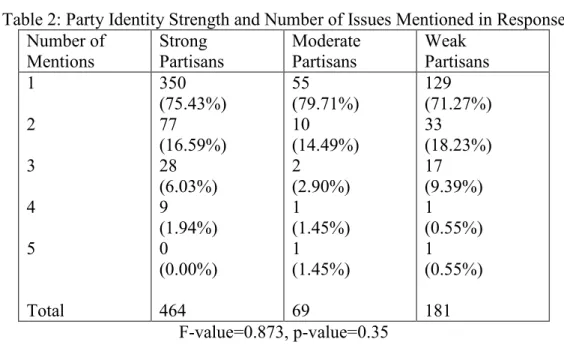
Table 2 - Party Identity Strength and Number of Issues Mentioned in Response………...18
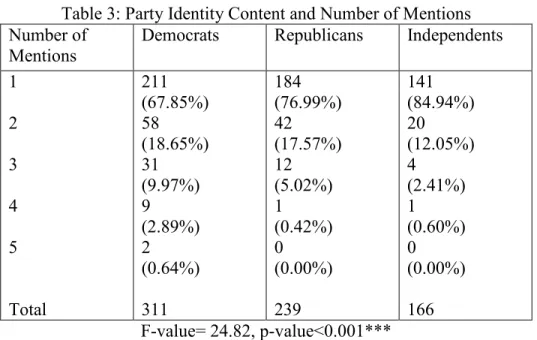
Table 3 - Party Identity Content and Number of Mentions………...19
Table 4 - Gender Identity Content and Conceptions of Women’s Issues………..20
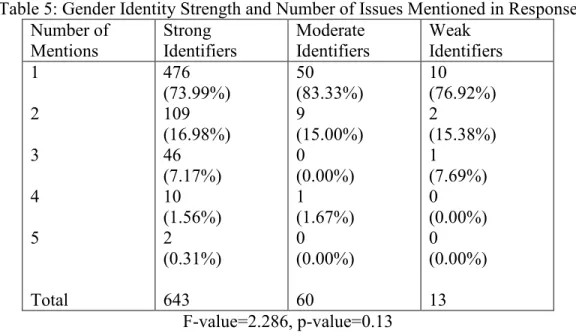
Table 5 - Gender Identity Strength and Number of Issues Mentioned in Response………..22
Table 6 - Gender and Number of Mentions………...24
Table 7 - Ownership of Women’s Issues and Party Identity Content………25
Table 8 – Gender………30
Table 9 - Party Identity Content………...30
Table 10 - Categorical Party Identity Content Variable………....30
Table 11 - Party Identity Strength Scale………30
Table 12 - Processing Time of Open-Ended Question………..30
Table 13 - Gender Identity Content Scale………..30
Table 14 - Dichotomous Gender Identity Content Variable………..31
Table 15 - Gender Identity Strength………..31
Table 16 - Issue Ownership………...31
Table 17 - Number of Mentions………...31
Table 18 - Gender Identity Strength Categorical Variable………31
Table 19 - Party Identity Strength Categorical Variable………...31
Table 20 - Gender Identity Content and Number of Mentions………..32
Table 21 - Responses to the Open-Ended Question by Party Identity Content………...33
LIST OF FIGURES
LIST OF ABBREVIATIONS
Introduction
During the 2012 presidential campaign, women’s issues figured prominently because women are an important group of voters that both Democrats and Republicans needed in order to win the election. The New York Times printed a variety of stories about women’s issues during the election, with titles ranging from “Warren Ties Brown to G.O.P.’s Agenda on Women’s Issues” to “Job Growth Isn’t Just a Women’s Issue.” As these headlines illustrate, political elites either employed the women’s issue slogan to appeal to women voters or challenged the usage of the phrase to avoid portraying women voters as a politically homogeneous group.
Insensitive comments about women’s health from several Republican congressional candidates, including Todd Akin and Richard Mourdock, further inspired Democratic discourse about the GOP’s inability to recruit women voters. Democrats running for office and the media claimed that the Republican Party was waging a “war on women,” and Democratic elites continued to discuss women’s issues to appeal to women voters (DeBonis, 2015). These efforts proved successful, as the partisan gender gap in the 2012 election was the largest gap recorded since 1952 (Jones, 2012). Yet, many women were unimpressed with the Democratic Party and its rhetoric surrounding women’s issues, as 44% of women voted for Republicans in 2012.
In this paper, I argue that political elites intend this popular women’s issue label to serve as an issue frame, as they strive to make the gender dimension of the topics that receive this label salient (Druckman, 2001). I evaluate how individuals, especially women, respond to this
women’s issue frame. I offer an original theoretical framework about how identities, specifically partisan and gender identities, influence conceptions of women’s issues, as the potentially distinct definitions of women’s issues between Democratic and Republican individuals may serve as the cause for their disparate responses to the women’s issue frame.
Translating Interests to Issues
Political elites, mainly those in the Democratic Party, suggest that a set of issues concerns women, yet this claim may not be appealing if individuals possess different interpretations of which topics exclusively affect women. Beckwith (2011) explains that prior to defining women’s issues, scholars should examine women’s interests, as interests will determine which topics citizens deem “women’s issues.”
Despite the fact that women may share common interests, these interests do not necessarily translate easily to specific issues. Beckwith (2011) explains that women mobilize around issues that involve their interests, but she emphasizes that interests and issues are distinct concepts. Women may mobilize around diverse issues, and only some of which receive the women’s issue label from political elites. If women do not perceive their interests in the issues selected by elites, they may not respond favorably to elite appeals. In this paper, I do not explore how accurately the women’s issue frame reflects women’s interests, yet the fact that a distinction exists suggests that this issue frame faces the same limits as other powerful frames, despite the fact that the targeted audience comprises over half of the United States voting population. Individual Interpretations of Elite Issue Framing
Politicians and elites in the media label women’s issues as such in order to increase the importance the gender aspect of certain concerns. In fact, by convincing women that these issues reflect their interests, they hope to recruit support for their policies. Previous research on framing shows that elites are able to elicit different policy opinions from individuals by altering the salience of particular components of an issue (Nelson, Clawson, and Oxley, 1997; Druckman, 2001). Both research and the previous discussion about women’s interests also suggest that while opinions on an issue may fluctuate depending on the dominant frame, there are factors that limit the success of frames. Certain factors, such as the source of the frame and the context in which an individual receives the frame, may prevent elite framers from making certain dimensions of an issue more salient (Druckman, 2001; Druckman, 2004; Chong and Druckman, 2007).
individuals with a strong attachment to a group will perceive their environments as an “us vs. them” situation, where they will view their ingroup favorably compared to other outgroups (Brewer, 1999). Thus, social identities serve as lens through which individuals perceive information (Conover, 1984). Specifically, individuals will respond to information from their ingroups differently than they would to information from outgroups (Tajfel and Turner, 1986; Goren et al., 2009). Consequently, social identities may influence how people react to elite frames. Individuals share a common perspective with members of their own social groups, so they are more likely to find issue frames persuasive when they are delivered from ingroup members rather than outgroup members.
The content of the frame suggests that gender identity plays an important role in shaping perceptions of women’s issues. The setting in which an individual receives the frame also matters because the salience of social identities fluctuates across contexts (Tajfel and Turner, 1986; Chong and Druckman, 2007). Elites label political topics like abortion, equal pay, and access to contraception as women’s issues, which suggests that this frame exists in a political setting. When individuals evaluate this label in a political context, their political identities also may influence their interpretations. Thus, I also posit that partisan identities will influence individual conceptions of women’s issues. Both gender and partisan identities should provide an understanding of how people define women’s issues, and this definition in turn should influence whether individuals accept or reject the frame itself.
Partisan Identities
others view membership in their partisan group as an integral part of their self-concept, which means partisan affiliation can function as a social identity (Greene, 1999). Thus, members of one political party view themselves and their copartisans as “us,” while they view members of the opposing party as “them.”
Findings on partisan source cues also show that party identities play an important role in shaping perceptions of frames. Partisans are more likely to respond favorably to messages from their own political party (Goren et al., 2009). Additional studies concerning partisan source cues find that messages from the opposing party, the outgroup, exert an even larger effect on how people respond to frames than appeals from their own party, the ingroup (Nicholson, 2011). If individuals engage in partisan motivated reasoning, the same women’s issue frame can elicit diverse responses, as Republicans may interpret a message differently than Democrats (Ditto and Lopez, 1992; Slothuus and de Vreese, 2010; Leeper and Slothuus, 2014).
Issue Ownership Theory (Petrocik, 1996) presents a compatible perspective that deepens our understanding of the public’s perception of women’s issues. This theory suggests that each party “owns” a set of issues, meaning individuals think that a particular party, either the
While partisan identities shape individual perceptions, their salience fluctuates across contexts. Identity strength affects the accessibility of a particular identity (Tajfel and Turner, 1986). Individuals with strong partisan identities are more likely to engage in partisan motivated reasoning, as this constitutes a more important part of their self-concept (Slothuus and de Vreese, 2010; Leeper and Slothuus, 2014). Specifically, strong partisans are more likely to view the environment in which they receive the women’s issue frame in an “us vs. them” context. Thus, even though elites from both political parties discuss women’s issues, people with strong partisan identities may develop an understanding of women’s issues that differs from individuals with weak partisan identities.
The strength and content of an individual’s partisan identity should influence his or her definition of women’s issues. However, individuals belong to multiple social groups, so they can rely on an array of potential identities to evaluate elite usage of the women’s issue phrase (Tajfel and Turner, 1986). Examining gender identity in addition to partisan identity will yield a more complete picture of how individuals incorporate these two relevant identities into their
conceptions of women’s issues. Gender Identities
Becker and Wagner (2008) refer to the meaning individuals assign to their gender identities as “gender identity content.” Women who have a “traditional” gender identity content believe that men and women should hold separate societal roles; women should maintain the home and raise children, while men work outside the home to provide financially for the family. Conversely, women with a “progressive” gender identity content strive to eliminate traditional gender roles in favor of a more egalitarian society in which men and women have equal
opportunities to pursue careers both inside and outside of the home (Becker and Wagner, 2008). Because women with traditional and progressive gender identities have fundamentally different conceptions about their proper societal roles, they are likely to also disagree about which set of issues affects women as a group.
As discussed previously, strength is an important dimension of identity. Regardless of whether or not women possess traditional or progressive gender identities, if they do not form a strong attachment to their gender group, they are likely to use other identities, like partisanship, to respond to the women’s issue frame. Conversely, strong gender identifiers are more likely to use their gender identity to evaluate elite discourse about women’s issues. Because this identity helps them clarify their political surroundings, their conceptions of women’s issues may differ from those with weaker gender identities.
broader set of women’s issues than men, who are less likely to focus on this frame that concerns members of the opposite gender group.
Hypotheses
Thus, I argue that identities serve as crucial components that mold individual reactions to issue frames. Specifically, I posit that politicians’ use of the women’s issue label constitutes an issue frame, and partisan and gender identities are important factors that shape how individuals conceive of women’s issues, and thus react to this frame. Because strength and content of identities are important considerations to assess when evaluating the issues different groups regard as women’s issues, I propose the following hypotheses about how individuals will respond when asked how they conceptualize women’s issues.
Partisan Identity Strength Hypothesis: Individuals with strong party identities will have more developed conceptions of women’s issues than individuals with weak party identities.
leading them to exert more cognitive effort to answer the question than weak partisans and independents.
Partisan Identity Content Hypothesis: Republicans will have a different understanding of women’s issues than Democrats.
When thinking about which specific issues concern women as a group, Republicans will be more likely to cite abortion and reproductive issues than Democrats. Discourse surrounding these issues indicates that Democrats perceive the Republican Party’s rhetoric and policies pertaining to these topics as attempts to control women and their bodies (Koplowitz, 2015). Indeed, comments on these issues sparked the controversy surrounding the GOP “War on
Women” (DeBonis, 2015). Democrats will be more likely to think about economic issues like the Glass Ceiling, equal pay, and jobs because elites in their party talk frequently about these issues (Walsh, 2015). Democrats may attribute their success among women voters to their commitment to these issues more than topics centered on women’s bodies.
Gender Identity Strength Hypothesis: Individuals with strong gender identities will have more developed conceptions of women’s issues than individuals with weak gender identities.
Gender Hypothesis: Women will have more developed conceptions of women’s issues than men. Gender should influence individual understanding of women’s issues regardless of the strength of identification with the gender group. When elites discuss women’s issues, they attempt to evoke support from individuals, especially women. Because women are the target audience for this rhetoric, they may be more exposed to discourse surrounding women’s issues than men. Women do not comprise a homogeneous group; thus, individual women can possess a range of gender and partisan identities. They also may not view these identities as a salient part of their self-concept. However, they may be more likely to listen to discussions about women’s issues to discern whether or not these problems actually affect them. This attention to the frame should promote knowledge of the topics that receive the women’s issue label. Because men do not belong in this social group, they may not be motivated to pay special attention to elite discourse on women’s issues even if they sympathize with these concerns. Thus, they may possess a weak prior understanding of women’s issues.
Gender Identity Content Hypothesis: individuals with traditional gender identities should select different issues as women’s issues than those who hold progressive gender identities.
Data and Methods
The hypotheses were tested using an original representative public opinion survey conducted by Qualtrics, an online survey software company. The sample (N=716) is representative of the population with respect to age and sex.
The dependent variable, conception of women’s issues, was measured using responses to an open-ended question that asked respondents, “What do you think of when you hear the term ‘women’s issues’ used in politics?” Using responses to this type of question is useful because the open-ended format allows respondents to reflect on the topic of women’s issues. The open-ended nature also does not force them to select from a range of options that may not capture their true understanding of which topics fall under the category of women’s issues. Additionally,
respondents can answer honestly if nothing comes to their minds when they hear this phrase. Responses to this question were coded using a list of categories originally constructed based on pre-test results to this question. Categories were added to create an exhaustive list of options that respondents offered in the open-ended question. A smaller set of six substantive categories—Abortion, Rights, Tradition and Family, Economy, Women’s Health, and other— was created by combining responses to the original 23 categories. (More information on the creation of the collapsed set of categories can be found in the Appendix.)
name more issues, they are more likely to have a stronger understanding of women’s issues than respondents who only name one topic.
The main independent variables are strength and content of party and gender identities. The content of party identity is measured using the standard ANES seven-point scale, recoded so that strong, weak, and independent leaners for each party are collapsed into a single category. (See Appendix for full wording.)
Strength of party identity is measured using survey questions that assess how salient party id is to respondents. Specifically, respondents were asked the following three questions:
• “Being a [DEMOCRAT/REPUBLICAN/INDEPENDENT] is important to my sense of what kind of person I am.”
• “I have a strong attachment to other people who are [DEMOCRATS/REPUBLICANS/INDEPENDENTS].” • “How would you describe your identity as a
[DEMOCRAT/REPUBLICAN/INDEPENDENT]? Please select where you are by ranking your identity from 1 to 7, where a 1 indicates that your identity is a fundamental part of who you are and is unlikely to change, and a 7 indicates that it could easily change with the circumstances. “
A party identity strength scale was created by averaging; the scale averages from one to seven. Values of the party identity strength scale range from one to seven, where one indicates the strongest party identity, and seven indicates the weakest party identity (alpha= .83). An
additional party identity strength variable collapses the scaled values into strong, moderate, and weak partisans.
home to support the careers of their partners from respondents who endorse progressive gender roles where women have careers outside the home. The questions also ask respondents to give opinions on gender norms like women changing their last name after marriage and not proposing to their future spouses. (See Appendix for the exact wording of the questions used to measure gender identity content)
From these five questions, a gender identity content scale was created to measure if respondents possess a more traditional or progressive gender identity (details in Appendix). Values of the gender identity content scale range from one, which indicates the most progressive identity, to seven, which indicates the most traditional identity (alpha= .54).
Created from the gender identity content scale, a categorical measure of gender identity was constructed. By combining scaled values, the traditional identifiers were separated from progressive identifiers. Scaled values less than four were collapsed into a Progressive Identity category, while a Traditional Identity category was created by combining scaled values greater than four. Scaled values that equal four were omitted, as these values indicate neither a
The responses to the Gender Identity Strength question were combined to construct a dichotomous variable used to test the Gender Hypothesis. Because gender is a socially
constructed phenomenon, I use this question rather than assuming respondents’ gender by using the sex variable. Females who selected choices less than four indicate that they at least somewhat identify with women. Similarly, males who selected choices less than four also at least somewhat identify with men. I create a gender dummy variable by combining these two groups of males and females who selected values less than four on the gender identity strength question.
Additionally, to assess if respondents are more likely to perceive the Democratic Party as capable of dealing with women’s issues, issue ownership was measured by a question that asks respondents to identify the political party that is better able to handle a variety of issues,
including women’s issues. If respondents select the Democratic Party despite their partisan affiliation, this would suggest that Democratic rhetoric concerning women’s issues is not only strategic but also effective. Conversely, if respondents tend to select their own party, this would imply that Democrats are only appealing to their own supporters when they discuss policies to address women’s issues.
Results
A series of one-way analysis of variance (ANOVA) tests were performed to examine if a relationship exists between the content of identities and conceptions of women’s issues.
women’s issues. I also construct a bivariate cross-tabulation between party identity and issue ownership, as this relationship may yield interesting information about the identities of the respondents beyond the relevant variables in this study.
To measure depth of processing, I first use response times to the open-ended question as the dependent variable rather than the responses themselves. I measure the relationship between depth of processing of the women’s issues question and party identity strength. I conduct a bivariate correlation between the response time and the categorical variable of party identity strength and measure the relationship between depth of processing of this open-ended question and gender identity strength. I also perform one-way analysis of variance (ANOVA) tests on these relationships. Statistically significant p-values indicate that individuals with strong identities spend more time answering the question than individuals with weak identities.
Party Identity and Conceptions of Women’s Issues
Table 1: Party Identity Content and Conception of Women’s Issues
Issue Category Democratic
Frequency Republican Frequency Independent Frequency Abortion
Tradition and Family Rights The Economy Women’s Health Other Total 89 (32.25%) 1 (0.36%) 64 (23.19%) 65 (23.55%) 14 (15.58%) 43 (5.10%) 276 65 (30.81%) 4 (1.9%) 49 (23.22%) 37 (17.54%) 7 (23.22%) 49 (3.32%) 211 32 (22.38%) 1 (0.70%) 35 (24.48%) 33 (23.10%) 3 (27.27%) 39 (2.10%) 143 F-value= 3.634, p-value=0.057*
I first tested the Party Identity Content Hypothesis. Table 1 displays the bivariate cross-tabulation between party identity content and conception’s of women’s issues. The p-value from the ANOVA shows that the relationship between conception’s of women’s issues and party identity content is statistically significant at the .10 level. Abortion-related comments were the most popular responses to the open-ended question. This table shows that proportionately Republicans most frequently cited issues in the Abortion category when responding to the question, which does comport with my initial prediction.
Along with abortion, Republicans also named issues that fall under the Rights and Other categories in their responses to the open-ended question. Additionally, Republicans more frequently named “Other” responses than Democrats and Independents. Answers such as
discuss either do not concern women exclusively or only apply to Democratic sympathizers. Republicans also more frequently named Tradition and Family issues than Democrats and Republicans, which may suggest that these respondents favor more traditional gender roles.
Table 1 also shows that Democrats most frequently name issues that fall under the Abortion category, which is not consistent with my original prediction that they would be more likely to cite economic issues than abortion-related topics. While Democratic elites might label economic issues as women’s issues more frequently than Republicans or Independents, they also might frequently discuss abortion as a women’s issue to communicate their displeasure with pro-life views and policies professed from those on the right.
Figure 1: The Impact of Party Identity Strength on Processing Time
Pearson Correlation Coefficient: 0.01
To test the Party Identity Strength Hypothesis, Figure 1 displays the correlation between processing time and party identity strength. After constructing the plot to display this
relationship, I calculated the Pearson Correlation Coefficient, which shows close to no
1 2 3 4 5 6 7
0
1
0
0
2
0
0
3
0
0
4
0
0
5
0
0
Party Identity Strength
P
ro
c
e
s
s
in
g
T
im
association between these two variables. On the x-axis, the values closer to one represent strong partisan identities, while the values closer to seven represent weak party identities. The figure shows that most respondents spent a short amount of time answering this question, and their response times did not differ significantly based on their party identification.
Table 2: Party Identity Strength and Number of Issues Mentioned in Response Number of Mentions Strong Partisans Moderate Partisans Weak Partisans 1 2 3 4 5 Total 350 (75.43%) 77 (16.59%) 28 (6.03%) 9 (1.94%) 0 (0.00%) 464 55 (79.71%) 10 (14.49%) 2 (2.90%) 1 (1.45%) 1 (1.45%) 69 129 (71.27%) 33 (18.23%) 17 (9.39%) 1 (0.55%) 1 (0.55%) 181 F-value=0.873, p-value=0.35
Although the correlation using the processing time variable indicated that strong,
Table 3: Party Identity Content and Number of Mentions Number of
Mentions
Democrats Republicans Independents 1 2 3 4 5 Total 211 (67.85%) 58 (18.65%) 31 (9.97%) 9 (2.89%) 2 (0.64%) 311 184 (76.99%) 42 (17.57%) 12 (5.02%) 1 (0.42%) 0 (0.00%) 239 141 (84.94%) 20 (12.05%) 4 (2.41%) 1 (0.60%) 0 (0.00%) 166 F-value= 24.82, p-value<0.001***
Gender Identity and Conceptions of Women’s Issues
Table 4: Gender Identity Content and Conceptions of Women’s Issues Issue Category Traditional
Frequency
Progressive Frequency Abortion
Tradition and Family Rights
The Economy Other
Women’s Health
Total
75 (32.19%) 0
(0.00%) 54 (23.18%) 47 (20.17%) 48 (20.60%) 9
(3.86%) 233
97 (29.22%) 5
(1.51%) 76 (22.89%) 79 (23.80%) 61 (18.37%) 14 (4.21%) 332 F-value= 0.116 p-value=0.73
I then tested the Gender Identity Content Hypothesis. Table 4 displays the bivariate cross-tabulation between conceptions of women’s issues and gender identity content. The p-value of the ANOVA is not statistically significant, which suggests that individuals with traditional and progressive gender identities do not think of different issues when they hear the term “women’s issues” used in politics. Thus, the gender identity content scale did not produce an even division between respondents along this dimension.
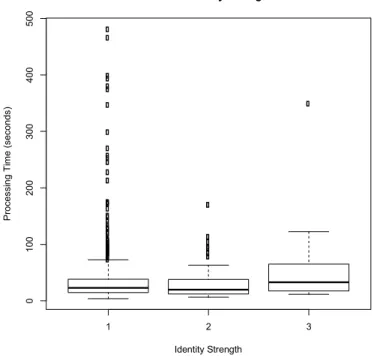
Figure 2: The Impact of Gender Identity Strength on Processing Time
F-value=0.591, p-value=0.44
Figure 2 is a box-and-whisker plot of the relationship between processing time and gender identity strength. The values along the x-axis correspond to strong, moderate, and weak gender identities, respectively. An analysis of variance between these variables shows that individuals with strong, moderate, and weak gender identities did not differ significantly in the time they spent answering the open-ended question.
1 2 3
0
1
0
0
2
0
0
3
0
0
4
0
0
5
0
0
Gender Identity Strength
Identity Strength
P
ro
c
e
s
s
in
g
T
im
e
(
s
e
c
o
n
d
s
Table 5: Gender Identity Strength and Number of Issues Mentioned in Response Number of Mentions Strong Identifiers Moderate Identifiers Weak Identifiers 1 2 3 4 5 Total 476 (73.99%) 109 (16.98%) 46 (7.17%) 10 (1.56%) 2 (0.31%) 643 50 (83.33%) 9 (15.00%) 0 (0.00%) 1 (1.67%) 0 (0.00%) 60 10 (76.92%) 2 (15.38%) 1 (7.69%) 0 (0.00%) 0 (0.00%) 13 F-value=2.286, p-value=0.13
A second test of the same hypothesis was conducted using the number of mentions variable. Respondents may spend the same time processing the question, yet individuals with stronger identities may be more likely to mention more issues during this same amount of time due to their developed cognitive structures surrounding the women’s issue frame. However, as shown in Table 5, a bivariate cross-tabulation between number of issues mentioned and gender identity strength also proves insignificant. Thus, using two different measures of depth of processing fails to reveal a significant relationship between gender strength and depth of processing.
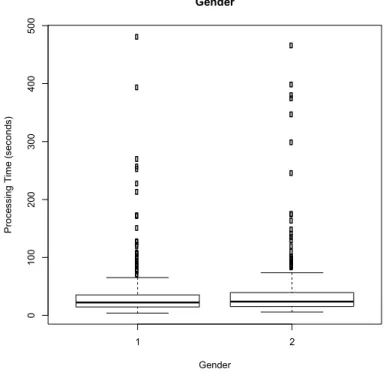
Figure 3: The Impact of Gender on Processing Time
F-value=0.31, p-value=0.58
Figure 3 displays a box-and-whisker plot of the relationship between processing time and gender. The values on the x-axis correspond to men and women, respectively. An ANOVA between these two variables reveals no statistically significant relationship between processing time and gender; men and women spend similar amounts of time answering the open-ended question.
1 2
0
1
0
0
2
0
0
3
0
0
4
0
0
5
0
0
Gender
Gender
P
ro
c
e
s
s
in
g
T
im
e
(
s
e
c
o
n
d
s
Table 6: Gender and Number of Mentions
Number of Mentions Men Women
1 2 3 4 5
Total
241 (81.06%) 44 (14.62%) 10 (3.32%) 3 (1.00%) 0 (0.00%) 298
231 (67.74%) 65 (19.06%) 36 (10.56%) 7
(2.10%) 2 (5.86%) 341 F-value= 19.29, p-value=<0.001***
Ownership of Women’s Issues and Party Identity Content
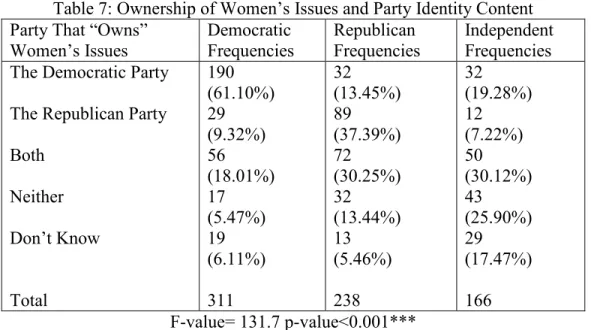
Table 7: Ownership of Women’s Issues and Party Identity Content Party That “Owns”
Women’s Issues Democratic Frequencies Republican Frequencies Independent Frequencies The Democratic Party
The Republican Party Both Neither Don’t Know Total 190 (61.10%) 29 (9.32%) 56 (18.01%) 17 (5.47%) 19 (6.11%) 311 32 (13.45%) 89 (37.39%) 72 (30.25%) 32 (13.44%) 13 (5.46%) 238 32 (19.28%) 12 (7.22%) 50 (30.12%) 43 (25.90%) 29 (17.47%) 166 F-value= 131.7 p-value<0.001***
It is also useful to consider the relationship between ownership of women’s issues and party identity content. Table 7 displays the bivariate cross-tabulation between perceptions of which party “owns” women’s issues and party identity content. An ANOVA between these variables shows that the relationship is statistically significant at the .01 level, a result that is consistent with findings surrounding motivated reasoning. That is, partisans are likely to perceive their own party as more competent than the opposition party (Ditto and Lopez, 1992).
Republicans cited their party as better able to handle women’s issues, while Democrats selected their own party. Critically, independents selected the “Both” response most frequently, which suggests that the Democrats do not “own” women’s issues. Thus, Democratic framing attempts may only appeal to their copartisans.
Discussion
open-ended question about women’s issues. This result implies that when elites discuss women’s issues, they may only appeal to a select audience, depending on the topics to which they attach the “women’s issue” label. Additionally, the disparate issues mentioned by individuals with different party identities suggests that the women’s issue frame may not be the strongest strategy elites can use to appeal to the broad American public.
While the gender and partisan identity strength hypotheses did not find support, my analyses does show that women possess a more developed conception of women’s issues than men. Elites label topics like abortion, the economy, and children’s issues as women’s issues, hoping to appeal to the broad group of women voters. Regardless of whether or not women view these elites and their policy proposals favorably, they still may focus their attention on this discourse because elites essentially argue that these topics are more pressing problems for women than men. This finding indirectly implies that the frame may be a bit more powerful than the findings consistent with the Party Identity Content hypothesis suggest. If women are paying more attention to elite rhetoric pertaining to “women’s issues” and develop a strong
understanding of these topics, they may be more likely to view women’s issues as salient concerns. Politicians who incorporate policies to address women’s issues into their rhetoric and electoral platforms may appreciate the fact that their target audience appears to pay attention to elite discussion of these issues.
one issue in their responses. Because Democratic elites most frequently employ the women’s issue frame, Democratic individuals are more likely to have a more developed cognitive structure surrounding this topic. This finding again speaks to the limited appeal of this issue frame. If Republicans pay more attention to discourse on women’s issues or viewed them as salient, then they, too, may have a strong schema with which to respond to this question. Yet, this finding suggests that Democrats either care more about these issues or focus more attention toward the Democrats in office who deliberate about women’s issues. The findings surrounding issue ownership also suggest that Democrats who use this frame may not appeal to Republicans or Independents.
The above findings support my contention that identities play an important role in
influencing conceptions of women’s issues. Research suggests that individual characteristics can moderate the success of an issue frame, and this analysis further shows the importance of party identity as a limit to framing effects (Druckman, 2001). Differences in conceptions of women’s issues between Democrats and Republicans, as well as differences in understanding women’s issues between women and men, suggests that elites should use this label with caution when attempting to appeal to the broad American public.
Future Research
The above analysis did not lend support to my hypotheses regarding gender identity content and gender identity strength. I plan to conduct additional analyses to test if these
Table 15 in the Appendix shows that most respondents possessed strong gender identities. Thus, in further projects, I plan to operationalize this variable differently as well. I also plan to examine additional identities in future studies, as the intersection of race, religion, and other identities with gender may produce interesting results.
While I found support for the Party Identity Content and Gender Hypotheses, I plan to continue this analysis to further explore the differences between Republicans and Democrats in the context of women’s issues. In this study, I used responses to an open-ended question about women’s issues to assess how people conceive of this topic, which strengthened this analysis about the role of individual identities as a moderator of framing effects. I found that partisan identities influences the issues individuals perceive as being women’s issues. Yet, in further analysis, I plan to explore how partisan identities influence the salience of women’s issues among individuals, as well as how individual attitudes toward women’s issues influence vote choice.
While the above analysis suggests that individual identities limit the success of the women’s issue frame, this study relied on cross-sectional data. In further projects, I plan to evaluate how the women’s issue frame has evolved over time to ascertain if the issues that elites currently label women’s issues have only recently been part of the broader women’s issue frame. I could also examine aggregate public opinion on each of my six substantive categories to assess if individuals possess different attitudes toward these topics when the women’s issue frame is prominent.
APPENDIX
Table 8: Gender Gender Frequency
Men Women
301 341
Table 9: Party Identity Content
Party Affiliation Frequency Strong Republican
Weak Republican
Independent but Lean toward Republican Independent
Independent but Lean toward Democrat Weak Democrat Strong Democrat 97 64 78 166 98 104 109 Table 10: Categorical Party Identity Content Variable
Identity Frequency Democrat Republican Independent 311 239 166
Table 11: Party Identity Strength Scale Party Identity Scale Value
Mean Standard Deviation Minimum Maximum 3.35 1.41 1.00 7.00
Table 12: Processing Time of Open-Ended Question Time in Seconds Value
Mean Standard Deviation Minimum Maximum 38.09 52.64 3.85 481.70 Table 13: Gender Identity Content Scale
Table 14: Dichotomous Gender Identity Content Variable Identity Frequency
Progressive Traditional
358 271
Table 15: Gender Identity Strength Gender Identity Strength Value
Mean Standard Deviation Minimum Maximum 1.86 1.08 1.00 7.00 Table 16: Issue Ownership
Party That “Owns” Women’s Issues Frequency The Democratic Party
The Republican Party Both Neither Don’t Know 254 130 178 92 61 Table 17: Number of Mentions Number of Issues
Mentioned Frequency 1 2 3 4 5 536 120 47 11 2
Table 18: Gender Identity Strength Categorical Variable Gender Identity Strength Frequency Strong Moderate Weak 642 60 13
Table 20: Gender Identity Content and Number of Mentions Number of Mentions Traditional
Identifiers
Progressive Identifiers 1
2 3 4 5
Total
207 (76.34%) 45 (16.61%) 16 (5.90%) 2 (0.74%) 1 (0.37%) 271
Table 21: Responses to the Open-Ended Question by Party Identity Content Issue Democratic
Frequency Republican Frequency Independent Frequency Abortion
Access to Contraception
Violence
Children’s Issues
Inequality in Homemaking
Equal Pay
Workplace Issues
Poverty and Welfare
Electing Women to Office
Feminism The Economy Equal Rights Liberal Issues Non Existent Women’s Health Not Sure
Restatement of Question
Sexism
Affirmative Action
Human Rights
Prostitution
Traditional Gender Roles
Table 22: Responses to the Open-Ended Question by Gender Identity Content Issue Traditional
Frequency
Progressive Frequency Abortion
Access to Contraception
Violence
Children’s Issues
Inequality in Homemaking
Equal Pay
Workplace Issues
Poverty and Welfare
Electing Women to Office
Feminism The Economy Equal Rights Liberal Issues Non Existent Women’s Health Not Sure
Restatement of Question
Sexism
Affirmative Action
Human Rights
Prostitution
Traditional Gender Roles
Reproductive Issues 23.25% (63) 4.10% (11) 0.74% (2) 0.00% (0) 0.00% (0) 12.55% (34) 3.69% (10) 0.00% (0) 2.21% (6) 2.95% (8) 1.11 (3) 18.82% (51) 2.95% (8) 8.49% (23) 3.32% (9) 9.23% (25) 4.80% (13) 1.10% (3) 0.00% (0) 0.00% (0) 0.37% (1) 0.00% (0) 0.37% (1) 23.42% (84) 2.48% (9) 1.38% (5) 0.83% (3) 0.28% (1) 15.43% (56) 4.68% (17) 0.28% (1) 2.80% (10) 2.20% (8) 1.10% (4) 19.00% (68) 2.48% (8) 7.44% (27) 3.86% (14) 5.79% (19) 2.75% (10) 1.93% (7) 0.28% (1) 0.55% (2) 0.00% (0) 0.28% (1) 0.83% (3) Survey Questions
2. What do you think of when you hear the term “women’s issues” used in politics? (Open-ended)
3. Which term best describes your political party affiliation? a. Strong Republican
b. Weak Republican
c. Independent but lean toward Republican d. Independent
e. Independent but lean toward Democrat f. Weak Democrat
g. Strong Democrat
4. Being a [DEMOCRAT/REPUBLICAN/INDEPENDENT] is important to my sense of what kind of person I am.
a. Strongly agree b. Agree
c. Somewhat agree
d. Neither agree nor disagree e. Somewhat disagree f. Disagree
g. Disagree strongly
5. I have a strong attachment to other people who are
[DEMOCRATS/REPUBLICANS/INDEPENDENTS]. a. Strongly agree
b. Agree
c. Somewhat agree
d. Neither agree nor disagree e. Somewhat disagree f. Disagree
g. Strongly disagree
6. How would you describe your identity as a
[DEMOCRAT/REPUBLICAN/INDEPENDENT]? Please select where you are by ranking your identity from 1 to 7, where a 1 indicates that your identity is a fundamental part of who you are and is unlikely to change, and a 7 indicates that it could easily change with the circumstances.
a. 1—Fundamental to who I am b. 2
c. 3 d. 4 e. 5 f. 6
7. I identify with women. (only if “Female” is selected for Question 1) a. Fully agree
b. Agree
c. Somewhat agree
d. Neither agree nor disagree e. Somewhat disagree f. Agree
g. Fully disagree
8. I identify with men. (only if “Male” is selected for Question 1) a. Fully agree
b. Agree
c. Somewhat agree
d. Neither agree nor disagree e. Somewhat disagree f. Disagree
g. Fully Disagree Women Only
Please evaluate the following statements as they have applied or might apply to your life. 9. I prefer to work inside the home instead of pursuing a career outside the home.
a. Strongly disagree b. Disagree
c. Somewhat disagree d. Neither agree nor disagree e. Agree somewhat
f. Agree
g. Strongly agree
10. I would not keep my maiden name after marriage. a. Strongly disagree
b. Disagree
c. Somewhat disagree d. Neither agree nor disagree e. Somewhat agree
f. Agree
g. Strongly agree
11. If possible, I would not work until my children are old enough to go to school. a. Strongly disagree
b. Disagree
c. Somewhat disagree d. Neither agree nor disagree e. Somewhat agree
g. Strongly agree
12. It is more important for me to support the career of my partner than build my own career. a. Strongly disagree
b. Disagree
c. Somewhat disagree d. Neither agree nor disagree e. Somewhat agree
f. Agree
g. Strongly agree
13. If I wanted to marry someone, I would just propose. a. Strongly disagree
b. Disagree
c. Somewhat disagree d. Neither agree nor disagree e. Somewhat agree
f. Agree
g. Strongly agree Men Only
Please evaluate the following statements about the role of women in society.
14. I believe women should work inside the home instead of pursuing a career outside the home.
a. Strongly disagree b. Disagree
c. Somewhat disagree d. Neither agree nor disagree e. Somewhat agree
f. Agree
g. Strongly agree
15. I feel like women should not keep their maiden names after marriage. a. Strongly disagree
b. Disagree
c. Somewhat disagree d. Neither agree nor disagree e. Somewhat agree
f. Agree
g. Strongly agree
16.If possible, women should not work until their children are old enough to go to school.
a. Strongly disagree b. Disagree
e. Somewhat agree f. Agree
g. Strongly agree
17. It is more important for women to support the careers of their partners than build their own careers.
a. Strongly disagree b. Disagree
c. Somewhat disagree d. Neither agree nor disagree e. Somewhat agree
f. Agree
g. Strongly agree
18. If a woman wanted to marry someone, she should just propose. a. Strongly disagree
b. Disagree
c. Somewhat disagree d. Neither agree nor disagree e. Somewhat agree
f. Strongly agree Open-Ended Response Categories
I first combined the mentions of abortion, access to contraception, and reproductive issues into a broad Abortion category. Then I created a Rights category that encompasses mentions of
Categorical Party Identity Strength Variable
Scale values less than four were collapsed into a Strong Partisans category. Scale values of exactly four were categorized as Moderate Partisans. Scale values greater than four were collapsed into a Weak Partisans category.
Gender Identity Content Scale
REFERENCES
Becker, Julie C. and Ulrich Wagner. 2008. “Doing Gender Differently—The Interplay of Strength of Gender Identification and Context of Gender Identity in Predicting Women’s Endorsement of Sexist Beliefs.” European Journal of Social Psychology, 39(4): 487-508.
Beckwith, Karen. 2011. “Interests, Issues, and Preferences: Women’s Interests and Epiphenomena.” Politics and Gender, 7(3): 424-429.
Celis, Karen, Childs, Sarah, Kantola, Johanna, and Mona Lena Krook. 2008.
“Rethinking Substantive Representation of Women.” Representation, 44(20): 99-110. Chong, Dennis and James N. Druckman. 2007. “Framing Public Opinion in Competitive
Democracies.” American Political Science Review, 101(4): 637-655.
Conover, Pamela Johnston. 1984. “The Influence of Group Identifications on Political Perception and Evaluation.” The Journal of Politics, 46(3): 760-785.
DeBonis, Mike. 2015. “Democrats: The GOP’s ‘War on Women’ is Back.” Washington Post, March. Web.
Ditto, Peter H. and David F. Lopez. 1992. “Motivated Skepticism: Use of Differential Decision Criteria for Preferred and Nonpreferred Conclusions.” Journal of Personality and Social Psychology, 63(4): 568-84.
Druckman, James N. 2001. “On the Limits of Framing Effects: Who Can Frame?” The Journal of Politics, 63(4): 1041-1066.
Greene, Steven. 1999. “Understanding Party Identification: A Social Identity Approach.” Political Psychology, 20(2): 1999.
Goren, Paul, Federico, Christopher M., and Miki Caul. 2009. “Source Cues, Partisan
Identities, and Political Value Expression.” American Journal of Political Science, 53(4): 805-820.
Jones, Jeffrey M. 2012. “Gender Gap in 2012 Vote Is Largest in Gallup’s History.” Gallup. Web.
Herrnson, Paul S., Lay, J. Celeste, and Atiya Kai Stokes. 2003. “Women’s Running ‘as Women’: Candidate Gender, Campaign Issues, and Voter-Targeting Strategies.” The Journal of Politics, 65(1): 244-255.
Leeper, Thomas and Rune Slothus. 2014. “Political Parties, Motivated Reasoning, and Public Opinion Formation.” Advances in Political Psychology, 35(1): 129-156. Mansbridge, Jane. 1999. “Should Blacks Represent Blacks and Women Represent
Women? A Contingent ‘Yes’.” The Journal of Politics, 61(3): 628-657.
Nicholson, Stephen P. 2011. “Dominating Cues and the Limits of Elite Influence.” The Journal of Politics, 73(4): 1165-1177.
Paolino, Phillip. 1995. “Group Salient Issues and Group Representation: Support for Women Candidates in the 1992 Senate Elections.” American Journal of Political Science, 39(2): 294-313.
Petrocik, John R. 1996. “Issue Ownership in Presidential Elections with a 1980 Case Study.” American Journal of Political Science, 40(3): 825-850.
Slothuus, Rune and Claes H. de Vreese. 2010. “Political Parties, Motivated Reasoning, and Issue Framing Effects.” The Journal of Politics, 72(3): 630-645.
Tajfel, Henri and John Turner. 1986. The Social Identity Theory of Intergroup
Behavior. In Psychology of Intergroup Relations, (eds.) S. Worchel and W. Austin(eds.). Chicago: Nelson Hall, 7-24.