PEER NETWORK INTERVENTIONS FOR SECONDARY STUDENTS WITH ASD: EFFECTS ON SOCIAL INTERACTION AND BULLYING VICTIMIZATION
Melissa A. Sreckovic
A dissertation submitted to the faculty at the University of North Carolina at Chapel Hill in partial fulfillment of the requirements for the degree of Doctor of Philosophy in the School of
Education.
Chapel Hill 2015
©2015
ABSTRACT
Melissa A. Sreckovic: Peer Network Interventions for Secondary Students with ASD: Effects on Social Interaction and Bullying Victimization
(Under the direction of Drs. Harriet Able and Kara Hume)
Students with autism spectrum disorder (ASD) may experience limited positive social interactions with their peers and high rates of bullying victimization, especially during
adolescence when peer groups become more selective. Limited positive social interactions with peers and bullying victimization have been associated with a myriad of negative consequences. Adolescents with ASD often require targeted supports to help them develop positive peer
relationships and to reduce frequency of bullying victimization. This study examined the effects of a school-based, social intervention for high school students with ASD. Three adolescent males with ASD participated in a peer network intervention. A single case, multiple-probe across participants design was used to evaluate the effects of the intervention on two elements of social interaction: initiations and responses to and from students with ASD. Additionally, this study employed questionnaires at four time points to explore the effects of the intervention on frequency of social contacts and bullying victimization of the participants with ASD.
ACKNOWLEDGEMENTS
I would like to begin by thanking the participants in my study. To the three students with ASD who volunteered their time to participate in this study, showed other students that
“different” is good, and made my day better every time I got to be with them, “thank you”. To the 14 students who made school more welcoming for other students, went out of their way to say “hi” to someone they may have just met, and genuinely cared about all the people in their network, “thank you”. The world is a better place because of people like you.
It is with deep gratitude that I thank the members of my dissertation committee. My dissertation became the product it is today because of our thoughtful discussions. More importantly, I am thankful for the learning opportunities and life lessons each of you provided that have prepared me to be a better teacher and researcher. Dr. Harriet Able, thank you for guiding me through my Ph.D. program, setting high expectations, and supporting me through all the peaks and valleys along the way. You instilled in me the importance of including families in every aspect of the research process and teaching future service providers how to advocate with families to provide the best education for their children. You understand the importance of family, both in work and personal life, and I am truly grateful for the insights you shared. Dr. Kara Hume, thank you for the weekly meetings, as well as your unwavering support,
encouragement, and good humor. I will be forever grateful for the research and writing
for the experiences you and Dr. Able provided as part of the translational, interdisciplinary research grant. Dr. Gary Mesibov, thank you for being a constant source of encouragement and reassurance throughout my studies, the dissertation process, and job search. The stories you shared have been truly inspirational. Finally, Dr. Samuel Odom, thank you for contributing your expertise in peer mediated interventions and helping me refine my dissertation. I am truly appreciative of both the research and writing opportunities you provided throughout my program. I would also like to thank Dr. Erik Carter, who is not on my dissertation committee, but who helped me conceptualize my dissertation through many thoughtful discussions.
The completion of this dissertation would not have been possible without the support of my friends and colleagues. Susan Hedges, Nelson Brunsting, and Evans Caison, thank you for your dedication to this project, your many hours of data collection, and your encouragement. Dr. Leslie Fox, thank you for reading drafts, providing feedback, and constantly encouraging me. To all of my friends in the School of Education and the Department of Allied Health, who I cannot begin to name, who have listened to my frustrations and helped me work through the bumps, thank you. I would also like to recognize and thank the Organization for Autism Research for providing funding for me to conduct my dissertation study.
My program would not have been the same if it weren’t for the Autism Team at the Frank Porter Graham Child Development Institute. Thank you to the members for always making me feel a part of the team, celebrating my accomplishments, and supporting me along the way. I would also like to thank Drs. Kathleen Lane and Tia Schultz for their mentorship and friendship throughout my program.
A special thanks to my husband, Tommy. You have been incredibly selfless and
supportive throughout this process. You are my partner in crime, my best friend, and the love of my life. This would not have been possible without you. I look forward to many years by your side and many more celebrations.
Finally, I want to recognize two students who were the inspirational force behind me attending graduate school, Lukas and Grace. Thank you for teaching me more than I could have ever taught you. You touch the lives of everyone you meet and I was lucky enough to be one of the people along the way.
TABLE OF CONTENTS
LIST OF TABLES ... xi
LIST OF FIGURES ... xii
CHAPTER 1: INTRODUCTION ...1
Statement of the Problem ...1
Social Challenges for Secondary Students with ASD ...4
Social interaction patterns and friendships of students with ASD ...5
Bullying Victimization of Students with ASD during Adolescence ...7
Prevalence of bullying victimization among students with ASD ...9
Consequences of Limited Social Interactions and Bullying Victimization ...9
Summary ...11
Purpose of Study ...12
Research aims ...13
CHAPTER 2: A REVIEW OF THE LITERATURE ...14
Autism Spectrum Disorder ...14
Severity of impairment ...17
The Intersection between Social Interaction and Victimization ...18
Points of Intervention ...21
Social skills training ...22
Peer-mediated instruction/intervention ...24
Review of peer network intervention studies conducted with
secondary students with ASD ...28
Summary ...33
Research Questions ...33
CHAPTER 3: METHODOLOGY ...36
Participants, Settings, and Materials ...36
Students with ASD ...36
Peer partners...45
Setting ...47
Materials ...48
Dependent Variables ...48
Primary dependent variables ...48
Exploratory dependent variables...48
Design and Procedures ...49
Primary dependent variables ...49
Exploratory dependent variables...50
Pre-baseline ...51
Baseline ...51
Intervention ...51
Maintenance and generalization probes ...55
Treatment Fidelity ...55
Social Validity ...55
Data Collection ...56
Primary dependent variables ...56
Data Analysis ...58
Primary dependent variables ...58
Exploratory dependent variables...58
CHAPTER 4: RESULTS ...59
Primary Research Aim: Social Interaction ...59
Research question 1 ...62
Research question 2 ...66
Secondary Research Aims: Social Contacts and Bullying Victimization ...70
Research question 3 ...70
Research question 4 ...75
Treatment Fidelity ...77
Inter-observer Agreement ...77
Social Validity ...78
Students with ASD ...79
Parents of students with ASD ...80
Peer partners...82
School personnel ...84
Summary ...85
CHAPTER 5: DISCUSSION ...87
Primary Research Aim: Social Interactions ...87
Secondary Research Aims: Social Contacts and Bullying Victimization ...93
Relationship between primary and secondary research aims ...95
Limitations ...96
Future Research ...99
Implications for Practice ...102
PREVALENCE STUDIES ...104
APPENDIX B: DESCRIPTIVE RESULTS OF REVIEWED PEER NETWORK INTERVENTION STUDIES...109
APPENDIX C: QUALITY COMPONENTS OF REVIEWED PEER NETWORK INTERVENTION STUDIES...111
APPENDIX D: SOCIAL CONTACTS QUESTIONNAIRE ...114
APPENDIX E: SOCIAL VALIDITY FORMS ...115
APPENDIX F: TREATMENT FIDELITY CHECKLISTS ...126
APPENDIX G: DIRECT OBSERVERATION CODING FORM ...129
LIST OF TABLES
Table 1 - Questions to Aid in Peer Partner Recruitment ...38
Table 2 - Descriptive Information for Participants with ASD ...45
Table 3 - Mean and Range Percentages of Total Social Interaction between Students with ASD and Peers ...62
Table 4 - Mean and Range Percentages of Social Interactions for all Dependent Variables ...70
Table 5 - Percentage of Peer Partners who engaged in Social Interactions/Activities with Peers ...74
Table 6 - Results from Social Contacts Questionnaire Reported by Students with ASD ...75
Table 7 - Results from Bully Victimization Scale ...77
Table 8 - Inter-observer Agreement Scores ...78
Table 9 - Mean Social Validity Scores from Students with ASD...80
Table 10 - Mean Social Validity Scores from Parents of Students with ASD ...82
Table 11 - Mean Social Validity Scores from Peer Partners ...84
LIST OF FIGURES
Figure 1 - The Reciprocal Effects Peer Interaction Model for Understanding Negative
Social outcomes Among Students with ASD ...19
Figure 2 - Recruitment to Enrollment Process Flow-Chart ...40
Figure 3 - Percentage of Intervals of Total Social Interaction ...61
Figure 4 - Percentage of Intervals of Initiations and Responses from Students with ASD ...65
Chapter 1 Introduction
Since the initial establishment of the Education for All Handicapped Children Act of 1975, federal legislation and school reforms have focused on ways to provide equal educational opportunities for students with disabilities and provide access to the general education
curriculum. Despite increased access to Free and Appropriate Public Education (FAPE) and to the least restricted environment under the Individuals with Disabilities Education Improvement Act (IDEA, 2004), secondary students with autism spectrum disorder (ASD) often experience difficulties accessing afforded rights within educational environments. Indeed, two critical problems in the school context can severely impact the full participation of secondary students with ASD: limited social interactions with peers (Wagner, Cadwallader, Garza, & Cameto, 2004) and frequent bullying victimization (Zablotsky, Bradshaw, Anderson, & Law, 2013).
Statement of the Problem
meet their multifaceted needs. In fact, in a recent survey, general and special educators expressed only moderate levels of confidence implementing evidence-based practices with students with ASD, with special educators expressing more confidence than general educators (Brock, Huber, Carter, Juarez, & Wareen, 2014). This is concerning, especially since students with ASD are increasingly being educated in general education classrooms for 80% or more of the school day (National Center for Educational Statistics, 2012). Further, some students with ASD do not qualify for special education services (because they are academically on or above grade level) despite their significant social challenges (Lukasik, 2011), resulting in general educators having the sole responsibility of providing social supports. As the prevalence of ASD continues to rise, schools are seeing a significant increase in children and adolescents with ASD being educated in primary and secondary school settings. In 2010, the Center for Disease Control and Prevention (CDC; 2014) estimated 1 in every 68 children eight years of age in the United States had been diagnosed with ASD. Although the prevalence estimates of ASD have been higher in younger grades in the past, recent research indicates for the first time prevalence of ASD in 14-17 year old cohorts matches that of younger cohorts (Blumberg et al., 2013). As both the prevalence of ASD increases among youth and the press for their inclusion continues, high school teachers need interventions that can be feasibly integrated into the school day that address the social deficits of students with ASD.
Students with ASD bring a myriad of social challenges to secondary education
classrooms, resulting in a continuing need to provide interventions to ensure full social inclusion and protection from negative social interactions. Currently, the literature base is limited in social interventions for secondary students with ASD. For example, in a review of interventions aimed at increasing the social behavior of individuals with ASD, Reichow and Volkmar (2009)
studies implemented with school-age youth with ASD and only 14 studies included participants in middle or high school (Carter, Sisco, Chung, & Stanton-Chapman, 2010). Unfortunately, even less is known about interventions to reduce rates of bullying victimization among school-age youth with ASD. Only one study, to the author’s knowledge, has been conducted that examined the effects of a program on rates of bullying victimization among youth with ASD (Humphrey, Lendrum, Barlow, Wigelsworth, & Squires, 2013). While statistically significant effects were found in relation to increasing positive relationships and decreasing bullying
experiences, the effect sizes were small and data were aggregated across disability groups so it is unknown how effective the program was specifically for students with ASD. While
anti-bullying and tolerance programs are increasingly more common in schools to address anti-bullying among the general population, two meta-analyses of anti-bullying programs indicated very few programs are actually effective and those that are effective have produced minimal overall reductions in bullying victimization rates (Merrell, Gueldner, Ross, & Isava, 2008; Ttofi & Farrington, 2011).
Engaging in positive social interactions can be challenging for students with ASD
because of deficits in social-communication skills and behavioral characteristics (Rao, Beidel, & Murray, 2008; Weiss & Harris, 2001). To engage in positive social interactions one needs to understand the social conventions of joining and exiting a conversation and appropriately
responding to verbal and non-verbal communication. For students with ASD, making initiations and responding to peers can be quite challenging. Individuals with ASD often have difficulty using appropriate greetings, establishing joint attention, and introducing topics of interest and relevance, all of which can make initiating interactions difficult (Paul, Orlovski, Marcinko, & Volkmar, 2009; Weiss & Harris, 2001). Further, difficulties understanding facial expressions, humor, and other people’s feelings can result in the individual with ASD not fully
comprehending the communicative intent of the message, thus making responding difficult (Weiss & Harris, 2001). Some students with ASD who have narrow interests may monopolize a conversation and not allow others to contribute their thoughts and/or interests resulting in an unbalanced conversation. Researchers have also noted an initial increase in aggression, self-injurious behavior, anxiety, and depression during adolescence (Hammond, & Hoffman, 2014; Shall & McDonough, 2010), which may further make engaging in social interactions difficult. For example, students with ASD may experience anxiety when attempting to initiate to peers and/or peers may be hesitant to initiate a conversation with a student with ASD who engages in self-injurious behaviors or expresses symptoms of depression.
As students transition to secondary settings these social challenges often become more prominent (Tantam, 2003), possibly due to the social structure of secondary settings and the increasing importance of the peer group. When students transition to middle and high school they are expected to navigate multiple teachers and peers daily and adjust their social behavior to the relevant context (Tobias, 2009). For example, students need to discriminate between
expectations for student behaviors (Lynch, Lerner, & Leventhal, 2013), which can further create challenges for students with ASD, as they have to not only successfully perform the behaviors, but be able to discriminate what behaviors are expected across various social contexts.
Furthermore, during adolescence peer relationships become more complex and friendships become more selective, making developing relationships challenging (Brown & Klute, 2003). Given that friendship development is highly dependent on frequent social interactions (Fehr, 2009), challenges in initiating and responding to peers can have a direct impact on friendship development. Indeed, adolescent students with ASD have reported difficulties in establishing friendships and noted difficulties were linked to not initiating interactions (Daniel & Billingsley, 2010). Other contributing factors noted by adolescents included being hesitant to try and
establish friends to protect oneself from being exploited and having difficulty recognizing who might be a good choice as a friend (Daniel & Billingsley, 2010). Thus, the combination of social skill deficits, complexity of high school contexts, and students with ASD struggling to identify potential friends and initiate interactions can make social interactions and developing peer relationships extremely difficult for these students. Indeed, despite inclusion initiatives, research suggests students with ASD engage in limited social interactions with peers and have
significantly fewer reciprocal and high quality friendships compared to their typically developing peers (Humphrey & Symes, 2011; Locke, Ishijima, Kasari, & London, 2010).
social aspects of school, such as establishing friendships and participating in group activities. Indeed, in a nationally representative longitudinal study of the involvement of adolescent students with disabilities, students with ASD were reported as the least likely to frequently see friends outside of school, receive telephone calls from friends, and get invited to another student’s social event (Wagner et al., 2004). Further, only 30% of the students with ASD participated in an organized group activity at school within the previous year (Wagner et al., 2004). Thus, due to lack of social involvement with their peers and high engagement in solitary activities, students with ASD do not get many opportunities to practice social skills and develop the communication skills needed to form relationships with their peers.
Bullying Victimization of Students with ASD during Adolescence
Bullying is a serious public health issue that has severe implications for those victimized (Gini and Pozzoli, 2009; Swearer, Espelage, Vaillancourt, & Hymel, 2010), especially
individuals with ASD (Zablotsky et al., 2013). Bullying is defined as ‘‘any unwanted aggressive behavior(s) by another youth or group of youths who are not siblings or current dating partners that involves an observed or perceived power imbalance and is repeated multiple times or is highly likely to be repeated. Bullying may inflict harm or distress on the targeted youth including physical, psychological, social, or educational harm.’’ (Gladden, Vivolo-Kantor, Hamburger, & Lumpkin, 2014, p. 7). Consequently, bullying victimization is “the experience among children of being a target of the aggressive behavior of other children…” (Hawker & Boulton, 2000, p. 441). Bullying victimization is also cited in the literature as peer victimization or victimization, and individuals who are victimized are also referred to as being bullied.
been reported to frequently work alone and engage in solitary activities, and have significantly fewer friends than their typically developing peers (APA, 2013; Biggs, Simpson, & Gaus, 2010; Heinrichs, 2003; Petrina et al., 2014). Thus, the common characteristics associated with victims of bullying are also characteristics commonly used to describe students with ASD.
While research has documented students with ASD experience bullying victimization across age-groups, recent research suggests victimization is more common during adolescence (Zablotsky et al., 2013). Adolescents often engage in bullying behavior to attain higher social status and to form peer groups (Pellegrini & Van Ryzin, 2011). As adolescent students engage in bullying behavior, students with ASD often become victims due to their social skill deficits. For example, as the peer culture sets the expectations for behaviors, students with ASD may not recognize what behaviors are expected or have the skills in their repertoire to perform the peer-expected behaviors (Attwood, 2007). When students do not demonstrate the peer-peer-expected behaviors they often stand-out from their peer group and are victimized. Further, during adolescence there is a strong push to conform to the expectations of peer culture (Berndt, 1979) and a strong press for homogeneity within the peer group (Bukowski & Sippola, 2001). Given the pressure for homogeneity, when a student does not conform to the expectations of the peer culture it creates conditions for victimization (Bukowski & Sippola, 2001).
they are more likely to receive a reaction and less likely to be penalized for it. Indeed, researchers have documented the high prevalence rates of victimization among students with ASD (Sreckovic, Brunsting, & Able, 2014).
Prevalence of bullying victimization among students with ASD. Over the last decade 16 descriptive studies have been conducted documenting the alarmingly high frequency of bullying victimization among school-age youth with ASD (see Appendix A). Research suggests students with ASD are bullied significantly more than the general population (e.g., Little, 2002) and more than their peers with other disabilities (e.g., Humphrey & Symes, 2010; Rowley et al. 2012; Twyman et al., 2010). While prevalence of bullying victimization rates among youth with ASD range across studies, a recent review indicated prevalence estimates reported within the past year to be between 46% and 94% across studies (Sreckovic et al, 2014). The range among studies may be due to variations in methodology (e.g., bullying measure used, characteristics of participants) or selection bias. In contrast, bullying victimization rates among the general adolescent population in the United States were estimated to be 28% in 2011 (Robers, Kemp, & Truman 2013).
Consequences of Limited Social Interactions and Bullying Victimization
Positive peer relationships are important, especially during adolescence as adolescents have reported friends to be the most significant factor influencing quality of life (Helseth & Misvaer, 2010). The limited positive social interactions and friendships students with ASD have with their peers are concerning considering interactions and relationships with peers can make important contributions not only to their overall quality of life, but to their success in school, as well (Rubin, Bukowski, & Laursen, 2009). During school, rejected students are less likely to participate in classroom activities and more likely to perform poorly on achievement assessments (Buhs & Ladd, 2001). Peer rejection can also lead to an array of psychological problems
can persist into adulthood and make navigating work and community relationships challenging (Sperry & Mesibov, 2005). On the contrary, research suggests adults with ASD who have greater quantity and quality of friendships report lower levels of loneliness (Mazurek, 2014). Thus, it is important to address these concerns during adolescence, but it is equally important to address these concerns to prepare individuals with ASD for employment and independent living beyond the high school context and improve overall quality of life.
When these individuals are subjected to bullying victimization, the negative
consequences become even greater. When students are victimized they experience an array of negative consequences and are at risk for dropping out of school, developing internalizing and externalizing behavioral problems (Parker & Asher, 1987), and in severe cases, suicide (Olweus, 1993). Research in the general population indicates victimization is significantly related to depression, loneliness, general and social anxiety, low self-esteem, and negative self-concept (Hawker & Boulton, 2000). Researchers have recently documented the negative outcomes students with ASD experienced as a result of being victimized. Zablotsky and colleagues (2013) reported of their participants with ASD who were bullied approximately 8% experienced
physical injuries and almost 70% experienced emotional trauma. Further, 14% were scared for their safety (Zablotsky et al., 2013). The National Autistic Society reported students with ASD who were victimized suffered from damaged self-esteem, poorer school work quality, and experienced negative impacts on mental health, social skills, and relationships (Reid & Batten, 2006). Additionally, more than 30% of students with ASD missed school and almost 20% changed schools due to bullying (Reid & Batten, 2006). Moreover, peer victimization has been identified as a risk factor of suicidality in individuals with ASD (Segers & Rawana, 2014). And, both bullying victimization and social rejection have been identified as precipitating factors for offending behavior (Allen et al., 2008).
Civil Rights in the U.S. Department of Education that outlined the legal protection of students with disabilities in regards to bullying. In brief, the letter stated that students with disabilities are protected under Section 504 of the Rehabilitation Act of 1973 and under IDEA (2004) if the bullying is disability-based harassment or if the bullying results in denial of FAPE regardless if the bullying was based on the student’s disability. If school districts do not appropriately respond to the bullying of a student with disability they could lose federal funding (Maag & Katsiyannis, 2012).
Summary
Research indicates students with ASD rarely initiate and respond to social bids with their peers, thus engaging in limited social interactions (Humphrey & Symes, 2011; Wainscot et al., 2008), are overrepresented as victims in the bullying dynamic (Zablotsky et al., 2013), and consequently experience a myriad of negative outcomes associated with social rejection and bullying victimization (Reid & Batten, 2006; Zablotsky et al., 2013). During adolescence peer relationships become increasingly important and the desire to attain social status and establish peer affiliations often cause students to engage in bullying behaviors and ostracize students making prevention and intervention efforts critical during this time period (Pellegrini & Van Ryzin, 2011). Empirical studies related to increasing social interactions and decreasing bullying victimization for secondary students with ASD are sparse. Addressing these two negative aspects of school simultaneously may be the best approach to provide optimal social outcomes for students with ASD, as both are social issues. Interventions targeting social outcomes will not only provide students with opportunities to increase social interactions with peers and establish relationships, but will likely increase student participation in social activities and decrease their vulnerability to bullying victimization.
Purpose of Study
The objective of this study was to examine the effects of a peer-mediated
outside of school, and (c) bullying victimization. This study is among the very few peer network studies implemented with high school students with ASD and marks the first study to specifically examine the effects of an intervention on rates of bullying victimization among students with ASD.
The long-term goal of this research was to build the evidence-base of peer network interventions and provide a first step for interventions aimed at reducing rates of bullying victimization among students with ASD. This study replicated and expanded on previous peer network intervention studies by implementing peer networks with high school students with ASD without intellectual disabilities (ID) and addressed several limitations posed in previous studies. The results of this study offer a better understanding of the use of peer network interventions implemented with high school students with ASD. Secondary teachers need evidence-based practices that address the social challenges of individuals with ASD that can be feasibly implemented within the context of high school settings. Further, they need interventions that can be implemented with students with ASD with varying profiles of abilities.
Research aims. The primary research aim was to investigate the effects of a peer
network intervention on the levels of social interactions between high school students with ASD and their typically developing peers. More specifically, the aim was to examine if initiations and responses to and from students with ASD increase once the intervention is implemented. To determine the effects of peer network interventions on social interactions, a single case, multiple-probe across participants design was employed.
The secondary research aims were to investigate the effects of a peer network
intervention on the frequency of social contacts between students with ASD and their peers and frequency of bullying victimization of students with ASD. To explore the effects of the
Chapter 2
A Review of the Literature
Literature specifically focused on interventions aimed at increasing positive social outcomes for secondary students with ASD is limited. However, to better understand why students with ASD are at-risk for limited social interactions and bullying victimization, it is necessary to review the defining features of ASD and how these features may impact social interactions and bullying victimization. It is equally important to understand how social interactions and bullying victimization are related so these problems can be addressed
concurrently. This chapter will include the following: (a) a review of the defining features of ASD; (b) a conceptual framework integrating social interaction and bullying victimization; (c) promising points of intervention; (d) a review of peer network intervention studies; and (e) the research questions this study addressed.
Autism Spectrum Disorder
childhood autism, Kanner’s autism, high-functioning autism, atypical autism, pervasive developmental disorder not otherwise specified, childhood disintegrative disorder, and Asperger’s disorder) as a single diagnostic disorder, ASD (APA, 2013).
Deficits in social communication and social interaction can greatly impact the social interactions individuals with ASD have with their peers or lack thereof. Individuals with ASD often have difficulty with social-emotional reciprocity, or the ability to share thoughts and feelings with others (APA, 2013). This can result in individuals with ASD engaging in little to no initiations toward peers as well as one-sided conversations and those lacking reciprocity. Individuals with ASD may also struggle in joining or starting conversations with peers. Difficulties with joint attention and introducing topics of interest and relevance can also make initiating difficult.
relation to bullying victimization, difficulties predicting others’ actions and intentions can result in the student with ASD not recognizing when their peers have bad intentions, making them socially vulnerable (Sofronoff et al., 2011). Because many of these students yearn for
friendships they are often compliant to the requests of their peers, consequently making them easy targets for bullying victimization as research suggests students with ASD who are socially vulnerable are at risk for experiencing bullying victimization (Sofronoff et al., 2011).
In addition to difficulties processing and comprehending verbal language, individuals with ASD often have deficits in demonstrating and understanding nonverbal communicative behaviors (APA, 2013). For example, individuals with ASD may demonstrate atypical use of eye contact, facial expressions, speech intonation, and body gestures (APA, 2013). This may be perceived by others as odd or others may think the individual with ASD is not paying attention to them or uninterested in the conversation. Consequently, others may stop or reduce frequency of initiating conversations with individuals with ASD. Further, individuals with ASD often have difficulty interpreting others’ facial expressions, body gestures, and tone of voice, resulting in challenges in responding to others. For example, a high school student with ASD may see a group of students talking with one student in the group crossing her arms with a scowl on her face. The student with ASD may not pick up on the social cues that the one student is mad and may attempt to join in on the conversation. The inappropriate timing of joining a conversation may be seen as disruptive by the peers, resulting in a negative reaction from the peers.
display emotional reactions, further making them stand out from their peers. Difficulties with impulse control can make peers hesitant to engage with students with ASD and can make students with ASD vulnerable to bullying victimization as bullies tend to target students who express emotional reactions (Kochenderfer-Ladd et al., 2009).
The combination of these deficits can result in individuals with ASD having extreme difficulties establishing and maintaining friendships. Individuals with ASD often desire to establish friendships, but do not have a complete understanding of what friendship entails (APA, 2013). Therefore, friendships are often one-sided.
Severity of impairment. It is clear that the defining characteristics of ASD can severely impact the social interactions students with ASD have with their peers and can place them at risk for experiencing bullying victimization. However, as previously mentioned, the severity of impairment varies from person to person. The DSM 5 describes three levels of impairment ranging from “requiring very substantial support” (Level 3; those who have severe verbal and nonverbal communication deficits) to “requires support” (Level 1; those who have social communication deficits that cause noticeable impairments without supports in place; APA, 2013). The severity of social impairment can impact the social interactions students with ASD have with their peers, and it can increase their risk of bullying victimization. For example, research suggests students with ASD with greater social severity and communication challenges are more likely to be victimized by their peers (Adams, Fredstrom, Duncan, Holleb, & Bishop, 2014; Cappadocia et al., 2012; Sterzing, Shattuck, Narendorf, Wagner, & Cooper, 2012). However, results from another study indicate students with ASD with less severe social and communication challenges are at greater risk for experiencing bullying victimization (Rowley et al., 2012). These researchers suggest students with ASD who experience less social and
additionally may have more opportunities to engage in social interactions with their peers which consequently can provide more opportunities for bullying to occur (Rowley et al., 2012).
Just as the severity of impairment can impact social interactions and bullying
victimization, it may also impact the educational setting the student with ASD is educated in, which can impact both frequency of social interactions and bullying victimization. While inclusive settings provide more opportunities for students with ASD to engage in social
interactions with their peers without ASD, they also increase the risk of bullying victimization. Research indicates students with ASD educated in mainstreamed schools or general education classrooms experience more bullying victimization compared to their counterparts educated in special education population schools or segregated settings (Hebron & Humphrey, 2013; Rowley et al., 2012; Sterzing et al., 2012; Zablotsky et al., 2013). Students with ASD educated in special education population schools/classrooms may be in classes that have smaller teacher-student ratios and more adult supervision resulting in fewer opportunities for bullying to occur (Hebron & Humphrey, 2013). Additionally, they may share similar characteristics with their peers and therefore may be less likely to stand out (Hebron & Humphrey, 2013). It may also be that students educated in special education population schools/classrooms have more severe disabilities and students with more noticeable disabilities are less likely to be bullied by their peers, because their disability is more obvious to their peers and can serve as a protective factor (Kasari, Locke, Gulsrud, & Rotheram-Fuller, 2011).
In summary, the defining characteristics of ASD can greatly impact the social
interactions between students with ASD and their peers and place students with ASD at-risk for bullying victimization. Difficulties initiating and responding to peers can make conversations awkward, one sided, or may result in negative judgment from peers. Therefore individuals with ASD may engage in limited social interactions with peers, develop few friendships, and
experience high rates of bullying victimization.
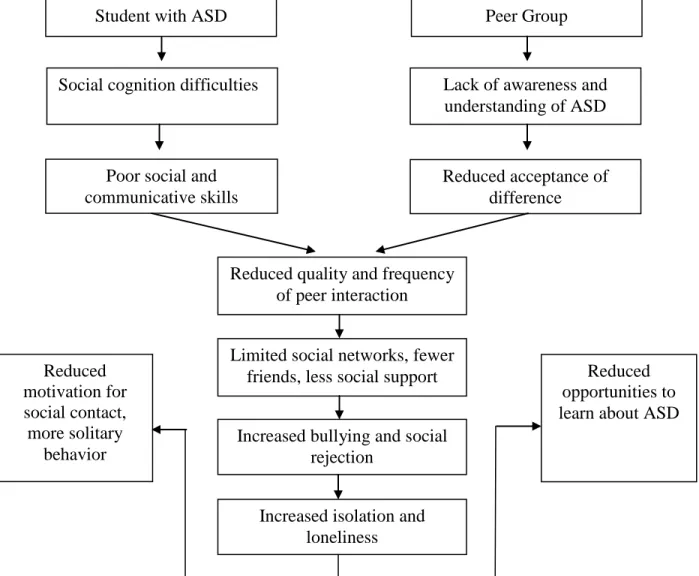
Students with ASD experience both limited positive social interactions with their peers and high rates of bullying victimization. These two problems are highly related and can be explained through the Reciprocal Effects Peer Interaction Model (REPIM) developed by Humphrey and Symes (2011; see Figure 1). The REPIM is a multidimensional conceptual framework demonstrating the interplay between individual student characteristics and the peer group and how limited interactions and friendships can lead to a cycle of bullying victimization (Humphrey & Symes, 2011). According to the REPIM, social outcomes for students with ASD originate at the individual level and at the peer group level (Humphrey & Symes, 2011).
Figure 1. The Reciprocal Effects Peer Interaction Model for Understanding Negative Social outcomes Among Students with ASD (Humphrey and Symes, 2011, p. 400).
Student with ASD Peer Group
Social cognition difficulties Lack of awareness and understanding of ASD
Poor social and communicative skills
Reduced acceptance of difference
Reduced quality and frequency of peer interaction
Limited social networks, fewer friends, less social support
Increased bullying and social rejection
Increased isolation and loneliness Reduced
motivation for social contact, more solitary
behavior
At the individual level, the student with ASD has social cognitive and social-communication skill deficits (Weiss & Harris, 2001). Social cognition encompasses the mechanisms that help individuals understand and make sense of the social world (Bauminger-Zviely, 2013). This includes understanding emotions, because they provide the communicative meaning of each social behavior (Bauminger-Zviely, 2013). Students with ASD have difficulties matching emotions to varying contexts and understanding why emotions occur (Bauminger et al., 2003). As previously noted, these students present an array of social and communication
difficulties, which make social reciprocity with peers challenging.
At the peer group level, students often lack awareness and understanding of ASD (Campbell, Morton, Roulston, & Barger, 2011). Therefore, when students with ASD demonstrate atypical behaviors, their peer group often views them negatively (Humphrey & Symes, 2011). This ignorance can lead to a lack of acceptance for the student with ASD and little motivation by typically developing students to engage in social interactions with the student with ASD (Campbell, Ferguson, Herzinger, Jackson, & Marino, 2004; Copeland et al., 2004).
Hodges, Boivin, Vitaro, & Bukowski, 1999). This research has also extended to students with ASD, as recent research indicates students with ASD who have fewer friends or who have difficulty making friends are more likely to be victimized (Cappadocia et al., 2012; Zablotsky et al., 2013). On the contrary, research has indicated higher levels of support from peers predicts reductions in frequency of victimization (Humphrey & Symes, 2010) and students who engage in positive peer relationships experience lower levels of victimization (Hebron & Humphrey, 2013).
When students with ASD are victimized, they experience the negative consequences of victimization, including increased levels of loneliness, depression, and anxiety (Hawker & Boulton, 2000; Shtayermman, 2007). In turn, these negative outcomes impact both the student with ASD and the peer group. For the student with ASD, experiencing these negative outcomes may lead to reduced motivation to engage with the peer group. This can result in increased isolation and engagement in solitary activities (Humphrey & Symes, 2011). For the peer group, students with psycho-social problems, such as depression and anxiety, are often irritating to their peers, further leading to reduced acceptance (Coyne, 1976). This can result in reduced
motivation for peers to engage in social interactions with students with ASD. In addition, reduced opportunities for social interactions can lead to limited opportunities for peers to gain awareness of ASD, which can further create feelings of differences (Humphrey & Symes, 2011).
Based on this conceptual framework, to increase the frequency of social interactions and reduce bullying victimization rates among these students, an intervention that targets both the peer group and the student with ASD may be most effective. By focusing on both the peer group and the student with ASD, the peer group can learn about social challenges of students with ASD which will likely increase acceptance (Campbell et al., 2004) and the student with ASD can learn and practice social skills, making reciprocal interactions easier. This multidimensional
Based on the REPIM (Humphrey & Symes, 2011) and the relationship between limited social interactions and bullying victimization, interventions that target social outcomes for students with ASD may be most effective at both increasing social interactions and reducing rates of bullying victimization. Recently, nine interventions have been identified as evidence-based practices for addressing social outcomes of youth with ASD, all of which have been effective for adolescents (Wong et al., 2014). These intervention practices include: antecedent based interventions, modeling, peer-mediated instruction/interventions (PMII), reinforcement, scripting, social skills training (SST), technology-aided instruction and interventions, video modeling, and visual supports (Wong et al., 2014). While all practices provide support for the effectiveness at the secondary level, some practices only included limited studies implemented with adolescents. Two primary pathways for improving the social outcomes for adolescents with ASD include intervention approaches focused on students with ASD, such as SST, and
intervention approaches focused on peers, such as PMII (Carter, Common, et al., 2014).
Social skills training. Social skills training is defined as “group or individual instruction designed to teach learners to appropriately interact with typically developing peers” (Wong et al., 2014, p. 91). These interventions typically involve meetings which include instruction on social skill concepts, practice and role-play of newly taught skills, and feedback from an instructor. While the overall goal of SST is to promote positive interactions with others, SST has been used to address skills related to social, communication, behavior, play, and cognitive domains (Wong et al., 2014).
intensity of the invention was related to treatment gains. More specifically, studies which implemented interventions for 10 weeks or longer resulted in greater likelihood of treatment gains, whereas shorter-term interventions resulted in limited treatment gains. Almost half of the reviewed studies held intervention sessions for approximately 10-16 weeks and each session lasted between 40 min to 2 hrs. While some studies resulted in treatment gains, there is limited information available on whether or not treatment gains resulted in improved social interactions with peers outside of the social skills group context. Further, limited information is available regarding what these social skills groups look like within the context of school settings, as only six of the 44 studies were implemented in such contexts, two of which also included peer-mediated components.
Two social skills group programs with an emerging evidence base at the secondary level are the Program for the Education and Enrichment of Relational Skills (PEERS; Laugeson et al. 2009) and the Social Competence Intervention (SCI; Stichter et al, 2010). The PEERS program is a manualized treatment program implemented in a clinic setting. Adolescents with ASD attend 12, 90 min weekly sessions and their parents attend concurrent but separate sessions to receive instruction on how to supervise their youth’s newly learned skills. Several skills are targeted during these sessions including: conversational skills, developing and expanding networks, handling bullying, teasing, and arguments with peers, demonstrating good
sportsmanship and host behaviors, and changing bad reputations (Laugeson et al., 2009, p. 597). Several studies have indicated PEERS is an effective social skills group intervention
adapted version of PEERS resulted in improvements in social skills knowledge, frequency of get-togethers with peers, and decreases in social anxiety.
Similar to PEERS, the SCI program is also a manualized treatment program (Stichter et al., 2010). The SCI program is based on cognitive behavior principles and utilizes social cognitive strategies, such as self-monitoring and self-regulation. Students with ASD attend 20, one hr sessions over the course of 10 weeks. While SCI has been implemented with elementary age students (e.g., Stichter, O’Connor, Herzog, Lierheimer, & McGhee, 2011), Social
Competence Intervention for Adolescents (SCI-A) was uniquely designed for adolescents with ASD who have full scale IQ scores above 70 (Stichter, Herzog, O’Connor, & Schmidt, 2012). The treatment program consists of five units including: recognizing facial expressions, sharing ideas, turn taking in conversations, recognizing feelings and emotions, and problem solving (Stichter et al., 2010, p. 1071). Research suggests adolescents with ASD who participated in the SCI-A program demonstrated significant growth on social skills, executive functioning, facial expression recognition, ToM, and problem solving (Sticther et al., 2010). While the results of SCI-A studies are promising, less is known about how these results translate to greater
improvement in social interactions with peers. To address this gap in the literature Schmidt and Stichter (2012) investigated the effects of the SCI-A program and two PMIIs on the social interaction and engagement of three middle school students with high functioning
autism/Asperger’s syndrome. Results indicated when the PMIIs were implemented social interaction increased for all three focal students above levels of interaction during baseline and during the SCI-A program (Schmidt & Stichter, 2012), indicating that PMIIs may be a useful strategy to help promote the generalization of social skills learned during the SCI-A program.
students with disabilities and to help them learn new skills in both learner-initiated and teacher-directed activities (Chan et al., 2009; Sperry et al., 2010; Strain & Odom, 1986). These
interventions have been effective at addressing both social and academic skills (Wong et al., 2014). During PMIIs aimed at improving social outcomes for students with ASD, one or more typically developing peers are taught how to provide ongoing social support to the student with ASD (Carter, Sisco, & Chung, 2012). The primary goal of peer-mediated social communication instruction/interventions is to promote positive peer interactions between the student with ASD and their typically developing peers (Ostrosky, Kaiser, & Odom, 1993). Additional goals include: teaching peers ways to engage with the student with ASD, increasing the frequency of interactions between students with ASD and their typically developing peers, extending social interactions within and across the school day, minimizing adult supports, teaching social skills, and promoting positive and natural interactions (Sperry et al., 2010). While each PMII is individualized to meet the needs of the student with ASD, Carter and colleagues (2012) have identified the following quality components typically included in PMIIs: (a) identifying students with disabilities who would benefit from the intervention; (b) selecting peer partners; (c)
equipping peer partners; (d) providing opportunities for social interaction; (e) providing guidance and support for peer partners and students with disabilities; and (f) evaluating student progress.
increasing social interactions between high school students with and without severe disabilities (Carter & Pesko, 2008).
Recently, Watkins et al. (2014) reviewed PMII studies aimed at improving social interaction skills of students with ASD educated in inclusive settings. Fourteen articles were reviewed, five of which included participants who were mostly adolescents or young adults. The studies measured a variety of outcomes including social interaction, social engagement, turn-taking, and gaining attention. While some PMII studies included both peer-mediated and social skills training components (e.g., Morrison et al., 2001), others included only peer-mediated components and found strong outcomes (Koegel et al., 2012). Of the 14 articles, 10 reported positive intervention outcomes indicating promising support for PMIIs implemented with students with ASD in inclusive settings. However, most of the reviewed PMII studies did not examine friendship development. One type of PMII increasingly gaining efficacy at the secondary level that has examined friendship development are peer network interventions.
The primary goals of peer network interventions implemented with students with ASD are to increase opportunities for students to meet new people, foster friendship development, and encourage students to engage in social activities during and outside of school (Carter et al., 2012). During these interventions, extended opportunities for social interaction are provided for the student with ASD and their peers. These interactions may occur during transitions between classes, during lunch, and/or during after-school activities (e.g., debate club, sporting events). Before the intervention begins, peer partners can participate in an orientation where they are provided with information about social areas that may be challenging for students with ASD (e.g., joining in on a conversation), and learn how to include the student with ASD in social interactions and activities. Peers can additionally be taught how to model appropriate social skills for students with ASD (e.g., initiating and responding), how to positively reinforce students with ASD, and how to intervene if a bullying situation happens (e.g., tell the bully to stop, walk away with the student with ASD, and report the bullying). Similar to other PMIIs, peer network interventions typically include the six quality components outlined above under “Peer-Mediated Instruction/Intervention”, which are individualized to meet the specific needs of the students with ASD and their peer partners.
2000). Further, given the format of peer network interventions, peer partners can be provided with information to explain atypical behaviors and specific social-communication difficulties of students with ASD, which may increase feelings of acceptance (Campbell et al., 2004). Peer network interventions also may be beneficial for addressing the bullying victimization of students with ASD, because they can be designed to target factors that make students with ASD vulnerable to victimization (e.g., social skills deficits, limited friendships). More specifically, by participating in peer network interventions students with ASD may gain greater social skills and may develop friendships with their peers, thus reducing their risk for experiencing bullying victimization. Finally, given that peer network interventions are implemented during non-instructional times they do not compete with the academic demands presented at the secondary level.
Given the advantages of this intervention, and the flexibility to tailor each intervention to meet the direct needs of students, peer network interventions may be a practical intervention to address both the low rates of social interaction and the high rates of bullying victimization among students with ASD. Further, peer network interventions address both the peer group and the individual with ASD which may promote greater social outcomes based on the REPIM (Humphrey & Symes, 2011). While peer network interventions have not been investigated to determine the extent they reduce the bullying victimization of students with ASD, they have been investigated to address other social outcomes for secondary students with ASD. Described next is a review of peer network interventions implemented with middle and high school students with ASD.
Review of Peer Network Studies Conducted with Secondary Students with ASD
While social intervention research is expanding to middle and high schools, the PMII literature base is still minimal for middle and high school students with ASD, including peer network intervention studies. To the author’s knowledge five empirical peer network
studies used single-case design methodology. Appendix B outlines descriptive information about each study, including characteristics of participants with ASD and their peer partners, research design, a description of the intervention implemented by peers, outcome variables, and results. Appendix C outlines the quality components of the peer network intervention studies, including the method used for selecting students with ASD and their peer partners, method used for training peers and the content taught, opportunities provided for social interaction, on-going support provided to students, and data collection methods.
A brief summary of each study is provided below including an evaluation of each study based on single case design quality indicators (Horner et al., 2005). More specifically, each study was evaluated to determine if it can be considered “high quality”. Based on the National Professional Development Center for ASD to be determined high quality the following criteria need to be met in entirety: (a) the dependent variable needs to align with the research question or purpose of study; (b) the dependent variable needs to be operationally defined; (c) the
Summary of peer network studies. While all five of the reviewed studies implemented a peer network intervention, the context of the interventions varied. The first published peer network intervention study was conducted by Haring and Breen (1992) and included two junior high students (one student with ASD and one student with ID and language delay). During this intervention study each focal student was grouped with 4-5 typically developing peers to form a network. Peer partners walked with the focal students in between classes, ate lunch with the focal students, and once a week the facilitator and network met to talk about times to interact, assess the group’s satisfaction, and casually interact. Using a multiple baseline across
participants design, the researchers measured social interactions, appropriate social responding, and extended social interactions. During intervention, the frequency of appropriate social interactions increased between the focal students and their peers. Further, both focal students participated in non-prompted events outside of school with their peer networks. One focal student’s mother noted that was the first time her son had been invited to an event outside of school by a peer. At the conclusion of the intervention 89% of the peer partners rated focal students as a friend and 11% rated focal students as a best friend. Though this study produced favorable treatment outcomes, it did not meet high quality standards as IOA was not collected and the independent variable was only manipulated by the experimenter at two different points in time.
The peer network interventions implemented by Koegel and colleagues (2012) and Koegel, Kim, Koegel, and Schwartzman (2013) differed from the peer network intervention implemented by Haring and Breen (1992) in that the network was a club developed around the student with ASD’s preferred interest. In the studies conducted by Koegel et al. (2012; 2013) flyers advertising the new clubs were posted around the school and teachers made
each club provided support mainly in the context of providing and preparing materials for the club and no peer partner training was provided. Using a repeated measures multiple baseline across participants design, time engaged with peers and rate of initiations to peers were measured in both studies. Results indicated level of engagement and frequency of initiations made to peers increased for all students with ASD across both studies. Data on friendship development and generalization of skills were collected in the study conducted by Koegel et al. (2013). Results indicated approximately half of the students with ASD reported they made friends; however, once the clubs ended, social engagement and interaction decreased to baseline levels and did not generalize outside the context of the clubs. Both studies met all nine quality indicators of single case design studies and therefore are considered high quality studies.
of social interactions and social engagement outside of network meeting days. Results indicated generalization occurred for one out of the four participants. Both studies met all nine quality indicators of single case design studies and therefore are considered high quality studies.
Limitations of the existing literature and directions for the current study. Based on the empirical literature, it is evident the five quality components of PMIIs can be tailored to meet the individual needs of focal students when implementing peer network interventions. This is evidenced by how widely the studies varied in each component. For example, the studies conducted by Koegel and colleagues (2012; 2013) did not include peer partner training, whereas the studies conducted by Haring and Breen (1992), Gardner et al. (2014), and Hochman et al. (in press) all included some element of peer partner training/orientation. However, all studies were effective in achieving the desired outcomes. This provides further support for the flexibility of these interventions.
While the evidence-base for peer network interventions implemented with secondary students with ASD is expanding, some limitations exist in the current literature, specifically around data collection. For example, only two of the five studies documented treatment fidelity during the intervention (Gardner et al., 2014; Hochman et al., in press). This is concerning, because the absence of treatment fidelity threatens both internal and external validity (Horner et al., 2005). While all studies did demonstrate a functional relationship between the
Additionally, while these studies included a range of dependent variables, most involved frequency of social interactions and social engagement of focal students. As noted previously, peer network interventions may be beneficial at producing positive, meaningful effects of other dependent variables, such as frequency of bullying victimization. While the intention of the reviewed studies was not to measure bullying victimization, more research is needed on the effects of peer network interventions on other dependent variables.
Finally, four of the five peer network intervention studies meet high quality standards as proposed by the National Professional Development Center on ASD (Wong et al., 2014). While this isn’t necessarily a limitation of individual studies, replication of these studies is needed to expand the research base to determine if peer network interventions can be deemed an evidence-based practice for secondary students with ASD. According to Horner et al. (2005) when
evaluating single case design studies to determine if a practice can be considered evidence-based a minimum of five high quality studies need to be conducted, across three different research teams, and a minimum of 20 participants need to be included across the studies. Currently, four high quality studies exist across two different research teams, which have included a total of 16 participants.
Summary
are minimal, the existing literature makes a strong case for targeting these two issues simultaneously through the use of a social intervention.
Research indicates two primary pathways to address the social concerns of secondary students with ASD include SST and PMII (Carter, Common, et al., 2014). While implementing SST and PMII concurrently may result in positive outcomes (e.g., Schmidt & Stichter, 2012), previous PMII studies have indicated strong results without the implementation of direct SST (e.g., Hochman et al., in press), indicating that perhaps a treatment package that includes both SST and PMII is not necessary to increase the social interactions of secondary students with ASD. Peer network interventions are one type of PMII that have shown promising results at both increasing social interactions and fostering friendship development and therefore may be an effective intervention to address both limited social interactions and bullying victimization. Addressing these two negative aspects of school simultaneously may be the best approach to provide optimal social outcomes for students with ASD.
Research Questions
The overall purpose of this study was to examine the effects of a peer network
intervention on the social interactions between students with ASD and their typically developing peers and the frequency of bullying victimization of students with ASD. This study expands on the current literature in two ways. First, the research base for empirical peer network
intervention studies implemented with middle and high school students with ASD is minimal. Replication is needed to determine the efficacy of peer network interventions as an evidence-base practice. This study most closely replicates the studies conducted by Gardner et al. (2014) and Hochman et al. (in press); however, it expands the literature by implementing peer network interventions with students with ASD without ID. Exploring the effects of peer network
study addresses the limitations of the existing literature base previously posed and includes measures of treatment fidelity and generalization of outcome variables.
Second, peer network studies have been efficacious at achieving a range of social goals for students with ASD, but they have not been explored to determine if they increase rates of social contacts between students with ASD and their peers within and outside the context of the school day. Further, they have not been explored to examine if they reduce the frequency of bullying victimization of students. Moreover, only one study to the author’s knowledge has been designed and implemented to reduce rates of bullying victimization for students with ASD (Humphrey et al., 2013), but the data were aggregated across students with a range of disabilities and the extent they reduced the victimization of students with ASD is unknown. Therefore, this study was the first to pilot an intervention to explore the level of change in bullying victimization rates for students with ASD as a result of a targeted intervention. This study addressed the following research questions:
1. Does the implementation of a peer network intervention produce increases in initiations and responses from students with ASD to their peers?
2. Does the implementation of a peer network intervention produce increases in initiations and responses from peers to students with ASD?
3. What effects does the implementation of a peer network intervention have on the social contacts between students with ASD and their peers?
Chapter 3 Methodology
This investigation used a single case, multiple-probe across participants design to study the effects of a peer network intervention on the frequency of social interactions between three high school students with ASD and their typically developing peers. The frequency of social contacts and bullying victimization of students with ASD were also examined before, during, and after the peer network intervention. Participant characteristics, setting, intervention procedures, design considerations, and data analysis techniques are described below. Participants, Setting, and Materials
Recruitment. The Exceptional Children’s (EC) facilitator and a special education teacher at the school identified students with ASD who were educated in the general education
classroom for a portion of their school day and had limited social interactions with peers and/or few friends. The EC facilitator contacted the parents/guardians of potential participants via phone (n = 7), briefly explained the study, and mailed consent packets for families to consider. Parents/guardians who were interested in having their child participate mailed the signed consent directly to the investigator (n = 4). The investigator followed up with a phone call to gather more information about the potential participant and determine if the potential participant met all inclusion criteria.
During the phone conversation with the parents/guardians, the investigator and parents discussed if the student expressed a willingness to participate in the study and was committed to being involved throughout the semester. The investigator asked parents/guardians if they were concerned their child was being bullied or was at-risk for bullying victimization. The
investigator also asked parents/guardians what motivates the student to be involved in groups (to help keep the student engaged throughout the semester if he met inclusion criteria), inquired about the student’s interests (e.g., football, video games; to help in peer partner recruitment if he met inclusion criteria), and asked if the student discloses his diagnosis to his peers (to protect the student’s privacy during the intervention if he met inclusion criteria). One student did not meet the inclusion criteria to be included in the study, because his guardian and teachers reported he was not currently being bullied and had no concerns about him being at-risk for bullying victimization.
(e.g., like to read the same books). The student was asked if he would like to participate in the program and if he could commit to participation through the semester. All students agreed and the investigator obtained assent. During this initial meeting the investigator also asked the students questions to aid in recruiting peer partners. This included questions about their hobbies, what they like to do in their free time, if they participate in any extracurricular clubs and if not if they would be interested in joining any specific clubs, and if they had any suggestions of peers they would like to join their network (recruitment procedures for peer partners is described in more detail below under “Peer partners”; see Table 1 for the list of questions the investigator asked students with ASD during the initial meeting).
Table 1
Questions to Aid in Peer Partner Recruitment
During the initial meeting with each student with ASD, the investigator asked the student the following questions to aid in peer partner recruitment:
1. What are your hobbies?
2. What do you like to do in your free time?
3. Are you in any extra-curricular clubs? If not, would you like to join one? 4. Do you have any suggestions of peers you would like to join your network?
Before the start of the study the investigator observed the participants during their lunch period for one week to gather more information about their social interactions during lunch, where they ate lunch, and their typical lunch routine (e.g., Did they buy lunch? Did they come late to lunch? Did they sit with any other students?). The investigator determined the
participants’ present levels of social contacts and frequency of bullying victimization by having students complete two descriptive assessments described below. These assessments were not used for inclusion criteria; rather they were used to describe the present level of social contacts and bullying victimization of the participants with ASD from their perspective.
provide descriptive information on the current level of victimization the student with ASD was experiencing. The BVS has been administered to adolescents with ASD in previous studies (e.g., Twyman et al., 2010) and is normed for students in grades 3-12 and has internal consistency reliability of 0.93 with test-retest reliability of 0.80 (Twyman et al., 2010). For the BVS, students answered 46 questions. Their answers were ranked and totaled. A higher score indicated a higher level of victimization. Based on total raw score students are classified into categories: normal (0-15), clinically significant (16-23), moderately severe (24-29), and severe (30-69). Students were not required to score a certain level to be included in the study if their parent or teacher reported they were concerned of bullying victimization. Therefore a student could score 0 (no victimization) but still be included in the study if their parents or teachers expressed concern about bullying victimization. Participants with ASD also completed a social contacts questionnaire (see Appendix D), which was adapted from the Social Connections and Relationships Assessment (Carter & Asmus, 2010-2014). The social contacts questionnaire was used to provide descriptive information on the types and frequency of social contacts participants with ASD had with their peers. Students were asked to report the interactions they had
throughout the school day and outside of school with their peers within the past week. In addition to the BVS and social contact questionnaire, each student filled out a pre-social validity form (see Appendix E). The purpose of the pre-pre-social validity form was to gain an understanding of the student’s current feelings about school (e.g., does he like going to school), perceptions of social interactions with peers (e.g., does he think his peers are nice, does he report he has friends), and if the student thinks social interactions with peers can be
challenging (e.g., does he think it is hard to talk to peers). In addition, students were asked to report on the form if they were currently being bullied or concerned about being bullied and if so where the bullying was happening (i.e., between what classes), or if the student was just