’Roids and Race
A content analysis of Barry Bonds and Roger Clemens media coverage, 2009-2013
By Benjamin A. Coley
Senior Honors Thesis School of Media and Journalism
University of North Carolina at Chapel Hill
Acknowledgments
To begin, I would like to thank my committee for providing guidance and constructive
criticisms, which helped me write the best possible thesis.
I would like to thank Dr. Johnston for introducing me to the world of media research.
Thank you for answering all my questions and providing encouragement.
I would also like to thank Maggie Engellenner for coding my articles. Your assistance
was greatly appreciated, and it played a significant role in my project.
I would like to thank Dr. Tuggle for serving as my reader, and providing feedback along
the way. Your comments were helpful and an instrumental part of the writing process.
Finally, I would like to give a special thanks to my adviser, Paul O’Connor. Thank you
for brainstorming ideas with me at the library over the summer. Also, thank you for buying me
lunch at Biskis all of those winter and spring afternoons. There is no other person I would rather
Abstract
This study is a content analysis comparing the media coverage of Barry Bonds and Roger
Clemens during their respective steroid scandals from 2009-2013. Articles from the New York
Times, Wall Street Journal, Los Angeles Times, Chicago Tribune, and USA Today were
examined. The research sought to answer whether there were differences in terms of prominence,
racial descriptions, and tone. After five key elements were analyzed – headlines, the article, lead
paragraphs, quote selection, and closing paragraphs – it was concluded that the coverage was
TABLE OF CONTENTS
INTRODUCTION... 1
LITERATURE REVIEW ... 4
SOCIAL LEARNING THEORY ... 4
FRAMING ... 5
MEDIA COVERAGE OF RACE ... 7
RACIAL FRAMING IN SPORTS MEDIA ... 9
MEDIA PORTRAYAL OF AFRICAN-AMERICANS IN BASEBALL ... 11
FRAMING OF ATHLETIC SCANDALS ... 13
JUSTIFICATION ... 16
METHOD ... 18
SAMPLING ... 18
CODING ... 19
CODER TRAINING AND INTERCODER RELIABILITY ... 21
RESULTS ... 24
HEADLINES ... 24
ARTICLE ... 25
LEAD PARAGRAPH ... 27
QUOTE AND SOURCE SELECTION ... 28
CLOSING PARAGRAPH ... 30
DISCUSSION ... 32
REFERENCES ... 38
APPENDIX... 46
CODEBOOK ... 46
1 Introduction
Past studies examining race in sports reveal the public perceive athletes and athletic
scandals (Rowe 2007; Seate, Hardwood, & Blecha, 2010). As a result, many communication
researchers have studied how journalists frame athletes. Evidence suggests that the media frame
African-American athletes as athletic, naturally gifted, and more aggressive. In comparison,
White athletes are framed as intelligent and hardworking (Butterworth 2007; Rada, 1996;
McElroy, 2014). For baseball specifically, previous research has analyzed topics ranging from
the heroic construction of Whiteness to the racial framing of minority baseball players
(Butterworth, 2007; Eagleman 2011). I continued the research of racial framing in the sports
media by studying the coverage of two former baseball players – Barry Bonds, an
African-American, and Roger Clemens, a Caucasian.
Statistically, Bonds is the home run king. In his 22 seasons Bonds hit 762 home runs,
which is an MLB record (Baseball-Reference.com). In the 2001 season alone, Bonds hit 73 home
runs – also an MLB record (Baseball-Reference.com). Clemens is also regarded as a top player,
but from the pitcher’s mound. Known as the “Rocket,” Clemens tallied 4,672 strikeouts – the
third-most in MLB history – and he is the only pitcher to have a single-game total of 20
strikeouts on multiple occasions (Baseball-Reference.com & Baseball-Almanac.com). Both have garnered several accolades. But both are also closely connected to MLB’s dreaded steroid era.
Bonds was the first to be accused. In 2004 Greg Anderson of the Bay Area Laboratory
Co-operative (BALCO) was indicted and charged with supplying steroids to athletes (Associated
2 before a grand jury in December 2003 and denied using steroids (Associated Press, 2015).
Criminal investigations continued over four years, and more evidence was obtained that
suggested Bonds had taken steroids from Anderson. So in November 2007, Bonds was charged
with perjury and obstruction of justice for allegedly lying about steroid use in his grand jury
testimony (Associated Press, 2015). In 2009, Bonds’ trial was delayed when lawyers appealed the judge’s decision to exclude evidence, so the trial began in March 2011 (Associated Press,
2015). Bonds was found guilty a month later and sentenced in December. Bonds’ conviction was
upheld after a three-judge panel heard an appeal in September 2013. But in April 2015, the
conviction was reversed, effectively ending the saga (Associated Press, 2015).
Clemens experienced similar tribulation. In 2007, the Mitchell Report – a lengthy
document detailing the use of steroids by MLB players – named 89 players who were alleged to
have used performance-enhancing drugs (Associated Press, 2012). Most of the evidence was provided by Clemens’ former trainer, Brian McNamee. In January 2008, Clemens filed a
defamation suit against McNamee (Associated Press, 2012). A month later, Clemens swore
under oath before a congressional committee that he had not taken steroids (Associated Press,
2012). But the committee noticed several inconsistences in his testimony and recommended that
the Justice Department investigate. In August 2010, as a result of the investigation, Clemens was
indicted by a grand jury. He was charged with perjury, making false statements, and obstruction
of justice (Associated Press, 2012). His trial began in July 2011, and he was eventually found not
guilty on all charges in June 2012 (Associated Press, 2012)
Bonds and Clemens both had tremendous careers that were tarnished by steroid
allegations and court proceedings. Additionally, both had negative reputations before the
3 his reputation as the surly superstar, a man who cares so little about public opinion that he could
barely face a television camera without sneering” (Zinser, 2007). Clemens was also hot-headed.
He was known as a headhunter, which is a pitcher who aims at batters’ heads. The best example
of this is when he nailed Mets catcher Mike Piazza in the head during the 2000 season. One New
York Post headline read “Roger’s rotten to core” (Kernan, 2000).
These two athletes have evenly-matched careers and personalities, making them perfect
subjects for a study about racial framing. Few studies have investigated how the media framed
baseball players in the fallout of the steroid era. Both Clemens and Bonds have had similar
careers and a similar reputation. One noticeable difference is that Bonds is Black and Clemens is
White. My research analyzed any discrepancies in stereotypical terms, prominence, and tone
between the coverage of Bonds and Clemens during their respective steroid controversies.
I used framing and social learning theory as conceptual foundations. These two concepts
suggest that the public might follow the media’s example in how to judge a particular storyline
or group of people. This includes how the media frame attitudes about minority groups,
particularly African-Americans. My main focus was how stereotypes affect African-American
athletes, but it is also important to understand that racial framing transcends athletics. Framing of
4 Chapter 1: Literature Review
Social Learning Theory
Researchers who study racial framing often use social learning theory as a conceptual
foundation (Mercurio & Filak, 2010; Sanders & Ramasubramanian, 2012). Social learning
theory postulates that knowledge is obtained via observation, imitation, and modeling of others.
By observing the positive and negative outcomes of different actions, people learn which actions are appropriate for specific situations. Bandura (1999) argues that people have “evolved an
advanced capacity for observational learning that enables them to develop their knowledge and
skills from information conveyed by modeling influences” (p. 25). According to one theory
about observational learning, there are four mechanisms involved in the modeling process –
paying attention to events, retaining the information, performing actions similar to modeled
behavior, and being incentivized to perform the modeled actions (Bandura, 1977). Some
exemplars are more efficient in providing socially learnable behavior than others. Grusec (1992) argues that “power and attractiveness of the model as well as the conditions under which
behavior is viewed” are important in determining the extent to which an exemplar will be
imitated (p. 781). For example, TV is visually compelling and more likely to garner observation
as opposed to other media.
Previous studies have applied the theory to determine whether media influences public
perception. For example, Anuradha (2012) found that gender stereotyping in television
commercials influenced how young children viewed gender roles. Moreno and Whitehill (2014)
5 In the sports media specifically, athletes are often perceived as role models for young males and females, and the media’s depiction plays a role in how viewers imitate a particular
player. Smith and Hattery (2006) argue that when the media extensively cover an athlete’s sexual
behavior, this presents an issue of viewers “mimicking the sexual promiscuity and even violence they associate with athletes” (p. 22). Some contend that social learning theory might be
practiced among media members. For example, one generation of sports writers and sportscasters
might unknowingly teach stereotypes to impressionable future writers as part of sports culture
(Eastman & Billings, 2001).
In some research, social learning theory is discussed in tandem with the theory of media
framing, which also plays a role in shifting public perception.
Framing
Framing describes how “news media resort to particular interpretive structures to set
particular events within their broader context” (Chuma, 2012, p. 316). The frames used by media
control which information is relevant and might influence how the public thinks (Kensicki,
2004). However, framing is different than agenda-setting. While agenda-setting is concerned
with the prominence of issues, framing is concerned with the presentation (De Vreese, 2005). A
variety of devices are used to frame a certain issue. Gamson and Modigliani (1989) contend that
frequent framing devices include metaphors, exemplars, catch-phrases, depictions, and visual
images. Entman (1993) notes that framing essentially has four functions: defining the issue,
diagnosing the causes, making moral judgments, and suggesting remedies.
De Vreese (2005) defines the stages of media framing as frame-building, frame-setting,
6 factors that shape the structure, modification, and creation of news frames. This includes how
journalists interact with social movements and the elite (Cooper, 2002; Hanggli, 2012). For those
studying frame-building, media frames are considered the dependent variable. For example,
Hanggli (2012) examined how political actors promote and influence media frames. He argues
that frame-building includes three main factors – power, salience of the media frames input, and
the multiplication effect (Hanggli, 2012).
Frame-setting is the interaction between media frames and how individuals currently
perceive a topic. In this case, media framing is considered the independent variable (Scheufele,
1999). This type of research is used more frequently than frame-building. For example, several
studies have researched news framing to determine how it affects people’s interpretation and
evaluation of events (Powell, 2011; Shen, Lee, Sipes, & Hu, 2012).
De Vreese (2005) argues that the consequences of framing can be observed on both an
individual and societal level. An individual consequence could be a changed attitude because of
increased exposure to a particular news frame. On a societal level, framing could potentially shape “social level processes such as political socialization, decision-making, and collective
actions” (De Vreese, 2005, p. 52).
The individual and societal consequences of framing are especially important when the
7 Media Coverage of Race
Winant (2000) defines race as a “concept that signifies and symbolizes sociopolitical conflicts and interests in reference to different types of human bodies” (p. 172). Race is a
pervasive and complicated social construct, so society often puts different groups into simplified
categories, also known as stereotypes. These stereotypes can have significant implications when
discussing race relations (Domke, McCoy, & Torres, 1999). This includes how the media cover different ethnicities or as Brooks and Rada (2002) state, “The media help to classify our world in
terms of the categories of race” (p. 119). In the late nineteenth century to early twentieth century,
pop culture suggested that all Black people fit into the image of “Jim Crow” – slow-thinking,
uneducated, and subservient. The stereotypes were so widespread that White Americans did not
realize that they were degrading African-Americans (Lemons, 1977). More recent research
reveals that racial stereotypes in the media have persisted into the rest of the twentieth century
and even in contemporary coverage.
Economically, a consistent stereotype has been the association of African-Americans
with poverty and welfare. For example, when Gilens (1996) examined news coverage on poverty
and related topics between 1988 and 1992, he found that Black people were overrepresented in
U.S. coverage. This overrepresentation causes White people to infer that African-Americans
benefit the most from welfare programs. As a result, White Americans are more likely to oppose
welfare legislation because Black people are often stereotyped as lazy and thus undeserving of
the benefits (Gilens, 1996). Even after welfare reform in the mid-1990s, media portrayals of
poverty still disproportionately featured Black people and depicted them as the unsympathetic
8 Race, media coverage, and politics have been noticeably intertwined, as well.
Historically, African-American candidates have had negative depictions. Research has found that
Black politicians are ignored on nonracial issues and are portrayed as pretentious (Ziber &
Niven, 2000). When the media do cover African-American candidates, they have a tendency to focus on the politician’s race. The most prominent and recent example of this is the 2008
presidential election. Holt (2012) found that Barack Obama was described as the “Black”
candidate even though he preferred not to discuss race during his campaign. In some cases,
White candidates have argued against their African-American opposition by appealing to the public’s negative perception of blackness, including inferiority and aggressiveness (McIlwain,
2007).
Culturally, criminality has often been framed through racial lenses. A persistent
stereotype is that Black people are often characterized as violent and aggressive (John & Moore, 1996). An experiment by Dixon and Maddox (2005) analyzes viewer’s discomfort with a crime
story and how it could be manipulated by race. The participants were exposed to a variety of
perpetrators: White, light-skinned Black, medium-skinned Black and dark-skinned Black.
Results of the study found that the dark-skinned Black offenders were the most memorable
(Dixon & Maddox, 2005). Studies have shown that the media are guilty of perpetuating these
prejudices (Mastro, Knight-Lapinski, Kopacz, & Behm-Morawitz, 2009; Oliver, 2003). For
example, in an examination of media coverage of Hurricane Katrina, researchers found that
stories tended to associate Blacks with crime and violence (Sommers, Apfelbaum, Dukes, Toosi,
& Wang, 2006). Additionally, a survey of Los Angeles County adults found a positive
9 overrepresentation as criminals, some White perpetrators engrossed in high-profile murder cases
initially blamed anonymous African-Americans. Smith and Hattery (2006) give the examples of
Susan Smith who drowned her children in South Carolina and Charles Stuart who murdered his
pregnant wife in Boston. Both perpetrators blamed anonymous African-Americans for their crime and “made the choice based on the images that pass across our media pages and TV
screens daily” (Smith & Hattery, 2006, p. 7).
The media’s framing of race, particularly African-Americans, has used stereotypes rooted
in economics, politics, and culture. Traces of these stereotypes can be extended to the sports
media, where Black athletes tend to be prominent figures.
Racial Framing in Sports Media
Studies have shown that sports journalists can set the agenda in how athletes are
perceived (Rowe, 2007). Researchers have examined the framing of both sports announcers and
print journalists (Rada, 1996; Mangun, 2013; McElroy, 2014). Enck-Wanzer (2009) argues that
mass-mediated images of Black athletes serve as one of the few areas in which
African-Americans appear to be superior to White people, and these “depictions simultaneously serve to
preserve (white) cultural hegemony by legitimizing the racist notion that blacks are naturally
superior physically (and whites, superior mentally)” (p. 9).
In an early study by Rainville, Roberts, and Sweet (1978), 90 White undergraduates and
90 Black undergraduates were given transcripts from nationally televised NFL games. A
majority of the time, the students identified players as either White or Black from the
announcer’s stereotypical descriptions. In football, quarterback is arguably the most important
10 are described much differently. For example, Mercurio and Filak (2010) examined how Sports
Illustrated described Black and White quarterbacks prior to the NFL Draft in the years 1998-2007. The research shows that Black quarterbacks were depicted as having athletic ability, while
White quarterbacks were described as mentally prepared (Mercurio & Filak, 2010).
These stereotypes have been perpetuated in the coverage of other sports, as well. In an
analysis of 1980s newspaper coverage of prominent NBA players Magic Johnson and Larry
Bird, the research shows that Johnson, an African-American, was commonly recognized for his
flashiness and natural athletic ability while Bird, a Caucasian, was more likely to be
characterized as having a high basketball IQ (Ferruci & Perry, 2015). Similar results have been
found in college basketball. White players were praised for hard work and effort while Blacks
were lauded for their quickness, agility, and strength (Eastman & Billing, 2001; Johnson,
Hallinan, & Westerfield, 1999).
Among the core professional sports leagues – MLB, NBA, NHL, and NFL -- baseball
includes a much higher percentage of Latino and Asian players. As a result, much research has
been done on the racial framing of minorities other than African-Americans (Juffer, 2002;
Eagleman, 2011; Nakamura, 2005). One study in particular observes the different portrayals of
Mark McGwire and Sammy Sosa during their 1998 home run race – the season when both
players surpassed Roger Maris’ single-season record of 61 home runs. McGwire finished the
season with 70 home runs while Sosa had 66. Butterworth (2007) hypothesizes that McGwire, a
White male, was elevated to heroic status while Sammy Sosa, a Latino, had a diminished role in
the home run race. Butterworth found that writers portrayed Sosa as an intruder in the race and
that most stories about Sosa focused on his heritage, further emphasizing the difference between
11 frequently described pitchers Hideo Nomo and Hideki Irabu as model minorities and economic
threats (Mayeda, 1999).
Similar to Latino and Asians, African-American baseball players have been constantly
subjected to racial typecasts by the media. In fact, the racial framing of Black players dates back
to the late nineteenth century.
Media Portrayal of African-Americans in Baseball
The origin of baseball’s racism is rooted in how the sport was founded. In Football Red
and Baseball Green: The Heroics and Bucolics of American Sport, Ross (1971) states that baseball was “conceived in nostalgia” and that it “creates an atmosphere in which everything
exists in harmony” (p. 31). The mythical qualities that surrounded baseball – pure, innocent, and
pastoral – are often descriptions associated with Whiteness (Nowatzki, 2002). In the early
twentieth century, the best example is when eight White Sox players were accused of fixing the
1919 World Series. The scandal tarnished the innocent, pastoral nature of baseball, so it was called “The Black Sox Scandal.” The name “implied the innocence of whiteness and the
wickedness of blackness” (Nowatzki, 2002, p. 83).
The first African-American player to gain prominent media attention was Moses
Fleetwood Walker in the 1880s. Walker played catcher for the Toledo Blue Stockings. Once the
Blue Stockings moved to the American Association, Walker became the first Black player in a
Major League. In an essay discussing newspaper coverage of Walker, Rowell (2015) notes that
initially, the media did not dedicate much time to discussing his race. But soon, Walker was
derided and vilified for being a mulatto. On sports pages, he was often referred to as coon,
12 ‘nigger’” (Rowell, 2015). Additionally, in a piece by Sporting Life, an article complimented
Walker by stating he “hasn’t grumbled at extra work.” Roessner (2011) explains that the
comment subtly spreads the idea that other Black players would have complained and insinuates
that African-American players are lazy. It is important to note that in baseball’s early history,
prominent White baseball players eluded criticisms from the media, unlike their black
counterparts. Ventresca (2014) states “However, for a number of these players, including Ty
Cobb and Babe Ruth, immoral behavior has often been downplayed, reframed, or even ignored,
allowing them to better exemplify the positive societal values associated with the sport” (p.59).
The end of Walker’s career marked the last time a Black player would play Major League
baseball until Jackie Robinson joined the Brooklyn Dodgers in 1947 and broke the color barrier.
Since Robinson, African-Americans have made their mark in “America’s Pastime.” Hank Aaron,
Barry Bonds, and Willie Mays rank top-10 in home runs and Ricky Henderson is the all-time
leader in stolen bases. But stereotypes manifested in media coverage of Walker in the 1880s still
existed in the sports media of the mid-twentieth century. For example, in an article about Aaron
by the Saturday Evening Post in 1956, the author states, “Aaron is still adding polish to his
abundance of natural ability, good strong wrists juice up his well-coordinated batting swing.” But earlier in the piece, the writer notes Aaron’s reputation of being the “all-time sleeping king”
of the Braves (Bisher, 1956). In a different article about Mays, the Saturday Evening Post writer clarifies that Mays “works at his business”, but also notes that he is the type of competitor
that sports writers like to describe as a “natural” (Linn, 1957).
In more contemporary examinations of sports articles, researchers have found that Black
baseball players are closely associated with physical strength and natural abilities (Tandoc,
13 the Magazine and Sports Illustrated, Black players were described as having to overcome
obstacles. The articles pointed to talent, not hard work, as the reason for their success (Eagleman,
2011).
All of these studies suggest that racial framing of African-American baseball players has
been a salient issue for the sports media. These tendencies remain unchanged when the media
racially frames athletes in the midst of a scandal or criminal activity.
Framing of Athletic Scandals
When athletes, teams, or collegiate programs are embroiled in scandals or criminal
lawsuits, news articles “have the ability to shape public opinion of the crime and the alleged criminal” (Seate, Harwood, & Blecha, 2010, p. 344). An experiment by Seate, Hardwood, and
Blecha (2010) examines how news articles about crime affect the perception of an athlete.
Contrary to perceived notions of stereotypes, Black athletes were not viewed as guiltier, which
might be a sign that people have grown more aware of racial typecasts (Seate, Hardwood, &
Blecha, 2010).
But Smith and Hattery (2006) argue that White male athletes are shielded from the
criminal justice system and from extensive media attention because of the attribution theory which states “that when African-American men perpetuate these crimes and behavior it confirms
all of White America’s worst fears about the black man and thus it receives attention” (p. 7).
These fears are perpetuated by the stereotype that Black males are more violent and aggressive.
By combining the expectation that sports pushes men toward violence, and the expectation that
Black athletes are physically superior, society is left with the conclusion that African-American
athletes are more prone to physical violence when provoked (Enck-Wanzer, 2009). One study in
14 After Iverson was involved in an alleged domestic incident, Brown (2005) argues that the media
reduced Iverson to the common, stereotypical descriptions of Black men – sexually aggressive
and prone to violence
There is also evidence to suggest that preconceptions take a more subtle form, especially
with baseball and steroid use. Alexander (2009) states in her research that sports writers, who are
mostly White, point to Game of Shadows as evidence to negatively depict Bonds, but disregard
the unethical work of fellow White sports writers. Game of Shadows, written by San Francisco
Chronicle reporters Mark Fainaru-Wada and Lance Williams, recounts the alleged use of performance-enhancing drugs by Bonds. But the authors used illegally obtained evidence,
including grand jury testimonies and other court documents. Alexander (2009) argues that White
sports writers disregard that the authors include illegal material when reporting on Bonds. The
selective reporting demonstrates the protection of Whiteness and “perpetuates a racial system
where mostly White sportswriters can frame issues about athletes, the majority of whom are men
of color, without equitable accountability” (Alexander, 2009, p. 84).
In a content analysis of Barry Bonds and Lance Armstrong, Greer and Murray (2014)
explored the episodic and thematic framing of criminality in sports coverage. The authors define
episodic framing as attaching blame to an individual, and define thematic framing as attaching
blame to the culture. They found that a majority of articles discussing Bonds were episodically
framed, meaning he was to blame for using steroids. However, Armstrong’s stories were mostly
thematically framed, meaning the articles blamed the culture of cycling (Greer & Murray, 2014).
Although there are few studies, some research has analyzed media coverage of race as it
15 television news in comparison to Rafael Palmeiro, a Latino player accused of steroid use, and
Mark McGwire, a White player who admitted to using steroids (Quick, Lambert, & Josey, 2014).
Bonds was viewed as a less sympathetic figure because he “should have no reason to use steroids
given his athleticism and as such, his usage would be vilified the most” (Quick, Lambert, &
Josey 2014, p. 23).
Based on the review of literature, I examined how media professionals portrayed Bonds
16 Justification
Research reveals that the media have consistently shown racial framing when covering
Black and White athletes. These frames are significant because the media might influence public
perception (Rowe, 2007; Seate, Harwood, & Blecha, 2010). Since Barry Bonds was a prominent
African-American baseball player linked to the steroid era, several studies have investigated
whether the media framed him in racial terms (Greer and Murray, 2014; Alexander 2009; King,
Leonard, Kusz, 2007). I continued this research through a content analysis of Bonds and
Clemens during their respective steroid controversies.
Bonds is an intriguing athlete because it’s hotly debated whether criticisms of him are
due to his surly attitude and his alleged steroid use, or if it’s caused by subtle, color-blind racism
– a theory that states majority groups use practices of color-blindness as a means of avoiding the
topic of racism and discrimination. For example, in a 2006 USA Today article, Game of Shadows
co-author Mark Fairnaru-Wada stated, “The premise that the media is going after Bonds is false.
People are reporting on a federal investigation that is about steroids, in which Bonds is a major
part of the investigation.” (Nightengale, 2006) However, later in the article, Minnesota Twins
player Torii Hunter stated, “It's so obvious what's going on. He has never failed a drug test and
said he never took steroids, but everybody keeps trying to disgrace him” (Nightengale, 2006).
From a public relations perspective, Cabot (2011) wrote that “Barry Bonds, by all accounts, was a nightmare client” because he was mean to his teammates, fans, and the media.
In comparing Bonds and Armstrong, Greer and Murray (2014) found that more
traditional newspaper articles portrayed Bonds as a scapegoat for his steroid controversy as
opposed to Armstrong. However, there are several confounding variables in the study, including
17 a charity that supports people affected by cancer. As a result, there is an uneven juxtaposition –
Bonds, the athlete with an unapproachable personality, and Armstrong, the athlete who battled
cancer. Quick, Lambert, and Josey’s (2014) study suffered the same issue. Throughout his
playing career McGwire was seen as a heroic figure, and was a key part of baseball’s resurgence
in the late 1990s (Butterworth, 2007). Predictably, McGwire would be seen as a more
sympathetic figure compared to Bonds.
In order to have a clearer study of racial framing, a content analysis requires Bonds to be
matched with a White athlete who has similar characteristics. This includes career
accomplishments, criminality, and negative reputation. Clemens, a former MLB pitcher, fits all
of those categories. In addition to continuing the analysis of Bonds, my study also filled another
gap in racial framing in the sports media. Few studies have compared how the media framed
Black and White baseball players in the fallout of the steroid era. Quick, Lambert, and Josey
(2014) state in their research, “However, unlike sports commentators, much less is known about
sports journalists categorizations of players linked to steroid use from distinct racial
backgrounds” (p. 3). I seek to fill this void and answer one comprehensive question about the
coverage of Bonds and Clemens.
RQ1: How does coverage of Barry Bonds and Roger Clemens’ steroid controversy compare in
terms of how they are framed?
I. Is coverage of Bonds or Clemens framed in racially stereotypical terms?
II. How does coverage of Bonds and Clemens compare in prominence of coverage?
III. How does coverage of Bonds and Clemens compare in tone of coverage?
A quantitative content analysis was be used to conduct the study. Additionally, certain
18 Chapter 2: Method
This study served as a longitudinal content analysis of Barry Bonds and Roger Clemens
media coverage. The research analyzed whether there were noticeable differences in coverage of
Bonds and Clemens, and did so by examining articles produced by traditional newspapers.
Sampling
Overall, this sample was purposive in order to obtain a national representation of both
Bonds and Clemens. According to Riffe, Lacy, and Fico (2014), purposive sampling is defined as a “nonprobability sample for logical or deductive reason dictated by the nature of the research
project” (p. 76). For this study, five nationally recognized newspapers were selected: Wall Street
Journal, USA Today, New York Times, Los Angeles Times, and Chicago Tribune. As of September 2011, each newspaper had an average weekly circulation of more than 400,000,
according to the Alliance for Audited Media. Additionally, each news outlet was among the nation’s 10 largest newspapers, meaning they can set the agenda for smaller news outlets.
Using the Proquest Newsstand, two separate searches were used – one for Bonds and one
for Clemens. The chosen time period was February 1, 2009 to January 30, 2013. This time frame
was used because the start and end date mark important events in each player’s controversy. The
start date of February 1, 2009, was selected because during that month and year, Bonds’ trial was delayed because prosecutors wanted to appeal the judge’s decision to exclude evidence, and a
judge dismissed most of Clemens’ defamation lawsuit against McNamee (Associated Press,
2012; Associated Press, 2015). The end date of January 30, 2013, was selected because in that
month and year, both players were eligible for the Hall of Fame for the first time. But because of
19 The first search was run for articles that included “Barry Bonds” anywhere in the piece and that included “steroids” in the text. To ensure that Bonds was at least a subject of all
searched articles, “Bonds, Barry” was selected under the Person section. The second search was
run for articles that included “Roger Clemens” anywhere in the piece and that included “steroids” in the text. To ensure that Clemens was at least a subject of all searched articles,
“Rogers, Clemens” was selected under the Person section. In both searches, any text that
contained “Associated Press” was excluded since the research was intended to examine framing
by the selected newspapers. Additionally, Proquest Newsstand contains the Wall Street Journal
and Wall Street Journal (Online). The Wall Street Journal (Online) was excluded from the study.
In the final analysis, 240 articles were coded for the study – 106 stories concerning Bonds and
134 stories concerning Clemens.
Coding
According to Zaharopoulos (2007), framing studies usually take one of two approaches –
they either analyze the frames present in the article or they examine how the frames affect the
public. My study used the former, which entailed researching how media frames shaped the
coverage of Bonds and Clemens.
The unit of analysis was the article because that unit often used by communication
researchers examining sports media coverage (Zaharopoulos, 2007; Greer & Murray 2014; Kian,
Anderson, Shipka, 2015). The study took a deductive approach, meaning the frames were
defined and operationalized before the analysis (De Vresse, 2005). As De Vresse (2005) also
noted, frames can be divided into two typologies – issue-specific and generic. Because my study
20 issue-specific topics: articles discussing Bonds and Clemens athletics careers and articles
discussing Bonds and Clemens court proceedings.
Similar to past studies, variables relating to both form and content were measured.
(Kinnick, 1998; Jones, 2013). In relation to form, the word length of each article was analyzed.
Riffe, Lacy, and Fico (2014) state that physical units such as the size of an article and time given
to topics “may be assumed in such research to relate to depth of coverage” (p.58). Specific
framing devices – which are variables relating to content – were examined. Tankard (2001)
suggests a list of 11 framing devices to help measure news frames. From this list, I analyzed four
mechanisms: headlines, leads, quote selection, and concluding paragraphs. Additionally each
article and each framing device within the article were analyzed in terms of tone (favorable,
neutral, unfavorable), similar to past communication researchers (Zaharopoulos, 2007).
Usually, the headline is what catches a person’s eye and causes him or her to read further.
The way a particular headline is framed has the potential to shape how the reader views the
player even before the reader looks at the actual words in the article. More specifically, van Dijk
(1990) stated that headlines have an important function in influencing how readers utilize and
interpret the information in the article. After the headline, the reader’s eyes usually switch to the
lead paragraph. The first sentence of an article gives an overview of the ensuing content. Past
communication researchers including Goshorn and Gandy (1995) suggest that the first couple
sentences might develop a certain frame for readers. Other than the headline, analyses of lead paragraphs “reveal additional patterns worthy of comment” (Goshorn and Gandy, 1995, p. 145).
In the body, most articles had sources to confirm and supplement the facts and figures.
21 contains clearly opinionated material. It is important to analyze who said the quote, the content
of the quote, and where the quote is placed in the story. Previous studies have found that framing
is manifested in source and quote selection. Reporters might use sources as framing devices by “linking certain points of view to authority by quoting official sources, and marginalizing certain
points of view by relating a quote or point of view to a social deviant” (Pan & Kosicki, 1993, p.
60).
The last framing device was concluding paragraphs. Similar to a movie, book, or any
other medium, the last portion of an article gives a final impression. Several communication
researchers consider concluding paragraphs an important framing device (Tankard, 2001; Price,
Tewksbury, & Powers, 1997). In the study by Price, Tewksbury, & Powers (1997), students were
given different versions of a fictitious story with the same set of core facts, but differing frames
set up by the opening and closing paragraphs. The framing of both paragraphs significantly affected the students’ responses.
The operationalization for the unit of analysis and framing devices can be found in the
coding guide (see Appendix A for coding guide and Appendix B for coding sheet). In order to
make sure that the categories are adequate and that research can be replicated by others,
determining intercoder reliability was required.
Coder Training and Intercoder Reliability
One other individual was trained to code the articles. Riffe, Lacy, and Fico (2014) stated
that the first step in training a coder is to familiarize him or her with the content and give the
person an idea of what to expect. The person was given training by coding a randomly sampled
22 were fully immersed in their steroid controversies. The start date of January 1, 2008 was used in
the practice study because Bonds was indicted on federal charges in November 2007, and
Clemens was formally accused of steroid use in December 2007 (Associated Press, 2012;
Associated Press, 2015). The end date of January 31, 2009 was used in the practice study because it leads up to the timeframe of the main study, which is February 1, 2009 to January 30,
2013. The content of the articles written during the practice study’s timeframe was similar to the
content of the articles written during the main timeframe. This adequately prepared the coder to
find variables in the actual research.
Once the coder was sufficiently trained, the individual coded 10 percent of Bonds articles
and 10 percent of Clemens articles. Overall, the coder analyzed 24 articles – 11 from the Bonds
sample and 13 from the Clemens sample. The articles were chosen via simple random sample.
Each article was ordered chronologically, with the earliest dated article receiving a 000. After the
researcher labeled the numbers, the sample of articles was identified using a random number generator. Holsti’s coefficient was used to calculate intercorder reliability. The calculations can
23 Table 1 – Holsti Calculations, 27 total variables
Agreement Coefficient
Name of newspaper 1
Date 1
Headline
Article headline 1
Content of headline 1
Tone of headline .88
Article
Subject of the article .96
How often is “steroid” used? 1
Tone of the article .88
Word count 1
Racial terms used? 1
Depictions of athleticism or intelligence 1
Depictions of aggressiveness or arrogance 1
Frequency of other players mentioned .83
Source selection & quotes
Sources used .79
Tone of quotes .92
Depictions of athleticism or intelligence 1
Depictions of aggressiveness or arrogance 1
Lead paragraph
“steroid” or other synonymous word used 1
Focus of lead paragraph .83
Tone of lead paragraph .96
Depictions of athleticism or intelligence 1
Depictions of aggressiveness or arrogance 1
Closing paragraph
“steroid” or other synonymous word used 1
Focus of closing paragraph .83
Tone of closing paragraph .92
Depictions of athleticism or intelligence 1
24 Chapter 3: Results
In the final analysis, I coded 240 articles – 134 articles in the Clemens sample and 106
articles in the Bonds sample. I removed 30 articles from both samples. Twenty-four articles were
deleted because Bonds or Clemens was not the main subject, and six articles were deleted due to
duplication.
In the Bonds sample, 48.11 percent of the articles were from the New York Times, 22.64
percent were from the USA Today, 15.09 percent were from the Los Angeles Times, 9.43 percent
were from the Wall Street Journal, and 4.72 percent were from the Chicago Tribune. In Clemens
sample, 35.08 percent of the articles were from the New York Times, 20.15 percent were from the
USA Today, 19.40 percent were from the Wall Street Journal, 14.18 percent were from the Chicago Tribune, and 11.19 percent were from the Los Angeles Times.
The following results are broken down by the framing devices – headline, article, lead
paragraph, quotes, and closing paragraph.
Headlines
To begin the analysis, I coded the headlines for the following content: “Bonds” in the headline, “Clemens” in the headline, “Bonds” and “steroid” in the headline, “Clemens” and
“steroid” in the headline, neither player’s name nor “steroid” in the headline, and “other.” It was
uncommon for either athlete’s name to be used in conjunction with “steroid” in the headline.
This type of headline appeared in fewer than 6 percent of the articles in each athlete’s sample. There were a combined five articles that fell in the “other” category. Each of these articles
25 Figure 1 – Analysis of headlines
Headline content Bonds sample
N=106
Clemens sample N=134
Name in the headline 79.25% 66.42%
Tone of headline: favorable 10.38% 4.48%
Tone of headline: neutral 76.42% 76.87%
Tone of headline: unfavorable 13.21% 18.66%
Next, I coded the headlines for tone – favorable, neutral, or unfavorable. Through this
analysis, I sought to determine whether one athlete was depicted more negatively than the other.
As stated previously, headlines might influence how readers interpret the article’s information
(van Dijk, 1990). The tone of the headlines was mostly similar between the Bonds sample and
Clemens sample. For both sets of articles, neutrality was the most consistent tone by a significant
margin (Figure 1). There was a larger portion of unfavorable headlines in the Clemens sample
(18.66 percent) compared the Bonds sample (13.21 percent).
Article
The average word count of the articles was 674.32 in the Bonds sample and 591.84 in the
Clemens sample. For both samples, the most common topic was court proceedings. This topic
occurred in more than 75 percent of the articles in each sample. The next largest topic was “other,” which occurred in 19.81 percent of the Bonds sample and 17.16 percent of the Clemens
sample. Among the stories labeled “other,” a combined 16 articles discussed Hall of Fame voting
26 Three coding categories helped analyze whether the samples were different in terms of
racial descriptions. Out of all 240 articles that I coded, only two articles mentioned race. Both
were in the Bonds sample. It was infrequent for either athlete to be portrayed as angry, arrogant,
or violent. Bonds was depicted as overly angry, arrogant, or violent in 6.6 percent of the sample.
Clemens was lower at 4.48 percent. Similarly, the athletes were infrequently described as athletic
or intelligent. There were no clear depictions of athleticism or intelligence in more than 90
percent of the articles in each sample. Overall, there was not a significant difference in tone.
Bonds sample had a slightly larger proportion of unfavorable articles in comparison to the
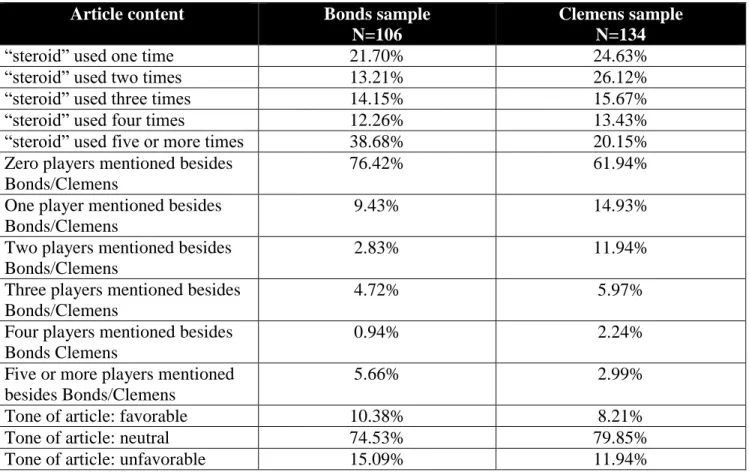
Clemens sample (Figure 2).
Figure 2 – Analysis of the article
Article content Bonds sample
N=106
Clemens sample N=134
“steroid” used one time 21.70% 24.63%
“steroid” used two times 13.21% 26.12%
“steroid” used three times 14.15% 15.67%
“steroid” used four times 12.26% 13.43%
“steroid” used five or more times 38.68% 20.15%
Zero players mentioned besides Bonds/Clemens
76.42% 61.94%
One player mentioned besides Bonds/Clemens
9.43% 14.93%
Two players mentioned besides Bonds/Clemens
2.83% 11.94%
Three players mentioned besides Bonds/Clemens
4.72% 5.97%
Four players mentioned besides Bonds Clemens
0.94% 2.24%
Five or more players mentioned besides Bonds/Clemens
5.66% 2.99%
Tone of article: favorable 10.38% 8.21%
Tone of article: neutral 74.53% 79.85%
27 I coded two categories for the frequency of the word “steroid” and the frequency of other
players linked to steroids. The first category was formed with the belief that greater frequencies of the word “steroid” might make the athlete seem guiltier. As seen in Figure 2, a much higher
percentage of Bonds sample (38.68 percent) included the word “steroid” five or more times, in
comparison to Clemens sample (20.15 percent).
The next category was formed with the belief that greater frequencies of other players
might make Bonds or Clemens seem less guilty. If other players are mentioned, more blame
might be attached to the culture of baseball as opposed to the individual athlete (Greer &
Murray, 2014). A higher proportion of Bonds sample (76.42 percent) mentioned no other player
as opposed to the Clemens sample (61.94 percent).
Lead paragraph
Past research suggests that leads work with headlines to introduce certain frames for the
reader (Goshorn and Gandy, 1995). It was uncommon for Bonds or Clemens to be depicted as
athletic or hardworking in the lead paragraph. There were no clear depictions of those attributes
in 94 percent of the Clemens sample and 97 percent of the Bonds sample. Additionally, there
were no descriptions of aggression or arrogance in more than 95 percent of the leads in each
sample. There were no significant differences in tone between the two samples. Most of the lead
paragraphs in both samples were neutral, but it was more common for both athletes to be
28 Figure 3 – Analysis of lead paragraphs
Lead paragraph content Bonds sample n=106
Clemens sample n=134
Focus on the athlete 55.66% 51.49%
Focus on different subject 44.34% 48.51%
The word “steroid” or any synonymous wording is included
34.91% 47.76%
The word “steroid” or any synonymous wording isn’t included
65.09% 52.24%
Tone of the lead: favorable 11.32% 12.69%
Tone of the lead: neutral 68.87% 71.64%
Tone of the lead: unfavorable 19.81% 15.67%
In more than 50 percent of the leads in each sample, Bonds or Clemens was the main
subject (Figure 3). The largest discrepancy among the lead paragraph categories was whether “steroid” or any synonymous wording was included. A much higher proportion of Clemens
sample contained such phrasing in comparison to Bonds sample (Figure 3). Some examples of synonymous wording include “drug use,” “performance-enhancing drugs,” or “syringes.”
Quotes and source selection
Source selection was not mutually exclusive, meaning one or more sources could be
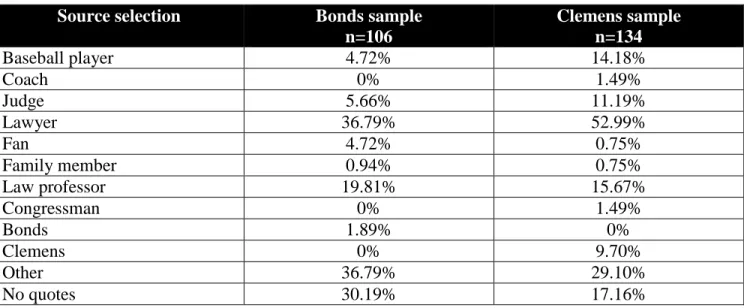
selected for each article. The most frequent sources for both samples were lawyer, “other,” and law professor. Examples of sources that comprised the “other” category include jurors,
witnesses, and representatives from the Hall of Fame. Bonds sample had a much greater portion
of articles that contained no quotes in comparison to Clemens sample. As seen in figure 4,
Clemens was used as a source in 9.70 percent of his sample. Bonds was used as a source in 1.89
29 The quotes uncommonly described Bonds or Clemens as athletic or hardworking. The
quotes described Clemens as hardworking in 4.47 percent of the sample and described him as
athletic in 2.24 percent of the sample. Bonds was almost never classified as athletic or
hardworking in the quotes. The quotes described Bonds as athletic only one time, and no quotes
described him as hardworking. Additionally, most of the quotes did not depict either athlete as
arrogant or aggressive. The quotes showed no clear depictions of anger or arrogance in more
than 95 percent of the quotes in each sample.
Figure 4 – Source selection
Source selection Bonds sample
n=106
Clemens sample n=134
Baseball player 4.72% 14.18%
Coach 0% 1.49%
Judge 5.66% 11.19%
Lawyer 36.79% 52.99%
Fan 4.72% 0.75%
Family member 0.94% 0.75%
Law professor 19.81% 15.67%
Congressman 0% 1.49%
Bonds 1.89% 0%
Clemens 0% 9.70%
Other 36.79% 29.10%
No quotes 30.19% 17.16%
Figure 5 – Analysis of quotes
Tone of quotes Bonds sample
n=106
Clemens sample n=134
Favorable 10.38% 15.67%
Neutral 51.89% 55.97%
Unfavorable 7.55% 11.19%
30 The overall tone of the quotes was mostly neutral. The Clemens sample had a higher
percentage of favorable and unfavorable quotes as opposed to the Bonds sample, but that might
be due to Bonds sample not containing as many articles with quotes (Figure 5).
Closing paragraphs
I coded the closing paragraphs with the same categories used to describe the lead
paragraph. The closing paragraphs infrequently described Bonds or Clemens as athletic, skilled,
hardworking, or intelligent. There were no indications of athleticism or intelligence in more than
96 percent of the closing paragraphs in both samples. The same trend was found in depictions of
aggressiveness and arrogance. In Clemens sample, only three articles had a closing paragraph
that described the athlete as overly aggressive or arrogant. In Bonds sample, it happened in only
one article.
Figure 6 – analysis of closing paragraphs
Closing paragraph content Bonds sample n=106
Clemens sample n=134
Focus on the athlete 43.40% 39.55%
Focus on different subject 56.60% 60.45%
The word “steroid” or any synonymous wording is included
28.30% 34.33%
The word “steroid” or any synonymous wording isn’t included
71.70% 65.67%
Tone of the closing: favorable 16.04% 15.67%
Tone of the closing: neutral 62.26% 68.66%
Tone of the closing unfavorable 21.70% 15.67%
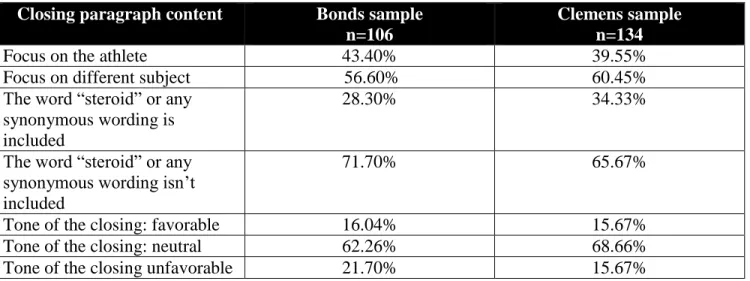
In most of the articles, the subject shifted away from Bonds or Clemens in the closing
31 “steroid” or any synonymous wording. This type of wording was excluded in more than 65
percent of the closing paragraphs in both samples (Figure 6). In the analysis of tone, the closing
paragraphs in both samples showed comparable percentages of favorability and neutrality.
However, Bonds sample had a moderately higher proportion of unfavorable closing paragraphs
32 Chapter 4: Discussion
Through this study, I sought to find discrepancies in prominence, tone, and racial
descriptions in the media coverage of Barry Bonds and Roger Clemens. The results revealed
minimal differences across the framing devices.
Articles that focused on Bonds were usually much longer than articles that focused on
Clemens. Sixteen of the articles in Bonds sample exceeded 1,000 words in comparison to just
nine articles in the Clemens sample. In addition to word count, Bonds was more commonly the
main focus of the lead and closing paragraphs, but by only a small margin. These findings seem
to reject Smith and Hattery’s (2006) statement that crimes by Black athletes are more captivating
because they confirm “all of White America’s worst fears.”
There was no major difference in the tone of either sample. Bonds sample had a higher
percentage of unfavorability in the lead paragraphs, closing paragraphs, and the article overall.
But Clemens sample had a higher percentage of unfavorability in the headlines and quotes. On
the other side of the spectrum, Bonds sample had a higher percentage of favorability in
headlines, closing paragraphs, and the article overall, while Clemens sample had a higher
percentage of favorability in lead paragraphs and quotes. Neither athlete had an overwhelmingly
positive or negative tone throughout their samples.
Both samples had articles that included former players defending the athlete. Hank Aaron – who Bonds passed on the career home run list – said in a New York Times article that the home
run record belongs to Bonds and that even if “the government produced 3,000 witnesses,” Bonds
would be the home run champion (Rhoden, New York Times). In a USA Today article, Clemens
33 that Clemens’ acquittal on charges of lying to Congress should allow him to enter the Hall of
Fame (Nightengale, USA Today).
Another interesting trend is that more articles depicted fan support in Bonds sample in
comparison to Clemens sample. For example, in October 2010 the New York Times published “Bonds is Still the King of the City” and “Giants Always Leave the Door Ajar for Bonds,” and
USA Today published “Bonds era, aura alive, though hard to find.” Each article depicted Bonds favorably, with positive quotes from fans. After Bonds was convicted in April 2011, A USA
Today author wrote, “Bonds' status as the city's favorite son seems to have eroded.” However, the same article ends with a quote of a fan voicing his support, “There was a whole bunch of guys who were in exactly that situation from that era who are not on trial for anything right now”
(Ortiz, USA Today). Clemens sample contained only one article that included quotes from fans.
In August 2010, A New York Times author wrote that fans in Houston are divided about
Clemens, but the article ends on a favorable quote from a fan, “…I’m not unhappy I saw games during the steroid era. The Astros would welcome him back” (Belson, New York Times).
The largest discrepancy between the samples came in the categories that coded for frequency of the word “steroid” and the frequency of other players linked to steroids. Bonds
sample used “steroid” five or more times in nearly 40 percent of the sample, while that was the
case in only 20 percent of Clemens sample. It was also more common for no other players linked
to steroids to be mentioned in Bonds sample in comparison to Clemens sample. These results are
the strongest evidence that Bonds was depicted as guiltier than Clemens during the steroid
fallout. These findings suggest that Bonds was more to blame for his steroid use while Clemens
34 synonymous wording was found more often in the lead and closing paragraphs of the Clemens
sample. So while part of the evidence supports that Bonds was depicted as guiltier, there were
compelling results to counter it.
Several studies have found that the media might often portray Black athletes as skilled
and athletic and portray White athletes as hardworking and intelligent (Rada, 1996; Mangun,
2013; McElroy, 2014). Differing results were found in this study. Across all the framing devices,
the athletes were infrequently referred to as athletic, skilled, hardworking, or intelligent. The
descriptions that did appear were brief. One Chicago Tribune article said Bonds broke the home run record “with an incredibly advanced skill set,” but he does not make another reference to his
athletic ability (Rogers, the Chicago Tribune). In one Wall Street Journal article, Clemens was described as hardworking by defense witnesses during the trial. The article states, “A series of
former players extolled Mr. Clemens as an athlete who outworked, out-trained, and outsmarted his fellow players” (Devlin, the Wall Street Journal). However, these descriptions reflected more
on the defense witnesses during the trial, not the media. While there were instances of racial
stereotypes, there were not enough examples to suggest it was a trend or common theme throughout either athlete’s sample.
There was no trend in descriptions of aggressiveness or arrogance either. However,
among the few depictions of aggressiveness or arrogance, the descriptions were usually overt.
Bonds was described as moderately aggressive or arrogant three times and described as overly
aggressive or arrogant seven times. Clemens was described as overly aggressive or arrogant five
times, but was never described as moderately aggressive. In one Chicago Tribune article about Bonds, the writer states, “But this trial was about Bonds, an arrogant, entitled celebrity athlete,
35 states, “Rolling over for your dramatic benefit is not Mr. Clemens's style. Not when he feels he's
been wronged. Not ever” (Gay, Wall Street Journal). Since the depictions of aggressiveness or
arrogance were similar between samples, these findings do not match the results of past studies
that argue the media might depict Black athletes as more aggressive than their White
counterparts (Enck-Wazner, 2009; Brown, 2005).
There were only two articles that mentioned race. However, these two articles offered
strong opinions about Bonds, Clemens, and the racial issue in athletics. The first was an article
from the New York Times entitled “Again, a Star is Prosecuted for his Unlikability.” The author states, “…the eight-year pursuit of Bonds also reflects America's discomfort with prominent,
powerful, wealthy black men” (Rhoden, New York Times). The author later states that some
people make the argument that because it was Roger Clemens who was going to trial for perjury,
Bonds was not being singled out because he was a Black star. However, the author disregards this argument by stating, “The government was virtually forced to go after Clemens, who loudly
denied allegations of drug use by his former trainer during a Congressional hearing” (Rhoden,
New York Times).
The second article that mentioned race was an article from the Chicago Tribune called “Cry for baseball, but not for its 2 greatest sinners.” The Tribune column criticizes the author of
the New York Times column for suggesting the Bonds’ fiasco was due to racism. In response to
the New York Times column, The Chicago Tribune author states “…seeing (the race card)
invoked on behalf of a narcissistic juicer who made millions — in the same game played by
Jackie Robinson — is just too pathetic for words” (Kass, Chicago Tribune). These two columns
are an example of how some baseball fans are split on Bonds and the race issue. Both authors
36 the arrogance as refusing to be “limited by social convention about how a champion was
supposed to behave” while the Chicago Tribune author states “He shared it, distributing his sin
like some baseball-transmitted disease” (Rhoden, New York Times; Kass, Chicago Tribune).
Although most of the articles in each sample were neutral, these two columns showcase
strikingly different opinions about Bonds, further emphasizing the importance of studying the
media coverage of Bonds and Clemens.
When Bonds was matched with Lance Armstrong in Greer and Murray’s (2014) study,
Armstrong was shown as more favorable. However, when coverage of Bonds was analyzed with
a more accurate comparison in Clemens, there were minimal differences. These findings propose
that the media did not treat Bonds unfairly because of race.
Due to time and resource restraints, there were several limitations to this study. Only five
national newspapers were used for the research. A greater selection of media would have
provided more accurate results in how Bonds and Clemens were depicted across the country.
Also, the news articles were retrieved electronically. A collection of the actual printed articles would’ve revealed important information such as page placement, use of photos, column inches,
and headline size.
Media coverage of Bonds and Clemens requires more examination before researchers can
draw any firm conclusions. This research uncommonly found racial stereotypes because the timeframe of the study takes place after both athletes’ playing careers. A future a study could be
conducted examining Bonds and Clemens in the midst of their playing careers, before either
athlete was accused of using steroids. That research would be more accurate in finding
37 the study was the use of fans in Bonds sample. It makes sense that writers would use quotes from fans more often since Bonds’ trial was located in San Francisco, where he played for a number of
years. A study comparing local coverage of Bonds’ trial and Clemens’ trial to national coverage
would have significant value because it might reveal subtle bias in how Bonds and Clemens were
portrayed. Media coverage of race is a salient issue, especially in sports. These future studies
38 References
A timeline in the career of Barry Bonds. (2015, July 21). Associated Press. Retrieved from
http://bigstory.ap.org/article/ce203d429c42416abd862bbba22c196a/timeline-career-barry-bonds
Anuradha, M. (2012). Gender Stereotyping in Television Commercials Aimed at Children in India.
Media Asia (Asian Media Information & Communication Centre), 39(4), 209–215.
Bandura, A. (1977). Self-efficacy: toward a unifying theory of behavioral change. Psychological
Review, 84(2), 191.
Bandura, A. (1999). Social Cognitive Theory: An Agentic Perspective. Asian Journal of Social
Psychology, 2(1), 21–41.
Bisher, F. (1956). Born to Play Ball. Saturday Evening Post, 229(8), 30–76.
Brooks, D. E., & Rada, J. A. (2002). Constructing Race in Black and Whiteness: Media Coverage of
Public Support for President Clinton. Journalism & Communication Monographs, 4(3), 113–
156.
Brown, T. J. (2005). Allan Iverson as America’s Most Wanted: Black Masculinity as a Cultural Site
of Struggle. Journal of Intercultural Communication Research, 34(1/2), 65–87.
Butterworth, M. L. (2007). Race in “The Race”: Mark McGwire, Sammy Sosa, and Heroic
Constructions of Whiteness. Critical Studies in Media Communication, 24(3), 228–244.
Cabot, M. A. (2011). Barry Bonds vs. the Media. Journal of Mass Media Ethics, 26(1), 66–70.
Career Leaders & Records for Home Runs | Baseball-Reference.com. (n.d.). Retrieved from
http://www.baseball-reference.com/leaders/HR_career.shtml
Career Leaders & Records for Strikeouts | Baseball-Reference.com. (n.d.). Retrieved October 19,
39 Chuma, W. (2012). Framing the Cape Town World Cup stadium in the media: The politics of identity
and sports in South Africa. Journal of African Media Studies, 4(3), 315–329.
Cooper, A. H. (2002). Media framing and social movement mobilization: German peace protest
against INF missiles, the Gulf War, and NATO peace enforcement in Bosnia. European Journal
of Political Research, 41(1), 37–80.
De Vreese, C. H. (2005). News framing: Theory and typology. Information Design Journal+
Document Design, 13(1), 51–62.
Dixon, T. L. (2008). Crime News and Racialized Beliefs: Understanding the Relationship Between
Local News Viewing and Perceptions of African Americans and Crime. Journal of
Communication, 58(1), 106–125.
Dixon, T. L., & Maddox, K. B. (2005). Skin Tone, Crime News, and Social Reality Judgments:
Priming the Stereotype of the Dark and Dangerous Black Criminal1. Journal of Applied Social
Psychology, 35(8), 1555–1570.
Domke, D., McCOY, K., & Torres, M. (1999). News Media, Racial Perceptions, and Political
Cognition. Communication Research, 26(5), 570–607.
Eagleman, A. M. (2011). Stereotypes of Race and Nationality: A Qualitative Analysis of Sport
Magazine Coverage of MLB Players. Journal of Sport Management, 25(2), 156–168.
Enck-Wanzer, S. M. (2009). All’s Fair in Love and Sport: Black Masculinity and Domestic Violence
in the News. Communication & Critical/Cultural Studies, 6(1), 1–18.
Entman, R. M. (1993). Framing: Toward Clarification of a Fractured Paradigm. Journal of
Communication, 43(4), 51–58.
40 Ferrucci, P., Tandoc, E. C., Painter, C. E., & Leshner, G. (2013). A Black and White Game: Racial
Stereotypes in Baseball. Howard Journal of Communications, 24(3), 309–325.
Gamson, W. A., & Modigliani, A. (1989). Media Discourse and Public Opinion on Nuclear Power: A
Constructionist Approach. American Journal of Sociology, 95(1), 1-37.
Gilens, M. (1996). Race and Poverty in America Public Misperceptions and the American News
Media. Public Opinion Quarterly, 60(4), 515–541.
Goshorn, K., & Gandy, O. H. (1995). Race, Risk and Responsibility: Editorial Constraint in the
Framing of Inequality. Journal of Communication, 45(2), 133–151.
Greer, J. & Murray, C. (2014). Armstrong, Bonds, and PEDs: Racial Framing in U.S. Newspapers,
1999-2006. In L. Martin (Ed.), Out of Bounds (pp. 255-277). Santa Barbara: Praeger
Grusec, J. (1992). Social learning theory and developmental psychology: The
legacies of Robert Sears and Albert Bandura. Developmental Psychology, 28, 776–786
Hänggli, R. (2012). Key Factors in Frame Building: How Strategic Political Actors Shape News
Media Coverage. American Behavioral Scientist, 56(3), 300-317
Holt, L. F. (2012). Hillary and Barack: Will Atypical Candidates Lead to Atypical Coverage? Howard
Journal of Communications, 23(3), 272–287.
Hertog, James K.McLeod, Douglas Malcol. (1995) Anarchists wreak havoc in downtown Minneapolis
:a multi-level study of media coverage of radical protest Columbia, SC : Association for Education in Journalism and Mass Communication,
John, C. S., & Heald-Moore, T. (1996). Racial Prejudice and Fear of Criminal Victimization by
Strangers in Public Settings*. Sociological Inquiry, 66(3), 267–284.