Master’s Paper for the M.S. in I.S degree. April, 2019. 64 pages. Advisor: Stephanie W. Haas
Most Airbnb homes have high ratings with a large proportion of positive reviews from users. However, the Airbnb website only releases the rating score of each aspect for each home. The aspect scores given by each reviewer are not available on the website. It is possible that the overall aspect score does not really reflect users’ sentiment as
represented in their comments about that aspect.
This paper proposes a methodology for finding the correspondence between aspect scores of Airbnb homes and the sentiments of their reviews. I set the sentiment analysis at the sentence level and proposed a sentence-to-aspect relevance detection approach for subjectivity classification step. The distributions of the sentiment polarities found in aspect-relevant for both the cleanliness and the location aspect show an apparent correspondence between review text and the aspect score.
Headings:
TO-ASPECT RELEVANCE MODEL
by Tianlin Lan
A Master’s paper submitted to the faculty of the School of Information and Library Science of the University of North Carolina at Chapel Hill
in partial fulfillment of the requirements for the degree of Master of Science in
Information Science.
Chapel Hill, North Carolina April 2019
Approved by
TABLE OF CONTENTS
1 INTRODUCTION ... 2
2 LITERATURE REVIEW ... 4
2.1 Sentiment Analysis ... 4
2.1.1 Two Approaches ... 5
2.1.2 Comparing Three Levels of Sentiment Analysis ... 7
2.2 Airbnb Studies ... 13
3 METHODOLOGY ... 16
3.1 Data ... 16
3.1.1 Initial Dataset: The Officially-Released Data of Seattle by Airbnb ... 16
3.1.2 Data Cleaning of the Initial Dataset ... 17
3.1.3 Data Selection for the Analysis of Two Aspects ... 19
3.2 Sentence-to-Aspect Relevance Detection Approach ... 21
3.2.1 The Relevance Lexicon of Aspects ... 21
3.2.2 Detecting the Relevance between Sentences and Aspects ... 26
3.2.3 Threshold Relevance Score Selection ... 27
3.3 Sentiment Analysis of Sentences ... 29
3.3.1 Determine the Sentiment Polarity of Each Sentence ... 29
3.3.2 Analysis of the Sentiments of Aspect-Relevance Sentences ... 29
4 RESULTS AND DISCUSSION ... 31
4.1 Statistics of Data Subsets for Aspects ... 31
4.2 Sentiment Statistics for Aspects ... 33
4.2.1 Overall Sentiment Polarities Distribution of Aspects ... 33
4.2.2 Average Sentiment Polarities Distribution of Aspects... 35
4.2.3 Polarities Distribution Patterns for Homes with Same Aspect Score ... 37
5 CONCLUSION ... 40
6 REFERENCES ... 42
1
INTRODUCTION
The growth of social media and online feedback technologies over the last decade provided customers with more information when making the decision of purchasing products. Online reviews, perform as the electronic word of mouth, have been found to play a significant role. More than 70% of consumers trust reviews in their own online purchasing experience (Bridges & Vásquez, 2018) because of the transparency of reviews. Airbnb, a sharing-economy homestay platform, allows purchasers rate their overall experience, as well as individual aspects such as cleanliness, location, etc. Previous researches pointed out that Airbnb homes have overwhelming positive ratings and reviews from users: nearly 95% of Airbnb homes received an average rating from users of either 4.5 or 5 (maximum) stars (Zervas, Proserpio & Byers, 2015). However, Airbnb website only shows a single score for each aspect to represent all reviewers score. Does the aspect score really represent the all guests’ opinion? Is that possible the score covers negative sentiments from guests towards the aspect?
sentence-to-aspect relevance detection approach for the first step and used the Stanford CoreNLP1 in the second step.
The hypothesis of this research is: there exists a correspondence between aspect scores and review text. Airbnb homes with higher aspect scores have larger proportion of positive sentences related to the aspect. The percentage of positive aspect-relevant sentences in reviews increases when the aspect score increases.
2
LITERATURE REVIEW
This section is the review of the previous relevant literature of this research. The review focuses on two main topics: sentiment analysis, and Airbnb review analysis.
2.1
Sentiment Analysis
Sentiment analysis is about finding out the emotions and sentiments of people towards a wide range of things such as a particular product, the function of a system, an event and so on. The phrase “opinion mining” (Pang & Lee, 2008; Pak & Paroubek, 2010; Esuli & Sebastiani, 2006; Chaovalit & Zhou, 2005) is used interchangeably with “sentiment analysis” in the academic field. The purpose of sentiment analysis and opinion mining is to the classify the sentiment expressed in natural language text.
Typically, the classification includes polarity (that is, positive or negative), and may also include strength (very positive, somewhat positive, and so on) (Chaovalit & Zhou, 2005; Liu, 2012).
process. For example, Bermingham & Smeaton (2011) analyzed the sentiments of Twitter postings to predict people’s political attitudes and then predicted the election result based on that analysis. In another project, movie review texts were used in an experiment on sentiment analysis by Joshi, Das, Gimpel & Smith (2010) to predict the opening weekend revenue.
2.1.1 Two Approaches
The studies of sentiment analysis are mainly about two approaches, the corpus-based approach and the lexicon approach (Liu. 2012) which is also known as supervised approach and unsupervised approach respectively (Abdulla, Ahmed, Shehab, & Al-Ayyoub, 2013).
The corpus-based approach requires a considerable volume of data with labels manually annotated by experts. Then, through training and applying machine learning classifiers such as Naïve Bayes (NB) and K-Nearest Neighbor (KNN), researchers have achieved high accuracies in detecting the polarity of a text. Pang, Lee, & Vaithyanathan (2002) implemented various machine learning techniques on movie reviews data from the Internet Movie Database (IMDb) archive of the rec.arts.movies.reviews newsgroup2. Their best accuracy was 82.9% when using the “unigrams + bigrams” input features. With the same data, Chaovalit & Zhou (2005) obtained 85.54% accuracy using 3-fold cross validation.However, the corpus-based approach is not very applicable for real-world cases due to the cost of the labeling process. Also, even if the classifier is very effective in a given domain like the movie reviews, the performance varies a lot when
applying the same classifier into other domains (Taboada, Brooke, Tofiloski, Voll & Stede, 2011).
The unsupervised approach, also referred to as the lexicon approach, is more practical. It assigns the polarity value representing positive, negative, neutral to each word according to a prepared lexicon. The lexicon can be created either manually or automatically. The automatic method starts from a set of seed words that contain strong positive or negative associations, such as excellent or abysmal. The next step is to expand the lexicon by adding adjective words in the whole text that associates with seed words (Taboada, Brooke, Tofiloski, Voll & Stede, 2011). Then, an overall sentiment score of each text or sentence can be computed using polarity values of all words in the text. However, the accuracy may be lower than the supervised approach. Turney (2002) only obtained 65.86% accuracy using the unsupervised approach on 120 movie reviews data from the Epinions3 website which is less than the accuracy (82.9%) of using supervised approach. Chaovalit & Zhou (2005) also compared two approaches on 100 movie reviews from Movie Vault4. They showed that a supervised approach (85.54%) is more accurate than unsupervised one (77%). They suggest that supervised approach costs a tremendous amount of time, while the unsupervised one compromised accuracy a little, but is more practical. Abdulla, Ahmed, Shehab, & Al-Ayyoub (2013) did the same comparison using tweets data in Arabic and reached a similar conclusion. The best
accuracy of supervised approaches is 87.2% while the best accuracy of their unsupervised approaches was only 59.6%.
Additionally, a hybrid approach merging the two approaches together was also proposed (El-Halees, 2011). El-Halees collected 1143 posts with Arabic statements as documents from education, politics and sports forum. He used the lexicon-based
(unsupervised) method to assign the sentiment label for each document, which resulted in 50% accuracy on sentiments of documents. Those labeled documents then were used as training set in the next-step supervised learning model (k-nearest neighbor classifier). The prediction accuracy of predicting sentiments of documents was then increased from 50% to 80%.
2.1.2 Comparing Three Levels of Sentiment Analysis
The sentiment analysis can be performed in different levels, document-level, sentence-level and aspect-level, to offer sentiment information from general to detailed. For each level analysis, this section points out the assumption, summarizes some previous researches and describes its pros and cons.
2.1.2.1 Document-level Sentiment Analysis
Document level sentiment analysis is based on the assumption that each document indicates only one overall sentiment opinion (Pang & Lee, 2008). For example, one review of an Airbnb home only expresses an overall positive or negative attitude towards the home. The challenge of this level of analysis is how to deal with the relations among sentences. If there is one positive sentence and one negative sentence in a document, the coordinating word joining the two sentences may affect the overall sentiment of
analysis cannot consider the sentiment transition in the sentence. Studies in this field are still not sufficient to solve this problem, instead, researchers generally neglect this challenge when designing their models. For example, Jiang, Yu, Zhou, Liu & Zhao (2011) considered the semantic relationships within each sentence when proposing and experimenting their document representation based on neural networks. However, they still did not capture the relationships between different sentences. Another distinct disadvantage of document-level sentiment classification is that the only one overall opinion may cover detailed indications in the document.
The disadvantage that document-level sentiment analysis does not deal with fine-grained tasks makes it less suitable for analyzing documents with long length such as newspaper, article, long blogs. However, this level sentiment analysis still works for cases like tweets and reviews that only have a few sentences.
2.1.2.2 Sentence-level Sentiment Analysis
The sentence-level sentiment analysis remedies the defect of document level to some extent. Many applications of this level’s analysis come with opinion targets which can be an entity like a product or an aspect of a review, such as the cleanliness of a house or hotel room. By identifying the targets first and then detecting the sentiments of
sentences, one could know the opinion polarity (positive or negative) toward the entity or aspect. There are two steps in sentence-level sentiment analysis, the subjectivity
statement without expressing an opinion about the home. The second step is to do the sentiment classification of each sentence. Each sentence can be regard as a smaller document. However, instead of dealing with the relationships among sentences in document-level, the problem here is about the semantic relationships among words in sentences.
Yu & Hatzivassiloglou (2003) built a Bayesian classifier and then used the sentence similarity for subjectivity classifications. Their model experimented on 2,000 articles from Wall Street Journal (WSJ) from 1987 to 1992. The features they used in the classifier include unigrams, bigrams, the presence of sentiment words, part-of-speech (POS). They measured sentence similarity according to common words, phrases, and WordNet synsets and assumed that subjective (opinioned) sentences are more similar to each other than to the objective sentences. Then, for sentence sentiment classification, they used the unsupervised approach proposed by Turney (2002) to extract phrases with adjectives or adverbs and calculate the sentiment orientation of each phrase using PMI (Pointwise Mutual Information). Their results achieved high precision and recall (F-measure of 91%) on detecting opinion sentences and 90% accuracy in predicting the sentiment polarities. Compared with the original 66% accuracy (Turney, 2002), the improvement is very significant.
research, and subjective nouns from the research of Riloff, Wiebe & Wilson (2003). After experimenting on 535 texts from publications of the Foreign Broadcast Information Service (FBIS), their model achieved 73.1% subjectivity precision and 66.2% subjectivity recall. Barbosa & Feng (2010) proposed an approach in the subjectivity classification of postings on Twitter that included special features of Twitter, retweets, hashtags, smileys, etc. Jiang, Yu, Zhou, Liu & Zhao (2011) improved the accuracy of sentiment classification for Twitter texts from 78.8% to 85.6% by adding target-dependent features for sentences in their research.
score(aspect) = - ./0123/01 4567/ 89 8:20280 ;8<= =2.150>/(8:20280 ;8<=, 5.:/>1)
@ABCB@C D@EFG BC GHCIHCJH
They used their method on customer reviews of 8 digital products and achieved 92% precision, 91% recall and 0.91 F-score. The results are better than the results of using methods proposed by Hu & Liu (2004), of 93% in precision, 76% recall and 0.83 F-score.
2.1.2.3 Aspect-level Sentiment Analysis
Aspect-based sentiment analysis (ABSA) extracts opinions more detailed than the other two levels by decomposing the document or sentence into aspect-relevant corpus of words or phrases. The assumption is in accord with the cases in reality that each
combining both frequent and infrequent aspects in the experiment, they increased the F-score of both restaurant (68.9 to 77.4) and hotel (65.9 to 74.8) data. Another approach used to improve Hu and Liu’s method is to improve the extraction of sentiment words for aspects through the dependency relation. Instead of using the closest adjectives to tag aspects, Kim & Hovy (2006) proposed a semantic role labeling framework to construct dependencies between aspect word (named as target word in their research) and other words and phrases. They labeled semantic roles including phrase type, head word, parse tree path, position and voice for words in a sentence. Their experiment data were 8,256 and 11,877 sentences that are associated to opinion bearing frames for verbs and adjectives from FrameNet5 annotation data. Using the semantic role labeling method, their system improved F-score for both adjective (38.2% to 70.3%) and verb target words (30.4% to 66.5%).
From the probability perspective in considering the aspect extraction, researchers used topic modeling in ABSA. Topic model discovers the abstract “topics” that occur in a collection of documents. In sentiment analysis, the “topics” can be regarded as aspects. Lu, Ott, Cardie & Tsou (2011) compared the performances of LDA (Latent Dirichlet Allocation) model, Local LDA model, Multi-Grained LDA model and Segmented Topic Models (STM) in sentiment analysis. The data they used for their aspect-labeling
experiment were 73,495 restaurant reviews with the aspect ratings on food, service and ambiance aspects. They suggest that those topic models have good performance given that all models lead to higher than 0.7 F-score for all three aspects. However, only the
best accuracy (80.3%) by using Local LDA is comparable to the result (83.0%) of using supervised SVM classifier while other models only have accuracies: 47.7% (LDA), 76% (MG-LDA) and 79.4% (STM).
2.1.2.4 Comparison
Compared with document-level analysis, sentence-level sentiment analysis focuses more directly on the opinion targets. Sentence-level sentiment analysis removes the unopinionated sentences in a document so that reduces the noise of those sentences and thus increases the performance of sentiment detection. However, it generally requires additional information, the opinion target, to do the subjectivity classification step. Only knowing the sentiment expressed by a sentence is useless if which target the sentence talks about is unknown. So, sentence-level analysis is more feasible in cases like online reviews, tweets which have specific opinion targets rather than texts in forums, blogs or newspapers. Aspect-level sentiment analysis performs better when encountering complex sentences that express multiple aspects with different sentiments. It orients phrases or words in sentences to their relevant aspects. So, even if a sentence contains multiple aspects, one can use the relevant text of each aspect to determine its polarity. However, because the ABSA method extracts aspects directly from texts, if one wants to analyze the texts for a given aspect, it is possible that the given aspect is not included in the extracted aspects.
2.2
Airbnb Studies
and another sharing economy platform, TripAdvisor. They found the proportion of positive ratings on Airbnb is overwhelmingly more than the other two and suggest the underlying reasons from the qualitative perspective. They suggest some behaviors of hosts of Airbnb may cause the too-positive phenomenon: rejecting customers that they identify as unsuitable on their own, preempting negative reviews and creating new property page to reset previous negative scores. Bridges & Vásquez (2018) analyzed 400 reviews of Airbnb from both guest and hosts (each with 200 reviews). They manually coded and categorized those reviews as either positive or negative. By coding the positive and negative corpus of reviews, they got the result that 93% of Airbnb reviews were positive which suggests a positivity bias in Airbnb reviews. They also supported one of the conclusions from Zervas et al. (2015) that guests maybe unwilling to write negative comments about the hosts. Their results find that negative reviews on Airbnb are more about the property or the location rather than the host, which suggests reviewers tend to avoid negative comments of host in their reviews.
Cheng & Jin (2019) implemented aspect-based sentiment analysis on Sydney Airbnb review data using Leximancer (a text mining software6) and compared the extracted aspects with concepts gathered from previous hotel stays literatures. Their results suggest that when assessing the experience, guests of Airbnb use basically the same attributes used by guests reviewing hotels, but the priority of attributes is different. Location, amenities, and host are aspects that Airbnb guests mostly care about. They also suggest that there exists a positivity bias in Airbnb reviews.
3
METHODOLOGY
In this section, I describe the process of conducting the aspect-based sentiment analysis in this research. The following subsections:
• describe the dataset used in this research,
• elaborate the data cleaning and selection process,
• propose and validate the sentence-to-aspect relevance detection model, and • explain the method of getting the sentiment polarities values and the analysis
method of sentiments.
The goal is to observe the correspondence between customers’ review texts and the numeric aspect scores of Airbnb homes. All python codes have been presented in a GitHub repository7.
3.1
Data
3.1.1 Initial Dataset: The Officially-Released Data of Seattle by Airbnb
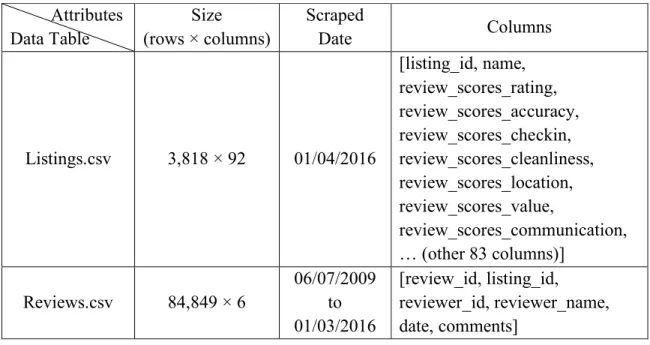
The initial dataset of this research includes two csv tables, listing.csv and reviews.csv, which contains the homes and reviews information in Seattle city released by Airbnb official account on Kaggle8. It can be assumed that the dataset is authentic and reliable given that it was released by Airbnb. The dataset also represents contemporary
Airbnb data given the scraped date of 01/04/2016. Table 1 shows the detailed contents of the two tables.
Table 1: Basic Information of Dataset
In summary, listings.csv provides the home description information including the distinct listing_id, price, accommodation, etc. and the score information of the homes such as overall score rating, and 6 aspect scores. The reviews.csv includes the distinct ids of each review, the listing_id reviews were written for, reviewer information and
comments text. Two tables can be interlinked by the “listing_id”. One Airbnb can have multiple reviews while each review is only about one home.
3.1.2 Data Cleaning of the Initial Dataset
This section is about the regular data cleaning process including removing empty data, and selecting necessary columns from the dataset for this research.
I removed 660 homes from the 3818 homes included in listings.csv, the table of homes information, because they were missing aspect scores. Next, I extracted the
Attributes Data Table
Size (rows × columns)
Scraped
Date Columns
Listings.csv 3,818 × 92 01/04/2016
[listing_id, name, review_scores_rating, review_scores_accuracy, review_scores_checkin, review_scores_cleanliness, review_scores_location, review_scores_value,
review_scores_communication, … (other 83 columns)]
Reviews.csv 84,849 × 6
06/07/2009 to 01/03/2016
[review_id, listing_id,
columns needed for this research. I focus on the location aspect and the cleanliness aspect, so out of the 92 columns in this table, I used the following 4 columns:
• listing_id: the unique id of each home
• number_of_reviews: the number of reviews for each home
• review_scores_cleanliness: the average cleanliness score for each home • review_scores_location: the average cleanliness score for each home
As for the reviews.csv, the table of reviews information, I removed 1119 reviews from 84849 reviews. The category of removed reviews are:
• Reviews automatically posted by Airbnb system with the same text: “The host canceled this reservation the day before arrival. This is an automated posting.” (57 reviews)
• Reviews that are not in English, for example, “위치가너무좋았습니다.
스티브는너무친절했습니다.\r\n가격도저렴합니다.\r\n다시시애틀에간다면또
이용하겠습니다”. (1032 reviews)
• Reviews with meaningless text such as only punctuation or a smiley. For example: “.”, “:)” etc. (30 reviews)
Out of the 6 columns in this table, I used the following 3 columns: • listing_id: the unique id of each home
Then, I merged two cleaned tables together using the “listing_id” column. After cleaning and merging, in the end, the data set contains 3,155 Airbnb homes and 83,682 reviews.
3.1.3 Data Selection for the Analysis of Two Aspects
This section describes the sampling process to select the homes and reviews for the sentiment analysis of the location and cleanliness aspects. The goal was to include a sufficient and comparable number of Airbnb homes and reviews for each score for further sentiment analysis. Some scores were grouped together and analyzed as a single group when the numbers of records were too small to be analyzed separately.
3.1.3.1 The Subset of Data for Cleanliness Aspect
Scores of Cleanliness Number of Homes Number of Reviews
3.0 1 2
4.0 4 9
5.0 5 23
6.0 30 107
7.0 40 511
8.0 183 3,569
9.0 740 22,197
10.0 2,152 57,262
Table 2: Distribution of Homes and Reviews by Cleanliness Score
Then, for the large number of records of cleanliness scores higher than 7, I created a random sample of 75 homes for each score group to reach approximately 2000 (the acceptable range is 1900 to 2100) number of reviews for further sentiment analysis. For the purposes of this study, I assumed that 2000 reviews would be a large enough sample for analysis. Given the average number of reviews of each home is 26.53, approximately 75 homes were needed for each group by cleanliness score to get 2000 reviews. 75 is also a reasonable number of homes that can be expected to show the sentiment distribution patterns within a score. As for the “0-7 score” group, considering the small data size, I chose to keep all the records. Table 3 shows the detailed information of subset in this section:
Scores 0 – 7 8 9 10
Selected number of homes 28 75 75 75
Number of reviews of selected homes 652 2026 2014 1984
Table 3: The Information of Subset Data for Cleanliness Aspect
3.1.3.2 The Subset of Data for Location Aspect
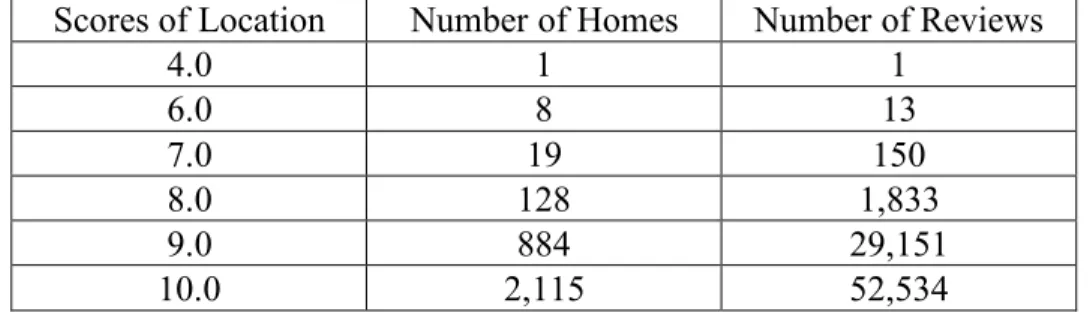
lower) and higher location scores (9, 10). The number of records of location score 8 are appropriate.
Scores of Location Number of Homes Number of Reviews
4.0 1 1
6.0 8 13
7.0 19 150
8.0 128 1,833
9.0 884 29,151
10.0 2,115 52,534
Table 4: Distribution of Homes and Reviews by Location Score
So, I followed the same procedure of selecting subset of data in cleanliness aspect. The only difference with cleanliness data selection was the data in location score 8 group. There are only 1833 number of reviews which is less than 2000, I did not make random selection here but instead kept all the records. Table 5 shows the detailed information of subset in this section.
Scores 0 – 7 8 9 10
Selected number of homes 28 128 75 75
Number of reviews of selected homes 164 1833 2017 1967
Table 5: The Information of Subset Data for Location Aspect
3.2
Sentence-to-Aspect Relevance Detection Approach
3.2.1 The Relevance Lexicon of Aspects
words. Each synset covers a set of synonyms that share a specific and distinct concept by similar semantic definition. All synsets are linked with each other by semantic
relationships such as hyponymy, antonymy, and so on. In addition, by reading through the given definitions of synsets of one word, one can deal with the polysemous problem by only selecting the useful synsets and ignoring others. For example, the synset
“goodly.s.01” of word “tidy” with the meaning “large in amount or extent or degree” is not the meaning I expected to use in cleanliness aspect analysis. After reading the definition, I did not include the words in this synset in my relevance lexicon.
The first step of extracting relevance lexicon of a certain aspect is to determine the keywords of this aspect as the starting point of using WordNet. In this research, I extracted keywords of each aspect from the “how do star ratings work” webpage of Airbnb which gives the brief official description. For example, the description of the aspect location is “How did guests feel about your neighborhood?10”; therefore, I used “location” and “neighborhood” as the keywords of location aspect.
The next step is finding the bag-of-words related to the given aspect using its keywords as the starting point in the WordNet’s synsets. In this research, there are 3 steps:
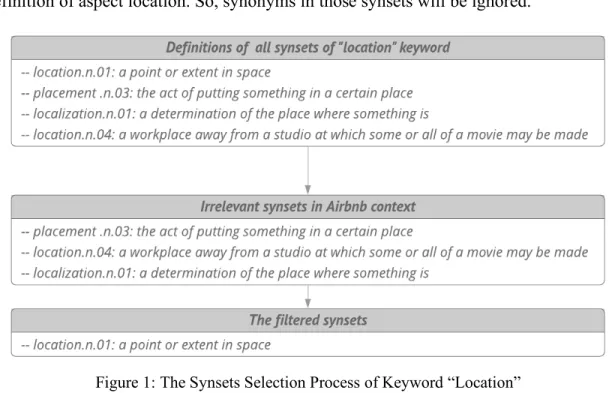
a) Filtering the synsets of all keywords. Filtering the synsets of keywords is necessary because there are some synsets of the keywords do not mean the concept of the word in the Airbnb context. For example, as shown in Figure 1, the location.n.04,
localization.n.01, placement.n.03 are not necessarily in accord with the Airbnb's definition of aspect location. So, synonyms in those synsets will be ignored.
Figure 1: The Synsets Selection Process of Keyword “Location”
b) Retrieve both synonyms and antonyms of the filtered synsets in
bag-of-words. When people comment about one aspect, they may describe their opinions by expressing the opposite evidence. For example, comments like “The apartment was clean and quiet” is relevant to the cleanliness aspect because it directly mentions the word “clean”. Comments like “The bathroom was very dirty with dust and hair in the tub and on the floor” also is relevant even though it doesn’t contain the symptoms of
“cleanliness”.
c) Investigate words in the broader or narrower semantic level of words in
Figure 2:The added words from broader and narrower semantic levels do not necessarily share the conceptual meaning of the “cleanliness” aspect in Airbnb.
Aspect Keywords Synsets Filtered Synsets Filtered Synsets Synonyms in Antonyms Relevance Lexicon
Location neighborhood Location,
location.n.01, placement.n.03, localization.n.01, location.n.04, vicinity.n.01, neighborhood.n.02, region.n.04, neighborhood.n.04 location.n.01, vicinity.n.01, region.n.04, neighborhood.n.04 locality, location, neighborhood, neighbourhood, region, vicinity, neck_of_the_woods None locality, location, neighborhood, neighbourhood, region, vicinity, neck_of_the_woods
Cleanliness clean, tidy, cleanliness cleanliness.n.01, cleanliness.n.02, tidy.n.01, tidy.v.01, tidy.a.01, kempt.s.01, goodly.s.01, clean_and_jerk.n.01, clean.v.01, clean.v.02, houseclean.v.01, cleanse.v.01, clean.v.05, clean.v.06, clean.v.07, clean.v.08, scavenge.v.04, clean.v.10, clean.a.01, clean.s.02, clean.s.03, clean.s.04, clean.s.05, clean.a.06, clean.a.07, clean.a.08, uninfected.s.01, clean.s.10, clean.s.11, blank.s.01, clean.s.13, clean.s.14, clean.s.15, clean.s.16, clean.s.17, clean.s.18, clean.r.01, fairly.r.03 clean.v.01, houseclean.v.01, clean.v.05, clean.v.08, scavenge.v.04, clean.a.01, cleanliness.n.01, cleanliness.n.02, tidy.v.01, tidy.a.01 houseclean, tidy_up, scavenge, clean_house, make_clean, straighten_out, cleanliness, square_away, clean, neaten, clean_up, straighten, tidy begrime, bemire, colly, dirty, grime, soil, soiled, unclean, uncleanliness, untidy soiled, clean_house, tidy_up, scavenge, make_clean, straighten_out, tidy, soil, grime, unclean, begrime, square_away, houseclean, cleanliness, clean_up, neaten, bemire, colly, straighten, uncleanliness, dirty, untidy, clean
3.2.2 Detecting the Relevance between Sentences and Aspects
For each aspect, I used the sentence-aspect relevance detection model described
below to create the corpus of all relevant sentences. The corpus of sentences of each
aspect were then used for the sentiment analysis and sentiment distribution. In the
sentence-aspect relevance detection model, the input variables are one sentence and the
relevance lexicon of aspects. One parameter, the relevance score, will be used to adjust
the model. Two outputs, word-similarity-score and sentence-aspect-similarity will be
computed during the process.
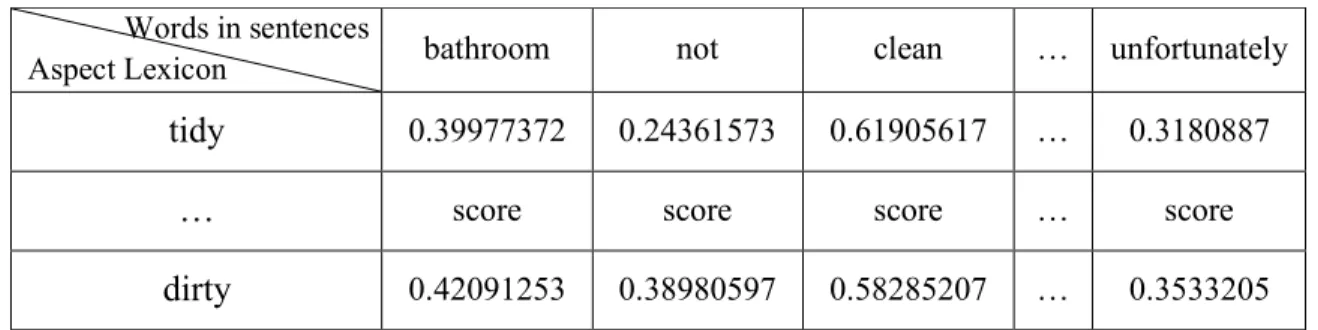
Firstly, for each word in each sentence, I computed the “word-similarity-score”
towards the keywords of one aspect. The value of word-similarity-score ranges from 0 to
1, with 0 representing poor similarity and 1 representing high similarity between two
words. For example, relevant words in the sentence, “The bathroom was not clean
unfortunately”, result in the similarity scores shown in Table 7.
Table 7: Example of word-similarity-score in a Sentence
I used the similarity method in spaCy, an open-source NLP library to compute it. I
chose to load the “en_core_web_md” model from the 4 models in spaCy for English
language processing. The chosen model contains “English multi-task CNN trained on
Words in sentences
Aspect Lexicon bathroom not clean … unfortunately
tidy 0.39977372 0.24361573 0.61905617 … 0.3180887
… score score score … score
OntoNotes, with GloVe vectors trained on Common Crawl11” and “685k keys, 20k
unique vectors (300 dimensions)”. It was also suggested by its author to use for written
text (blogs, news, comments). So, this model can be considered naturally suitable to
analyzing online Airbnb review texts.
Then, I defined a “threshold relevance score” to control sensitivity of this
sentence-aspect relevance model: a sentence is recognized as aspect relevant when there
is at least one word has the word-similarity-score larger than the “threshold relevance
score” parameter.
3.2.3 Threshold Relevance Score Selection
I selected several Airbnb homes in the dataset with more than 50 reviews each
and did manual validation for them using different relevance scores 0.5, 0.6 and 0.7. For
example, for home 30712 has 64 reviews which consists of 452 sentences, I used the
proposed model to find sentences relevant to the cleanliness aspect. I tried 3 different
threshold relevance score parameters: 0.5, 0.6 and 0.7 resulting in 3 corresponding
corpuses of relevant sentences. Every sentence in those 3 corpora contains at least 1 word
that has the word-similarity-score larger than threshold relevance score. As shown in
Table 8, the model detected 221, 43, and 31 cleanliness-relevant sentences for the three
threshold relevance scores, respectively. For each sentence in each corpus, I manually
checked the accuracy of results detected by model and summarized the precision.
Threshold Relevance Score
Number of Sentences Detected as Relevant
Number of Relevant
Sentences Checked Manually Precision
0.5 221 47 21.26%
0.6 43 43 100%
0.7 31 31 100%
Table 8: Precision of Relevant Sentence Corpuses by Running Sentence-Aspect Relevance Model with Different Relevance Score on Home30712
I found that the 0.5 corpus didn’t perform well with the accuracy 21.26%. The
reason may be that the word “clean” itself is a positive adjective which in the spaCy
similarity model is recognized to have word-similarity-score in range 0.5 – 0.6 with other
positive words like “wonderful”, “nice”, “great”, etc. The outcome of this is that
sentences like the followings were all detected as relevant sentences of “cleanliness”:
• “Overall, the neighborhood is nice, Al, and his daughter, are very welcoming and
Seattle is always great.”
• “The owner is super nice and accommodating.”
• “I had the whole place to myself so that was really nice.”
When I set the relevance score as 0.6, performance improved to 100% precision
based on my proofreading for this home 30712. However, when use 0.7 as relevance
score, although the results’ precision is also 100%, the number of sentences in the corpus
dropped a little. The underlying problem here was the balance between precision and
recall. Using the relevance score 0.5 definitely guaranteed the recall of the result however
compromise the precision while 0.7 by contrast has pretty high precision but impaired the
3.3
Sentiment Analysis of Sentences
3.3.1 Determine the Sentiment Polarity of Each Sentence
This section is to find out the sentiment polarities of aspect-relevant sentences
identified as being relevant to an aspect. I chose to use Stanford CoreNLP which has the
underlying technology based on a new type of Recursive Neural Network (RNN) that
builds on top of grammatical structures. The model provided the sentiment polarities
values for input sentences. The values 4, 3, 2, 1, 0 represent the sentiment polarities, very
positive, positive, neutral, negative and very negative respectively. Compared with other
widely-used sentence sentiment analysis tools, such as the NLTK Text-Processing API
which uses the lexicon approach, Stanford CoreNLP’s algorithm is more advanced and
comprehensive because its learning model actually builds up a representation of whole
sentences based on the sentence structure. It computes the sentiment based on the
sentence structure rather than simply summing up the positive or negative point of each
word.
3.3.2 Analysis of the Sentiments of Aspect-Relevance Sentences
For each home, I counted the number of sentences per sentiment polarity, for
example, home30712 has 24 sentences with sentiment polarities negative, 9 sentences
with neutral sentiment, and 9 with positive sentiment, in its cleanliness aspect-relevant
corpus of sentences. All statistics are in Appendix I. The hypothesis here is that the
numeric aspect scores of homes represent customers’ opinions towards homes.
Intuitively, homes with higher aspect score should receive larger percentage of positive
• Comparing the sentiment polarities distribution of sentences among score groups
in each aspect. The assumption is that as the score increases, the percentages of
sentences with very negative and negative sentiment polarities decrease and the
percentages of positive and very positive increase. I calculated two variables for
analysis:
o The percentages of sentences for each sentiment polarity value. This
shows the change of the percentages across score 0 – 7, 8, 9 and 10.
o The average percentages of the sentiment polarities percentages of homes
with the same aspect score. This shows the change of the average
percentages across score 0 – 7, 8, 9 and 10. The following formula shows
how to calculate this variable.
AvgPct(polarity) =∑CDEFGℎ34567 93:;<=>? 95<@5A>;B5 AH4I5< 3J ℎ3457
• Observing the sentiment distribution for homes with the same aspect score. The
assumption here is that homes with the same score have similar percentage
distribution of different sentiment polarities (positive, neutral, negative, etc.) in
review texts. For homes with the same aspect score, such as all homes with
cleanliness score 8, I want to observe the distribution pattern of sentiment
polarities. I calculated the percentages of each sentiment polarities for each home
and plot it in stacked bar chart. Each stacked bar represents one home and the
stacks in it represents the percentages of number of sentences with different
4
RESULTS AND DISCUSSION
Results are presented in this section. First, I report characteristics of the data
subsets for the location and cleanliness aspects. Next, I report results of the sentiment
analysis of sentences associated with each aspect. Finally, I discuss the tendency and
patterns of sentiment polarities distribution.
4.1
Statistics of Data Subsets for Aspects
I choose data subsets for both location and cleanliness aspects and used the
sentence-aspect relevance detection model for reviews in subsets to get a corpus of aspect
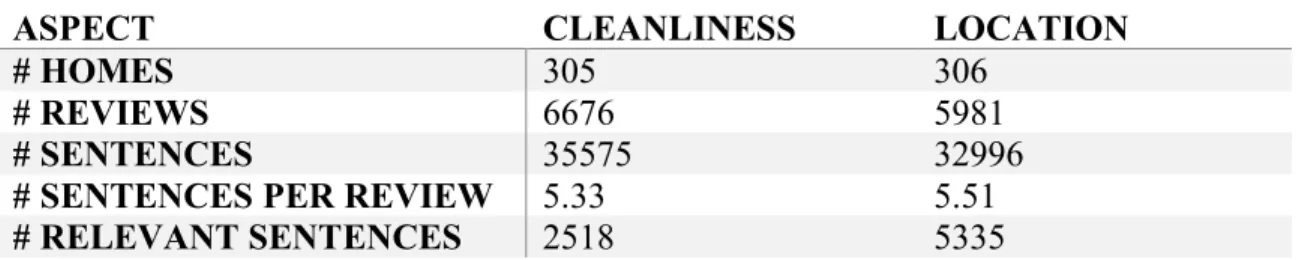
relevant sentences of the given aspect. Table 9 shows the statistics of all steps for the 2
data sets. We can see that the data sizes of both aspects are pretty close in the “#homes”,
“#reviews”, “#sentences” and “#sentences per review”. However, there is a difference in
the number of aspect-relevant sentences (“#relevant sentences”) where location occurs
approximately twice as frequently as cleanliness. This suggests that people talk more
about the location aspect than the cleanliness aspect when writing reviews for Airbnb
homes.
ASPECT CLEANLINESS LOCATION
# HOMES 305 306
# REVIEWS 6676 5981
# SENTENCES 35575 32996
# SENTENCES PER REVIEW 5.33 5.51
# RELEVANT SENTENCES 2518 5335
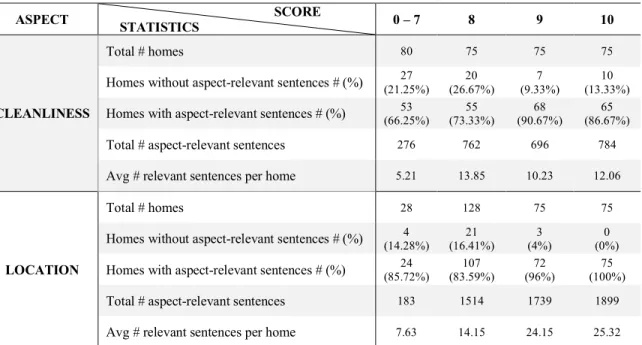
Table 10 shows more detailed information of both aspects’ data grouped by
scores. For both aspects, there exist some homes without aspect-relevance sentences.
However, the number is acceptable because after removing those, there remains a
sufficient number of homes for analysis. An observation is that guests tend to mention the
aspect when writing reviews if they rate the aspect a higher score. As the table shows,
21.15% and 26.67% of homes with lower scores on the cleanliness aspect (0-7 or 8) do
not have aspect-relevant sentences. In contrast, only 9.3% and 13.3% of homes with
scores of 9 or 10 are missing relevant sentences. The same pattern is seen for the location
aspect, 14.28% and 16.4% of homes with lower scores on the location aspect (0-7 or 8)
score do not have aspect-relevant sentences. In contrast, only 4% of homes with the
location aspect score of 9 are missing relevant sentences. All homes with score of 10
have sentences in their reviews that are relevant to the location aspect.
ASPECT STATISTICS SCORE 0 – 7 8 9 10
CLEANLINESS
Total # homes 80 75 75 75
Homes without aspect-relevant sentences # (%) (21.25%) 27 (26.67%) 20 (9.33%) 7 (13.33%) 10
Homes with aspect-relevant sentences # (%) (66.25%) 53 (73.33%) 55 (90.67%) 68 (86.67%) 65
Total # aspect-relevant sentences 276 762 696 784
Avg # relevant sentences per home 5.21 13.85 10.23 12.06
LOCATION
Total # homes 28 128 75 75
Homes without aspect-relevant sentences # (%) (14.28%) 4 (16.41%) 21 (4%) 3 (0%) 0
Homes with aspect-relevant sentences # (%) (85.72%) 24 (83.59%) 107 (96%) 72 (100%) 75
Total # aspect-relevant sentences 183 1514 1739 1899
Avg # relevant sentences per home 7.63 14.15 24.15 25.32
Table 10: Statistics of Data Subsets for Cleanliness and Location Aspects by Rating Scores
Another way of looking this is that for homes whose reviews do contain relevant
than those with lower scores. As for the cleanliness aspect, each home with lower aspect
score (0-7) only have an average of 5.21 relevant sentences, while other homes with
higher aspect scores (8, 9, 10) have more than 10 relevant sentences on average.
Similarly, for the location aspect, homes with lower aspect scores (0-7) only have 7.63
relevant sentences on average, while other homes have more. Homes with aspect score of
8 have 14.15 aspect relevant sentences on average, homes with 9 or 10 aspect scores have
more than 24 aspect relevant sentences on average.
4.2
Sentiment Statistics for Aspects
4.2.1 Overall Sentiment Polarities Distribution of Aspects
After extracting sentiment polarities of all sentences, I calculated the number of
sentences and the percentages of all polarities as shown in Table 11.
ASPECT POLARITIES # SENTENCES (%)
Score 0 – 7 Score 8 Score 9 Score 10
CLEANLINESS
very negative 9 (3.26%) 9 (1.18%) 5 (0.72%) 1 (0.13%) negative 154 (55.80%) 308 (40.42%) 167 (23.99%) 138 (17.60%)
neutral 37 (13.41%) 101 (13.25%) 39 (5.60%) 42 (5.36%) positive 68 (24.64%) 311 (40.82%) 411 (59.06%) 511 (65.18%) very positive 8 (2.90%) 33 (4.33%) 74 (10.63%) 92 (11.73%)
LOCATION
very negative 4 (2.19%) 8 (0.53%) 9 (0.52%) 7 (0.37%) negative 78 (42.62%) 547 (36.13%) 524 (30.13%) 481 (25.33%)
neutral 23 (12.57%) 199 (13.14%) 172 (9.89%) 159 (8.37%) positive 75 (40.98%) 694 (45.84%) 924 (53.13%) 1067 (56.19%) very positive 3 (1.64%) 66 (4.36%) 110 (6.33%) 185 (9.74%)
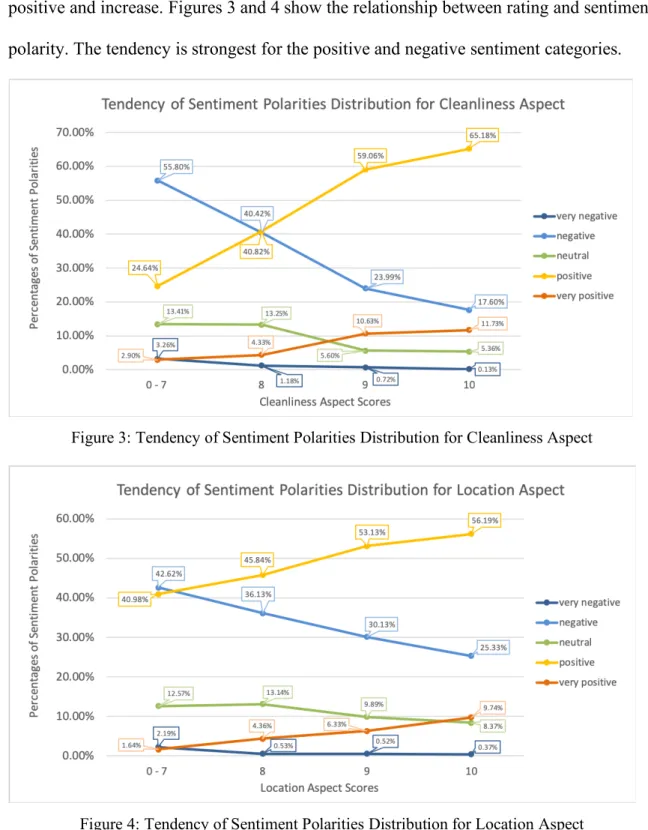
These statistics show that there is tendency of sentiment polarities of review texts
to correspond to aspect scores. As the aspect score increases, the percentages of very
negative, negative and neutral decrease. Similarly, the percentages of very positive,
positive and increase. Figures 3 and 4 show the relationship between rating and sentiment
polarity. The tendency is strongest for the positive and negative sentiment categories.
Figure 3: Tendency of Sentiment Polarities Distribution for Cleanliness Aspect
4.2.2 Average Sentiment Polarities Distribution of Aspects
The results presented in the previous section are based on the overall sentiment
percentage of homes with different aspect score. However, it may be inaccurate because
there is a possibility that the extreme situation such as one home having enough sentences
with positive sentiment to overwhelm sentences with other polarities. To provide an
alternate view, for every home, I computed the percentages of sentiment polarities for all
aspect-relevant sentences, and then calculated the average of them for every score group.
ASPECT POLARITIES AVERAGE PERCENTAGES OF SENTENCES OF ALL HOMES
Score 0 – 7 Score 8 Score 9 Score 10
CLEANLINESS
very negative 5.16% 1.41% 0.55% 0.13%
negative 50.35% 34.82% 21.48% 16.29%
neutral 13.63% 7.58% 5.73% 5.63%
positive 24.97% 49.35% 60.44% 66.99%
very positive 5.89% 6.85% 11.80% 10.97%
LOCATION
very negative 1.05% 0.17% 0.69% 0.19%
negative 41.34% 27.74% 30.66% 26.53%
neutral 14.82% 11.90% 10.73% 8.14%
positive 41.16% 52.09% 53.14% 55.95%
very positive 1.64% 8.10% 4.77% 9.19%
Table 12: Average Percentages of Sentiment Polarities of Sentences of All Homes grouped by Aspect Scores
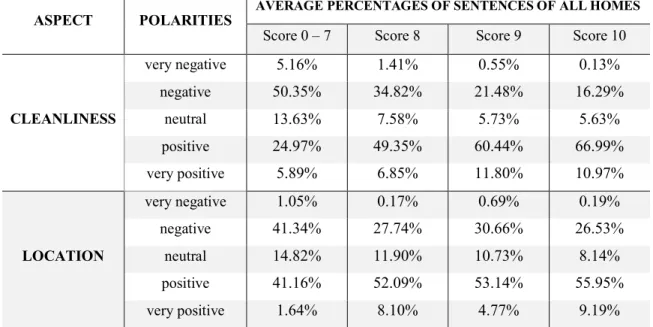
Table 12 and Figures 5 and 6 show the results and visualizations. We can see the
overall trends (in Figure 5) for the cleanliness aspect are generally similar to the first
analysis (in Figure 3). However, the proportion of very positive and neutral sentences
increased slightly, while the very negative, correspondingly decrease for homes with
Figure 5: Tendency of Average Sentiment Polarities Distribution for Cleanliness Aspect
Things are a little different in the location aspect. As shown in Figure 6, the
average percentages of all sentiment polarities basically keep stable for aspect scores 8, 9
and 10. The percentage of fluctuations of all sentiment polarities are all less than 5%
(3.86%, 4.13%, 3.76%, 4.42%, 0.5% for positive, negative, neutral, very positive and
very negative respectively). However, the polarities’ overall percentages tendency (see
Figure 4) shows larger fluctuations with 10.35%, 10.80%, 4.77%, 5.38%, 0.16% for
positive, negative, neutral, very positive and very negative respectively. This means
overall percentages of polarities enlarged the correspondence between aspect rating
scores and the polarities’ percentages. Homes with higher location scores did have larger
proportion of positive sentences in reviews relevant to location aspect, but not as
dramatically as in Figure 3. The trends reflected by average percentages (in Figure 6)
should be more accurate.
4.2.3 Polarities Distribution Patterns for Homes with Same Aspect Score
Figures in this section (Figure 7, 8, 9, 10) display the data in Appendix I by
plotting the sentiment polarities distribution of all relevant sentences of homes with the
same aspect score. The figures for both aspects, cleanliness (Figure 7, 8) and location
(Figure 9, 10), emphasize the difference between homes with scores of 0-7, and those
with scores of 10. The area of red and yellow color representing very positive and
positive in score 10 figures is obviously lager than it in score 0-7 figures. This appearance
supports the discussion in previous section that homes with higher aspect score will have
Figure 7: Sentiment Polarities Distribution of Homes with Cleanliness Score 0-7
Figure 9: Sentiment Polarities Distribution of Homes with Location Score 0-7
5
CONCLUSION
This research analyzed the correspondence between review text and the scores of
two aspects (cleanliness and location) to provide evidences based on sentence-level
sentiment analysis. The results show that there exists a positive correlation between
aspect scores and the proportion of positive aspect-relevant sentences in home reviews
for both the aspects. The correlation in cleanliness analysis is high while in location
analysis, the correlation became insignificant among score 8, 9 and 10. An additional
finding is that reviewers may tend to mention or write more about an aspect if they rate
the aspect a higher score.
In the methodology part, this paper proposed a sentence-to-aspect relevance
detection approach for the subjectivity classification step of sentence-level sentiment
analysis. Based on the manual validation, the approach is efficient to distinguish aspect
relevant sentences from review paragraphs. Previous studies used the set of sentiment
words with high occurrences in the text as lexicon in the subjectivity classification step,
while this research provides a new approach of creating lexicon by opinion-target/aspect
words and their synonyms and antonyms in WordNet. That is, for example, if one wants
to analyze the sentiment of sentences that represent the “cleanliness” aspect of Airbnb
homes, the lexicon of sentence subjectivity classification will consist of the word
Future work could be in three directions. One is to use the proposed
sentence-level sentiment analysis method on the other 4 aspects given by Airbnb: communication,
check-in, value and accuracy. By comparing the results of all 6 aspects, one could
achieve the evidence of a possible research question, “Do people pay more attention to
some aspects than other aspects of Airbnb homes?”. Another direction is to deploy and
generalize the methodology of this research to other kinds of online review data, for
example, reviews of sneakers which have some conventional aspects like fit, style, etc.
The possible research question could be “do the aspect scores of sneakers correspond to
the reviews?”. The last direction could be the optimization and validation of the
sentiment model proposed in this research. We could test more relevance scores in the
subjectivity classification model to find a more precise threshold. The creation of the
aspect-relevant lexicon is also a possible way to improve the model.
There are some limitations of this research. One is that the data size is still
insufficient, only around 7000 reviews of each aspect. Analyzing more data could be
helpful in both recognizing the distribution pattern among homes with a certain aspect
score and improving the performance of the proposed model. Another limitation is that
the data of this research are only the Seattle data. The results may be different for Airbnb
6
REFERENCES
Abdulla, N. A., Ahmed, N. A., Shehab, M. A., & Al-Ayyoub, M. (2013, December).
Arabic sentiment analysis: Lexicon-based and corpus-based. In 2013 IEEE Jordan
conference on applied electrical engineering and computing technologies
(AEECT) (pp. 1-6). IEEE.
Barbosa, L., & Feng, J. (2010, August). Robust sentiment detection on twitter from
biased and noisy data. In Proceedings of the 23rd international conference on
computational linguistics: posters (pp. 36-44). Association for Computational
Linguistics.
Bermingham, A., & Smeaton, A. (2011). On using Twitter to monitor political sentiment
and predict election results. In Proceedings of the Workshop on Sentiment
Analysis where AI meets Psychology (SAAIP 2011) (pp. 2-10).
Blair-Goldensohn, Sasha, Kerry Hannan, Ryan McDonald, Tyler Neylon, George A.
Reis, and Jeff Reynar. Building a sentiment summarizer for local service reviews.
In Proceedings of WWW-2008 workshop on NLP in the information explosion
era. 2008.
Bo Pang, Lillian Lee, Shivakumar Vaithyanathan, "Thumbs up? Sentiment Classification
using Machine Learning Techniques", the 2002 Conference on Empirical
Bridges, J., & Vásquez, C. (2018). If nearly all Airbnb reviews are positive, does that
make them meaningless?. Current Issues in Tourism, 21(18), 2057-2075.
Chaovalit, P., & Zhou, L. (2005, January). Movie review mining: A comparison between
supervised and unsupervised classification approaches. In Proceedings of the 38th
annual Hawaii international conference on system sciences (pp. 112c-112c).
IEEE.
Cheng, M., & Jin, X. (2019). What do Airbnb users care about? An analysis of online
review comments. International Journal of Hospitality Management, 76, 58-70.
Ding, X., Liu, B., & Yu, P. S. (2008, February). A holistic lexicon-based approach to
opinion mining. In Proceedings of the 2008 international conference on web
search and data mining (pp. 231-240). ACM.
Dave, K., Lawrence, S., & Pennock, D. M. (2003, May). Mining the peanut gallery:
Opinion extraction and semantic classification of product reviews. In Proceedings
of the 12th international conference on World Wide Web (pp. 519-528). ACM.
El-Halees, A. M. (2011). Arabic opinion mining using combined classification approach.
Arabic opinion mining using combined classification approach.
Esuli, A., & Sebastiani, F. (2006, May). Sentiwordnet: A publicly available lexical
resource for opinion mining. In LREC(Vol. 6, pp. 417-422).
Hassan, A., Qazvinian, V., & Radev, D. (2010, October). What's with the attitude?:
identifying sentences with attitude in online discussions. In Proceedings of the
2010 Conference on Empirical Methods in Natural Language Processing (pp.
Hu, M., & Liu, B. (2004, August). Mining and summarizing customer reviews. In
Proceedings of the tenth ACM SIGKDD international conference on Knowledge
discovery and data mining (pp. 168-177). ACM.
Jiang, L., Yu, M., Zhou, M., Liu, X., & Zhao, T. (2011, June). Target-dependent twitter
sentiment classification. In Proceedings of the 49th Annual Meeting of the
Association for Computational Linguistics: Human Language
Technologies-Volume 1 (pp. 151-160). Association for Computational Linguistics.
Joshi, M., Das, D., Gimpel, K., & Smith, N. A. (2010, June). Movie reviews and
revenues: An experiment in text regression. In Human Language Technologies:
The 2010 Annual Conference of the North American Chapter of the Association
for Computational Linguistics (pp. 293-296). Association for Computational
Linguistics.
Kessler, J. S., & Nicolov, N. (2009, March). Targeting sentiment expressions through
supervised ranking of linguistic configurations. In Third International AAAI
Conference on Weblogs and Social Media.
Kim, S. M., & Hovy, E. (2004, August). Determining the sentiment of opinions. In
Proceedings of the 20th international conference on Computational Linguistics (p.
1367). Association for Computational Linguistics.
Kobayashi, N.; Iida, R.; Inui, K.; and Matsumoto, Y. 2006. Opin- ion Mining on the Web
by Extracting Subject-Attribute-Value Relations. In AAAI-CAAW.
Le, Q., & Mikolov, T. (2014, January). Distributed representations of sentences and
Liu, B. (2012). Sentiment analysis and opinion mining. Synthesis lectures on human
language technologies, 5(1), 1-167.
Lu, B., Ott, M., Cardie, C., & Tsou, B. K. (2011, December). Multi-aspect sentiment
analysis with topic models. In 2011 IEEE 11th international conference on data
mining workshops (pp. 81-88). IEEE.
M., von Hoffen, M., Hagge, M., Betzing, J. H., & Chasin, F. (2017). Leveraging social
media to gain insights into service delivery: a study on Airbnb. Information
Systems and e-Business Management, 1-23.
Pak, A., & Paroubek, P. (2010, May). Twitter as a corpus for sentiment analysis and
opinion mining. In LREc (Vol. 10, No. 2010, pp. 1320-1326).
Pang, B., & Lee, L. (2008). Opinion mining and sentiment analysis. Foundations and
Trends® in Information Retrieval, 2(1–2), 1-135.
Taboada, M., Brooke, J., Tofiloski, M., Voll, K., & Stede, M. (2011). Lexicon-based
methods for sentiment analysis. Computational linguistics, 37(2), 267-307.
Turney, P. D. (2002, July). Thumbs up or thumbs down?: semantic orientation applied to
unsupervised classification of reviews. In Proceedings of the 40th annual meeting
on association for computational linguistics (pp. 417-424). Association for
Computational Linguistics.
Wang, S., & Manning, C. D. (2012, July). Baselines and bigrams: Simple, good
sentiment and topic classification. In Proceedings of the 50th annual meeting of
the association for computational linguistics: Short papers-volume 2 (pp. 90-94).
Wiebe, J., & Riloff, E. (2005, February). Creating subjective and objective sentence
classifiers from unannotated texts. In International conference on intelligent text
processing and computational linguistics (pp. 486-497). Springer, Berlin,
Heidelberg.
Yu, H., & Hatzivassiloglou, V. (2003, July). Towards answering opinion questions:
Separating facts from opinions and identifying the polarity of opinion sentences.
In Proceedings of the 2003 conference on Empirical methods in natural language
processing (pp. 129-136). Association for Computational Linguistics.
Zervas, G., Proserpio, D., & Byers, J. (2015). A first look at online reputation on Airbnb,
where every stay is above average. Where Every Stay is Above Average (January
Appendix I
The Sentiment Polarities of Aspect-Relevant Sentences of Airbnb Homes with Cleanliness Score 0-7
home_id # relevant sentences negative # very sentences # negative sentences # neutral sentences # positive sentences # very positive sentences
30712 43 0 24 9 9 1
299817 0 0 0 0 0 0
613151 1 1 0 0 0 0
639130 0 0 0 0 0 0
666897 8 0 6 0 2 0
670009 3 0 1 1 1 0
670021 5 1 1 1 2 0
716829 0 0 0 0 0 0
1145590 1 0 0 0 1 0
1520533 4 0 1 2 1 0
1520581 3 1 1 0 1 0
1520593 8 0 5 0 2 1
1764233 6 0 5 0 1 0
2357110 1 0 0 0 0 1
2769088 6 1 4 0 1 0
2856806 0 0 0 0 0 0
3052151 2 1 0 0 1 0
3096191 11 1 6 2 2 0
3226793 4 1 1 0 2 0
3291777 10 0 7 2 1 0
3424242 2 0 0 1 0 1
3534364 7 1 1 1 4 0
3593582 1 0 0 1 0 0
3697351 20 1 10 3 5 1
3732094 1 0 0 0 0 1
3766285 0 0 0 0 0 0
3770248 3 0 2 0 1 0
3888924 0 0 0 0 0 0
3889050 2 0 1 0 1 0
4041868 2 0 1 1 0 0
4082250 1 0 1 0 0 0
4340410 4 0 1 1 2 0
4550099 0 0 0 0 0 0
4701205 3 0 2 1 0 0
4773614 1 0 0 0 1 0
4892529 1 0 1 0 0 0
4951079 0 0 0 0 0 0
5126365 3 0 2 0 1 0
5252515 1 0 1 0 0 0
5261239 22 0 9 3 10 0
5353512 3 0 1 1 1 0
5479566 0 0 0 0 0 0
5637990 5 0 5 0 0 0
5639238 2 0 2 0 0 0
6120046 0 0 0 0 0 0
6250399 0 0 0 0 0 0
6363779 2 0 2 0 0 0
6370313 3 0 2 1 0 0
6623079 2 0 1 0 1 0
6717555 0 0 0 0 0 0
6864319 0 0 0 0 0 0
6865200 5 0 2 0 3 0
6958436 0 0 0 0 0 0
6959336 0 0 0 0 0 0
6992696 6 0 6 0 0 0
7093910 3 0 2 0 0 1
7203765 0 0 0 0 0 0
7245586 1 0 1 0 0 0
7732071 0 0 0 0 0 0
7844444 0 0 0 0 0 0
7934356 0 0 0 0 0 0
7965184 1 0 0 0 1 0
7975026 0 0 0 0 0 0
7985714 0 0 0 0 0 0
8050232 11 0 10 0 0 1
8067053 0 0 0 0 0 0
8083242 3 0 1 2 0 0
8227710 0 0 0 0 0 0
8555304 0 0 0 0 0 0
8594059 1 0 0 0 1 0
8754180 1 0 1 0 0 0
8863714 2 0 1 0 1 0
8922554 0 0 0 0 0 0
8934054 0 0 0 0 0 0
9075558 7 0 7 0 0 0
9151374 0 0 0 0 0 0
9183838 2 0 1 1 0 0
9509279 2 0 1 1 0 0
The Sentiment Polarities of Aspect-Relevant Sentences of Airbnb Homes with Cleanliness Score 8
home_id # relevant sentences negative # very sentences
# negative
sentences sentences # neutral # positive sentences
# very positive sentences
15108 7 0 3 0 3 1
258571 103 0 36 12 52 3
264829 15 0 3 2 8 2
278192 5 0 0 1 4 0
293890 12 0 4 2 6 0
338091 28 1 13 1 11 2
606297 28 0 12 5 10 1
637710 24 0 11 6 7 0
719233 127 2 41 26 52 6
859467 12 0 7 1 4 0
1039766 38 0 12 4 21 1
1107845 12 1 4 1 5 1
1190571 2 0 0 0 2 0
1541705 13 0 8 3 2 0
1589461 5 0 3 0 2 0
1709737 4 1 1 0 2 0
1724849 5 0 1 0 2 2
1773803 48 1 25 8 13 1
1815304 16 0 6 1 6 3
1831338 7 0 2 1 4 0
1840671 3 0 1 0 1 1
1950446 64 0 32 7 23 2
2909809 0 0 0 0 0 0
3155785 1 0 1 0 0 0
3528627 13 0 9 1 3 0
3562617 8 0 5 0 3 0
3732103 5 0 2 2 1 0
3811872 4 0 1 0 2 1
4130112 0 0 0 0 0 0
4258515 10 0 4 0 5 1
4264056 28 0 17 3 8 0
4384000 0 0 0 0 0 0
4632923 1 0 1 0 0 0
4681885 11 0 1 5 4 1
4716486 0 0 0 0 0 0
4808173 1 0 0 0 1 0
5062445 0 0 0 0 0 0
5364609 2 0 0 0 1 1
5459895 0 0 0 0 0 0
5487653 0 0 0 0 0 0
5618094 1 0 0 0 1 0
5931372 15 0 8 3 4 0
6278216 7 2 2 0 3 0
6337492 5 0 3 0 2 0
6425537 4 0 1 0 3 0
6436772 0 0 0 0 0 0
6528192 3 0 1 0 2 0
6852288 5 0 1 0 3 1
7095802 12 0 6 1 5 0
7219541 1 0 0 0 1 0
7219838 9 0 5 0 4 0
7386675 1 0 0 0 1 0
7401671 1 0 0 0 0 1
7634011 12 1 6 2 2 1
7649837 8 0 4 1 3 0
7667990 1 0 0 0 1 0
7940358 0 0 0 0 0 0
7970663 0 0 0 0 0 0
7987846 0 0 0 0 0 0
7999692 1 0 0 0 1 0
8147215 0 0 0 0 0 0
8355276 7 0 3 2 2 0
8391954 1 0 1 0 0 0
8517235 1 0 0 0 1 0
8553556 2 0 1 0 1 0
8578490 0 0 0 0 0 0
8631419 0 0 0 0 0 0
8843162 0 0 0 0 0 0
9134196 0 0 0 0 0 0
9157232 0 0 0 0 0 0
9303530 1 0 0 0 1 0
9411935 2 0 0 0 2 0
9511777 0 0 0 0 0 0
The Sentiment Polarities of Aspect-Relevant Sentences of Airbnb Homes with Cleanliness Score 9
home_id # relevant sentences
# very negative sentences
# negative
sentences sentences # neutral # positive sentences
# very positive sentences
13068 7 0 4 1 1 1
19611 13 0 7 0 5 1
86185 6 1 1 0 3 1
132120 10 0 1 0 9 0
286712 29 1 10 0 17 1
442487 43 0 9 4 25 5
444221 30 0 12 0 16 2
458186 5 0 1 0 4 0
479653 22 0 3 1 16 2
486344 11 0 2 1 6 2
486829 14 0 1 1 11 1
573942 22 0 6 1 13 2
654734 15 1 5 0 8 1
670056 13 0 4 1 8 0
1145148 4 0 2 0 2 0
1416763 5 0 2 1 2 0
1432713 56 0 13 0 34 9
1483944 21 0 4 2 12 3
1521633 7 0 2 2 2 1
1783382 9 0 0 0 7 2
2016613 2 0 0 1 1 0
2039149 56 0 12 8 33 3
2134911 0 0 0 0 0 0
2418658 26 0 7 2 11 6
2520890 5 0 3 0 2 0
2898401 12 0 3 2 6 1
2966415 16 0 6 0 9 1
2986056 0 0 0 0 0 0
3040278 33 1 4 1 21 6
3124383 8 0 1 0 6 1
3250577 1 0 0 0 1 0
3386862 23 0 9 1 12 1
3689416 7 0 1 0 5 1
3803212 1 0 0 0 1 0
4061051 2 0 1 0 1 0
4111954 2 0 0 1 1 0
4138423 10 0 3 0 6 1
4231670 2 0 0 0 2 0
4242626 1 0 0 0 0 1
4258762 13 1 1 0 8 3
4388148 19 0 2 1 15 1
4825472 4 0 0 0 4 0
4854767 5 0 1 1 3 0
5123904 2 0 1 0 1 0
5297143 1 0 0 0 0 1
5660792 13 0 5 0 7 1
6226666 2 0 0 0 2 0
6249536 1 0 0 0 1 0
6412566 4 0 0 1 3 0
6557297 4 0 3 0 1 0
6629278 5 0 3 0 2 0
6655233 5 0 2 0 2 1
6716620 0 0 0 0 0 0
6780670 4 0 1 1 1 1
6882518 8 0 0 0 7 1
6994406 0 0 0 0 0 0
7149703 5 0 0 0 3 2
7349099 1 0 0 0 1 0
7430926 12 0 2 1 8 1
7596455 0 0 0 0 0 0
7809718 1 0 0 0 1 0
7821003 1 0 0 0 1 0
7828222 1 0 1 0 0 0
7843145 3 0 0 0 2 1
7934963 8 0 1 2 5 0
7952930 7 0 2 0 4 1
8053921 3 0 1 0 1 1
8155710 0 0 0 0 0 0
8221520 4 0 0 0 2 2
8409975 5 0 1 1 3 0
9016362 2 0 1 0 0 1
9034515 0 0 0 0 0 0
9389755 2 0 0 0 2 0
The Sentiment Polarities of Aspect-Relevant Sentences of Airbnb Homes with Cleanliness Score 10
home_id # relevant sentences negative # very sentences
# negative
sentences sentences # neutral # positive sentences
# very positive sentences
117165 20 0 2 0 11 7
182716 16 0 1 0 12 3
215882 56 0 7 1 41 7
320704 29 0 7 1 20 1
394408 9 0 0 3 6 0
555182 2 0 0 0 1 1
825574 18 0 4 0 12 2
1159226 6 0 0 0 3 3
1198799 10 0 1 1 5 3
1851863 20 0 3 2 14 1
2373176 30 0 7 1 20 2
2489283 0 0 0 0 0 0
2692126 38 0 9 3 22 4
2721575 32 0 5 0 22 5
2723368 12 1 3 0 6 2
2727984 0 0 0 0 0 0
2822984 5 0 0 1 4 0
3076065 8 0 1 0 6 1
3231850 36 0 6 0 20 10
3258213 14 0 5 0 6 3
3544964 18 0 3 0 14 1
3652434 20 0 1 0 18 1
3673759 30 0 5 1 19 5
3882930 2 0 0 0 2 0
3979496 8 0 2 1 4 1
3986788 4 0 3 1 0 0
4238106 2 0 1 0 0 1
4240933 1 0 0 0 1 0
4449303 21 0 3 1 14 3
4520179 6 0 1 0 4 1
4565370 9 0 1 1 6 1
4616695 18 0 2 1 15 0
4776823 31 0 12 2 16 1
4811583 2 0 0 0 2 0
4872699 0 0 0 0 0 0
4922836 18 0 2 3 13 0
4947002 6 0 1 0 4 1
5031357 0 0 0 0 0 0
5218550 19 0 2 1 15 1
5236979 8 0 1 1 5 1
5252877 6 0 4 1 1 0
5625964 15 0 3 0 11 1
5651254 0 0 0 0 0 0
5805907 3 0 1 0 2 0
5959816 12 0 1 0 8 3
6228474 1 0 0 0 1 0
6274351 3 0 0 0 1 2
6629132 2 0 0 1 1 0
6657574 5 0 2 0 1 2
6675927 20 0 1 2 15 2
6773472 9 0 1 2 5 1
6821407 33 0 4 4 23 2
7070169 8 0 1 0 6 1
7198282 7 0 1 2 4 0
7247720 8 0 2 0 6 0
7455068 3 0 1 0 2 0
7550234 10 0 1 2 7 0
7635966 0 0 0 0 0 0
7678814 2 0 0 0 2 0
7699356 0 0 0 0 0 0
7763298 12 0 5 0 4 3
7902330 15 0 4 2 7 2
7956337 1 0 0 0 1 0
8086294 0 0 0 0 0 0
8147986 2 0 1 0 1 0
8308316 3 0 0 0 3 0
8453633 1 0 0 0 1 0
8608233 0 0 0 0 0 0
8919372 5 0 2 0 3 0
9015088 1 0 0 0 1 0
9318524 1 0 0 0 1 0
9374358 3 0 0 0 3 0
9727857 0 0 0 0 0 0