SURVIVING SLAVERY:
POLITICS, POWER, AND AUTHORITY IN THE BRITISH CARIBBEAN, 1807-1834
Randy M. Browne
A dissertation submitted to the faculty of the University of North Carolina at Chapel Hill in partial fulfillment of the requirements for the degree of Doctor of Philosophy in the
Department of History.
Chapel Hill 2012
ABSTRACT
RANDY M. BROWNE: Surviving Slavery: Politics, Power, and Authority in the British Caribbean, 1807-1834
(Under the direction of John Wood Sweet)
This dissertation explores a broad range of power relationships and struggles for authority in the early nineteenth century British Atlantic, focusing on the Caribbean colony of Berbice. I aim to understand how enslaved people and their enslavers negotiated their
relationships and forged their lives within multiple, interconnected networks of power in a notoriously brutal society. To do so, I focus on politics and culture writ large and small, zooming in to see the internal conflicts, practices, and hierarchies that governed individual plantations, communities, and families; and zooming out to explore the various ways that imperial officials, colonial administrators, and metropolitan antislavery activists tried to shape West Indian slavery during the era of amelioration--a crucial period of transformation in the Atlantic world.
ownership of different forms of property. In each case I show how the goals and priorities of different individuals and groups, enslaved and free, competed, overlapped, and intersected to shape high politics and lived realities.
I use a range of sources, including travel narratives, trial records, missionary
correspondence, and official government documents. Most important are the records of the Berbice fiscals and protectors of slaves, officials charged with hearing enslaved peoples’ grievances and enforcing colonial laws. Their investigations produced detailed, first-person testimony from owners, managers, overseers, drivers, and enslaved laborers themselves. These records provide an unparalleled opportunity to understand how enslaved people negotiated their day-to-day relationships with one another and with Europeans and how they struggled to survive. The voices at the heart of this project reveal a complex set of power relationships and concerns, painting a rich portrait of a world where authority was constantly contested and contingent.
ACKNOWLEDGMENTS
It is a pleasure to acknowledge the many people and institutions who helped make this project possible. By far, my largest debt is to John Wood Sweet. Over the many years it has taken to complete this dissertation, John has been a constant source of encouragement and an ideal advisor. His enthusiasm for this project was contagious, and his tough questions and imagination helped make it much stronger. The many hours John and I spent talking--and the countless drafts John read talking--and critiqued with great care--had a major impact on my approach to this project and on its outcome.
I am also very grateful for the support and encouragement of the other members of my dissertation committee. Heather Williams made me feel welcome when I arrived at UNC, helped me secure funding for my graduate studies, and challenged me to clarify and reconsider various aspects of my analysis large and small. Lisa Lindsay’s unflagging energy and good cheer were especially useful when I hit bumps in the road, as was her knack for helping me figure out what I was trying to say and why it was important. Laurent Dubois’s enthusiasm and encouragement at an early stage gave me the confidence to take on a
has raised--in private conversations and seminars and in his own scholarship--is evident throughout this dissertation.
Colleagues and friends at UNC and other universities on both sides of the Atlantic also helped in a variety of ways. In particular, I thank Trevor Burnard, Meghan Cohorst, Kathleen DuVal, Bronwen Everill, Jonathan Hancock, Jerome S. Handler, Jerma Jackson, Marjoleine Kars, Lloyd S. Kramer, Christina Mobley, Philip D. Morgan, Diana Paton, Susan G. Pennybacker, Brad Proctor, Ben Reed, Donald M. Reid, Katy Simpson Smith, Alvin O. Thompson, and Tyler Will. The support of Christopher Cameron and Laura Premack, my writing partners and close friends, was invaluable. Chris and Laura devoted an extraordinary amount of time and energy to this project, reading several drafts of each chapter, making insightful suggestions, and keeping my spirits up. I owe a large intellectual and personal debt to them both for their patience, enthusiasm, and friendship.
In Guyana, Margaret Chan-a-Sue was an ideal guide, fully of savvy advice and fantastic stories. Alex Mendes generously allowed me to stay at Dubulay, his family’s ranch on the Berbice River, where I got one of the most valuable perspectives on the history of Berbice and its people. I treasure the time I spent with Margaret and Alex, and thank them for all that they taught me about a country that is full of wonderful mysteries and surprises.
Georgetown, Guyana; and the Walter Royal Davis Library at the University of North Carolina.
Parts of this project were presented at various seminars and conferences, including the American Historical Association, the Caribbean Studies Association, the College of Charleston’s Carolina Lowcountry and Atlantic World Program, Duke University’s African and African American Studies Working Group, King’s College London, the Society for Caribbean Studies, the Triangle African American History Colloquium, the Triangle Early American History Seminar, the Triangle Legal History Seminar, UNC’s Working Group in Feminism and History, and the University of North Carolina at Chapel Hill. I am very grateful for the questions, comments, and suggestions I received from all who participated, and especially to Holly Brewer, Peter A. Coclanis, Richard Drayton, Kathleen DuVal, Laurie Maffly-Kipp, Diana Paton, Susan G. Pennybacker, Terri Snyder, Peter H. Wood, and Jason R. Young.
Quirós Varela travel grant, both from the Institute for the Study of the Americas at UNC, allowed me to spend a month in Guyana in 2010.
TABLE OF CONTENTS
LIST OF FIGURES...xii
LIST OF ABBREVIATIONS...xiii
INTRODUCTION...1
Chapter I. THE “BAD BUSINESS” OF OBEAH...16
“They could bring things on the estate to order”...25
“Setting the estate to rights”...38
An authority no longer...47
Conclusion...53
II. “THE DRIVER IS TOO GREAT A MAN”...58
“With a whip at their backs”...63
“His authority in the field would be entirely done away with”...70
“The driver knows we are in the right”...79
“A disgraced driver”...86
Conclusion...96
III. “ILL-TREATING WOMEN AND WIVES”...98
Amelioration and Bio-Power...101
Abuse, Infidelity, and Female Networks of Support...119
Conclusion...135
IV. “THE RIGHT OF A MASTER TO PUNISH”...136
The Problem of Slave Punishment...139
Amelioration and Penal Reform in the 1820s...151
Slaves, the Fiscal, and the Protector...166
Managers, Owners, and Colonial Officials...183
Conclusion...187
V. “THE CUSTOM OF THE COLONY”...189
“A reasonable...allowance”...193
“Our little property”...210
“The recovery of trivial debts”...230
Conclusion...239
EPILOGUE...241
LIST OF FIGURES
Figure
1.1 Berbice and neighboring colonies, circa 1820...5
3.1 Enslaved woman and driver, British West Indies, 1826...65
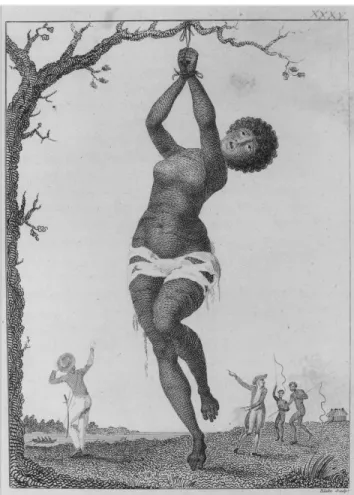
5.1 “Flagellation of a Female Samboe Slave”...155
LIST OF ABBREVIATIONS
CO Colonial Office Series, British National Archives, Kew, London, England PP Parliamentary Papers, House of Commons, England
INTRODUCTION
When December, a thirty year old enslaved man on a riverside sugar plantation in
Berbice, was flogged on February 23, 1833, the echoes of the whip’s cracks reverberated
throughout the Atlantic world. While December’s wounds were still fresh, the plantation
manager recorded the fifteen lashes December had endured in his official “punishment record
book.” His punishment records, which the colonial government required him to keep as part
of its statistical documentation of slavery, were not due for another five months. But
December went to colonial officials just two days after he was flogged, leaving the plantation
and traveling downriver to the colony’s capital, New Amsterdam. There he entered the office
of the protector of slaves, where he challenged the legitimacy of the whipping, and
complained that he had been forced to work all night in the sugar mill. The driver and the
overseer on December’s plantation, when summoned, corroborated the complaint, and the
five o’clock in the morning,” which was illegal, “and for having unjustly punished
December.” Ten months later he was fined £1.1
The records of this investigation, which the protector forwarded as part of his
semiannual reports to the governor, documented only one of hundreds of complaints made by
enslaved people in Berbice in the 1820s and 1830s. These documents routinely made their
way across the Atlantic, where they were scrutinized by the British Colonial Office and,
occasionally, reprinted in Parliamentary Papers and in the antislavery press. Complaints like
December’s thus generated a paper trail that spanned the Atlantic, connecting plantation
power struggles to metropolitan authorities.2
The transatlantic reverberations of this iconic act of violence--the whipping of a
single enslaved man on one plantation in a remote part of the British Empire--remind us that
slavery was, even at its most brutal and most intimate, much more complex than it is often
assumed to be. The binary, absolute master-slave relationship is a fiction. The process of
surveillance and documentation that linked the end of the lash that tore December’s flesh to
the core of the British Empire also reminds us that the personal power struggles at the heart
of slavery were embedded in broader structures of power and authority in the early modern
Atlantic world.
1 Feb. 25, 1833, CO 116/152, 95-98. The protector of slaves (sometimes referred to as the guardian of slaves) was an office created by the British government in many of its colonies in the early nineteenth century. The protector was responsible for hearing and investigating slaves’ complaints, and he had the authority to decide on cases summarily or, for more serious offenses, prosecute cases in regular colonial courts. In Berbice, the office of the protector of slaves was created in 1817 and, until 1826, the protector’s duties were handled by the fiscal, the colony’s chief judicial official. See Mary Turner, “‘The 11 O’Clock Flog’: Women, Work and Labour Law in the British Caribbean,” in From Slavery to Emancipation in the Atlantic World, ed. Silvia R. Frey and Betty Wood (London, 1999), 38-39; Alvin O. Thompson, Unprofitable Servants: Crown Slaves in Berbice, Guyana, 1803-1831 (Kingston, Jamaica, 2002), 2; and John Lean and Trevor Burnard, “Hearing Slave Voices: The Fiscal’s Reports of Berbice and Demerara-Essequebo,” Archives 27, no. 107 (October 2002): 120–33. For a summary of the protector’s duties, see CO 116/155, appendix one.
Taken together, these observations support the central premise of this study: that
enslaved people and European plantation authorities in Berbice negotiated their relationships
within a larger, more complicated network of power relations that transcended, overlapped
with, and sometimes undercut the slave-master dyad, the plantation, and, in some cases, the
colonial Caribbean itself. The major goal of this project is to reframe the way we think about
power and authority in Atlantic slavery. Specifically, this project aims to contextualize
plantation society power struggles, to see how the range of political, cultural, and social
systems in which slaveowners, their representatives, and enslaved people were embedded
influenced the ways they tried to gain power, assert authority, and negotiate their
relationships.
This study explores authority and power struggles at different levels, zooming in to
see the internal conflicts and divisions of individual plantations, slave communities, and
families on the one hand, and zooming out to assess the role of external authorities, such as
colonial administrators and imperial officials on the other, in shaping the politics of
plantation life.3 It also seeks to understand the relationship between these different
levels--the ways that struggles for power and legitimacy in different realms overlapped with and
were embedded in one another. Teasing out these relationships therefore requires sustained
attention to both local power conflicts and to the broader cultural and political contexts in
which these struggles took place. As recent studies of Atlantic slavery have demonstrated,
the social relations of power in colonial slave societies were shaped both by local
circumstances and by imperial developments.4
This project straddles the Atlantic world, with one foot in Britain and the other in
Berbice (Figure 1.1), which was one of the most well-documented plantation societies in the
Americas. The records from Berbice are particularly rich because of the legacy of the Dutch,
who began establishing plantations throughout the Guianas or the so-called Wild Coast (an
area that stretched from the mouth of the Orinoco River in the West to the Amazon delta in
the East) in the early seventeenth century. When the British captured Berbice and the
neighboring colonies of Demerara and Essequibo from the Dutch in the late eighteenth
century, they left much of the colonies’ legal and administrative structure intact. This
included the office of the fiscal, a powerful legal official responsible for hearing enslaved
4 See, for example, Laurent Dubois, A Colony of Citizens: Revolution and Slave Emancipation in the French
people’s complaints against Europeans and against other slaves, and for prosecuting enslaved
people for various crimes, ranging from theft to murder.5
Figure 1. Berbice and neighboring colonies, circa 1820. Drawn by Meghan Cohorst.6
5 For Berbice under Dutch rule, see Alvin O. Thompson, Colonialism and Underdevelopment in Guyana,
1580-1803 (Bridgetown, Barbados, 1987), esp. ch. 4; and Marjoleine Kars, “Policing and Transgressing Borders: Soldiers, Slave Rebels, and the Early Modern Atlantic,” New West Indian Guide 83, nos. 3–4 (2009), 188-89. The first European settlements in Berbice were established in the 1620s by the Dutch Van Peere family along the banks of the upper Berbice River. British forces seized Berbice (and Demerara and Essequibo) during the French Revolutionary and Napoleonic wars in May 1796. They restored the colonies to the Dutch (the revolutionary Batavian Republic) in March 1802 under the Treaty of Amiens, and recaptured them permanently in September 1803. In 1814, an Anglo-Dutch treaty formally ceded Berbice (along with Demerara and
Essequibo, which were combined, and the Cape of Good Hope) to the British. Berbice and Demerara-Essequibo became jointly administered in 1831 as British Guiana, which achieved its independence as the Cooperative Republic of Guyana in 1966. For the role of the fiscal in Berbice and Demerara-Essequibo, see Emília Viotti da Costa, Crowns of Glory, Tears of Blood: The Demerara Slave Rebellion of 1823 (New York, 1994), 45; Lean and Burnard, “Hearing Slave Voices,”120–33; J. H. Lean, “The Secret Lives of Slaves: Berbice, 1819 to 1827” (Ph.D. diss., University of Canterbury, 2002), esp. 9-44; and Trevor Burnard, Hearing Slaves Speak (Georgetown, Guyana, 2010). Michael Samuel Bennett, the Berbice fiscal and a prominent slaveowner, only began keeping records of his investigations in 1819, at the request of Henry Beard, who had recently been appointed president of the courts of civil and criminal justice and who would become lieutenant governor in 1820.
The large body of legal records that resulted from the fiscals’ investigations and
prosecutions include detailed, first-person testimony from owners, managers, overseers, and,
most importantly, enslaved people. The quality of these records distinguishes Berbice from
most other Atlantic slave societies, where the voices and perspectives of enslaved people are
much harder to find. The fiscals’ records, which cover the period from 1819 to 1832, are
complemented by the records of the protectors of slaves (1826-34). Taken together, these
legal records--which have only been used by a handful of historians--constitute the single
largest body of testimony from enslaved people in the British Empire. When combined with
other types of sources, which include travel narratives, missionary correspondence, legal
statutes, newspapers, punishment records, and official government correspondence, the
records of the fiscals and protectors of slaves provide a unique opportunity to see how
enslaved people negotiated their relationships with one another and with Europeans in the
context of an interventionist colonial government.
The early nineteenth century was a crucial period of transformation in the history of
the plantation complex in the Atlantic world.7 The upheavals of the American (1775-1783)
and Haitian (1791-1804) revolutions created imperial crises for Britain and France, leading to
the end of slavery in some areas and forcing Europeans to reconsider the role that slavery
would play in their empires. Nevertheless, when the British obtained Berbice in the midst of
the French Revolutionary and Napoleonic Wars, slavery was flourishing in many parts of the
Americas, including Brazil, the southern United States, and Cuba, and the transatlantic slave
trade was transporting nearly 100,000 captive Africans to American slave societies annually.
7 I borrow the term “plantation complex” from Philip D. Curtin, The Rise and Fall of the Plantation Complex:
Berbice and its neighboring colonies were an important part of this expanding frontier of
slavery.
The British takeover in Berbice ushered in an era of remarkable growth, as British
capital, planters, and captive Africans flooded into the colony on an unprecedented scale.8
The colony’s slave population more than doubled in six years, increasing from some 8,000
slaves in 1796 to more than 17,000 in 1802.9 By 1820, more than 140 plantations had been
established along the colony’s flood-prone rivers and seacoast, a feat that relied as much on
backbreaking labor as it did on engineering skill.10 Berbice’s famously productive
soil--which had not been exhausted like that of older West Indian colonies--helped it become one
of the leading British producers of coffee, cotton, and sugar in the early nineteenth century.11
But the transatlantic slave trade and the slave system that made this growth possible
were also under attack--especially in the British empire--during the so-called Age of
Revolution, the very period when slavery in Berbice was putting down new roots. Only in
hindsight can one appreciate just how quickly the British slave system collapsed: Britain
ended its transatlantic slave trade in 1807, experimented with various schemes to
“ameliorate” slavery in the 1810s and 1820s so that the system might be sanitized and
8 Seymour Drescher, Econocide: British Slavery in the Era of Abolition (Pittsburgh, 1977), 94-97. 9 Thompson, Unprofitable Servants, 25.
10 Lean, “Secret Lives of Slaves,” 27. For the unique challenges of establishing plantations in the Berbician environment, see Gordon Gill, “Labor, Material Welfare, and Culture in Hydrologic Plantation Enterprises: A Study of Slavery in the British Colony of Berbice (Guyana)” (Ph.D. diss, Howard University, 2004), esp. ch. 3.
11 In the late eighteenth century, coffee and cotton were the major exports in Berbice. These crops peaked around 1810, when Berbician planters began a shift to sugar cultivation. Throughout the 1810s, 1820s, and 1830s, many plantations were converted from coffee and cotton to sugar, while others were abandoned. See B. W. Higman, Slave Populations of the British Caribbean, 1807-1834 (Baltimore, 1984), 63, 106; Thompson,
therefore preserved, and finally emancipated nearly 800,000 slaves in 1834.12 In the span of
only three decades, Berbice went from an expanding and famously productive colony of
some 23,000 enslaved people to a post-emancipation society that would soon turn to
indentured laborers to maintain the plantation system.13 A central part of this study asks how
these major transformations in the British Atlantic world--and especially the growing
metropolitan interest in surveilling, regulating, and reforming slavery during the period of
amelioration--shaped power relationships on the ground, connecting transatlantic imperial
politics to the daily realities of colonial life. Doing so allows us, first, to explore plantation
society power relations in a more nuanced way, and second, to approach antislavery and
amelioration from a fresh perspective.
****
Broadening our view of power relationships in Atlantic slavery reveals a rich and
complex set of overlapping struggles. As historians have recently pointed out, an exclusive
focus on the slave-master binary often leads to viewing slavery as a two-sided power struggle
between dominating enslavers and slaves, who rebelled and resisted, struggled against
“social death,” and displayed their “agency.” This obscures many important features of
slavery. Of central importance is that focusing only on domination and resistance truncates
the political and social lives of enslaved people, capturing only one part of a complicated
12 Emancipation was followed by a four year period of forced “apprenticeship.”
predicament of enslavement.14 Reducing the history of slavery to enslaved people’s
relationships with owners, managers, and overseers also makes it difficult, as Joseph Miller
recently argued, to understand the other power relationships and networks that were at play,
“the historical contexts in which both parties, masters and slaves, were trying to manipulate
not only one another but also others around them.”15
How, then, were plantation power struggles constituted and conditioned by a wider
array of relationships and authorities in the early modern Atlantic world? One way of
approaching this question is by recognizing the range of intermediaries or go-betweens that
shaped the ways enslaved people and Europeans interacted with one another. This was
particularly true in Berbice, where the majority of plantations were owned by absentee
planters who lived thousands of miles away (mostly in Britain and the Netherlands).16 Most
owners entrusted their estates to attorneys, who then hired managers and overseers to handle
day-to-day business. Yet even overseers and managers, who lived on the estates they
supervised, relied heavily on drivers, enslaved men who were appointed to carry out their
14 For the implications of overemphasizing enslaved people’s agency and resistance, see, for example, Sidney W. Mintz, “Slave Life on Caribbean Sugar Plantations: Some Unanswered Questions,” in Slave Cultures and the Cultures of Slavery, ed. Stephan Palmié (Knoxville, 1995), 12-22;Walter Johnson, “On Agency,” Journal of Social History 37, no. 1 (2003): 113-24; and Peter Coclanis, “The Captivity of a Generation,” review of Ira Berlin, Generations of Captivity: A History of African-American Slaves (Cambridge, Mass., 2003), William and Mary Quarterly 61, no. 3 (2004): 544-55. For “social death,” see Orlando Patterson, Slavery and Social Death: A Comparative Study (Cambridge, Mass., 1982). For Patterson, slavery was a “relation of domination” that pitted masters and slaves against one another and, for enslaved people, “the permanent, violent domination of natally alienated and generally dishonored persons.” Ibid., 13. For a critical appraisal of the impact of Patterson’s model on slavery studies, see Vincent Brown, “Social Death and Political Life in the Study of Slavery,” American Historical Review 114, no. 5 (December 2009): 1231-1249; and Joseph C. Miller, “A Historical Appreciation of the Biographical Turn,” unpublished paper presented at “The Black Atlantic and the Biographical Turn: Slavery, Migration, and the Origins of the Modern World,” National Humanities Center, Research Triangle Park, N.C., Feb. 24-26, 2011. This dissertation responds, in part, to Vincent Brown’s call to ask not how enslaved people resisted slavery, but instead ask how their political actions were shaped by the conditions of slavery or the predicament of enslavement. “This would imply,” Brown writes, “a politics of survival, existential struggle transcending resistance against enslavement.” Brown, “Social Death and Political Life,” 1246.
15 Miller, “Biographical Turn.”
orders, keep slaves at work, and maintain discipline. Though drivers were often seen by
Europeans and Africans alike as the highest (legitimate) authorities among enslaved people,
they had the near-impossible task of balancing the competing needs of European superiors
and enslaved subordinates. They were the key negotiators between the most powerful and
the most compromised, the lynchpin of slaveowner power and its most intimate expression.
Drivers’ struggles to assert authority--which they needed to maintain their position and thus
their privileged status--highlight one of many overlooked layers of power in the plantation
world. The driver’s predicament also emphasizes the extent to which the power of enslaved
people and their enslavers could overlap or reinforce one another.
Contextualizing power relationships under slavery also requires us to acknowledge
that slave communities had their own politics and levels of authority that were shaped, but
not determined, by the slave system. Yet even what might seem like the most autonomous,
non-European systems of authority, in areas such as religion and culture, intersected with
official plantation power structures. This point is illustrated, for example, by looking at the
practice and politics of obeah--a catchall term the British used to describe a range of illicit,
ritualistic healing and divination practices conducted by specialists. Obeah practitioners
were powerful spiritual and political authorities in the eyes of many enslaved people, who
regarded them with fear and respect because they had the power to harm and to heal. Their
practice, however, was illegal, in part because colonial authorities knew that they could
threaten both the bodies and lives of enslaved people and the plantation system itself. At the
some of the same strategies that Europeans did, including cooperation with other authorities,
like drivers, and spectacular displays of physical violence and terror.
Plantation relationships were also shaped by a politics of gender, as evidenced by the
ways that enslaved men and women, European plantation authorities, and colonial officials
negotiated marital and domestic disputes. Evidence from conflicts over adultery, separation,
and domestic violence, for example, reveals that in many cases enslaved men and Europeans
cooperated to control enslaved women’s sexuality and mobility through physical violence,
intimidation, and legal action. Europeans supported enslaved men’s efforts to maintain
control of women for reasons both ideological and pragmatic, assuming that husbands had a
prerogative to control the women they claimed and that orderly, male-headed domestic
relationships would lead to a stable population. The gendered assumptions of metropolitan
antislavery activists and the imperial architects of amelioration, moreover, as reflected in
colonial policies on enslaved people’s sexual and domestic lives, reinforced the authority
enslaved men sought to assert over enslaved women. Enslaved women who found
themselves in unbearable relationships therefore developed their own gender-based networks
of support and protection.
The authorities on any given plantation, however, whether they were managers or
overseers, drivers, obeah practitioners, or husbands, as well as the power struggles in which
they were involved, were subject to the overarching power of the colonial government. Even
if plantations were worlds unto themselves, they were not insulated from the wider imperial
world. Colonial administrators such as the protector of slaves and the fiscal, who answered
relationships. Whether the fiscal or protector reinforced or circumscribed the authority of an
owner or manager, whether they upheld or dismissed an enslaved person’s complaint, their
very presence demonstrated the government’s willingness and ability to intervene in the daily
power struggles of life under slavery. Every time colonial officials collected plantation
punishment books, sentenced enslaved people to imprisonment or public whippings, granted
marriage licenses, or fined managers for not providing required “allowances” of clothing and
food, they reminded European plantation authorities and enslaved people alike of the
government’s power. Recognizing these overlapping power relationships and multilayered
political struggles allows us to develop a more rigorous, nuanced understanding of the ways
that power and authority were constructed and negotiated in Atlantic slavery.
****
Reframing our understanding of the power dynamics of slavery also requires an
approach to antislavery--and especially amelioration--that recognizes the dynamic
connections between metropolitan and colonial worlds. Most of the scholarship on
abolitionism in the British Atlantic world has approached antislavery as a problem in the
cultural, economic, and political history of the British Empire, debating why the British
abolished their slave trade and emancipated their slaves when they did and what impact
abolition and emancipation had on the British economy. In contrast, this study approaches
amelioration as a transatlantic power struggle shaped by both global (imperial) and local
(colonial) concerns, by political actors on both sides of the Atlantic, free and enslaved. As
recent studies have shown, the antislavery movements of the Age of Revolution and the
priorities of metropolitan reformers, imperial governments, slaveowners, and enslaved people
themselves.17
The narrative of amelioration in this study is, by necessity, both top-down and
bottom-up. Imperial decisions affected colonial power relationships and daily life in the
West Indies during amelioration. Among the most dramatic changes resulted from the new
slave codes that some colonies, including Berbice, were forced to adopt. Ameliorative laws
granted enslaved people a range of new legal rights and restricted the autonomy of managers
and owners. The imperial government also forced slaveowners and plantation authorities in
Berbice to adopt new systems of surveillance and record-keeping, such as slave registration
returns and punishment record books, designed to monitor the progress of amelioration.
Such developments provide an opportunity to assess the extent to which metropolitan
ideologies and polices on everything from marriage and property ownership to religion and
punishment shaped personal power relationships in the British Caribbean.
Yet amelioration and the struggle to end slavery were also shaped by the day-to-day
concerns and political activism of enslaved people, which alternately overlapped with,
diverged from, and butted up against the priorities of reformers. Even though the reforms
enacted by colonial legislatures fell far short of the radical changes antislavery activists
proposed--not to mention the aspirations of enslaved people--slaves in Berbice were still
quick to use the legal and rhetorical space created by amelioration to articulate their own
visions of rights and fairness. The politics of enslaved Berbicians must therefore be
integrated into the broader history of antislavery during the age of amelioration.
Some of the strongest connections between metropolitan antislavery politics and
colonial power dynamics can be seen in the transatlantic penal reform movement.
Antislavery activists, many of whom were engaged in a broad range of humanitarian reform
movements, were heavily influenced by domestic penal reform campaigns, which coincided
with the rise of abolitionism in the late eighteenth century. One of the primary ways
abolitionists tried to reshape colonial slavery was to make it less physically violent. This
fantasy involved not only new, purportedly more humane technologies of punishment, such
as the treadmill, but also an unprecedented expansion of state supervision and control of
violence against enslaved people. In Berbice, the fiscal and protector were charged with
enforcing new regulations on punishment--which ranged from limits on the numbers of
lashes enslaved people could be given to stipulations that punishments be carried out in
public and recorded on standardized forms--in the name of protecting enslaved people’s
bodies. Enslaved people took advantage of these laws, protesting the legitimacy of
punishments before colonial officials and, by extension, exposing the limits of their owners’
and managers’ power.
The dynamic connections between colonial power relationships and the metropolitan
antislavery movement are also illustrated by enslaved people’s efforts to use the colonial
legal system to secure a range of customary property rights. These rights, many of which
were given legal recognition during amelioration, included the right to be provided with
forms of personal property; to raise produce and livestock on provision grounds; and to
enforce contracts. Enslaved people in Berbice used the language of moral economy as well
as specific legal arguments in their complaints to the fiscal and protector to secure these
rights. Colonial officials, meanwhile, enforced laws on everything from food and clothing
allowances to “wages” slaves were entitled to for “overwork.” They also sometimes forced
Europeans, slaves, and free people of color to settle their debts. One of the more dramatic
ways that enslaved people shaped amelioration is evidenced by the “Small Debt Enactment”
passed by the Berbice government--with imperial support--in response to enslaved people’s
frustrating efforts to recover debts. The process by which enslaved people negotiated their
relationships, economic and otherwise, thus underwent significant change during
amelioration.
****
At its heart, this project is an attempt to answer a simple, overarching question: how
were power and authority constructed and negotiated in Atlantic slavery? Its ultimate goal is
to understand the multiple local and transatlantic networks of power in which enslaved
people and European plantation authorities in Berbice negotiated their relationships with one
another and with their peers. The overlapping worlds of enslaved people and their enslavers
turn out to be far more complicated--and far larger--than one might imagine. Yet the
complexity of their predicaments and their aspirations are worth understanding, not least of
all because the questions raised by their struggles--questions about the construction,
legitimacy, and limits of authority and power--remain important and contentious today,
CHAPTER ONE:
THE “BAD BUSINESS” OF OBEAH
When the drivers on Op Hoop van Beter, a riverside coffee plantation, saw Madalon’s
bloodied, bruised body early one morning in August 1821, they knew that if knowledge about what had happened spread, their own lives might be in danger. Yet they were confident that
others on the plantation of more than 170 slaves shared their interest in keeping the cause of the enslaved woman’s death a secret. As the workday began, the drivers ordered a small
group of men to hide the body and then told manager J. Helmers that Madalon had run away. While the manager initiated the search for Madalon, news of her disappearance spread.
Within hours a note had reached the nearby estate where her husband lived. He traveled to Madalon’s plantation to try to find out what had happened. But no one would tell him what
they knew. Indeed, for more than a month the people of Op Hoop van Beter kept their secrets. Eventually, however, militia officer and planter William Sterk caught wind of a
directions of a negro, named Willem . . . on an occasion of his having danced the Mousckie
dance,” an illegal ritual also known as the Minje Mama or Water Mama dance.1
Vigilant’s indiscretion set in motion a relentless investigation into Madalon’s murder
and the practice of obeah--an Afro-Caribbean complex of spiritual healing, harming, and divination--on the estate.2 Within hours Sterk apprehended Willem and took him two miles
downriver to the New Amsterdam office of the fiscal, the colony’s judicial authority. But fiscal Michael Samuel Bennett was not content with merely identifying Madalon’s murderer.
He was determined to uncover detailed information about the nature of the rituals that led to her death and about the people who participated in them. Over several months the fiscal
interrogated some two dozen witnesses, many of them slaves who lived on or near Op Hoop van Beter. Finally, more than five months after Madalon’s death, he brought formal charges
against Willem and a few others, not only for Madalon’s murder but also for facilitating the Minje Mama dance (a capital crime). Meanwhile onlookers such as the London Missionary
Society’s John Wray, who lived in New Amsterdam and saw obeah as an obstacle to
converting slaves, conducted their own informal investigations and commented on the case in
1 Trial of a Slave in Berbice, for the Crime of Obeah and Murder: Return to an Address to His Majesty, by The Honorable House of Commons, dated 29th of July 1822; for, Copy of any Information which may have been received concerning the Trial of a Slave, for the Crime of Obeah, in the Colony of Berbice, British
Parliamentary Papers, House of Commons ([London], 1823), 13–14 (quotation, 13), 23. Vigilant lived on a plantation adjacent to Op Hoop van Beter. An 1819 slave registration return listed 172 enslaved people (73 Africans and 99 Creoles) on Op Hoop van Beter. See “Return of Slaves, attached to Plantation Op Hoop van Beter, Situate on the West Bank of the River Berbice, the property of Pieter Elias Charbon of Amsterdam,” Feb. 1, 1819, T 71/438, pp. 119–24. In 1819 some twenty-three thousand enslaved people lived in Berbice, with Africans outnumbering Creoles 54 percent to 46 percent. See J. H. Lean, “The Secret Lives of Slaves: Berbice, 1819 to 1827” (Ph.D. diss., University of Canterbury, 2002), 23–24, 324.
letters sent across the Atlantic. Two years before Madalon’s death, in 1819, the fiscal had
prosecuted a similar case against an enslaved man named Hans “on charge of Obiah” after he, like Willem, had organized the Minje Mama dance on a plantation not far from Op Hoop
van Beter.3 The fiscal dutifully sent records of both investigations to the Colonial Office in
Britain, and Parliament published the proceedings of Willem’s trial in 1823.4 These records,
taken together, provide an opportunity to see obeah and the Minje Mama dance, if not through the eyes of enslaved people themselves, then over their shoulders.5
The need to approach obeah from the bottom up--to listen carefully to slaves’ testimony--is particularly acute because Europeans have played a central role in shaping
historians’ view of obeah for more than two centuries. Indeed historians’ overriding interest in approaching obeah as either resistance or evidence of African cultural continuities can be
3 “Complaint against the negro Hans . . . on charge of Obiah,” June 17, 1819, CO 116/138, pp. 60–63. Fiscal Michael Samuel Bennett was also a slaveholder and part owner of two sugar plantations. See Alvin O. Thompson, Unprofitable Servants: Crown Slaves in Berbice, Guyana, 1803–1831 (Kingston, Jamaica, 2003), 35; Gordon Eton Gill, “Labor, Material Welfare, and Culture in Hydrologic Plantation Enterprises: A Study of Slavery in the British Colony of Berbice (Guyana)” (Ph.D. diss., Howard University, 2004), 54. On the prohibition of obeah in Berbice, see “Proclamation of the Governor and Court of Policy Against the Practice of ‘Obeah,’ 2 Apr. 1810,” in Thompson, A Documentary History of Slavery in Berbice, 1796–1834 (Georgetown, Guyana, 2002), 149. According to missionary John Wray, the death penalty for practicing obeah was “founded on the Jewish Law Exo[dus] 22.18.” See Wray to William Wilberforce, Oct. 29, 1819, in Council for World Mission/London Missionary Society Archives, West Indies, B. Guiana-Berbice, Incoming Letters, box 1A, School for Oriental and African Studies, London, Eng. (Exodus 22:18 reads, “Thou shalt not suffer a witch to live.”) See also Thompson, Colonialism and Underdevelopment in Guyana, 1580–1803 (Bridgetown, Barbados, 1987), 132, 136. For Wray’s observations on Willem’s trial, see Wray to William A. Hankey, Treasurer of the London Missionary Society, Feb. 6, 1822, in Council for World Mission/London Missionary Society Archives, West Indies, B. Guiana-Berbice, Incoming Letters, box 1A, School for Oriental and African Studies.
4 These cases have also been addressed by several historians, including B. W. Higman, “Terms for Kin in the British West Indian Slave Community: Differing Perceptions of Masters and Slaves,” in Kinship Ideology and Practice in Latin America, ed. Raymond T. Smith (Chapel Hill, N.C., 1984), 59–84, esp. 66–70; Michael Mullin, Africa in America: Slave Acculturation and Resistance in the American South and the British
Caribbean, 1736–1831 (Urbana, Ill., 1992), 180–81; Emilia Viotti da Costa, Crowns of Glory, Tears of Blood: The Demerara Slave Rebellion of 1823 (New York, 1994), 107–13; Lean, “Secret Lives of Slaves,” 238–43; Thompson, Unprofitable Servants, 181–82, 197–200; Juanita De Barros, “‘Setting Things Right’: Medicine and Magic in British Guiana, 1803–38,” Slavery and Abolition 25, no. 1 (April 2004): 28–50; Gill, “Labor, Material Welfare, and Culture,” 334–55.
traced back to British interpretations of obeah during the eighteenth century. Until Tacky’s
Rebellion, a massive 1760–61 Jamaican slave revolt planned with the help of obeah practitioners, slaveholders and other European colonists largely ignored obeah and saw
African cultural practices as little more than evidence of Africans’ supposed primitivism or heathenism. In the decades after Tacky’s Rebellion, however, British writers began to pay
greater attention to obeah and associate it with slave revolt. By the late eighteenth century, partially in response to anxieties tied to the Haitian Revolution, a Romantic fascination and
even sympathy with the figure of the mysterious obeahman, depicted as a sort of African noble savage or rebellious martyr, emerged in British literature and drama.6 Colonials,
meanwhile, had come to view obeah--which they usually defined as “pretending to have communication with the devil” or “assuming the art of witchcraft”--with alarm and outlawed
its practice throughout the West Indies, beginning with the 1760 Jamaican “Act to Remedy the Evils Arising from Irregular Assemblies of Slaves.”7 In the name of curbing slave unrest,
6 Brown, Reaper’s Garden, 149. See also Michael Craton, Testing the Chains: Resistance to Slavery in the British West Indies (Ithaca, N.Y., 1982), 125–39; Paton, Small Axe 28: 8. Tacky’s Rebellion was the major turning point in British attitudes toward obeah, but it was not the first--or the last--revolt connected to it. In 1736, for example, Quawcoo, an “Old Oby Man” and “Wizard,” helped instigate a rebellion on Antigua. See David Barry Gaspar, Bondmen and Rebels: A Study of Master-Slave Relations in Antigua (Baltimore, 1985), 246–47 (quotations, 246). Three-Fingered Jack, who led a Jamaican rebellion in 1780, was also rumored to be an obeah man. See Brown, Reaper’s Garden, 150. For obeah in British literature and drama, see William Earle, Obi; Or, The History of Three-Fingered Jack, ed. Srinivas Aravamudan (Peterborough, Ont., 2005); Alan Richardson, “Romantic Voodoo: Obeah and British Culture, 1797–1807,” Studies in Romanticism 32, no. 1 (Spring 1993): 3–28; Brown, Reaper’s Garden, 152–56. Fictional portrayals of obeah include James Grainger, The Sugar Cane: A Poem. In Four Books. With Notes (London, 1764); Earle, Obi; Or, The History of Three-fingered Jack. In a Series of Letters From a Resident in Jamaica to his Friend in England (London, 1800); John Fawcett, Obi; Or, Three-Finger’d Jack: A Serio-Pantomime, in Two Acts (London, 1800); Maria Edgeworth, “The Grateful Negro,” in Popular Tales (London, 1804), 1: 171–210; Hamel, the Obeah Man (London, 1827).
colonial courts routinely sentenced suspected obeah practitioners to deportation or, in more
extreme cases, execution.8
When the British acquired Berbice, they followed this pattern, passing laws against
the “evil” that was obeah in 1801 and 1810.9 A weak missionary presence combined with
massive importation of African captives, however, allowed obeah and other non-Christian
spiritual and cultural practices to flourish in the West Indies well into the nineteenth century, as evidenced by continued efforts to curb the practice, such as the 1806 Barbados “Act for
the Punishment of Such Slaves as Shall be Found Practising Obeah.”10 By the 1820s one of
several dozen offenses regularly recorded in Berbice’s punishment record books--records the
colonial government required to better document slave behavior and punishment--was
8 According to Edward Long, the landmark 1760 Jamaican anti-obeah law stated that “Obeiah-men, pretended conjurors, or priests, upon conviction before two justices and three freeholders of their practicing as such, [were] to suffer death, or transportation, at the discretion of the court.” See Long, The History of Jamaica (London, 1774), 2: 489. By emancipation, nearly all British Caribbean colonies had enacted laws against obeah, many of which remained on the books well into the twentieth century. See Dianne M. Stewart, Three Eyes for the Journey: African Dimensions of the Jamaican Religious Experience (New York, 2005), 36–40, 44– 46, 76–79; Diana Paton, “Interpreting Spiritual Power in the Era of the Slave Trade: ‘Obeah,’ ‘Poisoning,’ and ‘Witchcraft’ in the Caribbean” (paper, “‘The bloody Writing is for ever torn’: Domestic and International Consequences of the First Governmental Efforts to Abolish the Atlantic Slave Trade,” Aug. 8–12, 2007, Accra and Elmina, Ghana), 7; Paton, Small Axe 28: 4–5.
9 “Proclamation . . . Against the Practice of ‘Obeah,’” in Thompson, Documentary History of Slavery in Berbice, 149 (quotation); Wray to Wilberforce, Oct. 29, 1819, in Council for World Mission/London Missionary Society Archives.
10 “An Act for the Punishment of Such Slaves as Shall be Found Practising Obeah,” Barbados, Nov. 4, 1806, CO 28/87, 103. This act was replaced with a slightly modified version in 1819 in the wake of a rebellion in which obeah supposedly played a role. See “Act for the Better Prevention of the Practice of Obeah,” Barbados, 1819, CO 30/20, no. 383. The missionary presence was particularly weak in Berbice and Demerara-Essequibo, where planter opposition was significant. As late as 1829, colonial officials in Berbice lamented the lack of progress made in converting enslaved people. As Henry Beard wrote to George Murray, “it certainly is deeply to be lamented that no measures should yet have been adopted to afford Religious Instruction to the generality of the Slave Population, more particulalry to the junior part of it. There are but two Clergymen, one of the Established Church, and the other from the London Missionary Society, in the Colony; and it is impossible for them to extend their labours beyond the town, the great mass of the slave population is unavoidably left in its original state of profound ignorance.” Beard to Murray, Sept. 25, 1829, CO 116/145, 23. See also Raymond T. Smith, “Religion in the Formation of West Indian Society,” in The African Diaspora: Interpretive Essays, ed. Martin Kilson and Robert Rotberg (Cambridge, Mass., 1976), 312–42; Thompson, Colonialism and
“practising obeah.”11 Enslaved people in Berbice and elsewhere continued to use obeah
despite British efforts to eradicate the practice, as the events on Op Hoop van Beter made clear. As rich as Willem’s trial record is, it is also problematic, partly because some
witnesses testified under duress. Early in the fiscal’s investigation, Lieutenant Governor Henry Beard granted him the “authority to inflict such punishment as the law will admit of
on such persons who be found prevaricating, and evincing a disposition to elude and frustrate the ends of justice,” and the trial record contains hints of the kinds of coercion that might
have been employed to gather evidence.12 As historians of slavery who have used Latin
American Inquisition records have shown, we must be very cautious when dealing with such
testimony; people often gave false confessions or made untrue accusations against others, and some witnesses carefully crafted their narratives in hopes of avoiding or mitigating
punishment. Studies based on such records, however, have also been enormously fruitful in uncovering the lives and cosmologies of people who left behind few written records of their
own.13
11 Semiannual punishment record books can be found in the records of the Berbice fiscals and protectors of Slaves, CO 116/139–53.
12 Trial of a Slave in Berbice, 18. See for example the following description of the initial interrogation of Baron, one of the enslaved men on the estate, who witnessed the Minje Mama dance and who was ordered to bury Madalon’s body after her death: “On the negro Baron first being called he refused to give a decisive answer to any question that was asked. After Mr. Sterk striking him on the side of the head he said he would tell him the whole truth.” Ibid., 18–21 (quotation, 19). The trial record makes no further mention of torture. More often the fiscal used witnesses against one another. Frederick, for example, only testified “after being expostulated with by the witness Vigilant, who pressed him to relate the truth, as he was really acquainted with the circumstances.” Ibid., 15.
Testimony preserved in the written record is also the product of translation, not a
literal transcription of slaves’ speech. Because of the colony’s Dutch heritage, many enslaved people there spoke a creole language known as Berbice Dutch. As John Wray
observed when he visited Op Hoop van Beter soon after Willem’s trial, he had to communicate with the people there “in Creole Dutch” because they did “not understand
English.”14 The fiscal therefore relied on an “interpreter in the English and Creole
languages” during his investigation, so some testimony must have passed through several
stages of translation and alteration before being committed to the final written record.15 But
the presence of certain creole words and phrases as well as the frequent use of the first person
in these records also suggest that legal secretaries attempted to record testimony precisely. And the African-derived terms in Berbice Dutch have allowed linguists and historians to
explore the regional origins of African captives taken to Berbice with unusual specificity.16
Ironically, what the fiscal and other British colonials saw as a problem of translation has
allowed some scholars to get even closer to slaves’ voices.
Using these records effectively and responsibly involves interrogating the possible
motivations of all witnesses and taking seriously the possibility that many people revealed to the fiscal less--and sometimes more--than they knew. Testimony must also be read with an
eye toward patterns of questioning and patterned responses, and with close attention to the
14 Wray to Hankey, Feb. 6, 1822, in Council for World Mission/London Missionary Society Archives.
15 Trial of a Slave in Berbice, 9.
ways that some witnesses’ stories changed over time and in response to the testimony of
other witnesses. Fortunately, much of the information gained from these documents regarding obeah, the Minje Mama dance, and, more generally, the cosmology of enslaved
African and Afro-Caribbean peoples can also be triangulated with other sources, ranging from missionary records and planters’ journals to contemporary ethnographic and
anthropological scholarship.
Listening carefully to the slaves’ voices preserved in the records generated when the
fiscal prosecuted Willem and Hans furnishes an opportunity to reconsider the role that obeah and its practitioners played in slaves’ lives and the internal politics of slave communities
from a fresh perspective. To date, much scholarship on obeah has emphasized its varied African roots or antecedents, its connections to slave rebellion or resistance, and especially
its role in healing and preventing misfortune.17 Much of this work has been illuminating, but
it has also contributed to an underappreciation of the complicated politics of obeah, the
dangers and violence associated with certain obeah practices, and the ways that obeah practitioners sought to establish and maintain their authority.
Obeah helped enslaved people solve many problems, but it could also be remarkably violent and dangerous. The records from Berbice reveal that the Minje Mama dance, for
17 The literature on obeah in the pre-emancipation Caribbean is vast, but some of the most influential work has been done by Kenneth M. Bilby and Jerome S. Handler. See, for example, Bilby and Handler, “Obeah: Healing and Protection in West Indian Slave Life,” Journal of Caribbean History 38, no. 2 (2004): 153–83. Bilby and Handler have argued that obeah was “primarily concerned with divination . . . healing and bringing good fortune, and protection from harm” and that “the supernatural/spiritual force (or forces) that the obeah
instance, featured whippings, beatings, and other forms of physical violence, much of it
directed against people who interfered with the dance or otherwise challenged obeah practitioners. And sometimes, as the slaves on Op Hoop van Beter learned, obeah proved
fatal. The Minje Mama dance and other healing practices--even when they represented continuity with African cosmologies--came to include extreme violence when reinterpreted in
the plantation environments of the Americas, where physical violence was central to the exercise of power.
The evidence from Berbice also reveals that obeah was an ambivalent and ambiguous practice: it could be used to heal or to harm, to preserve life or to destroy it, and was thus
both respected and feared by slaves.18 The drivers on Op Hoop van Beter, for example,
thought that Madalon had used obeah to sicken and kill other slaves. To counteract her
powers, they called in another obeah specialist, Willem, who they thought could solve their problems. The rituals Willem organized, however, resulted in much bloodshed, intensified
social divisions on the plantation, and created a new set of problems for the very people he was supposed to help. Obeah practitioners such as Willem and Hans were powerful, trusted
healers, but they were also dangerous--and unpredictable.
These observations supply compelling reasons for approaching obeah in Berbice with
a focus on questions of power and authority. How did obeah practitioners construct their authority? How did they get others to obey them and accept the risks associated with obeah?
And what happened when they lost the respect or allegiance of those followers? Focusing on a particular obeah ritual--the Minje Mama dance--can help answer these questions while
exploring how obeah practitioners fashioned themselves as spiritual and political leaders, how others responded to their use of obeah and especially their frequent recourse to violence
and intimidation, and how these men dealt with challenges to their authority. As Willem and Hans knew, their authority was contested, contingent, and controversial. Above all, it rested
on demonstrable success in practicing their craft.
“They could bring things on the estate to order”
For the drivers on Op Hoop van Beter, the Minje Mama dance was a last resort. For
weeks or months, they watched other slaves become incurably sick, and no one seemed to know why. It was the end of the long rainy season--the time of year when illness typically
peaked in the swampy environments where slaves lived and died--but things seemed worse than normal. By early August the death toll was still rising, and the medical treatment slaves
encountered in the estate “hospital” proved futile. As the epidemic worsened, some people began to suspect that a malevolent spiritual force was the culprit. They needed someone with
the requisite knowledge to identify and neutralize whatever it was that had sickened and killed their friends, kin, and neighbors, and they concluded that Anglo-American doctors
could “put the estate to rights” or “bring things on the estate to order,” as they understood it,
by devising a solution to what they saw as a spiritual, not epidemiological, crisis.19
The drivers might have been motivated by compassion, but it is also likely that their
desire to restore the spiritual and social order on the plantation stemmed from an urgent wish to maintain their own coveted positions of authority and respect. If people continued to die,
there was a good chance that they might be held accountable. So the drivers sought to reinforce a plantation regime that benefited them even as it enslaved them by turning to an
obeahman--an unsanctioned authority--and his illicit knowledge.20 Far from threatening the
slave system, as one might assume, obeah in this case was called on to preserve it.
Africans and their descendants in the Americas often suspected malevolent spiritual forces when sickness, death, or misfortune struck.21 In the British Caribbean, even
slaveholders knew that when someone died unexpectedly slaves often accused one another of using obeah. Bryan Edwards, a Jamaican planter in the late eighteenth century, observed,
19 Trial of a Slave in Berbice, 22. Primo was “head driver” and Mey was “second driver.” Ibid., 9 (quotations), 25. Contemporary observers believed Berbice and its neighboring colonies to be among the worst disease environments in the Caribbean, and epidemics were relatively common. See B. W. Higman, Slave Populations of the British Caribbean, 1807–1834 (Baltimore, 1984), 262–72; Thompson, Unprofitable Servants, 20–21; Gill, “Labor, Material Welfare, and Culture,” 26, 239. Anglo-American doctors--trained in the humoral or miasmatic theories of medicine--often employed treatments such as bloodletting, purging, and blistering, which harmed their patients more than they helped them. Enslaved people were understandably more likely to rely on their own healers. See Higman, Slave Populations, 261, 272; Richard B. Sheridan, Doctors and Slaves: A Medical and Demographic History of Slavery in the British West Indies, 1680–1834 (Cambridge, 1985), 70, 73, 320, 330; Handler, New West Indian Guide 74: 58–60. Enslaved people thought European medicine was particularly ineffective when it came to people who had fallen victim to obeah, as the lyrics of a so-called “negro song”--attributed to a wife whose husband had been “Obeahed” by another woman and described by Jamaican planter Matthew Gregory “Monk” Lewis--suggest: “Doctor no do you good. When neger fall into neger hands, buckra [white] doctor no do him good more.” See Lewis, Journal of a West India Proprietor Kept During a Residence in the Island of Jamaica (London, 1834), 253.
20 Some drivers used obeah to enhance their authority. Vincent Brown, for example, observes that slave drivers buttressed their status by “presid[ing] over unsanctioned judiciaries” in which obeah often played a central role in determining guilt or innocence. See Brown, “Spiritual Terror and Sacred Authority,” 197.
“When, at any time, sudden or untimely death overtakes any of their companions . . . they
never fail to impute it to the malicious contrivances and diabolical arts of some practitioner in Obeah.”22 John Wray observed that slaves in Berbice “attribute[d] almost all their diseases
to the Obeah-man or woman, and frequently also, the death of their friends; and [they] very frequently wore amulets to counteract their influence.”23
Enslaved people went to obeah practitioners for help with an array of problems, but they also viewed these men and women--and the powers they wielded--with suspicion and
fear. In 1822, when the slaves on Berbician plantation Friends became suspicious that Tobias had been “practising obeah on the estate,” they went to the manager and pleaded with him to
punish Tobias. The attorney, manager, and overseer all agreed that Tobias was “a very bad character, and disliked by all the other negroes on the estate.” They had Tobias put in the
stocks and later “sold at public vendue, and not allowed to return to the plantation.”24
Similar tensions between an obeah practitioner and other slaves developed on Matthew
Gregory “Monk” Lewis’s Jamaican estate in 1816–18. In his journal Lewis frequently complained of his problems with “a reputed Obeah-man,” Adam, who was “a most
dangerous fellow, and the terror of all his companions, with whom he live[d] in a constant state of warfare.” Adam “was accused [by other slaves] of being an Obeah-man,” was
“strongly suspected of having poisoned more than twelve negroes,” and had also “threatened the lives of many of the best negroes.” By 1818 they had had enough: several “principal
22 Bryan Edwards, The History, Civil and Commercial, of the British Colonies in the West Indies in Two Volumes (1794; repr., London, 1807), 2: 96.
23 John Wray to Charles Bird, Aug. 25, 1829, Reports of Protectors of Slaves, CO 116/145, fols. 218–19. See also Gill, “Labor, Material Welfare, and Culture,” 357–58.
negroes” asked Lewis to remove Adam from the plantation, “as their lives were not safe
while breathing the same air with Adam.”25
When the drivers on Op Hoop van Beter decided to turn to Willem, they knew that
bringing him to the plantation could help but would also expose them and other slaves to several dangers. Obeah and the Minje Mama dance were illegal, and the punishments were
severe. And even if the drivers were able to avoid detection, the practice of obeah itself posed serious risks. Some obeah practices involved whippings, beatings, and other forms of
violence that could prove more injurious than efficacious. And obeah practitioners
themselves could be dangerous and violent. How, then, do we explain the drivers’ decision
to turn to Willem despite the risks?
Willem was no stranger to the people on Op Hoop van Beter. One of about one hundred slaves who lived on Buses Lust, a coffee plantation on the east bank of the Berbice
River almost directly across from Op Hoop van Beter, Willem visited the plantation regularly and eventually developed a relationship with a woman, Johanna, who lived there. Born in
Berbice at the end of the eighteenth century, Willem had developed a reputation as a healer by his twenties, an impressive feat for a relatively young man.26 Several witnesses testified
that Willem was known as “Attetta Sara,” “Monkesi Sara,” “the Minje Mama,” “God
25 See Lewis, Journal of a West India Proprietor, 137 (“reputed Obeah-man”), 147 (“most dangerous fellow”), 350 (“was accused”), 352 (“threatened the lives”), 353 (“principal negroes”). When Lewis found “a
considerable quantity of materials for the practice of Obeah” in Adam’s house, he had Adam “immediately committed to the gaol” and then brought him to a slave court where Adam was tried “for Obeah & having materials used in Obeah.” He was sentenced to be transported. Ibid., 354 (“considerable quantity”), 237; “Slave Trials in the Parish of Westmoreland from 1st July 1814 to 30th June 1818,” Jamaica, Return of Trials of Slaves, 1814–1818, CO 137/147, fols. 25–29 (“for Obeah,” 27). See also Mullin, Africa in America, 179–80.
Almighty’s toboco,” and “a real Obiah man (Confou man)”--terms used in recognition of his
authority.27
When Willem learned of the epidemic, he first tried to treat sick people individually.
The healing strategies he employed--what might be called everyday obeah--were relatively benign when compared to collective rituals such as the Minje Mama dance. Willem first
obtained the permission of those he treated. Cornelia, the estate cook, explained,
“Willem . . . came on the estate and asked if we were sick, if so, he could cure us? I said
perhaps he could cure us; and as I was sick, he took three twigs of the cocoanut tree, and struck me on the head, and told me to go and wash myself.” Willem “made her eyes turn,” a
common description for spirit possession or a trance state. Afterward, Cornelia recalled, “she found herself much better, and [believed] that this had helped to cure her.” Fortuyn--who
some witnesses claimed had brought Willem to the plantation--asked him to help his wife, who “had been two or three months with a sore on her foot.” Willem also visited sick
children in the plantation hospital. He “came to the hospital,” one man explained, and
“directed the children to be brought out,” where they “were washed by Willem, who took off
two bits [coins] that were tied round the neck of one of them” as payment for his services.28
These efforts to treat individual symptoms, however, could only do so much. Willem
and the drivers realized that because they faced a widespread problem, a more systematic--and much more dangerous--healing process was necessary. Willem needed to uncover the
root cause of these different ailments if he was to put an end to the epidemic. It was time for the Minje Mama dance.
Unlike everyday obeah, the Minje Mama dance was a collective divination and healing ritual performed in moments of crisis. Also known as the Water Mama dance and by
other names, it was designed to identify the source of maleficium, or harmful spiritual
practice. Slaves throughout the Caribbean practiced variations of this ritual, which was often
characterized by trance-induced dancing and spirit possession. Similar rituals or ceremonies have also been practiced for centuries in some parts of West Africa, where the spirit is known
as Mami Wata.29 This ritual’s primary goal in the Caribbean was identification of the person
responsible for harming others though the use of spiritual powers. It was thus extremely
useful but also fraught with danger.
In the Guianas the Minje Mama dance was the tool of choice for identifying
suspected obeah practitioners or poisoners. There was always the danger that an innocent
28 Trial of a Slave in Berbice, 24 (“came on the estate,” “she found herself”), 22 (“made her eyes turn”), 26 (“had been two”), 28 (“came to the hospital”), 25; Gill, “Labor, Material Welfare, and Culture,” 332; “Return of Slaves, attached to Plantation Op Hoop van Beter,” Feb. 1, 1819, T 71/438, pp. 119-24.