SCIENCE TEACHERS’ EFFICACY BELIEFS, MASTERY-FOCUSED INSTRUCTION, AND STUDENTS’ EFFICACY BELIEFS: A MULTILEVEL STRUCTURAL EQUATION MODEL
Belle B. Booker
A dissertation submitted to the faculty of the University of North Carolina at Chapel Hill in partial fulfillment of the requirements for the degree of Doctor of Philosophy in the School of
Education.
Chapel Hill 2014
ii ABSTRACT
Belle B. Booker: Science Teachers’ Efficacy Beliefs, Mastery-Focused Instruction, and Students’ Efficacy Beliefs: A Multilevel Structural Equation Model
(Under the direction of Dr. Judith L. Meece)
Given the rigor of science learning continues to gain momentum with the Next
Generation Science Standard reforms (National Research Council, NRC, 2013), never before has it been so essential to inspire, motivate, and properly prepare the next generation of scientifically literate, innovative thinkers. Applying a lens of Self Efficacy theory (Banura, 1977), this
iii
classrooms, students’ perceptions of mastery-focused instruction did not predict students’ efficacy beliefs for science learning, teachers’ efficacy beliefs did not predict students’ perceptions of mastery-focused instruction, and teachers’ perceptions of mastery-focused instruction did not predict students’ efficacy beliefs for science learning. Taken together, findings highlight the importance of individual differences in student perceptions of the classroom instructional environment and the motivational beliefs of science teachers in
contributing to high school students’ motivation for science learning. Contributions for science education and educational psychology and suggestions for future research are discussed.
iv
DEDICATION
v
ACKNOWLEDGEMENTS
This particular intellectual journey that culminates with the completion of this
dissertation has been one of the most challenging and rewarding of my life thus far. I am forever grateful to my team of supporters who have always been in my corner, challenging and inspiring me all the way through the finish line. First and foremost, I would like to thank Dr. Judith Meece, chair of each of my committees, dissertation advisor, and my professional mentor. Judith, your professional story is one to be admired by your students and colleagues as you have paved the way for us all, but particularly for women in educational psychology. Your work ethic, perseverance, and dedication to your students and to your craft are unparalleled. Thank you for challenging me to be a better writer, scholar, and teacher. Throughout this program and dissertation process, you have “practiced what you preached” as a teacher and scholar by setting high expectations, modeling efficacy and quality work, and demonstrating that incremental growth is the way I could reach this goal. From the bottom of my heart, thank you.
vi
continue to refer to the notes I took in your classes to guide my writing and even my own teaching. Thank you, Jill, for your guidance, classroom instruction, feedback, and continued support through the last few years. To Dr. Bill Ware, thank you not only for sharing your statistical expertise and modeling excellence in teaching, but also for believing in me even when I did not believe in myself. This journey and aspects of my life have taken some humbling paths at times, and I cannot express to you how appreciative I am of the confidence and compassion you model as a teacher and a wonderful human being. Our lunch conversations over statistics, family, and life in general grounded my feet and settled my mind when they started to waver. I am forever grateful to you, and will always refer to you as my “Life Coach”.
Thank you, Dr. Janice Anderson for joining this team and being such a wonderful example of professionalism and scholarship in science education. You have been incredibly supportive and made yourself available even during times when it was near impossible. To Dr. Warren DiBiase, thank you for advising me throughout my Masters’ program, shaping my development as a science teacher, modeling best practices in science education, and fueling my passion and pursuit toward seeking answers to the questions I had about motivation and learning in science. Your continued support through the years will always be appreciated. To Dr. Cathy Zimmer, thank you for providing your statistical expertise and for reading drafts of the proposal and final chapters. To Dr. Adam Holland, thank you for being an incredible teacher, colleague, and friend. I could not have completed this dissertation without your help and guidance. I will forever be in your debt for answering all my weekend phone calls, late night emails with questions about MSEM, and for reading drafts of this dissertation.
vii
area. To Lorrie, thank you for being a wonderful friend, for reading drafts, and for our lunches that always turned into dinners. To Hatice and Ritsa for your loyal friendship and always
making me laugh when I needed it. Thank you, Melissa for being an incredibly generous person in so many ways, and to Maisy for hugging me tighter when you knew I needed it. The
friendships I have made in graduate school will remain close to my heart. I look forward to future collaborative endeavors with you all.
To my family, Kris, Mom, Dad, Matt, David, Linda, Ned, and Kathy, and Matt Z., I am forever grateful to have your unwavering support through this process. You all have taught me to learn from the highs and the lows; never forget who I am and from where I came; and to always remember that it took a “village” of family, friends, and mentors to get me here. To mom and dad especially, thank you for encouraging me to question everything; for reminding me that I am my own worst critic; to never, ever settle in life; and for letting me walk across that street to kindergarten all by myself. Finally, a special thank you to my best friend and loving husband, Kris Zorigian. You are my calm during the storm, my rock, my partner, and the love of my life. I could not have completed this dissertation without your unconditional support, shoulder to lean on, subtle nudge forward when I needed it, and the incredible strength of your soul. I am
viii
TABLE OF CONTENTS
LIST OF TABLES ... xiii
LIST OF FIGURES ...xv
LIST OF APPENDICES ... xvi
CHAPTER ONE: INTRODUCTION ...1
New Reforms in Science Education Emphasize Mastery ...2
Classroom as Context for Student Motivation and Learning ………. 4
Teacher Beliefs as Antecedent to Classroom Instructional Practices ……… 5
Application of Self-Efficacy Theory to Current Study ...……….. 6
Statement of the Problem ………... 8
Purpose of the Study ...9
Potential Contributions of the Study ...9
Summary ...10
CHAPTER TWO: LITERATURE REVIEW ...12
Classroom Environment as Context for Student Development ………12
A Theoretical Framework Lens of Self-Efficacy Theory...…...14
Efficacy Beliefs as Proxy for Achievement-Related Outcomes ...17
Summary ...18
Applying a Lens of Self-Efficacy Theory to the Classroom Environment ...19
Teachers’ Instructional Practices are Key to Science Learning and Motivation ...20
ix
Summary ...24
Breaking Down the Conceptual Model: Proximal Processes at Work in the Classroom ..25
Connecting Mastery-Focused Instruction and Students’ Efficacy Beliefs ...25
Teacher Versus Student Reports of Mastery-Focused Instruction ...27
Connecting Teacher and Student Efficacy Beliefs ...29
Connecting Mastery-Focused Instruction and Teachers’ Efficacy Beliefs ...31
Mastery-Focused Instruction as a Mediator Between Teacher and Student Efficacy Beliefs ……. ...33
Purpose of the Study ...34
Research Questions and Hypotheses ………36
CHAPTER THREE: METHOD ...40
High School Longitudinal Study 2009 ...40
HSLS: 09 Sample Design ...40
HSLS: 09 Procedure and Participants ...41
HSLS: 09 Imputation ...42
Current Study ...43
IRB and Restricted Data Access ...43
Participants ...43
Instrumentation ...43
Measurement: Latent Variables ...44
Measurement: Covariates ...51
Construction of the Dataset and Software ...59
Plan for Analyses ...63
x
Hypotheses ...67
CHAPTER FOUR: RESULTS ...70
Analysis...70
Descriptive Statistics ...70
Demographic Information for Biology Students ...71
Demographic Information for Biology Teachers ...72
Multiple Students In Classrooms ...73
Exploratory Factor Analysis ...74
Multilevel Mediation ...82
Hypothesis 1...85
Hypothesis 2...86
Hypothesis 3...86
Hypothesis 4...87
Hypothesis 5...87
Hypothesis 6...87
Hypothesis 7...87
Hypothesis 8...88
Hypothesis 9...88
CHAPTER FIVE: DISCUSSION ...91
Classroom Instructional Environment is Key ...91
Summary of Major Findings ...92
Teachers’ Efficacy Beliefs and Classroom Instruction ...93
xi
Students’ Perceptions of Mastery-Focused Instruction and Students’
Efficacy Beliefs ...94
Non-Significant Findings ...94
Contribution to Science Education and Educational Psychology ...97
Future Directions ...100
Educational Psychology ...100
Science Education ...101
Methodology ...101
Limitations of the Study...102
Conclusion ...103
APPENDICES ...105
Appendix A: Results of Item Alignment Questionnaire: Student Perceptions of Mastery-Focused Instruction ...105
Appendix B: Results of Item Alignment Questionnaire: Teacher Perceptions of Mastery-Focused Instruction ...112
xii
LIST OF TABLES
Table 3.1 – Students’ Efficacy Beliefs for Science Learning Items ...45
Table 3.2 – Potential Items for Students’ Perceptions of Mastery-Focused Instruction ...46
Table 3.3 – Retained Items for Students’ Perceptions of Mastery-Focused Instruction ...47
Table 3.4 – Potential Items for Teachers’ Perceptions of Mastery-Focused Instruction ...48
Table 3.5 – Retained Items for Teachers’ Perceptions of Mastery-Focused Instruction ...50
Table 3.6 – Science Teachers’ Efficacy Beliefs Items ...50
Table 3.7 – Univariate Statistics for Missing Data Analysis ...63
Table 4.1 – Descriptive Statistics: Skewness and Kurtosis ...71
Table 4.2 – Biology Student Demographics ...72
Table 4.3 – Biology Teacher Demographics ...73
Table 4.4 – Frequency of Students Per Biology Classroom ...74
Table 4.5 – EFA Factor Loadings for Students’ Efficacy Beliefs Using Maximum Likelihood Estimation ...76
Table 4.6 – Summary of EFA for Students’ Efficacy Beliefs ...76
Table 4.7 – Reliability Analysis for Students’ Efficacy Beliefs ...76
Table 4.8 – EFA Factor Loadings for Students’ Perceptions of Mastery-Focused Instruction Using Maximum Likelihood Estimation ...77
Table 4.9 – Summary of EFA for Students’ Perception of Mastery-Focused Instruction ...77
Table 4.10 – Reliability Analysis for Students’ Perceptions of Mastery-Focused Instruction ...78
Table 4.11 – EFA Factor Loadings for Teachers’ Perceptions of Mastery-Focused Instruction Using Maximum Likelihood Estimation ...79
Table 4.12 – Summary of EFA for Teachers’ Perceptions of Mastery-Focused Instruction ...79
xiii
Table 4.14 – EFA Loadings for Teachers’ Efficacy Beliefs Using Maximum
Likelihood Estimation ...81 Table 4.15 – Summary of EFA for Teachers’ Efficacy Beliefs ...81 Table 4.16 – Reliability Analysis for Teachers’ Efficacy Beliefs: General Teaching Efficacy ....82 Table 4.17 – Reliability Analysis for Teachers’ Efficacy Beliefs: Personal Teaching Efficacy ...82 Table 4.18 – Parameter Estimates for Model 1: Teachers’ Perceptions of
Mastery-Focused Instruction ...84 Table 4.19 – Parameter Estimates for Model 2: Students’ Perceptions of Mastery-Focused
xiv
LIST OF FIGURES
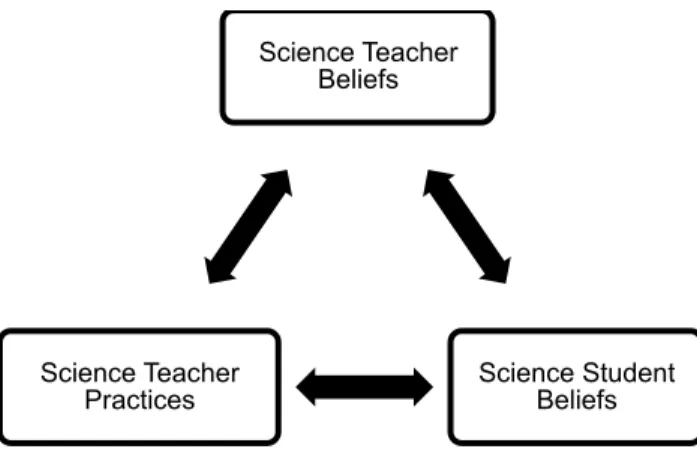
Figure 2.1 – Proximal Processes within the Science Classroom Environment ...14 Figure 2.2 – Conceptual Model of Science Students’ Efficacy Beliefs
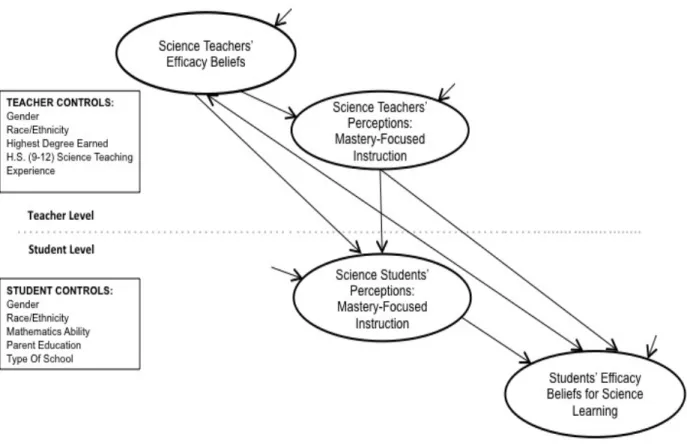
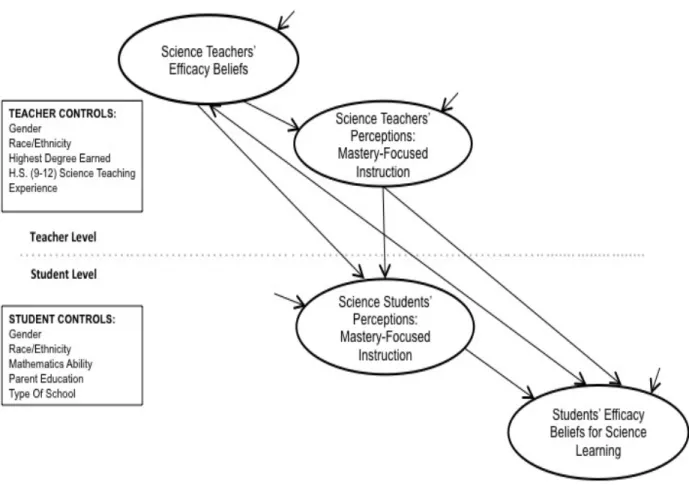
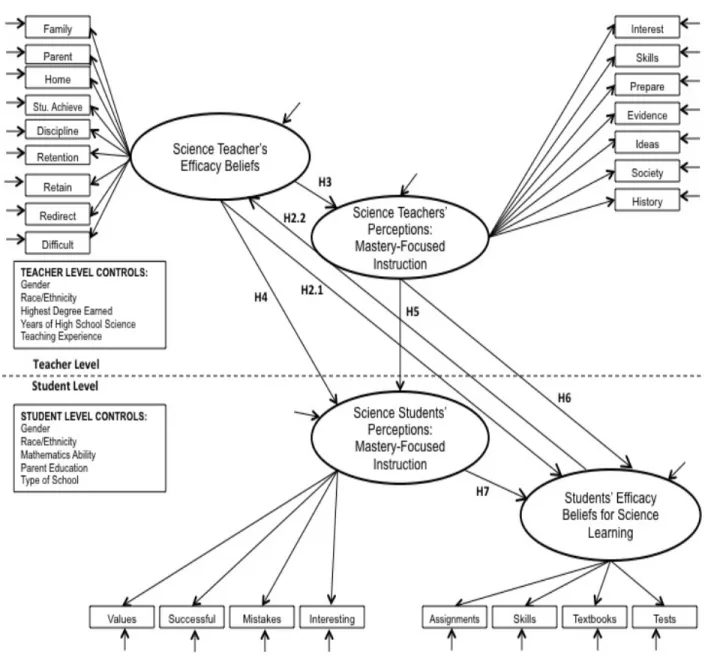
for Science Learning ...19, 39 Figure 3.1 – Full Structural Model of Student’s Efficacy Beliefs for Science Learning ...59 Figure 4.1 – Model 1: Path Diagram of Teachers’ and Students’ Efficacy Beliefs
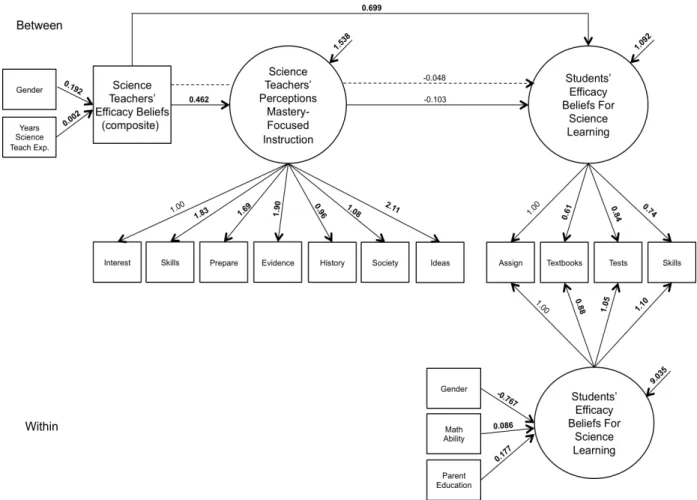
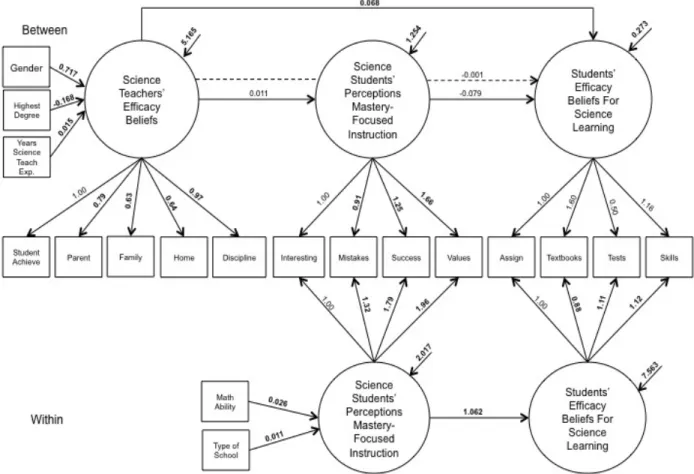
as Mediated by Teachers’ Perceptions of Mastery-Focused Instruction ...89 Figure 4.2 – Model 2: Path Diagram of Teachers’ and Students’ Efficacy Beliefs
xv
LIST OF APPENDICES
Appendix A – Results of Item Alignment Questionnaire: Student Perceptions
of Mastery-Focused Instruction ...105 Appendix B – Results of Item Alignment Questionnaire: Teacher Perceptions
1
CHAPTER ONE INTRODUCTION
Science learning has become critical for regaining and sustaining America’s
competitiveness in a global society. Recent reports indicate that 80% of the jobs created in the United States in the next decade will require science skills (Carnevale, Smith, & Strohl, 2010). Students who develop critical skills necessary to become the next innovative thinkers and leaders undoubtedly will benefit from more career choices and higher earning potential than those who do not develop these skills. Never before has it been so essential to inspire, motivate, and properly prepare the next generation of scientifically literate, innovative thinkers. However, when compared to 64 other countries, the students in the United States rank only 23rd in science achievement (National Center for Education Statistics, NCES, 2012), and according to the National Assessment of Educational Progress’ (NAEP), The Nation’s Report Card: Science 2011 (NCES, 2012), only 2% of the nation’s eighth graders perform at an advanced level in science. Thus, cultivating an interest in and motivation toward science learning not only is imperative for job creation but for moving American students from the middle of the pack to the top in science achievement.
2
relation between the motivational beliefs of science teachers and their students. This dissertation study bridges a gap between bodies of literature in science education and educational psychology regarding motivation and instructional practices in high school science classrooms. Furthermore, this study used a large scale, national data set and advanced statistical techniques (i.e., structural equation modeling (SEM)) to assess a multilevel mediation model. Therefore, this study
contributes to educational research in both fields by using advanced statistical techniques and extending research on motivational beliefs and classroom instruction to high school science classrooms, which may inform future professional developments focused on improving student motivation and learning through quality instructional practices.
This first chapter presents the rationale for the study. First, reforms in science education are discussed to highlight the emphasis on mastery learning, which motivational researchers characterize as active participation, higher-order thinking, and cognitive engagement (Meece, Blumenfeld, & Hoyle, 1988). Second, the importance of the classroom environment is described to underline how the instructional climate contributes to students’ motivation for learning
science. Third, the theoretical framework of Self-Efficacy Theory (Bandura, 1977) is briefly discussed to provide a lens through which the conceptual model is viewed. Fourth, science teachers’ motivational beliefs as a potential antecedent to their classroom instruction are explained. Fifth and finally, the statement of the problem, purpose, and contributions of the study are presented to warrant the investigation.
New Reforms in Science Education Emphasize Mastery
3
(National Research Council, NRC, 2012). This revisionary framework builds on previous reforms, such as Science for All Americans (American Association for the Advancement of Science, AAAS, 1989), Benchmarks for Science Literacy (AAAS, 1993), and the National Science Education Standards (NRC, 1996). The new framework is being used to develop the Next Generation Science Standards (NRC, 2013), which is expected to act as a prelude to common core standards in science. The committee contends this new framework reflects the field's understanding of science, science teaching, and science learning.
The reformed framework emphasizes the importance of individual inquiry, collaborative learning, problem solving, and mastery of key science concepts. Specifically, the committee charged with developing the framework recommended science education address three
dimensions: (a) scientific and engineering practices, (b) concepts that cut across content fields, and (c) core ideas in physical sciences, life sciences, earth and space sciences, and engineering and application sciences (NRC, 2012, p. 2). While the language in the second and third
dimensions focuses more on science content, the language in the first dimension of scientific and engineering practices focuses more on deep levels of cognitive engagement, higher-order
thinking skills, and content mastery, rather than on rote learning and memorization of science facts. This first dimension of the reform framework requires active forms of learning: Students should be able to ask questions and define problems; develop and use models; plan, organize, and carry out scientific investigations; analyze and interpret scientific data; use mathematics; construct scientific explanations and design solutions; engage in arguments based on scientific evidence; and obtain, evaluate, and communicate scientific information to others (NRC, 2012, p.3). The emphasis on active participation, deep cognitive engagement, and higher-order
4
1988). In order for these new reforms to be effective and students to develop a mastery approach to learning, it is important to examine how the classroom context contributes to the development of students’ motivation toward science learning.
Classroom as Context for Student Motivation and Learning
The classroom environment is critical for facilitating student motivation and learning (Eccles & Roeser, 2011; Meece, Anderman, & Anderman, 2006), and teachers play a critical role in creating classroom instructional environments that foster active participation, higher order thinking, and deep engagement in learning (Midgley, Anderman, & Hicks, 1995; Patrick, Anderman, Ryan, Edelin, & Midgley, 2001; Turner, 2011; Turner et al., 2002; Urdan, 2004; Wiesman, 2012). Specifically, when teachers focus on the value of learning, press for student
understanding, set high academic expectations for their students, emphasize conceptual understanding of content, and offer motivational support during learning, the classroom instructional climate is focused on mastering content (Stipek & Kowalski, 1989; Turner et al., 2002). When students perceive a classroom emphasis on mastery-focused instruction, they tend to be more motivated toward learning (Meece, 1991; Meece, Herman, & McCombs, 2003), cope better with challenging academic tasks (Kaplan & Maehr, 1999), adopt personal mastery goals (Anderman & Midgley, 1997; Wolters, 2004), and have a high sense of efficacy (Bong, 2009; Urdan & Midgley, 2003). Hence, by creating classrooms with emphases on mastery-focused instruction, science teachers convey to their students that everyone can learn science, develop scientific skills, persist through challenging reform-based science tasks, and develop a high sense of efficacy in learning science.
5
from traditional, textbook-based instruction toward mastery-focused instruction represents a critical shift in teacher beliefs and practices. Particularly, it shows a movement away from the teacher’s role as the transmitter of knowledge toward the role of facilitator or guide through the science learning process. This shift in the way teachers think about teaching and facilitate learning requires considerable knowledge of science content and pedagogy as well as confidence in both areas. Teachers make classroom decisions each day with respect to instructional policies and practices, such as choosing science activities, grouping students, providing feedback,
differentiating instruction to individual learners, and evaluating their students. These
instructional decisions help determine the degree to which students have opportunities to master scientific concepts and skills and build their confidence in their own science learning. Thus, it is critical to examine the beliefs and values teachers hold that contribute to these instructional decisions and practices.
Teacher Beliefs as Antecedent to Classroom Instructional Practices
An essential teacher belief, which has become a focal point in research among
6
Considerable research documents the role of teachers’ sense of efficacy in predicting teachers’ instructional practices and behavior in the classroom. Teachers with a high sense of efficacy tend to be more responsive to student needs (Ashton & Webb, 1986), are more likely to use a variety of instructional strategies to meet the needs of their students (Gibson & Dembo, 1984), are more willing to try new instructional practices (Ross, 1998), and tend to be more flexible and provide more effective feedback to their students (Gibson & Dembo, 1984). Thus, across studies, teachers’ efficacy beliefs have been shown to contribute to critical aspects of instructional practices as well as student academic motivation. Yet, no published studies were found that examine teachers’ efficacy beliefs, mastery-focused instruction, and students’ efficacy beliefs in high school science classrooms. To address this gap in the literature, Self-Efficacy theory (Bandura, 1977) was used as a lens to examine the relation among teachers’ and students’ efficacy beliefs and mastery-focused instruction in high school science classrooms.
Application of Self-Efficacy Theory to Current Study
Teaching and learning are intricately connected processes (Mayer, 2003), and teachers’ instructional practices should be evaluated by their impact on key indicators of student
7
they are more inclined to raise their own level of mastery expectation (Bandura, 1977). For example, when students have multiple, successful mastery experiences in the science classroom (e.g., balancing a chemistry equation correctly), they may raise their own interpretation of
mastery (e.g., moving on to a more difficult chemistry equation) as well as raise their efficacy for the science task (e.g., balancing chemistry equations). When students’ efficacy beliefs for
science tasks are high, they are more likely to engage and persist with the tasks, but when students’ efficacy beliefs are low, they are less likely to do so. Hence, providing students with continuous opportunities for mastery experiences in science classrooms is critical for fostering their motivation toward science learning.
8 Statement of the Problem
Given that the rigor of science learning continues to gain momentum with the Next Generation Science Standard (NRC, 2013) reforms, it is necessary to identify the state of science teachers’ efficacy beliefs for science teaching, their emphasis on mastery-focused instruction, and students’ own efficacy beliefs for learning science. As described later in the next chapter, students’ efficacy beliefs are key predictors of numerous behaviors associated with science achievement outcomes. Furthermore, understanding the role that instruction plays in connecting teacher and student beliefs is important for gaining a better understanding of the dynamic and complex nature of student motivation. Although links between teacher beliefs and instructional practices (see Klassen, Tze, Betts & Gordon, 2011 for a review of teachers’ self efficacy) and teacher beliefs and student academic motivation (e.g., Ashton & Webb, 1986) have been demonstrated, only one study was found that examined the relation among teachers’ efficacy beliefs, instructional practice, and students’ efficacy beliefs in a single model (Thoonen,
Sleegers, Peetsma, & Ooart, 2011). This study examined the role of instruction in mediating the relation between teacher and student efficacy beliefs (Thoonen et al., 2011). Although the study supported the idea that instruction mediates teacher and student efficacy beliefs, the
9
instruction as mediating the relation between teachers’ efficacy beliefs and student efficacy beliefs within the context of high school science classrooms.
Purpose of the Study
The purpose of this investigation was to examine the relations among high school science teachers’ efficacy beliefs, teacher and student perceptions of mastery-focused instruction, and students’ efficacy beliefs for learning science. Specifically, the purposes of this study were to (a) explore the degree to which high school science teachers’ sense of efficacy relates to teachers’ perceptions of mastery-focused instruction in their high school science classroom; (b) explore the degree to which high school science teachers’ perception of mastery-focused instruction aligns with high school students’ perceptions mastery-focused instruction in the science classroom; (c) explore the degree to which high school science teachers’ sense of efficacy relates to their students’ sense of efficacy for learning science; (d) explore the degree to which mastery-focused instruction in the high school science classroom relates to students’ sense of efficacy for learning science; and (e) examine whether high school science teachers’ and students’ perceptions of their science teachers’ focus on mastery instruction in the science classroom partially mediate the relation between high school science teachers’ sense of efficacy for teaching science and high school science students’ sense of efficacy for learning science. Specific research questions and hypotheses are discussed in the second chapter of this dissertation.
Potential Contributions of the Study
10
teachers, administrators, policymakers, and researchers with additional information about the current state of U.S. ninth grade students’ efficacy beliefs for learning science and for their perceptions of their science teachers’ use of mastery-focused instruction in the science
classroom. Third, empirical findings could provide teachers, administrators, policymakers, and researchers with a glimpse into how well aligned students’ and teachers’ perceptions are of science teachers’ use of mastery-focused instruction. Fourth, empirical evidence from this investigation also could add to our understanding of how science teacher efficacy beliefs
contribute to their instructional practice and how their efficacy beliefs and instruction contribute to the formation of their students’ perceptions of their teachers’ classroom practices and their efficacy beliefs in science. Fifth, empirical evidence examining how science teachers’ efficacy beliefs relate to their classroom practices also would inform researchers and practitioners as they design interventions and professional developments based on the Framework for K-12 Science Education (NRC, 2012) and on the Next Generation Science Standards (NRC, 2013).
Summary
In summary, this study relies on data from a national dataset to explore the relation between high school science teachers’ efficacy beliefs and their students’ efficacy beliefs for learning science as mediated by both teacher and student perceptions of mastery-focused instruction. This study is grounded in self-efficacy theory (Bandura, 1977) and seeks to add to the current understanding of teacher and student motivation. The findings may add to
understandings of how certain proximal processes within the classroom environment contribute to students’ motivation to learn science. Furthermore, the findings may inform science educators and policymakers on both the importance of teachers’ efficacy beliefs in guiding science
11
12
CHAPTER TWO LITERATURE REVIEW
This dissertation study examined the role of the classroom instructional environment in mediating the relation between teacher and student motivation. Specifically, mastery-focused instruction was hypothesized to mediate the relationship between science teachers’ efficacy beliefs and science students’ efficacy beliefs. In this chapter, the conceptual model is described and broken into individual components to show how the current study contributes to bodies of literature in science education and educational psychology. First, the importance of the classroom as context for student learning and motivation is discussed. Second, the theoretical framework of self-efficacy is reviewed and then applied as a lens through which the conceptual model (see Figure 2.2, p. 19) is viewed. Third, the use of students’ efficacy beliefs as a proximal indicator of distal achievement-related outcomes is presented. Fourth, the conceptual model is then broken down and evidence for each link is reviewed with particular attention paid to science education literature. Finally, the purpose, research questions, hypotheses, and structural model are presented.
Classroom Environment as Context for Student Development
13
majority of school-based proximal processes” (p. 26). These proximal processes (see Figure 2.1, p. 14) include various aspects of the classroom, such as teachers’ beliefs, instructional strategies, curriculum tasks, relationships between teachers and students, and students’ performance and motivation, which all interact to shape development (Eccles & Roeser, 2003). Although
researchers have examined different processes within the classroom and used various theoretical lenses (e.g., Stage Environment Fit Theory, Eccles & Midgley, 1989; Self Determination Theory, Deci & Ryan, 1985), much of this research has centered on students’ experiences within the classroom and the ways in which their experiences uniquely contribute to their academic
development. After all, it is the experiences students have in the classroom that are most closely related to student outcomes (Hamre & Pianta, 2010; Nye, Konstantopoulos, & Hedges, 2004).
One particularly salient aspect of students’ classroom experience involves the
14
motivational self-beliefs. These internal beliefs and external practices are continuously changing as new information is gathered, internalized, and evaluated. In order to explain the key concepts that underlie the conceptual model, the major tenets of self-efficacy theory are described first in the next section. Then, the conceptual model is described through the lens of self-efficacy theory (Bandura, 1977).
Figure 2.1. Proximal Processes within the Science Classroom Environment (Adapted from Hamre & Pianta, 2010)
A Theoretical Lens of Self-Efficacy Theory
Albert Bandura’s Self-Efficacy Theory (Bandura, 1977) was used to frame this study because it explains how motivational beliefs develop and how they contribute to classroom behaviors, such as teachers’ instructional practices and students’ academic performance.
Bandura (1977) theorized that individuals’ cognitive processes (e.g., agency) act as a mechanism that mediates a stimulus and a response. He defined agency as an intentional pursuit of courses of action, characterized by intentionality, forethought, self-regulation, self-reflectiveness, quality of functioning, and the meaning of one’s own life pursuits (Bandura, 2006, p. 167). Therefore, individuals’ behavior can be predicted by their beliefs about their own capabilities, or self-efficacy. Specifically, Bandura defined self-efficacy as “beliefs in one’s capabilities to organize and execute the courses of action required to manage prospective situations” (Bandura, 1997, p.
Science Teacher Beliefs
Science Student Beliefs Science Teacher
15
3). These self-efficacy beliefs can act as a mediator between the task and outcome behaviors. In addition, self-efficacy beliefs are characterized by self-perception of competence rather than by the actual level of competence. This distinction is critical because many individuals misestimate their ability, which may have consequences in their participation in or effort expended in
particular activities (Schunk & Pajares, 2005).
Efficacy beliefs are further differentiated into two dimensions of expectations: efficacy expectations and outcome expectations (Bandura, 1977). First, efficacy expectations are defined as the personal beliefs that one can successfully execute behaviors necessary to complete certain tasks. These beliefs act as mechanisms by which individuals engage in behaviors. Second, outcome expectations are defined as the expectations that certain behaviors will result in certain outcomes. For example, teachers may believe certain instructional practices can produce student learning (outcome expectations), but if teachers do not believe they can successfully execute the instructional practices to produce student learning (efficacy expectations), they may not engage in those instructional practices. Consistent with Bandura’s theory, efficacy beliefs are shaped by the individual’s interactions with the environment. Four sources shape efficacy expectations: mastery experiences, vicarious experiences, verbal persuasion, and physiological states (Bandura, 1977). As mentioned in the first chapter, personal mastery experiences are characterized as the individual’s interpretation of purposive performances and are the most influential source of efficacy, for repeated success can raise mastery expectations. After
16
typically less certain about their own capabilities to perform that task with success, and therefore tend to rely on vicarious experiences with others. Vicarious experiences are characterized by observations of others performing activities without adverse consequences (e.g., observing teachers or other students they perceive to be similar to themselves correctly model a science laboratory investigation). Furthermore, social persuasions are described as verbal judgments and other social messages such as corrective feedback, where individuals can be socially persuaded that they have the capabilities necessary to achieve success at a particular task (e.g., receiving encouragement from their science teacher). Finally, physiological states, such as anxiety, stress, and fatigue also act as sources of efficacy expectations. These physiological reactions to
particular tasks (e.g., butterflies in their stomach when asked to complete the equation for photosynthesis) provide cues for the anticipated success or failure of the outcomes. These four sources combine to form teacher and student efficacy beliefs and when efficacy beliefs are high, teachers and students are more likely to engage in particular classroom behaviors, such as instructional practices or learning activities (Bandura, 1977). For example, while students with low efficacy for science tasks may avoid activities or may not expend much effort because they do not believe they possess adequate competence to complete them with success, students with high efficacy may persevere when faced with difficult science tasks because they believe they do possess adequate competence to successfully complete them. Efficacy beliefs are domain specific and even situation specific, meaning they change depending on self-perceptions of competence in cognitive skills or actions required for adequate
17
For the current study, students form efficacy beliefs regarding their capabilities to learn science while teachers form efficacy beliefs regarding their capability to influence students’ science learning. Students’ self-efficacy in science (i.e., efficacy beliefs) was the primary outcome variable for this dissertation study. As described next, efficacy beliefs act as a proxy for more distal outcomes in science.
Efficacy beliefs as proxy for achievement-related outcomes. Students’ self-efficacy in science acts as a predictor of students’ achievement level and their engagement in science-related activities (Kupermintz, 2002; Lau & Roeser, 2002). Students’ beliefs in their capabilities to succeed in science tasks relate to their choices of science-related activities, the effort they expend on those activities, the persistence when encountering difficulty, and the success they experience (Britner & Pajares, 2006; Kupermintz, 2002; Lau & Roeser, 2002). Research has shown
students’ efficacy beliefs for science are associated with achievement-related outcomes across grade levels (e.g., Britner, 2008; Britner & Pajares, 2006). Regarding middle school students’ efficacy beliefs for science, Britner and Pajares (2001; 2006) asked students to rate their confidence related to earning a high grade in science, and correlational analysis confirmed a strong relationship between science self-efficacy and science achievement as measured by students’ final grades in science. In other words, students’ efficacy beliefs for earning a high grade in science acted as a proxy for achievement in science class.
18
science content, test-specific efficacy, and science confidence beliefs. Particularly important for this dissertation study, Lau and Roeser found efficacy beliefs explained a portion of the variance in science test scores and final grades above and beyond the variance accounted for by students’ prior ability level. Efficacy beliefs were also found to be the strongest predictor of students’ engagement in science tasks and expected science-related college major and career choices. Furthermore, efficacy beliefs were a stronger predictor of student outcomes than demographic characteristics, such as students’ ethnicity, gender, and parents’ educational level. Similar results have been found with college students enrolled in science courses. Researchers found students with higher efficacy beliefs tend to earn higher grades in science courses (Andrew, 1998), persist in related undergraduate majors (Dalgety & Coll, 2006), and express interest in science-related career choices (Gwilliam & Betz, 2001; Lent, Larkin & Brown, 1989). Based on these findings, students’ efficacy beliefs in science can act as a proximal indicator of more distal science achievement-related outcomes, such as science performance and choice and persistence in undergraduate majors and careers. Hence, students’ efficacy beliefs represent the motivational outcome variable in this study because students’ efficacy beliefs are essential achievement-related motivational beliefs for science educators and stakeholders who want to create classroom environments that facilitate motivation and achievement in science.
19
efficacy beliefs for science are viewed as a proximal indicator of more distal outcomes (e.g., science achievement, persistence in science majors, and career choices).
Applying a Lens of Self-Efficacy Theory to the Classroom Environment
Embedded in the larger school environment, the science classroom is similar to a petri dish in which students’ experiences with various proximal processes shape their academic development (Hamre & Pianta, 2010). The conceptual model of classroom proximal processes (see Figure 2.2) proposes the mechanism that underlies the relation between science teachers’ efficacy beliefs and students’ efficacy beliefs may actually lie in the instructional environment that teachers establish in their classrooms. Specifically, teachers’ efficacy beliefs for teaching science is proposed as a precursor to classroom instruction in science, which in turn is proposed as a precursor to students’ efficacy beliefs for learning science.
20
Teachers’ instructional practices are key to science learning and motivation. Teachers play a critical role in students’ motivation in the science classroom. Teachers’ instructional practices and beliefs about their instruction contribute to the formation of their students’ motivational beliefs. Science teachers are responsible for the frequency and duration of the situations in which students experience verbal persuasions (e.g., receiving corrective
feedback and encouragement from the teacher), participate in vicarious learning activities (e.g., watching the teacher model how to decipher animal cells from plant cells), and engage in
mastery experiences in science class (e.g., identifying animal cells from plant cells on their own). The success or failure students have with these experiences, particularly mastery experiences, contributes to the development of their own efficacy judgments for science learning. Science teachers can use instruction that provides students with multiple opportunities to engage in mastery experiences. Because mastery experiences are one of the most influential sources of students’ efficacy beliefs (Bandura, 1977), teachers’ instructional emphasis on mastery is a primary focus of this dissertation study.
21
analyze, evaluate, and synthesize information in order to draw conclusions based on scientific criteria (Mayer, 2003; 2002). Furthermore, science teachers are asked to make their instruction meaningful and relevant to students, which can facilitate understanding, application, evaluation, and creation of new ideas about science topics (Stipek; 2005; Stipek & Seal, 2002). Teachers who use instructional practices aimed at concept development and meaningful learning tend to have students who make larger gains in achievement (Alparslan, Tekkaya, & Geban, 2003; Romberg, Carpenter, & Kwako, 2005).
The call for science teaching practices that emphasize conceptual understanding and meaningful learning are also consistent with motivational researchers’ call for teaching practices that emphasize mastery learning, which they refer to as mastery-focused instruction (Meece, Herman, & McCombs, 2003). Mastery learning occurs when students are actively participating, cognitively engaged in a task, and continually receiving constructive verbal feedback on their performance through the task (Meece et al., 2003). Evidence suggests that in order for students to successfully complete challenging and meaningful tasks (i.e., mastery learning experiences) they need effective and multidimensional instructional support and guidance from their teacher (Pintrich & Schunk, 2002; Stipek & Seal, 2002). Looking across subject areas, Meece (1991) characterized mastery-focused instruction to include an emphasis on students’ understanding rather than on rote memorization of facts, recognition and praise of students’ effort and
22
students are more likely to perceive a classroom environment that emphasizes mastery-focused instruction (Meece, 1991).
In science, mastery-focused teachers use instructional activities that provide opportunities to develop higher order thinking skills and encourage students to take risks (Anderman, Sinatra, & Gray, 2012; Meece, 1991). For the purposes of this dissertation, mastery-focused instruction in science is characterized by teachers’ promotion of interest in science, teaching science processes and inquiry skills, and teaching students to develop higher order thinking skills (e.g., evaluating arguments based on scientific evidence, communicating science ideas effectively, and establishing connections between science and society, such as technology, business, and
industry). Motivational researchers agree that teachers play a critical role in creating classrooms that are intellectually challenging and developmentally supportive (Anderman, Andrzejewski, & Allen, 2011; Meece, 1991; Meece et al., 2003; Turner et al., 2002). With respect to creating classrooms that foster motivation and achievement, it is important to examine other classroom proximal processes as well. In the past, researchers have examined classroom instruction and motivation separately, but over the past few decades, researchers have begun to look toward the motivation and classroom practices of teachers as contributing to the explanation of student success in the classroom (e.g., Angle & Moseley, 2009; Meece, 1991). Researchers now are examining teachers’ beliefs and classroom instructional practices as potential predictors of students’ efficacy beliefs. Understanding the dynamic of these relationships could contribute to promoting science learning in the United States.
23
ideas, Tschannen-Moran, Hoy, and Hoy (1998) also argued teachers’ sense of efficacy varies across teaching tasks and contexts. Teachers’ efficacy beliefs are defined as teachers’ judgments of their own capabilities to produce desired outcomes of student learning and engagement, even among difficult or unmotivated students (Tschannen-Moran & Woolfolk Hoy, 2001). Similar to students’ evaluations of efficacy, teachers continuously evaluate their own teaching competence as well as the difficulty of the science-teaching task (Klassen et al., 2011). Teachers are
continually receiving and processing cues from the classroom that contribute to the development of their overall teaching efficacy. For example, if teachers engage in instruction focused on students’ concept development and mastery learning (i.e., mastery-focused instruction) and experience success in student engagement and learning outcomes, then their efficacy beliefs for engaging in mastery-focused instruction will likely rise (Bandura, 1997). However, if teachers perceive failure in student learning after engaging in mastery activities, their efficacy beliefs are likely to decline, leading them to possibly withdraw from engaging in mastery-focused
instructional practices in the future. Teachers’ efficacy beliefs are associated with teachers’ goals, effort, and persistence with teaching tasks, which in turn are associated with their teaching behaviors (e.g., choice in instructional strategies, feedback to students), and actual teaching performances serve as mastery experiences for future efficacy judgments.
A focus of the current study was to examine how teachers’ efficacy beliefs contribute to their instructional practices, which could potentially alter students’ efficacy beliefs. Teachers’ efficacy beliefs have been shown to relate to their instructional practices (Tschannen-Moran & Woolfolk Hoy, 2001). For example, teachers with low efficacy may avoid planning lessons that may exceed their science content or pedagogical knowledge, be unlikely to persist with
24
misconceptions (Tschannen-Moran & Woolfolk Hoy, 2001). In contrast, teachers with high efficacy beliefs may spend more time developing challenging inquiry activities, persist with helping struggling students, and create a classroom climate focused on all students learning (Tschannen-Moran & Woolfolk Hoy, 2001). Thus, teachers’ efficacy beliefs may contribute to the degree to which they engage in mastery-focused instruction and the degree to which their students’ perceive mastery-focused instruction in the classroom. In turn, these perceptions of mastery-focused instruction may help shape the formation of students’ efficacy beliefs for learning science. Finally, completing the cycle of proximal processes within the classroom (see Figure 2.1, p. 14), students’ efficacy beliefs may contribute to the formation of teachers’ efficacy beliefs for teaching science.
Summary. Recent investigations in educational psychology (e.g., Anderman, Andrzejewski & Allen, 2012; Meece et al., 2006; Turner, 2011) and science education (e.g., Anderman, Sinatra, & Gray, 2012; Angle & Moseley, 2009; Appleton & Lawrenz, 2011; Britner, 2008; Bybee, 2010) have focused on how the classroom instructional climate promotes positive student development. Together these bodies of literature emphasize how the quality of
25
Christensen, & Meyer, 2009). In the next sections, the conceptual model is broken down and each proximal process is further explored.
Breaking Down the Conceptual Model: Proximal Processes at Work in the Classroom The conceptual model (see Figure 2.2, p. 19) is composed of hypothesized relations among students’ efficacy beliefs and mastery-focused instruction, teachers’ and students’ efficacy beliefs, and teachers’ efficacy beliefs and mastery-focused instruction. In the previous section, an explanation of how these processes work together within the classroom context to promote students’ efficacy beliefs for science learning is described. In the following section, research supporting each linkage is reviewed in more detail.
Connecting mastery-focused instruction and students’ efficacy beliefs. To date, few studies have examined the relation between mastery-focused instruction and students’ efficacy beliefs in high school classrooms. The majority of these studies have focused on classroom achievement goals (e.g., Bong, 2009; Gutman, 2006; Wolters & Daughtery, 2007). Achievement goal theory (Ames, 1992) suggests that individuals form types of goals: mastery goals, which are concerned with developing new skills and improving on past performance, and performance goals, which are concerned with being judged and outperforming others. Although achievement goals were not a focus of this dissertation, some research on mastery-goal orientations aligns with mastery-focused instruction (e.g., helping students set objectives or goals and evaluating effort toward them). Drawing on this literature, researchers have found that teachers of higher grade-levels tend to report less emphasis on mastery-focused instruction in the classroom than do teachers of lower grade levels (Wolters & Daughtery, 2007).
26
emphasizing mastery-focused instruction may experience more positive changes in their efficacy beliefs as they move up in grade level (Gutman, 2006). The use of mastery-focused instruction has been shown to predict student efficacy beliefs (Anderman & Young, 1994; Meece et al., 2003; Siegle & McCoach, 2007). When students perceive that their teacher emphasizes mastery-focused instructional practices, they are more likely to report higher efficacy beliefs (Meece et al., 2003). In a recent investigation, Siegle and McCoach (2007) demonstrated the role of mastery-focused instruction in promoting elementary-aged students’ efficacy beliefs in
mathematics. Specifically, they found teachers posted daily lesson objectives in classrooms and reviewed the previous day’s accomplishments toward meeting these objectives, which helped students evaluate their own growth. Another instructional strategy teachers used was appropriate feedback, meaning they complimented students’ on effort and growth toward specific skills and away from attributing failure to a lack of ability. These findings were consistent with other motivational researchers who suggest providing students with appropriate and meaningful feedback on progress can help raise students’ efficacy beliefs (Schunk & Meece, 2006).
Therefore, how a teacher structures lessons, provides feedback to students, and evaluates student performance help mold students’ efficacy beliefs about learning (Anderman, Eccles, Yoon, Roeser, Wigfield, & Blumenfeld, 2001; Meece, Anderman, & Anderman, 2006).
27
highest achieving students as examples to other students) rather than mastery-focused
instructional practices (e.g., emphasizing individual effort and persistence over competition) also reported lower efficacy beliefs for learning science. Additional studies are needed to connect teachers’ mastery-focused instruction to students’ efficacy beliefs in high school science classrooms.
Teacher versus student reports of mastery-focused instruction. Whether the instructional climate of classrooms should be measured through teacher or student reports is a critical question and is debated by researchers (Desimone, Smith & Frisvold, 2010). The issue is particularly important with the implementation of standards-based instruction in the classroom (Pianta & Hamre, 2009). Some researchers have argued that teacher self-reports of their
instructional practices are unreliable (e.g., Spillane & Zeuli, 1999; Stigler, Gonzales, Kawanaka, Knoll, & Serrano, 1999). These researchers contended that relative to student reports, teachers tend to view their classroom climate more positively and overestimate their use of particular instructional practices (Fisher & Fraser, 1983).
28
practices” (Meece et al., 2003, p. 471) and suggest the inclusion of student reports of classroom climates.
On the other hand, other researchers have argued that teacher and student reports of classroom climates are unique contributors, and it is necessary to consider both. For example, Urdan and colleagues (1998) found low positive correlations between teacher and student reports of the same mastery emphasis, and both teacher and student reports of classroom instructional emphasis contributed uniquely to predicting student outcomes. Desimone, Smith, and Frisvold (2010) used data from the National Assessment of Education Progress (NAEP) to compare middle school mathematics teacher and student reports of mathematics instruction. The
researchers found low correlations between students’ and teachers’ reports. Specifically, teacher and student reports were more similar when more objective questions (e.g., frequency of
computer use) were asked rather than more subjective (e.g., types of strategies). Desimone and colleagues (2010) reasoned that teachers and students may have different conceptualizations of what counts as a “class discussion” or “inquiry,” which may reflect particular responses to survey items. Due to inconsistencies across studies, it is necessary to attend to teacher and student perceptions of the instructional environment when examining instruction and student academic or motivational outcomes.
Summary. Based on previous definitions (e.g., Meece, 1991), mastery-focused
instruction in science refers to teachers’ use of promoting students’ interest in science, teaching science process and inquiry skills, and helping students develop higher order thinking skills. To date, no studies were found that have examined the relation between mastery-focused instruction and students’ efficacy beliefs within the context of high school science classrooms.
29
measured through teacher or student reports. Therefore, this study includes both teacher and student reports when examining the connection between mastery-focused instruction and students’ efficacy beliefs within the context of high school science classrooms.
Connecting teacher and student efficacy beliefs. A limited body of literature exists that directly links teachers’ sense of efficacy to students’ sense of efficacy, and to-date no published studies were found that establish this connection within the domain of high school science. However, the studies that have been conducted outside of high school science do show support for the connection between constructs. For example, Anderson and colleagues (1988) found the level of teaching efficacy that teachers held at the beginning of the school year was significantly related to the development of their students’ efficacy beliefs. The researchers also showed that teachers’ sense of efficacy contributed to students’ level of efficacy in language arts and social studies. In another study, Ross and colleagues (2001) examined teachers’ efficacy beliefs for computer instruction, students’ use of computers, and students’ efficacy beliefs for using computers. The researchers found that teachers’ efficacy beliefs contributed to the promotion of students’ efficacy beliefs by fostering their involvement in class activities and toward difficult computer-related tasks. However, Ross and colleagues found only modest bivariate correlations between teacher and student efficacy beliefs.
30
between teacher and student perceptions of students’ literacy efficacy beliefs. Third, the researchers found that teachers’ efficacy beliefs were associated with teachers’ perception of students’ efficacy beliefs but were not associated with students’ reports of their efficacy beliefs.
Although empirical links between teacher and student efficacy beliefs have been explored, the direction of the relation is still not clear. Theoretically speaking, based on
Bandura’s (1997) and Tschannen-Moran and colleagues’ (1998) description of teacher efficacy, the relation could be bidirectional due to the dynamic nature of the constructs. In other words, students’ and teachers’ efficacy beliefs are constantly influencing and being influenced by individuals’ experiences and thought processes in the classroom (Henson, 2001). Specifically, the mastery experiences, vicarious experiences, and verbal persuasions that teachers provide during instruction could contribute to the development of their students’ efficacy beliefs. Reciprocally, student efficacy beliefs could also contribute to the formation of teachers’ beliefs through the same experiences. For example, when teachers engage in mastery-focused
31
Summary. Previous research explores connections between teacher and student efficacy beliefs. However, additional research is needed to understand the direction of the relation and the mechanism that may connect these two types of beliefs. Furthermore, future research needs to extend to high school classrooms, particularly high school science classrooms. Hence, in the next section, the evidence supporting the connection between mastery-focused instruction and teachers’ efficacy beliefs is discussed.
Connecting mastery-focused instruction and teachers’ efficacy beliefs. Researchers have shown that teachers’ efficacy beliefs are associated with mastery-focused instructional practices, such as the effort they exhibit in their planning (Allinder, 1994); level of openness to trying new instructional strategies to better meet the needs of individual students in their
classroom (Berman, McLaughlin, Bass, Pauly, & Zellman, 1977; Guskey, 1988), and their level of persistence during setbacks (Ross, 1998). When compared to teachers who report low
efficacy beliefs, teachers who report high efficacy beliefs tend to be less critical of their students when mistakes are made, believing that mistakes are a part of the learning process (Ashton & Webb, 1986), are more willing to persist when working with students who are struggling (Gibson & Dembo, 1994); and are less inclined to refer difficult students to special education programs (Podell & Soodak, 1993). Specific to the focus of this study and discussed in the next section is the link between teachers’ efficacy beliefs and instructional practices in science classrooms.
32
between teachers’ efficacy beliefs and various instructional practices that align with what could be considered mastery-focused instruction in motivation literature.
Riggs and Jesunathadas (1993) reported that teachers with a higher sense of personal science teaching efficacy were more likely to spend more time teaching science and more time developing the science concepts they were asked to teach than were teachers with a low sense of efficacy. Furthermore, Watters and Ginns (1995) reported personal science teaching efficacy to be associated with teacher ratings of the relevance of science and enjoyment of science activities. Specifically, more highly efficacious teachers rated science as more relevant and science
activities as more enjoyable than teachers with a low sense of personal teaching efficacy. Evidence also suggests teachers with a high sense of personal teaching efficacy tend to engage their students in more student-centered science lessons (Loughran, 1994) and believe that all students are capable of learning science through classroom experiences and cooperation with peers (Scharmann, & Hampton, 1995). Other studies (Enochs, Scharmann, & Riggs, 1995; Gibson & Dembo, 1984) reported that science teachers with a low sense of efficacy tend to rely heavily on the use of more authoritative, teacher-directed instruction, such as text-based
33
inquiry during a typical lesson, and (c) the correlation between teachers’ sense of efficacy and time spent using inquiry dropped slightly when they controlled for grade level and content area. These studies indicated that science teachers feel less efficacious for using instruction that is effective for overcoming barriers to student learning in science. Although progress has been made, additional research is needed to connect teachers’ sense of efficacy and mastery-focused instruction to student-level outcomes. This study contributes to the extant body of literature in science education by investigating how these constructs relate to one another within the context of high school science classrooms.
Summary. Researchers have examined the connection between inservice science teachers’ efficacy beliefs and various instructional practices that align with aspects of mastery-focused instruction. However, researchers have not yet investigated the potential mediating relation of mastery-focused instruction between teacher and student efficacy beliefs in high school science classrooms in the United States. Therefore, in the next few sections, a mediation model is presented. Drawing on existing research, teachers’ efficacy beliefs are hypothesized to be associated with teachers’ use of mastery-focused instruction in the classroom. In turn, mastery-focused instruction is hypothesized to be associated with students’ efficacy beliefs. Mastery-Focused Instruction as a Mediator between Teacher and Student Efficacy Beliefs
34
only one study (Thoonen, Sleegers, Peetsma, & Ooart, 2011) was found that examined the relative importance of teachers’ instruction and efficacy beliefs to explain variation in students’ efficacy beliefs.
Thoonen and colleagues administered scales of teachers’ efficacy beliefs (van Woerkom, 2003), student efficacy beliefs (Midgley et al., 1997), and teaching practices (Roelofs &
Houtveen, 1999). When completing the instructional questionnaire, teachers indicated the extent to which the item referred to four teaching practices: process-oriented instruction, connection to students’ world, cooperative learning, and differentiation. Thoonen and colleagues characterized process-oriented instruction as the gradual shift of control of the learning process from the teacher to the student, focusing on knowledge building, fostering independent learning, and supporting students to become lifelong learners. Using multilevel regression analyses, they reported, “the effect of teachers’ sense of self-efficacy on students’ well-being in school was fully mediated by process-oriented instruction and cooperative learning” (p. 356). In other words, teacher and student efficacy beliefs were related through the mediation of teachers’ instructional practices, as measured by the four teaching practices. However, Thoonen and colleagues recognized the limitations of their study and recommended additional research be conducted. Therefore, this dissertation study attempts to address the limitations of Thoonen and colleagues’ study and expand teachers’ instructional practices to include mastery-focused instruction (Meece et al., 2003).
Purpose of the Study
35
respect to generalizability. First, the researchers surveyed only elementary school teachers and students in a particular area of the Netherlands. Second, the researchers used an unpublished scale of teachers’ efficacy beliefs, citing a dissertation as the only source for additional information. Third, the researchers did not collect certain demographic information from
students (e.g., socioeconomic status, prior performance, ethnicity), which have been shown to be associated with students’ motivation to learn (Desimone et al., 2010; Vedder, Boekaerts, & Seegers, 2003). To their credit, Thoonen and colleagues recognized some of these limitations by noting that their findings are restricted by a relatively small class-level and school-level variance. As a result of these limitations, the researchers recommended future studies use larger and more heterogeneous samples and utilize multilevel structural equation modeling to analyze the data.
This dissertation study responded to Thoonen and colleagues’ (2011) call for additional research by addressing their limitations and extending the scope of investigation to high school classrooms. Furthermore, this dissertation study expanded this body of literature to high school science classrooms. Thus, the purpose of this dissertation was to use Self Efficacy Theory (Bandura, 1977) to examine the relationships among science teachers’ efficacy beliefs, both student and teacher perceptions of science teachers’ emphasis on mastery-focused instruction, and students’ efficacy beliefs for science. In addition, this study used teacher and student reports of mastery-focused instruction in an effort to examine alignment between perceptions and if and how each partially mediates the relation between teacher and student efficacy beliefs.
36
and science students’ sense of efficacy. Specifically, a mediation model of mastery-focused instruction was examined to explore whether or not students’ and teachers’ perceptions of mastery-focused instruction partially mediate the relation between teachers’ and students’
efficacy beliefs in science. Because students are nested within classrooms, hierarchical structural equation modeling was used for analyses (Muthen & Muthen, 2007). This study contributes to and bridges a gap between bodies of literature in educational psychology and science education. The next section presents all research questions and hypotheses.
Research Questions and Hypotheses
1. Does the hypothesized model (see Figure 2.2, p. 39) provide a satisfactory fit to the sample data? I hypothesized that the model would produce satisfactory goodness-of-fit indices using the following goodness-of-fit indices used for multi-level structural equation modeling in Mplus (Muthen & Muthen, 2007): Akaike (AIC) and Bayesian (BIC).
2.1. Are science teachers’ efficacy beliefs related to students’ efficacy beliefs for science learning? I hypothesized science teachers’ efficacy beliefs would be related positively to students’ efficacy beliefs for science learning with statistical significance (p < .05) being the determining factor. In other words, teachers who report higher efficacy beliefs for science teaching would have students who report higher efficacy beliefs for science learning.
37
3. Are science teachers’ efficacy beliefs related to science teachers’ perceptions of mastery-focused instruction? I hypothesized science teachers’ efficacy beliefs would be related positively to science teachers’ perceptions of mastery-focused instruction with statistical
significance (p < .05) being the determining factor. In other words, teachers who report higher efficacy beliefs for science teaching would also report higher levels of mastery-focused
instruction in the classroom.
4. Are science teachers’ efficacy beliefs related to students’ perceptions of mastery-focused instruction? I hypothesized science teachers’ efficacy beliefs would be related
positively to students’ perceptions of mastery-focused instruction with statistical significance (p < .05) being the determining factor. In other words, science teachers who report higher efficacy beliefs would have students who report higher levels of mastery-focused instruction in the classroom.
5. Are science teachers’ perceptions of mastery-focused instruction related to their students’ perceptions of their mastery-focused instruction? I hypothesized science teachers’ perceptions of mastery-focused instruction would be related positively to science students’ perceptions of mastery-focused instruction with statistical significance (p < .05) being the determining factor. In addition, I hypothesized science teachers would report higher perceptions of mastery-focused instruction in the classroom than their students.
38
report higher levels of mastery-focused instruction in the classroom would have students who report higher efficacy beliefs for science learning.
7. Are students’ perceptions of mastery-focused instruction related to students’ efficacy beliefs for science learning? I hypothesized students’ perceptions of mastery-focused instruction would be related positively to students’ efficacy beliefs for science learning with statistical significance (p < .05) being the determining factor. In other words, students who report higher levels of mastery-focused instruction in the classroom would report higher efficacy beliefs for science learning.
8. What relation exists among science teachers’ efficacy beliefs, science teachers’
perceptions of mastery-focused instruction, students’ perceptions of mastery-focused instruction, and students’ efficacy for science learning? I hypothesized both teachers’ and students’
perceptions of mastery-focused instruction would partially mediate the relation between science teachers’ efficacy beliefs and students’ efficacy beliefs for science learning with statistical significance (p < .05) being the determining factor.
39
40
CHAPTER THREE METHOD
In this chapter, a description of the High School Longitudinal Study 2009 (HSLS: 09) design, study procedures, and participants is provided. Next, descriptions of the instruments used for the proposed study are described, and an explanation of how the data were prepared for analysis is presented. This chapter concludes with a summary of the methods used to investigate each research question.
High School Longitudinal Study 2009
This study used data from HSLS: 09, which is a nationally representative, longitudinal study of ninth graders across the United States who will be followed through high school and into postsecondary education and the workforce (Ingels et al., 2011). HSLS: 09 is the fifth in a series of longitudinal studies conducted by the National Institute for Educational Statistics (IES), and the major focus of the study is to map student trajectories from the start of the high school experience into postsecondary education, the job market, and beyond.
HSLS: 09 Sample Design