A longitudinal analysis of the effects of collective bargaining on interstate teacher salary differences from 1960 to 2000
Tate O’Gara Gould
A dissertation submitted to the faculty of the University of North Carolina at Chapel Hill in partial fulfillment for the degree of Doctor of Philosophy in the School of
Education.
Chapel Hill 2007
Approved by: Dr. Carol E. Malloy, Chair
Dr. Tom James Dr. Catherine Marshall
©2007
ABSTRACT
TATE O’GARA GOULD: A longitudinal analysis of the effects of collective bargaining on interstate teacher salary differences from 1960 to 2000
(Under the direction of Dr. Carol Malloy)
The current study examined how collective bargaining provisions affected average teacher salary trends for states from 1960 to 2000, after controlling for various economic, social, and demographic variables. Results show that collective bargaining had a significant, but waning, effect on teacher pay increases over the 40 year period with slight effects found in the 1970s after the initial organization of unions. Further, results show this effect in certain regions, but not others. Finally, results show that after controlling for other factors, the difference in teacher pay between collective bargaining and non-collective bargaining states has changed little over the last 40 years. Any increases experienced in the collective bargaining states were also experienced in the latter, either simultaneously or shortly thereafter.
This study is the first interstate historical comparison of teacher pay that controls for teacher educational attainment and experience over a 40 year period, as well as adjusting for inflation and cost of living. The implications for this
ACKNOWLEDGEMENTS
It is misleading when only one author’s name exists on the front of this study, and I want to formally, albeit briefly, thank the many people who were gracious and generous with time and resources to help me along this journey. First and foremost, I want to thank my wife Laura, whose support, encouragement, and intellectual gifts are a constant source of motivation. I will always admire her scholarly gifts while keeping her “boots” firmly planted in the decision that is best for the child. To my brother Sean, whose editing pen and writing gifts were a fitting contribution at the end of my graduate experience, as he has been there since the beginning, “editing” most of my journey’s decisions from his wisdom and friendship. I am particularly indebted to my parents, who have been a continual support of encouragement in my life, years before I started this process, and I know, years to come. I hope that one day, I can be the parent that they were to me. And finally, to the Burkes, who provided a home away from home, always keeping me entertained, relaxed, and of course, fed.
I also want to thank the several people who helped turn this exploration of ideas into research. First, I want to thank John Post for his assistance with the
DEDICATION
I would like to dedicate this work to my mentor Carol, whose standards for teaching and commitment to students has been a model for me and should be for all who
TABLE OF CONTENTS
LIST OF TABLES ... ix
LIST OF FIGURES ... x
ABBREVIATIONS ... xi
Chapter I. INTRODUCTION OF PROBLEM ... 1
Statement of Problem ... 1
Purpose of Study ... 3
Significance of Study ... 5
II. REVIEW OF THE LITERATURE ... 9
Politics of the Teacher Salary Issue ... 10
Unions and the Public Sector ... 13
Factors Affecting Teacher Salary Differences ... 37
Need to Improve Methodologies ... 45
Theoretical Framework ... 57
Questions for Analysis ... 67
III. METHODOLOGY ... 71
Measures... 74
Analytic Framework ... 84
IV. RESULTS ... 90
V. DISCUSSION ... 98
Summarizing the Study ... 98
Limitations and Future Directions ... 113
Conclusions ... 125
APPENDICES ... 142
LIST OF TABLES
Table Page
1. Research Questions for Current Study ...127
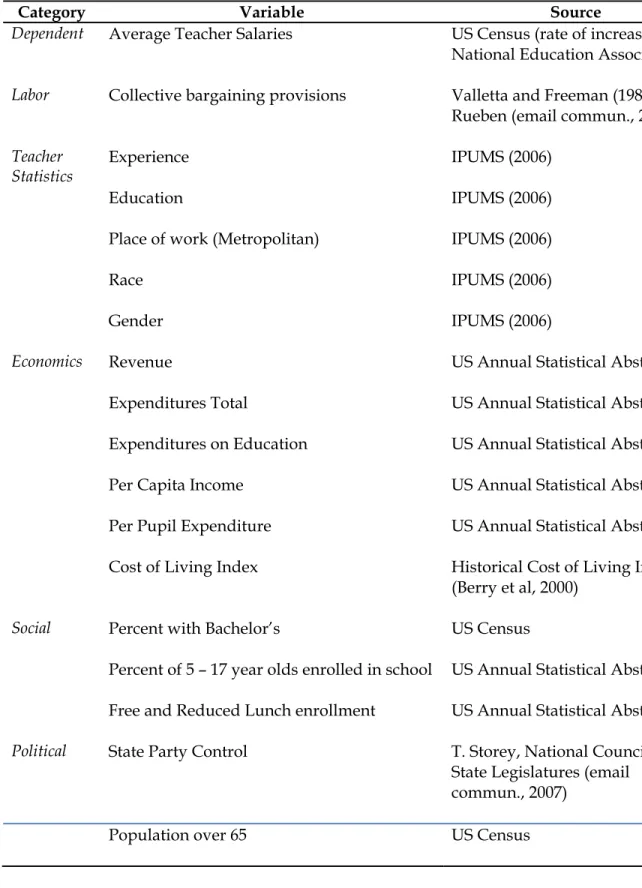
2. Variables used in Current Study and Sources for Data ...128
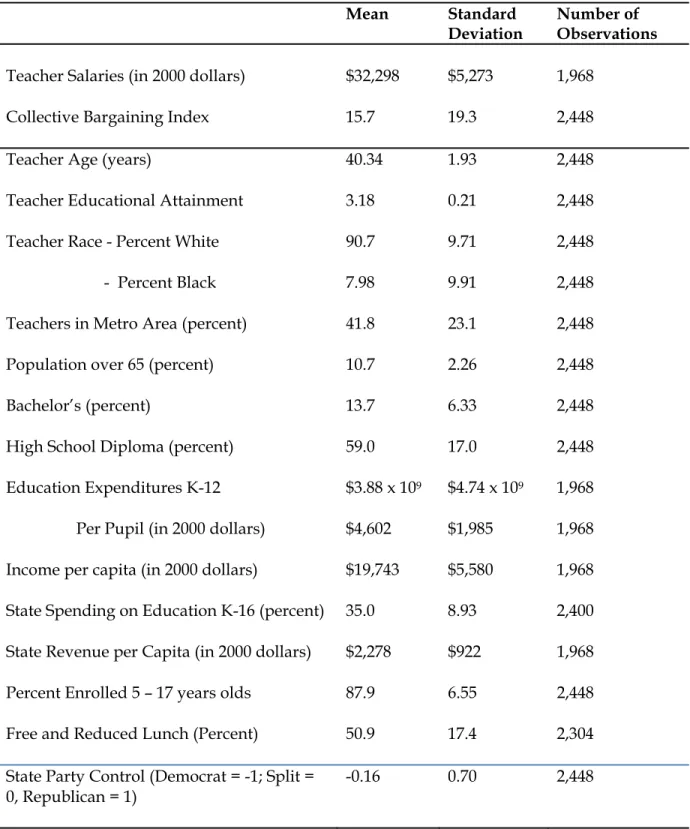
3. Descriptive Statistics for Dependent and Independent Variables ...129
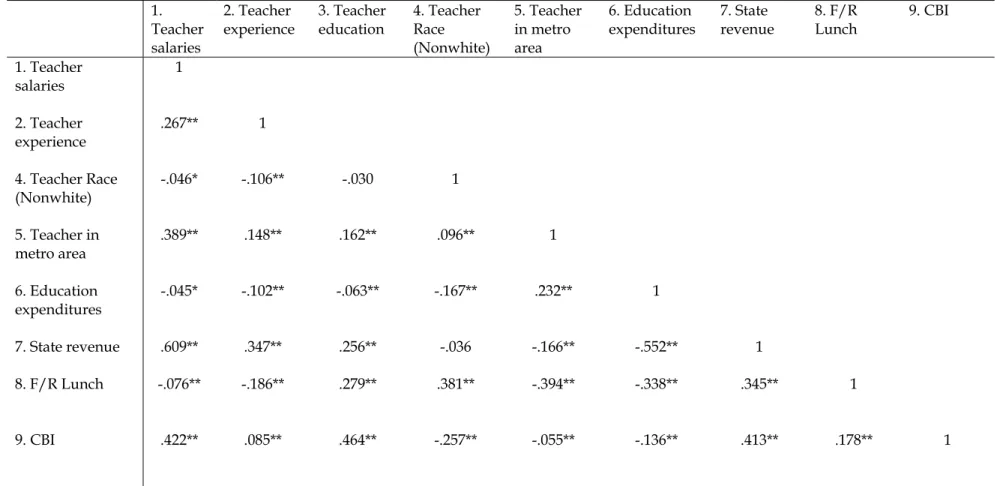
4. Correlations among Variables of Interest ...130
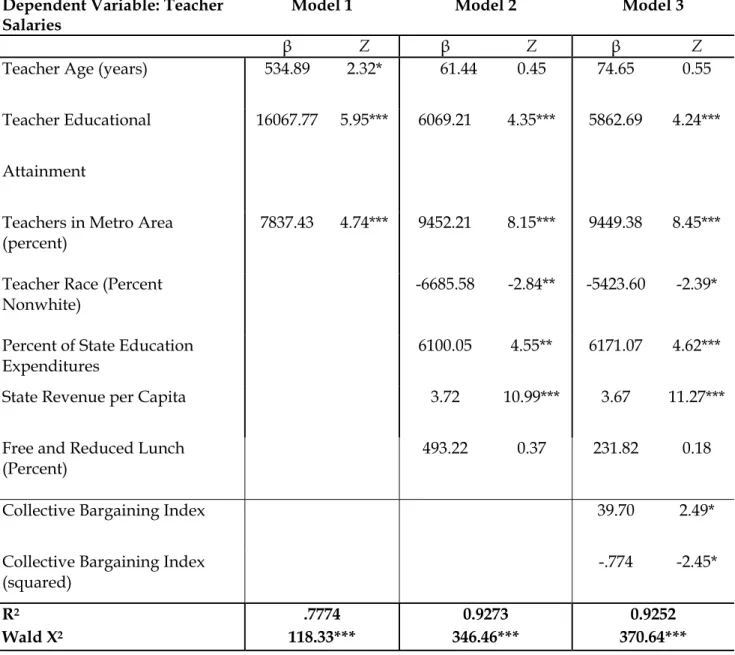
5. Question 1: Baseline Model ...131
6. Question 2: Twenty Year Comparisons ...132
7. Question 2: Decade Effect ...133
8. Hypothesis 3: Regional Effect - Northeast ...134
9. Hypothesis 3: Regional Effect – South ...135
10.Hypothesis 3: Regional Effect – Midwest ...136
LIST OF FIGURES
Figures Page
1. Theoretical Framework: General Model of Study ...138 2. CBI Index For States: Average Index from 1960 to 2000 ...139 3. Regressed Teacher Salaries for States by Collective Bargaining ...140 4. Regressed Teacher Salaries for States by Collective Bargaining Percent
ABBREVIATIONS
Abbreviation Meaning
AFL-CIO American Federation of Labor - Congress of Industrial Organizations
AFT American Federation of Teachers
CBI Collective Bargaining Index
CEI Cost of education index
COL Cost of living (index)
ESEA Elementary and Secondary Education Act
IPUMS Integrated Public Use Microdata Series
HLM Hierarchical Linear Modeling
NEA National Education Association
NBER National Bureau of Economic Research
OLS Ordinary Least Squares
PCSE Panel corrected standard errors
TSCS Time series Cross Sectional
TURN Teacher Union Reform Network
CHAPTER I
INTRODUCTION OF PROBLEM
STATEMENT OF PROBLEM
The issue of teacher pay is complicated based on its intertwining with community, business, and politics. A ceiling remains suspended over the issue of compensation because teachers are primarily paid through public tax dollars. Any substantial pay increase would likely involve a significant tax hike for citizens. Meanwhile, parents and students are perpetually affected by a troubling teacher attrition rate. Almost fifty percent of new teachers leave the profession within five years, creating staffing instability in many schools; especially in critical needs and/or specialty areas where instructor turnover persists. The bottom line is that teacher consistency enables student success, but under the current compensation system1, a pay increase must benefit all teachers, regardless of the publicly perceived quality of the teacher, which sometimes leads to less collective public support for substantial teacher pay increases.
A teacher’s role and the pedagogical delivery of a curriculum appears relatively similar regardless of the area, region, or state, however, there is significant
difference in the amount of monetary compensation. Compared to the private business sector, such pay differences are commonplace. Various industries supplement salaries due to increases in product sales, faster production times, or labor pressure. In the public sector, specifically in education, reasons for pay variation remain less apparent. Some equate higher pay with a more qualified
1
teacher workforce, resulting in better education. Others assume that teacher pay is greater in wealthier districts because these particular school districts can access larger budgets. If schools are financed by public tax dollars, usually property taxes, then areas with greater tax bases can afford to pay their teachers more in order to attract and recruit.
Perhaps the only assumption concerning wages that has been studied is the existence of teacher unions and their subsequent impact on the fluctuation of wages. For example, both service sector and auto industry unions have pressured
management to increase worker pay-- often with great success. The impact of
unions regarding the teaching profession remains overshadowed by conflicting local and state and political interests. Studies can be politically motivated; in some
instances research serves as a defense for union advocates. On the other hand studies may seek to discredit unions. In either case, skewed outcomes gravitate towards supporting a specific political agenda as opposed to exploring or
questioning union’s efficacy. In essence, research may dissect and present collected data supporting one extreme or another. Studies concerning the overall
effectiveness of union influence on teacher pay allow no exception to the debate.
PURPOSE OF STUDY
postdates the majority of previous research of teacher pay. Moreover, because the issue of teacher wages involves many stakeholders not limited to those actively participating in the profession, I examined and included several factors that have contributed to the widely varying pay trends nationwide. By employing updated, comprehensive statistical methods, I balanced and organized the staggering
complexity of interaction among these variables, generating a clearer understanding for how the union movement has affected teacher pay over a half century.
The dataset includes 40 years of state level statistics dealing with various aspects of teacher pay. These factors were pulled from economic, labor, and social data sets and covered the following eras of educational reform: unionization of the teacher force in the 1960s, the teacher accountability movement beginning in the 1980s, and the rise of the “education governors” in the last two decades. From this dataset, I explored the following research questions:
• How do the collective bargaining laws affect teacher pay in the last 40 years, after controlling for the influences of social and economic forces?
• How does the influence of collective bargaining laws on teacher pay,
controlling for the influence of social and economic forces, differ over various eras in school reform?
SIGNIFICANCE OF STUDY
Teacher salaries continue to be a much politicized and debated issue in the education field. Undoubtedly, selfless dedication and commitment are obvious traits inherent to longevity in the teaching profession. More often than not, it becomes almost commonplace to assume that monetary compensation should be accepted at face value. In other words teaching is primarily viewed as an altruistic profession; that is, collectively, teaching professionals are humble, civil servants. The idea of teaching monetary for gain is, in some cases, perceived as frivolous. This stereotype can be traced back to the days of the one- room schoolhouse when teachers “boarded ‘round,” exchanging teaching services for free room and board and little if any pay (NEA Salary Committee & Evenden, 1923). But the professional status of the classroom teacher has evolved into a prominent occupational role in our society. Teaching is a legitimately recognized profession and those in and around the education community consistently voice the need for equal and fair compensation.
Too often, high attrition rates plague the professional fate of many new
Understanding how unions affect salary increases has been an area of interest in many facets of research, however, the implemented methods as well as the access to recently-released historical data place this study at the forefront of understanding unions and their influence on teacher salaries. Collective bargaining has been the primary method of negotiation in the last 50 years and teacher salary increases have been a “litmus test” for unions’ success. Despite some of the initial criticism that unions receive, many teachers feel at bare minimum, “at least we are paid better than if there were no unions.” Quantifying this difference in pay versus situations where unions are nonexistent has been difficult to parlay into a research model. Often times, the interpretation of specific data is limited to a narrow chronological window. Placing unions at the focal point of a study often initiates
apprehensiveness from union advocates. Conversely, union critics may seize the opportunity to seek flaws in union’s overall effectiveness, judged merely on the gains sought in pay. Regardless, the function of teacher unions remains more politically volatile and complex than the tempered politics of teacher salaries. Extensive consideration and research must attempt to balance extrinsic political motivations with an educator’s desire for fair wage.
overall disparity concerning teacher salaries. These trends appear to influence research in accordance with specific past social and political issues.
The first research wave occurred in the 1940s following the wave of implementation of the single salary schedule. Researchers were curious about causes, trends and fluctuations in monetary compensation after 99 percent of the nation’s school districts evolved from a standard, differential pay structure, which discriminated based on race and gender. The single salary schedule attempted to rectify this flaw by paying teachers based on education level and years of teaching experience. The second wave of research occurred in the 1970s which sought to understand the effect of collective bargaining on the education public sector (Fournier & Rasmussen, 1986). These laws encouraged teachers to unionize and employ traditional labor strategies to improve pay and work conditions. The third and most recent research wave follows the teacher accountability movement in the 1980s. Policy makers and the general public placed additional pressure on school officials to audit educational expenditures and their effects on student achievement and success. Each historical wave capitalizes on evolving and improved statistical methodologies as well as a further understanding of the complexities attempting to determine the quantitative value of teachers’ wages.
In order to examine this subject using quantitative approaches, the methods must be capable of balancing the delicate complexity of how labor, social,
extract conclusions when compared with quantitative trends and correlations. The study will act as the first step toward unraveling previous historical events which underlie the research trends and conclusions that have affected decades of statistics collected on the topic.
Through this study, I capitalized on several improvements used to interpret to the cost of living research. Although common assumption implies that certain cost variations exist between services and goods in different regions (commonly referred to as the “cost of living index”), the statistical application of these indices was problematic and controversial even up to the 1990s. These methods interpreted based on costs of consumer goods and land valuations, ignoring variables specific to the education profession and related work conditions. Furthermore, cost of living theory only recently has been applied to the field of education, which does not follow the typical trends in a market-based, private economy (Chambers, 1995; Fournier & Rasmussen, 1986). Researchers have only recently begun to understand the applications and limitations of cost of living comparisons to the field.
Finally, I constructed one of the most extensive and comprehensive state-level data sets encompassing statistics specifically related to teacher wages. These
CHAPTER II
REVIEW OF THE LITERATURE
Interpreting teacher salary trends has been thoroughly researched but
continues to elude researchers as to specific factors contributing to differences in pay (Lankford & Wyckoff, 1997). As outlined earlier, researching teacher salary
emulates waves of contrasting critical trends that shape the basis of educational reform. Economists and education researchers remain conscious of the impact on teacher salaries in relation to society: public education accounts for almost half the state spending while teacher salaries and employee benefits consume almost eighty percent the education budget (Podgursky, 2004). The weight of public funding education draws attention from policymakers, politicians, economists, public taxpayers, and powerful teacher associations. Because of these influences, teacher salary research is often characterized by the view of public education in the public eye.
The following literature review accomplishes four objectives: 1) to
legal debate, 3) review the statistical findings relating teacher unions to salaries, covering the quantitative and qualitative findings from previous researchers, and 4) argue for necessary improvements while studying differences amongst teachers’ salaries, showing that an informed perspective facilitates the greater understanding of union’s effect as well as an improvement for what variables should be considered in examining teacher wages.
POLITICS OF THE TEACHER SALARY ISSUE
The politics of teacher pay is perhaps one of most underrated issues in education today. It accounts for most of a district’s budget and is a substantial investment for localities and states. The issue draws in large numbers of
stakeholders, not just based on the public funding for education, but based on the role schools play in our society. (Brimelow, 2003; Lankford, Ochshorn, & Wycoff, 1996; Murnane, Singer, & Willett, 1987). Employers in most occupations demand highly skilled and trained workers (Goodson, 2003). Programs funded by state or local tax dollars can be hampered by the enormous budgets of education. Political leaders are pressured by one of the largest and most powerful lobbying groups at all levels of governments - teacher unions, which devote their attention to funding issues of its memberships (Lieberman, 1997). The issue affects multiple special interest groups and invites several players to the negotiation table.
teachers (Haley, 1904), Chicago teachers became frustrated with their demand for fair wages. Teachers’ voices were ignored and their interests were consistently dismissed. As a result, teachers joined forces with local labor leaders and uncovered almost $2 million in unpaid corporate taxes, helping to fund teacher salary raises and spark several similar battles in other large city school districts. The mostly female groups demanded just and equal pay similar to their male coworkers for doing the same work (Murphy, 1990). The eventual adoption of the single salary system helped eliminate discriminatory pay, however, the debate continued over low teacher pay relative to other professions’ salaries (Goodson & Hargreaves, 1996; Shen & Hsieh, 1999).
In order to appease both the growing frustration of teachers under the
differential pay plan, as well as ease the managerial headaches for administrators as schools consolidated, public schools adopted the single salary schedule. The
observations were made during this period. First, the role that teachers perform is similar across most of the United States; yet, the salaries were remarkably different across districts, regions, and states (Bechdolt, 1942). Second, although several
factors are attributed to the varying levels of pay, compensation needs to be adapted for living adjustments which account for the varying cost of goods and services in different parts of the country (Borgersrode, 1942; Davis, 1943; Staffelbach, 1942). The latter observation predated the extensive cost of living indices that were developed in the 1970s, and thus remained a suggestion for future inquiry.
Advocates for teacher pay initiative received a significant boost when states began allowing public sector workers to unionize in the 1960s. Within a decade, a majority of the states allowed their teachers to unionize (Fuller, Mitchell, &
Hartman, 2000). Although many challenges were placed in front of teacher unions, such as improving work conditions and reducing class sizes, the issue of increasing teacher wages and benefits would serve as the barometer of success for their
existence (Duplantis, Chandler, & Geske, 1995; Freeman & Medoff, 1979; Hoxby, 1996; Murphy, 1990; National Education Association, 1969). Much like the
successes found in the labor movements of the private industry, the teacher union movement sought to obtain similar successes in obtaining just and fair pay for its members.
teacher salaries; they usually compare national averages in order to gauge salaries. This power this has been proven to be highly inaccurate benchmark based on the number of regional differences that exist. In an era of increasing worker mobility, districts and states lure teacher candidates based on salaries and benefits (Einhorn, 2001). This competitiveness presides at both local and state levels, so much so that the state comparison issue has become more on the radar of politicians’ agendas. Florida, for example, recently published a scathing report that criticized the national reports on state teacher pay which are annually released by the NEA (Florida
Department of Education & McDougal, 2006). The “Annual State Rankings”
criticized the inaccuracies for defining the role of teacher, excluding supplemental or bonus pay, and not adjusting for cost of living differences. State politicians must constantly defend (or promote) its average state pay of teachers and with the teacher unions making a presence at every election, teacher pay regularly becomes a
political issue (Odden & Kelly, 1997).
UNIONS AND THE PUBLIC SECTOR
in the 1960s, teachers quickly organized and became one of the most unionized professions in the country, as well as one of the most controversial (Hannaway & Rotherham, 2006). Supporters of teachers’ unions point to higher salaries and benefits, better working conditions, and a respectable place at the stakeholder table (Blackburn & Prandy, 1965; Duplantis, Chandler, & Geske, 1995). Critics point to an added layer of bureaucracy, a slowing of educational reform, and the tendency to focus on teacher issues rather than student interests (Brimelow, 2003; Freeman & Medoff, 1979). The political quagmire of teacher unions has severely hampered any sustentative scholarly debate (Hannaway & Rotherham, 2006; Loveless, 2000).
The current research on the effects of collective bargaining tends to be
categorized as one of three ongoing debates: professional, social, and legal. In terms of viewing the issues through a professional lens, I review the debate around the capacity that unions have contributed to the professional growth of the teaching occupation. From the social lens, I present the limited literature reviewing the effect of a female-dominated workforce within a mostly male-managed profession. Finally, I review the research on the legal ramifications on teachers, understanding the limitations and effects of how “state scope” affects teacher union involvement.
Professional Debate: White versus Blue
professional association, and the American Federation of Teachers (AFT), which employs tactics like a traditional labor union. The following will review the current theory on professions and what constitutes a career as a profession versus a trade. Then, I review the current works surrounding the impact of unions on the
professionalization of teachers, highlighting two distinct approaches.
Understanding the theoretical basis for what defines a profession can better explain why teaching endured difficulty garnering acceptance with the same professional stature as law or medicine. However, defining varying levels of professionalism has become a contested topic, with the concept stirring up political contention (Casey, 2006). Understanding that such contention exists, the following idea provides common, recurrent themes that exist in academic literature.
The theory of professional development can be described as a tiered process, with some referring to it as an “evolutionary stage” of growth (Goodson, 2003). The highest tier of professions is considered the “classical profession,” commonly used to define law or medicine.2 These professions are usually highly ranked in terms of public status and publicly recognizable (Hargreaves, 2000). There is a specialized knowledge base or shared technical culture, a strong service ethic with a
commitment to meeting the customer or client's needs. They are self-regulated and defined by collegial powers rather than external bureaucratic control over its
recruitment and training or its codes of ethics (Hargreaves, 2000). Although few
2
professions are considered “classical” or elite, an immediate criticism points to the value system benefiting more to male workers. Hence, only male-dominated careers tend to be classified as “classical,” and often, female dominated careers are
considered less-than-elite professional status” (Bascia, 1998).
If a field is not considered “classical,” according to the literature, it can be considered flexible, practical, extended, or complex (Hargreaves, 2000; Soder, 1990; Wilensky, 1964). As listed in that order, they represent a continuum of professional organization, with “flexible” being the least rigid or organized and “complex” assimilating to many of the principles of a classical profession. Flexible
professionalism is rooted in shared or collaborative communities, with scientific certainty replaced with situational certainty defined by local groups. Practical professionalism is based on the experiences of its members and places value on reflective practice, a common rejection in a university setting where theory is derived among the elite thinkers as opposed to the practitioners. Extended professionalism draws on experience coupled with its commitment to theory. Finally, complex professionalism derives status through demonstrating the field’s complex and intense nature associated with the work. Illustrating that the trade has several levels of complexity, it is inherently worthy of respect in a society (Rowan, 1994).
incorporates numerous levels of bureaucratic control based on the funding structure and the public involvement. In terms of developing a "shared technical culture," Booth (1988) states that teaching will forever be hampered by the “ordinary language” problem: the technical language used in the teaching profession is not that different from common language outside the profession. Rosenholtz (1991) further states that teaching will never experience an age of discovery, such as the medicine field, which helps to separate a profession from common public
understanding. Finally, Ozga (2004) suggests that teachers adopt most of their pedagogical practice from either previous experience as a student or trial-by-error experiments in their own classrooms, questioning the need of formal training or education as in other classical professions. Based on these observations as well as the inherent discrimination of the allowance for a profession to be considered “classical,” it is questionable if teaching can ever be considered a classical profession.
community and thus, all teachers must operate as if held accountable to the
community. Second, the teacher’s connection to the community is still an important aspect of the profession. If teachers begin to use technical language that separates them from parents or the community, the idea of local control becomes challenged, potentially setting up the division between teacher and community, similar to the division found in medicine between doctor and patient. Finally, in order for teaching to become self regulated, teachers must be allowed to broaden their job descriptions to take on such roles. Currently, the majority of teaching review is performed by an administrator, certification is granted by the state department, and mentoring plans are delegated by state legislatures. Self regulation requires teachers to have active (not honorary) decision making powers, yet the current job
description limits teachers’ involvement outside the classroom (Rowan, 1994). A common rebuttal blames teacher unions for narrowing work details and extra duties, ranging from bus supervision to such things as committee work, as well as limiting teachers’ potential participation in more decision making roles and
processes.
similar building. With the rise of teacher colleges established within the university system, teaching began to root itself more in research and theory, and adhered more to the principles of extended professionalism. Teaching reforms following the release of the A Nation At Risk, in 1983, appeared to follow the fourth tier of complex professionalism. Reforms such as site based management, merit systems, and career ladders established paths to differentiate between teachers’ role assignments. These reforms attempted to add complexity (through additional responsibilities and challenges) to the profession of teaching, redefining the idea that teachers “only instruct.” However, this movement insignificantly impacted the profession because most of the reforms that increased the complexity of the teacher’s role also increased the workload, piling on new obligations along with previous duties. Certainly, reforms such as site based management allowed teachers to demonstrate skills such as financial management within a school’s budget; however, proper training for these roles was never adequate. In some districts, teacher unions vehemently
opposed such reforms, protecting its members from taking on added responsibilities which were viewed as managerial (Haar, Lieberman, & Troy, 1994; Johnson &
Landman, 2000).
Looking at the initial missions of the NEA in the late 1800s, there was a tendency to model more classic professions. Marshall and Andre-Bechely (in press) state that the NEA was original setup as a “national policy making organization,” with the creation of a National Council, research divisions, and numerous
efforts largely excluded women who held a vast majority of teaching positions within the profession. A rift ensued between the policy makers (administrators/ men) and the policy doers (teachers/ women). As the literature suggests, in the beginning of the twentieth century, this exclusion as well as rampant discrimination within the NEA forced women to seek alternative methods for getting their voices heard (Murphy, 1990; Urban, 1982). At this point in the stage of professionalism, teaching faced a crossroad. Teachers, who had not been pressured by hiring practices and compensation, tried to voice their concerns using the current
associations such as the NEA. Through discrimination, their demoralizing status in the NEA forced them to take stronger action. Teachers in mostly urban areas began to affiliate with the local unions in order to voice their concerns and gain political power to create change (Blum, 1969; Haley, 1904). The NEA continued to focus on the membership of its administrators and largely ignored the educators, which helped fuel teachers’ motivation to seek out other means of voicing their
disapproval, eventually giving rise to its present competitor, the AFT.
If teaching is not a “classical profession” as the previous research suggests, then can it follow the principles of unionism? The following reviews the research on the theory of labor unions, the model that the AFT and more recently, the NEA has endorsed. It will be argued that even though the strategies of these two
There are three main principles of labor union theory. The first is that the interests of labor and management are at odds. There are limited resources and one person's loss is another person’s gain with a firm. Second, standardized practices are more desirable under the theory of labor unions since uniform operations across all sectors of work make for a better and more efficient management. Third,
similarly skilled laborers are interchangeable and should be treated alike (Freeman & Medoff, 1979). Applying these principles to education creates a clear division between the role of teacher and administrator, with rampant discrimination
occurring since the creation of the position of principal (Tyack, 1974). After 50 years of the NEA’s existence, teachers felt powerless and yearned for change. If teachers could become unionized, then their collective voices would be difficult to ignore, much like the successes found in the private sector unions.
Two questions so far have been raised: can teachers be considered a “classical profession” and does the labor union model suitable for teaching? As discussed, teaching has a difficult time being considered a classical profession, based on the issues previously reviewed. In fact, it may benefit teaching to remain inclusive and inviting and to reflect the broader relationship between schools and the community. Turning attention to unions, teaching does not appear to fit the three labor principles outlined above. Although teachers have been at odds with administrators, the “limited resource” cannot exclude students. Teachers generally understand that substantial raises mean less money for school operations, curriculum, and student resources. The parent group of the AFT, the AFL-CIO, recognized also recognized this. As most of the group’s members in the private sector unions were losing membership, the public sector union was quickly gaining ground, forcing union officials to rethink the labor model (Selden, 1985; Urban, 1982). Even as late as 1959, the AFL-CIO president, George Meaney, was incorrect in assuming that unions in the public sector would not be successful because “it is impossible to bargain collectively with the government” (M. Green, 1996). With membership rates surpassing most private sector industries, Meaney and labor leaders balanced the power of teacher organization but understood the need to adopt the model to public sector.
(Braun, 1972; Selden, 1985). Thousands of teachers were eagerly joining the union, surpassing membership percentages unlike most private sector unions. The need for organization existed at all levels of government, from local to federal.
Unionizing became less of an outlet for some urban districts and more of a mainstream component of the teaching profession in all districts. A core communication of unions, collective bargaining, came under question as to its intents for depicting teachers as either blue or white collar professionals.
Collective bargaining research receives mixed reviews concerning the advantages of promoting a professional identify. Several researchers have
discovered benefits collective bargaining has brought to teaching, such as reduced class sizes (Eberts & Stone, 1985), reduction and protection against “extra assigned duties” (Eberts & Stone, 1987), and even refined student discipline policies
(Hechinger, 1967). Yet despite these benefits, the combativeness approach typified in union bargaining scrutinized the collective bargaining process. Calls for “reform bargaining” and “collaborative bargaining” were attempts to transform traditional union negotiating into constructive communication (Johnson & Kardos, 2000; Kerchner & Koppich, 1993)
either improvement of teacher education and certification, or increase salary. It was the most recent large scale effort to professionalize teaching, creating higher standards to differentiate instructional practices. As Johnson (2001) points out, National Certification must balance the principles of unionism with leaving room for self regulation like that of white collar professions. Other efforts such as peer review and career ladders attempted to “un-flatten” the teaching career but largely failed due to the divide it created among teachers (Nelson, 1996). As stated before, a principle of unionization theory is that similarly skilled laborers are interchangeable and should be treated alike. Nelson points out that peer review has created levels of teachers where some teachers act as managers, placing the union in a precarious position, attempting to resolve conflicts among its own members. In one case, the managing teachers (promoted to these positions based on their position on the career ladder) were forced to leave the union as their responsibilities were considered managerial, even though their title was still “teacher.”
apparent raises witnessed in the 1960s. Second, the contrast between blue and white collar union approaches becomes blurred following the period of the 1980s, meaning the NEA openly adopted traditional labor union approaches while the AFT
understood the need to employ more professional strategies like reform bargaining and conciliatory negotiations. Although this study will look at union effect as a whole, it cannot distinguish between the two methods, thereby limiting its analysis as to what method was more impactful. Although states that do not have collective bargaining tend to utilize the NEA’s traditional method of bargaining (through lobbying, collective voice, policy influence), it cannot be implied that states with collective bargaining laws are considered “blue” while non-collective bargaining states are considered “white.”
Gender Debate: Women as Professionals
claims that leading scholars of union history often ignore issues of gender all together, thus leaving a gap in any analysis of union theory.
The reason teachers joined unions is perhaps the most written and discussed topic of gender in education. Scholars repeatedly point out the rampant
discrimination in pay, position, and respect between gender and race since the beginning of the one-room schoolhouse model. Teaching has been considered “inherently a politically and bureaucratically subordinate occupation” (Bascia, 1998, p. 551). As schools consolidated in the early 1900s, the only outlet available was the NEA, but because it was controlled by male administrators, women like Margaret Haley and Catherine Groggin turned to the local labor unions, ironically, also a mostly male institution at the time (Murphy, 1990). Teachers had few other options because their own professional organization was essentially shutting the door on their issues. Larson (1977) reasoned that this alliance with unions narrowed the types of issues that teachers could address. The push for the single salary schedule in the 1930s came largely the “equal pay for equal work” approach, and
administrators quickly endorsed the plan not just as a way to curb inequity but also to ease administration of the new pay system (Podgursky, 2004). Gibby-Wachter states that even after the adoption of the pay system, women were discriminated from taking on higher pay positions such as administrators or high school teachers.
late as the middle of the twentieth century (Murphy, 1990; Tyack, 1974). Women were discouraged from balancing families and work because men were given more prominent status (and higher paying jobs) under the assumption that they were providing for a family (Bascia, 1998; Shen & Hsieh, 1999). Although equality was an issue, many women were trying to support their families, sometimes violating contract language that prohibited otherwise. Even still, Bascia (1994) found a correlation between teacher union support and the lack of educational reforms and educational support for students. What has been disproved, despite common assumption, was unions entered the teaching profession largely in part due to an influx of male teachers in the 1950s and 1960s. Although male teachers were much a part of the union movement for similar reasons as women, the foundation for
women unionizing occurred well before the 1950s and, as pointed out, had several reasons for motivation (Bascia, 1998; Cole, 1969; Murphy, 1990). Some women teachers have rejected the combativeness and negotiation style of labor unions, and instead, opting for more diplomatic methods for dealing with conflicts (Bascia, 1998).
These multiple reasons forcing women to unionize are often ignored in union research, prompting Marshall and Andre-Bechely (in press) and Bascia (1994) to call for a revisiting of union research. This can help deepen our understanding of
Wesley, 1957). It is incorrect to assume that teachers who unionize also endorse the ideology of that organization, similar to the dilemma within a two party political system, where a voter may not agree with all the views of the party, but votes for the best choice. Often, no other outlet exists to voice disapproval of policies and unions are limited in the number of bargained issues or negotiated terms, inviting criticism that unions narrowly focus on salary and benefit issues (Brimelow, 2003; Lieberman, 1997; Rabban, 1991). Hargreaves (1994) states that union activity, which require some members to become politically active, often draw criticisms of colleagues and peers who see such work as taking away from their classroom duties. In her
interviews with teachers, Bascia (1994) found many women teachers opposed to unionism due to its focus on bargaining over wages and salaries and issues that did not attract them to the profession. This was also found in a similar research study conducted by Gibby-Wachter (2000) who found that some women rejected the tactics of unionizing as a way to increase professionalism, for they saw this as a threat to the feminine model that they used as a basis for their careers” (p. 7).
Women were forced to choose between two patriarchic systems of organization, the NEA or the AFT, in order to voice their concerns or push for change.
tenured teachers (Haar et al., 1994), and are primarily rentseeking by raising school budgets but lowering student achievement through the decrease of productivity (Hoxby, 1996). Yet these criticisms can be constructs of a predominantly male media corps, male administrations, and sometimes male-led teacher unions. As Gabby-Wachter reviews in the case study of the famous 1960s Utah strike, the female
president to the Utah Education Association as merely a “figurehead” while the lead negotiator with the school system and the press contact was a male who was linked to creating a militant union public image. The direction was “inherently masculine” and the failure to see any results from the strike “directly related to the socially constructed feminized ideal for teachers and the low value of feminized work” (p. 5). There was an assumption that had developed that teachers were nurturing, moral role models, and compliant. Because of the nature of the work, there was an expectation for serving and teaching children, rather than picket for better wages. Any action that questioned this image was immediately criticized in the press and other outlets of public relations. The result was a public not ready to receive images of teachers striking or picketing, regardless if the work conditions were unfair (Kahlenberg, 2006; Kerchner & Koppich, 1993; Murphy, 1990).
would be dying” (PBS Foundation, 1996). Teacher unions have traditionally
donated less than three percent to the national Republican party (and 97 percent to the Democratic Party), drawing criticisms that the donation ratio does not reflect the political affiliation of its members (Lieberman, 1997).
Most scholars admit that in terms of public relations, teacher unions have lost out to the expected ideal of the feminized teacher. Unions have made inroads for women as policy entrepreneurs, but the traditional expectations of the moral teacher seem to predominate. When dealing with unions, especially at politically tense times, strikes and/or labor contract renegotiations, this is a common tactic to criticize the teachers’ motivations as “selfish” at the expense of focusing on “educational issues.” The negotiated terms are usually limited in scope, thus leaving unions to bargain job responsibilities or narrow the focus of the teacher’s duties, again fueling the gendered assumptions of a teacher’s “abilities or interests” (Acker, 1992; Bascia, 1994). For example, a bargained contract that limits the
It is important to consider gender issues when undertaking any study of teacher unions. As previously stated, such a consideration should go beyond just historical trivialization and instead, use a lens that reveals the hidden values placed on teachers or the often lost agendas from female teachers who do not have a place to voice these concerns either inside or outside the union. Teacher unions are
Legal: Debate over Scope
The state passage of collective bargaining laws provides the pedestal for teacher unionization. At the root of the laws is the scope, or parameters for bargaining, which is usually defined as wages, benefits, and other conditions relating to employment. An ongoing debate in union research has been the
effectiveness of collective bargaining on public sector work, especially public service work such as education Even as late as 1959, the year Wisconsin became the first state to allow public employees to unionize, the AFL-CIO president stated that, “It is impossible to bargain collectively with government” (Hannaway & Rotherham, 2006, p. 9). Because the scope is supposed to outline what can be bargained, much of the research has reviewed the effects of the scope as it plays out with
categories of research that has studied the legal implications of collective bargaining: limit or expand the current scope versus reforming the collective bargaining process. Research advocating for the expansion of scope argues that both the teaching profession and the students will benefit. Teachers are not laborers, they argue, and the current scope forces unions to focus their efforts on labor issues such as wages and benefits. By expanding the scope, unions can bargain for issues such as curriculum decisions, assessments, and standards for hiring, which can greatly benefit the workplace for teachers and students (Koppich, 2006). The ability for teachers to organize helped prove that they can effectively bring about change and organize as a profession. This collective power can champion ideas such as the collaboration of developing student assessments or curriculum. These issues exist at the classroom level, and allow bargainers to exercise their power beyond labor issues. The current scope, despite its limitations, has brought teachers further into the decision making arena, positioning them closer to the decision making process. Still, they are held at bay for making decisions, and instead, considered part of the advising process (Eberts & Stone, 1984; McDonnell & Pascal, 1979). Expanding the scope gives them decision-making power, something that has been missing for teachers.
proven examples where government and worker can bargain outside the typical labor issues. Expanding the scope may allow these isolated successes to encourage other districts to expand beyond the scope (Kerchner, 1978).
A third argument exists that changing the scope is required in order to stay abreast with the changing dynamics of the school organization (Kleingartner, 1973). When states set up their legal provisions for bargaining in the 1960s, the current events and the relationships were remarkably different than what exists today. The “technology of teaching” has also changed, becoming less isolating and resistant to the patriarchic forms of administrations that existed in the 1960s. Team teaching, peer review, and other collaborative forms of instruction could blossom if protected under collective bargaining agreements. Currently, many of these reforms fail because unions are wary of management, with unions trying to establish differences in responsibility between teacher and administrator (Urbanski, 1998).
Conversely, an argument exists for limiting the scope, not expanding it, in order to control the growing power teacher unions. The impressive power teacher unions exert on all levels of government has been highly criticized due to the
candidates, and act as a powerful state level education stakeholder, but these efforts appear to benefit teacher interest and issues, with issues like pay increases or
electing supportive school board candidates. Thus, expanding the scope may expand teacher union powers over more – not less – teacher issues. As one of the primary tenants of labor union theory states: there exist limited resources with management and laborers at odds. Unions serve to defend the laborer, securing as many resources as possible.
Few critics of scope expansion would doubt that teachers require a voice, especially in a gendered-imbalanced institution such as schools; however, unions can sometimes create a hostile environment not just within the school, but also within the community (Freeman & Medoff, 1979; M. Green, 1996). Unions set up an adversarial relationship, pitting teachers against administrators and teachers against school boards. Based on the slow progress of school reform, some believe that the legal scope of bargaining should limit teachers’ capacity in union power, specifically outlining what can and cannot be bargained. This will help “rein in” teacher union power and area of focus.
Limiting scope is not always synonymous with “union busting” or other terms that hint towards breaking up teacher unions, as has been done in the private sector. In fact, limiting the scope can have positive effects (Kerchner, 1978).
teacher unions would likely use contract negotiations or other traditional means of labor negotiation to bargain curriculum decisions. Thus, the issue of curriculum gets tangled with issue of wages, benefits, and other labor-like issues. By separating curriculum from the collective bargaining process, it removes this discussion from the sometimes hostile process of contract renewals (Kerchner, 1978; Loveless, 2000).
In the 1990s, there was a rise in popularity for reforming the bargaining process, rejecting the legal expansion or limitation of scope. Scholars such as Johnson, Kerchner, Koppich, and Urbanski proposed setting up a “collaborative bargaining” between the district and union, essentially, reforming the combative process of contract renewal and issue debates. Johnson (1987) stated, “Collective bargaining as a bartering process is for adversaries; collective bargaining as a problem solving process requires trust and good intentions” (p. 276). These redefined relationships will promote better teacher involvement and grant them more decision making skills, at the same time create a better representation for education stakeholders. Kerchner (1978; 1986) argues that two groups need to be included in the collective bargaining process. Principals, whose voices were
current needed relationships between schools, community, administrators, and teachers.
For this research, the legal debate is of primary focus. The measured variable, collective bargaining, is measured based on how limiting or expansive a state has set their scope of bargaining. It is not simply an issue of whether or not states have passed such laws, but to what degree does the scope relate to the impact over teacher wages. No state has passed laws to reform the process, coined by phrases such as “trust agreements” or collaborative bargaining,” so although the idea has been presented, no state has ventured beyond the industrial scope set up in the 1960s. Yet, it should be noted that several districts already engage in such relationships, such as the unions that make up the national organization, the Teacher Union Reform Network (TURN). A growing amount of evidence suggests that such relationships are more dependent on the individual relationships between a select few, such as the union leader and superintendent, and less, mandated by the scope or the legal parameters for bargaining. So although such unions exist, it is difficult to identify the percent of those unions (or relationships) that exist within a state.
FACTORS AFFECTING TEACHER SALARY DIFFERENCES
most noticeable, is the politicized nature of unions, causing most research, either publishing positive or negative effects, to be quickly dismissed in ongoing political battles. Second, it can be difficult to measure union activity based on the study of contracts, the end result of collective bargaining. Contract language can be
voluminous and cumbersome, sometimes being loosely interpreting and
implemented, and other times being used a formula for how teachers should work within a district or school. As Hannaway (2006) states, “collective bargaining is a process rather than a predetermined set of outcomes” (p. 112). Comparing contracts across districts can be dependent on how they are interpreted and implemented, leaving researchers to try to measure the union activity through a variety of means or simply categorizes it as union or not union.
Finally, the effects of collective bargaining do not occur in isolated instances. Public schools become both involved and influenced by the numerous tides of social change. Federal legislation such as the No Child Left Behind or the ESEA Title I Act can alter how local and state governments fund education. Similarly, social changes can influence how teachers are funded. In the 1950s, over 80,000 experienced
African American teachers were fired in the South following Brown versus Board, after all-black schools were closed and mostly inexperienced white teachers were hired in place (Toppo, 2004). In the 1970s, women’s career opportunities expanded, thus allowing women who would traditionally enter the profession to seek
bargaining or unionization would remain the sole influence on of educational change.
The following reviews two areas of research that pertains to this study: teacher salaries and work benefits. Researchers have explored the effects of
unionizing on areas beyond what is included, most noticeably, student achievement or teacher quality; however, the focus of this research is wages and benefits, the two main aspects that are within the scope of bargaining.
Collective Bargaining and Teacher Salaries
Beginning in the 1970s, researchers focused on unionization’s impact on teacher salaries. The objectiveness of reports have been called to question (Peltzman, 1996; Snyder, 1994), with some studies acting more as political
effectiveness, despite the often tumultuous relationship that exists between unions and administrators (Lipsky & Drotning, 1973; Mitchell, 1979).
Following his findings, the bulk of union wage affect research has either found no effects of unionization on teacher salary (Balfour, 1974; Mitchell, 1979; Smith, 1972), slight increases in pay between three and six percent in union districts (Baugh & Stone, 1982; Frey, 1975; Hall & Carroll, 1973; Lipsky & Drotning, 1973), and larger increases around 15 to 30 percent that resemble raises found in the private labor sector (Baugh & Stone, 1982; Schmenner, 1973). Following the union research boom in the 1970s, it is commonly agreed that unions have had a small but significant effect that is between 3 to 6 percent (Gustman & Segal, 1976; Lipsky, 1975; Loveless, 2000; Mitchell, 1979; Murphy, 1990; Nelson, 1996; Prandy et al., 1983;
Rabban, 1991). It is unlikely that pay raises greater than ten percent occurred due to collective bargaining and occurred due to the sharp increase in inflation in the 1970s. Conversely, the null effects found by Kasper and others are generally disregarded because of the positive effects in the private sector research. Also, because unions are founded upon securing more resources for its members (Freeman & Medoff, 1979), it is unlikely that union popularity would have boomed if teacher pay had not experienced significant, albeit, small increases.
comprehensive looks. By using data collected from the Censuses of Governments, Hoxby constructed a data set that included every school district in the United States for 1972, 1982, and 1992. Demographic data, student achievement, teacher salary, and other statistics were included in an attempt to produce an unbiased estimate of union wage premium. As with any quantitative research, several assumptions were made that have been later questioned, yet her research remains as a benchmark for any future research. She substantiated the earlier findings that unions have
increased teacher salaries around 5 percent, but also found several negative effects of unionization such as an increased student dropout rate, lower student
achievement, and a decrease in teacher productivity. No other studies have attempted to replicate the depth or methodology as the Hoxby study.
veteran teachers (Ballou & Podgursky, 2002; Moe, 2005). Similarly, Lankford and Wycoff (1997) found that increases in teacher pay tends to favor more experienced teachers, with “novice teachers [receiving] far less than a proportionate share of the large salary increases” from the collective bargaining process (p. 381). Again, the findings are less clear as to whether “backloading” pay can benefit the teaching profession. On one hand, teaching beyond five years of experience has not been found to have a significant impact benefiting student achievement (Ballou & Podgursky, 2002), while others have found that higher teacher pay for veteran teachers helps promote professional status and in turn, has led to increases in educational spending (Greenwald, Hedges, & Laine, 1996; E. A. Hanushek, 1989).
It is apparent that unions do have some influence for teacher salaries based on previous findings. They are included in this research. However, union effects cannot be measured alone and must be balanced with the host of other influences and factors contributing to teacher pay. Teacher pay, unlike private sector labor pay, is not determined based on production and profits. Teacher unions are one group, albeit a powerful one, among which several stakeholders contribute to funding patterns in education. Therefore, it is important to broaden the scope of factors to include other variables, as discussed below.
Collective Bargaining and Work Conditions
negotiation, and unions have repeatedly tried to expand the interpretation of “work conditions” to include anything from class size restrictions to restroom facility upkeep. Length of work day, preparation time for lesson planning, and teachers transfer policies appear to be the most popular bargained items under what specifies ‘work conditions.’
In other areas of work conditions, unions again have been shown to have positive and significant benefits for its members. Union polices affecting class size enrollment caps have been the most researched work condition provision, possible due to the ease of measurement coupled with the strain an over-populated class places on a teacher’s workload. High teacher/student ratio has been a factor in teacher turnover, yet reducing such ratios can be very costly to districts, thus
Beyond class size, unionized teachers have been shown to have 4 percent more preparation time than nonunionized districts (Eberts & Stone, 1987; Hoxby, 1996). Tighter discipline polices have been introduced as well as more protection of “extra duties,” that tend to infringe on a teacher’s work day. Outside the classroom, unions have also bargained for stricter protections over transfer polices as well as protecting the dismissal of teachers simply because they marry, get pregnant, or other discriminating reasons.
The growing influence and involvement of unions’ interests in teacher
contracts has become alarming. The bargained provisions, while seen as protecting the individual teacher, have been criticized as hampering the production of
more like labor and less like a profession” (p. 12). Most research critical of union effects on teaching can be summarized by the protection it has on mediocrity while sacrificing innovation and reform. In terms of this research, many of the
discretionary work conditions were not studied because of data collection issues, such as extra duty protections or work times, however, other work conditions, such as student-teacher ratios and school resources were analyzed in connection with higher teacher pay.
NEED TO IMPROVE METHODOLOGIES
The first step for researching teacher salaries is to better understand the factors effecting teacher salary pay, as stated previously. The second important step is to better understand the ways in which these factors are studied against the pay averages. The following reviews several needed improvements that should be undertaken in order to fully understand how these factors influence and effect teacher pay increases over time.
Extending the Time Frame of Analysis
spectrum of public taxes, inviting ownership from all tax payers. Industries rely on the products (graduates) of public education to be well skilled and competitively trained for the demands of the market. The number of stakeholders with interests in education can be expansive and involve multiple levels of influence, power, and bureaucracy (Marshall, 1984). Understandably, in order for some reforms to be brought to fruition, they must be compromised at the lowest common denominator, offering multiple benefits for several groups or and the diversity of stakeholders.
Other studies have attempted to take a more “longitudinal” approach but still are subject to similar criticism comprising only one year of study. Baugh and Stone (1982) collected data from two years, 1974 and 1977, and draw conclusions from gains and differences within the three year period. Again, this hardly can account for tumultuous economic trends or periods of recession that may take over a decade to impact education. Hoxby’s (1995) study remains as the most comprehensive look at the various factors on teacher compensation, drawing data from 1970, 1980, and 1990. The study has no results pertaining to the years prior to unionization or compensation reform in the 1940s. In order to understand regional differences in pay, a study cannot be limited to even a speculative twenty year window.
Teacher salary research must not only extended time period of analysis but also include data pre-and post the pivotal teacher salary reform movements.
without a more expansive time period of study pertaining to a period greater than twenty years.
Need for Regional Adjustments
Inherent in teacher wage research remains relegated to comparing various school districts or states in order to measure pay increases. These comparisons are commonly used for policy decisions, justifying current pay levels for its teachers, or drawing indirect assumptions on the level of quality of instruction (Chambers, 1995; Georgiou, Villarreal, & Moore, 2005). Economic theory stresses the need to adjust for regional cost differences before such comparisons are made. The power of the dollar is not consistent in every district or region, just like it fluctuates in the international economy. Thus, one must adjust for regional cost differences in teacher wage research. There are several approaches to adjust prices, and no one method has been endorsed in education, however, this remains a critical step in modern teacher wage research (Chambers, 1995; Fowler & Monk, 2001; E. Hanushek, 1997; Nelson, 1991; Stoddard, 2005).
education credentials. Almost 80 percent of its teachers only hold a bachelor's degree which would minimize its reported average teacher salary. Connecticut on the other hand, reports that almost 80 percent of its teachers have some kind of post bachelor’s degree experience. In order to make an accurate comparison between Connecticut and North Dakota, a regional adjustment must account for teacher experience (Chambers, 1995; McMahon, 1994). The same argument is applied to adjusting for experience levels among the teachers.
Adjusting for regional differences improves the analyses of education cost outputs. With an increased attention on accountability and a school’s spending, neglecting geographical or demographical variations can alter conclusions. Claiming a state pays its teachers above the national average or ranks high on per pupil expenditure may be ill-founded after regional adjustments are applied. Walden (1998) finds that almost two-thirds of teacher wage differences across states can be attributed to regional adjustments. Barro (1993) also finds that adjusting for rural versus urban population can dramatically affect raw average comparisons on teacher pay. Teachers in urban areas are usually paid higher based on greater revenue sources. Comparing a state such as Iowa, which is largely rural, to a state with a high percentage of urban dwellers such as New York, is not viable. Ideally, the rural teachers of New York must be compared to the rural teachers of Iowa, thus making a logical and consistent comparison.
developed from economic theory, as a method to adjust costs and salaries based on the prices of standard consumer needs, regardless of location. The cost of education index evolved from this research, but sought to include several school specific factors.
Cost of Living Approach. Cost-of-living research was the forerunner for
making regional adjustment and has spawned several variations since its emergence in the 1970s. Higher cost-of-living yields higher wages and salaries for its workers (Fournier & Rasmussen, 1986). If it is expensive to live in a location, companies and employing institutions will pay higher wages in order to attract workers to the area. McMahon and Melton (1978) published the first interstate cost-of-living index that normalized index values on 100 representing an average cost of living. Areas that have a higher cost-of-living are assigned an index above a hundred and vice versa. This index (interpreted as a percentage) can be divided into the actual teacher salary cost and the result will estimate the adjusted pay controlling for regional variation.
One method for making a COL adjustment is through the use of the
Thus, schools in an area of high cost of living will be pressured to offer higher-than-average salaries in order to attract more qualified candidates.
The cost-of-living approach has several advantages both in its methodology and reporting. The factors creating the index, such as prices or rent, are clearly defined and recognized by the public, even though the statistical methodology is complex and confusing. This has helped policy makers and the public to
understand its significance, interpret its findings, and accept the adjustments (Fowler & Monk, 2001; Nelson, 1991; Taylor & Keller, 2003). Also, the factors that calculate the index are clearly defined and measurable such as housing prices or consumer goods (Nelson, 1991). These factors benefit the historical application of the cost-of-living adjustment allowing researchers to calculate adjusted prices, salaries, and costs for over 60 years. There is little variation in how this data is collected across various states, minimizing the error usually involved in multi- regional data collection efforts.
However, some education researchers resist applying the cost-of-living approach because of the several education-specific factors ignored through COL methodology. Even though rent and consumer goods prices account for teacher wage differences, no connection can be made to the quality of instruction or student achievement (Taylor, Alexander, Gronberg, Jansen, & Keller, 2002). Thus, two districts may pay their teachers equally after the cost-of-living adjustment; however, the quality of life may be remarkably different (Stoddard, 2005). A common
large inner-city. Based on rent and market good prices, these two districts may appear to pay teachers equally following cost of living adjustments, but the quality of life and available amenities in teaching in these two districts may be drastically different. Stoddard (2005) also finds problems applying a cost of living adjustment to interpreting education data. She finds that teacher salaries were negatively
associated with student test scores after the cost of index was applied. For the study, not only do the cost-of-living and rent adjustments fail to adjust for differences in teacher wages but “may actually exacerbate existing differences” (p. 333). Also, she finds that inappropriately adjusting for cost-of-living differences may affect other factors such as unionization.
membership longevity, tenure or graduate level experience leads to incorrect comparisons in teacher wage research (Gaines, 2001; Goldhaber, 1999).
Work conditions, defined by protection clauses or school safety, are also a critical component of regional adjustments. A cost of education index can adjust for various work conditions so that suburban areas of similar work conditions can be compared to other similar districts. The cost of living approach groups districts by rent prices, which may compare two remarkably different school environments (Taylor et al., 2004).
includes an adjustment for regional differences using the cost-of-living approach (Nelson, 1991)
The consistency of data collection is also a common criticism of the cost of education index. Many of these additional CEI factors are not collected through the US Census or Bureau of Labor. Other factors can be quite subjective and costly to measure on a consistent basis, such as teacher satisfaction. Although the Schools and Staffing Survey administered by the National Center of Educational Statistics is highly regarded as the best efforts to collect education statistics at the individual, school, and district level, the survey is only administered every four to five years. Based on the four administered surveys of SASS data, CEI researchers are only beginning to understand how various discretionary factors are related to aspects of education.3
Comparisons of Indices. Several studies use multiple adjustment indices in order to show similarities in accounting for various factors or to compare the
differences in CEI to cost of living (COL) indices. Taylor and Alexander (2002) have provided the most comprehensive look at adjustment index comparisons for
intrastate studies on Texas:
• Basic Cost of Education Indices
o Current Texas CEI (Monk & Walker, 1991) o Updated Texas CEI (Alexander et al., 2000)
o Texas Teacher Cost Index (Alexander et al., 2000, 2002) o Geographic Cost of Index (Chambers, 1999)
• CEI’s based on Student Achievement
3