READING LIPS AND LEARNING SOUNDS: THE EFFECT OF VISUAL CUE SALIENCY ON PHONOLOGICAL PRODUCTION IN A SECOND-LANGUAGE
Brent Taylor Eisenbarth
A thesis submitted to the faculty at the University of North Carolina at Chapel Hill in partial fulfillment of the requirements for the degree of Master of the Arts in the
Linguistics in the College of Arts and Sciences.
Chapel Hill 2018
© 2018
ABSTRACT
Brent Eisenbarth: Reading lips and learning sounds: The effect of visual cue saliency on phonological production in a second-language
(Under the direction of A. Elliott Moreton)
While L2 production is widely understood to show traces of L1 interference and general cue availability, the role of visual cue strength on L2 production is previously unstudied. As such, this experiment compares the production of 10 L2 Italian speakers’ intervocalic /p/ - /pp/ and /k/ - /kk/ contrasts, to see if the more visible labial pair is produced more distinctly than its less visible velar counterpart. Participants read an adapted excerpt of Antoine de Saint-Exupéry’s The Little Prince and a subsequent word list. After
compensating for following vowel effects within a subset, intermediate and advanced participants were found to produce more distinct labial than velar pairs; an effect most evident in advanced participants.
Furthermore, this thesis discusses a potential asymmetry between the behavior of visible and non-visible gestures produced across different places of articulation, suggesting further research into the potential influence of varying visual cue strengths in L2
ACKNOWLEDGEMENTS
There are many people to whom I hold gratitude, but foremost I want to express my gratitude towards my advisor Elliott Moreton. I deeply appreciate his support of the project and feel privileged to have participated in his course, LING 526, Second-Language
Phonetics and Phonology, which led me to develop an interest in this research topic. I also send my thanks to Jen Smith and Lucia Binotti, the other two members of my committee, for their support and instruction. I am grateful to have held a role in both the Linguistics and Romance Studies departments and wish to express gratitude to the many other professors whom I consider influential in my linguistics educational experience, including but not limited to Bruno Estigarribia, Misha Becker, David Mora-Morin and Paul Roberge.
I also like to thank the members of the P-side group for their feedback on my project, and to my linguistics cohort for their advice and suggestions. I especially want to thank Katya Pertsova for suggesting that this experiment may warrant exploration with possible future perceptual studies. I also send thanks to the Odum Institute for assistance with statistical analysis, and to Michele Cammelli for meeting with me to look over the source text.
Lastly, I am grateful to my friends and family for supporting me as I worked through the thesis process. It would be incomplete to end a letter of thanks without
TABLE OF CONTENTS
LIST OF TABLES ……… x
CHAPTER 1: INTRODUCTION ……… 1
1.1 Study Goals and Implementations ……… 1
CHAPTER 2: THEORETICAL BACKGROUND ……… 3
2.1 Introduction ……… 3
2.2 McGurk Effect ……… 3
2.3 Visibility of Gemination ……… 5
2.4 Place of Articulation and Spanish L2 Spirantization ……… 9
2.5 Gemination Cross-Linguistically ……… 10
2.6 Structure of Italian Geminates ……… 11
2.7 Project Aims and Hypotheses ……… 12
2.7.1 Hypothesis 1 ……… 12
2.7.2 Hypothesis 2 ……… 13
CHAPTER 3: METHODOLOGY ………14
3.1 Introduction ……… 14
3.2 Participants ……… 14
3.3 Questionnaire Design ……… 16
3.4 Short Story Task ……… 16
3.4.1 Short Story Methods ……… 16
3.4.2 Short Story Token Design and Balance ……… 17
3.4.3 O-subset Design ……… 19
3.5.1 Word List Methods ……… 20
3.5.2 Word List Token Design and Balance ……… 21
3.6 Measurement Process ……… 22
3.6.1 Measurement Procedures ……… 22
3.6.2 Exemplars ……… 25
3.6.3 Handling of Abnormalities ……… 26
3.7 Hypotheses and Experimental Prediction ……… 27
CHAPTER 4: RESULTS ………28
4.1 Statistical Model ……… 28
4.2 Results ……… 29
4.2.1 Short Story Task ……… 29
4.2.2 Word List Task ……… 31
4.2.3 O-subset Results ……… 33
4.3 Hypotheses and Statistical Results ……… 35
4.3.1 Hypothesis 1 ……… 35
4.3.2 Hypothesis 2 ……… 36
4.4 Statistical Trends ……… 36
CHAPTER 5: DISCUSSION ………38
5.1 Introduction to Experimental Discussion ……… 38
5.2 Experimental Conclusions ……… 39
5.2.1 Validity of the O-subset’s Behavior ……… 39
5.2.2 Spanish L2 Deaspiration and Non-Visible Cues ……… 40
5.2.3 Synthesis of Data on Visible and Non-Visible Cues ……… 42
5.3 Future Experimental Design and Repeatability ……… 43
5.3.2 Variations of this Study in Other Languages ……… 44
5.4 Further Questions ……… 45
5.4.1 Visual and Auditory Saliency ……… 45
5.4.2 Perceptual Studies ……… 46
5.4.3 Pedagogical Questions ……… 47
5.5 Conclusions ……… 48
APPENDIX A: TESTING MATERIALS ……… 50
Appendix A.1: Questionnaire ……… 50
Appendix A.2: Elicitation Text ……… 51
Appendix A.3: Consent Form ……… 57
APPENDIX B: TOKEN INFORMATION ……… 58
Appendix B.1: Token Balance Extended Summary Chart ……… 58
Appendix B.2: Full Token Balance Chart ……… 59
LIST OF TABLES
Table 1: McGurk Effect Responses ……… 4
Table 2: Accuracy with Spanish Spirants by Proficiency Level ……… 10
Table 3: Italian Consonant Inventory ……… 11
Table 4: Linguistic Experience ……… 15
Table 5: Short Story Task Tokens ……… 16
Table 6: Token Balance Summary Chart ……… 18
Table 7: Word List Task Tokens ……… 21
Table 8: Short Story Task Results ……… 29
Table 9: Word List Task Results ……… 31
Table 10: O-subset Results ……… 33
Table 11: (PL/PS)/(KL/KS) Ratio Results Summary Chart ……… 35
Table 12: Mean VOT per Phoneme per Group ……… 41
Table 13: Expected VOT of /k/ Proportionately Calculated from Native Productions …… 42
Table 14: Token Balance Extended Summary Chart ……… 58
Table 15: Full Token Balance Chart ……… 59
Table 16: O-subset Balance Chart ……… 60
Plot 1: Short Story Task Results ……… 29
Plot 2: Word List Task Results ……… 31
Plot 3: O-subset Results ……… 33
Figure 1: Arai et al (2017) Testing Tokens Spectrograph ……… 6
Figure 2: Arai et al (2017) Token Design ……… 6
1 Introduction
1.1 Study Goals and Implementation
This thesis explores the impact of visual input on L2 phonological learning.
Particularly, this experiment tests whether L2 Italian speakers distinguish labial geminate and singleton voiceless stops more than their velar counterparts in production, with the goal of seeing whether the visibility of the articulators correlates to the production accuracy of articulatory gestures not present in the L1.
While visual cues’ interaction with speech perception has been primarily studied in the context of immediate and short-term perceptual confusions, such as the McGurk effect, the data in a study on L2 Spanish spirantization by Menke and Face (2009) demonstrates an unexplained trend in which Spanish L2 speakers produce the labial spirant more accurately than the velar spirant. The effect appears stronger in speaker populations with more experience and fluency; for example, doctoral candidates of Spanish produce spirant /b/ 13.9% more accurately than spirant /g/.
The McGurk Effect suggests that the labial position is advantaged as more visually salient than other places of articulation. As such, if visual cues provide useful information to L2 learners, than the labial position’s additional visual information may facilitate the learning of this production, so that within a natural class defined by manner of articulation, L2 learners would produce the gesture more accurately at the labial position than other places of articulation.
word list of 25 words. All tokens are voiceless stops that pertain to one of four types: /p/, /p:/, /k/, or /k:/. 60 tokens, or 15 of each type, were collected from the short story task and 20 tokens, or 5 from each type, were collected from word list task to test whether labial singleton and geminate tokens are more distinct from each other than in the velar condition.
While overall the short story task and word-list task is ambiguous, when a subset controlled for the following vowels’ backness is selected, the labial pair is significantly more distinct than the velar pair amongst intermediate and advanced speakers in the short story task. Literature on vowel backness and place of articulation suggests that the subset
measurements are the most accurate.
This paper explores how the saliency of visual cues may influence L2 phonological production. Further study on this topic with similar L2 articulatory gestures realized in different places of articulation across speech may be useful for better understanding the mechanisms related to this phenomena. This research needs to be further conducted both with visible and non-visible phonetic patterns to what degree the features individual visibility may or may not condition this pattern; although, data from L1 English L2 Spanish speakers learning of Spanish VOT with voiceless tokens suggests that the
2 Theoretical Background
2.1 Introduction
Since the discovery of the McGurk effect, visual input has been shown to influence speech perception. This chapter establishes the theoretical framework behind this
experiment with L2 Italian gemination, exploring the current knowledge on visual cues and their saliencies, the aforementioned Menke and Face (2009) study on Spanish
spirantization, Italian gemination and the visibility of gemination.
2.2 McGurk Effect
In 1976, McGurk and McDonald discovered “a categorical change in auditory
perception influenced by incongruent visual speech, resulting in a single percept of hearing as something other than the sound.” (Tiippana, 2014) Speakers process visual information alongside auditory information, so that when the information strongly conflicts speakers often perceive something distinct from both the original audio or visual input, be it a
compromise of the two sounds in place of articulation, or an amalgamation of the segments. In the original experiment, McGurk and McDonald (1976) presented 21 preschool, 28 elementary school, and 54 adult participants with speech tokens that consisted of audiovisual clips of a speaker producing labial and velar stops. A control group faced away from the screen hearing only the auditory portions of the tape, whereas the experimental group faced the screen and was exposed to mismatched audio and visual stimuli
and velar stops, and participants were asked to repeat back the sound they perceived after they heard and watched the clips.
The researchers grouped the responses of participants in the audiovisual experimental condition based on whether their perception concurred with the auditory stimuli, reflected the visual stimuli, concatenated the auditory and visual stimuli, or fused the auditory and visual stimuli into a distinct phoneme. Only a small number of responses, with no more than 6% per audiovisual token in the adult conditions, were classified as other. Below, the most common responses to the information are shown.
Table 1: McGurk Effect Responses
Auditory Stimuli Visual Stimuli Majority (Plurality) Response % of Adults
1 [ba.ba] [ga.ga] Fusion: [da.da] 98%
2 [ga.ga] [ba.ba] Combination: [bag.ba], [ga.ba], [ba.ga] 59%
3 [pa.pa] [ka.ka] Fusion: [ta.ta] 81%
4 [ka.ka] [pa.pa] Combination: [pak.pa], [ka.pa], [pa.ka] 44%
Adapted from McGurk and McDonald (1976)
articulation and results in compromise. Visual cues from stops in the labial position are stronger than those in a velar position.
Token 4 (an audio velar, visual labial token) is the only token to have a plurality response rather than a majority response. In this case, it is notable that none of the adults chose a fused response (i.e. [ta.ta]) typical to the visual velar type tokens. Rather, the reason it didn’t reach a majority is because more adults perceived solely by its auditory ([ka.ka]) or visual ([pa.pa]) stimuli in this condition that in the other conditions.
2.3 Visibility of Gemination
Visual cues are relevant beyond influencing the perception of place of articulation; particularly, speakers can see gemination. In 2017, Arai et al. tested the ability of Japanese native speakers to use visual input to distinguish singleton /s/ and /t/ from their geminate counterparts by observing their perception of different audiovisual cues. As our current project focuses on geminate stops, our focus lies with their findings on the singleton and geminate /t/, although both tokens yielded similar results. Beyond duration, formant transitions serve as an important cue in helping Japanese native speakers distinguish singleton and geminate tokens, to the extent that Japanese learners sometimes produce tokens, that while long, still sound like singletons to native speakers because of incorrect formant transitions (Yanagisawa and Arai, 2015a).
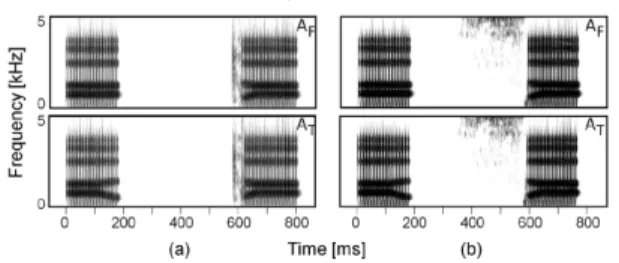
Figure 1: Arai et al (2017) Testing Tokens Spectrograph
From Arai et al (2017)
As such, the duration of audio content in the audio cues is the same, but what differs is whether the vowel formants contextualize the token as one geminate phoneme or as singleton preceding a pause. Lastly, in one trial of the experiment, the audio is absent from the audiovisual tokens (A0).
The visual cues, similarly, either corresponded with geminate or singleton production. A video of a speaker was displayed, and if his mouth closed early, than this suggests a geminate consonant (VE), whereas if he closed late, then this cues with a singleton consonant (VL). Similarly, the visual cue could also be absent (V0). Below is a diagram from Arai e al. 2017 of their testing stimuli.
Figure 2: Arai et al (2017) Token Design
Each experiment consisted of three trials, and the t-experiment was administered before the s-experiment. In all trials, participants were asked to sit at an audiovisual monitor and headphone set, and select with a keystroke whether the token they perceived was a geminate or singleton. Each trial consisted of 20 tokens. In the first trial, only the audio conditions were played (ATV0 and AFV0). Then, in the second trial, the tokens mixed all the audio-visual combinations, so that the visual and audio cues could both suggest the same consonantal length or they could suggest contradictory length. As such, this trial included concurring tokens, ATVE (audio geminate, visual geminate) and AFVL (audio
singleton, visual singleton), and contrasting tokens, AFVE (audio singleton, visual geminate) and ATVL (audio geminate, visual singleton). Lastly, a third trail consisted of the visual cues, A0VE, and A0VL.
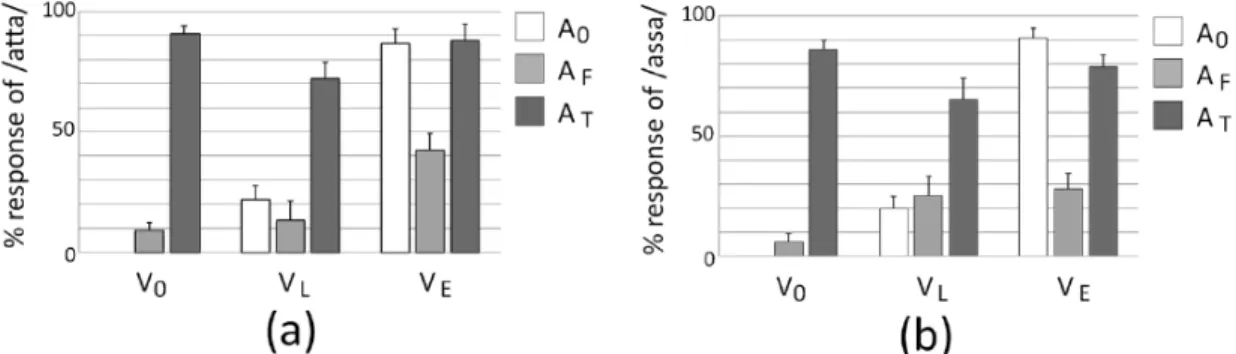
Both the T- and S- experiments show that consonant length is a visible cue and the T- experiment additionally suggests that geminates are more visibly salient than
Figure 3: Arai et al (2017) Experimental Results
From Arai et al 2017
Before discussing the AFVE’s behavior in the T condition, it is worth noting some differences between the T- and S- condition. The visual cues of the T- condition have 2 frames difference between the early and late closure in the visual condition, whereas the S- condition only had 1 a frame difference. Secondly, the T- condition’s audio tokens are potentially less ambiguous and more natural than the S- condition’s tokens. Arai et al inserted a silent interval of 140ms into the S- condition audio tokens, both because
geminate fricatives sometimes have silence in real speech, and because it would have been unrealistic to follow a /a/ with no formant transitions by and the frication noise of a
singleton /s/ immediately. While these are logical modifications to S- experiment, stop geminates are inherently silent during the closure and the T- experiment thus required no altercations to the natural tokens. A geminate /t:/ will always contain silence, removing the variability found in a geminate /s:/.
video conditions. (2017)1 Furthermore, they report that visual gemination significantly impeded audio cues in phonological perception, whereas the visual singleton was not strong enough to significantly interrupt the geminate audio perception. Length is available as a visual cue per the visual-only A0 experiments, but the mixed conditions furthermore suggest that geminates are more visually salient than singletons, which seems intuitively logical. A long closure provides a more observable and unique visual cue than a short one.
2.4 Place of Articulation and Spanish L2 Spirantization
In 2009, Menke and Face studied the development of Spanish L2 learners in their second-year of college Spanish, as graduating majors, and as doctoral students, to explore how students learn an allophonic pattern regarding Spanish voiced stops. Spanish voiced stops /b, d, g/ become spirantized intervocalically in all dialects, and English L1 learners frequently struggle to produce the allophones in their proper environments.
While their object was to discover whether more advanced speakers showed improved production of this allophony, their data incidentally also shows that all
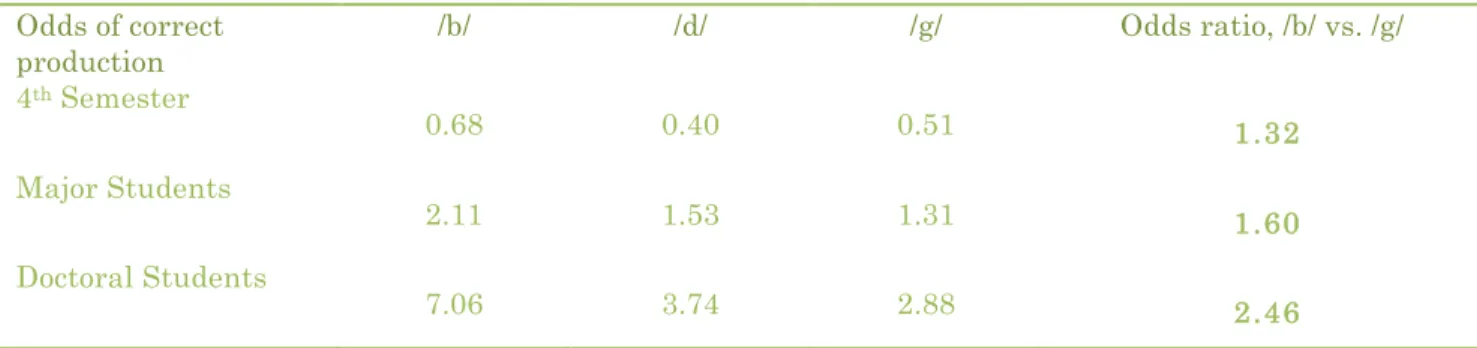
participants produced labial consonants better than velar consonants as shown in table 2. While the values were originally reported as the percentage of tokens produced correctly, these values have been converted to odds ratios here for better comparison. While they do not discuss this margin in their paper, it cannot be explained by frequency, as /b/ and /g/ have relatively the same frequency in Spanish at 2.1% and 1.4% respectively (Piñeros, 2009). /d/ actually has much greater frequency than the /b/ and /g/ at 4.0%, but, except for the fourth semester students, students produce less accurately than /b/ and more accurately than /g/. Labial and velars generally understood are marked compared to coronals, so these
phonemes should have similar markedness (Lombardi, 2002). If it is true that visual influence holds a key role in the acquisition of L2 phonology, then this would predict that learners acquire /b/’s allophony more accurately than /g/’s because of additional visual information.
Table 2: Accuracy with Spanish Spirants by Proficiency Level Odds of correct
production /b/ /d/ /g/ Odds ratio, /b/ vs. /g/
4th Semester
0.68 0.40 0.51 1.32
Major Students
2.11 1.53 1.31 1.60
Doctoral Students
7.06 3.74 2.88 2.46
Adapted from Menke and Face (2009)
It is furthermore interesting that the gap between /b/ and /g/ spirantization grows in doctoral students, even though accuracy improves in all phonemes. This seems to support the idea that there is a distinct interface between visual input and learning specific to L2 phonology acquisition. Frequency does not explain the accuracy of these three sounds, as /d/ is the most frequent, consisting of 4% of phonemes, and markedness also fails to make an accurate prediction, as /d/ is likely the least marked of the stops as a coronal articulation.
2.5 Gemination Cross-Linguistically
This experiment uses voiceless singleton stops rather than voiced singleton stops for a few reasons. Typically, though not exclusively, voiceless geminate stops are more common than their voiced counterparts, so that if a language has voiced geminate stops they
served as the basis for measurement (see 3.1), spectrogram information is still useful when reading the waveform for stop closure. Esposito (1999) notes that voiced stops do not always have as sharp a transition on the spectrogram. As they may be more inherent
cross-linguistically and due to ease of measurement, this experiment employs voiceless geminate stops in its test of impact of visual cues on a second language.
2.6 Structure of Italian Geminates
Standard Italian has a consonantal length contrast unique to the Italo-Romance branch of the Romance languages (Stevens, 2011). In Standard Italian, length is contrastive for all consonants intervocalically, except for five long consonants (Payne, 2006).
Table 3: Italian Consonant Inventory Singleton Phonemes: /p, b, t, d, k, g, t͡ ʃ, d͡ ʒ, s, f, v, n, m, l/ Geminate Phonemes: /p, b, t, d, k, g, t͡ ʃ, d͡ ʒ, s, f, v, n, m, l/
Inherently Long Sing.: /r, ʃ, ɲ, t͡ ʃ, d͡z/
Adapted from Payne (2006)
Listeners distinguish singletons and geminates primarily by their length, but the V1 of the proceeding vowel may serve a weak as an additional correlate (Esposito, 1999). While research suggests that normally Italian speakers cannot identify gemination based off of the proceeding vowel alone, the V1s after a geminate are normally 25% shorter than a V1 following a singleton (Esposito, 1999).
In Italian, gemination occurs intervocalically, as geminates are often analyzed as holding a mora of the coda position of one syllable and onset of the following one
than /p/ and /p:/ in front of /a/ and /i/ in terms of absolute values. Payne (2006) finds that word-stress, intonational prominence, and the sonority of the consonant can slightly
influence absolute duration. These features can alter the absolute values of gemination, but the general relative correlate is relatively consistent.
There is some dialectical variation found within Italian gemination. Some northern dialects use preaspiration to compensate for the length partially, but length of closure duration is still the primary correlate (Payne, 2006).
2.7 Project Aims and Hypotheses
As aforementioned, this project seeks to explore whether L2 phonologies show the influence of visual cues in the acquisition of the production of L2 phonological gestures, which we can refer to as a Visual Cue Saliency L2 Effect. This background section has established that Spanish spirantization allophony is better learnt in the labial position than in the velar position, that gemination is visible, and that the labial position is visually salient. This section also discusses the nature of Italian gemination.
Participants will read a short story in Italian and a word list. If visual input
facilitates the learning of phonological processes, then participants will demonstrate more accurate elongation of geminate /p/ than of geminate /k/. This will be evident in the
distinctiveness of labial and velar Italian geminates from their singular counterparts, as more accurate speakers will produce fewer geminates as singletons in their production.
2.7.1 Hypothesis 1
4.1), but this is conceptually similar to claiming that the difference in the ratio of /p:/ to /p/ to the ratio of /k:/ to /k/ will be a positive number. I anticipate /p:/ to be produced better, and thus longer than /k:/. Hypothesis one is a measure of relative distinctness and claims that the labial pair will be more distinct than the velar one.
2.7.2 Hypothesis 2
3 Methodology
3.1 Introduction
Now that the projects goals and hypotheses have been established, this section will detail the experimental design, measurement process, and token design. Participants were asked to complete 3 tasks in the following order: answer a questionnaire, read a short story and read a word list. After the experiment was conducted, the researcher selected a subset of the short story tokens, because the experimental design had not properly accounted for the influence of the following vowel in stop closure length, as discussed in 3.4.3. The guided reading was designed so that participants would not know that gemination specifically was the topic of study, to discourage careful reading regarding these phonemes.
3.2 Participants
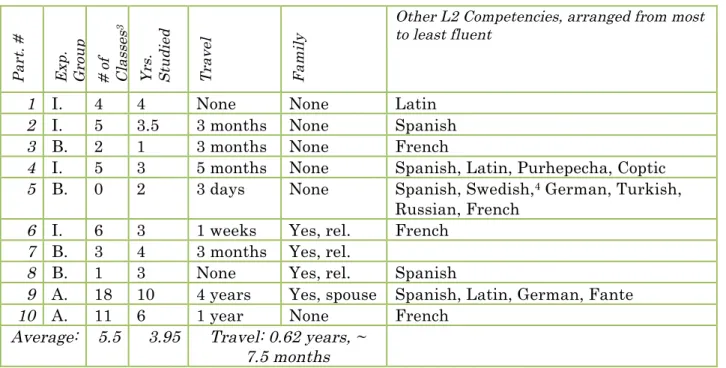
The participants in this study are Italian L2 learners with between 2 and 10 years of formal study in the language. Among participants, the mean length of study was 3.95 years of Italian, and the median length was 5.5 years. Participants belong to one of three
categories, defined relative to how many courses they taken beyond the fourth class in Chapel Hill’s undergraduate language-learning sequence (Italian 204). The group of
intermediate students had taken through Italian 204, advanced students had taken at least 4 major level Italian courses beyond Italian 204, and the last group consisted of graduate students, who that spring were finishing, at least their second year of graduate study.
total in the results, with 4 participants in the beginner and intermediate groups and 2 in the advanced group. Two participants were excluded: one as he was a heritage speaker of Italian who acquired some Italian as a L1 speaker, and the other because his recording was of low quality.2
No participant reported knowledge of a language that included a singleton-geminate contrast, and all spoke English as a first language. The languages they have studied beyond Italian are listed in order of proficiency. The languages they have studied are reported as follows:
Table 4: Linguistic Experience
Pa rt . # Ex p. Gr ou p # of Cl as se s 3 Yr s. St ud ie d Tr av el Fa m il y
Other L2 Competencies, arranged from most to least fluent
1 I. 4 4 None None Latin
2 I. 5 3.5 3 months None Spanish 3 B. 2 1 3 months None French
4 I. 5 3 5 months None Spanish, Latin, Purhepecha, Coptic 5 B. 0 2 3 days None Spanish, Swedish,4 German, Turkish,
Russian, French 6 I. 6 3 1 weeks Yes, rel. French
7 B. 3 4 3 months Yes, rel.
8 B. 1 3 None Yes, rel. Spanish
9 A. 18 10 4 years Yes, spouse Spanish, Latin, German, Fante
10 A. 11 6 1 year None French
Average: 5.5 3.95 Travel: 0.62 years, ~ 7.5 months
2 In this case, I was trying to see if the participant could send their own recording electronically, in order to increase the number of graduate students All participants in the study’s results are Chapel Hill students, who were recorded in the Linguistics departments’ professional sound booth.
3 Number of Classes taken past 204 (not inclusive).
3.3 Questionnaire Design
First, participants responded to a questionnaire with questions about their language experience.5 Questions pertained to their formal study of Italian, travel to Italy, and
knowledge of other language amongst other things. Most importantly, participants reported how long they had studied Italian, and how many Italian-language major-level courses they have completed. Relevant data is compiled in Table 4, above.
3.4 Short Story Task
3.4.1 Short Story Methods
After completing the questionnaire, participants narrated an adapted Italian version of the first three chapters of The Little Prince, written by Antoine de Saint-Exupéry,
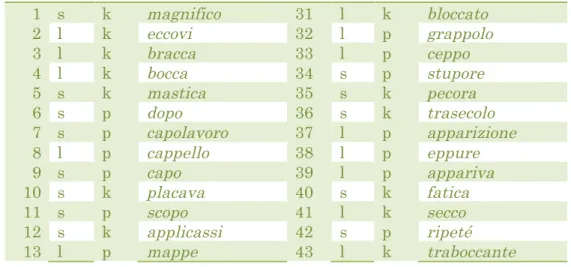
available in appendix A.2. I adapted the translation, editing sentences and words, so that there were 60 tokens total embedded into the reading. Native Italian speakers proofread the edited work. There were 15 tokens of each type: 15 /p:/, 15 /p/, 15 /k:/, and 15 /k/ respectively. The tokens are available below, but further information on token design and balance will be covered in section 3.4.2.
Table 5: Short Story Task Tokens
1 s k magnifico 31 l k bloccato
2 l k eccovi 32 l p grappolo
3 l k bracca 33 l p ceppo
4 l k bocca 34 s p stupore
5 s k mastica 35 s k pecora
6 s p dopo 36 s k trasecolo
7 s p capolavoro 37 l p apparizione
8 l p cappello 38 l p eppure
9 s p capo 39 l p appariva
10 s k placava 40 s k fatica
11 s p scopo 41 l k secco
12 s k applicassi 42 s p ripeté
13 l p mappe 43 l k traboccante
14 s k logica 44 s k pericolo
15 l k sacco 45 s k ricordai
16 s p capiscono 46 l k piccolo
17 s k affaticano 47 l p groppo
18 l k d'occhio 48 l p appuntò
19 s p sapere 49 s k amico
20 s p l'opinione 50 l k vecchia
21 s p aperta 51 s p concepire
22 s p capire 52 s k poco
23 l p cappuccio 53 l p scoppio
24 l k peccato 54 s p riposo
25 s k politica 55 s p canapa
26 l p troppo 56 s p proposta
27 l k staccate 57 l p dappertutto
28 l k siccome 58 s k fico
29 l k meccanico 59 l p pioppo
30 l k acqua 60 l p scappare
All of the participants were tested in the sound booth the Phonetics Lab at UNC in Dey 103. The recordings were captured at 44100 Hz in Praat. Participants were permitted to take breaks as needed, and were given short breaks of around 1 to 2 minutes at the
beginning of the second and third chapter so that the researcher could start a new recording file; although, one intermediate student and one advanced student continued reading and thus have different breaks between the recordings of the reading section. Advanced students took around 10-15 minutes to complete this reading, whereas beginner students normally needed around 20-25 minutes.
3.4.2 Short Story Token Design and Balance
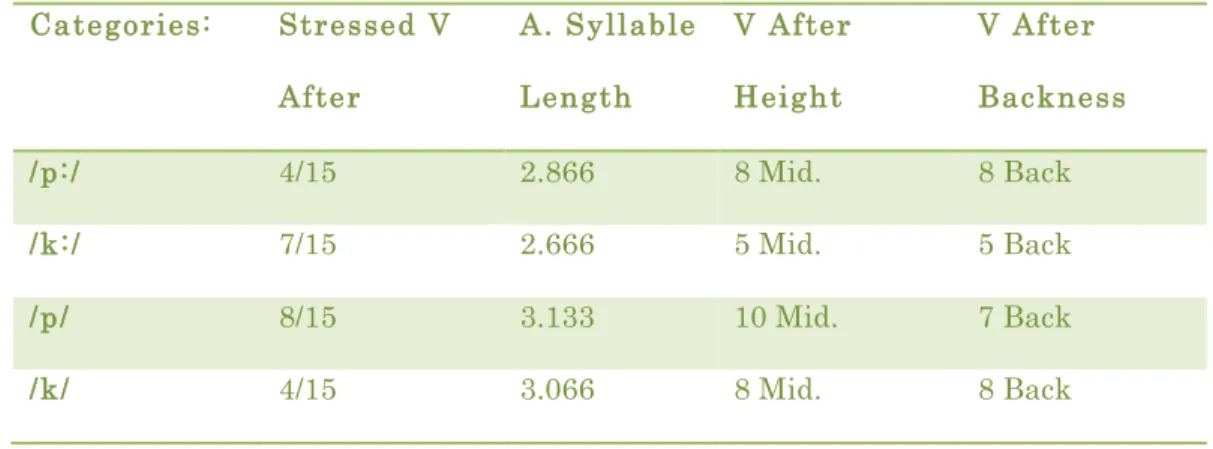
the token balance, and a complete inventory of the tokens as marked for token balance is available in Appendix B.
Table 6: Token Balance Summary Chart
Categories: Stressed V
After
A. Syllable
Length
V After
Height
V After
Backness
/p:/ 4/15 2.866 8 Mid. 8 Back
/k:/ 7/15 2.666 5 Mid. 5 Back
/p/ 8/15 3.133 10 Mid. 7 Back
/k/ 4/15 3.066 8 Mid. 8 Back
Geminate length may be affected by being followed by a stressed syllable, the word length and vowel quality (Payne, 2005, Esposito, 1999). The design goal is certainly to minimize the influence of these factors, but when impossible, the tokens are chosen so that these environmental factors support the distinctiveness of the K contrast. As both
hypotheses of the experiment center around the idea that the P contrast will be more distinct than the K contrast, by having the tokens lean towards K contrast’s distinctiveness when perfect balance is impossible, this helps protect against false positives.
With word length, both /p:/ and /p/ occur in longer words than /k:/ and /k/, which means that the P contrast is more likely to have shorter tokens than the K contrast. By having longer tokens in the geminate condition, the K-condition is biased towards being more distinct than the P-condition, as gemination is produced more than singletons. The K contrast is similarly advantaged in word stress. Being in a stressed syllable seems to
K-condition’s distinctiveness. Vowel balance proved to be the most problematic element of the design, so a subsection of the short story task’s data was analyzed as a subset controlled for vowel quality. This subset will be discussed here.
3.4.3 O-subset Design
After the experiment was conducted the researcher realized that previous research (Esposito, 1999), found that out of the various environmental aspects the quality of the following vowel most dramatically alters the absolute duration of the preceding stop. While the relative duration is roughly the same among vowels, without ensuring that there are an equal number of tokens across the four token types with each of the following vowel, the distribution of vowel balance of the experiment can bias the average durations of tokens across the four token types. This proves to be the clearest problem in this experimental design, and while the experimental balance’s focus was originally concentrated on ensuring similar numbers of mid, low, and high vowels in each singleton-geminate group, the
literature makes it clear that backness and height clearly must be prioritized together in the experimental design over other environmental influences discussed in 3.4.2.
Given that the following vowel quality seems to affects absolute stop length much more dramatically than other variation in the experiment (Esposito, 1999), the experimental conclusions would have been incomplete without analyzing a subset of the data controlled for the following vowel. The O-subset, as explained here, will serve to either confirm the experimental findings of the short-story task, or remove the influence of the following vowel in experimental design.
reputable, with some possible subsets having only 1 token or lacking a token for a certain token type. Containing nearly half of the short story list, the O-subset it is large and controlled so it can ensure that vowel misbalance among the types did not interfere in the results analysis. Esposito (1999) shows that /p/, /p:/, /k/ and /k:/ behave similarly to one another in front of /a/ and /u/ (the paper studied tokens proceeded by /i/, /a/, and /u/).
Furthermore, the subset is not biased towards the P-condition’s distinctness in word length or stress, as visible in table 16 in appendix B.2. While the subset was selected after
conducting the experiment, its concordance or dissonance with the overall results is necessary information to account for behavior related to vowel backness and ensure the validity of the results of the short story and word list sections as a whole.
3.5 Word List Task
3.5.1 Word List Methods
After reading the short story, participants read a word list. The words were presented as a Google Slides presentation on a laptop computer screen, such as:
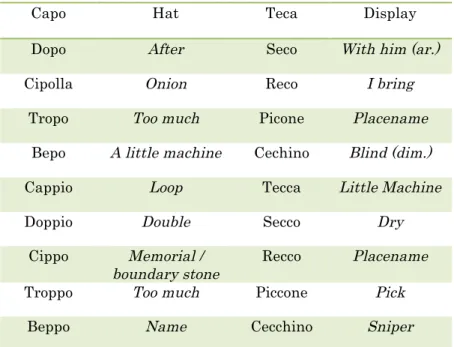
There were 25 words in all, of which 20 were measured as tokens, and 5 were distractor terms, which served only to mute slightly that gemination was under
Table 7: Word List Task Tokens
Capo Hat Teca Display
Dopo After Seco With him (ar.)
Cipolla Onion Reco I bring
Tropo Too much Picone Placename
Bepo A little machine Cechino Blind (dim.)
Cappio Loop Tecca Little Machine
Doppio Double Secco Dry
Cippo Memorial /
boundary stone Recco Placename
Troppo Too much Piccone Pick
Beppo Name Cecchino Sniper
There were five additional words that served as filler: bene, caffè, posto, luce, oro. The slides were placed in a random order for each participant, using a website called Random.org.6 Participants were instructed to click through the slides and read each
recording. They were instructed only to repeat a word if they felt they had mispronounced it in such a way that they would normally correct themselves in a classroom setting, and the last iteration would be taken for measurement.
3.5.2 Word List Token Design and Balance
By and large, each measurement reflects a participant’s first attempt at production. The tokens are well balanced in this task, but there are slight discrepancies in vowel backness. However, this task is much smaller than the short story task, and subject to greater variation as a result. Additionally as aforementioned, participants do seem to become aware of the focus on gemination during the task.
3.6 Measurement Process
After all participants were recorded, the experimenter randomly ordered the recordings and measured them according to this order. The reading passage consisted of three chapters (each recorded as a separate tape) and the word list was one tape, so that each participant was recorded on four tapes. As such, by randomizing the measuring order, of the four portions of each participant’s production, the experimenter ensured that none of the chapters or participant groups were privileged above the other in terms of measurement, the concern being that later measurements might be more accurate than early
measurements. The closure of the geminate and singleton tokens was measured in Praat (2018), as calculated from the nearest zero crossing to the left of the last glottal pulse on the waveform to the burst of the stop. The following details the measurement procedure.
3.6.1 Measurement Procedure
The following section outlines our measurement procedures. All tokens were measured at least twice to ensure the measurement’s concurrence to these procedures.
1) File Organization
1.a Open the sound file and add one band as a .txtgrid under Annotate.
1.b Filter the sound file with a stop band filter, from 0 - 100. Set the smoothness to
10, and then press ‘ok’ to conserve the original sound file. 2) Locating the Beginning of the Selection
2.a Find the target stop closure, and zoom into about .8 seconds so that most of the
Image 17, the visible section here is .819 seconds.
2.b Zoom into to 0.1 – 0.2 seconds near the closure to determine what the last glottal
pulses with clear vowel formants may be.
Image 2, selected portion corresponds to Image 3.
2.c To find the beginning of the closure measurement, insert a boundary on the
nearest zero crossing to the left of the highest peak within the last repetition of the cycle as seen on the waveform. The last repetition on the waveform is defined as the one where:
2.c.1 The cycle on waveform maintains the same recognizable shape as earlier cycles in the middle of the vowel, so that the three waves with the highest peaks within this glottal pulse are also the three waves with the highest peaks in a prominent cycle in the middle of the vowel.
Image 3
2.d Use Praat commands to find the zero crossing described in 2.c, set a boundary at
this location.
3) Locating the Release
3.a. Use the waveform to identify the release of the articulators after the closure.
3.a.1 If there is an irregularity in the stop burst (for example, a click occurs before
the burst), note this in an irregularity log.
3.b From here, locate the zero crossing at the first wave of the release on the
Image 4
4) Verification of Measurement and Removal of Inadequate Tokens
4.a If the stop consonant is produced incorrectly, then remove it from the count.
Further details are available in section 3.3.3. Log irregularities for consistency. 4.b Apply labels in between the boundaries on the text grid to mark the token
number and the target phoneme.
After all tokens were passed over again to verify their correspondence to the
conditions set forth in above, I used Dr. Katherine Crosswhite duration-logger Praat script available online at http://phonetics.linguistics.ucla.edu/facilities/acoustic/duration_logger.txt to extract the duration measurements. This logger places the durations of the labeled
segments into a Text Edit file, which was then processed in Excel.
3.6.2 Exemplars
Beginners, Participant 4: 42, 6: 5
Intermediate, Participant 3: 9 5: 57
Advanced, Participant 13: 52 12: 18
3.6.3 Handling of Abnormalities
3.7 Hypothesis and Experimental Predictions
4 Results
4.1 Statistical Model
The data was as analyzed using a log-linear generalized model with a gamma-distributed error term. 12 groups are defined in the statistical analysis based on the place of articulation (p or k), the length (long or short) and experience (beginner, intermediate, and advanced) so that design matrix can be understood so that the log of duration is equal
to [β1(KLB)+ β2(KLI)+ β3(KLA)+ β4(KSB)+ β5(KSI)+ β6(KSA)+ β7(PLB)+ β8(PLI)+ β9(PLA)+
β10(PSB)+ β11(PSI)+ β12(PSA)]. The variance accounted for multiple observations per subject,
and the analysis was conducted in SAS PROC GENMOD.
As aforementioned, the first hypothesis proposed that the ratio of the singleton and geminate /p/ would be greater than the ratio of singleton and geminate /k/, so that log(sing. p) - log(gem. p) - log(sing. k) + log(gem. k) > 0, if (sing. p / gem. p) / (sing. k/gem. k) > 1.
The second hypothesis purports that the size of the ratio calculated to test
hypothesis 1 is greater in higher-level proficiency groups than lower-level groups out of the three proficiency groups: beginner, intermediate, and advanced.
In the results section we report the ratios of ratios of the P- and K-conditions per task and per group here as “(PL/PS)/(KL/KS) Ratios.” We also report the average duration of each token, /p:/, /p/, /k:/ and /k/, per level. Lastly, we report the ratio between the
identify which token types changed to form the ratio patterns hypothesized. These values are discussed for both the short story and word list task, as well as for the O-subset.
4.2 Results
4.2.1 Short story Task
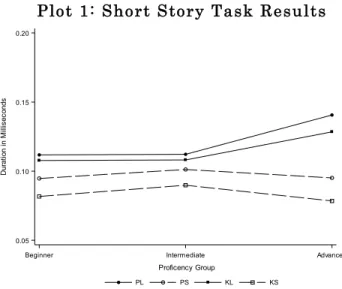
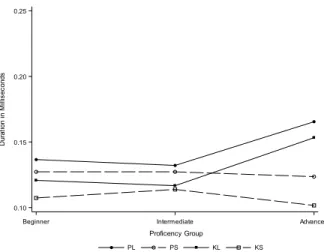
The short story condition had 15 tokens of each type (/p:/, /p/, /k:/, /k/), and there were 4 participants in the beginning and intermediate groups, and 2 in the advanced. Plot 1 shows the average durations in seconds of each token type per group. The ratio of the distinctiveness of geminate and single /p/ to that of geminate and singleton /k/ is found in Table 8 and in Plot 1, as well individual A/B ratios per type that show how different participants produced each type of token in each of the four categories.
Plot 1: Short Story Task Results
Table 8: Short Story Task Results
Label: Short story task
Mean
Estimate MeanLowerCL MeanUpperCL Chi-Square Pr > ChiSq
Average Durations in Seconds:
KL B 0.1078 0.0926 0.1254
KL I 0.1080 0.0787 0.1483
KL A 0.1286 0.0946 0.1748
Label: Short story task
Mean
Estimate MeanLowerCL MeanUpperCL Chi-Square Pr > ChiSq
KS B 0.0817 0.0759 0.0879
KS I 0.0898 0.0641 0.1258
KS A 0.0786 0.0712 0.0867
PL B 0.1120 0.0968 0.1295
PL I 0.1124 0.0899 0.1404
PL A 0.1405 0.1198 0.1647
PS B 0.0950 0.0800 0.1127
PS I 0.1013 0.0755 0.1358
PS A 0.0950 0.0929 0.0972
(PL/PS)/(KL/KS) Ratios:
Beginner: (PL/PS)/(KL/KS) 0.8938 0.7910 1.0099 3.24 0.0717
Intermediate: (PL/PS)/(KL/KS) 0.9224 0.8417 1.0108 2.99 0.0838
Advanced: (PL/PS)/(KL/KS) 0.9033 0.6903 1.1821 0.55 0.4587
A/B Ratios per Type:
KL: Advanced/Beginner 1.1936 0.8475 1.6810 1.03 0.3111
KS: Advanced/Beginner 0.9621 0.8510 1.0876 0.38 0.5366
PL: Advanced/Beginner 1.2547 1.0115 1.5565 4.26 0.0390
PS: Advanced/Beginner 1.0007 0.8417 1.1898 0.00 0.9933
If /p:/ and /p/ are longer than /k:/ and /k/ in production, then we expect their (PL/PS)/(KL/KS) ratio of ratios to be greater than 1. Per the beginner, intermediate, and advanced (PL/PS)/(KL/KS) ratios Mean Lower CL and Mean Upper CL, we can see that the error ranges of all three groups in this condition fall on both sides of 1, so the short story task is inconclusive.
It is also useful to examine the ratios of the advanced tokens to the beginner’s tokens per type, available under “A/B ratios per type.” After accounting for error, if the number is greater than 1, then it means that the average length of the advanced tokens in the
condition was longer than the advanced condition. The short story task shows that /k:/ and /p:/ do seem to be significantly longer in advanced L2 learners compared to beginning L2 learners, so that learners are learning gemination. In contrast, the /k/ and /s/ do not evidence a significant difference between the groups.
4.2.2 Word List Task
The word-list task contains less data than the reading-list condition with 5 tokens for each type and tested the same participants as in the reading list. Plot 2 and Table 9
summarize the experimental results.
Plot 2: Word List Task Results
Table 9: Word List Task Results
Label
Mean
Estimate MeanLowerCL MeanUpperCL Chi-Square Pr > ChiSq
Average Durations in Seconds:
KL B 0.1477 0.1360 0.1603
KL I 0.1563 0.0903 0.2704
KL A 0.1964 0.1957 0.1972
KS B 0.1383 0.1154 0.1657
KS I 0.1494 0.0961 0.2322
KS A 0.1242 0.0874 0.1765
Beginner Intermediate Advanced
Label
Mean
Estimate MeanLowerCL MeanUpperCL Chi-Square Pr > ChiSq
PL B 0.1849 0.1625 0.2105
PL I 0.1842 0.1200 0.2827
PL A 0.2243 0.2104 0.2391
PS B 0.1570 0.1373 0.1796
PS I 0.1607 0.1123 0.2302
PS A 0.1469 0.1002 0.2155
(PL/PS)/(KL/KS) Ratios:
Beginner: (PL/PS)/(KL/KS) 1.1028 0.9348 1.3010 1.35 0.2459
Intermediate: (PL/PS)/(KL/KS) 1.0952 0.9838 1.2194 2.76 0.0967
Advanced: (PL/PS)/(KL/KS) 0.9656 0.8744 1.0664 0.48 0.4894
A/B Ratios per Type:
KL: Advanced/Beginner 1.3301 1.2251 1.4441 46.23 <.0001
KS: Advanced/Beginner 0.8983 0.6051 1.3335 0.28 0.5946
PL: Advanced/Beginner 1.2131 1.0501 1.4015 6.88 0.0087
PS: Advanced/Beginner 0.9357 0.6236 1.4040 0.10 0.7481
We are less equipped to draw a conclusion from the word list task than from short story task, as there are fewer tokens in the word-list task. Furthermore, as mentioned in 3.5.2, participants also became aware that gemination was the focus of the study as they progressed through the randomized tokens of this task, whereas they were unaware during the short story task. All tokens’ average durations were longer in the word list task than in the short story task; perhaps, this supports the idea that participants used more careful speech on the word list. Nonetheless, like the short story task, all three (PL/PS)/(KL/KS) values are inconclusive due to the error, and as to the P and K-conditions’ ratios.
4.2.3 O-subset Results
The O-subset proves to be the most interesting out of the three analyses of data, consisting of 26 tokens from the short story task. All tokens consist of the target sound followed by /o/ or /ɔ/, and Plot 3 and Table 10 describe the experimental results in detail.
Plot 3: O-subset Results
Table 10: O-subset Results
Label: O-subset
Mean
Estimate MeanLowerCL MeanUpperCL Chi-Square Pr > ChiSq
Average Durations in seconds:
KL B 0.1220 0.0940 0.1585
KL I 0.1142 0.0844 0.1545
KL A 0.1155 0.0978 0.1364
KS B 0.0897 0.0798 0.1008
KS I 0.0972 0.0690 0.1370
KS A 0.0895 0.0780 0.1027
PL B 0.1233 0.1003 0.1515
PL I 0.1305 0.1050 0.1622
PL A 0.1754 0.1585 0.1941
PS B 0.0957 0.0776 0.1180
Beginner Intermediate Advanced
Label: O-subset
Mean
Estimate MeanLowerCL MeanUpperCL Chi-Square Pr > ChiSq
PS I 0.1042 0.0767 0.1414
PS A 0.1007 0.0996 0.1018
(PL/PS)/(KL/KS) Ratios:
Beginner: (PL/PS)/(KL/KS) 0.9466 0.8265 1.0842 0.63 0.4283
Intermediate: (PL/PS)/(KL/KS) 1.0666 1.0316 1.1028 14.35 0.0002
Advanced: (PL/PS)/(KL/KS) 1.3493 1.1138 1.6345 9.37 0.0022
A/B Ratios per Type:
KL: Advanced/Beginner 0.9467 0.6945 1.2905 0.12 0.7290
KS: Advanced/Beginner 0.9978 0.8329 1.1954 0.00 0.9813
PL: Advanced/Beginner 1.4226 1.1307 1.7898 9.05 0.0026
PS: Advanced/Beginner 1.0520 0.8527 1.2979 0.22 0.6363
While the short story and word lists task show inconclusive results concerning the ratio of the P- and K-conditions, the O-subset shows significant results in the intermediate and advanced categories of the (PL/PS)/(KL/KS) ratios, because the Mean Lower CL is greater than 1. Furthermore, the Mean Lower CL of the advanced group is greater than the Mean Higher CL of the intermediate group, so that there is no overlap between the groups. This shows that the advanced group has indisputably longer (PL/PS)/(KL/KS) ratio than the intermediate group. Furthermore, the A/B per token type values show that only /p:/
4.3 Hypotheses and Statistical Results
In responding to the hypotheses, the (PL/PS)/(KL/KS) ratios are the most useful information. Table 11 summaries these ratios below.
Table 11: (PL/PS)/(KL/KS) Ratio Results Summary Chart
Wo rd Li st Me an Es tim at e Me an Lo w er
CL Mean
Up
pe
r
CL
Short Story Task
Beginner: (PL/PS)/(KL/KS) 0.8938 0.7910 1.0099
Intermediate: (PL/PS)/(KL/KS)
0.9224 0.8417 1.0108
Advanced: (PL/PS)/(KL/KS)
0.9033 0.6903 1.1821
Word List
Beginner: (PL/PS)/(KL/KS) 1.1028 0.9348 1.3010
Intermediate: (PL/PS)/(KL/KS)
1.0952 0.9838 1.2194
Advanced: (PL/PS)/(KL/KS)
0.9656 0.8744 1.0664
O-subset
Beginner: (PL/PS)/(KL/KS) 0.9466 0.8265 1.0842
Intermediate: (PL/PS)/(KL/KS)
1.0666 1.0316 1.1028
Advanced: (PL/PS)/(KL/KS)
1.3493 1.1138 1.6345
4.3.1 Hypothesis 1: /p:/ and /p/ will be more distinct than /k:/ and /k/
K-condition (/k:/ and /k/). In the overall short story task and word list task, the results are ambiguous as shown in table 11.
4.3.2 Hypothesis 2: The trend observed in hypothesis 1 will become more prominent in
advanced student categories
Hypothesis 1 was built from hypothesis 2, so that it was anticipated that labial geminate and singleton sound contrast would be more distinct from the velar counterpart in more advanced speakers. While hypothesis 1 proposes an observable effect, hypothesis 2 suggests that this effect should be visible as a trend at different stages of L2 acquisition. This is visible in O-subset, as the ratio of ratios in the intermediate group’s low and high range is 1.0316 and 1.1028ms respectively, whereas the advanced groups’ answers range between 1.1138 and 1.6345ms. There is no overlap between the values of the two groups. That said, the advanced group had two participants while the intermediate group had four, so the intermediate group should have statistically stronger data than the advanced group. Although the tests administered here support hypothesis 2, it may perhaps be wisest to confirm with further experimentation as to the results of this trend over time.
4.4 Statistical Trends
The A/B ratios (advanced-to-beginner) per type show that the geminate /p/ in the O-subset was the only type of token to become longer between beginner and advanced groups in a statistically significant way. In other words, the statistical response to hypothesis 1 discussed above seems to be related to increasing the length of the labial geminate stop, and not due to changes in length between any of the other stops.
5 Discussion
5.1 Introduction to Experimental Discussion
The results of this experiment are consistent with the theory that higher visual
saliency of a phone corresponds to higher accuracy in L2 production than sounds of the same natural class at other places of articulation. That said, this alone does not exclusively
implicate that our cue visibility theory, referred to in section 2.7 as a Visual Cue Saliency L2 Effect, is the cause. As such, in 5.2.2, we juxtapose the distinct production across place of articulation in studies with visible cues with the indistinct behavior across place of
articulation found in an additional study entailing L2 production of non-visible cues (Reeder, 1998). Visibility, of course, is prerequisite to the visibility differences that may influence L2 sound production. This asymmetry between the production of visible and non-visible cues across place of articulation supports this claim that the differing visual saliency of cues is responsible for differences in the L2 production of visible gestures across place of
articulation.
5.2 Experimental Conclusions
As discussed in the results, the data from the O-subset shows that intermediate and advanced participants produce the P-condition more distinctly than the K-condition. Similar to the data of the Menke and Face (2009) paper, the second hypothesis also concurs with the data in the O-subset, as L2 Italian advanced participants produce a significantly greater distinction than intermediate participants. The effect of visual input captured in this experiment grows more noticeable in more advanced populations in accord with the second hypothesis, even though one might have anticipated that advanced speakers show less external influence in their L2 phonologies.
5.2.1 Validity of O-subset’s Behavior
Although the O-subset was selected after the experiment was conducted, I believe that it best explains what is happening in the data. Geminate duration may vary depending on the following vowel, but it is proportionally relatively similar across the places of
While future experimentation will be useful, as discussed below, the O-subset’s behavior can only be understood as distinct from that of the other tokens through this explanation. Furthermore, the framework of the theory that visual cue salience causes the difference in production between labial and velar counterparts in the O-subset and the Menke and Face (2009) finds further justification, actually, from an L2 acquisition pattern regarding place of articulation and a non-visible cue.
5.2.2 Spanish L2 Deaspiration and Non-Visible Cues
If the O-subset pattern was deviated purely from the influence of labial visual saliency, as the Visual Cue Saliency L2 Effect proposes, then it follows that non-visible articulations should be produced without bias across places of articulation. Indeed, VOT differences are likely not visibly salient due to the role of glottis in voice onset timing, and the Reeder (1998) findings on L1 English L2 Spanish production of Spanish voiceless stops does seem to concord with our prediction that non-visually salient productions lack a labial preference because /p/, /t/ and /k/ are all equally non-visible. More advanced participants produce similar aspiration proportionally across all places of articulation.
intermediate groups, and level 4 best parallels our advanced groups. Table 12 reports the mean VOT of each phoneme per group.
Table 12: Mean VOT per Phoneme per Group
/p/ /t/ /k/
Level 1 (Novice) 54ms 53ms 73ms
Level 2 51ms 55ms 74ms
Level 3 36ms 36ms 60ms
Level 4 (Advanced) 29ms 29ms 49ms
Native Speaker (Control) 17ms 17ms 28ms
Adapted from Reeder (1998)
In table 12, the native speaker group shows us that /p/ and /t/ have slightly different targets than /k/; however, /p/, /t/ and /k/ do not all have the same target VOT, as seen in the native speaker productions above. In order to understand this data, we have to look
proportionally at the relationship between the target VOT and the L2 productions.
Table 13 juxtaposes the anticipated length of /k/, based off of native speaker productions, to its observed length, so that the anticipated length of /k/, X, is calculated proportionally from the ratio of the observed values of /p/ and /t/ in both the Native Speaker group and the L2 production group. X is equal to the observed length of the native speaker groups’ /k/, times the quotient of the observed length of /p/ and /t/ in the L2 speaker group and that of the native speaker. In other words:
Table 13: Expected VOT of /k/ Proportionately Calculated from Native Productions
/p/ + /t/ Base Anticipated /k/ (X) Measured /k/
Level 1 (Novice) 53 ~ 54ms Ant. 87.29 ~ 88.94ms Actual 73ms
Level 2 51 ~ 55ms Ant. 84 ~ 90.58ms Actual 74ms
Level 3 36ms Anticipated 59.29ms Actual 60ms
Level 4 (Advanced) 29ms Anticipated 47.76ms Actual 49ms
Native Speaker (Control) 17ms — 28ms
When the target production is taken into account, and the L2 productions are understood as proportional to the target the actual production of level 3 and level 4
speakers of these tokens is actually consistent between /p ~ t/ and /k/. In other words, while advanced participants produce longer /k/ tokens, they produce them with the same
proportion to native speech that regulates their production of /p ~ t/. The measured-values of the beginner Level 1 and 2 participants are not consistent; however, beginner
participants may also be less important in understanding how the availability of visual cues may impact L2 production. The O-subset of our study was also significant only in
intermediate and advanced groups, and the effect witnessed in Menke and Face (2009) was also more significant in these. In Reeder (1996) intermediate and advanced L2 Spanish learners acquire deaspiration, a non-visible cue showing no bias across place of articulation towards the labial position.
5.2.3 Synthesis of Data on Visible and Non-Visible Cues
production so that visual saliency boosts the production of the labial counterpart. The availability of labial over velar visual cues is seen where the articulatory cue is visible, and non-visible cues do not confirm to this pattern. This of course suggests that differing visual cue saliency may be the cause of this pattern and is consistent with the predictions of a possible Visual Cue Saliency L2 Effect.
5.3 Future Experimental Design and Repeatability
The current experimental findings can be strengthed both by repeating the present experiment and by designing similar, new experiments that test L2 learner’s production of foreign phonological patterns that are both accompanied by a salient visual cue and
produced at different places of articulation.
5.3.1 Future Repetitions of this Study
As discussed, token balance proved to be the primary source of obstruction in this experiment, and in future studies should be well controlled, weighted over other factors such as word stress and length. The O-subset allowed this experiment to control for this within a subset, however further repetitions of this experiment should have an equal number of tokens within each type that are followed by the same vowel. This would allow further descriptive insight onto the relationship between the following vowel and gemination, as Esposito (1999) has explored.
were being specifically tested as the progressed through the word list. While there are drawbacks to the rigid structure of the short story, it has a more naturalistic design, so it is perhaps advisable to use as many tokens as possible (balanced for the following-vowel) than to use a word list.
Lastly, this study isolates the phonetic pattern of gemination from its context within the production of the word. If visibility of the phonetic pattern predicts its accuracy with which it is produced in an L2, then perhaps the vowel context of the geminate raises or lowers the visibility of the geminate. Depending on whether the underlying form of the word reflects this effect evidenced in production, we may expect more distinction in the production of geminate-singleton minimal pairs with low-vowels around the singleton or geminate than we might in one surrounded by two high-vowels. This could be incorporated as an additional step into a perception-production experiment as discussed in section 5.4.2.
5.3.2 Variations of this Study in Different Languages
5.4 Further Questions
5.4.1 Visual and Auditory Saliency
Beyond the primary theory of the Visual Cue Saliency L2 Effect, the research conducted in this study raises questions about how the varying visibility of binary features may affect production. Upon what other dimensions, besides place of articulation, could cue visibility be a meaningful factor that impacts L2 production, or even typological patterning? As discussed in section 2.3, the Arai et al (2017) experiment suggests that gemination may be one such dimension, so that geminates are more visibly salient than singletons. The behavior of the visible geminate audio singleton tokens (AFVE tokens) suggest that visual geminacy is stronger than an auditory singleton because the visual geminacy causes significant perceptual interference, whereas the visible singleton audio geminate condition (ATVL tokens) shows that visual singletons are weak compared to auditory gemination. In the ATVL tokens the visual singletons can only cause comparably negligible interference, if any at all, to the audio geminate token.
visual gemination cues are meaningful to phonological processing, but the question as how differing visual and auditory cue strengths, especially of binary features, can affect L2 phonological production and acquisition remains.
Conducting a version of the McGurk experiment with geminate and singleton tokens across different places of articulation may perhaps provide further insight into
understanding the cross-section of visual- and audio-cue strength with place of articulation. Miller and Nicely (1955) tested participants to create confusion matrices of 16 English consonants (including all the stop consonants) found that place of articulation was the most frequently confused natural class over confusion in the manners of articulation. If place of articulation is a weak cue audibly, then not only is it curious as to the extent to which visual geminate cues could interrupt audio geminate cues given the elongation of the audio cue, but this also inquires to the role of visual cues in language processing and comprehension.
While the research presented hear is focused on how visual and auditory cues impact L2 acquisition, it is fathomable that there could be relationships between cue strength and assimilatory tendencies cross-linguistically. For example, many languages exhibit some form of place neutralization in the coda. Furthermore, coda place-assimilation happens informally and incidentally in causal speech frequently in languages such as English, in part because the audio cue is even weaker in a coda position (Tavabi et al 2009). By understanding the relative strengths of visual and auditory cues in comparison to one another, it may be possible to make predictions as to what types of place assimilations are most likely to occur.
5.4.2 Perceptual Studies
The primary finding that visual-saliency seems to affect the acquisition of visually noticable phonetic patterns across different places of articulation prompts further
pattern only exist in production, or to what degree does this L2 production correlate with perception? To what degree does L2 perception and do L2 speakers’ underlying forms reflect the type of access that they have to different cues?
One potentially could conduct an experiment similar to the Arai et al experiment, testing second-language learners of a language with a singleton-geminate labial contrast at their accuracy in distinguishing normative (not-mixed) audiovisual, auditory, and visual, singleton and geminate tokens. The tokens would need to be real minimal pairs in order to try and understand underlying representation. One would anticipate that if L2 perception reflects production, in this case, participants would perceive /p:/ more distinctly from /p/ (P-condition) with greater accuracy than /k:/ and /k/ (K-(P-condition) in all the visual and
audiovisual categories. Furthermore, if the underlying forms were somehow clearer due to the visual information, we would anticipate participants to perceive the P-condition more accurately than the K distinction even in the audio condition. The visual cues are not available for the perception of this condition, so if participants are more accurate in the P-condition than the K-P-condition of this experiment, it suggests that the quality of their underlying forms reflects the availability of the visual cues available in perception.
5.4.3 Pedagogical Questions
Like all L2 production research, this research is useful in its interface with
This research may also interface well with research on metalinguistic knowledge in production. Do advanced students with a background in philology or linguistics produce tokens better than other students? While this experiment proposes that learners process visual cues at a subconscious level rather than explicitly, studies such as Wremble (2013) have found that metalinguistic knowledge is useful learning phoneme distinctions and allophonic patterns. Perhaps the incorporation of light non-theoretical phonetics information and even diagrams that mimic and explain the motion in less-visible places of articulation may help students better visualize and understand how their articulators should be shaped during sound production. While this experiment and theory deals with implicit visual information, research on the role of explict visual information during language instruction may assist in bridging any gaps left over from less visable places of articulation.
5.5 Conclusions
In conclusion, the primary finding of this experiment is that the strength of visual cues at different places of articulation may influence the accuracy with which L2 learners acquire phonetic patterns. Graduating Italian students (intermediate level) and Italian graduate students (advanced level) produce the P-condition much more distinctly than they produce the K-condition in a reading passage in the O-subset. In other words, when we control for vowel context, it seems that participants produce a more distinct labial geminate-singleton contrast than its velar counterpart.
that generally behaves, proportionally, the same regardless of place of articulation. The non-visual pattern of deaspiration contextualizes this effect.
That said, before this theory of a Visual Cue Saliency L2 Effect can be purported more strongly, it needs to be further verified. It would be useful to retest the behavior of Italian geminates in a sample well-controlled for the following vowel’s context like the O-subset, and further visible and non-visible phonetic patterns across different places of
articulation need to be tested for their conformity or rejection of the aforementioned pattern. It would be useful to test visible spirantization, gemination, and the non-visible aspiration, patterns in other L2 languages. Beyond these it would be useful to test phonetic patterns, such as other voicing distinctions and labialization, to see if they conform to this pattern.
Appendix A: Testing Materials A.1: Questionnaire:
How many years have you studied Italian?
Have you traveled to Italy? If so, for how long?
Do you have family that speaks Italian? If so, how many hours a week do you speak Italian with them? When did you start speaking Italian with them?
What other languages do you have experience with?
How many major-level (>300 level) Italian courses have you taken, where Italian is the language of instruction?
A.2: Elicitation Text
Quando avevo sei anni, in un libro sulle foreste primordiali, intitolato "Storie vissute della natura", vidi un magnifico disegno. Rappresentava un serpente boa nell'atto di inghiottire un animale. Eccovi la copia del disegno.
C'era scritto: "Appena bracca la sua preda, il boa la mette in bocca tutta intera, e non la mastica. Dopo di che non riesce più a muoversi e dorme durante i sei mesi che la digestione richiede". E si fermerebbe. Il movimento sarebbe energia sprecata.
Meditai a lungo sulle avventure della giungla. È a mia volta riuscii a tracciare il mio primo disegno. Il mio disegno numero uno. Era così:
Mostrai il mio capolavoro alle persone grandi, domandando se il disegno li spaventava. Ma mi risposero: "Spaventare? Perché mai, uno dovrebbe essere spaventato da un cappello?" Il mio disegno non era il disegno di un capo di vestiario. Era il disegno di un boa feroce che placava la fame con un elefante. Allo scopo che vedessero chiaramente che cos'era, disegnai l'interno del boa. Bisogna sempre spiegargliele le cose, ai grandi. Il mio disegno numero due si presentava così: