THE PREVALENCE OF LEGAL ISSUES IN DIVISION I COLLEGE ATHLETICS AND HOW DEPARTMENTS MANAGE THESE ISSUES
Catherine E. Mitchell
A thesis submitted to the faculty of the University of North Carolina at Chapel Hill in fulfillment of the requirements for the degree of Master of Arts in the Department of Exercise and Sport
Science (Sport Administration) Chapel Hill
2014
Approved by: Barbara Osborne Edgar Shields
© 2014
ABSTRACT
CATHERINE E. MITCHELL: The Prevalence of Legal Issues in Division I College Athletics and How Departments Manage These Issues
(Under the direction of Barbara Osborne, Esq.)
Division I athletics departments often face legal matters and must manage these issues. This study conducted a survey of two populations, Division I athletics directors and general counsels, soliciting responses about how frequent athletics departments encounter various legal issues and the structure utilized to manage those issues. The survey also asked respondents to provide information on the positives and negatives of various management models.
Previous research in this area focused on the presence of Juris Doctor degrees in athletics and looked at the advantages of hiring those with law degrees. An older study investigated the sources of legal counsel for departments, but was performed before the exponential growth in college athletics. This study furthered findings from previous studies, but specifically showed that university counsel is the most common legal resource for athletics departments.
ACKNOWLEDGEMENTS
I would like to extend a tremendous amount of gratitude to my advisor, Barbara Osborne. Not only have you advised me on the thesis process but you have been a mentor over the last 6 years of my life. You provided me with great guidance as I made the choice to stay at UNC for law school and graduate school and you continued to provide guidance in my endeavors
throughout this journey. Thank you for your support and I look forward to many visits to exchange stories in the future.
I would also like to thank Dr. Shields for serving on my committee. You have been a great deal of help in pointing me which direction to go with statistics, but more than that I have enjoyed getting to know you outside of thesis work. It was an honor to serve on the Campus Rec Search Committee with you. I hope we can keep in touch in the future.
Joanna, you have been one of the best mentors I have had the privilege to work under. Thank you for your willingness to serve on my committee and more importantly for your passion for higher education and your support as I pursue my dreams after graduation. Without your guidance and the opportunities you have helped to create I have no idea where I would be headed next year. But due in large part to you I am excited to be heading to UNC Charlotte and starting my postgraduate career in higher education law.
over the country in the future! I have no doubt that you all are going to make a huge impact on college athletics… and the world—I am honored to call you all peers.
There are many other people I owe a huge thanks to as I finish up this process and what is essentially nearing the end of a long road of education. There is no question that I would not be where I am today without the unconditional love, constant prayers, and support from my parents. Mama and Papa Mitch are two of the greatest human beings on this Earth and I dare anyone to tell me otherwise. To my sisters—I thank you for the example you have set for me throughout my life. After one had an MBA and another graduated from pharmacy school I did not have a choice but to dream big. I only pray that I can continue to chase the wonderful examples you have set. To my main girl, C$--thanks for always making the tough weeks and long hours better just by being you and making me smile. I might have a new job, but the best job will always be my “aunt” status. Pound it!
Next to my parents the ones probably enduring the brunt of my thesis experience and lack of sleep were some of the best friends in the world. To Lester and Babs—the last tres amiga to finish up! Thank you for your unending support as I whined about the many late nights spent “thesisizing.” Now let’s start planning a post-bar adventure! To Abbey—you, my friend, are a God-send. We survived the thesis experience together, just at separate times, and I got the benefit of you going first. Thanks for all your tips, tricks, your ear to listen to me vent and most of all your prayers. And to Tadlock—you probably got the most whines, complaints, and
journeyed to Starbucks at the wee hours of the morning. I would not have survived the last two years, much less the last few weeks without you.
TABLE OF CONTENTS
LIST OF TABLES ...x
LIST OF FIGURES ...xii
CHAPTER 1: INTRODUCTION...1
Statement of Purpose ... 3
Research Questions... 4
Definition of Terms ...4
Limitations ...5
Delimitations ...5
Assumptions ...5
Significance of Study ...5
CHAPTER 2: LITERATURE REVIEW ...7
Legal Issues in College Athletics ...8
NCAA Issues ...11
Opportunities for Sport Law Specialization ...14
Presence of Legal Staff in Athletics Departments ...15
University Counsel ...18
Outside Counsel ...22
Call for More Oversight ...23
CHAPTER 3: METHODOLOGY ...25
Instrumentation ...26
Procedures ...27
CHAPTER 4: RESULTS...28
Demographics ...28
Research Question One ...35
Research Question Two ...37
Research Question Three ...40
Research Question Four ...68
CHAPTER 5: DISCUSSION ...86
Summary ...86
Research Question One ...90
Research Question Two ...92
Research Question Three ...94
Research Question Four ...99
Discussion of Relationship Between Two Populations ...102
Comparisons to Previous Studies ...103
Limitations ...106
Future Studies ...107
Conclusions ...109
APPENDIX A: NCAA Division I Colleges and Universities ...110
APPENDIX B: Survey One-Athletics Directors ...114
APPENDIX D: Email Cover Letter to Athletics Directors ...123
APPENDIX E: Email Cover Letter to General Counsels ...124
APPENDIX F: Reminder Email Cover Letter to Athletics Directors ... 125
APPENDIX G: Reminder Email Cover Letter to General Counsels ...126
LIST OF TABLES Table
1. Number of Attorneys in General Counsel Office ...34
2. Issues “Never” Encountered by Athletics Directors (or Assignees) ...35
3. Athletics Issues “Never” Encountered by General Counsel Offices ...36
4. Frequency of Legal Issues for Athletics Departments ...37
5. Frequency of Athletics Legal Issues for General Counsel Offices ...39
6. Who Handles Legal Matters According to Athletics Departments ...41
7. Responses from Athletics Department by Combination ...42
8. Legal Issues Athletics Commonly Send to University Counsel ...44
9. Responses for How Outside Counsel Is Obtained from Athletics Perspective ...46
10. How Much Is Spent on Outside Counsel Each Year From Athletics Opinion ...48
11. Athletics Issues That Outside Counsel Is Relied On ...49
12. Reporting Structures for Legal Matters as Described by Athletics Departments ...51
13. Summary of Popular Text Responses for Reporting Structures on Legal Matters ...51
14. Reporting Structures for Compliance as Described by Athletics Directors ...53
15. Who Is Consulted by General Counsel for Athletics Issues ...56
16. Frequency of Combinations for General Counsel Offices ...58
17. Who Handles The Issue from General Counsel Perspective ...59
18. Issues in Athletics That General Counsel Seek Outside Counsel for Help ...61
19. How Outside Counsel Obtained from Perspective of General Counsel Offices ...63
20. General Counsel Estimates of Amount Spent on Outside Counsel For Athletics Issues ...64
22. Descriptions of Reporting Structures for Compliance Matters According to General
Counsel Offices ...67
23. Positive Characteristics Identified by Athletics Departments/Administrators ...68
24. Negative Characteristics Identified by Athletics Departments/Administrators ...70
25. Positive Characteristics Identified by General Counsel Offices ...71
26. Negative Characteristics Identified by General Counsel Offices ...72
27. Effectiveness of Various Models as Perceived by Departments of Athletics ...72
28. Effectiveness of Various Models as Perceived by General Counsel Offices ...77
29. Explanations of Effectiveness from General Counsel Offices ...81
30. Additional Comments from Athletics Departments ...84
LIST OF FIGURES Figure
1. Position in Athletics Department ...29
2. Time in Position in Athletics ...30
3. Number of Student-Athletes at Institution (Athletics) ...31
4. Respondents with a Law Degree (Athletics) ...32
5. Role in General Counsel Office ...33
6. Experience in General Counsel Office ...34
7. Reported Frequency of Person Managing Athletics Issues According to Athletics Administrators ...41
8. Frequency Athletics Consults with University Counsel ...44
9. Frequency Athletics Interact with Outside Counsel ...46
10. Does Your Institution Have a Formal Reporting Structure for Legal Matters? (Athletics Directors) ...50
11. University Counsel Involvement in Reporting Structure (Athletics) ...52
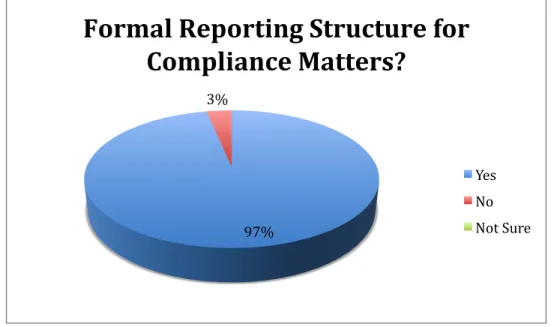
12. Does Your Institution Have a Formal Reporting Structure for Compliance Matters? (Athletics Directors) ...53
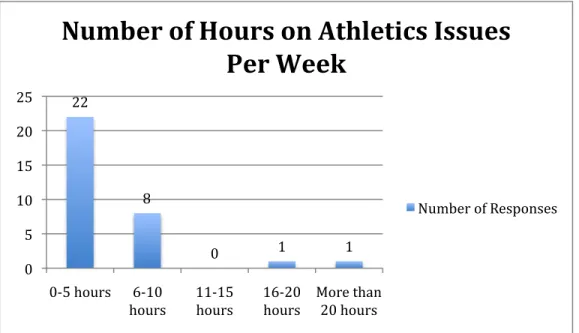
13. Hours Spent by General Counsel Office on Athletics Issues ...55
14. Frequency General Counsel Offices Interact with Athletics ...56
15. Reported Frequency of Person Managing Athletics Issues According to General Counsel ...60
16. Seeking Outside Counsel for NCAA Related Issues (General Counsels) ...61
17. Frequency of Interaction with Outside Counsel by General Counsel for Athletics Matters ...63
18. Is There a Reporting Structure for Legal Matters? (General Counsels) ...65
20. Effectiveness of Athletics In-House Counsel Model from Athletics Perspective ...73 21. Effectiveness of Sending All Athletics Issues to University Counsel from
Athletics Perspective ...74 22. Effectiveness of Relying on Outside Counsel for All Athletics Matters from
Athletics Perspective ...75 23. Effectiveness of Using a Combination of Athletics Administrator and University
Counsel to Oversee Athletics Issues from Athletics Perspective ...76 24. Effectiveness of Using a Combination of Athletics Administrator and Outside
Counsel to Oversee Athletics Issues from Athletics Perspective ...76 25. Effectiveness of Athletics In-House Counsel Model from General Counsel
Office Perspective ...78 26. Effectiveness of Sending All Athletics Issues to University Counsel from General
Counsel Perspective ...79 27. Effectiveness of Using a Combination of Athletics Administrator and University
Counsel to Oversee Athletics Issues from General Counsel Perspective ...79 28. Effectiveness of Relying on Outside Counsel for All Athletics Matters from
General Counsel Perspective ... 80 29. Effectiveness of Using a Combination of Athletics Administrator and Outside
Counsel to Oversee Athletics Issues from General Counsel Perspective ...81 30. Importance of Attorney in Athletics Department from the Perspective of
Athletics Department ...82 31. Importance of Attorney in Athletics Department from the Perspective of General
Chapter 1
INTRODUCTION
There is no question that sports are a prevalent part of society. From the ever-increasing ticket prices and team apparel sales to the boom of fantasy leagues and increasing number of networks covering sports, the importance of sports to our society appears obvious. The importance of sports holds true at all levels, professional, intercollegiate, interscholastic, and even recreational sports. Not only have sports themselves become a ubiquitous part of our society but the issues encountered in sports have infiltrated our conversation and debates as well. At all levels of sports, those involved as a participant, coach, administrator, employee, or even fan are deeply invested; therefore when problems arise they potentially affect many constituents. Even those unaffected by the situations have an interest in the outcome as sports are such a prevalent part of our society.
legal issues, college athletics departments are no different. In addition to managing the wide range of legal issues, intercollegiate athletics also have several other factors to consider such as the number of NCAA rules with which they must comply, the strong fan bases involved in intercollegiate athletics, and constant public scrutiny of these programs.
A quick skim of a newspaper or a few minutes tuned in to ESPN supports this notion. Over the last few years, there has been constant publicity about an antitrust case brought by former student-athletes against the NCAA, a case that has the potential to significantly impact college sports. (In Re: NCAA Student-Athlete Likeness Litigation, 2010). One also might see a story related to concussions because of the many individuals bringing suit against the NCAA over head trauma suffered as a college athlete (Harris, 2013). Another headline may focus on the newest television contract for a conference and the large amount of money that schools will make from the contract (Dosh, 2013). All of these stories can trigger heated debates and have a significant effect not only on those involved in the particular situation, but on the athletics departments, colleges or universities, and the college sport world as a whole.
The vast array of legal issues that can arise in any business intersect with college athletics as well. While certainly not an exhaustive list, these issues range from liability for student athlete welfare, coaches’ contracts, and antitrust suits against the NCAA, to gender equity, NCAA rules compliance, negligence or other torts and athlete conduct issues. This study will examine the various legal issues faced by college athletic departments in order to determine which of these are the most prevalent in NCAA Division I athletics programs, and how these departments are addressing these issues.
expertise of a member of the department of athletics administration who has a law degree. Another option is to hire an attorney to manage the legal issues within the department of athletics. This approach allows the departments to manage the issues internally, but requires additional funds and could present some conflicts with the institutional administration as the interest of athletics and university counsel may differ. Another approach is to rely on the university counsel to handle the legal issues that arise. Rather than dealing with anything directly inside the athletic department, the attorneys managing the legal issues of the university handle those in athletics just the same. Within university counsel, the office structures may vary in their management of issues and departments as well. A fourth option is to hire outside counsel to handle their legal issues. Departments can incur large bills when utilizing outside counsel and must open itself to those outside the department. Of course there are many varieties of each of these approaches within college athletics and many departments use a combination of these depending on the legal issue at hand. This study will examine the approaches Division I athletic departments choose to manage these legal issues and attempt to determine not only the most commonly used option but also the most efficient and effective model.
Statement of Purpose
Research Questions
R1. What are the legal issues faced by Division I college athletics departments? R2. Which of these legal issues occurs most often in Division I college athletics departments?
R3. When legal issues arise in a Division I college athletics departments, how does the department manage the issue—within the department, through University Counsel, using outside counsel, or a combination?
R4. What are the advantages and disadvantages of each structure model? Definition of Terms
NCAA (National Collegiate Athletic Association): A national governing body for college athletics, of which membership is voluntary.
NACUA (National Association of College and University Attorneys): an association comprised of attorneys who represent colleges and universities with the purpose of educating and updating those attorneys on the legal issues faced on campus.
Division I: the highest level of competition within the National Collegiate Athletic Association structure
In-house counsel/attorney: Attorney housed within athletics
University counsel: General counsel for the university, employees of the university—the lawyers that handle all university legal matters
Limitations
1. This study is limited by the researcher’s ability to identify and contact the correct staff at the universities.
2. This study is limited by the cooperation and willingness of athletics directors, university counsel, or other appropriate participants to provide accurate answers.
3. This study is limited by the sensitivity and duty of confidentiality that may come into play in regards to certain legal issues.
Delimitations
The scope of this study is limited to only Division I institutions within the NCAA. Assumptions
1. The researcher assumes that the athletic director will answer him/herself or forward the survey to the individual in the best position to answer the questions.
2. The researcher assumes that the university counsel will be able to answer the survey related to athletics.
3. The researcher assumes all respondents will answer truthfully and accurately.
4. The researcher assumes that the questions are clear and those responding understand what the question is asking.
Significance of the Study
Chapter 2
LITERATURE REVIEW
Open up any publication on college athletics or any sport news website like ESPN or Yahoo! Sports and there is a good chance you will read more than just a recap of the recent college game and instead read multiple stories that address some ongoing legal issue. In simply browsing the table of contents of a textbook entitled Managing Legal Issues in College Athletics
Legal Issues in College Athletics
One of the issues often covered is the threat of tort cases against college departments of athletics. This threat permeates all of society, but the sports world in particular seems to have experienced an extensive growth in this area (O’Brien & O’Brien, 2004). Whether it be conduct on the field between athletes or the condition of the entrance to a facility, athletic departments must be aware of potential liabilities and properly manage these to avoid being liable. Risk management has become a prevalent area in the sports world as a whole and this certainly is true for college athletics. Managing the risks of a department requires a great deal of attention, but can shield the department from a number of potential lawsuits, costs, and the poor perception of a mismanaged department (Appenzeller, 1998).
In further regards for student-athlete specific concerns, the continuing concern and developments over concussions are also at the forefront of college athletics. Departments of athletics must consider adopting concussion policies and recognize the threat of liability that comes from student-athletes suffering these potentially catastrophic injuries (Reilly, 2012). Over the last few years several lawsuits have been brought by former student-athletes against
Antitrust claims against the NCAA have been unsuccessfully raised many times over the last 50 years, but recently this claim seems reinvigorated as a result of the case involving Ed O’Bannon and other former student-athletes (In re Student-Athlete Likeness Litigation, 2010). The outcome of this case could significantly reframe college athletics. While the details of this case are outside the scope of this study, it is an example of how impactful the law can be in intercollegiate athletics. This case hinges on antitrust and the rights of publicity for student-athletes (In re Student-Athlete Likeness Litigation, 2010). If the court finds in favor of the plaintiffs, student-athletes would be able to receive payment for the use of their likeness in products like video games, which could cause sweeping changes across departments of athletics. A ruling against the NCAA could cost departments of athletics millions of dollars and further divide the ‘haves’ and the ‘have-nots’ (Levick, 2013). For this reason it is important for departments to monitor and understand the antitrust issues facing the NCAA and more
importantly the potential impact on their departmental budgets. With such complex legal issues and procedural methods involved in this case, an individual with a legal background is best equipped to analyze and understand the potential impacts as the case evolves.
(2013) also emphasizes that despite athletics contracts containing similar clauses and elements to all other contracts the university enters, these hold much greater interest for the public. The NACUA guide also suggests that there are certain elements and provisions that general counsel should be particularly aware of and carefully review. The compensation package in a coach’s contract is of course important, but also important is the length of the contract including termination options and the NCAA implications (Varady, 2013).
Another area of the law that can have an important impact on college athletics arises out of federal legislation requiring gender equity and nondiscrimination on the basis of sex. Title IX of the Education Amendments of 1972 is particularly influential in college athletics.
Departments must consider this issue in many of its decisions and ensure compliance with the requirements. During the period from 2009-2011, the Office of Civil Rights in the U.S.
hiring practices and the pay structure for employees to ensure they comply with the federal requirements of these laws.
There is certainly no shortage of legal issues that arise in college athletics and the operation of these departments in regards to these issues is critical. Intercollegiate athletics continue to expand and have reached a point where it is now a big business. In 2010, an article in the Journal of College and University Law pointed out that the nature of being a big business means that there is “big regulation and even bigger legal problems” (Lee, 2010, p. 682).
Division I college athletics programs regularly face issues similar to those of large corporations and even beyond. Not only do they face compliance issues, big contracts, and risk management but departments of athletics must also consider the implications of financial aid cancellation, conference realignment, and the numerous legal matters associated with the NCAA—antitrust law, federal constitutional law, state law due process protection and federal discrimination law (Lee, 2010). Whoever handles these issues cannot simply be a fan on the sidelines cheering on the team, but must be thoroughly involved in the matters and able to do so with limited resources as Lee (2010) points out in her article.
NCAA Issues
choose the way it governs and the rules it implements. The members agree to operate under these rules, in other words, this is a contract between more than 1,000 members (Potuto, 2009).
Jo Potuto (2009), a professor of Constitutional law and sport law at the University of Nebraska, equates the breadth of the NCAA bylaws to a legal system “where shared normative and cultural understandings cover a wide range of subject areas with multi-varied and complex interrelationships” (p. 268). In other words, the rules and enforcement structure acts as a quasi-legal system over the members and thus requires specialized knowledge and ability to navigate this system. The bylaws, under which members operate, parallel statutes in the legal system (Potuto, 2009). These bylaws regulate the actions and decisions of member institutions, governing what athletic departments, staff members, student athletes, and boosters must, may, and may not do (Potuto, 2009). The Committee on Infractions serves almost as an administrative court, which decides cases and hands down punishments to institutions that have violated rules (Potuto, 2009).
athletic compliance directors at the New York schools are violating New York’s Judiciary Law by negotiating deals, drafting contracts and regulations and interpreting agreements without a law license (Fuller, 2009). While there does not appear to be any cases that bring up this issue, Fuller (2009) points out that this behavior is considered unauthorized practice of law in other areas where non-lawyers are providing guidance on the benefits and disadvantages of contracts and the consequences of certain actions. The eligibility and future of student-athletes relies on this advice and interpretation with no due process for the student-athletes and no standards for compliance directors to comply with in their role. While their job is at risk in maintaining a compliant department, there is no set ethical code they must hold themselves to as attorneys have, thus furthering the argument against this unauthorized practice of law (Fuller, 2009). While this argument may not carry much legal weight, as the NCAA is a private association and
compliance officers are not operating under the laws, Fuller (2009) does bring light to a sensitive area. These issues are complex and closely resemble legal issues making the argument a valid one to consider.
Compliance departments as a whole though are not completely without legal training. A 2008 study noted that an estimated 162 athletic administrators have a Juris Doctor (J.D.) degree (Tharrington). While these individuals may not all be licensed attorneys, they have the
Opportunities for Sport Law Specialization
With all these issues it seems clear that there is a need for legal counsel in college athletics—response to the need appears to be occurring on the front side of the industry. There are many opportunities in postgraduate education to explore the combination of sport and law. Marquette University School of Law offers a track within the law program to obtain a Sport Law certification from the National Sports Law Institute (Marquette University School of Law, 2013). The education provided by Marquette Law School in sport law is one of the most comprehensive in the nation and prepares students for employment in the sport industry, in both professional and amateur sports (Marquette University School of Law, 2013). The National Sports Law Institute, which researches and educates on the legal issues involved in amateur and professional sports, is housed at Marquette Law School (National Sports Law Institute, 2013). The Institute hosts national conferences where some of the leading researchers and practitioners in the nation discuss sports law issues and disseminate potential problems and solutions. It also publishes one of the nation’s leading publications on legal issues in sports, the Marquette Sports Law Review
(Marquette Sports Law Review, 2013).
The law school at Tulane University also offers a specific sport law program (Tulane School of Law, 2013). At Tulane, the sports law program seeks to provide students with an academic and practical education in the unique area of sport (Tulane School of Law, 2013). Beyond these specific programs, a large number of law schools offer a course in sport law, which covers the broad spectrum of legal issues in sport from recreational and interscholastic to
North Carolina at Chapel Hill, which offers a law degree and a Masters in Sport Administration (UNC Exercise and Sport Science, 2013). The sport administration program at UNC focuses on college athletics (UNC Exercise and Sport Science, 2013). Other sport administration programs as well as business administration programs provide opportunities to take sport law courses and pursue specializations in sport law matters. Drexel University will begin a new program in January 2014 that offers a Master’s degree in Legal Studies with a focus in regulatory
compliance (Drexel University School of Law, 2013). This program is offered through the law school and will allow students to specialize in NCAA compliance and sports law (Drexel University School of Law, 2013). It is through these program and course offerings that it becomes evident that the industry has presented a need for people to be educated and
familiarized on these issues. College and universities have recognized the need and now provide the opportunity to receive the necessary education.
Legal Staff Presence in Athletics Departments
In her 2008 study, Anna Tharrington looked at the prevalence of college athletics
administrators and staff who held Juris Doctor degrees (Tharrington, 2008). Her study indicated that there were 97 athletics administrators who held a J.D. in the departments of the respondents (Tharrington, 2008). This translated into an estimated 162 administrators with a J.D. working at 362 Division I departments or conference offices (Tharrington, 2008). As part of the study, respondents with a J.D. were asked which issues they most commonly advised on from a legal standpoint (Tharrington, 2008). The most common responses were NCAA and/or conference rules and compliance, risk management/liability concerns, gender equity issues, contract
(Tharrington, 2008). When athletic directors were asked to whom they refer legal matters 72% said they refer legal matters to general counsel, 34.8% sought outside counsel, and 21.2%
indicated that they refer it to an individual within the department with a J.D. (Tharrington, 2008). A similar study was conducted in 1993 and addressed the growing size and scope of departments of athletics and the need for legal counsel (Lea & Loughman, 1993). Twenty years later, departments of athletics are even larger and the legal issues even more prominent. Even in 1993, the ways college athletics departments chose to deal with legal issues failed to keep up with the growing prominence of the issues in front of them. The 1993 study chose a combination of survey research and in-depth interviews to measure: the source of legal services; the cost of those services; the subject area of those services; education with respect to legal issues; growth of athletic department staff, facilities, and services; changes in athletic department budget and revenue; and growth of the university as a whole (Lea & Loughman, 1993). Institutions in all three NCAA divisions were included (Lea & Loughman, 1993). The study found that the majority (59.43%) of respondents turned to a single source for their legal needs, however in Division IA the departments utilized more than one source significantly more often than other divisions (Lea & Loughman, 1993, p.16). Over half of the respondents, 57.88%, looked to the university in general whether that was the general counsel or outside counsel hired by the university (Lea & Loughman, 1993, p. 16). The researchers also studied the amount these athletic departments were spending on these legal issues and determined that the overall
was most needed included the general area of administration followed by marketing and negligence issues (Lea & Loughman, 1993).
Lea and Loughman (1993) suggested a review structure that athletics departments could utilize to manage legal issues. Under this model athletics departments would have an attorney in-house who would handle the legal matters, but would be required to seek approval from the university president’s designee before actions were implemented (Lea & Loughman, 1993). While certain issues are solely athletically related and would not require approval such as
compliance, media contracts, and corporate sponsorships, for all other issues athletic departments should address them with the President (Lea & Loughman, 1993). This would allow for a
greater integration of athletics into the overall institutional role. Many administrators indicated “the position of the athletics department in the overall structure of the school” to be a major concern (Lea & Loughman, 1993, p. 20). While to some extent one might say Presidents have greater control now, even twenty years later the discussion often focuses on whether or not there is a culture of institutional control and ensuring athletics aligns with this culture.
One area where in-house counsel can prove particularly beneficial would be the broad area of compliance. The study conducted by Lea and Loughman (1993) showed that compliance violations were a common area for lawsuits to be brought against schools. Individual
administrators participating in the study went on to say that the tremendous increase in external regulations was most responsible for changes in athletic administration and the majority agreed that attorneys should hold the compliance officer positions (Lea & Loughman, 1993).
violations can lead to extraordinary negative effects. As Fuller (2009) strongly argues, just as corporations often rely on attorneys to supervise and act as compliance officers, athletic departments could benefit from having attorneys manage their compliance department as well.
One example of the athletics in-house model can be found at the Ohio State University. Here, the individual holds the title of Assistant General Counsel (Ohio State University, 2013). The individual is also listed as an athletics administrator with the title of Senior Associate Athletic Director (Ohio State University, 2013). While this may just be a structural setup and little practical implication, it at least presents the impression that an attorney in the General Counsel Office is also serving a role in athletics.
University Counsel
In order to evaluate the option of referring legal issues within athletics to the university counsel office it is first important to understand the role of that office within the university structure. One common misunderstanding of the university counsel office is who the client is and the purpose of the office. The university itself is the client of this office and attorneys within the office represent the university. Departments that make up the university and employees of the university are often included within this, but ultimately the general counsel office is looking out for the best interest of the university itself (Ruger, 1997).
One role of university counsel is a preventative function in which attorneys look to prevent formal litigation against the university from arising (Ruger, 1997). Ruger (1997)
explains (as cited in Peri, 2008): “the biggest benefit of inside counsel is that risks can be better managed and future legal costs minimized by laying proper legal foundation for the business’ future” (p.198)
Roderick Daane (1985) expands on the role of university counsel. Daane (1985) argues there are six basic roles of university counsel: advisor/counselor, educator/mediator,
manager/administrator, draftsman, litigator, and spokesman. With these suggested roles in mind, we can evaluate the role that university counsel plays in relation to college athletics. These broad roles can be applied to the relationship with athletics just as to the university as a whole.
Universities in general have not always had attorneys on staff. The University of
Alabama created the first campus legal office in 1925 but this did not become a trend right away (Ruger, 1997). In a 2005 edition of The Chronicle of Higher Education it was suggested that only within the last decade had smaller universities started hiring in-house counsel rather than using attorneys from outside firms (Lipka, 2005). The use of in-house counsel for universities as a whole has proven to be more cost effective (Lipka, 2005). This approach also allows for the individuals handling the matters to be more aware of the situation, the people involved, and the implications for the university. Peri (2008) argues that this in turn leads to better policies and better drafting for the university.
Central to the preventive function and the role of university counsel is the ability to create and counsel on departmental policies. This is especially true in regards to athletics. From drug testing and student-athlete code of conduct to missed class for competition and social media, these matters have a significant impact on student-athletes and their rights, therefore proper policies need to be in place. A publication from the National Association of College and
the general counsel at universities should ensure the department of athletics has proper policies in place (Varady, 2013). Effective policies can support and enhance the preventive function by ensuring clear expectation of those involved and establishing concrete steps for handling situations.
As it relates to athletics, institutions have different structures for their counsel office. Smaller institutions often have only one attorney on staff who acts as a general practitioner, advising all departments in general terms. These institutions may look to hire outside counsel if matters reach the litigation stage or for special situations. On the other hand some larger
institutions likely have multiple attorneys on staff with each one having specific areas of expertise working under one general counsel. Even within this structure, though, there are different approaches such as having one associate counsel as the designated counsel for various departments, with the department of athletics being one of those departments assigned. Other offices may divide up solely based on legal area of expertise and any issue involving that particular area (e.g. employment, students, intellectual property, procurement) is directed to that individual regardless of the department.
all must operate in pursuit of the mission of the university (Davis, 1995). Utilizing university counsel for legal issues that arise in athletics provides support for this relationship, preventing athletics from addressing and acting on legal issues in a way that may be contrary to the mission of the university.
Cost is also an important factor to consider in using university counsel as opposed to athletic legal staff or outside counsel. University counsel is employed on a salary basis and has a duty to the institution to represent the many departments and areas that make up the university (Lee, 2010; Bickel, 1993). This means that attorneys in this office do not bill by the hour and therefore the cost of using them is typically free as opposed to the high cost of outside attorneys. As noted, departments of athletics present a lot of legal issues, which can be very complex; this could mean a lot of billable hours for outside attorneys.
The disadvantages of athletics using university counsel to handle their legal matters mainly come as a result of the size and scope of university counsel offices. With athletics being such a big business the legal issues facing that department are abundant. In order for university counsel to work as effective counsel they must be accessible to those who need to make
decisions for the department (Bickel, 1993). While athletics are a big business with many legal issues to handle, athletics is only one department in a larger institution that has an abundance of legal matters across departments. This demand can create a dilemma as university counsel only has a limited amount of resources. The time and money constraints on university counsel offices may make it difficult to attend to all legal matters with utmost care (Bickel, 1993).
Outside Counsel
previously discussed the governing structure and rules established by the NCAA require
individuals advising on these issues to be familiar with the specifics. In fact, many might argue that not only has sports as a whole created a specialty in the law, but a further specialty has developed in advising and representing institutions that face NCAA investigations (Heller, 1996). Often times notice of an NCAA investigation prompts institutions to hire an outside firm to handle or coordinate the university’s response, especially when major violations are involved (Heller, 1996). Along with requiring a specific knowledge, these investigations frequently involve significant and focused time, which can prompt universities to utilize outside counsel (Heller, 1996). The athletics staff, as well as the attorneys in the university counsel office, have extremely busy schedules, which may not allow for them to adequately devote their undivided attention to an extended investigation by the NCAA. These investigations can involve multiple interviews, long responses to allegations, communication with enforcement officers, research on prior decisions by the Committee on Infractions, and gathering and reviewing records (Heller, 1996). Outside counsel can provide the time and attention necessary for such an investigation in a way that universities themselves may not be able to do. For instance, consider a recent
Again, the specialized skills and knowledge that characterize an ideal outside firm are important to note. Some of the skills suggested for an attorney conducting an NCAA
investigation for an institution include: attention to detail, meticulous writing skills, the ability to use facts in an advantageous manner, problem-solving, and advocacy skills (Heller, 1996). As Heller (1996) suggests, the outside counsel essentially serves as a fact-finder more so than a defender of the university or athletic department. Once the facts are discovered the investigator then must know the appropriate bylaws to apply to the situation and prepare a report (Heller, 1996). This independent role allows for thorough investigation on behalf of the university and also benefiting the NCAA by providing a report from outside the internal department (Heller, 1996). Beyond just these initial skills though, some outside counsel may specialize further to act as defender, advocate and negotiator for the university. These firms may act as experts in areas such as contract law and employment and labor law as it relates to the unionizing of college athletes.
Call for more oversight
Chapter 3
METHODOLOGY
This study had three defined purposes—to identify the legal issues most often faced in Division I departments of athletics, to determine the process by which departments manage these issues, and to discuss the positives and negatives of various approaches. A survey was
conducted to gather the data.
Subjects
Two sets of subjects were utilized for the survey process due to the structural nature of colleges and universities with athletic departments being part of a larger institution. The first population was made up of 345 administrators in NCAA Division I college athletic departments. These individuals are on the front line of college athletics and their individual departments. The individuals responding to the survey were to be those in their department that most often handled the legal matters.
At the end of the letter a link was included to a website where individuals could access the survey if they chose to participate. This survey is included in Appendix B.
The second group of subjects was made up of attorneys in the university general counsel offices at the same 345 NCAA Division I institutions. A cover letter (Appendix E) was sent via email to the lead general counsel at each institution. Emails of general counsels as well as the administrative assistant or office manager were obtained from the website of each individual institution. The cover letter explained the purpose of the study and requested their voluntary participation. The letter also requested that the general counsel forward the survey to the individual in the office who most regularly interacts with athletics. The letter included a link at the end that directed readers to the online survey found in Appendix C. Some questions in Survey Two were similar to those asked in Survey One but directed to university attorneys and included questions about the specific structure of the university counsel office.
A reminder email was also sent to each group one week prior to the date that the survey closed. The cover letters found in Appendix F and G were used.
Instrumentation
Due to the nature and purposes of the study with two groups of subjects that have
Survey Two (Appendix C) was directed to a second population made up of attorneys in university counsel offices. The purpose of Survey Two was to gather information on the issues university counsel offices deal with regarding athletics and to seek answers about the structure of these offices in relation to issues in athletics. This group was asked questions about which issues athletics administrators direct to them, which issues their office is required to handle, the internal structure of their office in regards to athletics issues, and the amount of time their office spends on athletics issues. Along with these questions, basic demographic questions as well as opinion questions were asked.
Procedures
Once responses were collected, various descriptive statistics and frequencies were
extracted to show which responses were most common among respondents. The results from the two populations were analyzed separately with frequencies and percentages calculated for both groups. The open-ended responses for various questions were coded and analyzed
Chapter 4
RESULTS
Overall, 345 athletics directors at all NCAA Division I institutions and 345 general counsels at those same institutions were sent an email and asked to participate in a survey. The athletics directors were asked to participate in Survey One and general counsels were asked to participate in Survey Two. Of the 345 athletics departments contacted, the emails at three schools could not be delivered leaving 342 athletics departments. Of those 342 athletics departments, 79 responded to the survey for a response rate of 23.1%. Of the general counsel offices at the 345 Division I institutions, the email to one school was undeliverable to the address listed leaving 344 general counsel offices contacted. Of the 344 general counsel offices, 36 responded to the survey for a response rate of 10.5%. For both populations, not all respondents elected to respond to every question. The results of the two surveys will be reported separately.
Demographic Information
Athletics Administrators Population
The majority of respondents (51%, 36 respondents, n=71) in the first population
10% (7 respondents) consider themselves Other General Employees. These results are found in Figure 1.
Figure 1. Position in Athletics Department
It appears that the athletics administrator most involved with legal issues in the
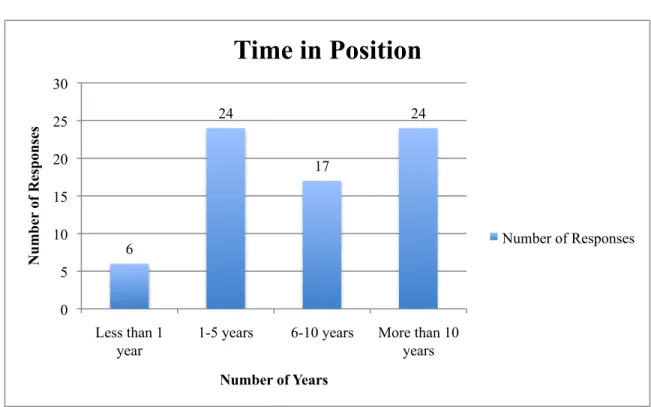
department is either very new or quite experienced. Just over one-third (34%, 24 respondents, n=71) indicated that they have been in this position for “1-5 years” and the same number indicated “More than 10 years”. Six (8%) respondents selected “less than 1 year” while 17 (24%, n=71) respondents selected “6-10 years.” Figure 2 below displays the experience level of the athletics administrators.
36
17
3 1 7 7
0 5 10 15 20 25 30 35 40
D ire ct or of A thl et ic s A ss oc ia te D ire ct or of A thl et ic s A ss is ta nt D ire ct or of A thl et ic s D ire ct or of D epa rt m ent In-H ous e/ G ene ra l Couns el O the r G ene ra l E m pl oye e N u mb er of R es p on se s
Title
Figure 2. Time in Position
As for the profile of the institutions being represented by the participants of this study, they appear to mainly be public schools with a mid-level number of student-athletes. The majority of respondents, 49 (69%, n=71) indicated that their institution was public, while 22 (31%) respondents indicated they were at a private institution. The majority of respondents work in athletics programs that support “401-600” student-athletes accounting for 39% (28
respondents, n=71). Twenty-two respondents (31%) selected “201-400”, while “601-800” and “more than 800” accounted for a combined 29%. Figure 3 displays the results of the size of departments based on number of student-athletes.
6
24
17
24
0 5 10 15 20 25 30
Less than 1 year
1-5 years 6-10 years More than 10 years
N
u
mb
er
of R
es
p
on
se
s
Number of Years
Time in Position
Figure 3. Number of Student-Athletes at Institution
The demographic probably most related to the study was whether the respondent has a law degree. The majority of respondents indicated “no” they do not have a law degree (70%, 50 respondents, n=71) while 30% (21 respondents, n=71) responded “Yes.” Of those who have a J.D., about two-thirds (62%, 13 respondents, n=21) indicated that they have practiced law in a public or private setting. Figure 4 below exhibits the proportion of respondents who indicated they have a Juris Doctor degree.
0
22
28
10 11
0 5 10 15 20 25 30
0-‐200 201-‐400 401-‐600 601-‐800 More than 800
N
u
m
b
er
o
f R
esp
on
se
s
Number of Student-Athletes
Number of Student-Athletes
Figure 4. Respondents with a Law Degree
General Counsel Population
The General Counsel population was made up of mainly General Counsels or Associate General Counsels. Eighteen (50%, n=36) of the respondents indicated that they were General Counsel, thirteen (38%, n=36) indicated they were Associate Counsel, one (3%, n=36) person chose Assistant Counsel, and two (6%, n=36) selected Director of Department. Figure 5 displays the results for the office roles of the participants.
30%
70%
Juris Doctor Degree?
Figure 5. Role in General Counsel Office
Most respondents in this population had a great deal of experience in their role. While one-third (30%, 10 respondents, n=33) of respondents indicated they had been in the office for 1-5 years, another one-third (30%, 10 respondents, n=33) have been in their office for 6-10 years. However, the largest group (39%, 13 respondents, n=33) had been practicing in the office for more than 10 years. These results are displayed in Figure 6.
18
13
1 2 0
0 2 4 6 8 10 12 14 16 18 20
N
u
m
b
er
o
f R
esp
on
se
s
Title in Office
Role in General Counsel Office
Figure 6. Experience in General Counsel Office
The profile of the institutions represented by the participants of Survey Two varied quite a bit. The majority of the institutions were public (76%, 26 respondents, n=34) but there were some private schools participating (24%, 8 respondents, n=34). As for the size of the general counsel offices at these institutions, they ranged from one attorney to seventeen attorneys. . The average number of attorneys was 1.9, the median number was 4, and the mode was 1, with 7 respondents indicating there was only 1 attorney on staff in their office. Table 1 shows the various responses for office sizes at the institutions represented.
Table 1. Number of Attorneys in the General Counsel Office
Number of Attorneys Number of Responses
One 7
One.Five 1
Two 3
Three 2
Four 6
Five 1
Seven 5
Eight 1
Nine 2
Ten 1
Eleven 1
0
10 10
13
0 2 4 6 8 10 12 14
Less than 1
year 1-‐5 years 6-‐10 years More than 10 years
N u m b er o
f R
esp
on
se
s
Number of years
Years in General Counsel Office
Twelve 2
Seventeen 1
Research Question 1
What are the legal issues faced by Division I college athletics departments?
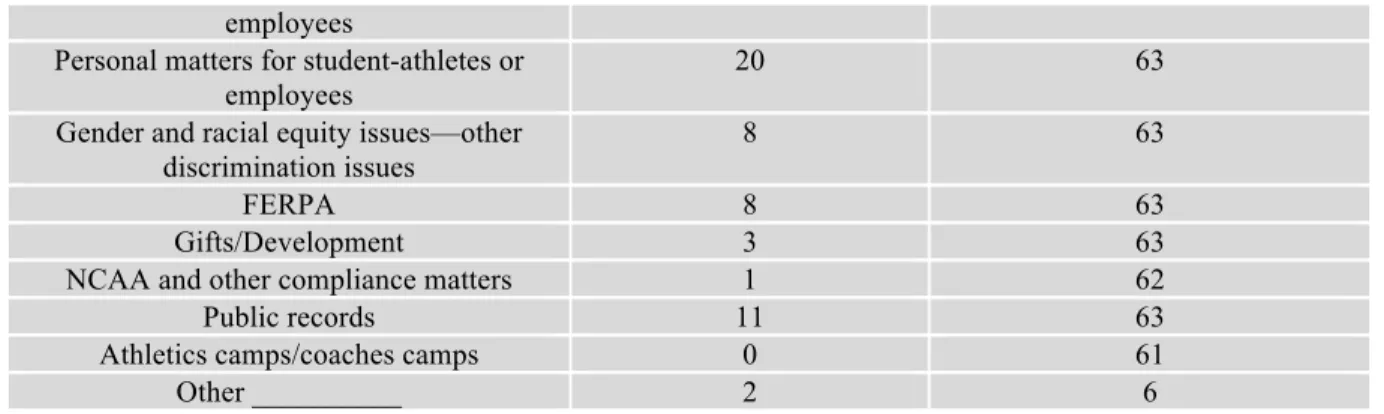
Of the 16 legal issues identified, almost all departments face these issues at least occasionally. The majority responded that they face all issues to some degree, meaning the “Daily”, “Weekly”, “Monthly”, “Yearly”, and “Occasionally” responses accounted for a larger percentage of the population than “Never.” The legal areas of Torts against visitors to campus, Intellectual property, Torts against student-athletes, and Personal matters for student-athletes and employees received the most “Never” responses, which exhibits that for these departments these issues are the least likely to be faced by the responding departments. In total, for all areas combined, “never” was selected 161 times (16.0%, n=1,008), therefore from a totality
perspective a large majority of respondents are facing the issues addressed. The only categories receiving zero “never” responses were contract negotiations, employment issues, and athletics camps/coaches camps. In a few other areas—contract drafting, risk management,
gifts/development, NCAA and other compliance matters, and other—“never” was selected 3 times or less. Table 2 shows which issues departments indicated they are facing, as well as which ones some department representatives said they are not facing.
Table 2. Issues “Never” Encountered by Athletics Directors (or Assignees)
Legal Issue Never Responses Total Responses
Contract Negotiation 0 63
Contract Drafting 1 63
Employment Issues 0 63
Torts involving student-athletes, employees 21 62
Torts involving visitors to campus 26 63
Risk Management 1 63
Intellectual property 25 61
employees
Personal matters for student-athletes or employees
20 63
Gender and racial equity issues—other discrimination issues
8 63
FERPA 8 63
Gifts/Development 3 63
NCAA and other compliance matters 1 62
Public records 11 63
Athletics camps/coaches camps 0 61
Other __________ 2 6
From the General Counsel offices perspective, only 3 legal issues received “Never” responses from more than 20% of the respondents—Personal matters for student-athlete and employees, Tax, and Gifts/Development. Most issues had at least one participant select “Never” though, as only Contract negotiation, Contract drafting, and Risk management had zero
responses in the “Never” category. Once again, for all issues asked about in the survey the overwhelming majority indicated that athletics faces it to some degree whether it be “Daily”, “Weekly”, “Monthly”, “Yearly”, or “Occasionally.” There was no response filled in for the “Other” category. Results are shown in Table 3.
Table 3. Athletics Issues “Never” Encountered by General Counsel Offices
Legal Issue Never Responses Total Responses
Contract Negotiation 0 27
Contract Drafting 0 27
Employment Issues 0 27
Torts involving student-athletes, employees 5 27
Torts involving visitors to campus 5 27
Risk Management 0 27
Intellectual property 2 27
Tax issues 8 27
Criminal charges against student-athletes or employees
4 26
Personal matters for student-athletes or employees
12 27
Gender and racial equity issues—other discrimination issues
3 27
FERPA 2 27
Gifts/Development 7 27
Athletics camps/coaches camps 1 27
Other __________ 1 6
Research Question 2
Which of these legal issues occurs most often in Division I college athletics departments?
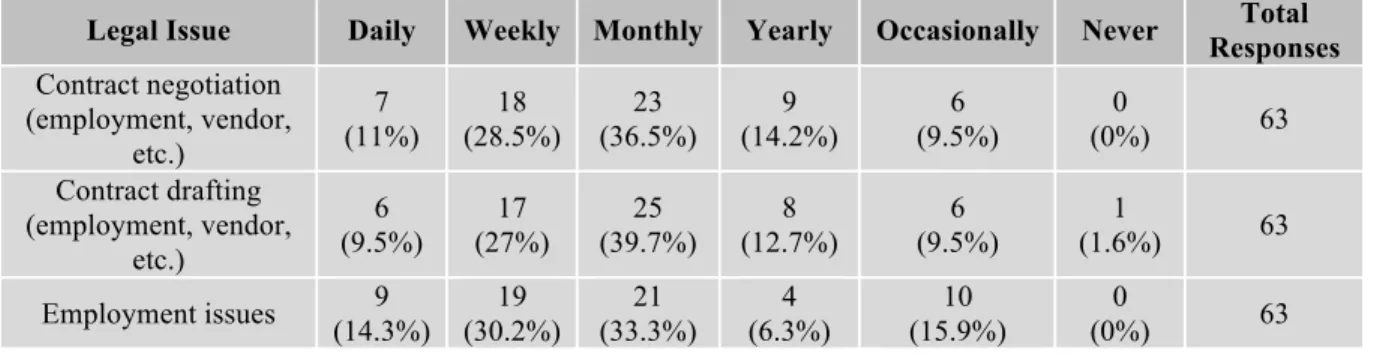
The results of Survey One, Question 12 provided a direct answer to the frequency with which athletics departments face the legal issues provided. There were 5 issues in which “Daily” was selected more than 10% of the time; these included contract negotiation (11%, 7
respondents, n=63), employment issues (14.3%, 9 respondents, n=63), risk management (14.3%, 9 respondents, n=63), NCAA/other compliance matters (35.4%, 19 respondents, n=62), and public records (11.1%, 7 respondents, n=63). Several more categories received more than 10% of responses for “Weekly.” Some of those categories were the same as those in “Daily”, the full list includes: contract negotiation (28.5%, 18 respondents, n=63), contract drafting (27%, 17 respondents, n=63), employment issues (33.3%, 21 respondents, n=63), risk management
(15.9%, 10 respondents, n=63), FERPA (14.3%, 9 respondents, n=63), NCAA/other compliance matters (21%, 13 respondents, n=62), and public records (25.4%, 16 respondents, n=63). For most categories “Monthly” or “Occasionally” were the most common responses accounting for 52.8% (532 responses, n=1,008) of responses in all. Table 4 below reports all frequency results for each legal issue.
Table 4. Frequency of Legal Issues for Athletics Departments
Legal Issue Daily Weekly Monthly Yearly Occasionally Never ResponsesTotal
Contract negotiation (employment, vendor,
etc.)
7
(11%) (28.5%)18 (36.5%)23 (14.2%)9 (9.5%)6 (0%)0 63
Contract drafting (employment, vendor,
etc.)
6
(9.5%) (27%)17 (39.7%)25 (12.7%)8 (9.5%)6 (1.6%)1 63
Torts involving
student-athletes (0%)0 (0%)0 (6.4%)4 (9.7%)6 (50%)31 (33.9%)21 62
Torts involving visitors to campus
0 (0%)
0 (0%)
5 (7.9%)
3 (4.8%)
29 (46%)
26
(41.3%) 63 Risk management (14.3%)9 (15.9%)10 (25.4%)16 (15.9%)10 (27%)17 (1.6%)1 63 Intellectual property (3.3%)2 (6.6%)4 (9.8%)6 (9.8%)6 (29.5%)18 (41%)25 61
Tax issues 0
(0%) 4 (6.3%) 5 (7.9%) 11 (17.5%) 27 (42.9%) 16
(25.4%) 63
Criminal charges against student-athletes or employees 0 (0%) 0 (0%) 5 (7.9%) 12 (19%) 36 (57.1%) 10
(15.9%) 63
Personal matters for student-athletes or employees (e.g. traffic
tickets, etc.) 0 (0%) 1 (1.6%) 10 (15.9%) 3 (4.8%) 29 (46%) 20
(31.7%) 63
Gender and racial equity issues--other discrimination issues 1 (1.6%) 0 (0%) 7 (11.1%) 12 (19%) 35 (55.6%) 8
(12.7%) 63
FERPA 5
(7.9%) 9 (14.3%) 13 (20.6%) 6 (9.5%) 22 (34.9%) 8
(12.7%) 63
Gifts/Development (e.g. donor estate
planning) 5 (7.9%) 6 (9.5%) 18 (28.6%) 10 (15.9%) 21 (33.3%) 3
(4.8%) 63
NCAA and other compliance matters
(e.g. Equity in Athletics Disclosure Act) 19 (35.4%) 13 (21%) 11 (17.7%) 6 (9.7%) 12 (19.4%) 1
(1.6%) 62
Public records 7
(11.1%) 16 (25.4%) 19 (30.2%) 1 (1.6%) 9 (14.3%) 11
(17.5%) 63
Athletics camps/coaches camps 0 (0%) 5 (8.2%) 13 (21.3%)) 24 (39.3%)) 19 (31.1%) 0
(0%) 61
Other 0
(0%) 0 (0%) 0 (0%) 0 (0%) 4 (66.7%) 2
(33.3%) 6
percentage of responses in the “Monthly” frequency. The five legal issues that received the most “Daily” and “Weekly” responses in comparison to all other legal issues included contract
negotiation (37.0%, 10 respondents, n=27), risk management (25.9%, 7 respondents, n=27), FERPA (25.9%, 7 respondents, n=27), NCAA/other compliance matters (25.9%, 7 respondents, n=27), and public records (44.4%, 12 respondents, n=27). Table 5 below reports all frequencies of each issue.
Table 5. Frequency of Athletics Legal Issues for General Counsel Offices
Legal Issue Daily Weekly Monthly Yearly Occasionally Never ResponsesTotal
Contract negotiation (3.7%)1 (33.3%)9 (40.7%)11 (11.1%)3 (11.1%)3 (0%)0 27
Contract drafting (3.7%)1 (18.5%)5 (44.4%)12 (14.8%)4 (18.5%)5 (0%)0 27 Employment issues (7.4%)2 (14.8%)4 (44.4%)12 (14.8%)4 (18.5%)5 (0%)0 27
Torts involving student-athletes
0 (0%)
0 (0%)
1 (3.7%)
7 (25.4%)
14 (51.9%)
5
(18.5%) 27 Torts involving visitors
to campus (0%)0 (0%)0 (7.4%)2 (25.9%)7 (48.1%)13 (18.5%)5 27
Risk management (7.4%)2 (18.5%)5 (33.3%)9 (14.8%)4 (25.4%)7 (0%)0 27
Intellectual property (3.7%)1 (14.8%)4 (22.2%)6 (25.4%)7 (25.4%)7 (7.4%)2 27
Tax issues (0%) 0 (3.7%) 1 (3.7%) 1 (25.9%) 7 (37.0%) 10 (29.6%) 8 27 Criminal charges against student-athletes or employees 0 (0%) 0 (0%) 2 (7.7%) 6 (23.1%) 14 (53.8%) 4
(15.4%) 26
Personal matters for student-athletes or employees (i.e. traffic
tickets, etc.) 0 (0%) 0 (0%) 1 (3.7%) 1 (3.7%) 13 (48.1%) 12
(44.4%) 27
Gender and racial equity issues--other discrimination issues 0 (0%) 1 (3.7%) 4 (14.8%) 6 (22.2%) 13 (48.1%) 3
(11.1%) 27
FERPA (0%) 0 (25.9%) 7 (40.7%) 11 (3.7%) 1 (22.2%) 6 (7.4%) 2 27 Gifts/Development
(e.g. donor estate planning, etc.) 1 (3.7%) 5 (18.5%) 3 (11.1%) 5 (18.5%) 6 (22.2%) 7
(25.9%) 27
NCAA and other compliance matters (e.g. Equity in Athletics
Disclosure Act) 4 (14.8%) 3 (11.1%) 5 (18.5%) 7 (25.4%) 7 (25.4%) 1
(7.4%) (37.0%) (25.9%) (7.4%) (11.1%) (11.1%) Athletics
camps/coaches' camps 0 (0%)
1 (3.7%)
6 (22.2%)
9 (33.3%)
10 (37.0%)
1
(3.7%) 27
Other 0
(0%)
3 (50%)
1 (16.7%)
0 (0%)
1 (16.7%)
1
(16.7%) 6
Research Question 3
When legal issues arise in a Division I college athletics department, how does the department manage the issue—within the department, through University Counsel, using outside counsel, or
a combination?
Figure 7. Reported Frequency of Person Managing Athletics Issues According to Athletics
Administrator
For many legal issues, combinations of the various choices were made by many
respondents. In total, 955 responses were given across all the legal issues, but university counsel alone was the most common choice overall, selected 275 times (28.8%, n=955). The next
highest selection was the combination of “non attorney athletics administrator” and “university counsel” which was selected 144 times (15.1%, n=955). There were a total of 27 different combinations of management structures made across the 16 legal issues. The results for combinations overall and by each legal issue can be seen below in Table 6 and Table 7. Table 6. Who Handles Legal Matters According to Athletics Departments
Legal Issue Attorney in Athletics Department
Non-attorney Athletics Administrator
University Counsel
Outside
Counsel Other
Total Responses Contract negotiation
(employment, vendor,
etc.) 13 38 43 9 4 107
Contract drafting
(employment, vendor, 13 28 48 8 4 101
186
640
484
139 159
0 100 200 300 400 500 600 700
In -‐h ou se Uni versit
y Counsel
N on -‐a tt or ne
y
at
hl
et
ic
s
ad mi ni st ra to
r
Outs
id
e co
uns
el
Oth
er
Who Handles Legal Matters?
etc.)
Employment issues 13 37 39 9 10 108
Torts involving student-athletes or
employees 12 17 47 14 6 96
Torts involving visitors
to campus 8 11 48 13 5 85
Risk management 13 37 44 3 12 109
Intellectual property 6 15 45 8 11 85
Tax issues 5 21 36 14 14 90
Criminal charges against student-athletes
or employees
11 25 39 17 11 103
Personal matters for student-athletes or employees (e.g. traffic
tickets, etc.)
10 33 21 11 16 91
Gender and racial equity issues--other discrimination matters
13 38 49 11 12 123
FERPA 15 33 44 5 10 107
Gifts/Development (e.g. donor estate
planning)
7 38 31 7 21 104
NCAA and other compliance matters
(e.g. Equity in Athletics Disclosure
Act)
19 48 32 7 8 114
Public records 13 27 44 2 7 93
Athletics
camps/coaches camps 13 41 35 3 10 102
Other 0 0 0 0 1 1
Table 7. Responses from Athletics Department by Combination
Selections Number Responses Percentages
University Counsel 275 28.8%
Non-attorney athletics administrator 117 12.3%
In-house counsel 25 2.6%
Outside Counsel 31 3.2%
Other 81 8.5%
Non-attorney athletics admin & University
Counsel 144 15.1%
Non-attorney athletics admin & University
Counsel & Outside Counsel 37 3.9%
University Counsel & Outside Counsel 20 2.1%
Non-attorney Athletics admin & Outside
Counsel & Other 3 0.3%
In-house attorney, non-attorney athletics
admin
In-house attorney & University Counsel &
Outside Counsel 4 0.4%
Non-attorney athletics admin & Outside
counsel 10 1.0%
In-house attorney & University counsel 22 2.3%
In-house attorney, non-attorney athletics
admin & University counsel & other 10 1.0%
Non-attorney athletics admin & university
counsel & other 16 1.7%
Non-attorney athletics admin & other 21 2.2%
In-house attorney & non-attorney athletics admin & university counsel & outside
counsel 11 1.2%
University counsel & Other 6 0.6%
In-house attorney & non-attorney admin & University counsel & outside counsel &
other 11 1.2%
In-house attorney & outside counsel 3 0.3%
Non-attorney athletics admin & university
counsel & outside counsel & other 6 0.6%
University counsel & outside counsel &
other 2 0.2%
In-house attorney & non-attorney admin &
outside counsel 1 0.1%
In-house attorney & Other 1 0.1%
In-house attorney & non-attorney admin &
other 1 0.1%
In-house attorney & university counsel &
other 1 0.1%
Total: 955