NEAR AND DEER: VARIABILITY IN ANIMAL ECONOMIES OF THE LATE WOODLAND AND HISTORIC PIEDMONT OF NORTH CAROLINA AND VIRGINIA
Julia Anne Longo
A thesis submitted to the faculty at the University of North Carolina at Chapel Hill in partial fulfillment of the requirements for the degree of Master of Art in the Department of
Anthropology in the College of Arts and Sciences.
Chapel Hill 2018
Approved by: Benjamin Arbuckle R. P. Stephen Davis, Jr. Heather Lapham
ABSTRACT
Julia A. Longo: Near and Deer: Variability in Animal Economies of the Late Woodland and Historic Piedmont of North Carolina and Virginia
(Under the direction of Benjamin Arbuckle)
ACKNOWLEDGEMENTS
I have received my secondary education and all of the opportunities it affords me on occupied ancestral Catawba territory. The university that will eventually award me my degree was built on this occupied land by enslaved Black people. This sordid past—and the inequitable and unjust present it continues to shape—can never be divorced from the work produced at this university. That undeniably includes this thesis and my future scholarship.
This thesis would not have been possible without the support and involvement of a number of individuals, institutions, and communities. First and foremost, I would like to thank the scholars on whose research this thesis is based: Mary Ann Holm and Amber Vanderwarker. I am indebted to the members of my committee: Benjamin Arbuckle, Heather Lapham, Steve Davis, and Margie Scarry. I deeply appreciate the guidance and support of my advisor, Ben. I especially want to thank Heather for her inspiring mentorship that renewed my enthusiasm and curiosity. My sincerest gratitude to Steve for sharing his encyclopedic knowledge of North Carolina prehistory and his thoughtful comments throughout this process. I am indebted to Margie for sharing her advice to strengthen this thesis and opening doors to exciting
opportunities. I would also like to thank Silvia Tomášková and Colin West. I would especially like to thank Silvia for her unwavering support throughout my time at UNC (and for the many fires she lit under my seat to finish my degree). Thank you to Colin for allowing me to
I have had the great fortune to meet so many wonderful colleagues throughout my academic career and I count many of them among my closest friends. I want to thank my fellow union members, particularly Molly Green (and Newton), Maja Jeranko, Alyssa Bowen, April Munroe, Jen Standish, Aubrey Lauersdorf, Willa Dong, Miranda Elston, Lindsay Ayling, Maya Little, Susan O’Rourke, Samee Siddiqui, Sam Finesurrey, Steve Pedroza, Mark He, and Michael Conroy, among many others. I have been continually encouraged by the camaraderie of Achsah Dorsey, Eric Thomas, Meg Twomey (and Oliver), Tony Rossodivito, Will Partin, Zac Parker, Jeremy Simon (and Miles), Colleen Betti, Isa Godinez, Dawn Rivers, and Lucía Stavig. I am so touched by their impact on my life.
TABLE OF CONTENTS
LIST OF TABLES ...ix
LIST OF FIGURES ...x
CHAPTER 1: INTRODUCTION ...1
Previous Research and Data Sources ...2
Study Site Descriptions ...4
Piedmont Chronology ...10
Research Questions ...12
CHAPTER 2: BACKGROUND ...14
Environmental Setting ...14
Cultural Setting ...18
Historical Accounts of the Piedmont ...24
CHAPTER 3: CASE STUDIES...35
Historic Coast: Subsistence Practices at Jordan’s Landing ...35
Late Woodland Mountains: Agricultural Sedentism of the Northwest Mountains ...38
CHAPTER 4: METHODS ...41
Meta-Analysis ...41
Quantitative Measures ...44
Geographic Information Systems Analysis ...48
Regional Trends ...53
Mammals...55
Birds ...63
Reptiles ...68
Fish ...71
Sub-Regional Trends ...77
Roanoke River Drainage ...77
Cape Fear River Drainage ...87
Neuse River Drainage ...94
CHAPTER 6: DISCUSSION ...102
Trends in the Roanoke River Drainage ...103
Trends in the Cape Fear River Drainage...107
Trends in the Neuse River Drainage ...110
CHAPTER 7: CONCLUSIONS ...113
Future Directions ...114
LIST OF TABLES
Table 1.1: Study Sites ...8
Table 1.2: Assemblage Information ...9
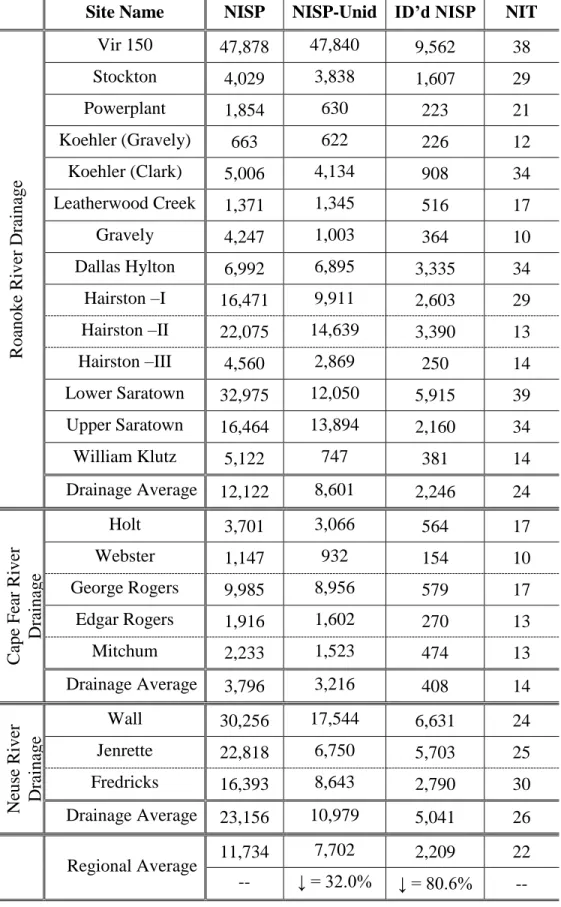
Table 5.1: Total NISP ...54
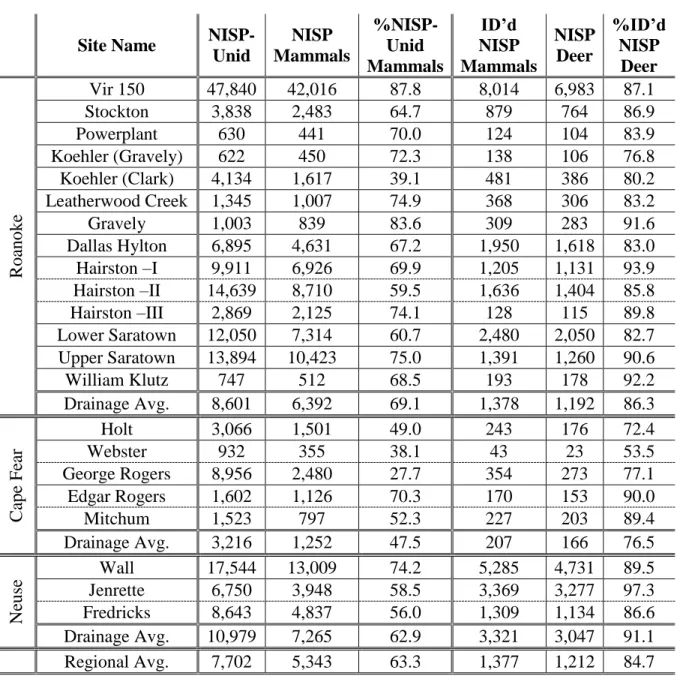
Table 5.2: Mammal NISP ...57
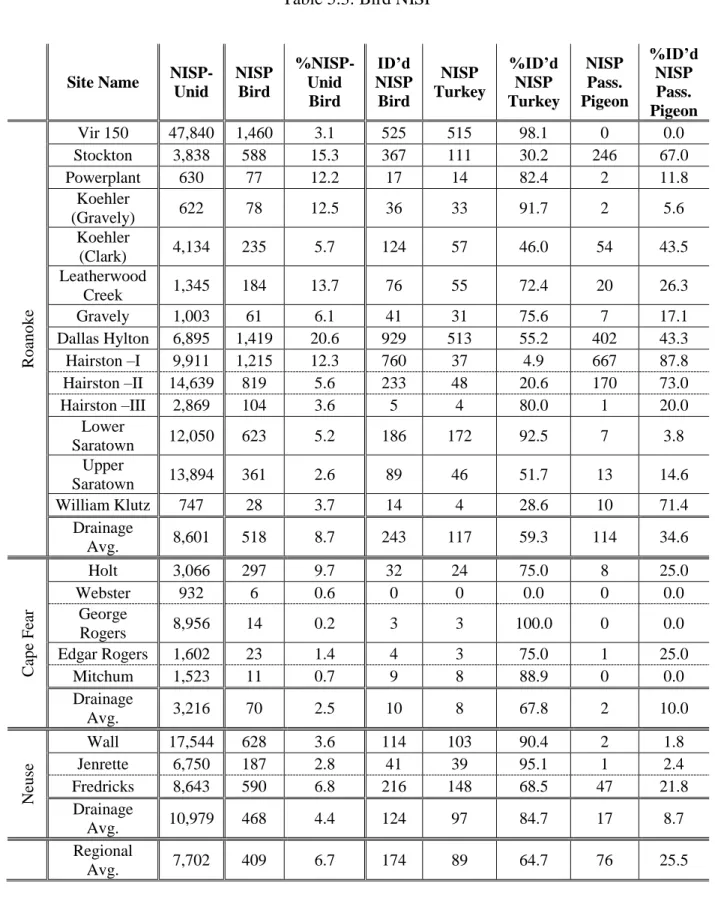
Table 5.3: Bird NISP...64
Table 5.4: Reptile NISP ...69
Table 5.5: Fish NISP ...73
Table 5.6: Percent of Identified NISP (%ID’d NISP) across Drainages ...75
Table 5.7: Roanoke River Drainage: Percent of Identified NISP (%ID’d NISP) for Taxonomic Classes ...80
Table 5.8: Roanoke River Drainage: Percent of Associated Taxonomic Class Identified NISP (%ID’d NISP) for Species of Interest ...84
Table 5.9: Cape Fear River Drainage: Percent of Identified NISP (%ID’d NISP) for Taxonomic Classes ...89
Table 5.10: Cape Fear River Drainage: Percent of Associated Taxonomic Class Identified NISP (%ID’d NISP) for Species of Interest ...91
Table 5.11: Neuse River Drainage: Percent of Identified NISP (%ID’d NISP) for Taxonomic Classes ...96
LIST OF FIGURES
Figure 1.1: North Carolina and Virginia Physiographic Regions and
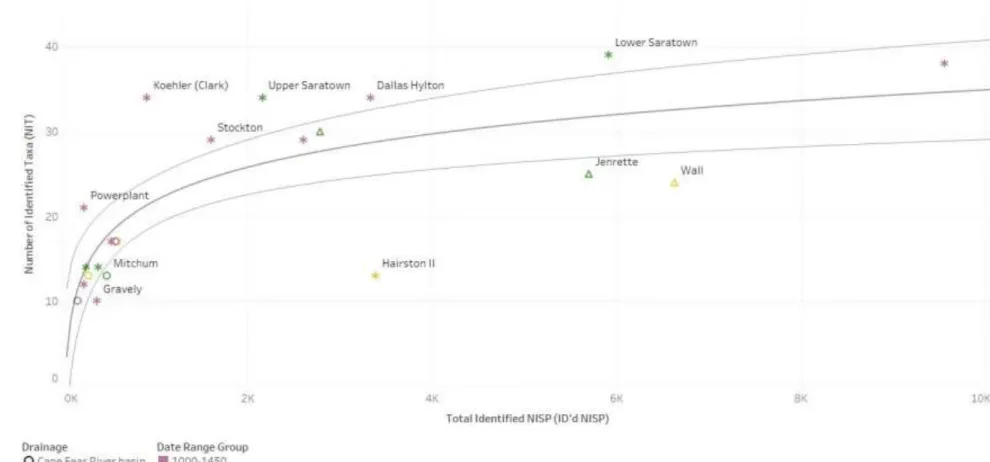
River Drainages ...6 Figure 1.2: Study Area ...7 Figure 5.1: Species Diversity and Sample Size ...56 Figure 5.2: Heat Map: Percent Taxonomic Class of Total NISP Excluding
Unidentified Specimens (%NISP-Unid) ...59 Figure 5.3: Heat Map: Percent Species of Interest of Identified Specimens
of Associated Taxonomic Class (%ID’d NISP)...62 Figure 5.4: Late Woodland Period, Roanoke River Drainage: Percent
Taxonomic Class of Identified Specimens (%ID’d NISP) ...81 Figure 5.5: Historic Period, Roanoke River Drainage: Percent Taxonomic
Class of Identified Specimens (%ID’d NISP) ...82 Figure 5.6: Late Woodland Period, Roanoke River Drainage: Percent
Species of Interest of Identified Specimens of Associated
Taxonomic Class (%ID’d NISP) ...85 Figure 5.7: Historic Period, Roanoke River Drainage: Percent Species of
Interest of Identified Specimens of Associated Taxonomic Class
(%ID’d NISP) ...86 Figure 5.8: Cape Fear River Drainage: Percent Taxonomic Class of Identified
Specimens (%ID’d NISP) ...90 Figure 5.9: Cape Fear Drainage: Percent Species of Interest of Identified
Specimens of Associated Taxonomic Class (%ID’d NISP) ...92 Figure 5.10: Neuse River Drainage: Percent Taxonomic Class of Identified
Specimens of Associated Taxonomic Class (%ID’d NISP) ...100 Figure 6.1: Change Over Time: Average Percent Taxonomic Class of Total
Identified Specimens (%ID’d NISP) ...104 Figure 6.2: Change Over Time: Average Percent Species of Interest of
Identified Specimens of Associated Taxonomic Class
CHAPTER 1: INTRODUCTION
During the Late Woodland period (AD 800-1600) the Native communities of the North Carolina and Virginia Piedmont developed a suite of specialized subsistence strategies that shaped and were shaped by their local environmental and cultural settings. As such, cultural identities of the region were inextricably linked to and inspired by these sustaining human-environment interactions. By the time European traders and settlers made their way through the area in the seventeenth and eighteenth centuries, it was apparent that Native groups had been thriving in the region for thousands of years; European explorers such as John Lawson and John Lederer noted as much in their expedition journals (Lawson 1709; Lederer 1672).
Yet it cannot be denied that the waves of European influence permeating the Piedmont during this time had a lasting effect on the construction of Native ways of being, not the least of which were the subsistence strategies that formed the basis of daily life for these Native
communities. The degree to which these strategies, associated practices and activities, and the cultural identities constructed around them were reconfigured to meet the changing
environmental and cultural settings of the Historic period has been the subject of decades of archaeological research, yet clear regional and temporal trends have been tricky to elucidate as of yet.
research to identify patterns of subsistence practices within and among river basins before and during the period of cultural contact (c. AD 1000-1710). I ask, through a multi-scalar meta-analysis of 22 faunal assemblages from 19 sites within the North Carolina and Virginia Piedmont, how did Native communities shape their subsistence practices to the particular environmental and cultural settings of the Piedmont during the Late Woodland period and in the years spanning the transition to the Historic period?
PREVIOUS RESEARCH AND DATA SOURCES
Extensive research has been conducted by the Research Laboratories of Archaeology (RLA) at the University of North Carolina at Chapel Hill (UNC) on the subject of Piedmont foodways. The present study hinges on two major contributions to North Carolina archaeology: the Siouan Project (Dickens et al. 1987; Holm 1994; Ward and Davis 1993) and a study
conducted for the US Fish and Wildlife Service (Vanderwarker 2001).
Beginning in 1983, the RLA embarked on the Siouan Project. Focusing on three river basins of the North Carolina and Virginia Piedmont (Haw, Eno, and Dan), the Siouan Project investigated over 25 archaeological sites that were once occupied by Native groups during the Late Woodland and Historic periods. These groups came to be known historically as the
The breadth and depth of research conducted during the Siouan Project has provided and continues to provide ample material for subsequent theses and dissertations, as well as many reports and publications. Specifically, the zooarchaeological data collected by Mary Ann Holm as a part of the Siouan Project (Holm 1987, 1993), and her subsequent dissertation (Holm 1994), form the basis of the present study. The faunal assemblages from 14 of the 19 archaeological sites included in this study were first analyzed by Holm during her tenure in the RLA. These sites include the Powerplant (AD 1000-1450), Hairston (AD 1250-1670), Lower Saratown (AD 1620-1670), Upper Saratown (AD 1620-1710), and William Kluttz (AD 1670-1710) sites of the Roanoke River drainage; the Holt (AD 1000-1400), Webster (AD 1000-1400), George Rogers (AD 1400-1600), Edgar Rogers (AD 1500-1600), and Mitchum (AD 1600-1670) sites of the Cape Fear River drainage; and the Wall (AD1400-1600), Jenrette (AD 1660-1680), and Fredricks (AD 1680-1710) sites of the Neuse River drainage.
resilience across a broader spatiotemporal scale, using targeted date ranges and river basins as analytical units of comparison.
This project also includes data from six faunal assemblages (five sites total) collected by Amber Vanderwarker (2001) during a survey of North Carolina freshwater fisheries for the US Fish and Wildlife Service. These sites include the Vir 150 (AD 1000-1400), Koehler (AD 1250-1450), Leatherwood Creek (AD 1250-1250-1450), Gravely (AD 1250-1250-1450), and Dallas Hylton (AD 1250-1450) sites of the Roanoke River drainage. Her research aimed to “determine the pre-Columbian distribution and abundance of fish and other animals in the Roanoke River basin in North Carolina and Virginia” (Vanderwarker 2001:1) in order to develop “policy regarding fishery management plans, recover plans for threatened and endangered species, federal land management plans, and dam re-licensing” (Vanderwarker 2001:3). Given these project goals, her findings only alluded to differences in Late Woodland Native subsistence practices among the sites. Instead, she focused on the environmental and biogeographical shifts in local catchment zones and ranges of certain species of fish. It would be impossible without her foundational research to bring to life a picture of pre-contact environmental settings. Furthermore, I aim to investigate in more detail the variety of subsistence practices Vanderwarker identified in the Roanoke River basin.
STUDY SITE DESCRIPTIONS
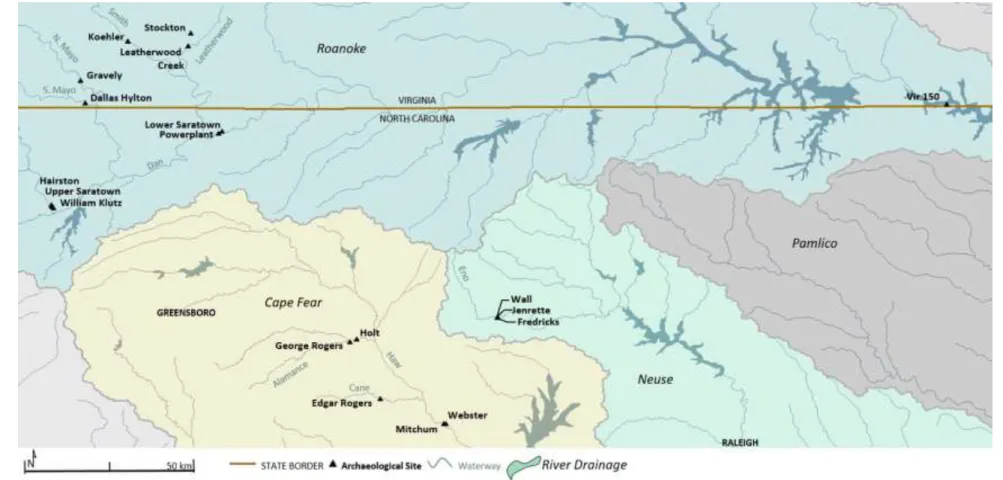
Stockton (AD 1000-1450), Powerplant (AD 1000-1450), Koehler (AD 1250-1450), Leatherwood Creek (AD 1250-1450), Gravely (AD 1250-1450), Dallas Hylton (AD 1250-1450), Hairston (AD 1000-1710), Lower Saratown (AD 1620-1710), Upper Saratown (AD 1660-1710), and William Kluttz (AD 1670-1710). Five sites are situated within the Cape Fear River basin: Holt (AD 1000-1400), Webster (AD 1000-1000-1400), George Rogers (AD 1400-1600), Edgar Rogers (AD 1500-1600), and Mitchum (AD 1600-1670). Lastly, three sites are located within the Neuse River basin: Wall (AD 1400-1600), Jenrette (AD 1660-1680), and Fredricks (AD 1680-1710).
Figure 1.1: North Carolina and Virginia Physiographic Regions and River Drainages
Figure 1.2: Study Area
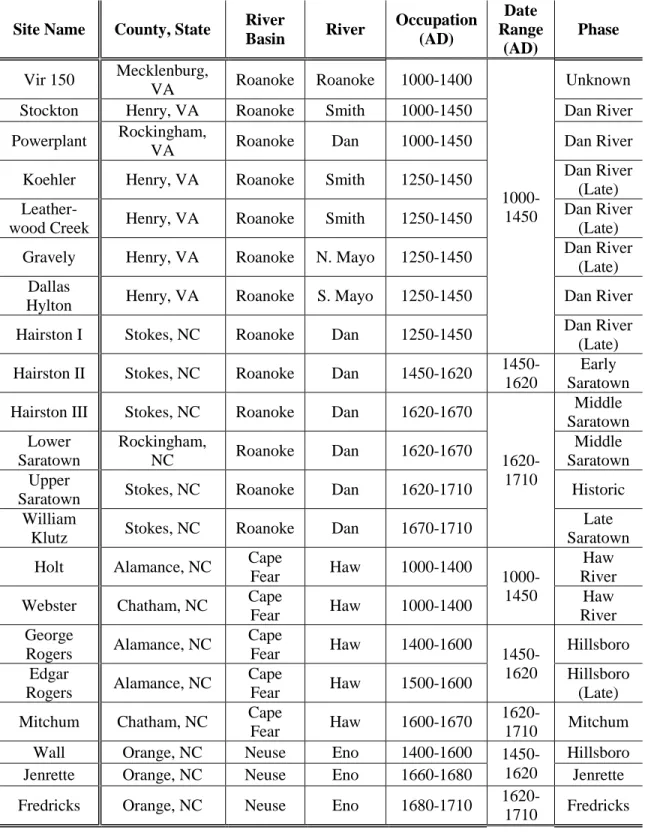
Table 1.1: Study Sites
Site Name County, State River
Basin River
Occupation (AD) Date Range (AD) Phase
Vir 150 Mecklenburg,
VA Roanoke Roanoke 1000-1400
1000-1450
Unknown
Stockton Henry, VA Roanoke Smith 1000-1450 Dan River
Powerplant Rockingham,
VA Roanoke Dan 1000-1450 Dan River
Koehler Henry, VA Roanoke Smith 1250-1450 Dan River (Late)
Leather-wood Creek Henry, VA Roanoke Smith 1250-1450
Dan River (Late)
Gravely Henry, VA Roanoke N. Mayo 1250-1450 Dan River (Late) Dallas
Hylton Henry, VA Roanoke S. Mayo 1250-1450 Dan River
Hairston I Stokes, NC Roanoke Dan 1250-1450 Dan River (Late)
Hairston II Stokes, NC Roanoke Dan 1450-1620 1450-1620
Early Saratown
Hairston III Stokes, NC Roanoke Dan 1620-1670
1620-1710 Middle Saratown Lower Saratown Rockingham,
NC Roanoke Dan 1620-1670
Middle Saratown Upper
Saratown Stokes, NC Roanoke Dan 1620-1710 Historic William
Klutz Stokes, NC Roanoke Dan 1670-1710
Late Saratown
Holt Alamance, NC Cape
Fear Haw 1000-1400 1000-1450
Haw River
Webster Chatham, NC Cape
Fear Haw 1000-1400
Haw River George
Rogers Alamance, NC
Cape
Fear Haw 1400-1600 1450-1620
Hillsboro
Edgar
Rogers Alamance, NC
Cape
Fear Haw 1500-1600
Hillsboro (Late)
Mitchum Chatham, NC Cape
Fear Haw 1600-1670
1620-1710 Mitchum Wall Orange, NC Neuse Eno 1400-1600
1450-1620
Hillsboro Jenrette Orange, NC Neuse Eno 1660-1680 Jenrette
Fredricks Orange, NC Neuse Eno 1680-1710
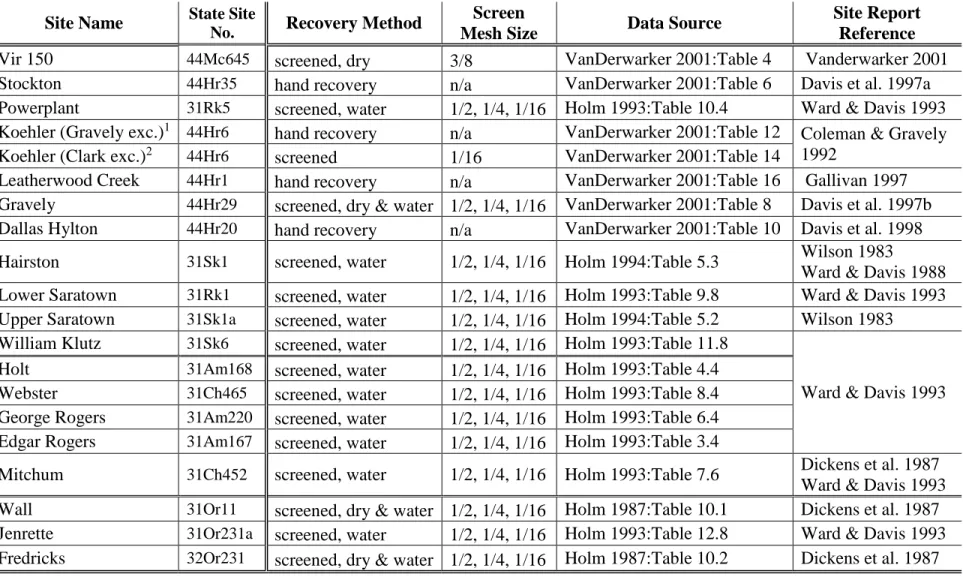
Table 1.2: Assemblage Information
Site Name State Site
No. Recovery Method
Screen
Mesh Size Data Source
Site Report Reference
Vir 150 44Mc645 screened, dry 3/8 VanDerwarker 2001:Table 4 Vanderwarker 2001
Stockton 44Hr35 hand recovery n/a VanDerwarker 2001:Table 6 Davis et al. 1997a
Powerplant 31Rk5 screened, water 1/2, 1/4, 1/16 Holm 1993:Table 10.4 Ward & Davis 1993 Koehler (Gravely exc.)1 44Hr6 hand recovery n/a VanDerwarker 2001:Table 12 Coleman & Gravely
1992 Koehler (Clark exc.)2 44Hr6
screened 1/16 VanDerwarker 2001:Table 14
Leatherwood Creek 44Hr1 hand recovery n/a VanDerwarker 2001:Table 16 Gallivan 1997 Gravely 44Hr29 screened, dry & water 1/2, 1/4, 1/16 VanDerwarker 2001:Table 8 Davis et al. 1997b Dallas Hylton 44Hr20 hand recovery n/a VanDerwarker 2001:Table 10 Davis et al. 1998 Hairston 31Sk1 screened, water 1/2, 1/4, 1/16 Holm 1994:Table 5.3 Wilson 1983
Ward & Davis 1988 Lower Saratown 31Rk1 screened, water 1/2, 1/4, 1/16 Holm 1993:Table 9.8 Ward & Davis 1993 Upper Saratown 31Sk1a screened, water 1/2, 1/4, 1/16 Holm 1994:Table 5.2 Wilson 1983
William Klutz 31Sk6 screened, water 1/2, 1/4, 1/16 Holm 1993:Table 11.8
Ward & Davis 1993 Holt 31Am168 screened, water 1/2, 1/4, 1/16 Holm 1993:Table 4.4
Webster 31Ch465 screened, water 1/2, 1/4, 1/16 Holm 1993:Table 8.4 George Rogers 31Am220 screened, water 1/2, 1/4, 1/16 Holm 1993:Table 6.4 Edgar Rogers 31Am167 screened, water 1/2, 1/4, 1/16 Holm 1993:Table 3.4
Mitchum 31Ch452 screened, water 1/2, 1/4, 1/16 Holm 1993:Table 7.6 Dickens et al. 1987 Ward & Davis 1993 Wall 31Or11 screened, dry & water 1/2, 1/4, 1/16 Holm 1987:Table 10.1 Dickens et al. 1987 Jenrette 31Or231a screened, water 1/2, 1/4, 1/16 Holm 1993:Table 12.8 Ward & Davis 1993 Fredricks 32Or231 screened, dry & water 1/2, 1/4, 1/16 Holm 1987:Table 10.2 Dickens et al. 1987
1 The first excavation at the Koehler site was conducted by Richard Gravely in 1968. No screening or flotation was used, which may result in sampling bias.
2 The second excavation at the Koehler site was conducted by Wayne Clark in 1968. All features were dry screened. Most features were also water-screened.
PIEDMONT CHRONOLOGY
The Piedmont region of what is currently North Carolina and southern Virginia was first occupied as early as 13,000 years ago. Five major cultural traditions demarcate the culture history of this region: Paleo-Indian (before 8000 BC), Archaic (8000-1000 BC), Woodland (1000 BC-AD 1600), Mississippian (c. AD 1200-1600), and Historic (after c. AD 1600) (Ward and Davis 1993:Figure 1.5). The present study focuses on three components of the Late
Woodland and Historic periods as analytical units of comparison: the years of village development and population growth between AD 1000-1450; the period of pre-contact
coalescence and early, sporadic, and indirect contact during AD 1450-1620; and the early contact time of tenuous negotiations of regional identity, changing power relations, and new modes of production and exchange (AD 1620-1710). When referring to village sites in my discussion, I will reference these date ranges rather than their specific dated occupations. For site occupation dates, consult Table 1.1.
increased after c. AD 1450, possibly as a result of Iroquois raiding parties invading the Piedmont as early as the mid-fifteenth century (Davis and Ward 1989:2). These changes in subsistence practices and sociopolitical settings coincided with an increase in population size within more densely consolidated (and later, stockaded) villages and towns (Ward and Davis 1999:98-99).
The earliest European presence in the Southeast is represented by the Spanish expeditions led by Hernando de Soto (AD 1539-1541) and Juan Pardo (AD 1566-1568). Piedmont tribes, however, did not experience prolonged European contact until the early eighteenth century when English began settling the area. After the establishment of Jamestown in 1607 and subsequent decimation of Chesapeake game by 1650 (Holm 1994:15), English and German colonizers began exploring the Southeast and indirectly trading with Native Piedmont communities. As Holm (1994:15) stated, “intercultural exchange had little impact” on daily life during AD 1450-1620. Even European pathogens had not yet affected some Piedmont communities by c. 1680 (Ward and Davis 1999:237).
During the mid to late seventeenth century between AD 1680-1710, however,
and spread of disease resulted in strained and fraught Native coalescence in the first decade of the eighteenth century. The impact of these changes on local foodways on a regional scale and in comparison to preceding traditions, however, has not been explicitly interrogated.
RESEARCH QUESTIONS
With this rich culture history and the supporting archaeological research in mind, I pursue research questions aimed at providing detailed regional information about the subsistence
practices of the Piedmont. First, I review what Vanderwarker (2001) and Holm (1987, 1993, 1994) have identified regarding which animals were utilized (and in what capacity) by Native groups for subsistence within the Piedmont during the Late Woodland and Historic periods. Based on their findings I ask, were Native groups practicing regionally specific subsistence strategies that can be distinguished among and between river basins? Vanderwarker (2001) identified one possible regional pattern within the Roanoke River basin: vertebrate species abundance and diversity differ between sites located along main waterways and sites located along their tributaries. She suggested this pattern may be the result of different local catchment zones, as Lapham (2011:413) has noted elsewhere. Is this pattern also discernable within the Cape Fear and Neuse River basins? And, do rigorous spatiotemporal analyses reveal any other potential explanations for this variation?
planting activities to seasonal availability. In this regard, Late Woodland Piedmont subsistence strategies were varied and broad-based, but withstanding through time. I seek to identify these patterns of subsistence practices through time.
In addition, I address the question, did Native communities alter their subsistence strategies from the Late Woodland period to the Historic period? How so, and why? Holm (1994:185) found that “many of the results of contact were not really innovations, but rather were intensifications of previously existing patterns.” Did all subsistence practices intensify in the Historic? If not, which ones were changed, and how so?
I will address these questions through a zooarchaeological and geospatial meta-analysis. First, I describe the environmental and cultural settings of the Late Woodland and Historic periods. In this discussion, I also review previous research conducted in this area. Second, I discuss two case studies from the neighboring geophysical regions, the mountains and the coast, that aid in answering questions about Native Piedmont subsistence practices. Third, I explain my methods of inquiry. I discuss meta-analysis and why might it be important to the future of
CHAPTER 2: BACKGROUND
In this chapter, I detail the particular geographic, ecological, and cultural settings of the Late Woodland and Historic Piedmont. First, I describe the general characteristics of Piedmont physiogeography and the move to a description of the ecologies of each river drainage of interest more specifically. I rely on both current ecological data as well as historical accounts to construct a picture of Piedmont life during this time. Second, I offer a more detailed understanding of the culture history of the Piedmont based on previous archaeological research. In this discussion, I return to explaining the analytical categories into which I grouped the sites of interest.
ENVIRONMENTAL SETTING
A major goal of the present study is to explore the ways in which subsistence practices vary within the Late Woodland and Historic Piedmont. While characterized as a bounded physiographic region distinct from its neighboring regions of the Blue Ridge Mountains to the west and Coastal Plains to the east, the Piedmont of today is a patchy, uneven ecosystem recognized as highly heterogeneous and variable (Winterhalder 1980:136). Furthermore, the current ecological character of the Piedmont is remarkably different from the area as it existed between AD 1000 and the 1700s. Even within this seven-hundred-year period, the Piedmont ecosystem was neither stable nor homogenous across time and space (Holm 1994). The
of comparison on which I rely for analysis: the Roanoke, Cape Fear, and Neuse River drainages and the years spanning AD 1000-1450, AD 1450-1620, and AD 1620-1710.
The Piedmont plateau of North Carolina and Virginia is bounded by the Atlantic Coast and Coastal Plains to the east and Appalachian Mountains to the west (Figure 1.1). The Piedmont extends beyond North Carolina and Virginia, stretching north to New Jersey and south to central Alabama. The present-day cities of Raleigh, Greensboro, Roanoke, and Lynchburg reside within the region of interest to the present study (Figure 1.2). The Piedmont of today can be broadly characterized by its remnant metamorphic mountains and dissected plateaus host to high velocity streams and rivers as well as mixed hardwood and pine forests comprised of oak, hickory, beech, maple, poplar, and white or loblolly pine trees (Duncan and Duncan 1988). The Piedmont’s hills range from 122 meters in elevation at the coastal plain to 610 meters above sea level in the western foothills of the Appalachian Mountains (Mathis and Crow 1983). Its river valleys provide rich nourishment for fertile bottomlands, though the present-day Piedmont is
experiencing mass wasting of soils due to erosion caused in large part by extensive deforestation for agricultural production and industrial development, which started as early as the late
eighteenth century (Beyer 1991; Mathis and Crow 1983).
The present study area focuses on the Roanoke, Cape Fear, and Neuse River basins of the Piedmont in what is currently North Carolina and Virginia. Generally, this region witnesses distinct but temperate seasons that carve out ecological niches for hardy plants and animals to thrive throughout the year in the humid summers and cool winters, though this was not necessarily the case throughout the Late Woodland and Historic periods.
rivers, lakes, and estuaries, but of particular interest are the Roanoke and Dan Rivers and those that feed into them: the South and North Mayo rivers, Smith River, and Leatherwood Creek. According to the North Carolina Department of Environmental Quality, the Roanoke River basin comprises over 3,500 km of rivers and streams, over 81,000 acres of lakes, and almost 1,500 acres of estuary. It currently hosts the densest populations of white-tailed deer, wild turkey, and black bear out of all the river drainages in the present study (NC DEQ 2018a). Furthermore, over 200 species of birds are currently found within this basin, over 100 of which are migratory, and its rivers act as important migratory mating runs for bass, herring, and other anadromous fish. The Roanoke River carries more water and has the widest floodplain of any North Carolina river. As a result, frequent flooding events consistently alter the landscape of the Roanoke River
drainage. At present, however, the Roanoke River has been dammed for almost 70 years, which mitigates fluxes in flooding but has also submerged historically dry areas of the basin. The Dan River forms part of the Roanoke headwaters and provides habitat for a diverse range of plants and animals that are also represented within the larger drainage.
fundamentally altered the surrounding ecology. Still, the Haw River and its tributaries support almost 100 species of fish and many other mammalian, reptilian, and avian species including white-tailed deer, box turtle, and wild turkey.
The Neuse River drainage, to the east of Cape Fear, is the smallest of the study region at 15,700 sq. km., though it is home to the expansive and wandering Neuse River. At its mouth, the Neuse is currently the widest river in the United States at over 9 km across. The present study focuses on the archaeological sites situated along the Eno River, which acts as an important spawning area for shad, herring, bass, and other anadromous species of fish. Its brackish, slow-traveling water also supports a rich forest ecology home to white-tailed deer, wild turkey, small mammals, migratory birds, and reptiles such as snapping and box turtles (NC DEQ 2018c).
The Little Ice Age, spanning c. 1450 to 1850, helped to shape the humid subtropical climatic environment those of us in the Piedmont experience today. This climatic type is
characterized by hot, humid summers and short, mild winters, both interspersed with fairly high precipitation (Peel et al. 2007). According to the North Carolina Climate Office, temperatures in the Southeast vary according to altitude and season. In the summer months, maximum
variable ecological landscape (Ogilvie 1984; Roundtree 1989). Before the Little Ice Age, regional variability characterized the locally distinct and “patchy” ecologies of the river basins (Gremillion 1989:138), though the Late Woodland Piedmont can be broadly characterized along parameters similar to those of today: forested and temperate.
The current understanding of Piedmont ecology, however, cannot simply be projected onto the environment of the Late Woodland and Historic periods. In the following sections, I review what we know about the cultural and environmental settings of these periods in the North Carolina Piedmont.
CULTURAL SETTING
In the following section, I describe the various cultural trends and shifts characteristic of the range of time between AD 1000 and 1710. I also explain, from a culture history perspective, why I group the study sites into three date ranges: AD 1000-1450, AD 1450-1620, and AD 1620-1710. Later, when I outline my methodological considerations, I return to addressing this choice from an analytical perspective. In the present discussion, however, I contextualize the study sites within broader spatiotemporal cultural trends of the Southeast, and specifically, the Piedmont.
During the Late Woodland period, the once-sporadically utilized cultural innovations of pottery production, semi-sedentary villages, and horticulture became the norm (Ward and Davis 1999:76). Native communities of the Piedmont developed distinct regional styles of making and designing ceramic vessels (Ward and Davis 1999:76-137). These styles were probably
The increasing popularity of pottery-making may have, in part, been a result of peoples’ increasing reliance on both wild and domestic seed crops at the end of the preceding Middle Woodland period (Smith 1986), such as knotweed, sumpweed, squash, bottle gourds, sunflower, maygrass, and goosefoot (Gremillion 2011:387-40; Scarry 2003:50-104Smith 1992:14; Yarnell and Black 1985). Though maize was introduced well before this time (AD 200), archaeologists agree that Piedmont groups did not widely incorporate the crop into existing horticultural rounds until AD 1000 (Scarry 2008). In addition, beans were not incorporated into Piedmont subsistence for another 200 years after that (Smith 1992:203). To accommodate this intensification of
horticultural practices, communities relied on more permanent settlements than the previous periods. Or perhaps, the intensification of horticultural practices was required in order to accommodate changes in lifeways of more permanent settlements.
As Steponaitis (1986:378) noted, however, these changes in subsistence and settlement organization did not alter people’s reliance on or preference for hunting, scavenging, trapping, and gathering wild plants and animals for food. Hardwood nuts such as acorn, hickory, and beech nuts were the primary plant food collected and managed by Piedmont groups, but other plants such as wild grape, passionfruit, persimmon, sedges, and grasses were also integral to their subsistence (Scarry 2003). Broadly, researchers have found that animals such as white-tailed deer, muskrat, raccoon, tree squirrels, beaver, opossum, otter, turkey, box turtle, bullhead catfish, and freshwater mollusks were staples in Early and Middle Woodland subsistence of the
Piedmont (Lapham 2006, 2011).
More specifically, Lapham (2011:412) characterizes Late Woodland subsistence
time, Piedmont communities lived in both permanent or semi-permanent villages as well as short-term special-use camps. These camps often specialized in the “exploitation of species with limited seasonal availability, such as migratory waterfowl and certain fishes” (Lapham
2011:412). Lapham (2011:413) also noted that “even minor differences in local catchment areas influenced animal procurement strategies.” Collecting freshwater shellfish, however, was a “widespread practice in the late prehistoric Southeast” (Lapham 2011:414).
After about AD 1000, as people began focusing more heavily on horticulture and specifically the cultivation of corn, the small and scattered villages of the Piedmont grew into larger, more nucleated settlements (Ward and Davis 1999:78). Mortuary studies and
bioarchaeological research indicate that some social distinctions and stratification existed within these largely egalitarian groups, and such distinctions were primarily based on age and gender (Ward and Davis 1999: 79). Yet, as villages continued to grow intergroup conflicts increased. As early as the beginning of the Late Woodland Period, and definitely by AD 1000, it became common for larger villages to be surrounded by stockades and palisades. Food surpluses brought on by intensified horticulture and agriculture practices were likely one of the enticing reasons for groups to raid neighboring villages (Ward and Davis 1999:98).
result, supported the rise of complex, hierarchical societies (Ward and Davis 1999:78). In the Late Woodland Piedmont, feasting events marked communitywide ceremonies and celebrations. Some have described the period between c. AD 1400 and 1600 as the agricultural and
socioeconomic peak of the Piedmont before European contact (Ward and Davis 1999). Holm (1994:15) poignantly refers to this period as the Protohistoric period (AD 1400-1600).
As early as AD 1525 the Spanish expedition team led by Pedro de Quejo investigated what is currently North Carolina’s coast for potential sites for settlement (Hoffman 1994:40). Soon after, Hernando de Soto’s expedition arrived in the Carolinas in 1540 (Hudson et al. 1984:73-75) and ventured inland. Twenty years later, Juan Pardo retraced de Soto’s route
through the Piedmont—twice (Ward and Davis 1999:229). While the Spaniards clearly travelled extensively through the region, they did not establish any permanent settlements in the Piedmont, although Pardo established a series of short-lived forts in the region (Beck et al. 2016).
Additionally, there is no archaeological evidence for Spanish influence among the Native communities of the Piedmont during this time (Ward and Davis 1999:231).
Chesapeake groups and European settlers, predominantly English. She noted that sites in the Piedmont (in the area surrounding the current border between North Carolina and Virginia) contain little evidence of such interaction. In AD 1644, tensions between occupying settlers and northern Native groups exploded in the Second Pamunkey (or Powhatan) War, only to be quashed by AD 1645 (Ward and Davis 1999:232). As a result, the town of Petersburg, Virginia was founded and served as a jumping off point for further futile overland expeditions in search of East Asia. Less than 30 years later, ports opened along the Virginia and North Carolina coasts and offered a vast exchange network for traders developing the deerskin trade (Ward and Davis 1999:233).
early eighteenth century Piedmont Native groups “had lost much of the power that had characterized their earlier relations with Virginia traders” (Holm 1994:22; Merrell 1989).
Indeed, by the time English explorer John Lawson arrived to the Piedmont in 1701, Native groups had suffered from: deadly European diseases such as smallpox, measles, and influenza; intense and violent conflict, both intertribal and with European settlers; and
widespread forced relocation and displacement (Duffy 1997). Even still, archaeological evidence indicates that Native groups were very resistant to incorporating European crops and animals into their existing subsistence strategies (Ward and Davis 1999:236). Some plants, such as watermelon and peach, were widely adopted within preexisting frameworks of subsistence though they did not replace any traditional crops and were instead used alongside Native resources (Gremillion 1989, 1993, 1995). There is very little evidence for the presence of European domesticated animals in Native Piedmont communities during the Historic period, suggesting that livestock were actively rejected by Native communities. For example, only one site assemblage in the present study, that of Fredricks (1620-1710), contains single elements from a pig and horse (Holm 1987:Table 10.2). In spite of strong ties to particular longstanding Native identities and practices, Piedmont groups who survived “the ravages of disease and nearly continuous raiding” made the decision to emigrate either north to Fort Christanna or south to live in the emerging Catawba Nation (Holm 1994:23).
culturally and analytically meaningful groupings that aid in effective meta-analyses, which I define below in my discussion of the methodological considerations of this project.
HISTORICAL ACCOUNTS OF THE PIEDMONT
Much of our understanding about the relationship between Piedmont ecology and Native American lifeways of the Late Woodland and Historic periods comes from the journals,
sketches, and maps of John Lawson, an eighteenth century English colonial explorer who led a small expedition through the Carolinas in the winter months of 1700 and 1701. Ethnographic and Native research is continuously correcting, adjusting, and bolstering these early accounts of life in the Piedmont to not only add detail to such accounts but also to counter Lawson’s euro- and ethno-centrism (Goertzen 2001; Jeffries 2015). Still, Lawson provides a descriptive account of eighteenth century Piedmont ecology and offer a unique point of departure for examining the human-animal interactions of the Late Woodland and Historic Piedmont communities. Quite frequently, Lawson’s passages describe the intersection of subsistence activities and landscape ecology, as well as their sociocultural contexts. For example,
As we went up the River, we heard a great Noise, as if two Parties were engag'd against each other, seeming exactly like small Shot. When we approach'd nearer the Place, we found it to be some Sewee Indians firing the Canes Swamps, which drives out the Game, then taking their particular Stands, kill great Quantities of both Bear, Deer, Turkies, and what wild Creatures the Parts afford. These Sewees have been formerly a large Nation, though now very much decreas'd since the English hath seated their Land, and all other Nations of Indians are observ'd to partake of the same Fate, where the Europeans come, the Indians being a People very apt to catch any Distemper they are afflicted withal… [Lawson 1709:10]
In the above passage, Lawson details a game drive in which Sewee Indians capture bear, deer, turkeys, and other animals by burning the cane swamps to drive out game in what is
present study, this excerpt exemplifies some important details. First, it allows for a glimpse into the types of animal resources available and those targeted as game. Second, this passage details how subsistence activities were shaped by landscape ecology—the swamp ecology attracted a variety of game and offered a particular setting for the success of a particular hunting technique. Third, Lawson describes the aftermath of the sociopolitical shifts of the early Historic period, and may even hint at earlier Mississippian sociopolitical dynamics. In fact, his description dovetails with interpretations of the earlier archaeological record that detail increased population density resulting from many independent Native nations occupying a relatively compacted area, which were then decimated by European invasion and the diseases they introduced (Crosby 1997; Rutman and Rutman 1997).
Lawson focused primarily on describing the ecology and landscape of the Carolinas to convince the colony’s Lords Proprietors of the real estate’s economic profits. Most of the detailed descriptions are found at the beginning of his journey in the coastal plains of what is currently South Carolina. For example:
Santee River, at this Time, (from the usual Depth of Water) was risen perpendicular 36 Foot, always making a Breach from her Banks, about this Season of the Year: The general Opinion of the Cause thereof, is suppos'd to proceed from the overflowing of fresh Water-Lakes that lie near the Head of this River, and others, upon the same Continent: But my Opinion is, that these vast Inundations proceed from the great and repeated Quantities of Snow that falls upon the Mountains, which lie at so great a Distance from the Sea, … fills those Branches that feed these Rivers, and causes this strange Deluge, which oft-times lays under Water the adjacent Parts on both Sides this Current, for several Miles distant from her Banks; tho' the French and Indians affir'm'd to me, they never knew such an extraordinary Flood there before. [Lawson 1709:14-15]
French and Native inhabitants that may have been the result of the beginning of the end of the Little Ice Age, which is said to have ‘ended’ by c. 1850, 150 years after this account was written.
Though Lawson’s descriptive ecological writing is focused on the coastal plains, he does compare those environments to the Piedmont plateau ecology. Here, in his description of the Wateree Chickanee Nation of the southern Piedmont, Lawson notes, “[t]his Nation is much more populous than the Congerees, and their Neighbours, yet understand not one anothers Speech… Their Country is wholly free from Swamps and Quagmires, being high dry Land, and
consequently healthful, producing large Corn-Stalks, and fair Grain” (Lawson 1709:32). Furthermore, Lawson touches on the interaction between settlement pattern and the landscape:
Five Miles from this [Uwharrie] River, to the N. W. stands the Keyauwees Town. They are fortify'd in, with wooden Puncheons, like Sapona, being a People much of the same Number. Nature hath so fortify'd this Town, with Mountains, that were it a Seat of War, it might easily be made impregnable; having large Corn-Fields joining to their Cabins, and a Savanna near the Town, at the Foot of these Mountains, that is capable of keeping some hundred Heads of Cattle. And all this environ'd round with very high Mountains, so that no hard Wind ever troubles these Inhabitants. [Lawson 1709:50]
Lawson described the central Piedmont Keauwees Town as a palisaded, strategically protected settlement, nearby to a navigable river with agricultural fields and “Savanna,” or human-made clearings, abutting the town. This description offers a similar picture of the settlement patterns of the Piedmont that has been interpreted archaeologically (Ward and Davis 1999).
all of which “prov’d excellent Meat” (Lawson 1709:44). Whereas in the Sapona territory, or in the central Piedmont, Lawson listed beavers, swans, and geese, as well as “amphibious Animals” (which, in his appendix listing the “Beasts of Carolina,” includes turtles and snakes), as
incredibly common and sought-after (Lawson 1709:48, 115).
Included among these “amphibious Animals” are what Lawson refers to as the “Terebins,” or box turtle (Terrapene sp.):
The Land-Terebin is of several Sizes, but generally Round-Mouth'd and not Hawk-Bill'd, as some are. The Indians eat them. Most of them are good Meat, except the very large ones; and they are good Food too, provided they are not Musky. […] Water Terebins are small; containing about as much Meat as a Pullet, and are extraordinary Food; especially, in May and June. When they lay, their Eggs are very good. [Lawson 1709:133-134]
Here, Lawson alluded to the Native preference for turtle meat. Furthermore, Lawson indicated that certain species of Terrapene are considered tastier in the late spring and early summer, which allows for an understanding of site seasonality.
Another highly utilized species, passenger pigeon (Ectopistes migratorius), can also shed light on the seasonal rounds of Native subsistence strategies.On the way to Sapona territory, Lawson wrote of the massive passenger pigeon flocks he encountered:
we went to shoot Pigeons, which were so numerous in these Parts that you might see many Millions in a Flock; they sometimes split off the Limbs of stout Oaks, and other Trees, upon which they roost o' Nights. You may find several Indian Towns, of not above 17 Houses, that have more than 100 Gallons of Pigeons Oil, or Fat; they using it with Pulse, or Bread, as we do Butter, and making the Ground as white as a Sheet with their Dung. The Indians take a Light, and go among them in the Night, and bring away some thousands, killing them with long Poles, as they roost in the Trees. At this time of the Year, the Flocks, as they pass by, in great measure, obstruct the Light of the day. [Lawson 1709:44-45]
they were seen to do in the Year 1707, which was the hardest Winter that ever was known, since Carolina has been seated by the Christians. [Lawson 1709:140] Furthermore, flocks of passenger pigeon were most numerous in the western edges of the Piedmont near the foothills of the Blue Ridge Mountains:
Although the Flocks are, in such Extremities, very numerous; yet they are not to be mention'd in Comparison with the great and infinite Numbers of these Fowl, that are met withal about a hundred, or a hundred and fifty, Miles to the Westward of the Places where we at present live; and where these Pigeons come down, in quest of a small sort of Acorns, which in those parts are plentifully found… [Lawson 1709:140-141]
Still, passenger pigeon flocks were common (and welcome) seasonal visitors to the Piedmont, where John Lawson witnessed them near the Yadkin River:
I saw such prodigious Flocks of these Pigeons, in January or February, 1701-2, (which were in the hilly Country, between the great Nation of the EsawIndians, and the pleasant Stream of Sapona, which is the West- Branch of Clarendon, or the Cape-Fair River) that they had broke down the Limbs of a great many large Trees all over those Woods, whereon they chanced to sit and roost; especially the great Pines, which are a more brittle Wood, than our sorts of Oak are. These Pigeons, about Sun-Rise, when we were preparing to march on our Journey, would fly by us in such vast Flocks, that they would be near a Quarter of an Hour, before they were all pass'd by; and as soon as that Flock was gone, another would come; and so successively one after another, for great part of the Morning. It is observable, that wherever these Fowl come in such Numbers, as I saw them then, they clear all before them, scarce leaving one Acorn upon the Ground… They were very fat, and as good Pigeons, as ever I eat. I enquired of the Indians that dwell'd in those Parts, where it was that those Pigeons bred, and they pointed towards the vast Ridge of Mountains, and said, they bred there. [Lawson 1709: 141-142]
Lawson recognized the importance of passenger pigeon as a winter resource. He wrote, “[i]n some parts, where Pigeons are plentiful, they get of their Fat enough to supply their Winter Stores. Thus they abide in these Quarters, all the Winter long, till the Time approach for planting their Maiz and other Fruits” (Lawson 1709:208).
Piedmont diets, regardless of the local variation Lawson described (see Lapham 2006; 2011 for an overview of Southeastern subsistence practices). Moreover, Lawson frequently references deer and turkey in tandem with one another in his descriptions of diet or hunting practices. He wrote,
[W]e view'd the Land on both Sides the River, and found as good Tracts of dry, well-wooded, pleasant, and delightful Ground, as we have seen any where in the World, with abundance of long thick Grass on it, the Land being very level, with steep Banks on both Sides the River, and in some Places very high, the Woods stor'd every where, with great Numbers of Deer and Turkies, we never going on Shoar, but we saw of each Sort. [Lawson 1709:67]
And later,
We found a very large and good Tract of Land, on the N. W. Side of the River, thin of Timber, except here and there a very great Oak, and full of Grass,
commonly as high as a Man's Middle, and in many Places to his Shoulders, where we saw many Deer, and Turkies… [Lawson 1709:68]
Deer and turkey clearly played key, complementary roles to one another in Native Piedmont subsistence practices during the Historic period. Turkeys were plentiful across the Piedmont:
Of Turkeys they have abundance; especially, in Oak-Land, as most of it is, that lies any distance backwards. I have been often in their Hunting-Quarters, where a roasted or barbakued Turkey, eaten with Bears Fat, is held a good Dish; and indeed, I approve of it very well. [Lawson 1709:207]
Most of these turkeys, Lawson noted, “weigh’d no less than 40 Pounds,” providing ample meat for tasty dishes (Lawson 1709:27,207). “I have seen half a turkey,” Lawson wrote, “feed eight hungry Men for two Meals” (Lawson 1709:149).
Additionally, according to Lawson’s descriptions, Native Piedmont communities had domesticated or tamed turkeys by the Historic period:
must. I see no manner of Difference betwixt the wild Turkeys and the tame ones; only the wild are ever of one Colour, (viz.) a dark gray, or brown, and are
excellent Food. They feed on Acorns, Huckle-Berries, and many other sorts of Berries that Carolina affords. The Eggs taken from the Nest and hatch'd under a Hen, will yet retain a wild Nature, and commonly leave you, and run wild at last, and will never be got into a House to roost, but always pearch on some high Tree, hard-by the House, and separate themselves from the tame sort, although (at the same time) they tread and breed together. I have been inform'd that if you take these wild Eggs, when just on the point of being hatch'd, and dip them (for some small time) in a Bowl of Milk-warm Water, it will take off their wild Nature, and make them as tame and domestick as the others. Some Indians have brought these wild Breed hatch'd at home, to be a Decoy to bring others to roost near their Cabins, which they have shot. [Lawson 1709:149-150]
This excerpt suggests that not only were turkeys incredibly important and plentiful in Native Piedmont subsistence strategies but also Native communities had domesticated, or at the very least “tamed” wild turkeys well before Lawson wrote this in his diary.
Deer, by all accounts, were the most important mammalian species utilized by Native Piedmont communities during this time. In his appendix, “Beasts of Carolina,” Lawson described “Fallow-Deer” as
taller and longer-legg'd, than [those] in Europe; but neither run so fast, nor are so well haunch'd. Their Singles are much longer, and their Horns stand forward, as the others incline backward; neither do they beam, or bear their Antlers, as the English Deer do. Towards the Salts, they are not generally so fat and good Meat, as on the Hills. [Lawson 1709:123]
and “Stags of Carolina” as
lodg'd in the Mountains. They are not so large as in Europe, but much larger than any Fallow-Deer. They are always fat, I believe, with some delicate Herbage that grows on the Hills; for we find all Creatures that graze much fatter and better Meat on the Hills, than those in the Valleys: I mean towards and near the Sea. [Lawson 1709: 123]
traveling through the Piedmont. In one instance, he described a particular method Native hunters utilized to capture deer:
[Native hunters] commonly go out in great Numbers, and oftentimes a great many Days Journey from home, beginning at the coming in of the Winter; that is, when the Leaves are fallen from the Trees, and are become dry. 'Tis then they burn the Woods, by setting Fire to the Leaves, and wither'd Bent and Grass, which they do with a Match made of the black Moss that hangs on the Trees in Carolina, and is sometimes above six Foot long. This, when dead, becomes black, (tho' of an Ash-Colour before) and will then hold Fire as well as the best Match we have in Europe. In Places, where this Moss is not found, (as towards the Mountains) they make Lintels of the Bark of Cypress beaten, which serve as well. Thus they go and fire the Woods for many Miles, and drive the Deer and other Game into small Necks of Land and Isthmus's, where they kill and destroy what they please. [Lawson 1709:206-207]
In this passage, he also described how Native hunters approached turkeys: “[a]ll small Game, as Turkeys, Ducks, and small Vermine, they commonly kill with Bow and Arrow, thinking it not worth throwing Powder and Shot after them” (Lawson 1709:207).
Furthermore, both deer and turkey play an active role in constructing the cosmology, worldviews, and social landscape of Piedmont life. In addition to the strategies described above, Native hunters adopted the likeness and persona of white-tailed deer to hunt:
Similar practices have been explored elsewhere, such as the Mesolithic Star Carr site in northern England (Conneller 2004). Conneller examined the use of red deer antler masks to explore the agency of deer in producing different types of bodies, human or otherwise. It is possible a similar phenomenon was at play in the Carolina Piedmont, though that line of inquiry is beyond the scope of the present study.
In describing the Keyauwee treatment of deer and turkey bones after preparing and eating a meal, Lawson mentioned that “All the Indians hereabouts carefully preserve the Bones of the Flesh they eat, and burn them, as being of Opinion, that if they omitted that Custom, the Game would leave their Country, and they should not be able to maintain themselves by their Hunting” (Lawson 1709:52). This is not unlike the Santee practice of veneration bestowed on ancestors and community members who have passed:
As soon as the Flesh grows mellow, and will cleave from the Bone, they get it off, and burn it, making all the Bones very clean, then anoint them with the
Ingredients aforesaid [Root beaten to Powder, which looks red as Vermilion; the same is mix’d with Bear’s Oil], wrapping up the Skull (very carefully) in a Cloath artificially woven of Possoms Hair. […] The Bones they carefully preserve in a wooden Box, every Year oiling and cleansing them: By these Means preserve them for many Ages… [Lawson 1709:22]
During this process, a member of the deceased’s family
addresses himself to the People of that Town or Nation, and bids them supply the dead Man's Place, by following his steps, who, he assures them, is gone into the Country of Souls, (which they think lies a great way off, in this World, which the Sun visits, in his ordinary Course) and that he will have the Enjoyment of
handsome young Women, great Store of Deer to hunt, never meet with Hunger, Cold or Fatigue, but every thing to answer his Expectation and Desire. This is the Heaven they propose to themselves. [Lawson 1709:180]
Such practices and worldviews may have contributed to the fact that Native Piedmont communities were very resistant to adopting European domesticates, as has been argued
elsewhere by Gremillion (1989, 1993, 1995) and others. In one case, for example, Lawson noted Native communities’ lack of need or desire for horses:
They are of a quite contrary Disposition to Horses; some of their Kings having gotten, by great chance, a Jade, stolen by some neighbouring Indian, and transported farther into the Country, and sold; or bought sometimes of a
Christian, that trades amongst them. These Creatures they continually cram, and feed with Maiz, and what the Horse will eat, till he is as fat as a Hog; never making any farther use of him than to fetch a Deer home, that is killed somewhere near the Indian's Plantation. [Lawson 1701:38]
Rather than understanding this aversion to horses and other European domesticates as disinterest, it is more useful to understand that, in light of the deeply held beliefs and practices surrounding traditional subsistence practices, Native Piedmont communities chose to disregard these animals in acts of self-determination, cultural expression, and resistance.
Despite the utility of journals such as Lawson’s, it must be noted that they came at great costs to Native communities of the Piedmont. By Lawson’s own account, for example, his company ransacked and partially burned the home of “a famous Hunter” with little remorse or accountability:
This Night we got to one Scipio's Hutt, a famous Hunter: There was no Body at Home; but we having (in our Company) one that had us'd to trade amongst them, we made our selves welcome to what his Cabin afforded, (which is a Thing common) the Indians allowing it practicable to the English Traders, to take out of their Houses what they need in their Absence, in Lieu where of they most
much ado, put it out, tho' with the Loss-of Part of the Roof. The next Day we travell’d on our Way… [Lawson 1709: 17-18]
In conclusion, the Piedmont region during the years spanning AD 1000-1710 experienced environmental and cultural shifts. From ecological, archaeological, and ethnohistoric sources, I have constructed a sense of what the Late Woodland and Historic Piedmont might have looked like. The Piedmont consisted of forested rolling hills and valleys, cut apart by navigable and wandering river systems. Such river drainages contained distinct, local, and patchy ecologies which hosted myriad plants and animals. This landscape was further shaped by temperate seasons, and as such, offered many localized patches for a variety of plants and animals, including migratory species.
As the present culture history shows, these time periods were characterized by the mediation and navigation of social change by the Native communities who lived in the
CHAPTER 3: CASE STUDIES
The present study explores zooarchaeological modes of understanding past Native subsistence practices. This exercise will directly inform the ways in which archaeologists understand how these practices were integral to the construction of identities, traditions, and worldviews. In order to first interpret faunal remains I not only build off of robust disciplinary traditions but also synthesize multiple theoretical frameworks addressing subsistence practices. As such, this section reviews two case studies of previous research conducted on Late Woodland and Historic subsistence from the neighboring mountainous and coastal environmental regions to the Piedmont (Byrd 1997; Whyte 2003). In tandem with the present study, these case studies allow for a regional perspective of patterns in subsistence practices.
HISTORIC COAST: SUBSISTENCE PRACTICES AT JORDAN’S LANDNG
In his study of Cashie phase (c. AD 673 – 1444) Tuscarora subsistence practices at the coastal Jordan’s Landing site, John Byrd addressed issues of human-environment interactions (Byrd 1997). He argued that “rising complexity does not have to relate to specific environmental circumstances” (Byrd 1997:1). Resisting environmental determinism, Byrd constructed a
theoretical relationship between “subsistence and other economic data” with technology,
ecological communities” that relates to “stability, maturity, productivity, evolutionary time, predation pressure, and spatial heterogeneity” (Byrd 1997:56). In utilizing an evolutionary model, Byrd assumed two things. First, temporal continuity was not a given. Second, responses to environmental change did exhibit some spatial continuity.
Careful to resist simply applying what is known about subsistence practices in the Historic period to prehistoric cultures, Byrd argued that such falsely constructed and arbitrary continuity would “obscure any differences that might exist between subsistence practices” of different time periods (Byrd 1997:10). Instead, Byrd focused his research on faunal assemblages which originated from four Cashie phase components to make inferences about pre-contact subsistence.
His results indicated that all archaeological features analyzed lacked small mammal remains (e.g., voles, moles) and contained more large mammal (e.g., deer, bear, wolf) bone fragments than medium mammal (e.g., beaver, raccoon, squirrel) (Byrd 1997:20, 28). Reptile remains consisted mainly of turtle, while birds were poorly represented across the assemblages and what few remains were found were predominantly turkey. Distribution, evenness, and richness of fish taxa offer the most variation across features. Bony fish were most common. Lastly, freshwater mussels were present in all features.
because deer and other large mammals were no longer available in sufficient numbers close to the home village” (Byrd 1997:64).
Furthermore, due to the predomination of turkey remains, Byrd concluded that waterfowl were not heavily exploited during the Cashie phase in part due to the difficulty of hunting them with so-called “primitive” weapons and the overabundance of low-cost alternatives (Byrd
1997:65-66). I find this particular conclusion suspect due to well-recorded and continuing Native traditions of expertly hunting waterfowl with what Byrd presumed were “primitive” weapons (for an alternative perspective, see Lawson 1709).
Other aquatic fauna such as reptiles, amphibians, and fish were abundant in the faunal assemblages analyzed by Byrd. This was congruent with the site’s location at the intersection of a small stream with a major river. In addition to providing abundant faunal resources, such a location offered clean drinking water, abundant easily-exploited fauna in the river, shallow areas for fish traps, “hot spots” and microhabitats for desired prey, and protected waters (Byrd
1997:66).
Byrd concluded that these results displayed characteristics of the diversification process, or the process by which “intensification in subsistence practices” occurs as “hunter-gatherers become more culturally complex,” a process that “include[s] the exploitation of new species along with technological innovation and reorganization of labor” (Byrd 1997:56). In congruence with this theory, Christensen (1980:42) hypothesized that “groups that have adopted plant
species” (Byrd 1997:59-60). Ultimately, he argued that there are two major conclusions that can be drawn from his analysis. First, that agriculture “offered dependable, storable sustenance and encouraged sedentism” (Byrd 1997:67). Second, that the orientation toward aquatic resources complemented both agricultural production and sedentary living because they were easily exploitable near the site throughout the year.
Byrd’s study offers an important case study for a number of reasons. First, he outlines a particular theoretical framework for understanding subsistence practices. In combining an evolutionary model with diversification processes, Byrd displays an interpretive framework that resists a teleological application of environmental determinism across time and space. Second, his conclusions shed light on the ways in which Native communities utilized and prioritized varied subsistence practices in response to changing social and environmental settings particular to the Late Woodland.
LATE WOODLAND MOUNTAINS: AGRICULTURAL SEDENTISM OF THE NORTHWEST MOUNTAINS
Thomas Whyte (2003) explored subsistence practices of the Late Woodland Appalachian Summit of northwestern North Carolina. In a study of Dan River-associated sites, Whyte
Whyte examined assemblages from two village sites in the southern Appalachian Mountains. First, the Ward site was occupied primarily between AD 980 and 1300, though the site was often visited at earlier and later dates (Whyte 2003:5). Second, the Katie Griffith site was occupied between AD 1280 and 1400, or the middle of the Pisgah phase, and immediately post-dates the Ward site village occupation (Whyte 2003:11). Using ceramic analysis, Whyte contested the prevailing interpretation that occupants of both sites were “in some way affiliated with Mississippian chiefdoms” (Whyte 2003:11). Instead, he argued, that “their artifact
assemblages simply do not fit the pattern” when taken in consideration with architectural and settlement traits (Whyte 2003:11). As a result, Whyte concluded that both sites are “assignable to the Late Woodland (not Mississippian) period,” and more specifically, to the Dan River phase (Whyte 2003:13).
Whyte also considered climatological data to make this connection. Due to variations in moisture between AD 1000 and 1600, such as prolonged droughts followed by relatively wet conditions, Whyte argued that evidence of occupation above 2,500 feet in the Appalachian Summit is most likely the result of “only seasonal visitation, probably in the fall when food resources, especially those providing protein, are at a maximum” (Whyte 2003:14-15).
Unpredictable or hostile climatic conditions devastated crop production at higher altitudes and “may have led to the relocation of households to lower elevations,” especially during winter months, drought, or increased rainfall (Whyte 2003:15).
CHAPTER 4: METHODS
In this section I describe the analytical methods used in the present study. First, I detail the methodological considerations I addressed in building the database of zooarchaeological data and in conducting subsequent meta-analyses. In doing so I discuss best practices for performing these analyses with data collected from other researchers. Furthermore, I explain the justification behind the comparative quantitative categories I chose for my analysis. Second, I outline the geospatial analyses used for visualizing patterns in the data, specifically inverse distance weighting. In combining both traditional zooarchaeological methods with geospatial analyses, I elucidate patterns of subsistence practices across the region and throughout time.
META-ANALYSIS
In order to conduct this research, I constructed a site database from previously recorded and disparate zooarchaeological datasets with the direction of Dr. Heather Lapham (details in Table 1.2). This accumulation of large datasets collected from disparate sources to address broad research questions has been referred to as meta-analysis (see Jones and Gabe [2015] and
Koricheva and Gurevitch [2014] for descriptions and case studies of meta-analyses). Such types of analyses have been gaining popularity in zooarchaeological research to take advantage of the immense amount of data already collected but rarely synthesized (McKechnie and Moss 2016; Orton et al. 2014).
center we recognize today. Similarly, McKechnie and Moss (2016: 470) assembled zooarchaeological data from over two hundred sites to explore the cultural and ecological dimensions of ancient fisheries on the northwestern coast of North America. Their studies revealed dynamic variability of fish utilization up and down the Pacific Coast that describe “spatial patterning within geographically and culturally distinct regions” (McKechnie and Moss 2016: 483). Such conclusions would not be possible without large datasets spanning vast geographic regions—as well as robust geospatial analyses, which I will return to later in this chapter. These types of analyses have more rarely been attempted in the analysis of terrestrial sites. While meta-analyses are a new trend in Southeastern archaeology; archaeologists of the region have a long history of comparing notes and combining datasets in order to construct broad culture histories of the region (see Coe 1952, 1964). While zooarchaeologists of the region have also been integral collaborators in understanding Piedmont lifeways (see the works of Mary Ann Holm, Heather Lapham, and Amber Vanderwarker, among others) meta-analyses of this scope have yet to gain popularity in the study of subsistence practices.
The methods used in the collection, recovery, and identification of these assemblages vary widely (Table 1.2). In addition to differential preservation conditions, this variability has an undeniable and well-documented effect on how representative assemblages are of the original deposit (Reitz and Wing 2008). Preservation of a specimen is affected by soil acidity and moisture, the basic physical structure and condition of the bone, and the way in which it was discarded (Holm 1994:94). Smaller or less dense bones and cartilage do not survive well even in the best conditions, while denser and larger bones do. As such, specimens from larger taxa may be over-represented (and those from smaller taxa under-represented) in most of the assemblages, but especially those that were recovered without the use of screens or with poor soil quality. Carnivore and rodent scavenging can also be detrimental to bone preservation.
With this in mind, I carefully recorded both contextual information and quantitative data for each of the 22 assemblages. The contextual information I recorded including site location and coordinates; associated river drainage, river, and/or tributary; dates of occupation and cultural phase; and recovery methods, and site report references.
The quantitative data I recorded in the database are based primarily on the number of identified specimens, or NISP, for particular taxa of interest. While Holm and Vanderwarker recorded additional metrics and details about specimens in their assemblages (element modification, for example), at present it is difficult to standardize this information across the work of multiple researchers with idiosyncratic practices analyzing assemblages recovered using different collection methods.
In fact, creating a database for meta-analysis required strict parameters for site
assemblages prohibited standardization alongside other assemblages in the database. The Gaston site faunal data reported the cumulative results of multiple components from the Vincent phase (1000 BC-AD 300), Clements phase (AD 300-1000), and Gaston phase (AD 1000-1600). Based on the published data, I was unable to separate these components and therefore unable to include them in the database (Vanderwarker 2001: Table 2). The faunal data from the Parker site
reported faunal data in minimum faunal count (MFC) rather than NISP (Newkirk 1978). MFC, which is calculated in a similar fashion to the more commonly used minimum number of individuals (MNI), may be a useful analytical category, but it is not comparable to NISP data used in this study. Lastly, the NISP of the Falls Lake site assemblages was reported as an estimation (e.g., “more than 110 bones”) (McCullough, Bass, Autrey, and Lenhardt 1980:55). For these reasons, my meta-analysis was restricted to 22 assemblages, though ideally, such a project would include a more robust sample size.
For these reasons, I chose to focus my analysis on NISP in order to maintain standardized comparative units. Using NISP, I also calculated secondary data, “which involve interpretation, extrapolation, or estimations based on primary data” (Wing and Brown 1979:118). I define and explain these categories below. First, I explain the benefits and risks of using NISP as a
comparative measure.
QUANTITATIVE MEASURES