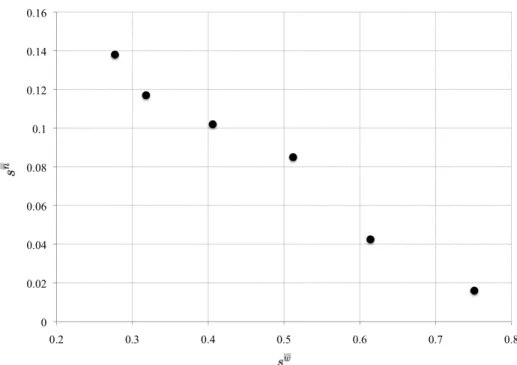
ANALYSIS OF TWO-FLUID-PHASE POROUS MEDIUM SYSTEMS USING MICROSCALE EXPERIMENTS AND LATTICE BOLTZMANN MODELING
Amanda L. Dye
A dissertation submitted to the faculty at the University of North Carolina at Chapel Hill in partial fulfillment of the requirements for the degree of Doctor of Philosophy in the
Department of Environmental Sciences and Engineering.
Chapel Hill 2015
ABSTRACT
Amanda L. Dye: Analysis of Two-Fluid-Phase Porous Medium Systems Using Microscale Experiments and Lattice Boltzmann Modeling
(Under the direction of Cass T. Miller)
level-set method to locate interfaces and estimate their rate of advancement. The proposed
adaptive algorithm was shown to reduce computational e↵ort by an order of magnitude, while yielding essentially identical solutions to a conventional fully coupled approach. Futhurmore,
the microfluidic experiments were modified to study the dynamics of a two-fluid-phase flow.
Viscous fingering and Haines jumps were visualized. The validated LBM was used to model
the experimental data and showed good agreement for certain aspects of the dynamics.
Over-all, the results show that the developed experimental and computational techniques can be
ACKNOWLEDGMENTS
It is safe to assume that when I started this journey I did not realize how much I didn’t know. I had never studied anything within the subsurface, written a program that ran on more than my laptop, thought about what may exist in the 26th dimension, or examined physical phenomenons on the order of microns. What I have learned over the last 6 years from a scientific perspective is laid out in great detail in this document, but what isn’t described is what I have learned about the self. Getting a PhD for me was as much about the science as it was about survival. Many times I found myself journeying through a black hole of codes and data, completely lost and unaware. In these times of despair I began to question not only my methods but my existence. As I dove deeper into the darkness I began to realize we become what we think. Today I view the world as a lattice, where the interactions between every node or being obeys the basic laws of physics. As proven by Mach’s Principle (the inertia of any particular particle or particles of matter is attributable to the interaction between that piece of matter and the rest of the universe), this document could not have existed without the help of many people. I would like to dedicate my dissertation to those who have given me the inertia to make it possible.
would like to express my special appreciation to Professor William Gray, you have been a
tremendous mentor for me. Your advice on both research as well as on my career have
been invaluable. I am also very grateful to Professor David Adalsteinsson for his
comput-ing knowledge throughout this journey. Additionally, I would like to thank my committee
members Professor Jingfang Huang, Professor Jan Prins, and Professor William Vizuete for
their guidance and interest in my work.
The lattice Boltzmann modeling discussed in this dissertation would not have been
possible without extensive collaboration with Dr. James McClure. He wrote the
three-dimensional, multiphase lattice Boltzmann code and set up the framework for applying the
model to an array of porous medium systems.
For the microfluidic work, I am particularly indebted to Professor Laura Pyrak-Nolte
and Bradley Abell. Laura was kind enough to let me take over her lab and borrow Brad,
who lead me through fabricating a microfluidic cell and setting up an experimental system
that was capable of capturing equilibrium states.
In my attempt to become an experimentalist, I thank Dr. Scott Hauswirth for his
forbear-ance and knowledge. He aided in the design and construction of the microfluidic experiments
and helped me overcome many crisis situations in and out of the lab. Scott also patiently
revised portions of this dissertation, persevering through my version of the English language.
I thank all my current and former undergraduate research assistants, Morgan Talley, Erin
Schaberg, Blythe Carter, and Stephanie Yu, for giving hours of their time to collecting and
analyzing data.
I am also grateful to my good friends, Kara Verkennis, Laura Liendo, Ashley Boyer, Nick
Chappell, and Ashley Kranz (in order of appearance), who have supported me throughout
this sometimes difficult journey. It was in our yearly road trips, weekly lunches and brunches, nightly therapy sessions, and impromptu dance parties that I found happiness.
Lastly, I thank my family for all their love and encouragement. To my siblings, Kevin,
Erica and Samantha, that have been stuck with me since birth, my grandfather, Bill, who
has been my biggest fan since the beginning, and most of all my parents, Bill and Pam, who
have been a constant source of support throughout my student career and this dissertation
would certainly not have existed without them. It is thanks to the two of them for allowing
me to dream big and never letting me give up on those dreams.
LIST OF TABLES
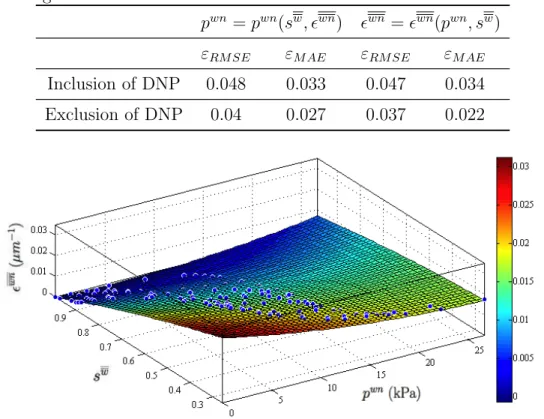
2.1 Best-fit coefficients for functional form given by Eq. (2.85). . . 57
2.2 Normalized root mean square error for estimation of each variable given func-tional fit corresponding to the coefficients listed in Table 2.1. . . 58
3.1 Runtime on Intel Core 2 Duo (2.4GHz) for a range of pressure steps using implementations of the non-adaptive LBM approach and the adaptive LBM algorithm. . . 91
LIST OF FIGURES
2.1 Two-dimensional micro-model in which the solid is represented by black and the regions accessible to fluid flow by white. . . 47
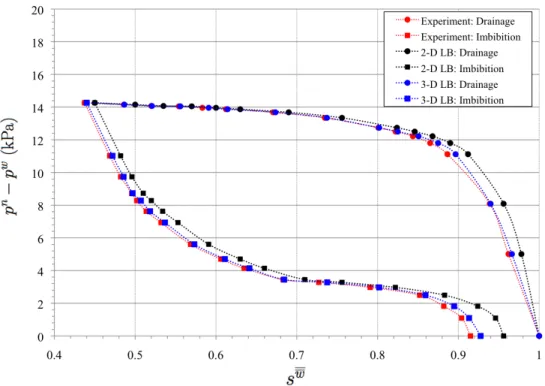
2.2 Pressure-saturation curves obtained from the displacement experiment and the LBM simulations for the porous geometry shown in Figure 2.1. . . 48
2.3 Pressure-saturation equilibrium states computed using the LBM. . . 53
2.4 Fluid distributions for a set of equilibrium states along the simulated primary drainage curve shown in Figure 2.3. . . 54
2.5 Fluid distributions for a set of equilibrium states along the simulated main imbibition curve shown in Figure 2.3. . . 55
2.6 ✏wn as a function of pwn and sw for the case in which DNP is excluded. . . . 58
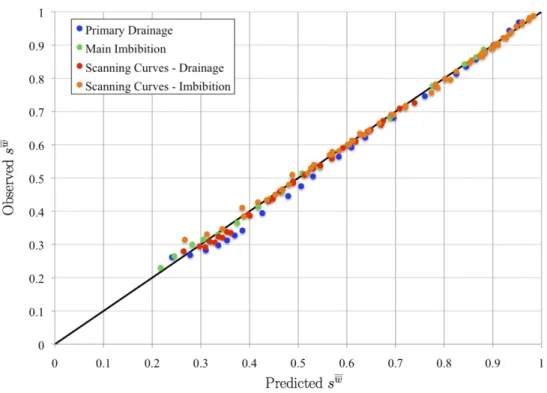
2.7 Error in sw resulting from the equation of state given by Eq. (2.85) for the
case in which DNP is excluded. . . 59
2.8 Maximum disconnected non-wetting phase saturation that can form as a func-tion of the minimum wetting-phase saturafunc-tion state of the system. . . 61
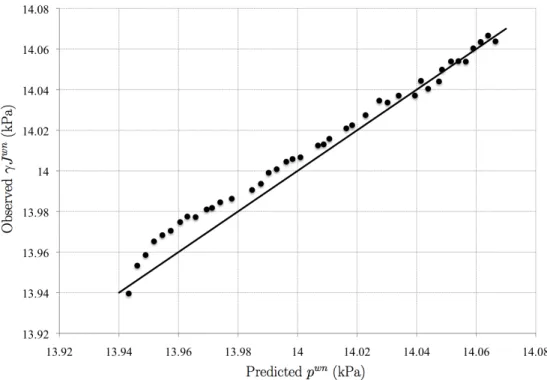
2.9 Observed versus predicted values ofpwn for points from a dynamic LBM
sim-ulation of relaxation to an equilibrium state. . . 63
2.10 A comparison of the capillary pressure obtained under dynamic conditions in the simulations and predictions based upon the state equation derived using only equilibrium data. . . 65
3.1 The di↵erence in phase pressures pn pw as a function of the product of the
interfacial tension wn and interfacial curvature Jwn
w as determined using a
series of two-dimensional bubble tests in the absence of a solid phase. . . 81
3.2 Two-dimensional porous media in which the solid is represented by gray and the pore space is represented by white. . . 82
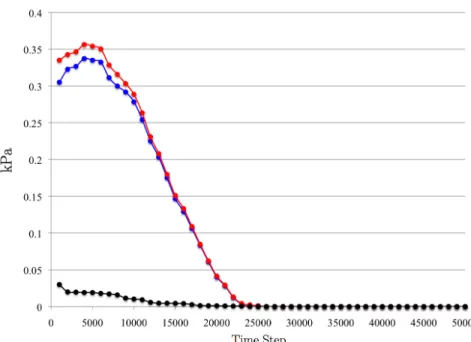
3.3 The phase pressure di↵erence, wetting phase saturation, and capillary pressure values as they evolved in time from one equilibrium state to the next. . . 84
3.4 Adaptive LBM algorithm for two-fluid-phase flow. . . 88
3.5 Pressure-saturation curves obtained from LBM simulations performed using the non-adaptive LBM and the adaptive LBM algorithm. . . 90
3.7 The time evolution of the active fraction of the domain for the equilibrium state simulation depicted in Figure 3.6. . . 94
3.8 The active fraction of the domain as a function of time for an equilibrium state simulation in which a Haines jump occurs. . . 94
3.9 The time evolution of then phase distribution during a Haines jump. . . 95
3.10 Fluid distributions for a set of simulated equilibrium states along the primary drainage curve shown in Figure 3.5. . . 96
3.11 Fluid distributions for a set of simulated equilibrium states along the main imbibition curve shown in Figure 3.5. . . 97
3.12 The initial state of an equilibrium simulation during main imbibition where the red interface identifies thewninterface that is mobile during the simulation. 98
4.1 Two-dimensional porous medium cell in which the solid is represented by black and the regions accessible to fluid flow by white. . . 104
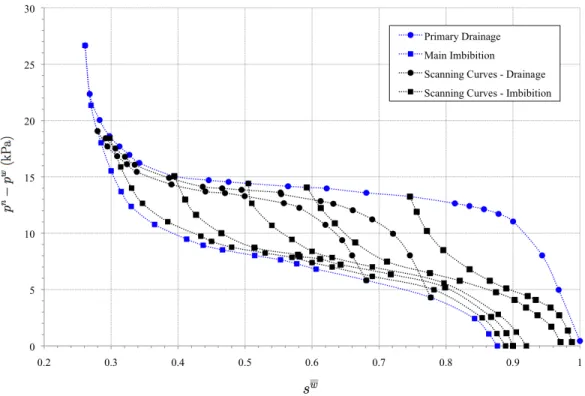
4.2 Primary drainage, main imbibition, and scanning curves obtained from the microfluidic displacement experiment for the porous geometry shown in Fig-ure 4.1. . . 110
4.3 Primary drainage and main imbibition curves obtained from the microfluidic displacement experiment and the LBM simulations for the porous geometry shown in Figure 4.1. . . 110
4.4 The simulated and observed dynamic states between equilibrium states on the primary drainage curve shown in Figure 4.3. . . 111
4.5 The simulated and observed dynamic states between equilibrium states on the main imbibition curve shown in Figure 4.3. . . 112
4.6 Fluid distributions for a set of imaged equilibrium states along the primary drainage curve shown in Figure 4.2. . . 113
4.7 Fluid distributions for a set of imaged equilibrium states along the main im-bibition curve shown in Figure 4.2. . . 113
4.8 The time evolution of the boundary pressures, wetting phase saturation, fluid-fluid interfacial area, and capillary pressure values as the two-fluid-fluid-phase sys-tem relaxes toward equilibrium. . . 115
4.10 The fluid distributions of a two-dimensional slice of a simulated equilibrium state compared to the fluid distributions of an experimental image for the corresponding pressure value. . . 117
4.11 Primary drainage curve as computed from the fluid distributions of a two-dimensional slice of the three-two-dimensional simulated data and the experimen-tal image data. . . 118
4.12 The viscous fingering pattern of a two-dimensional slice of a simulated equi-librium state compared to the viscous fingering pattern of an experimental image for the corresponding capillary pressure value . . . 119
LIST OF ABBREVIATIONS AND SYMBOLS
ACRT averging of conservative equations with rational thermodynamics
CAH chlorinated aliphatic hydrocarbon
CIT classical irreversible thermodynamics
DNAPL dense non-aqueous phase liquid
DNP disconnected non-wetting phase
FLOP floating point operation
LBM lattice Boltzmann method
LNAPL light non-aqueous phase liquid
MAE mean average error
MVA method of volume averging
NAPL non-aqueous phase liquid
PAH polyaromatic hydrocarbon
PCE tetrachlorethylene
PMMC porous medium marching cubes
RAV representative averaging volume
REV representative elementary volume
RMSE root mean square error
TCAT thermodynamically constrained averaging theory
Nomenclature
b entropy body source density
C Green’s deformation tensor,rXx·(rXx)T
Cs macroscale Green’s deformation tensor, hCsi⌦s,⌦s
Ci Collision operator for the LBM
ˆ
c closure coefficient
cs speed of sound
C gradient of the dimensionless density field
d↵ macroscale rate of strain tensor, [rv↵+ (rv↵)T]/2
E internal energy density
E↵ macroscale energy of entity ↵ per total volume, hE ↵i⌦↵,⌦
E↵
⇤ particular material derivative form of a macroscale entity total energy conservation
equation
Ed set of discrete velocity vectors
ei discrete velocity vector i
f general scalar function
f vector containing discrete distributions for the LBM
Fdk set of discrete distributions
G↵ macroscale orientation tensor for↵ interface or common curve, DI I(n)
↵
E
⌦↵,⌦↵
Gi↵
G↵
⇤ macroscale entity-based body force potential balance equation
g body force per unit mass, acceleration
g↵
i LBM distribution for mass transport of phase↵
h energy source density
h↵ macroscale energy source density for entity↵
I unit tensor
I(n)↵ unit tensor associated with 3 n-dimensional entity, ↵
I set of entity indices
Ic↵ connected set of indices for entity ↵, =I+c↵[Ic↵
I+
c↵ connected set of indices of dimension higher than entity↵
Ic↵ connected set of indices of dimension lower than entity ↵
If set of fluid-phase indices
II set of interface indices
IP set of phase indices
I/S set of entity indices except the solid phase,s
J first curvature equal to twice the mean curvature
j jacobian
j fluid momentum
ˆ
kwn parameter for rate of relaxation of interfacial area
ˆ kwn
1 parameter for rate of relaxation of interfacial area
k I boundary node on the interfacial region⌦I
M
!↵ microscale transfer rate of mass of entity to entity ↵ per entity extent
!↵
M macroscale transfer rate of mass of entity to entity ↵ per entity extent
M↵
⇤ macroscale entity mass conservation equation
M transformation matrix
m vector of moments
n↵ unit normal vector outward from boundary of entity ↵
ns interface between n and s phases
P↵
⇤ macroscale entity momentum conservation equation
P pressure, interfacial tension, or common curve lineal tension based upon entity
qualifier
p pressure
p pressure as measured by the pressure transducer
pwn capillary pressure of thewninterface
Q
!↵ general macroscale transfer rate of energy from entity to entity↵ !↵
Q general macroscale transfer rate of energy from entity to entity↵
q non-advective energy flux
R radius
ˆ
R closure scalar
r general integration variable
S↵
⇤ macroscale entity entropy balance
s↵ saturation of fluid phase↵
ˆ
S Diagonal matrix of relaxation rates
T transport theorem
T
!↵ general microscale transfer rate of momentum from entity to entity ↵
!↵
T general macroscale transfer rate of momentum from entity to entity ↵
Ts
⇤ macroscale Euler equation for a solid
T↵
⇤ macroscale Euler equation for an entity
Ts
G⇤ body source potential of a solid phase
T↵
G⇤ entity body source potential
t time
t timestep
t stress tensor
t↵ macroscale stress tensor for entity↵
V set of variables
W weighting function for averaging
wxx free parameter in the MRT scheme
wi weight for the LBM
w wetting phase
wn interface between wand n phases
wns common curve at boundary ofwn,ws, and nsinterfaces
ws interface between wand s phases
w velocity of a domain boundary
wwn vector velocity of normal component ofwn interface, vwn·nwnw
wh width of the halo around the interfacial region⌦I
X position vector in a solid in the initial state
Xk set of neighboring lattice sites to sitexk
x position vector
sZd regular lattice space ind dimensions
Greek Symbols
↵ entity index
entity index
t number of time steps of the LBM in the Adaptive LBM Algorithm
interfacial or surface tension; common curve lineal tension
✏ porosity
✏↵ specific entity measure,h1i
⌦↵,⌦
"w termination condition in the Adaptive LBM Algorithm
⇣ parameter controlling interfacial width in LBM
⌘ entropy density
⌘↵ macroscale entropy of entity ↵ per volume, h⌘ ↵i⌦↵,⌦
✓ temperature
✓↵ entropy weighted macroscale temperature of entity ↵, h✓↵i⌦↵,⌦↵,⌘↵
wns
G macroscale geodesic curvature
wns
N macroscale normal curvature
w termination condition in the Adaptive LBM Algorithm
⇤ entropy production rate
⇤↵ macroscale entropy production rate associated with entity ↵
µ chemical potential
⇢ mass density
LBM parameter used to control the interfacial tension
solid-phase stress tensor
dimensionless density field
s solid phase value of dimensionless density field
!↵
general macroscale transfer of entropy from entity to entity ↵
'ws,wn macroscale measure of contact angle
' non-advective entropy flux
'↵ macroscale non-advective entropy flux associated with entity↵
'ws,wn microscale contact angle
↵ fraction of boundary of entity ↵ in contact with entity ,h1i⌦,⌦↵
body force potential density
↵ entity-based macroscale body force potential density
body force potential per unit mass
↵, macroscale average of body force potential density
⌦ averaging domain
⌦↵ domain of entity↵
Superscripts
eq equilibrium value
n macroscale non-wetting phase qualifier
ns macroscale qualifier for interface betweenn and s phases
s macroscale solid-phase qualifier
T transpose
w macroscale wetting-phase qualifier
wn macroscale qualifier for interface betweenw and n phases
wns macroscale qualifier for common curve where wn, ws and ns interfaces meet
ws macroscale qualifier for interface betweenw and s phases
↵ macroscale entity qualifier
↵ intrinsic average over entity↵ or macroscale property of entity ↵
↵ mass average over entity↵
↵ uniquely defined average over ↵
above a superscript refers to a density weighted macroscale average
above a superscript refers to a uniquely defined macroscale average
0 vector tangent to a surface
00 vector tangent to a common curve
Subscripts
eq equilibrium value
E associated with the total energy conservation equation
eq equilibrium
M associated with the mass conservation equation
n microscale non-wetting-phase qualifier
ns microscale qualifier for interface betweenn and s phases
P associated with the momentum conservation equation
s microscale solid-phase qualifier
ss refers to the total boundary of the s phase
T total
T associated with the thermodynamic equation
TG associated with the derivative of potential energy equation
w microscale wetting-phase qualifier
wn microscale qualifier for interface betweenw and n phases
wns microscale qualifier for common curve wherewn, ws and nsinterfaces meet
ws microscale qualifier for interface betweenw and s phases
↵ microscale entity qualifier
↵↵ refers to the total boundary of entity ↵
Other Mathematical Symbols
D↵/Dt material derivative with microscale velocityv↵
D↵/Dt material derivative with macroscale velocityv↵
D00s/Dt material derivative on a curve where the macroscale solid is employed
@0/@t partial time derivative at a point fixed on a surface
@00/@t partial time derivative at a point fixed on a common curve
@(n)/@t partial time derivative at a point fixed on 3 n-dimensional entity
r0 microscale surficial del operator
r00 microscale common curve del operator
r(n) microscale del operator for a 3 n-dimensional entity where (n) is the number of
primes
rX gradient operator with respect to X coordinates
rx gradient operator with respect to macroscale xcoordinates
(n) denotes the number of primes that should appear
ˆ a parameter defined at the scale indicated by the subscript or superscript
hf↵i⌦ ,⌦ ,W = ✓ R
⌦
W f↵dr
◆
/
✓R
⌦
Wdr
◆
, average of microscale property f↵
f↵ =hf↵i⌦ ,⌦
f↵ =hf
↵i⌦↵,⌦↵, intrinsic average
f↵ =hf↵i⌦ ,⌦ ,⇢↵, general density-weighted average
f↵ =hf
CHAPTER 1 INTRODUCTION
1.1 Multiphase Flow in Porous Media
A porous medium system contains a continuous connected solid phase and a connected pore
space that spans the length scale of the system and admits the simultaneous flow of one
or more fluids. When the pore space in such a system can be occupied by more than one
immiscible fluid (e.g., water, gas, organic solvent, petroleum liquid), the system is commonly
referred to as a multiphase porous medium system. Porous medium systems occur routinely
in both natural and engineered environments for a wide range of important applications, such
as groundwater supply, contaminant remediation, carbon sequestration, hydraulic fracturing,
and hydrogen fuel cells.
The contamination of groundwater, a significant source of drinking water, is a serious
health and environmental problem in many areas of the United States. Groundwater
contam-ination is generally the result of human activities such as waste-disposal practices, runo↵from
agriculture, accidental spills and leaking underground storage tanks that contain protroleum
products [24, 83]. Contaminants associated with accidental spills and leaking underground
storage tanks are often released as non-aqueous phase liquids (NAPLs). When introduced
into the subsurface, NAPLs form a separate, potentially mobile phase whose migration is
governed by gravitational, buoyant, viscous, and capillary forces. [16, 18, 43]. NAPLs are
density, LNAPLs tend to migrate to the capillary fringe of the water table whereas DNAPLs
can to travel deep into the saturated zone. LNAPLs are commonly released into the
environ-ment via the production, use, and disposal of many products associated with the petroleum
and gasoline industries, and include toluene, ethylbenzene, octane, decane, and benzene, a
known carcinogen. The presence of DNAPLs in the subsurface is typically associated with
in-dustrial activities such as degreasing, metal stripping, chemical manufacturing, and pesticide
production [126]. Common chemicals associated with DNAPLs include chlorinated aliphatic
hydrocarbons (CAHs), such as tetrachlorethylene (PCE) and trichloroethylene (TCE), and
polyaromatic hydrocarbons (PAHs). Once the source of the NAPL is cut o↵ or depleted,
continuous NAPL phase may become numerous disconnected features in the pores. These
features are held in the pore space by capillary forces and can act as continual sources of
contamination for decades or even centuries [133, 135]. In order to e↵ectively develop and
assess remediation strategies, models describing the migration and entrapment of NAPLs in
the subsurface are necessary.
Multiphase flow also arises within hydraulic fracturing operations. Due to an increase
in energy demands and economic benefits, the use of hydraulic fracturing to extract natural
gas from organic-rich shales is expanding [90]. Hydraulic fracturing is the process of drilling
and injecting fluid into the ground at a high pressure in order to fracture shale rocks. The
objective of hydraulic fracturing is to create a highly conductive fracture system that will
allow flow through the shale rock to the production well used to extract natural gas from
the subsurface. Hydraulic fracturing fluids are used to initiate and expand fractures, as well
as to transport proppant into fractures within the shale rock. Proppants are sand or other
transport and entrapment of proppant into a fracture is highly dependent on the viscosity
of the fracturing fluid [120]. There are over 750 di↵erent chemicals used in fracturing fluids
[121]. A majority of these chemicals, such as citric acid and guar gum, pose no known
health risk, but others, such as benzene and lead, are known carcinogens. After fracturing of
the shale occurs, the injection of fracturing fluid is stopped and a portion of the fracturing
fluids flow back to the surface. During flow back, multiphase flow of gas and fracture fluid
occurs in the created fracture and the gas reservoir. When simultaneous flow of di↵erent
phases occurs in a hydraulic fracture, factors such as relative permeability, capillary pressure,
and wettability inside the fracture and the reservoir could potentially be important in the
fracturing fluid behavior and long term gas production in the gas reservoir. Due to the
uncertainity surrounding the behavior of fracturing fluids within the subsurface, the potential
impacts of hydraulic fracturing operations on groundwater resources is becoming a concern
[125]. Multiphase models describing the transport and fate of injected fracturing fluids under
conditions of high pressure and temperature are necessary to adequately examine current
hydraulic fracturing technologies.
1.2 Modeling Multiphase Flow
Multiphase flow in porous media is modeled on several di↵erent length scales (molecular
scale, microscale, macroscale, and megascale), each of which is inherently related to the
other. The two scales of interest in this work are the microscale and the macroscale. At
the microscale, the morphology and topology of the pore space and phase distributions are
known. At the macroscale, the details of the system at the microscale are unknown. Since
used in characterizing porous medium systems, such as the fractional volume of the porous
media occupied by each phase, porosity or the volume of pore space within the total volume,
and interfacial area between phases per volume. In order to identify and characterize these
properties, the characteristic length at the macroscale must be large enough that the volume
fractions will not be e↵ected by small changes in the length scale. Therefore, upscaling
from the microscale to the macroscale is commonly done by averaging over a representative
elementary volume (REV), a volume that is smaller than the domain of the system, but that
is large enough to permit a meaningful statistical average.
Due to the fact that porous medium systems are usually understood more completely
at the microscale, it seems logical to develop macroscale flow models by establishing a
con-nection to the microscale physics. However, traditional macroscopic porous medium models
for multiphase flow are often obtained by combining empirical relationships with standard
continuum conservation equations for mass written at the macroscale, therefore ignoring the
microscale physics. For example, a two-fluid-phase porous medium system is often modeled
using Darcy’s law, a form of the mass conservation equation, where the interaction between
the phases is accounted for by introducing relative permeability and assuming the di↵erence
in pressure between the two fluids is related by capillary pressure [40]. In order to close
this model, an empirical relationship between capillary pressure, saturation, and
perme-ability is introduced. The many functional forms of the capillary pressure, saturation, and
permeability relationship that have been reported in the literature demonstrate hysteretic
behavior, implying other variables are needed to fully specify the state of the multiphase
system [19, 23, 76]. Like the multiphase model discussed here, many standard macroscopic
foun-dation and misrepresent the underlying microscale physics. Recent theoretical work aims
to improve traditional modeling approaches by basing macroscopic models on microscale
precursors.
The thermodynamically constrained averaging theory (TCAT) provides a means for
ob-taining macroscopic models from microscopic models via averaging schemes [52, 56]. At the
microscale, conservation equations are combined with thermodynamics, constitutive laws
and simplifying assumptions to obtain a microscopic description of the system. To obtain a
macroscopic model, the thermodynamics and conservation equations are averaged from the
microscale. This ensures that all macroscopic variables are rigorously defined in terms of
more familiar microscale variables, eliminating any ambiguity with respect to these variables.
The macroscopic equations are then combined with simplifying assumptions and constitutive
relationships, which must be determined in order to obtain a closed model. Closed models
are needed both to facilitate a solution of an equation set and to allow for validation of
TCAT models by comparison with system behavior observed at the corresponding scale.
Advances in microscale computational and experimental methods have helped guide the
development of closed form models. Many traditional fluid mechanics approaches are not
well suited to deal with the complexity of flows in porous media. The lattice Boltzmann
method (LBM) has emerged as a leading alternative to traditional approaches due to the
simplicity by which fluid and solid interfaces are treated. In addition to LBMs designed
to model multiphase flows, algorithms have also been constructed to model a wide range of
physical processes including di↵usion [45, 77], dissolution [25, 124], phase transitions [2, 107],
and reactive transport [37, 68].
can be studied experimentally using micro-model methods based upon image analysis.
Two-dimensional micro-models are synthetic porous media that provide valuable insights into
important pore-scale mechanisms of multiphase flow in porous media systems [27, 28, 69].
Most micro-models are etched as natural porous substrates to imitate natural processes or as
simple pore networks of circular pore bodies to quantify basic transport phenomena. To allow
for the microscopic analysis of fluid flow, micro-models are created out of transparent material
(glass, silicon, or polymers) and imaged under a microscope. Due to their design,
micro-models have also been used to visualize and quantify colloid transport and filtration [11] and
investigate chemical reactions that take place in the subsurface environment [70, 132].
1.3 Research Objectives
The research presented here is focused on advancing the fundamental understanding of
two-fluid-phase porous medium systems using theoretical, computational, and experimental
ap-proaches. Recent advancements in both methods development and application of the LBM
will be presented. Results will be shown for both the equilibrium state and dynamics of
two-fluid-phase flow.
The specific objectives for this research are as follows:
1. Formulate a model for two-fluid-phase flow in porous medium systems based on the
TCAT theory.
2. Construct computational and experimental methods capable of capturing the
micro-scale physics needed to guide the development of closed models in conjuction with the
3. Investigate the validity of capillary pressure approximations used to describe
two-fluid-phase porous medium systems and develop functional forms based on state variables
by applying the LBM and comparing results to experimental data.
4. Advance existing LBM algorithms in order to account for the relatively slow process
in which fluid interfaces relax to their equilibrium state in a two-fluid-phase porous
medium system.
The objectives of this work are accomplished through 3 specific contributions, which are in
CHAPTER 2
MULTISCALE MODELING OF POROUS MEDIUM SYSTEMS 1
2.1 Background
The use of computers over the last 60 years for simulating subsurface flow problems has
pro-vided an impressive ever-expanding ability to model processes at a high resolution. Whereas
in the 1960’s a computational grid with 500 fixed nodes would have pushed the boundaries
of computer power [105], simulations today involve millions of spatial grid points and
adap-tive meshes [71, 101]. The availability of this power for solving the equations that describe
physical and chemical processes in porous media is wasted, however, if the equations being
used to describe the systems are inadequate. Most assuredly, the ability to solve equations
that are posed has been vastly improved. Unfortunately, the equations that are being solved
have not developed to the same degree.
For example, the primary equation for describing momentum transport of fluids in porous
media is Darcy’s Law, a correlation of data from a highly idealized set of experiments (e.g.,
homogeneous medium, single-fluid phase, steady state) in 1856 [17, 35, 36]. The results
of these experiments have been presumed to apply to transient, multiphase, flows in
het-erogeneous systems at di↵erent scales. This extension of the experiment to systems clearly
beyond their scope has resulted in equations with ill-defined and poorly understood variables.
A clear path for rigorously extending the form of Darcy’s equation to flows well beyond those
considered by Darcy, such as high-velocity flow and flows with cross-coupling between the
fluid phases, does not exist. Furthermore, inclusion of physical phenomena such as capillary
pressure, contact angles, and evolution of interfaces between phases has been a heuristic
ef-fort justified somewhat by dabbling in physical understanding rather than a comprehensive
rigorous derivation of equations that describe the processes [e.g., 61, 87, 94].
Averaging of equations from the microscale to a larger scale is one general approach
that has been employed in an e↵ort to obtain equations that have a firm theoretical basis.
Underlying averaging theory is the mathematical theorems that allow transformation of the
scale of equations. Theorems for transformation of conservation equations for phases have
been employed for almost fifty years [5, 8, 109, 129]. Theorems that allow averaging of
equations for interfaces between phases and for common curves where three interfaces meet
were developed subsequently [49, 51] and the forms of all these equations were subsequently
unified [55]. Four principal variants of averaging theory that make use of these theorems
have been employed. The first emphasizes averaging of microscale conservation equations for
phases and then makes heuristic arguments to close the equation system [e.g., 13, 57, 129].
A second approach pioneered by Whitaker and employed by adherents to this approach
is commonly referred to as the method of volume averaging (MVA). Applications of MVA
typically make use of averaging theorems applied to conservation equations for phases only.
This approach begins with closed microscale equations, which are then averaged to a larger
scale. The new terms that arise are closed by derivation of closure equations solved for a
periodic unit cell and the solution of closure variables to map from the smaller scale to the
The third approach makes use of averaging of conservation equations in conjunction
with rational thermodynamics (ACRT). ACRT averages equations for phases, interfaces, and
common curves. Then based on a set of axioms concerning system behavior, thermodynamic
relations are obtained directly at the larger scale, and the equation set is closed based on
exploitation of an entropy inequality [e.g., 14, 58, 60, 115].
These preceding methods have shortcomings primarily in that the first two methods do
not account for interface dynamics and require assumptions about the forms for deviations
between microscale and larger scale values. The approaches make very limited use of
ther-modynamic information. ACRT su↵ers in that the larger scale thermodynamic relations in
fact are expressed in terms of quantities that are not based on fundamental thermodynamic
variables [9, 75, 79, 123]. Additionally, these models have been abused by using erroneous
clo-sure conditions for the interface stress tensor and the interface dynamics [e.g., 88, 89]. Thus,
complete and correct models based on averaged conservation equations, thermodynamics,
and phase distribution kinematics are missing.
In an e↵ort to overcome the problems of these earlier methods, a fourth method, referred
to as thermodynamically constrained averaging theory (TCAT) has been formulated. This
method is the basis of this contribution. Here we outline the elements of TCAT and show
how it can be used to obtain model equations that overcome many theoretical difficulties.
2.2 Introduction
Conservation equations and thermodynamic relations applicable to porous medium systems
above the microscale, where a point refers to the averaged conditions in some representative
averaging region. We will call this larger scale the macroscale. The thermodynamically
con-strained averaging theory (TCAT) has been developed to formulate macroscale models such
that all variables are expressed explicitly in terms of microscale precursors [52, 56]. TCAT
also assures consistency with the second law of thermodynamics. It has been shown that
use of the TCAT procedure leads to the occurrence of variables such as volume fractions,
interfacial tensions, and density of interfacial area between the fluid and solid phases for the
case of single-fluid porous medium systems. For multifluid systems, common curve lengths
per volume, interfacial tensions, curvatures, and contact angles also arise naturally in the
for-mulation [66]. On physical grounds, these variables can be argued to be of importance; their
magnitudes relate to possibilities for interactions and exchanges between phases. However,
these variables do not appear explicitly in traditional porous medium models.
Despite the theoretical appeal of TCAT models, a problem remains: solvable models
require the explicit identification of closure relations that have only been specified in general
functional forms by the theoretical work advanced to date. The constitutive relations
em-ployed for a particular system must be consistent with the general forms inferred and also
clearly stipulated and parameterized. Closed models are needed both to facilitate solution
of an equation set and to allow for validation of TCAT models by comparison with system
behavior observed at the corresponding scale.
In recent years, some needed closed forms have been motivated by small scale
experimen-tal and computational methods. Of particular interest here is the high-resolution microscale
modeling approach known as the Lattice Boltzmann method (LBM). This method can be
the pores of a porous medium system and and also the macroscale variables that can be
obtained as integrated forms of the microscale variables. These macroscale variables can be
employed in posited general forms of closure relations [42, 59, 93, 116]. Computational
ex-periments thus provide a basis for the development of closed models making use of equations
developed using the TCAT procedure. Because TCAT models are new, multiscale modeling
of specific forms of TCAT closure relations has not yet been completed for many theorized
model forms.
In this chapter, we examine a TCAT model for two-fluid-phase flow in a porous medium
system. In Section 2.3, we provide the theoretical elements that are combined to establish the
TCAT approach. In Section 2.4 we propose a set of closed equations that describes
two-fluid-phase flow in a porous medium. For this set to be solvable, values or functional forms of some
coefficients and equations of state must be specified. In Section 2.5, we discuss how knowledge
of the smaller scale system behavior, obtained through complementary experimental and
LBM studies, can provide insights for specification of the needed forms and coefficients.
Section 3.2 provides details concerning the formulation, verification, and validation of the
LBM approach used to simulate two-fluid-phase flow in a porous medium system. The
resultant model is used to investigate various aspects of of the flow system that the TCAT
model suggests warrant attention, such as an appropriate formulation of capillary pressure.
The need to obtain information about geometric features of the porous medium system,
such as the curvature of interfaces between phases and the extent of those interfaces, is
discussed in Section 2.7. In Section 2.8 specific closure relations for a two-fluid-phase system
are obtained from analysis of LBM simulations. This serves as an illustration of how robust
with computer simulation for a range of phenomena.
2.3 Theory
TCAT is a systematic procedure for changing the scale of conservation, balance, and
ther-modynamic equations from the microscale to a larger scale. For use in porous media, the
TCAT method involves averaging over a representative averaging volume (RAV) to obtain
equations for phases, interfaces between phases, common curves, and common points, which
are referred to generically as entities. The method has been developed by considering each of
these entities separately. Here, we will make use of the similarities of the equations and
aver-aging theorems for each of the di↵erent entity types to develop the equations. The following
six subsections present the following TCAT components: averaging theorems, conservation
equations, entropy balance, thermodynamic equations, evolution equations, and the entropy
inequality. The full details of these equations and the procedures used to manipulate them
can be found in [56]. Here, we emphasize the equations that are particularly useful in
mac-roscale porous medium flow modeling. These results form the bases for model formulation
and closure considerations, which are considered subsequently.
2.3.1 Averaging Theorems
For porous medium analysis, it is not possible to model large systems at a microscale where
the flow profile within the pores is described. Neither is it always informative to model the
system at a megascale where only an average value of a quantity within the full system is
determined. As a compromise between these two extremes, it is important to be able to
as the macroscale, where a filtered variability of quantities in the system is used. At the
microscale, the phases within a system are visualized as being juxtaposed and separated by
interfaces. At a microscale location, a point lies within a single phase or on an interface or
a common curve. From a macroscale perspective, all phases, interfaces, and common curves
may be present at a location with each having a geometric density. A phase has a volume
fraction measure, an interface has an interfacial area per volume measure, and a common
curve has a length per volume measure. A similar density can be developed for common
points, which do not occur in the systems considered in this chapter.
The conservation and balance equations that describe a system are most easily formulated
directly in terms of microscale quantities. To transform the microscale equations to the
macroscale, mathematical relations are needed. These have the e↵ect of changing averages of
derivatives of microscale quantities into derivatives of macroscale quantities. These theorems
[5, 49–51, 55, 64, 78, 86, 109, 128] are most readily applied when the length scales of the
microscale and macroscale are widely separated. Microscale phase conservation equations
are three-dimensional transient forms. Interface conservation equations are two-dimensional
at the microscale. Common curves and common points are, respectively, one- and
zero-dimensional at the microscale. On transformation to the macroscale, all these equations
become three-dimensional as the properties of interest vary in space regardless of the type
of entity to which they belong.
operators according to
⌦
r(n)·f↵
↵
⌦↵,⌦ =r·
D
I(n)↵ ·f↵
E
⌦↵,⌦
D⇣
r(n)·I(n)↵ ⌘·f↵
E
⌦↵,⌦
+ X
2Ic↵
hn↵·f↵i⌦,⌦ (2.1)
and
⌦
r(n)f
↵
↵
⌦↵,⌦ =r·
D
I(n)
↵ f↵
E
⌦↵,⌦
D⇣
r(n)·I(n)
↵ ⌘ f↵ E ⌦↵,⌦ + X
2Ic↵
hn↵f↵i⌦,⌦ , (2.2)
where (n) is the number of primes that appear in the superscript, and the integration domain
is of dimensionality 3 n. Thus, for example, for a surface of dimensionality 2, (n) = (1),
so the microscale surface gradient operator,r0, uses a single 0to indicate that it is a surface
operator. For a phase, n = 0, and I(0)
↵ = I. For a common point, n = 3 and I(3)↵ =0. Note
that all variables and operators are defined in the nomenclature section.
In addition to the spatial averaging theorems, a temporal averaging theorem is employed
that relates the spatial average of a time derivative of a function to the time derivative of
the spatial average of the function. This theorem is stated
⌧ @(n)f
↵
@t ⌦↵,⌦ =
@
@thf↵i⌦↵,⌦ +r·
D⇣
I I(n)↵ ⌘·v↵f↵
E
⌦↵,⌦
+Dr(n)·I(n)
↵ ·v↵f↵
E
⌦↵,⌦
X
2Ic↵
hn↵·vf↵i⌦,⌦ , (2.3)
where (n) is the number of primes that appear in the superscript, and the integration domain,
⌦↵, is of dimensionality 3 n. Eqs. (2.1) and (2.3) are the primary averaging theorems that
and common points to their macroscale forms.
2.3.2 Conservation and Balance Equations
The conservation equations at the macroscale can all be derived from the microscale total
energy equation by application of the averaging theorems followed by the restriction that the
equation obtained must apply in any inertial coordinate system. In the development here,
we will not consider species transport or interphase mass transfer of individual species. We
state the microscale total energy equation for entity ↵ as
E↵ :=
@(n) @t
⇣
E↵+⇢↵
v↵·v↵
2 + ↵
⌘
+r(n)·h⇣E↵+⇢↵
v↵·v↵
2 + ↵
⌘ v↵
i
h↵ ⇢↵
@(n)
↵
@t ⇢↵g↵·
⇣
I I(n)
↵
⌘
·v↵
X
2I+c↵
✓
E
⇢
+ v·v
2 +
◆
M
!↵+v·T!↵+Q!↵
r(n)·⇣I(n)
↵ ·t↵·v↵+I(n)↵ ·q↵
⌘
= 0 for ↵2I;n = 3 dim ↵ , (2.4)
where the summation term in this equation accounts for exchanges with entities of higher
dimensionality.
This equation is averaged to the macroscale using the operator h·i⌦↵,⌦. After application
of the averaging theorems Eqs. (2.1) and (2.3), the macroscale energy equation that results
is
E↵ := @
@t
E↵+✏↵⇢↵ ✓
v↵·v↵
2 +K
↵
E ◆
+ ↵
+r·
⇢
E↵+✏↵⇢↵ ✓
v↵·v↵
2 +K
↵
E ◆
✏↵h↵ X
2Ic↵
!↵
M E↵,+v
↵,·v↵,
2 +K
↵,
E + ↵, !
X
2Ic↵
!↵
T ·v↵, X 2Ic↵
!↵
Q
r·⇣✏↵t↵·v↵+✏↵q↵+✏↵q↵g⌘ ⌧
⇢↵
@(n)
↵
@t ⌦↵,⌦
D ⇢↵v↵·
⇣
I I(n)
↵
⌘
·g↵
E
⌦↵,⌦
= 0 for ↵2I;n= 3 dim ↵. (2.5)
The notation used in this equation is designed to precisely indicate the macroscale quantities
(with superscripts), particular kinds of averages (spatial average with no overbar on the
superscript, mass density weighted with a single overbar on the superscript, specially defined
with a double overbar on the superscript), an exchange terms between entities (with a super
arrow indicating the transfer from one entity to the other). The definitions arise naturally
in the averaging process, and the expressions in terms of microscale variables appear in the
nomenclature or in far greater detail in [56]. It is useful to rewrite the first two terms in Eq.
(2.5) making use of the material derivative operator to obtain
E↵
⇤ :=
D↵
Dt
E↵+✏↵⇢↵ ✓
v↵·v↵
2 +K
↵ E ◆ + ↵ +
E↵+✏↵⇢↵ ✓
v↵·v↵
2 +K
↵
E ◆
+ ↵ I:d↵
✏↵h↵ X
2Ic↵
!↵
M E↵,+v
↵,·v↵,
2 +K
↵,
E +
↵,
!
X
2Ic↵
!↵
T ·v↵, X
2Ic↵
!↵
Q
r·⇣✏↵t↵
·v↵+✏↵q↵+✏↵q↵g⌘ ⌧
⇢↵
@(n)
↵
@t ⌦↵,⌦
D ⇢↵v↵·
⇣
I I(n)↵ ⌘·g↵E ⌦↵,⌦
This energy equation must apply in any inertial reference coordinate system. We can
replace v↵ by v↵+C, where Cis an arbitrary constant velocity vector, and Eq. (2.6) will
still apply. After making this substitution, collection of terms that multiply Cresults in an
equation of the form
E↵
⇤ +C·P↵⇤ +
C·C
2 M
↵
⇤ = 0. (2.7)
Because C is arbitrary, selection of C = 0 confirms that Eq. (2.6) still applies. If C
is orthogonal to the terms collected to form P↵
⇤, then Eq. (2.7) requires that M↵⇤ = 0.
Therefore, we must also have P↵⇤ = 0, since Eq. (2.7) must hold for all constant C. The
group of terms that comprise P↵⇤ is the momentum equation as follows:
P↵
⇤ :=
D↵
Dt
⇣
✏↵⇢↵v↵⌘+✏↵⇢↵v↵I:d↵ ✏↵⇢↵g↵ X
2Ic↵
!↵
M v↵, X
2Ic↵
!↵
T r·⇣✏↵t↵⌘=0 for ↵2I. (2.8)
The elements of M↵
⇤ constitute the mass conservation equation for entity ↵, which can be
written as
M↵⇤ :=
D↵⇣✏↵⇢↵⌘
Dt +✏
↵⇢↵I:d↵ X 2Ic↵
!↵
M = 0 for ↵2I. (2.9)
For two-fluid-phase flow, we note that the set of entities is the phases, interfaces, and
common curve such that the index set is
As an example of the connected sets, for the wninterface,
I+c↵wn={w, n} (2.11)
and
Ic↵wn={wns} (2.12)
We are considering the connected set of the solid phase to include the common curve.
2.3.3 Entropy Balance
In addition to the conservation equations, an entropy balance equation may be formulated
for each entity. The microscale equation denoted as S↵ is written
S↵ :=@
(n)⌘
↵
@t +r
(n)·(⌘
↵v↵) b↵
X
2I+c↵
⌘
⇢
M
!↵ r
(n)·⇣I(n)
↵ ·'↵
⌘
=⇤↵
for↵ 2I;n = 3 dim ↵. (2.13)
Application of the averaging theorems Eqs. (2.1) and (2.3) to this equation yields the
macroscale entropy balance,
S↵ := @⌘
↵
@t +r·
⇣
⌘↵v↵⌘ ✏↵b↵ X
2Ic↵
!↵
M ⌘↵,
X
2Ic↵
!↵
As with the conservation equations, it will prove convenient to write this equation in terms
of the material derivative such that we have
S↵
⇤ :=
D↵⌘↵
Dt +⌘
↵I:d↵
✏↵b↵ X
2Ic↵
!↵
M ⌘↵, X
2Ic↵
!↵
r·⇣✏↵'↵⌘=⇤↵
for ↵2I. (2.15)
We observe that the quantities that appear in this balance equation do not appear in the
conservation equations. To make use of this equation in conjunction with those equations,
two steps are taken. First, the inter-entity exchange terms will drop out if one sums the
entropy balance equation over all entities. This gives us
X
↵2I
S⇤↵ =
X
↵2I "
D↵⌘↵
Dt +⌘
↵I:d↵ ✏↵b↵
r·⇣✏↵'↵⌘ #
= X
↵2I
⇤↵ . (2.16)
From the second law of thermodynamics, we know that entropy generation due to irreversible
processes is non-negative. Therefore, we know that
X
↵2I
⇤↵ 0. (2.17)
The second step in making the entropy inequality helpful in conjunction with the
con-servation equations is the postulation of a thermodynamic formalism that relates entropy to
2.3.4 Thermodynamic Formalism
The simplest thermodynamic formulation that can be employed is classical irreversible
ther-modynamics (CIT) [9, 22, 38]. We will use this formalism here because of its simplicity and
the fact that it indeed describes the thermodynamic behavior of many important systems.
The approach employed is to make use of the known thermodynamic relations at the
mic-roscale and then average them to the macmic-roscale. By using this approach we ensure that
all thermodynamic quantities are well-defined at the macroscale and that thermodynamic
information is transferred consistently between scales. The thermodynamic formalism can
be developed using a common notation for all entities except the solid. Here, we assume
that the solid is elastic, and we provide the thermodynamic relations consistent with that
specification.
Classical thermodynamics provides thermodynamic properties of equilibrium systems.
Using the CIT approach, we make use of a local equilibrium assumption such that the
thermodynamic relations are considered to apply at each point in the system even though
the properties that are constant when the system is at equilibrium have spatial and temporal
variation. It is important to note that the local equilibrium assumption is enforced at the
microscale but is not imposed separately at a larger scale when the larger scale equations
are obtained by averaging the smaller scale thermodynamic relations. The impact and
importance of non-local equilibrium at the larger scale in the thermodynamic relations is
obtained through the averaging process that requires consistency between scales.
the Euler form of the energy equation per region of the entity written as:
E↵ =✓↵⌘↵+µ↵⇢↵ P↵ for ↵2I/S . (2.18)
In this equation, P↵ = p↵ is pressure when ↵ denotes a fluid phase, P↵ = ↵ for an
interface where ↵ is the interfacial tension, and P↵ = ↵ for a common curve where ↵ is
the curvilinear tension of the curve. The derivative of this equation may be written
d(n)E
↵=✓↵d(n)⌘↵+µ↵d(n)⇢↵ for ↵ 2I/S , (2.19)
where d is a di↵erential operator, and the superscript (n) constrains the di↵erentiation to
remain at fixed entity coordinates when ↵ is of dimensionality 3 n.
With d(n) replaced by @(n)/@t in Eq. (2.19), averaging theorem Eq. (2.3) can be applied
to obtain a macroscale thermodynamic equation involving the time derivative. If d(n) is
replaced by the gradient operator, r(n) in Eq. (2.19), the spatial averaging theorem, Eq.
(2.2), can be used to obtain an expression for the macroscale gradient of energy. Then
summation of these two results after dotting the gradient expression with v↵ yields the
averaged form of the thermodynamic relation given by
T⇤↵ :=
D↵E↵
Dt ✓
↵D↵⌘↵
Dt µ
↵D↵(✏↵⇢↵)
Dt
+ X
2Ic↵
⌦
n↵· v vs P↵
↵ ⌦,⌦
+
* ⌘↵
D(n)s(✓
↵ ✓↵) Dt + ⌦↵,⌦ + ⌧ ⇢↵
D(n)s(µ
↵ µ↵)
⌘↵r✓↵ r·DI(n)↵ P↵
E
⌦↵,⌦
+✏↵⇢↵rµ↵ · v↵ vs
r·D⇣I I(n)
↵
⌘
· v↵ v↵ P↵
E
⌦↵,⌦
D⇣
I I(n)
↵
⌘
P↵
E
⌦↵,⌦
:d↵
D
r(n)·I(n)
↵ · v↵ vs P↵
E
⌦↵,⌦
+D⌘↵ v↵ vs ·
⇣
I I(n)
↵
⌘E
⌦↵,⌦·r
✓↵
+D⇢↵ v↵ vs ·
⇣
I I(n)↵ ⌘E
⌦↵,⌦·r
µ↵ = 0 for ↵2I/S . (2.20)
We emphasize that this expression makes use of the local equilibrium approximation at the
microscale but does not require this condition to hold at the macroscale.
Although it is not a thermodynamic condition, the equation for the rate of change of
the gravitational potential is handled similarly to the thermodynamic condition. Because
↵ =⇢↵ ↵, the derivative of this expression is
d(n) ↵ ↵d(n)⇢↵ ⇢↵d(n) ↵ = 0 for ↵2I. (2.21)
The di↵erential d(n) may be replaced, successively, by the partial time derivative and
gra-dient operators with the averaging theorems applied to the resulting equations. Then if the
resulting equation in terms of the gradient is dotted with v↵ and added to the partial time
derivative equation, the result is
TG↵⇤ :=
D↵ ↵
Dt
↵D↵(✏↵⇢↵)
Dt
⌧ ⇢↵
D(n)s ↵
Dt ⌦↵,⌦ ✏
↵⇢↵
r ↵· v↵ vs
+D⇢↵ v↵ vs ·
⇣
I I(n)↵ ⌘E
⌦↵,⌦·r
This equation added to Eq. (2.20) provides a relation for the rate of change of macroscale
internal plus potential energy for fluid phases, interfaces, and the common curve.
A potentially fertile area for additional research is the representation of solid phases at
the macroscale. Here, we adopt a relatively simple model of the solid as an elastic material,
which can be formulated as
Es =✓s⌘s+ s:
Cs
js
+µs⇢s , (2.23)
where s is a stress tensor, Cs is Green’s deformation tensor, and js is the Jacobian. The
derivative of this equation may be written
dEs =✓sd⌘s+ s:d ✓
Cs
js ◆
+µsd⇢s . (2.24)
If the arbitrary di↵erential in Eq. (2.24) is replaced successively by the partial time
derivative and gradient operators, the resulting equations can be averaged making use of the
time and space averaging theorems. With the gradient expression dotted with vs added to
the time derivative expression, the resulting expression for the relation among the rates of
change of macroscale thermodynamic properties of the solid is
Ts
⇤ :=
DsEs
Dt ✓
sDs⌘s
Dt µ
sDs(✏s⇢s)
Dt
X
2Ics ⌧
ns·(v vs) s:
Cs
js ⌦,⌦
X
2Ics ⌦
ns·ts· vs vs ↵
⌦,⌦ +
* ⌘sD
s(✓s ✓s)
Dt
+
⌦s,⌦
+
⌧ ⇢sD
s(µ
s µs)
Dt ⌦s,⌦ r·
⌧✓
ts s:
Cs
js
I
◆
· vs vs
⌦s,⌦
✏sts:ds+✏s s:C s
jsI:d s+
⌧✓
r·ts r s:
Cs
js ◆
· vs vs
⌦s,⌦
This expression makes use of the microscale local equilibrium approximation and also
ac-counts for the fact that a concentrated force can act on the solid surface at common curves
and common points. The equation for the rate of change of gravitational potential for the
solid phase is obtained from Eq. (2.22).
2.3.5 Evolution Equations
Unique to the TCAT approach in comparison to other averaging methods is the incorporation
of the kinematics of the space occupied by a phase, and of the shape and extent of an interface
between phases and of the common curve on the solid surface into the full formulation
[54, 56, 58]. Kinematics of irregular geometries are difficult to describe exactly, so we rely
on approximations that are based on the averaging theorems, in particular Eqs. (2.2) and
(2.3) with f↵= 1. The gradient theorem becomes
0 =r✏↵ r·DI I(n)↵ E
⌦↵,⌦
D
r(n)·I(n)
↵
E
⌦↵,⌦
+ X
2Ic↵
hn↵i⌦,⌦ , (2.26)
while the time derivative theorem simplifies to
0 =@✏
↵
@t +r·
D⇣
I I(n)
↵
⌘
·v↵
E
⌦↵,⌦
+Dr(n)·I(n)
↵ ·v↵
E
⌦↵,⌦
X
2Ic↵
hn↵·vi⌦,⌦ . (2.27)
These two equations provide relations among the geometric density of the entity of interest,
an orientation tensor, and averages of the velocities of the entities.
It is important to recognize that the velocity of an entity is not necessarily equal to the
curve, in the directions normal to the entity. As might be expected, the velocities of the
entities in their tangential directions do not appear in the preceding two equations. The
challenge that arises is relating the changes of extent of one entity to that of another entity.
For example, if a phase is spherical, it is easy to relate the rate of change in the size of the
sphere to the rate of change of the surface area of the sphere; for the case of complicated
phase geometries, phase boundaries, and curve lengths, such a relation cannot be obtained.
Nevertheless, Eqs. (2.26) and (2.27) provide exact relations that can be approximated to
obtain appropriate macroscale relations. These results can then be studied because the larger
scale variables will be specified in terms of microscale variables.
To obtain an evolution form in terms of a material derivative moving with the macroscale
solid phase velocity, we take the dot product of Eq. (2.26) withvsand add this to Eq. (2.27).
After minor rearrangement, this gives
Ds✏↵
Dt +r·
D⇣
I I(n)↵ ⌘· v↵ vs
E
⌦↵,⌦
+DI I(n)↵ E
⌦↵,⌦
:ds
+Dr(n)·I(n)↵ · v↵ vs
E
⌦↵,⌦
X
2Ic↵
⌦
n↵· v vs
↵
⌦,⌦ = 0 for ↵2I. (2.28)
Although this equation describes the evolution of the various geometric entities, it is of
limited use as is because not all of the quantities expressed with the averaging operator can
be evaluated in terms of the set of macroscale variables that arise in averaging conservation
equations. The complex geometries and distributions of the entities also means that robust
approximate evaluations are difficult to identify. Nevertheless, these equations are important
constraints on the behavior of the system. The last term on the left side of Eq. (2.28)
distribution of lower-dimensional entities. For the two-fluid-phase system of concern here, we
make some approximations that can be revisited if significant errors in subsequent macroscale
simulations or insights gained from microscale simulations suggest a need to do so.
The derivation of an approximate form of Eq. (2.28) is a rather involved process and can
be found in [56]. Here, we provide the equation that results when the solid deformation is
much slower than fluid redistribution; and we are interested in the rate of change of thewn
interface. Elements of the physical processes that can cause ✏wn to evolve are the normal
velocity of the interface, interfacial curvature changes, and the movement of the common
curve on the solid surface. The governing approximate equation is [54, 56]
Ds✏wn
Dt +r·
h
✏wn wwn Gwn·vs i JwwnD
s✏w
Dt
ˆ
kwn⇣✏wneq ✏wn⌘ cos'ws,wn(✏ws+✏ns)D
s ws s
Dt = 0. (2.29)
The terms in this equation are, in order, the rate of change of wn interface density, the
net outward flux of ✏wn, increase in ✏wn caused by a change in the volume fraction of fluid
phase w, relaxation of ✏wn to an equilibrium configuration, and the change in ✏wn due to
movement of the common curve that is the boundary of the interface. The quantity Gwn is
an orientation tensor that accounts for the fact that the wn interface may have a preferred
orientation direction.
For the common curve, more approximations are needed. These approximations are not
as robust as those for the interface, but the errors are not as important if the common curve
results is [54, 56]
Ds✏wns
Dt +r·
h
✏wns wwns Gwns·vs i
+wnsG (✏ws+✏ns)D
s ws s
Dt kˆ
wns⇣✏wns
eq ✏wns ⌘
= 0. (2.30)
This equation relates the rate of change of common curve length per volume, respectively, to
the net outward flux of the common curve, the movement of the curve along a solid surface
that leads to its expansion or contraction, and the relaxation of the common curve length
to its equilibrium length due to stretching. This latter term is expected to be negligible for
the case of a two-fluid system when the solid does not deform.
2.3.6 Entropy Inequality
The entropy inequality is constrained by the conservation equations, the body force potential
equation, and the thermodynamic relations such that the material derivatives are eliminated
as far as possible. This strategy serves to express the rate of entropy generation as a product
of independent forces and fluxes, each of which is zero at equilibrium. The constrained form
is expressed as
X
↵2I
S↵
⇤
1
✓↵E ↵
⇤ +
1
✓↵v ↵·P↵
⇤ +
1
✓↵
✓
µ↵+ ↵ v
↵·v↵
2 +K
↵ E ◆ M↵ ⇤ + 1
✓↵T ↵
⇤ +
1
✓↵T ↵ G⇤ =
X
↵2I
⇤↵ 0. (2.31)
After substitution of the appropriate conservation and thermodynamic equations into this