Australian Institute of Health and Welfare Canberra
Cat. no. HWL 46
The
c
oding
w
orkforce
s
hortfall
© Australian Institute of Health and Welfare 2010
This work is copyright. Apart from any use as permitted under the Copyright Act 1968, no part may be reproduced without prior written permission from the Australian Institute of Health and Welfare. Requests and enquiries concerning reproduction and rights should be directed to the Head of the Communications, Media and Marketing Unit, Australian Institute of Health and Welfare, GPO Box 570, Canberra ACT 2601.
A complete list of the Institute’s publications is available from the Institute’s website <www.aihw.gov.au>.
ISBN 978-1-74249-090-8
Suggested citation
Australian Institute of Health and Welfare 2010. The coding workforce shortfall. Cat. no. HWL 46. Canberra: AIHW.
Australian Institute of Health and Welfare Board Chair
Hon. Peter Collins, AM, QC
Director Penny Allbon
Any enquiries about or comments on this publication should be directed to:
Vicki Bennett
Australian Institute of Health and Welfare GPO Box 570
Canberra ACT 2601 Phone: (02) 6249 5082
Published by the Australian Institute of Health and Welfare
The Australian Institute of Health and Welfare is Australia’s national health and welfare statistics and information agency. The Institute’s mission is
Contents
Acknowledgments... v Glossary/abbreviations ... vi Symbols used ... ix Executive summary ...x 1 Introduction...1 Scope of information...2 2 History...4The evolution of the coding workforce...4
The change in the role of coded data...5
3 Environment...6
National change...6
International...9
Jurisdictional activities and initiatives ...14
Case studies...25
4 The current workforce...31
Coding workforce information prior to the 2010 survey...31
2010 Clinical Coder and HIM survey results ...37
Developments over time ...49
Educational outputs...52
5 The future workforce needs ...57
Approach to projections ...57
Workforce stocks and flows...58
Workforce needs based on workloads ...59
Other workforce issues and implications ...60
6 Recommendations...61
Immediate actions ...63
Short-term actions ...64
Longer-term actions...67
Appendix 1 - List of consultations ...71
Appendix 2 – Project scope and objectives...74
Appendix 3 – Survey methodology...75
Appendix 4 – Future workforce projection calculations...97
Appendix 5 – Existing education and training courses...106
Appendix 7 – Apprenticeship information ...111
Appendix 8 – Draft international curriculum for HIMs ...115
References...119
List of tables ...123
Acknowledgments
This report was prepared by Vicki Bennett, David Braddock, Pam Lee and Laura Smith of the Australian Institute of Health and Welfare, with support and assistance from Sue Walker, Director of the National Centre for Health Information Research and Training, Queensland University of Technology.
Thanks are extended to:
• Queensland Health for their previous work on the Queensland coding workforce, which provided useful background information for the calculations of projections in this report • Coding companies for their valuable comments and information on their use of services
supplied through interviews
• Coding managers, coding contractors and coder educators in hospitals across the countries for their input to the survey
• Health Information Managers (HIMs) and Coding Course coordinators for supplying graduate numbers
• National Centre for Health Information Research and Training (NCHIRT) for sharing knowledge and expertise regarding the coding workforce
• the following state and territory departments for contributing essential information: ACT Health, NSW Health Department, NT Department of Health and Families, SA
Department of Health, Tasmanian Department of Health and Human Services, Victorian Department of Health, WA Health and Queensland Health
• international contacts in Ireland, Canada, New Zealand and the United Kingdom, who provided valuable information on relevant projects and practices in their countries. We also acknowledge the financial support for the project from the Department of Health and Ageing (DoHA), without which the report could not have been produced.
Glossary/abbreviations
ABF Activity Based Funding ABS Australian Bureau of Statistics ACBA Australian Coding Benchmark Audit ACCM Area Clinical Coding Manager
ACHI Australian Classification of Health Interventions
ACS Australian Coding Standards
ACT Australian Capital Territory
AGSC Australian Geographic Standard Classification
AHIMA American Health Information Management Association
AHS Area Health Service
AIHW Australian Institute of Health and Welfare AN-DRGs Australian National Diagnosis Related Groups
ANZSCO Australian and New Zealand Standard Classification of Occupations
APC Admitted Patient Care
AQF Australian Qualifications Framework
AR-DRGs Australian Refined Diagnosis Related Groups ASCO Australian Standard Classification of Occupations BADS Business Analysis and Decision Support Unit
CAHIIM Commission on Accreditation for Health Informatics and Information Management Education
CC Clinical Coder
CCSA Clinical Coders Society of Australia
CCSAA Clinical Costing Standards Association of Australia CHIMA Canadian Health Information Management Association CIHI Canadian Institute for Health Information
COAG Council of Australian Governments
CQHSD Central Queensland Health Service District
CS Costing Specialist
CSAC Coding Standards Advisory Committee
DEEWR Department of Education, Employment and Workplace Relations
DoHA Department of Health and Ageing
DRG Diagnosis Related Group
ESRI Economic and Social Research Institute FTE Full time equivalent
GCHSD Gold Coast Health Service District
GCUH Gold Coast University Hospital
GCSEs General Certificates of Secondary Education GTOs Group Training Organisations
GWAHS Greater Western Area Health Service HIM Health Information Manager
HIMAA Health Information Management Association of Australia HIPE Hospital In-Patient Enquiry
HMDB Hospital Morbidity Database HSD Health Service District HWA Health Workforce Australia
ICD-10-AM International Statistical Classification of Diseases and Related Health Problems, tenth revision, Australian modification IFHRO International Federation of Health Records Organizations IHRIM Institute for Health Records and Information Management
LHN Local Hospital Network
MoH Ministry of Health
MRA Medical Record Administrator MRAU Medical Record Advisory Unit
NCCH National Centre for Classification in Health NCCQ National Clinical Coding Qualification
NCHIRT National Centre for Health Information Research and Training
NHISSC National Health Information Standards and Statistics Committee
NHS National Health Service
NPA National Partnership Agreement NSNL National Skills Needs List
NSW New South Wales
NT Northern Territory
NZ New Zealand
OTEN Open Training and Education Network PICQ Performance Indicators for Coding Quality
QCC Queensland Coding Committee QUT Queensland University of Technology
RBH Rockhampton Base Hospital
RPL Recognition of Prior Learning RTO Registered Training Organisation
SA South Australia
SACC South Australian Coding Committee
SNOMED-CT Systematised Nomenclature of Medicine - Clinical Terms SOL Skilled Occupation List
TAFE Technical and Further Education
TERC Training and Employment Recognition Council TESQA Tertiary Education Quality and Standards Agency
UK United Kingdom
USA/US United States of America
VET Vocational Educational Training
WA Western Australia
WHO World Health Organization
WHO-FIC WHO Family of International Classifications WIES Weighted Inlier Equivalent Separation
Symbols used
Italics within a table denotes a subtotal
™ trademark
— em dash rounded to zero, (for example, the statistics is less than 0.5) including null cells
. . not applicable (that category, data item does not apply)
n.a. not available
n.p. not published (data cannot be released due to quality issues, confidentiality, or permission not granted)
n.e.c. not elsewhere classified n.f.d. not further defined
< less than
Executive summary
Concern about the shortfall in the coding workforce in Australia has been raised in a number of national fora. This report seeks to quantify the scope of the existing shortfall, to project future numbers required to cover increasing demands, and to provide a consolidated set of recommendations to address the issues identified. For the purposes of this report, the coding workforce has been described as comprising Health Information Managers (HIMs), Clinical Coders (CCs) and Costing Specialists (CSs).
Background
Coding has been undertaken in Australian hospitals for over 60 years for the purposes of public health measurement, health services management, planning, performance and activity monitoring and epidemiological studies. However, with the introduction of casemix
management in Australia in the early 1990s, different drivers for the quality and completeness of coding emerged. The first state to implement a case based funding
mechanism was Victoria in 1993–94, followed by several other states and territories whose implementation of casemix was variously for management or funding purposes.
In 2010, in light of increasing pressures to deliver quality services to an ageing population which is experiencing increasing rates of chronic diseases, greater reliance on technology, increased consumer expectations and growing workforce shortages, the National
Performance Agreement on Hospital and Healthcare Reform has proposed the introduction of an Activity Based Funding (ABF) model. This will be for an increased range of services, particularly in the case of outpatient services, and is based on the need for more and better health information to support public accountability and efficiency of hospital based services. The implementation of ABF and other aspects of the National Partnership Agreement (NPA) will require a larger and more productive coding workforce as coded data provides the source of many of the performance reporting and measurement targets.
The current coding workforce
There is a recognised shortfall in the coding workforce in Australia, as has been articulated in two previous national surveys (HIMAA 1995; McKenzie & Walker 2003). This report
identifies changes in the workforce across the period since 1994, including an ageing workforce, general dissatisfaction with employment conditions and salaries, a greater number of part-time workers, an increasingly flexible and mobile CC population often working across multiple facilities, increased reliance on contract coding companies and the use of shared and ‘roving’ HIMs and CCs. These latter workers often have to travel great distances in order to manage the coding in rural and remote hospitals. Despite the greater reliance on complete and accurate coded data, there is evidence that the coding workforce continues to be required to undertake many other tasks as well as their coding roles. In addition the inclusion, for the purposes of this report, of CSs within the definition of the coder workforce has created some issues, as this group is currently not a recognised
specialist workforce. Thus further work is required to define these workers if their numbers are to be measured, and therefore no comparison over time is made.
The current coding workforce, as reported by respondents to the 2010 AIHW Coding Workforce Survey compared with the previous surveys, has the following broad characteristics:
• increasingly educated through the VET sector and not universities
• 65.3% CCs and not HIMs (except in Victoria, where the majority of the workforce is represented by HIMs who have graduated from an undergraduate program) • increasing duration of coding experience
• predominantly female (92.8%) • more than 50% aged 45 years or over • around 50% working part-time
• two-thirds employed in public sector facilities
• 177.4 FTE vacant positions reported in respondent facilities, with the highest percentages reported in New South Wales, Queensland and Western Australia
• nearly 1 in 5 facilities employed contract coding companies to manage their coding workloads.
Other responses to the survey indicated issues relating to education, including the cost and duration of training, accessibility and the need to provide individualised support for new coders at facilities, regardless of how they have obtained their initial coding education. This issue was noted as difficult to manage because it also reduces the productivity of the
supervisor.
The identified workforce deficit is anticipated to become more acute as the proposed
government initiatives are implemented. A similar workforce shortage has been identified in a number of other countries that have also implemented case-based funding mechanisms. Australian state and territory health departments have also recognised the shortfall, and most have conducted their own studies to identify and count the workforce and to develop strategies and opportunities to improve its productivity. Common strategies identified across the states and territories include:
• use of a state-wide licence for the use of the 3M™ Codefinder™ • use of the Performance Indicators for Coding Quality (PICQ) tool • creation of Coding Auditor and Educator positions
• state coding committees and coder websites for improved communication with coders. This report explores past and current mechanisms for educating the coding workforce and makes recommendations for the future. Coders have been educated through undergraduate and postgraduate HIM programs conducted in four Australian universities, as well as for CCs through the Health Information Management Association of Australia (HIMAA), TAFE sector and through on-the-job training. Little is known about the CS workforce or about how they are educated. However, the universities report lack of enrolments into HIM programs and because of this, half of the previously offered undergraduate programs have been discontinued in recent years. The reported ‘invisibility’ of the coding workforce and the HIM and CC professions have affected enrolment numbers, and targeted marketing strategies are required. The announcement of the creation of Health Workforce Australia (HWA) is
anticipated to provide the vehicle for engaging with the universities and other organisations that offer (or previously offered) coder training. This will assist them to identify strategies for recruitment, to better facilitate articulation between tertiary education sectors and to provide a variety of educational pathways for the workforce.
The future workforce needs
There is no way to determine exact figures for the supply and demand of coding workforce, but some attempts have been made in this report to estimate the numbers required. More importantly, this report provides a method for calculating the impact of various policy changes, so that as the details of the health reform become clearer, these calculations could be modified to test these or other hypotheses.
No attempt has been made in this section to estimate the number of CSs required for the future as, until this workforce can be more clearly defined, there are no baseline data on which to base projections. However, it can reasonably assumed that more are needed than are currently employed, and that this need will increase due to the same factors that are affecting the HIM and CC workforce.
One significant difficulty in undertaking these calculations is that the inflows to the
workforce are only able to be calculated by the number of people trained, and the workload implications are only able to be calculated by the number of full time equivalents (FTEs) required to perform the function. Given the large proportion of part-time workers in this industry and the geographical challenges of delivering coding services in some areas of the country, the number of people required to meet the FTE calculations below is assumed to be much greater than the number of FTE coders estimated.
Following are the main calculations able to be derived from the data available and assumptions made for the proceeding 5-year period:
• the net gain from HIM and CC training programs, less the anticipated retirements from the workforce, is estimated as 1,476 people
• the results of the survey undertaken demonstrate a current national coder vacancy rate of >175 FTEs
• to code the current volume of annual separations, 1,265 FTE coders are required
• to keep up with the projected growth in separations, Australia will require an additional 193FTE coders over the next 5 years
• to code all non-admitted hospital services, an additional 1,493 coders will be required, or as few as 149 if only 10% require coder validation following some automated coding process
• e-health and other reform initiatives are expected to require an addition of 150 FTEs, as a low end projection
• the implementation of ABF to all states may not mean additional numbers of staff, but may require more qualified staff, as per the Victorian experience.
These calculations indicate that an HIM and CC workforce of between 3,101 and 1,757 FTEs will be required within 5 years (2010 to 2015).
Recommendations
All the recommendations are based on the basic premise that there are three key ways to deal with workforce shortfalls in any area, which are:
• increase workforce numbers and hours worked • retain the existing workforce
It is also critical to note that these recommendations are not sequential, and that it is essential that many of these are undertaken concurrently.
It is recommended that the first thing required is the establishment of a Coder Workforce Taskforce under the auspices of HWA to undertake proper workforce planning. This will include assessment of where coding workforce staff are needed, how many and at what level of skill, etc. The outcome of the work of the taskforce will be an integrated plan to address workforce shortages and to determine actions based on the recommendations and action strategies noted below.
Immediate
1. Find non-working HIMs and CCs to fill current vacancies
2. Promote immediate improvement in current work arrangements for existing staff.
Short-term actions
3. Support a more in-depth body of work on the Costing Specialist Workforce, with the aim of developing a set of competencies and training packages
4. Finalise the development of an Australian Qualifications Framework (AQF) qualification for Clinical Coding, and assist existing coders to obtain Recognition of Prior Learning (RPL)
5. Promote careers in Clinical Coding, HIM and Clinical Costing nationally 6. Seek to have these careers listed on skills shortage lists
7. Investigate the value of coding software for improving quality and speed 8. Enhance continuing professional development opportunities
9. Undertake a national review of salary and industrial conditions for CCs, HIMs and CSs.
Longer-term actions
10. Provide scholarships, internships and training incentives
11. Establish Coding Workforce Units at the Local Hospital Network (LHN) level 12. Use technology to improve access to records to allow remote coding
13. Conduct national clinician training on diagnosis assignment and documentation 14. Establish a national coding auditing, education and support function
15. Define a career path for the coding workforce to integrate the existing workforce and create promotional pathway.
1 Introduction
The World Health Organization has recognised that health information is a key component of a well functioning health system, as outlined in their Health Systems Framework (WHO 2010). This focus on information has been driven by recognition of the importance of evidence-based decision making in the health sector, but in many countries the
improvements in health information systems have been limited by the number of skilled staff to undertake this work.
Australia has acknowledged the need to enhance the health information workforce for a number of years, with a key body of work being undertaken in 2003 by the Australian Health Information Council, titled ‘Health Information Workforce Capacity Building National Action Plan’ (Australian Health Information Council 2003). However, this plan had a key focus on health informatics, and not on the broader health information workforce needs, and very few of the actions outlined in the report have been implemented.
Subsequent to the 2003 report, a number of national health reforms have been proposed that would place increasing demands on the existing health information workforce, specifically those involved in clinical coding. These include the implementation of national performance monitoring, Activity Based Funding, e-health initiatives, and other proposals that will rely heavily on coded data.
The new National Partnerships Agreement (NPA) component related to health workforce reform aims to restructure and improve the workforce capability and supply, and the
efficiency of public hospital services, but does not specifically address the coding workforce. The national Activity based funding framework and implementation plan report acknowledged a national shortage of health information staff, including qualified Health Information
Managers (HIMs) and Clinical Coders (CCs) (COAG 2009). A workshop initiated by the National Health Information Standards and Statistics Committee (NHISCC) based on the recognition of this issue was held in June 2009, which recommended a number of courses of action categorised as follows:
• achieving better understanding of shortages • increasing workforce supply
• improving retention • marshalling for action.
This report is the commencement of delivering on these recommended actions.
A broad picture of the size and characteristics of the coding workforce that underpins much health sector information is outlined in this report. The coding workforce has been defined by the Australian Government Department of Health and Ageing for the purposes of this report, as comprising the occupations of Clinical Coders (CCs), Health Information
Managers (HIMs) and Costing Specialists (CSs). The definitions used for the first two groups, CCs and HIMs, are based on the standard classification of occupations by the Australian and New Zealand Standard Classification of Occupations (ANZSCO) used by the Australian Bureau of Statistics (ABS) (ABS 2010).
• A clinical coder is someone who assigns codes to narrative descriptions of patients’ diseases, operations and procedures in accordance with the ICD-10-AM classification to allow for storage, retrieval and analysis of health data.
• A health information manager is someone who plans, develops, implements and manages health information services, such as patient information systems, and clinical and administrative data, in order to meet medical, legal, ethical and administrative requirements of health care delivery.
Although the third occupation has been labelled Costing Specialists, there is no single occupation or definition of workers who undertake the specialist costing functions in the health sector. In the ANZSCO classification, they may be in any one of numerous different occupations in accounting, financial management, or financial analyst fields.Costing Specialists are believed to have experience in, and knowledge of, the business and clinical aspects of the delivery and cost of health services at an operational level. They have expert knowledge of finance, relative values, casemix, costing, financial performance and national efficiency pricing which enables them to negotiate with health funds and payers on behalf of providers.
Collectively, these three occupations are described as the coding workforce in this report, which describes and quantifies the existing coding workforce, and uses this information to determine the likely shortfall in HIMs, CCs and CSs to support proposed government reforms and anticipated health sector growth. Although it is difficult to predict exactly how reforms and growth will impact this workforce, it is evident that the environment and drivers affecting coding are changing, and that action needs to be taken. The report also recommends a range of solutions to meet the growing workforce needs, including the use of existing and potential education and training pathways to attaining careers in these areas.
Scope of information
People working as CCs are mainly employed by hospitals and day care facilities or by private agencies which contract out their clinical coding services. Both these groups have been targeted in this project through different means. In some jurisdictions, some of the coding workforce may also be engaged at a regional or area level, providing coding services to a group of health facilities.
HIMs work in a much larger range of agencies, including all levels of government, health facilities, private agencies and health insurance companies. For the purposes of this project, the work performed by HIMs who are not employed in health facilities is assumed to be ‘secondary’, or indirect involvement, rather than ‘primary’, or direct involvement, in the clinical coding processes. That is, they may use the data resulting from the clinical coding that occurs in health facilities but have no involvement in the clinical coding process itself, and are therefore not considered part of the coding workforce.
'Clinical costing is a process of determining the "true" cost of treating patients. Each input utilised to treat a patient is determined, costed and assigned to the relevant AR-DRG' (The Royal Children's Hospital Melbourne – Health Information Services 2009). This is often referred to as a casemix funding model. Although not defined by any professional set of competencies or specific professional body, Costing Specialists are those people who work to ensure that the way costs are calculated and the AR-DRGs are allocated are accurate.
With no consistent definition of Costing Specialists in use nationally, collecting data about this group is problematic, particularly because little is known about the people who perform the costing functions of interest, or the homogeneity of the group. Collecting quantitative data was not feasible in the timeframe for this project and the focus will thus be on qualitative, or descriptive, information. A Clinical Costing Standards Association of Australia (CCSAA) exists to 'improve the costing of health services across Australia by
devising clinical costing standards that promote best practice and provide a benchmark for all hospitals to achieve'. However, this organisation appears to be currently dormant (The Clinical Costing Standards Association of Australia 2010).
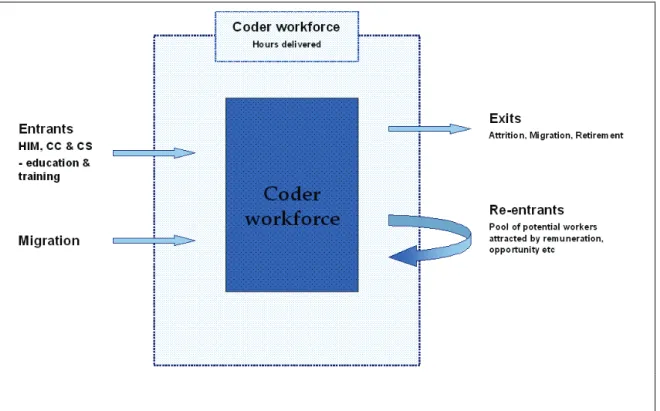
A number of factors affect the size of the coding workforce at any particular point in time, including in-flows through education, migration and workplace transition, re-entry of workers previously trained, and out-flows of existing workforce due to migration,
retirement, attrition, and even death. Figure 1 below provides a diagrammatic representation of how these flows affect the coding workforce.
2 History
The evolution of the coding workforce
'Coding is the translating of narrative descriptions of diseases, injuries and procedures into alphanumeric codes' (HIMAA 1995). Coding of disease and procedure data has been undertaken in Australian hospitals since the late 1940s, and currently the
ICD-10-AM/Australian Classification of Health Interventions (ACHI)/Australian Coding Standards (ACS) represents the classification system used to code all admitted patient episodes of care nationally.
The HIM profession has existed in Australia for more than 60 years. Over this time, the tertiary education programs for HIMs have included coding components, and new graduate HIMs have often taken on coding roles immediately after graduation as a pathway to
transition into other areas of professional practice. Other HIMs choose to stay as specialist coders long term, some moving into more senior coding roles or becoming coding educators. More recently, the CC profession received formal recognition during the National Coder Workforce Issues Project, conducted by the Health Information Management Association of Australia (HIMAA) in 1994–95 as a prelude to anticipated widespread casemix
implementation. The title ‘Coding Clerk’ was first included in the ABS’ Australian Standard Classification of Occupations in 1997 (ASCO code 61992) (ABS 1997, 1998). Information relating to the job and career prospects was included in Job Guide 2003 by the
Commonwealth Department of Education, Science and Training (DEST 2003). The ASCO code was subsequently revised in 2009 to the title ‘Clinical Coder’ (ABS 2009)
Coders may have tertiary HIM qualifications but increasingly coding is performed by those who obtain their coder education through other means, as described below. These two occupational groups have well recognised identities but the boundaries in responsibility for coding overlap between the two groups. The emerging role of CSs also has strong
interrelationships with CCs and HIMs, and with the increased use of casemix data these roles will continue to interplay.
To date, the coding workforce has been educated in one of the following ways in Australia: • as part of formal HIM university degree programs
• through a distance education format, the most recognised of which is run by the HIMAA, which offers distance education programs in ICD-10-AM coding at introductory, intermediate and advanced levels and also offers a formal Coder
Certification program to recognise excellence. The NSW Open Training and Education Network (OTEN) also offers distance education for coders through its Business
Administration program
• through participation in an intensive short course in classroom format (for example, that run by the Queensland University of Technology (QUT) in 2007 which incorporated a 1-week medical terminology program followed by 3 1-weeks of coding instruction and then supervised workplace practice)
Although, for the purposes of this report the coding workforce has been defined as CCs, HIMs and CSs, the latter has not previously been considered as part of this workforce group, and little is known about them.
The change in the role of coded data
As noted above, Australia has a long history of coding of hospital separations data. These data were traditionally used for public health research, health services management and planning, performance and activity monitoring, and epidemiological purposes.
In more recent times, the implementation of casemix, or episode-based funding mechanisms, has increased the focus on the quality and timeliness of coded data, and provides a different set of drivers to the collection of the data. Casemix has been implemented in different ways in the states and territories, as outlined below:
• Victoria was the first state in Australia to introduce casemix funding in 1993–94 for all public hospitals, and has continued to be recognised as the leading Australian state in its use of casemix for management and funding purposes. The Victorian system utilises Australian Refined Diagnosis Related Groups (AR-DRGs) that are converted into a single number—the Weighted Inlier Equivalent Separation (WIES). Health services receive a target WIES allocation at the beginning of each financial year which is capped; those who do more work than is allocated via the WIES will not be paid for the extra work nor will they receive the whole allocation if they fail to meet the target. Since its initial implementation for acute care hospital funding, a separate simplified ‘casemix type’ model has been implemented for ambulatory and rehabilitation services.
• At present New South Wales (NSW) Health utilises a funding allocation process to areas such as considering the population's needs, on recurrent expenditure requirements of new facilities and developments in Commonwealth funding arrangements. This is known as the Resource Distribution Formula. NSW implemented Episode Funding as a policy in 2008–09 which included acute, emergency, intensive care and sub- and non-acute services.
• South Australia (SA) implemented casemix principles or an output-based funding model in July 1994 based on that introduced in Victoria.
• Western Australia (WA) and Tasmania implemented casemix funding in 1996–97 utilising a standard price-capped full price model covering fixed and variable costs. Tasmania only implemented casemix for its three major hospitals.
• The Queensland introduction of casemix in 1998 followed the Victorian model of a capped standard price per hospital group, with fixed and variable costs separately enumerated. Fixed overhead costs and a variable cost per patient treated were implemented and the focus was on casemix as a management tool not as a funding mechanism.
• The Northern Territory (NT) is using a block funding model currently, but is working towards an ABF model following a failed implementation of casemix proposed in 1996.
3 Environment
National change
The Australian health system is under increasing pressure, as are many developed
economies around the world, to deliver adequate levels of quality services to meet the needs of the population. This pressure is driven by 'increasing demand due to an ageing
population, rising chronic disease, advancing technology and pressures associated with workforce shortages' (COAG 2008). In addition, there is a rise in the expectations of the health-care consumers about the services they receive.
Health reform
Acknowledging these challenges, on 29 November 2008 the Council of Australian
Governments (COAG) committed to a new NPA on Hospital and Health Workforce Reform to deliver a range of reforms and improvements in the health and hospital sector. The NPA aims to improve the efficiency and capacity in public hospitals through four key reform components, the most significant one of these for the coding workforce being the introduction of a nationally consistent ABF approach.
Activity Based Funding
'Activity Based Funding is a management tool that has the potential to enhance public accountability and drive technical efficiency in the delivery of health services' (COAG 2008). The NPA commits all governments to the development and implementation of patient classification and costing methodologies to enable Activity Based Funding of public hospital services, and the development of an ABF model methodology, including for setting price, incentives and transition arrangements.
The introduction of ABF highlights the explicit relationship between services provided and funds allocated, aiming to reward efficiencies, improve equity, financial performance and transparency and provide an objective basis for comparisons between peer groups. The ABF model proposed includes acute admissions, emergency care, sub-acute care, mental health, outpatient care, hospital-auspiced community health services, teaching/research,
community service obligations ('minimum volume' hospitals).
The national reforms in the health and hospital sector will significantly increase activities to support the management and collection of health information and development of health information infrastructure for evidence-based decision making for health-care and health service delivery (National Health and Hospitals Reform Commission 2009). Underpinning these initiatives is the need for:
• classifications fit for purpose ('product IDs') • counting methodology
• costing methodology
• funding mechanisms
• processes for governance and management
• education for clinical staff to support better clinical documentation.
Performance reporting
Performance benchmarks and indicators are also key requirements of the new NPA with each aspect of the agreement having specific performance measurement targets, many of which require coded data as the source. Skilled health information specialists will be necessary to produce these data.
Local Hospital Networks
The Australian Government has recently announced the establishment of Local Hospital Networks (LHNs) across the country, to be paid directly by the Australian Government for each public hospital service they provide.
LHNs will be made up of small groups of hospitals that will work together to provide a range of hospital services and manage their own budgets. The networks are planned to be run locally, with national funding and accountability for performance against the national performance measurement standards noted above.
It is proposed that LHNs will be comprised of between one and four hospitals, with regional networks potentially including more small hospitals. The networks will be responsible for the running of public hospital services. In capital cities, networks will be built around large tertiary or specialist hospitals. In regional and remote areas, networks will be built around large regional hospitals (The Hon. Nicola Roxon, MP Minister for Health and Ageing 2010). It is anticipated that the networks will become the principal unit of activity in terms of ABF and their creation may provide an opportunity to maximise use of scarce health information resources through sharing of expertise across hospitals in the network.
e-health
Advancing, implementing, and utilising health information technology and initiatives to better manage the timely flow of quality health information will be critical to the success of the reforms. Recent national workforce projections indicate that there is a significant shortfall in the number of suitably qualified health information specialists to undertake this vital work (The Australian Healthcare & Hospitals Association and The Health Informatics Society of Australia 2008). In addition, the e-health initiatives undertaken over the past few years nationally have already demonstrated the drain on the HIM workforce in particular, with many HIM graduates choosing e-health related roles over coding roles, mostly related to salaries and work opportunities (Victoria State Government 2010).
Coder education program changes
Significant changes have occurred in the education and training offerings for HIMs and CCs in recent years. Appendix 5 outlines the existing and proposed courses offered in Australia for HIMs and CCs. No formal training programs currently exist for CSs.
A number of factors, including the low profile of the profession and competition from other allied health professions, have led to a decline in both the number of candidates seeking
training in HIM, and to the number of courses offered nationally (Victoria State Government 2010). Two of the universities that previously offered undergraduate HIM degrees, The University of Sydney and Queensland University of Technology, indicate that they could not sustain programs with so few enrolments and these programs have been discontinued. Changes to the programs offered at La Trobe University and Curtin University reflect attempts to better cater for the market and encourage student uptake.
As part of the 2009 Budget, the federal government announced the creation of a Tertiary Education Quality and Standards Agency (TEQSA) which will take responsibility for the whole of higher education in 2010. The government plans that by 2013, the vocational education sector will also come under the responsibility of the new agency, which will also oversee the Australian Qualifications Framework (AQF) (Australian Government 2010). This provides opportunities to consider new ways to integrate the current disparate training programs for the coding workforce.
Health workforce planning
In addition, COAG has established a new agency—Health Workforce Australia (HWA)—to manage and oversee major reforms to the Australian health workforce. HWA will undertake workforce planning and research, education and training, and innovation and reform. COAG has announced the following major reforms which the agency will manage and oversee:
Increasing supply
• Improving the capacity and productivity of the health sector to provide clinical education for increased university and vocational education and training places • Facilitating immigration of overseas trained health professionals and continuing to
develop recruitment and retention strategies. Reforming the workforce
• System, funding and payment mechanisms to support new models of care and new and expanded roles
• Redesigning roles and creating evidence based alternative scopes of practice
• Developing strategies for aligned incentives surrounding productivity and performance of health professionals and multi-disciplinary teams (Community Services and Health Industry Skills Council 2009).
HWA provides a vehicle for reforms in education and training for health information professionals. Mechanisms are required to facilitate better articulation and credit transfer arrangements between the higher education sectors, for example, Certificate I to Advanced Diploma for work based training; Diploma to Doctorate in the higher education sector. The AQF, a national competency based arrangement, is seen as the model to be used across sectors to guide content of education and training programs within a single governance framework for the tertiary sector.
All of the changes outlined above that are occurring within the broader national context mean that changes to the supply and demand for the coding workforce are expected. There will not only be a need for more health information professionals but also changes in the skill levels required of each discipline and changes to their roles and education.
International
Australia is not the only country to be facing challenges in maintaining adequate levels of specialist health information workers, and more specifically the coding workforce. The increasing importance of the collection and processing of health data, particularly for funding, is a phenomenon that is being experienced in a number of countries which have implemented some form of case based funding. The need for a larger and increasingly skilled coding workforce is a common factor in these countries and is being addressed in a variety of ways, as outlined below.
Some work has also been commenced on an international curriculum for health information management, and a draft of this can be found at Appendix 8. Work is also being undertaken to develop a core curriculum for coder training programs by the WHO Family of
International Classifications (WHO-FIC) and International Federation of Health Records Organizations (IFHRO).
New Zealand
As our closest neighbour, and with open boarders for migration of workers, it is important for us to understand how New Zealand (NZ) is managing their need for coders,
acknowledging that their coding workforce is also influenced by an international shortage of skilled Clinical Coders. NZ has also noted that they have specific issues with an ageing CC workforce (Wetherspoon 2009).
New Zealand has no university programs in HIM and most of their existing CCs have been trained using the HIMAA distance education program, or via local training programs. In 2007, a briefing paper entitled ‘Clinical Coder Workforce Issues’ was written which noted a shortage of trained and experienced CCs, and reported on the results of a Clinical Coder needs survey that was undertaken in August 2007. This survey found that approximately 10% of all hospital-based coding positions were vacant (17 full-time equivalent (FTE) positions), with an additional 17 CCs with >10 years experience intending to leave the coding workforce in the near future. In addition to this, 30% of the respondents had no formal coding
qualification.
A number of activities have been undertaken to address the issues identified in this report, including:
• the promotion of clinical coding as a career, by including a career profile of Clinical Coding on the New Zealand Careers website, development of a CC career brochure and efforts to increase the visibility of CCs
• delivery of a national coder training program. The NZ Ministry of Health (MoH) has endorsed the HIMAA clinical coder education program to enable CCs to attain formal coding qualifications. In addition, the MoH provides a yearly regional education program, newsletters, a helpdesk service and a website to support CCs (New Zealand Ministry of Health 2007).
Ireland
Ireland commenced using the Australian ICD-10-AM/ACHI/ACS and AR-DRGs in 2005, and thus their experience with supplying and maintaining an adequate coding workforce is particularly relevant.
The 60 acute public hospitals in Ireland have 200 CCs in total. The CCs are supported in their work by approximately 30 Coding Managers nationally who often have a dual role as
Casemix Coordinators. A full-time CC is expected to code about 7,000 discharges per year. CCs are provided training, free of charge, by the national Hospital In-Patient Enquiry (HIPE) unit in the Economic and Social Research Institute (ESRI). Those trained as CCs are generally administration staff of the hospital with no formal medical training. The training 'involves attendance at modular training, starting with a 2 day WebEx guided course by
teleconference. This is followed by two two-day courses over the following month. This course is followed by a visit to their hospital by one of the data quality team. After three months these coders are invited to attend an Intermediate level-doing course' (Murphy 2010).
In addition, specialised workshops are conducted three times per year, and 2-day refresher courses are run regularly. Courses are held at both the central and regional levels.
A quarterly newsletter is used to communicate with the coders in the hospitals, providing information about code changes, courses, and as a tool for providing feedback on issues arising from audits or queries.
While there is currently no accredited certification for CCs in Ireland, a project is underway to consider the introduction of certified and accredited training programs. The ESRI courses are currently only available to staff working in a HIPE supported hospital, but consideration is being given to opening this up in the future. It is anticipated that 'accredited training would provide:
• a career structure for coders • create a coding profession
• improve perceptions within the wider healthcare community of the high standards coders work to
• help with retention of coders' (Murphy 2010).
Consideration is also being given as to how the skills of the existing staff can be enhanced, and to open up coding roles to new staff.
United Kingdom
The United Kingdom of Great Britain and Northern Ireland is made up of the two countries of England and Scotland, the principality of Wales and the province of Northern
Ireland. Each country has a National Health Service (NHS) and in Northern Ireland there is integrated health and social care.
The National Clinical Coding Qualification (NCCQ) is the only nationally recognised qualification for CCs working in the NHS. It is a national standard qualification that values their unique skills and knowledge. The qualification was established in 1999 by the NHS Connecting for Health, in partnership with the governing body for the exam which administers all aspects of the process, the Institute for Health Record and Information
Management (IHRIM). It was also developed in collaboration with the NHS in Scotland, NHS Cymru (Wales), and the Health and Social Services Executive (Northern Ireland).
Wales and Northern Ireland
Wales encourages coders to become qualified by sitting the NCCQ and uptake for the exam is good. However, of the 296 coders registered in Wales in 2008, only 51 had the full ACC qualification (17.22%). Northern Ireland has the lowest percentage uptake within the United Kingdom (exact numbers were unable to be obtained).
Scotland
Within Scotland there is a variety of models used for the coding of patient records, from dedicated departments managed by a Health Records and Informatics Service to various other clerical staff members who may undertake clinical coding for all of part of their time and are managed by various clinical service directorates.
The majority of NHS boards are managing to recruit and retain sufficient clinical coding staff to maintain the current 6-week turnaround of Scottish Morbidity Record data. Staff trained as coders are mostly existing staff working in health records departments.
There is a central training team which provides a national program of annual training. Although this training takes place and there are mentoring arrangements in each board to support new and learning staff, there has not been a great uptake for the NCCQ and the numbers of qualified coders are very low indeed.
England
England is the largest country in the UK and has the highest percentage uptake of the NCCQ. Having coders qualified with the NCCQ and targeted training programs is a formal requirement in England as clinical coding supports Payment by Results, which is the
mechanism whereby hospitals are paid for the work that they do. Since the National Clinical Classifications Service introduced its training service in 2002, there has been an increased uptake in the number of new coders who have had formal foundation course training. Continued professional development in clinical coding is through attendance at meetings and workshops.
In England, CCs use the ICD-10 for coding diseases and the Office of Population, Censuses and Surveys Classification of Surgical Operations and Procedures 4th revision (OPCS-4) for coding procedures, either using coding manuals or encoders. For employment as a CC, most hospitals require General Certificates of Secondary Education (GCSEs) and a good standard of English language; medical terminology experience is desirable but not essential.
In 2003, a total of 307 NHS Trusts were asked to participate in a survey about the English coding workforce. Half of the English respondents were employed on a full-time basis and undertaking no additional work other than clinical coding, and 46% were employed part-time and undertaking no additional work other than coding (Bracewell & Dear 2003). England faces a number of similar issues to other countries including:
• inability to recruit trained staff within the NHS Trusts due to active recruitment by commercial companies who undertake coding consultancy, training and back-log coding • financial challenges at the trust level with funding CC positions
• pressures to meet the Payment by Results deadlines (the NHS case-based payment system)
• the time required to keep up to date with changes and updates to the coding system, time for studying for the NCCQ exam, and time for staff to attend ongoing training. A number of strategies have been implemented at the national level to address the needs of NHS CCs and deliver cost effective training, including establishment of:
• a
Classifications Service to support the continuous professional development of the NHS CCs. Training is delivered by approved clinical coding trainers using a national suite of training materials
• a c
become a clinical coding trainer or auditor are delivered by the NHS Classifications Service to maintain and develop required national standards
•
•
(Bracewell & Dear 2003).
United States of America
In the United States of America (USA) CCs are required to have a wide range of
competencies that include quality and audit areas and reimbursement system knowledge, as well as the usual roles of abstraction and code selection.
In 2002 in the USA 10% of coders were employed part-time, 87% on a full-time basis and 3% were paid a per diem rate (AHA Commission on Workforce for Hospitals and Health and Health Systems 2002). The USA had a higher proportion of coders with tertiary qualifications than many of the other countries reviewed when a comparison was undertaken in 2004, and were paid 30% more than Australian coders (McKenzie et al. 2004). However, vacancy rates appeared to be even greater than those experienced in Australia at that time, with 8% of hospitals reporting vacancies, and over 40% of hospitals reporting difficulties in recruitment to their coding workforce. This was even though they had lower reported coding throughput targets, which may be related to an enhanced role in coding data quality and compliance due to its use for reimbursement.
The American Health Information Management Association (AHIMA) offers coding certificates at a range of levels. Eligibility to sit for AHIMA Coding Certificates is based on demonstrated knowledge and experience. Formal coding education is not required, but is recommended for novice coders. AHIMA offers a model coding curriculum approval program for certificate programs (see Appendix 6) with a formal process to ensure that programs meet the model curriculum criteria. Health-care organisations in the USA indicate that an AHIMA coding credential is either desirable, or required in some cases, for
employment (McKenzie et al. 2004).
HIMs in the USA are required to hold a bachelor's degree from an accredited program. In 2008, there were 48 accredited bachelor's degree programs and five master's degree
programs in HIM, according to the Commission on Accreditation for Health Informatics and Information Management Education (CAHIIM) (CAHIIM 2010). CAHIIM has been
degree levels. Career pathways have been designed to try to attract more students and to assist HIMs to plan their careers (see Appendix 6).
Canada
In Canada, coders are responsible for allocating ICD-10-CA/CCI codes to diagnoses and procedures using a Folio software product. The Folio product is a computerised program which eliminates the need for coding books. The coders also check reports that are returned, either online or in paper format, from the Canadian Institute for Health Information (CIHI). They are responsible for quality assurance activities, participating in meetings to discuss coding issues and other activities related to coding.
A coder can gain their education from a community college, a university program or from a program offered by the Canadian Healthcare Association. All programs are reviewed and approved by the Canadian Health Information Management Association (CHIMA). Once a potential coder has graduated from one of these approved programs, they are qualified to sit the certification exam set by CHIMA. A 'laddering program' exists in which a practising HIM professional, such as a health record technician or health record administrator, can enter the third year of a 4-year program and when the candidate passes, receive a bachelor’s degree in HIM. Today, Canada has only one category of HIM graduate—an HIM professional. The previous health record technician and health record administrators still exist but these practitioners are encouraged to upgrade their skills.
The experiences of the countries outlined above demonstrates that similar issues and challenges are being faced globally with regard to training and maintaining an adequate number of HIMs and CCs to undertake coding, and that these challenges seem to be exacerbated by the introduction of casemix-based funding models.
A number of the strategies outlined may be worthy of consideration for trial in Australia, and these will be discussed further in the recommendations section of this report.
Jurisdictional activities and initiatives
The issue of a shortfall in the coding workforce has been recognised by all jurisdictions in varying degrees over a number of years, and many activities have already been commenced to address the problem.
The following is a summary of issues faced and strategies implemented by each jurisdiction. This information was collected through the review of published reports and direct
consultation with key representatives within each jurisdiction to ensure the most up-to-date information is contained.
Australian Capital Territory
With its small population size, unique demographic mix, and non-metropolitan rural location, the Australian Capital Territory (ACT) faces some challenging coding workforce issues. There are two large public facilities with broad and complex casemix, as well as three private facilities.
Issues
Generally, facilities within the ACT have adequate clinical coding positions to meet submission deadlines. Some facilities, though, have been operating with recurrent coder vacancies over the last few years, which has led to substantial coding backlogs. There is some effort required to attract competent Clinical Coders to the ACT. Pay grades for CCs in the ACT are equitable to other states and territories, but do not attract CCs from interstate or those with experience. Like a number of rural and remote facilities, ACT has challenges attracting a new and young workforce. As is experienced in all states and territories, newly graduated coders require significant amounts of on-the-job training and mentoring to achieve high standards of coding throughput and quality. However, this additional training impacts on total coder productivity and can take up to 12 months.
Retention is not seen as a problem, with many long-standing staff across the facilities. There are, however, issues relating to lack of opportunity for career advancement and the ageing workforce, as coders reduce their working hours or retire.
The introduction of new information systems and software has improved coding outputs and allows coders to concentrate on their core tasks. For instance, the Canberra Hospital has a scanned medical record, with the 3M™ Codefinder™ and Grouper™ interfaced with the patient administration system. However, such systems are costly and require well
functioning infrastructure, implementation, training and maintenance.
Strategies
The engagement of contract coding companies and the use of casual coders have been used to manage the substantial coding backlogs experienced on a periodic basis.
ACT had a Coding Committee to facilitate communication and feedback between Clinical Coders, coding managers and HIMs. However, this committee is currently inactive due to workload pressures and workforce shortages. Monthly facility-based coding meetings are being held to discuss coding queries, education and workplace issues, and informal communication between ACT facilities is common.
ACT Health facilities monitor their own quality of coding output. This is performed through regular audits, both random and specific, for example to identify adherence to a coding standard change, or to inform education in an identified ‘problem’ area of coding. Data quality tools such as Performance Indicators for Coding Quality (PICQ), and the Admitted Patient Care (APC) data set validations, and external audits are also used.
The public hospitals have a number of HIMs who work as coders. Their roles include coding education and auditing, in addition to coding. All facilities encourage coders to attend coding workshops and conferences as they are able.
ACT Health has a limited number of clinical costing officers and specialists working within its two public hospitals. In conjunction with the implementation of the ACT's ABF initiatives under the NPA on Hospitals and Health Workforce Reform, ACT Health will be developing staff skills in clinical costing with particular attention to patient level costing. Training of staff has been identified as one of the main activities under the ACT's implementation plan.
New South Wales
As the state with the largest population, NSW has the greatest need in regard to numbers of staff in the coding workforce.
Issues
NSW is experiencing a shortage of suitably trained CCs and HIMs. With the introduction of ABF in NSW Health as a hospital budget tool, instead of a hospital cost benchmarking tool, the demands and impact on the coding workforce is expected to be significant, particularly given the closure of the HIM undergraduate program at The University of Sydney.
Strategies
A number of strategies are being introduced to help reduce the impact on the coding workforce; one of these being to undertake a review of the coding workforce and capacity development in NSW. This review will assist in exploring new avenues to grow the
workforce and amend the career structure for coder educators and coder auditors. As part of the capacity development component, continuing education opportunities will be explored. The Area Health Services (AHS) have made significant efforts to grow their coding
workforces and their ideas and strategies will be canvassed as part of this strategy.
A recent clinical coding workforce survey, which was a component of a coding audit, was undertaken in NSW. It included public hospitals where the episode funding policy would apply. The final report by the consultants is still to be delivered; however, it is anticipated that a number of recommendations will be made by the consultants regarding workforce issues.
No information was able to be obtained about CSs working in NSW.
Northern Territory
Currently, the NT is funded using a block funding model, although it is working towards an ABF model. There is a long history to this, part of which was a failed activity based model which was proposed in 1996. The move to an ABF model being adopted by the NT has highlighted the issues affecting clinical coding, providing some leverage to achieve change.
Issues
The NT, like many other jurisdictions, has suffered from a lack of adequate number of
coding positions, as well as CCs to fill the existing vacancies, and this has led to major coding backlogs. Retaining the existing coding workforce is also an issue, with 50% of the workforce over the age of 50 years, and difficulty with training new coders at remote sites often
thousands of kilometres apart. There are also very limited career options for coders, and geography and remoteness contribute significantly to the issues experienced in the NT.
Strategies
The NT has undertaken a number of different strategies to ensure it has an adequate coding workforce including recruitment from interstate, as well as investing in training existing hospital staff in major centres to undertake the HIMAA fast track coding course. The
available coding resources are used within the network of five hospital sites where the need arises, and a number of retired employees have been engaged as contract coders to assist with backlogs.
The small size of the coding workforce provides the potential to achieve high levels of coding consistency across sites and is facilitated through the NT Coders’ Forum. This is an inclusive committee rather than a representative one and provides peer support and a forum to discuss coding queries, common issues and the application of standards. It is also a formal communication channel for the dissemination of information from national committees such as the Coding Standards Advisory Committee (CSAC), and feedback from conference attendance.
Other recent changes have provided further opportunities for improvements, including the implementation of the Shared Electronic Health Record (EHR). NT is investigating off-site coding within the NT hospital network by utilising the skills and time of coders to code episodes at various sites electronically. This is possible due to electronic diagnostic results and discharge summaries, scanning and a shared hospital information systems network which allows for data entry (coding indexing) at a location distant to the original hospital. It is unclear how many people may be defined as ‘Costing Specialists’ given the lack of definition of this role and numbers are hard to quantify in terms of FTEs. There was one person specifically recruited to a costing role for the public hospital network in 2010 in a newly created position, but there may be others whose work borders on costing but would generally be as part of another role.
Queensland
Queensland Health has been grappling with the issue of obtaining and maintaining an adequate coding workforce for some time, and has already undertaken some large pieces of work that have helped to inform this Coding Workforce Shortfall report, particularly in relation to future workforce projections.
Issues
In February 2010, Queensland Health published a report on the Health information manager and clinical coder workforce project prepared by Workforce Design and Liaison Unit, Clinical Workforce Planning and Development Branch (Queensland Health 2010). This report attempts to quantify the existing HIM and CC workforce in Queensland public hospitals, as
well as project the additional numbers that will be needed for the future. There are a number of key areas of recommendations proposed which are now being considered by the
Queensland Health Executive Director of Corporate Services. The strategies recommended relate to:
• recruitment and retention strategic initiatives • education and training liaison with providers • role design and flexible models of service delivery
• workforce data collection and interrogation for workforce strategy development • collaborative approaches to national initiatives for e-health and ABF implementation. An undergraduate degree program in HIM existed at QUT until recently, with the last intake of students commencing study in 2008. Since that time, a Graduate Certificate in Health Science (Clinical Coding) has been implemented but will be discontinued from 2011.
Strategies
Queensland Health holds a state-wide licence for the use of the 3M™ Codefinder™ allowing its use in all public hospitals in the state. However, it is unknown whether coders at each hospital use this tool and there has been no evaluation conducted to determine whether using the encoder makes them faster or more accurate coders.
There are auditor roles in certain hospitals held by both CCs and HIMs, as well as in some districts. This is seen as an area of increased demand and obviously higher skill levels are required, but these will not contribute to the coding of additional separations.
Queensland Health sponsored a fast track coding program in 2007 that included supervised work-based practice at the conclusion of a face-to-face training period. Feedback from participants was mixed due to the length and depth of the program, and some felt that they did not get sufficient grounding to enable them to code completely and accurately. This is a common comment from graduates and employers of graduates of all coding programs regardless of duration or depth.
Queensland Health also operates the Queensland Coding Committee (QCC) which has representatives of major hospitals, speciality hospitals, and rural and remote sites. The QCC provides expert advice and support to Queensland Health coders and acts as a conduit for coding queries and advice to and from the National Centre for Classification in Health (NCCH), although this filtering process has been reported to be inefficient and should be reviewed nationally. The QCC publication, CodeFile, also provides coding advice, and a clinical coder support website has been established. Queensland Health suggests that a national coder support website is something that would be of benefit in sharing best practice and resources.
In 2009 a new pay arrangement for CCs employed by Queensland Health was negotiated within the Administrative Officer scale, which has significantly improved the pay and conditions of CCs as there has been a disparity for some time between coders carrying out the same role (even in the same hospital) and being paid under different streams. However, at the same time, HIMs were not included in the newly created Health Practitioner Award, but left on the general Professional Officer scale. This has created significant inequities in terms of award provisions, specifically in relation to the Administrative and Professional Officer pay scales. It has also created an additional issue where new graduate HIMs are paid