Lighting
BUILDING
TECHNOLOGIES
PROGRAM
Development, Adoption,
and Compliance Guide
Lighting
BUILDING TECHNOLOGIES PROGRAM
September 2012
Prepared for the U.S. Department of Energy under Contract DE-AC05-76RL01830 | PNNL-SA-90653
Development, Adoption,
and Compliance Guide
BUILDING TECHNOLOGIES PROGRAM
September 2012
Prepared for the U.S. Department of Energy under Contract DE-AC05-76RL01830 | PNNL-SA-90653
3.3 Exterior Lighting Controls ...24
3.3.1 Dusk to Dawn Controls ...25
3.3.2 Lighting Power Reduction Controls ...25
3.3.3 Parking Garage Controls ...26
4
LIGHTING POWER LIMITS ...284.1 Interior Lighting Power Density ...28
4.2Exterior Lighting Power Limits ...31
5
REQUIREMENTS FOR ALTERATIONS ...335.1 Code/Standard Application Examples ...34
6
COMPLIANCE by ENERGy MOdEL ...366.1 Addressing Credit for Lighting Control Use ...36
7
FUNCTIONAL TESTING ...388
REFERENCES ...39Table of Contents
Introduction and Acronyms ...IV1
Energy Code Origins, development, and Adoption ...11.1 The Purpose of Building Energy Codes ...1
1.2 Baseline Building Energy Code Origins and Development ...2
1.3 Future Code and Standard Development ...4
1.4 Lighting Power Density Limit Development ...5
1.5 Building Energy Code Adoption ...6
2
ENERGy COdE COMPLIANCE/INSPECTION ANd THE dESIGN PROCESS ...72.1 Working with Codes, Building Officials and Design Criteria ...7
2.2 Compliance Coordination with the Building Design Process ...8
2.3 Compliance Verification and Documentation ...10
3
LIGHTING CONTROL REQUIREMENTS ...1 1 3.1 Daylighting and Controls ...113.1.1 Toplighting ...1 1 3.1.2 Sidelighting ...16
3.2 Interior Lighting Controls ...20
3.2.1 Manual Controls ...20
3.2.2 Lighting Reduction Controls ...20
3.2.3 Automatic Lighting Shutoff Controls ...22
AF area factor
ANSI American National Standards Institute
ASHRAE American Society of Heating, Refrigerating and Air-Conditioning Engineers
BCAP Building Codes Assistance Project
BECP U.S. Department of Energy, Building Energy Codes Program
CABO Council of American Building Officials
CU coefficient of utilization
DOE U.S. Department of Energy
ECPA Energy Conservation and Production Act
EPAct Energy Policy Act of 2005
fc foot-candles
HID high-intensity discharge (lamps)
HVAC heating, ventilation, and air conditioning
Introduction and Acronyms
The design and implementation of lighting for buildings has many elements that must be coordinated in order to achieve quality lighting for the occupants and their intended use of the space. Working to also maximize energy
savings further complicates the process and introduces the need for compliance with energy code and standard requirements.
Striving to meet each of these needs creates a challenge for the building owner or designated lighting designer. This guide provides information for anyone dealing with a lighting energy code
or standard. It provides background and development information to help readers understand the basis for requirements and their intent. The guide also provides detailed explanations of the major types of requirements such that users can more effectively design to meet compliance while applying the most flexibility possible.
ICC International Code Council
IECC International Energy Conservation Code
IES Illuminating Engineering Society
LDD luminaire dirt depreciation
LE luminous efficacy
LED light-emitting diode
LLD lamp lumen depreciation
LLF light loss factors
LPD lighting power density
RCR room cavity ratio
RSDD room surface dirt depreciation
SHGC solar heat gain coefficient
Energy Code Origins, Development,
and Adoption
1.1
THE PURPOSE OF
bUILdING ENERGy COdES
Buildings have a fundamental
impact on people’s lives,
affecting their home, work,
and leisure environments. In
the United States, residential
and commercial buildings
together use more energy
and emit more carbon dioxide
than either the industrial or
the transportation sector.
Fundamental environmental issues, as well as the increasing cost of energy, has elevated building energy efficiency to a key component of sound public policy. While choosing less energy-efficient methods or materials may save money in the short term, it increases energy costs far into the future. The potential long-term impacts of our choices result in a unique role for government in setting and ensuring compliance with building codes and standards, promoting
improvements, and collecting and disseminating information on new technologies and best practices. Building energy codes and
standards set minimum requirements for energy—efficient design and construction of new buildings as well as additions and renovations of existing buildings that impact energy use and emissions for the life of the building.1
They are part of the overall set of building codes (structural, electrical, plumbing, etc.), that govern the design and construction of buildings. Building energy codes set a baseline for energy efficiency in new construction through energy use limits and control requirements. Improving building energy codes generates consistent and long-lasting energy savings. Buildings last a long time, and an energy-efficient building can save energy throughout its lifespan. The benefits of more efficient construction today are enjoyed for 30–50 years.
Energy-efficient buildings offer both tangible and intangible energy, economic, and environmental benefits.
• Energy-efficient buildings are more comfortable and cost effective.
• Lower energy expenditures often correlate with a reduced dependency on foreign oil, which impacts national security.
• Studies show a significant correlation in building energy use and environmental pollutants.
1.0
Introduction and Acronyms
• Energy-efficient buildings can create economic opportunities for business and industry by promoting new energy-efficient technologies.
• While the marketplace does not guarantee energy-efficient design and construction, studies on operating costs and resale of commercial spaces built to higher energy efficiencies indicate direct savings to building owners and occupants and financial benefits to building owners.
building Energy Codes and Lighting Quality
While the main purpose of building energy codes and standards is to save energy, there is a need to ensure that the requirements put in place do not inhibit the quality of the building environment for the well being of its occupants. This is particularly true with building lighting because of the significant effect lighting can have on human function and capability.
Beginning with ANSI/ASHRAE/ IES Standard 90.1-1999, lighting power densities (LPDs) have been developed using the light level recommendations of the Illuminating Engineering Society (IES) as well as the availability of high- efficiency equipment and the latest in researched lighting loss factors and lighting design principles. This helps ensure that LPD values in properly applied energy codes and standards will provide sufficient power to accommodate quality lighting in buildings.
Because building lighting is commonly considered one of the easiest energy uses in which to find energy savings, it is often targeted in building energy codes and standards when energy reductions are sought. However, unless corresponding changes in lighting design and equipment capability can be effectively applied, the reduction of LPD limits in energy codes and standards will cause the lighting quality in a space to suffer. Therefore, it is important for lighting energy code developers and the lighting design
community to coordinate efforts to ensure that lighting energy codes continue to be energy effective and do not inhibit quality lighting design and implementation.
1.2 bASELINE bUILdING
ENERGy COdE ORIGINS
ANd dEVELOPMENT
The requirement for states to adopt and enforce a building energy code is a direct result of the Energy Conservation and Production Act (ECPA) as amended by the Energy Policy Act of 2005 (EPAct). The legislation calls for the U.S. Department of Energy to make a determination of the energy efficiency level of new building energy standard versions (currently for versions of ASHRAE Standard 90.1). Based on this determination, the legislation then typically sets that new building energy standard version as the level of stringency that states must meet. This, in part, drives the development of building energy codes.Initial development of commercial building energy codes began with the American Society of Heating, Refrigerating, and Air-Conditioning Engineers’ (ASHRAE’s) development of ASHRAE Standards 90-1975 and
90A-1980 with involvement of the IES in the lighting requirements. These requirements were based directly on IES LEM-12 which
provided watts-per-square-foot limits for individual space types based on IES illuminance recommendations. These early standards required the calculation of the room cavity ratio (RCR) values for each space type and was further based on the simplified lumen method which provided the mathematical relationship between illuminance and energy use.3
Neither ASHRAE Standard 90-75 nor Standard 90A-1980 included whole-building LPD values—each provided only individual space-type values. In the 1980s ASHRAE began to develop ASHRAE Standard 90.1-1989 as the latest commercial energy code. This standard included LPD values developed with a
goal to simplify the process of calculating allowed wattage. The final ASHRAE Standard 90.1-1989 included space-type LPDs based on the then-current IES illuminance 2 IES–Illuminating Engineering Society. Recommended Procedure for Determining Interior and
Exterior Lighting Power Allowances. IES LEM-1, Illuminating Engineering Society, New York.
3 Lumen method—a calculation assuming a uniform layout of luminaires to provide the average horizontal illuminance at the work plane.
recommendations and required the calculation of an area factor (AF) modifier based on ceiling height and area that mimicked the effect of an actual RCR.
The 1989 edition also included selected whole-building LPD values, providing one LPD value for an entire building for six different size categories but only a limited set of 11 building types. These values were not developed with any direct
relation to the calculated space-type values. Instead, they were developed primarily from case studies, limited building audit data, and committee consensus.
The 1999 edition of ASHRAE Standard 90.1 introduced a new method of LPD development based on individual space-type models using the lumen method formula for relating illuminance and energy use.
These models incorporate realistic space-type design input such as internationally recognized light level recommendations from IES, current lighting equipment efficiency characteristics, and common design practice. This edition also included an expanded set of whole-building LPDs based directly on the calculated space type LPD values and real building space-type square footage data from a database of current building projects.4 Since the 1999 edition,
2001, 2004, 2007, and 2010 edition LPDs have been produced using the same basic methodology adopted for ASHRAE Standard 90.1-1999 but with periodic updates to the space-type models. The updates are triggered when inputs to the space-type models change, such as IES recommendations or improved equipment efficiency.
ASHRAE Standard 90.1 is developed by ASHRAE and the IES using a consensus process that meets American National Standards Institute (ANSI) requirements
for a balance of interests and open process. This means that the development committee is required to represent a cross-section of interests. It also means that interested parties including designers, code officials, builders and contractors, building owners and operators, manufacturers, utilities, and energy advocacy groups can participate by addressing the 90.1 project committee during deliberations, participating in subcommittees, or commenting during the public review process. The 90.1 project committee develops and finalizes the standard, which then receives additional approvals from ASHRAE Standards Committee and the Board of Directors. These approvals help ensure that appropriate process procedures, including those associated with ANSI, were followed.
Before adopting ASHRAE Standard 90.1, state and local governments can make changes to reflect regional building practices or state-specific energy-efficiency goals. The International Code Council (ICC) also develops and publishes model building energy codes that are available for state and local governments to adopt. Their most recent publication is the 2012 International Energy Conservation Code (IECC), which covers both residential and commercial buildings. The provisions therein for commercial buildings reference ASHRAE Standard 90.1-2010 as an alternative path to compliance with the model code.
All ICC model codes are developed through a governmental consensus process. Any interested party can submit code change proposals and public comments and testify at public hearings but the final decision on what is approved and therefore contained in the next edition of the IECC and other ICC model codes is made by ICC governmental
members employed by federal, state, or local government. The first edition of the IECC was published in 1998. Prior to that, the Council of American Building Officials (CABO), which was comprised of the three legacy organizations that merged to form the ICC, published the Model Energy Code from 1982 until 1995. The first model building energy code was published in 1977 by the three legacy organizations and the National Conference of States on Building Codes and Standards and was based on ASHRAE Standard 90-75.
Where states do not adopt a model energy code or standard with or without amendment, they are likely to develop their own building energy code based in part on criteria in these documents. California Title 24 is one long-standing example of development and maintenance of a state energy code by a state without reference to or adoption of a model energy code or standard.
Both the IECC and ASHRAE
Standard 90.1 are revised and
offered for use on a three-
year cycle.
1.3 FUTURE COdE ANd
STANdARd dEVELOPMENT
The future development of requirements for building lighting will depend on energy advocacy, industry trends, and userinvolvement in the process. The LPDs have generally hit a stable point where revisions will only be prompted by significant changes in design principles, accepted light level recommendations, and lighting technology. The current focus is on controls where large savings are possible and the technology has advanced to make control requirements generally cost effective and reasonable to implement.
Daylighting as one of the lighting controls is relatively new to codes and standards and will likely continue to be refined and required in more applications as users become more familiar with the nuances of its
effective use. Code and standard development to support good daylighting for energy savings is also likely to explore basic design requirements such as window sizing and location to support maximum daylighting capability.
There is also increasing interest in outcome-based type requirements that look at the buildings actual (future) energy use as a compliance target. This type of requirement initially appears simple and straightforward but involves much work on target development as well as future compliance infrastructure. Future compliance is also of interest with respect to code and standard application beyond building occupancy such that energy savings can continue through possible requirements for future commissioning and updates.
details on Model Calculations
The LPD calculation basis is a restructuring of the lumen method that provides the energy needed to provide the required light levels and quality design elements in a space according to the following basic formula:
where
LPD =lighting power density in watts per square foot fc_1, fc_2, fc_3 =the illuminance in foot-candles or lumens per
square foot that is assigned to be provided by each of up to three luminaires in the space. These are currently calculated as percent foot-candles (for each luminaire) times the total average weighted foot-candles for the space.
TF_1, TF_2, + TF_3 = the overall light output effectiveness of the light source that is based on light source luminous efficacy (LE), fixture coefficient of utilization (CU), and light loss factors (LLF) [lamp lumen depreciation (LLD), luminaire dirt depreciation (LDD), room surface dirt depreciation (RSDD)] as follows:
TF = LE x CU x LLD x LDD x RSDD.
LPD
= TF_1
+
TF_2 + TF_3
fc_1
fc_2
fc_3
1.4 LIGHTING POWER
dENSITy LIMIT dEVELOPMENT
Lighting power density limits are a major part of all current building energy codes. They set maximums for installed power over a defined area expressed in watts per square foot (W/ft2) and known as thelighting power density (LPD). Since the 1990s the LPD values have predominately been developed within the committee responsible for updating and maintaining ASHRAE Standard 90.1.
The LPD limit values found in energy codes are typically based on a space-type lighting model system incorporating currently available lighting product characteristics, light loss factors, building construction data, and professional design experience to calculate appropriate values for each building space type. The calculation model for each space type incorporates four basic input elements.
• The first element is
manufacturer-supplied typical
CU values for each representative luminaire type that is commonly used in current lighting design. • The second element is the use of
typical LLFs and lamp efficacies associated with efficient luminaire and lamp product categories. • A third element is the IES
recommended light level data available from the Lighting Handbook5. These values provide
the basis for making sure that the standard does not promote energy efficiency at the expense of internationally accepted lighting levels. They also make sure that the calculation of the power needed to provide the required lighting in the space incorporates all primary effects on light delivery.
• The fourth element is the application of professional lighting design consensus that makes sure the LPDs are based on real design experience, and apply energy-efficient equipment in achieving lighting quality and occupant comfort.
A detailed examination of this basic process is available for review on the IES website at: http://lpd.ies. org/cgi-bin/lpd/lpdhome.pl. Current LPD development applied to ASHRAE Standard 90.1-2010 also includes further updates to the process and development including:
• More precise modeling adjusted based on specific design modeling • Inclusion of an RCR adjustment
for spaces with difficult or unusual geometries.
1.5 bUILdING ENERGy
COdE AdOPTION
Building energy codes aregenerally adopted at the state level through legislation or regulation. In the latter situation legislation has likely given a regulatory authority the responsibility for code development and adoption with possible oversight by the legislature. The state adoption is generally mandatory statewide but can also be a minimum adoption (e.g., local government can increase stringency) or only applicable in certain jurisdictions (e.g., only where the locality specifically adopts the code). Adoption at the state level with the least scope of coverage is for state-owned or funded buildings. Where buildings may not be addressed by a state adoption, local government has the freedom to adopt (or not) a code through legislation or regulatory rulemaking. In most cases state and local government adopting building energy codes for commercial buildings adopt ASHRAE Standard 90.1 either directly or by reference
through the adoption of the IECC. Adoption can be with or without amendments to these documents and in some cases the adoption is automatic because the enabling legislation or regulations will refer to “the latest edition” in their laws or regulations. Most state and local governments adopting building energy codes are generally 2 to 3 years “behind” the latest published edition of a model energy code or standard.
For more detailed information on the building energy code adopted in each state and the process by which codes are adopted, consult:
www.energycodes.gov www.iccsafe.org
www.energycodesocrean.org www.reedconstructiondata.com.
2.1 WORKING WITH COdES,
bUILdING OFFICIALS, ANd
dESIGN CRITERIA
The code compliance process should begin even before the initial design work is considered. The code requirements will depend on the location of the building (state or local jurisdiction), which determines which energy code is applicable. Corporate specifications may exceed the energy code adopted by a state or municipality. In other cases, corporate specifications may be at odds with mandated energy codes. In either case, it is important for the building team and lighting designer to understand any
conflicts to help prevent delays later in the design process. In addition, building owners may be interested in beyond-code opportunities. In these cases, both the energy code requirements and the beyond-code opportunities need to be integrated to enhance building performance potential.
Critical to the design and code compliance process is working with the building official and owner or corporate representatives to resolve conflicts early.
Energy Codes Compliance/Inspection
and the Design Process
Energy code requirements are beginning to demand more
from lighting practitioners through expanded compliance
considerations—from installed load to multiple control
components within the lighting system. It is extremely
important to understand early in the design process what the
requirements are for all of the facets of the lighting system so
that decisions can be made from the start to meet the code.
2.0
Most building officials are looking for reasonable solutions to tough applications that will meet the intent of the energy code and provide reasonable design flexibility for the building owner and contractor. Approaching a building official with clear identification of the issues and a reasonable solution will go a long way toward successful code compliance with minimal complications.
Regardless of the compliance path, certain lighting system
characteristics will need to be addressed. Lighting power
densities are the most basic indicator for the lighting energy
use, and proposed designs should be well documented so that
watts per square foot can be easily and frequently determined
for each design iteration.
2.2 COMPLIANCE
COORdINATION WITH THE
bUILdING dESIGN PROCESS
Once the project is characterized and the applicable energy code and beyond-code programs (if applicable) are identified, coordination of compliance options with the design can begin. During this stage, the list of design considerations is developed. At the same time, the lighting practitioner should begin to review the system components that will be influenced by the code requirements.The design criteria need to be considered from a code compliance perspective, and the expectations of the lighting system need to be identified to accommodate both the lighting and code compliance needs of the building.
Designers unfamiliar with the applicable code would be wise in this phase to become familiar with the code and its compliance options. Multiple resources can provide assistance with understanding code adoption and compliance, including
nationally available code assistance programs [DOE’s Building Energy Codes Program (BECP) and the Building Codes Assistance Project (BCAP)], local building departments, and model code and standard developers (ICC, ASHRAE, IES).
Once the design and code compliance needs are identified, a preliminary lighting layout is developed and some basic calculations, mockups, or computer-aided models are completed. The code compliance path for the LPD limits for a given project (either space-by-space, whole building, or performance) may not be known or identified before design work begins. In many cases, the compliance path will be determined from experience or application of multiple options to determine the best fit. It is also important to coordinate compliance paths and any interactive effects the lighting design or contractor may have [daylighting architecture, heating, ventilation, and air
conditioning (HVAC)] with other members of the design team.
Many energy codes and beyond-code programs require that the lighting system include daylighting controls. This requirement relies on the actual daylighting potential of the space based on building design
elements such as size, skylight area, window orientation and shading, and furniture layout. As soon as these elements are identified, compliance needs regarding daylighting controls can be determined.
For these controls requirements, it must first be determined whether daylighting integration is required (e.g., requirements to install skylights in a space); then lighting controls—including controls responsive to available daylight— must be considered. There are, of course, many possibilities for controlling the lighting in any given space. Often minimum control requirements will have more than one compliance option to provide design flexibility so that the needs of the building occupants can be considered in addition to the energy code requirements. Some above-code and green-above-code programs also have requirements for the capability of daylighting and views for building spaces. These should not be confused with the actual energy code daylighting controls requirements.
As the design transitions from the design development phase to the construction document phase, the lighting system becomes increasingly refined.
Basic calculations performed during preliminary design stages need to be re-computed as a finalized design takes shape. As space types and characteristics are finalized, the various allowances and exemptions need to be carefully considered—particularly if using the space-by-space method—to achieve the maximum LPD allowance for design flexibility.
Advanced control credits may
be available and applicable
that can also provide
designers with increased
power allowances if lighting
controls superior to the
minimum requirements are
applied, or if certain strategies
are incorporated.
Lighting controls are determined according to the space type of function; therefore it is important to understand space classifications and lighting uses so the appropriate controls can be implemented. All lighting controls features need to be well documented as the project transitions into the contract documents phase. Forms for energy compliance need to be completed prior to electrical permitting. Once construction begins, the lighting practitioner’s focus shifts from design to implementation. The appropriate equipment must be installed to achieve the necessary light and energy levels that were calculated and documented during the compliance determination phase. This stage is called compliance verification and is essentially the process in which the building owner or designee ensures that the lighting system is installed as specified and the lighting controls are commissioned and functioning properly.
A final phase in a successful
design implementation is
post-occupancy evaluation,
which typically occurs after
code compliance has been
verified, and as such is often
skipped.
However, it is in the best interest of building owners to incorporate this important phase into the design process to understand the successes and shortcomings of a given lighting design.
There are many ways to achieve code compliance, and a successful design and its implementation should not ignore this final step. While this phase is not required by code, closing the loop on the design and implementation can increase user acceptance and can lead to many more successful and energy- efficient designs.
2.3 COMPLIANCE
VERIFICATION ANd
dOCUMENTATION
Compliance with energy codes and standards is the primary responsibility of the building owner or designee such as the architect, designer, or engineer. Verification of compliance is commonly completed by the state or local building official. Some jurisdictions may contract energy code compliance support and verification to others with specific experience. In either case the requirements will be based on the code or standard that has been adopted by the state or local jurisdiction.
Enforcement strategies will vary according to a state or local government’s regulatory authority, resources, and manpower and may include all or some of the following activities:
• Review of plans
• Review of products, materials, and equipment specifications
• Review of tests, certification reports, and product listings • Review of supporting calculations • Inspection of the building and its
systems during construction • Evaluation of materials substituted
in the field
• Inspection immediately prior to occupancy, with verification of functional testing of lighting control systems.
Plan reviews are a first important step in documenting compliance and are typically also tied to the issuance of a building permit. The submitted plans can also serve as a verification schedule for the building official at the time of inspections. The format of field inspections for lighting energy code requirements will vary among jurisdictions but will likely follow the format for other code-related inspections such as for structural, electrical, and plumbing installation. The field inspections will commonly involve physical calculation of LPD as well as verification of control installation and functionality.
Final documentation of code compliance can come in different formats but is commonly
completed as paper forms or a software printout that is typically accompanied by the initial plan review. The ASHRAE Standard 90.1 User’s Manual provides a set of forms for compliance, including lighting requirements. Many jurisdictions have developed formats for showing compliance with the IECC. A common method of compliance documentation and accounting is the use of software that provides for construction inputs, which it uses to calculate compliance values and report the status of compliance. One such software product is the COMcheck™ tool developed by BECP (www. energycodes.gov). This tool supports compliance to a variety of versions of publicly available energy codes and standards (ASHRAE Standard 90.1 and the IECC) as well as some variations of these developed by states and local jurisdictions.
It is important to remember
that the building official is
typically the final authority
for interpreting the adopted
code, verifying compliance,
approving plans, and issuing
the certificate of occupancy.
When potential compliance issues arise, it is often very useful to communicate early with the building official to find a reasonable solution or compromise that is practical and meets the intent of the building energy code or standard compliance.
3.1 dAyLIGHTING ANd
CONTROLS
Daylighting is a means of bringing natural light into a space to provide comfort and a connection to the outdoors. It has many benefits, including the ability to provide a better indoor environment as well as save energy by replacing electric lighting.
Studies indicate that
daylighting can improve
worker productivity in
office buildings and student
performance at schools, and
it certainly provides a more
natural lighted environment
that is generally preferred by
most occupants.
There are two ways to bring light into a space: from the top through a roof or ceiling or from the side through windows. Building energy codes generally refer to bringing daylight into a space from the
top as toplighting and from the side as sidelighting. Bringing light through the top typically provides a more even distribution of light than bringing light in from the side, where light levels drop with distance from the window wall.
3.1.1
TOPLIGHTING
To implement toplighting, a space must have roof access. Skylights are the simplest form of toplighting. A more complex way includes the use of roof monitors (also known as saw-tooth roof) with vertical glazing. Energy codes have begun requiring skylight installation in large spaces such as those typically found in warehouses, retail stores, and school gymnasiums. In spaces with tall ceilings, skylights can light a large portion of the floor area, allowing electric lighting to be turned off or down to save energy. Energy codes typically require automatic control or minimum manual control of general lighting in areas where daylighting is available.
3.0
Lighting Control Requirements*
dAyLIGHT AREA
To determine which lights will be required to be dimmed in response to daylighting, a daylight area must be established.
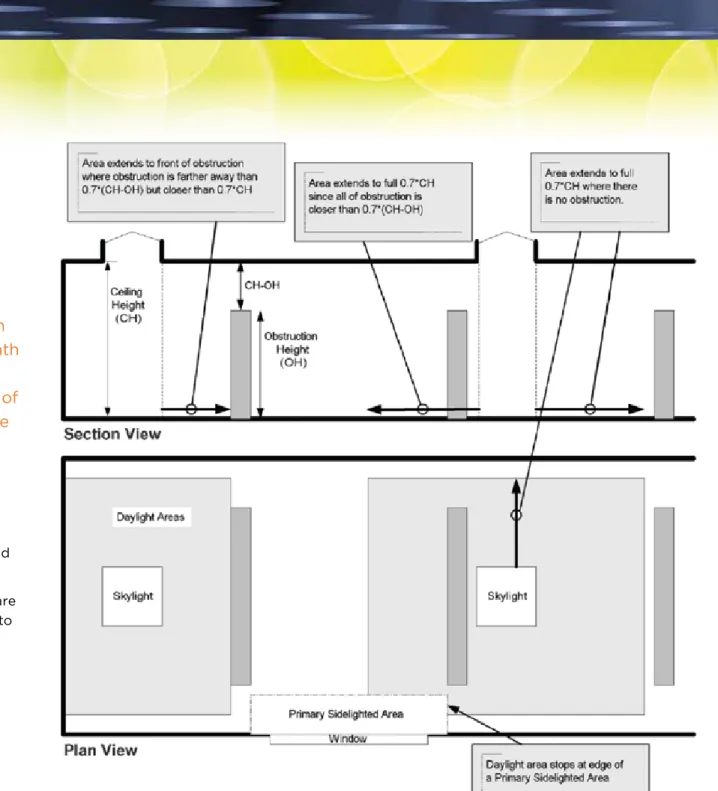
ASHRAE 90.1 defines the daylight area from
skylights as the floor area directly underneath
the skylight opening plus the floor area
horizontally in each direction for a distance of
0.7 times the ceiling height beyond the edge
of the skylight.
Daylighting only needs to be supplied from one source; overlapping daylight in an area (i.e., skylight plus sidelighting) is only counted once and typically controlled by one system. Also, partitions above a certain height are considered obstructions and bound the effective daylight area.
Figure 3.1 illustrates how the skylight requirements are interpreted under different space layouts according to the requirements in ASHRAE 90.1.
Figure 3.2. Daylight area interpretations for roof monitors
Figure 3.2 illustrates the daylight area interpretations for roof monitors. The IECC has a slightly different definition for daylight area under skylights with the added horizontal width under the skylights being equal to the floor-to-ceiling height. It is important to note that different versions of all energy codes will show some variance so it is important to check the specific code being applied to the project to get the exact requirements.
CONTROLS
The availability of daylight allows electric lighting to be either turned off or turned down depending upon how much daylight is available, which then saves energy and reduces cooling loads.
To harvest the energy-saving
potential of daylighting, energy
codes require general electric
lighting in the daylight area
to be controlled by manual
or automatic daylighting
controls.
General lighting refers to lights that are used to provide uniform illumination within the space. Decorative or task lights are not typically included under general lighting for the purpose of daylighting controls.
Daylighting controls can be of two types: manual or automatic. ASHRAE Standard 90.1 requires automatic controls, whereas the 2012 IECC provides an option of either manual or automatic control. Automatic daylight controls can be either continuous dimming or stepped. Continuous dimming controls provide a finer control over light output and can also result in a smooth output level change when the daylight level changes suddenly. Stepped dimming controls are less expensive, do not offer as smooth a transition as continuous dimming systems, and commonly save slightly less energy compared to continuous dimming.
ASHRAE Standard 90.1 has different control
requirements for toplighting and sidelighting. It
also requires the toplighting daylight area to be
greater than 900 ft
2before daylighting controls
are required. The 2012 IECC does not distinguish
between toplighting controls and sidelighting
controls. Moreover, it does not place a threshold
on the minimum daylight area required to have
daylight capability controls.
daylight responsive controls
work best when they are
integrated into the lighting and luminaire design of the
space. If the daylight area does not encompass the entire
space, then the luminaires in the daylight area must
be placed on a separate circuit for individual control.
In sidelighted spaces, where the amount of daylight
decreases with distance from the window, rows of
luminaires parallel to the windows should be controlled
separately. Some new
daylight responsive
control systems integrate
the photocell, dimming
ballast, and control into
a single luminaire. This
allows great flexibility in
adjusting the light output
of individual luminaires
within a space.
daylighting controls
are based on the use of
photocells that sense the amount of light reflecting
off a daylighted surface or the intensity of light
coming through an opening such as a window.
A photocell sends a signal to a controller indicating
the light level in the space. The controller adjusts
the electric lighting output through direct dimming
or switching that may involve dimming ballasts
or drivers. The photocell and controller must be
calibrated to desired illuminance levels prior to use.
For example, in a school gym, an illuminance
level of 30 footcandles (fc) may be required at the
floor level. The daylight dimming system must
be calibrated such that when 15 fc of daylight
is received at the floor level, light output of
the overhead luminaires is reduced by half by
the daylight dimming system. Calibration and
commissioning of the dimming system is crucial
for it to work as intended.
3.1.2 SIdELIGHTING
Sidelighting refers to bringing daylight into a space through vertical fenestration (windows). As light travels deeper into the space from the perimeter, it is absorbed or blocked by the floor, ceiling, furniture, and partitions in the space. As a result, the total light level decreases for areas farther away from the windows. Window characteristics influence how deeply daylighting can effectively travel into a space.These characteristics include
the amount of window area
on the perimeter wall, the
height of the top edge of
the window, and visible light
transmittance (VLT) of the
glass.
Energy codes rely on these parameters to predict the daylighting potential in a space and based on those parameters ensure the building is able to effectively use available daylighting.
dAyLIGHT AREA
There is much debate about how much floor area can be daylighted using sidelighting. Placing windows higher on the wall allows daylight to penetrate more deeply into the space. Thus, a greater proportion of the space can be daylighted and more electric lighting can be turned down for increased energy savings. However, there are practical limits on how high windows can be placed on a wall, as well as the limit of VLT through glass products. The space type as well as ceiling height and construction cost usually limit the heights of windows. Also, the solar heat gain coefficient (SHGC) values for glass are strongly related to the VLT of the glass and are specific to climate zones and regulated by energy codes. Therefore, the VLT is indirectly regulated by code. Accordingly, the area that is required to be daylighted using sidelighting is specifically addressed in building energy codes and
standards.
Both ASHRAE Standard 90.1 and the IECC provide clear
definitions for daylight area from sidelighting but each
definition is slightly different in each document.
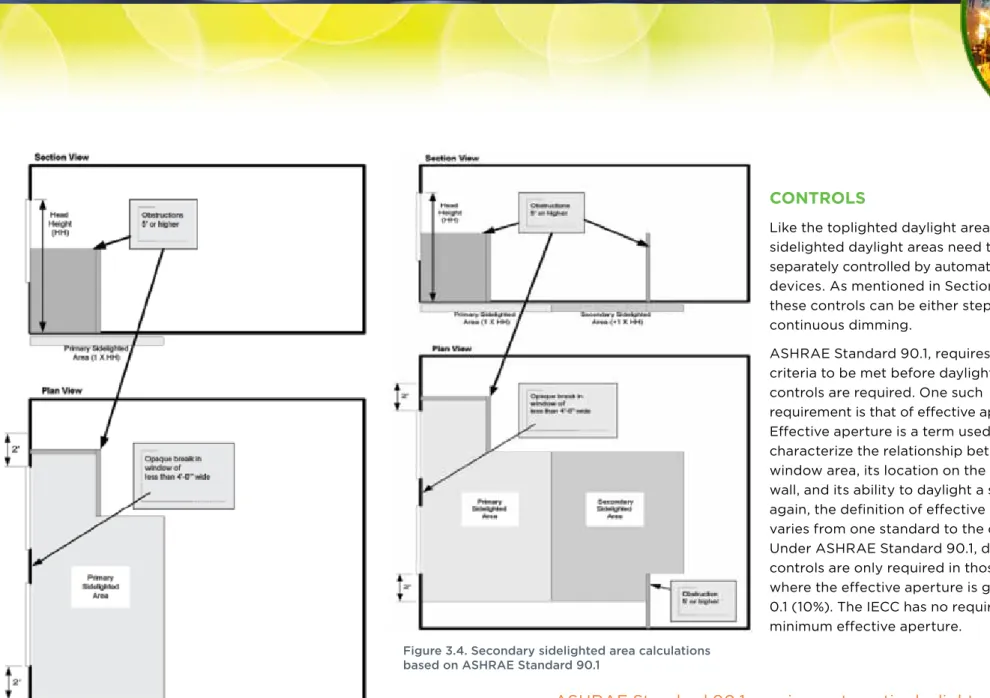
Under ASHRAE Standard 90.1, the primary sidelighted area is the floor area adjacent to the window and is equal to the product of the width of sidelighting window plus 2 feet on both sides and the window head height. Vertical obstructions taller
than 5 feet also bound the primary sidelighted area along both the width and the depth.
Figures 3.3 and 3.4 illustrate the primary and secondary sidelighted area calculations in ASHRAE Standard 90.1.
ASHRAE Standard 90.1 requires automatic daylight responsive
controls but only when the daylight area from sidelighting is
more than 250 ft
2. The IECC only requires that general lighting
in daylight areas have separate manual controls.
Figure 3.3. Primary sidelighted area calculations based on ASHRAE Standard 90.1
Figure 3.4. Secondary sidelighted area calculations based on ASHRAE Standard 90.1
CONTROLS
Like the toplighted daylight areas, the sidelighted daylight areas need to be separately controlled by automatic control devices. As mentioned in Section 3.1.1, these controls can be either stepped or continuous dimming.
ASHRAE Standard 90.1, requires other criteria to be met before daylighting controls are required. One such
requirement is that of effective aperture. Effective aperture is a term used to characterize the relationship between the window area, its location on the perimeter wall, and its ability to daylight a space. Here again, the definition of effective aperture varies from one standard to the other. Under ASHRAE Standard 90.1, daylighting controls are only required in those spaces where the effective aperture is greater than 0.1 (10%). The IECC has no requirement for a minimum effective aperture.
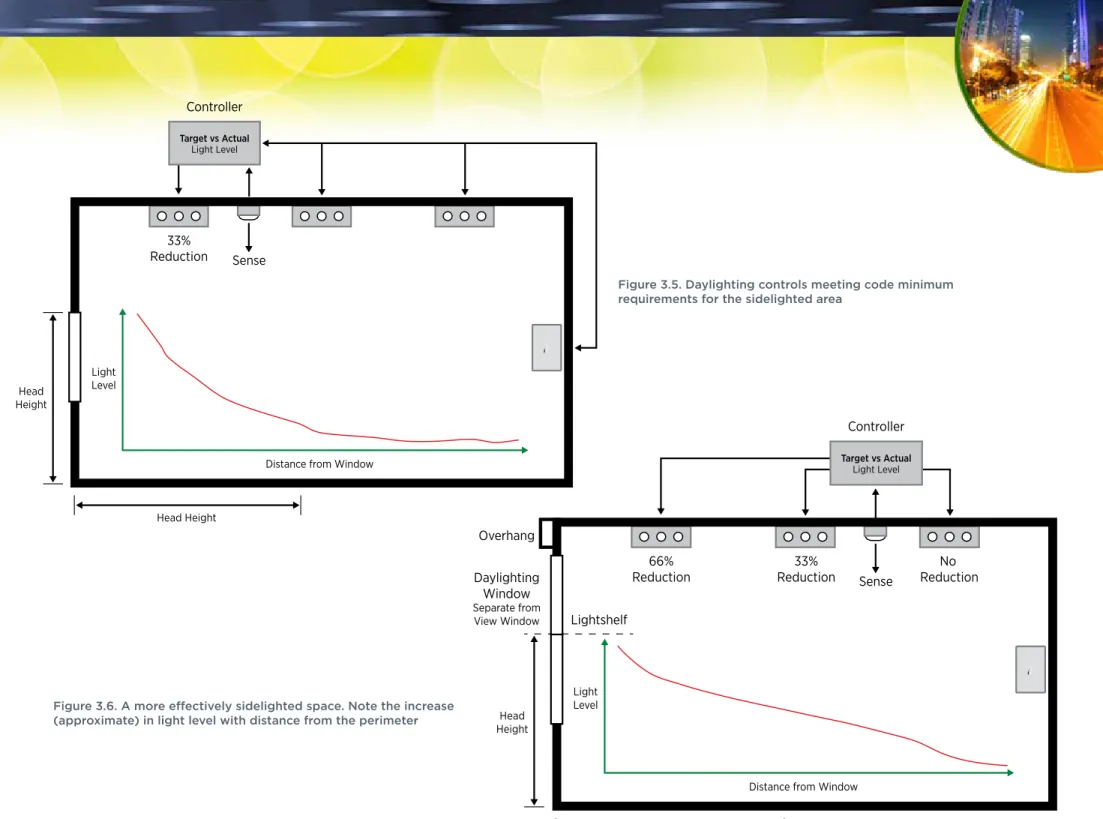
Figures 3.5 and 3.6show the same space but Figure 3.6 shows expanded daylighting controls and design strategies.
First, the function of daylighting is separated from the function of providing view. The bottom window now provides view, while the top window provides daylighting. By placing the daylight window higher in the perimeter wall, daylight can penetrate deeper into the space. The view window is allowed to have user-controlled blinds, with the daylighting window providing daylight capability, even when the blinds on the view window are closed for privacy. Exterior and interior lightshelves are placed at the bottom end of the daylighting window. In the summer months, the exterior lightshelf redirects sunlight from high sun angles into the space, while also providing shade for the view window. In winter months, the interior lightshelf redirects sunlight from low sun angles deeper into the space and provides protection from direct sunlight or glare.
The combination of high daylight windows with interior and exterior lightshelves provides a more even distribution of light levels in the space. All three luminaires within the space must now be controlled to account for the increased daylight area. The controller is
configured such that the light output of each of the three luminaires can be reduced independent of the others. Correctly calibrating the photocell and controller is crucial for this control strategy to work.
Once configured correctly, this space can provide much
better quality of light all through the year, while delivering
energy savings and meeting code requirements.
Figure 3.5
illustrates a typical sidelighting design
that will meet the minimum requirements of
ASHRAE/IES 90.1-2010. In this space, the window
provides both view and daylighting. The graph
overlay shows the rapid reduction in light level
with increasing distance from the window. In these
conditions the luminaire next to the window, which
provides general lighting in the sidelighted area,
must be controlled in response to the daylight.
Based on input from a photocell, the controller
can either lower the output of all three lamps in a
continuous dimming strategy or shut off individual
lamps successively for stepped dimming control.
All three luminaires within the space are also
controlled by a wall switch. This example shows
how controls can be applied to meet minimum
code requirements. Careful design can, however,
lead to better daylighting and more savings while
also meeting code.
Figure 3.5. Daylighting controls meeting code minimum requirements for the sidelighted area
Figure 3.6. A more effectively sidelighted space. Note the increase (approximate) in light level with distance from the perimeter
Head Height Head Height Sense 33% Reduction Controller Target vs Actual Light Level
Distance from Window Light
Level
Head Height
Distance from Window Light Level Sense 66% Reduction Controller Target vs Actual Light Level 33% Reduction ReductionNo Overhang Lightshelf Daylighting Window Separate from View Window
3.2 INTERIOR LIGHTING
CONTROLS
Interior lighting is one of the largest electricity energy end-uses in many commercial buildings. And controls can have a significant effect on their total use. Interior lighting controls give occupants control over the electric lighting in a space, and can be used to manage building lighting automatically. Effectively controlling the space lighting results not only in occupant comfort, but also in energy savings. Efficient lamps and light fixtures reduce the total installed lighting power, whereas controls generally reduce the amount of lighting used or the amount of time for which lighting is used. Lighting controls can be classified as those required across the entire building and those that must be applied space by space. The following sections describe the interior lighting controls required by building energy codes and standards.
3.2.1 MANUAL CONTROLS
The basic control provided in all spaces is a wall switch that allows occupants to turn general lighting on and off. This manual control device must be easily accessible and must be located such that the lights it controls are seen easily from the control location. Manual controls provide a minimum level of comfort for occupants. Manual control is not required in spaces such as corridors, stairwells, or other spaces where turning the lights off would be detrimental to egress and security. Lights in these spaces may be controlled separately using automatic controls, and lighting control requirements for these building areas are discussed in Section 3.2.3.Manual controls are allowed to override automatic controls. For example, in an office building with a time-based operation schedule that turns off general lighting after 8 pm, cleaning staff that come in after 8 pm must be allowed to override the automatic control and turn on the lights using manual controls. However, the manual override is allowed to last for a maximum of 2 hours, after which automatic controls will again turn off the lights.
3.2.2 LIGHTING
REdUCTION CONTROLS
Enclosed spaces with ceiling height partitions are good candidates for controlled reduction of lighting. Providing occupants with the capability of reducing light levels manually can lead to energy savings and occupant comfort.In ASHRAE Standard 90.1, the occupant must be able to reduce the lighting power to between 30% and 70% of full power using the manual control device. The IECC requires this stepped reduction to be lower than or equal to 50% of full power. Spaces such as corridors, stairways, electrical/mechanical rooms, public lobbies, restrooms, storage rooms, and sleeping units are exempted. Also exempted are spaces with only one luminaire with a rated power of less than 100 W and spaces with an LPD allowance of less than 0.6 W/ft2. The IECC
exempts areas within spaces that are controlled either by an occupancy sensor or by daylighting controls.
Under ASHRAE Standard 90.1, for spaces smaller than
10,000 ft
2, one manual control device is required for every
2,500 ft
2. For spaces larger than 10,000 ft
2, one manual
Many control strategies can be applied to reduce the light
output of a lighting system. Figure 3.7 illustrates different
control arrangements to reduce light levels from an array
of luminaires in a space.
In Figure 3.7.a
, the control switches off half of all the
luminaires in the space, while keeping the other half on.
Lighting Power Reduction: Control Strategies
Another approach is shown in figure Figure 3.7b, where
dimming controls reduce the input power to individual
lamps, reducing the light output. A third approach,
shown in Figure 3.7c, is to switch off alternate lamps
between adjacent luminaires. All three strategies would
qualify as lighting reduction controls.
SS
U
c. Alternating Lamps
D
I
b. Dimming
Dimmer Switch
SS
a. Alternating Luminaires
SS
U
c. Alternating Lamps
D
I
b. Dimming
Dimmer Switch
SS
a. Alternating Luminaires
SS
U
c. Alternating Lamps
D
I
b. Dimming
Dimmer Switch
SS
a. Alternating Luminaires
a. Alternating Luminaires
b. Dimming
c. Alternating Lamps
Dimmer Switch
3.2.3 AUTOMATIC LIGHTING
SHUTOFF CONTROLS
On/off controls and lighting reduction controls are manual controls that are needed in most spaces. However, these controls rely on occupants in order to obtain energy savings. There is no guarantee that these controls will save energy. When occupants are not present in a space and during the night, there is ample opportunity to turn lights off. Automatic lighting controls are required to control the lighting during these unoccupied periods. Automatic controls also guarantee energy savings from lighting.
The automatic shutoff can be implemented by a single device or by multiple devices. For example, if the time-based operation schedule is used, a single control system can turn off the lighting in the entire building. If occupancy sensors are used to meet the requirement, then multiple sensors would be needed for different spaces within the building.
Certain spaces are exempted from the automatic shutoff control requirements.
Spaces that house 24-hour operations or where turning off lights would compromise security are exempted. Sleeping units and patient rooms are also exempted.
When a time-based operation schedule is used to control automatic shutoff, the controls must be able to use different schedules for every 25,000 ft2 as
well as for every floor in a building. If occupancy sensors are installed, they must turn all general lighting off no more than 30 minutes after the space becomes unoccupied. If occupancy sensors are used in a space, that space cannot have a separate automatic shutoff system. Occupancy sensors and their requirements are discussed in greater detail in Section 3.2.4.
Energy codes require that all building spaces be controlled by an
automatic control device that shuts off general lighting. This control
device must turn off lights in response to a time-based operation
schedule, occupancy sensors that detect the absence of occupants,
or a signal from the building’s energy management system or some
other system that indicates that the space is empty.
3.2.4 OCCUPANCy
CONTROLS
Occupancy sensors allow a more granular control of automatic lighting shutoff in buildings. They are typically based on sensing movement within a space.
With occupancy sensors,
individual spaces can be
controlled independently of
each other. This allows the
lights to be on at night in
spaces such as lobbies that
operate 24 hours per day,
while lighting in other spaces
in the building is turned off.
Apart from the greater flexibility, this also results in greater energy savings. Of course the extra savings come at the expense of more sensors, controllers, and wiring for the occupancy sensors.
Both IECC and ASHRAE Standard 90.1 require occupancy sensors in certain spaces.
ASHRAE Standard 90.1 requires occupancy sensors in classrooms, lecture halls, conference rooms, training rooms, lunch or break rooms, storage rooms between 50 ft2 and 1,000 ft2, copy/print
rooms, office spaces smaller than 250 ft2, restrooms, dressing rooms,
locker rooms, and stairwells. IECC requires occupancy sensors in classrooms, conference rooms, lunch or break rooms, private offices, restrooms, storage rooms, and all other spaces smaller than 300 ft2. In these spaces, both
documents require the occupancy sensor to turn off lights no more than 30 minutes after all occupants have left the space.
Most building energy codes also regulate the way occupancy sensors turn lights on. Lighting must be controlled such that when occupants enter a room where the lights have been turned off by occupancy sensors, the lights must be turned on manually, or they may be turned on automatically but only to 50% of full power.
By preventing the lights from coming on automatically, false turn-on of lighting is avoided. Turning the lights on to full power is allowed in public corridors, stairwells, restrooms, primary building entrances, and lobbies and in areas where manual-on operation is considered unsafe.
3.2.5 AddITIONAL LIGHTING
CONTROLS
Apart from general lighting within the building, energy codes require controls for other types of lighting.
Display, accent, and case
lighting must be controlled
using separate control
devices. Similarly, lighting for
nonvisual tasks such as food
warming, plant growth, or
lighting for demonstration
purposes, must be controlled
by separate control devices.
The control device must be capable of controlling these lighting types independently of the general lighting within the space. These requirements are part of both the IECC and ASHRAE Standard 90.1. Guestrooms and suites in hotels and motels are required to have a master switch near the entry to the room that controls all permanently
installed luminaires and switched receptacles in the room except those in the bathroom. ASHRAE Standard 90.1 additionally requires automatic shutoff of bathroom lighting 60 minutes after motion is no longer detected. ASHRAE Standard 90.1 also requires task lighting, such as under-cabinet lights, to be controlled by a separate control device. This device must be accessible to the user and be either integral to the luminaire or located on a nearby wall or surface.
3.3 ExTERIOR LIGHTING
CONTROLS
Exterior lighting includes lighting installed in parking lots, parking garages, building façades,
walkways, entries, exits, canopies, and building grounds.
Exterior lighting may
represent a significant
portion of the building’s
total energy consumption.
Energy codes attempt to control exterior lighting consumption by regulating both the installed lighting power and the time for which the lights can be on. Each category of exterior lighting has specific limits on the power that can be installed. Similarly, separate control strategies are specified for the different categories of exterior lighting.
3.3.1 dUSK-TO-dAWN
CONTROLS
For dusk-to-dawn lighting, all
exterior lights must be turned
off during the day.
This is achieved by using either astronomical time switches or photocell-based controls. Astronomical time switches work by storing or calculating the sunrise and sunset times for each day of the year. Photocell-based controls simply sense the exterior light level. Apart from astronomical time switches, ordinary schedule-based controllers can also be used for special purpose lighting. Building energy codes require all time-switch
controls to hold the programming and time settings for 10 hours in the event of a power loss.
ASHRAE Standard 90.1 simply requires all exterior lighting to be turned off during the day. The corresponding IECC requirement is more specific. Under the IECC, all lighting designated for dusk-to-dawn operation must be controlled by either an astronomical time switch or a photocell-based control. Lighting that is not intended to operate from dawn to dusk must be controlled by either a combination of a photocell-based control and a time switch or
This type of lighting may be turned off any time during the night. For special cases, such as lighting for musical events, concerts, and sports events, the IECC requirement allows automatic turn-on and turn-off based on daylight availability as well as the event schedule.
3.3.2
LIGHTING POWER
REdUCTION CONTROLS
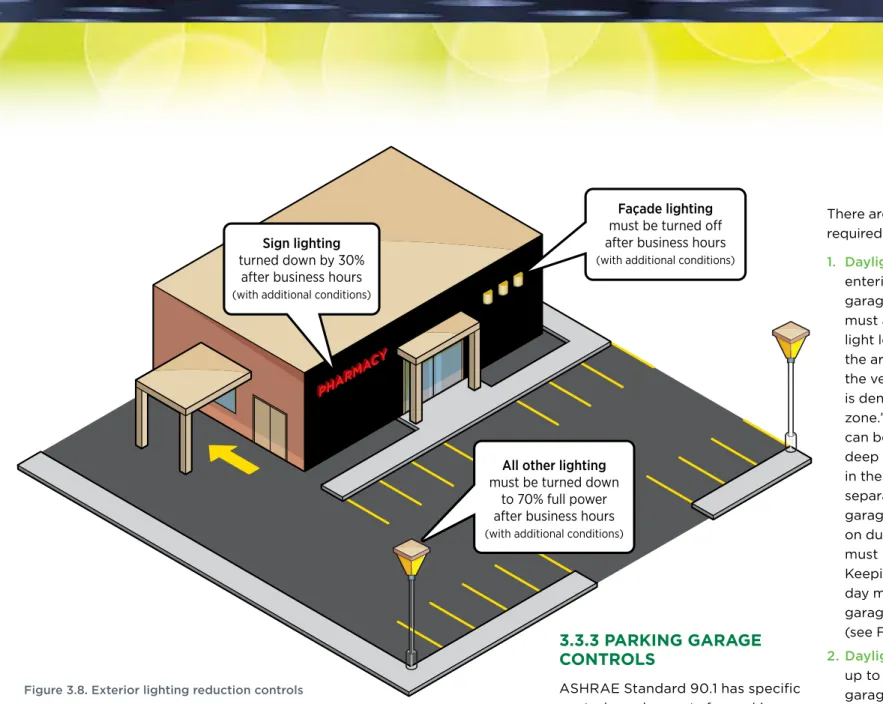
The IECC has no requirements for reduction in exterior lighting power during operation. Under ASHRAE Standard 90.1, certain exterior lighting categories must reduce, and in some cases completely turn off, lighting in response to an operation schedule or actual occupancy. The following controls are required by ASHRAE Standard 90.1:1. Building façade and landscape lighting is required to be shut off between midnight or business closing, whichever is later, and 6 a.m. or business opening, whichever is earlier. For example, the pharmacy building shown in Figure 3.8 closes at 2 a.m. and
landscape lighting at this building must be turned off from 2 a.m. through 6 a.m.
2. All other lighting must be reduced by at least 30% of full power using either occupancy sensors to turn lights off within 15 minutes of sensing zero occupancy, or from midnight or one hour from close of business, whichever is later, until 6 a.m. or business opening, whichever is earlier. For example, the pharmacy building shown in Figure 3.8 must turn down its parking lot lighting, walkway and canopy lighting, and the sign lighting to at most 70% of full power between 3 a.m. and 6 a.m.
Exterior lighting provided
for security, safety, or
eye adaptation, such as
covered parking lot or
building entrances and
exits, is exempted from
lighting reduction control
requirements.
3.3.3 PARKING GARAGE
CONTROLS
ASHRAE Standard 90.1 has specific control requirements for parking garages, which are treated as interior spaces for the purpose of lighting control. This means that many of the controls required for interior spaces are applied to the parking garage.
There are three categories of controls required for parking garages:
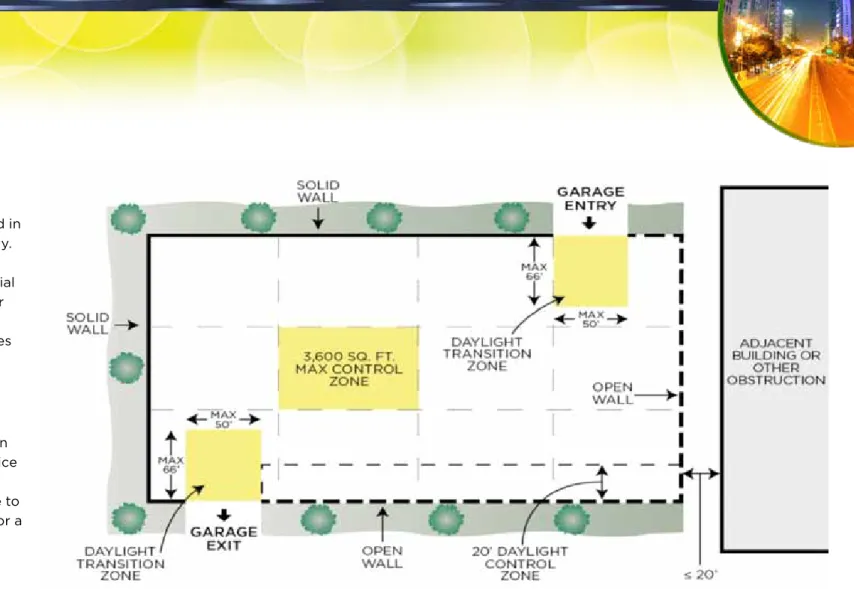
1. Daylight transition zones: While entering or exiting a parking garage during the day, the eye must adapt to a large change in light level. To ease this transition, the area inside the garage near the vehicular entrances and exits is denoted as a “daylight transition zone.” Daylight transition zones can be a maximum of 66 feet deep and 50 feet wide. Lighting in these zones must be controlled separately from the rest of the garage. Lighting must remain on during daylight hours and must be turned off after sunset. Keeping the lighting on during the day makes entering the parking garage much easier on the eyes (see Figure 3.9).
2. Daylight zones:Areas extending up to 20 feet inside the parking garage perimeter are considered daylight zones. If the perimeter wall has openings that are greater than or equal to 40% of the total wall area, and if there are no exterior obstructions within at least 20 feet of the
Sign lighting
turned down by 30% after business hours
(with additional conditions)
Façade lighting
must be turned off after business hours
(with additional conditions)
All other lighting
must be turned down to 70% full power after business hours
(with additional conditions)
perimeter, then lighting in the daylight zone must be reduced in response to daylight availability. This requirement attempts to harvest the daylighting potential in parking garages in a manner similar to the sidelighting requirements for interior spaces (see Figure 3.9).
3. Automatic lighting shutoff: Parking garages must comply with the automatic lighting shutoff requirements in Section 3.2.3. At least one control device is required to turn all parking garage lighting off in response to an operation-based schedule or a signal that senses occupancy. 4. Occupancy sensors: Lighting
reduction controls, similar to those described in Section 3.2.2, are required in all parking garage areas, except daylight transition zones. One control device is allowed to control only 3,600 ft2
of garage area. If the control area is unoccupied for 30 minutes, the control must be able to turn down lighting power to each luminaire by 30%. The manner in
Daylight transition zones and ramps without parking are exempted from the daylighting control and occupancy sensor requirements. Induction lamps and high-intensity discharge (HID) lamps rated less than 150 W are exempted from the
The energy use of lighting systems is directly related to installed power (watts) and hours of use. The installed power over a defined area is expressed in watts per square foot (W/ft2) and is known as the
lighting power density (LPD). The LPD is universally used for interior lighting power limits and most exterior limits. A few other limits for exterior applications are expressed in watts per linear foot and watts per location. As codes have progressed and interest in energy efficiency and savings has grown, the power limits set by the energy codes have become increasingly restrictive. The idea, of course, is for the code limits to reduce wasteful design by limiting power allowed for lighting. This can have the desired effect but can also create more difficult design challenges for many space types and task needs.
4.1 INTERIOR LIGHTING
POWER dENSITy
The interior LPD limits (watts per square foot) are presented by most energy codes as either whole building (building area) or space-by-space, or both. For whole-building compliance, the total lighting power designed for the building must be no greater than the allowed LPD for the building type. For space-by-space, the total power designed for the building must be no greater than the sum of the individual space allowances multiplied by the area of that space type in the building. The LPD limits in most energy codes and standards are based on a set of space-type lighting models that mimic quality energy efficient design for that space type. These models incorporate all primary
elements involved in design, including current product lamp efficacy, luminaire efficiency, light loss factors, and common design practice. Values are developed for most expected space types within buildings such that reasonably efficient design that still maintains quality design elements can be accomplished. It is understood that in some applications, the configuration of an individual space or specific lighting needs may make it difficult to meet the allowance for that space. Therefore, most interior space-by-space LPD compliance is based on a total building trade-off principle. This means that the summed allowance for the entire building can be used anywhere in the building. For example, the allowance for office areas can be only partially or completely used for
office lighting design. Any unused allowance can be applied to other spaces in the building. It is the total allowance compared to the total designed watts that is important for compliance.
4.0
Lighting Power Limits*
Designers and practitioners need to understand how the
limits are applied, what lighting can be exempted from
compliance, and where there are allowances that can be
applied for special purposes.
* Building energy code requirements change over time to meet newer federal requirements and address energy efficiency goals through revisions to the available codes and standards and their subsequent adoption by state and local jurisdictions. The guidance in this document is intended to be as broadly applicable as possible yet specific enough to provide practical application. To be most useful, the guidance is based on the current versions of the commonly available ASHRAE Standard 90.1-2010 and the 2012 IECC.
Whole building LPD compliance is a simpler method, in which allowances (typically one to three) are applied for each different building type area in the building and the total watts designed for the building must not exceed that value. While this method is easier to calculate, it does not offer the additional flexibility of the space-by-space method.
When completing designs that meet energy code limits, it is important to take advantage of any exemptions allowed. Most energy codes have a list of lighting applications that do not need to be counted when determining compliance. These applications are not counted as part of the designed watts per square foot for the building. Table 1 shows a partial list from the most recent ASHRAE 90.1 standard.
Exemptions will vary between
building energy codes. It is
important to review the list
to make sure only required
lighting power is used for
compliance calculation.
In addition to exempted lighting, most energy codes also provide allowances for lighting needs that go beyond basic illuminance for standard visual tasks.
One major allowance category is additional lighting used by retail establishments to highlight merchandise.
This long-standing use of light is important to retail sales. The energy codes typically set a minimum LPD for retail that provides light for basic employee and customer use and then allows additional lighting if installed and used to highlight merchandise. This allowance is commonly only allowed when applying a space-by-space LPD method. Some retail establishments use little or no highlighting and would therefore not be able to
• Lighting in spaces specifically designed for use
by the visually impaired.
• Lighting in retail display windows, provided
the display area is enclosed by ceiling-height
partitions.
• Lighting in interior spaces that have been
specifically designated as a registered interior
historic landmark.
• Lighting that is an integral part of advertising or
directional signage.
• Exit signs.
• Lighting that is for sale or lighting educational
demonstration systems.
• Lighting for theatrical purposes, including
performance, stage, and film and video
production.
Partial List of ASHRAE Standard 90.1-2010
Interior Lighting Power Exemptions
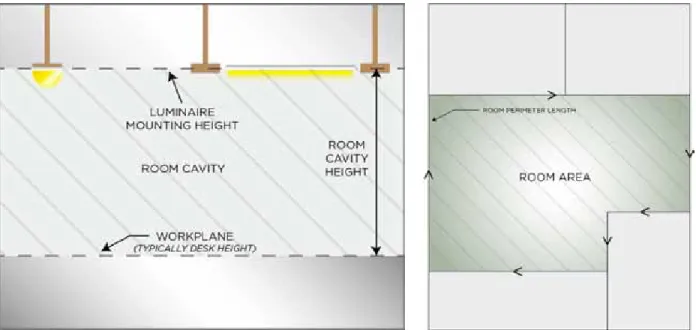
adjustment. It is understood in lighting design that odd room geometries and particularly high ceilings generally increase the watts needed to provide equivalent illuminance levels. The tighter LPDs in current energy codes can make compliance difficult for unusual spaces. The room geometry adjustment is designed to provide relief in unusual cases and is based
on the room cavity ration (RCR) calculated for a space (see figure 4.1). If the calculated RCR is above a specified threshold, the allowance for that space is increased by 20%. The thresholds are set above typical dimensions for most spaces of each type and are therefore not easily met, but they are available if needed.
Figure 4.1. Typical room geometry related to room cavity ratio calculations claim any additional watts. When
additional highlighting watts are a part of the design, the energy code allowance is limited depending on the type of merchandise being highlighted and can only be used up to the actual amount of lighting watts installed.
One potential misconception is the dual use of lighting for general illumination and highlighting. In a case like this, the lighting is counted as general illumination and is not eligible for additional watts. The allowance is only applied to lighting that is in addition to general lighting, separately installed, and specifically oriented or aimed to highlight merchandise. One way to understand the application of the retail allowance is to consider what happens if all lighting that is being claimed as eligible for the highlighting allowance is turned off. In this situation, if the space is left dark or below the level of general illumination for occupant function, allowances are likely being applied beyond the intent of the standard.
Another common allowance is applied to decorative lighting. Again, this must be in addition to general lighting and for decorative purposes only. The same lights-off test described for the retail merchandise allowance can also be applied here.
ASHRAE Standard 90.1-2010 also incorporates a room geometry