Security Quality
Requirements
Engineering
(SQUARE)
Methodology
Nancy R. Mead Eric D. Hough Theodore R. Stehney II November 2005 TECHNICAL REPORT CMU/SEI-2005-TR-009 ESC-TR-2005-009Pittsburgh, PA 15213-3890
Security Quality
Requirements
Engineering
(SQUARE)
Methodology
CMU/SEI-2005-TR-009 ESC-TR-2005-009 Nancy R. Mead Eric D. Hough Theodore R. Stehney II November 2005This report was prepared for the
SEI Administrative Agent ESC/XPK
5 Eglin Street
Hanscom AFB, MA 01731-2100
The ideas and findings in this report should not be construed as an official DoD position. It is published in the interest of scientific and technical information exchange.
FOR THE COMMANDER
Christos Scondras Chief of Programs, XPK
This work is sponsored by the U.S. Department of Defense. The Software Engineering Institute is a federally funded research and development center sponsored by the U.S. Department of Defense.
Copyright 2005 Carnegie Mellon University.
NO WARRANTY
THIS CARNEGIE MELLON UNIVERSITY AND SOFTWARE ENGINEERING INSTITUTE MATERIAL IS FURNISHED ON AN "AS-IS" BASIS. CARNEGIE MELLON UNIVERSITY MAKES NO WARRANTIES OF ANY KIND, EITHER EXPRESSED OR IMPLIED, AS TO ANY MATTER INCLUDING, BUT NOT LIMITED TO, WARRANTY OF FITNESS FOR PURPOSE OR MERCHANTABILITY, EXCLUSIVITY, OR RESULTS OBTAINED FROM USE OF THE MATERIAL. CARNEGIE MELLON UNIVERSITY DOES NOT MAKE ANY WARRANTY OF ANY KIND WITH RESPECT TO FREEDOM FROM PATENT, TRADEMARK, OR COPYRIGHT INFRINGEMENT.
Use of any trademarks in this report is not intended in any way to infringe on the rights of the trademark holder.
Internal use. Permission to reproduce this document and to prepare derivative works from this document for internal use is granted, provided the copyright and "No Warranty" statements are included with all reproductions and derivative works.
External use. Requests for permission to reproduce this document or prepare derivative works of this document for external and commercial use should be addressed to the SEI Licensing Agent.
This work was created in the performance of Federal Government Contract Number FA8721-05-C-0003 with Carnegie Mellon University for the operation of the Software Engineering Institute, a federally funded research and development center. The Government of the United States has a royalty-free government-purpose license to use, duplicate, or disclose the work, in whole or in part and in any manner, and to have or permit others to do so, for government purposes pursuant to the copyright license under the clause at 252.227-7013.
For information about purchasing paper copies of SEI reports, please visit the publications portion of our Web site (http://www.sei.cmu.edu/publications/pubweb.html).
Table of Contents
Acknowledgments ...vii Executive Summary...ix Abstract...xi 1 Introduction ...1 1.1 Industry Problem ...1 1.2 Practice Description...22 Security Quality Requirements Engineering Process...3
3 Security Quality Requirements Engineering Steps ...7
3.1 Step 1: Agree on Definitions ...8
3.2 Step 2: Identify Security Goals...10
3.3 Step 3: Develop Artifacts...12
3.4 Step 4: Perform Risk Assessment...13
3.5 Step 5: Select Elicitation Technique ...14
3.6 Step 6: Elicit Security Requirements ...15
3.7 Step 7: Categorize Requirements ...17
3.8 Step 8: Prioritize Requirements ...18
3.9 Step 9: Requirements Inspection ...19
4 Recent Results...21
4.1 Step 1: Agree on Definitions ...21
4.2 Step 2: Identify Security Goals...23
4.3 Step 3: Develop Artifacts...24
4.3.1 System Architecture...24
4.3.2 Attack Trees...26
4.3.3 Use Cases ...27
4.6 Step 5: Select Elicitation Techniques...37
4.6.1 Literature Review ...37
4.7 Step 6: Elicit Security Requirements ...39
4.7.1 IBIS ...39
4.7.2 ARM...41
4.7.3 JAD ...43
4.8 Step 7: Categorize Requirements ...45
4.9 Step 8: Prioritize Requirements...46
4.10 Step 9: Inspect Requirements...49
5 Future Research Plans ...51
Appendix ...53
List of Figures
Figure 1: Sample of Terms and Definitions Provided to Stakeholders for Review. 22
Figure 2: Simple Hierarchy of Goals and Recommendations ... 23
Figure 3: Example System Architecture Diagram... 25
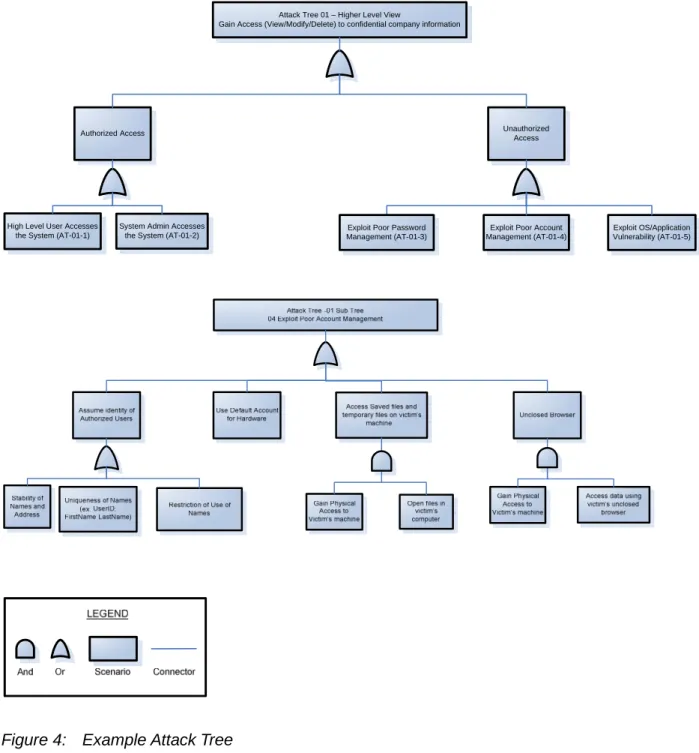
Figure 4: Example Attack Tree ... 26
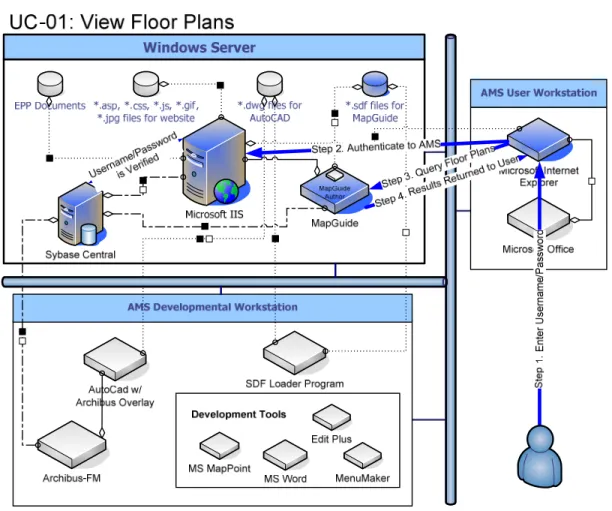
Figure 5: Sample Use Case Diagram... 28
Figure 6: Example Misuse Diagram Trace ... 30
Figure 7: Example IBIS Map Generated with Compendium ... 40
List of Tables
Table 1: Steps in the SQUARE Process ... 4
Table 2: Example Set of Initial Terms... 8
Table 3: Example Term with Suggested Definitions ... 9
Table 4: Minimal Set of Categories for Requirements Categorization ... 17
Table 5: Acme Corporation’s Business and Security Goals ... 23
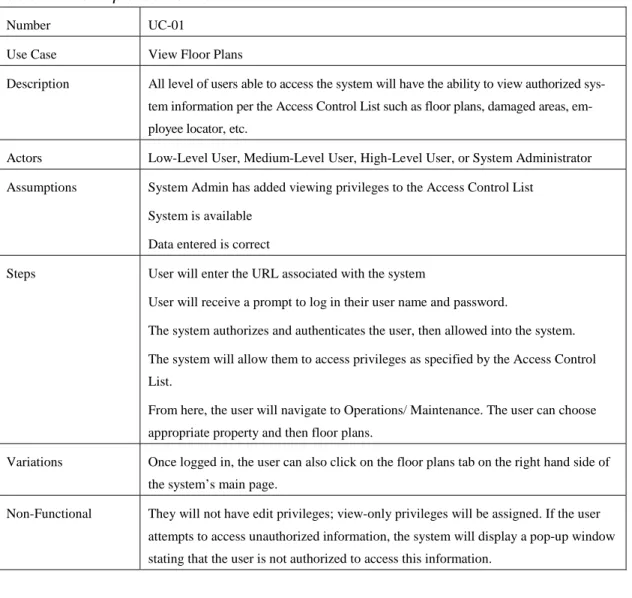
Table 6: Sample Use Case... 27
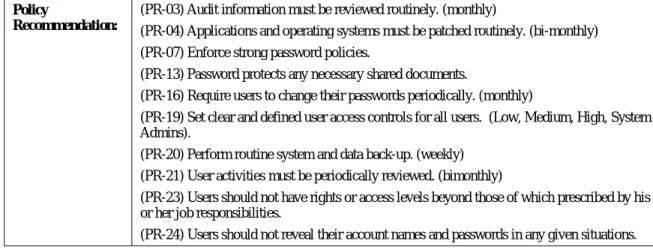
Table 7: Example Misuse Case ... 28
Table 8: Mapping Between Misuse Cases and Attack Trees... 31
Table 9: Use Cases and Initial Rankings of Essentiality... 32
Table 10: Results of Risk Assessment Literature Review ... 35
Table 11: Risk Assessment Results... 36
Table 12: Comparison of Elicitation Techniques... 38
Table 13: Requirements Generated for Acme Using the “Unstructured Interview” Elicitation Technique ... 39
Table 14: Security Requirements Generated with IBIS ... 41
Table 20: Interpretation of Values in Matrix ...46
Table 21: Interpretation of Costs in Matrix ...47
Table 22: Peer Review Log Format...49
Table 23: Inspection Checklist ...50
Table 24: Terms and Definitions from Initial Case Study...53
Acknowledgments
The authors would like to acknowledge the work of the student teams at Carnegie Mellon University that have contributed to the SQUARE methodology. They are Peter Chen, Lydia Chung, Marjon Dean, Dan Gordon, Frank Hung, Lilian Lopez, Don Ojoko-Adams, Hassan Osman, Will Salamon, Ted Stehney, Neha Wattas, Nick (Ning) Xie, and Eugene Yu.
Executive Summary
The Software Engineering Institute’s Networked Systems Survivability (NSS) Program at Carnegie Mellon University has developed a methodology to help organizations build secu-rity into the early stages of the production life cycle. The Secusecu-rity Quality Requirements En-gineering (SQUARE) Methodology consists of nine steps that generate a final deliverable of categorized and prioritized security requirements. Although the SQUARE Methodology could likely be generalized to any large-scale design project, it was designed for use with in-formation technology systems.
The SQUARE process involves the interaction of a team of requirements engineers and the stakeholders of an IT project. It begins with the requirements engineering team and project stakeholders agreeing on technical definitions that serve as a baseline for all future communi-cation. Next, business and security goals are outlined. Third, artifacts and documentation are created, which are necessary for a full understanding of the relevant system. A structured risk assessment determines the likelihood and impact of possible threats to the system. Following this work, the requirements engineering team determines the best method for eliciting initial security requirements from stakeholders, which is dependent on several factors, including the stakeholders involved, the expertise of the requirements engineering team, and the size and complexity of the project. Once a method has been established, the participants rely on arti-facts and risk assessment results to elicit an initial set of security requirements. Two subse-quent stages are spent categorizing and prioritizing these requirements for management’s use in making tradeoff decisions. Finally, an inspection stage is included to ensure the consis-tency and accuracy of the security requirements that have been generated.
SQUARE is a work in progress. Several case studies with real-world clients have shown that the methodology holds good promise for incorporation into industry practice. The SQUARE process has been enhanced and refined throughout the case studies. The current working model is presented in this paper. NSS is currently continuing research on the process and is working in parallel to create a CASE tool to support each stage of the methodology.
Abstract
Requirements engineering, a vital component in successful project development, often does not include sufficient attention to security concerns. Studies show that up-front attention to security can save the economy billions of dollars, yet security concerns are often treated as an afterthought to functional requirements. Industry can thus benefit from a model to examine security requirements in the development stages of the production life cycle.
This report presents the Security Quality Requirements Engineering (SQUARE) Methodol-ogy for eliciting and prioritizing security requirements in software development projects, which was developed by the Software Engineering Institute’s Networked Systems Survivabil-ity (NSS) Program. The methodology’s steps are explained, and results from its application in recent case studies are examined. The NSS Program continues to develop SQUARE, which has proven effective in helping organizations understand their security posture and produce products with verifiable security requirements.
1 Introduction
1.1 Industry
Problem
Requirements engineering is well recognized in industry to be critical to the success of any major development project. Several authoritative studies have shown that requirements engi-neering defects cost 10 to 200 times more to correct once fielded than they would if they were detected during requirements development [Boehm 88, McConnell 01]. Other studies have shown that reworking requirements defects on most software development projects costs 40 to 50 percent of total project effort [Jones 86], and the percentage of defects originat-ing duroriginat-ing requirements engineeroriginat-ing is estimated at more than 50 percent [Wiegers 01].
A recent study found that the return on investment when security analysis and secure engi-neering practices are introduced early in the development cycle ranges from 12 to 21 percent, with the highest rate of return occurring when the analysis is performed during application design [Soo Hoo 01]. NIST reports that software that is faulty in security and reliability costs the economy $59.5 billion annually in breakdowns and repairs [NIST 02]. The costs of poor security requirements show that there would be a high value to even a small improvement in this area. By the time that an application is fielded and in its operational environment, it is very difficult and expensive to significantly improve its security.
Requirements problems are the single number one reason projects
• exceed budget
• exceed schedule
• have significantly reduced scope
• deliver poor-quality applications
• are not significantly used once delivered
• are cancelled
quirements, ignoring quality requirements and other constraints such as architecture, de-sign, implementation, and testing.
• Requirements specification is typically haphazard, with specified requirements that are ambiguous, incomplete (e.g., non-functional requirements are often missing), inconsis-tent, not cohesive, infeasible, obsolete, unable to be tested or validated, and not usable by all of their intended audiences.
• Requirements management is typically limited to tracing, scheduling, and prioritization, with poor storage (e.g., in one or more documents rather than in a database or tool) and missing attributes.
1.2 Practice
Description
While much has been written about security requirements in the abstract, the mechanisms to translate the theory into practice have been unclear. If security requirements are not effec-tively defined, the resulting system cannot be effeceffec-tively evaluated for success or failure prior to implementation. Security requirements are often missing in the requirements elicitation process. The lack of validated methods is considered one of the factors.
In addition to employing applicable software engineering techniques, the organization must understand how to incorporate the techniques into its existing software development proc-esses. The identification of organizational mechanisms that promote or inhibit the adoption of security requirements elicitation can be an indicator of the security level of the resulting product.
An earlier report, focusing on survivable requirements engineering, provided an interesting range of material in this respect [Mead 03]. Security requirements engineering has only been recently researched, with much of the material assembled within the past year or two. The security area did not have techniques or templates for requirements elicitation. By assembling an elicitation framework based on our initial research and applying it to active software de-velopment efforts, we were able to identify additional research areas and refine the frame-work through further research.
If usable approaches to security are developed and mechanisms to promote organizational use are identified, then the organization can ensure that the resulting product effectively meets security requirements.
2 Security Quality Requirements
Engineering Process
Security Quality Requirements Engineering (SQUARE) has been developed at Carnegie Mel-lon University by Nancy Mead with Donald Firesmith and Carol Woody of the Software En-gineering Institute (SEI). The process provides a means for eliciting, categorizing, and priori-tizing security requirements for information technology systems and applications. The long-term goal of SQUARE is to integrate security considerations into the early stages of the de-velopment life cycle. SQUARE has also proven to be useful for documenting and analyzing the security aspects of fielded systems and has potential for steering future improvements and modifications to these systems.
As is common with many quality requirements, the distinction between functional and
non-functional security requirements of a system is subtle. For instance, a developer may argue
that a system must protect against denial-of-service attacks in order to fulfill its mission. Such a requirement may be considered by other stakeholders to be an availability or reliability is-sue that is not central to the mission of the system. In the SQUARE methodology, security requirements are often discussed in the context of quality, non-functional requirements. How-ever, as opposed to artificially categorizing all security requirements as nonfunctional, the methodology approaches security requirements as they are often handled in requirements en-gineering: as an afterthought and add-on to the system’s functional requirements. By address-ing security requirements in this respect, the SQUARE Methodology is able to accurately adapt to the current state of the practice of software and requirements engineering.
The methodology is most effective and accurate when conducted with a team of requirements engineers with security expertise and the stakeholders of the project. The requirements engi-neering team can be thought of as external consultants, though often the team is composed of one or more internal developers of the project. Throughout this report, the terms “require-ments engineer” and “require“require-ments engineering team” are synonymous. Likewise, this report will refer to “stakeholders” also as “clients” or “the client organization.” The effectiveness of SQUARE in eliciting requirements is dependent on representation from the project’s
stake-formed in parallel. For instance, it might be more efficient for the requirements engineering team to perform Step 2 (Identify Security Goals) and Step 3 (Develop Artifacts) simultane-ously, since to some extent they are independent activities. The output of both steps, however, is required for Step 4 (Identify Security Goals).
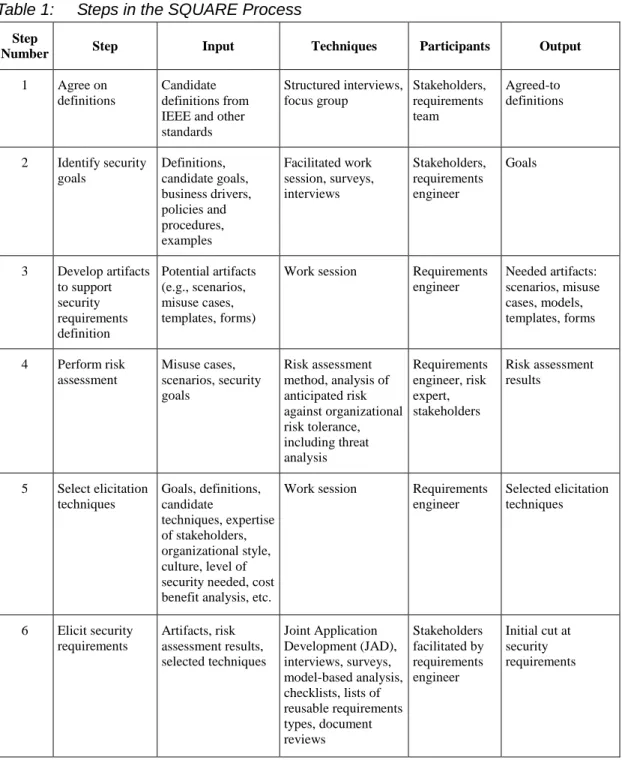
Table 1: Steps in the SQUARE Process Step
Number Step Input Techniques Participants Output
1 Agree on
definitions
Candidate definitions from IEEE and other standards Structured interviews, focus group Stakeholders, requirements team Agreed-to definitions 2 Identify security goals Definitions, candidate goals, business drivers, policies and procedures, examples Facilitated work session, surveys, interviews Stakeholders, requirements engineer Goals 3 Develop artifacts to support security requirements definition Potential artifacts (e.g., scenarios, misuse cases, templates, forms)
Work session Requirements engineer Needed artifacts: scenarios, misuse cases, models, templates, forms 4 Perform risk assessment Misuse cases, scenarios, security goals Risk assessment method, analysis of anticipated risk against organizational risk tolerance, including threat analysis Requirements engineer, risk expert, stakeholders Risk assessment results 5 Select elicitation techniques Goals, definitions, candidate techniques, expertise of stakeholders, organizational style, culture, level of security needed, cost benefit analysis, etc.
Work session Requirements engineer Selected elicitation techniques 6 Elicit security requirements Artifacts, risk assessment results, selected techniques Joint Application Development (JAD), interviews, surveys, model-based analysis, checklists, lists of reusable requirements types, document reviews Stakeholders facilitated by requirements engineer Initial cut at security requirements
Step
Number Step Input Techniques Participants Output
7 Categorize requirements as to level (system, software, etc.) and whether they are requirements or other kinds of constraints
Initial requirements, architecture
Work session using a standard set of categories Requirements engineer, other specialists as needed Categorized requirements 8 Prioritize requirements Categorized requirements and risk assessment results Prioritization methods such as Triage, Win-Win Stakeholders facilitated by requirements engineer Prioritized requirements 9 Requirements inspection Prioritized requirements, candidate formal inspection technique Inspection method such as Fagan, peer reviews Inspection team Initial selected requirements, documentation of decision making process and rationale
As Table 1 illustrates, the first task for the organization is to agree on a common set of secu-rity definitions, followed by the definition of organizational secusecu-rity goals. These secusecu-rity goals may be derived from business application goals, potential threats to project assets, and management controls and policy. The requirements engineer can then develop artifacts (net-work maps and diagrams, attack trees, and use/misuse cases) that will aid in the elicitation of security requirements. Next, a formal risk assessment allows the organization to understand how the likelihood and impact of various threats can affect the project’s security goals and assets.
At this point in the SQUARE process, the requirements engineer must select one or more requirements-elicitation techniques appropriate for the organization’s culture, expertise, level of security required, and nature of the system being developed. The selected techniques are subsequently used to elicit an initial set of security requirements in the form of operational constraints on the system. An example of such a requirement is “The system shall only reveal employee salary information to members of the Human Resources Department.” These re-quirements are then categorized, prioritized, and formally inspected for correctness in the remaining steps of SQUARE. The final output of the process is a security requirements document that satisfies the security goals of the project, contains clear and verifiable re-quirements, and is agreed on by all relevant stakeholders.
3 Security Quality Requirements
Engineering Steps
In this section, the steps in the SQUARE Methodology are enumerated in greater detail. The purpose of this section is to clarify the purpose of each step, the expectations of the partici-pants, and the exit criteria of each step. Recommendations to the process are also stated where appropriate.
3.1
Step 1: Agree on Definitions
In order to guarantee effective and clear communication throughout the requirements engi-neering process, the requirements engiengi-neering team and stakeholders must first agree on a common set of terminology and definitions. Given the differences in expertise, knowledge, and experience, an arbitrary term may have multiple meanings between the participants of SQUARE. In addition, there may be ambiguity in the level of detail that is assumed for a given term. For instance, one stakeholder may view “access controls” as a set of policies that governs which users may be granted access to which resources. Another stakeholder may view access controls as the software elements in the system that actually implement this func-tionality. These differences in perspective must be resolved before the process can continue.
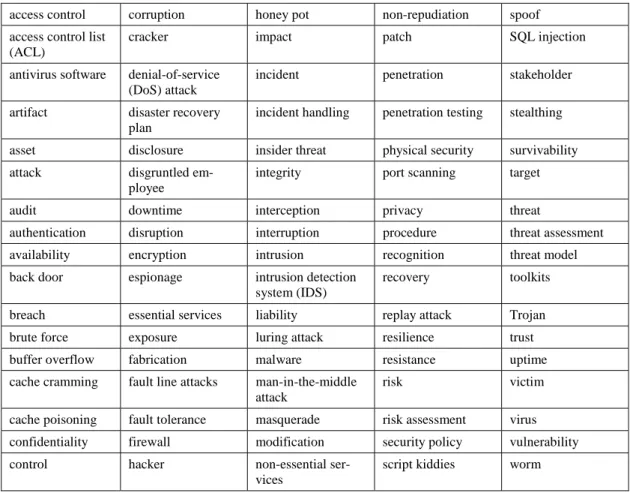
Fortunately, it is not necessary to reproduce a comprehensive set of definitions for each itera-tion of SQUARE. Using public resources, such as the Software Engineering Body of Knowl-edge (SWEBOK) [IEEE 05], IEEE 610.12 Standard Glossary of Software Engineering Ter-minology [IEEE 90], and Wikipedia [Wiki 05], the requirements engineering team can produce and reuse a comprehensive set of security terms with which to work. See Table 2 for an example set of initial terms upon which the requirements engineering team can build.
Table 2: Example Set of Initial Terms
access control corruption honey pot non-repudiation spoof access control list
(ACL)
cracker impact patch SQL injection
antivirus software denial-of-service (DoS) attack
incident penetration stakeholder
artifact disaster recovery
plan
incident handling penetration testing stealthing
asset disclosure insider threat physical security survivability
attack disgruntled
em-ployee
integrity port scanning target
audit downtime interception privacy threat
authentication disruption interruption procedure threat assessment
availability encryption intrusion recognition threat model
back door espionage intrusion detection system (IDS)
recovery toolkits
breach essential services liability replay attack Trojan
brute force exposure luring attack resilience trust
buffer overflow fabrication malware resistance uptime
cache cramming fault line attacks man-in-the-middle attack
risk victim cache poisoning fault tolerance masquerade risk assessment virus
confidentiality firewall modification security policy vulnerability
control hacker non-essential
ser-vices
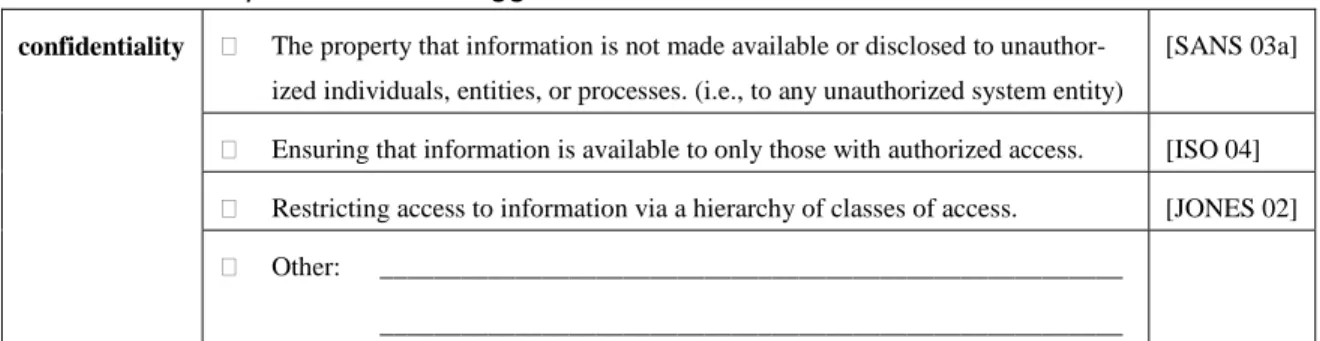
The initial list of terms should also include suggested definitions for each term and their cor-responding sources. This allows the stakeholders to get a general understanding and scope of each term, and in the common case, select one of the suggested definitions as final. See Table 3 for an example of the information that should be provided with each term. In this example, the stakeholders could place a checkmark next to the definition that suits them best.
Table 3: Example Term with Suggested Definitions
confidentiality The property that information is not made available or disclosed to unauthor-ized individuals, entities, or processes. (i.e., to any unauthorunauthor-ized system entity)
[SANS 03a]
Ensuring that information is available to only those with authorized access. [ISO 04]
Restricting access to information via a hierarchy of classes of access. [JONES 02]
Other: _______________________________________________________ _______________________________________________________
Requirements Engineering Team Responsibilities:
1. Provide an initial set of terms with corresponding suggested definitions. All external sources should be cited. The set of terms should be as comprehensive as possible, even if some terms appear to be irrelevant to the project.
2. Provide a means for stakeholders to review and select a desired definition for each term. This process could take place by way of a Web-based tool, email exchanges, or paper surveys. The chosen means must allow the stakeholders to freely add new terms and definitions to the set.
3. Document and share the finalized set of terms and definitions.
Stakeholder Responsibilities:
Select an existing or create a custom definition for each term provided by the requirements engineering team. All stakeholders must come to a consensus on each term’s definition in a timely manner and present their results to the requirements engineering team.
Joint Responsibilities:
Establish a single point of contact (POC) for interaction between the requirements engineer-ing team and the stakeholders.
3.2
Step 2: Identify Security Goals
The purpose of Step 2 in SQUARE is for the stakeholders to formally agree on a set of priori-tized security goals for the project. Without overall security goals for the project, it is impos-sible to identify the priority and relevance of any security requirements that are generated. In addition, the establishment of security goals scopes the rest of the SQUARE process.
Initially, different stakeholders will likely have different security goals. For example, a mem-ber of human resources may be concerned about maintaining the confidentiality of personnel records, whereas a stakeholder in finance may be concerned with ensuring that financial data is not modified without authorization. The security goals of the stakeholders may also con-flict with one another. A security-conscious stakeholder may place high importance on strong security controls for the system, which in turn may hamper overall system performance. De-creased performance might likely be at odds with the goals of the marketing department. Step 2 in the SQUARE process serves to eliminate such conflicts and align all of the stakeholders’ interests.
The security goals of the project must be in clear support of the project’s overall business goal, which also must be identified and enumerated in this step. On average, stakeholders should attempt to brainstorm to come up with approximately half a dozen security goals for the project, with more or less depending on the scale of the project. More sophisticated tech-niques for mapping high-level business requirements to low-level requirements can be found in Core Security Requirements Artefacts [Moffett 04] and “Mapping Mission-Level Availabil-ity Requirements to System Architectures and Policy Abstractions” [Watro 01].
Once the goals of the various stakeholders have been identified, they must be prioritized. In the absence of consensus, an executive decision may be needed to prioritize the goals.
Finally, the requirements engineering team must encourage the stakeholders to generate secu-rity goals as opposed to requirements or recommendations. There is a fine line between a se-curity goal such as “The system shall be available for use when needed,” a requirement such as “The system must have a continuity of operations plan in place to ensure appropriate sys-tem availability,” and a recommendation such as “Invest in backup information technology hardware to ensure business continuity.” The requirements engineering team must act as the experts in this situation, providing assistance to the stakeholders so that they may generate an appropriately scoped set of security requirements.
Requirements Engineering Team Responsibilities:
1. Facilitate the brainstorm session by the stakeholders, emphasizing the importance of creating a single business goal, followed by several security goals that support it. 2. Review the stakeholders’ business and security goals, providing any feedback on scope,
level of detail, and relevance to the business goal of the project.
Stakeholder Responsibilities:
1. Identify a single business goal for the project. This goal should be stated in one sen-tence, such as “The system shall provide the means to effectively manage company re-sources in a disaster situation.”
2. Brainstorm and create approximately half a dozen security goals that are in clear support of the business goal. For example, “The system shall maintain high availability, even in the face of public utility failures.”
3. Prioritize the security goals.
4. Provide the business goal and security goals to the requirements engineering team for review, and edit the goals as deemed necessary by the team.
Exit Criteria:
A single business goal for the project and several prioritized security goals that support it have been established.
3.3 Step
3:
Develop
Artifacts
Before the requirements engineering team and stakeholders can generate a comprehensive set of security requirements, the team must collect a complete set of artifacts of the system. The following are the types of artifacts that should be collected:
• system architecture diagrams
• use case scenarios/diagrams
• misuse case scenarios/diagrams
• attack trees
• standardized templates and forms
In developing such artifacts, it is important to enlist the assistance of knowledgeable engi-neers from the organization. In some cases, it is possible that the client organization will not have any of the artifacts in place, including such basic items as system architecture diagrams. In such situations, the requirements engineering team should reiterate to the stakeholders that by creating and documenting artifacts of the system, they are investing in the success of the project.
Requirements Engineering Team Responsibilities:
Work with the stakeholders and client organization to identify and collect as many artifacts as possible.
Stakeholder Responsibilities:
Generate or collect any system artifacts and present them to the requirements engineering team. This information includes system architectures, actors, use/misuse cases, and suspected attacks. It is possible that other experts from within the organization may be called upon to provide information as well.
Joint Responsibilities:
Verify the accuracy and completeness of all artifacts.
Exit Criteria:
A set of artifacts for the system, as complete as possible, has been generated by the require-ments engineering team and shared with the stakeholders.
3.4
Step 4: Perform Risk Assessment
The purpose of this step in the SQUARE process is to identify the vulnerabilities and threats that face the system, the likelihood that the threats will materialize as real attacks, and any potential consequences of an attack. Without a risk assessment, organizations can be tempted to implement security requirements or countermeasures without a logical rationale. For in-stance, the stakeholders may decide that encryption is a necessary component of their system without fully understanding the nature of the problem that encryption can solve. The risk as-sessment also serves to prioritize the security requirements at a later stage in the process.
There are a growing number of risk assessment methods from which to choose (see the list of examples in Section 4.5.1). Some of the methods are very structured and may require the as-sistance of an external risk expert. Ideally, this expert would already be a part of the require-ments engineering team.
After the threats have been identified by the risk assessment method, they must be classified according to likelihoods. Again, this will aid in prioritizing the security requirements that are generated at a later stage. For each threat identified, a corresponding security requirement can identify a quantifiable, verifiable response. For instance, a requirement may describe speed of containment, cost of recovery, or limit to the damage that can be done to the system’s func-tionality.
Requirements Engineering Team Responsibilities:
1. Facilitate the completion of a structured risk assessment, likely performed by an external risk expert.
2. Review the results of the risk assessment and share them with stakeholders.
Exit Criteria:
All vulnerabilities and threats have been identified and classified according to their likeli-hoods. Potential consequences of attacks are identified. The results are well documented and shared with the stakeholders.
3.5
Step 5: Select Elicitation Technique
The requirements engineering team must select an elicitation technique that is suitable for the client organization and project. Although this task may appear to be straightforward, it is of-ten the case that multiple techniques will likely work for the same project. The difficulty is in choosing a technique that can adapt to the number and expertise of stakeholders, size and scope of the client project, and expertise of the requirements engineering team. It is ex-tremely unlikely that any single technique will work for all projects under all circumstances, though previous experience has shown that the Accelerated Requirements Method (ARM) has been successful in eliciting security requirements. This particular technique is discussed further in Section 4.7.2.
The following is a sample of elicitation techniques that may be appropriate:
• Structured/unstructured interviews
• Use/misuse cases [Jacobson 92]
• Facilitated meeting sessions, such as Joint Application Development and the Accelerated Requirements Method [Wood 89, Hubbard 99]
• Soft Systems Methodology [Checkland 89]
• Issue-Based Information Systems [Kunz 70]
• Quality Function Deployment [QFD 05]
• Feature-Oriented Domain Analysis [Kang 90]
• Controlled Requirements Expression [Mullery 79]
• Critical Discourse Analysis [Schiffrin 94]
Requirements Engineering Team Responsibilities:
1. Select an elicitation technique that is appropriate for the number and expertise of stake-holders, size and scope of the project, and expertise of the requirements engineering team.
2. Document the rationale for the choice and make necessary preparations to execute the technique.
Exit Criteria:
The requirements engineering team has selected an appropriate elicitation technique and documented the rationale for their choice.
3.6
Step 6: Elicit Security Requirements
This step is the heart of the SQUARE process: the elicitation of security requirements. To the benefit of the requirements engineering team, most elicitation techniques provide detailed guidance on how to perform the elicitation, so this step is simply a matter of executing the technique. However, even if the stakeholders are very knowledgeable about the project and communicate effectively, it can be challenging for the requirements engineering team to elicit correct requirements.
Perhaps the largest mistake that the requirements engineering team can make in this step is to elicit non-verifiable or vague, ambiguous requirements. Each requirement must be stated in a manner that will allow relatively easy verification once the project has been implemented. For instance, the requirement “The system shall improve the availability of the existing cus-tomer service center” is impossible to measure objectively. Instead, the requirements engi-neering team should encourage the production of requirements that are clearly verifiable and, where appropriate, quantifiable. A better version of the previously stated requirement would thus be “The system shall handle at least 300 simultaneous connections to the customer ser-vice center.”
A second mistake that the requirements engineering team can make in this step is to elicit
implementations or architectural constraints instead of requirements. Requirements are con-cerned with what the system should do, not how it should be done.
All elicitation techniques will involve face-to-face interaction with the stakeholders, so it is also the responsibility of the requirements engineering team to make logistical arrangements with the stakeholders and inform them of the time they can expect to spend in this part of the SQUARE process.
Requirements Engineering Team Responsibilities:
1. Execute the elicitation technique chosen in Step 5. This may entail a large amount of logistical preparation and orientation for the stakeholders. Stakeholders should be in-formed of the amount of time they can be expected to spend during this step of the proc-ess.
2. Document the requirements as they are collected.
Stakeholder Responsibilities:
Exit Criteria:
An initial set of security requirements for the system has been elicited and documented. It is not necessary that the set be considered final or completely correct.
3.7
Step 7: Categorize Requirements
The purpose of this step is to allow the requirements engineer and stakeholders to classify the requirements as essential, non-essential, system level, software level, or as architectural con-straints. The requirements engineering team can provide to the stakeholders a matrix such as the one in Table 4 to assist in this process.
Table 4: Minimal Set of Categories for Requirements Categorization
System level Software level Architectural constraint
Essential Non-essential
The categories in Table 4 are not fixed; each iteration of SQUARE will likely produce a much larger set of categories that are customized to the project at hand. These categories are instead suggested as a minimal set.
Since the goal of SQUARE is to produce security requirements, the requirements engineering team and stakeholders should avoid producing architectural constraints. Architectural con-straints are provided as a category here to serve as an outlet for “requirements” that, upon categorization, are considered to be constraints. Ideally, such anomalies would be identified and corrected in the previous steps of the process.
Once the requirements are categorized, the requirements engineering team and stakeholders will be able to prioritize them more efficiently.
Requirements Engineering Team Responsibilities:
1. Provide a baseline set of categories such as those in Table 4. The team may have to sug-gest alternative categories, depending on the client project.
2. Facilitate the stakeholders’ categorization process.
Stakeholder Responsibilities:
Come to a consensus on the categorization for each requirement.
Exit Criteria:
3.8
Step 8: Prioritize Requirements
In most cases, the client organization will be unable to implement all of the security require-ments due to lack of time, resources, or developing changes in the goals of the project. Thus, the purpose of this step in the SQUARE process is to prioritize the security requirements so that the stakeholders can choose which requirements to implement and in what order. The results of Step 4, the risk assessment, and Step 7, categorization, are crucial inputs to this step.
The available prioritization methods are flexible and can be as simple as unstructured delib-eration between the stakeholders. There are several structured prioritization techniques that exist, such as Triage [Davis 03], Win-Win [Boehm 01], and the Analytical Hierarchy Process (AHP); the latter has been reported to be quite effective [Karlsson 97, Saaty 80]. AHP is dis-cussed in detail in Section 4.9 of this report. Ideally, the requirements engineering team should also produce a cost-benefit analysis to aid the stakeholders’ decisions.
During prioritization, some of the requirements may be deemed to be entirely unfeasible to implement. In such cases, the requirements engineering team has a choice: completely dis-miss the requirement from further consideration, or document the requirement as “future work” and remove it from the working set of project requirements. This decision should be made after consulting with the stakeholders.
Requirements Engineering Team Responsibilities:
Facilitate the prioritization process with the stakeholders. If a structured prioritization process is selected, teach the stakeholders how to perform the process.
Stakeholder Responsibilities:
Prioritize the security requirements using the risk assessment and categorization results as a basis for decision making.
Exit Criteria:
3.9
Step 9: Requirements Inspection
The last step of the SQUARE process, requirements inspection, is one of the most important elements in creating a set of accurate and verifiable security requirements. Inspection can be done at varying levels of formality, from Fagan Inspections to peer reviews [Fagan 86, Wiegers 02]. The goal of any inspection method, however, is to find any defects in the re-quirements such as ambiguities, inconsistencies, or mistaken assumptions.
Requirements Engineering Team Responsibilities:
Facilitate the inspection process by providing any orientation to the structured inspection technique or informal inspection guides such as checklists.
Stakeholder Responsibilities:
Come to a consensus on the validity of each security requirement. Verify that each require-ment is verifiable, in scope, within financial means, and feasible to implerequire-ment. Requirerequire-ments that do not fit these criteria should have been identified in earlier stages of SQUARE, but the stakeholders should use this opportunity as a last chance to remove any requirements from the working set.
Joint Responsibilities:
Verify that each requirement is directly applicable to one or more of the security goals of the project or in support of a higher level requirement.
Exit Criteria:
All security requirements have been verified both by the requirements engineering team and the stakeholders. At this point the SQUARE process is complete, and the requirements engi-neering team can produce the final security requirements document for the stakeholders.
4 Recent Results
The SQUARE Methodology has undergone several case studies conducted by graduate stu-dents at Carnegie Mellon University [Chen 04, Gordon 05]. The goals of the case studies were to experiment with each step of the SQUARE process, make recommendations, and determine the feasibility of integrating SQUARE into standardized software development practices. The case studies involved real-world clients that were developing large-scale IT projects. The clients included an IT firm in Pittsburgh, Pennsylvania, a federal government research institute, and a department of the federal government. In this section, the results from the case studies are presented at each step of the process.
4.1
Step 1: Agree on Definitions
The process of establishing and agreeing on definitions was conducted rather straightfor-wardly with the stakeholders in the case studies. The requirements engineering team initially held a brainstorming session to create the preliminary list of terms involved with the security industry. This list was primarily based on the team’s academic courses and prior work experi-ence. Table 2 outlines some of these terms, and Section 0 lists the final set of terms along with their agreed-on definitions.
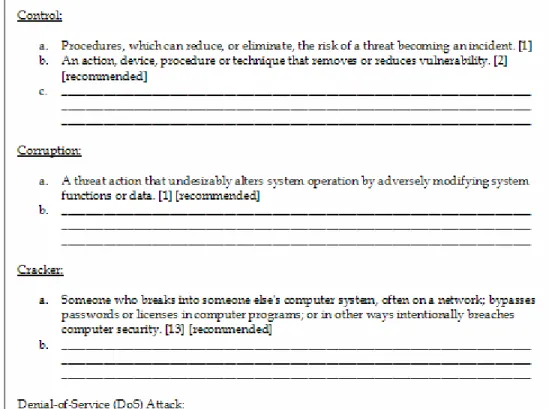
After narrowing the potential definitions for each term down to two or three, along with a “suggested” definition, the team sought input from the stakeholders by emailing a set of com-piled definitions with appropriate referencing. The team asked the client to indicate which definitions best fit their understanding, to modify or create new definitions, and to add any terms that may have been omitted. The following figure shows a snapshot of part of the docu-ment that was submitted:
Figure 1: Sample of Terms and Definitions Provided to Stakeholders for Review
The clients relied on the requirements engineering team’s expertise and knowledge for guid-ance through the first step; stakeholders considered some terms to overlap and have ambigu-ous or double meanings. For a large portion of the terms, the suggested definition was se-lected by the stakeholders. After each term had a finalized definition, the requirements engineering team finalized the dictionary of terms and shared it with the stakeholders.
4.2
Step 2: Identify Security Goals
The identification of security goals for each of the case studies was performed with varied difficulty. Some of the case studies had identified business and security goals before the SQUARE process even began. Others did not even have an explicit business goal for their system. In this section of the report, the development of Acme Corporation’s security goals is presented as an example.
To begin with, the student team asked the stakeholders of Acme to develop a business goal that could be expressed in a single sentence. In this case, the stakeholders came up with “The system allows the client to make informed decisions based on which assets are available.” The team then asked the stakeholders to generate a few security goals for the product that were in more or less clear support of this business goal. They created a simple hierarchy, shown in Figure 2, that illustrated how the system’s business goal, security goals, security requirements, and recommendations connected together. In this case, Acme developed one business goal and three security goals, which are shown in Table 5. The corresponding secu-rity requirements, which were generated in a later stage of the process, are presented in Sec-tion 4.7.
Business
Goal
3 Safety and Security Goals
9 Security
Requirements
Various Architectural and Policy
Recommendations
Figure 2: Simple Hierarchy of Goals and Recommendations Table 5: Acme Corporation’s Business and Security Goals
Business Goal
4.3 Step
3:
Develop
Artifacts
Throughout the case studies, a series of artifacts were developed that served as important in-puts to subsequent steps. The artifacts included system architecture diagrams, use/misuse cases, attack trees, and assessment of essential assets and services.
4.3.1 System
Architecture
The case studies revealed that some organizations, surprisingly, had no documentation of the system architecture for their projects. In some cases, this was due to the dynamic nature of the project: there was no “typical” setup of the system due to the fact that the end user more or less defines that. Regardless, the establishment of system architecture diagrams proved very useful throughout the later stages of SQUARE. It is possible that the requirements engi-neering team will need to handle very detailed system architecture diagrams. The following figure is an example of a simple system architecture diagram that was produced by one of the case studies.
4.3.2 Attack
Trees
Attack trees provide a formal, hierarchical way of describing the security threats to a system based on the types of attacks that could happen and how they could be realized. Attack tree diagrams represent attacks in a tree structure, where an attacker’s goal is listed as the root node and tree leaves represent different ways to achieve that goal. In the following example, a higher level attack tree is depicted, followed by a drill down of a more specific sub tree:
Attack Tree 01 – Higher Level View
Gain Access (View/Modify/Delete) to confidential company information
Unauthorized Access
Exploit OS/Application Vulnerability (AT-01-5) Exploit Poor Account
Management (AT-01-4) Authorized Access
System Admin Accesses the System (AT-01-2) High Level User Accesses
the System (AT-01-1)
Exploit Poor Password Management (AT-01-3)
In general, attack trees proved very useful to both the stakeholders and the requirements en-gineering team in getting a better sense of the scope of threats that the system faces. Many attack trees can be reused between iterations of SQUARE, thus saving the requirements engi-neering team from developing entirely new attack trees for the same attacks.
4.3.3 Use
Cases
Use cases are scenario-based artifacts that force stakeholders to answer “how is this done” questions from a user’s perspective. By providing a context for operation, stakeholders and the requirements engineering team can gain a deep understanding of the interactions of the system components. Use case scenarios can be supplemented with use case diagrams, which graphically display the component interactions of the system.
A detailed set of use cases were completed during the SQUARE case studies, which both the requirements engineering team and stakeholders found to be very useful. A sample use case and diagram are shown in Table 6 and Figure 5:
Table 6: Sample Use Case
Number UC-01
Use Case View Floor Plans
Description All level of users able to access the system will have the ability to view authorized sys-tem information per the Access Control List such as floor plans, damaged areas, em-ployee locator, etc.
Actors Low-Level User, Medium-Level User, High-Level User, or System Administrator Assumptions System Admin has added viewing privileges to the Access Control List
System is available Data entered is correct
Steps User will enter the URL associated with the system
User will receive a prompt to log in their user name and password.
The system authorizes and authenticates the user, then allowed into the system. The system will allow them to access privileges as specified by the Access Control List.
From here, the user will navigate to Operations/ Maintenance. The user can choose appropriate property and then floor plans.
Related Misuse Cases MC-01, MC-08, MC-11, MC-12, MC-13, MC-14, MC-15, MC-16, MC-17, MC-18, MC-19, MC-20, MC-21,MC-22
Figure 5: Sample Use Case Diagram
4.3.4 Misuse
Cases
For the initial case study, a detailed set of misuse cases were completed that encompassed the most significant threats to the system. Sample misuse case and diagram traces are shown in Table 7 and Figure 6.
Table 7: Example Misuse Case
Number: MC-01
Name: Unauthorized logon to server. Scope: User Authorization Concerns Priority: Low Medium x High Deployment
Environment:
x Intranet Extranet/Internet
Mis-actors: Unauthorized users Access Right
Levels:
x Low-Level System Users x Medium-Level System Users x High-Level System Users x Sys Admin
x Other Network User
Point of Entry: Network x Host Application Security Attributes
Affected:
x Confidentiality x Integrity Availability
Description: An unauthorized user attempts to log on to the server and succeeds.
Sophistication: x Low
Medium High
Pre-conditions: Access control lists are configured properly in a domain based network. The unauthorized user has unintended logon rights to the Server. The Server resides on an intranet network
Assumptions: The user does not have expressed permission to log on to the server.
Worst Case Threat: The unauthorized user logs onto the server machine. Her actions are never caught.
Wanted Prevention Guarantee:
Enforce machine access control list (ACL) security policy. (role-based user authentication)
Wanted Detection Guar-antee:
Logon attempts are logged and viewed by system administrators. Post-conditions:
Wanted Recovery Guar-antee:
Remove users’ unauthorized logon rights on the server. Potential Mis-actor
Profiles:
Medium to highly skilled, potentially host administrators with medium criminal intent. Stakeholders and
Threats:
Stakeholders’ clients: loss of data integrity and/or confidentiality. Stakeholders: loss of reputation, loss of current and potential clients.
Related Use Cases: UC-01, UC-02, UC-03, UC-04, UC-05, UC-06, UC-07, UC-08
Related Threats: Elevation of privilege, disclosure of confidential data, unauthorized access to administration interface, unauthorized access to configuration stores, retrieval of print text configuration secrets
Architectural Recommendation:
(AR-01) All shared drives on the network should enforce authentication policies.
(AR-03) Audit information is stored in a separate location from the servers and the worksta-tions.
Policy
Recommendation:
(PR-03) Audit information must be reviewed routinely. (monthly)
(PR-04) Applications and operating systems must be patched routinely. (bi-monthly) (PR-07) Enforce strong password policies.
(PR-13) Password protects any necessary shared documents.
(PR-16) Require users to change their passwords periodically. (monthly)
(PR-19) Set clear and defined user access controls for all users. (Low, Medium, High, System Admins).
(PR-20) Perform routine system and data back-up. (weekly) (PR-21) User activities must be periodically reviewed. (bimonthly)
(PR-23) Users should not have rights or access levels beyond those of which prescribed by his or her job responsibilities.
(PR-24) Users should not reveal their account names and passwords in any given situations.
Microsoft IIS *.asp, *.css, *.js, *.gif,
*.jpg files for website
EPP Documents *.dwg files for
AutoCAD *.sdf files for MapGuide
MapGuide
Windows Server
Sybase Central Microsoft Office
Microsoft Internet Explorer
AMS User Workstation
AMS Developmental Workstation
MS Word MenuMaker MS MapPoint SDF Loader Program Edit Plus AutoCad w/ Archibus Overlay Archibus-FM MapGuide Author Development Tools Lo go n U sing S po o fed Ide n tity
MC-01: Unauthorized Logon to Server
Figure 6: Example Misuse Diagram Trace
4.3.5 Reconciliation of Attack Trees and Misuse Cases
One of the goals of completing the attack trees was to ensure that the team had a complete set of misuse cases. Table 8 shows a mapping between the attack trees and the misuse cases. While the attack trees provide a general picture of potential attacks on the system, the misuse
cases drill down to the details of the interactions between system components in the event of an attack.
Table 8: Mapping Between Misuse Cases and Attack Trees
Misuse Case Name Attack Tree
Unauthorized logon on the Windows 2003 server AT-01-04
Sys Admin gain access to system data AT-01-02
Users gain Sys Admin rights on the Windows 2003 server (Elevation of Privilege) AT-01-04
Sys Admin deletes critical system configurations on the Windows 2003 server AT-01-02
Sys Admin creates holes in the system configurations on the Windows 2003 server AT-01-02
User deletes critical data from the AMS system AT-01-03
Users falsify system data AT-01-03
Access system data through developmental machines AT-01-01,02
Access system data directly to/from database AT-01-01,02
Steal user credential information through developmental machines AT-01-01,02
Users see data that they should not see from their workstations AT-01-01,02,03
Malicious user uses replay attack in the same browser to assume the identity of
an-other user AT-01-05
Malicious users tap communications channel between workstations and servers AT-01-05
Malicious users gain access to sensitive data via saved Excel export files on victim’s
machine AT-01-05
Malicious users install malicious programs that can tap into Excel’s memory to steal
exported data AT-01-05
Input validation attack AT-01-05
Infect Windows 2003 server with virus/worms AT-01-05
User gains access to the system using spoofed identities AT-01-04
Information gathering/network eavesdropping AT-01-05
Brute force attacks: password cracking/credential theft AT-01-03
Denial of service AT-02-01
Execute malicious code AT-01-05
Mapping the attack trees to the misuse cases provided a useful sanity check for the work. Ad-ditionally, the team found that it might have been useful to have two independent teams working in parallel: one team working on attack trees and one team working on misuse cases.
4.4
Essential Assets and Services
In one of the case studies, the team noticed that another class of artifacts could be derived by utilizing the Survivable Systems Analysis (SSA) method developed by the CERT® Coordina-tion Center (CERT/CC) [CERT/CC 02]. SSA is a white-team exercise aimed at providing survivable recommendations for a system. Some of the preliminary work for SSA is already covered in the earlier stages of SQUARE. The team noticed that Step 2 of SSA, defining es-sential service scenarios and components, would yield useful artifacts for inclusion in the case study.
To begin identifying the essential elements of the system, the team first looked back to the business goal of the client’s project. In this case, the goal was to “provide the ability to make important decisions in emergency situations based upon current and available information.” The students analyzed the use cases of the system and made a determination as to which ser-vices, assets, and components were essential to fulfilling the business goal of Acme’s product.
4.4.1 Essential
Services
The team analyzed the importance of each of the major system services, outlined in Table 9 by way of use cases, and made a determination as to each service’s essentiality.
Table 9: Use Cases and Initial Rankings of Essentiality
Use Case Service Status
UC-1 View floor plans Essential
UC-2 Enter damage assessment Essential
UC-3 Add/delete/edit Post-It notes Non-Essential
UC-4 Find specialized employees Important
UC-5 Create journal entry Non-Essential
UC-6 Install the base system software Non-Essential
UC-7 Create links to documents Non-Essential
UC-8 Archibus admin: add user and assign privileges Non-Essential UC-9 View contact information for maintenance tasks Important
UC-10 Create open space report Essential
UC-11 View incident command Essential
The major business goal of this particular system was to allow decisions to be made both be-fore an emergency takes place (i.e., in the planning phase), as well as during and after an event. The most critical services needed to assist decision making are those that directly af-fect viewing and altering event-specific information. Thus, viewing floor plans, entering damage assessments, creating open space reports, and viewing incident commands would be of highest priority. If an emergency or an attack were to occur, it would be crucial to preserve
® CERT and CERT Coordination Center are registered in the U.S. Patent and Trademark Office by
these system functions. Though not quite critical, the case study team flagged two services as important: viewing contact information for maintenance tasks, and finding specialized em-ployees.
The other major functions were all deemed to be non-essential. Though important to the func-tioning and upkeep of the system, the ability to add this information can be recovered after an attack. Many of the other functions deal with configuring the actual system or its user pro-files, which can also be performed after an attack with little loss. Other functions involve making useful but non-critical posts in the form of journal entries or Post-It notes. Still other services support the viewing of non-critical data such as overseas contact information. While all of this functionality is important to the long-term usability of the system, an attack on these services does not threaten the ability of the system to aid decision making during an emergency. If compromised, the information and services would need to be repaired before the system could become fully usable and functional again. However, if the information in the system configuration is kept current, the ability to add new assets and documents during an emergency is secondary to viewing the current state of assets.
4.4.2 Essential
Assets
There were two major assets in the system under study: (1) a server that housed the majority of the system’s intellectual assets (i.e., the code that ran the system) and provided remote ac-cess and (2) the information inside the central server, including Microsoft IIS configurations, the Sybase database, and the MapGuide Database. These assets were found to be critical in order to make informed decisions.
The user and developer workstations in the system were not considered. No important files or intellectual assets critical to system’s mission are housed on these machines. Should they fail, a spare machine could easily act as a replacement, provided the proper software is available. This is not the case with the central server or the information that it contains. An attack on its ability to function, or on its ability to deliver accurate information, will critically impact sur-vivability.
4.5
Step 4: Perform Risk Assessment
In the case study analyses, some risk assessment methodologies were analyzed to determine which were suitable for the elicitation of security requirements. The result of this analysis is presented in this section as an example of techniques that are available, as well as their strengths and weaknesses. These techniques are provided only as examples of previous work, not as recommendations for inclusion in the SQUARE process.
4.5.1 Risk
Assessment
Techniques
Before the first SQUARE case study, the student team performed a literature review of the available risk assessment techniques. Ideas came from faculty, course work completed by team members at Carnegie Mellon, and Internet and library searches. The search was nar-rowed down to a list of eight techniques:
• The Government Accountability Office’s (GAO) model [GAO 99]
• National Institute of Standards and Technology (NIST) model [Stoneburner 02]
• NSA’s INFOSEC Assessment Methodology [NSA 05]
• Butler’s Security Attribute Evaluation Method (SAEM) [Butler 02]
• CMU’s “V-RATE” method [Lipson 01]
• Yacov Haimes’s RFRM model [Haimes 04]
• CMU’s Survivable Systems Analysis method [CERT/CC 02]
• Martin Feather’s DDP model [Cornford 04]
After the initial research, the team completed a brief analysis to determine which models would be likely candidates for further consideration. They found that attempts to quantify risks on the basis of dollar value per attack were either too complicated or too involved for the limited time given to the project, and were therefore rejected. The team concluded that qualitative methods would add more value to the short case studies.
The following chart shows which criteria were used to evaluate the different methodologies and how each was scored (using a scale of 1 - 4, with “1” being the highest mark, and “4” being the lowest). Here is a brief explanation of each rating:
1. Very suitable for the requirement
2. Well suited for the requirement
3. Somewhat unsuitable for the requirement
Table 10: Results of Risk Assessment Literature Review Suitable for small organizations Suitable for short time frame Additional data collection required Suitable for requirements Average GAO 2 4 2 2 2.50 NIST 2 2 1 1 1.5 NSA/IAM 3 3 2 2 2.50 SAEM 4 4 4 4 4.00 V-RATE 3 4 4 4 3.75 Haimes 2 2 2 2 2.00 SSA 2 2 2 4 2.50 DDP/Feather 3 4 2 4 3.25
As Table 10 illustrates, the student team found that NIST’s SP 800-30, also called the “Risk Management Guide for Information Technology Systems,” and Yacov Haimes’s “Risk Filter-ing, RankFilter-ing, and Management Framework” (RFRM) held the most promise for inclusion in the SQUARE process.
4.5.2 Risk
Assessment Field Tests
The student teams proceeded to conduct an independent field test for each of the two selected methodologies. This section outlines the results of their work.
The RFRM framework contains eight phases, some of which the team found to be out of scope for a basic risk assessment. The team identified and tested two phases of RFRM that it felt were strong candidates for inclusion in SQUARE: Phase III, Bicriteria Filtering and Ranking, and Phase IV, Multicriteria Filtering and Ranking.
NIST’s model for risk assessment is broken into nine steps, each with an output that serves as the input to the next step. Steps 1, 8, and 9 were omitted from the test; Step 1 was completed previously in the SQUARE process, Step 8 deals with control recommendations, which are handled separately in SQUARE, and Step 9, Documentation, was omitted because the team combined these results with the RFRM results. Thus, the steps that were actually included were
• Step 2: Threat Identification
The results of the different approaches in these two models produced a list of security risks that are on different levels of abstraction, and thus the two sets of filtered and ranked risk scenarios cannot always be easily compared. In some cases, the results of the two models were in conflict. In other cases, the models produced similar evaluations of risk scenarios. The following chart summarizes a three-tier view of each model’s risk assessment results on one of the clients’ systems:
Table 11: Risk Assessment Results
NIST RFRM
Tie
r 1
● Insider or terrorist alters or disables key archi-tecture components.
● Insider or terrorist discloses proprietary infor-mation.
● Terrorist gains unauthorized use of system re-sources.
● Intruder executes malicious code to gain unau-thorized access.
● High-level user is recruited for help.
● System administrator is recruited for help.
● High-level user abuses rights.
● System administrator abuses rights.
Tie
r 2
● Insider installs malicious software (viruses, Trojans, key loggers, etc.).
● Insider or natural forces physically destroy sys-tem components.
● Insider steals system components.
● Intruder sniffs password.
● Hardware is damaged by natural disaster or environment.
● Intruder socially engineers password.
Tie
r 3
● Terrorist steals system components.
● Terrorist installs malicious software (viruses, Trojans, key loggers, etc.).
● Terrorist physically destroys system compo-nents.
● Insider or terrorist alters or corrupts data.
● Intruder uses abandoned, authenticated browser.
● Hardware fails.
● Intruders guesses, cracks password.
The team analyzed the combined results and was able to make the following conclusions:
• Insider threats pose the most important risk to the system.
• Because of weak controls, it is easy for an insider or a passerby to defeat authentication. Both risk assessment models are concerned with hardware failure or destruction, but they rank the importance differently. Hardware damage is a “Tier 2” risk for both models, but NIST’s output considers deliberate destruction by an insider or terrorist a “Tier 1” risk. Some of the risk scenarios from each model do not map directly to one another. NIST’s output fo-cuses more on an attacker’s motives once inside the system (destroying and corrupting data, disclosing proprietary information, etc.) whereas RFRM’s output deals more with the ability of an attacker to break the frontline defenses of the system.
Every application of the SQUARE Methodology will be unique, and so too will the risk as-sessment, as it needs to be tailored to meet the context of the system under analysis. What is important is that the results from the risk assessment provide a meaningful way to categorize the likelihood and impact of the major threats to the system.