1
Small Business Development Corporation
Annual Report
2012-13
Small Business
The Small Business Development Corporation acknowledges and thanks the following small business clients whose photographs appear in this Annual Report:
Ms Alit Caro, Alit Mineral Cosmetics, Booragoon.
Mr Sanjay Prag, Westralian Commservice Patient Transfer Mr Jade Stubbs, Carpenter, Cannington
Mr Andrew Skead, Fishco Boatshed Markets, Cottesloe Mr JinHe Xu, Golden Estate Property Development, Winthrop Mr Niall Lawlor, Tartine Café, Perth
Mr Alex Robertson and Mr Kent Osmotherly, The House Factory, Kununurra Mr Ashley Whitworth, Embroid Me, Perth
Ms Jessie Sun, Sun Dental Logistics, Willetton Mr Ken Everett, Digital Matters, Perth
and:
Ms Kitty Prodonovich, Board member, SBDC Board Ms Sue Foot, Small Business Centre, Bunbury
Winners of the 2012 Western Australian Regional Small Business Awards
Earthcare Recycling: Winners of the Best New Business Award (Hanson Swan Business Awards 2012) Messrs Jack and Allison Grobowski and team; Winners of the 2012 Best Franchise Award (WARSBAs 2012) Members of the Business Migrant Network
Members of Chinese delegation visiting SBDC 15 April, 2013 Mr Mark Brennan, Federal Small Business Commissioner
Mr James Pearson, CEO, Chamber of Commerce and Industry (WA) Inc. © Small Business Development Corporation
This work is copyright. With the exception of any use as permitted under the Copyright Act 1968, no part may be reproduced by any process without written permission from the Small Business Development Corporation.
Requests and inquiries concerning reproduction and rights should be addressed to the Chief Executive Officer,
Small Business Development Corporation, GPO Box C111, Perth, Western Australia. ISSN 1447-8382
1
Contents
Statement of Compliance 3
Overview of Agency TI 903 (3)
About the SBDC 4
What is a small business? 5
At a glance – statistical snapshot 6
Executive summary TI 903 (5)
Chair’s Report 7
Operational structure 8
Organisational structure 10
Performance Management 11
Framework TI 903 (7)
Agency Performance TI 903 (8)
Report on operations
Financial targets 12
Summary of Key
Performance Indicators 13
Chief Executive Officer’s Report 15 Activity reports:
- Small business services 17
- Policy and advocacy 33
- Communications and marketing 39
- Corporate resources 43
Significant Issues Impacting
the Agency TI 903 (9) 48
Disclosures and Legal Compliance
Independent Auditors’ Report 51
Certification of Key
Performance Indicators 54
Key Performance Indicators TI904 55 Certification of Financial Statements 63 Financial Statements TI 903 (10) 64
Other Financial Disclosures 101
Governance Disclosures 104
TI 903 (14)
Other Legal Requirements 107
TI 903 (15)
Government Policy Requirements 112 TI 903 (16)
Appendix 1: Strategic alliances 114 with other agencies
3
Statement of Compliance
For the year ended 30 June 2013
HON JOE FRANCIS, MLA
MINISTER FOR SMALL BUSINESS
In accordance with section 63 of the Financial Management Act 2006, we hereby submit for your information and presentation to Parliament, the Annual Report of the Small Business Development Corporation for the financial year ended 30 June 2013. The Annual Report has been prepared in accordance with the provisions of the
Financial Management Act 2006.
Ray Mountney Chairman
Statement of Compliance
for the year ended 30 June 2013
Overview of agency
About the SBDC
The Small Business Development Corporation (SBDC) is an independent statutory authority, established in 1984 under the Small Business Development Corporation Act 1983.
What we do
The primary role of the SBDC is to encourage, facilitate and assist the establishment, growth and development of small business in Western Australia.
This is achieved by providing advice and guidance, as well as education and skill development programs, to small business owners.
The SBDC works directly with small business operators and liaisers with industry and business associations to exchange information and provide support and assistance to their members.
The SBDC also provides advice and support to the Minister for Small Business on matters impacting the sector, including the effect of government policy and legislation on small business.
Through these avenues, the SBDC helps to raise public awareness of the importance of small business to the economy and the community.
In addition, the SBDC investigates any matters impacting small businesses, and advises small business owners on the means of obtaining assistance.
The SBDC also maintains an information centre with a comprehensive range of business resources and delivers workshops for small business operators, existing and potential.
Responsible Minister
As at 30 June 2013, the Hon. Liza Harvey MLA, Minister for Small Business, is the Minister responsible for the Small Business Development Corporation.
Enabling legislation
The Small Business Development Corporation Act 1983 (SBDC Act) makes provision for the establishment of the Small Business Development Corporation, the Small Business Commissioner and the Alternative Dispute Resolution service.
Our vision
A strong and enterprising small business sector in Western Australia.
Our mission
To facilitate and deliver relevant, practical support to small businesses and to foster the development of policy conducive to the growth of a thriving sector.
Our values
Enterprise – valuing a culture of enterprise and innovation within the community
Focus – acting with courage, discipline and clarity of purpose
Independence – acting in the best interests of the small business sector
Fairness – valuing an environment where small business can thrive
Collaboration – actively engaging with others to achieve our mutual objectives
5
Our strategic objectives
In accordance with its 2013-2017 Strategic Plan, the SBDC strives to:
• Offer continually improving practical and relevant services across Western Australia; • Model contemporary service delivery;
• Build strong engagement with and
commitment from all key stakeholder groups;
• Advocate for a fair, conducive and productive environment for small business;
• Develop our organisational capacity;
• Ensure the best return on Government funds invested in the development of the sector.
What is a small business?
The SBDC Act defines a “small business” as a business undertaking which is wholly owned and operated by an individual person, persons in partnership, or by a proprietary company within the meaning of the Corporations Act
2001 (Cth) and which:
i. has a relatively small share of the market in which it competes;
ii. is managed personally by the owner or owners or directors, as the case requires; and
iii. is not a subsidiary of, or does not form part of, a larger business or enterprise. In effect, the SBDC uses the standard Australian Bureau of Statistics (ABS) definition of small business, which is any non-employing business or a business employing fewer than 20 staff members.
Small business statistics
There are 211,203 small businesses in Western Australia (95.2% of all businesses in the State). The proportion of Western Australian businesses in each size category is illustrated below.
The industries with the largest number of small businesses (in descending order) are:
• Construction (39,600 – 11.7%)
• Professional, Scientific and Technical Services (24,671 – 10.1%)
• Rental, Hiring and Real Estate Services (21,869 – 9.9%)
• Agriculture, Forestry and Fishing (18,543 – 10.6%)
• Financial and Insurance Services (17,498 – 10.3%)
(ABS Cat. No. 8165.0 – Counts of Australian Businesses, including Entries and Exits, June 2008 to June 2012)
Note: Medium sized businesses are defined as those with 20-199 staff members and large businesses are defined
2012-13 AT A GLANCE
SBDC:
93%
The percentage of clients who said
SBDC’s information and advice was
‘of value to their business’.
$260m
The amount
invested by
business migrants
moving to WA
during the year.
428
The number of clients who
received intensive case
management through
SBDC’s Alternative Dispute
Resolution service.
7,415
The number of small business
owners who received a
business licence pack from
the SBDC.
18,561
The number of personal
client contacts SBDC
handled during
the year.
The number of small business opinions gathered from business owners during the year to assist SBDC in developing initiatives and advocating to government, in the best interests of the sector.
7
Executive
Summary
Chair’s Report
The wide diversity of small business within Western Australia creates many challenges and opportunities for the sector. The independent nature of small business owners and the relatively limited size of their enterprises also brings the advantages of flexibility and resilience to meet market variations. However, the lack of a uniform and consistent voice can also mean the sector struggles to raise awareness of the issues it has to face.
As we look to the future, the SBDC will continue to focus on providing consistently solid advice and guidance to new and existing business owners, as it has been doing very successfully for almost 30 years. However, it is imperative that our current strategic direction allows us to adopt a more ‘helicopter view’ of the sector; to recognise and address the major issues and challenges facing every small business.
Small businesses around Australia are essentially contending with the same issues. This is why governments have created the role of Small Business Commissioner in four states, including Western Australia. At the beginning of 2013 this support was further enhanced with the introduction of a federal Small Business Commissioner. The strength of this ‘team’ of Commissioners will enable them to share routes to success, develop new strategies to engage with government and peak industry bodies, and provide a clear, consistent voice championing the needs and challenges concerning the small business sector.
Some of the key areas which continue to place a real burden on small business are red tape, bureaucracy and duplication of paperwork.
These are imposed, in the main, by government agencies. Of all the challenges facing small business owners, these are some of the biggest impediments to their enterprises being efficient and competitive.
Establishing the Alternative Dispute Resolution service was one of the first significant tasks undertaken when the role of Small Business Commissioner was created here in Western Australia. I am delighted to report that this service is now completely ‘bedded in’ and meeting a demand well above initial expectations.
The Commissioner’s success in overseeing the Alternative Dispute Resolution service has been acknowledged and praised from all sides. He has shown an even-handedness when dealing with disputes between big business and small business and demonstrated his independence from Government when handling business to government disputes. This particular skill will be vital as he continues to work with all levels of government to reduce red tape and compliance difficulties for small business owners.
As Chair of the SBDC Board, I fully support the Commissioner as he increases his focus on the major challenges that affect the small business sector across Western Australia.
Ray Mountney Chair
Operational Structure
SBDC Board
The Small Business Development Corporation is governed by an independent Board, drawn from the private sector under the auspices of the Small Business Development Corporation Act 1983.
Membership as at 30 June 2013: • Mr Ray Mountney (Chair)
• Ms Caterina (Kitty) Prodonovich • Mr Steven Dobson
• Mr Jeff Healy • Ms Sonia McKeiver
• Mr Mark Irwin (resigned 6 June 2013) • Mr David Eaton (ex officio)
(For Board members’ biographies please see page 104)
The Small Business Commissioner
Mr David Eaton is Small Business Commissioner for Western Australia and Chief Executive Officer of the SBDC. This dual role is responsible for the day-to-day operation of both the SBDC and the Alternative Dispute Resolution service, and reports to the Board. The key services of the SBDC are:
• Small business advisory services • Dispute resolution services • Business migration services • Policy, advocacy and advice to
government
• Small Business Centre Program
Small business advisory services
The core service of the SBDC is the delivery of advice and guidance to small business operators to aid in the development and growth of small business in Western Australia. These services are provided through all channels including online, in person, by telephone, e-mail, on-site appointment, through third parties, business associations and the media. A range of tailored business skills workshops are also delivered and a business information centre provides a ‘walk-in’ service for clients seeking information on business licensing and regulatory requirements. (See page 17 for details of 2012-13 achievements.)
Dispute resolution service
The Alternative Dispute Resolution service, established in March 2012, is a low-cost, non-litigious means of resolving business-to-business and business-to-government disputes involving small businesses. The service is also particularly useful in resolving retail tenancy disputes. The SBDC is now the first port of call for businesses experiencing disputes of this kind. (See page 22 for details of 2012-13 achievements.)
Business migration services
The SBDC delivers the Western Australian Business Migration Program as a key investment attraction initiative for the State. Business migrants are a significant source of new capital, business establishment, export income and employment generation. (See page 27 for details of 2012-13 achievements.)
9
Small Business Centre Program
There are 25, not-for-profit community-based Small Business Centres (SBC) located around the State, with 19 in regional areas. These Centres provide locally delivered services and are partially funded by the Government, through the SBDC. (See page 29 for details of 2012-13 achievements.)
Policy, advocacy and advice to government
The SBDC ensures the small business voice is heard and considered by governments at all levels through submissions, and liaison, and is a key influence in policy development where it pertains to small business. The SBDC conducts regular surveys to gauge the sentiment of the sector and to inform government of trends and concerns within small business. (See page 33 for details of 2012-13 achievements.)
Ms Sue Foote, Small Business Centre, Bunbury-Wellington. In 2012-13, the SBDC allocated $3.68 million in core operational grants to the SBC network.
Organisational Structure
SMALL BUSINESSDEVELOPMENT CORPORATION BOARD OF
MANAGEMENT SMALL BUSINESS COMMISSIONER / CHIEF
EXECUTIVE OFFICER POLICY AND
ADVOCACY
POLICY EVALUATION AND DEVELOPMENT
ADVOCACY RED TAPE REDUCTION RESEARCH & STATISTICS
BUSINESS AND GOVERNMENT LIAISON
MARKETING AND PROMOTION
MEDIA
STAKEHOLDER LIAISON EVENTS
ADVISORY AND EDUCATION SERVICES ALTERNATIVE DISPUTE
RESOLUTION BUSINESS INFORMATION
CENTRE BUSINESS MIGRATION
SMALL BUSINESS CENTRE PROGRAM ABORIGINAL BUSINESS
FINANCIAL RESOURCES HUMAN RESOURCES
INFORMATION RESOURCES ONLINE RESOURCES
ADMINISTRATIVE SUPPORT
CORPORATE COMMUNICATIONS
AND MARKETING
SMALL BUSINESS
11
Performance
Management Framework
Outcome-based management framework
Government goal: Financial and Economic Responsibility – Responsibly managing the State’s finances through the efficient and effective delivery of services, encouraging economic activity and reducing regulatory burdens on the private sector.
Desired
outcome Effectiveness indicators Service Efficiency indicators
Development of new and existing small business in Western Australia
The extent to which clients rate the usefulness of the information and guidance provided to them
Information, guidance, referral and business development services
• Average cost per direct client contact
• Average cost per indirect client contact
• Average cost per Small Business Centre client contact
• Cost per unit of policy advice
Changes to outcome based management framework
The Small Business Development Corporation’s Outcome Based Management Framework did not change during the reporting period.
Shared responsibility with other agencies
The Small Business Development Corporation did not share any responsibilities with other agencies in 2012-13.
Agency Performance
Financial targets
2012-13 (1) Target
$’000
2012-13 Actual
$’000
Variation (2) $’000
Total cost of services (expense limit)
(Sourced from Statement of Comprehensive Income)
12,634 13,281 647(a) The variance relates to additional expense for a Royalties for Region funded Buy Local program
established after the finalisation of
the 2012/13 budget together with costs for the decommissioning from
Office of Shared Services.
Net cost of services
(Sourced from Statement of Comprehensive Income)
12,083 12,618 535(b) Offset against the variance in (a) above is higher than expected interest revenue.
Total equity
(Sourced from Statement of Financial Position)
1,021 2,004 983(c) The variation is due mainly to a greater than expected surplus from the prior year.
Net decrease in cash held
(Sourced from Statement of
Cashflows)
(92) (304) 212
Approved Full Time Equivalent (FTE) Staff Level
58 52 6(d) The variance relates to an FTE ceiling reduction applied during the reporting period together with a number of positions remaining vacant throughout.
(1) As specified in the 2012-13 Budget Statements (Budget Paper No 2 Volume 2) Pages 471-478
13
Summary of Key Performance Indicators
The Corporation undertakes client surveys to measure performance through core effectiveness indicators.
These indicators are:
• Usefulness of the information and guidance provided;
• Contribution the service made to an informed decision to start or buy a business;
• The extent the information or guidance benefited the operations of the
business; and
• The value of the guidance or information received.
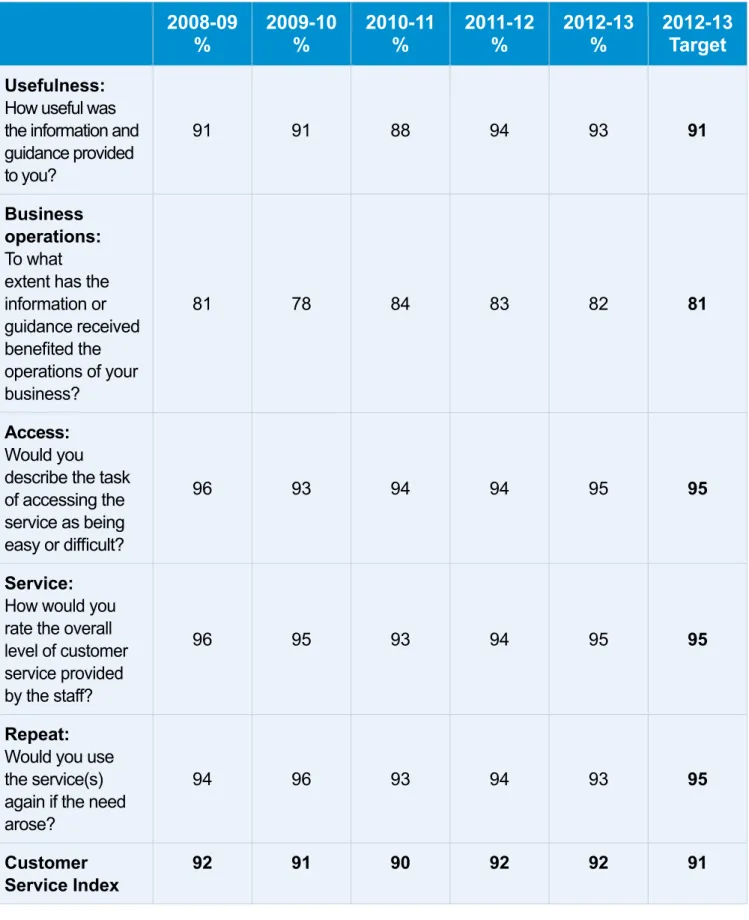
For 2012-13 all survey based effectiveness indicators exceeded the targets set and have remained consistent in comparison with the previous period.
Very high levels of satisfaction continue to be achieved:
• 93 per cent of survey participants rated the information/guidance provided as very or somewhat useful
• 78 per cent who believed the services of the SBDC/SBCs had directly contributed to their decision to start or buy a business • 82 per cent of business owners said the
information or advice had benefited the operations of their business to a great, or to some extent;
• 84 per cent of those surveyed said they valued the information or guidance received.
The Corporation achieved a Customer Service Index rating of 92 per cent, the same result as in 2011-12. The index was introduced to measure the extent to which the Corporation satisfied customer enquiries and requests for assistance and comprises five individual performance indicators focusing on both the process and outcomes of providing services to clients.
“I approached SBDC after
doing some initial research,
to help guide me through
the information overload,
doubts and uncertainties,”
Sanjay said.
“Not only did they
have great business
acumen in marketing and
business practices to pass
on, they were also very
approachable and very
understanding.”
Sanjay Prag
Westralian
Commservice Patient
Transfer
Another key effectiveness indicator is the result from activities of the Business Migration Program. This program attracts business migrants to Western Australia to boost the State’s economic growth and development. Business migrants therefore make a significant contribution to the State’s economy. In 2012-13, the Corporation granted State nomination for 302 business migrants from prime markets in China, South Africa, the United Kingdom, Malaysia, Singapore and 21 other countries. Confirmed investment from Permanent Residency Business Visa Holders remains at very high levels. For 2012-13 the
State economy benefitted from investment of over $260 million in Total Capital Inflow, $78 million in Capital in Business and over $20 million in Western Australian Treasury Bonds. In addition, 90 jobs were created and 13 businesses commenced exporting.
Full details of the key performance indicators are provided on page 55
Niall Lawlor credits the SBDC for assisting with his business development, - from one café in the CBD to three.
15
Chief Executive
Officer’s Report
Providing independent information, guidance and advice to small business operators is the important core of the services provided through the Small Business Development Corporation (SBDC).
During 2012-13 the SBDC responded to more than 18,500 personal client contacts (by phone, email or in person) while another 51,000 were handled by the Small Business Centre network.
The past twelve months have seen Western Australia leading the nation in population growth and business confidence. However it has also presented a challenging environment for many small businesses as they faced this period of economic transition.
In these times, it is important to have a supportive government framework together with access to quality information and practical advice, to help the small business sector build resilience and growth.
The sector is vital to our economy, contributing 33.7 per cent of Australia’s private sector GDP and 45.7 per cent of private sector employment.
In addition to supporting clients who are in the process of starting a new business, we have also continued to work with those affected by unfavourable global economic conditions, increased competition accelerated by the growth of online trading, rising operating costs and the ongoing issue of attracting and retaining skilled labour.
Like the small businesses we support, the SBDC has also experienced a challenging, varied and rewarding year. You will see from this annual report that we have expanded our influence through services delivered directly to small business owners and the information
and advice we share with industry groups, and particularly, other government agencies. In early 2012, we launched the Alternative Dispute Resolution service to provide practical, intensive guidance to businesses in dispute with another business or a government agency. Over the last 12 months this service has provided an important, unique and well supported resource for businesses in WA facing disputation.
Our investigation into the non-payment of subcontractors on construction contracts administered by Building Management and Works was a significant body of work. We were pleased to note that all the recommendations have been accepted by Government and should contribute to improvements across the construction industry.
Finding ways to reduce red tape and lower the burden of compliance on small business, continues to be a challenge for all levels of government. The SBDC plays a significant role in helping to meet this challenge by providing informed advice to regulators and government agencies.
As part of our commitment to continuous service improvement, many aspects of our customer service delivery have been reviewed. We are determined to remain relevant, effective and valuable to our clients. These themes of ‘continuous improvement’ and ‘customer focus’ are emphasised throughout our strategic plan.
I take this opportunity to recognise and thank my staff and management team for their ongoing dedication to delivering important services to the small business sector. The team’s collective passion and commitment are reflected in the extremely positive results of our customer survey and I applaud them for their ongoing dedication.
I would also like to acknowledge the individual business owners and the industry associations that make such a substantial contribution to the economic and social wealth of Western Australia.
David Eaton
Small Business Commissioner
Chief Executive Officer
Small Business Development Corporation
Small Business Commissioner David Eaton with business migrants Jessie Sun, Sun Dental Logistics and Ken Everett, Digital Matters.
17
Small Business Services
Providing relevant and timely information, advice and guidance to small business,
including specialist advice on finance, marketing, employment, commercial tenancy,
business migration, franchising and exporting.
The core services of the SBDC are directly linked to the provision of of free and low-cost, information, advice and business skills development to the small business sector in Western Australia.
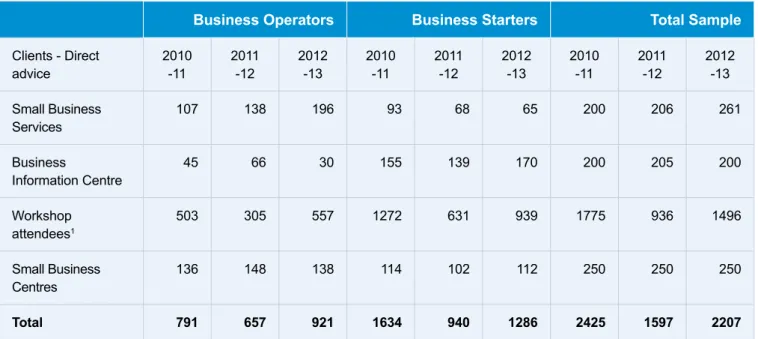
Throughout 2012-13, business advisors and program officers responded to clients’ needs through a variety of service channels including telephone, e-mail, face-to-face meetings and workshops, and supported 25 Small Business Centres located throughout Western Australia. Most clients were operating businesses in the professional and other services, accommodation and food services, retail trade and construction industries.
Almost three quarters of all clients accessing SBDC advisory services were actively involved in running a business, while a further 24 per cent were looking to establish a small business. The SBDC, in cooperation with the 25 Small Business Centres located around the State, meet the needs of these clients by assisting with all stages of the business lifecycle from pre-start, development and growth, through to succession planning and exit strategies.
Outcomes for 2012-13:
The SBDC had a total of 18,561 personal client contacts across all services and programs, and a further 51,000 client contacts by 25 Small Business Centres through the Small Business Centre program. Overall comparison to previous years’ results are not made, as statistical information this year was collected using a new Client Management System (CRM) which differs from the method used previously.
During the year, the majority of personal
client contacts (10,479) were received by the Business Information Centre and business advisory service, followed by 3,755 directed to the specialist commercial tenancy and alternative dispute resolution services and 2,009 to the Business Migration Team. Of these, business advisors, case managers and migration officers conducted 2,128 face-to-face appointments and serviced the balance of clients’ needs by phone and email.
The annual survey of key performance indicators shows a high level of client satisfaction. The survey results indicate that the information and advice provided was ‘useful’ for 93 per cent of clients, ‘of value to business’ for 84 per cent of clients and ‘of benefit to business operations’ for 82 per cent of clients.
This year’s survey results also state that 93 per cent of clients were ‘satisfied with their overall SBDC experience’ and 93 per cent of clients were ‘likely to use the service again’. Most performance indicators remain consistent with last year.
Business Information Centre (BIC)
The Business Information Centre (BIC) is the entry point for small business services provided by the SBDC. The BIC provides business and licensing information and online resources to streamline the business start up process, and assist with the growth of established businesses.
Information available at the BIC includes a range of free business information leaflets and checklists as well as a range of publications on starting, developing and managing a small business. The BIC also manages the SBDC’s range of business skills workshops.
Online services include access to the Business Licence Finder and the IBISWorld database. This database provides free access to financial benchmarking and market research reports on over 500 industries in Australia.
Outcomes for 2012-13:
During the year in review, there were 1,632 personal client contacts with Small Business Services seeking information and guidance on licensing and regulation issues and a further 570 about workshops and online research. In February 2013, a review of the existing services, structure and resources of the BIC was undertaken. This review made a range of recommendations, many of which will be implemented during the next financial year. One recommendation was to reduce the number of commercially produced publications available for sale in the BIC. This is because of the increased ease and affordability of purchasing business titles online from private providers. As a result, book sales this year were slightly lower than last year with 1,538 units sold, valued at $21,333.
The annual survey of BIC clients indicated a high level of satisfaction across most indicators, particularly for ‘usefulness of information and advice’ (96%), ‘satisfied with overall contact’ (96%) and ‘value to the business’ (89%) all of which represent slight increases on last year.
There was a decrease in those who felt the BIC was ‘a benefit to business operations’, down 4 per cent to 76 per cent.
Business Licence Finder
The Business Licence Finder (BLF) is a core service offered by the BIC. It has a database of more than 8,000 federal, state and local government licences, registrations and permits, as well as relevant codes of practice required to conduct any type of business in Western Australia.
The BLF is accessible to the public via the SBDC website or with the assistance of BIC staff. This online service has the advantage of being available at any time for clients to generate their own business licence reports.
Outcomes for 2012-13:
A total of 7,415 business licence reports were generated through the BLF database. Approximately 70 per cent of clients (5,224) opted to generate their own reports online while the remaining 30 per cent sought assistance from BIC staff.
Small business workshops
A review of the small business workshop program was undertaken, resulting in the SBDC expanding its suite of regular business skills workshops.
The new workshops are designed for businesses in the start-up phase to provide an introduction to the fundamentals of starting and operating a small business, as well as those in the development stage of their business to provide more advanced management skills.
The Business Information Centre is the entry point for SBDC services
19
Outcomes for 2012-13:
By March 2013, a full suite of new workshops was available. All workshops are conducted at least monthly, with the weekly BiZBasics workshop proving most popular for those looking to start a small business.
Workshop Number of
workshops Commencement date Number of attendees
BiZBasics 49 July 2012 1084
Succeeding Online 12 July 2012 286
The 12 Step Business Plan 10 October 2012 178
Understanding Your
Business Financials 10 November 2012 129
Spreading the Word –
Marketing your Business 7 December 2012 114
Setting up Business Systems 4 March 2013 27
OVERALL TOTAL 92 1818
Following the review, the SBDC has also introduced a variety of specialist workshop presenters, greater frequency of workshops to cater for more participants, and increased the range of resource workbooks and presentation materials, including a useful take-home tool for participants.
Workshop resources will also be made available to 25 Small Business Centres located around the State to further expand the reach of these resources.
Industry Link
During 2012-13, the SBDC has sought opportunities to extend its services to reach more small business clients without increasing the agency’s costs or resources. To this end, the SBDC has enhanced its current service delivery model by partnering with industry and business groups through a new Industry Link program which provides fundamental business management information and business skills workshops tailored to the particular industry.
Industry Link is aimed at enhancing the business acumen of a wider range of small business operators throughout the State, resulting in a more resilient and robust small business sector. See details of strategic alliances and Industry Link partners on page 114.
Outcomes for 2012-13:
Since the program commenced in February 2013, Industry Link has successfully engaged with 15 organisations, delivering workshops, services, resources and support to over 440 participants.
Industry Link events have been undertaken with LotteryWest, Penrhos College, REIWA Business Brokers, TAFE, Western Australian Department of Health Nurse Practitioners and the Master Builders Association. Future Industry Link events are planned ,including sessions for the Western Australian Occupational Therapists Association.
Business Advisory Service – general
The SBDC business advisors provide free general business information and advice for both start-up and established business operators. In addition, the advisors also provide expertise on a range of business management areas including finance, marketing, employment, franchising, importing and exporting.
During 2012-13, almost half of all personal client contacts (47%) to Small Business Services were from people in business seeking general business information and advice. Response to client contacts was mainly delivered by telephone (66%), face-to-face appointment (17%) and email (14%).
Outcomes for 2012-13:
Most of the enquiries received by the SBDC in 2012-13 were from clients who were in business or wanting to start a new business. The majority of these clients were from the following industry areas;
• Professional and other services; • Retail trade;
• Construction; and
• Accommodation and food services.
Of the 8,277 general business advisory enquiries received, the majority were for business start-up advice (33%), the statutory requirements for operating a business (9%) and information on buying or selling a business (6%).
Other areas of demand for business advice and management support were mostly focused on increasing skills and knowledge in business planning (8%), taxation (6%), business growth (5%) and financial management and marketing (4%).
The SBDC business advisors also responded to business dispute enquiries. In total there were 2,438 dispute-related enquiries of which the advisory team responded to over
“All those years ago, when
I found out what a terrific
service the SBDC was,
I told everyone about it,
went to all the workshops
and got invaluable advice
on how to start my beauty
salon.
“When I took over this
business two years ago,
I went back to the SBDC
for information on growing
the business and what
I needed to know about
employing people.”
Alit Caro
Mineral Cosmetics
Booragoon
21
90 per cent, the Policy team handling the business to government disputes and the Alternative Dispute Resolution (ADR) team responding to the remaining disputes. The majority of disputes handled by business advisors were business to business issues with 28 per cent of these being between a landlord and tenant.
To promote a greater understanding of the free advisory services available to the small business sector, SBDC advisors participated in a number of presentations and special events throughout the year. See full list of strategic alliances on page 113.
Specialist advisory service – commercial tenancy
One of the most important and potentially damaging issues for a small business is the process of negotiating a commercial lease. The SBDC provides a specialist commercial tenancy advisory service for small business tenants, landlords and other industry stakeholders.
The service provides information and guidance on the Commercial Tenancy (Retail Shops) Agreements Act 1985 (CTA Act) and all aspects of negotiating and leasing business premises.
With the introduction of the ADR service in March 2012, the specialist commercial tenancy advisory service is now enhanced to include the provision of access to the Small Business Commissioner and assistance to resolve business disputes.
Outcomes for 2012-13:
During the year in review, the commercial tenancy advisory team responded to 2,037 personal client contacts (of which 689 were dispute related), with information and guidance on commercial tenancy issues.
Changes to the CTA Act that increased safeguards for small business tenants
commenced on 1 January 2013. The SBDC played a major role in the creation of these important reforms providing advice to the administrators of the CTA Act, the Department of Commerce. The SBDC also ensured the interests of small business were taken into account at all stages of the reform process, including during the finalising of supporting regulations to the changes to the CTA Act. These changes were designed to create a level playing field and create a fairer and more equitable commercial tenancy market for Western Australian retailers engaged in lease negotiations. The new laws also address some of the main grievances experienced by small businesses during their lease negotiations and agreements. As a result, lease negotiations will be more transparent, equitable and efficient, and tenants will be able to make more informed decisions about leasing business premises. To assist small business tenants, landlords and other industry stakeholders to better understand the changes to the CTA Act, the SBDC has produced three comprehensive publications which incorporate the recent changes. The publications are in easy to read question and answer format.
A required function of the Small Business Commissioner, under the CTA Act, is to provide information and guidance on provisions of the Act.
At a seminar, conducted by the Department of Commerce, the Commissioner provided information related to the SBDC’s field experience on changes to the CTA Act and the SBDC’s Alternative Dispute Resolution service. The seminar was held for real estate agents and property managers as part of an education program on the changes to the CTA Act.
In August 2012, new retail trading hours, including Sunday trading, commenced in Western Australia. Prior to these changes, the Small Business Commissioner wrote to tenants of retail premises to prepare them for
the new trading hours, reinforcing that the CTA Act protected retailers from being forced to open on Sundays and that retailers could only be charged additional operating expenses if they chose to open on Sundays.
Alternative Dispute Resolution (ADR) service
The 2012-13 financial year was the first full year of operation for the ADR service. This service is the first of its kind dedicated to small business, and further increases the scope of the SBDC’s business advisory role in Western Australia.
The ADR service commenced with the introduction of the Small Business and Retail Shop Legislation Amendment Act 2011
(the Act) and the passing of amendments to the Commercial Tenancy (Retail Shops) Agreements Act 1985 in March 2012.
The service was introduced to give businesses an opportunity to resolve disputes without the need to engage in formal legal action.
ADR is a voluntary process where an SBDC case manager assists parties to understand their rights and responsibilities and to examine options for the resolution of a dispute without the need for a determination by a court or tribunal. It provides parties with greater control over the resolution process and any outcome or agreement generated. ADR can also have a positive effect on maintaining ongoing business relationships.
As part of this service, the SBDC has developed a pool of independent and professional mediators to further assist in the resolution of disputes. Where parties are willing to attend mediation, the SBDC can appoint a mediator from the pool. The mediation service is subsidised by the State Government, with parties contributing a small fee to commence the mediation process.
Outcomes for 2012-13:
During the year in review, a total of 428 cases were referred to the ADR team for intensive case management, which involves a dedicated case manager actively working with the disputing parties to resolve the issues in conflict.
As at 30 June 2013, the ADR case managers had resolved 376 (88%) of the dispute cases which had a total value of $18,523,379 (based on client estimation). The balance of cases remain active and will be finalised during the next financial year.
As well as assisting businesses in dispute with another business or with a government agency, the SBDC has a mandated role in the resolution of retail tenancy disputes which arise between retail tenants and their landlords. Since the introduction of the ADR service, retail tenancy disputes that have previously been directed to the State Administrative Tribunal (SAT) for a determination, must now attempt to be resolved through the SBDC’s ADR service.
Approximately one third of the 376 cases (132) resolved by the ADR service were related to retail tenancy disputes. Of these, 80 per cent were resolved directly with the assistance of the ADR service, therefore removing the need for the disputing parties to seek a determination through the SAT.
The ADR process not only reduces the length of time and the costs associated with resolving disputes, it may also reduce the number of small business disputes which go unaddressed due to the reluctance of parties to pursue a matter in a more formal and costly legal setting. Often the cost associated with retrieving the debt through formal court action outweighs the amount owed and as such go unaddressed. This impacts not only on the bottom line of the business concerned, but also potentially its ongoing business relationships.
23
As formal mediation requires the voluntary participation of both parties, not all cases recommended for mediation actually occur. However, a total of 36 mediations were held in 2012-13 with 83 per cent recorded as having a successful outcome. The total value of disputes successfully resolved via the mediation process in 2012-13, was $1,707,220.
Alternative Dispute Resolution service - business-to-government disputes
As part of the ADR service, the SBDC is also responsible for investigating business-to-government disputes. The service assists businesses experiencing difficulty dealing with government agencies (at all levels) to:
• understand how government policies and procedures work;
• communicate effectively with government agencies;
• navigate licensing and other red tape issues; and
• find alternative solutions that are consistent with legislative and policy requirements.
In addition to assisting with individual issues, this service allows the SBDC to identify issues that may impact a broader range of businesses and address issues at a systemic level.
Outcomes for 2012-13:
During the year in review, the SBDC investigated 52 business-to-government enquiries and disputes. Around half of these enquiries were related to local government, with planning approvals remaining the most common type of dispute. In relation to the State Government enquiries, which accounted for just under half of all business-to-government enquiries, licensing and issues relating to utilities were raised most frequently.
Most business-to-government enquiries received during the year were resolved through early, informal liaison by the SBDC, with the relevant government authority, on behalf of the small business owner.
CASE STUDY 1:
This case involved the complex interaction of local and state laws, a lease between a small business and a government agency, and a franchise agreement in which the parties could not agree on who, the lessee or leaser, was liable to pay council rates as there was no provision for this in the lease agreement. Over the course of a few months, the SBDC provided support to help resolve this matter, initially assisting the business operator to obtain clarification of their obligations under the lease and the Local Government Act 1995.
The SBDC case manager also liaised between the business operator, the government agency and its legal team, and the local government authority. This culminated in the lessee and the government party agreeing to try to resolve the matter by attending mediation, which subsequently resulted in an agreement. Importantly, the mediation provided not only a successful agreement for the immediate payment of the outstanding rates notice, but also a longer-term agreement on the payment of future notices, helping to preserve the ongoing business relationship.
CASE STUDY 2:
During 2012-13, the SBDC received complaints from a number of small businesses regarding a scheduled power outage by a government-owned utility. The SBDC successfully negotiated a mutually beneficial outcome between the two parties including the provision of generators for each of the affected businesses.
“Ignition” for small business entrepreneurs
In 2012-13, the SBDC partnered with the Curtin Centre for Entrepreneurship (C4E) within the Curtin University’s Business School to support the Ignition program.
Ignition provides a five day entrepreneurial learning program that helps participants take their innovative ideas through a disciplined, intensive process to:
• validate their business concepts;
• help form the basis of a business plan; and • commence building a funding proposition. The SBDC is a founding partner of this entrepreneurial program which links academia, industry and business with government in the provision of experiential learning.
Outcomes for 2012-13:
The $50,000 financial contribution from the SBDC ensures that Western Australia (through the C4E) continues to hold exclusive rights to deliver Ignition, and will provide access to world standard education and support for local small business innovators and inventors.
The program fills a gap in the market for small business entrepreneurs seeking support to commercialise a service or product and is complementary to the specialist business development services provided by the SBDC.
Indian Ocean Territories Service Delivery Agreement
Since November 2008, the SBDC has held a Service Delivery Agreement (SDA) with the Commonwealth Department of Regional Australia, Local Government, Arts and Sport (DRALGAS) to provide programs and services to potential and existing small business operators on the Indian Ocean Territories of Christmas and Cocos (Keeling) Islands. This agreement expired on 30 June 2012.
During 2012-13, the agreement was reviewed and DRALGAS was advised that the SBDC would not be seeking continuation of the agreement but would still provide programs and services through to 31 December 2012 to allow time for them to find an alternative service provider.
Under this agreement, the SBDC has provided a broad range of advisory services, workshops and events tailored for individuals and businesses within the Indian Ocean Territories (IOT). During 2012-13, the services were delivered through a local representative supported by visits from SBDC business advisors and private sector consultants.
Outcomes for 2012-13:
An SBDC business advisor visited Christmas Island and the Cocos (Keeling) Islands on two occasions.
The business advisor, supported by a private sector business specialist and assisted by the local island representative, delivered business advisory services to local small businesses. Tailored workshops and events were also conducted to promote small business sustainability and growth and to help strengthen the IOT business communities.
25
To raise awareness of issues that affect the development of small businesses in the IOT, SBDC representatives met with 16 government officials and industry organisations.
In the six months to 31 December 2012, a total of 114 personal client contacts were made by SBDC representatives, covering business issues including financial management, strategic planning, business planning, marketing, merchandising, customer service and leasing.
The SBDC, although no longer visiting the IOT under an SDA, continues to provide direct business information and advice to small business operators on the islands via telephone and online resources.
Tourism BOOST
The Tourism BOOST program was officially launched in August 2011 to assist small business owners to better understand the tourism industry and boost their financial returns through practical marketing initiatives. With the assistance of $150,000 in funding from Tourism WA, the SBDC developed a comprehensive training program for aspiring and existing tourism operators, including a series of workshops and an online guide. It was delivered throughout the State for a 12 month period during 2011-12.
Funding for the workshops was extended by the SBDC to 31 December 2012 after which, the program was converted to an online resource. Although the workshop program has now closed, assistance for small businesses in the tourism industry is still provided through the online guide available on the SBDC website.
“The Alterative Dispute
Resolution team is very
efficient and approachable
and they ensured we
were well-prepared for our
mediation session.
“They certainly alleviated
a lot of stress as we were
very grateful for their
involvement in helping us
sort out our dispute.”
Carolyn and Jade Stubbs
Carpenter,
The guide provides specific information about the tourism industry and business tips, as well as:
• interactive tools to help accommodation providers and tour operators correctly price their products;
• interactive quizzes to test business operators’ knowledge;
• a range of checklists, templates and resources to help operators set up business systems; and
• links to a dedicated Tourism BOOST YouTube channel featuring video footage of operators sharing their tourism and business experiences.
Outcomes for 2012-13:
In total, the Tourism Boost program was delivered around the State to 688 small business operators, through 31 workshops in 26 regional and metropolitan locations.
From 1 July 2012 to December 2012, the SBDC delivered four Tourism BOOST workshops in the south west of the State, to a total of 51 participants.
In recognition of its contribution to the Western Australian tourism industry, the program was awarded a silver medal in the Tourism Education and Training category of the 2012 Perth Airport WA Tourism Awards.
Business Online Services Project (BOS)
The Business Online Services (BOS) project is a key component of the Australian Business Number and Business Name Registration Project – one of 27 regulatory hotspots identified by the Council of Australian Government (COAG) to reduce the burden on business.
BOS aims to help businesses be more productive and cut the cost of complying with government regulations. This is to be achieved through a suite of online services
including the Australian Business Licence & Information Service (ABLIS) and Australian Business Account (ABA).
The SBDC works in partnership with the Commonwealth, state and territory governments to design, test and implement the features of the BOS.
Outcomes for 2012-13:
During the year, BOS consolidated the business licence information held in eight jurisdictions, into a single site which enables businesses to access licence information for every jurisdiction, across all three tiers of government, through a single portal.
Complementing the ABLIS is the ABA – an account that allows businesses to save their search results from ABLIS to their own private ‘to do list’. From there, they can work on the customised search results when convenient, without having to conduct another search in ABLIS.
The delivery of BOS features is an iterative process, planned in stages over several years. Essential functionality for Western Australia to transition to the BOS platform will not be available until later in 2013. In the meantime, the SBDC will continue to use the Business Licence Finder tool to assist clients.
In 2012-13, the SBDC
hosted three delegations (65 participants) of State nominated and potential business migrants from China.
27
Business Migration Program
The SBDC delivers the Western Australian Business Migration Program on behalf of the State Government. This program is a key initiative to attract investment into the State, as business migrants make a significant contribution to the State’s economic prosperity. Through business establishment costs, export income and employment generation, business migrants are a leading source of new capital for Western Australia.
The Business Migration Program attracts business migrants to Western Australia by: • marketing the State as one of the world’s
leading destinations for investment, employment, education and lifestyle;
• assisting potential business migrants with information on visa options as well as living, working and establishing a business in Western Australia; and
• supporting qualifying business migrants with State nomination to become eligible to lodge a visa application with the Department of Immigration and Citizenship (DIAC) under the Business Innovation and Investment Program.
The SBDC promotes Western Australia internationally to agents and potential business migrants through a marketing program focusing on the State’s primary immigration markets.
China continues to be a primary market, accounting for 54 per cent of all business migrants coming to the State during 2012-13. Malaysia and Singapore are the State’s second ranked market with 11 per cent. Other important markets are South Africa and the UK with 5 per cent each. Pakistan and Iran were the two most significant emerging markets during the reporting year.
To generate maximum exposure for the Business Migration Program and to assist new migrants in establishing and developing their businesses in Western Australia, SBDC
has formed strategic alliances with a range of government and private sector organisations, including:
• Department of State Development (DSD) International Trade and Investment Offices; the SBDC cooperates with the DSD and the Western Australian Overseas Trade Offices by jointly participating in events, presenting seminars and attending appointments with potential business migrants.
• Migration Institute of Australia and Migration Alliance Western Australian Branches; the SBDC provides the Institute and the Alliance with up to date information on the policies and criteria for State nomination for distribution to migration agents in Western Australia and overseas.
• Western Australian Chinese Chamber of Commerce; the SBDC jointly hosts events with the Chamber to ensure new business migrants are aware of the services provided by the SBDC.
• Department of Immigration and Citizenship (DIAC); as a member of the national Skilled Migration Officials Group and a participant of the State Client Reference Group, the SBDC consults with DIAC to assist with policy development, strategies and initiatives.
From 1 July 2012, the Department of Immigration and Citizenship introduced the new Business Innovation and Investment Program for business migrants. This program has introduced two key changes to the previous Business Migration Program;
• business migrants can no longer apply for a business visa without the nomination of a state or territory government; and
• personal criteria for entry into Australia as a business migrant has been significantly increased and financial requirements have been increased by over 50 per cent.
These changes will result in the Business Innovation and Investment Program delivering a lower number of business migrants but with a higher economic value.
Outcomes for 2012-13:
During the year, representatives from the SBDC and the Western Australian Overseas Trade Offices participated in international migration activities in the State’s prime markets of China and South Africa. In total, over 500 potential business migrants attended the 15 presentations on Western Australia and 2,500 attended the migration expo. Training was also provided to 40 overseas migration agents and their staff.
These events form part of the overall marketing strategy to attract new business migrants to Western Australia, and to develop and reinforce relationships with Overseas Trade Offices and migration agents based in Western Australia’s prime target countries.
Throughout 2012-13, demand for business migration information and support remained high, with the SBDC team responding to 2,464 enquiries and nomination applications from clients and migration agents. State nomination application fees raised $128,900 against an anticipated $125,000 to assist with the cost of servicing clients and agents and undertaking the international marketing program.
During 2012-13:
• 167 State nominations were approved for new business migrants to apply for visas to commence business in Western Australia, and
• 135 State nominations and one registration were approved for business migrants on temporary residency visas to convert to permanent residency visas.
The key outcome achieved for the Western Australian economy is that 136 business migrants finalised their investment this year, injecting $260,502,656 into the State for business establishment, treasury bond investment, personal expenditure and settlement costs. This investment also created 90 new jobs and 13 new exporting businesses. Businesses established by migrants range across a variety of industry sectors. Of the export businesses, most focused on agricultural products and mining resources. During the year in review, the SBDC hosted three delegations of State nominated and potential business migrants (65 participants) from China, seeking investment opportunities in Western Australia. A program
In 2012-13, 136 business migrants injected more than $260 million into the State for business establishment, treasury bond investment, personal expenditure and settlement costs.
29
of business presentations and visits to various organisations were arranged for each of the delegations.
Business Migrant Network
The SBDC provides ongoing support for business migrants in Western Australia through its Business Migrant Network. Networking events provide an opportunity for recently arrived migrants to broaden their business networks by meeting other business migrants and service providers.
Outcomes for 2012-13:
During the year in review, three Business Migrant Network events were hosted by the SBDC, attracting more than 280 participants. The Network now has over 400 members and is a valuable source of peer support to assist migrants in establishing and developing their businesses in Western Australia.
Small Business Centre Program
Twenty-five Small Business Centres (SBC) are located throughout Western Australia, with 19 centres in regional areas. The SBC are independent, not-for-profit, community based organisations providing locally delivered small business services. In 2012-13, the SBDC allocated $3.68 million in core operational grants to the SBC network. Of this, $2.81 million (76%) was allocated to regional SBC.
Outcomes for 2012-13:
Throughout the year in review, the SBC continued to support new and existing small business operators throughout Western Australia. Collectively, the SBC undertook in excess of 43,000 client sessions (up 4 per cent on last year), which resulted in over 1,500 new business start-ups (down 1 per cent on last year). In addition, the SBC program facilitated the creation of over 2,500 jobs (up 15 per cent on last year), and hosted just under 8,000 workshop participants.
During 2012-13, SBC managers were required to report on new performance measurements for their centres. Results indicate that collectively, the SBC Program has provided 13,092 hours of facilitation to small businesses throughout Western Australia during 2012-13. The three main issues covered during these sessions were business planning, marketing and financial management. The most common business types were food and accommodation; retail trade and professional; and scientific and technical.
In addition, the SBDC conducted an online customer satisfaction survey. Results indicated that the overall experience of SBC clients was positive, with a majority of clients indicating they would use the services of the SBC again.
A SBC State conference was held in November 2012, with professional development provided for chairs and managers of the SBC. For managers, the professional development focused on peer to peer learning, social media, problem solving and assisting Aboriginal businesses. Professional development for the chairs of SBC committees focused on improving knowledge of corporate governance and proactive board engagement.
In May 2013, the SBDC sponsored a series of “Future Proofing” small business information seminars in Broome, Karratha, Geraldton and Bunbury, delivered in partnership with Redwave Media.
During the reporting period, the management committee of the Small Business Centre, Wheatbelt South (Narrogin), experienced difficulties securing a manager to provide services to the region. As a result, the management committee of the Centre relinquished the SBC program to the SBDC. In order to maintain service delivery to small businesses in the region, the SBDC contracted an experienced business advisor to provide the SBC program. He is well known to stakeholders and businesses in the region.
• Review into the delivery of business advisory services by third party providers
Endorsement was received during 2012-13 from the Minister for Small Business to conduct a review of the SBC program. This review, due to commence in August 2013, will involve an in-depth study of the delivery of business advisory services, an assessment of the efficiency and effectiveness of both the service delivery model and the governance arrangements. The review is being undertaken to ensure on-going value for small business operators and the best return for public funding. The current program and its use of third-party providers will be assessed and recommendations made on future design, governance framework, outcome measures and service methods. It is anticipated that a final report with recommendations will be forwarded to the Minister for Small Business in 2014.
• Regional “Buy Local Program” pilot project
During 2012-13 the SBDC, in collaboration with the Department of Commerce, received Royalties for Regions funding to pilot a Regional Buy Local Program. A pilot project is being trialled through nine regional SBC servicing the SuperTowns identified in the Regional Centres Development Plan (Esperance, Manjimup, Katanning, Margaret River, Collie, Northam, Jurien Bay, Morawa and Boddington).
The objective of the program is to build the capacity of local small businesses, creating an environment in the regions that is viable and sustainable and leads to long term growth and resilience, despite fluctuating economic conditions.
Activities undertaken for the project include ‘mystery shopping’ of local retail shops to assess where improvements
JinHe Xu travelled around
Australia before deciding
that Western Australia was
the best place for sound
business opportunities and
a great family lifestyle.
“Through the SBDC, the
Government provides a lot
of assistance for business
migrants like us, and they
were very helpful in showing
us how to comply with the
requirements of our visa.”
JinHe Xu, Director
Golden Estaate Property
Development
31
are needed, online business directories listing all local businesses, retail “buy local” promotions and continuous improvement sessions for businesses through one-on-one consultations. These measures are designed to help identify and address gaps in business operations and increase the capacity of regional businesses to capitalise on changing economic circumstances.
Specialist advisory service – Aboriginal business support
The SBDC provides a suite of business support services to assist and support the development of Aboriginal businesses and the Aboriginal business community in Western Australia.
Throughout 2012-13 the SBDC has focused on creating collaborative relationships between Government and Industry in support of the Aboriginal business sector.
Creating purposeful relationships with both Federal and State Government agencies, the resource sector (e.g. Woodside), Western Australia Indigenous Tourism Operators Council (WAITOC), Many Rivers Microfinance and the Small Business Centre network, has enabled the delivery of SBDC services to be coordinated and the delivery of business assistance to communities to be improved.
Outcomes for 2012-13:
Since July 2012, the SBDC met with a total of 27 Aboriginal business clients, conducted 28 client follow-up contacts and participated in 98 stakeholder meetings.
In addition, the SBDC has played a major collaborative role in a range of projects to assist Aboriginal entrepreneurs around the State to start and grow their enterprises. Such projects include:
• Aboriginal Business Directory WA
A partnership was developed between the SBDC, the Chamber of Commerce and Industry Western Australia (through Project Connect), the Department of Aboriginal Affairs, and the Department of Training and Workforce Development to develop an Aboriginal Business Directory WA.
This State-wide initiative, inclusive of all industry sectors, is free to register, searchable by location and industry sector, and able to provide details of the capabilities of the registered businesses.
The Aboriginal Business Directory WA is designed to:
• enhance the opportunities for Aboriginal business to secure business and contracts;
• support the sustainability and growth of Aboriginal business;
• develop procurement networks that will ensure the opportunities for Aboriginal business;
• provide a means for industry and government to engage with Aboriginal businesses; and
• be inclusive of all industry sectors.
SBDC Board member,
Ms Kitty Prodonovich with Parliamentary Secretary Joe Francis MLA, at the launch of the Aboriginal Business Directory WA.