3GPP TS 29.231
V11.0.0
(2012-09)
Technical Specification
3rd Generation Partnership Project;
Technical Specification Group Core Network and Terminals;
Application of SIP-I Protocols to
Circuit Switched (CS) Core Network Architecture;
Stage 3
(Release 11)
Keywords
UMTS, network, architecture
3GPP
Postal address
3GPP support office address
650 Route des Lucioles - Sophia Antipolis Valbonne - FRANCE
Tel.: +33 4 92 94 42 00 Fax: +33 4 93 65 47 16
Internet
http://www.3gpp.org
Copyright Notification
No part may be reproduced except as authorized by written permission. The copyright and the foregoing restriction extend to reproduction in all media.
© 2012, 3GPP Organizational Partners (ARIB, ATIS, CCSA, ETSI, TTA, TTC). All rights reserved.
UMTS™ is a Trade Mark of ETSI registered for the benefit of its members
3GPP™ is a Trade Mark of ETSI registered for the benefit of its Members and of the 3GPP Organizational Partners
LTE™ is a Trade Mark of ETSI currently being registered for the benefit of its Members and of the 3GPP Organizational Partners GSM® and the GSM logo are registered and owned by the GSM Association
Contents
Foreword... 5
1
Scope ... 6
2
References ... 6
3
Definitions, symbols and abbreviations ... 7
3.1 Definitions ... 7
3.2 Symbols ... 7
3.3 Abbreviations ... 8
4
Protocols ... 8
4.1 Introduction... 8
4.2 Call control protocol (Nc interface) ... 9
4.3 Resource control protocol (G)MSC and MGW (Mc Interface) ... 9
4.4 Bearer Framing Protocol between MGWs (Nb interface) ... 10
4.5 Signalling Transport ... 10
4.5.1 Call Control protocols ... 10
4.5.2 Resource control protocol (G)MSC and MGW (Mc Interface) ... 10
4.5.3 IP Transport between MGWs (Nb interface) ... 10
4.6 Payload Types ... 10
5
Amendments and Endorsements to Referenced Specifications ... 11
5.1 ITU-T Q.1912.5 (Interworking between Session Initiation Protocol (SIP) and Bearer Independent Call Control protocol or ISDN User Part) ... 11
5.2 IETF RFC 2046 (Multipurpose Internet Mail Extensions (MIME) Part Two: Media Types) ... 11
5.3 IETF RFC 4566 (SDP: Session Description Protocol) ... 11
5.4 IETF RFC 3966 (The tel URI for Telephone Numbers) ... 12
5.5 IETF RFC 2976 (The SIP INFO method) ... 12
5.6 IETF RFC 3204 (MIME media types for ISUP and QSIG Objects)... 12
5.7 IETF RFC 3261(SIP: Session Initiation Protocol) ... 12
5.8 IETF RFC 3262 (Reliability of Provisional Responses in the Session Initiation Protocol) ... 13
5.9 IETF RFC 3264 (An Offer/Answer Model with the Session Description Protocol) ... 13
5.9.1 Multicast Streams ... 13
5.9.2 3GPP Node Generating the Offer ... 13
5.9.3 3GPP Node Generating the Answer ... 13
5.9.4 3GPP Node as Offerer Processing of the Answer ... 13
5.9.5 Modifying the session ... 14
5.9.6 Unspecified Connection Address ... 14
5.10 IETF RFC 3311 (The Session Initiation Protocol (SIP) UPDATE Method) ... 14
5.11 IETF RFC 3312 (Integration of Resource Management and Session Initiation Protocol) ... 14
5.12 IETF RFC 3323 (A Privacy Mechanism for the Session Initiation Protocol) ... 14
5.13 IETF RFC 3325 (Private Extensions to the Session Initiation Protocol (SIP) for Network Asserted Identity within Trusted Networks) ... 15
5.14 IETF RFC 3326 (The Reason Header Field for the Session Initiation Protocol) ... 15
5.15 IETF RFC 4028 (Session Timers in the Session Initiation Protocol) ... 15
5.16 IETF RFC 4960 (Stream Control Transmission Protocol)... 15
5.17 Void ... 15
5.18 IETF RFC 4168 (The Stream Control Transmission Protocol (SCTP) as a Transport for the Session Initiation Protocol) ... 15
5.19 IETF RFC 791 (Internet Protocol, Version 4) ... 16
5.20 IETF RFC 2460 (Internet Protocol, Version 6) ... 16
5.21 IETF RFC 4715 (The Integrated Services Digital Network (ISDN) Subaddress Encoding Type for tel URI) ... 16
5.22 IETF RFC 4320 (Actions Addressing Identified Issues with the Session Initiation Protocol's (SIP) Non-INVITE Transaction) ... 16
6
3GPP Extensions ... 17
6.1 Codec Negotiation ... 17
6.1.1 Encoding of 3GPP_OoBTC_Indicator ... 17
6.1.2 Encoding of SDP answer including 3GPP OoBTC Indicator ... 17
6.2 MGW Identifier ... 17
6.2.1 Semantic and Usage of the MGW_Identifier ... 17
6.2.2 Encoding of MGW_Identifier ... 17
6.2.3 Procedures related to MGW_Identifier ... 18
6.3 Additional MGW Ids ... 18
6.3.1 Semantic and Usage of the Additional_MGW_Ids ... 18
6.3.2 Encoding of Additional_MGW_Ids ... 18
6.3.3 Procedures related to Additional_MGW_Ids ... 18
Annex A (informative):
IANA Registration of OoBTC Indicator ... 19
A.1 Introduction... 19
A.2 Contact name, email address, and telephone number ... 19
A.3 Attribute Name (as it will appear in SDP) ... 19
A.4 Long-form Attribute Name in English ... 19
A.5 Type of Attribute ... 19
A.6 Is Attribute Value subject to the Charset Attribute? ... 19
A.7 Purpose of the attribute ... 19
A.8 Appropriate Attribute Values for this Attribute ... 19
Annex B (informative):
IANA Registration of MGW Identifier ... 20
B.1 Introduction... 20
B.2 Contact name, email address, and telephone number ... 20
B.3 Attribute Name (as it will appear in SDP) ... 20
B.4 Long-form Attribute Name in English ... 20
B.5 Type of Attribute ... 20
B.6 Is Attribute Value subject to the Charset Attribute? ... 20
B.7 Purpose of the attribute ... 20
B.8 Appropriate Attribute Values for this Attribute ... 20
Annex C (informative):
IANA Registration of Additional MGW Ids ... 20
C.1 Introduction... 20
C.2 Contact name, email address, and telephone number ... 21
C.3 Attribute Name (as it will appear in SDP) ... 21
C.4 Long-form Attribute Name in English ... 21
C.5 Type of Attribute ... 21
C.6 Is Attribute Value subject to the Charset Attribute? ... 21
C.7 Purpose of the attribute ... 21
C.8 Appropriate Attribute Values for this Attribute ... 21
Foreword
This Technical Specification has been produced by the 3rd Generation Partnership Project (3GPP).
The contents of the present document are subject to continuing work within the TSG and may change following formal TSG approval. Should the TSG modify the contents of the present document, it will be re-released by the TSG with an identifying change of release date and an increase in version number as follows:
Version x.y.z where:
x the first digit:
1 presented to TSG for information; 2 presented to TSG for approval;
3 or greater indicates TSG approved document under change control.
y the second digit is incremented for all changes of substance, i.e. technical enhancements, corrections, updates, etc.
1
Scope
The present document describes the protocols to be used when SIP-I is optionally used as call control protocol in a 3GPP CS core network on Nc interface, see 3GPP TS 23.231 [1]. The SIP-I protocol operates between (G)MSC servers. The SIP-I architecture consists of a number of protocols. The following types of protocols are described: call control protocol, resource control protocols and user plane protocol for this architecture. The architecture complies with the requirements imposed by 3GPP TS 23.231 [1] and TS 23.153 [2].
Interworking of SIP-I on Nc to external networks is described by TS 29.235 [3].
The present document is valid for a 3rd generation PLMN (UMTS) complying with Release 8 and later.
2
References
The following documents contain provisions which, through reference in this text, constitute provisions of the present document.
· References are either specific (identified by date of publication, edition number, version number, etc.) or non-specific.
· For a specific reference, subsequent revisions do not apply.
· For a non-specific reference, the latest version applies. In the case of a reference to a 3GPP document (including a GSM document), a non-specific reference implicitly refers to the latest version of that document in the same Release as the present document.
[1] 3GPP TS 23.231: "SIP-I based Circuit Switched Core Network ; Stage 2". [2] 3GPP TS 23.153: "Out of Band Transcoder Control; Stage 2".
[3] 3GPP TS 29.235: "Interworking between the 3GPP CS domain with SIP-I as signalling protocol and other networks".
[4] ITU-T Recommendation Q.1912.5: "Interworking between Session Initiation Protocol (SIP) and Bearer Independent Call Control protocol or ISDN User Part".
[5] IETF RFC 2046: "Multipurpose Internet Mail Extensions (MIME) Part Two: Media Types". [6] IETF RFC 3966: "The tel URI for Telephone Numbers".
[7] IETF RFC 2976: "The SIP INFO method".
[8] IETF RFC 3204: "MIME media types for ISUP and QSIG Objects". [9] IETF RFC 3261: "SIP: Session Initiation Protocol".
[10] IETF RFC 3262: "Reliability of Provisional Responses in the Session Initiation Protocol (SIP)". [11] IETF RFC 3264: "An Offer/Answer Model with the Session Description Protocol (SDP)". [12] IETF RFC 3311: "The Session Initiation Protocol (SIP) UPDATE Method".
[13] IETF RFC 3312: "Integration of Resource Management and Session Initiation Protocol (SIP)". [14] IETF RFC 3323: "A Privacy Mechanism for the Session Initiation Protocol (SIP)".
[15] IETF RFC 3325: "Private Extensions to the Session Initiation Protocol (SIP) for Network Asserted Identity within Trusted Networks".
[16] IETF RFC 3326: "The Reason Header Field for the Session Initiation Protocol (SIP)". [17] IETF RFC 4566: "SDP: Session Description Protocol".
[18] 3GPP TS 29.232: "Media Gateway Controller (MGC) - Media Gateway (MGW) interface; Stage 3".
[19] 3GPP TS 29.415: "Core network Nb data transport and transport signalling". [20] 3GPP TS 29.414: "Core Network Nb data transport and transport signalling". [21] 3GPP TR 21.905: "Vocabulary for 3GPP Specifications".
[22] IETF RFC 3389: "Real-time Transport Protocol (RTP) Payload for Comfort Noise".
[23] IETF RFC 4733: "RTP Payload for DTMF Digits, Telephony Tones and Telephony Signals". [24] IETF RFC 4028: "Session Timers in the Session Initiation Protocol (SIP)".
[25] IETF RFC 4960: "Stream Control Transmission Protocol". [26] Void
[27] IETF RFC 4168: "The Stream Control Transmission Protocol (SCTP) as a Transport for the Session Initiation Protocol (SIP)".
[28] IETF RFC 5407: "Example Call Flows of Race Conditions in the Session Initiation Protocol (SIP)".
[29] IETF RFC 791: "Internet Protocol (IP)".
[30] IETF RFC 2460: "Internet Protocol, Version 6 (IPv6)".
[31] IETF RFC 3550: "RTP: A Transport Protocol for Real-Time Applications".
[31] 3GPP TS 26.102: "Mandatory speech codec; Adaptive Multi-Rate (AMR) speech codec;Interface to Iu, Uu and Nb".
[32] 3GPP TS 26.103: "Speech codec list for GSM and UMTS". [33] 3GPP TS 23.003: "Numbering, addressing and identification".
[34] IETF RFC 4715: " The Integrated Services Digital Network (ISDN) Subaddress Encoding Type for tel URI ".
[35] IETF RFC 4320: "Actions Addressing Identified Issues with the Session Initiation Protocol's (SIP) Non-INVITE Transaction".
[36] IETF RFC 5079: "Rejecting Anonymous Requests in the Session Initiation Protocol (SIP)".
3
Definitions, symbols and abbreviations
3.1
Definitions
3.2
Symbols
For the purposes of the present document, the following symbols apply: Nc Interface between the(G)MSC servers.
Mc Interface between the server and the media gateway. Nb Interface between media gateways (MGW).
3.3
Abbreviations
For the purposes of the present document, the abbreviations given in 3GPP TR 21.905 [21] and the following apply. An abbreviation defined in the present document takes precedence over the definition of the same abbreviation, if any, in 3GPP TR 21.905 [21].
BCU Bearer Control Unit
BICC Bearer Independent Call Control MGC Media Gateway Controller
MIME Multi-purpose Internet Mail Extensions OoBTC Out of Band Transcoder Control
4
Protocols
4.1
Introduction
Implementations providing any of the interfaces or protocols identified in the subclauses below shall implement the requirements of the specifications identified in those subclauses.
4.2
Call control protocol (Nc interface)
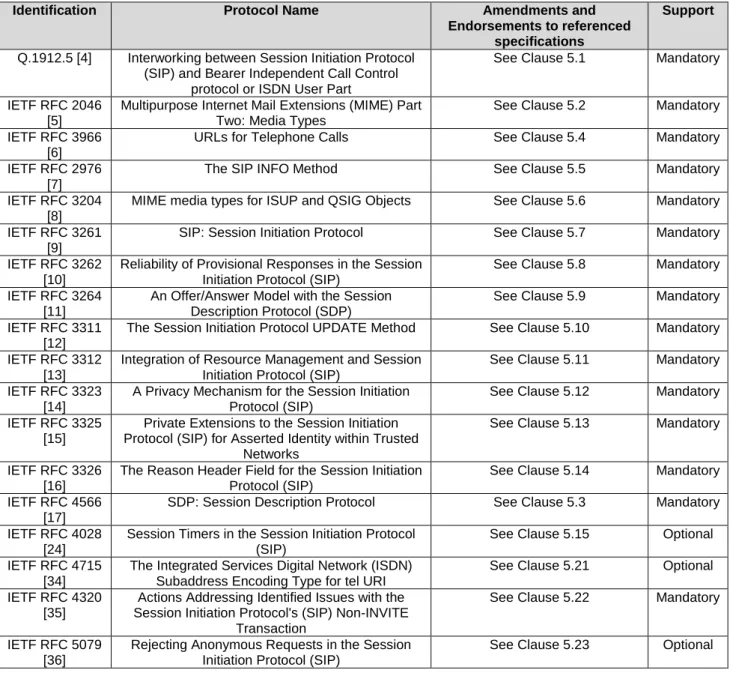
Table 4.2.1: Call Control Protocol Specifications
Identification Protocol Name Amendments and
Endorsements to referenced specifications
Support
Q.1912.5 [4] Interworking between Session Initiation Protocol (SIP) and Bearer Independent Call Control
protocol or ISDN User Part
See Clause 5.1 Mandatory
IETF RFC 2046 [5]
Multipurpose Internet Mail Extensions (MIME) Part Two: Media Types
See Clause 5.2 Mandatory IETF RFC 3966
[6]
URLs for Telephone Calls See Clause 5.4 Mandatory IETF RFC 2976
[7]
The SIP INFO Method See Clause 5.5 Mandatory
IETF RFC 3204 [8]
MIME media types for ISUP and QSIG Objects See Clause 5.6 Mandatory IETF RFC 3261
[9]
SIP: Session Initiation Protocol See Clause 5.7 Mandatory IETF RFC 3262
[10]
Reliability of Provisional Responses in the Session Initiation Protocol (SIP)
See Clause 5.8 Mandatory IETF RFC 3264
[11]
An Offer/Answer Model with the Session Description Protocol (SDP)
See Clause 5.9 Mandatory IETF RFC 3311
[12]
The Session Initiation Protocol UPDATE Method See Clause 5.10 Mandatory IETF RFC 3312
[13]
Integration of Resource Management and Session Initiation Protocol (SIP)
See Clause 5.11 Mandatory IETF RFC 3323
[14]
A Privacy Mechanism for the Session Initiation Protocol (SIP)
See Clause 5.12 Mandatory IETF RFC 3325
[15]
Private Extensions to the Session Initiation Protocol (SIP) for Asserted Identity within Trusted
Networks
See Clause 5.13 Mandatory
IETF RFC 3326 [16]
The Reason Header Field for the Session Initiation Protocol (SIP)
See Clause 5.14 Mandatory IETF RFC 4566
[17]
SDP: Session Description Protocol See Clause 5.3 Mandatory IETF RFC 4028
[24]
Session Timers in the Session Initiation Protocol (SIP)
See Clause 5.15 Optional IETF RFC 4715
[34]
The Integrated Services Digital Network (ISDN) Subaddress Encoding Type for tel URI
See Clause 5.21 Optional IETF RFC 4320
[35]
Actions Addressing Identified Issues with the Session Initiation Protocol's (SIP) Non-INVITE
Transaction
See Clause 5.22 Mandatory
IETF RFC 5079 [36]
Rejecting Anonymous Requests in the Session Initiation Protocol (SIP)
See Clause 5.23 Optional
4.3
Resource control protocol (G)MSC and MGW (Mc Interface)
Table 4.3.1: Resource Control Protocol Specifications
Identification Protocol Name Amendments and
Endorsements to referenced specifications
Support
3GPP TS 29.232. [18]
Media Gateway Controller (MGC) – Media Gateway (MGW) Interface; Stage 3
None (NOTE) Mandatory
NOTE: IPv4 (IETF RFC 791 [29]) shall be supported on the Mc interface. IPv6 (IETF RFC 2460 [30]) may be supported.
4.4
Bearer Framing Protocol between MGWs (Nb interface)
Table 4.4.1: Framing Protocol Specifications
Identification Protocol Name Amendments and
Endorsements to referenced specifications
Support
IETF RFC 3550[31]
RTP: A Transport Protocol for Real-Time Applications
None Mandatory
NOTE: Further specified by 3GPP TS 29.414 [20]
4.5
Signalling Transport
4.5.1
Call Control protocols
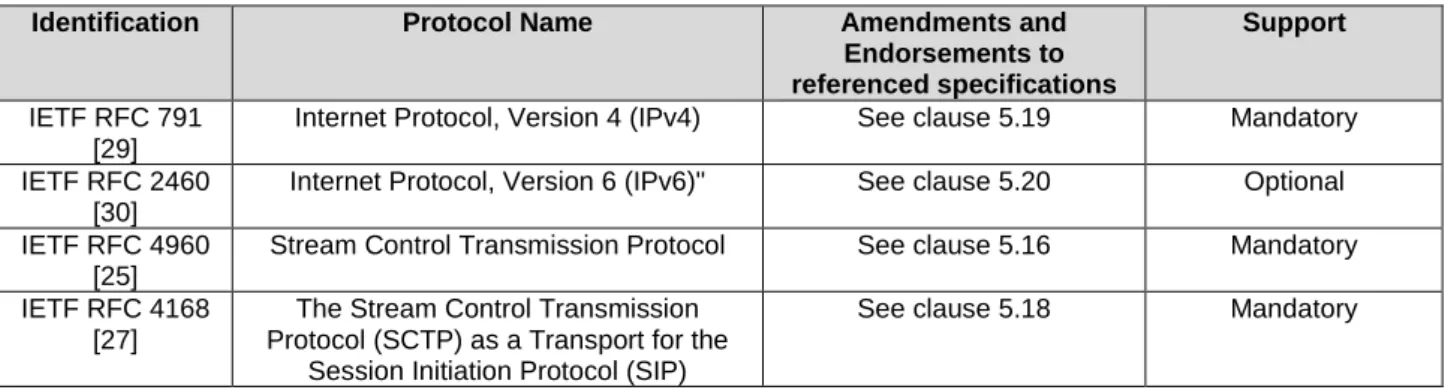
Table 4.5.1.1: Call Control Signalling Transport
Identification Protocol Name Amendments and
Endorsements to referenced specifications
Support
IETF RFC 791 [29]
Internet Protocol, Version 4 (IPv4) See clause 5.19 Mandatory IETF RFC 2460
[30]
Internet Protocol, Version 6 (IPv6)" See clause 5.20 Optional IETF RFC 4960
[25]
Stream Control Transmission Protocol See clause 5.16 Mandatory IETF RFC 4168
[27]
The Stream Control Transmission Protocol (SCTP) as a Transport for the
Session Initiation Protocol (SIP)
See clause 5.18 Mandatory
4.5.2
Resource control protocol (G)MSC and MGW (Mc Interface)
Table 4.5.2.1: Resource Control Signalling Transport
Identification Protocol Name Amendments and
Endorsements to referenced specifications
Support
3GPP TS 29.232 [18]
Media Gateway Controller (MGC) – Media Gateway (MGW) Interface;Stage 3
None Mandatory
4.5.3
IP Transport between MGWs (Nb interface)
Table 4.5.3.1: Nb Interface Signalling Transport
Identification Protocol Name Amendments and
Endorsements to referenced specifications
Support
3GGP TS 29.414 [20]
Core Network Nb Data Transport and Transport Signalling
None Mandatory
4.6
Payload Types
The details of which payload types shall be supported for the SIP-I application are defined in 3GPP TS 26.102 [31] and the RTP attributes for each specific codecs are defined in 3GPP TS 26.103 [32].
5
Amendments and Endorsements to Referenced
Specifications
5.1
ITU-T Q.1912.5 (Interworking between Session Initiation
Protocol (SIP) and Bearer Independent Call Control
protocol or ISDN User Part)
Only Profile C shall apply.
5.2
IETF RFC 2046 (Multipurpose Internet Mail Extensions
(MIME) Part Two: Media Types)
The "multipart" MIME type with the sub-type of "mixed" shall be supported as per IETF RFC 2046 [5] to allow exchange of multiple bodies in a single SIP message (e.g. initial INVITE message with ISUP IAM encapsulation and SDP bodies) between (G)MSC-Servers. Nested MIME message is not supported in the SIP-I based Nc interface. The following MIME types only shall be supported in the SIP-I based Nc interface:
- The "application" MIME type as per IETF RFC 2046 [5] with the sub-type of "ISUP" as per IETF RFC 3204 [8] to allow exchange of ISUP encapsulation in SIP messages between (G)MSC-Servers.
- The "application" MIME type as per IETF RFC 2046 [5] with the sub-type of "SDP" as per IETF RFC 4566 [17] to allow exchange of SDP in SIP messages between (G)MSC-Servers.
5.3
IETF RFC 4566 (SDP: Session Description Protocol)
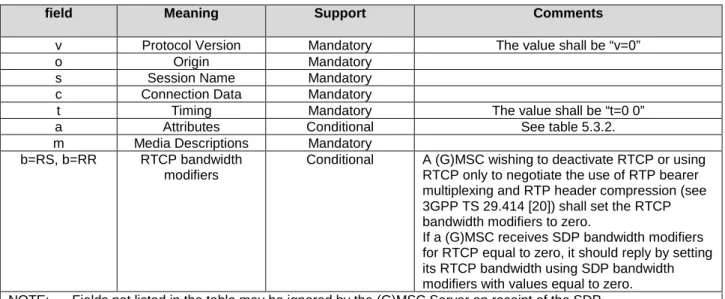
The following SDP properties are described for SIP-I call control procedures; use of SDP within H.248 MGW control protocol interface is described in the relevant profile specification, e.g. 3GPP TS 29.232 [18].
Table 5.3.1: Support of SDP Fields
field Meaning Support Comments
v Protocol Version Mandatory The value shall be “v=0”
o Origin Mandatory
s Session Name Mandatory
c Connection Data Mandatory
t Timing Mandatory The value shall be “t=0 0”
a Attributes Conditional See table 5.3.2.
m Media Descriptions Mandatory b=RS, b=RR RTCP bandwidth
modifiers
Conditional A (G)MSC wishing to deactivate RTCP or using RTCP only to negotiate the use of RTP bearer multiplexing and RTP header compression (see 3GPP TS 29.414 [20]) shall set the RTCP bandwidth modifiers to zero.
If a (G)MSC receives SDP bandwidth modifiers for RTCP equal to zero, it should reply by setting its RTCP bandwidth using SDP bandwidth modifiers with values equal to zero. NOTE: Fields not listed in the table may be ignored by the (G)MSC Server on receipt of the SDP.
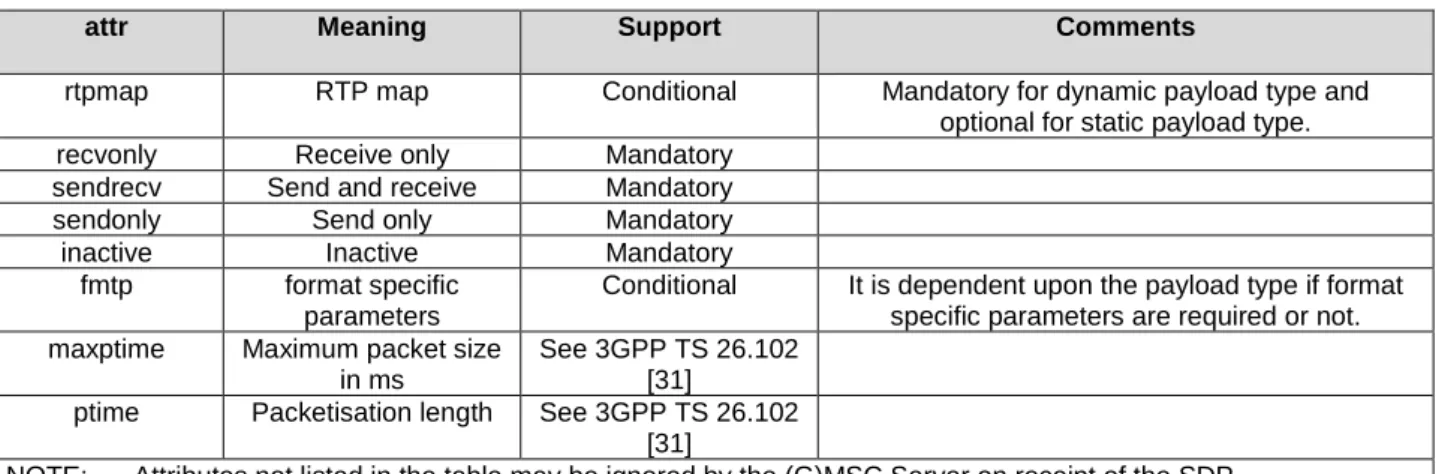
Table 5.3.2: Support of Attributes
attr Meaning Support Comments
rtpmap RTP map Conditional Mandatory for dynamic payload type and optional for static payload type. recvonly Receive only Mandatory
sendrecv Send and receive Mandatory
sendonly Send only Mandatory
inactive Inactive Mandatory
fmtp format specific parameters
Conditional It is dependent upon the payload type if format specific parameters are required or not. maxptime Maximum packet size
in ms
See 3GPP TS 26.102 [31]
ptime Packetisation length See 3GPP TS 26.102 [31]
NOTE: Attributes not listed in the table may be ignored by the (G)MSC Server on receipt of the SDP.
5.4
IETF RFC 3966 (The tel URI for Telephone Numbers)
The Tel-URI, in both global and local telephone formats, shall be supported as defined in IETF RFC 3966 [6]. The "isub" parameter defined within IETF RFC 3966 [6] may be used to include the ISDN sub-address as may be required within the MSISDN. See 3GPP TS 23.003 [33]. When the "isub" parameter is present, the "isub-encoding" parameter defined within IETF RFC 4715 [34] shall be used to define the ISDN subaddress encoding type. The procedures specified within ITU-T Q.1912.5 [4] Annex B.5 for profile C shall be applied for Sub-addressing.
5.5
IETF RFC 2976 (The SIP INFO method)
The SIP INFO method shall be supported as per IETF RFC 2976 [7] to allow exchange of ISUP signalling between (G)MSC-Servers. The contents of the message body shall not be encrypted. The SIP INFO method shall not be used to carry any other kind of information, e.g. DTMF digits.
5.6
IETF RFC 3204 (MIME media types for ISUP and QSIG
Objects)
Only ISUP Media Type is supported in the SIP-I based Nc interface, see ITU-T Q.1912.5 [4] Clause 5.4.1.2. The "version" parameter is used to signal the ISUP version, as per ITU-T Q.1912.5 [4], sub-clause 5.4.1.2.
5.7
IETF RFC 3261(SIP: Session Initiation Protocol)
SIP-I initial and any subsequent INVITEs shall always include SDP. 3GPP SIP-I entities shall apply loose routeing on SIP-I based Nc. SIP forking is not supported in the SIP-I Nc interface.
Race conditions for call clearing should be solved as described in clause 3.1.2 of the IETF RFC 5407 [28]. Non-INVITE transaction shall be implemented as specified in subclause 5.22 of the present specification.
5.8
IETF RFC 3262 (Reliability of Provisional Responses in the
Session Initiation Protocol)
IETF RFC 3262 [10] specifies an extension to SIP in order to provide reliable provisional response messages. As support for PRACK's is required for a SIP-I based Nc interface to support preconditions, the support of 100rel is mandatory for the 3GPP SIP-I profile on the Nc interface.
Procedures in clauses 3 and 4 of IETF RFC 3262 [10] apply on the Nc interface according to the following rules: - A (G)MSC Server originating a SIP INVITE shall advertise its preference of provisional reliable responses via a
SUPPORTED header containing the tag "100Rel".
- A (G)MSC Server receiving a SIP INVITE will receive a SUPPORTED header containing the tag "100rel" and shall include a REQUIRE header with tag "100rel" and RSeq header field when sending a response in the range 101-199.
- A (G)MSC Server receiving a response in the range 101-199 with a REQUIRE header present with tag "100rel" shall generate a PRACK request for this provisional response.
Authentication procedures are not required to be supported for PRACK (and any other) messages.
5.9
IETF RFC 3264 (An Offer/Answer Model with the Session
Description Protocol)
5.9.1
Multicast Streams
Procedures in Clauses 5.2 and 6.2 of IETF RFC 3264 do not need to be supported.
5.9.2
3GPP Node Generating the Offer
Procedures in Clause 5.1 of IETF RFC 3264 apply with the following modifications:
- An MSC-S initiating an offer with multiple speech codec payload types in one m-line shall apply the related procedures in Clause 9 of 3GPP TS 23.153 [2], in particular the following requirement from IETF RFC 3264 Clause 5.1 is overruled:
"Once the offerer has sent the offer, it MUST be prepared to receive media for any recvonly streams described by that offer. It MUST be prepared to send and receive media for any sendrecv streams in the offer, and send media for any sendonly streams in the offer (ofcourse, it cannot actually send until the peer provides an answerwith the needed address and port information)."
5.9.3
3GPP Node Generating the Answer
Procedures in Clause 6 of IETF RFC 3264 apply with the following modifications:
- If the 3GPP MSC-S terminating the codec negotiation supports multiple speech codec payload types it shall apply the related procedures in Clause 9 of 3GPP TS 23.153 [2]. It does not need to be prepared to receive media encoded by speech codec payload types within the answered Available Codec List (see Clause 6.1.1).
5.9.4
3GPP Node as Offerer Processing of the Answer
Procedures in Clause 7 of IETF RFC 3264 apply with the following modifications:
- If the offering MSC supports multiple speech codecs and the MSC-S receives an answer with multiple speech codec payload types in one m-line, it shall apply the related procedures in Clause 9 of 3GPP TS 23.153 [2]. It does not need to be prepared to receive media encoded by speech codec payload types within the Available Codec List (see Clause 6.1.1) received in the answer.
5.9.5
Modifying the session
Procedures in Clause 8 of IETF RFC 3264 apply with the same modifications as described in Clauses 5.9.2, 5.9.3, and 5.9.4.
5.9.6
Unspecified Connection Address
The use of an "unspecified connection address" may be used during initial call establishment, for deferred MGW selection where no user plane connection has been seized by the Offerer.
No further applications for the use of an "unspecified connection address" are defined in SIP-I on Nc. The "unspecified connection address" shall not be sent within a re-INVITE message.
For IPv6 implementations the "unspecified connection address" shall be defined by a domain name within the ".invalid" DNS top-level domain.
For IPv4 implementations if the "unspecified connection address" shall be defined by the IPv4 unspecified address (c= IN IP4 0.0.0.0).
5.10
IETF RFC 3311 (The Session Initiation Protocol (SIP)
UPDATE Method)
The SIP UPDATE method shall be supported to allow updating of session parameters (media streams, codecs) during early and confirmed dialog, and allow the support of preconditions.
The support of the UPDATE method shall be negotiated on SIP-I based Nc according to the following rules:
- A (G)MSC Server originating a SIP INVITE request shall advertise its support of the UPDATE method via the ALLOW header listing the UPDATE method.
- A (G)MSC Server receiving a SIP INVITE request shall include an ALLOW header listing the UPDATE method when sending a response in the range 101-199. The MSC-S is then allowed to generate the UPDATE method, for the purpose of session modification during early dialog. In addition the MSC-S shall include an ALLOW header listing the UPDATE method when sending a 2xx final response.
- A (G)MSC Server receiving a response to a SIP INVITE request with an ALLOW header present listing the UPDATE method is then allowed to generate the UPDATE method.
Authentication and Integrity protection procedures are not required to be supported for the UPDATE message.
5.11
IETF RFC 3312 (Integration of Resource Management and
Session Initiation Protocol)
Precondition type QoS only shall be supported using the segmented status type (therefore end-to-end status type e.g. Clause 13.1 does not apply) and the strength-tag value "mandatory" for the local segment and the strength-tag value "optional" for the remote segment. Precondition tag may be included in either REQUIRE or SUPPORTED header; the use of the SUPPORTED header is a deviation from this RFC when the strength-tag contains a "mandatory" value.
5.12
IETF RFC 3323 (A Privacy Mechanism for the Session
Initiation Protocol)
IETF RFC 3323 [14] provides privacy requirements and mechanisms for SIP.
The Privacy header shall be supported to signal privacy of the P-Asserted-Identity and allow or restrict the presentation of the network asserted identity, as specified in 3GPP TS 23.231 [1]. The following privacy values may be used: header, none, critical, id.
5.13
IETF RFC 3325 (Private Extensions to the Session Initiation
Protocol (SIP) for Network Asserted Identity within Trusted
Networks)
IETF RFC 3325 [15] provides for the existence and trust of an asserted identity within a trust domain. It shall be supported on the SIP-I based Nc interface with the following modifications:
- a (G)MSC Server shall consider that neighbouring (G)MSC Servers connected via a Nc interface are trusted; - the P-Preferred-Identity header and related requirements shall not be used.
5.14
IETF RFC 3326 (The Reason Header Field for the Session
Initiation Protocol)
The SIP Reason header provides a means of transporting SIP or ISUP/BICC cause value in the SIP message; this is especially useful in SIP message without encapsulated ISUP information.
The SIP Reason header shall be supported as specified by IETF RFC 3326 [16] and by ITU-T Q.1912.5 [4] (as endorsed by sub-clause 5.1 of the present specification), with the following modifications:
- a Reason header field containing a Q.850 cause value shall be added to the SIP CANCEL message sent by the (G)MSC Server if the value is known; if unknown, the Q.850 cause value 31 (normal unspecified) shall be sent. - the header field shall not be protected by any integrity mechanism.
5.15
IETF RFC 4028 (Session Timers in the Session Initiation
Protocol)
SIP session continuity may be supported through the use of SIP Session Timer as per IETF RFC 4028 [24] with the following amendments.
- Clause 4 indicates that the minimum value of the Session-Expires header field should not be less than 30 minutes. Since the vast majority of mobile calls are significantly less than 30 minutes, it may be desirable to use a minimum Session-Expires of less than 30 minutes within the 3GPP CS core network. The RFC states that the value SHOULD NOT be less then 30 minutes. That statement is modified to "…MAY choose values of less than 30 minutes but greater than the absolute minimum of 90 seconds."
- Clause 8 "Proxy Behavior" is not applicable to MSC Servers.
5.16
IETF RFC 4960 (Stream Control Transmission Protocol)
See sub-clause 5.18.
5.17
Void
5.18
IETF RFC 4168 (The Stream Control Transmission Protocol
(SCTP) as a Transport for the Session Initiation Protocol)
SCTP shall be the transport protocol for a SIP-I based Nc interface as per IETF RFC 4168 [27].
Semi-permanent SCTP associations shall be established between peer 3GPP SIP-I entities, i.e. the SCTP associations shall remain up under normal circumstances.
Multiple local SCTP endpoints may be supported. Multiple remote SCTP endpoints shall be supported. When multiple local or remote SCTP endpoints are configured, several simultaneous SCTP associations shall be supported between peer 3GPP SIP-I entities.
Published IP addresses and ports for SCTP associations are supported as specified below:
- The (G)MSC Server shall support SCTP association setup, where an SCTP association request is performed to a published IP address and port.
- The (G)MSC Server may initiate SCTP association requests from a local published IP address and port. - The (G)MSC Server shall accept incoming SCTP association requests from remote published IP address and
port.
- When two endpoints are configured for a specific SCTP association between two published IP addresses and ports, one endpoint shall be configured as "server" and the peer endpoint as the "client" with respect to SCTP association setup.
NOTE: Published IP addresses or ports can be configured via O&M or they can be obtained through a DNS enquiry.
Dynamically assigned ports for SCTP associations are supported as specified below:
- The (G)MSC Server may initiate a SCTP association from an ephemeral (non-published) port.
- The (G)MSC Server shall accept incoming SCTP association requests from remote ephemeral (non-published) ports.
5.19
IETF RFC 791 (Internet Protocol, Version 4)
IPv4 (IETF RFC 791 [29]) shall be supported on the Nc interface.
5.20
IETF RFC 2460 (Internet Protocol, Version 6)
IPv6 (IETF RFC 2460 [30]) may be supported on the Nc interface.
5.21
IETF RFC 4715 (The Integrated Services Digital Network
(ISDN) Subaddress Encoding Type for tel URI)
The "isub-encoding" parameter defined within IETF RFC 4715 [yy] shall be present and include the ISDN subaddress encoding type when the "isub" parameter of the Tel-URI is present as defined in Clause 5.4.
5.22
IETF RFC 4320 (Actions Addressing Identified Issues with
the Session Initiation Protocol's (SIP) Non-INVITE
Transaction)
The actions specified in clause 4 of the IETF RFC 4320 [35] shall be supported with following modifications: - Actions which are not applicable for SCTP transport are not required to be supported.
- Actions specified for proxy are not applicable to MSC-S.
5.23
IETF RFC 5079 (Rejecting Anonymous Requests in the
Session Initiation Protocol (SIP))
6
3GPP Extensions
6.1
Codec Negotiation
6.1.1
Encoding of 3GPP_OoBTC_Indicator
3GPP OoBTC Indicator shall be encoded as the following media-level SDP attribute with the following syntax (ABNF definition):
3GPP_OoBTC_Indicator = "a=3gOoBTC"
No attribute values to this SDP attribute are defined in the present Release. If attribute values for the attribute are received, they shall be ignored.
The SDP offer and SDP answer signalling procedures for OoBTC Indicator are described in Clause 9 of 3GPP TS 23.153 [2].
Editor´s Note: The 3GPP_OoBTC_Indicator will be registered at IANA.
6.1.2
Encoding of SDP answer including 3GPP OoBTC Indicator
If the 3GPP OoBTC Indicator is included in an SDP answer, the corresponding SDP m-line shall be encoded as follows: - The first codec in the m-line (indicated by RTP payload type) shall indicate the Selected Codec.
- Any subsequent codecs in the m-line (indicated by RTP payload type), which are not of "auxiliary" payload type (see next bullet), shall indicate the Available Codec List (ACL)
- Codecs of "auxiliary" payload type, i.e. RTP Telephony Event payload type (IETF RFC 4733 [23]) or the comfort noise codec (IETF RFC 3389 [22]), may be included as the last codecs in the m-line (indicated by RTP payload type).
6.2
MGW Identifier
6.2.1
Semantic and Usage of the MGW_Identifier
The MGW_Identifier shall be used to encode a MGW Identity as used for the optional "optimised MGW selection " and "deferred MGW selection" procedures in Clauses 4.4.2 and 4.4.3 of TS 23.231 [3].
Additional MGW identities may be proposed in the Additional_MGW_IDs attribute (see subclause 6.3) for the deferred MGW selection procedure.
The support of the MGW_Identifier attribute is only required for a (G)MSC Server that supports at least one of the optional "optimised MGW selection " and "deferred MGW selection" procedures.
6.2.2
Encoding of MGW_Identifier
The MGW Identifier shall be encoded as the following "session-level" value attribute with the following syntax (ABNF definition):
MGW_Identifier = "a=MGW_Identifier: <MGW_Id>"
<MGW_Id> = Octet string containing any octet value except 0x00 (Nul), 0x0A (LF), and 0x0D (CR). Values are to be interpreted as in ISO-10646 character set with UTF-8 encoding.
NOTE: The <MGW_Id> sub-field may be encoded for example in the same manner as BCU-ID in BICC, i.e. 4 Octets for representing Network ID field and Local BCU-ID field.
<MGW_Id> shall contain an operator-defined unique identifier for a MGW.
Attribute values of the SDP MGW_Identifier attribute shall not be subject to the SDP "charset" attribute.
Editor´s Note: The MGW_Identifier will be registered at IANA.
6.2.3
Procedures related to MGW_Identifier
Provided that the (G)MSC Server supports the MGW Identifier attribute, it shall apply the following procedures: - For the optimised MGW selection, the (G)MSC Server shall apply the MGW Identity related procedures in
Clause 4.4.2 of TS 23.231 [3].
- For the deferred MGW selection, the (G)MSC Server shall apply the MGW Identity related procedures in Clause 4.4.3 of TS 23.231 [3].
6.3
Additional MGW Ids
6.3.1
Semantic and Usage of the Additional_MGW_Ids
The Additional_MGW_Ids shall be used to encode a list of MGW Identities that may be proposed in addition to the MGW Identity signalled in the MGW_Identifier (see subclause 6.2.1), as used for the optional "deferred MGW selection" procedure in clause 4.4.3 of 3GPP TS 23.231 [3].
The support of the Additional_MGW_Ids attribute is only required for a (G)MSC Server that supports the "deferred MGW selection" procedure.
6.3.2
Encoding of Additional_MGW_Ids
The Additional MGW Ids shall be encoded as the following "session-level" value attribute with the following syntax (ABNF definition):
Additional_MGW_Ids = "a=Additional_MGW_Ids: <MGW_Id>, <MGW_Id>, …"
<MGW_Id> = Octet string containing any octet value except 0x00 (Nul), 0x0A (LF), and 0x0D (CR). Values are to be interpreted as in ISO-10646 character set with UTF-8 encoding.
NOTE: The <MGW_Id> sub-field may be encoded for example in the same manner as BCU-ID in BICC, i.e. 4 Octets for representing Network ID field and Local BCU-ID field.
<MGW_Id> shall contain an operator-defined unique identifier for a MGW.
Attribute values of the SDP Additional_MGW_Ids attribute shall not be subject to the SDP "charset" attribute.
Editor´s Note: The Additional_MGW_Ids will be registered at IANA.
6.3.3
Procedures related to Additional_MGW_Ids
Provided that the (G)MSC Server supports the Additional MGW Ids attribute, it shall apply the following procedures: - For the deferred MGW selection, the (G)MSC Server shall apply the Deferred MGW Ids related procedures in
Annex A (informative):
IANA Registration of OoBTC Indicator
A.1
Introduction
This Annex describes information required for the IANA registration of the OoBTC Indicator SDP attribute, as required according to Clause 8.2.4 of IETF RFC 4566 [17]
A.2
Contact name, email address, and telephone number
3GPP Specifications Manager
+33 (0)492944200
A.3
Attribute Name (as it will appear in SDP)
3gOoBTC
A.4
Long-form Attribute Name in English
3GPP Out-of-band Transcoder Control Indicator
A.5
Type of Attribute
Media level
A.6
Is Attribute Value subject to the Charset Attribute?
Not applicable, as no attribute values are defined.
A.7
Purpose of the attribute
The semantics of the 3GPP OoBTC Indicator are defined in Clause 9.4 of 3GPP TS 23.153 [2].
A.8
Appropriate Attribute Values for this Attribute
Annex B (informative):
IANA Registration of MGW Identifier
B.1
Introduction
This Annex describes information required for the IANA registration of the MGW Identifier SDP attribute, as required according to Clause 8.2.4 of IETF RFC 4566 [17]
B.2
Contact name, email address, and telephone number
3GPP Specifications Manager
+33 (0)492944200
B.3
Attribute Name (as it will appear in SDP)
MGW_Identifier
B.4
Long-form Attribute Name in English
Media GateWay Identifier
B.5
Type of Attribute
Session level
B.6
Is Attribute Value subject to the Charset Attribute?
No
B.7
Purpose of the attribute
As defined in Clause 6.2.1
B.8
Appropriate Attribute Values for this Attribute
Annex C (informative):
IANA Registration of Additional MGW Ids
C.1
Introduction
This Annex describes information required for the IANA registration of the Additional MGW Ids SDP attribute, as required according to clause 8.2.4 of IETF RFC 4566 [17]
C.2
Contact name, email address, and telephone number
3GPP Specifications Manager
+33 (0)492944200
C.3
Attribute Name (as it will appear in SDP)
Additional_MGW_Ids
C.4
Long-form Attribute Name in English
Additional Media GateWay Identifiers
C.5
Type of Attribute
Session level
C.6
Is Attribute Value subject to the Charset Attribute?
No
C.7
Purpose of the attribute
As defined in clause 6.3.1
C.8
Appropriate Attribute Values for this Attribute
Annex D (informative):
Change history
Change history
Date TSG # TSG Doc. CR Rev Subject/Comment Old New
CT#36 Agreed as base version for further work 0.0.0
10/2007 Output from CT4#36bis 0.0.0 0.1.0
11/2007 Output from CT4#37 0.1.0 0.2.0
11/2007 Updated with missing contribution from Kobe 0.2.0 0.2.1
02/2008 Output from CT4#38 0.2.1 0.3.0
03/2008 TSG #39 Agreed as information 0.3.0 1.0.0
04/2008 Output from CT4#38Bis 1.0.0 1.1.0
05/2008 Output from CT4#39 1.1.0 1.2.0
07/2008 Output from CT4#39bis 1.2.0 1.3.0
08/2008 Output from CT4#40 1.3.0 1.4.0
09/2008 TSG#41 CP-080484 V2.0.0 was presented for approval 1.4.0 2.0.0 09/2008 TSG#41 CP-080484 V2.0.0 was approved in CT#41 2.0.0 8.0.0 12/2008 TSG#42 CP-080686 0002 Correction on definition of MGW identifier 8.0.0 8.1.0
CP-080686 0004 1 Clean-up of tables, text and references CP-080686 0005 2 SCTP Usage for SIP-I on Nc
CP-080686 0006 1 Format of the unspecified connection address CP-080686 0007 2 Non-Support of SIP forking in SIP-I CSCN CP-080686 0011 Removal of Re-INVITE without SDP
03/2009 TSG#43 CP-090029 0012 Reference update for SCTP 8.1.0 8.2.0 09/2009 TSG#45 CP-090529 0015 1 SIP-I Support of IETF RFC 3966 Tel-URI for Telephone Numbers 8.2.0 8.3.0
CP-090529 0017 1 Reference update – IETF RFC 5407
CP-090529 0018 1 Endorsement of IETF RFC 3325 – SIP Asserted Identity CP-090529 0019 1 Endorsement of IETF RFC 3323 - Privacy Mechanism for SIP
2009-12 - - - - Update to Rel-9 version (MCC) 8.3.0 9.0.0 2010-03 TSG#47 CP-100018 0022 1 Non-INVITE transaction: handling according to RFC 4320 9.0.0 9.1.0
0024 Support of response code 433 Anonymity Disallowed
2011-03 TSG#51 CP-110069 0025 1 Deferred MGW selection 9.1.0 10.0.0 2012-06 - - - - Update to Rel-9 version (MCC) 10.0.0 11.0.0