Research Report
IBM Tivoli Storage Productivity Center and IBM SmartCloud
Virtual Storage Center: Getting Storage Under Control
Introduction
We could tell you that storage grew by 69x between 2000 and 2010. We could highlight research that reveals that storage requirements are growing at 20-40% per year and that the need to store information is doubling every 18-24 months. We could point out that 2.5 quintillion bytes of data are created every day (80% of which is unstructured). But we’re pretty sure that you already know that storage demand is increasing at a breakneck pace… The big question on the table is: “how can I continue to add more and more storage devices given that my IT budget is flat?” And the answer is: “by centralizing storage management by automating storage tasks, and by using storage more efficiently”.
To cut storage-related costs your enterprise needs an enterprise storage management strategy needs that focuses on the following:
• Centralized management of heterogeneous storage (preferably using an easy-to-use, intuitive, graphic use interface [GUI]);
• The automation of storage tasks (such as virtualization and provisioning); and, • Storage network design (a design that can automatically handle
virtualization/-provisioning and that can integrate storage within a cloud architecture).
The way we see it, there are dozens upon dozens of storage management products available in the marketplace that can help centralize storage management, that can automate storage management tasks, and that can cloud-enable storage environments. But few vendors offer a storage management environment that can do all three of these tasks in an integrated, graphically driven fashion. However, IBM is one such vendor.
In this Research Report, Clabby Analytics takes a close look at the new version of IBM’s Tivoli Storage Productivity Center (known as TPC 5.1) — and at IBM’s SmartCloud Virtual Storage Center (VSC). And what we find is an excellent example of an integrated storage management environment that can centrally manage a heterogeneous storage environment, that can automate a wide variety of storage management tasks (including virtualization and provisioning), and that enables storage to easily be integrated into a cloud computing environment. For enterprises looking to get ever-expanding storage under control, we strongly recommend that this advanced storage management environment be evaluated.
Background
EMC, Hitachi, Oracle, Hewlett-Packard, Dell, and IBM all offer storage management products. But as we evaluate all of these offerings, we see IBM’s approach as distinctly different from competitive offerings in the areas of:
• Heterogeneous storage management;
• The level of integration and sophistication of its GUI;
• The level of automation that is offered (we especially like the work IBM has done to automate storage virtualization/provisioning, deduplication, and storage tiering); • The level of reporting that is offered; and in
• The simplicity of cloud deployment/integration.
In TPC 5.1, new packaging merges five products (TPC Basic Edition, TPC for Disk, TPC for Data, TPC for Replication and TPC Standard Edition) into two, introducing a two-tier model that includes TPC 5.1 ( basic management) and VSC (advanced management).
IBM’s TPC 5.1 provides a suite of capabilities that can be used to perform storage infrastructure management (in a licensed form, or pre-installed on an appliance). VSC is a superset of TPC 5.1, and is used to extend storage management into the cloud and provide advanced analytics.
A closer look at these products shows that TPC 5.1 includes storage management tools that enable:
• Discovery and topology management; • Health monitoring and alerting; • Capacity management;
• Device performance management;
• Performance management of SAN fabric; • SONAS management;
• Two and three-site replication management;
• Cognos reporting on health, capacity and performance; and a • Cloud service API (application program interface).
VSC is a superset of TPC 5.1 — and is used for automated storage cloud and advanced analytics, including all of the above and:
• Cognos-based storagetier reporting (makes recommendations for migrating data between tiers — specifically related to the Storage Analytics Engine discussed later in this report);
• Tiered storage optimization ( via Storage Analytics Engine); • Cloud management;
• Cloud storage service catalog; • Self-service provisioning; • File scan;
• Configuration change management;
• SAN storage planners and policy-based management; • FlashCopy Manager; and
• External storage virtualization software.
The key points to be made about these product offerings are that they are highly integrated, highly automated, and include advanced reporting facilities so storage managers and administrators can better understand their storage environment (such that they can tune their storage environment for better utilization and performance).
It is also important to note that with TPC 5.1, IBM has made great progress in evolving TPC from traditional storage management to a storage management environment designed and optimized for virtualized, heterogeneous cloud environments. With a new GUI, the introduction of Cognos-based reporting and analytics, simplified two-tier packaging and several other new features (all of which we will discuss in depth), organizations will be much better able to manage big data storage requirements comprehensively, simply and affordably.
TPC 5.1—A Closer Look
Tivoli Storage Productivity Center 5.1 storage management software provides a new, graphically-driven user interface to monitor, manage and report on storage capacity, storage networks, storage systems and replication services. It offers centralized
management, administrative control of advanced storage features, task automation, broad storage support, and operational analytics enabling storage administrators to complete storage tasks faster, complete more tasks in less time and manage storage-saving features throughout the enterprise from a single dashboard.
New User Interface
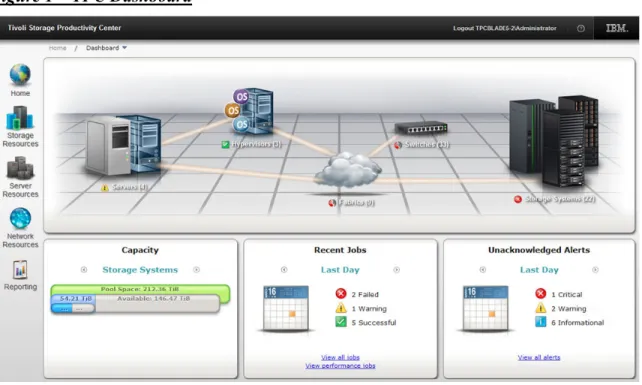
To us, the one of the most impressive aspects of TPC 5.1 is the new web-based GUI, based on IBM’s XIV and Storwize GUIs (as well as feedback from an active beta test) — and now supported on XIV, Storwize, SONAS and SVC. (See Figure 1, next page). Using this new GUI, administrators can manage SAN and NAS configurations, plan replication and back-up for disaster recovery, do capacity planning and performance
monitoring and establish and achieve storage service level agreements. Not only is the GUI itself very intuitive and user-friendly with “drag and drop” functionality, but the broad support also means that storage administrators need only learn one interface to manage many different types of storage (IBM and non-IBM).
Navigation is based around tasks, and simplified icon-based navigation reduces the time needed to perform storage management tasks, thereby improving productivity. The new interface is available with roughly 25% of functionality in the legacy GUI (still available) and will offer full functionality in a future release. Features in the new GUI include a breadcrumb trail for location awareness, a view of internal and external resources all in one place, and resource and health information in a simple and intuitive workspace view.
Figure 1 – TPC Dashboard
Source: IBM, 2012
At last month’s Edge 2012 conference in Orlando, Florida, IBM shared the results of a recent study of the new GUI conducted by the Edison Group regarding the ease-of-use of the new TPC 5.1 GUI interface. In a comparison of TPC 5.1 on StorwizeV7000 and EMC’s Unisphere solution on a VNX 5500, TPC saved up to 47% in administrative time and had 31% less complexity when compared to EMC Unisphere doing the same set of administrative tasks. This savings in administrative time means that IT personnel can spend less time on basic storage–related tasks and more time on revenue generating activities (like business analytics, for example). And there are a ton of features that are managed through the TPC 5.1 GUI, vastly improving administrator productivity, increasing efficiencies and cutting costs.
How Storage Managers and Administrators Use This New Interface
Storage managers and administrators can take advantage of numerous graphically-driven screens to perform activities such as automated discovery, disaster recovery management, or to easily access physical as well as virtual infrastructure. Each of these activities deserves a closer look.
Automated Discovery
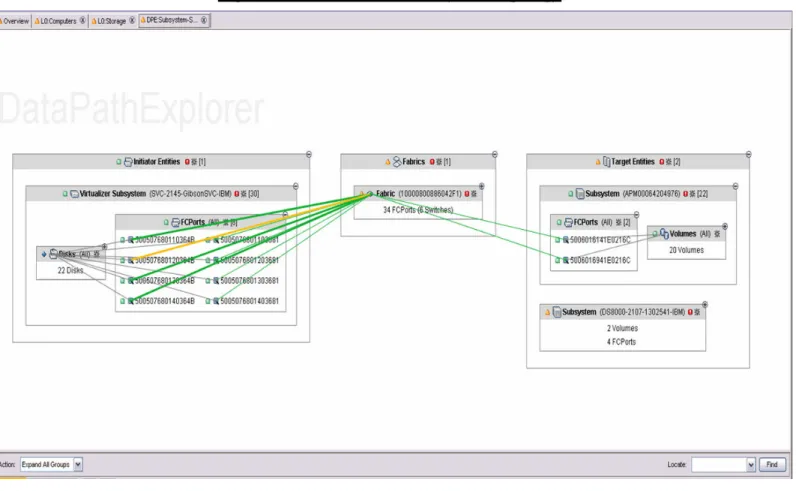
Using Tivoli’s automated discovery and topology viewer, managers and administrators can launch a utility that is able to (agentlessly) discover and manage heterogeneous storage — providing administrators with a single view of storage paths (see Figure 2 below). Using this comprehensive end-to-end view of the storage path, relationships between storage devices and connectivity for both virtual and physical resources can be seen. Menus with context sensitive drill-down provide access to management functions in real-time.
Figure 2 – Automated Discovery and Topology
Source: IBM, June 2012
Support for a Wide Range of Storage Across a Physical/Virtual Infastructure
TPC 5.1 offers discovery and visualization of scale-out network attached storage (SONAS — file-oriented networked storage) in the GUI, as well as health status monitoring,
capacity usage reporting and provisioning of file-based storage for cloud deployments. TPC 5.1 also includes intelligent SAN management (block-oriented storage area network management) with best practice guidance using SAN Configuration Analyzer. This analyzer can determine whether an existing SAN configuration complies with predefined best practices or policies (up to 16). SAN Planner wizards select configuration information to plan and modify a configuration including providing provisioning recommendations based on performance and policies. With the new GUI, users can drill down to individual storage components and performance metrics.
TPC 5.1 provides a unified storage management platform for both block and file storage, simplifying both storage management and training across the storage product portfolio.
Additionally, new virtual server features in TPC 5.1 enable the discovery and reporting of logical aspects to physical relationships within virtualized environments. Shared storage attached to multiple hosts in a cluster is correlated—associating storage not just with individual VMs and hypervisors— but also with the cluster.
These features will provide more accurate reporting for ESX server/VM guests on total, free and used capacity and avoid double counting of storage capacity within VMware.
Integration of Storage Management and the Cloud: Cloud APIs
TPC 5.1 includes a facility that enables storage managers and administrators to create their own service catalogs using a special cloud application programming interface (API). This API also isolates storage services from underlying hardware (which means that storage administrators can use these services independent of the underlying hardware).
Cloud API (Storage Management API for Clouds or SMAC) provides a REpresentational State Transfer (RESTful) API for distributed web-based service management applications to automate storage provisioning and perform storage management tasks independent of the device type.
Virtual Storage Center includes an OpenStack Nova-volume driver, which enables cloud applications to automatically provision storage from any VSC managed disk.
Why is this important? As the foundation for service catalog implementations, the Cloud API will define storage classes, and applications can provision storage based on class. Today the capability is limited to file-based storage (on Storwize V7000 Unified and SONAS), but block will be available in the future.
Look Closely At the Reporting Facilities
When evaluating TPC 5.1 — storage managers/administrators should also look closely at IBM’s new Cognos reporting:
• Cognos Reporting —Tivoli Common Reporting (TCR) Cognos is the reporting tool for TPC 5.1 (at no extra charge). Customers can easily create ad-hoc reports and charts in multiple formats through an intuitive GUI and schedule reports at predefined timeframes. Support for Cognos in TPC 5.1 will enable better
integration of storage data and analytics with other Cognos-based data throughout the enterprise, providing consistent end-to-end reporting and linkages across domains and infrastructure.
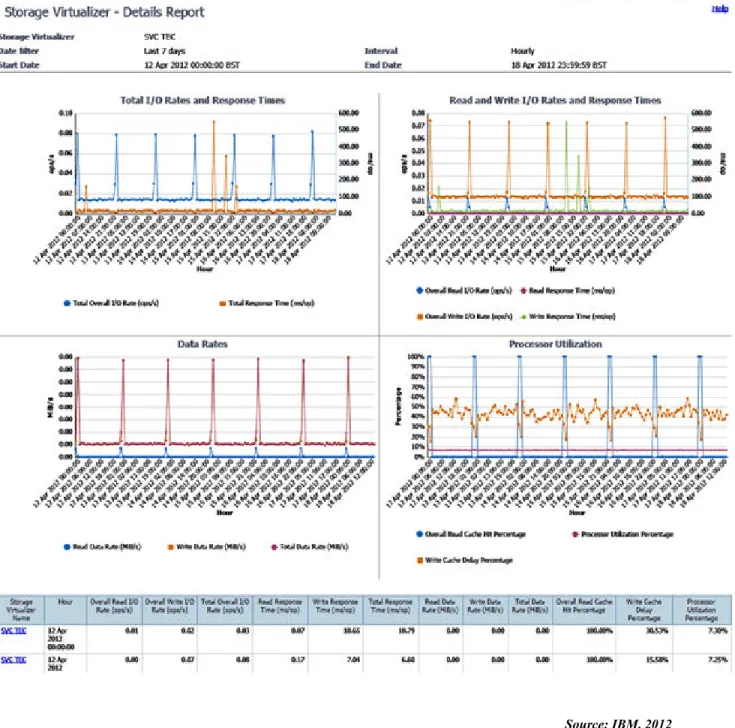
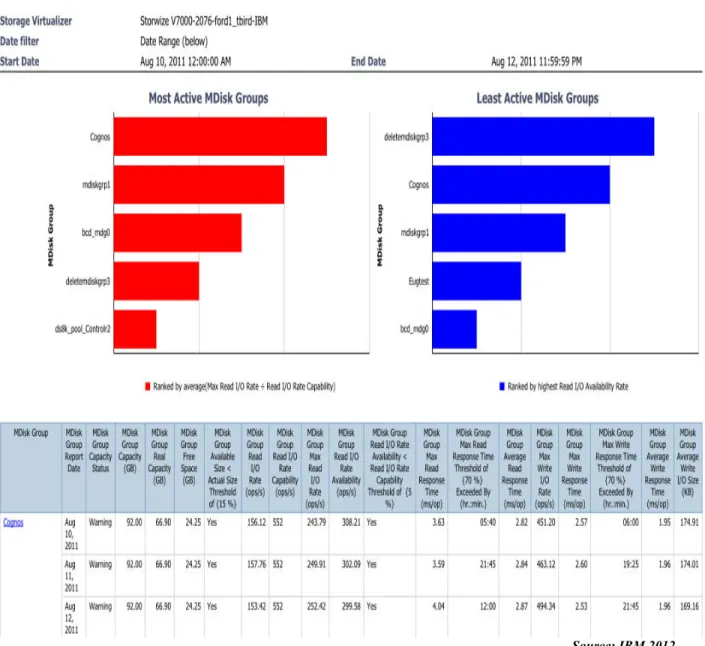
• Predefined Reports —Over 400 pre-built reports/report templates are included for performance and capacity reporting (see Figures 3 and 4, next pages).
Figure 3 – Predefined Cognos-based Performance Report
Figure 4 – Managed Disk Group Workload Report
Source: IBM 2012
This Managed Disk Group Workload Report shows the most (ranked by average read I/O performance compared to capability) and least active (ranked by highest I/O availability) MDisk groups. This report also illustrates how much storage capacity in the pool is being used for each workload, read and write response times by workload, and the number of hours/minutes that the thresholds have been exceeded.
The IBM SmartCloud Virtual Storage Center Superset — A Closer Look
As described earlier, IBM’s SmartCloud Virtual Storage Center is a superset of TPC 5.1 (so, when a buyer purchases VSC, TPC 5.1 is built into the offering). VSC extends the capabilities of TPC 5.1 by adding storage cloud and storage virtualization capabilities, data mobility, snapshot and advanced analytics. TPC 5.1 is easily upgraded to VSC. From a packaging perspective, VSC combines SAN Volume Controller (SVC), TPC 5.1, FlashCopy Manager and Storage Analytics Engine (described in detail below).
Clabby Analytics believes that the pricing model is one of the most exciting things about VSC. IBM offers all sorts of features and functions that enable customers to use storage more efficiently (storage tiering, thin provisioning, optional Real-time Compression etc.), so that customers can store and manage more data with the same amount of storage—thereby keeping pace with explosive data growth without breaking the budget. But consider this —VSC is licensed by managed TBs (the data in SVC primary storage pools)— so as customers use these data reduction features to lower hardware costs, they are actually lowering software costs as well. Customers are, in fact, getting a “two-fer”!
When evaluating VSC, look closely at the storage hypervisor, data mobility, the Storage Analytics Engine, and at back-up/restore with Tivoli FlashCopy Manager.
The Storage Hypervisor
VSC includes IBM’s storage hypervisor (introduced as a concept late in 2011). The idea is that the hypervisor (a concept originally applied to servers) allows the pooling and
centralized management of physical resources (from virtually any disk array vendor) to be consumed by virtual machines in order to improve utilization of those resources. VSC takes the next logical step in virtualized cloud computing environments by virtualizing storage. For storage virtualization, VSC acts as the virtualization platform, performing VMware-like functions and TPC takes on the management role of VCenter.
Services (I/O caching, thin provisioning, automated tiering, application-integrated snapshot and mirroring, mobility-driven disruption avoidance) are delivered by the hypervisor independent of the underlying hardware — because the Service Level Agreement (SLA) is encapsulated with the data in a virtual volume.
Storage Cloud Service Catalog
VSC includes a standardized storage cloud service catalog where services can be selected and additional services can be created. These resources are available on a “pay-per-use” basis so end-users know what they are paying for and how much it will cost as well as have the ability to choose from various service levels. For more comprehensive service level management, the service catalog in VSC can integrate with IBM’s Intelligent Storage Service Catalog.
Storage Analytics Engine
on access and usage patterns and performance requirements. Storage Analytics Engine (also known as “Tiered Storage Optimization”) operates in conjunction with Easy Tier by complementing Easy Tier functionality.
Easy Tier works vertically within a logical volume, and Storage Analytics Engine looks enterprise-wide (across volumes and storage systems) to redistribute workloads.
Storage Analytics Engine is focused on ensuring storage is placed in the appropriate tier, with operational analytics (based on performance and age) looking for storage volumes that should be moved up or down a tier. Storage Analytics Engine’s policy-driven information lifecycle management (ILM) leverages virtualization to make recommendations (no more than one per volume) for storage relocation and workload migration to move the most demanding workloads to the highest performing storage.
Storage Analytics Engine requires, as input, the list of volumes to be evaluated and the list of candidate pools to which volumes could be migrated. All defined policies are evaluated in priority order and the available space in a target pool is taken into account as if the migration was effective immediately. Two types of evaluation are supported: (1) a “white box” approach requires all storage devices are known to TPC and performance data for at least one day has been collected from all of them (most accurate) and (2) a “black box” approach which requires some performance data but the user specifies theoretical I/O values. The output is a CLI “from” and “to” list that can easily be executed as a script. Cognos reports provide additional information (60 packaged reports included).
Block level functionality is available today with file storage support available in a future release. Future releases will also automate the workload migration process (so it will perform migrations automatically, as Easy Tier does).
Disaster Recovery Management
With TPC for Replication integrated into TPC 5.1, TPC 5.1 supports FlashCopy (near-instant application-aware backups and restores using snapshot technologies), Metro Mirror (synchronous long-distance copy solution supporting a maximum distance of 300km), Global Mirror (long-distance remote copy solution across two sites using asynchronous technology) and Metro Global Mirror (three-site, high availability disaster recovery solution using synchronous replication to mirror data between a local site and an
intermediate site, and asynchronous replication to mirror data from an intermediate site to a remote site).
For storage managers and administrators, TPC 5.1 can provide central control of all replication capabilities, simplifying replication, automating the task and reducing the time it takes to perform replication jobs.
Data Mobility
VSC provides simplified management and non-disruptive data mobility across
heterogeneous tiers of storage (any supported by SVC). VSC stretched-cluster provides data access and mobility between two physical datacenters. When used with VMware vMotion or PowerVM Live Partition Mobility, transparent migration of virtual machines and their corresponding applications and data over distance is enabled.
This feature enables customers to balance workloads by moving data on the fly – within a datacenter or across two datacenters up to 300km apart
Snapshot Back-up and Restore
Easy to configure and install, FlashCopy Manager (packaged with VSC) can be ready for initial application snapshots in fewer than 4 hours. FlashCopy Manager provides near-instant application-aware snapshot back-ups for IBM DB2, Oracle, SAP, Microsoft SQL Server and Exchange.
With FlashCopy Manager, application availability and service levels are improved through high-performance, near-instant restore capabilities that reduce downtime.
Summary Observations
IBM’s TPC 5.1 offers end-to-end storage management designed and optimized for
virtualized, heterogeneous cloud environments — a trend Clabby Analytics sees across the entire Tivoli product line. The new GUI, based on the well-received XIV GUI, is intuitive and easy to navigate with detailed topology views that show connectivity and related dependencies. Reporting is vastly improved, having been replaced with Cognos, and including hundreds of pre-built reports. Analytics provide details about storage utilization, SAN configurations and performance.
Tivoli’s Virtual Storage Center is a superset of TPC 5.1 that makes it easier to deploy and manage storage within a virtualized cloud environment. It offers extended reporting and tiered storage optimization (data tier migration recommendations and scripts) with Storage Analytics Engine; cloud management facilities; the ability to set-up a cloud storage service catalogue; self-service provisioning via API (users can actually provision their own
storage); configuration change management; policy-based management, FlashCopy for backup/restore — and external virtualization capabilities found in SAN Volume Controller (which is used to manage storage across heterogeneous environments).
What we like most about these two packages is the level of integration. These products offer centralized management of heterogeneous storage; provide facilities for the automation of numerous storage tasks (using policy driven management scripts and
Clabby Analytics
http://www.clabbyanalytics.com Telephone: 001 (207) 846-6662
Clabby Analytics is an independent technology research and analysis organization. Unlike many other research firms, we advocate certain positions — and encourage our readers to find counter opinions —then balance both points-of-view in order to
Think back to the beginning of this report. The key challenge faced by information
technology (IT) executives is to get storage cost under control. We believe that automated storage management is a key element that should be used to drive down storage costs (the hardware cost of storage is minimal compared to the human-labor costs related to storage management). As we examined IBM’s TPC 5.1 and VSC products, we could not help but notice the improved GUI (which simplifies management for storage managers and
administrators); the improved reporting (that helps make more efficient use of storage); and the level of automation available throughout this product offering.
From our perspective, TPC 5.1 and VSC are the most comprehensive storage management products available on the market today. We believe that their simplified user interfaces combined with new facilities that automate storage management workflows will go a long way to reducing the cost of storage management. And this, in turn, will help enterprises get storage costs under control both now, and in the future, as storage demands continue to escalate.