Data Sheet
Cisco Multimode G.SHDSL Enhanced High-Speed
WAN Interface Card for Cisco Integrated Services
Routers Generation 2 with EFM/ATM Mode
Cisco
®Integrated Services Routers Generation 2 (ISR G2) offer a wide variety of
WAN connectivity modules to accommodate the range of application needs in
customer networks. The single-port Cisco Multimode Four-Pair G.SHDSL Enhanced
High-Speed WAN Interface Card (EHWIC-4SHDSL-EA) offers G.SHDSL-based WAN
connectivity using both 802.3ah Ethernet in the First Mile (EFM) and ATM modes on a
single enhanced high-speed WAN interface card (EHWIC). Both modes are not
supported simultaneously. This EHWIC will be used in modular routers that are
deployed in small to medium-sized businesses (SMBs) and enterprise branch offices
(Figure 1).
Overview
Designed to deliver high-speed Ethernet services over SHDSL access, the multimode G.SHDSL EHWIC offers symmetric data rates over one to four pairs of copper wire and supports both EFM and ATM modes. In order to achieve higher bandwidths, bonding of multiple pairs (4-wire, m-pair, Inverse Multiplexing over ATM [IMA], and EFM bonding) is supported.
In EFM mode, the multimode G.SHDSL EHWIC allows bonding as defined by IEEE 802.3ah, and it is typically used in scenarios where individual links are aggregated using the 802.3ah loop aggregation. Depending on the amount of wire pairs in service, the data rates can be 1 x 5.7 Mbps up to 4 x 5.7 Mbps with Annexes F and G. The EHWIC complies with the TL standard, which is based on the IEEE 802.3ah EFM standard. The 2BASE-TL standard uses the technology standard based on ITU recommendation G.991.2 bis.
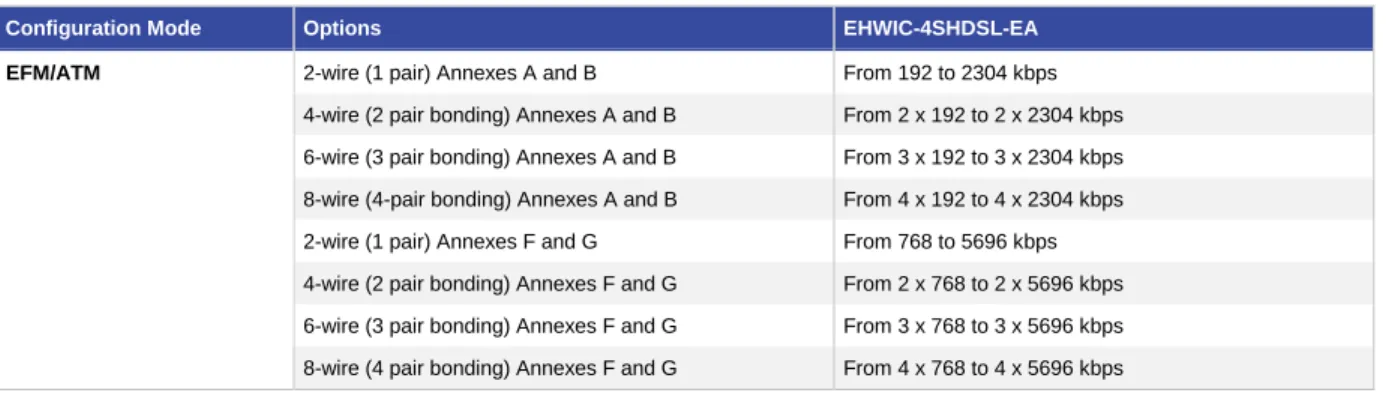
In ATM mode, the multimode G.SHDSL EHWIC allows bonding of multiple pairs up to 4 pairs (8-wire) with increased bandwidth by using IMA or data interleaving with m-pair mode. In both IMA and m-pair modes, the multimode four-pair G.SHDSL EHWIC offer data rates up to 5.696 Mbps per pair and up to 22.784 Mbps over four pairs. Refer to Table 2 for the data rates supported by the multimode four-pair G.SHDSL EHWIC (EHWIC-4SHDSL-EA) under different modes.
The multimode four-pair G.SHDSL EHWIC cost-effectively allows service providers and enterprise customers to deliver Ethernet services to sites with no access to fiber by using bonded copper pairs with symmetrical bandwidth at rates up to 4 x 5.696 Mbps. These rates cover applications traditionally served by high-data-rate DSL (HDSL), single-line DSL (SDSL), T1, E1, and services beyond E1.
The multimode four-pair G.SHDSL EHWIC together with the Cisco ISR G2 router provides businesses the necessary bandwidth for critical traffic such as voice and videoconferencing, and enables customers to save money by integrating voice and data traffic on the same WAN link. Service providers can increase subscriber revenue by bundling services and offering differentiated service levels through service-level agreements (SLAs).
Figure 1. Cisco Multimode Four-Pair G.SHDSL EHWIC (EHWIC-4SHDSL-EA)
Feature Summary
● Complies with standard based on ITU Recommendation G.991.2
● Supports G.SHDSL Annexes A (U.S. signaling) and B (European signaling) ● Supports Annexes F and G
● Offers symmetrical WAN speeds up to 1 x 2304 kbps over single copper pair, up to 2 x 2304 kbps over two copper pairs, up to 3 x 2304 kbps over three copper pairs, and up to 4 x 2304 kbps over four copper pairs using ITU-T G.991.2 Annexes A and B
● Offers symmetrical WAN speeds up to 1 x 5696 kbps over single copper pair, up to 2 x 5696 kbps over two copper pairs, up to 3 x 5696 kbps over three copper pairs, and up to 4 x 56964 kbps over four copper pairs using ITU-T G.991.2 Annexes F and G
● Supports EFM bonding; supports up to four SHDSL pairs bonding
● In ATM mode, supports maximum of eight permanent virtual circuits (PVCs) ● Supports dying gasp and wetting current
● Supports point-to-point configuration
● Supports 802.1Q, QinQ, trunk, and VLAN tagging
● Supports ATM class-of-service (CoS) and IP quality-of-service (QoS) features, 802.1P, and differentiated services code point (DSCP)
● Supports EFM (IEEE 802.3ah) operation, administration, and maintenance (OA&M)
● Offers ability to configure multiple G.SHDSL EFM EHWICs per Cisco 1921, 1941, and 2900 and 3900 Series Routers
● Provides single RJ-45 connector system requirements
System Requirements
● The multimode four-pair G.SHDSL EHWICs are supported on all modular Cisco ISR G2 routers: Cisco, 1921, 1941, 2901, 2911, 2921, 2951, 3925, 3945, 3925e, and 3945e.
● The multimode four-pair G.SHDSL EHWICs are supported in all Cisco IOS® Software feature sets. ● The routers listed previously need to run Cisco IOS Software Release 15.2(2)T or later.
● The system requires no additional flash or DRAM memory other than the specified minimum memory for the previously mentioned Cisco IOS Software releases.
Cisco Integrated Services Router with/multimode G.SHDSL EFM EHWIC Applications
Business-Class DSL with Backup WANThe Cisco ISR and ISR G2 routers with the 4-pair G.SHDSL EFM EHWIC provide a business-class DSL solution for WAN access along with the option of a backup WAN interface (asymmetric DSL [ADSL] and ADSL2+, very-high-data-rate DSL 2 [VDSL2], ISDN Basic Rate Interface [BRI], T1/E1, analog modem, cable modem, third- and fourth-generation [3G and 4G, respectively], etc.) for mission-critical applications. The bonding feature offered on the G.SHDSL EFM EHWIC allows service providers to bond two or more pairs of G.SHDSL links to offer
differentiated bandwidth based on SLAs.
Business-Class Security
The Cisco ISR G2 routers with the multimode G.SHDSL EFM EHWICs can be optimized for Internet security with the Cisco IOS Firewall supporting stateful-inspection-firewall and intrusion-prevention-system features. These platforms can also be optimized for VPNs to allow for secure use of the Internet for communications with the same policies and levels of security and performance as a private network. VPNs provide security through encryption tunneling, and the Cisco routers support hardware-based Triple Data Encryption Standard (3DES) IP Security (IPsec), Advanced Encryption Standard (AES), and Secure Sockets Layer VPN (SSL VPN). Encryption features can be enabled on the routers with the Advanced Security or any later feature set of the Cisco IOS Software. Further, Cisco ISR G2 Web Security with Cisco ScanSafe enables branch offices to intelligently redirect web traffic to the cloud to enforce granular security and control policy over dynamic Web 2.0 content, protecting branch-office users from threats such as Trojan horses, back doors, rogue scanners, viruses, and worms.
Differentiated Service Offerings through IP
Using Cisco QoS features, including Class-Based Weighted Fair Queuing (CBWFQ), Low-Latency Queuing (LLQ), Weighted Random Early Detection (WRED), etc., the Cisco Integrated Services Routers Generation 2 with the G.SHDSL EHWIC help service providers and resellers offer services that can differentiate bandwidth based on a specific application or a specific user.
Metro Ethernet
Service providers could also run Layer 2 Ethernet Services and provide Transparent LAN Services over a Metro Ethernet infrastructure. Service providers could take advantage of ISR G2 support for Xconnect on over Multiprotocol Label Switching (SVIEoMPLS) over generic routing encapsulation (GRE) with Static Pseudowire Provisioning and L2PT on Layer 2 ports, Dot1Q tunnel mode support on Layer 2 ports, customizable L2PT tunneling MAC address etc., and provide these Layer 2 Ethernet services.
Converged Platform for SMB and Enterprise Branch-Office Applications
The Cisco 1921,1941, 2900, and 3900 Integrated Services Router platforms with the multimode G.SHDSL EFM EHWICs offer you a choice of converged platforms that offer best-of-class data, security, WAN access, and voice services in a single system. The Cisco 2900 and 3900 Series Routers embed voice functions directly inside the router, enabling you to deploy voice services by installing Cisco High-Density Packet/Voice Digital Signal
Processor (DSP) Modules (PVDM3) and Cisco Integrated Services Modules (ISMs) for IP telephony conferencing, voice gateways, and Cisco Unity® Express voicemail and Automated Attendant. For call processing, you can enable the Cisco Unified Communications Manager Express solution as part of Cisco IOS Software and reconfigure the same software to support Cisco Survivable Remote Site Telephony (SRST) for centralized call processing with Cisco Unified Communications Manager.
Such an integrated solution rapidly enables service deployment, increases efficiency of network operations, and provides opportunities to protect, grow, and optimize your business.
Multimode G.SHDSL EHWIC Feature
Table 1 lists the features of the G.SHDSL EHWIC. Table 1. Multimode Four-Pair G.SHDSL EHWIC FeaturesFeatures Description
Annexes A and B Yes
Annexes F and G Yes
Support for 2-, 4-, and 8-wire modes Yes
Support for IMA Yes
Support for M-pair bonding with Annex F and Annex G
Yes
EFM bonding Yes
Connecter RJ-45
Dying gasp Yes
Wetting current Yes
Line coding 16- and 32-TCPAM (Trellis Coded Pulse Amplitude Modulation)
64-TCPAM (Lantiq extension rates - supported if DSL access multiplexer [DSLAM] supports it as well)
Rate adaption Yes
Termination Customer premises equipment (CPE)
Data rate 192-5696 kbps per pair
Up to 10 Mbps per pair (Lantiq extension rates - supported if DSLAM supports it as well)
G.SHDSL chipset Socrates-4e from Lantiq
Data Rates Supported with Four-Pair G.SHDSL EFM/ATM EHWIC
Table 2 gives data rates for the 4-pair G.SHDSL EHWIC in the two modes (EFM and ATM). Note: Actual data rates depend upon factors such as loop length, line conditions, DSLAM line card and chipset, and data rates provisioned by the service provider.
Table 2. EFM and ATM Bonding
Configuration Mode Options EHWIC-4SHDSL-EA
2-wire (1 pair) Annexes A and B From 192 to 2304 kbps 4-wire (2 pair bonding) Annexes A and B From 2 x 192 to 2 x 2304 kbps 6-wire (3 pair bonding) Annexes A and B From 3 x 192 to 3 x 2304 kbps 8-wire (4-pair bonding) Annexes A and B From 4 x 192 to 4 x 2304 kbps 2-wire (1 pair) Annexes F and G From 768 to 5696 kbps 4-wire (2 pair bonding) Annexes F and G From 2 x 768 to 2 x 5696 kbps 6-wire (3 pair bonding) Annexes F and G From 3 x 768 to 3 x 5696 kbps EFM/ATM
Interoperability
The multimode G.SHDSL EHWIC is based on the Lantiq chipset, and it operates when connected to a DSLAM. Table 3 lists the DSLAMs that have been tested and are supported for interoperability. This table will be updated as more DSLAMs, line cards, and firmware versions are tested and supported in the future.
Table 3. DSLAM Interoperability EFM
Sr.No Mode DSLAM DSLAM Chassis Controller Card Line Card Firmware
SMLT-A LDP7AA46.030 1 ATM Alcatel ASAM 7300 7300 SANT-F
SMLT-C LPR9AA46.029
2 ATM Huawei MA5603 5603 SCUB SHEB 1.4.13
LIM-SL-72 9.7.4 e21 3 ATM Lucent Stringer
LIM-SL-48 9.7.4 e21 STUC-16A S3_8.10.16
4 ATM ECI 480 480
STUC-32A S3_8.10.16 NSLT-A 1.4.1 5 ATM Alcaltel ISAM_7330_FTTN 7330 NANT-A
SMLT-J 1.2.42 7 EFM Alclatel ISAM_7330_FTTN 7330 NANT-A NSLT-A 1.4.1
8 EFM Huawei_5603 5603 SCUB SHEB 1.4.13
9 EFM Huawei_5600 5600 SHEB 1.4.18
10 EFM Hatteras HN4000 HN4000 7.1.2
11 EFM Actelis ML698 ML 698 SW: 7.10/35
Platform Support
Table 4 gives platform support details for the multimode G.SHDSL EHWICs. Table 4. List of supported ISRG2 platforms
Platforms Multimode Four-Pair G.SHDSL EHWIC
Platforms supported Cisco 1921, 1941, 2901, 2911, 2921, 2951, 3925, 3945, 3945E, and 3925E Onboard EHWIC slots on all platforms Yes
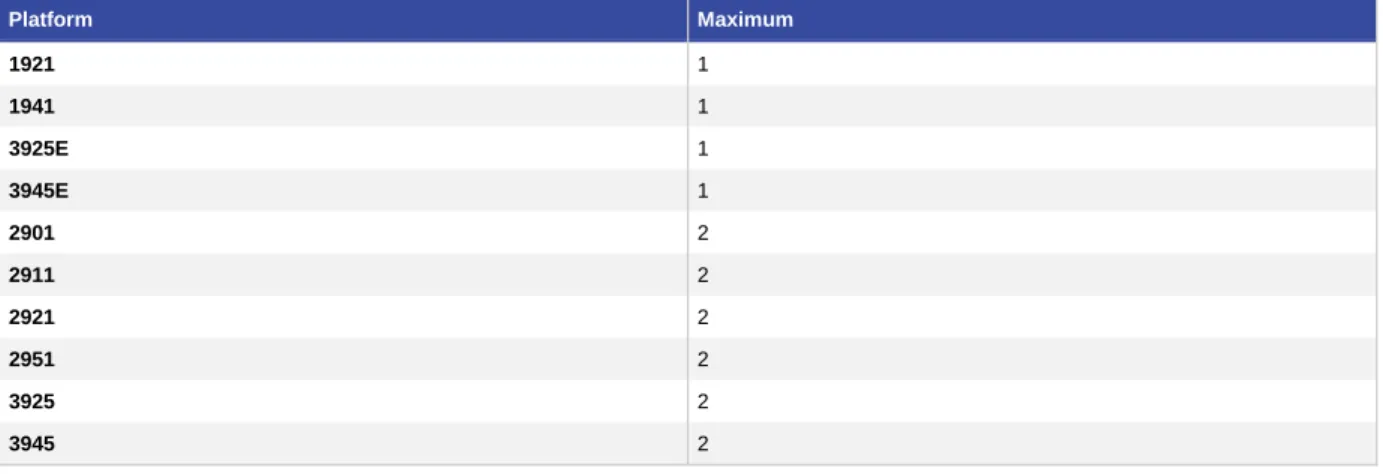
Table 5 gives the maximum number of multimode G.SHDSL EHWICs per platform Table 5. Number of supported multimode G.SHDSL EHWICs per ISR G2 Platform
Platform Maximum
1921 1
1941 1
3925E 1
3945E 1
2901 2
2911 2
2921 2
2951 2
3925 2
Software Requirements
The minimum Cisco IOS Software Release required for the multimode G.SHDSL EHWIC (EHWIC-4SHDSL-EA) on the Cisco 1921,1941, 2900, and 3900 Integrated Services Routers is listed in Table 6. The recommended T-train Cisco IOS Software Release is 15.2(2)T. The four-pair multimode G.SHDSL EFM/ATM EHWIC is supported in all Cisco IOS Software feature sets.
Table 6. Minimum Cisco IOS Software Release
Platforms Minimum Cisco IOS Software Release
Recommended Cisco IOS Software Release
Cisco IOS Software Release Feature Set
1921, 1941, 2901, 2911, 2921, 2951, 3925, 3945, 3925E, and 3945E
15.2(2)T 15.2(2)T or later IP Base and later
Product Number and Ordering Information
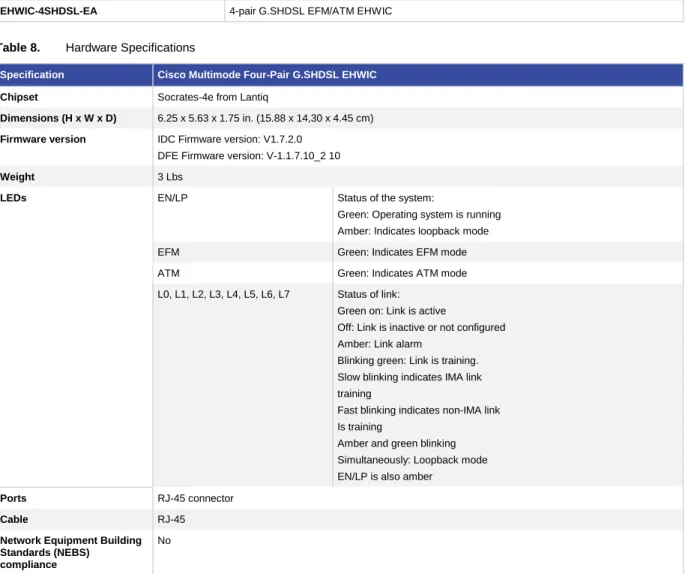
Table 7 gives product ordering information, and Table 8 gives product hardware specifications. Table 7. Product Ordering Information
Product Number Description
EHWIC-4SHDSL-EA 4-pair G.SHDSL EFM/ATM EHWIC
Table 8. Hardware Specifications
Specification Cisco Multimode Four-Pair G.SHDSL EHWIC
Chipset Socrates-4e from Lantiq
Dimensions (H x W x D) 6.25 x 5.63 x 1.75 in. (15.88 x 14,30 x 4.45 cm) Firmware version IDC Firmware version: V1.7.2.0
DFE Firmware version: V-1.1.7.10_2 10
Weight 3 Lbs
EN/LP Status of the system:
Green: Operating system is running Amber: Indicates loopback mode EFM Green: Indicates EFM mode ATM Green: Indicates ATM mode LEDs
L0, L1, L2, L3, L4, L5, L6, L7 Status of link: Green on: Link is active
Off: Link is inactive or not configured Amber: Link alarm
Blinking green: Link is training. Slow blinking indicates IMA link training
Fast blinking indicates non-IMA link Is training
Amber and green blinking Simultaneously: Loopback mode EN/LP is also amber
Ports RJ-45 connector
Cable RJ-45
Network Equipment Building Standards (NEBS)
compliance
Safety, EMC, Telecom, Network Homologation, Power, and Environmental Requirements
When installed in a Cisco 1921,1941, 2900, or 3900 router, the multimode four-pair G.SHDSL EHWIC (EHWIC-4SHDSL-EA) does not change the standards (safety, EMC, telecom, network homologation, power, environmental requirements, and regulatory approvals) of the router itself. Refer to the Cisco 1921,1941, 2900, and 3900 data sheets for additional information about mechanical, environmental, and agency certifications.● For Cisco 1900 Series:
http://www.cisco.com/en/US/prod/collateral/routers/ps10538/data_sheet_c78_556319.html. ● For Cisco 2900 Series:
http://www.cisco.com/en/US/prod/collateral/routers/ps10537/data_sheet_c78_553896.html. ● For Cisco 3900 Series:
http://www.cisco.com/en/US/prod/collateral/routers/ps10536/data_sheet_c78_553924.html.
Country Support
● This worldwide-accepted technology is based on ITU Recommendation 991.2.
● Refer to the following URL or contact your local Cisco representative for country-specific approval status: http://tools.cisco.com/cse/prdapp/jsp/externalsearch.do?action=externalsearch&page=EXTERNAL_SEARC H.