274
EXPERIMENTAL RESEARCHES REGARDING THE DENSIMETRIC
SEPARATOR FOR CLEANING OF THE WHEAT DESTINED TO MILLING
CARMEN BRĂCĂCESCU, ANIŞOARA PĂUN, PAUL GĂGEANU, ELENA SORICĂ, COSTIN MIRCEA National Institute of Research-Development for Machines and Installations Designed to Agriculture and Food Industry, INMA Bucharest, Romania [email protected]
Keywords: wheat cleaning, densimetric mass, electric motovibrator
ABSTRACT
The cleaning of cereal seeds represent an essential operation of the conditioning chain. Taking into account all considerations, the experts׳ attention has been drawn by the study of phenomena which influence upon the impurities separation process, aiming at a maximum reduction impurities. The paper presents the constructive and functional scheme of an densimetric separator driven by means of electrical motovibrators, in view of theirs utilisation with best results for the drive of vibrating sieves. The results of the experimental researches are highlighted, after which the optimal operating parameters were established.
INTRODUCTION
The continous progress related to improving the primary processing methods as conditioning operations and technical and material base periodically determines the enhancement of requirements in terms of foreign bodies removal and other quality aspects.Therefore, profoundly knowing the technology to be used, the operating method of technical equipment appropriate to relevant technology and technical-functional parameters adjusting represent an important preriquisite to obtain the maximum quality with reduced power and man labour consumption.
275
MATERIAL AND METHODS
It was designed and achieved a densimetric separator having a capacity of 2 – 4 kg/h for equipping of the wheat cleaning technological line destined to grain milling (Fig. 1). The separator is a complex structure equipped on inferior part with operation surface made up from wire cloth and discharging pipes of the product after separation. On the upper part, the case is provided with aspiration and feeding pipes. Each pipe has one clack for regulating air flow respectively feeding product flow. The case is provided with plastic visor for the controlling of operation process.
Figure 1. Constructive scheme of densimetric separator [1]
1 - sustaining frame; 2 - separator case; 3 - driving system (electric motovibrators); 5, 6 – finished (cleaned) product discharging pipe; 10- air aspiration pipe;11 - product feeding pipe; 12 -
pipe for discharging heavy impurities; 13 - screw mechanism
276
heavy impurities are moved to upper side of the operation surface but the grain are moved to inferior side, after that they are evacuated by two connecting pipes 5 and 6 . The wheat cleaning process is influenced by the following parameters: product feeding flow; air flow; inclination angle of the operation surface and the amplitude of the oscillatory motion. The product and air flows are regulated by means of clack being on feeding connection pipes. The inclination angle of the operation surface is continuously regulated (betwen limits 5…100) by means of the screw mechanism that fixes the case against frame. The amplitude of the oscillatory motion is regulated between limits 1.5...2.5 mm by modification of the vibrator with eccentric masses.
The material used at experimental researches was the wheat (as seeds) obtained from experimental plots of INMA Bucharest. This material was first introduced in the intensive vacuum separator, being subjected to the operation of separation by size.
For experimental measurements were used measurement devices and / or registration of the following sizes (parameters):
- masses of products and impurities in the separation process;
- inclination angle respect to the horizontal of the working surface of the separator (vibrating sieve);
- air flow rate of the suction installation by determining the velocity of air currents in the suction pipe;
- oscillation amplitude of the working surface;
- frequency of oscillation of the electro-vibrators, by determining their rotation speed;
- power consumption of electro-vibrating system of the separator; - humidity and temperature of processed product.
For the calculation of the technological effect index were determined by weighing and calculation for the following sizes, reported to 1,000 kg of wheat processed by the separator: total quantity of impurities separated, kg; the quantity of eliminated stones, kg; the quantity of other impurities eliminated (seeds of other nature including broken, non-eliminated light seeds, soil, etc.), kg; the quantity of lost good seeds, kg.
The coefficient of loss of good seeds Cps is calculated with the relation:
Cps (m/M)100 [%] (1)
where: m is the good seeds mass which are found at the exit from equipment in the quantity of total impurities eliminated;
M- good seeds mass at the entry into equipment.
The index of technological effect Ecs represents the percentage of foreign bodies (impurities) eliminated from the mass of processed product and is determined with the relation (Costin I. ,1999):
Ecs
CcsiCcse/Ccsi
x100 [%] (2)277
Ccse- content foreign bodies (impurities) at evacuation of material, %
The quantity of electricity W consumed by electric motovibrators is calculated by the relation:
W (Pat)/3600 [kWh] (3)
where Pa is the power absorbed by electric motovibrators (kW), t - operating time at tests (s)
Specific electricity consumption q was determined by calculation with the following formula: me u Q P q
[kWh/kg] (4)
where Pu is the the effective power of the machine, kW; Q- the flow rate of processed product, kg/h; ηme- actuation yield.
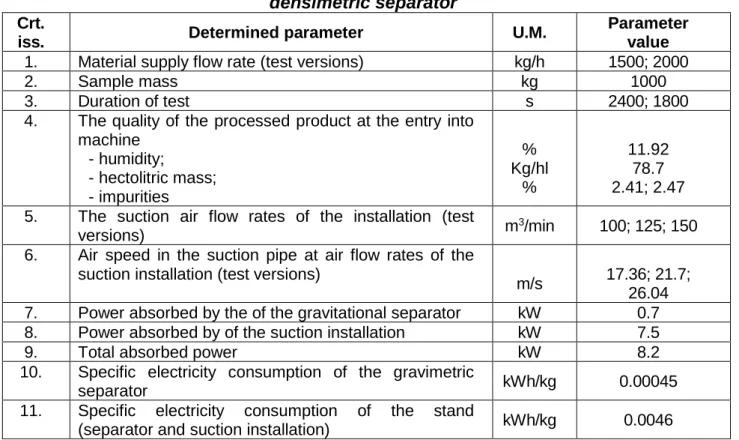
The values resulting from processing determined parameters are mentioned in Table 1.
RESULTS AND DISCUSSIONS
Table 1 The results of the tests effected for the determination of optimal regime of the
densimetric separator Crt.
iss. Determined parameter U.M.
Parameter value
1. Material supply flow rate (test versions) kg/h 1500; 2000
2. Sample mass kg 1000
3. Duration of test s 2400; 1800
4. The quality of the processed product at the entry into
machine - - humidity;
- - hectolitric mass; - - impurities
% Kg/hl % 11.92 78.7 2.41; 2.47
5. The suction air flow rates of the installation (test
versions) m
3/min 100; 125; 150
6. Air speed in the suction pipe at air flow rates of the suction installation (test versions)
m/s 17.36; 21.7;
26.04
7. Power absorbed by the of the gravitational separator kW 0.7
8. Power absorbed by of the suction installation kW 7.5
9. Total absorbed power kW 8.2
10. Specific electricity consumption of the gravimetric
separator kWh/kg 0.00045
11. Specific electricity consumption of the stand
(separator and suction installation) kWh/kg 0.0046
278
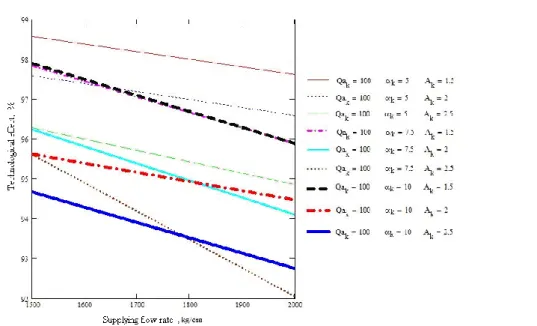
Figure 2. Variation of the values of technological effect index ECS depending on the supplying flow rate with material (wheat) Qg at suction installation flow rate of Qa=100 m3/minand the following adjustment parameters: inclination angle of the working surface αk and working surface
amplitude Ak
Figure 3. Variation of the values of technological effect index ECS depending on the angle of the working surface α at the supplying flow rate with material Qg=2000 kg/h, for the following
adjustment parameters: air flow rate Qa and working surface amplitude A
It finds the following aspects after analyse of the experimental results:
• The performance of the densimetric separator increases by the increasing of air flow due to that it achieves a better stratification of product strata depending on specific weight of particles.
• By the increasing of the inclination angle of the operation surface, it diminishes the wheat quantity eliminated through impurities pipes. We have to mention that if it increases inclination angle more then 100, the performance of separator becomes worst.
279
CONCLUSIONS
The results obtained during the experimental researches reveal that the experimental model of densimetric separator comply with the requirements in terms of destination, of the purpose and functioning mode, of the possibilities for adjustment and servicing, working having a working capacity suitable technological flows from milling units.
BIBLIOGRAPHY
1. Brăcăcescu C., Sorică C., Manea D., Yao Guanxin, Constantin G.A., 2014 -
Theoretical contributions to the drive of cereal cleaning technical equipment endowed with non-balanced vibration generating systems, INMATEH – Agricultural Engineering, Vol. 42;
3. Costin I., 1999 - Miller’s Book, Technical Publishing House, Bucharest, Romania; 4. Didyh V.F., 2002 - Improving the efficiency of drying agricultural plant materials, monograph, Lutsk;
5. Falko O., 2014 - Bulk products separation on a stepped screen surface, Journal of EcoAgriTourism, vol.10, no.1, Braşov;
6. Geankoplis Chr., 2003 - Transport processes and separation process principles, Prentice Hall PTR,Fourth Edition;
![Figure 1. Constructive scheme of densimetric separator [1]](https://thumb-us.123doks.com/thumbv2/123dok_us/8068291.2137011/2.892.257.631.327.883/figure-constructive-scheme-of-densimetric-separator.webp)