38
EVALUATION OF THE CYTOGENETIC EFFECTS PRODUCED BY
BOTRYTIS ALLII
FUNGUS TO
ALLIUM CEPA
BONCIU ELENA1*, SĂRAC IOAN2, PETRESCU IRINA2 1
University of Craiova, Faculty of Agronomy, Department of Agricultural and Forestry Technology;
2Banat’s University of Agricultural Science and Veterinary Medicine „Regele Mihai I al
României” Timisoara, Faculty of Horticulture and Forestry, Genetic Engineering Department *Corresponding author email: [email protected]
Keywords: Allium cepa, Botrytis allii, mitotic index, chromosomal aberrations
ABSTRACT
The purpose of this paper was to evaluate the cytological effects produced by Botrytis allii fungus (gray rottenness) on the meristematic cells of onion (Allium cepa). In case of the samples studied (onion bulbs affected by the disease, together with a healthy control), the following cytogenetic characteristics were analysed: the mitotic index, the frequency of mitosis phases in the roots apex, the frequency and types of chromosomal aberrations and nuclear abnormalities.
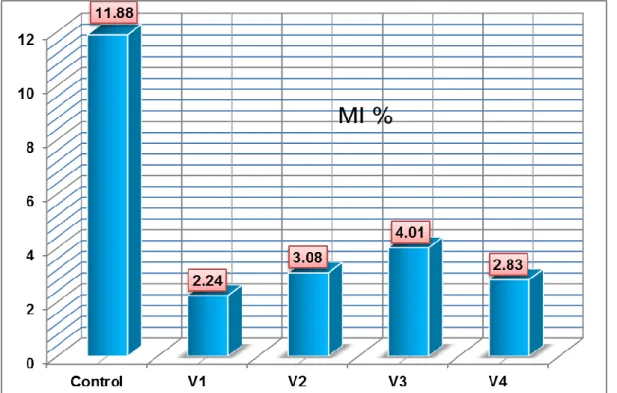
After analysing results were found large differences between samples; thus, the mitotic index decreased from 11.88% for the control to 2.24-4.01% for samples affected by Botrytis allii. Also, it has been found the following main types of chromosome aberrations and nuclear abnormalities: sticky and laggard type
chromosomes, fragments of chromosomes, as well as cells with nuclear erosion. From this point of view, the frequency of chromosomal aberrations and nuclear abnormalities was significantly higher in the case of variants affected by Botrytis allii, compared to the control variant (1.41% for control variant and 10.43-14.74% for variants affected by Botrytis allii).
The results show that Botrytis allii (gray rottenness) has the ability to cause a large number of mitotic abnormalities to Allium cepa, affecting the growth and development of plants. In addition, the cytogenetic effects of infection with Botrytis allii can probably be similar to those produced by the action of a mutagenic agent.
INTRODUCTION Onion (Allium cepa L.) belongs to the
genus Allium of the family Alliaceae and is originated in southwestern Asia. Onions are an important food crop worldwide. It is grown mainly as addition for different food dishes. Onions not only provide flavour, they also provide important nutrients and health-promoting phytochemicals. Thus, onion, along with garlic and leek, is part of the functional food category that abounds in antioxidant vitamins and phytonutrients (allylsulfides), very healthy for the daily diet of consumers. From this point of view, a niche segment consisting of different
functional foods and dietary supplements - very necessary for the consumer whose daily stress level is increased - has been developed (Săvescu P., 2017; Săvescu P., 2016). Vitamin C, or the ascorbic acid, is one of the most valuable substances; to onion, vitamin C is the most important minor component (9 mg/100 g fresh onion) (Belitz H.D. and Grosch W., 1992). Onions are a good source of dietary fiber and folic acid. They also contain calcium, iron, and have a high protein quality (ratio of mg amino acid/gram protein).
39 onion-producing farms has been made in the most favourable areas. In Romania, the most farms where onions are grown
are located in counties in the
southeastern part of the country, where are the best pedoclimatic conditions for this species. The onion culture is also suitable in the Oltenia region, though this area is often affected by drought and heat that strongly influence other plant (like maize, peanuts) development and yield (Bonea D., 2016; Bonea D. and Urechean V., 2017; Olaru L.A., 2009; Popescu C.V. and Bora C., 2009). However, there is emphasized the rational use of water as a
main method to combat drought
(Popescu C.V. and Bora C., 2009).
Fungal pathogens may be present on plants before harvesting, in the time of harvest or after harvesting, in the time of
storage, depending on storage
conditions. Botrytis allii is a plant pathogen, a fungus that causes gray rottenness to stored onions (Chilvers M.I. and Du Toit L.J., 2006). The species was first described scientifically by Mancel Thornton Munn in 1917. Botrytis allii it is a common disease in onion crops and produces major damage, 15-20%, both in field crops and in deposits.
Latent Botrytis infections in onion bulbs are typically detected by storing harvested bulbs for 8 to 16 weeks, and then cutting the bulbs vertically to assess for internal symptoms (Chilvers M.I. et al., 2004). A real-time fluorescent PCR assay based on SYBR green chemistry has been developed to quantify the amount of neck rot Botrytis spp. (B. allii, B. aclada, and B. byssoidea) present in onion seed (Chilvers M.I. and Du Toit L.J., 2006).
Higher plants provide valuable genetic
assay systems for screening and
monitoring environmental pollutants. For this purpose, the Allium cepa is one of the most frequently used higher plant species. The Allium test for genotoxicity was introduced by L. Evan (1938). The vegetal meristematic tissues that are used for testing the effects of some mutagens on chromosomes should be easy to obtain and less expensive. From this point of view, Allium cepa are well suited to cytogenetic studies because the meristematic roots appear lightly, have relatively large chromosomes in small numbers and can be easily observed by microscope.
MATERIALS AND METHODS
The experiment was maintained in laboratory conditions at 24±2°C. For cytogenetic analyses, five bulbs of a commercial variety of onion (Allium cepa, 2n = 16) were selected; one of which was healthy (Control) and four bulbs were affected by Botrytis allii (samples V1, V2, V3, V4). The onion bulbs were allowed to produce roots in tap water for 72 h. After germination, the roots from each onion bulbs were immediately cut and fixed in solution of ethanol and glacial acetic acid (3:1) for 24 h; next day, the roots were transferred to 70% alcohol and stored in refrigerator until use. For microscopic preparation, the root tips were treated with 1N HCl for 5 min and HCl 50% for 16 min; after that, the roots were washed with distilled water. To carry
out the chromosomes view using the optic microscope, these were colorized with the basic fuchsine decolorized solution (Schiff reactive), prepared in the laboratory. The effective colorized operation was the introduction to 3-4 cc colorant solution from onion roots placed in glass ampoules, at room temperature. After max 30 minutes, the meristematic tissues were colored in purple-red.
Microscopic slides were done by
40 percent ratio of dividing cells and total numbers of cells scored.
The different phases of mitosis were calculated as following: Prophase frequency % = number of cells in prophase x 100/total number of dividing cells; Metaphase frequency % = number of cells in metaphase x 100/ total number of dividing cells; Anaphase frequency % = number of cells in anaphase x 100/ total number of dividing cells; Telophase frequency % = number of cells in telophase x 100/ total number of dividing cells.
The rates of mitotic abnormalities were also calculated: number of cells with
chromosomal aberrations/ nuclear
abnormalities x 100/ total number of dividing cells.
The analysis of variance was used to assess the significant differences between control and each treatment. The data were expressed as mean ± standard error of the means for all parameters. To calculate and to graphically represent the statistical parameters, the Microsoft Office Excel 2010 software of Windows
XP operating system was used.
RESEARCH RESULTS The effects produced by Botrytis allii
fungus (gray rottenness) on the
meristematic cells of onion (Allium cepa) are reported in Table 1 and Figure 1. Analysis of the results showed a decrease in % MI of between different samples and control. Thus, the mitotic index decreased from 11.88% (Control) to 2.24 % (V1); 3.08% (V2); 4.01% (V3) and 2.83% (V4).
Mitotic index is considered a parameter that allows one to estimate the frequency of cellular division; inhibition of mitotic activities is often used for tracing
cytotoxic substances. Generally
cytotoxicity means a decrease in mitotic index and as an increase of the chromosomal aberrations and nuclear abnormalities. Regarding the different phases of mitosis, they recorded the following values: prophase 54.03% (Control) and 40.08-45.90% (V1-V4); metaphases 19.69% (Control) and
28.82-35.95% (V1-V4); anaphase 11.25%
(Control) and 13.36-14.95% (V1-V4); telophase 15.03% (Control) and 9.24-14.55% (V1-V4).
The changes in the organization and morphology of the chromosomes in the root tips affected by Botrytis allii were observed (Table 2). They identified some types of chromosomal aberrations and nuclear abnormalities, as follows: sticky
and laggard type chromosomes,
fragments of chromosomes, as well as
cells with nuclear erosion (Figure 3). From this point of view, the frequency of chromosomal aberrations and nuclear abnormalities was significantly higher in the case of variants affected by Botrytis allii, compared to the control variant: 1.41% (Control); 10.43% (V1); 14.74% (V2); 11.91% (V3) and 12.22% (V4). Regarding the frequency of different types of mitotic abnormalities (Figure 2), sticky chromosomes recorded values between 0.71% (Control) and 3.85-5.91%
(V1-V4); aberrant fragments
chromosomes recorded values between 0.30% (Control) and 0.92-3.62% (V1-V4); laggard chromosomes recorded values between 0.40% (Control) and 1.95-2.92% (V1-V4).
In mitosis, laggards chromosomes may be lead to genetic disequilibrium between daughter cells. On the other hand, from the point of view of nuclear anomalies, the control variant did not recorded such cases, whereas at the samples affected by Botrytis allii, was detected cells with nuclear erosion with a frequency of 2.74% (V1); 3.23% (V2); 2.81% (V3) and 3.12% (V4).
The appearance of chromosomal
anomalies in plants is generally regarded as a potential danger, even if, sometimes, the mutagens create variability (Bonciu E., 2012; Bonea D. et al., 2018; Bonea D.
41
Table 1
The mitotic index and frequency of mitosis phases to Allium cepa affected by
Botrytis allii fungus
Mitotic index (MI%)*
Frequency of mitosis phases (%)*
P M A T
Control 11.88±0.65 54.03±2.58 19.69±2.05 11.25±0.41 15.03±1.90
V1 2.24±0.21 40.08±4.51 32.01±4.02 13.36±1.82 14.55±2.03
V2 3.08±0.42 43.01±2.57 28.82±0.58 14.95±2.82 13.22±4.08
V3 4.01±0.51 40.26±3.05 35.95±3.01 14.55±2.03 9.24±1.68
V4 2.83±0.34 45.90±2.60 29.55±0.61 14.31±2.46 10.24±1.79
*mean ± standard error of the means
P=Prophase; M=Metaphase; A=Anaphase; T=Telophase
Table 2
Frequency of mitotic abnormalities induced by Botrytis allii fungus to Allium cepa
Total CA and NA (%)
Type (%)
S F L NE
Ct 1.41 0.71 0.30 0.40 0
V1 10.43 3.85 0.92 2.92 2.74
V2 14.74 5.44 3.62 2.45 3.23
V3 11.91 5.91 1.24 1.95 2.81
V4 12.22 4.85 2.23 2.02 3.12
CA=Chromosomal aberrations; NA=Nuclear abnormalities; S=Stickiness; F=Fragments; L=Laggards; NE=Nuclear erosion
42
Figure 2. Graphical representation of the chromosomal aberration (%) and nuclear abnormalities (%) to Allium cepa affected by Botrytis allii fungus
A B
C
43
CONCLUSIONS
In our experience, Botrytis allii
fungus has a significant influence on the mutagenic activity to Allium cepa and can produce negative effects on mitotic divisions in Allium cepa cells. The mitotic inhibition will lead to growth inhibition of active protective response when plants are exposed to this pathogen. Also, the appearance of various chromosomal
aberrations illustrates the cytotoxic potential of this disease.
The fungal pathogen caused a relatively high number of chromosomal aberrations and nuclear abnormalities in all analysed samples compared to the control sample. In conclusion, we can say that Botrytis allii fungus can behave as a
weak mutagen
.
BIBLIOGRAPHY
1. Belitz H.D., Grosch W., 1992:
Lehrbuch der Lebensmittelchemie, Springer-Verlag, Berlin, p. 199.
2. Bonciu E., 2012: Cytological effects induced by Agil herbicide to onion. Journal of Horticulture, Forestry and Biotechnology, 16(1): 68-72.
3. Bonea D., Bonciu E., Niculescu M., Olaru A.L., 2018: The allelopathic, cytotoxic and genotoxic effect of the Ambrosia artemisiifolia on the germination and root meristems of Zea mays. Caryologia, International Journal of Cytology, Cytosystematics and Cytogenetics, Volume 71, 2018, Issue 1, Pages 24-28.
4. Bonea D. and Bonciu E., 2017:
Cytogenetic effects induced by the fungicide Royal Flo to maize (Zea mays L.). Caryologia , International Journal of Cytology, Cytosystematics and Cytogenetics, Volume 70, 2017, Issue 3, Pages 195-199.
5. Bonea D., Urechean V., 2017.
Study on the selection for drought tolerance of some semi-late maize
hybrids cultivated at A.R.D.S.
SIMNIC. Annals of the University of
Craiova-Agriculture,Montanology,
Cadastre Series, Vol. 47, no 1, pp.
34-40.
6. Bonea D., 2016: The effect of climatic conditions on the yield and quality of maize in the central part of Oltenia. Annals of the University of Craiova-Agriculture, Montanology, Cadastre Series, Vol. 46, no 1, pp. 48-55.
7. Chilvers M.I., Du Toit L.J., 2006: Detection and Identification of Botrytis Species Associated with Neck Rot, Scape Blight, and Umbel Blight of Onion". Plant Health Pr, doi:10.1094/PHP-2006-1127-01-DG.
8. Chilvers M.I., Hay F.S., Wilson C.R., 2004: Survey for Botrytis species associated with onion in northern Tasmania, Australia. Australasian Plant Pathol., 33:419-422.
9. Olaru L.A., 2009: Îmbunătăţirea tehnologiei de cultivare a arahidelor pe nisipurile irigate din stânga Jiului. Tipografia Universitătii.
10. Popescu C.V., Bora C., 2009: The rational use of water as a main method to combat drought. Annals of the University of Craiova-Agriculture, Montanology, Cadastre Series, vol. 39, Issue 1, pp. 455-459.
11. Popescu C.V., Bora C., 2009:
Oportunitatea irigării culturilor agricole in zona centrala a Olteniei. Editura Sitech, Craiova.