188
IDENTIFYING THE SOCIO-ECONOMIC NEEDS OF THE AGRICULTURAL
POPULATION IN TIMIS COUNTY, ROMANIA
GABRIELA POPESCU Banat`s University of Agricultural Sciences and Veterinary Medicine, Faculty of Agricultural
Management, Timisoara, Romania
ABSTRACT
The statistical data collected in the European Union have revealed a distinctive socio-economic profile of the Romanian rural environment compared to the Western European states and even the new Member States of Central and Eastern Europe. Romania has a high percentage of rural population (almost 45% of the total population, representing 9.65 million people – National Institute of Statistics - NIS, Statistical Yearbook 2009) and low socio-economic indicators in rural areas. Studies on life quality conducted in the past years have revealed critical levels of income, consumption, habitation or access to public services and utilities in rural.
Given the social changes that have occurred in the Romanian society in the past two decades, the rural environment is undergoing a tortuous stage of reorganisation initiated by a series of socio-economic processes: restoration of land, economic reorganisation, urban-rural migration, external migration, rapid development of localities near larger towns or depopulation of isolated areas.
Under the circumstances, the image of the current village at the macro level is very different from the reality of 20 years ago.
INTRODUCTION
The socio-economic changes that have led to the reconfiguration of the rural environment in the past two decades have had different effects on the various population categories or rural localities. As a result, in the rural area, the process of social transformation was fluctuating, irregular and often contradictory, leading to a higher social differentiation level both among individuals and in localities.
Creating the organisational framework that encourages the basis of the development options of localities, systematisation and environmental protection, private initiative, providing a decent living standard through economic and social protection measures should start with familiarisation with the population of each region.
189
Effective economic and administrative measures cannot be taken without information about the number of inhabitants and the population structure on age and sex, occupation and educational level, the current dimension and the probable evolution of families and households.
The purpose of this research paper is to make a special presentation of the needs of the agricultural population in three pilot villages of Timiş County – Orţişoara, Becicherecu Mic and Secaş – and to provide suitable solutions to the problem of socio-economic counselling. This research activity is part of a project aiming to facilitate market-related agricultural reorganisation in correlation with the identification of the main local socio-economic characteristics and the objectives of the CESAR project.
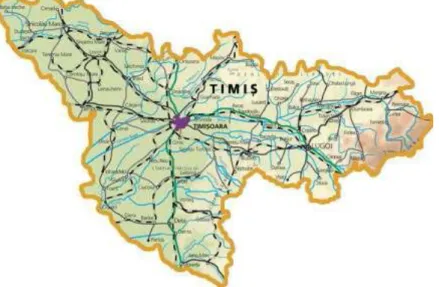
Timiş County covers a total area of 869 665 hectares, i.e. 3.65% of Romania’s territory. It is the largest county in the country.
Timiş County has 259.989 rural inhabitants (39.3%), most of them earning their living as land cultivators or animal breeders.
A number of 158.000 people, representing 2.21% of the total of people involved in agricultural activities at the national scale and 61% of the total rural population (according to the agricultural census conducted in 2010-2011) work in agriculture.
Demographically speaking, the rural area of Timiş County is not homogeneous. There is a differentiation in the population profile at the community level, taking the localities as reference points.
From this perspective, one can differentiate three main types of localities in correlation with the degrees of socio-economic development and the occupational features of the population: periurban (Dumbrăviţa, Giroc, Giarmata, Lugojel, etc), with mostly non-agricultural population in close connection with the nearby town, leading to low poverty rates; isolated rural localities or localities that are very far from major urban centres (Secaş, Jamu Mare, Lăţunaş, etc.), where the population works in subsistence or semi-subsistence farms and the poverty rate is the highest; and intermediary rural localities (Orţişoara, Becicherecu Mic, etc.)whose profile is a combination of the previous two types. The project will be implemented in Timiş County, in the pilot villages Orţişoara,
Secaş and Becicherecu Mic, as well as other localities with agricultural potential. The end beneficiaries of the project are the following:
1. small and medium-size farms and potential producers; 2. young farmers who wish to start an agricultural business; 3. people working in the subsistence farming system;
4. producer groups; 5. family associations.
The indirect beneficiaries are the local and regional authorities and the community as a whole.
It is estimated that during the implementation stage of the project, a number of 400 farmers and individual agricultural producers in Timiş County will benefit from socio-economic counselling services.
Setting up the hypotheses
Our approach is based on several hypotheses that can be either confirmed or ruled out.
General hypothesis:
If the needs of the agricultural population in the three pilot villages - Orţişoara, Becicherecu Mic and Secaş – were identified, then effective measures could be taken to provide socio-economic counselling.
190
- The agricultural population of the pilot villages knows very little about the European funds for agriculture.
- The agricultural population is reluctant to accessing European funds for agriculture.
- The agricultural population does not use socio-economic counselling services because it is not well-informed.
Working hypotheses:
- The agricultural population knows very little about accessing European funds for agriculture.
- The gender variable influences the desire to obtain European funds for agriculture. - The agricultural population knows very little about the socio-economic counselling services.
- The age variable influences the use of socio-economic counselling services. - Education influences the use of socio-economic counselling services.
Delimiting the scope of the research and the sampling activity
This research work covers the agricultural population of three pilot villages of
Timiş County, Orţişoara, Becicherecu Mic and Secaş.
The at-risk rural population is the object of the investigation.
Sampling will be done in stages. In the first stage, the at-risk individuals are identified with the help of the questionnaire and the interview guide. The next stage is document analysis.
Mayor’s Office in Orţişoara
The research sample was established as follows:
Confidence level: 95%
Confidence interval (error): 4%
Total population on January 1st 2010: 4,182
Sample size:525 subjects
The K parameter, namely the population/sample size, is calculated. Example: K = 4,182/525=7.9 approximately 8.
The sample includes subjects from all the four hamlets of Orţişoara village.
In the first stage, data were collected with the help of questionnaires and face-to-face interviews.
Mayor’s Office in Becicherecu Mic
The research sample was established as follows:
Total population on January 1st 2010: 4,816
Sample size: 604 subjects. Mayor’s Office in Secaş
The research sample was established as follows:
Total population on January 1st 2010: 355
Sample size: 45 subjects.
The questionnaire was filled in by 1,174 people, while the interview guide was used only with the key staff in the three mayor’s offices – a total of 15 people.
The research methods were theoretical documentation, investigation, observation, examination and appraisal, data collecting, processing and interpretation.
Research Instruments
191
The interview and the formal conversations were applied in the first stage.
The interview guide was chosen because it was considered that the key staff in the mayor’s office in Orţişoara had much to say about the village and the problems its agricultural population has to cope with. This research instrument was used to supplement the data obtained with the questionnaire. It also allows the subjects to give free, open answers. The subjects are not limited to standard answers; on the contrary, sometimes they give additional information.
The informal conversations with the agricultural staff of the mayor’s office in
Orţişoara focused on the difficulties of the local agricultural population. They represented the most direct method of learning details about motivations, aspirations, emotions or interests.
The interview and the informal conversations provided a complete image of the investigated population.
In the second stage, the documents about the agricultural population of the village were analysed.
Document analysis deals with analysing data collected by others. We have found many data collected for other purposes than ours (census and statistical data, a monograph of the village etc.), but they may still be useful in our research work.
Having obtained a clear image of the agricultural population, a questionnaire was used next to collect further details about the needs of the farming population.
The questionnaire deals especially with the needs of this population and it was chosen because more precise data are easier to collect this way; furthermore, no changes occur between the subjects’ choices and their processing.
The questionnaire was changed and updated based on the pilot investigation.
The data obtained with the above-mentioned instruments give a complete image of the agricultural population in Orţişoara and help us take the right measures to answer the people’s needs.
The questionnaire consists of 32 questions and is divided in several parts as follows:
- The first part has 4 questions (Q1, Q2, Q3, Q4) about the subjects’ factual data;
such data helps compare and correlate the attitudes of people of a certain age, gender and level of education with those of other people of different age, gender and level of education. These questions validate or invalidate our hypotheses.
- The second section has 8 questions (Q5, Q6, Q7, Q8, Q9, Q10, Q11, Q12) concerning the subjects’ occupational status.
- The third section has 5 questions (Q13, Q14, Q15, Q16, Q17) related to the subjects’ income.
- The forth section consists of 6 questions (Q18, Q19, Q20, Q21, Q22, Q23) related to the subjects’ housing conditions.
- The fifth section has 6 questions (Q24, Q25, Q26, Q27, Q28, Q29) about farmers’
households.
- The sixth section includes 3 questions (Q30, Q31, Q32) about European funding and socio-economic counselling.
The interview guide has 8 questions and was drawn up to complete the data collected with the questionnaire.
The research instruments were applied by field operators.
ANALYSIS AND INTERPRETATION OF FIELD RESULTS
192
2. performing the frequency analysis and drawing the charts for all the variables in the questionnaire;
3. crosstab analysis for all possible variable pairs;
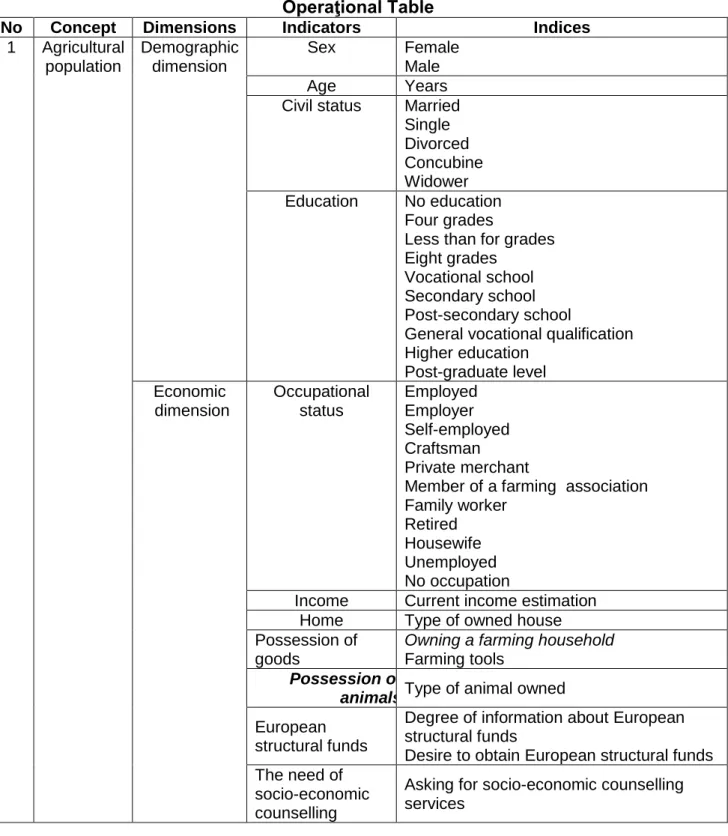
4. validating the hypotheses with the help of association tables and correlations. Table 1. Operaţional Table
No Concept Dimensions Indicators Indices
1 Agricultural population
Demographic dimension
Sex Female
Male
Age Years
Civil status Married Single Divorced Concubine Widower Education No education
Four grades
Less than for grades Eight grades
Vocational school Secondary school Post-secondary school
General vocational qualification Higher education
Post-graduate level Economic
dimension
Occupational status
Employed Employer Self-employed Craftsman Private merchant
Member of a farming association Family worker
Retired Housewife Unemployed No occupation
Income Current income estimation Home Type of owned house Possession of
goods
Owning a farming household Farming tools
Possession of
animalsType of animal owned
European structural funds
Degree of information about European structural funds
Desire to obtain European structural funds The need of
socio-economic counselling
193
80
15
5
0 10 20 30 40 50 60 70 80
Yes No Don't know/I choose not to
answer
Would you be interested in accessing such funds?
percenatge 70
26
4
0 10 20 30 40 50 60 70
Yes No Don't know /I
choose not to answ er
Have you heard of the European funds for agriculture?
percenatge
With the help of this question, we learned how informed the 1,174 subjects are on the matter of European funds for agriculture.
Twenty-six percent of the subjects answered that they had never heard of European funding programmes for agriculture, 70% said that they had heard of such programmes, while 4% said they didn’t know or had no opinion on the subject.
194 75
15
10
0 10 20 30 40 50 60 70 80
Yes No Don't know /I choose
not to answ er
If you were offered agricultural counselling services would you accept them?
percenatge
As far as the desire to obtain European funding is concerned, 80% of the 1,174 subjects replied affirmatively, 15% gave a negative reply, while 5% did not know or did not answer this question.
On the whole, the answers show that most subjects wish to obtain European funds for agriculture, which we think is a good thing for the further development of national agriculture. However, most subjects indicated they required supported in developing their projects.
With the help of this question we wanted to find out the subjects’ opinion on socio-economic counselling programs.
10 10 10 5
10 10
45
0 5 10 15 20 25 30 35 40 45
Unemployed Housew if e Retired Family w orker Member of a f arming association Self -employed Employed
Wha t is your curre nt occupa tiona l sta tus?
percenatge
More than half of the subjects (75%) agreed with socio-economic counselling, 15% disagreed with it, and 10% did not know or did not wish to answer.
The high percentage of affirmative answers suggests that people truly understand the necessity of such socio-economic counselling services.
195
housewives, 10% of the subjects are retired, 10% are family workers, 5% are members of a farming association and 5% are free lancers.
The answers reveal a small percentage of employed individuals, which is a worrying reality all over the country.
0 10 20 30 40 50 60 70 80
Yes No I don’t know/I
choose not to answer. Have you applied for a job in the past 12 months?
percenatge
This question is useful to discover how interested the subjects were in finding a job. The answers show that 80% of them have searched for a new working place in the past 12 months, 16% have not searched for a job, while 4% did not know or did not wish to reply. The described situation is positive, as most subjects (80%), have searched for a job in the past year. As a result, they can be described as responsible individuals.
Reasons for looking for a job
Do not have a job 30%
For additional budget
15% Current job is at
risk 35% Current job is not
w ell paid 20%
With the help of this question, we wanted to find out the 1,174 subjects’ reasons for looking for a new job. Thirty percent of them answered that they were not employed, 30% said that their present job was at risk, 25% said that their current job was not well paid, while 15% said they needed additional budget.
There is a worryingly high percentage of people who do not have a job; to make things worse, the same number of people who said they had a job felt that they were under the threat of losing it.
As far as the gender of the subjects and their interest in applying for European funds for agriculture are concerned, it seems that most of them have the intention of obtaining them. The highest frequency occurs in the point where the answer yes meets the answer
male.
196
European funds are female, while 4% of them are male. Only 5% of the subjects (3% female and 2% male) did not wish to share their point of view on this subject.
Table 2. Gender & the intention to obtain European agricultural funds – Cross tabulation
Intention to obtain European agricultural funds
Total Yes No Not sure /Did not answer
Gender Female 18% 11% 3% 32%
Male 62% 4% 2% 68%
Total 80% 15% 5% 100%
CONCLUSIONS
Given the obtained data and knowing the real situation in each farm or household, an Orientation Plan is to be developed. This Plan shall refer to the management of goods that are produced or inherited; the transfer of goods between generations; developing a business plan for the farm and planning the investments; evaluating the insolvency risk of the farm; giving up or extending agricultural activities; signing contracts for services/goods/new farm employers; defining the proper options of changing the social status, such as retiring, one family member getting married, setting-up of new farmers, children starting school etc.
In addition, farmers will receive direct support either to apply for funding through EU programmes (the eligible socio-economic measures of the National Rural Development Programme - NRDP), or to use other available public or private counselling services.
The particular needs of the areas where the project is to be implemented will be monitored permanently. Other structural funds besides NRDP will be identified in order to answer the needs of the target-group and to increase the awareness and information degree within this group.
Farmers (especially the subsistence or semi-subsistence farmers) will receive support to consolidate their connections with the local authorities, to become part of the programmes that access funds and contribute to the participative management of their communities’ needs.
BIBLIOGRAPHY
1. Bara Simona, Moldovan Minodora,(1998), The Role of Institutions in the
Development of Agriculture and Rural Area, IEA, CIDE, Probleme economice (Economic Matters), no 33
2. Barreiri J., Soler F, Perez y Perez L., Garcia S. (2003), How much does it to include a marginal rural areas as a Natura 2000 sites, Social cost and expenditure for compensation scheme, XII EAERE ANNUAL CONFERENCE 2003 BILBAO
3. Ciutacu C., Chivu Luminiţa (2002), Romanian and the European Model of
Agriculture and Rural Development, CIDE, Economic Matters, no 31
4. Otiman Păun I. (2000), Agricultural Restructuring and Rural Development in
Romania in View of EU Accession. An Opinion, ESEN 2000, Bucharest
5. Population and Housing Census, Volume I and II, NIS, Bucharest, various editions 6. Quality of Life of the Romanian Population, NSI, Bucharest, 2011
7. Romania’s Statistical Yearbook, NIS, Bucharest, various editions 8. Strategy of Socio-Economic Development of Timis County, 2007-2013