Evaluation of IR User interface
- Implications for User Interface
Design
Preben Hansen
Swedish Institute of Computer Science
Abstract
In this paper, we discuss the methodological framework used in an experimental evaluation study and present the implications drawn from the analysis of the information retrieval (IR) interaction for a user interface redesign of an on-line WWW-based IR system. The goal was to investigate if the current user interface to an on-line WWW-based IR system with real users with real information needs provided sufficient support in order to conduct an information-seeking task. For our study purpose, we used a set of data collection and analysis methods from the area of information science and Human-Computer Interaction (HCI). We collected and analysed cognitive and statistical data using a combination of both qualitative and quantitative data collection methods such as questionnaires, open-ended questions and system log statistics. Variables and correlation
between the variables were measured and requirement lists were elicited. Finally, the framework used, identified and recognised several important factors that need to be supported in the design of an user interface design. The framework also proves that an on-line based evaluation setting with real users and with real information seeking tasks is feasible.
Contents
2. Information Retrieval Interaction and models
3. IR evaluation
4. Research Design and Methodology
5. Results and discussion
6. Implications for user interface design
7. Conclusions
About the author
Footnotes
References
1. Introduction
We are constantly involved in various interactions with the environment through different communication mechanisms and processes. Information seeking and retrieval are such processes, where users in different ways interact with the information
environment. The users' information needs, knowledge, experience and goals may vary and influence the information seeking process within an information retrieval (IR) systems, and need to be identified and supported in the user interface design (Hansen and Karlgren 1996), especially when offered via WWW with large end-user
populations. This situation presents a number of challenges in the field of information retrieval (IR) and Human-Computer Interaction (HCI) research. We need to examine questions such as: how users interact with IR systems; their different information
seeking strategies and behaviours; how to design user interfaces for IR systems and the users' tasks and goals. When evaluating IR systems, the traditional view of research into IR considers information seeking and retrieval from a systems perspective and evaluations are made in laboratory environments. Some critique against traditional methods used for evaluation of IR systems and users that guided this study:
few studies on people performing real information seeking tasks with real information needs
few studies are done in a real-world online IR setting
from an IR perspective, there are not many examples that directly involve the user interface and what implications the user behaviour and information seeking strategies have on the user interface design
Recently, there has been a growing interest towards interdisciplinary research
system (Belkin et. al., 1995) as well as to create more effective performance of the IR systems. Library and information science research have a long tradition in conducting user studies and evaluation studies such as Saracevic (1988) and recently, Kuhlthau (1993), and studies on intermediaries/user interfaces in IR such as Brajnik et. al. (1996). In HCI research the main goal is to investigate and improve the usability of computer systems and the interaction between the user and the computer. Some of its research focus on evaluating and designing systems including user interfaces using different methods and techniques (Norman, 1986, Hix and Hartson, 1993, and Nielsen and Mack, 1994), as well as user and usability studies described by Dillon (1996). Recent studies have been focused on evaluation and design of adaptive user interfaces and hypermedia systems (Brusilovsky, 1996). Since there are obvious points of connection between these two areas, we will try to combine methods and approaches from both in our study. As Allen (1996b) points out, there is a need to establish a link between research within IR and the design of user interfaces. A major recognised issue is that the methods of evaluating IR systems, under a long period, have been focused on precision and recall, but not on the usability of the user interface and how well users can accomplish their goals and tasks.
1.1 Research objective and questions
One of our objectives (see Hansen, 1997 for more details) of our study was to set up a methodological framework in order to investigate if the user interface provided
sufficient support in order to conduct an information seeking task. For this we used a set of data collection and analysis methods. Questions related to this paper are:
Can the proposed evaluation framework be used to conduct an experimental evaluation of the user interface of a hypertext IR system in a
WWW-environment?
What are the requirements of our user's and what are the implications for the user interface design?
How do we support differences among users and make better adaptations to them in the user interface design?
(Back to the beginning of the article)
2. Information Retrieval Interaction and models
A general view of an information retrieval system is that the IR system consists of a "device interposed between a potential user of information and the information
collection itself" (Harter, 1986, p. 2), containing three major components: the
database; the communication channel or interface between the user and the
studies of the user interface design (Belkin, Marchetti and Cool, 1993 and Brajnik, Mizarro and Tasso, 1996) have made interesting contribution within the broader context. This notion of integrating both system- and user-based studies, including the importance of the user interface, calls for an interdisciplinary research approach. The traditional IR model has mainly been concerned with improving the effectiveness of automatic searching techniques, such as precision and recall, and has been criticised for not taking issues like cognitive 1 and interactive aspects (Saracevic, 1995 and 1996; Ingwersen, 1996) into consideration. One attempt to develop the traditional IR model is made by Peter Ingwersen in his cognitive model (1996), (Figure 1). IR interaction is viewed as a set of cognitive processes, which involves system characteristics
(representational and retrieval techniques), the user's situational characteristics and the functionalities of the user interface/intermediary. According to Ingwersen, users do not only interact with systems, but also with texts and objects, indexing rules and the user interface, a view supported by the author. Other IR models have been proposed, such as the episode model (Belkin et. al., 1995), and the stratified model of IR
interaction by Saracevic (1996).
Figure 1. Cognitive model of IR interaction (Ingwersen, 1996, p. 9)
An information need initiates a person to perform an information-seeking task, based on a work-task, and thus activates information seeking behaviours and
strategies. This activity is dependent on several factors, such as the user's preferences,
knowledge, the tasks and goals, the information object, the domain, and the satisfaction with search outcome. There have been several attempts to describe the IR process. Marchionini (1995, pp. 49-60) describes information seeking as a dynamic and action-oriented process and another model, presented by Kuhlthau (1993, pp. 41-53), describes the tasks that are involved in the information seeking process from a psychological perspective, containing affective (feelings), cognitive (thoughts), and physical (actions) activities. Within an information-seeking situation, people use different strategies to solve an information problem and to accomplish their goal. Belkin et. al. (1995) proposed a scheme for classifying information-seeking strategies into four dimensions and a set of 16 information seeking strategies. The user's
interaction with the information system is the central process, which should be understood as interaction, especially as human-computer interaction.
...the information seeking behaviour is characterised by movement from one strategy to another within the course of a single information seeking episode, ... (Belkin et. al., 1995, p. 381).
These interactions between the user and the different IR system components depend, according to Belkin, on the user's characteristics, such as the user's state of knowledge and tasks and goals. Furthermore, Borgman (1989) suggests that these individual characteristics have implications for both design and training of users of information systems. Information retrieval interaction can be defined according to Ingwersen (1992, p. viii):
the user, the intermediary, and the IR system.
Since the IR interaction also includes the problem of design of IR systems, it has drawn attention to research from within both the information science and computer science areas (e.g. Koenemann and Belkin, 1996; Brajnik, Mizarro and Tasso, 1996).
(Back to the beginning of the article)
3. IR evaluation
Traditional IR experiments and system evaluations have been carried out for almost forty years such as the Cranfield and TREC. As stated, the traditional IR evaluation research has mainly been concerned with measuring the system performance such as the effectiveness using precision and recall, and has been criticised for not taking issues like interactive and cognitive aspects into consideration. One example to extend the IR evaluation are Robertson and Hancock-Beaulieu, (1992) with research and
development of the Okapi IR system.
Within the HCI research, Norman has described the interaction activity between the user and the system as the "Gulf of Execution and Evaluation". According to Norman there is a discrepancy between the user's goals when using the system, and the physical system mechanisms:
The user of the system starts off with goals expressed in psychological terms. The system, however, presents its current state in physical terms. Goals and system state differ significantly in form and content, creating the Gulfs that need to be bridged if the system can be used(Norman, 1986,
p. 38)
Hix and Hartson (1993), describes the user-centred design and methods as the interaction development process principally based on user requirements, task analysis and users performing task. Furthermore, there has also been extensive work within the usability 2 evaluation area. Generally, there is a distinction between formative and
summative evaluations (Löwgren, 1993), where the former evaluates the product, tool
3.1 IR and User interface design
We are constantly involved in various interactions with our environment and we interact through different communication mechanisms. How can we support the user in finding her way to information as she engage in an information seeking activity? The user interface connects the user with the system and can be either human (e.g. an
information specialist), or a mechanism (e.g. a user interface). Since one of the main characteristics in an IR system is the level of interactivity, interaction can be thought of as being the level of control and support in making decisions in the various information seeking tasks and decisions throughout the interaction process.
Generally, in user interface design process, the focus is on who the users are and what the tasks are. The task of information seeking is complex, and may vary from finding specific information through query formulation to a browsing activity involving exploring the database or information space. The main function of the system is to support the human user in her task(s). This task could be some activity that involves gaining a particular goal or purpose. Support should be designed to provide the user with the necessary assistance in gaining her goal. Generally, the user interface of an IR system has the task of guiding, supporting and transforming user's information problems or needs. The user interface can be described as a "front-end program which interacts with the user and controls an underlying information retrieval system accessing information resources" (Brajnik, Mizarro, and Tasso, 1996), which includes built in possibilities for communication, interaction and different functions and tools to support the user. In IR interaction, the user interface is the primary mechanism and serves as a link or a communication channel between the user and the computer (system). One problem when dealing with the design of information systems has been formulated by Marchionini:
We cannot discover how users can best work with systems until the systems are built, yet we should build systems based on knowledge of users and how they work. This is a user-centred design paradox (Marchionini, 1995, p
75).
Generally, the user interface can be divided in 2 parts: the interaction components and the development of interface software. The interaction component deals with how the user interfaces works and its behaviour in response to what the user does while performing a task. The interface software deals mainly with the implementation of the code for the interaction component (Hix and Hartson, 1993). Furthermore, there are different interaction styles to choose between when designing the interaction
component such as typed-command languages, menus, windows, boxes, and graphical interfaces (Hix and Hartson, 1993).
(Back to the beginning of the article)
4. Research Design and Methodology
apply an interdisciplinary approach combining the IR interaction and user-centred design methods in HCI
implement the study in an experimental real-world online WWW setting collect cognitive and statistical data from users performing an information seeking task using a combination of both qualitative (questionnaires) and quantitative (transaction logs) data collection methods
analyse collected data according to how users interact with the information system in order to make suggestions for supporting user characteristics and needs in the user interface redesign
System: For the study purpose, we used the Dienst distributed database system,
developed at Cornell University and Xerox Corporation in 1993 and further developed at Cornell University for the ARPA-funded Computer Science Technical Reports project in the USA. Our study was based on a project, initiated by the European Research Consortium for Informatics and Mathematics (ERCIM) 6 , in which SICS participated.
Subjects: The system was not previously presented or explained for the subjects. The
study was conducted in a real environment and with real users and information seeking situations. 38 subjects (16 female, 21 male, and 1 anonymous) completed the
questionnaires. 37% of the participants were computer science researchers (CS), 24% worked within industry (I), and 39% were information specialists and/or librarians (ISL). Concerning the education and occupation, the participants had a diverse and heterogeneous background, especially within the ISL group. About 150 subjects were approached by way of e-mail.
4.1 Research methods
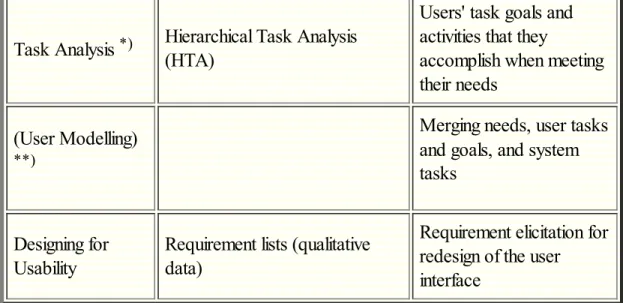
As a framework for our evaluation task, we used a model (based on a model by Allen, 1996a, p.24) for user-based IR interaction and interface design (Table 1). To
accomplish our task, we used a combination of both qualitative (content analysis of written data) and quantitative (statistical analyses of transaction logs and Likert scale ratings) data collection methods and analysis methods as shown in Table 2. The data were collected during August-November 1996. Allen's model provides a set of interesting components for an IR system evaluation that we wanted to test.
COMPONENT METHOD TASK
Resource Analysis
*)
Description of information system functionality
Describe resource(s) that are used to complete the tasks
User Needs Analysis
1. Questionnaire with 5-point scale ratings and open-ended questions (qualitative and quantitative data)
2. Log statistics (quantitative data)
1. Users' goals, purpose objectives, actions, and individual preferences 2. Logging user
Task Analysis *) Hierarchical Task Analysis(HTA)
Users' task goals and activities that they
accomplish when meeting their needs
(User Modelling)
**)
Merging needs, user tasks and goals, and system tasks
Designing for Usability
Requirement lists (qualitative data)
Requirement elicitation for redesign of the user interface
*) = components not described in this paper ; **) = not used in the overall study
Table 1. Model for user-based IR interaction and interface design (based on a model by Allen, 1996a, p.24)
Data collection methods Types of data collected analysisData methods
Internet-based evaluation questionnaires before and after information seeking task
1. Quantitative data: 5-point Likert scale from
questionnaire
2. Qualitative data: Written (open-ended) data to the 5-point Likert scale
1. Quantitative data analysis 2. Qualitative analysis of written data 3.
Comparison of statistical data 4. Task analysis of qualitative data Download of search log history Quantitative data: Log
statistics
Quantitative data analysis
Table 2. Types of data collected, data collection methods and analysis methods.
questionnaire and performed the information-seeking task. Then they answered the second questionnaire. Finally, log statistics were collected for the individual subject and all data merged into an individual record for analysis and coding. This way the data were collected iteratively during the experiment. The following data collection and
analysis methods have been used:
Questionnaires (or structured interviews) were used to collect users' opinions and
satisfaction with the use of the system, before and after using the system. The pre-search questionnaire collected demographic data and data about user's preferences, experiences, intentions and goals. The post-search questionnaire examined factors such as user satisfaction with the search result, functions within the system, information usefulness, navigation support to complete an information seeking task, domain knowledge, system overview, information display, and system effectiveness. Answers to the questions were made on a 5-point Likert 7 scale. The questionnaires were made available online and the participants contacted through electronic mailing lists. The questions represented a set of variables to be measured. The data collected were measured at three levels: a general level including all users; a group level including all users in that group; and finally at an individual level. To measure the relations between single variables, we used the Pearson correlation (r) 8.
Written or "open-ended" data: In addition to every question within the
questionnaires, there was a "comment"-field, where the subject could submit information to clarify or verify her statement on the 5-point Likert scale (Losee and Worley, 1993). We adopted this method because we thought that this would give us valuable information in addition to the statistical data. This way the data collected could be measured both quantitatively and qualitatively. Content analysis was used to identify and clarify the measured single variables. Transcripts from the written data were coded to establish a structure and organisation of that data.
Database transaction log: To automatically monitor the users' interaction, we made
use of the IR system log. Data were collected from the transaction log capturing each online user's server requests and contained information about the subject's machine-address, the amount of time, the total of actions and types of actions made and were used to observe the subject's actions and movements within the system and to collect information about individual information seeking sessions and also to measure time spent in the system. This data were matched to the data submitted by the users in the questionnaires for validity checking and discrepancy investigations.
Requirement elicitation: Another of our goals was to establish a set of requirements
variables were marked in the table. Finally, in the last column, we have an indication if the required function was or was not present in the system.
(Back to the beginning of the article)
5. Results and discussion
Due to limited space, we will not report the statistical results concerning the single variables the specific results (see Hansen, 1997 for more details of this study). Instead, our focus will be to present a list of factors from our experiment, that will be of
importance for the user interface design for an IR system.
5.1 Methodological results of the experiment
Through, analysis of collected data, we could describe the user's activities, tasks, and seeking behaviour, as well as their preferences and differences, and finally acquire requirements for a redesign of the user interface (Hansen, 1997 for a more detailed version). From these data we finally could draw some conclusions from the analysis, and suggest important factors to be considered in the user interface (re)design. In this paper we focus on the experimental evaluation as part of the (re)design cycle. Our evaluation experiment and methods provided us with valuable data so we could better understand some of the problems within the area of information seeking behaviour and user interface design. The following observations were made:
Our WWW based evaluation study was performed in a real setting and situation and created real empirical data to be
evaluated and showed that it was possible to conduct an experimental WWW-based evaluation as part of a design cycle, rather than studies of users in a laboratory setting. This method is suited for iterative interface design tasks and decision. However, to get more reliable data sets, there is a need for a larger user population.
No interference from other users or the evaluation team was made during the evaluation task.
The on-line questionnaires could be distributed both locally and world-wide via e-mail. The questionnaires were easily managed and administrated in an online setting and the subjects had easy access to the database through WWW. However, one lesson learned was not to ask too many questions. It is better to focus on a few factors to be examined. The reason for this is that users do have time constraints and motivation problems. It is easier to get questions answered at the beginning of a session than at the end.
The feedback received resulted in a complex set of data to be evaluated. Although the analysis phase was time consuming, it was well worth the results since the data set also can be used for other studies.
objective sets of data could be combined in various ways to extract information. Planning of the analysis is important. Questionnaires create a large set of data. Data collection, analysis methods and designing a matrix for the data have to be planned. Quantitative and qualitative data need to be treated differently.
Transaction logs only provide information about what the users did using different commands, and not what they thought nor their personal feedback. What we can observe, are patterns of movements within the system. Transaction log statistics provide a means of collecting data over a long time period, but are insufficient for answering complex questions.
(Back to the beginning of the article)
6. Implications for user interface design
One of our tasks in this study was to see if was possible to gather information and results that could be used for a redesign of the user interface to the IR system. One task for the design of user interfaces would then be to cope with and to reflect the users tasks of seeking information and their behaviour through consideration of users knowledge and goals. Recent studies (Koenemann and Belkin, 1996) show that when the end-users are given more instructions and more control over their searches, this affects their satisfaction and performance in a positive way. This will then obviously be an issue for the user interface design for any successful system. When designing a user interface, we have to make some decisions in order to improve the user interface in some particular direction. In our study we have based these decisions on the results from user preferences, user satisfaction, user tasks, user behaviour and user
requirements. It should also be noted that our mission was to extract factors important for the user interface design. It should be noted that the results and the following conclusions mainly concerns computer science domain, but the implications drawn could represent important factors to be considered for IR design in general. The following important factors emerged when examining user background preferences, user satisfaction and user requirements:
Previous experience. Users stated that they had basic experience with
searching in a hypertext WWW-based information system.
User expectation. We found that users do have expectations. These
expectations are based on earlier experiences acquired through experience with different IR systems and reflect the users mental model of an IR system.
User tasks and goals. We found that users had a variety of goals when entering
the system, including learning the system. Generally, the redesign should take into consideration the goals stated by the users and the tasks analysed, which can then be adopted by the system. More specifically, the interface solutions should be to give the user goal- or task-based options where the user could specify or define their task. The study also showed that there are different context environments, in which the user's tasks originated.
Recognition and identification. We found that user had problems in identifying
Our study methods detected two design aspects: one level where we need to implement new functions and that we need to improve already existing functions due to the problems of recognition or lack of identification. Secondly, we need to provide means for the users that support different information seeking strategies.
Browsing and searching. There was a strong tendency towards browsing, and
the system should therefore be enhanced to better support both browsing and the combination of search/browse activities. When examining what users said they wanted to do and what they really did, we found that users that wanted to browse had limited possibilities to do so and that they were "forced" to execute search actions. We also found differences among the subject concerning
preferred information seeking strategy: the CS wanted to browse and within the ISL group there was a subgroup who preferred searching. We also found that 50% of the users used a combination of browse and search actions. In summary browsing is poorly supported and since the interface "forced" the user to
perform searching, we need to support for different information seeking strategies in order to let the user have more control over the interaction.
Novices vs. experts. We found evidence that there are users with non-expert
knowledge as well as subjects with expert knowledge concerning IR
knowledge. Ultimately, these different knowledge levels should be built into a user model that in some way recognises or suggests an interface level for the user.
Support learning. We also found that, when using the system, the subject did
go through a learning process. When the user were finished with the task, she had stated other expectations concerning the systems functionality. We also noticed that subjects requested enhanced instructions for how to formulate queries and information about syntax. This points out that users build on their experiences and knowledge, and leave the system with new knowledge about our system specifically, and IR systems in general.
Decision problems. We found that users had problems in deciding the level of
satisfaction with certain functions within the system. A reason may be that the user did not have the knowledge to decide if the results or functions were satisfactory or not.
Level of control. One of the main characteristics of an IR system is the degree
of interactivity. By this we mean the level of control we give the user when performing a task and making decisions during the information seeking
interaction process. To support different levels of knowledge and user groups like novices and experts, we could provide different interaction levels
implemented in the user interface. One thing that we could see in our study was that users wanted to have a rather high degree of control. We could see that they did learn about the system and that they used their previous experience in judging both the system performance and the result outcome. This shows that the interface in some way has to adopt to the individual differences and also to differences within the user groups.
Requirement elicitation: The study of open-ended questions resulted in a list of
database collection description; keyword list; subject list and classification; time coverage and database update. Concerning the level of IR knowledge, we found that better instructions for query syntax formulation were needed. We also saw that some of the functions asked for actually were present in the system. This must be considered in the redesign of the system.
Mediate communication. When investigating the user requirements, users
expressed that they wanted to communicate in several ways. Statements like: make recommendations for customers and to establish contact with other researchers, indicates that there is a need for tools and ways to collaborate and communicate.
(Back to the beginning of the article)
7. Conclusions
Our approach for evaluating an IR user interface involved methods from both HCI and information science research. We implemented the study in an experimental real-world online WWW setting and collected both cognitive and statistical data sets from users performing an information seeking task using a combination of both qualitative
(questionnaires) and quantitative (transaction logs) data collection methods. We have observed several levels of work that must be understood in order to understand information seeking in a context:
The task environments (work-task, information seeking task and search task) The users specific goals and tasks
The users information seeking behaviour
The use of an IR system and its components, including the user interface Iterations between evaluations, requirements review and redesign could continuously be executed, until a satisfactory level of design has been reached. We should however remember that this is the first experimental attempt in this particular environment, in moving parts of the usability lab onto the WWW.
Cognitive data that deals with both the users knowledge, experience and expectations and how users cope with their information problem and interact with the IR system and its components (including the user interface), are very important for the understanding of the users problems regarding information seeking. This includes the understanding of how users interact with the user interface.
Future research will involve a more focused methodological framework for acquiring knowledge of how users, on a general and individual level perform during an IR
interaction. This study has created some insight in the general problem area of
information seeking strategies and IR interaction and IR user interface design. Another future research area of interest is user modelling in order to create a better adaptation between user's knowledge, tasks and goals. Also very important are the information seeking tasks and how they relate to the design of user interfaces.
Acknowledgement: I want to thank my supervisors at Swedish Institute of Computer Science
(Back to the beginning of the article)
About the author
Preben Hansen is currently working as a researcher within the group Human-Computer Interaction and Language Engineering at SICS - Swedish Institute of Computer
Science. The paper above is an excerpt from his M.Sc. thesis finished in 1997. Current research interests are IR interaction, IR evaluation, user studies and user interface for IR.
(Back to the beginning of the article)
Footnotes
1. Within the HCI field, cognitive psychology, cognitive science and human factors have influenced studies of human behaviour in order to understand the interaction between human and computer and to make better choices when designing systems. Within the IR interaction field, Ingwersen suggest that:
... cognitive IR models should view IR interactions as the interactions of various types of cognitive structures[...] generally understood as
manifestations of human cognition, reflection or ideas. (Ingwersen and
Willett, 1997).
2. Usability is a general concept that is related to the effectiveness and efficiency of the user interface/system, and to the user's reactions to that interface. Generally, usability are concerned with four major parts of any work situation: user, task, system, and environment. Some characteristics investigated are ease of learning and subjective user satisfaction. Relevant issues include design procedures, design guidelines, and
evaluation methods. Examples of methods to identify user interface problems are heuristic evaluation and Cognitive walkthrough (Nielsen and Mack, 1994).
3. The basic idea is that the evaluation is done in several steps until satisfactory results are reached. Generally this is achived through following a design-cycle containing prototype, evaluation, requirements, design and implementation. This cycle is then repeated several times.
4. Heuristic evaluation is a technique where a small group of experts (for example three to five) evaluate the design of a system. To do this, a set of usability guidelines are used.
5. Cognitive walkthrough is a theory-based method to perform usability evaluations of user interfaces and emphasize basic usability principles. The goal of cognitive
walkthrough is to focus on user's cognitive activities such as the goal and knowledge of a user while performing a specific task (Löwgren, 1993, p. 53).
development in the areas of information technology and applied mathematics. The national member institutions aim to foster collaborative work within the European research community and to increase cooperation with European industry.
7. Likert scales are characterized by a set numbers of choices, usually 5, 7 or 9. A method designed to scale subjects and which is used to gather individual differences in attitudes concerning an issue (Ghiselli, Cambell and Zedeck 1981).
8. Pearson correlation measures the strength of association between 2 variables (Losee and Worley, 1993)
(Back to the beginning of the article)
References
Allen, B. (1996a), Information tasks. Towards a user-centered approach to information systems. San Diego : Academic Press.
Allen, B. (1996b), From research to design: A user-centered approach. In:
Ingwersen, P. and Pors, N. O. (eds.), CoLIS 2. Second International Conference on Conceptions of Library and Information Science: Integration in Perspective,
Copenhagen, Denmark. October 13-16, 1996. pp. 45-59. Copehagen : The Royal School of Librarianship. 1996.
Allen, B. (1994), Cognitive abilities and information system usability. Information Processing & Management, 1994, Vol. 30 (2), pp. 177-191.
Belkin, N. J., C. Cool, A. Stein and U. Thiel. (1995), Cases, scripts, and information-seeking strategies: On the design of interactive information retrieval systems. Expert Systems With Applications, 1995, Vol. 9 (3), pp. 379-396.
Belkin, N., Marchetti, P and Cool, C. (1993), BRAQUE: Design of an interface to support user interaction in information retrieval. Information Processing & management, Vol. 29, (3), pp. 325-344.
Borgman, C. (1989). All users of information retrieval systems are not created equal: an exploration into individual differences. Information Processing & Management, Vol. 25 (3), pp. 237-252.
Brajnik, G., Mizzaro, S and Tasso, C. (1996), Evaluating user interfaces to
information retrieval systems. A case study on user support. In: Frei, H-P., Harman, D., Schäuble, P., and Wilkinson, R. (eds.). Proceedings of the 19th Annual
International ACM SIGIR Conference on Research and Development in Information Retrieval (SIGIR'96). Zurich, Switzerland. August 18-22, pp. 128-136. 1996. Brusilovsky, P. (1996), Methods and techniques of adaptive hypermedia. User modeling and user-adapted interaction, no. 6, pp. 87-129.
Dillon, A. (1996), User analysis in HCI - the historical lessons from individual
differences research. International Journal of Man-Machine Studies, Vol. 45, pp. 619-637.
Ghiselli, E., Cambell, J. and Zedeck, S. (1981), Measurement theory for the behavioural sciences. San Francisco, CA : W. H. Freeman and Co. 1981.
Hansen, P. (1997). An exploratory study of IR interaction for user interface design. An interdisciplinary approach. Borås: Högskolan I Borås. 1997:81.
user tasks and strategies with non-topic document analysis. First DELOS Workshop. An overview on projects and research activities in Digital Library related fields. Sophia Antipolis, France, 4-6 March, 1996. pp. 23-26. DELOS Working Group Reports: ERCIM-97-W0001.
Harter, S. (1986), Online information retrieval. Concepts, principles, and techniques. Orlando: Academic Press.
Hix, D. and Hartson, H. R. (1993), Developing user interfaces. Ensuring usability through product and process. New York : Wiley.
Ingwersen, P. (1996), Cognitive perspectives of information retrieval interaction: Elements of a cognitive IR theory. Journal of Documentation, 1996, Vol. 52, (1), pp. 3-50.
Ingwersen, P. (1992), Information Retrieval Interaction. London, UK: Taylor Graham.
Ingwersen, P. and Willett, P. (1997). Algorithmic and cognitive approaches to information retrieval. An introduction. Tutorial notes. SIGIR'97. The 20th Annual international conference on Research and Development in Information Science. Koenemann, J. and Belkin, N. (1996), A case for interaction: A study of interactive information retrieval behaviour and effectiveness. In: Tauber, M., Bellotti, V., Jeffries, R., Mackinlay, J. and Nielsen, J. (Eds.), Proceedings of CHI'96 Human Factors in Computing Systems. New York : ACM Press. pp. 205-212. 1996.
Kuhlthau, C. (1993), Seeking meaning. A process approach to library and information services. New York: Ablex publ.
Losee, R. and Worley, K. (1993), Research and evaluation for information professionals. San Diego, CA : Academic Press.
Löwgren, J. (1993), Human-computer interaction. What every system developer should know. Lund: Studentlitteratur.
Marchionini, G (1995), Information seeking in electronic environments. Cambridge Series on Human Computer Interaction 9. Cambridge : Cambridge University Press. Nielsen, J. and Mack, R. (1994), Executive summary. In: Nielsen, J. and Mack, R. (eds.). Usability inspection methods. New York : John Wiley & Sons.
Norman, D. (1986), Cognitive engineering. In: Norman, D. and Draper, S. (eds.) (1986). User centered system design. New perspectives on human-computer interaction. pp. 31-61. Hillsdale, N. J. : Lawrence Erlbaum Ass.
Robertson, S. E. and Hancock-Beaulieu, M. M. (1992), On evaluation of IR systems. Information Processing and Management, Vol. 28, (4), pp. 457-466.
Saracevic, T. (1996), Relevance reconcidered ´96. In: Ingwersen, P. and Pors, N. O. (eds.) CoLIS 2. Second International Conference on Conceptions of Library and information Science: Integration in Perspective, Copenhagen, Denmark. Oct. 13-16, 1996. pp. 201-218. Copenhagen, Denmark: The Royal School of Librarianship. 1996. Saracevic, T. (1995), Evaluation of evaluation in information retrieval. In: Fox, E. A., P. Ingwersen, and F. Fidel (eds.). Proceedings of the 18th Annual International ACM SIGIR Conference on Research and Development in Information Retrieval
(SIGIR'95). Seattle, Washington, USA. July 9-13, 1995. pp. 138-146. New York: ACM. 1995.
Saracevic, T. and Kantor, P. (1988), A study of information seeking and retrieval. II. Users, questions and effectiveness. Journal of the American Society for Information Science, Vol. 39, (3), pp. 177-196.
New York : Wiley.