Self adaptive controlling mechanism to optimize the efficiency of
network implementing Routing
–
as-a-Service
J
J. Chandrakanta Badajena, Chinmayee Rout, Shatabdinalini, Anandita Mohapatra Lecturer, CET,Bhubaneswar,Odisha, India
Assistant Professor, ABIT, Cuttack,Odisha, India Lecturer, CET, Bhubaneswar, Odisha, India M.Tech Scholar, CET, Bhubaneswar, Odisha, India
[email protected],[email protected], [email protected] [email protected]
Abstract-In today's Abstract-Internet, clients can pick their neighborhood Internet specialist co-ops (ISPs), yet once their bundles have entered the system, they have little control over the general courses their parcels take. It gives a client the capacity to pick between supplier level courses, the capability of encouraging ISP rivalry to offer upgraded benefit and enhancing end-to-end execution and unwavering quality. Its gives client the capacity to pick the succession of suppliers his parcels take. Another system is intended to present the parts, and assess a model in light of RaaS (Routing-as-a-Service). The new structure addresses a wide scope of issues, including commonsense supplier pay, versatile course revelation, effective course representation, quick course bomb over, and security. It underpins client decision without running a worldwide connection state directing convention. It breaks a conclusion to-end course into a sender part and a recipient part and gives the client to give include according to the necessity. A client can indicate a course with just a source and a goal address, and switch courses by exchanging input. The structure is assessed utilizing a mix of system estimation, reproduction, and investigation.
Key words- ISP, OSP, RaaS, ECMP, BGP, AS I. INTRODUCTION
Data centre is a key infrastructure for online service providers (OSPs) to provide always-on and responsive services to end-users. Typically consisting of thousands to hundreds of thousands of servers, data centre are designed to handle tremendous computations, large storage, and quick service delivery. However, the computational resources in a Data centre design—IP network infrastructure [11] centre are not used monolithically. Often, the resources are multiplexed between different tenants’ clients of the data centre
resources—so they can simultaneously perform computations, store data, and provide services to end-users.
The following problems are common with this paradigm.
A. Labor-Intensive Process:
In a server farm environment, course control customization includes a work escalated handle where occupants submit course control solicitations to the proprietor. This outcomes in tight coupling in the vicinity of inhabitants and the proprietor, broad human asset sending, and long ticket determination time. It loads both the occupants and landowner, however more the proprietor on the grounds that; the landowner can spend enhancing and keeping up the system. It might be middle of the road when the demand volume is little, such a framework is unsustainable as the volume and assortment of customization increments.
B. Lack of Automated Control:
The conventional worldview takes away inhabitants' capacity to consequently control steering to their administrations. In this manner, inhabitants regularly need to submit steering strategies that fulfill a specific class of situations (e.g., the normal/most dire outcome imaginable). Furthermore, responding quick to changes in this worldview gains more tickets immersed to the ticket appropriation framework, additionally overpowering the landowner.
C. Long Ticket Resolution Time:
determination procedure could take days if occupants and the landowner impart by means of email, or weeks if in-person gatherings are required. Such a postponement won't not be satisfactory if inhabitants want a fast reaction to changes in the system.
Another system is intended to present the segments, and assess a model in view of RaaS. The new structure addresses a wide scope of issues, including down to earth supplier pay, adaptable course revelation, effective course representation, quick course flop over, and security. It bolsters client decision without running a worldwide connection state directing convention. It breaks a conclusion to-end course into a sender part and a recipient part and gives the client to give enter according to the prerequisite. A client can indicate a course with just a source and a goal address, and switch courses by exchanging input .The system is assessed utilizing a blend of system estimation, reenactment, and investigation.
II. USAGE SCENARIOS
RaaS prototypes for load balancing and workload migration:
A. Load Balancing:
Load balancing refers to a technique where the traffic is distributed evenly across multiple outgoing links. With load balancing enabled, the network increases its resilience against random link failures. Resilience against random link failures is an important feature because as failures occur closer to the core, the effect might become more severe. ECMP (Equal-cost multi-path routing) is enabled on a router; the router uses a hashing scheme to choose the traffic destination, with the goal of distributing the incoming flow equally among the available next-hops. While some imbalance might occur due to bad luck (i.e., most of the incoming traffic are hashed to the same destination), this chance occurrence should happen less as the number of flows in the network increases. Load balancing is possible, if exclude the possibility of such imbalance by choosing specific IP addresses so that the hashing scheme chooses different destinations.
B. Workload Migration:
Workload migration is the idea of moving traffic from one place to another. When it is coupled with the RaaS framework, can be used as a foundation upon which custom policies can be built. The policies possible for these expressive actions are only constrained by the information available to tenants, which is enormous due
to the amount of information modern operating systems expose. A simple application is developed to demonstrate how a tenant could implement a custom policy using the RaaS framework.
III. LIMITATIONS OF THE ROUTING ARCHITECTURE
Today, an ISP expresses its policies by configuring the Border Gateway Protocol (BGP) [2]. The use of a single-path, path vector routing protocol and
hop-by-hop forwarding imposes several restrictions on how routes are selected within a single AS.
A. Propagating only one best route:
Despite learning multiple routes for the same prefix, a BGP-speaking router only announces a single best route to its neighbors, making the rest of the candidate routes invisible to other routers.
B. Selecting only one best route:
Each router can only select one BGP [2] route for forwarding data traffic. This not only limits the ability of routers to balance load over multiple paths.
C. Coupling of decisions across routers:
Today, traffic entering the AS (Autonomous System) is forwarded to egress points in a hop-by-hop fashion. Edge routers connected to the same internal router are forced to direct traffic toward the same egress point. Limitations are overcome by ensuring full visibility into all candidate routes and flexible assignment of routes to routers.
IV. EVALUATION
Our overall goal is to design a routing system that practically supports user choice. Here we evaluate the technical aspects of RaaS that impacts its feasibility, scalability and efficiency. The evaluation includes the input from input side, the overhead to maintain the state, the convergence speed and to maintain the traffic overloading and traffic migration problem.
Our evaluation on efficiency and performance focuses on the connection setup. This setup latency affects the performance of interactive applications and short transfers. Our evaluation shows that RaaS framework is scalable, has low overhead and converges fast, and the setup latency is negligible.
Figure. 1 input from user side
It will ask to enter the choice. Then the user can enter the broadcasting licensed destination node, packet size, Euclidean node strength, packet transmission speed,
radius of the transmission range of each node, average time interval. Once the user enters the data according to his convenience, then the simulation will start.
Figure. 2 Communication between the region For the simulation we have used the NS2 simulator. The
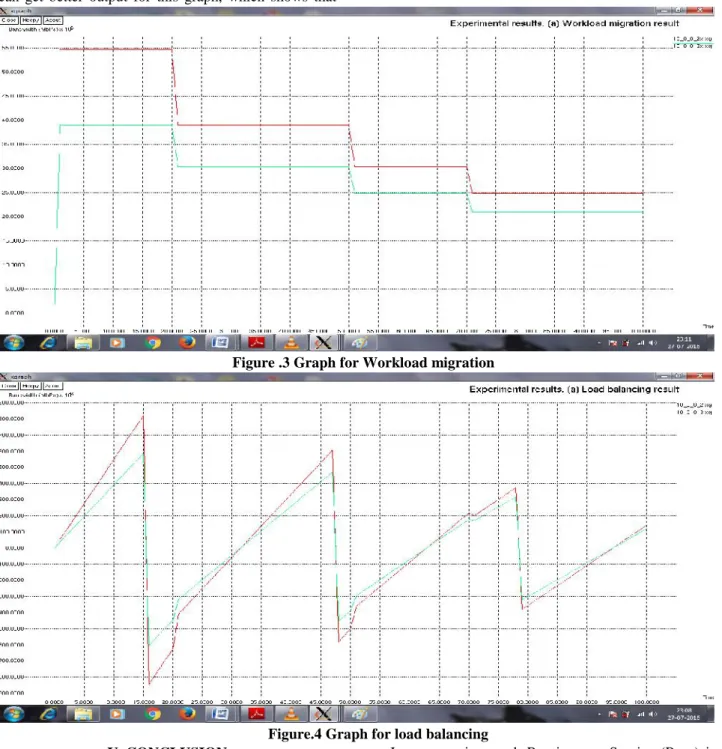
protocol used for the simulation is DSR (Dynamic Source Routing protocol. As we need to take dynamic values every time, so this protocol is being used. For the evaluation, firstly we have created 3 regions and in each region 15 nodes are being created. The nodes are being labeled with tenants and landlords. In middle this region are having access point, so that within the region also they can communicate with each other. One global router is also present in the middle, by the help of which
and traffic overloading. As this is a new framework we
don’t have any inbuilt formula for traffic migration,
traffic overloading, and network overload.
We have developed new formulas for this, so that we can get better output for this graph, which shows that
the efficiency is more as compared to the existing framework which are being already developed.
Figure .3 Graph for Workload migration
Figure.4 Graph for load balancing V. CONCLUSION
The traditional paradigm for routing customization involves a laborious and lengthy process, in which landlord and tenants are tightly coupled. Giving a user the ability to choose domain level routes has the potential of fostering ISP competition to offer enhanced
service and improving end-to-end performance and reliability.
In our ongoing work Routing-as-a-Service (Raas) is a framework for balancing tradeoffs between multiple policy objectives in route selection algorithms. Traffic engineering typically depends on routing decisions across many routers and destination prefixes. Ways are being exploring to embed the load balancing objectives directly in the route selection algorithm.
adjust the percentage of traffic they place on each path, rather than selecting an entirely new path for one or more prefixes.
Finally it can be concluded that many useful local policies can be achieved without compromising global stability, including policies that are not possible in other frameworks, to maintain the traffic migration and load balancing problem with more efficiency, finding out the optimal path in order to prevent the packet loss and failure and creating a much more stable framework and checking out the performance in order to increase the performance level.
REFERENCES
[1] C.-C. Chen, L. Yuan, A. Greenberg, C.-N. Chuah,
and P. Mohapatra, “Routing-as-a-service (RaaS): A framework for tenant-directed route control in data
center,” inProc. IEEE INFOCOM, Apr. 2011.
[2] Y. Rekhter, T. Li, and S. Hares, “A Border Gateway Protocol”
[3] The Network Simulator–ns-2 2004 [Online].Available: http://www.isi.
[4] Y. Wang, I. Avramopoulos, and J. Rexford,
“Morpheus: Making routing programmable,” in Proc. ACM SIGCOMM INM, 2007.
[5]A. Fabrikant, U. Syed, and J. Rexford, “There’s
something about MRAI: Timing diversity can
exponentially worsen BGP convergence,” inProc. IEEE INFOCOM, Apr. 2011.
[6] P. Francis and R. Gummadi, “IPNL: A NAT
-extended internet architecture,” in Proc. ACM SIGCOMM, 2001.
[7] C. Labovitz, A. Ahuja, A. Bose, and F. Jahanian,
“Delayed Internet routing convergence,” inProc. ACM SIGCOMM, 2000.
[8] E. Keller and J. Rexford, “The platform as a service model for networking,” inProc. USENIX INM/WREN, Berkeley, CA, USA, 2010.
[9] M. Caesar, D. Caldwell, N. Feamster, J. Rexford, A.
Shaikh, and J. Van derMerwe, “Design and implementation of a routing control platform,” inProc. USENIX NSDI, May 2005.
[10] V. Valancius, N. Feamster, J. Rexford, and A. Nakao, “Wide-area route control for distributed
services,” inProc. USENIX Annu. Tech. Conf., 2010.
[11] Cisco, San Jose, CA, USA, “Data center design— IP network infrastructure,” 2009.
[12] D. Oran, “OSI IS-IS Intra-domain Routing Protocol—RFC 1142,” 1990.
[13] X. Yang, “NIRA: A new internet routing architecture,” inProc. ACM SIGCOMM FDNA, 2003. [14] K. K. Lakshminarayanan, I. Stoica, S. Shenker,
and J. Rexford, “Routing as a service,” EECS
Department, University of California, Berkeley, CA, USA, Tech. Rep. UCB/EECS-2006-19, Feb. 2006
[15] Internap, Atlanta, GA, USA, “Network-based