Coupled Inductor Based H6 Transformer less Full Bridge Inverter For
PV- Grid Systems
Muralidhar Kosarllapudi1, Y.Raja Babu2
1PG Scholar, Pydah College of Engineering, Kakinada, AP, India.
2Assistant Professor, Pydah College of Engineering, Kakinada, AP, India.
Abstract—In this paper a coupled inductor based h6 transformer-less full bridge inverter for pv- grid systems have been proposed. Transformer-less inverters have much importance in grid-tied photovoltaic (PV) generation systems, having the advantage of achieving high efficiency and low cost. Many number of transformer-less inverter topologies have been proposed for the safety requirement of leakage currents. In this paper two types of the proposed H6 inverter topologies are taken as an example for detail analysis and modulation strategy. A single frequency method and double frequency methods have been developed for maintaining the voltage constant at the grid side irrespective of changes in the input voltage. The power losses and power device costs are compared between the proposed H6 topologies. In this paper, a family of coupled inductor based h6 transformer-less full bridge inverter for pv-grid systems with low leakage currents is proposed with MPPT PV systems. Simulation results show that the proposed H6 topology achieves good results, which is slightly worse than that of the H5 topology, but it has higher efficiency than that of H5 topology.
Index Terms: -Common-mode voltage, grid-connected inverter, leakage current, photovoltaic (PV), transformer-less inverter.
I. INTRODUCTION
Transformer-less inverters have much importance in grid-tied PV generation systems, having the benefit of achieving high efficiency and low cost. Many number of transformer-less inverter topologies have been proposed for the safety requirement of leakage currents. Nowadays, the discovery and improvement of new energy sources are increasing due to the poisonous results caused by oil, gas and nuclear fuels. This has lead the renewable energy sources particularly the solar PV systems to the prime spot in the production of electricity. Photovoltaic have
applications ranging from small power supply to power grids.
Photovoltaic systems coupled to the grid have quite a lot of advantages such as straightforwardness in setting up, high effectiveness, consistency and flexibility. With a reduction in system price PV equipment seems to be an efficient means of power generation. The cost of PV panel has been declined largely, the overall cost of both the investment and generation of PV grid-tied system are still too high, comparing with other renewable energy sources. Therefore, the grid-tied inverters need to be watchfully planned for achieving the purposes of high competence, low rate, small dimension, and small weight, especially in the low-power single-phase systems (less than 5 kW). From the safety point of view, most of the PV grid-tied inverters employ line-frequency transformers to provide galvanic isolation in commercial structures in the past.
However, line-frequency transformers are large and heavy, making the whole system bulky and hard to install. Compared with line-frequency isolation, inverters with high-frequency isolation transformers have lower cost, smaller size and weight. On the other hand, the inverters with high-frequency transformers have a number of power stages, which increase the system difficulty and decrease the system efficiency. As a end result, the transformer-less PV grid-tied inverters, as shown in Fig. 1, are widely installed in the low-power distributed PV generation systems.
Moreover, the leakage currents lead to serious safety and radiated interference issues. When the transformer is removed, the common mode (CM) leakage currents (ileakage) may appear in the system and flow through the parasitic capacitances between the PV panels and the ground. Therefore, they must be limited within a realistic range. As shown in Fig. 1, the leakage current iLeakage is flowing throughout the loop consisting of the parasitic capacitances (CPV1 and CPV2), bridge, filters (L1 and L2), utility grid, and ground impedance Zg. The leakage current path is equivalent to an LC resonant circuit in series
with the CM voltage, and the CM voltage vCM is defined as
Where vAN is the voltage difference between points A and N, vBN is the voltage difference between points B and N. L1 and L2 are the output filter inductors. In order to eliminate leakage currents, the CM voltage must be kept constant or only varied at low frequency, such as 50 Hz/60 Hz. The conventional solution employs the half-bridge inverter. The filter inductor L2 is zero in the half-bridge inverters. Therefore, (1) is simplified as
The CM voltage vCM is constant due to the neutral line of the utility grid connecting to the midpoint of the split dc-link capacitors directly. However, a drawback of half-bridge inverters is that, the dc voltage utilization of half-bridge type topologies is half of the full-bridge topologies. As a result, either large numbers of PV panels in series are involved or a boost dc/dc converter with extremely high voltage transfer ratio is required as the first power conditioning stage, which could decrease the system efficiency. The full-bridge inverters only need half of the input voltage value demanded by the half-bridge topology, and the filter inductors L1 and L2 are usually with the same value. As a result, (1) is simplified as
Many solutions have been proposed to realize CM voltage constant in the full-bridge transformer-less inverters. A traditional method is to apply the full-bridge inverter with the bipolar sinusoidal pulse width
modulation (SPWM). The CM voltage of this inverter is kept constant during all operating modes. Thus, it features excellent leakage currents characteristic. However, the current ripples across the filter inductors and the switching losses are likely to be large. The full-bridge inverters with uniploar SPWM control are attractive due to the excellent differential-mode (DM) characteristics such as smaller inductor current ripple, and higher conversion efficiency. However, the CM voltage of conventional unipolar SPWM full-bridge inverter varies at switching frequency, which leads to high leakage currents. Two solutions could be applied to solve this problem. One solution is to connect the PV negative terminal with the neutral line of the utility grid directly, such as the Karschny inverter derived from buck–boost converter, and the inverters derived from virtual dc-bus concept.
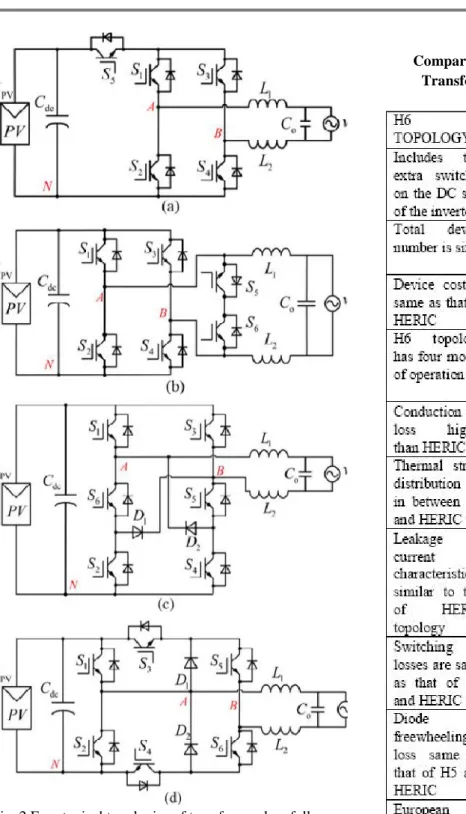
The CM voltage is kept constant by these full-bridge topologies with unipolar modulation methods. Another solution is to disconnect the dc and ac sides of the full-bridge inverter in the freewheeling modes. Various topologies have been developed and researched based on this method for keeping the CM voltage constant, such as the H5 topology, the highly efficient and reliable inverter concept (HERIC) topology, the H6-type topology, and the hybrid-bridge topology, etc., are shown in Fig. 2. Fig. 2(a) shows the H5 topology. It employs an extra switch on the dc side of inverter.
As a result, the PV array is disconnected from the utility grid when the inverter output voltage is at zero voltage level, and the leakage current path is cut off. The HERIC topology shown in Fig. 2(b) employs two extra switches on the ac side of inverter, so the leakage current path is cut off as well. However, its power device cost is higher than that of the H5 topology.
Fig. 2 Four typical topologies of transformer-less full-bridge inverters (a) H5 (b) HEIRC (c) H6-type (d)
Hybrid bridge
Assumptions:
1. Filter inductors used L1 and L2 are assumed to be of same value.
2. Common mode voltage, VCM is expressed as VCM = ( _ + _ )/2
3. The switches and diodes are ideal and the dead time between the switches are neglected.
4. Inductors are ideal without any internal resistance.
TABLE-1
Comparison of H6 Topology with Other Transformer less Inverter Topologies
TABLE II
II. OPERATION OF H6
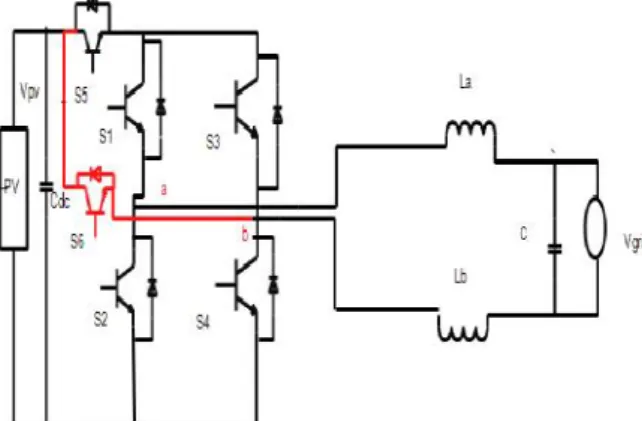
Fig 3 shows the circuit diagram of the proposed H6 inverter topology. It consists of six MOSFET switches S1, S2, S3, S4, S5 and S6. The modulation technique used is the unipolar sinusoidal PWM. The photovoltaic panel is represented by Vpv. An LCL filter is used for filtering purpose. Vgrid represents the electrical grid. Cdc represents the input dc capacitance.
Fig 3 Proposed transformer less H6 inverter topology A. Modes of operation:
There are four modes of operation for the proposed H6 inverter. The four modes include two active modes and two freewheeling modes.
Mode 1: Active Mode
During active mode of positive half period switches S1, S4 and S5 will carry out and switches S3 and S6 leftovers in the Off position. The direction of current flow is indicated by the arrows. The regular mode voltage VCM is given by VCM = (Van + Vbn)/2
≈ 0.5VPV.
Fig 4 Active mode in positive half period
Mode 2: Freewheeling Mode
During freewheeling mode of positive half period, current freewheels throughout switch S1 and the anti-parallel diode S3.All the other switches remains in off position. The frequent mode voltage during this period is given by VCM=Van +Vbn/2=0.5VPV
Fig 5 Freewheeling mode in positive half period
Mode 3: Active Mode
During active mode of negative half period switches S2, S3 and S6 will conduct and switches S1 and S4 remains in the off position. In this mode of operation although three switches are turned on, current flows through only S2 and S6 and hence the conduction losses can be reduced. The direction of current flow is indicated by the arrows. The common mode voltage VCM is given by VCM =(Van + Vbn)/2
≈ 0.5VPV.
Fig 6 Active mode in negative half period
During freewheeling mode of negative half period, current freewheels through switch S3 and the anti-parallel diode S1.All the other switches remains in off position. The common mode voltage during this period is given by VCM=Van +Vbn/2=0.5VPV.
Fig 7 Freewheeling mode in negative half period
III. SIMULATION RESULTS
Fig 8 simulation circuit of proposed H6 topology with PV panel
Fig 9 Proposed SPWM technique for single frequency method
Fig 10 Proposed SPWM technique for double frequency method
Fig 12 simulated voltage & currents of proposed system with single frequency method
Fig 13 inverter output voltages and leakage current of double frequency method
Fig 14 simulated voltage & currents of proposed system with double frequency method
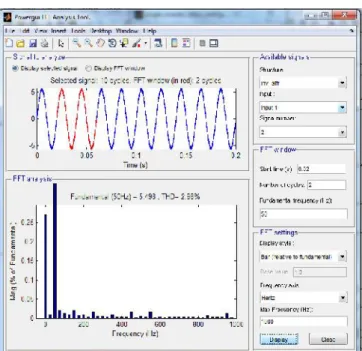
Fig 15 % THD of proposed system with single frequency method
Fig 15 % THD of proposed system with Double frequency method
CONCLUSION
eliminated, which otherwise leads to serious safety problems. This paper deals with an H6 transformer-less full- bridge inverter topology with low leakage currents that can be used in PV grid–tied applications.
A single frequency method and double frequency methods have been developed for maintaining the voltage constant at the grid side irrespective of changes in the input voltage. Simulation results show that the proposed H6 topologies achieve similar performance in leakage currents, which is slightly worse than that of the H5 topology, but it features higher efficiency than that of H5 topology. The circuit is simulated to verify the design and to check whether the reference grid current is obtained. Now it is found that the double frequency method of controlling have very less THD compared with single frequency method
REFERENCES
[1] S. B. Kjaer, J. K. Pederson, and F. Blaabjerg, “A
review of single-phase grid-connected inverters for
photovoltaic modules,” IEEE Trans. Ind. Appl., vol.
41, no. 5, pp. 1292–1306, Sep/Oct. 2005.
[2] F. Blaabjerg, Z. Chen, and S. B. Kjaer, “Power
electronics as efficient interface in dispersed power
generation systems,” IEEE Trans. Power Electron.,
vol. 19, no. 5, pp. 1184–1194, Sep. 2004.
[3] B. Sahan, A. N. Vergara, N. Henze, A. Engler, and
P. Zacharias, “A single stage PVmodule integrated converter based on a low-power current source
inverter,” IEEE Trans. Ind. Electron., vol. 55, no. 7,
pp. 2602–2609, Jul. 2008.
[4] M. Calais, J. Myrzik, T. Spooner, and V. G.
Agelidis, “Inverters for single phase grid connected photovoltaic systems—An overview,” in Proc. IEEE PESC, 2002, vol. 2, pp. 1995–2000.
[5] F. Blaabjerg, Z. Chen, and S. B. Kjaer, “Power
electronics as efficient interface in dispersed power
generation systems,” IEEE Trans. Power Electron.,
vol. 19, no. 5, pp. 1184–1194, Sep. 2004.
[6] Q. Li and P. Wolfs, “A review of the single phase
photovoltaic module integrated converter topologies
with three different dc link configuration,” IEEE Trans. Power Electron., vol. 23, no. 3, pp. 1320–1333, May 2008.
[7] O. Lopez, F. D. Freijedo, A. G. Yepes, P. Fernandez-Comesana, J.Malvar, R. Teodorescu, and J. Doval-Gandoy, “Eliminating ground current in a transformerless photovoltaic application,” IEEE Trans. Energy Convers., vol. 25, no. 1, pp. 140–147, Mar. 2010.
[8] R. Gonzalez, J. Lopez, P. Sanchis, and L. Marroyo,
“Transformerlessinverter for single-phase photovoltaic
systems,”IEEE Trans. Power Electron., vol. 22, no. 2,
pp. 693–697, Mar. 2007.
[9] H. Xiao and S. Xie, “Leakage current analytical
model and application in single-phase transformerless photovoltaic grid-connected inverter,” IEEE Trans. Electromagn. Compat., vol. 52, no. 4, pp. 902–913, Nov. 2010.
[10] VDE-AR-N 4105: Power Generation Systems
Connected to the Low- Voltage Distribution Network— Technical Minimum Requirements For the Connection to and Parallel Operation with Low-Voltage Distribution Networks, DIN_VDE Normo, 2011–08. [11] B. Yang, W. Li, Y. Gu, W. Cui, and X. He,
“Improved transformerless inverter with common-mode leakage current elimination for a photovoltaic grid-connected power system,” IEEE Trans. Power Electron., vol. 27, no. 2, pp. 752–762, Feb. 2012. [12] R. Gonzalez, E. Gubia, J. Lopez, and L.Marroyo,
“Transformerless singlephase multilevel-based
photovoltaic inverter,”IEEE Trans. Ind. Electron., vol.
55, no. 7, pp. 2694–2702, Jul. 2008.
[13] H. Xiao and S. Xie, “Transformerless split -inductor neutral point clamped three-level PV
grid-connected inverter,”IEEE Trans. Power Electron., vol.
27, no. 4, pp. 1799–1808, Apr. 2012.
[14] L. Zhang, K. Sun, L. Feng, H.Wu, and Y. Xing,
“A family of neutral point clamped full-bridge topologies for transformerless photovoltaic grid-tied
inverters,”IEEE Trans. Power Electron., vol. 28, no. 2,
pp. 730–739, Feb. 2012.
[15] German Patent Wechselrichter: DE 19642522C1 Apr. 1998.
[16] Y. Gu,W. Li,Y. Zhao, B.Yang, C. Li, and X. He,
“Transformerless inverter with virtual DC bus concept for cost-effective grid-connected PV power systems,” IEEE Trans. Power Electron., vol. 28, no. 2, pp. 793–
805, Feb. 2012.
[17] M. Victor, F. Greizer, S. Bremicker, and U.
H¨ubler, “Method of convertinga direct current voltage from a source of direct current voltage, more specifically from a photovoltaic source of direct current voltage, into a alternating current voltage,”
U.S. Patent 7 411 802, Aug. 12, 2008.
[18] S. Heribert, S. Christoph, and K. Jurgen, “Inverter
for transforming a DC voltage into an AC current or an
[19] W. Yu, J. Lai, H. Qian, and C. Hutchens, “High -efficiency MOSFET inverter with H6-type configuration for photovoltaic nonisolated ac-module
applications,” IEEE Trans. Power Electron., vol. 26,
no. 4, pp. 1253–1260, Apr. 2011.
[20] W. Cui, B. Yang, Y. Zhao, W. Li, and X. He, “A
novel single-phase transformerless grid-connected
inverter,” inProc. IEEE IECON, 2011, pp. 1067–1071.
[21] E. Gubia, P. Sanchis, and A. Ursua, “Ground
currents in single-phase transformerless photovoltaic
systems,” Prog. Photovolt., vol. 15, no. 7, pp. 629–
650, May 2007.
[22] H. Xiao, S. Xie, Y. Chen, and R. Huang, “An
optimized transformerless photovoltaic grid-connected
inverter,” IEEE Trans. Ind. Electron., vol. 58, no. 5,
pp. 1887–1895, May 2011.
[23] R. Gonzalez, J. Lopez, P. Sanchis, and L.
Marroyo, “Transformerless inverter for single-phase
photovoltaic systems,” IEEE Trans. Power Electron.,
vol. 22, no. 2, pp. 693–697, Mar. 2007.
[24] T. Kerekes, R. Teodorescu, P. Rodriguez, G.
Vazquez, and E. Aldabas, “A new high-efficiency single-phase transformerless PV inverter topology,” IEEE Trans. Ind. Electron., vol. 58, no. 1, pp. 184–
191, Jan. 2011.
[25] S. V. Araujo, P. Zacharias, and R. Mallwitz,
“Highly efficient single-phase transformerless inverters for grid-connected photovoltaic systems,”IEEE Trans. Ind. Electron., vol. 57, no. 9, pp. 3118–3128, Sep. 2010.
[26] A. D. Rajapakse, A. M. Gole, and P. L. Wilson,
“Electromagnetic transients simulation models for accurate representation of switching losses and thermal
performance in power electronic systems,” IEEE Trans. Power Electron., vol. 20, no. 1, pp. 319–327, Jan. 2005.
[27] T. Shimizu and S. Iyasu, “A practical iron loss
calculation for AC filter inductors used in PWM
inverter,” IEEE Trans. Ind. Electron., vol. 56, no. 7,
pp. 2600–2609, Jul. 2009.
[28] Y. L. Xiong, S. Sun, H. W. Jia, P. Shea, and Z. J.
Shen, “New physical insights on power MOSFET
switching losses,” IEEE Trans. Power Electron., vol.
24, no. 2, pp. 525–531, Feb. 2009.
[29] F. Hong, R. Z. Shan,H. Z.Wang, andY.Yangon,