67
EFFECT OF FEEDING ON THE CONSUMPTION OF FODDER AND THE
STRUCTURE OF BROILERS CARCASSES
M COLĂ, FLORICA COLĂ
Keywords: amino acids, combined fodder, carcasse, energy-protein level
ABSTRACT
The consumption of feed, protein and essential amino acids, as well as the metabolisable energy, to obtain one kilogram gain, registered better results, although they are not statistically ensured for the feed used in group 1 as compared to the feed used in group 2. With the feeds mentioned in the 2 periods, Cornish x Rock broilers at the age of 60 days registered, on average, a body weight of 1,700 kg with a consumption of 2,250 kg combined fodder/kg gain in live weight. There were not significant differences in the experimental variants regarding the weight of carcasses, the yield at slaughter of carcasses with and without organs, the bones-meat ratio and the weight of some organs such as: liver, gizzard and heart.
INTRODUCTION
Excess or deficits of main nutritional substances certainly lead to significant economic losses, compromising the flocks and the production.
There have been carried out a series of researches regarding the role of fats and amino acids in the feed of broiler chickens. Thus, doing researches on the influence of adding, in the chickens’ feed, of some amino acids (methionine, lysine, histidine) it has been found out that the most remarkable effect was the use of lysine.Moreover, it has been studied the influence of the level of proteins in the feed and the composition of protein in essential amino acids on the rearing and growth of chickens. Following these researches there has been noticed their positive influence on weight gain and the capitalization of feed.
MATERIAL AND METHOD
The researches were carried out at S.C. VITALL S.R.L. Coșoveniin the year 2013, being followed the need ofenergyand amino acidsinCornish-Rock broilers, on a flock of 640 broilers,divided into 2 experimental groups. Within each group there have been formed 10 variants, each variant having 32 broilers.
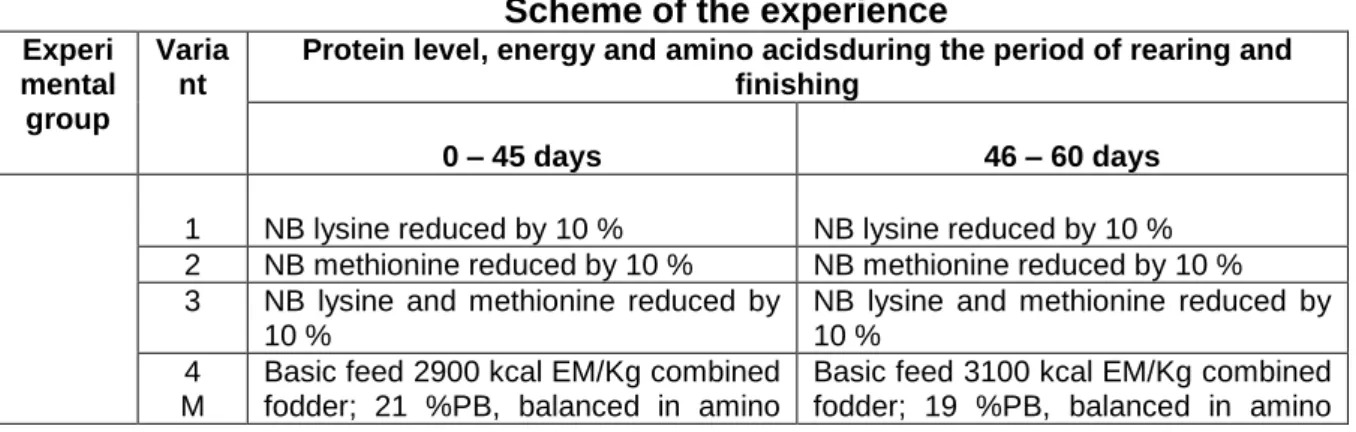
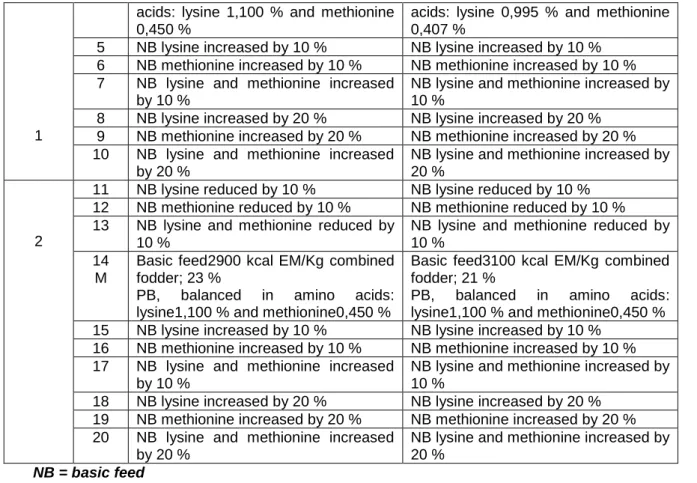
Within the groups it was studied, during the rearing and fattening of chickens, (1-45 days) and during the finishing period (46-60 days), 2 energy-protein levels different and balanced in amino acids, considered as control group, and inside each group have been experimented 10 variants, where lysine andmethioninehave been decreased or increased as compared to the control group by 10-20 %, single or associated, according to thescheme in table1.
Table 1 Scheme of the experience
Experi mental
group
Varia nt
Protein level, energy and amino acidsduring the period of rearing and finishing
0 – 45 days 46 – 60 days
1 NB lysine reduced by 10 % NB lysine reduced by 10 % 2 NB methionine reduced by 10 % NB methionine reduced by 10 % 3 NB lysine and methionine reduced by
10 %
NB lysine and methionine reduced by 10 %
4 M
Basic feed 2900 kcal EM/Kg combined fodder; 21 %PB, balanced in amino
68
1
acids: lysine 1,100 % and methionine 0,450 %
acids: lysine 0,995 % and methionine 0,407 %
5 NB lysine increased by 10 % NB lysine increased by 10 % 6 NB methionine increased by 10 % NB methionine increased by 10 % 7 NB lysine and methionine increased
by 10 %
NB lysine and methionine increased by 10 %
8 NB lysine increased by 20 % NB lysine increased by 20 % 9 NB methionine increased by 20 % NB methionine increased by 20 % 10 NB lysine and methionine increased
by 20 %
NB lysine and methionine increased by 20 %
2
11 NB lysine reduced by 10 % NB lysine reduced by 10 % 12 NB methionine reduced by 10 % NB methionine reduced by 10 % 13 NB lysine and methionine reduced by
10 %
NB lysine and methionine reduced by 10 %
14 M
Basic feed2900 kcal EM/Kg combined fodder; 23 %
PB, balanced in amino acids: lysine1,100 % and methionine0,450 %
Basic feed3100 kcal EM/Kg combined fodder; 21 %
PB, balanced in amino acids: lysine1,100 % and methionine0,450 % 15 NB lysine increased by 10 % NB lysine increased by 10 %
16 NB methionine increased by 10 % NB methionine increased by 10 % 17 NB lysine and methionine increased
by 10 %
NB lysine and methionine increased by 10 %
18 NB lysine increased by 20 % NB lysine increased by 20 % 19 NB methionine increased by 20 % NB methionine increased by 20 % 20 NB lysine and methionine increased
by 20 %
NB lysine and methionine increased by 20 %
NB = basic feed
RESULTS AND DISCUSSIONS
The obtained results are given in table2.From the analysis of the data it may be noticed that for group 1, variants 1-10, withenergy-protein levels of 2900 kcal/kg combined fodder and 21 % P.B. in the first period and 3100 kcal/kg combined fodder with 19 % P.B. in the finishing period, the consumption of combined fodder for 1 kg gain live weight varied from 2,154 kg to 2,278 kg, as compared to 2,233 kg the consumption of the control variant, and for group 2, variants 11-20, withenergy-protein levels of 2900 kcal/kg combined fodder and 23 %P.B. in the first period and 3100 kcal/kg combined fodder with 21 % P.B. in the finishing period, this consumption variedfrom 2,099 kg to 2,340 kg as compared to 2,236 kg the consumption of the control variant.
Table 2
Consumption of feed, energy, protein and amino acids for 1 kg gain at the age of 60 days
Exp erim enta l gro
up V ar ia n
t
Average body weight
at 60 days
Consumption of feed for 1 kg gain
Combined fodder
P.B. E.M. Lysine Methionine+
cystine
g % g % g % g % g % g %
1
1 1689 ,37
99,3 7
2,26 1
101,25 456,9 5
100,78 678 3
101,25 21,0 0
90,5 1
15,8 2
101,5 4 2 1695
,00
99,7 1
2,27 2
101,75 459,4 6
101,34 681 6
101,74 23,7 6
102, 41
15,4 7
99,29
3 1732 ,18
101, 89
2,15 4
96,46 436,1 0
96,19 646 2
96,46 24,2 8
91,7 2
15,0 7
96,72
4 - M
1700 ,00
100, 00
2,23 3
100,00 453,3 9
100,00 669 9
100,00 23,2 0
100, 00
15,5 8
100,0 0
5 1687 ,50
99,2 6
2,27 8
102,01 460,8 9
101,65 683 4
102,01 26,0 6
112, 321
15,9 0
69
6 1697 ,81
99,0 7
2,19 7
98,39 445,7 5
98,31 659 1
98,38 22,7 2 98,3 6 15,3 3 96,39
7 1706 ,56
100, 39
2,15 4
96,46 435,9 5
96,15 646 2
96,46 24,6 4 106, 20 15,0 3 96,40
8 1667 ,78
98,0 7
2,27 4
101,84 460,4 3
101,50 682 2
101,83 28,3 7 122, 28 15,8 7 101,8 6 9 1735
,93
102, 11
2,19 5
98,30 443,9 1
97,91 676 5
100,98 22,8 0 98,7 0 15,3 1 98,26 1 0 1771 ,87 104, 23 2,21 2
99,06 447,8 1
98,77 663 6
99,05 27,6 0 114, 60 16,4 1 105,3 2 2 1 1 1745 ,62 106, 56 2,09 9
93,87 467,1 7
93,74 629 7
93,87 21,8 9 85,2 0 16,2 6 93,69 1 2 1690 ,62 103, 20 2,11 5
94,59 471,8 7
94,68 634 5
94,58 23,6 8 92,1 7 15,7 3 90,55 1 3 1722 ,50 105, 25 2,10 6
94,19 468,8 0
94,07 631 8
94,18 21,7 8 85,1 6 15,6 6 90,15 1 4 - M 1638 ,12 100, 00 2,23 6
100,00 498,3 6
100,00 670 8
100,00 25,6 9 100, 00 17,3 7 100,0 0 1 5 1691 ,56 103, 25 2,12 1
94,86 471,8 4
94,68 636 3
94,85 26,8 5 104, 51 16,4 8 94,87 1 6 1679 ,16 102, 50 2,14 0
95,71 476,1 2
95,54 642 0
95,70 24,5 8 95,6 7 17,6 7 101,7 2 1 7 1623 ,12 99,0 89 2,26 8
101,43 505,1 5
101,36 680 4
101,41 28,7 1 111, 75 18,7 1 107,7 1 1 8 1745 ,00 106, 52 2,14 9
96,11 478,8 7
96,09 644 7
96,10 29,6 7 115, 49 17,6 2 101,4 3 1 9 1592 ,81 97,2 3 2,34 0
104,65 520,8 4
104,51 702 0
104,65 26,9 1 104, 74 20,4 2 117,5 5 2 0 1672 ,18 102, 08 2,20 1
98,43 489,8 3
98,29 660 3
98,43 30,3 9 118, 29 20,2 4 116,5 2
Consumption of combined fodder is almost identical for the 2 control variants and significantly closer from a variant to anotherwithin the used feeds. The consumption of proteins for 1 kg gain has the same fluctuations as the consumption of feed and, for variants 1-10, from 435,95 g to 460,89 g as compared to 453,39 g registered for the control variant, and for variants 11-20 the consumptions of protein are of 467,17 g to 520,84 g as compared to 498,36 g registered in the control variant.
It must be specified that, in relation to the content of combined fodder in limiting essential amino acids, consumed for 1 kg gain, it is found that for lysine the fluctuations in variants 1-10 were between 21,00 g and 28,37 g as compared to 23,20 g in the control variant, and for the variants 11-20 the quantities ranged from 21,78 g to 30,39 g as compared to 25,69 g in the control variant. As for the quantities of methionine and cystine, they varied from 15,03 g to 16,41 g as compared to 15,58 g in the control variant for the first group, and for the second group, variants 11-20, the fluctuations were between 15,66 g and 20,42 g as compared to 17,37 g in the control variant.
If we are to compare the metabolisable energy of the consumption of feed in obtaining one kilogram gain in live weightwe must emphasize that at group 1,variants 1-10, there have been registered values ranging between 6462 kcal and 6834 kcal as compared to 6699 kcal in the control variant, and in group 2, variants 11-20, the values ranged between 6297 kcal and 7020 kcal as compared to 6708 kcal in control variant.
70
results, as compared to the feed in group 2 with energy-protein level of 2900 kcal/kg combined fodder with 23 % P.B. during the period 1-45 days and 3100 kcal/kg combined fodder with 21 % P.B. in the finishing period from 46 to 60 days, fact which entitles us to recommend it for practical applications.
Results obtained at slaughter
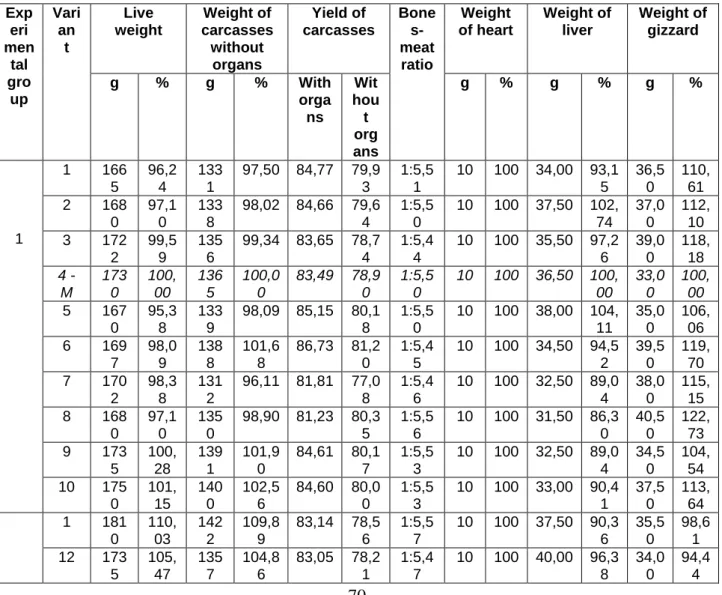
At the age of 60 days of broilersslaughters have been carried out in order to establish the weight of carcasses without organs, carcasses yield with and without organs and the weight of some organs such as the liver, the gizzard and the heart.
From the analysis of the data in table 3 it results that no significant differences were noticed regarding the weight of carcasses. For the variants in group 1 the weight of carcasses registered values ranging from 1312 g to 1400 g as compared to 1365 g in the control variant, and for the variants in group 2 the values varied from 1282 g to1422 g as compared to1294 g in the control variant.
Also, the yield at slaughter has not registered significant differences between groups and variants. For variants 1-10,the yieldof carcasses withorganswas of 81,81 % up to 86,73 % as compared to 83,49 % for the control group, and the yield of carcasses without organs represented 77,08-81,20 % as compared to 78,90 % for the control variant. The yieldof carcasses withorgansin variants 11-20 was of 82,00-85,05 % as compared to 83,98 % for the control variant, and that of carcasses without organs represented 77,42-80,05 % as compared to 78,65 % for the control variant.
Table 3
Results upon the slaughter of broilers
Exp eri men
tal gro up
Vari an t
Live weight
Weight of carcasses without organs
Yield of carcasses
Bone s-meat ratio
Weight of heart
Weight of liver
Weight of gizzard
g % g % With
orga ns
Wit hou t org ans
g % g % g %
1
1 166 5
96,2 4
133 1
97,50 84,77 79,9 3
1:5,5 1
10 100 34,00 93,1 5
36,5 0
110, 61 2 168
0
97,1 0
133 8
98,02 84,66 79,6 4
1:5,5 0
10 100 37,50 102, 74
37,0 0
112, 10 3 172
2
99,5 9
135 6
99,34 83,65 78,7 4
1:5,4 4
10 100 35,50 97,2 6
39,0 0
118, 18
4 - M
173 0
100, 00
136 5
100,0 0
83,49 78,9 0
1:5,5 0
10 100 36,50 100, 00
33,0 0
100, 00
5 167 0
95,3 8
133 9
98,09 85,15 80,1 8
1:5,5 0
10 100 38,00 104, 11
35,0 0
106, 06 6 169
7
98,0 9
138 8
101,6 8
86,73 81,2 0
1:5,4 5
10 100 34,50 94,5 2
39,5 0
119, 70 7 170
2
98,3 8
131 2
96,11 81,81 77,0 8
1:5,4 6
10 100 32,50 89,0 4
38,0 0
115, 15 8 168
0
97,1 0
135 0
98,90 81,23 80,3 5
1:5,5 6
10 100 31,50 86,3 0
40,5 0
122, 73 9 173
5
100, 28
139 1
101,9 0
84,61 80,1 7
1:5,5 3
10 100 32,50 89,0 4
34,5 0
104, 54 10 175
0
101, 15
140 0
102,5 6
84,60 80,0 0
1:5,5 3
10 100 33,00 90,4 1
37,5 0
113, 64 1 181
0
110, 03
142 2
109,8 9
83,14 78,5 6
1:5,5 7
10 100 37,50 90,3 6
35,5 0
98,6 1 12 173
5
105, 47
135 7
104,8 6
83,05 78,2 1
1:5,4 7
10 100 40,00 96,3 8
34,0 0
71
2 13 174 5
106, 11
135 1
104,4 0
82,00 74,4 2
1:5,6 1
10 100 33,00 79,5 2
37,0 0
102, 77
14 - M
164 5
100, 00
129 4
100,0 0
83,98 78,6 5
1:5,4 7
10 100 41,50 100, 00
36,0 0
100, 00
15 165 2
100, 42
129 6
100,1 5
83,14 78,4 5
1:5,4 4
10 100 32,50 78,3 1
35,0 0
97,2 2 16 166
5
101, 21
131 8
101,8 5
84,02 79,1 6
1:5,5 9
10 100 31,00 74,7 0
40,0 0
111, 11 17 170
9
103, 89
136 5
105,4 8
84,93 79,8 7
1:5,4 2
10 100 38,00 91,5 7
38,5 0
106, 94 18 176
0
106, 93
140 9
108,8 8
85,05 80,0 5
1:5,5 0
10 100 37,00 89,1 6
41,0 0
113, 89 19 163
0
99,0 8
128 2
99,07 83,56 78,6 4
1:5,5 0
10 100 35,50 85,5 4
35,0 0
97,2 2 20 169
5
103, 03
132 3
102,2 4
82,80 78,0 5
1:5,5 0
10 100 33,50 80,7 2
37,0 0
102, 78
The same may be said about the bones-meat ratio which, practically, registers the same values for all experimental variants, ranging from 1:5,42 to 1:5,61. Similar values between variants regarding the weight of liver, gizzard and heart are registered.
CONCLUSIONS
Within the feeds mentioned and balanced in limiting essential amino acids, a variation up and down of lysine and methionine does not produce obvious modifications favourable or not favourable in body and weight growth of broilers up to the age of 60 days.
The consumption of feed, protein andessential amino acids, as well as metabolised energy, in order to obtain one kilogram gain, registered better results, although are not statistically ensured for the feed used in group 1 as compared to the feed in group2.
Both between the 2 groups where were used different feeds as well as between thevariants within the experimental feeds, the chemical composition of the chicken meat and its content in amino acids has not had significant variations.
No significant differences have been registered in the experimental variants regarding the weight of carcasses, the yield at slaughter of carcasses with and without organs, the bones-meat ration and the weight of some organs such as: liver, gizzard and heart.
For the feeds mentioned in thetwo periods, Cornish x Rock broiler chickensat the age of 60 dayshad, on average, a body weight of 1,700 kg with a consumption of 2,250 kg combined fodder/kg gain in live weight.
BIBLIOGRAPHY
1.Dinescu, S. et al., 2003, "Rearing of farm animals. Efficient techniques in rearing pigs and poultry. Vol. II". AGRIS Publishing House – Editorial Team of Agricultural Magazines, Bucharest.
2. Hebean, N. et al., 1994, Translation "Poultry nutrition and feed" by M. Larbier (Nutrition et alimentation de vollailes, INRAS-France). ALUTUS Publishing House, Bucharest.
3.Sauveur, B., 1988, "Reproduction des volailles et production d'oeufs". INRA Paris, France.