
ClouDiA: A Deployment Advisor for Public Clouds
Tao Zou, Ronan Le Bras, Marcos Vaz Salles
†, Alan Demers, Johannes Gehrke
Cornell University †University of Copenhagen
Ithaca, NY Copenhagen, Denmark
{taozou, lebras, ademers, johannes}@cs.cornell.edu,
†[email protected]
ABSTRACT
An increasing number of distributed data-driven applications are moving into shared public clouds. By sharing resources and oper-ating at scale, public clouds promise higher utilization and lower costs than private clusters. To achieve high utilization, however, cloud providers inevitably allocate virtual machine instances non-contiguously, i.e., instances of a given application may end up in physically distant machines in the cloud. This allocation strategy can lead to large differences in average latency between instances. For a large class of applications, this difference can result in signif-icant performance degradation, unless care is taken in how applica-tion components are mapped to instances.
In this paper, we propose ClouDiA, a general deployment ad-visor that selects application node deployments minimizing either (i) the largest latency between application nodes, or (ii) the longest critical path among all application nodes. ClouDiA employs mixed-integer programming and constraint programming techniques to ef-ficiently search the space of possible mappings of application nodes to instances. Through experiments with synthetic and real applica-tions in Amazon EC2, we show that our techniques yield a 15% to 55% reduction in time-to-solution or service response time, without any need for modifying application code.
1.
INTRODUCTION
With advances in data center and virtualization technology, more and more distributed data-driven applications, such as High Perfor-mance Computing (HPC) applications [23, 33, 50, 69], web ser-vices and portals [27, 43, 51, 58], and even search engines [5, 7], are moving into public clouds [3]. Public clouds represent a valu-able platform for tenants due to their incremental scalability, agility, and reliability. Nevertheless, the most fundamental advantage of using public clouds is cost-effectiveness. Cloud providers manage their infrastructure at scale and obtain higher utilization by com-bining resource usages from multiple tenants over time, leading to cost reductions unattainable by dedicated private clusters.
Typical cloud providers adopt a pay-as-you-go pricing model in which tenants can allocate and terminate virtual machine instances at any time and pay only for the machine hours they use [2, 48,
Permission to make digital or hard copies of all or part of this work for personal or classroom use is granted without fee provided that copies are not made or distributed for profit or commercial advantage and that copies bear this notice and the full citation on the first page. To copy otherwise, to republish, to post on servers or to redistribute to lists, requires prior specific permission and/or a fee. Articles from this volume were invited to present their results at The 39th International Conference on Very Large Data Bases, August 26th - 30th 2013, Riva del Garda, Trento, Italy.
Proceedings of the VLDB Endowment, Vol. 6, No. 2
Copyright 2012 VLDB Endowment 2150-8097/12/12... $ 10.00. 0 0.2 0.4 0.6 0.8 1 0.2 0.4 0.8 1.6 CDF Mean Latency[ms]
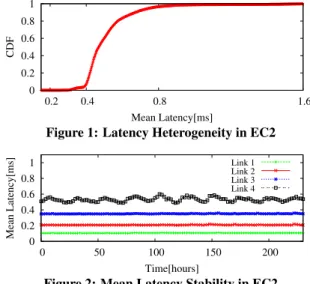
Figure 1: Latency Heterogeneity in EC2
0 0.2 0.4 0.6 0.8 1 0 50 100 150 200 Mean Latency[ms] Time[hours] Link 1 Link 2 Link 3 Link 4
Figure 2: Mean Latency Stability in EC2
64]. Giving tenants such freedom in allocating and terminating instances, public clouds face new challenges in choosing the place-ment of instances on physical machines. First, they must solve this problem at scale, and at the same time take into account different tenant needs regarding latency, bandwidth, or reliability. Second, even if a fixed goal such as minimizing latency is given, the place-ment strategy still needs to take into consideration the possibility of future instance allocations and terminations, not only for the cur-rent tenant, but also for other tenants who are sharing the resources. Given these difficulties, public cloud service providers do not currently expose instance placement or network topology informa-tion to cloud tenants.1While these API restrictions ease application deployment, they may cost significantly in performance, especially for latency-sensitive applications. Unlike bandwidth, which can be quantified in the SLA as a single number, network latency depends on message sizes and the communication pattern, both of which vary from one application to another.
In the absence of placement constraints by cloud tenants, cloud providers are free to assign instances to physical resources non-contiguously; i.e., instances allocated to a given application may end up in physically distant machines. This leads to heterogeneous network connectivity between instances: Some pairs of instances are better connected than other pairs in terms of latency, loss rate, or bandwidth. Figure 1 illustrates this effect. We present the CDF
1The only exception we know of is the notion ofcluster placement
groupsin Amazon EC2 cluster instances. However, these cluster instances are much more costly than other types of instances, and only a limited number of instances can be allocated within a cluster placement group.
of the mean pairwise end-to-end latencies among 100 Amazon EC2 large instances (m1.large), obtained by TCP round-trip times of 1 KB messages. Around 10% of the instance pairs exhibit latency above 0.7 ms, while the bottom 10% are below 0.4 ms. This het-erogeneity in network latencies can greatly increase the response time of distributed, latency-sensitive applications. Figure 2 plots the mean latencies of four representative links over a 10-day ex-periment, with measurements taken every two hours. The observed stability of mean latencies suggests that applications may obtain better performance by selecting “good” links for communication.
This paper examines how developers can carefully tune the de-ployment of their distributed applications in public clouds. At a high level, we make two important observations: (i) If we care-fully choose the mapping from nodes (components) of distributed applications to instances, we can potentially prevent badly in-terconnected pairs of instances from communicating with each other; (ii) if we over-allocate instances and terminate instances with bad connectivity, we can potentially improve application response times. These two observations motivate our general approach: A cloud tenant has a target number of components to deploy onto xvirtual machines in the cloud. In our approach, she allocatesx instances plus a small number of additional instances (sayx/10). She then carefully selects which of these 1.1·xinstances to use and how to map herxapplication components to these selected virtual machines. She then terminates thex/10 over-allocated instances.
Our general approach could also be directly adopted by a cloud provider – potentially at a price differential – but the provider would need to widen its API to include latency-sensitivity infor-mation. Since no cloud provider currently allows this, we take the point of view of the cloud tenant, by whom our techniques are im-mediately deployable.
Contributions of this paper.In this paper, we introduce the prob-lem of deployment advice in the cloud and instantiate a concrete deployment advisor called ClouDiA (CloudDeploymentAdvisor). 1. ClouDiA works for two large classes of data-driven applica-tions. The first class, which contains many HPC applications, is sensitive to the worst link latency, as this latency can significantly affect total time-to-solution in a variety of scientific applications [1, 11, 21, 34]. The second class, represented by search engines as well as web services and portals, is sensitive to the longest path between application nodes, as this cost models the network links with the highest potential impact on application response time. ClouDiA takes as input an application communication graph and an opti-mization objective, automatically allocates instances, measures la-tencies, and finally outputs an optimized node deployment plan (Section 2). To the best of our knowledge, our methodology is the first to address deployment tuning for latency-sensitive applications in public clouds.
2. We formally define the two node deployment problems solved by ClouDiA and prove the hardness of these problems. The two op-timization objectives used by ClouDiA – largest latency and longest critical path – model a large class of current distributed cloud ap-plications that are sensitive to latency (Section 3).
3. We present an optimization framework that can solve these two classes of problems, each by different solvers based on mixed-integer and constraint programming. We discuss optimizations and heuristics that allow us to obtain high-quality deployment plans over the scale of hundreds of instances (Section 4).
4. We discuss methods to obtain accurate latency measurements (Section 5) and evaluate our optimization framework with both syn-thetic and real distributed applications in Amazon EC2. We observe
15%-55% reduction in time-to-solution or response times. These benefits come exclusively from optimized deployment plans, and require no changes to the specific application (Section 6).
We discuss related work in Section 7 and then conclude.
2.
TUNING FOR LATENCY-SENSITIVE
APPLICATIONS IN THE CLOUD
To give a high-level intuition for our approach, we first describe the classes of applications we target in Section 2.1. We then de-scribe the architecture that ClouDiA uses to suggest deployments for these applications in Section 2.2.
2.1
Latency-Sensitive Applications
We can classify latency-sensitive applications in the cloud into two broad classes: high-performance computing applications, for which the main performance goal istime-to-solution, and service-oriented applications, for which the main performance goal is re-sponse time for service calls.
Goal: Time-to-solution. A number of HPC applications simu-late natural processes via long-running, distributed computations. For example, consider the simulation of collective animal move-ment published by Couzin et al. in Nature [19]. In this simula-tion, a group of animals, such as a fish school, moves together in a two-dimensional space. Animals maintain group cohesion by ob-serving each other. In addition, a few animals try to influence the direction of movement of the whole group, e.g., because they have seen a predator or a food source. This simulation can be parti-tioned among multiple compute nodes through a spatial partition-ing scheme [60]. At every time step of the simulation, neighborpartition-ing nodes exchange messages before proceeding to the next time step. As the end of a time step is a logical barrier, worst-link latency essentially determines communication cost [1, 11, 34, 69]. Simi-lar communication patterns are common in multiple linear algebra computations [21]. Another example of an HPC application where time-to-solution is critical is dynamic traffic assignment [62]. Here traffic patterns are extrapolated for a given time period, say 15 min, based on traffic data collected for the previous period. Simulation must be faster than real time so that simulation results can generate decisions that will improve traffic conditions for the next time pe-riod. Again, the simulation is distributed over multiple nodes, and computation is assigned based on a graph partitioning of the traffic network [62]. In all of these HPC applications, time-to-solution is dramatically affected by the latency of the worst link.
Goal: Service response time. Web services and portals, as well as search engines, are prime cloud applications [5, 27, 58]. For ex-ample, consider a web portal, such as Yahoo! [51] or Amazon [58]. The rendering of a web page in these portals is the result of tens or hundreds, of web service calls [43]. While different portions of the web page can be constructed independently, there is still a critical path of service calls that determines the server-side communication time to respond to a client request. Latencies in the critical path add up, and can negatively affect end-user response time.
2.2
Architecture of ClouDiA
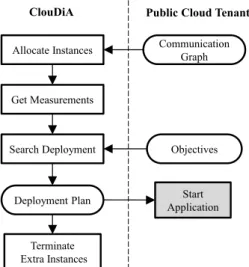
Figure 3 depicts the architecture of ClouDiA. The dashed line indicates the boundary between ClouDiA and public cloud tenants. The tuning methodology followed by ClouDiA comprises the fol-lowing steps:
1. Allocate Instances: A tenant specifies the communication graph for the application, along with a maximum number of in-stances at least as great as the required number of application nodes. CloudDiA then automatically allocates cloud instances to
Objectives Allocate Instances Get Measurements Terminate Extra Instances Search Deployment Deployment Plan Communication Graph Start Application
ClouDiA Public Cloud Tenant
Figure 3: Architecture of ClouDiA
run the application. Depending on the specified maximum number of instances, ClouDiA will over-allocate instances to increase the chances of finding a good deployment.
2. Get Measurements: The pairwise latencies between in-stances can only be observed after inin-stances are allocated. ClouDiA performs efficient network measurements to obtain these latencies, as described in Section 5. The main challenge reliably estimating the mean latencies quickly, given that time spent in measurement is not available to the application.
3. Search Deployment: Using the measurement results, to-gether with the optimization objective specified by the tenant, CloudDiA searches for a “good” deployment plan: one which avoids “bad” communication links. We formalize this notion and pose the node deployment problem in Section 3. We then formulate two variants of the problem that model our two classes of latency-sensitive applications. We prove the hardness of these optimization problems in Appendix A. Given the hardness of these problems, traditional methods cannot scale to realistic sizes. We propose tech-niques that significantly speed up the search in Section 4.
4. Terminate Extra Instances: Finally, ClouDiA terminates any over-allocated instances and the tenant can start the applica-tion with an optimized node deployment plan.
Adapting to changing network conditions.The architecture out-lined above assumes that the application will run under relatively stable network conditions. We believe this assumption is justified: The target applications outlined in Section 2.1 have long execution time once deployed, and our experiments in Figure 2 show stable pairwise latencies in EC2. In the future, more dynamic cloud net-work infrastructure may become the norm. In this case, the optimal deployment plan could change over time, forcing us to consider dynamic re-deployment. We envision that re-deployment can be achieved via iterations of the architecture above: getting new mea-surements, searching for a new optimal plan, and re-deploying the application.
Two interesting issues arise with iterative re-deployment. First, we need to consider whether information from previous runs could be exploited by a new deployment. Unfortunately, previous runs provide no information about network resources that werenotused by the application. In addition, as re-deployment is triggered by changes in network conditions, it is unlikely that network condi-tions of previous runs will be predictive of condicondi-tions of future runs. Second, re-deployment should not interrupt the running ap-plication, especially in the case of web services and portals.
Unfor-tunately, current public clouds do not support VM live migration [2, 48, 64]. Without live migration, complicated state migration logic would have to be added to individual cloud applications.
3.
THE NODE DEPLOYMENT PROBLEM
In this section, we present the optimization problems addressed by ClouDiA. We begin by discussing how we model network cost (Section 3.1). We then formalize two versions of the node deploy-ment problem (Section 3.2).
3.1
Cost Functions
When a set of instances is allocated in a public cloud, in principle any instance in the set can communicate with any other instance, possibly at differing costs. Differences arise because of the un-derlying physical network resources that implement data transfers between instances. We call the collection of network resources that interconnect a pair of instances the communication linkbetween them. We formalize communication cost as follows.
DEFINITION1 (COMMUNICATIONCOST). Given a set of in-stances S, we define
C
L:S×S→R as the communication costfunction. For a pair of instances i,j∈S,
C
L(i,j)gives thecommu-nication cost of the link from instance i to j.
C
L can be defined based on different criteria, e.g., latency,band-width, or loss rate. To reflect true network properties, we do not assume
C
Lto be a metric: Costs of links can be asymmetric and thetriangle inequality does not necessarily hold. In this paper, given the applications we are targeting, we focus solely on usingnetwork latencyas a specific instance for
C
L. Extending to other networkcost measurements is future work.
Our definition of communication cost treats communication links as essentially independent. This modeling decision ignores the underlying implementation of communication links in the dat-acenter. In practice, however, current clouds tend to organize their network topology in a tree-like structure [10]. A natural question is whether we could provide more structure to the communication cost function by reverse engineering this underlying network topol-ogy. Approaches such as Sequoia [52] deduce underlying network topology by mapping application nodes onto leaves of a virtual tree. Unfortunately, even though these inference approaches work well for Internet-level topologies, state-of-the-art methods cannot infer public cloud environments accurately [9, 15].
Even if we could obtain accurate topology information, it would be non-trivial to make use of it. First, there is no guarantee that the nodes of a given application can all be allocated to nearby physical elements (e.g., in the same rack), so we need an approach that fun-damentally tackles differences in communication costs. Second, datacenter topologies are themselves evolving, with recent propos-als for new high-performance topologies [42]. Optimizations de-veloped for a specific tree-like topology may no longer be generally applicable as new topologies are deployed. Our general formu-lation of communication cost makes our techniques applicable to multiple different choices of datacenter topologies. Nevertheless, as we will see in Section 6, we can support a general cost formu-lation, but optimize deployment search when there are uniformities in the cost, e.g., clusters of links with similar cost values.
To estimate the communication cost function
C
L for the set ofallocated instances, CloudDiA runs an efficient network measure-ment tool (Section 5). Note that the exact communication cost is application-dependent. Applications communicating messages of different sizes can be affected differently by the network het-erogeneity. However, for latency-sensitive applications, we ex-pect application-independent network latency measurements can
be used as a good performance indicator, although they might not precisely match the exact communication cost in application exe-cution. This is because our notion of cost need only discriminate between “good” and “bad” communication links, rather than accu-rately predict actual application runtime performance.
3.2
Problem Formulation
To deploy applications in public clouds, a mapping between log-ical application nodes and cloud instances needs to be determined. We call this mapping adeployment plan.
DEFINITION2 (DEPLOYMENTPLAN). Let S be the set of in-stances. Given a set N of application nodes, a deployment plan
D
:N→S is a mapping of each application node n∈N to an in-stance s∈S.In this paper, we require that
D
be an injection, that is, each in-stances∈Scan have at most one application noden∈Nmapped to it. There are two implications of this definition. On one hand, we do not collocate application nodes on the same instance. In some cases, it might be beneficial to collocate services, yet we ar-gue these services should be merged into application nodes before determining the deployment plan. On the other hand, it is possible that some instances will have no application nodes mapped to them. This gives us flexibility to over-allocate instances at first, and then shutdown those instances with high communication cost.In today’s public clouds, tenants typically determine a deploy-ment plan by either a default or a random mapping. CloudDiA takes a more sophisticated approach. The deployment plan is gen-erated by solving an optimization problem and searching through a space of possible deployment plans. This search procedure takes as input the communication cost function
C
L, obtained by ourmea-surement tool, as well as acommunication graphand adeployment cost function, both specified by the cloud tenant.
DEFINITION3 (COMMUNICATIONGRAPH). Given a set N of application nodes, the communication graph G= (V,E)is a di-rected graph where V=N and E=
(i,j)|i,j∈N∧talks(i,j) . Thetalksrelation above models the application-specific commu-nication patterns. When defining the commucommu-nication graph through thetalksrelation, the cloud tenant should only include communica-tion links that have impact on the performance of the applicacommunica-tion. For example, those links first used for bootstrapping and rarely used afterwards should not be included in the communication graph. An alternative formulation for the communication graph would be to add weights to edges, extending the semantics oftalks. We leave this to future work.
We find that although such communication graph is typically not hard to extract from the application, it might be a tedious task for a cloud tenant to generate an input file with O(|N|2) links.
ClouDiA therefore providescommunication graph templates for certain common graph structures such as meshes or bipartite graphs to minimize human involvement.
In addition to the communication graph, a deployment cost func-tion needs to be specified by the cloud tenant. At a high level, a deployment cost function evaluates the cost of the deployment plan by observing the structure of the communication graph and the communication cost for links in the given deployment. The op-timization goal for CloudDiA is to generate a deployment plan that minimizes such cost. The formal definition of deployment cost is as follows:
DEFINITION4 (DEPLOYMENTCOST). Given a deployment plan
D
, a communication graph G, and a communication cost func-tionC
L, we defineC
D(D,G,C
L)∈Ras the deployment cost ofD
.C
Dmust be monotonic on link cost and invariant under exchangingnodes that are indistinguishable using link costs.
Now, we can formally define the node deployment problem: DEFINITION5 (NODEDEPLOYMENTPROBLEM). Given a deployment cost function
C
D, a communication graph G, and acommunication cost function
C
L, the node deployment problem isto find the optimal deployment
D
OPT=arg minDC
D(D
,G,C
L).In the remainder, we focus on two classes of deployment cost functions, which capture the essential aspects of the communica-tion cost of latency-sensitive applicacommunica-tions running in public clouds. In High Performance Computing (HPC) applications, such as simulations, matrix computations, and graph processing [69], ap-plication nodes typically synchronize periodically using either global or local communication barriers. The completion of these barriers depends on the communication link which experiences the longest delay. Motivated by such applications, we define our first class of deployment cost function to return the highest link cost.
CLASS1 (DEPLOYMENTCOST: LONGESTLINK). Given a deployment plan
D
, a communication graph G= (V,E) and a communication cost functionC
L, the longest link deployment costC
LLD(D,G,
C
L) =max(i,j)∈EC
L(D(i),D(
j)).Another class of latency-sensitive applications is exemplified by search engines [5, 7] as well as web services and portals [27, 43, 51, 58]. Services provided by these applications typically organize ap-plication nodes into trees or directed acyclic graphs, and the overall latency of these services is determined by the communicationpath which takes the longest time [56]. We therefore define our second class of deployment cost function to return the highest path cost.
CLASS2 (DEPLOYMENTCOST: LONGESTPATH). Given a deployment plan
D
, an acyclic communication graph G and a communication cost functionC
L, the longest path deployment costC
LP D (D,G,C
L) =maxpathP⊆G Σ(i,j)∈PC
LD(
i),D(
j) . Note that the above definition assumes the application is sending a sequence of causally-related messages along the edges of a path, and summation is used to aggregate the communication cost of the links in the path.Although we believe these two classes cover a wide spectrum of latency-sensitive cloud applications, there are still important appli-cations which do not fall exactly into either of them. For example, consider a key-value store with latency requirements on average response time or the 99.9thpercentile of the response time distribu-tion [20]. This applicadistribu-tion does not exactly match the two deploy-ment cost functions above, since average response time may be in-fluenced by multiple links in different paths. A natural extension to Longest Link returningkthhighest link cost as deployment cost can be useful in this case. While we leave this extension to future work, we discuss the applicability of our deployment cost functions to a key-value store workload further in Section 6.1. We then proceed to show experimentally in Section 6.4 that even though Longest-Link is not a perfect match for such a workload, use of this deployment cost function still yields a 15%-31% improvement in average re-sponse time for a key-value store workload. Considering this pos-sibility of utilizing the above cost functions even if there is no exact match, CloudDiA is able to automatically improve response times of an even wider range of applications.
We prove that the node deployment problem with longest-path deployment cost is NP-hard. With longest-link deployment cost, it is also NP-hard and cannot be efficiently approximated unless
P=NP (Appendix A). Given the hardness results, our solution ap-proach consists of Mixed-Integer Programming (MIP) and Con-straint Programming (CP) formulations (Section 4). We show ex-perimentally that our approach still brings significant performance improvement to real applications. In addition, from the insight gained from the theorems above, we also show that properly round-ing communication costs tocost clusterscan be heuristically used to further boost solution performance (Section 6).
4.
SOLVER TECHNIQUES
In this section, we propose two encodings to solve the Longest Link Node Deployment Problem (LLNDP), as well as one formu-lation for the Longest Path Node Deployment Problem (LPNDP).
4.1
Mixed-Integer Program for LLNDP
Given a communication graphG= (V,E)and a communication cost function
C
Ldefined over any pair of instances inS, theLongestLink Node Deployment Problemcan be formulated as the following Mixed-Integer Program (MIP):
(MIP)min c s.t.
∑
i∈V xi j=1 ∀j∈S (1)∑
j∈S xi j=1 ∀i∈V (2) c≥C
L(j,j0)(xi j+xi0j0−1) ∀(i,i0)∈E,∀j,j0∈S (3) xi j∈ {0,1} ∀i∈V,j∈S c≥0In this encoding, the boolean variablexi jindicates whether the application nodei∈V is deployed on instance j∈S. The con-straints (1) and (2) ensure that the variablesxi jrepresent a one-to-one mapping between the setV andS. Note that the setV might need to be augmented with dummy application nodes, so that we have|V|=|S|. Also, the constraints (3) require that the value ofcis at least equal to
C
L(j,j0)any time there is a pair(i,i0)ofcommu-nicating application nodes and thatiandi0are deployed on jand j0, respectively. Finally, the minimization in the objective function will make one of the constraints (3) tight, thus leading to the desired longest link value.
4.2
Constraint Programming for LLNDP
Whereas the previous formulation directly follows from the problem definition, our second approach exploits the relation be-tween this problem and the subgraph isomorphism problem, as well as the clusters of communication cost values. The algorithm proceeds as follows. Given a goalc, we search for a deployment that avoids communication costs greater thanc. Such a deploy-ment exists if and only the graphGc= (S,Ec)whereEc={(i,j):
C
L(i,j)≤c}contains a subgraph isomorphic to thecommunica-tion graphG= (V,E). Therefore, by finding such a subgraph, we obtain a deployment whose deployment costc0is such thatc0≤c. Assumec00is the largest communication cost strictly lower thanc0. Thus, any improving deployment must have a cost ofc00or lower, and the communication graphG= (V,E)must be isomorphic to a subgraph ofGc00= (S,Ec00)whereEc00={(i,j):
C
L(i,j)≤c00}.We proceed iteratively until no deployment is found. Note that the number of iterations is bounded by the number of distinct cost val-ues. Therefore, clustering similar values to reduce the number of distinct cost values would improve the computation time by low-ering the number of iterations, although it approximates the actual
value of the objective function. We investigate the impact ofcost clustersin Section 6. For a given objective valuec, the encoding of the problem might be expressed as the following Constraint Pro-gramming (CP) formulation:
(CP) alldifferent (ui)1≤i≤|V|
(ui,ui0),(j,j0) ∀(i,i0)∈E,∀(j,j0):
C
L(j,j0)>cui∈ {1, ...,|S|} ∀1≤i≤ |V| This encoding is substantially more compact that the MIP for-mulation, as the binary variables are replaced by integer variables, and the mapping is efficiently captured within thealldifferent constraint. In addition, at the root of the search tree, we perform an extra filtering of the domains of thexi j variables that is based on compatibility between application nodes and instances. Indeed, as the objective valuecdecreases, the graphGcbecomes sparse, and some application nodes can no longer be mapped to some of the instance nodes. For example, a node inGneeds to be mapped to a node inGcof equal or higher degree. Similar to [68], we define a labeling based on in- and out-degree, as well as information about the labels of neighboring nodes. This labeling establishes a partial order on the nodes and expresses compatibility between them. For more details on this labeling, please refer to [68].
4.3
Mixed-Integer Programming for LPNDP
As previously mentioned, the Node Deployment Problem is in-trinsically related to the Subgraph Isomorphism Problem (SIP). In addition, the Longest Link objective function allows us to di-rectly prune the graph that must contain the communication graph Gand therefore, can be encoded as a series of Subgraph Isomor-phism Satisfaction Problems. This plays a key role in the success of the CP formulation. On the contrary, the objective function of the Longest Path Node Deployment Problem(LPNDP) interferes with the structure of the SIP problem and rules out sub-optimal so-lutions only when most of the application nodes have been assigned to instances. As a result, this optimization function barely guides the systematic search, and makes it less suitable for a CP approach. Consequently, we only provide a MIP formulation for the LPNDP. Given a communication graphG= (V,E)and a communication cost function
C
Ldefined over any pair of instances inS, theLongestPath Node Deployment Problem(LPNDP) can be formulated as the following Mixed-Integer Program (MIP):
(MIP)min t s.t.
∑
i∈V xi j=1 ∀j∈S∑
j∈S xi j=1 ∀i∈V cii0≥C
L(j,j0)(xi j+xi0j0−1) ∀(i,i0)∈E,∀j,j0∈S t≥ti,ti≥0 ∀i∈V ti0≥ti+cii0 ∀(i,i0)∈E xi j∈ {0,1} ∀i∈V,j∈S cii0≥0 ∀(i,i0)∈E t≥0As in the previous MIP encoding, the boolean variablexi j indi-cates whether the application nodeiis deployed on instancejin a one-to-one mapping. In addition, the variablecii0captures the
com-munication cost from application nodeito nodei0that would result from the deployment specified by thexi jvariables. The variableti represents the longest directed path in the communication graphG
that reaches the application nodei. Finally, the variabletappears in the objective function, and corresponds to the maximum among thetivariables.
5.
MEASURING NETWORK DISTANCE
Making wise deployment decisions to optimize performance for latency-sensitive applications requires knowledge of pairwise com-munication cost. A natural way to characterize the comcom-munication cost is to directly measure round-trip latencies for all instance pairs. To ensure such latencies are a good estimate of communication cost during application execution, two aspects need to be handled. First, the size of the messages being exchanged during application execution is usually non-zero. Therefore, rather than measuring pure round-trip latencies with no data content included, we mea-sure TCP round-trip time of small messages, where message size depends on the actual application workload. Second, during the application execution, multiple messages are typically being sent and received at the same time. Such temporal correlation affects network performance, especially end-to-end latency. But the exact interference patterns heavily depend on low-level implementation details of applications, and it is impractical to require such detailed information from the tenants. Instead, we focus on estimating the quality of links without interference, as this already gives us guid-ance on which links are certain to negatively affect actual execu-tions.
Although we observe mean latency heterogeneity is stable in the cloud (Figure 2), experimental studies have demonstrated that clouds suffer from high latency jitter [55, 59, 69]. Therefore, to estimate mean latency accurately, multiple round-trip latency mea-surements have to be obtained for each pair of instances. Since the number of instance pairs is quadratic in the number of instances, such measurement takes substantial time. On the one hand, we want to run mean-latency measurements as fast as possible to min-imize the overhead of using ClouDiA. On the other hand, we need to avoid introducing uncontrolled measurement artifacts that may affect the quality of our results. We propose three possible ap-proaches for organizing pairwise mean latency measurements in the following.
1. Token Passing. In this first approach, a unique token is passed between instances. When an instanceireceives this token, it selects another instance jand sends out a probe message of given size. Once the entire probe message has been received by j, it replies to iwith a message of the same size. Upon receiving the entire reply message,irecords the round-trip time and passes the token on to another instance chosen at random or using a predefined order. By having such a unique token, we ensure that only one message is being transferred at any given time, including the message for token passing itself. We repeat this token passing process a sufficiently large number of times, so multiple round-trip measurements can be collected for each link. We then aggregate these measurements into mean latencies per link.
This approach achieves the goal of obtaining pairwise mean-latency measurements without correlations between links. How-ever, the lack of parallelism restricts its scalability.
2. Uncoordinated. To improve scalability, we would like to avoid excessive coordination among instances, so that they can exe-cute measurements in parallel. We introduce parallelism by the fol-lowing simple scheme: Each instance picks a destination at random and sends out a probe message. Meanwhile, all instances monitor incoming messages and send reply messages once an entire probe message has been received. After one such round-trip measure-ment, each instance picks another probe destination and starts over. The process is repeated until we have collected enough round-trip
measurements for every link. We then aggregate these measure-ments into mean latencies per link.
Givenninstances, this approach allows up tonmessages to be in flight at any given time. Therefore, this approach provides better scalability than the first approach. However, since probe destina-tions are chosen at random without coordination, it is possible that: 1) one instance needs to send out reply messages while it is sending out a probe message; or 2) multiple probe messages are sent to the same destination from different sources. Such cross-link correla-tions are undesirable for our measurement goal.
3. Staged. To prevent cross-link correlations while preserving scalability, coordination is required when choosing probe destina-tions. We add an extra coordinatorinstance and divide the en-tire measurement process intostages. To start a stage forn in-stances in parallel, the coordinator first picksbn
2cpairs of instances
{(i1,j1),(i2,j2), ...,(ibn
2c,jb
n
2c)}such that ∀p,q∈ {1..n},ip, jq and ip ,iq if p,q. The coordinator then notifies eachip,p∈ {1, ..,bn
2c},of its corresponding jp. After receiving a notification,
ipsends probe messages to jpand measures round-trip latency as described above. Finally,ipends its stage by sending a notification back to the coordinator, and the coordinator waits for all pairs to finish before starting a new stage.
This approach allows up to n2 messages between instances in flight at any time at the cost of having a central coordinator. We minimize the cost of per-stage coordination by consecutively mea-suring round-trip times between the same given pair of instances Kstimes within the same stage, whereKsis a parameter. With this optimization, the staged approach can potentially provide scalabil-ity comparable to theuncoordinatedapproach. At the same time, by careful implementation, we can guarantee that each instance is always in one of the following three states: 1) sending to one other instance; 2) receiving from one other instance; or 3) idle in net-working. This guarantee provides independence among pairwise link measurements similar to that achieved bytoken passing.
Approximations. Even the Staged network latency benchmark above can take non-negligible time to generate mean latency esti-mates for a large number of instances. Given that our goal is simply to estimate link costs for our solvers, we have experimented with other simple network metrics, such as hop count and IP distance, as proxies for round-trip latency. Surprisingly, these metrics did notturn out to correlate well with round-trip latency. We provide details on these negative results in Appendix B.
6.
EXPERIMENTAL RESULTS
In this section, we present experiments demonstrating the effec-tiveness of ClouDiA. We begin with a description of the several representative workloads used in our experiments. We then present micro-benchmark results for the network measurement tools and the solver of ClouDiA. Finally, we experimentally demonstrate the performance improvements achievable in public clouds by using ClouDiA as the deployment advisor.
6.1
Workloads
To benchmark the performance of ClouDiA, we implement three different workloads: a behavioral simulation workload, a query ag-gregation workload, and a key-value store workload. Each work-load illustrates a different communication pattern.
Behavioral Simulation Workload. In behavioral simulations, collections of individuals interact with each other to form complex systems. Examples of behavioral simulations include large-scale traffic simulations and simulation of groups of animals. These sim-ulations organize computation into ticks and achieve parallelism
by partitioning the simulated space into regions. Each region is al-located to a processor and inter-node communication is organized as a 2D or 3D mesh. As synchronization among processors hap-pens every tick, the progress of the entire simulation is limited by the pair of nodes that take longest to synchronize. Longest-Link is thus a natural fit to the deployment cost of such applications. We implement a workload similar to the fish simulation described by Couzin et al [19]. The communication graph is a 2D mesh and the message size per link is 1 KB for each tick. To focus on network effects, we hide CPU intensive computation and study the time to complete 100K ticks over different deployments.
Synthetic Aggregation Query Workload. In a search engine or distributed text database, queries are processed by individual nodes in parallel and the results are then aggregated [7]. To prevent the aggregation node from becoming bottleneck, a multi-level aggre-gation tree can be used: each node aggregates some results and forwards the partial aggregate to its parent in the tree for further aggregation. The response time of the query depends on the path from a leaf to the root that has highest total latency. Longest-Path is thus a natural fit for the deployment cost of such applications. We implement a two-level aggregation tree of a top-k query answering workload. The communication graph is a tree and the forwarding message size varies from the leaves to the root, with an average of 4 KB. We hide ranking score computation and study the response time of aggregation query results over different deployments.
Key-Value Store Workload. We also implement a distributed key-value store workload. The key-value store is queried by a set of front-end servers. Keys are randomly partitioned among the stor-age nodes, and each query touches a random subset of them. The communication graph therefore is a bipartite graph between front-end servers and storage machines. However, unlike the simulation workload, the average response time of a query is not simply gov-erned by the slowest link. To see this, consider a deployment with mostly equal-cost links, but with a single slower link of costc, and compare this to a similar deployment with two links of costc−ε. If Longest-Link were used as the deployment cost function, the sec-ond deployment would be favored even though the first deployment actually has lower average response time. Indeed, neither Longest-Link nor Longest-Path is the precisely correct objective function for this workload. We evaluate the query response time over dif-ferent deployments by using Longest-Link, with a hope that it can still help avoid high cost links.
6.2
Network Micro-Benchmarks
Setup. The network measurement tools of ClouDiA are imple-mented in C++ using TCP sockets (SOCK_STREAM). We set all sockets to non-blocking mode and useselectto process concurrent flows (if any). We disable the Nagle Algorithm.
We ran experiments in the Amazon Elastic Compute Cloud (Amazon EC2). We used large instances (m1.large) in all exper-iments. Each large instance has 7.5 GB memory and 4 EC2 Com-pute Units. Each EC2 ComCom-pute Unit provides the equivalent CPU capacity of a 1.0-1.2 GHz 2007 Opteron or 2007 Xeon proces-sor [2]. Unless otherwise stated, we use 100 large instances for net-work micro-benchmarks, all allocated by a singleec2-run-instance command, and set the round-trip message size to 1KB. We show the following results from the same allocation so that they are com-parable. Similar results are obtained in other allocations.
Round-Trip Latency Measurement. We run latency measure-ments with each of the three approaches proposed in Section 5 and compare their accuracy in Figure 4. To make suretoken passingcan observe each link a sufficiently large amount of times, we use 50 large instances in this experiment. We consider the mean latencies
for 502 instance pairs as a 502-dimension vector of mean laten-cies, of which each dimension represents one link. Results are first normalized to the unit vector. Then,stagedanduncoordinatedare compared with the baselinetoken passing. The CDF of the relative error of each dimension is shown in Figure 4. Usingstaged, we find 90% of links have less than 10% relative error and the maximum error is less than 30%; whereas usinguncoordinatedwe find 10% of links have more than 50% relative error. Therefore, as expected, stagedexhibits higher measurement accuracy thanuncoordinated.
Figure 5 shows convergence over time using thestagedapproach with 100 instances andKs=10. Again, the measurement result is considered as a latency vector. The result of the full 30 minutes observation is used as theground truth. Each stage on average takes 2.75 ms. Therefore, we obtain about 3004 measurements for each instance pair within 30 minutes. We then calculate the root-mean-square error of partial observations between 1 and 30 minutes compared with the ground truth. From Figure 5, we observe the root-mean-square error drops quickly within the first 5 minutes and smooths out afterwards. Therefore, we pick 5 minutes as the mea-surement time for all the following experiments with 100 instances. For experiments withn,100 instances, since thestagedapproach tests n2 pairs in parallel whereas there areO(n2)total pairs, mea-surement time needs to be adjusted linearly to 5· n
100minutes.
6.3
Solver Micro-Benchmarks
Setup.We solve the MIP formulation using the IBM ILOG CPLEX Optimizer, while every iteration of the CP formulation is performed using IBM ILOG CP Optimizer. Solvers are executed on a local machine with 16 GB memory and Intel Core i7-2600 CPU (4 phys-ical cores with hyper-threading). We enable parallel mode to allow both solvers to fully utilize all CPU resources. We usek-means to cluster link costs. Since the link costs are in one dimension, such k-means can be optimally solved inO(kN)time using dynamic pro-gramming, whereNis the number of distinct values for clustering andkis the number ofcost clusters. After runningk-means cluster-ing, all costs are modified to the mean of the containing cluster and then passed to the solver. For comparison purposes, the same set of network latency measurements as in Section 6.2 is used for all solver micro-benchmarks. In each solver micro-benchmark, we set the number of application nodes to be 90% of the number of allo-cated instances. To find an initial solution to bootstrap the solver’s search, we randomly generate 10 node deployment plans and pick the best one among those.
Longest-Link Node Deployment Problem. We provide both a MIP formulation and a CP formulation for LLNDP. Since the pa-rameter of cost clustering may have different impacts on the perfor-mance of the two solvers, we first analyze the effect of cost clus-tering. Figure 6 shows the convergence of the CP formulation for 100 instances with different number of clusters. The communica-tion graph for Figure 6 to Figure 8 is a 2D mesh from the simu-lation workload and the deployment cost is the cost of the longest link. We tested all possiblekvalues from 5 to the number of dis-tinct values (rounded to nearest 0.01 ms), with an increment of 5. We present three representative configurations: k=5,k=20 and no clustering. As we decrease the number of clusters, the CP ap-proach converges faster. Indeed, with no clustering, the best solu-tion is found after 16 minutes, whereas it takes 2 minutes and 30 seconds for the CP approach to converge withk=20 andk=5, respectively. This is mainly due to the fact that fewer iterations are needed to reach the optimal value. Such a difference demonstrates the effectiveness of cost clustering in reducing the search time. On the other hand, the smaller the value ofkis, the coarser the cost clusters are. As a result, the CP model cannot discriminate among
0 0.2 0.4 0.6 0.8 1 0 0.2 0.4 0.6 0.8 1 CDF
Normalized Relative Error[%] Staged Uncoordinated
Figure 4: Staged vs Uncoordinated (against Token Passing)
0 0.5 1 1.5 2 2.5 0 5 10 15 20 25 30 Root-Mean-Square Error Measurement Time[Minutes]
Figure 5: Latency Measurement Conver-gence over Time
0 0.2 0.4 0.6 0.8 1 1.2 1.4 1.6 2 4 8 16 Longest-Link Latency[ms] Optimization Time[Minutes] k = 5 k = 20 no clustering
Figure 6: CP Convergence with k-means: Longest Link 0 0.2 0.4 0.6 0.8 1 1.2 1.4 1.6 2 4 8 16 Longest-Link Latency[ms] Optimization Time[Minutes] CP MIP
Figure 7: CP vs MIP Convergence: Longest Link (k=20) 0 10 20 30 40 50 60 70 80 90 20 40 60 80 100 Convergence Time[s] # of Instances
Figure 8: CP Solver Scalability: Longest Link 0 0.5 1 1.5 2 2.5 3 3.5 4 4.5 2 4 8 16 Longest-Path Latency[ms] Optimization Time[Minutes] k = 5 k = 20 no clustering
Figure 9: MIP Convergence with k-means: Longest Path
deployments within the same cost cluster, and this might lead to sub-optimal solutions. As shown in Figure 6, the solver cannot find a solution with a deployment cost smaller than 0.81 fork=5, while both casesk=20 andno clusteringlead to a much better deployment cost of 0.55.
Figure 7 shows the comparison between the CP and the MIP for-mulations withk=20. MIP performs poorly with the scale of 100 instances. Also, other clustering configurations do not improve the performance of MIP. One reason is that for LLNDP, the encoding of the MIP is much less compact than CP. Moreover, the MIP formu-lation suffers from a weak linear relaxation, asxi jandxi0j0should
add up to more than one for the relaxed constraint 3 to take effect. Given the above analysis, we pick CP withk=20 for the follow-ing scalability experiments as well as LLNDP in Section 6.4.
Measuring scalability of a solver such as ours is challenging, as problem size does not necessarily correlate with problem hardness. To observe scalability behavior with problem size, we generate multiple inputs for each size and measure the average convergence time of the solver over all inputs. The multiple inputs for each size are obtained by randomly choosing 50 subsets of instances out of our initial 100-instance allocation. The convergence time corre-sponds to the time the solver takes to not be able to improve upon the best found solution within one hour of search. Figure 8 shows the scalability of the solver with the CP formulation. We observe that average convergence time increases acceptably with the prob-lem size. At the same time, at every size, the solver is able to devise node deployment plans with similar average deployment cost im-provement ratios.
Longest-Path Node Deployment Problem. Figure 9 shows the convergence of the MIP formulation for 50 instances with different number of link cost clusters. The communication graph is an aggre-gation tree with depth less than or equal to 4. Similar to Figure 6, the solver performs poorly under the configuration ofk=5. In-terestingly, clustering costs does not improve performance for LP-NDP. This is because the costs are aggregated using summation over the path for LPNDP, and therefore the solver cannot take ad-vantage of having fewer distinct values. We therefore use MIP with no clusteringfor LPNDP in Section 6.4.
Comparison with a Greedy Algorithm. A greedy algorithm can be used as a lightweight approach to quickly find a (usually sub-optimal) solution for the Node Deployment Problem: 1) Start with an empty deployment; 2) find a link(u,v)with the lowest cost be-tween the current partial deployment and a nodevnot in it, and add the nodevto the partial deployment via(u,v); and 3) repeat Step 2 until all nodes are included. We experiment with this algo-rithm over 20 different allocations with 50 nodes. On average, the deployment cost of the solution generated by the greedy algorithm is 65.7% higher than the solution returned by our solver using the CP formulation with a 2-minute optimization time. The reason is that although the links(u,v)explicitly picked by the greedy algo-rithm typically do not have high cost, the implicit additional links introduced often have substantial cost.
6.4
ClouDiA Effectiveness
Setup.We evaluate the overall ClouDiA system in EC2 with 100 to 150 instances over different allocations. Other settings are the same as in Section 6.2 (network measurement) and Section 6.3 (solver). We use a 10% over-allocation ratio for the first experiment and vary this ratio in the second experiment. The deployment decision made by ClouDiA is compared with the default deployment, which uses the instance ordering returned by the EC2 allocation command. Note that EC2 does not offer us any control on how to place in-stances, so the over-allocated instances we obtain are just the ones returned by theec2-run-instancecommand.
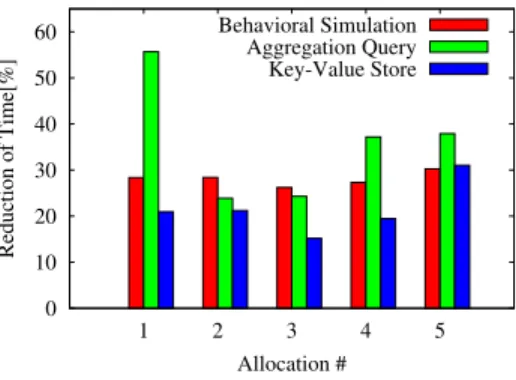
Overall Effectiveness. We show the overall percentage of im-provement over 5 different allocations in EC2 in Figure 10. The behavioral simulation and key-value store workloads use 100 ap-plication nodes, whereas the aggregation query workload uses 50 nodes due to the scalability limits of the LPNDP solver. For the simulation workload, we report the reduction in time-to-solution. For the aggregation query and key-value store workloads, we report the reduction in response time. Each of these is averaged based on an at least 10 minutes of observation for both. We compare the per-formance of ClouDiA optimized deployment to the default deploy-ment. ClouDiA achieves 15% to 55% reduction in time-to-solution or response time over 5 allocations for 3 workloads. The reduction
0 10 20 30 40 50 60 1 2 3 4 5 Reduction of Time[%] Allocation # Behavioral Simulation Aggregation Query Key-Value Store
Figure 10: Overall Improvement in EC2
0 100 200 300 400 500 600 0 10 20 30 40 50 Time-to-solution[s] Over-Allocation Ratio[%] Default ClouDiA
Figure 11: Effect of Over-Allocation in EC2: Behavioral Simula-tion
ratio varies for different allocations. Among three workloads, we observe the largest reduction ratio on average in the aggregation query workload, while the key-value store workload gets less im-provement than the others. There are two reasons for this effect. First, the communication graph of the aggregation query workload has the fewest edges, which increases the probability that the solver can find a high quality deployment. Second, the Longest-Link de-ployment cost function does not exactly match the mean response time measurement of the key-value store workload, and therefore deployment decisions are made less accurately.
Effect of Over-allocation. In Figure 11, we study the benefit of over-allocating instances for increasing the probability of finding a good deployment plan. Note that although ClouDiA terminates extra instances once the deployment plan is determined, these in-stances will still be charged for at least one hour usage due to the round-up pricing model used by major cloud service providers [2, 64, 48]. Therefore, a trade-off must be made between performance and initial allocation cost. In this experiment, we use an applica-tion workload similar to Figure 10, but with 150 EC2 instances allocated at once by a singleec2-run-instance command. To study the case with over-allocation ratiox, we use the first(1+x)·100 instances out of the 150 instances by the EC2 default ordering. Fig-ure 11 shows the improvement in time-to-solution for the simula-tion workload. The default deployment always uses the first 100 instances, whereas ClouDiA searches deployment plans with the 100xextra instances. We report 38% performance improvement with 50% extra instances over-allocated. Without any over allo-cation, 16% improvement is already achieved by finding a good injection of application nodes to instances. Interestingly, with only 10% instance over-allocation, 28% improvement is achieved. Sim-ilar observations are found on other allocations as well.
7.
RELATED WORK
Subgraph Isomorphism. Thesubgraph isomorphism problemis known to be NP-Complete [26]. There is an extensive literature about algorithms for special cases of the subgraph isomorphism problem, e.g., for graphs of bounded genus [40], grids [41], or pla-nar graphs [22]. Algorithms based on searching and pruning [17, 18, 57] as well as constraint programming [37, 68] have been used to solve the general case of the problem. In our Node Deployment Problem, a mapping from application nodes to instances needs to be determined as in the subgraph isomorphism problem, but in ad-dition the mapping must minimize the deployment cost.
Overlay Placement.Another way to look at the Node Deployment Problem is to find a good overlay within the allocated instances. The networking community has invested significant effort in in-telligently placing intermediate overlay nodes to optimize Internet
routing reliability and TCP performance [29, 54]. This community has also investigated node deployment in other contexts, such as proxy placement [39] and web server/cache placement [35, 47]. In the database community, there have been studies in extensible defi-nition of dissemination overlays [45], as well as operator placement for stream-processing systems [46]. In contrast to all of these previ-ous approaches, ClouDiA focuses on optimizing the direct end-to-end network performance without changing routing infrastructure in a datacenter setting.
Virtual Network Embedding. Both the virtual network embed-ding problem [14, 16, 24, 65] and the testbed mapping problem [53] map nodes and links in a virtual network to a substrate network tak-ing into account various resource constraints, includtak-ing CPU, net-work bandwidth, and permissible delays. Traditional techniques used in solving these problems cannot be applied to our public cloud scenario simply because treating the entire datacenter as a substrate network would exceed the instance sizes they can handle. Recent work provides more scalable solutions for resource alloca-tion at the datacenter scale by greedily exploiting server locality [8, 28]. However, this work does not take network latency into consid-eration. CloudDiA focuses on latency-sensitive applications and examines a different angle: We argue network heterogeneity is un-avoidable in public clouds and therefore optimize the deployment as a cloud tenant rather than the infrastructure provider. Such role changing enables us to frame the problem as an application tuning problem and better capture optimization goals relevant to latency-sensitive applications. Also, we only need to consider instances al-located by a given tenant, which is a substantially smaller set than the entire data center. Of course, nothing precludes the methodol-ogy provided by ClouDiA being incorporated by the cloud provider upon allocation for a given tenant, as long as the provider can ob-tain latency-sensitivity information from the application.
Auto-tuning in the Cloud. In the database community, there is a long tradition of auto-tuning approaches, with AutoAdmin [13] and COMFORT [61] as some of its seminal projects. Recently, more attention has focused on auto-tuning in the cloud setting. Babu investigates how to tune the parameters of MapReduce programs automatically [6], while Jahani et al. automatically analyze and optimize MapReduce programs with data-aware techniques [32]. Lee et al. optimizes resource allocation for data-intensive applica-tions using a prediction engine [38]. Conductor [63] assists public cloud tenants in finding the right set of resources to save cost. Both of the above two approaches are similar in spirit to ClouDiA. How-ever, they focus on Map-reduce style computation with high band-width consumption. Our work differs in that we focus on latency-sensitive applications in the cloud, and develop appropriate auto-tuning techniques for this different setting.
Cloud Orchestration.AWS CloudFormation [4] allows tenants to provision and manage various cloud resources together using tem-plates. However, interconnection performance requirements can-not be specified. AWS also supports cluster placement groups and guarantees low network latency between instances within the same placement group. Only costly instance types are supported and the number of instances that can be allocated to the same placement group is restricted. HP Intelligent Management Center Virtual Ap-plication Network Manager [30] orchestrates virtual machine net-work connectivity to ease application deployment. Although it al-lows tenants to specify an ‘information rate’ for each instance, there is no guarantee on pairwise network performance characteristics, especially network latency. Wrasse [49] provides a generic tool for cloud service providers to solve allocation problems. It does not take network latency into account.
Topology-Aware Distributed Systems. Many recent large-scale distributed systems built for data centers are aware of network topology. Cassandra [36] and Hadoop DFS [12] both provide poli-cies to prevent rack-correlated failure by spreading replicas across racks. DyradLINQ [66] runs rack-level partial aggregation to re-duce cross-rack network traffic. Purlieus [44] explores data lo-cality for MapReduce tasks also to save cross-rack bandwidth. Quincy [31] studies the problem of scheduling with not only local-ity but also fairness under a fine-grained resource sharing model. The optimizations in these previous approaches are both rack- and application-specific. By contrast, ClouDiA takes into account ar-bitrary levels of difference in mean latency between instances. In addition, ClouDiA is both more generic and more transparent to applications.
Network Performance in Public Clouds. Public clouds have been demonstrated to suffer from latency jitter by several exper-imental studies [55, 59]. Our previous work has proposed a gen-eral framework to make scientific applications jitter-tolerant in a cloud environment [69], allowing applications to tolerate latency spikes. However, this work does little to deal with stable differ-ences in mean latency. Zaharia et al. observed network bandwidth heterogeneity due to instance colocation in public clouds and has designed a speculative scheduling algorithm to improve response time of MapReduce tasks [67]. Farley et al. also exploit such net-work bandwidth as well as other types of heterogeneity in public clouds to improve performance [25]. To the best of our knowledge, ClouDiA is the first work that experimentally observes network la-tencyheterogeneity in public clouds and optimizes application per-formance by solving the Node Deployment Problem.
8.
CONCLUSIONS
We have shown how ClouDiA makes intelligent deployment de-cisions for latency-sensitive applications under heterogeneous la-tencies, which naturally occur in public clouds. We formulated the deployment of applications into public clouds as optimization problems and proposed techniques to speed up the search for high-quality deployment plans. We also presented how to efficiently ob-tain latency measurements without interference. Finally, we evalu-ated ClouDiA in Amazon EC2 with realistic workloads. ClouDiA is able to reduce the time-to-solution or response time of latency-sensitive applications by 15% to 55%, without any changes to ap-plication code.
As future work, we plan to extend our formulation to support weighted communication graphs. Another direction of practical importance is quantifying over-allocation cost and analyzing its im-pact on total cost-to-solution for scientific applications. Finally, we will investigate the deployment problem under other criteria, such as bandwidth, as well as other deployment cost functions.
Acknowledgments. The third author took inspiration for the title from the name of an early mentor, Claudia Bauzer Medeiros, to whom he is thankful for introducing him to database research dur-ing his undergraduate studies. We thank the anonymous PVLDB reviewers for their insightful comments which helped us to improve this paper. This research has been supported by the NSF under Grants CNS-1012593, IIS-0911036, by an AWS Grant from Ama-zon, the AFOSR under Award FA9550-10-1-0202 and by the iAd Project funded by the Research Council of Norway. Any opinions, findings, conclusions or recommendations expressed in this paper are those of the authors and do not necessarily reflect the views of the sponsors.
9.
REFERENCES
[1] R. D. Alpert and J. F. Philbin. cBSP: Zero-cost
synchronization in a modified BSP model. Technical report, NEC Research Institute, 1997.
[2] Amazon web services, elastic compute cloud (ec2). http://aws.amazon.com/ec2/.
[3] Amazon web services, case studies.
http://aws.amazon.com/solutions/case-studies/. [4] Amazon web services, cloudformation.
http://aws.amazon.com/cloudformation/.
[5] Amazon web services, search engines & web crawlers. http://aws.amazon.com/search-engines/.
[6] S. Babu. Towards automatic optimization of mapreduce programs. InSOCC, 2010.
[7] C. S. Badue, R. A. Baeza-Yates, B. A. Ribeiro-Neto, and N. Ziviani. Distributed query processing using partitioned inverted files. InSPIRE, pages 10–20, 2001.
[8] H. Ballani, P. Costa, T. Karagiannis, and A. I. T. Rowstron. Towards predictable datacenter networks. InSIGCOMM, 2011.
[9] D. Battré, N. Frejnik, S. Goel, O. Kao, and D. Warneke. Evaluation of network topology inference in opaque compute clouds through end-to-end measurements. InIEEE CLOUD, 2011.
[10] T. Benson, A. Akella, and D. A. Maltz. Network traffic characteristics of data centers in the wild. InInternet Measurement Conference, 2010.
[11] O. Bonorden, B. Juurlink, I. von Otte, and I. Rieping. The paderborn university BSP (PUB) library.Parallel Computing, 29(2):187–207, 2003.
[12] D. Borthakur. The hadoop distributed file system: Architecture and design.
http://hadoop.apache.org/core/docs/current/hdfs design.pdf. [13] S. Chaudhuri and V. Narasayya. An efficient, cost-driven
index selection tool for microsoft SQL server. InVLDB, 1997.
[14] X. Cheng, S. Su, Z. Zhang, H. Wang, F. Yang, Y. Luo, and J. Wang. Virtual network embedding through topology-aware node ranking.SIGCOMM CCR, 41(2):38–47, 2011.
[15] M. Chowdhury, M. Zaharia, J. Ma, M. I. Jordan, and I. Stoica. Managing data transfers in computer clusters with orchestra. InSIGCOMM, 2011.
[16] N. M. M. K. Chowdhury, M. R. Rahman, and R. Boutaba. Virtual Network Embedding with Coordinated Node and Link Mapping. InINFOCOM, 2009.
[17] L. P. Cordella, P. Foggia, C. Sansone, and M. Vento. Performance evaluation of the VF graph matching algorithm. InInternational Conference on Image Analysis and
Processing, 1999.
[18] L. P. Cordella, P. Foggia, C. Sansone, and M. Vento. A (sub)graph isomorphism algorithm for matching large graphs.IEEE Transactions on PAMI, 26:1367–1372, 2004. [19] I. Couzin, J. Krause, N. Franks, and S. Levin. Effective
leadership and decision-making in animal groups on the move.Nature, 433(7025):513–516, 2005.
[20] G. DeCandia, D. Hastorun, M. Jampani, G. Kakulapati, A. Lakshman, A. Pilchin, S. Sivasubramanian, P. Vosshall, and W. Vogels. Dynamo: Amazon’s highly available key-value store. InSOSP, 2007.
[21] J. Demmel, M. Hoemmen, M. Mohiyuddin, and K. A. Yelick. Avoiding communication in sparse matrix computations. InIPDPS, 2008.
[22] D. Eppstein. Subgraph isomorphism in planar graphs and related problems. InSODA, 1995.
[23] C. Evangelinos and C. N. Hill. Cloud computing for parallel scientific HPC applications. InCloud Computing and Its Applications, 2008.
[24] I. Fajjari, N. Aitsaadi, G. Pujolle, and H. Zimmermann. VNE-AC: Virtual network embedding algorithm based on ant colony metaheuristic. InIEEE International Conference on Communications, 2011.
[25] B. Farley, V. Varadarajan, K. Bowers, A. Juels, T. Ristenpart, and M. Swift. More for your money: Exploiting performance heterogeneity in public clouds. InSOCC, 2012.
[26] M. R. Garey and D. S. Johnson.Computers and intractability. Freeman, 1979.
[27] R. Geambasu, S. D. Gribble, and H. M. Levy. Cloudviews: Communal data sharing in public clouds. InHotCloud, 2009. [28] C. Guo, G. Lu, H. J. Wang, S. Yang, C. Kong, P. Sun, W. Wu,
and Y. Zhang. Secondnet: a data center network virtualization architecture with bandwidth guarantees. In CoNEXT, 2010.
[29] J. Han, D. Watson, and F. Jahanian. Topology aware overlay networks. InINFOCOM. IEEE, 2005.
[30] HP intelligent management center virtual application network manager.
http://h17007.www1.hp.com/us/en/products/network-management/IMC_VANM_Software/index.aspx. [31] M. Isard, V. Prabhakaran, J. Currey, U. Wieder, K. Talwar,
and A. Goldberg. Quincy: fair scheduling for distributed computing clusters. InSOSP, 2009.
[32] E. Jahani, M. J. Cafarella, and C. Ré. Automatic optimization for mapreduce programs.PVLDB, 2011. [33] G. Juve, E. Deelman, K. Vahi, G. Mehta, B. Berriman, B. P.
Berman, and P. Maechling. Scientific workflow applications on amazon EC2. InIEEE International Conference on e-Science., 2009.
[34] J.-S. Kim, S. Ha, and C. S. Jhon. Efficient barrier synchronization mechanism for the BSP model on message-passing architectures. InIPPS/SPDP, 1998. [35] P. Krishnan, D. Raz, and Y. Shavitt. The cache location
problem.IEEE/ACM Transactions on Networking, 8(5):568–582, 2000.
[36] A. Lakshman and P. Malik. Cassandra: a decentralized structured storage system.SIGOPS OSR, 44(2):35–40, 2010. [37] J. Larrosa and G. Valiente. Constraint satisfaction algorithms
for graph pattern matching.Mathematical. Structures in Comp. Sci., 12(4):403–422, Aug. 2002.
[38] G. Lee, N. Tolia, P. Ranganathan, and R. H. Katz. Topology-aware resource allocation for data-intensive workloads.SIGCOMM CCR, 2011.
[39] B. Li, M. J. Golin, G. F. Italiano, X. Deng, and K. Sohraby. On the optimal placement of web proxies in the internet. In INFOCOM, 1999.
[40] G. L. Miller. Isomorphism testing for graphs of bounded genus. InSTOC, 1980.
[41] Z. Miller and J. B. Orlin. Np-completeness for minimizing maximum edge length in grid embeddings.J. Algorithms, pages 10–16, 1985.
[42] R. N. Mysore, A. Pamboris, N. Farrington, N. Huang, P. Miri, S. Radhakrishnan, V. Subramanya, and A. Vahdat. Portland: a scalable fault-tolerant layer 2 data center network fabric. InSIGCOMM, 2009.
[43] C. O’Hanlon. A conversation with werner vogels.ACM Queue, 4(4):14–22, May 2006.
[44] B. Palanisamy, A. Singh, L. Liu, and B. Jain. Purlieus:
locality-aware resource allocation for mapreduce in a cloud. InSC, 2011.
[45] O. Papaemmanouil, Y. Ahmad, U. Çetintemel, J. Jannotti, and Y. Yildirim. Extensible optimization in overlay dissemination trees. InSIGMOD, 2006.
[46] P. R. Pietzuch, J. Ledlie, J. Shneidman, M. Roussopoulos, M. Welsh, and M. I. Seltzer. Network-aware operator placement for stream-processing systems. InICDE, 2006. [47] L. Qiu, V. N. Padmanabhan, and G. M. Voelker. On the
placement of web server replicas. InINFOCOM, 2001. [48] Rackspace. http://www.rackspace.com/.
[49] A. Rai, R. Bhagwan, and S. Guha. Generalized resource allocation for the cloud. InSOCC, 2012.
[50] L. Ramakrishnan, K. R. Jackson, S. Canon, S. Cholia, and J. Shalf. Defining future platform requirements for e-Science clouds. InSOCC, 2010.
[51] R. Ramakrishnan. Data serving in the cloud. InLADIS, 2010. [52] V. Ramasubramanian, D. Malkhi, F. Kuhn, M. Balakrishnan,
A. Gupta, and A. Akella. On the treeness of internet latency and bandwidth. InSIGMETRICS, 2009.
[53] R. Ricci, C. Alfeld, and J. Lepreau. A solver for the network testbed mapping problem.SIGCOMM CCR, 33(2):65–81, 2003.
[54] S. Roy, H. Pucha, Z. Zhang, Y. C. Hu, and L. Qiu. Overlay node placement: Analysis, algorithms and impact on applications. InICDCS, 2007.
[55] J. Schad, J. Dittrich, and J.-A. Quiané-Ruiz. Runtime measurements in the cloud: Observing, analyzing, and reducing variance.PVLDB, 3(1), 2010.
[56] Y. J. Song, M. K. Aguilera, R. Kotla, and D. Malkhi. RPC chains: Efficient client-server communication in
geodistributed systems. InNSDI, 2009.
[57] J. R. Ullmann. An algorithm for subgraph isomorphism. Journal of the ACM, 23, 1976.
[58] W. Vogels. Data access patterns in the amazon.com technology platform. InVLDB, page 1, 2007.
[59] G. Wang and T. S. E. Ng. The impact of virtualization on network performance of Amazon EC2 data center. In INFOCOM, 2010.
[60] G. Wang, M. A. V. Salles, B. Sowell, X. Wang, T. Cao, A. J. Demers, J. Gehrke, and W. M. White. Behavioral simulations in mapreduce.PVLDB, 2010.
[61] G. Weikum, C. Hasse, A. Moenkeberg, and P. Zabback. The COMFORT automatic tuning project, invited project review. Inf. Syst., 19(5), 1994.
[62] Y. Wen.Scalability of Dynamic Traffic Assignment. PhD thesis, Massachusetts Institute of Technology, 2008. [63] A. Wieder, P. Bhatotia, A. Post, and R. Rodrigues.
Orchestrating the deployment of computations in the cloud with conductor. InNSDI, 2012.
[64] Windows azure. http://www.windowsazure.com/.
[65] M. Yu, Y. Yi, J. Rexford, and M. Chiang. Rethinking virtual network embedding: substrate support for path splitting and migration.SIGCOMM CCR, 38(2):17–29, 2008.
[66] Y. Yu, M. Isard, D. Fetterly, M. Budiu, Ú. Erlingsson, P. K. Gunda, and J. Currey. DryadLINQ: A system for
general-purpose distributed data-parallel computing using a high-level language. InOSDI, 2008.
[67] M. Zaharia, A. Konwinski, A. D. Joseph, R. H. Katz, and I. Stoica. Improving mapreduce performance in
heterogeneous environments. InOSDI, 2008.
[68] S. Zampelli, Y. Deville, and C. Solnon. Solving subgraph isomorphism problems with constraint programming. Constraints, 15(3):327–353, 2010.
[69] T. Zou, G. Wang, M. V. Salles, D. Bindel, A. Demers, J. Gehrke, and W. White. Making time-stepped applications tick in the cloud. InSOCC, 2011.
![Figure 12: Latency order by IP distance 0 0.4 0.8 1.2 1.6 1 10 100 1000 10000Mean Latency[ms]](https://thumb-us.123doks.com/thumbv2/123dok_us/8747517.2372076/12.918.480.822.89.223/figure-latency-order-ip-distance-mean-latency-ms.webp)
