3.2 Units of Measurement >
3.2 Units of Measurement >
Chapter 3
Scientific Measurement
3.1 Using and Expressing Measurements
3.2 Units of Measurement
3.2 Units of Measurement >
3.2 Units of Measurement >
Will the high
temperature tomorrow be 28°C, which is very warm? Or 28°F, which is very cold? Without the correct units, you can’t be sure.
CHEMISTRY & YOU
CHEMISTRY & YOU
What’s the forecast for tomorrow—hot
3.2 Units of Measurement >
3.2 Units of Measurement >
Using SI Units
What makes metric units easy to use?
3.2 Units of Measurement >
3.2 Units of Measurement >
• The standards of measurement used in science are those of the metric system.
All metric units are based on multiples of 10. As a result, you can convert
between units easily.
3.2 Units of Measurement >
3.2 Units of Measurement >
• The metric system was originally established in France in 1795.
• The International System of Units
(abbreviated SI after the French name, Le Système International d’Unités) is a
revised version of the metric system.
• The SI was adopted by international agreement in 1960.
3.2 Units of Measurement >
3.2 Units of Measurement > Using SI UnitsUsing SI Units
• There are seven SI base units.
• From these base units, all other SI units of
measurement can be derived.
• Derived units are used for measurements
such as volume,
density, and pressure.
SI Base Units
Quantity SI base unit
Symbol
Length meter m
Mass kilogram kg Temperature kelvin K
Time second s
Amount of
substance mole mol Luminous
intensity candela cd Electric
3.2 Units of Measurement >
3.2 Units of Measurement >
• In SI, the basic unit of length, or linear measure, is the meter (m).
• All measurements of length can be expressed in meters.
• For very large and very small lengths,
however, it may be more convenient to use a unit of length that has a prefix.
Units of Length
3.2 Units of Measurement >
3.2 Units of Measurement > Using SI UnitsUsing SI Units
The table below lists the prefixes in common use.
Units of Length
Commonly Used Metric Prefixes
Prefix Symbol Meaning Factor mega M 1 million times larger than the unit it precedes 106
kilo k 1000 times larger than the unit it precedes 103
deci d 10 times smaller than the unit it precedes 10-1
centi c 100 times smaller than the unit it precedes 10-2
milli m 1000 times smaller than the unit it precedes 10-3
micro μ 1 million times smaller than the unit it precedes 10-6
3.2 Units of Measurement >
3.2 Units of Measurement >
• For example, the prefix milli- means 1/1000 (one-thousandth), so a millimeter (mm) is 1/1000 of a meter, or 0.001 m.
• A hyphen (-) measures about 1 mm.
• For large distances, it is most appropriate to express measurements in kilometers (km).
• The prefix kilo- means 1000, so 1 km equals 1000 m.
Units of Length
3.2 Units of Measurement >
3.2 Units of Measurement >
• The space occupied by any sample of matter is called its volume.
• You calculate the volume of any cubic or rectangular solid by multiplying its length by its width by its height.
• The unit for volume is thus derived from the units of length.
Units of Volume
3.2 Units of Measurement >
3.2 Units of Measurement >
• The SI unit of volume is the amount of space occupied by a cube that is 1 m along each edge.
• This volume is a cubic meter (m3).
• A more convenient unit of volume for everyday use is the liter, a non-SI unit.
• A liter (L) is the volume of a cube that is 10 centimeters (10 cm) along each edge (10 cm x 10 cm x 10 cm = 1000 cm3 = 1 L).
Units of Volume
3.2 Units of Measurement >
3.2 Units of Measurement >
• A smaller, non-SI unit of volume is the milliliter (mL); 1 mL is 1/1000 of a liter.
• Thus, there are 1000 mL in 1 L.
• Because 1 L is defined as 1000 cm3, 1 mL
and 1 cm3 are the same volume.
• The units milliliter and cubic centimeter are thus used interchangeably.
Units of Volume
3.2 Units of Measurement >
3.2 Units of Measurement >
These figures give you some idea of the relative sizes of a liter and a
milliliter.
Units of Volume
Using SI Units Using SI Units
1 mL
3.2 Units of Measurement >
3.2 Units of Measurement >
• There are many devices for measuring liquid volumes, including graduated cylinders,
pipets, burets, volumetric flasks, and syringes.
• The volume of substances will change with temperature, so accurate volume-measuring devices are calibrated at a given temperature —usually 20 degrees Celsius (20°C), which is about normal room temperature.
Units of Volume
3.2 Units of Measurement >
3.2 Units of Measurement > Using SI UnitsUsing SI Units
The relationships among common metric units of volume are shown in the table below.
Units of Volume
Metric Units of Volume
Unit Symbol Relationship Example
Liter L base unit quart of milk ≈ 1 L
Milliliter mL 103 mL = 1 L 20 drops of water ≈ 1 mL
Cubic centimeter cm3 1 cm3 = 1 mL cube of sugar ≈ 1 cm3
3.2 Units of Measurement >
3.2 Units of Measurement >
• The mass of an object is measured in comparison to a standard mass of 1 kilogram (kg), which is the
basic SI unit of mass.
• A kilogram was originally defined as the mass of 1 L of liquid water at 4°C.
• A cube of water at 4°C measuring 10 cm on each edge would have a volume of 1 L and a mass of 1000 grams (g), or 1 kg.
• A gram (g) is 1/1000 of a kilogram; the mass of 1 cm3 of water at 4°C is 1 g.
Units of Mass
3.2 Units of Measurement >
3.2 Units of Measurement > Using SI UnitsUsing SI Units
The relationships among units of mass are shown in the table below.
Units of Mass
Metric Units of Mass
Unit Symbol Relationship Example Kilogram
(base unit) kg 1 kg = 103 g small textbook ≈ 1 kg Gram g 1 g = 10-3 kg dollar bill ≈ 1 g
Milligram mg 103 mg = 1 g ten grains of salt ≈ 1 mg
3.2 Units of Measurement >
3.2 Units of Measurement >
• Weight is a force that measures the pull on a given mass by gravity.
• Weight, a measure of force, is different from mass, which is a measure of the quantity of matter.
• The weight of an object can change with its location.
• An astronaut in orbit is weightless, but not massless.
Units of Mass
3.2 Units of Measurement >
3.2 Units of Measurement >
• The capacity to do work or to produce heat is called energy.
• The SI unit of energy is the joule (J), named after the English physicist James Prescott Joule (1818–1889).
• A common non-SI unit of energy is the calorie. • One calorie (cal) is the quantity of heat that
raises the temperature of 1 g of pure water by 1°C.
Units of Energy
3.2 Units of Measurement >
3.2 Units of Measurement >
• Conversions between joules and calories can be carried out using the following
relationships.
• 1 J = 0.2390 cal
• 1 cal = 4.184 J
• A kilojoule is 1000 joules; a kilocalorie is 1000 calories.
Units of Energy
3.2 Units of Measurement >
3.2 Units of Measurement >
3.2 Units of Measurement >
3.2 Units of Measurement >
What is the SI unit of volume?
The SI unit of volume is the cubic meter (m3). A
liter (L) can be converted to the SI unit of
3.2 Units of Measurement >
3.2 Units of Measurement >
Temperature Scales
What temperature units do scientists commonly use?
3.2 Units of Measurement >
3.2 Units of Measurement >
• Temperature is a measure of how hot or cold an object is.
• An object’s temperature determines the direction of heat transfer.
• When two objects at different
temperatures are in contact, heat moves from the object at the higher
temperature to the object at the lower temperature.
3.2 Units of Measurement >
3.2 Units of Measurement >
• Almost all substances expand with an increase in temperature and contract as the temperature decreases.
• A very important exception is water.
• These properties are the basis for the common bulb thermometer.
3.2 Units of Measurement >
3.2 Units of Measurement >
The liquid in a thermometer expands and
contracts more than the volume of the glass, producing changes in the column height of liquid.
3.2 Units of Measurement >
3.2 Units of Measurement >
Scientists commonly use two equivalent units of temperature, the degree Celsius and the kelvin.
3.2 Units of Measurement >
3.2 Units of Measurement >
• The Celsius scale sets the freezing point of water at 0°C and the boiling point of water at 100°C.
• The distance between these two fixed
points is divided into 100 equal intervals, or degrees Celsius (°C).
3.2 Units of Measurement >
3.2 Units of Measurement >
• Another temperature scale used in the
physical sciences is the Kelvin, or absolute, scale.
• This scale is named for Lord Kelvin (1824– 1907), a Scottish physicist.
• On the Kelvin scale, the freezing point of water is 273.15 kelvins (K), and the boiling point is 373.15 (K).
• Note that with the Kelvin scale, the degree sign is not used.
3.2 Units of Measurement >
3.2 Units of Measurement >
• The figure below compares the Celsius and Kelvin scales.
• The zero point on the Kelvin scale, 0 K, or absolute zero, is equal to –273.15°C.
3.2 Units of Measurement >
3.2 Units of Measurement >
• Because one degree on the Celsius scale is equivalent to one kelvin on the Kelvin scale, converting from one temperature to another is easy.
• You simply add or subtract 273, as shown in the following equations.
Temperature Scales Temperature Scales
3.2 Units of Measurement >
3.2 Units of Measurement >
In a few countries, such as the United States, metric units are not commonly used in everyday measurements. What temperature units are used for a typical weather forecast in the United States? What about for a country that uses the metric system, such as Australia or
Japan?
CHEMISTRY & YOU
3.2 Units of Measurement >
3.2 Units of Measurement >
In a few countries, such as the United States, metric units are not commonly used in everyday measurements. What temperature units are used for a typical weather forecast in the United States? What about for a country that uses the metric system, such as Australia or
Japan?
CHEMISTRY & YOU
CHEMISTRY & YOU
3.2 Units of Measurement >
3.2 Units of Measurement > SampleSample Problem 3.7Problem 3.7
Converting Between Temperature Scales
3.2 Units of Measurement >
3.2 Units of Measurement > SampleSample Problem 3.7Problem 3.7
Analyze List the known and the unknown.
Use the known value and the equation K = °C + 273 to calculate the temperature in kelvins.
KNOWN
Temperature in °C = 37°C
UNKNOWN
Temperature in K = ? K
3.2 Units of Measurement >
3.2 Units of Measurement > SampleSample Problem 3.7Problem 3.7
Calculate Solve for the unknown.
Substitute the known value for the Celsius temperature into the equation and solve.
K = °C + 273 = 37 + 273 = 310 K
3.2 Units of Measurement >
3.2 Units of Measurement > SampleSample Problem 3.7Problem 3.7
Evaluate Does the result make sense?
You should expect a temperature in this range, since the freezing point of water is 273 K and the boiling point of water is 373 K; normal body temperature is between these two values.
3.2 Units of Measurement >
3.2 Units of Measurement >
3.2 Units of Measurement >
3.2 Units of Measurement >
Is the change of one degree on the Celsius scale equivalent to one kelvin on the Kelvin scale?
Yes, a change of one degree on the Celsius
3.2 Units of Measurement >
3.2 Units of Measurement >
Density
What determines the density of a substance?
3.2 Units of Measurement >
3.2 Units of Measurement >
• The relationship between an object’s mass and its volume tells you whether it will float or sink.
• This relationship is called density. • Density is the ratio of the mass of an
object to its volume.
Density Density
3.2 Units of Measurement >
3.2 Units of Measurement >
• When mass is measured in grams, and volume in cubic centimeters, density has units of grams per cubic centimeter
(g/cm3).
• The SI unit of density is kilograms per cubic meter (kg/m3).
3.2 Units of Measurement >
3.2 Units of Measurement >
This figure compares the density of four
substances: lithium, water, aluminum, and lead.
Density Density
Increasing density (mass per unit volume)
10 g
0.53 g/cm3
19 cm3
10 g 10 cm3
10 g 3.7 cm3
10 g 0.88 cm3
3.2 Units of Measurement >
3.2 Units of Measurement >
Density is an intensive property that depends only on the composition of a substance, not the size of the sample.
3.2 Units of Measurement >
3.2 Units of Measurement >
• Because of differences in
density, liquids separate into layers.
• As shown at right, corn oil floats on top of water
because it is less dense. • Corn syrup sinks below
water because it is more dense.
Density Density
Corn oil Water
3.2 Units of Measurement >
3.2 Units of Measurement > InterpretInterpret DataData
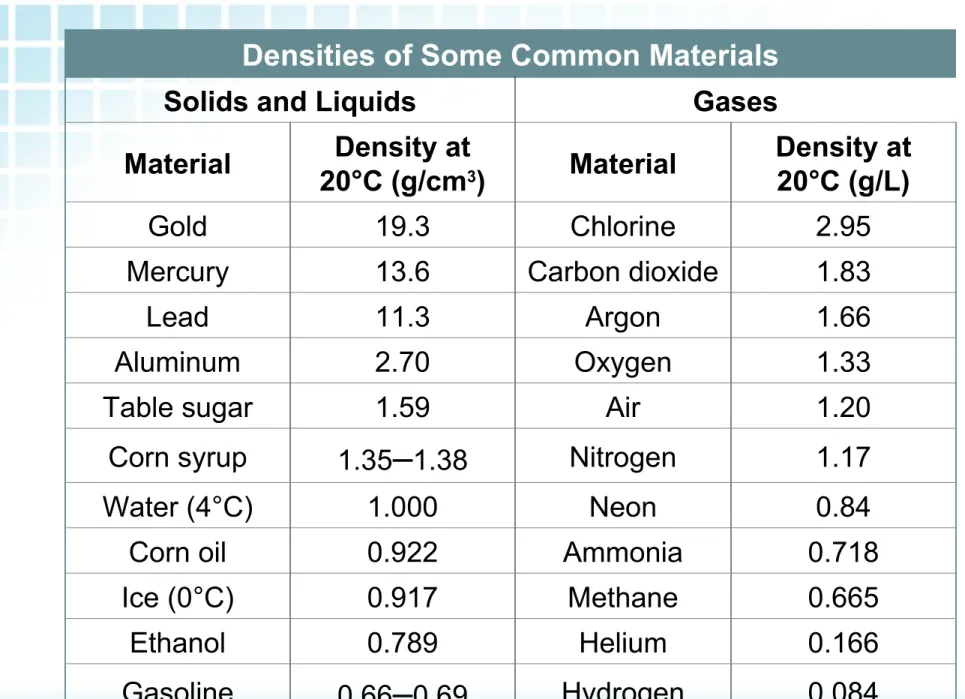
Densities of Some Common Materials
Solids and Liquids Gases
Material Density at
20°C (g/cm3) Material
Density at 20°C (g/L) Gold 19.3 Chlorine 2.95 Mercury 13.6 Carbon dioxide 1.83
Lead 11.3 Argon 1.66
3.2 Units of Measurement >
3.2 Units of Measurement >
What happens to the density of a substance as its temperature increases?
• The volume of most substances increases as the temperature increases, while the mass remains the same.
• Since density is the ratio of an object’s mass to its volume, the density of a substance generally
decreases as its temperature increases.
3.2 Units of Measurement >
3.2 Units of Measurement > SampleSample Problem 3.8Problem 3.8
Calculating Density
A copper penny has a mass of 3.1 g and a volume of 0.35 cm3. What is
3.2 Units of Measurement >
3.2 Units of Measurement > SampleSample Problem 3.8Problem 3.8
Analyze List the knowns and the unknown.
Use the known values and the equation for density to solve the problem.
KNOWNS
mass = 3.1 g
volume = 0.35 cm3
UKNOWN
3.2 Units of Measurement >
3.2 Units of Measurement > SampleSample Problem 3.8Problem 3.8
Density = mass volume
Calculate Solve for the unknown.
Start with the equation for density.
3.2 Units of Measurement >
3.2 Units of Measurement >
Calculate Solve for the unknown.
Substitute the known values for mass and volume and then calculate.
Sample Problem 3.8
Sample Problem 3.8
2
Density = 31 g
0.35 cm3 = 8.8571 g/cm
3 = 8.9 g/cm3
3.2 Units of Measurement >
3.2 Units of Measurement > SampleSample Problem 3.8Problem 3.8
Evaluate Does the result make sense?
A piece of copper with a volume of about 0.3 cm3 has a mass of about 3 grams. About three
times that volume of copper, 1 cm3, should have
a mass three times larger, about 9 grams. This estimate is close to the calculated result.
3.2 Units of Measurement >
3.2 Units of Measurement >
3.2 Units of Measurement >
3.2 Units of Measurement >
Can you assume that something with a low weight will float in water?
3.2 Units of Measurement >
3.2 Units of Measurement >
All metric units are based on multiples of 10. As a result, you can convert between units easily.
Scientists commonly use two equivalent units of temperature, the degree Celsius and the kelvin.
Density is an intensive property that depends only on the composition of a substance.
3.2 Units of Measurement >
3.2 Units of Measurement >
K = °C + 273
°C = K – 273
Key Equations Key Equations
3.2 Units of Measurement >
3.2 Units of Measurement >
• International System of Units (SI): the revised version of
the metric system, adopted by international agreement in 1960
• meter (m): the base unit of length in SI
• liter (L): the volume of a cube measuring 10 centimeters
on each edge (1000 cm3); it is the common unprefixed unit
of volume in the metric system
• kilogram (kg): the mass of 1 L of water at 4°C; it is the
base unit of mass in SI
• gram (g): a metric mass unit equal to the mass of 1 cm3 of
3.2 Units of Measurement >
3.2 Units of Measurement >
• weight: a force that measures the pull of gravity on a given mass
• energy: the capacity for doing work or producing heat
• Joule (J): the SI unit of energy; 4.184 J equals one calorie
• calorie (cal): the quantity of heat needed to raise the temperature of 1 g of pure water 1°C
• temperature: a measure of the average kinetic energy of particles in matter; temperature determines the direction
3.2 Units of Measurement >
3.2 Units of Measurement >
• Celsius scale: the temperature scale in which the freezing point of water is 0°C and the boiling point is 100°C
• Kelvin scale: the temperature scale in which the freezing point of water is 273 K and the boiling point is 373 K; 0 K is absolute zero
• absolute zero: the zero point on the Kelvin temperature scale, equivalent to –273.15°C
•
3.2 Units of Measurement >
3.2 Units of Measurement >