
Knowledge
Management
in Policing
Enforcing Law on Criminal Business Enterprises
Enforcing Law on Criminal Business
Enterprises
Petter Gottschalk
Hindawi Publishing Corporation
410 Park Avenue, 15th Floor, #287 pmb, New York, NY 10022, USA Nasr City Free Zone, Cairo 11816, Egypt
Fax: +1-866-HINDAWI (USA Toll-Free)
© 2008 Hindawi Publishing Corporation
All rights reserved. No part of the material protected by this copyright notice may be reproduced or utilized in any form or by any means, electronic or mechanical, includ-ing photocopyinclud-ing, recordinclud-ing, or any information storage and retrieval system, without written permission from the publisher.
Foreword vii
Introduction ix
1. Criminal Business Enterprises 1
1.1. Organized Crime and Criminal Organizations 2
1.2. Criminal Enterprise Paradigm 5
1.3. The Business of Crime 11
1.4. Criminal Entrepreneurship 14
1.5. Growing the Crime Business 17
1.6. The Case of Hawala Bankers Transferring Criminal Proceeds 21
2. Theories of Criminal Enterprises 23
2.1. Criminology Theories of Organized Crime 23
2.2. Management Theories of Organized Crime 27
2.3. Organized Crime in the US 35
3. Knowledge Management in Policing 41
3.1. The Need for Knowledge in Policing 41
3.2. Police Forces as Knowledge Organizations 48
3.3. Organized Crime Investigations 52
3.4. How Police Organizations Work 53
3.5. How Police Investigations Work 55
3.6. Knowledge Management Matrix for Intelligence Policing 58
3.7. Information and Communication Technology 59
3.8. Stages of Knowledge Management Technology 61
3.9. Filtration of Knowledge 68
3.10. The Case of Social Intelligence and Investigation Service 70
3.11. The Case of Criminal Intelligence Service Alberta 72
4. Intelligence Strategy Development 75
4.1. Strategic Planning 76
4.2. Intelligence Strategy 79
vi Knowledge Management in Policing
4.4. The Case of National Strategy for Intelligence and
Analysis in Norway 83
4.5. Is Strategy Always Strategy? 85
5. Intelligence Information Sources 89
5.1. Categories of Information Sources 90
5.2. Information into Knowledge Management Systems 94
5.3. Organized Crime Intelligence Analysis 94
5.4. Market Share Intelligence Analysis 99
5.5. Knowledge Workers in Investigations 107
5.6. How Detectives Work 109
5.7. Detective Thinking Styles 112
5.8. Characteristics of Effective Detectives 115
5.9. The Case of Lawyers as Information Sources 123
6. Enforcing Law on Criminal Business 127
6.1. Administrative Approach to Organized Crime 128
6.2. Investigation Value Shop 129
6.3. Organized Crime Investigation Flow Chart 131
6.4. Law Enforcement Road Map 132
6.5. Senior Investigating Officer 136
6.6. Organized Crime Economics 149
6.7. A Contingent Approach to Policing Organized Crime 150
7. Knowledge Management in Policing MC Crime 161
7.1. The Case of Hells Angels Motorcycle Club 161
7.2. The Case of Criminal Motorcycle Clubs in Norway 166
7.3. Knowledge Matrix in Policing MC Crime 175
7.4. Research Model for Policing MC Crime 181
8. Stage Model for Online Grooming Offenders 183
8.1. Online Victimization of Children 183
8.2. Stages of Growth Models 185
8.3. Online Grooming Offence 186
8.4. Stages of Online Grooming Offenders 189
8.5. Police Investigations 194
8.6. The Need for More Police Intelligence 195
Conclusion 199
This book offers new insights to the understanding of organized crime
based on the enterprise paradigm and the theory of profit-driven crimes. It will be a source of debate and inspiration for those in law enforcement and academia in this area. It makes a contribution to intelligence-led and knowledge-based policing, an emerging area of interest that builds upon and enhances policing as knowledge work, police officers as knowledge
workers, and police forces as knowledge organizations.
This book offers practitioners and academics alike new thinking on
understanding the business operation of organized crime, to better to be able to detect and disrupt organized criminal enterprises. Police all over the world are struggling with the combat against criminal organizations with varying success. The core idea behind this book—implementing intelli-gence strategy for policing criminal business enterprises—should certainly be appealing.
The primary intended audience for this book is academics and the increasing group of specialist law enforcement personnel engaged in tack-ling organized crime. There are a growing number of serious crime ana-lysts who are now employed by forces and agencies. Law enforcement offi
-cers (police, customs, etc.) working in criminal investigative departments (senior investigative officers, analysts, heads of CID) are expected to be
viii Knowledge Management in Policing
But such is the subject matter of the book that the potential mar-ket is much wider than the student marmar-ket and the investigator marmar-ket. For example, among the various types of readers expected for this book, business courses should be explored. Faculty members in business schools responsible for business courses may be looking for new ways of teaching business by presenting the alternative of business of crime. Also, the topic of strategy implementation is important in most business courses.
This book is considered to be a much needed and original overview of the boundary between “legal” and “illegal” entrepreneurship, which makes it a critical challenge for policing criminal business enterprises. The lan-guage and concepts of business and management are applied in discussing the structures and processes of illegal entrepreneurial activities and how law enforcement can respond to this challenge. The book defines organized crime as the main challenge and discusses the role of entrepreneurs in illegal business that is criminal in nature.
We all know names of business enterprises such as IBM, Fiat, Elf, Siemens, Ericsson, Nokia, Sony, Heineken, Ikea, Microsoft, Kia, Nike, and Virgin. These names belong to corporations producing goods and services. We may find the headquarters of IBM in the USA, Fiat in Italy, Elf in France, Siemens in Germany, Ericsson in Sweden, Nokia in Finland, Sony in Japan, Heineken in the Netherlands, and so forth. These are multinational or global business enterprises employing thousands of persons. The case is always that an entrepreneur has started the business a long time ago. In IBM, the first entrepreneur was Herman Hollerith who founded the busi-ness, and the second entrepreneur was Thomas J. Watson who grew the business. Fiat was founded by a group of investors including Giovanni Agnelli. Other famous entrepreneurs include Bill Gates (Microsoft), Ingvar Kamprad (Ikea), and Richard Branson (Virgin).
Similarly, we can identify criminal business enterprises such as Hells Angels, Cosa Nostra, Camorra, Yakuza, Adams Group, Warren Group, Sinaloa Cartel, Tijuana Cartel, Carli Cartel, Medellin Cartel, N’drangheta, Sacra Corona Unita, Verhagen, Favelas, Primeiro Commando da Capi-tal, Aryan Brotherhood, Fuk Ching, Mara Salvatrucha, Bandidos, Coffin
Cheaters, Commando Vermelho, Tarceiro Comando, Asia World Com-pany, Ahmidan Group, Bout Group, Karzai Group, McGraw Group, Heav-enly Alliance, Outlaws, Marcos Group, Afragola, Dalnevostochny, Ural-mashski, Solntsevo, Chechen, Tambov, Podolsk, and Holleeder Group.
Cosa Nostra is a Sicilian confederation of more than one hundred Mafia groups. Hells Angels Motorcycle Club (HAMC) was formed in 1948 in Fontana, Calif, USA. It is not easy to identify an entrepreneur or the chief executive officer (CEO) in criminal organizations, but here are some
examples.
x Knowledge Management in Policing
•Jamal Ahmidanwas doing well in the narcotics trade. He was caught and put in jail, where he converted to Islam. When he was released from prison, he had planned for terror attacks together with other inmates. To finance the intended terrorism, he continued to head the narcotics trade. At the same time he planned the train station explosions in Madrid. With money from drug dealing he bought explosive material, which was used in the subway system in Madrid. Hence, Ahmidan was involved in both criminal business and terrorism [138]. In the morning of March 11, 2004, the terror bombing hit commuter trains destined for Madrid. 191 people were killed and 1460 were injured. The attack was carried out by an Islamic group. The attack consisted of a co-ordinated series of ten explosions onboard four commuter trains in the rush hour. A total of thirteen bombs were placed, but three did not explode. •Victor Bout is claimed to be the world’s largest weapons dealer. He
was born in Tajikistan. He has Russian military training and speaks six languages fluently. He has supplied Afghan groups with weapons and ammunition. His headquarter is in the Arab Emirates, first in Sharjah and later in Ajman. In the summer of 2004, one of Bout’s transport planes landed in Liberia, containing helicopters, armored vehicles, and firearms (http://www.gangsterinc.tripod.com/).
•Edoardo Continiis chief executive of the Camorra Mafia in Naples, Italy. He is currently managing the Mafia from his prison cell. Naples is the hometown for the Camorra Mafia, which is famous for narcotics and blackmail.
•Sam Goodmanwas a long-time thief, fence, and quasi-legitimate busi-nessman in the USA. He had a criminal career that spanned for fifty years, beginning in his teens and ending with his death in his mid-sixties with lung cancer. The book “Confessions of a Dying Thief ” by Steffensmeier and Ulmer [155] is an indepth ethnographic study of
Goodman. At the age of sixty, Goodman settled in Tylersville where he gradually established an upholstery business, which he combined with a small trade of antiques and secondhand furniture. The shop eventually employed seven workers and was Goodman’s major involve-ment and source of income. In addition, he dabbled in fencing, mainly in antiques, jewelry, and guns. Occasionally, he gave tips to thieves for prospective opportunities. He sometimes opened safes that had been carried from the premises by an acquaintance burglar, and he “doctored” phony or fraudulent antiques for resale.
doing his business from Singapore, where he manages his narcotics empire. He started opium trade in the 1950s. He was arrested and sentenced to death in 1973, but was released from prison again in 1980. In 1992 he founded Asia World Company, which is the legal branch of his narcotics empire. He now controls the economy in Burma together with the spider man Tay Za. In 2006, Han arranged the wedding for the daughter of the junta leader Tan Shwe. Tan Shwe is the military dictator in Myanmar (Burma) as he is the chief commander in the military junta [83].
•Ivo Karamanskiin Bulgaria was the “godfather of Bulgarian Mafia.” Car theft was one of the many organized crimes he managed. He was born in 1959 and died already in 1998, when he with his bodyguard was gunned down in what police termed a drunken quarrel. He founded an insurance company as well as twenty other small firms. His personal signature and phrase was: “The good boys go to heaven, the bad ones go wherever they like” (http://www.wikipedia.org/).
•Ahjed Wali Karzaiis the opium baron of Afghanistan. He is the younger brother of president Hamid Karzai in the country. Sixty members of parliament in Kabul are assumed to be involved in opium production. Karzai’s family is not only the wealthy owner of the Afghan Helmand restaurants in the US, the family is also very influential in the Helmand and Kandahar provinces with 62 percent of Afghanistan’s opium pro-duction and more than half of the global propro-duction [171].
•Terry McGrawis chief executive in a gang of bank robbers. When they robbed a nightclub, they were unable to switch offthe alarm. Police
came and arrested McGraw. The next day he was released, because he had an agreement with the police to be an informant. His wife Margaret McGraw had calmed his friends that night by saying: “The boys have been on to me already to say that it’s okay, they have it in hand. Not to worry, he’ll be home tomorrow. You have to just sit tight.” The boys to whom she referred were The Serious Crime Squad in the police force in Glasgow (http://www.gangstersinc.tripod.com/).
•Bernardo Provenzano is the chief executive of Cosa Nostra on Sicily. His calling name is “the tractor,” because he early in his Mafia career ploughed down people by shooting them down. He was jailed in 2006, but is probably still in charge of the organization. Another calling name is “the bookkeeper,” because he in recent years has led the operations of his criminal empire in a discrete and careful way [230].
xii Knowledge Management in Policing
750 clans with 17.500 members. The organization is involved in almost all kinds of criminal businesses (http://www.gangstersinc.tripod.com/). •Curtis Warren is one of the greatest and richest drug dealers in the UK. His personal wealth is estimated by 185 million pounds. Warren is claimed to be an intelligent man, who neither drinks, smokes, nor uses narcotics. He has a photographic memory of telephone numbers and bank accounts. His organization has good contacts with the Colombian Cali cartel, as well as Marocan and Turkish criminal organizations. His organization imports tons of cocaine and heroin to the UK each year. Presently he is in prison and is expected to be released in 2014 (http://www.gangsterinc.tripod.com/).
•George Wegerswas the international president of the motorcycle club Bandidos. In October 2006, he pleaded guilty and received a two-year sentence for conspiracy for being engaged in racketeering.
•Ismael Zambada-Garcia is capo (captain) and chief executive of the Sinaloa cartel in Mexico. He is “El Mayo,” Mexico ’s largest drug dealer. He climbed to the top by eliminating rivals and victory over the Colom-bian cocaine producers. Zambada-Garcia received indirect help from the police because they in Mazatlan shot and killed his strongest rival Ramon Arellano Felix in 2002. The Tijuana cartel of Felix was weak-ened, while the Sinaloa cartel of Zambada-Garcia was strengthened [145].
These examples illustrate the variety of backgrounds of chief executives in criminal business enterprises all over the world. These examples also illustrate the various ways chief executives have gained the power and posi-tion. Such kind of executive career can be compared to the career of many executives in legal organizations.
This book makes a contribution to the emerging academic discipline of police science. Jaschke et al. define police science as follows [30].
Core topics of police science include strategies and styles of policing, police organizations and management, and policing specific crime types. This book is at the core of police science by studying the serious crime type of organized crime in the context of intelligence strategy implementation.
Organized crime has received increased attention in recent years. To fight organized crime, there is a need to understand criminal organizations. In this book, terminology from the business and management literature is applied to the growing area of organized crime. Rather than thinking of organized crimes as acts of criminals, this book suggests an understanding of criminal organizations similar to non-criminal organizations. This is based on the enterprise paradigm of organized crime as well as the general theory of profit driven crime.
Policing criminal business enterprises requires police intelligence and police investigations. Police intelligence has to be based on an intelligence strategy that is implemented.
Strategy implementation is important because failure to carry out strat-egy can lead to loosing opportunities and leave police officers reluctant to
do strategic planning. Lack of implementation creates problems in main-taining priorities and reaching organizational goals. The strategy execution task is commonly the most complicated and time-consuming part of strate-gic management. Yet, strategy implementation suffers from a general lack
of both academic and practical attention. This book makes a contribution to police strategy and implementation literature by developing a research model to study the extent of intelligence strategy implementation.
1
Criminal Business Enterprises
Criminal organizations take on many different forms requiring different
kinds of policing criminal business enterprises. For example, Staring [154] tells the story how Dutch police discovered a Chinese gang controlling human smuggling in the Netherlands:
Just before the summer holidays of 2005, the Dutch National Crim-inal Investigation Service arrested ten members of a violent Chinese gang. All detainees were suspected of human smuggling, drug trafficking, extortion and liquidations. Police not only found large
amounts of drugs and money, but also came across 24 automatic firearms, among which several Uzis. The Chinese gang members were allegedly heavily involved in smuggling Chinese from their home country through the Netherlands to the UK. Smuggled immigrants had to pay up to forty or even fifty thousand euros for their journey and according to the police the gang members were prepared to use violence towards defaulters. In addition, the police suspected some of the arrested gang members being ulinked to previously apprehended snakeheads of other Chinese smuggling organizations. Since the turn of the millennium, the Chinese in the Netherlands have acquired the reputation of being involved in professionally organized human smuggling through Eastern European countries to the UK, using safe houses in harbor cities such as Rotterdam. The involvement of Chinese immigrants with human smuggling in the Netherlands became explicitly visible through the “Dover case.” In this tragedy on June 18, 2000, 58 Chi-nese smuggled immigrants on their way to the UK suffocated in a
2 Knowledge Management in Policing
it wrongly focused solely on Chinese smugglers. It turned out that Dutch citizens from different ethnic backgrounds and with
different ethnic backgrounds and with different judicial status were
involved in the lucrative business of human smuggling.
The kinds of gains and benefits obtained from criminal activities vary, depending on the type of crime a criminal organization is involved in. Some benefits are monetary, obtained from theft, robbery, fraud, smug-gling, trafficking, etc. In addition, benefits can be psychic, such as the thrill
of danger, peer approval, retribution, sense of accomplishment, or power and influence [240].
1.1. Organized Crime and Criminal Organizations
Organized crime denotes a set of criminal actors as well as a set of criminal activities. These for-profit activities include trafficking in drugs, trafficking
in women and children, kidnapping for profit, alcohol and cigarette smug-gling, credit card fraud, personal protection, and other organized crimes. Thus, organized crime covers a wide range of individuals and activities in a number of crime sectors and markets [65].
A criminal market is like a legal market, a meeting place for supply and demand. Suppliers have goods and services to offer, which customers
demand. If there is high demand and little supply, prices will rise. If there is little demand and great supply, prices will fall. Criminal business enter-prises are typically in the business of continuous supply of illegal goods and services. In order to make profits, those who offer illegal goods and services
must promote their supply in terms of advertising, corruption, and other means.
Corruption in the police is the really dark side of law enforcement. In October 2006, two police officers from Nottingham were sentenced to a
total of eight years’ imprisonment for passing information about police investigations to organized criminals. The major offender, a police
consta-ble who had joined the force in 1999, passed to the owner of a fashion shop details of the investigation into the murder of Marian Bates, a jeweler shot dead in 2003. He was rewarded with discounts on clothes from the store [205]:
Evidence produced showed that the officer had also carried out
intelligence checks on suspected criminals at their own request.
crime. Furthermore, organized crime is a crime committed by criminal organizations whose existence has continuity over time and across crimes, and that use systematic violence and corruption to facilitate their criminal activities. These criminal organizations have varying capacities to inflict economic, physical, psychological, and societal harm. The greater their capacity to harm, the greater the danger they pose to society. Organized crime involves a continuing enterprise in a rational fashion, geared towards profit achieved through illegal activities [235, 236, 183]. It is an ongoing criminal conspiracy, with a structure greater than any single member, and the potential for corruption and/or violence to facilitate the criminal pro-cess. Some criminal organizations develop illegal markets for their goods and services [182].
In order to speak about organized crime, according to the European Union, at least six out of a set of 11 characteristics need to be present, four of which must be numbered 1, 3, 5, and 11 out of the following list [241]:
(1) collaboration of more than two people; (2) each with own appointed tasks;
(3) for a prolonged or indefinite period of time; (4) using some form of discipline or control;
(5) suspected of the commission of serious criminal offences;
(6) operating at an international level;
(7) using violence or other means suitable for intimidation; (8) using commercial or business-like structures;
(9) engaged in money laundering;
(10) exerting influence on politics, media, public administration, judicial authorities, or economy;
(11) Determined by the pursuit of profit and/or power.
Characteristic (8) suggests commercial or business-like structures, as assumed and explored in terms of managing organizations in this paper. Several other characteristics are similar to characteristics of traditional projects. For example, a project is normally a collaboration of more than two people (1), each with his own appointed tasks (2), and for a prolonged, not indefinite period of time (3). While an organized crime will seldom be for an indefinite period of time, the criminal organization might very well be. Compared to legal business projects, we suggest that criminal projects have a tighter control structure.
4 Knowledge Management in Policing
Organized crime means the illegal activities carried out by struc-tured groups of three or more persons existing for a prolonged period of time and having the aim of committing serious crimes through concerted action by using intimidation, violence, corrup-tion or other means in order to obtain, directly or indirectly, a financial or other material benefit.
Criminal organizations are active and strategic in their efforts to bribe
policemen. Kugler et al. [53] find that cooperative police officers are helpful
to criminal organizations by passing information to them about police investigations and planned raids, and by making deliberate changes in prosecutions. Such changes then might ensure that the charges against the criminals will not result in guilty verdicts. Corruption of police officers
is made easier in many countries by the fact that they are modestly paid and, therefore, are subject to temptation. Combined with violence and threats of violence, corruption is an effective strategy for many criminal
organizations.
People tend to believe that large-scale criminal organizations dominate the production, distribution, and sale of illegal drugs all over the world. Paoli [102] questioned this belief by fieldwork in Italy, Russiaand Ger-many. She found that the great majority of drug deals, even those involving large quantities of drugs, were carried out by numerous, relatively small, and often temporal groups. Many drug enterprises were “crews”: loose associations of people, who form, split, and come together again as each opportunity arises. In crews, positions and tasks are usually interchange-able and exclusivity is not required. Many crew members frequently have overlapping roles in other criminal enterprises.
Paoli [102] argues that law enforcement agencies often resort to draw-ing the picture of large-scale criminal organizations to back their requests for extra funding. She found that it is the “invisible hand of the market” that reduces the effects of their repressive actions. At the retail level, the
number of people willing to sell drugs seems to have no end. When five Moroccans are arrested in Milan or Frankfurt, there are fifty ready to do the same job even at less cost.
While criminals seldom act alone, they do not necessarily join a crimi-nal organization. Rather, they often form more or less temporary networks of collaboration [103]. ulinks allow criminals to coordinate their efforts
and thus to derive spillover benefits.
number of dimensions that generate transaction costs. These include their organization, boundaries, goals and objectives, competition and rent seeking. Each of these involves transaction costs, which vary according to the extent to which an enterprise is licit or illicit. Table 1.1 adapted from Wright [183] sets out a comparison of legitimate business and organized criminal groups across these dimensions.
1.2. Criminal Enterprise Paradigm
By criminal business enterprise we mean an organization involved in busi-ness crimes pursued on a sustained and continuous basis for profit [155]:
Criminal enterprise refers mainly to that slice of crime and under-world that relies on “business practices,” involvesongoingcriminal ventures, and tends more towardmarketoffenses involving
consen-sual exchanges between providers, suppliers, sellers, and customers than toward predatory crimes, like ordinary forms of theft and hustling. Enterprise crime typically involves more supply-related offenses like fencing, bookmaking, loan sharking, smuggling, drug
dealing, and sex peddling. Obviously, more sustained and orga-nized forms of burglary, auto theft, fraud, etc. (e.g., theft or fraud rings), can shade into the criminal enterprise and market cate-gories.
This book is based on the enterprise paradigm, which assumes that legal and criminal organizations have similarities. Also, Lyman and Potter [74] base their book on the enterprise paradigm by discussing alterna-tives and by identifying special characteristics of criminal organizations. Specifically, Lyman and Potter [74] distinguish between criminal groups and criminal businesses.
(1) Groups engaged in criminal enterprise are loosely structured, flexible, and highly adaptable to environmental impacts. These enterprises respond readily to the growth and decline of a market for a particular illicit good or service and to the availability of new distributors and manufacturers.
6 Knowledge Management in Policing
Furthermore, Lyman and Potter [74] identified hostile and uncertain environments as two distinguishing characteristics for criminal organiza-tions.
(1) All criminal enterprises exist in relatively hostile environments pri-marily as a function of their illegality. As a result of functioning in a hostile environment, criminal enterprises avoid complex technology and stay small in size with little organizational complexity, formality (i.e., formal rules, procedures, chains of command) is lacking, and the organizations are based on mutual understandings and relatively discrete and concise set of operating procedures.
(2) All criminal enterprises exist in relatively uncertain environments, both as a function of the illicit market and of the uncertain and changing nature of law enforcement policies and public attitudes. As a result, the danger of structural elaboration for criminal enterprises increases as the degree of uncertainty increases. However, the uncer-tainty of the environment requires that organizational structures be informal, with decentralized decision-making authority.
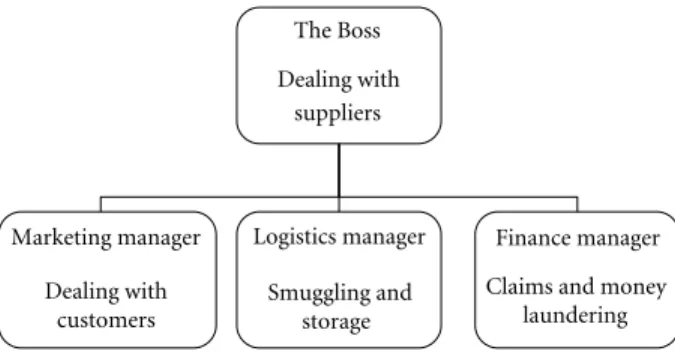
Abadinsky [1] explains that the typical bureaucracy might be problem-atic for criminal organizations (see Figure 1.1):
Many aspects of bureaucracy are impractical for criminal organi-zations because they must be concerned with the very real pos-sibility that communications be monitored. Telephone use must be limited (often only to arrange in-person meetings), and written communication is avoided. Information, as well as orders, money, and other goods, is transmitted on an intimate, face-to-face basis. Lengthy chains of command, characteristic of modern bureaucracy, are impractical for IC, and this limits the span of control.
An alternative is the network model as illustrated in Figure 1.2. If a criminal at A wants to contact someone at H, he or she might either com-municate through B or through G, D and C, or maybe G, D and E.
Here functions such as marketing, logistics, and finance may be spread to several places in the network. In the American Mafia, a place might be a family [1]:
The member-as-patron can put a client “in touch with the right people.” He can bridge communication gaps between the police and criminals, between businessmen and syndicate-connected union leaders; he can transcend the world of business and the world of the illegitimate entrepreneur. He is able to perform important favors and be rewarded in return with money or power. There is a network surrounding the patron, a circle of dyadic relationships orbiting the OC member in which most clients have no relations with another except through the patron.
Table 1.1: Comparison of legitimate business and organized crime groups (Adapted from [183]).
Dimension Legitimate business Organized crime groups
Enterprise
Activities cover the whole range of goods and services above the legal limit. May be involved in illicit forms of power brokering or security/protection.
Illicit; only covering a limited range of goods and services below the legal limit. These often involve illicit forms of power brokering or security/protection based on threats and violence.
Transaction costs
Apply to all transaction costs, including incentives,
co-operation and enforcement. There is a tendency to minimize such costs to support profits.
Apply to all transactions, including incentives,
co-operation and enforcement. In particular, they are relevant to the security and survival of the group.
Organization
Generally hierarchical; sometimes bureaucratic in structure but now less so. Exceptions to this in some specialist fields, where structures are less well defined. Transaction costs because of organizational structures may be somewhat higher than they are in organized crime groups.
Hierarchical, non-bureaucratic, in loose confederation, often with partners. Organizational transaction costs may be lower than in legitimate business, although applying too many draconian sanctions may increase them.
Boundaries
Legal and ethical boundaries. Businesses may impose strategic boundaries by choice.
Multinational organizations have only limited jurisdictional boundaries.
8 Knowledge Management in Policing
Table 1.1: Continued.
Dimension Legitimate business Organized crime groups
Goals and objectives
Generally accessible, although some business strategies are kept confidential for commercial reasons. Goals are often multiple to satisfy a range of constituencies within the firm.
Clandestine to protect the group and its leaders. Except in “expressive” gangs, goals generally are limited to those that maximize profitability. Transaction costs are minimized in this respect.
Profitability
Optimizing satisfying behavior, depending on the type of business, the multiplicity of its goals and the character of its executive and stakeholders.
Generally maximizing, although personal generosity is not unknown.
Competition
Competitive edge preserved through technology, research, marketing and intellectual property rights. Not adverse to corruption to achieve their ends in some environments. Transaction costs more predictable than they are in a firm pursuing illicit enterprises.
Competitive edge preserved by means of coercion, violence and use of capital resources for corruption on a regular basis. These may appear to reduce transaction costs but there may be a long-term price to pay.
Rent seeking behavior
Some rent-seeking behavior to achieve specific goals. It is rarely immanent in the functions and purposes of the business.
Almost constant rent-seeking behavior, which is often immanent in the functions and activities of the group.
Contrary to received wisdom, Colombia’s drug trade has never been dom-inated by a price-fixing association. Even during the respective heydays of the Medellin and Carli “cartels,” cocaine production and exportation in Colombia were highly competitive as independent trafficking groups in
more than a dozen cities smuggled substantial amounts of cocaine to Amer-ican and European drug markets. While some of these enterprises trans-acted with Pablo Escobar, the Orchoa brothers, and other prominent traf-fickers; their business relations more closely resembled informal producer-export syndicates than public or private cartels that controlled prices and monopolized markets. Although different groups occasionally pooled their
The Boss
Dealing with suppliers
Marketing manager
Dealing with customers
Logistics manager
Smuggling and storage
Finance manager
Claims and money laundering
Figure1.1. Bureaucracy model for criminal enterprise.
A H
G F
E
D C B
Figure1.2. Network model for criminal enterprise.
Albanese [248] argues that the enterprise model of organized crime grew out of dissatisfaction with both the hierarchical and local ethnic models that had been dominating so far. A growing number of investi-gations had found that relationships between individuals (hierarchical, ethnic, racial, or friendship) were the genesis of organized crime activity (as opposed to individual, less organized forms of criminal behavior). The view was that if the factors causing these illicit relationships to form (i.e., conspiracies) could be isolated, a determination might be made about the true causes of organized crime. It is the conspiratorial nature of organized crime that makes it serious. It is not the individual drug dealer and illegal casino operator that cause public concern but rather how these individuals organize their customers, suppliers, and functionaries to provide illicit goods and services for profit.
The realization that organized crime operates as a business spurred a series of studies in an effort to isolate those factors that contribute most
10 Knowledge Management in Policing
govern entrepreneurship in the legitimate marketplace: a necessity to main-tain and extend one’s share of the market. According to this finding, orga-nized crime groups form and thrive in the same way that legitimate busi-nesses do: they respond to the needs and demands of suppliers, customers, regulators, and competitors. The only difference between organized crime
and legitimate business is that organized criminals deal in illegal products, whereas legitimate businesses generally do not [248].
The business enterprise model of organized crime focuses on how eco-nomic considerations, rather than hierarchical or ethnic considerations, lie at the base of the formation and success of organized crime groups. Regardless of ethnicity or hierarchy, the enterprise model labels economic concerns as the primary cause of organized criminal behavior. A study of illicit drug sales in the southwest USA found that the drug markets consisted of small organizations rather than massive, centralized bureau-cracies, that were competitive rather than monopolistic in nature. A study of bookmaking, loan sharking, and numbers gambling in New York City, found them not monopolies in the classic sense or subject to control by some external organization. Instead, economic forces arising from the ille-gality of the product tended to fragment the market, making it difficult
to control or centralize these illegal activities on large scale. The supply of illegal goods seems not marked by a tendency toward the development of large-scale criminal enterprises, due to the illegal nature of the product. Instead, smaller, more flexible and efficient enterprises characterized this
type of organized crime [248].
Organized crime as a business enterprise sees organized crime as the product of market forces, similar to those that cause legitimate businesses to flourish or die in the legal sector of the economy. The major character-istics of the enterprise are summarized as follows by Albanese [248]:
•Organized crime and legitimate business involve similar activities on different ends of a spectrum of legitimacy of business enterprise. •Operations are not ethnically exclusive or very violent in order to
enhance profit.
•Criminal organizations are rarely centrally organized due to the nature of the markets and activities involved.
the cocaine trade in New York City during the early 1990s, there was also notable evidence of interethnic cooperation involving Italian, Greek, Irish, and Black participants [248].
1.3. The Business of Crime
Profit-driven crime by criminal business enterprises should be understood mainly in economic rather than sociological or criminological terms. In an attempt to formulate a general theory of profit-driven crime, Naylor [91] proposed a typology that shifts the focus from actors to actions in a way that differs from legal studies of crime by identifying inherent
char-acteristics of market crime (illegal distribution), predatory crime (illegal redistribution), and commercial crime (illegal business practice).
(1) Market crimeinvolves production and/or distribution of goods, ser-vices, or information that are inherently illegal, such as drugs trade, alcohol smuggling and child pornography. There are multilateral exchanges involving producers, distributors, and retailers who sell to customers. Retailers represent supply, while customers represent demand for illegal products. Depending on supply and demand, prices will vary, which in economic terms, is labeled price elasticity. For example, if supply of heroin increases and the demand is stable, then the unit price for heroin will go down on the market. Market crime might also be labeledillegal distribution.
(2) Predatory crimeinvolves redistribution of legally owned wealth from one party to another. It is typically a bilateral relation between victim and perpetrator. The redistribution represents involuntary transfer supported by violence or deception. The victim is readily identifiable. Transfer takes place in cash, physical goods, services, information, or other material or immaterial valuables. Predatory crime might also be labeledillegal redistribution.
(3) Commercial crimeinvolves illegal practices during production or dis-tribution of inherently legal goods and services. Illegal methods to produce or distribute are used in a normal business setting. The vic-tim as well as income earned by virtue of illegal methods is identifi-able. For example, when corruption is used by a construction com-pany to get a government building contract, then the potential winner of a fair and open bidding competition is a victim. Income earned is the difference between the building price paid to the corrupt company
12 Knowledge Management in Policing
This categorization as any other categorization needs to satisfy several requirements to be trustworthy. First, there should be no apparent overlap between the categories. Next, the categories need to be at the same level, that is, one category should not appear to be part of another category. Finally, there should intuitively be no crime examples not fitting into one of the categories. A way of checking is to apply another categorization. Here we apply criminal businesses in criminal industries for such a comparison of categorizations.
Criminals are associated with or employed by criminal business enter-prises. Similar business enterprises are in the same criminal industry. A criminal industry is collection of criminal enterprises that conduct business in the same business area. Similarity refers here to the kind of business they are in.
Here, we will distinguish between four criminal industries.
(1) Commerce and trade includes trafficking in women and children,
trading in illegal sporting drugs, narcotics commerce, prostitution, stolen cars, smuggling of liquor and cigarettes.
(2) Theft and robberyincludes shoplifting, game machines robbery, illegal stock exchange, bank forgery, illegal credit card use, illegal cartels among legal businesses, pocket theft, fraud, industrial espionage, art theft, car theft, tax fraud, and identity theft.
(3) Productionincludes illegal printing of official documents, fake credit
cards, inside trade, pedophile pornography, slavery, and software copying.
(4) Violenceincludes killing for money, torpedo activity for cash retrieval, terrorism, security services, and sabotage.
Damage to persons
Damage to property Theft and
robbery Violence
Production Commerce
and trade
Figure1.3. Criminal industries by damage to persons and property.
Damage to persons
Damage to society Theft and
robbery Violence
Production Commerce
and trade
Figure1.4. Criminal industries by damage to persons and society.
Money laundering and corruption are not included in this categoriza-tion of criminal business enterprises into industries, as both are included in all industries as supporting organized crime.
When comparing Naylor’s [91] categorization with our categorization, we find the following:
(a) commerce and trade are mainly part of market crime; (b) theft and robbery are mainly part of predatory crime;
(c) production is mainly part of market crime; (d) violence is not really covered;
14 Knowledge Management in Policing
We leave it to the reader to agree or disagree with this evaluation of Naylor’s [91] categorization and to come up with an improved categoriza-tion of profit-driven crime.
1.4. Criminal Entrepreneurship
Unfortunately, innovation and learning do not occur in legal enterprises only. Many illegal enterprises seem to innovate and learn quickly over time. Illegal enterprises include trafficking, narcotics, smuggling, and
other criminal organizations. For example, Abramova [112] expects more transnational organized crime originating in Russia in the future based on innovation and learning. Having established and/or legalized their positions in the key industries at home, the leaders of Russian criminal organizations will try to expand their economic influence abroad. For this purpose, they are most likely to use the methods perfected in Russia: violence, fraud and corruption, in addition to business financing of their legal enterprises [39]. They will not limit themselves to creating new affiliate criminal structures abroad, but will try to carve out a share of the
existing criminal markets overseas. This will transfer hostilities between organized crime groups to other lands; in particular, Southern Europe, South-East Asia and selected key, countries in the West.
Entrepreneurship and organized crime tarnishes the conventional clean and wholesome depiction of entrepreneurs by bringing to life the lived and messy realities of entrepreneurs who run illegal businesses. The pur-pose of this section is to apply organizational and management concepts such as entrepreneurship to criminal business enterprises to shed light on organized crime. Organized crime has received increased attention in recent years. To fight organized crime, there is a need to understand crim-inal organizations [229, 250]. In this book, terminology from the business and management literature is applied to the growing area of organized crime. Rather than thinking of organized crimes as acts of criminals, this paper suggests an understanding of criminal organizations similar to non-criminal organizations.
Gibraltar the legitimate business economies would struggle to sustain the livelihoods of those communities. Entrepreneurial behavior seems indeed to be part of committed criminality.
Creativity is an important ingredient of entrepreneurship, and creativ-ity in entrepreneurship is defined as the internal processes through which entrepreneurs produce ideas that are valued to them and to their wider communities of practice. Often innovation is related to creativity, where innovation is taken to mean the transformation of creativity into profitable development of goods, services, relationships or internal work practice. Therefore, it is important to understand entrepreneurial behavior practiced in a criminal context. The subject of criminal entrepreneurship continues to be of interest in intelligence and analysis of organized crime in a global context.
Risk management is an important activity in criminal entrepreneur-ship, as the threat from law enforcement as well as competing criminals has to be taken into account before committing crimes. Information on risks has to be collected from both underworld and overworld sources. Risk has to be evaluated in terms of both probability of something going wrong as well as consequence if something goes wrong.
Symeonidou-Kastanidou [161] argues that there is a need for a new definition of organized crime, where entrepreneurial structure is included as an important element. An entrepreneur is a person who operates a new enterprise or venture and assumes some accountability for the inherent risks. The view on entrepreneurial talent is a person who takes the risks involved to undertake a business venture. Entrepreneurship is often diffi
-cult and tricky, as many new ventures fail. In the context of the creation of for-profit enterprises, entrepreneur is often synonymous with founder. Business entrepreneurs often have strong beliefs about a market oppor-tunity and are willing to accept a high level of persona, professional, or financial risk to pursue that opportunity.
In his general theory of entrepreneurship, Shane [137] distinguishes between sources of opportunities as follows.
•Technological changesare an important source of entrepreneurial op-portunity because they make it possible for people to allocate resources in different and potentially more productive ways. For a criminal
entrepreneur, technological changes enable new ways of smuggling physical goods and new ways of communicating with customers and partners.
16 Knowledge Management in Policing
or that redistribute wealth from one member of society to another. When a commodity or service becomes illegal in a country, a criminal entrepreneur may find it attractive to serve the new illegal market. •Social and demographic changestransfer information about how people
allocate resources in different and potentially more productive ways.
For example, urbanization is a source of entrepreneurial opportunity as communication is greater in more densely populated areas.
Why does a criminal entrepreneur choose to organize a criminal busi-ness enterprise in order to exploit a market opportunity? Alvarez and Bar-ney [259] argue that entrepreneurial opportunities can be exploited in a variety of ways and seek to understand the conditions under which orga-nizing an enterprise is the most efficient way of exploiting a particular
opportunity.
Opportunities to create new economic value exist because of demand for goods and services in illegal markets. Entering an illegal market as entrepreneur is based on the assumption that there are competitive imper-fections reflecting changes in technology, demand, or other factors that individuals or groups in an economy attempt to exploit. For example, Ismael Zambada-Garcia is a Mexican drug lord. He is capo (captain) and head of the Sinaloa cartel in Mexico. He is “El Mayo,” Mexico’s number one drug dealer. He climbed to the top by eliminating rivals and victory over Columbian cocaine producers. Zambada-Garcia got indirect help from the police, because police in Mazatlan shot and killed his most powerful rival Ramon Arellano Felix in 2002. The Tijuana cartel by Felix was weakened, while the Sinaloa cartel of Zambada-Garcia was strengthened [145]. Com-petitive imperfections were created by the purposeful actions of Zambada-Garcia.
Whatever the source of competitive imperfections is, their existence, per se, often only holds the potential for creating new economic value [259]:
The realization of this potential often requires additional economic activities, activities that sometimes require the organization of a firm and sometimes can be organized through other governance mechanisms, such as arbitrage and alliances.
is said to be engaging in arbitrage if he or she possess all the resources neces-sary to exploit a market opportunity, and thus no additional coordination through economic organization is required to create economic value.
If an individual does not possess all the resources required to exploit an opportunity, access to those resources will need to be obtained by the entrepreneur. This can be done in a variety of ways. For example, the entrepreneur can recruit the owners of these resources into a hierarchical structure to gain access required to exploit an opportunity. Alternatively, the entrepreneur might form an alliance with the owners of these resources in a network structure to gain access.
Entrepreneurial leadership is characterized by judgment in decision-making. Judgment is where individuals take decisions without access to any generally agreed rule that could be implemented using publicly avail-able information known to be true. A drug dealer who buys before he or she knows the price at which it can be resold must make a judgment about what the future price will be, for instance. Judgment refers primarily to business decision-making when the range of possible future outcomes is generally unknown. Judgment is required when no obviously correct model or decision rule is available or when relevant data is unreliable or incomplete [260].
Entrepreneurial judgment is ultimately a judgment about the control of resources. As an innovator, a leader, a creator, a discoverer, and an equilibrator, the entrepreneur exercises judgment in terms of resource acquisition and allocation to prosper from criminal business opportunities. As a founder and developer of the business enterprise, the entrepreneur must exercise judgmental decision-making under conditions of uncer-tainty [260].
Sheptycki [140] finds that criminal entrepreneurship has gained scant recognition among police, because organized crime is stubbornly reduced to a narrow spectrum of phenomena. Therefore, policing practices which aimed at reducing the harms due to organized criminality often fall wide of the mark, and that is the contrast between traditional and new under-standings of what constitutes organized crime.
1.5. Growing the Crime Business
18 Knowledge Management in Policing
point for drug distribution occurred a decade later, as locally centered and poorly structured supply was replaced by organized professionals’ well-structured supply chains. The explosion of the heroin consumption prob-ably stimulated this turning point in the early 1980s.
Despite mature markets, aging assets, imprisoned staffmembers, aging
procedures, and increased competition, attractive growth opportunities still exist. Similar to legal enterprises, criminal enterprises may have five ways to grow their business [104].
(1)Establish a joint venture or strategic alliance in a high growth geo-graphic market.It was believed that the large size of many markets meant that local organized crime did not need to look beyond the border for new markets. It made sense to focus on serving and expanding domestic markets. But today, globalization, increased offshore manufacturing, and
the breakdown of trade barriers call for joint ventures [73]. For example, the Russian Mafia has entered into joint ventures with Colombian cocaine cartels to expand their criminal activity into more markets.
A joint venture is an entity formed between two or more parties to undertake economic activity together. The parties agree to create a new entity by both contributing assets, and they then share in the revenues, expenses, and control of the enterprise. The venture can be for one specific criminal project only, or a continuing business relationship. This is in contrast to a strategic alliance, which involves no assets by the participants, and is a much less rigid arrangement.
A joint venture exists between the Heavenly Alliance in Taiwan and traf-ficking organizations in the mainland China. While a trafficking
organiza-tion supplies women, Heavenly Alliance arranges “marriages” and “visits.” Women are smuggled from mainland China to Taiwan. Because rules for visiting relatives are very strict, it is difficult for Chinese to obtain a visa
to visit their relatives in Taiwan. Therefore, fake marriages are arranged for sex workers [256]. As the prostitution market is growing in Shanghai and other cities in China, Heavenly Alliance may be interested in a new kind of joint venture, where their business concept of a jockey is implemented.
By joining forces with developing foreign businesses, local criminal businesses gain access to high growth markets in a developing country, and they may better serve existing and new customers who are expanding there. For example in terms of joint venture projects, criminal organiza-tions dealing in drugs, gambling, and prostitution may find it attractive to make money during Olympic games in foreign locations, such as in Beijing 2008.
distinctive solutions for customers. To break away from the pack and offer
a more distinctive solution to customers, producers need to learn how to collaborate with suppliers, customers and/or competitors to find new and better solutions. This is difficult to do effectively and needs a strong
commitment by all parties in order to work. Fortunately if successful, this difficulty represents a barrier to entry and therefore ensures less
competi-tion and higher margins.
This growth strategy is common in a number of legal as well as illegal businesses. For example, if the criminal organization is in the business of stealing and smuggling stolen cars, it may increase its revenues if it is at the same time able to handle money laundering for customers buying the cars. (3)Diversify or expand product offerings to the best customer segment. Based on a demand curve, the criminal business enterprise knows that the best customers are willing to pay more than the market price for their products. If the enterprise was to offer complementary goods and
ser-vices, then the highest prices are to be achieved in the best customer seg-ment. It is necessary to first have a clear understanding of who the most profitable customers are and identify what additional goods and services they need.
(4)Eliminate the bottom ten percent of the business. To grow a criminal business, it is necessary to ensure that it only competes in markets where it has a strong competitive advantage. Where an advantage does not exist, it is necessary either to invest to attain it or to withdraw from the market completely. While withdrawal means lower volumes on the short term, it often ultimately leads to a stronger, more sustainable enterprise and one that is better positioned to grow in core markets.
(5)Leverage underused intangible assets in the business. Internal capa-bilities, competencies, and knowledge that have evolved to support the current business are often overlooked as possible sources of competitive advantage [100]. Even worse, they are sometimes viewed as expendable when the focus is on cost cutting and streamlining the organization. These intangible assets are typically information-based and include customer relationships, access to supply networks, and corrupt politicians. The critical challenge is often to identify how best to leverage these assets.
20 Knowledge Management in Policing
Growth as a goal has to be on both short-term and long-term levels to achieve both prosperity and viability. Business growth has to be accompa-nied and supported by growing leaders, otherwise it may go wrong.USA managers in Hyundai Motors and Kia Motors never seemed to please their
Korean superiors, and the North American management staffwas in
con-stant turnover. Then, the chairman of Hyundai Motors, Chung Mongkoo, and his son, Kia Motors president Chung Euisun, came under investigation for their roles in scandals involving political slush funds and the misuse of company money.
Matthews [81] identified four factors essential for growth.
(1) Talent. An entrepreneur takes the risk to create something from noth-ing. Such talent must be developed by educating people about the basics of enterprise and foster their entrepreneurial instincts. Some people are more predisposed and willing to take risks than others. Not everyone has the skills or knowledge to grow a business enterprise. (2) Idea. To meet target customer’s needs and wants, the criminal
enter-prise must have a “better idea” than competitors and law enforce-ment. The idea is broken down into resources and organizing, as well as products and markets.
(3) People. Good criminals may be hard to find. They will often tend to favor opportunistic behavior, where their own goals are more tant than goals of the criminal business enterprise. Thus it is impor-tant to recruit knowledgeable people who stay loyal in critical situ-ations. Management needs to lead people, build an organization for growth, and develop an approach to align criminals’ efforts around
execution of a growth strategy.
(4) Capital. While entrepreneurs may have the personal resources to start a company, very few have enough to grow a company. This is especially the case in criminal business enterprises where the entrepreneurs enjoy a luxurious standard of living, without secur-ing funds through money laundersecur-ing for future investments. Most entrepreneurs need to learn how to manage their balance sheet, do debt financing, trust strategic alliances and joint ventures, and understand finance.
and services in an illicit manner. But they may also penetrate the legitimate economy, or in the case of the Mafia, assume quasi-governmental roles. However they choose to do it, and whatever they chose to do, their goal remains the same-to make money, as much as they can. Based on such an understanding of organized crime, this chapter has explored organizational and management concepts from legal businesses to shed light on criminal organizations.
1.6. The Case of Hawala Bankers Transferring Criminal Proceeds
In the summer of 2008, Nigerian prostitute went to an official bank in
Oslo, Norway, to transfer money to Nigeria. This seemed to be a legal transaction as proceeds from prostitution are legal income. What the bank did not know was that the money was not from prostitution. The money was proceeds from drug trafficking rather than human trafficking, which is
illegal income. When the bank discovered the prostitutes were lying about their income, money transfers were stopped.
Therefore, the Nigerian drug dealers went to hawala bankers instead. Hawala bankers are financial service providers who carry out financial transactions without a license and therefore without law enforcement con-trol. They accept cash at one location and pay a corresponding sum in cash or other renumeration at another location. This service is similar to services provided by official banks, but hawala bankers disregard all
legal obligations concerning the identification of clients, record keeping, and the disclosure of unusual transactions, to which these official financial
institutions are subject [196].
Hawala banking has a long history [196]:
Primarily entrenched in the monetary facilitation of trade between distant regions, these bankers still provide a useful service especially to migrants who wish to transfer money to their country of origin. The informal system has long existed but only recently gained prominence in conflict torn regions, such as Afghanistan and Somalia. After years of conflict, confidence in the formal banking system is absent and the remaining banks neither accept deposits nor extend loans. Significantly, these formal banks do not have the capacity to provide international or domestic remittance services.
Both official and hawala banks often transfer money without actually
22 Knowledge Management in Policing
transferred without leaving trails of the completed transactions. But rather, the essence of hawala banking is simply that financial transactions occur in the absence of, or parallel to, official banking sector channels [196]:
Hawala banking is not certified and supervised by any government. There are international differences in regulation and supervision
of financial transactions by Central Banks, but hawala banking has been legally banned in almost all countries of the world, even those, which are strongly Islamic, such as Pakistan and Iran.
2
Theories of Criminal Enterprises
Organized crime has received increased attention in recent years. To under-stand the “what, how, and why” of the organized crime and to stimulate know-what, know-how and know-why, there is a need for theory develop-ment. A theory might be a prediction or explanation, a set of interrelated constructs, definitions, and propositions that present a systematic view of phenomena by specifying relations among variables, with the purpose of explaining natural phenomena. The systematic view might be an argument, a discussion, or a rationale, and it helps to explain or predict phenomena that occur in the world.
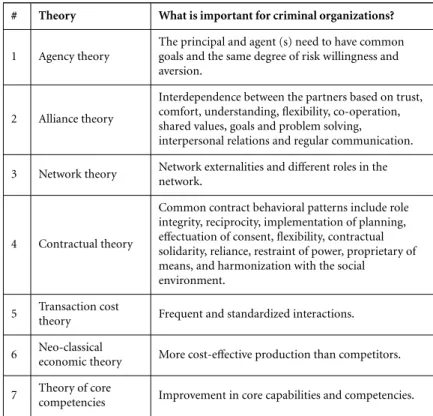
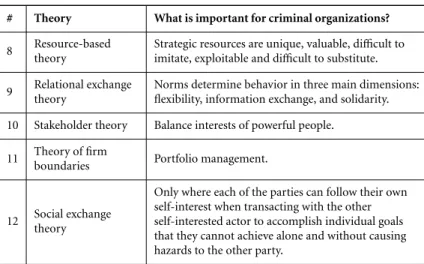
In our context of organized crime, we search for theoretical explana-tions in two streams of research. One stream of research we label “criminol-ogy theories of organized crime” where theories are developed explicitly to explain the phenomenon of organized crime. Another stream of research we label “management theories of organized crime,” where general man-agement theories are applied to the phenomenon of organized crime [4].
It is difficult to overstate the importance of theory to law
enforce-ment understanding of organized crime and criminal organizations. The-ory allows analysts to understand and predict outcomes on a probabilistic basis [217]. It also allows them to describe and explain a process or a sequence of events. Theory prevents analysts from being confused by the complexity of the real world by providing a linguistic tool for organizing a coherent understanding of the real world. Theory acts as an educational device that creates insights into criminal phenomena.
2.1. Criminology Theories of Organized Crime
24 Knowledge Management in Policing
organized crimes. The monopolistic model implies that potential criminals have no other choice but are forced to join the criminal organization if they decide to commit a crime. Chang et al. [210] find this perspective to be less than exhaustive in terms of describing criminal behavior. They argue that the determination of the market structure for crime should be endogenous, which has notable implications for the optimal crime enforcement policies and crime itself.
To recover the conventionally neglected facts and provide a more com-plete picture regarding organized crime, Chang et al. [210] developed a model in terms of a criminal decision framework in which individual crime and organized crime are coexisting alternatives to a potential offender. The
model makes the size of a criminal organization a variable and explores interactive relationships among sizes of criminal organization, the crime rate, and the government’s law enforcement strategies. Model runs showed that the method adopted to allocate the criminal organization’s payoffs and
the extra benefit provided by the criminal organization play crucial roles in an individual decision to commit a crime and the way in which he or she commits that crime.
Gross [9] argued in his classical article on thetheory of organizational crimethat more than some areas of sociology, studies of crime, and delin-quency usually have a strong theoretical base. He suggested two important theoretical relationships. First, the internal structure and setting of orga-nizations is of such nature as to raise the probability that the attainment of the goals of the organization will subject the organization to the risk of violating societal laws of organizational behavior. Secondly, persons who actually act for the organization in the commission of crimes, by selective processes associated with upward mobility in organizations, are likely to be highly committed to the organization and be, for various reasons, will-ing and able to carry out crime, should it seem to be required in order to enable the organization to attain its goals, to prosper, or minimally, to survive.
Lombardo [71] has challenged the alien conspiracy theory as an expla-nation of the origin of organized crime in USA, as he reviewed the history of Black Hand (organized crime group) activity in Chicago in the early 20th century, arguing that the development of Black Hand extortion was not related to the emergence of the Sicilian Mafia, but rather to the social structure of the American society.
Rational choice theorysuggests that people who commit crimes do so after considering the risks of detection and punishment for the crimes, as well as the rewards of completing these acts successfully. Examples of this theory include a man who discovers that his wife is having an affair and
chooses to kill her, her lover, or both; the bank teller who is experiencing personal financial difficulty and decides to embezzle funds from the bank
to substantially increase her earnings; and an inner-city youth who decides that social opportunities are minimal and that it would be easier to make money by dealing crack cocaine [74].
In organized crime, Shvarts [141] suggests that rational choice theory can explain the growth of the Russian Mafia. Because of low income and financial difficulties at the individual level, combined with a corrupt police
force, it seems rational to move into organized crime to improve the stan-dard of living for members joining the criminal organization.
Some theorists believe that crime can be reduced through the use of deterrents. The goal of deterrence, crime prevention, is based on the assumption that criminals or potential criminals will think carefully before committing a crime if the likelihood of getting caught and/or the fear of swift and severe punishment is present. Based on such belief,general deter-rence theoryholds that crime can be thwarted by the threat of punishment, whilespecial deterrence theoryholds that penalties for criminal acts should be sufficiently severe that convicted criminals will never repeat their acts
[74].
Furthermore,learning theorieshave been used to explain the onset of criminal activity. The body of research on learning theory stresses the atti-tudes, ability, values, and behaviors needed to maintain a criminal career [74].
Next,cultural deviance theoriesassume that slum dwellers violate the law because they belong to a unique subculture that exists in lower-class areas. The subculture’s values and norms conflict with those of the upper class on which criminal law is based [74].
26 Knowledge Management in Policing
Social control theorists argue that the relevant question is not, Why do persons become involved in crime, organized or otherwise? but, rather, Why do most persons conform to societal norms? If, as control theorists generally assume, most persons are sufficiently
motivated by the potential rewards to commit criminal acts, why do only a few make crime a career? According to control theorists, delinquent acts result when an individual’s bond to society is weak or broken. The strength of this bond is determined by internal and external restraints. In other words, internal and external restraints determine whether we move in the direction of crime or of law-abiding behavior.
Bruinsma and Bernasco [195] used social network theoryto describe
and tentatively explain differences in social organization between criminal
groups that perform three types of transnational illegal activities: smug-gling and large-scale heroin trading, trafficking in women, and trading in
stolen cars. Groups that operate in the large-scale heroin market tend to be close-knit, cohesive, and ethnically homogeneous. Groups active in the trafficking of women have a chain structure, while those that operate in the
market for stolen cars are characterized by three clusters of offenders in a
chain. Both groups are less cohesive than criminal groups in the large-scale heroin market are. The differences in social organization between the three
types of illegal activities appear to be related to the legal and financial risks associated with the crimes in question, and thereby to the required level of trust between collaborating criminals.
It is often argued that criminal organizations have a network structure. For example, similar to other forms of organized criminality, including weapons trafficking, immigrant smuggling, and prostitution; drug
traf-ficking in Colombia occurs in fluid social systems where flexible exchange networks expand and retract according to market opportunities and regu-latory constraints. This durable, elastic structure did not emerge overnight but developed over many years as entrepreneurs built their enterprises through personal contacts and repeated exchanges and resources they accu-mulated gradually, while drawing on social traditions, such as contraband smuggling, that extend far back to Colombia’s colonial past [45].
Krebs et al. [54] applied non-cooperative game theory to examine
![Table 1.1: Comparison of legitimate business and organized crime groups (Adapted from [183]).](https://thumb-us.123doks.com/thumbv2/123dok_us/8188157.2170687/22.594.83.519.330.830/table-comparison-legitimate-business-organized-crime-groups-adapted.webp)
![Figure 4.1. Four models for strategic planning in policing (Adapted from [188]).](https://thumb-us.123doks.com/thumbv2/123dok_us/8188157.2170687/93.594.145.450.76.305/figure-four-models-strategic-planning-policing-adapted-from.webp)
![Figure 4.2. Table of contents in the document National Strategy for Police Intelligence and Analysis [109].](https://thumb-us.123doks.com/thumbv2/123dok_us/8188157.2170687/100.594.111.489.71.471/figure-contents-document-national-strategy-police-intelligence-analysis.webp)
![Table 4.1. Evaluation of National Strategy for Police Intelligence [109] in terms of strategy construct requirements.](https://thumb-us.123doks.com/thumbv2/123dok_us/8188157.2170687/102.594.101.494.138.387/evaluation-national-strategy-police-intelligence-strategy-construct-requirements.webp)
