Unit 5
Selling
Unit 5
Selling
Chapter 12
Preparing for
the Sale
Chapter 13
Initiating the Sale
Chapter 14
Presenting the
Product
Chapter 15
Closing the Sale
Chapter 16
Using Math in
Chapter 12
Preparing for the Sale
Chapter 12
Preparing for the Sale
•
Section 12.1 What Is Selling?
•
Section 12.2 Getting Ready To Sell
•
Section 12.1 What Is Selling?
What Is Selling?
Objectives
Define selling and different types of selling situations
Explain the purpose and goals of selling Define consultative selling
Key Terms personal selling business-to-business selling telemarketing consultative selling feature-benefit selling product features customer benefits rational motive emotional motive extensive decision making limited decision making routine decision making
What Is Selling?
Objectives
Differentiate between rational and emotional buying motives
Marketing and the Marketing
Concept
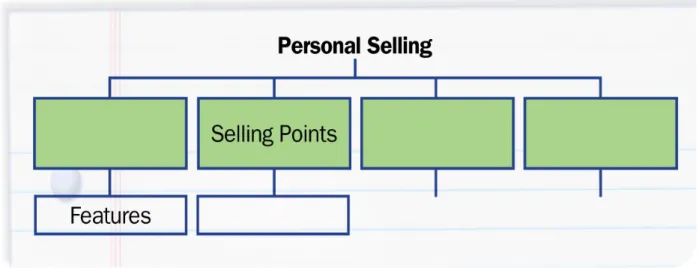
Graphic Organizer
Create a chart to record important information about selling situations and customers’ decision making.
Selling
Personal selling X is any form of direct contact
between a salesperson and a customer.
Retail selling is unique because customers come to the store. The salesperson should be available to answer any questions about the product.
personal selling
Any form of direct contact between a
Selling
Business-to-business selling X may take place
in a manufacturer’s or wholesaler’s showroom (inside sales) or a customer’s place of business (outside sales). In the latter case, the salesperson needs to make contact with the customer.
business-to-business selling
Sales that take place in a
manufacturer’s or wholesaler’s showroom
(inside sales) or in a customer’s place of business (outside sales).
Selling
Telemarketing X is the process of selling over the
telephone. Telemarketers are regulated by the Do Not Call Registry established by the Federal
Communications Commission.
Goals of Selling
The purpose and goals of selling are to:
• Help customers make satisfying buying
decisions
• Create ongoing, profitable relationships
between buyer and seller
Goals of Selling
If a business is successful at keeping customers happy, the customers are likely to pass along positive recommendations to:
• Other business associates • Friends
Consultative Selling
Consultative selling X is the process of providing
solutions to customers’ problems by finding products that meet their needs.
To be effective in consultative selling, you need to understand feature-benefit selling.
consultative selling Sales that provide solutions to customers’ problems by finding products that meet their needs.
Feature-Benefit Selling
Matching the characteristics of a product to a customer’s needs and wants is a concept called
feature-benefit selling X.
Product features X may be any of three types of
product attributes: basic, physical, or extended.
feature-benefit selling Sales that match the characteristics of a product to a customer’s needs and wants.
product features
Basic, physical, or extended
Feature-Benefit Selling
Customer benefits X are the advantages or
personal satisfaction a customer will get from a good or service. These include:
• The feature helps the product’s performance. • Performance information gives the customer a
personal reason to buy the product.
customer benefits
The advantages or personal
satisfaction a customer will get from a good or service.
Feature-Benefit Selling
After identifying the features of a product and their benefits, you should put together a feature-benefit chart to match each feature with a customer
Customer Buying Motives
Customers have rational or emotional motives for making purchases. A rational motive X is a
conscious, logical reason for a purchase, such as dependability, savings, health and safety issues, and quality.
rational motive A conscious,
logical reason for a purchase.
Customer Buying Motives
Emotional motives X are the feelings a customer
experiences in association with a product. These include:
• Social approval • Recognition • Prestige
emotional motive A feeling
experienced by a customer
through
Customer Decision Making
Some customers do not need help from
salespeople while others do. This difference has its roots in three types of decision making:
• Extensive • Limited • Routine
Customer Decision Making
How a person makes a decision is affected by the following factors:
• Previous experience with the product and
company
• How often the product is purchased
• Amount of information necessary to make a
Customer Decision Making
• The importance of the purchase to the customer • Perceived risk involved with the purchase
• Time available to make the decision
Customer Buying Motives
Extensive decision making X is used when there
has been little or no previous experience with an item such as goods and services that:
• Have a high degree of perceived risk • Are very expensive
• Have a high value to the customer
extensive decision making
The process used when there has been little or no previous
Customer Buying Motives
Limited decision making X is used when a
person buys goods and services that he/she has purchased before but not regularly, such as:
• A second car
• Certain types of clothing
• Furniture and household appliances
limited decision making
The process used when a person buys goods and services that he or she has
purchased before but not regularly.
Customer Buying Motives
This ad highlights the features of
A customer makes a purchasing decision based on a variety of factors, including the following:
Customer Buying Motives
Routine decision making X is used when a
person needs little information about a product. The perceived risk may be low because the item is inexpensive, bought frequently, or highly
satisfying.
routine decision making
The process used when a person needs little information
about a product to make a
decision because he or she buys it regularly.
SECTION 12.1 REVIEW
-Getting Ready to Sell
Objectives
Name sources of product information Explain the main focus of preparation in
business-to-business selling and in retail selling
Key Terms
pre-approach prospect
referrals
endless chain method
cold
Marketing and the Marketing
Concept
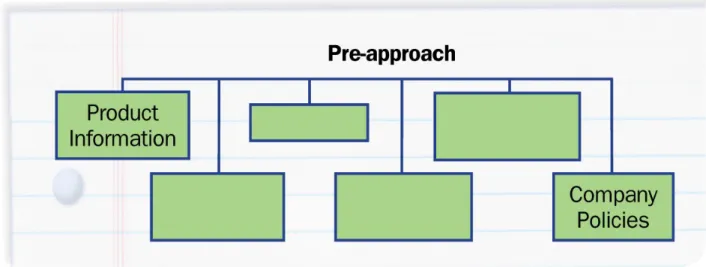
Graphic Organizer
Draw this chart to take notes about sources of product, industry information, and methods of prospecting.
The Pre-Approach
The pre-approach
X
is the preparation for the face-to-face encounter with potential customers. In preparing to assist customers, salespeople must:• Study their products
• Know industry trends and competitors
The Pre-Approach
• Research potential customers
• Develop familiarity with their company’s policies
and procedures
• Review ethical and legal issues involved in their
selling situation.
Product Information
Developing product knowledge is easy if you know where to look for the information. Salespeople find product information through four main sources:
Industry Trends
Sales representatives read periodicals related to their trade to gain insight into the industry. For example, a clothing sales representative for an apparel manufacturer might read Women’s Wear Daily.
Prospecting
Looking for new customers is called prospecting. A
prospect X, or a lead, is a potential customer.
Prospecting is especially important in business-to-business selling.
Prospecting
Some firms employ entire telemarketing teams to generate leads for their sales staffs. They also attend trade shows to display their products.
Sales representatives can use trade, professional, and residential directories to contact potential
customers not in the Do Not Call Registry.
Prospecting
Satisfied customers often give salespeople
referrals X—the names of other people who might
buy the product.
When salespeople ask previous customers for
names of potential customers, they are said to be using the endless chain method X.
referrals The names of other people who might buy a
product, given to salespeople by satisfied
customers. endless chain method
Prospecting
In cold canvassing X, potential customers are
selected at random, such as by going door-to-door or selecting names from a telephone directory.
This process is also called blind prospecting.
cold canvassing
The process of locating as many potential customers as possible without checking out leads beforehand.
Preparing for the Sale in
Business-to-Business Selling
In business-to-business (B-to-B or B2B) sales, pre-approach activities vary. When dealing with a new customer, salespeople should research the following:
• Does the prospect need this product or service? • Does the prospect have the financial resources
Preparing for the Sale in
Business-to-Business Selling
To answer these questions, you make inquiries by:
• Calling other sales representatives who sell
noncompeting lines
• Reading the company’s annual reports
• Subscribing to database listings that monitor
businesses’ financial situations
Preparing for the Sale in
Retail Selling
Preparation centers around the merchandise and work area and includes:
• Straightening, rearranging, and restocking • Adjusting price tickets before and after sales • Knowing where and how much stock is available • Arranging displays
Company Policies and Training
Sales management establishes the guidelines and policies under which salespeople function. This process involves scheduling, overseeing,
evaluating, and training the staff.
Company Policies and Training
This four-step process is often used to train new sales personnel:
• Explanation • Demonstration • Trial
Company Policies and Training
Salespeople are compensated by straight commission, straight salary, or salary plus commission. Managers often establish sales quotas. Sales quotas X are dollar or unit sales
goals set for the sales staff to achieve in a specified period of time.
sales quotas Dollar or unit sales goals set for the sales staff to achieve in a specified period of time.
Company Policies and Training
Commission sales and sales quotas can create pressure on the sales staff to produce sales.
Company Policies and Training
A purchase contains all the elements of a legal contract:
• An offer or acceptance
• Consideration (price and terms)
• Competent parties (buyer and seller) • Legal form and subject matter
Company Policies and Training
In a contract to provide services, all services and materials that will be used should be clearly
Section 12.1
• Three types of selling situations are retail,
business-to-business, and telemarketing.
• Matching the characteristics of a product to a
customer’s needs and wants is feature-benefit selling.
Section 12.2
• To prepare for a sale, salespeople study their
products, industry trends, competitors, and
customers, as well as company policies and legal and ethical selling issues.
This chapter has helped prepare you to meet the following DECA performance indicators:
• Acquire product information for use in selling. • Explain key factors in building a clientele.
• Describe the use of technology in the selling
function.