The Third Manifesto
A detailed study of the impact of type theory on the relational model of data,
including a comprehensive model of type inheritance
C. J. Date
and
Hugh Darwen
———————
Again I must remind you that A Dog’s a Dog──A CAT’S A CAT
—T. S. Eliot, demonstrating that logical differences are not everything, and nor is logic
————————
We would like to dedicate this book to philosophers and poets everywhere
———————
This book is a major revision of an earlier book that was published under the titleFoundation for Future Database Systems: The Third Manifesto(ISBN 0-201-70928-7) published by Addison-Wesley in 2000. That in turn was a revision ofFoundation for Object/Relational Database Systems: The Third Manifesto(ISBN 0-201-30978-5) published by Addison-Wesley in 1998.
In this PDF copy, provided at www.thethirdmanifesto.com, text marked in blue is either material that does not appear in the book as published in 2007, or material in that book that was later revised, or material in aTutorial Dexample affected a by subsequent change to that language. In the latter two cases the revisions in question can be seen in other documents at the same web site. A few minor errors in the book have been silently corrected and a few pieces of text not appropriate to this online version have been silently excluded.
Disclaimer:It proved difficult to faithfully reproduce the formatting of the printed book.
Typographical errors might have been introduced in the editing process. Please report any problems to Hugh Darwen ([email protected]).
——————
Preface x
PART I PRELIMINARIES
Chapter 1 Background and Overview 2
The Third Manifesto 3
Back to the relational future 8 Some guiding principles 10
Some crucial logical differences 11 Concluding remarks 13
Exercises 15
Chapter 2 A Survey of the Relational Model 16
The running example 16 Tuples 18
Relations 21
Relation variables 23
Relvars, relations, and predicates 28 Integrity constraints 32
Relational operators 35 Virtual relvars 48 The relational model 48 Exercises 50
Chapter 3 Toward a Theory of Types 56
Values are typed 58
Types vs. representations 61 Scalar vs. nonscalar types 62 Possible representations 62 Selectors and THE_ operators 64 System-defined types 70
Operators 71 Type generators 75 Concluding remarks 77 Exercises 78
PART II FORMAL SPECIFICATIONS
Chapter 4 The Third Manifesto 82
RM Prescriptions 82 RM Proscriptions 90 OO Prescriptions 91 OO Proscriptions 92
RM Very Strong Suggestions 92 OO Very Strong Suggestions 93 RecentManifestochanges 93 Chapter 5 Tutorial D 96
Common constructs 99 Scalar definitions 102 Tuple definitions 104 Relational definitions 104 Scalar operations 106 Tuple operations 110 Relational operations 114 Relations and arrays 122 Statements 124
Recent language changes 125 A remark on syntax 127 Exercises 129
——————
PART III INFORMAL DISCUSSIONS AND EXPLANATIONS
Chapter 6 RM Prescriptions 133
RM Prescription 1: Scalar types 133
RM Prescription 2: Scalar values are typed 137
RM Prescription 3: Read-only vs. update operators 137 RM Prescription 4: Physical vs. possible representations 144 RM Prescription 5: Expose possible representations 149 RM Prescription 6: Type generator TUPLE 153
RM Prescription 7: Type generator RELATION 159 RM Prescription 8: Equality 163
RM Prescription 13: Relation variables (relvars) 169 RM Prescription 14: Kinds of relvars 170
RM Prescription 15: Candidate keys 174 RM Prescription 16: Databases 174 RM Prescription 17: Transactions 176 RM Prescription 18: Relational algebra 176
RM Prescription 19: Relvar names, relation selectors, and recursion 181 RM Prescription 20: User-defined tuple and relational operators 185 RM Prescription 21: Assignments 186
RM Prescription 22: Comparisons 189 RM Prescription 23: Integrity constraints 190 RM Prescription 24: Total database constraints 197 RM Prescription 25: Catalog 197
RM Prescription 26: Language design 198 Exercises 198
Chapter 7 RM Proscriptions 202
RM Proscription 1: No attribute ordering 202 RM Proscription 2: No tuple ordering 204 RM Proscription 3: No duplicate tuples 204 RM Proscription 4: No nulls 205
RM Proscription 5: No nullological mistakes 205 RM Proscription 6: No internal-level constructs 206 RM Proscription 7: No tuple-level operations 207 RM Proscription 8: No composite attributes 208 RM Proscription 9: No domain check override 208 RM Proscription 10: Not SQL 208
Exercises 209
Chapter 8 OO Prescriptions 210
OO Prescription 1: Compile-time type checking 210 OO Prescription 2: Type inheritance (conditional) 210 OO Prescription 3: Computational completeness 212 OO Prescription 4: Explicit transaction boundaries 213 OO Prescription 5: Nested transactions 214
OO Prescription 6: Aggregate operators and empty sets 214 Exercises 216
Chapter 9 OO Proscriptions 217
OO Proscription 1: Relvars are not domains 217 OO Proscription 2: No object IDs 222
Chapter 10 RM Very Strong Suggestions 227
RM Very Strong Suggestion 1: System keys 227 RM Very Strong Suggestion 2: Foreign keys 230
RM Very Strong Suggestion 3: Candidate key inference 232 RM Very Strong Suggestion 4: Transition constraints 233 RM Very Strong Suggestion 5: Quota queries 234
RM Very Strong Suggestion 6: Generalized transitive closure 236 RM Very Strong Suggestion 7: User-defined generic operators 240 RM Very Strong Suggestion 8: SQL migration 241
Exercises 253
Chapter 11 OO Very Strong Suggestions 255
OO Very Strong Suggestion 1: Type inheritance 255
OO Very Strong Suggestion 2: Types and operators unbundled 255 OO Very Strong Suggestion 3: Single-level store 257
Exercises 257
——————
PART IV SUBTYPING AND INHERITANCE
Chapter 12 Preliminaries 259
Toward a type inheritance model 260 Single vs. multiple inheritance 261 Scalars, tuples, and relations 262 The running example 263 Concluding remarks 271 Exercises 272
Chapter 13 The Inheritance Model 275
IM Prescriptions 275
Recent inheritance model changes 281
Chapter 14 Single Inheritance with Scalar Types 283
IM Prescription 1: Types are sets 283 IM Prescription 2: Subtypes are subsets 283 IM Prescription 3: “Subtype of” is reflexive 286 IM Prescription 4: Proper subtypes 286
IM Prescription 8: Scalar values with inheritance 288 IM Prescription 9: Scalar variables with inheritance 289 IM Prescription 10: Specialization by constraint 295 IM Prescription 11: Assignment with inheritance 298 IM Prescription 12: Equality etc. with inheritance 301 IM Prescription 13: Join etc. with inheritance 303 IM Prescription 14: TREAT 305
IM Prescription 15: Type testing 309
IM Prescription 16: Read-only operator inheritance and value substitutability 312 IM Prescription 17: Operator signatures 316
IM Prescription 18: Read-only parameters to update operators 324
IM Prescription 19: Update operator inheritance and variable substitutability 324 IM Prescription 20: Union, dummy, and maximal and minimal types 328 Exercises 335
Chapter 15 Multiple Inheritance with Scalar Types 337
An introductory example 337 Type graphs 343
Least specific types unique 345 Most specific types unique 347 Remarks on operator inheritance 354 Exercises 356
Chapter 16 Inheritance with Tuple and Relation Types 358
IM Prescription 21: Tuple/relation subtypes and supertypes 358 IM Prescription 22: Tuple/relation values with inheritance 362 IM Prescription 23: Maximal and minimal tuple/relation types 365 IM Prescription 24: Tuple/relation most specific types 368
IM Prescription 25: Tuple/relation variables with inheritance 374 Some implications of RM Prescriptions 21-25 376
Exercises 380
——————
APPENDIXES
Appendix A A New Relational Algebra 383
Motivation and justification 384
◄REMOVE►, ◄RENAME►, and ◄COMPOSE► 387 Treating operators as relations 389
Formal definitions 392
Appendix B A Design Dilemma? 401
Encapsulation 401 Discussion 402
Further considerations 403
Appendix C Types and Units 406
Type definition 406 Selectors 407 THE_ operators 408
Computational operators 409 Display operators 411 Type constraints 411
A more complex example 412
Appendix D What Is a Database? 413
Updating the database 413 The database is a tuple 414
Appendix E View Updating 416
Date’s appoach 416
Assumptions and notation 417
A closer look at relational assignment 418 A model of updating 421
A closer look at constraints 423 Updating restrictions 427 Updating intersections 429 Updating unions 432 Updating differences 434 Nested updates 437 Updating extensions 442 Updating joins 443 Updating projections 449
Some remarks on orthogonality 454 A remark on multiple assignment 456 Summary 457
Darwen’s approach 459
Appendix F A Closer Look at Specialization by Constraint 469
The 3 out of 4 “rule” 469
Benefits of S by C 476 What about objects? 479
Implementation considerations 483
Appendix G A Closer Look at Structural Inheritance 488
An introductory example 488
Tuple types, values, and variables 490 Subtables and supertables 494
Scalar types revisited 499
Structural inheritance with fewer tears 501
Appendix H A Comparison with SQL 506
RM Prescriptions 507 RM Proscriptions 518 OO Prescriptions 520 OO Proscriptions 521
RM Very Strong Suggestions 521 OO Very Strong Suggestions 522 IM Prescriptions 523
Appendix I Tutorial D Syntax 528
Appendix J The Next 25 Years of The Relational Model? 541 Remarks on republication 541
Introduction 541 Background 543
The Third Manifestoand SQL 547 Technical content 547
More on SQL 552
Miscellaneous questions 554
This is a textbook on database management. It is based on our earlier bookFoundation for Future Database Systems: The Third Manifesto(Addison-Wesley, 2000), but it has been thoroughly revised—indeed, completely rewritten—from start to finish. Part of our reason for wanting to revise it was to make it more suitable as a textbook (the earlier book, by contrast, was quite terse and formal and not very easy to read); in particular, most chapters now include a set of exercises, answers to which can be found on the websitewww.thethirdmanifesto.com. (Much other relevant material can be found on that website also, including in particular information regarding prototype implementations ofTutorial D,q.v.). However, we have naturally taken the opportunity to incorporate many other changes as well, including numerous clarifications, a certain amount of restructuring, many more examples, and—we regret to have to say—quite a few corrections also.
Like its predecessor, the book is organized around the ideas ofThe Third Manifesto. As Chapter 1 explains in more detail,The Third Manifesto—theManifestofor short—is a proposal for a foundation for data and database management systems (DBMSs); it can be seen as an abstract blueprint for the design of a DBMS and the language interface to such a DBMS. In particular, it serves as a basis for a model of type inheritance, also discussed in this book. The overall structure of the book is thus as follows. First of all, it is divided into four major parts:
I. Preliminaries
II. Formal Specifications
III. Informal Discussions and Explanations IV. Subtyping and Inheritance
To elaborate briefly:
■ Part I (three chapters) sets the scene by explaining in general terms what the Manifestois all about and why we wrote it. It also contains an informal overview of both the relational model and a theory of types. We recommend that you read these chapters fairly carefully before moving on to later parts of the book.
■ Part II (two chapters) is the most formal part. It contains the Manifestoproper and a grammar for a language based onManifestoprinciples calledTutorial D. Note: This part of the book is provided mainly for reference purposes; it is not necessary, and probably not even a good idea, to study it exhaustively, at least not on a first reading. Tutorial Din particular is
intended to be largely self-explanatory. Even though examples throughout the book are based on it, therefore, it should not be necessary to study theTutorial Dgrammar in depth in order to understand those examples.
■ Part III is the real heart of the book. It consists of six chapters, one for each of the six sections of theManifestoas defined in Part II. Each chapter discusses the relevant section of the
■ Finally, Part IV (five chapters) does for type inheritance what Parts I-III do for the Manifesto
proper.
In addition to the foregoing, there areelevenappendixes, including one in particular
(Appendix K) that gives an annotated and consolidated list of references for the entire book. Note:
References throughout the book take the form of numbers in square brackets. For example, the reference “[3]” refers to the third item in the list in Appendix K: viz., a paper by Malcolm P. Atkinson and O. Peter Buneman entitled “Types and Persistence in Database Programming Languages,” published inACM Computing Surveys,Volume 19, No. 2, in June 1987.
We defer discussion of exactly who the book is aimed at and what readers are expected to know to Chapter 1.
ACKNOWLEDGMENTS
The number of people who have supported us over the years in our work on theManifestoin general and this book in particular has now grown so large that it is no longer feasible to list them all here. With apologies to other supporters, therefore, we would just like to mention the following: Shai Berger, Peter Elderon, Maurice Gittens, Jonathan Leffler, David McGoveran, Åke Persson, Bryn Rhodes, and Andrew Sieber. All of these have helped in one way or another to ensure that this book finally saw the light of day in its present form. We would also like to thank Doug Inkster, David McGoveran, Jeremy Peel, Sudha Ram of the University of Arizona, Greg Baylor of Baylor University, Junping Sun of Nove Southeastern University, Vassilis Tsotrasof UC Riverside, and especially Jonathan Leffler again, for their careful and constructive comments on earlier versions of the manuscript. Finally, we would like to thank once again our wives, Lindy Date and Lindsay Darwen, for their support throughout this project, and to acknowledge our copyeditor, Elisabeth Beller, for her assistance and high standards of professionalism.
We are also grateful to Addison-Wesley for returning the rights on this book to us, allowing us to provide this online copy.
C. J. Date,Healdsburg, California
P R E L I M I N A R I E S
B a c k g r o u n d a n d O v e r v i e w
This book is about the foundations of database technology. It is meant as a basis for self-study or as a text to accompany an advanced course on databases. We should immediately explain that “advanced”! The book is advanced not because of the subject matter, which is mostly not that difficult, but rather because of the treatment, which is meant to be fairly rigorous and detailed (even definitive, so far as it goes): more rigorous and detailed, perhaps, than might be suitable for a first course in the subject. But it is our belief that anyone who is serious about database technology—in particular, anyone who claims to be a database professional—really ought to be familiar with this material. Professionals need to know the foundations of their field, whatever that field might be.
What makes this book different? We feel there are two key features that make it stand out: its strong focus on the relational model, and its thorough treatment of type theory (and together, of course, the relational model and type theory are precisely the foundations referred to in the previous
paragraph). To amplify:
■ The relational model: We must stress that what we arenotdoing is proposing some kind of “new” or “extended” relational model. Rather, we are concerned with what might be called the “classical” version of that model; we have tried to provide as careful and accurate a description of that classical model as we possibly can. It is true that we have taken the opportunity to dot a few
i’s and cross a fewt’s (i.e., to perform a few minor tidying activities here and there); however, the model as we describe it departs in no essential respects from Codd’s original vision as
documented in references [20-22]. (Indeed, we even toyed at one point with the idea of calling the bookA Relational Model of Data for Large Shared Data Banks.)
■ Type theory: Relations in the relational model haveattributes,and those attributes in turn have
types(also calleddomains). Thus, the relational model certainly assumes that types exist.
However, it nowhere says just what those types must be, nor does it have much to say about what properties those types must have; in other words, the relational model and type theory are almost completely independent of each other (they areorthogonal,to use the jargon). In this book, we present a detailed theory of types that complements the relational model, and we explore some of its implications. In particular, we show that our type theory serves as a basis for a comprehensive model of type inheritance.
Who then is the book aimed at? Well, in at least one sense it is definitely not self-contained—it does assume you are seriously interested in database technology and are reasonably well acquainted with classical database theory and practice. However, we have tried to define and explain, as carefully as we could, any concepts that might be thought novel. Thus, we have tried to make the book suitable for both reference and tutorial purposes; moreover, we have clearly identified those portions of the book that are more formal in style and are provided primarily for reference. Thus, our intended
■ Data and database administrators
■ “Information modelers” and database designers
■ Database application designers and implementers
■ Database students, graduate and undergraduate
■ Computer science professors specializing in database issues
■ Database language designers and standardizers
■ Database product implementers and other vendor personnel
■ People responsible for database product evaluation and acquisition
For academic readers in particular, we should add that we have tried to present the material in a way that is clear, precise, correct, and uncluttered by the baggage—not to say mistakes—that often, sadly, seem to accompany commercial products. Thus, we believe the book provides an opportunity to acquire a firm understanding of database fundamentals without being distracted by irrelevancies.
THE THIRD MANIFESTO
This book is organized in large part around the ideas ofThe Third Manifesto. The Third Manifesto— theManifestofor short—is a formal proposal by the present writers for a solid foundation for data and database management systems (DBMSs); like Codd’s original papers, therefore, it can be seen as an abstract blueprint for the design of a DBMS and the language interface to such a DBMS. Among other things, it lays the foundation for what we believe is the logically correct approach to integrating object and relational technologies, or in other words to building what are sometimes called “object/relational” DBMSs. (We will have more to say on this particular topic in the subsection “A Little History” later in this section.) However, we must immediately add that the ideas of theManifestoare not limited to object/relational databases as such, but are applicable to other kinds of databases also: for example, temporal databases, spatial databases, and databases used in connection with the World Wide Web. They are also applicable to the design of “rule engines” (also known as “business logic servers”), which some writers regard as the next generation of general-purpose DBMS products [66].
Why Did We Write It?
We wrote the first version of theManifesto[35] in the early 1990s because we were concerned about certain trends we observed in the database industry at that time (trends that, we should add, we continue to observe in some circles to this day). Among other things, we were concerned about certain well-publicized but ill-considered attempts to integrate object and relational technologies. Not that there is anything wrong with the idea of such integration per se, we hasten to add; the problem lay in the specific manner in which that integration was being attempted. Chapter 9 elaborates on this issue.
We were not the first writers to address these matters. In fact, one of our original aims in writing
The Third Manifestowas to respond to two earlier ones (hence our choice of title): ■ “The Object-Oriented Database System Manifesto” [2]
■ “The Third-Generation Database System Manifesto” [130]
Like our ownManifesto,each of these documents proposed a basis on which to build DBMSs. However:
■ The first essentially ignored the relational model. In our opinion, this flaw was more than enough to rule it out as a serious contender. In any case, it seemed to us that it failed to give firm
direction.
■ The second did correctly embrace the relational model, but failed to emphasize (or indeed even mention) the hopelessness of continuing to follow a commonly accepted perversion of that model—namely, SQL—in pursuit of relational ideals. In other words, it simply assumed that SQL, with all its faults, was (and is) an adequate realization of the relational model and hence an adequate foundation on which to build.
Regarding SQL in particular, we feel that any attempt to move forward, if it is to stand the test of time, must reject SQL unequivocally. Our reasons for taking this position are too many and varied for us to spell them out in detail here; in any case, we have described them in depth in many other places (see, e.g., references [27], [41], [44-45], [51], and [62] among others if you want more specifics). Of course, we do realize that SQL databases and applications are going to be with us for a long time—to think otherwise would be quite unrealistic—and so we do have to pay some attention to the question of what to do about today’s SQL legacy. TheManifestotherefore does include some specific suggestions in this regard (see Chapter 10 for a detailed discussion).
Further analysis of the proposals of references [2] and [130] can be found in the annotation to those references in Appendix K. Also, a detailed examination of how SQL measures up to the ideas of theManifestocan be found in Appendix H.
What Problem Were We Trying to Solve?
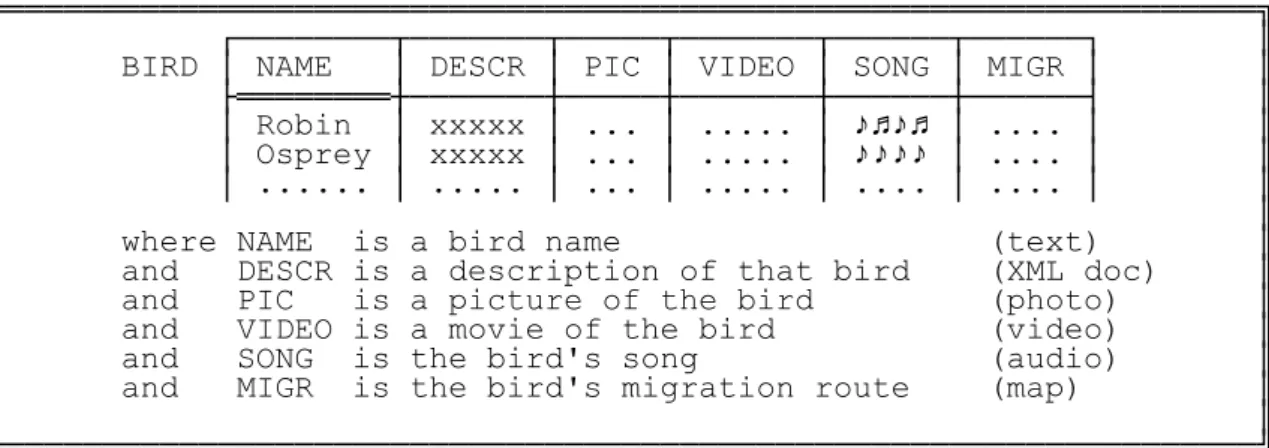
were capable of at the time; in other words, we needed to find a way of extending, dramatically, the range of possible kinds of data we could keep in our databases. For example, we might imagine a biological database that included a BIRD relation like the one shown in Fig. 1.1. Note: We follow convention in Fig. 1.1 and similar figures throughout this book in usingdouble underliningto mark components of primary keys—despite the fact that (as we will see in the next chapter) theManifesto
does not require primary key support.
╔═════════════════════════════════════════════════════════════════╗ ║ ┌────────┬───────┬─────┬───────┬──────┬──────┐ ║ ║ BIRD │ NAME │ DESCR │ PIC │ VIDEO │ SONG │ MIGR │ ║ ║ ├════════┼───────┼─────┼───────┼──────┼──────┤ ║ ║ │ Robin │ xxxxx │ ... │ ... │ ♪♫♪♫ │ .... │ ║ ║ │ Osprey │ xxxxx │ ... │ ... │ ♪♪♪♪ │ .... │ ║ ║ │ ... │ ... │ ... │ ... │ .... │ .... │ ║ ║ ║ ║ where NAME is a bird name (text) ║ ║ and DESCR is a description of that bird (XML doc) ║ ║ and PIC is a picture of the bird (photo) ║ ║ and VIDEO is a movie of the bird (video) ║ ║ and SONG is the bird's song (audio) ║ ║ and MIGR is the bird's migration route (map) ║ ║ ║ ╚═════════════════════════════════════════════════════════════════╝
Fig. 1.1: The BIRD relation
Before going any further, we should make it clear that, strictly speaking, the table in Fig. 1.1 is not really a relation at all, even though we said it was just now. Rather, it is apictureof a relation, as displayed on a computer screen perhaps, that contains among other things certain icons. Clicking on, say, the SONG (“♪♫♪♫”) icon in the Robin row in that picture might cause the system to play a recording of a robin singing; and, loosely speaking, it is that recording, not the icon, that is the actual value of the SONG component of the Robin row within the BIRD relation.
To get back to the main thread of our discussion: Of course, we would need to be able to operate on such new kinds of data, too. In the case of the BIRD relation, for example, we might want to find information concerning birds whose migration route includes Italy:
SELECT NAME, DESCR, SONG, VIDEO FROM BIRD
WHERE INCLUDES ( MIGR, COUNTRY('Italy') )
Note: We use SQL as the basis for this example for reasons of familiarity, despite the fact that (as indicated in the previous subsection) theManifestoexpressly proscribes it.
So the problem we were addressing was this: How could we support new kinds of data within the classical relational framework? (Of course, we did take it as axiomatic that we wanted to stay in that framework; it would be unthinkable to walk away from what is, at the time of writing, well over 35 years of relational research and development.) And the key to the solution was, of course,type theory:
Topics Deliberately Omitted
As you know by now, this book is not about SQL (at least, not directly). Nor is it about commercial products. Rather, it is aboutprinciples(in this context, just another word for foundations). Why? Because principles endure;1principles are solid; principles are what you need to know in order to be able to understand—and analyze, and evaluate, and perhaps judge—vendor claims, commercial products, the SQL language, and numerous other developments and pronouncements in the database field.
Of course, a real DBMS will necessarily include many features over and above those that can properly be regarded as foundation features as such. Such features include:
■ Recovery and concurrency controls
■ Security and authorization controls
■ Stored and triggered procedures (the latter more usually known, somewhat inappropriately, as just
triggers)
■ Support for the development of generic applications (e.g., some kind of call-level interface) ■ Performance tuning and other administration controls
and many other things besides. Now, we recognize that such features can be extremely important in practice—in fact, the quality of support for them can make or break a DBMS as a commercial
proposition. As already stated, however, they are not part of the foundation per se; they are therefore not addressed in theManifesto,and they are not discussed in the present book (at least, not much).
We also have little to say regarding matters of implementation. As explained in more detail in the section “Some Crucial Logical Differences” later in this chapter, we draw a sharp distinction between model issues and implementation ones, and we believe it is important to get the model right first before worrying about how to implement it—though we should immediately add that we have at least thought about implementation matters enough to have reason to believe that everything we propose is indeed implementable.2 In particular, much existing SQL implementation technology should be useful and usable in implementing the ideas of theManifesto,even though we reject SQL as such. (In fact, we venture to suggest that implementing theManifestoshould actually be easier than implementing SQL, for reasons we hope will become clear as we proceed.)
1 By contrast, products change all the time, and so does SQL.
2 In this respect, we might again claim to be following Codd, who wrote, possibly tongue in cheek, in his famous 1970
What about Objects?
Something else we need to explain at the outset has to do with our adoption—or lack thereof, rather, for the most part—of terminology from the object world.1 In the early to mid 1990s, there were those who argued that object technology was destined to replace relational technology. Few now subscribe to that position, but it might still be claimed that object technology at least does have some contributions to make to the database field. We do not dispute that claim; however, we prefer not to use object terminology, even when we make use of object concepts (or, at least, concepts that might have some counterpart in the object world), because we do not find that terminology appropriate to our purpose. For consider:
■ First of all, the very term objectitself does not seem to have a precise or universally agreed meaning. Sometimes it seems to mean avalue;sometimes avariable;sometimes even atype;
and there might be other interpretations as well. (Sometimes an object is defined to be an
instance,but that definition merely shifts the question of interpretation on to this latter term. In this book, therefore, we avoid the use of the terminstancealso, except in very informal contexts.) ■ As a label, moreover, that same term objectis applied to a wide variety of quite distinct
endeavors. It is used among other things to describe a certaingraphic interfacestyle, a certain
programmingstyle, certainprogramming languages(not the same thing as programming style, of course), and certainanalysisanddesigntechniques—all of these in addition to a certain approach to what is after all the principal focus of this book,database management. And it is quite clear that the term does not mean the same thing in all of these different contexts (see, e.g., the annotation to reference [9] in Appendix K).
Similar comments apply to other object terms as well (class, method,and so on). Given this state of affairs, therefore, and given also that we are trying to be precise in this book (for the most part, at any rate), we prefer to avoid terminology that might be subject to misinterpretation.
There is another point we need to make clear in this connection, though. In this book, we are (of course) interested in the field of database management. We are therefore interested in—among many other things—the applicability of object concepts and technology to that field. Please note, therefore, that all remarks made in this book concerning object concepts and technology must be understood in this light. We offer no opinion whatsoever regarding the usefulness of object ideas in any other context.
A Little History
Being organized as it is aroundThe Third Manifesto,this book can be seen as a reincarnation of, and replacement for, two previous books (though it has been drastically revised, and in fact totally rewritten). The first of those previous books was published in 1998, under the titleFoundation for Object/Relational Databases: The Third Manifesto[82]. We chose that title because “object/relational” DBMSs were a hot topic at the time; we were concerned in particular that certain portions of the
industry were going about implementing such DBMSs in a way that seemed to us seriously flawed, and
we wanted to do our best to help correct matters. In retrospect, however, we now realize the title was a little unfortunate in at least two respects:
■ It got the emphasis wrong, in that it suggested that the book was concerned with “object/relational” databases exclusively, whereas (as already indicated) the ideas of the
Manifestoare much wider-ranging.
■ In any case, we regard “object/relational” primarily as a marketing term. Indeed, it is our contention that a truerelationalsystem—that is, a system that supported the relational model properly, with all that such support entails—would in factbean “object/relational” system (which is why we usually set the term in quotation marks).
We went on to publish a revised version of that first book in 2000 under the somewhat better title
Foundation for Future Database Systems: The Third Manifesto[83]. But that title too was not perfect. The problem with the future is, it never arrives!—and we would like to see the industry in general act on the ideas of theManifestoas soon as possible (we take this subject seriously). Certainly there is room for improvement in the current crop of commercial products.
And so to the present book. This time we have chosen what we hope is a more appropriate title; in particular, we have tried to get away from the shortcomings of the two earlier titles. And we have, as already indicated, taken the opportunity to overhaul the text from beginning to end. Thus, although the overall message remains unchanged, what you hold in your hands is to all intents and purposes a brand new book.
BACK TO THE RELATIONAL FUTURE
It is a major thesis of both theManifestoand this book that we need to move away from SQL and get back to our relational roots. In other words, we do not believe that SQL is capable of providing the kind of solid foundation we seek. Rather, we believe any such foundation must be firmly rooted inthe relational model of data,first presented to the world in 1969 by E. F. Codd in reference [20].
Now, we have already said we acknowledge the desirability of supporting certain features that are commonly regarded as aspects of object orientation. However, we believe the features in question are orthogonal to (i.e., independent of) the relational model as such. In other words, we claim that the relational model needs noextension,nocorrection,nosubsumption—and, above all, noperversion—in order for it to be possible to define some database language that (a) is truly relational, (b) does
accommodate those desirable orthogonal features, and (c) can represent the firm foundation we seek. Let there be such a language, and let its name beD. Please note immediately that no special significance attaches to this choice of name—we use it merely to refer generically to any language that conforms to the principles laid down in theManifesto. There could be any number of distinct
languages all qualifying as a validD. We define one such language in this book; we call itTutorial D, and we use it as the basis for most of our examples.
proscriptions into RM and OO categories. The various prescriptions and proscriptions are itemized and discussed in detail in Parts II and III of this book.
In addition to the prescriptions and proscriptions just mentioned, theManifestoincludes a series ofVery Strong Suggestions,likewise divided into RM and OO categories; again, see Parts II and III. Also, Part IV contains the definition of a model of type inheritance, and that model is likewise
formulated as a series of prescriptions—Inheritance Model Prescriptions(IM Prescriptions). Please note, however, that almost everything to do with that inheritance model is ignored prior to Part IV, except for the occasional remark here and there. The material of Part IV extends, but does not invalidate, the material presented in earlier parts of the book.
For definiteness, we assume throughout theManifestoand throughout this book that the language Dis imperative in style. Like all such languages, therefore, it is based on the four core conceptstype, value, variable,andoperator.1 For example, we might have a type called INTEGER; the integer 3 might be a value of that type; N might be a variable of that type, whose value at any given time is some integer value (i.e., some value of that type); and plus might be an operator that applies to integer values (i.e., to values of that type). See the section “Some Crucial Logical Differences” later in this chapter for further elaboration of these concepts.
As an aside, we remark that if it is true that theManifestocan be regarded as defining a foundation for database technology, then the concepts of type, value, variable, and operator can be regarded as providing a foundation for that foundation. And since the value, variable, and operator concepts in turn all rely on the type concept, we might go further and say the type concept can be regarded as a foundation for the foundation for the foundation ... In other words, the type concept is the most fundamental of all, as we will soon see.
Back to the languageD. We have said thatDis imperative in style (or so we will assume). Now, some writers equate the termimperativewith the termprocedural,but we do not (even though they both refer to a style of programming in which the programmer explicitly directs the computer to carry out certain processes). Actually, neither term is very precisely defined; however,proceduralusually connotes a rather low level of abstraction, whileimperativedoes not (at least, not necessarily). In other words, procedural languages are imperative, but imperative languages are not necessarily procedural. In particular, the languageD—or its relational portion, at any rate—is at a comparatively high level of abstraction and is thus imperative but not procedural.
One last point to close this section: Do not infer from our assumption of an imperative style that we discount the possibility of (e.g.) a functional style; at the time of writing, however, we have not investigated such a possibility in any depth. But we should point out that certain of the prescriptions, proscriptions, and suggestions spelled out in this book would have to be reformulated in the context of a functionalD. For example, a functionalDwould obviously have no need of variables at all, in the usual programming sense of that term, and hence would not need any update operators either.
1 Note that we distinguish between operators and operations—anoperationis the process carried out when anoperatoris
SOME GUIDING PRINCIPLES
Throughout our work on theManifesto(and related work), we have tried to follow certain guiding principles, of which the most important—indeed, it underpins all the rest—is this:
All logical differences are big differences.
The relevance of this maxim, which is due to Wittgenstein [91], is as follows. The relational model is at hearta formal system:just as a DBMS is, or an operating system (or indeed any computer program, come to that). Formal systems are what computers are, or can be made to be, good at. And, of course, the basis of any formal system islogic. It follows that with respect to formal systems in general, and with respect to the matters that are the concern of theManifestoin particular, differences that are logical in nature are very important ones, and we need to pay very careful attention to them.
Incidentally, we might point out, slightly tongue in cheek, that Wittgenstein’s maxim has an interesting corollary: namely, thatall logical mistakes are big mistakes. Because, of course, a mistake is a difference—a difference between what is right and what is wrong. And we do unfortunately observe a number of logical mistakes that have been made, and still are being made, in the industry as a whole ...
We further conjecture that the inverse of Wittgenstein’s maxim is true as well: namely, thatall nonlogical differences are small differences—by which we mean, not that (e.g.) psychological
differences are unimportant in general, but that theyareunimportant from the point of view of formal systems in particular. In the context of theManifestospecifically, therefore, we pay little attention to nonlogical considerations, such as matters of syntax. (Syntax is important from a human factors point of view, of course, and in our design ofTutorial Din particular we have naturally tried to favor good syntax over bad. However, we do not regard differences that are mere differences in syntax as logical differences, nor as very important ones.)
Another fundamental principle we have tried to follow is that ofconceptual integrity(the term is due to Fred Brooks). In his classicThe Mythical Man-Month[12], Brooks has this to say:
[Conceptual] integrity isthemost important consideration in system design. It is better to have a system omit certain anomalous features [and] to reflect one set of design ideas, than to have one that contains many good but independent and uncoordinated ideas [italics in the original].
And writing 20 years later, he adds:
A clean, elegant programming product must present ... a coherent mental model ... [Conceptual] integrity ... is the most important factor in ease of use ...Today I am more convinced than ever. Conceptual integrityiscentral to product quality [boldface and italics in the original].
Let us elaborate briefly on this question of conceptual integrity. In order to maintain integrity of concepts, it is clearly necessary to have some concepts in the first place. Furthermore, the concepts in question had better be carefully chosen, preferably few in number, agreed upon by all parties
must not sacrifice the conceptual integrity of that model to some vaguely defined goal such as “keeping the syntax simple” [31].
We will have occasion to refer to these guiding principles many times over in the pages ahead.
SOME CRUCIAL LOGICAL DIFFERENCES
The following logical differences are worth examining right away, since they are relevant to just about everything to be discussed in this book:
■ Model vs. implementation
■ Value vs. variable
■ Value vs. appearance
Many others will be identified in the chapters to come. See also reference [79].
Model vs. Implementation
The first logical difference we want to discuss is that betweenmodelandimplementation. First some definitions:
■ A model(sometimes referred to as adatamodel specifically) is an abstract, self-contained, logical definition of the objects, operators, and so forth, that together constitute the abstract machine with which users interact.1 The objects allow us to model thestructureof data. The operators allow us to model itsbehavior. Note: The termobjectshere is to be understood in its generic sense, not in the special sense of object orientation. Also, the termusers,here and elsewhere throughout this book, is intended to mean end users and/or application programmers and/or transactions, as the context demands.
■ An implementationof a given model is a physical realization on a real computer system of the components of the abstract machine that together constitute that model. Note: The term
implementation,here and elsewhere throughout this book, is to be understood to mean
implementation of “the system” (i.e., the DBMS itself), not implementation of some application that runs on top of the DBMS.
As you can see, the distinction between model and implementation is really just an important special case of the familiar distinction between logical and physical aspects of a system. And just in case it might not be obvious, we would like to make it clear that our primary concern throughout the
1 The termarchitectureis sometimes used with much the same meaning. To quote Brooks once again, “the architecture of a
Manifesto,and throughout this book, is with the model specifically, not the implementation (though our informal discussions and explanations do occasionally touch on matters of implementation for purposes of clarification).
Observe, incidentally, that keeping the model and its implementation rigorously separate—in particular, not cluttering up the model with implementation matters—is what enables us to achievedata independence[76,86]. Indeed, we fail to achieve that objective precisely to the extent that we fail to observe that separation.
Value vs. Variable
The second logical difference we want to elaborate on here is that betweenvaluesandvariables(where byvariablewe mean a variable in the usual programming sense). Following Cleaveland [19], we define these concepts as follows:
■ A valueis an “individual constant”: for example, the individual constant that is the integer 3. A value hasno location in time or space. However, values can be represented in memory by means of some encoding, and such representations, or (our preferred term in this context)appearances,
do have locations in time and space. Indeed, any number of distinct appearances of the same value can exist at any number of distinct locations in time and space, meaning, loosely, that any number of different variables—see the bullet item immediately following—can have the same value, at the same time or different times. Note in particular that, by definition,a value cannot be updated;for if it could, then after such an update it would not be that value any longer (in general).
■ A variableis a holder for an appearance of a value. A variable does have a location in time and space.1 Also, of course, variables, unlike values,can be updated;that is, the current value of the variable in question can be replaced by another value, probably different from the previous one. (Of course, the variable in question is still the same variable after the update
Please note very carefully that it is not just simple things like the integer 3 that are
legitimate values. On the contrary, values can be arbitrarily complex; for example, a value might be a geometric point, or a polygon, or an X ray, or an XML document, or a fingerprint, or an array, or a stack, or a list, or a relation (and on and on). Analogous remarks apply to variables too, of course.
By the way, the distinction between values and variables might seem obvious; however, it is not always observed in the literature (in fact, it is easy to fall into traps in this area). By way of illustration, consider the following extract from a tutorial on object databases [137] (the italicized text in brackets is commentary by the present authors):
We distinguish the declared type of a variable from ... the type of the object that is the current value of the variable [so an object is a value] ... We distinguish objects from values [so an object
1 We are speaking intuitively here, not formally. The notion that variables “have location” is useful for explaining what
is not a value after all] ... Amutator[is an operator such that it is] possible to observe its effect on some object [so in fact an object is a variable].
Value vs. Appearance
The third and last logical difference we want to discuss here is the one, touched on in the preceding subsection, between a value per se and an appearance of that value in some particular context (in particular, an appearance as the current value of some variable). As already explained, the very same value can appear in many different contexts simultaneously. Each of those appearances consists, internally, of some encoding or physical representation of the value in question. For example, the integer value 12 occurs exactly once in the set of integers—there is exactly one integer 12 “in the universe,” as it were—but any number of variables might simultaneously contain an appearance of that integer as their current value, as in thisTutorial Dexample:
VAR X INTEGER ; VAR Y INTEGER ;
X := 12 ; /* assign the value 12 to the variable X */ Y := 12 ; /* assign the value 12 to the variable Y */
What is more, some of those appearances might be physically represented by means of (say) a decimal encoding, and others by means of a binary encoding, of that particular integer (in the example, X might contain the “packed decimal” encoding 00010010 while Y contains the “pure binary” encoding 00001100). Thus, there is also a logical difference between an appearance of a value, on the one hand, and the internal encoding or physical representation of that appearance, on the other; in fact, there might even be a logical difference between the encodings used for different appearances of the same value.
The foregoing remarks notwithstanding, we usually find it convenient, for fairly obvious reasons, to abbreviateencoding of an appearance of a valueto justappearance of a value,or (more often) to justvalue,so long as there is no risk of ambiguity in doing so. Note carefully too thatappearance of a valueis a model concept, whereasencoding of an appearanceis an implementation concept. For example, users certainly might need to know whether variables X and Y contain appearances of the same value (i.e., whether those variables “compare equal”); however, they do not need to know whether those appearances use the same physical encoding.
CONCLUDING REMARKS
1. Scalar types
2. Scalar values are typed
3. Read-only vs. update operators 4. Physical vs. possible representations 5. Expose possible representations 6. Type generator TUPLE
7. Type generator RELATION 8. Equality
9. Tuples 10. Relations 11. Scalar variables 12. Tuple variables
13. Relation variables (relvars) 14. Kinds of relvars
15. Candidate keys 16. Databases 17. Transactions 18. Relational algebra
19. Relvar names, relation selectors, and recursion 20. User-defined tuple and relational operators 21. Assignments
22. Comparisons 23. Integrity constraints 24. Total database constraints 25. Catalog
26. Language design
RM Proscriptions
1. No attribute ordering 2. No tuple ordering 3. No duplicate tuples 4. No nulls
5. No nullological mistakes 6. No internal-level constructs
9. No domain check override 10. Not SQL
OO Prescriptions
1. Compile-time type checking 2. Type inheritance (conditional) 3. Computational completeness 4. Explicit transaction boundaries 5. Nested transactions
6. Aggregate operators and empty sets
OO Proscriptions
1. Relvars are not domains 2. No object IDs
RM Very Strong Suggestions
1. System keys 2. Foreign keys
3. Candidate key inference 4. Transition constraints 5. Quota queries
6. Generalized transitive closure 7. User-defined generic operators 8. SQL migration
OO Very Strong Suggestions
1. Type inheritance
2. Types and operators unbundled 3. Single-level store
We close this chapter by confessing that we do feel a little uncomfortable with the idea of calling what is, after all, primarily a technical document a “manifesto.” According toChambers Twentieth Century Dictionary,a manifesto is “a written declaration of the intentions, opinions, or motives” of some person or group (e.g., a political party). By contrast,The Third Manifestois—we hope—a matter of science and logic, not mere “intentions, opinions, or motives.” Given the
EXERCISES
1.1 Define and distinguish between the termsdatabaseandDBMSas carefully as you can. What do you regard as the foundations of database technology?
1.2 What do you understand by the termorthogonality?
1.3 Explain the following in your own words: architecture; implementation; conceptual integrity; logical difference; data independence; model.
1.4 What isThe Third Manifesto? What problem was it originally intended to solve?
1.5 In the body of this chapter, we said the concepts oftype, value, variable,andoperatorcan be regarded as providing “a foundation for the foundation.” Explain this remark as carefully as you can.
1.6 What do you understand by the term “object/relational database”?
1.7 Explain the logical differences between a value, an appearance of a value, and an encoding of an appearance of a value.
1.8 What isD?
1.9 In the body of this chapter, we said the table in Fig. 1.1 was not a relation but, rather, a
pictureof a relation (in general, in fact, there is always a logical difference between a thing and a picture of that thing). What are some of the specific points of difference between the table in Fig. 1.1 and the relation it depicts?
1.10 Distinguish betweenimperative, procedural,andfunctionalprogramming languages. Give examples of each. Can you identify any other language styles?
1.11 Who was E. F. Codd?
A S u r v e y o f t h e R e l a t i o n a l M o d e l
Most of this book assumes you have a reasonably good understanding of the relational model. This chapter is meant to serve as a quick refresher course on that model; in effect, it summarizes much of what you will be expected to know in later chapters. A detailed tutorial on this material, and much more, can be found in reference [76]; if you are familiar with that reference, you probably do not need to read this chapter in detail. But if your knowledge of the relational model derives from other sources—especially ones based on SQL—then you probably do need to read this chapter fairly carefully, because it emphasizes numerous important topics that other sources typically do not. Such topics include:
Relations vs. types
Relation values vs. relation variables
Predicates and propositions
Relation-valued attributes
The crucial role of integrity constraints
Relational assignment and comparisons
and many others.
THE RUNNING EXAMPLE
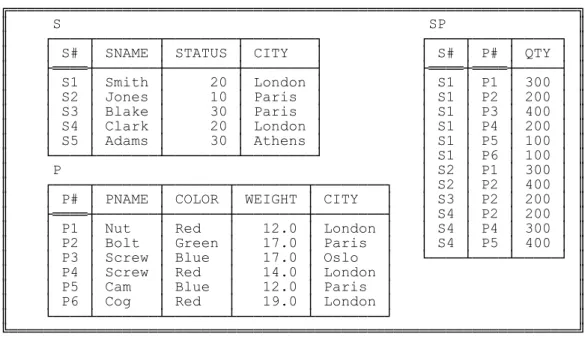
Examples in this book are based for the most part on the familiar suppliers-and-parts database (see Fig. 2.1 for a set of sample values). The semantics are as follows:
Relvar S representssuppliers(more accurately, suppliersunder contract).1 Each supplier has one supplier number (S#), unique to that supplier; one name (SNAME), not necessarily unique (though the SNAME values in Fig. 2.1 do happen to be unique); one rating or status value (STATUS); and one location (CITY).
1 The termrelvaris short forrelation variable. It is explained in detail in the section “Relation Variables” later in this
chapter. Also, note that throughout this book we favor the termsrelation, attribute,andtuple──usually pronounced to
Relvar P representsparts(more accurately,kindsof parts). Each kind of part has one part number (P#), which is unique; one name (PNAME); one color (COLOR); one weight (WEIGHT); and one location where parts of that kind are stored (CITY).
Relvar SP representsshipments(it shows which parts are supplied by which suppliers). Each shipment has one supplier number (S#), one part number (P#), and one quantity (QTY); there is at most one shipment at any given time for a given supplier and a given part. Notice that the database of Fig. 2.1 includes one supplier, S5, with no shipments at all.
╔═════════════════════════════════════════════════════════════════╗ ║ S SP ║ ║ ┌────┬───────┬────────┬────────┐ ┌────┬────┬─────┐ ║ ║ │ S# │ SNAME │ STATUS │ CITY │ │ S# │ P# │ QTY │ ║ ║ ├════┼───────┼────────┼────────┤ ├════┼════┼─────┤ ║ ║ │ S1 │ Smith │ 20 │ London │ │ S1 │ P1 │ 300 │ ║ ║ │ S2 │ Jones │ 10 │ Paris │ │ S1 │ P2 │ 200 │ ║ ║ │ S3 │ Blake │ 30 │ Paris │ │ S1 │ P3 │ 400 │ ║ ║ │ S4 │ Clark │ 20 │ London │ │ S1 │ P4 │ 200 │ ║ ║ │ S5 │ Adams │ 30 │ Athens │ │ S1 │ P5 │ 100 │ ║ ║ └────┴───────┴────────┴────────┘ │ S1 │ P6 │ 100 │ ║ ║ P │ S2 │ P1 │ 300 │ ║ ║ ┌────┬───────┬───────┬────────┬────────┐ │ S2 │ P2 │ 400 │ ║ ║ │ P# │ PNAME │ COLOR │ WEIGHT │ CITY │ │ S3 │ P2 │ 200 │ ║ ║ ├════┼───────┼───────┼────────┼────────┤ │ S4 │ P2 │ 200 │ ║ ║ │ P1 │ Nut │ Red │ 12.0 │ London │ │ S4 │ P4 │ 300 │ ║ ║ │ P2 │ Bolt │ Green │ 17.0 │ Paris │ │ S4 │ P5 │ 400 │ ║ ║ │ P3 │ Screw │ Blue │ 17.0 │ Oslo │ └────┴────┴─────┘ ║ ║ │ P4 │ Screw │ Red │ 14.0 │ London │ ║ ║ │ P5 │ Cam │ Blue │ 12.0 │ Paris │ ║ ║ │ P6 │ Cog │ Red │ 19.0 │ London │ ║ ║ └────┴───────┴───────┴────────┴────────┘ ║ ╚═════════════════════════════════════════════════════════════════╝
Fig. 2.1: The suppliers-and-parts database—sample values
Here areTutorial Ddefinitions for these three relvars:
VAR S REAL RELATION
{ S# S#, SNAME NAME, STATUS INTEGER, CITY CHAR } KEY { S# } ;
VAR P REAL RELATION
{ P# P#, PNAME NAME, COLOR COLOR, WEIGHT WEIGHT, CITY CHAR } KEY { P# } ;
VAR SP REAL RELATION
{ S# S#, P# P#, QTY QTY } KEY { S#, P# } ;
Detailed discussion of the foregoing definitions can be found in Chapter 6, under RM Prescription 13. For present purposes, it is sufficient to observe that:
Each attribute has atype;for example, the types of the attributes of relvar S are called S#, NAME, INTEGER, and CHAR, respectively.
In this chapter we will mostly take types for granted—we will discuss them in detail in the next chapter—but it is at least worth stating explicitly that attributes can be ofany type whatsoever.1 In particular, those types can be either system defined (built in) or user defined. In our running example, we will assume, where it makes any difference, that types INTEGER (integers) and CHAR (character strings of arbitrary length) are system defined and all others are user defined.
TUPLES
Since relations are built out of tuples, it is convenient to begin by defining the termtupleprecisely. Given a collection of typesTi(i= 1, 2, ...,n,wheren0), not necessarily all distinct, atuple value (tuplefor short) over those types2—t,say—is a set ofnordered triples of the form <Ai,Ti,vi>, where
Aiis anattribute name,Tiis atype name,andviis avalueof typeTi. Moreover:
The valuenis thedegree(orarity) oft.
The ordered triple <Ai,Ti,vi> is acomponentoft.
The ordered pair <Ai,Ti> is anattributeoft,and it is uniquely identified by the attribute nameAi(attribute namesAiandAjare the same only ifi=j). The valueviis theattribute valuefor attributeAioft. The typeTiis the correspondingattribute type. Note: There is, of course, a logical difference between an attribute and its name; among other things, an attribute is a pair but its name is a singleton. This fact notwithstanding, we often (as we just did) use expressions such as “attributeAi,” informally, to mean the attribute whosenameis
Ai. Similar remarks apply to various other constructs, including types, variables, and operators.
The complete set of attributes is theheadingoft.
Thetuple typeoftis determined by the heading oft,and the heading and that tuple type both have the same attributes (and hence the same attribute names and types) and the same degree astdoes. Thetuple type nameis, precisely, TUPLEH, whereHis the heading. Thus, the particular tuple type name under discussion can be expressed inTutorial Das follows:
TUPLE { A1 T1, A2 T2, ..., An Tn }
The order in which the attributes are specified is immaterial, however; thus, for example,
1 This remark is true in general, but there are exceptions, of which one of the most important is this: Attributes of relations in the database──as opposed to relations that are local to the application (see RM Prescription 14)──are not
allowed to be of typepointer. See Chapter 9 for further explanation.
TUPLE { A1 T1, A2 T2 } and TUPLE { A2 T2, A1 T1 }
both denote the same tuple type, inTutorial D. Here is a sample tuple:
┌────┬────┬───────┬──────┬────────┬─────────┬──────┬──────┐ │ S# S# │ SNAME NAME │ STATUS INTEGER │ CITY CHAR │ ├────┴────┼───────┴──────┼────────┴─────────┼──────┴──────┤ │ S1 │ Smith │ 20 │ London │ └─────────┴──────────────┴──────────────────┴─────────────┘
The attribute names here are S#, SNAME, STATUS, and CITY; the corresponding type names are, respectively, S#, NAME, INTEGER, and CHAR; and the corresponding values are, respectively, S#('S1'), NAME('Smith'), 20, and 'London'—though most of these expressions have been simplified somewhat in the picture (and we will make use of similar simplifications in such pictures
throughout this book). The degree of this tuple is four. Its heading is:
┌────┬────┬───────┬──────┬────────┬─────────┬──────┬──────┐ │ S# S# │ SNAME NAME │ STATUS INTEGER │ CITY CHAR │ └────┴────┴───────┴──────┴────────┴─────────┴──────┴──────┘
Its type inTutorial Dterms is:
TUPLE { S# S#, SNAME NAME, STATUS INTEGER, CITY CHAR }
Now, it is common in informal contexts to omit the type names from a heading, showing just the attribute names. Informally, therefore, we might represent the foregoing tuple thus:
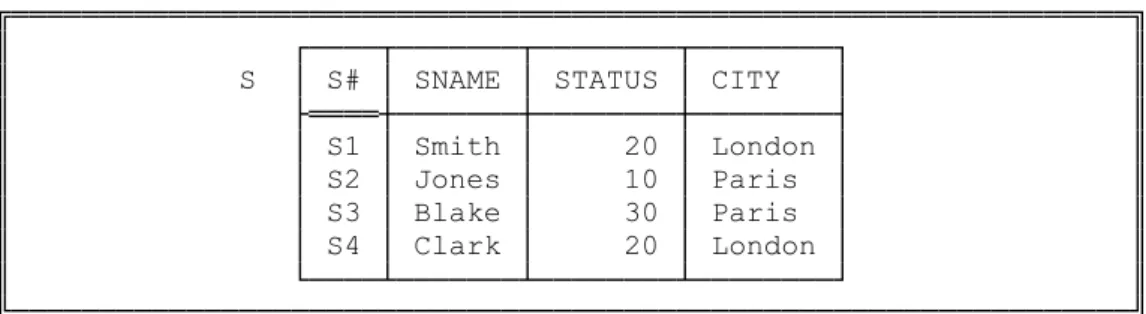
┌────┬───────┬────────┬────────┐ │ S# │ SNAME │ STATUS │ CITY │ ├────┼───────┼────────┼────────┤ │ S1 │ Smith │ 20 │ London │ └────┴───────┴────────┴────────┘
InTutorial D,the following expression could be used to denote this tuple:
TUPLE { S# S#('S1'), SNAME NAME('Smith'), STATUS 20, CITY 'London' }
This expression is an example of atuple selector invocation. We will have more to say about such expressions in Chapter 3; here we just remark that—as you might have noticed—the keyword TUPLE does double duty inTutorial D,being used in connection with both tuple selector
invocations and tuple type names. An analogous remark applies to the keyword RELATION (see the next section, “Relations”).
Properties of Tuples
Tuples possess a number of important properties, all of them immediate consequences of the foregoing definitions. To be specific:
Note carefully that, by definition, a tuple considered in its entirety is also a value. For emphasis, we sometimes speak of “tuple values” explicitly, but we usually abbreviate that term to justtuples(exactly as we usually abbreviate, e.g., “integer values” to justintegers).
There is no left-to-right ordering to the components of a tuple. This property follows because a tuple has asetof components, and sets in mathematics have no ordering to their elements. (Our reason for including the redundant qualifier “left-to-right” in the foregoing sentence is explained in the next section.)
Every subset of a tuple is a tuple and every subset of a heading is a heading. Given some particular tuple, therefore—say the tuple
┌────┬───────┬────────┬────────┐ │ S# │ SNAME │ STATUS │ CITY │ ├────┼───────┼────────┼────────┤ │ S1 │ Smith │ 20 │ London │ └────┴───────┴────────┴────────┘
—then what we might call “the {S#,CITY} value in this tuple” is itself a tuple:
┌────┬────────┐ │ S# │ CITY │ ├────┼────────┤ │ S1 │ London │ └────┴────────┘
In like fashion, every subset of a heading is a heading.
As an aside, we note that this bullet item is the first place in the text to use the termsubset. We therefore take the opportunity to say that, throughout this book, we take statements of the form “bis a subset ofa” (equivalently, “ais a superset ofb”), noncontroversially, to include the
possibility thataandbmight be equal; if we wish to exclude that possibility, we will talk explicitly in terms ofpropersubsets and supersets. Also, we take statements of the form “ais a set” (again noncontroversially) to include the possibility thatamight be empty; if we wish to excludethat
possibility, we will talk explicitly in terms ofnonemptysets. Tuple Equality
Two tuples are equal, obviously enough, if and only if they are in fact the very same tuple (just as, e.g., two integers are equal if and only if they are the very same integer). However, it is worth spelling out the semantics of tuple equality in detail, since so much in the relational model depends on it; for example, candidate keys, functional dependencies, and most of the operators of the relational algebra are all defined in terms of it. Here then is a precise definition:
■ Tuples t1andt2areequalif and only if they have the same attributesA1, A2, ..., Anand, for alli(i= 1, 2, ...,n), the value ofAiint1is equal to the value ofAiint2.
Differences” in Chapter 1 if you need to refresh your memory regarding the meaning of the term
appearance.)
RELATIONS
Now we can define the termrelation. Arelation value(relationfor short),rsay, consists of a
headingand abody,where:
Theheadingofris a heading as defined in the previous section. Relationrhas the same attributes (and hence the same attribute names and types) and the same degree as that heading does.
Thebodyofris a set of tuples, all having that same heading (and the cardinality of that set is thecardinalityofr).
Therelation typeofris determined by the heading ofr,and it has the same attributes (and hence the same attribute names and types) and degree as that heading does. Therelation type nameis, precisely, RELATIONH, whereHis the heading. InTutorial D,therefore, we can express a relation type name as here:
RELATION { A1 T1, A2 T2, ..., An Tn }
(The order in which the attributes are specified is immaterial, however.) Here is a sample relation:
┌────┬────┬───────┬──────┬────────┬─────────┬──────┬──────┐ │ S# S# │ SNAME NAME │ STATUS INTEGER │ CITY CHAR │ ├────┴────┼───────┴──────┼────────┴─────────┼──────┴──────┤ │ S1 │ Smith │ 20 │ London │ │ S2 │ Jones │ 10 │ Paris │ │ S3 │ Blake │ 30 │ Paris │ │ S4 │ Clark │ 20 │ London │ │ S5 │ Adams │ 30 │ Athens │ └─────────┬──────────────┴──────────────────┴─────────────┘
Its type inTutorial Dis:
RELATION { S# S#, SNAME NAME, STATUS INTEGER, CITY CHAR }
As previously noted, it is common in informal contexts to omit the type names from a heading, showing just the attribute names. Informally, therefore, we might represent the foregoing relation thus (as we did in Fig. 2.1, in fact):