Exercises designed on statistical methods and their impact on the development of
physical and motor capabilities of the legs and on achieving 100 metres race for
juniors runners
Dr. Mokhalad Mohammad Jasim, Dr. Mohammad Jasim Faculty of Physical Education & Sports Sciences- Babylon
University-Iraq
Article Info
Received: November 25, 2016
Accepted: December 30, 2016
Published online: Jun 1, 2017
Abstract:
This study focuses on what has been achieved from showing the effective contribution of physical and motor capabilities of the runners' legs muscles in (100) metres race for juniors, their achievement in it. It also investigates the extent of contribution of each of these capacities in that achievement, and the effects of the exercises designed upon the statistical methods on developing those capabilities and improving the achievement. The authors have empirically carried out many tests related to the capabilities and executed the items of the designed exercises (before and after the experiment) with 72 attempts. The data of these tests results have been dumped and analyzed statistically, taking into consideration the requirements of presentation and registration required to comply with rules and legal procedures.
From the above mentioned it was concluded that there are high correlative links between some of the investigated capabilities and the achievements of the runners in the competition. This matter inevitably contributed to developing runners' capabilities and improving their recorded achievement, relying on the impact of statistically designed exercises.
Keywords: designed exercises, statistical methods, physical and motor capabilities, (100) metres runners, achievement
1. Introduction:
performance. The reason is that it deals with the maximum speed of the competitor and accuracy of performance from the beginning of the competition to its end.
To obtain such capabilities, the competitors must undergo systematic training aiming for their comprehensive development, and this development in all its aspects can only be achieved through the quantitative calculations of the components of the excersise load and also the relationship between them. Accordingly, the process of the scientific approach in the planning of exercises for junior athletes in (100) meters race upon the extent of their contribution in their achievement is of great importance in the diagnosis and determination methods for any of these capabilities concerned with the legs muscles of the junior runners in (100) meters competition, especially those related to their achievement. As the scarcity and the weakness of them will cause a problem that requires designing proper exercises based on the right scientific planning for developing the physical and motor capabilities of the legs which have the biggest role in improving the records of the competition's juniors runners.
As far as the authors know, such studies, especially those concerned with the planning of training upon statistical methods, have not been studied. However, the contributions of predecessors in dealing with such a problem should not be neglected. This study can be considered as continuation of what precedes (if any) or qualitative addition helps researchers and teachers to apply planning processes to achieve the objectives of their teaching processes. There is no solution to the problem of our research only by achieving the following objectives:
1. To know which of the physical and motor abilities of the legs muscles of runners in 100 metres junior contest is of effective contribution in their achievement, as well as the rate of the contribution of each of these capabilities which caused achievement.
2. Knowing the effect of the designed exercises upon the statistical methods in developing the physical and motor capabilities of the leg muscles which contributed to achieve (100) metres competition and improve that achievement of junior runners.
2. Research Methodology:
For achieving the research goals, the authors have undertaken the following procedures:
1. Adopting the empirical approach in solving the problem of the research as they are matching together or as it is the most appropriate one for it. Such a method is the most transparent solution to many scientific problems in both practical and theoretical ways. (215: 3)
2. The research community was identified by the juniors contestants in the (100) meters competition. These juniors were members of local clubs in the city of Najaf in Iraq numbering(16) runners ,(12) of them were selected randomly to be the primary sample of the research (106:4). the tests were applied at a rate of (6) attempts for each of runners. So The total of the sample items were (72) attempts.
3. Identifying the physical and motor capacities of the legs muscles of junior runners in (100) metres competition with their tests. This can be obtained by presenting them in statistical forms on 15 experts and in the range of (0-10) for the capabilities, and 25 experts for the tests that were determined between (3-5) tests for each capability. After processing the responses statistically by using the test of coefficient of determination (r2), the results have nominated (4) (physical and motor) capabilities and a test for each capability to represent it.
5. To provide the objective conditions for conducting the exercises planning process to be applied on the research sample, the authors conducted the main experiment. In the experiment, the pre-tests were conducted for the (100) m running within the legal conditions, as well as measuring the physical and motor capabilities of the individuals of the research sample, as the tests have been repeated (6) times over a period of (12) days started off 2016/9/25. Thus, they were able to obtain a sample of (72) operational attempts for the race and the capabilities conducted by (12) junior runners.
6. To enable the authors to achieve their goals, a set of statistical methods in the analysis and processing of research data was used, such as; arithmetic mean, standard deviation, standard error, Kay square, spearman correlation test, T test for correlation, regression coefficient, T test for two interrelated samples. (1: 127-295), and the Law of Impact Size (2: 211).
3. Results and Discussion
For achieving the research goals, it is important to know the results of the research variables, they are as the following:
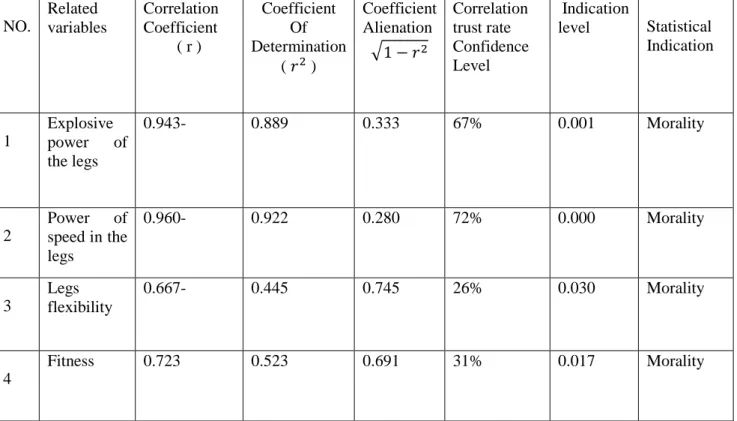
1. For the purpose of showing the correlative relationships between the total achievement of the competition and the investigated capabilities, the results have been processed statistically. and the researchers obtained the correlation matrix shown in Table 1. The results in Table 1 shows that all the correlative relationships between the achievement of the junior runners of (100)m competition and their physical and motor abilities of the muscles of the legs are high with significant statistical indication. This helps the authors with calculating regression coefficients to calculate the time estimates for training any physical and motor capacity for runners. Thus, the authors performed the statistical analysis(regression) using ( step wise) on the research data for the purpose of obtaining the rates of the contribution of each influential capability in the achievement of the competition as explained in Table 2.
Table 1 Correlation between the achievement of the competition of (100) m and the physical and motor capabilities of the junior runners
NO.
Related variables
Correlation Coefficient
( r )
Coefficient Of Determination
( 𝑟2 )
Coefficient Alienation
√1 − 𝑟2
Correlation trust rate Confidence Level
Indication
level Statistical Indication
1
Explosive power of the legs
0.943- 0.889 0.333 67% 0.001 Morality
2
Power of speed in the legs
0.960- 0.922 0.280 72% 0.000 Morality
3
Legs flexibility
0.667- 0.445 0.745 26% 0.030 Morality
4
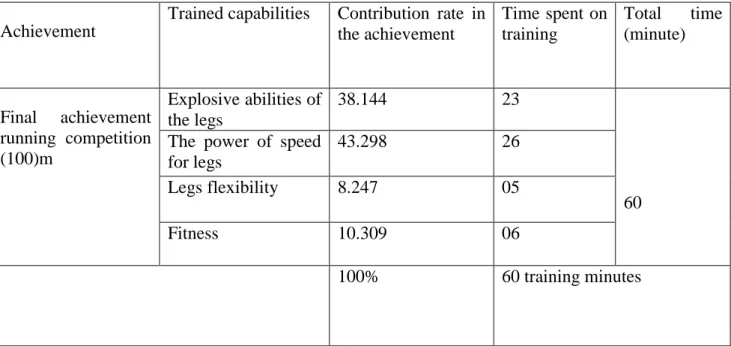
2. The results of Table 2 show that the time of each physical or motor capability contributed in achieving (100) m running competition can be calculated. As the contribution rate of each capability is figured out, and from which its time can also be calculated. For example, the training time of the explosive power of the athlete's legs muscles is calculated as follows:
Explosive power time = 144, 38/100 × 60 (training time in the main phase of the training unit) =22,886 = 23 minute
Table 2: Values of regression equation coefficients derived from correlations of achievement and capacity Dependent variable (the achievement) Independent variables
(capability tests results)
Constant value (A)
Regression coefficients (B1,B2,B3,B4)
Standard Error Error rate Variable contribution rate
Achievement of
(100) m
competition
long jump from stillness
(physical)
12.955
0.033 0.077 0.000 %38.144
Long jump
forward (10) sec (physical)
0.042- 0.010 0.017 %43.247
Sit and Reach ( mobile)
0.008 0.005 0.047 %8.247
Crossed running between
barriers
0.010 0.016 0.000 %10.309
Total 0.097 100%
Thus, it is possible to calculate the training time for all the physical and motor capabilities required to be trained in each training unit as planned. The result of the time planning for the researched capacity training is described in Table 3.
Table 3: Contribution rate of the training capabilities and its allotted time in the training unit
Achievement
Trained capabilities Contribution rate in the achievement
Time spent on training
Total time (minute)
Final achievement running competition (100)m
Explosive abilities of the legs
38.144 23
60 The power of speed
for legs
43.298 26
Legs flexibility 8.247 05
Fitness 10.309 06
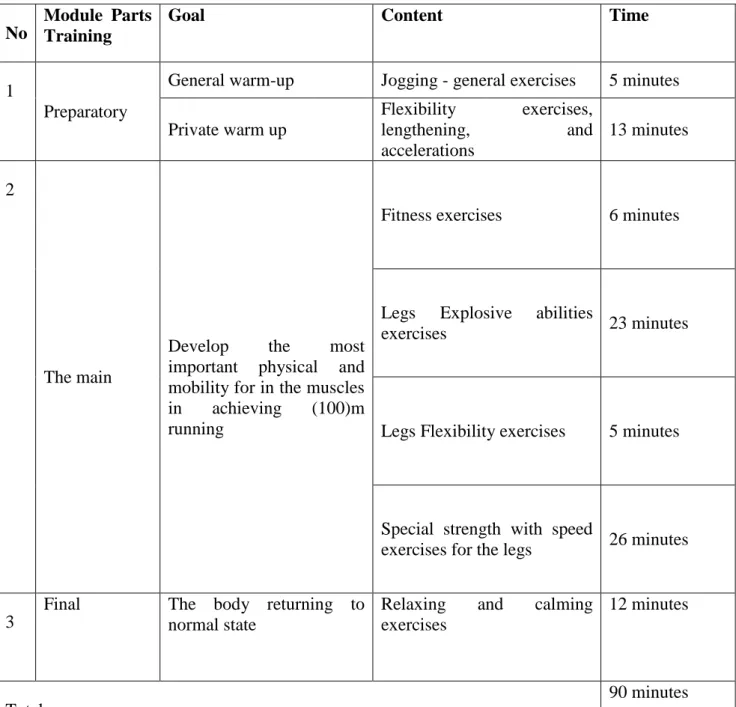
3. After analyzing the rates of the contribution of the physical and motor capabilities investigated in the achievement and representing it by the time units and according to the time of the main part of the training module of (60) minutes, it was necessary for authors to apply them on the exercises (using the staircase style) in order to develop these capabilities and improve achievement within the training modules of the total time (90) minutes,Table 4 shows a sample for dividing this training module.
Table 4: Model of the division of the training unit and the content of the training according to the scheduled time and the required target.
No
Module Parts Training
Goal Content Time
1
Preparatory
General warm-up Jogging - general exercises 5 minutes
Private warm up
Flexibility exercises,
lengthening, and
accelerations
13 minutes
2
The main
Develop the most important physical and mobility for in the muscles in achieving (100)m running
Fitness exercises 6 minutes
Legs Explosive abilities
exercises 23 minutes
Legs Flexibility exercises 5 minutes
Special strength with speed
exercises for the legs 26 minutes
3
Final The body returning to normal state
Relaxing and calming exercises
12 minutes
Total
90 minutes
5. After the process of applying the exercises of capacities development and improving the performance of the runners in the (100) m running competition which extended over(8) weeks with (24) training units at a rate of (3) training units per week, the post-measurement with the same procedures were performed under the same pre-experiment measurement conditions, after the expiry of the training period by two days. To know its details, look at Table 5.
Table 5: Statistical estimates of the results of the tests on capabilities and achievement before and after the planned exercises
No. Research variables
Esteem and measurement units
Mean Standard
Deviation
Standard Error Distribution Indication
Before after before after before After
1 Legs explosive ability
Meter and its parts
2.101 2.68 0.217 0.043 0.342 0.009 Moderate
2 Legs power with speed
Meter and its parts
30.85 36.95 2.31 1.56 0.472 0.318 Moderate
3 Legs flexibility
Centimeter 10.42 15.96 3.08 2.29 0.628 0.467 Moderate
4 Fitness Second and its parts
11.08 8.39 1.58 0.786 0323 0.160 Moderate
5 (100) m
running achievement
Second and its parts
11.92 11.21 0.278 0.201 0.057 0.041 Moderate
6. The results have referred to the validity of the research tools, the devices and utilities, sufficiency of the work team, handling the difficulties associated with the work, and choosing the proper time for work, etc. It is also characterized by scientific coefficients in term of objectivity and consistency, ranged between ( 0.86- 0.92) which are significant coefficients in the correlation when selected in the test ( t) for indication of the coefficient of correlation with the value of (3.37 – 4.69) in comparison with the value of (t) scalability of (2.78) at (4) degree of freedom and (0.05) significance level.
Effect of the designed exercises statistically using the staircase method on the investigated capabilities and the achievement of the (100) m running.
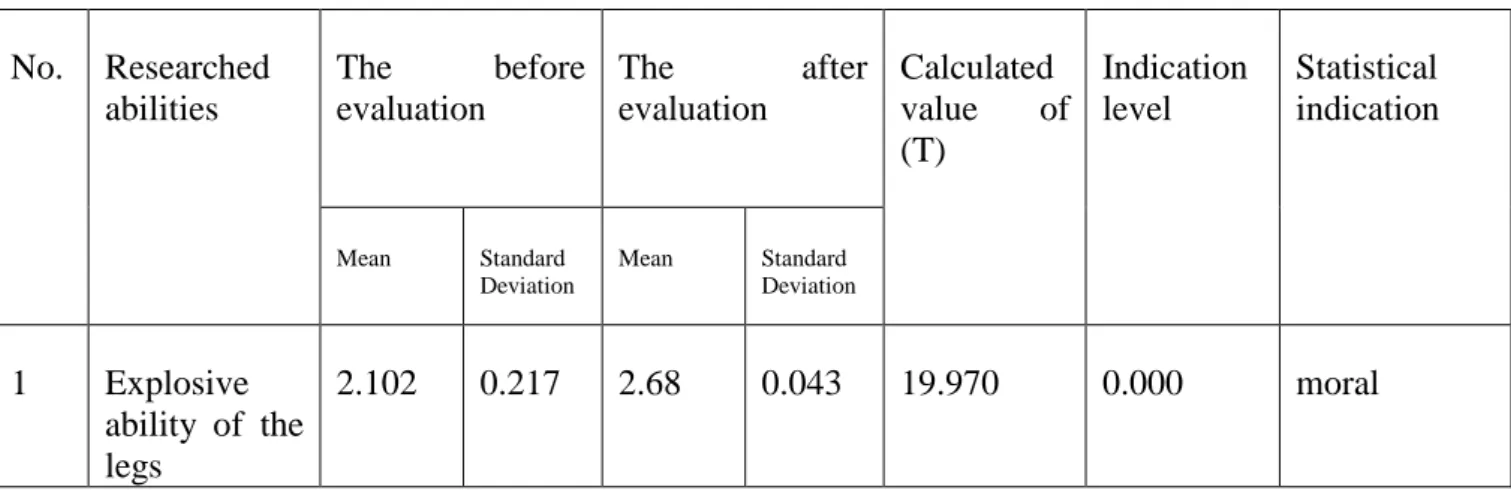
of statistical estimates values (means and standard deviations) obtained from the measurements (before and after application). For the purposes of obtaining the varieties and the differences in these values, the tests were tested by (Test T) for the correlative samples. The calculated T- test values were significant ,at a level of indication less than (0.05). This means that the development of capabilities and improvement in the recorded achievement is confirmed to a reliable degree. For the purpose of knowing the magnitude of the impact exercises in both physical and motor capabilities and overall achievement, the equation of effect size (
r
2)has been used as follow:r= 𝑡2+Degree of freedom √ 𝑡2
where:
r= effect size
t= t-test, comparison of means between two groups
The equations results shows that the effect effect size of the designed exercises executed with the staircase style were large in all of the physical and motor capabilities and the total achievement of the (100) meter competition, as shown in Table 7.
It is no wonder that the results obtained by the authors indicate that there is a significant impact on the physical and motor capabilities of the runners legs in (100)m competition for juniors, that helped to improve their recorded achievement in this competition. The reason behind that was the actual and significant relationship with statistical indication between each of them, in varying degrees, and that is because of the differences in the contribution rates of each capability in the achievement. These rates were also the basis for the planning of exercises related to their developing. The staircase training style supports that. This style is considered an exciting exercise that elevates the runner to new levels by “taking advantage of reducing body weight, and increasing the strength and ability highly that makes the body a mass of power and strength” (6b-y). This exercise also focuses on working on the muscles of the leg, thigh and back muscles greatly through the use of different and varied exercises interspersed with the identification of new goals in the training with generating challenges and pressures that help stimulating the brain of the runner and increasing the desire to train, especially when these exercises include continuous change in intensity and density.
Table 6: Demonstrate the effect of the planned(statistically schematic) training of the stairs for the development of physical and motor(kinetic) abilities and the achievement of (100)m running
meters for juniors
No. Researched abilities
The before evaluation
The after
evaluation
Calculated value of (T)
Indication level
Statistical indication
Mean Standard Deviation
Mean Standard Deviation
1 Explosive ability of the legs
2 Legs power with speed
30.85 2.31 36.95 1.56 27.650 0.000 moral
3 Legs flexibility
10.417 3.08 15.96 2.29 13.432 0.000 moral
4 Fitness 11.08 1.58 8.39 0.786 11..696 0.000 moral
5 (100) m
running achievement
11.92 0.278 11.212 0.201 32.974 0.000 moral
Table 7: The amount of the magnitude of the impact (t) and the degree of impact for each of the researched abilities and the achievement
No. Researched abilities The value of the calculated impact
The standard The impacts degree
1 Explosive abilities of the legs
0.92 0.50 and above Very high
2 Legs power with speed 0.96 0.50 and above Very high
3 Legs flexibility 0.85 0.50 and above Very high
4 Fitness 0.81 0.50 and above Very high
5 (100) m running
achievement
0.97 0.50 and above Very high
Summary
The following conclusions can be drawn from the results found:
1. The performance of the sample of the junior runners of (100) m the competition in all physical and motor capabilities measured (before and after the development of the exercises) and the overall achievement of the competition is distinct with moderate distribution.
2. The results showed high correlation between the abilities of the runners and their achievements of (100) m because of the contribution of each one to that achievement.
4. The results indicate an increase in the size of the impact of the designed exercises according to the statistical methods in developing the physical and motor abilities of the leg muscles of the competitors in the competition of (100) m and improving their recorded achievement.
Sources and references
1. Mohammed Jasim Al-Yasiri. Principles of Educational Statistics, p: Najaf Al - Ashraf, Dar Al - Diaa for printing Publishing, 2011
2. Mohammed Jasim Al-Yasiri (and others). Analytical Statistics between Theory and Practice: Najaf Al Ashraf, Dar Al Diaa Press and Publishing, 2011.
3. Mohamed Hassan Allawi, Osama Kamel Rateb. Scientific research in physical education and psychology Riyadi: Cairo, Arab Thought House, 1999
4. Wage Mahjoub (and others). Methods of scientific research and its methods in physical education: Baghdad, Press Higher Education, 1988.
5. Https://www.fitandme.com/stair - climber - benefits2 stair climber Benefits you Absolu telly Need To Know .