164
Unenforceable Securitization Contracts
Tracy Lewis† and Alan Schwartz††
A “portfolio” here is a bundled set of contracts. In this Article, we address a commercially important example, where a local bank finances home purchases. The bank bundles the resultant contracts—the mortgage-backed securities (MBS)—into a portfolio, which it then sells to a firm, denoted an “originator.” The originator buys portfolios from several local banks and sells the portfolios to a large bank, which markets the portfolios to public-investment vehicles, such as trusts. “Portfolio contracts” govern each of these sales.
We show that the initial portfolio contract between the local bank and originator is unenforceable for two reasons. First, in contrast to goods sellers, who warrant that the goods perform, the local bank warranted that it created each of the constituent MBS in the portfolio according to good underwriting practice. Hence, while breach is observable to the goods buyer (who can see that the goods did not perform), the portfolio buyer cannot observe breach because efficiently and inefficiently created MBS are facially identical. Thus, an MBS buyer would have had to reconstruct how the local bank created particular loans in order to establish a warranty breach. Second, the goods in a bundle usually are homogenous, so the buyer can prove damages by extrapolating the loss on sampled goods to the whole. In contrast, the MBS in a portfolio usually are heterogeneous: the loans have different face values, and the individual obligors have paid different sums before defaulting. Hence, the
† Fuqua School of Business, Duke University.
†† Yale Law School and Yale School of Management. Schwartz was retained by certain trusts who had sued the banks that they bought mortgage-backed loan portfolios from. Schwartz was not the trusts’ litigation expert—the issue he consulted on was whether the trusts should accept the banks’ settlement offers. Earlier versions of this paper benefited from presentations at the American Law and Economics Association Meeting (2017), the Law and Economics Theory Conference (2017), the Public Economic Theory Conference (2016), Law and Economics Workshops at the Buchman Law School, Tel Aviv University, the Columbia Law School, the Fuqua School of Business at Duke University, and a Faculty Workshop at Yale Law School; and from comments by Ian Ayres, Ralph Brubaker, Ronald J. Gilson, Benjamin Johnson, Alvin Klevorick, Roy Kreitner, Zachary Mollengarden, Michael Moore, and Robert E. Scott.
165
originator must prove damages contract by contract. For these reasons, it would have been too costly for an originator to prove breach and damages.
The originator, however, sold the MBS portfolio to the large bank, remaking the unenforceable local-bank warranties that had been made to them. The large bank then remade the warranties to the public-investment vehicles. These vehicles were even less able than the originators to enforce the best-practice warranties. Hence, no one could—and no one did—enforce an MBS-portfolio contract as it was written.
Anticipating this result, the originating local banks reduced pre-loan screening of potential borrowers. This increased the number of marginal borrowers with two results: (i) many borrowers defaulted because they could not pay, and (ii) some borrowers who could pay defaulted strategically because they believed that the large number of defaulters overwhelmed a portfolio buyer’s capacity to pursue them.
Anecdotal data indicate that market agents today continue to sell MBS portfolios under similar unenforceable contracts. A material fall in housing prices thus could yield macroeconomic consequences similar to those experienced in the Great Recession.
Introduction ... 166
A. Distribution Chains ... 167
B. Overview ... 171
I. Optimal Loan Origination and Securitization ... 181
A. A Model of the Short Intermediation Chain ... 182
B. The Long Intermediation Chain ... 185
C. The Possibility of Contagion ... 188
II. Warranties, Asymmetric Information, and the Enforcement Difficulty ... 191
A. Verification Difficulties ... 192
B. Trust Litigation Strategies ... 197
C. Contagion Revisited ... 200
III. Why the Standard MBS-Portfolio Contract Exists ... 201
A. Current Contract Law ... 201
B. Creating an Efficient MBS-Portfolio Contract ... 202
C. Inadequacy of Default Rules ... 204
D. Paving the Way for an Efficient Contract—Revenue-Recognition Rules and Bankruptcy Remoteness ... 204
IV. Would Reform Help?... 207
V. Policy Implications and Reforms ... 210
A. Rejecting Dodd-Frank ... 210
B. Creating an Efficient MBS Contract ... 212
C. Rescuing Homeowners in Hard Times ... 214
166
Introduction
We begin with three widely accepted facts.
First, in the period leading up to the Great Recession, banks made many mortgage-backed home loans (herein sometimes “MBS”) to borrowers who would not have previously qualified for the loans. Second, the banks (herein “local banks” or “originating banks”) securitized the home loans: that is, a local bank would sell the loans it originated to a second financial intermediary. Through a distribution chain described immediately below, public investors ultimately came to own the loans. Third, during the Great Recession, defaults on home loans greatly exceeded their historical average, with disastrous macroeconomic effects. Commentators assume that these three facts are related; securitization in some way created incentives for the local banks to make loans to borrowers who were unlikely to repay. When economic distress became widespread, many risky borrowers could not withstand the pressure to default.
This stylized story raises two questions. First, how did securitization increase a bank’s incentive to make risky loans? Second, why did sophisticated profit-maximizing firms create and sell MBS through a distribution channel that increased the probability of defaults? These questions are relevant today because financial firms continue to use essentially the same distribution channel.1 Thus, another substantial economic shock could cause a second
unfortunate spike in defaults.
1. See Matt Phillips, Wall Street Loves These Risky Loans. The Rest of Us Should Be Wary., N.Y. TIMES (Oct. 19, 2018), https://www.nytimes.com/2018/10/19/business/economy/clo-corporate-loans.html [https://perma.cc/Q7TC-EHWN]:
A financial assembly line that went haywire a decade ago and contributed to an economic crisis is gearing up again on Wall Street.
Back then, one of the products the banks churned out—bond like investments based on thousands of mortgages—proved far riskier than most banks, investors and regulators had expected when many borrowers couldn’t pay. The banking system froze, a financial panic ensued and the country experienced its worst recession in decades.
This time around, a similar kind of investment, called C.L.O.s, for collateralized loan obligations, are at the heart of the boom. And that’s not the only parallel: The loans are being made to risky borrowers. Lending standards are dropping fast, and regulators are easing the rules.
No-down-payment loans, or loans in which the seller financed the down payment, were among the riskiest loans during the Great Recession and were later prohibited. The Federal Housing Administration, however, now is working with private nonprofits to subsidize down payments for borrowers who lack the resources to make down payments. These subsidies are classified as second loans on the property. See Ben Eisen & Laura Kusisto, Home Buyers Get Government Help with Down Payments, WALL ST.J. (June 16, 2019),
https://www.wsj.com/articles/home-buyers-get-government-167 We approach these questions in two ways. First, we offer a novel and plausible theory to explain why securitization incentivizes local banks to make risky home loans. Second, we set out an original, comprehensive explanation for why sophisticated agents created and continue to use the inefficient MBS-distribution channel.
This Introduction begins by sketching a typical MBS-distribution channel. We then introduce our theory of why securitization worsened bank incentives and explain why sophisticated actors distributed, and continue to distribute, MBS in the same questionable way. The Article then expands on our arguments and offers further supporting evidence.
A. Distribution Chains
In a “short intermediation chain,” individuals lend money to a local bank through deposits, and the bank then relends the money in the form of home loans supported by mortgages. Because the bank holds the loans and accompanying mortgages from creation to maturity, it internalizes the costs and realizes the gains from efficiently screening potential borrowers for their ability to repay and efficiently monitoring loans in response to default. Short intermediation chains, however, no longer govern home finance.
Instead, MBS during the Great Recession were distributed through “long intermediation chains,” and this practice continues today. Such a chain begins when a local bank sells the loans it creates to an entity called an “originator.” The local bank does not sell one loan at a time but rather bundles the loans into a “portfolio.” Portfolio sales from the local bank to the originator are characterized by asymmetric information: notably, the originator cannot observe the originating local bank’s practice in making loans or the “quality” of the individual borrowers. In a case like this, when a seller is better informed about a new product than the buyer, the seller customarily warrants product quality. Local banks thus made warranties to the originators regarding the quality of loans they created.
An originator—the first MBS-portfolio purchaser—can be an independent firm or a subsidiary of a large bank. In either event, the originator would buy MBS portfolios from several local banks and sell the portfolios to a larger bank. Again, because these were sales, the originator, when selling portfolios to
help-with-down-payments-11560677400 [https://perma.cc/ME53-78CS]. More formally, a recent paper refers to “the revival of the structured finance market with over $3.10 trillion in securities issuance between January 2010 and June 2015.” Jordan Nickerson & John M. Griffin, Debt Correlations in the Wake of the Financial Crisis: What Are Appropriate Default Correlations for Structured Products?, 125 J.FIN.ECON. 454, 455 (2017).
168
large banks, would remake the warranties regarding loan quality that the local bank had made to it. The large bank, commonly called a “seller,” then would resell the portfolio, pursuant to a “Mortgage Loan Purchase Agreement,” to another financial intermediary, called a “purchaser.” The seller would remake the warranties the originator made to it to the purchaser, oftentimes a trust.2
The parties to the Mortgage Loan Purchase Agreement also would make an accompanying contract, the “Pooling and Servicing Agreement.” The Mortgage Loan Purchase Agreement required the purchaser to deposit the mortgage loans into a mortgage pool comprising the trust fund. The trust fund would be evidenced by “a single series of ‘mortgage pass-through certificates’ [which] will consist of... classes of certificates. The Certificates will be issued pursuant to a Pooling and Servicing Agreement.”3 The parties to the related
Pooling and Servicing Agreement were (i) the seller under the Loan Purchase Agreement, now called the “depositor”; (ii) an entity called the “servicer,” whose task was to service the loans; and (iii) the trustee.
Finally, the trust would sell the certificates it held to public investors. A public investor thus became a partial owner of the relevant MBS portfolio. As such, the investor bore the purchase risk: it was entitled to the payments that the ultimate obligors—the home buyers—had to make, but it bore the loss when those payments shrank or stopped.
The servicer was the trust’s agent. A typical Pooling and Servicing Agreement would provide that:
The servicer shall service and administer the Mortgage Loans and shall have full power and authority... to do any and all things which it may deem necessary or desirable in connection with such servicing and administering, all in accordance with Accepted Servicing Practices....[T]he Servicer may allow a modification
2. These agreements took a standard form. As an example, one such contract provided: The Seller agrees to sell, and the Purchaser agrees to purchase, on or before February 28, 2007 (The “Closing Date”), certain conventional mortgage loans (the “Mortgage Loans”) originated by Opteum Financial Series LLC (“Opteum” or the “Originator”) having an aggregate principal balance as of the close of business on February 1, 2007, of $603,341,258.09 . . . . The Seller will prepare or cause to be prepared on or prior to the Closing Date a final schedule (the “Closing Schedule”) that together shall describe such Mortgage Loans and set forth all of the Mortgage Loans to be purchased under this Agreement. The Closing Schedule will conform to the requirements set forth in this Agreement and to the definition of “Mortgage Loan Schedule” under the Pooling and Servicing Agreement.
Mortgage Loan Purchase Agreement Between Citigroup Global Markets Realty Corp. and Citigroup Mortgage Loan Trust § 1 (Feb. 15, 2007). Many, many similar contracts could be quoted.
3. Id. Though the MBS in a single sale sometimes were originated in the same period, the loans were for different face values, and the individual obligors defaulted at different stages of their repayment schedules.
169
with respect to a Mortgage Loan if the Servicer would take such action in the ordinary course of its business if it were the owner of the Mortgage Loan. . . .4
The Pooling and Servicing Agreements also contained a limitation of liability term providing that neither the servicer, the depositor, the seller, nor the Trust:
shall be under any liability to... the Trust Fund or the Certificate Holders for any action taken or from the refraining of any action taken in good faith pursuant to this Agreement or for errors in judgment; provided that this provision shall not protect any Protected Party [the purchaser, seller, etc.] against any breach of representations or warranties made by it herein . . . .5
As said, each MBS-portfolio seller made representations and warranties: that the mortgage loans were not in default at the time of sale; that the loans were made in the ordinary course of the seller’s business; that the sales would be structured to minimize tax liabilities; and so forth. Relevant to this Article, sellers customarily warranted that ”[t]he origination, collection and servicing practices used by the Seller, any Originator and Prior Servicers, with respect to each Mortgage Note and Mortgage have been legal and in accordance with applicable laws and regulations, and in all material respects proper and prudent in the mortgage origination and servicing business.”6
The key takeaway from this schematic description is that commercial parties traded MBS portfolios in a highly impoverished information environment.7 Namely, there were four sale levels: from originating local bank
4. CFLX 2007-2 Trust § 5.01; Flow Mortgage Loan Purchase, Warranties and Servicing Agreement § 8.03 (2005). Servicers sometimes were restricted to modifying a subset of portfolio loans. For an extensive description of the servicing function, see Adam J. Levitin & Tara Twomey, Mortgage Servicing, 28 YALE J. ON REG. 1 (2011).
5. Pooling and Servicing Agreement in Connection with BSABS 2005-SD1 Trust § 7.04 (emphasis added). This is a typical term. In an alternative-distribution form, the party that buys from the originator would assign the mortgages to the trust, pursuant to an “Assignment and Recognition Agreement.” These assignment contracts also made warranties and limited liabilities, just as the “Mortgage Loan Purchase Agreements” did.
6. J.P. Morgan Mortgage Acquisition Corp. Purchaser and Chase Manhattan Mortgage Corporation Seller and Servicer § 301.h (Jan. 1, 2004) (emphasis added). We quote similar warranties from other contracts in note 18 infra.
7. The text describes the distribution channel for private-label loans, which are loans that a federal agency does not guarantee. Because the portfolios went through several hands, the channel is called a long intermediation chain. This was a large market. In 2006, private-label loans constituted 56% of real-estate MBS issuance and 21% of total mortgages outstanding by dollar amount. 2 INSIDE
MORTG.FIN.,THE 2010MORTGAGE MARKET STATISTICAL ANNUAL 9-10 (2010); see also James J. Dow, Jr., Mortgage Origination During 2002-2007 as an Example of an Evolutionary Market, 26 J. EVOLUTIONARY ECON. 1007, 1017 (2016) (“In fact, towards the end of the boom in 2005 and 2006, the
170
to originator, from originator to larger bank, from larger bank to trust, and from trust to public investors who were ultimately the certificate holders. None of these buyers observed, or could observe, the local originating banks’ lending practices or the quality of the individual borrowers. The point of securitization, however, was to make MBS informationally opaque: the buyers were supposed to treat an MBS as they would treat money. People do not ask what backs money; they just accept money. Similarly here, portfolio buyers and public-trust investors were not supposed to ask what backed the MBS securities; they were just supposed to take the securities.8
When everyone acted in this way, credit to finance home purchases would be maximized. An implicit premise of this system, however, was that the MBS themselves were efficiently created, even if not every loan would perform. This premise, in turn, relied on the loan-quality warranties that every portfolio seller made to every portfolio buyer to induce efficient underwriting practices and efficient postdefault salvage practices. These premises are what we contest in our explanation for the poor performance of securitization markets.9
private-label market was securing more mortgages than [government-agency-sponsored loans].”); Robert M. Mooradian & Pegaret Pichler, Servicer Contracts and the Design of Mortgage-Backed Security Pools, 46 REAL ESTATE ECON. 698, 701 (2018) (“[B]y 2007 nearly 20% of outstanding mortgage credit is through nonagency securitization, without guarantees against default risk.”). For an extensive discussion of the economics and structure of long intermediation chains for various consumer contracts, including mortgages and credit cards, see Gary Gorton & Andrew Metrick, Securitization, in
HANDBOOK OF THE ECONOMICS OF FINANCE 1 (2013). Particularly relevant to this Article, these authors remark, “The contractual nature of securitization also needs more attention . . . . Nothing is known about servicers of securitized portfolios or about the contractual arrangements with servicers.” Id.at 63, 64. We describe these contracts here and show infra how the servicers performed.
8. Many of the MBS portfolios were organized in tranches. A Pooling and Servicing Agreement would create senior and junior classes of certificate holders (i.e., the public investors). There could be as many as twenty-one classes in a single public offering. Certificate holders were paid in order of seniority. Because poorly performing portfolios generated some cash, the most senior certificate holders, rated AAA, did much better than junior certificate holders, whose certificates were rated as low as BBB. Over one trillion AAA-rated tranches defaulted on their claims, however. See Nickerson & Griffin, supra note 1, at 454. Our concern is the relation of securitization to the default rate, so we do not analyze the tranching process itself.
9. Two prominent commentators claimed that securitization “transforms illiquid, low-grade loans into publicly traded assets of high quality.” BENGT HOLMSTROM &JEAN TIROLE, INSIDE AND
OUTSIDE LIQUIDITY 8 (2011). When loans are bundled into a portfolio, the portfolio holder can sell
interests in the portfolio because buyers are protected by the law of large numbers: the many good loans offset the few bad ones. Securitization, as Holmstrom and Tirole claim, thus transforms illiquid loans into liquid investment securities. On the other hand, a low-quality loan—a bad loan—cannot become a good loan just because the originating bank sells the loan to another intermediary. The sale does not change the individual obligor’s risk profile. It follows that selling a hundred bad loans must produce a hundred-member portfolio of bad loans. Holmstrom and Tirole’s claim that the loan portfolio is “of high quality” thus must rest on the implicit premise that the originating bank optimally pre-screened the individual borrowers. As such, portfolio-default rates would be the product of circumstance: i.e., some loans inevitably fail, rather than also be a function of improvident loans to high-risk borrowers.
171
B. Overview
We introduce our theory explaining contract failure in securitization markets in four steps.
Step One: The originator could not enforce the local bank’s warranty of loan quality for two related reasons: (i) the local bank did not warrant loan performance—an output—but rather warranted underwriting-practice quality— an input; and (ii) the local bank warranted the quality of each loan.10 To
enforce the local bank’s warranties, the originator thus would have had to identify each nonperforming loan and show that that particular loan was improperly created. This would have been an almost impossible burden for the originator to bear because the originator could not observe the input—the quality of the local bank’s underwriting practice—in connection with each individual loan. Further, as shown, the originator would resell the loans and remake the local bank’s warranties. This next buyer—the depositor/seller—was even further removed from the originating context than the originator. Hence, depositors/sellers could not have enforced the warranties at all had they ultimately held the loans. But instead of holding the loans, they marketed the loans to trusts, remaking the warranties that had been made to them. The trust was even further away from the originating context than the seller bank.
Step Two: To the extent that local banks realized that they would not be sued on the warranties they made, they would have an incentive to relax lending standards because lending costs fall as borrower-screening costs fall.
Step Three: Lax screening by local banks would reduce the quality of the loan pool—that is, more loans would be made to unqualified borrowers. This would increase the number of “necessary” defaults: defaults by borrowers who could not pay.
Step Four: To the extent that individual borrowers realized that a greater-than-usual number of borrowers was defaulting, an individual borrower who could pay would have an incentive to default strategically, believing that the probability of being punished for default would fall as the relevant servicer’s ability to enforce loans became more strained. The increasing number of poorly performing loans traceable (at least in considerable part) to the unenforceable warranties thus also could produce a “contagion effect”; there would be both necessary and strategic defaults, with an increase in the former contributing to an increase in the latter.
10. Seesupra note 6 and accompanying text; and infra note 17-18 and accompanying text (elaborating on warranties).
172
Our theory yields a simple answer to the first question we posed: securitization increased the number of bad loans, and hence the number of defaults, because no bank in the distribution chain could be held liable for making bad loans.11 We next introduce evidence that supports our four-step
theory and summarize the legal and economic reasons why sophisticated commercial parties traded hundreds of billions of dollars of MBS under unenforceable contracts. The Article then expands on these claims.
Our argument in “Step One” begins by contrasting the typical contract to sell goods with the MBS-portfolio contract that local banks made with originators.12 The typical goods seller warrants its “output”: the goods will
perform as promised.13 Such output warranties take three forms:
(i) the seller promises that the goods meet specifications, such as size or color;
(ii) the sale is “by description,” i.e., the seller of a widget agrees that the product will do what widgets commonly do;14
(iii) the seller
(a)guarantees that the product is free from defects in materials and workmanship; and
(b)promises that the seller will repair or replace defective parts or systems.15
Form (iii)(a) warrants aspects of the seller’s performance, but the seller’s liability is triggered by the good’s nonperformance. Thus, the buyer need not
11. Our explanation is not exclusive. Some commentators have traced the increase in bad loans in the 2005-2007 period to increased pressure that senior bank officials put on lending officers.
See, e.g., Simon Sepe, Regulating Risk and Governance in Banks: A Contractarian Perspective, 62 EMORY L.REV. 327 (2012).We claim only that when a seller knows that she will not be liable on the promises she makes, she is less likely to keep those promises. The Article’s novelty is its showing that the warranties sellers made in connection with MBS sales were unenforceable.
12. Classifying contracts by subject matter, there are (i) contracts to sell goods; (ii) contracts to sell services; (iii) contracts to sell a single contract; and (iv) contracts to sell numerous contracts (the MBS portfolio). Categories i and ii are familiar to lawyers and economists. Category iii may be less familiar, but several statutes and a large scholarly literature concern it. See, e.g., U.C.C. arts. 3, 4 (AM.
LAW INST.&UNIF.LAW COMM’N 2017). This contract form includes assignments of contract rights and the negotiation of financial instruments. See, e.g., Clayton P. Gillette, Alan Schwartz & Robert E. Scott, PAYMENT SYSTEMS AND CREDIT INSTRUMENTS (1996). We analyze category iv contracts, whose properties, we claim, lawyers and commentators have largely overlooked.
13. For illustrative purposes, we focus on the difference between the contract to sell contracts and the contract to sell goods. Contracts to sell services are similar to contracts to sell goods in relevant respects.
14. Section 2-314(2)(a) of the U.C.C. provides that goods are merchantable if they “pass without objection in the trade under the contract description.” U.C.C. § 2-314(2)(a) (AM.LAW INST.& UNIF.LAW COMM’N 2017).Section 2-314(2)(c) of the U.C.C. similarly requires goods to “be fit for the ordinary purposes for which such goods are used.”
173 show which defective part or system caused the product to fail. Rather, the seller must fix the problem.
In contrast, the originating local bank did not warrant its output—that the MBS portfolio the local bank created would perform—in its sale to the originator.16 Rather, the bank warranted its “input”: that the bank created each portfolio contract appropriately. The originating bank thus warranted that it made each loan in accordance with customary lending standards; it conducted each home appraisal appropriately;17 each borrower lived in her home—i.e., the
borrower was not a speculator; and so forth.18
To understand the operational difference between the goods-output warranty and the MBS-input warranty, suppose that a buyer purchased a $10,000 machine but that defects reduced the machine’s efficiency by 30%. If the buyer accepted the machine, it could reduce the price by $3,000.19 Now let
an originating bank sell a portfolio of a hundred loans, each of face value $100,000. If a 1% default rate is acceptable, the market would value the portfolio at $9,900,000 (discounted to present value). But suppose the default rate turned out to be 30%. The portfolio buyer could not sue the originating
16. A portfolio would perform if the individual borrowers, or most of them, paid off their loans.
17. Trust plaintiffs alleged that originating banks failed to conduct appraisals in accordance with standard appraisal practice. See Nomura Home Equity Loan, Inc. v. Nomura Credit & Capital, Inc., 29 N.Y.3d 992 (2017).
18. See, e.g., Assignment and Recognition Agreement Among Citigroup Global Markets Reality Corp., Citigroup Mortgage Loan Trust, Inc. and WMC Mortgage Corp., at xxii (Jan. 31, 2006) (emphasis added) (“The origination and collection practices used with respect to each Mortgage Note and Mortgage have been in all respects legal, proper, prudent and customary in the mortgage origination industry.”); Flow Mortgage Loan Purchase, Warranties and Servicing Agreement, Between JP Morgan Mortgage Acquisition Corp. (Purchaser) and Chase Manhattan Mortgage Corporation § 3.01q (stating that the Mortgage Loan complies with all the terms, conditions and requirements of the Seller’s Underwriting Guidelines in effect at the time of origination of such Mortgage Loan); Mortgage Loan Purchase Agreement Between Citigroup Mortgage Loan Trust Inc. and Citigroup Global Markets Reality Corp., at xxi (Feb. 15, 2007) (stating that the origination, servicing and collection practices used by the Originator with respect to each Mortgage Note and Mortgage have been in all respects legal, proper, prudent and customary in the mortgage origination and servicing industry); Mortgage Loan Purchase Agreement Between EMC Mortgage Corporation and Structured Asset Mortgage Investment II Inc., at xvii (Jul. 29, 2005) (“Each Mortgage Loan was originated . . . in conformity with the underwriting standards of and purchased by a subsequent mortgagee that was either a savings and loan association, savings bank, commercial bank . . . .”) (emphasis added). Additionally, the RMBS Trust Settlement Agreement between JP Morgan Chase & Co. (a portfolio seller) and institutional investors in several-hundred trusts provided, in one of the introductory recitals: “WHEREAS, the Institutional Investors have alleged that certain Mortgage Loans held by the trusts in breach of representations and warranties contained in the Governing Agreements, cause the Investors in such Trusts to seek to compel the trustee” to take legal action. RMBS Trust Settlement Agreement (Nov. 15, 2013) (emphasis added). Many more such examples are available.
19. U.C.C. § 2-714(2) (AM. LAW INST. & UNIF. LAW COMM’N 2017) (“The measure of damages for breach of warranty is the difference at the time and place of acceptance between the value of the goods accepted and the value they would have had if they had been as warranted . . . .”).
174
bank for $2,900,000, the unanticipated decline in portfolio value. Rather, because the local bank warranted its input, the originator would have to identify each nonperforming loan and show that the originating bank did not write that loan in accordance with standard underwriting practice.20
The MBS-portfolio contracts were not enforceable largely because no portfolio buyer could observe—at acceptable cost—how the originating bank created the constituent portfolio loans. In contrast, the goods buyer can observe a warranty breach directly: the washing machine does not clean; the dish washer does not wash; the car does not run. If a buyer purchases a bundle of goods, he can establish breach by taking a sample because the goods in a bundle usually are identical: they are all washing machines. In contrast, the portfolio buyer would have to “get behind” the portfolio to observe how each
nonperforming loan to learn how it was made: did the originating bank check the borrower’s income and job status? Where she lived? What her credit rating was? Because the MBS portfolios that originators purchased contained hundreds or thousands of loans, it was not economical for them to check how each defaulting loan was made.
In addition, the goods buyer usually can establish causation easily. For example, a well-made washing machine cleans, and the seller warranted performance. Hence, courts find prima facie that the seller breached its quality warranty if the machine does not clean. It is more difficult for the loan buyer to establish causation because a portfolio can underperform for three reasons:
(i) exogenous events, such as a recession or a natural disaster, caused many portfolio borrowers to default;
20. Regarding remedies:
If the Seller or originator . . . does not cure such . . . [warranty] breach in all material respects, the Trustee shall enforce the obligations of the related Originator . . . and then, to the extent that the related Originator fails to cure such defect or breach, the related Originator or the Seller, as the case may, [shall] repurchase that Mortgage Loan from the Trust Fund at the Purchase Price . . . .
Pooling and Servicing Contract JPALT 2005-A § 2.5(a) (emphasis added). Additionally, “to the extent that the related Originator fails to cure such defect or breach . . . the related Originator or the Seller . . . as the case may be, [shall] repurchase that Mortgage Loan from the Trust Fund at the Purchase Price.”
Pooling and Servicing Contract JPALT 2006-A1 § 2.5(a) (emphasis added). The repurchase price would be the unpaid loan balance, plus unpaid accrued interest plus costs, less “Monthly Advances and advances paid to the purchaser of the Mortgage Loan (if any).” Pooling and Servicing Agreement Governing the Structured Asset Mortgage Investments II Trust2007-AR4, at 41 (Aug. 1, 2007) (defining “Repurchase Price”). Some courts have held that a warranty breach is actionable if it materially reduced the value of a particular loan; in other words, the buyer need not show that the loan was in default. See, e.g., Homeward Residential, Inc. v. Sand Canyon Corp., 298 F.R.D. 116 (S.D.N.Y. 2014); Assured Guar. Mun. Corp. v. Flagstar Bank, F.S.B.,892 F. Supp. 2d 596(S.D.N.Y. 2012).Because a loan is not performing in ordinary usage if it falls materially in value or defaults, this Article uses the phrase “nonperforming” to refer to both default types.
175 (ii) an atypically large set of defaulters would have received loans even if
the originating bank had appropriately investigated;
(iii)a different set of defaulters would not have been extended loans had the originating bank appropriately investigated.
The originator could only recover damages for loans in the third category; it would have to exclude defaults in categories (i) and (ii).
Finally, it is less costly to prove damages for breach of a goods warranty than for breach of the MBS warranty because goods usually are identical, but mortgages are not. For example, let a merchant purchase 1,000 washing machines, which it values at v each, sample fifty, and find that (a) all fifty were defective; and (b) the defects reduced the value of each machine by 20%. A court will award the buyer damages of 0.2v times 1,000. Damages for breach of a warranty that a loan was efficiently originated are the difference between the face value of the loan and the payments the borrower made before defaulting.21
Suppose, then, that the buyer purchased a portfolio of 1,000 mortgage loans, and the face value of one identified loan was $250,000, on which the borrower had paid $60,000 before defaulting. A court will not (and courts have not) permitted the buyer to establish damages by multiplying $190,000—the sample defaulted sum—by the number of nonperforming portfolio loans. This is because portfolio loans commonly have different face values (i.e., they are for different amounts), and borrowers default after paying off different portions of their loans. Therefore, the portfolio buyer must prove damages loan by loan.
As a result of these difficulties, there was an “unenforcement cascade.” The trusts, suing on behalf of the certificate holders, could not enforce the warranties that the depositor/seller banks made to them. The depositor/seller banks, not being liable, had no standing to sue the originators, and the originators, not being liable, had no standing to sue the local banks. Consistent with this analysis, no selling bank has been held liable on the warranties it made to a trust. And so far as appears, neither the originators nor the local banks have been sued directly on their warranties at all.
Steps Two and Three: There is substantial evidence that local originating banks reduced lending costs by suboptimally screening potential borrowers.22
21. U.C.C. § 2-714(2) (AM.LAW INST.&UNIF.LAW COMM’N 2017).
22. Scholars have found that securitization led to suboptimal screening. Benjamin J. Keys, et al., Did Securitization Lead to Lax Screening?: Evidence from Subprime Loans, 125 Q.J.ECON. 307 (2010); see also Dong Beom Choi & Jung-Eun Kim, Securitization and Screening Incentives: Evidence
from Mortgage Processing Time (Aug. 11, 2019),
https://papers.ssrn.com/sol3/papers.cfm?abstract_id=3135292 [https://perma.cc/RE4N-YF6Y] (finding that banks invested less time in screening borrowers when they securitized the loans); Dow, supra note 7, at 1018 (summarizing the literature regarding lax originator screening); Patricia A. McCoy & Susan Wachter, Representations and Warranties: Why They Did Not Stop the Crises, in EVIDENCE AND
176
Two factors suggest that the banks were incentivized to reduce screening because they recognized that they would not be held liable for making poor loans. First, while some warranty breaches would be apparent on a contract’s face—that the loan had a balloon payment, for example—other breaches could be proved only by reconstructing the bank’s lending practices in connection with individual loans. A local bank would understand, more than any other market actor, how impossible a burden this would be for a trust or public investor to meet. Second, a local bank would know that some of its borrowers were defaulting but would also know that no one was suing it. Hence, a bank that relaxed its lending standards, or was contemplating doing so, would not anticipate being sued. For these reasons, which are consistent with the evidence, we claim that the inability of portfolio buyers to enforce the MBS contracts governing their trades materially facilitated the moral hazard—the making of improvident loans—that characterized the long securitization chains.23
Secondly, there are four reasons why sophisticated commercial actors made, and continue to make, unenforceable MBS-portfolio contracts.24
Initially, though local banks had good reason to recognize that they would not be held liable for poor underwriting practices, this knowledge did not percolate into the wider marketplace. Put simply, from 2005 through 2007, people did not widely recognize that input warranties are extremely difficult to enforce. Nor is that fact widely recognized today. For example, before the Crisis, rating agencies refused to rate senior tranches of loan portfolios highly unless the originating banks warranted the quality of their loans to the buyers. However, the agencies, then and now, require the banks to warrant an input: that the
INNOVATION IN HOUSING LAW AND POLICY 289, 311 (L. Fennel & B. Keys eds. 2017) (“During the credit expansion leading up to 2008, representations and warranties contributed to the overheating of the cycle by giving false assurances to investors while failing to deter the race to the bottom in lending standards.”); Amiyatosh Purnanandam, Originate-to-Distribute Model and the Subprime Mortgage Crisis, 24 REV.FIN.STUD. 1881 (2011).
Additionally, an early paper found:
[D]efault rates increase[d] significantly more from 2005 to 2007 in ZIP codes that experience[d] an increase in the fraction of mortgages sold in private securitizations or to noncommercial bank finance companies from 2002 to 2005. This result hints at moral hazard on behalf of originators as a factor contributing to the expansion in credit supply, although we believe more research is need on this precise mechanism.
Atif Mian & Amir Sufi, The Consequences of Mortgage Credit Expansion: Evidence from the U.S.
Mortgage Default Crisis, 124 Q.J.ECON. 1449, 1454 (2009) (citation omitted).
23. We put off Step Four—that MBS markets experienced a contagion effect—until Section II.C infra.
177 originating bank made each loan in accordance with standard-underwriting practice.25
Second, characterizing the efficient portfolio contract is an unsolved problem for lawyers and economists. Two related public-goods problems may prevent contract innovation. Initially, a single bank or buyer firm that solves the problem by creating an efficient portfolio contract would incur the solution costs. However, because the firm could not prevent other firms from copying its contract form, the innovating firm would realize a trivial portion of the social gain. Copying, however, may be less serious than the coordination problem. There are many firms on several distribution levels in securitization markets. An innovative contract form would be unlikely to catch on unless many of these firms could be persuaded to use it. The innovating firm thus would have to coordinate the behavior of numerous buyers and sellers, which again would create costs that likely would exceed a single firm’s coordinating gain. These two reasons suggest that individual contract innovators would not (and in fact did not) emerge.
Third, an efficient portfolio contract would make the local bank liable to the originator for borrower default in order to induce the bank to write efficient loans. In commercial law, a loan buyer who can put a loan back to the lender if the loan does not perform is considered a creditor of the lender.26 For example,
if a retailer attempted to sell loans, rather than borrow on the strength of its accounts receivable, and then became insolvent, the “buyer” would have to participate in the retailer’s bankruptcy if the buyer had the right to require the retailer to take nonperforming receivables back. Applying this law to the MBS context, if a local bank had warranted the output of portfolio performance in its contract with the originator, the law probably would have required the
25. Rating agencies condition their ratings on the originating bank warranting the quality of its loans. The “baseline R&W” (representations and warranties) must recite that (i) there was no fraud in the origination of each mortgage loan; (ii) the originator complied with its underwriting guidelines and all applicable laws during the loan origination process; (iii) the property appraiser had no conflict of interest; and (iv) the borrower occupied her home. See THOMAS P.LEMKE,GERALD T.LINS &MARIE E. PICARD,MORTGAGE BACKED SECURITIES § 11:10 (2019).
26. See JAMES J.WHITE &G.ERIC BRUNSTAD JR.,SECURED TRANSACTIONS: TEACHING
MATERIALS 86-87 (4th ed. 2013). Because the commercial effect of a loan and a purchase was identical,
there once was a question whether the ostensible buyer had to give public notice of its interest in such contracts. In 1998, the U.C.C. was amended to make clear that such a buyer need not give public notice of the sale. See U.C.C. § 9-309(4) (AM.LAW INST.&UNIF.LAW COMM’N 2017). In 1993, a privately operated mortgage-registry system, the Mortgage Electronic Registration System (MERS), was created. Both MERS and the amended U.C.C. facilitated securitization by reducing its costs; recording with MERS is cheaper than recording under traditional recording systems. For an explanation of how these two recording regimes function, and suggestions as to how better to harmonize them, see Adam J. Levitin, The Paper Chase: Securitization, Foreclosure, and the Uncertainty of Mortgage Title, 63 DUKE
178
originator to participate in the local bank’s insolvency. An originator who
remade that warranty would have created a material risk that the larger bank to
whom it sold the portfolio would also have been a creditor. And given the warranty chain, the public investors could not value their securities without assessing the solvency prospects of the local banks. But the public investors knew nothing about these banks and could not easily have found out. Therefore, had an originating bank made an output warranty—guaranteed portfolio performance—a trust certificate or a special purpose vehicle (SPV) bond would have been an unattractive security for a public investor to hold. Even today, it thus is considered good securitization practice to shield public investors from an originating bank’s insolvency.27 The input warranties created
such a shield.
Finally, under the accounting rules that governed transactions when securitization became widely popular (and still govern today), if the value of a portfolio guarantee is reasonably estimable, the portfolio seller must either take a material charge against current income or amortize the risk over time.28
Either practice would reduce an originating bank’s current reported profits. In contrast, when the portfolio seller warrants inputs to loan performance, it can book the entire revenue from the sale in the current year.
Before reaching law-reform implications, we note that servicers administered the portfolio loans as agents of the trusts. The servicers also lacked local knowledge and, as we show, had neither the capacity nor the liquidity to make efficient salvage decisions. As a result, loans were foreclosed that should have been renegotiated.
In addition to the concerns just mentioned, borrowers had heightened incentives to default strategically. We thus establish—this is “Step Four”—the existence of a “contagion effect.” Because banks (and their servicer agents) have a limited capacity to monitor defaulters, at least in the short run, the likelihood that a bank or servicer will proceed against a particular defaulter is decreasing in the number of defaulters there are. Hence, a borrower who can repay has an incentive to ask whether other borrowers “like her” will probably default. When borrowers think other borrowers are defaulting, a borrower’s expected payoff from defaulting can exceed her payoff from repaying. As a
27. For bonds or trust certificates to receive a high rating, “the rating agencies require that certificate holders or bondholders be insulated from the effects of an issuer bankruptcy.” LEMKE, LINS
& PICARD, supra note 25.
28. Contemporaneous accounting requirements are described in MATTHEW J.BARRETT &
DAVID R. HERWITZ, ACCOUNTING FOR LAWYERS 771-91, 855-56 (2006); and LAWRENCE A. CUNNINGHAM,LAW AND ACCOUNTING 100-26 (2006). The current rules are described in SCOTT A.
179 result, the population of defaulters should include many “won’t pays,” as well as many “can’t pays.” We are the first, as far as we know, to show that such a contagion effect likely increased the default rate in MBS markets.
Turning to law reform, we argue that Dodd-Frank command-and-control regulation cannot cure the incentive problem that unenforceable MBS contracts create for originating banks. Rather, the MBS contract itself should be improved. Because creating an efficient contract is a problem the private market may not solve (and has not solved), structural reforms appear necessary. To that end, the Federal Reserve Board or the U.C.C. Permanent Editorial Board could create a task force to draft sample solutions. In addition, the legal and accounting obstacles to improving MBS contracts’ efficiency should be removed. In particular, the bankruptcy rules should change. In Europe, for example, an originating bank can sell bonds on the portfolios it originates because the law guarantees “bankruptcy remote” status to the public investors. There is almost no market for such “covered bonds” here because the originating bank would bear the payment risk. Thus, the bond buyers would be considered creditors of the bank and then have to participate in the bank’s insolvency proceeding.29 Also, the revenue-recognition rules should change so
that an originating bank, which bears the payment risk, can book the portfolio-sale price in the current year if the bank discloses its contingent liability. Finally, we suggest that the state should stand behind—i.e., guarantee or refinance—weak loans when a serious contagion effect materializes.
We end this Introduction with three remarks. First, there are several explanations for why so many MBS performed poorly: borrower fraud and misrepresentation,30 local bank fraud and misrepresentation, and conflicts of
interest among portfolio sellers and between sellers and rating agencies. We do
29. We discuss covered bonds further in Part V infra. Hyun Song Shin was perhaps the earliest to recognize that covered bonds could respond effectively to securitization-market concerns. Hyun Song Shin, Financial Intermediation and the Post-Crisis Financial System (BIS Working Paper No. 304, Mar. 2010); see also Frequently Asked Questions About Covered Bonds, MORRISON & FOERSTER LLP, https://media2.mofo.com/documents/faqscoveredbonds.pdf [https://perma.cc/YKY4-D5W8] (providing an extensive description of covered bonds); Daphne Heant, Sophie Vermielle & Yan Coatanlam, Higher Quality Securitization, in FINANCIAL REGULATION IN THE EU:FROM RESILIENCE TO
GROWTH 405 (Raphaël Douady, Clément Goulet & Pierre-Charles Pradier eds., 2017) (describing general European regulation of securitization markets).
30. Brent W. Ambrose, James Conklin & Jiro Yoshida, Credit Rationing, Income Exaggeration and Adverse Selection in the Mortgage Market, 71 J.FIN. 2637 (2016) (finding that low-income borrowers exaggerated low-income); Wei Jiang, Ashlyn Aiko Nelson & Edward Vytlacil, Liar’s Loan?: Effects of Origination Channel and Information Falsification on Mortgage Delinquency, 96 REV.ECON.&STAT. 1 (2014) (coming to similar conclusions as Ambrose et al.); Atif Mian & Amir
Sufi, Fraudulent Income Overstatement on Mortgage Applications During the Credit Expansion of 2002-2005, 30 REV.FIN.STUD. 1831 (2017) (finding substantial over-reporting of income in certain zip
180
not adjudicate among these causes. Rather, we argue that the resultant problems would have been materially ameliorated had portfolio sellers made enforceable warranties regarding portfolio performance. If so, a buyer, especially a public investor, would not have cared whether the originating bank wrote loans in accordance with good underwriting practice or misrepresented the quality of its due diligence. The buyer would just have enforced the warranty, in the same way that the goods buyer does not care whether product failure was the result of seller negligence because the goods buyer can enforce the warranty made to her. Enforceable contracts thus would have offset, or partly deterred, the mortgage market’s bad behavior. Therefore, to the extent that the Great Recession was worsened by market participants coming to lack confidence in the soundness of mortgage-backed debt, we claim that confidence would have been strengthened had this debt been sold under enforceable contracts.31 Second, the combination of (i) a recession, and (ii) a
low-quality borrower pool, partly traceable to the MBS inefficiency, caused mortgage-loan defaults to spike.32 The similarity of current contracts to past
ones thus suggests that a substantial shock to the financial system could cause the securitization market to perform as badly as it did the last time. Third, market professionals understood that trading huge loan portfolios along long intermediation chains created systemic risk. If an unexpected exogenous shock did present, such as a recession, there would be insufficient liquidity in the system to rescue every holder of a poorly performing portfolio or every foreclosed-on borrower.33 But it was not widely known that the entire system
rested on a false premise: that the originating banks made efficient loans.
31. Currently, there is a debate as to whether the Recession’s underlying cause was financial-market deregulation, organic changes in financial financial-markets, or a combination of the two. Paul G. Mahoney is the latest major scholar to enter the debate. See Paul G. Mahoney, Deregulation and the Subprime Crisis, 104 VA. L. REV. 235 (2018) (arguing that deregulation was not responsible). Mahoney’s article and the entire debate have been thoughtfully reviewed by Kathryn Judge. See
Kathryn Judge, Regulation and Deregulation: The Baseline Challenge, 104 VA.L.REV.ONLINE 101 (2018) (arguing that both deregulation and economic changes were probably both responsible).
32. See Martino Ricci & Patrizio Tirelli, Subprime Mortgages and Banking in a DSGE Model
10 (Dems Working Paper Series No. 366, June 2017) (finding that the default rate in the subprime market increased from about 6% to over 16% during the Great Recession, and claiming that many defaults were strategic). Similarly, the number of loans in foreclosure in a specific quarter as a percent of total loans rose from roughly 1% before 2006 to 4.6% in 2010. Jeffrey P. Cohen, Cletus C. Coughlin & Vincent W. Yao, Sales of Distressed Residential Property: What Have We Learned from Recent Research?, FED.RES.SAINT LOUIS REV. 159, 164 (2016); see also Steven Laufer, Equity Extraction and Mortgage Default, 28 REV.ECON.DYNAMICS 1 (2018) (“When house prices peaked and began to decline sharply in 2006, mortgage delinquencies surged, with the fraction of losses in some stage of foreclosure reaching 4 percent in 2010, almost eight times its historical average.”).
33. For a general discussion, see Adriano A. Rampini & S. Viswanathan, Financial Intermediary Capital, 86 REV.ECON.STUD. 413 (2019).
181 Rather, the contracting failure embodied in MBS-portfolio agreements incentivized banks to reduce their investments in loan quality materially.
The Article proceeds as follows. Part I considers the initial-originating-bank/borrower context. It creates a model that shows what efficient screening and post-loan monitoring require, demonstrates the existence of a possible contagion effect, and illustrates how selling a loan portfolio could create or worsen contagion. Part II develops in detail the costly enforcement problem that an MBS contract that makes input warranties creates. Perhaps the best evidence that the costs are prohibitively high, Section II.B shows, is that the ultimate trust buyers, who had billions of dollars at stake, did not attempt to enforce the input warranties as written—that is, loan by loan. Rather, the trusts pursued indirect litigation strategies, such as portfolio sampling and portfolio-value focused approaches. The courts have consistently rejected these strategies. Part III provides a more complete explanation of why sophisticated market participants traded loan portfolios under inefficient contracts, and Part IV asks whether parties would use an efficient MBS contract if the state facilitated its use. Part V discusses two categories of law reforms: command-and-control regulation—the Dodd-Frank model—and creating efficient contracts for securitization markets. We support the contract solution.
I. Optimal Loan Origination and Securitization
To understand what went wrong, it is helpful to understand what should have gone right. We begin by explaining how an originating bank would make loans if it did not plan to resell them. The bank would make contracts with borrowers that maximize borrower surplus, subject to the constraint that the bank will break even when it invests optimally in pre-loan screening and in creating the capacity to monitor and foreclose defaulting loans. The bank’s incentive to make efficient loans should not change when the bank bundles the loans into a portfolio and sells them. This is because, ideally, the bank would warrant the soundness of its loans, and the portfolio buyer would enforce the warranty.
Local banks, however, made unenforceable input warranties. Hence, after setting out the model, we show how the inability of later portfolio buyers to enforce the warranties reduced the local bank’s incentive to screen optimally and caused the loans to be held by agents—the servicers—whose structure and incentives inclined them to make suboptimal foreclosure and modification decisions. Part I’s analysis makes two contributions: (i) it helps to explain why there were excessive foreclosures; and (ii) it shows that loan defaults not only were the product of improvident loans, but likely also were the product of
182
believed that the payoff from defaulting was higher. This is the contagion effect.
A. A Model of the Short Intermediation Chain
A bank invests the sum I to screen a potential-borrower pool and issues loans to the borrowers who pass. The financial soundness of the homeowners who get loans is increasing in I. The bank also creates capacity Km to monitor
defaulting borrowers. In the model of the short intermediation chain, to monitor is to discover defaulters and to foreclose against them.34 The bank’s capacity, Km, determines the number of defaulters it can monitor. Each borrower realizes
the gross benefit Y from her loan, the value she places on home ownership. The bank does not observe Y, which varies across borrowers.35 The bank requires
borrowers to repay the sum R (including interest), which covers the bank’s cost of screening borrowers and monitoring defaulters. A borrower who repays her loan realizes the return Y – R, and the bank realizes R. Importantly, the bank creates sufficient monitoring capacity to monitor every borrower who defaults. The bank, therefore, always forecloses so that defaulters receive a return of zero. We assume that borrowers (i) are rational and risk neutral; (ii) know what their mortgage contracts say, and thus know that foreclosure is a possible consequence of default; and (iii) know the approximate probability with which they will be monitored.36
The bank’s contract with borrowers thus is a function of the bank’s investment in a screening and monitoring program (i.e., I and Km), the
borrower’s type (her realized value and the likelihood of being monitored), and the required repayment (R). Under this contract, the borrower automatically defaults if the contract requires her to repay more than her realized return:
34. In the long intermediation chain, to monitor is to decide whether a loan is salvageable under renegotiated terms or must be foreclosed.
35. More precisely, borrower returns are distributed on . The distribution of borrowers is assumed to be F(Y |I) = Unif f[ (I), (I)]. This notation says that there is a distribution of borrower types whose realized values range from low to high, with each value being equally probable, and that the quality of the borrower pool is a function of the bank’s investment in pre-loan screening. The assumption of uniform values—equal probabilities—is made for convenience. The same analysis also applies to other distributions, such as the bell curve, or normal distribution.
36. It is widely believed that some borrowers were irrationally optimistic about future housing prices: Marginal borrowers required, and assumed that there would be, an increase in future home prices so that the borrowers could refinance their mortgages. We do not analyze cognitive error, but we note that the inefficient-MBS contract worsens the optimism problem because it creates an incentive for local banks to reduce screening, and thus to lend to more borrowers who believe they can pay but who have objectively poor repayment prospects. We motivate the assumption that borrowers know (approximately) the probability with which banks monitor infra.
183
R > Y.37 Conversely, the borrower repays if R ≤ Y, to avoid foreclosure and a
zero return.
Figure 1 illustrates how the bank’s low investment IL and its high
investment IH affect the distribution of borrower’ types. A low investment
produces a disperse distribution of borrower types, reflected by the large difference between the highest percentile borrower types, Y(IL), and the lowest
percentile borrowers types, (IL), on the vertical axis. In contrast, higher
investment compresses the distribution function, yielding a correspondingly tighter distribution of returns, reflected by the comparatively small distance between Y(IH) and (IH). Importantly here, higher investment reduces the
number of low-return borrowers, who are in most danger of defaulting.
Figure 1
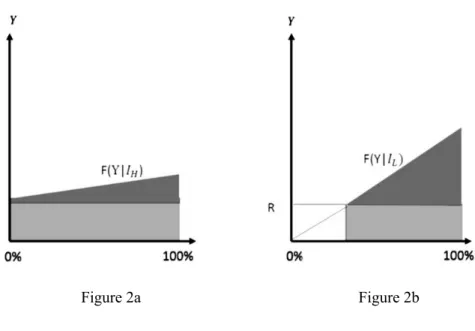
Figures 2a and 2b below illustrate a bank’s optimal contract with borrowers when the bank chooses a low IL or high IH investment in screening,
respectively. In both cases, the bank selects the variables I, Km, and R to
maximize the net surplus of the borrowers and to cover the costs of the loans, including the costs of investment in borrower quality and bank-monitoring
37. Ex ante, a person will not borrow if she expects to have a lower valuation for her home than the required repayment. Hence, borrowers become automatic defaulters when their ex-post valuations fall materially below their ex-ante valuations. This could occur because housing prices fall, a possibility considered in Part I.C infra, or because a borrower’s relative utility from home versus other consumption changes.
184
capacity. The percentile distribution of borrower types, F(Y | I), corresponds to low and high screening investments—IL and IH—and appears on the horizontal
axis, graphed as a function of the return Y, which itself appears on the vertical axis. We normalize the population size to one.38 The required repayment, R,
separates the types who default from the types who repay. The lighter-colored areas (bottom) represent the repayments that cover lending and screening costs, and the darker-colored areas (top) represent the borrowers’ net surplus after repayment. The unshaded areas between the dotted line and the horizontal axis represent the deadweight loss that occurs when borrowers are unable to repay. Here, the loan contracts are formed and efficiently enforced, given the costs of investment and enforcement.
In Figure 2a, the bank chooses a high investment level to minimize the likelihood of borrower default. As a result, low-risk borrowers are screened out, leaving only creditworthy borrowers, who can repay their mortgage in full. In the case depicted, the repayment, R, is sufficient to cover the bank’s cost of loan origination and is small enough to preclude defaults.39 In Figure 2b, the
bank does not invest in the creditworthiness of its borrowers. This reduces the bank’s loan-origination cost but, compared to the case in Figure 2a, results in defaulting borrowers. Each defaulting borrower causes a deadweight loss of R, because she does not repay the loan.40
Comparing the total surpluses generated by the high-investment and low-investment banks in Figure 2a and 2b, respectively, reveals that when borrowers are carefully screened there are fewer defaults, thus generating greater returns to loan origination. In the next Section, we argue that originating banks were dissuaded from investing optimally in borrower screening for two reasons. First, competition between originating banks to sell their loan repayments to the market made prime mortgages a luxury good that many commercial banks were unwilling to buy. Second, and critically here, originating banks would not be liable for breaching loan-quality warranties, and so would not be penalized for reducing screening.
38. In normal language, this means that there are many potential borrowers.
39. Cases where no defaults occur are rare. We illustrate such a case here just to show how careful screening limits defaults.
40. This—where the bank cannot resell mortgages in the relevant period after foreclosure—is also a polar case. We later relax this assumption.
185
Figure 2a Figure 2b
B. The Long Intermediation Chain
A bank’s loan-origination practice is efficient when the intermediation chain is short, but then individual deposits would be the banks’ only source of funds. Increasing demand for securities from money-market funds and other entities induced many banks to enter the credit market and seek funds from public investors. To enter the credit market, the banks increased their scale of operations and created portfolios to sell to other financial intermediaries. The originating local banks thereby became the initial links in long intermediation chains.41
To illustrate how these longer chains should and did function, we return to our short-chain example. In a competitive credit market, each bank provides borrowers with an expected surplus, which is the borrower’s return less the required repayment. In our example, the bank chooses the amount to invest in prescreening borrowers (I), the repayment amount (R), and the bank’s monitoring capacity (Km) to minimize its costs of supplying good quality loans
41. It was recognized that individual deposits could not meet traditional banks’ financing needs. See Markus Brunnermeier et al., The Fundamental Principles of Financial Regulation, in 11 GENEVA REPORT ON THE WORLD ECONOMY 17-18 (2009) (“Even for traditional deposit-taking banks, their marginal source of funding has been the capital markets . . . .This is because the traditional source of funding such as retail deposits are usually insufficiently flexible to fund expansions of lending.”).
186
to borrowers at prices the borrowers will pay. The bank’s revenue from borrowers must cover the cost of these activities. This constraint requires the cost of the money that the bank lends, plus the bank’s pre-loan investment and post-loan monitoring costs, to equal or be less than the sum of the bank’s return from repaying borrowers and the bank’s return from foreclosing against or renegotiating with borrowers that it does not immediately monitor.
When a local bank bundles loans into a portfolio and sells the portfolio to a financial intermediary, the bank’s capital, which allows it efficiently to originate loans, now comes from the price that the portfolio buyer pays. The price of the socially optimal contract would reflect the local bank’s cost of efficient origination and the portfolio buyer’s expected cost of monitoring efficiently originated loans. Suppose, however, that an originating bank warranted its input—that the bank engaged in efficient screening for each loan. As the Introduction summarized, and as Part II later details, the intermediary buyer could not prove breach. Anticipating this inability, we argue, the bank would reduce its investment in screening so it could earn positive profits.
Reducing screening would have two effects. First, the quality of the homeowners receiving loans would decline. Therefore, more borrowers would be in the automatic-default market segment (i.e., R > Y). To understand the second effect, recall that the efficient contracts in the short intermediation chain permitted the local bank to monitor, and thus foreclose against, every defaulter. But now, the monitoring responsibility lies with the portfolio buyer. If this buyer’s monitoring capacity equaled that of the originating bank in the short intermediation chain example, the buyer still could not monitor every defaulter, because reduced screening increases the number of defaulters. As a result, the probability that a borrower is monitored will fall below one. To illustrate, the probability that a defaulting borrower is monitored is P = Km/D, where Km is
the number of defaulters the bank (or its transferee) can monitor in a period, and D is the number of defaulters. Holding Km constant, the probability that a
borrower is monitored must fall below one when the number of defaulters, D, exceeds the bank’s monitoring capacity Km.42 But additionally, intermediary
portfolio buyers seldom have the same monitoring ability as the local banks: they do not have “local knowledge,” such as who the borrowers are or what the gains from foreclosure in specific markets would be. Moreover, the buyers commonly hold larger portfolios. Thus, the second effect of reduced screening is to create the possibility of strategic defaults. A borrower for whom R < Y
42. As an example, let the population of defaulters be D = 20% of the borrowing population, and suppose that the bank (or its transferee) has the capacity Km to monitor 15% of the borrower population. Thus, P = Km/D, the probability that a defaulter is monitored, is 15%/20% = 75%.