Online or offline? Exploring working memory constraints in spatial updating
by
Anthony Michael Harrison
B.S. Psychology, Drexel University, 1999 B.S. Information Systems, Drexel University, 1999
M.S. Psychology, University of Pittsburgh, 2004
Submitted to the Graduate Faculty of College of Arts and Sciences in partial fulfillment
of the requirements for the degree of Doctor of Philosophy
University of Pittsburgh
UNIVERSITY OF PITTSBURGH College of Arts and Sciences
This dissertation was presented
by
Anthony Michael Harrison
It was defended on September 14th, 2007
and approved by
Stephen Hirtle, PhD, College of Information Sciences Erik D. Reichle, PhD, Department of Psychology Walter Schneider, PhD, Department of Psychology
Copyright © by Anthony M. Harrison 2007
All spatial representation theories rely upon two spatial updating processes in order to maintain spatially consistent self-to-object relationships: movement-driven, automatic online updating and offline, conscious mental transformations of perspective. Theoretical differentiation based on offline updating is difficult given the equivalent predictions for many of the spatial tasks commonly used (i.e. egocentric pointing). However, representational theories do diverge with respect to the predicted working memory constraints of online updating. In experiment one participants studied groups of 4, 6, & 8 targets, engaged in a 180º rotation on half the trials and completed a series of judgments of relative direction and egocentric pointing. Set size effects for both tasks were limited to latencies alone, suggesting offline updating. Experiment two had participants study smaller (3 target) configurations and make egocentric pointing responses. On half the trials, participants engaged in either a verbal or spatial 1-back task during both retention and rotation periods. No effect of dual-task load or type were found for egocentric pointing. Both latencies and errors were significantly greater for the post-rotation pointing suggesting offline updating. The lack of evidence for online updating is surprising and contrary to previous findings that it is an obligatory automatic process (e.g. Farrell & Thomson, 1998). Multiple models were developed within ACT-R/S (Harrison & Schunn, 2003) illustrating the sufficiency of offline updating to account for the current findings. The challenges of detecting online updating and investigating its working memory constraints are discussed in the light of these results and simulations.
Online or offline? Exploring working memory constraints in spatial updating Anthony M. Harrison, M.S.
TABLE OF CONTENTS
PREFACE ... XIII
1.0 INTRODUCTION ...1
1.1 PREVIOUS RESEARCH ...4
1.1.1 Representational perspectives on updating...7
1.1.2 Set size and spatial updating...14
1.1.3 Updating under dual-task load ...19
1.2 SUMMARY ...21 2.0 EXPERIMENT ONE ...23 2.1 METHODS ...28 2.1.1 Participants...28 2.1.2 Materials...29 2.1.3 Procedure...30 2.1.3.1 Training ...31 2.1.3.2 Testing...32 2.1.4 Data cleaning ...33 2.2 RESULTS ...33 2.2.1 Visualization style...34
2.2.2.1 Latency ...36 2.2.2.2 Absolute error....38 2.2.2.3 Signed error...40 2.2.3 Egocentric pointing ...41 2.2.3.1 Latency....41 2.2.3.2 Absolute error ...42 2.2.4 Trial presentation...43 2.2.5 Study time...43 2.2.6 Speed/accuracy ...43 2.2.7 Gender differences ...44 2.2.8 Questionnaire responses...44 2.3 DISCUSSION ...45 2.4 SUMMARY ...51 3.0 EXPERIMENT TWO ...53 3.1 METHODS ...56 3.1.1 Participants...56 3.1.2 Materials...56 3.1.3 Pointing task...57 3.1.3.1 Study phase...58 3.1.3.2 Testing phase ...59
3.1.4 Continuous auditory 1-back task...60
3.1.5 Experiment structure ...61
3.2 RESULTS ...63 3.2.1 Egocentric pointing ...63 3.2.1.1 Latency ...64 3.2.1.2 Error ...64 3.2.2 1-back performance ...65 3.2.2.1 Accuracy....65 3.2.2.2 Sensitivity...67 3.2.2.3 Error distribution...68 3.2.3 Speed/Accuracy ...70 3.2.4 Gender differences ...70 3.2.5 Questionnaire responses...70 3.3 DISCUSSION ...70 3.4 SUMMARY ...73
4.0 MODELING OF SPATIAL BEHAVIOR ...75
4.1 ACT-R/S THEORY...77 4.2 ACT-R/S IMPLEMENTATION...80 4.2.1 Attending ...81 4.2.2 Representations ...82 4.2.3 Updating ...83 4.2.4 Configural Buffer ...84 5.0 MODELING IN ACT-R/S ...86
5.1 EXPERIMENT ONE MODELS...87
5.1.1.1 Alignment effect and reversal ...90
5.1.1.2 Initial fitting...91
5.1.2 Model 1b : Online...93
5.1.3 Model 1c : Transient ...95
5.1.4 Model 1d : Allo-surrogate ...97
5.2 EXPERIMENT TWO MODEL...98
5.3 SUMMARY ...102
6.0 GENERAL DISCUSSION ...105
6.1 EXPERIMENT & MODEL ONE...105
6.2 EXPERIMENT & MODEL TWO...106
6.3 ALTERNATIVE REPRESENTATIONAL ACCOUNTS ...108
6.3.1 Egocentric theories ...108 6.3.2 Allocentric theories...109 6.4 SPATIAL UPDATING...110 7.0 FUTURE DIRECTIONS...114 8.0 CONCLUSIONS ...116 APPENDIX A...118 APPENDIX B ...124 APPENDIX C...131 APPENDIX D...134 APPENDIX E ...136 REFERENCES...139
LIST OF TABLES
Table 2.1 Primary egocentric & allocentric questions for PCA extracted factors...35
Table 3.1 1-Back accuracy and sensitivity...67
Table 4.1 Example search and attending productions for visual and aural modalities...81
Table 4.2 Symbolic representation of a configural (spatial) chunk...82
Table 4.3 Sample mental transformation productions. ...84
Table 5.1 Sample 1-back productions for verbal and spatial modalities ...100
Table B.1 Basic demographic questions ...124
Table B.2 Experiment one debriefing questionnaire* ...125
Table B.3 Experiment two debriefing questionnaire* ...127
LIST OF FIGURES
Figure 1.1 Egocentric encoding of space ...3
Figure 1.2 Cognitive-mapping allocentric encoding of space...4
Figure 1.3 Object configuration used in Mou et al. (2004)...10
Figure 1.4 Predictions from Mou et al. (2004)...11
Figure 1.5 Results from Mou et al. (2004)...12
Figure 1.6 Sample four-point path and viewing location from Waller et al. (2002). ...13
Figure 1.7 Results from Rieser & Rider (1991), experiment 3. ...16
Figure 1.8 Pointing errors and latencies as a function of set size (Hodgson & Waller, 2006). ....18
Figure 1.9 Object placement error (a) and latency (b) from Wang et al. (2006)...19
Figure 2.1 Sample training and testing configurations for experiment 1...29
Figure 2.2 Experiment one per-configuration sequence and timings. ...32
Figure 2.3 Main effects of alignment (a) and set size (b) for JRD latencies...36
Figure 2.4 Interaction of imaginary alignment and body position for JRD latencies...37
Figure 2.5 Interaction of imaginary alignment, body position, and visualization style for JRD latencies.. ...38
Figure 2.6 Interaction of imaginary alignment, body position, visualization style and target set size for JRD latencies...38
Figure 2.7 Main effect of body position on JRD pointing errors. ...39
Figure 2.8 Interactions of body position & imaginary alignment (a) and body position & target set size (b) for pointing error. ...39
Figure 2.9 Interaction of body position, imaginary alignment and visualization style for JRD pointing errors...40
Figure 2.10 Interactions for body position & imaginary alignment (a) and body position & imaginary alignment & target set size (b). ...41
Figure 2.11 Main effects of body position (a) and target set size (b) on latency ...42
Figure 2.12 Main effect of body position on absolute pointing error...42
Figure 2.13 Absolute alignment effect...47
Figure 3.1 Experiment two per-configuration structure and timings...58
Figure 3.2 Spatial and verbal 1-back tasks...61
Figure 3.3 Egocentric pointing latency.. ...64
Figure 3.4 Egocentric pointing error...65
Figure 3.5 1-Back accuracy as a function of body position (a) and task load (b).. ...66
Figure 3.6 Interactions of 1-back type with body position (a) and task load (b)...67
Figure 3.7 Temporal distribution of 1-back errors as a function of body position and 1-back type ...69
Figure 3.8 Temporal distribution of 1-back errors as a function of task load and 1-back type ....69
Figure 5.1 Initial fits to egocentric visualizer data. ...92
Figure 5.2 Fit egocentric visualizer fits (set sizes 4 & 8) for 12 data points...93
Figure 5.3 Online updating model (ChunkCapacity=3), zero-parameter fit for 6 data points...95
Figure 5.5 Fit to allocentric visualizer data, set size 4...98
Figure 5.6 Zero-parameter fits of both egocentric pointing (a) and 1-back accuracy (b) data....102
Figure A.1 Experiment 1, training and set size 4 configurations ...119
Figure A.2 Experiment 1, set size 6...120
Figure A.3 Experiment 1, set size 8...121
Figure A.4 Experiment 2, training and test configurations ...123
Figure C.1 Spatial and verbal N-back for N=1...132
PREFACE
While this is a document of my own work, obviously I could not have accomplished it without the help of many people. Thanks go out to Dr. Susan Chipman, formerly with ONR, for having funded the early theoretical work behind ACT-R/S. Dr. Christian Schunn also has my profound gratitude and appreciation for supporting me and this work; perhaps for longer than he should have. Dr. Dario Salvucii must also be acknowledged for allowing me to finish my work from out of his lab in Philadelphia. And finally, a heart felt thank you to all my friends who had to endure the early pilot studies of this research.
1.0 INTRODUCTION
As people interact with the environment around them, their spatial relationship to it is constantly changing. Few of us are ever prepared for the occasional nighttime power failure. In these situations we must navigate through rooms and around furniture in search of the flashlight. Some of us will inch along the walls, feeling our way; others will stumble through the dark, stubbing toes and tripping over pets. Those who are confident in their memory and spatial skills may attempt something different. They will actively track the remembered locations of objects in the room as they move, retrieving the flashlight with relatively few collisions. This tracking process is referred to as spatial updating and is a necessary component in all spatial reasoning theories.
A substantial amount of research has been devoted to trying to understand spatial updating processes. While the processes, their inputs, and facilitating or interfering effects are well documented, one line of research remains contentious: trying to determine what is actually being updated. Studies looking at changes in spatial representation have yielded mixed results; some show spatial updating operating on individual egocentric representations, others indicate that updating merely anchors the location of the viewer within a larger allocentric (i.e. object-centered) spatial representation.
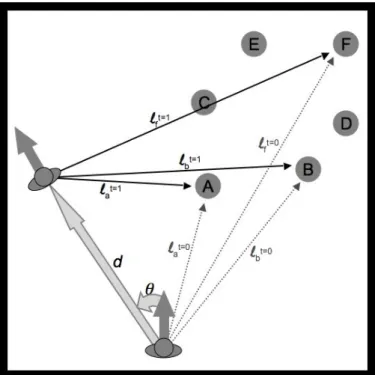
In the past year, studies have been published that take a different approach towards this problem. If spatial updating operates on individual egocentric representations, it is almost certain that the process will be subject to working memory constraints (figure 1.1). It is computationally
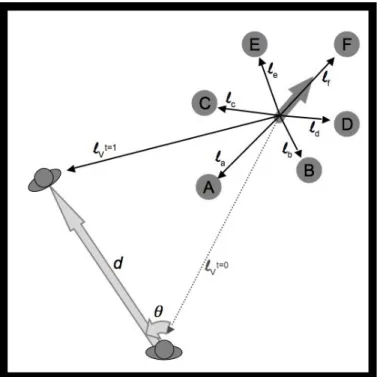
improbable and functionally unnecessary to update the representations of all the objects in one’s environment. This line of inquiry has focused on uncovering set size effects in spatial updating (Hodgson & Waller, 2006; Wang et al., 2006). If updating processes work merely to anchor the viewer within a larger integrated allocentric representation of the environment, they should be insensitive to set size manipulations (figure 1.2). The presence of set size effects for updating errors would strongly support the theory that updating operates on individual egocentric representations. However, one need not look exclusively at set size effects, interference from concurrent spatial tasks should exhibit similar effects.
Exploring the working memory constraints in spatial updating faces another challenge in that there are two different forms of spatial updating. Spatial updating can be accomplished by either an automatic path-integration process as the individual moves through space (e.g. Mittelstaedt & Mittelstaedt, 1981; Rieser, 1989) or a conscious mental transformation of perspective (e.g. Rieser, 1989; Easton & Sholl, 1995). The working memory capacity limitations mentioned previously apply only to the automatic process, conscious mental transformations are only limited by long-term memory (Hodgson & Waller, 2006). This means that if experimental methodologies cannot differentiate between the two updating processes, mental transformations’ lack of working memory limitations might be misinterpreted as evidence for allocentric updating.
Figure 1.1 Egocentric with spatial updating’s encoding of the space as egocentric vectors (l) at one instance (t=0). As the subject rotates through θ and traverses across d, the egocentric vectors are updated to maintain spatial consistency, yielding a new set of egocentric vectors (t=1). In this example only the behaviorally significant objects (A,B & F) are encoded into capacity limited working memory.
Figure 1.2 Cognitive-mapping allocentric encoding of the space. The centroid is defined as the mean of the egocentric vectors to the objects (omitted for clarity). The objects are then encoded relative to the centroid, with the reference direction (dark grey arrow) defined along the longitudinal axis of the configuration. The viewer’s position within the map is represented as lV at t=0. As the viewer moves through the environment only their position relative to the centroid is updated (lV at t=1).
1.1 PREVIOUS RESEARCH
Spatial updating is performed by two separate but very similar functions: path-integration (May & Klatzky, 2000; Mittelstaedt & Mittelstaedt, 1980) and conscious mental transformations (Wraga, 2003; Wraga, Creem-Regehr, & Proffitt, 2004). Path-integration is driven primarily by idiothetic inputs (proprioceptive, vestibular, and motor efferent-copies), but does receive limited support from the experience of optic flow (Klatzky, Loomis, Beall, Chance, & Golledge, 1998), and is automatic in the obligatory sense (Farrell & Thomson, 1998; Klatzky et al., 1998; Waller,
Montello, Richardson, & Hegarty, 2002). While research on mental spatial transformations has a long history dating back to the early work of Shepard & Metzler (1971), the concern here is with mental transformations of perspective, which seems to show slightly different chronometric profiles (Hegarty & Waller, 2004; Wraga, Creem, & Proffitt, 1999, 2000). The preponderance of evidence shows that mental transformations of perspective come in two flavors: rotational and translational. Both of which show chronometric profiles that depend upon the angular or linear disparity between source and target (Creem, Wraga, & Proffitt, 2001; Easton & Sholl, 1995; Farrell & Robertson, 1998; Farrell & Thomson, 1998; Jola & Mast, 2005; May, 2004; Nori, Iachini, & Giusberti, 2004; Presson & Montello, 1994; Rieser, 1989; Wraga et al., 2000). Regardless of the mechanism, spatial updating is able to facilitate spatial judgments in scene recognition (Burgess, Spiers, & Paleologou, 2004; Simons & Wang, 1998), judgments of relative direction (Presson & Montello, 1994; Roskos-Ewoldsen, McNamara, Shelton, & Carr, 1998; Wang & Spelke, 2000), egocentric pointing (Hodgson & Waller, 2006; Sholl, 1999; Wang, 2007) and likely imaginary perspective taking as well.
Aside from differentiating spatial updating along idiothetic and conscious lines, one can also divide it in terms of when the processing takes place. Farrell and colleagues (Farrell & Robertson, 1998; Farrell & Thomson, 1999) asked participants to walk blindfolded to a previously learned location. They showed that participants modified both the number and length of steps taken to accurately arrive at the target location. This behavior persisted when subjects were able to walk with vision, but not when they were asked to walk the same distance but in the opposite direction (away from the target location). From this they concluded that subjects were updating the locations of the targets relative to themselves and adjusting their movements continuously instead of relying upon preplanned movements. Hodgson & Waller, rather
succinctly, refer to this as simply online updating (2006). This is in contrast to offline updating where representations from long-term memory are transformed after a movement using the memory of an actual (or imagined) traversal (Loomis, Klatzky, Golledge, Philbeck, & Golledge, 1991).
Where as online updating is an automatic process, offline updating is not and can be influenced by task demands and instructions (Amorim, Glasauer, Corpinot, & Berthoz, 1997; Waller et al., 2002). Amorim and colleagues asked subjects to study a model of a three-dimension capital “F” and then to update both its location and orientation relative to themselves while walking. Subjects were asked to engage in one of two tasks while they moved. They either reported the number of steps they had taken or which side of the F was closest to them. After moving, they were to rotate and face the F and turn another model to indicate the F’s orientation relative to them. Those subjects who reported which side of the F was closest to them showed significantly lower pointing errors than those who counted steps. What’s more, step-counters showed significantly higher instances of major orientation errors of the F (i.e. confusing left and right). Amorim et al. concluded that subjects who were focusing on the F were engaging in online updating, resulting in lower errors; whereas those that counted steps were using their memory of the path traveled to drive offline updating resulting in larger errors (Amorim et al., 1997).
These two perspectives on spatial updating: input (idiothetic or conscious effort) and time-of-processing (online or offline), are difficult to separate from each other. Within each perspective the means of differentiating is the same: magnitude of error and latency. Both idiothetic and online spatial updating show significantly lower errors and faster response times than their respective counterparts. From a computational perspective one could argue that online
updating and path-integration are the same thing (using the idiothetic input to continuously update the representations), and likewise for consciously driven and offline updating. Unfortunately there has been no research in this area. For the current time, research will only be considered in terms of online and offline updating, however, the issue of input selection will be returned to in later chapters.
1.1.1 Representational perspectives on updating
While many studies have looked at the processes behind spatial updating and how it facilitates spatial judgments, few can speak directly towards what is being updated. The theoretical form of the spatial representations has significant bearing on how one views spatial updating, regardless of whether it is online or offline. To better highlight this consider two diametrically opposed representational forms: egocentric and allocentric.
Without a spatial updating process to maintain consistency in the face of movement, egocentric theories (e.g. Wang, 1999) would only be able to account for a small fraction of the empirical findings. These theories maintain that the spatial updating processes operate on individual egocentric representations. This enables the viewer to maintain spatially consistent representations of the objects in the environment. If this spatial updating process were disrupted (e.g. by disorientation), the representations would no longer be spatially consistent, resulting in a jumbled understanding of the environment. For egocentric theories, online updating is automatic, operating on individual attended representations, and is therefore constrained by available working memory resources. As the number of targets tracked online increases, so to should the updating errors; however, latencies will be largely unaffected since the targets will have been updated before testing even occurs (Hodgson & Waller, 2006). On the other hand, offline
updating is largely limited by long-term memory as individual representations must be retrieved before they can be consciously transformed.
This is in stark contrast to allocentric spatial theories that propose that an individual encodes a representational network of locations that is independent of the viewer (McNamara, 2003; O'Keefe & Nadel, 1978; Sholl, 2001). In this representational scheme, spatial updating merely acts to anchor the viewer’s location within the “cognitive map” thereby facilitating egocentric judgments (King, Trinkler, Hartley, Vargha-Khadem, & Burgess, 2004). Spatial updating doesn’t act on the spatial representation of the environment, rather just the location of the viewer. Should the spatial updating process become disrupted, the viewer should just be misplaced within the “cognitive map”, inter-object spatial judgments should not be affected. Since online updating only has to anchor the single representation of the viewer, it should be relatively insensitive to working memory manipulations. As in the egocentric account, offline updating permits the individual to imagine themselves at positions and orientations that they aren’t currently in (King, Burgess, Hartley, Vargha-Khadem, & O'Keefe, 2002; King et al., 2004). Again, since only the self is being updated, it is largely immune to working memory manipulations.
If the spatial representations are themselves being updated then the orientation dependence of the representations should change as the subject moves (or imagines movement) through the environment. For instance, imagine an environment were encoded with a specific orientation dependency favoring views towards the north. If the representation were updated as the viewer rotated to face south, that dependency should rotate as well (Waller et al., 2002), or disappear entirely if the subject is able to encode an additional representation of the space from the new orientation (Sholl & Bartels, 2002; Sholl & Nolin, 1997). On the other hand, if updating
anchors the viewer in the space, spatial updating should either not affect orientation dependency at all (O'Keefe, 1993) or simply as a function of the disparity between their actual and imagined positions (King et al., 2002; May, 2004).
With these different theoretical perspectives in mind, attention can be turned to two contrasting studies that have attempted to differentiate what is being updated. Not surprisingly, the evidence is mixed. Some show evidence that it is the position of the viewer that is being updated (or find no evidence that the representations are being updated) (Easton & Sholl, 1995; May, 2004; Mou & McNamara, 2002; Mou, McNamara, Rump, & Xiao, 2006; Mou, McNamara, Valiquette, & Rump, 2004; Sholl & Bartels, 2002; Sholl & Kenny, 2005), while others find evidence of individual representations being updated (Hodgson & Waller, 2006; Waller et al., 2002; Wang, 2004; Wang & Brockmole, 2003; Wang et al., 2006; Wang, Hermer, & Spelke, 1999; Wang & Simons, 1999; Wang & Spelke, 2000).
Mou, McNamara, Valiquette, & Rump (2004) conducted a series of experiments examining the efficiency of spatial updating using the well established judgment of relative direction (JRD) methodology. Subjects learned the locations of a series of objects from a given vantage point. They then walked into the middle of the configuration for testing. From this location, subjects were asked to engage in multiple JRDs (e.g. figure 1.3: “Imagine you are standing at the shoe, looking at the clock, point towards the banana”). Noticing that all previous studies had confounded actual body heading with imagined heading, Mou et al. divided subjects into two groups: those who’s imagined and actual body headings were consistent (A-I=0°) and
those who were rotated 225° CCW out of alignment with their imagined heading (A-I=225°). If a
given JRD trial relied upon an imagined heading other than 0°, the subject rotated (with vision)
Figure 1.3 Object configuration used in Mou et al. (2004).
Mou et al. predicted that if subjects were engaging in egocentric-online updating during locomotion performance should be equivalent across the three levels of imagined heading (0°,
90° & 225°) within the actual-imagined (A-I) factors (figure 1.4a). However, performance would
be best for A-I=0°, since the imagined heading was always parallel to the reference direction
established by the body. Performance for A-I=225° would be less efficient than from 0°, but
since the difference across the imagined headings were constant, there would still be no effect of imagined heading. On the contrary, if subjects were engaged in allocentric-online updating, neither the spatial representations nor the reference alignment would be updated and access would be most efficient when the imagined heading is parallel to the reference heading. Specifically, performance would be best for imagined headings of 0° (learned heading) and 90°
(orthogonal but perceptually salient intrinsic axis), and significantly poorer for 225°, regardless
a b
Figure 1.4 Predictions from Mou et al. (2004). A) If updating operates on individual representations, there should be no effect of imagined heading. B) If spatial updating anchors the viewer within an allocentric network, imagined heading effects should dominate.
Mou et al. found significant effects of imagined-heading (favoring judgments aligned with the 0° and 90° axes), as well as actual-imagined disparity (showing a roughly constant cost
in latency and error for A-I=225°). They conclude that since the effect was not flat across
imagined-headings, spatial updating was not acting upon individual representations (figure 1.5). In other words, moving to the center of the target configuration did not update the representation of the environment (2004).
a
b
Figure 1.5 Results from Mou et al. (2004). Dominance of imaginary heading effect was interpreted as evidence for no egocentric updating.
Egocentric theories of spatial updating are not without their support, however. Waller, Montello, Richardson, & Hegarty conducted a series of experiments to see if the spatial updating processes actually influenced the representation of the space (Waller et al., 2002). In these studies subjects learned a simple path and were tested on their pointing speed and accuracy for aligned versus contra-aligned JRD-triplets. For aligned JRD-triplets, subjects imagined themselves at a location, facing in the same direction as they were when they studied the path; contra-aligned triplets had them imagining themselves facing in the opposite direction (see figure 1.6a). Given that spatial memories are strongly orientation dependent, aligned judgments should be both faster and more accurate than contra-aligned judgments.
To test the possibility that spatial updating can influence orientation dependency, they had subjects either stay in the same location after learning or rotate 180º in-place before testing
(experiment 2). If the viewer’s location relative to the objects was being updated (i.e. allocentric-online updating), the alignment effect should remain unchanged: aligned judgments should be significantly faster and more accurate than contra-aligned judgments regardless of the subject’s orientation. However, if the spatial representations were being transformed by egocentric-online updating a reversal of the alignment effect should occur since the subjects are now in alignment with the contra-aligned position. The averaged data for the rotate condition showed a slight, but non-significant reversal. Investigating the individual data patterns revealed that approximately half of the subjects showed the reverse-alignment pattern (see figure 1.6b). Half of the subjects appeared to be updating their representation while the other half were updating their position within the representation (Waller et al., 2002).
a b
Figure 1.6 Sample four-point path and viewing location adapted from Waller et al. (2002). An aligned judgment would be to imagine standing at 4, facing 3, pointing at 2. A contra-aligned judgment would be to imagine standing at 2, facing 1, pointing at 4. Figure 4b. Half the subjects in experiment 2 rotate
To further explore this effect, Waller et al. conducted another experiment where half the subjects in the rotate condition were instructed to ignore the rotation and the other half were told to explicitly imagine the spatial configuration behind themselves (update). Once again the rotate-ignore group should show the standard alignment effect, with the rotate-update group showing the reverse-alignment. Waller et al. (2002) concluded that the representations were being updated and that online updating, if automatic, could be ignored (as in the rotate-ignore condition) or at least undone with little cost in accuracy (Farrell & Robertson, 1998; May & Klatzky, 2000). Embedded within their conclusions was the alternative that online updating may not actually be obligatory; a hypothesis that has recently received support (Hodgson & Waller, 2006) and will be discussed in the next section.
1.1.2 Set size and spatial updating
While the evidence for what is being updated is currently quite mixed, the theoretical perspectives underlying the previous experiments point towards another differentiating factor. If, as egocentric theorists propose, spatial updating operates on the level of individual representations it is highly unlikely that the processes can operate on an unbounded set of representations. While there is significant evidence showing spatial processing is dependent upon working memory resources (for a detailed review see Sholl, Fraone, & Allen, 2004), their have been few studies specifically looking at the role of set size on spatial updating. It should be explicitly noted that of the two forms of spatial updating, only automatic online updating should show working memory limitations and only if it is operating on individual egocentric representations. Offline updating, in service of egocentric or allocentric representations, should
be relatively insensitive to working memory manipulations since it is performed after the movement has taken place.
Hodgson & Waller (2006) present an argument for egocentric-online and offline updating exhibiting different responses towards working memory manipulations. Since offline updating occurs after a movement has completed, it should be relatively immune to set size manipulations. Specifically, while there will be some latency effects, due largely to serial-search processes, updating error should be unaffected by set size manipulations. On the other hand, errors due to egocentric-online updating will be influenced by set size manipulations as the working memory resources devoted to tracking will be increasingly taxed by the increasing number of targets. With these two pieces in mind, we can look at the few studies that have explicitly examined spatial updating through set size manipulations.
Rieser & Rider (1991) examined the factors influencing children’s and adults’ ability to accurately point to targets after walking without vision. Participants were asked to study the locations of one or five targets. After completing baseline-pointing responses using a mounted compass pointer, subjects were blindfolded and escorted to a new test location. The path to the new test location was either 4m long with one 90º turn or 11m long with three 90º turns. They found no differences in error based on the number of targets studied. The only significant factor was the complexity of the path that subjects walked to the testing locations (figure 1.7).
Figure 1.7 Results from Rieser & Rider (1991), experiment 3.
These findings need to be considered in light of a few key issues. First, as has been shown by other researchers (e.g. Roskos-Ewoldsen et al., 1998), merely relying on accuracy measures can be problematic, potentially hiding quite significant effects in latencies. Second, errors accumulate rapidly as the path-traveled increases (e.g. Amorim et al., 1997; Gallistel, 1990; Klatzky et al., 1998; Mittelstaedt & Mittelstaedt, 1980). The magnitude of the path complexity manipulations may have exceeding normal updating abilities increasing errors to such a point that it effectively obscured any effect set size effects. Regardless of the two previous issues, Rieser & Rider, like many other researchers, made the blanket assumption that the updating taking place was online. While this may have been warranted for the simpler path (i.e. single 90º turn), the magnitude of the complex path errors are more consistent with offline updating (Hodgson & Waller, 2006).
Rieser & Rider (1991) are not the only ones that have found no effect of set size on spatial updating. Recognizing that task instructions could influence the use of online or offline
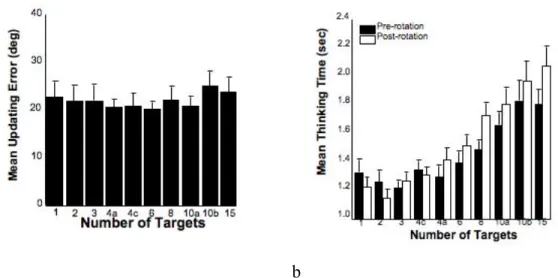
updating strategies, Hodgson & Waller were interested in what strategies subjects would engage in when left to their own devices (2006). They had subjects study sets of targets of various sizes (from one to fifteen targets). After establishing baseline-pointing responses, instead of engaging in complex translations to a new location, subjects merely rotated 135º in a random direction. As mentioned previously, they hypothesized that only egocentric-online updating should show an effect of set size on pointing error. If subjects were engaged in offline updating, while there would be an effect for latencies, it would be. If subjects were engaged in offline updating, the set size effect on latency (due to serial-search processes) would be present both before and after rotation and errors would be relatively high (around 20º). On the other hand, if subjects were engaged in allocentric-online updating, while the errors would be stable and smaller (around 10-15º), there would be no pre- post-rotation latency differences. The results of their study mirrored their predictions for offline updating: there was no effect of set size on pointing errors, and latency effects were seen in both pre- and post-rotation phases (figure 1.8). This is in stark contrast to the notion of online updating being automatic. Regardless of the instructions given, subjects should have engaged in online updating. Assuming they are correct, the question of set size effects on online updating is still left up in the air. Their conclusions are also heavily influenced by their implicit assumption that subjects will engage in one process or the other but not both. If subjects engaged in egocentric-online updating for targets up to some capacity limit and offline updating for the remaining targets, this data becomes much less clear. It is uncertain that current methodologies would be able to detect such a behavior.
a
b
Figure 1.8 Pointing errors (a) and latencies (b) as a function of set size, adapted from Hodgson & Waller (2006).
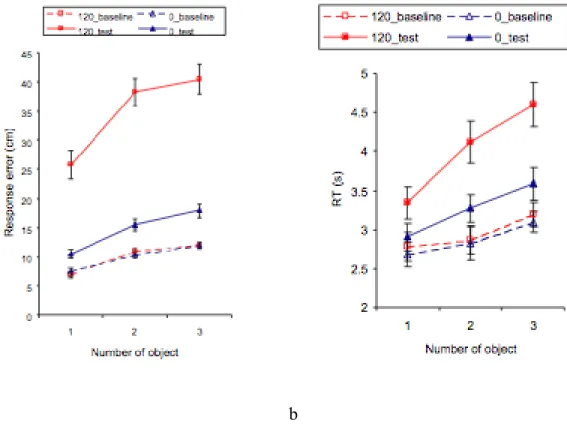
The final set size study to be considered was conducted by Wang and associates (Wang et al., 2006). Wang et al. utilized a fully immersive virtual reality environment in order to exercise significant control over both learning and testing. Subjects entered a large projector room with digital projections on all four walls, ceiling and floor and studied the locations of one to three virtual cubes in an otherwise neutral, featureless environment. After studying, blindfolded subjects either walked the perimeter of a circle, covering a 120-degree arch, or walked in place for an equivalent period of time (around 4s). After moving, subjects used a digital wand (controlled by their hand) to place each of the studied targets in their original locations. Analyzing only the data for the first object placed, Wang et al. showed clear set size effects for both latency and positioning error (figure 1.9). Unfortunately, because they measured error with a Euclidean linear deviation and did not report subject-to-object distances, the errors in this study cannot be directly compared to those utilizing pointing methodologies. The presence of set size effects for both latency and positioning error may hint at both online and offline updating.
a b
Figure 1.9 Object placement error (a) and latency (b) adapted from Wang et al. (2006).
1.1.3 Updating under dual-task load
Instead of manipulating spatial set size, working memory constraints can be explored by introducing a concurrent task during the movement phases. If egocentric-online updating is utilizing working memory resources, then the concurrent task should degrade performance as the two compete for limited resources (Book & Garling, 1981; Linberg & Garling, 1981; May & Klatzky, 2000). On the other hand, if subjects are engaging in offline updating, there will be little contention since the concurrent task will occur before the updating actually begins.
While there have been many studies looking at dual-task interference in other spatial tasks such as reorientation and wayfinding (e.g. Hupbach, Hardt, Nadel, & Bohbot, 2007;
Meilinger, Knauff, & Bulthoff, submitted; Ratliff & Newcombe, 2005), a review of the literature has only revealed three published studies that have looked specifically at dual-task interference in updating. The two earliest, by Garling and associates (Book & Garling, 1981; Linberg & Garling, 1981) utilized backward counting as the concurrent task as subjects walked an internal corridor while tracking target locations. From the consistent decrement in angular estimates seen in the dual-task condition, they concluded “that keeping track of the location of a reference point whilst walking is easily disturbed when the amount of central processing capacity available for the task is reduced.” However, it is uncertain whether the observed task was one of updating, wayfinding (Meilinger et al., submitted) or place-learning (Waller, Loomis, Golledge, & Beall, 2000).
May & Klatzky (2000), while not strictly using concurrent tasks, did use similar tasks within an interruption paradigm. Blindfolded subjects were guided along two legs of a triangle and then asked return to the start point on their own (triangle-completion task). During the guided traversal, they were interrupted and asked to engage in backward counting or an irrelevant (to-be-ignored movement). Not surprisingly, they found that the irrelevant movements had the greatest decrement on the accuracy of the return path. This inability to ignore the irrelevant movement is one of the key pieces of evidence for the conclusion that online updating is obligatory. While much weaker, there was also a significant effect of the backward counting on participants’ ability to return to the starting point. Like many of the previously discussed studies, this one made no attempt to differentiate between online and offline updating.
Amorim et al.’s (1997) experiment can also be viewed in light of dual-task load. In addition to step counting, they utilized a concurrent task that actually depended upon the updating. Participants who were asked to track the orientation of the “F” actually showed better
updating performance than those who were counting. While it is uncertain whether the step counting was interfering or the orientation tracking was facilitating, it is worth noting that the concurrent task explicitly required the subjects to track the target.
Unlike the influence of set size, the role of dual-task loads appears to be clear. While concurrent tasks do interfere somewhat with spatial updating, some spatial tasks are much more deleterious (i.e. irrelevant movements), while others seems to facilitate performance (i.e. orientation tracking). There are two points worth considering here. First, with the exceptions of step counting and the irrelevant movements, all of these tasks are relatively complex requiring resources beyond just working memory retention. Second, and more importantly, in those studies where different concurrent tasks were contrasted, no attempts were made to equalize them in terms of the cognitive load they would introduce. It is possible that theses tasks are introducing more than just spatial interference, further undermining the conclusions drawn.
1.2 SUMMARY
Spatial updating is a complex, multi-faceted set of processes that is necessary in order to effectively maintain self-to-object spatial relationships. For every study showing that spatial updating acts upon egocentric representations there is another that shows either no spatial updating effect or that it merely anchors the viewer within a larger allocentric network. With the realization that individually updating egocentric representations should be constrained by working-memory limitations, attention has recently shifted towards exploring set size effects on online spatial updating. However, the results from many of these studies, and those that look at dual-task interference, are often interpreted with the implicit assumption that the updating taking
place is entirely online. Unfortunately, the assumption of automaticity in online updating is becoming increasingly problematic (Hodgson & Waller, 2006). Combined with the fact that most tasks can be solved using either online or offline updating, attempts to differentiate the various representational theories becomes even more of a challenge. In order to effectively explore the working memory constraints of online updating, care must be taken in order to detect whether that updating is actually online or merely taking place after the fact.
With these challenges in mind, two experiments were conducted looking at set size effects on judgments of relative direction (chapter two) and 1-back interference in egocentric pointing (chapter three). At first pass, the results from these two studies could be interpreted in the light of either online or offline updating. However, analyses looking at individual differences in visualizations (chapter two) and the time course of 1-back errors (chapter three) strongly suggests that the updating taking place was entirely offline, further undermining the automaticity assumption of online updating. Models of both of the experiments were developed utilizing ACT-R (Anderson et al., 2004) and a spatial extension to the architecture, ACT-R/S (chapter four). While the results from experiment one show the hallmarks of both allocentric and egocentric updating, results from the modeling (chapter five) illustrate how such a pattern can emerge relying only on egocentric representations. Additional models explored the roles of various architectural components with respect to the tasks, illustrating inconsistencies in alternative theories and ACT-R/S itself (chapter five). The challenges to any investigation of the working memory constraints of spatial updating are discussed at length with respect to these results and models (chapter six), as well as directions for future research and theoretical development (chapter seven).
2.0 EXPERIMENT ONE
The first experiment conducted was designed to examine the role of spatial set size on spatial updating and use this information to infer how that updating was taking place. Hodgson & Waller (2006) differentiate between two different modes of updating: online and offline. Online updating is effectively an automatic1 process driven by path-integration (Farrell & Robertson, 1998; Farrell & Thomson, 1998, 1999; Klatzky, Loomis, Beall, Chance, & Golledge, 1998; May & Klatzky, 2000; Rieser & Rider, 1991). As such, upon the termination of the movement, the updating (egocentric or allocentric) will have already taken place and should therefore show no set size effects for latency. If the online updating is egocentric the accuracy of the updating will be influenced by set size as the updating process must be distributed over the set of representations in working memory (Hodgson & Waller, 2006). If that updating is allocentric the accuracy will be unaffected by set size manipulations since only the single representation of the viewer is being updated.
In contrast to online updating, offline is performed after the movement, typically at testing, and is controlled entirely by conscious processes. From both the egocentric and allocentric perspectives, representations currently in working memory are transformed using a
1 Unfortunately, the use of the term automatic is somewhat problematic, while most researchers use it in the more traditional sense of outside of volitional control; others have classified the updating as automatic if subjects engage in it without explicit instructions (Wang, 2007).
representation of the path traversed or some other imagined transformation. If the appropriate representations are not available in working memory (i.e. individual egocentric representations or a different “cognitive map”), they can be retrieved from long-term memory before transformation (Hodgson & Waller, 2006; Wang, 1999). Therefore offline updating should show set size effects for latency, but only because of serial search effects (Atkinson, Holmgren, & Juola, 1969; Banks & Fariello, 1974; Flexser, 1978; Holmgren, Juola, & Atkinson, 1974). For an allocentric representation, since only the self will be updated there should be no effect of set size on accuracy. Similarly, in an egocentric framework the representations would be updated individually, exhibiting no set size effect on updating accuracy (Hodgson & Waller, 2006).
Most recently, Hodgson & Waller (2006) have presented a series of experiments looking at set size effects (one through fifteen targets) on egocentric pointing after simple rotations (135°). This extremely wide sampling of set sizes showed no effect on pointing error, and
latencies that increased linearly with the number of targets. The authors concluded that subjects, in the absence of explicit updating instructions were simply relying upon an offline updating strategy.
The current experiment was interested in examining similar set size effects but from a slightly different perspective. While egocentric pointing is predominantly used to explore updating effects (Diwadkar & McNamara, 1997; Easton & Sholl, 1995; Farrell & Robertson, 1998; Hodgson & Waller, 2006; Jola & Mast, 2005; Klatzky et al., 1998; May, 2004; McNamara, 2003; Shelton & McNamara, 2004; Sholl, 1999; Wang, 2007), the predictions are often the same as those derived from allocentric or hybrid theories which rely upon processes that anchor the viewer within a stable allocentric reference frame, where the viewer is just another object in the “cognitive map.” When computing self-to-object relationships for the to-be
pointed-to object, the subject must perform a serial search of memory to find the target. In other words, the allocentric and hybrid theories would predict the same set size latency effect that egocentric offline updating would. The only way to differentiate the two classes of theories would be if evidence of online updating were found. Given the lack of online updating seen in numerous egocentric pointing experiments conducted by Hodgson & Waller (2006), relying upon set size effects in egocentric pointing to differentiate the theories could be challenging.
One way around this problem is to change the task. Instead of relying upon egocentric updating, this experiment utilizes judgments of relative direction (aka. JRD, “imagine you are at X, facing Y, point to Z”). Both JRD and imaginary perspective tasks (i.e. egocentric pointing from an imaginary orientation) show pronounced alignment effects, such that they are faster and more accurate when the imagined perspective is consistent with the preferred alignment of the representation (Easton & Sholl, 1995; Roskos-Ewoldsen et al., 1998; Sholl, 1999). Usually the representation’s preferred alignment is that of the studied viewpoint (Diwadkar & McNamara, 1997; Shelton & McNamara, 2001, 2004), but it can also be influenced by other factors such as intrinsic salient axes defined by the environment (McNamara, 2003; Mou & McNamara, 2002; Shelton & McNamara, 2004). If spatial updating (online or offline) transforms the representations in working memory to maintain consistency, then this alignment effect should change as the representations are updated. For example, if an object’s preferred alignment is straight ahead of the viewer, as the viewer rotates 180°, the preferred alignment should as well,
making imaginary judgments facing 180° faster than those aligned with the initial viewpoint.
As was mentioned in the previous chapter, this alignment transformation has been found in the JRD studies by Waller et al. (2002) and others (Kelly, Avraamides, & Loomis, in pres). In their second experiment they compared JRD that were aligned with the study view with those
that were contra-aligned (180° rotated) for participants who had remained in the study position
and those that had also rotated 180°. Initial analyses of the averaged group data showed that after
rotation the standard alignment effect favoring aligned judgments disappeared, contra-aligned JRD were just as fast an accurate. Examining the individual data they found that around half the subjects showed the standard alignment effect whereas the other half showed a complete reversal, contra-aligned judgments were faster and more accurate than aligned judgments. A follow up study, explicitly manipulated the instructions given to subjects, found that subjects who were asked to track the objects during rotation showed the reversal and subjects that were told to ignore the rotation showed the standard effect (2002).
The reversal of the alignment effect is particularly challenging for pure allocentric theories that would predict that the alignment effect arises from the preferred alignment of the stable allocentric map. Mou et al. (2004) attempt to explain this phenomenon by proposing a egocentric system on top of their allocentric encoding. They describe this system as a transient, perceptual-like egocentric system used primarily for obstacle avoidance and guiding action in space. While able to engage in limited updating with movement, representations decay rapidly in the absence of perceptual input. They argue that as the subject rotates, the egocentric system tracks the objects allowing for more rapid and accurate contra-aligned JRDs. Assuming that it can engage in the conscious transformations that are required for JRDs (e.g. “imagine you are at X, facing Y” requires an offline translation and rotation), there is still a significant problem with this explanation. While this “perceptual” system can account for the contra-aligned benefit after rotation, it can only do so for the first judgment. After that first JRD, the representations in the system will be consistent with that JRD – making subsequent judgments would require one of two things: unwinding the representations to their previous state (i.e. undoing the offline rotation
and translation), or retrieving the relevant allocentric representations into the egocentric system and applying the 180° rotation. Both options would result in additional costs in terms of latency
and probably error, thereby negating the savings necessary to reverse the alignment effect.
At this point, the attentive reader may realize that JRDs are solved mostly through the use of offline updating. Online updating cannot directly facilitate the process of imagining oneself at one location, facing another direction. However, it can do so indirectly, if locations are updated during rotation then they will be in a spatial consistent state before engaging in the JRD, enabling the savings seen in Waller et al. (2002). If, on average, JRDs require the same number and magnitude of offline transformations, then whatever set size effects are observed should primarily be those due to the type of spatial updating taking place before the JRDs (online or offline).
To preview, experiment one was an extension of the Waller et al. (2002) study adding a between-subjects set size manipulation, where all subjects engaged both in stationary and rotated judgments of relative direction. Like the Waller et al. study, group averaged data showed no alignment reversal after rotation. When considering the subjective quality of participant visualizations, the standard alignment effect was seen for those that reported visualizing targets from a map-like perspective. Subjects who reported visualizing the targets egocentrically (i.e. relative to themselves) did show the alignment effect reversal. Set size effects were limited to latency alone, suggesting that subjects waited until after completing the rotation to update the target locations.
2.1 METHODS
This study introduced a few changes to Waller et al.’s methodology (2002). First, a between subjects manipulation of set size was added (4, 6 & 8). Because of this, new configurations had to be generated for the six and eight target conditions. Geometrically regular configurations (i.e. grid-like configurations) were avoided in order to dissuade intrinsic alignments, which might mask changes in the alignment effect (Mou & McNamara, 2002). Additionally, Waller et al. (2002) had subjects point to each of the targets blindfolded before engaging in judgments of relative direction (JRD). This was done to ensure that participants knew the target locations sufficiently after studying. In this experiment, a training-to-criterion study phase was used instead to ensure participants knew target locations. The egocentric pointing phase was moved to the end of the JRD pointing block in case it provided an additional rehearsal or updating opportunity after rotating. Finally, the rotate-ignore group was not included; all subjects were asked to visualize the target locations relative to themselves as they rotated.
2.1.1 Participants
Sixty-one undergraduates (29 female, 32 male) from Pittsburgh and Philadelphia universities participated for course credit or pay. All participants were tested individually in one-hour sessions. Two participants were omitted due to equipment failure, and two were excluded due to insufficient samples after data cleaning, leaving a total of 57 participants (28 female, 29 male; 20, 17 & 20 in set sizes 4, 6 & 8 respectively). Analyses based on those reported below were conducted dividing the groups based on school and compensation. No significant differences between the groups were found allowing them to be collapsed.
2.1.2 Materials
Fifteen configurations of targets were generated for this study (three training sets and four testing sets for each set size) (see appendix A). Configurations were assembled from 30.5cm (1ft) tall orange cones with 7.6cm (3in) reflective letter labels. Each configuration fit within a 3m square region, with a minimum of 0.5m separating each target. The initial pointing-training configuration was an 8-target diamond pattern, labeled alphabetically clockwise, with the subject position in the center. The remaining two training configurations were four-target configurations similar to those used in Waller et al. (2002). The testing configurations were pseudo randomly generated by computer with the following constraints: there must be at least two columns with two targets each, but no row or column can contain more than two targets. Labels were assigned to targets pseudo randomly to prevent label repetition in consecutive configurations and to minimize phonetic similarity of labels.
Figure 2.1 Sample training and testing configurations for experiment 1.
Participants wore a pair of blacked-out wrap-around sunglasses, a pair of passive noise-canceling headphones (for probe presentation), and held a high-precision joystick (for
responding). Participants were blindfolded for the entire study except when studying the target configurations. During the duration of the study, low-level white noise was played over the headphones.
2.1.3 Procedure
After obtaining informed consent subjects were randomly assigned to one of three target set size groups (4, 6 & 8). Before testing, all participants completed the same three training configuration blocks.
2.1.3.1Training The first training configuration (figure 2.1) gave participants practice using the joystick to respond and introduced them to the two pointing tasks: egocentric pointing and judgments of relative direction (JRD). Subjects stood in the middle of an eight-target diamond configuration and were asked to point (while sighted) to each of the targets in random order. For each target, if their pointing error exceeded 15°, they were provided with corrective feedback and asked to try again. After completing the sighted-egocentric block, participants replaced the blindfold and were prompted to point to each of the targets again. As before, if their errors exceeded 15° they were provided corrective feedback, given fifteen seconds additional study time before replacing the blindfold, and asked to try again. Upon completion of the blindfolded-egocentric block, the JRD task was explained to the participants. They were instructed that they would be provided with three target locations. They were to imagine themselves standing at the first, facing the second, and then point to the third. Like the egocentric blocks, participants were asked to engage in four sighted and blindfolded JRDs. In this case the error threshold was a more liberal 45°. After completing the egocentric and JRD training, participants received additional
information. They were told that accuracy was more important than speed, but that they would have eight seconds to complete each trial. If they were uncertain of their response, they were told to just let the time expire.
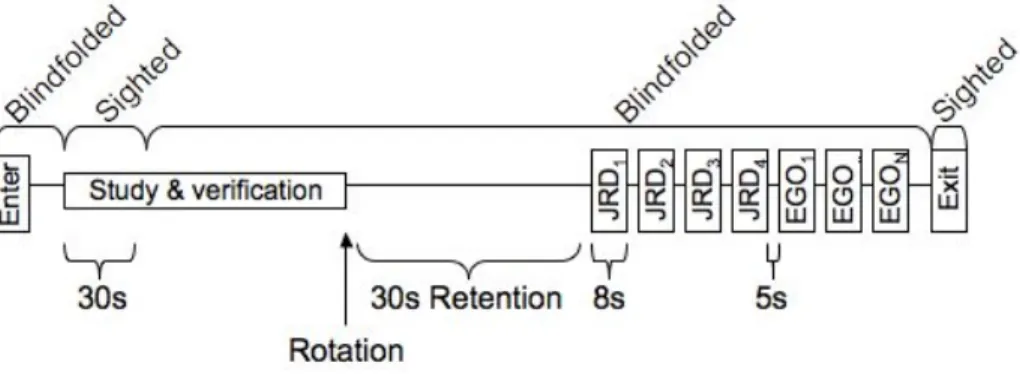
Participants were next introduced to the second and third practice configuration blocks, which were structured like the actual testing configurations (figure 2.2). Subjects entered the experiment area and began the study-phase of the block. During the study phase, participants were given thirty seconds to study the configuration (figure 2.1), after which time they replaced the blindfold and were tested. The study-phase repeated itself until participants passed this test. The test prompted them to point to each of the targets randomly three times. In order to pass the study test, their pointing error to each target had to be less than 15°. Upon exiting the study-phase there was a thirty second retention interval followed by the study-phase. The testing-phase consisted of a block of eight randomly ordered JRD trials followed by a block of randomly ordered egocentric trials (once per target) with a five second delay between each judgment. The eight JRD trials were composed of four aligned and four contra-aligned trials. The second practice configuration block introduced participants to the rotate instructions. Specifically, just before the retention interval, participants were instructed to turn 180° in-place. They were instructed to try to visualize the locations of the objects relative to themselves as they moved, since they would be asked to point to each of the targets at the end of the configuration block.
After the third practice configuration, the experimenter answered any questions and set up the first testing configuration block.
Figure 2.2 Experiment one per-configuration sequence and timings (not to scale).
2.1.3.2Testing Having completed the training, participants were exposed to the four testing configurations presented in random order (two each in stay and rotate conditions). The testing configuration blocks were structured almost identically to the second and third practice configurations. After the configuration was in place, the participant entered the experiment area and began the study-phase. Actual initial study times were different based on set size condition. Initial study times for the three conditions were thirty, fifty, and seventy seconds for set sizes 4, 6 and 8 respectively. If participants failed the study test, the additional study time was always thirty seconds regardless of set size. The testing-phase again consisted of eight randomly ordered JRD trials (four aligned & contra-aligned) followed by a block of egocentric trials.
After the final configuration, participants filled out a brief questionnaire asking for general demographic information as well their subjective awareness of the frequency of various types of visual imagery, behaviors, and strategies (see appendix B). Of greatest interest here were the visual imagery questions. These questions were designed to probe the frequency of the use of egocentric (i.e. “When remembering the location of a target, I often saw it from the same perspective I studied it from”) or allocentric (i.e. “When remembering the location of a target, I often saw it from a top-down, map-like perspective”) visualizations. The responses for each were averaged to produce an estimated frequency of egocentric and allocentric imagery use.
2.1.4 Data cleaning
For each pointing response recorded, four data points were collected. The two latency measures looked at total response time and time to the first movement of the joystick. Deviations were measured both for absolute and signed pointing error (i.e. including the directionality of the error with negative values reflecting angular over estimations). Any responses that exceeded three standard deviations from the group mean for total latency (≤ 0.5s, ≥ 7.5s) or absolute error (≥ 120°) were excluded for that subject. 135 of 1888 (8%) responses were excluded. Responses
were averaged within each primary condition for JRD (stay-aligned, stay-contra, rotate-aligned, and rotate-contra) and egocentric (stay and rotate). Any subject with less than half the possible responses per condition was excluded entirely. Two subjects were excluded by this criterion. Looking at their data individually revealed that they were frequently responding almost immediately (< 0.5s) with extremely high errors (average 105°). From all outward appearances
these two subjects were not taking the task seriously. Unfortunately, their exclusion will present a problem during the set size analyses discussed later.
2.2 RESULTS
Analyses reported here were conducted on each of four measures (absolute latency, first-movement latency, absolute error and signed error). Since the first-first-movement latency measure showed no differences, only absolute latency is reported. Similarly, analyses of signed errors showed little significance and will only be mentioned briefly.
The core, theoretically relevant, analyses are presented first. Secondary and tertiary analyses exploring alternative interpretations and subject behaviors are included for completeness. Those interested in just the core analyses can skip to the discussion (2.3) after the egocentric pointing results.
2.2.1 Visualization style
Before delving into the various analyses it is necessary to introduce a measure derived from the debriefing questionnaires. Anticipating that the individual differences seen in Waller et al. (2002) might have been due to differences in visualization styles, questions were asked regarding the subjective quality of participants’ mental visualizations of the targets. Questions probed the relative frequency of use of different visualizations along egocentric and allocentric (map-like) boundaries.
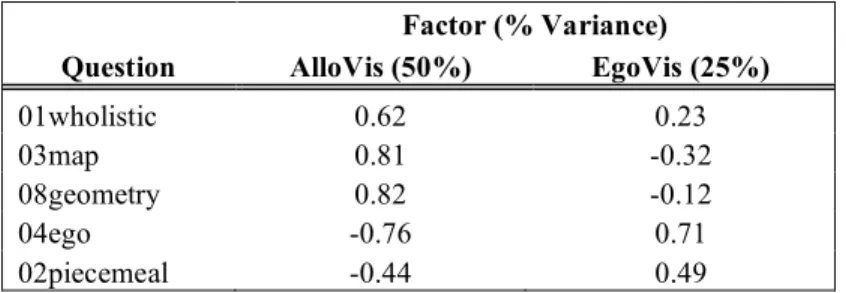
A principle component analysis of the visualization questions yielded two dominant factors. Three of the allocentric visualization questions weighed most heavily on the first factor (allo-vis). The second factor (ego-vis) consisted entirely of the egocentric questions. No other factor attained eigenvalues greater than 1.0. A frequency of visualization usage for each type was established by averaging the responses to the questions within each factor. While most participants (90%) reported using egocentric visualizations more than half the time, only half the subjects reported frequently using allocentric visualizations (50%). The frequency of allocentric visualization use was recoded into a split half, yielding two groups of roughly equal sizes. Low frequency allocentric visualizers were classified as the predominantly egocentric visualizers.
Table 2.1 Primary egocentric & allocentric questions for PCA extracted factors. Factor (% Variance)
Question AlloVis (50%) EgoVis (25%)
01wholistic 0.62 0.23
03map 0.81 -0.32
08geometry 0.82 -0.12
04ego -0.76 0.71
02piecemeal -0.44 0.49
Grouping based on allocentric visualization usage is an important factor in the following analyses. While the over-all distribution of allocentric visualizers is roughly equal, in two areas it is heavily skewed. In set sizes four and eight allocentric visualizers accounted for 58% of the participants. Set size six saw a radically different distribution with only 4/17 (24%) of subjects reporting frequently using allocentric visualizations. Finally, the distribution of allocentric visualizers is significantly different when grouped by sex. Only 28% of women frequently used allocentric visualizations whereas 70% of men did, Χ2 (1, 57)=10.6, p<0.001.
2.2.2 Judgments of relative direction
Each of the analyses reported here (absolute latency and error) are based on the same general 2x2x2x2 RMANOVA with body position (stay & rotate) and imaginary alignment (aligned & contra-aligned) as within-subject factors and visualization type (allo-vis & ego-vis) and set size (4 & 8) as between-subject factors.
It should be noted that set size 6 is being excluded from these analyses. As mentioned previously, there was an unequal distribution in the visualization self-reports, with allocentric visualizers accounting for less than a third of the sample (4/17). As it turns out, the two participants that were excluded during data cleaning also belonged to this group. Given the small
sample size for set size 6 allocentric visualizers, the entire set size is omitted from these analyses, leaving an effective sample size of 40 participants.
While the main effects are interesting in their own right, the primary focus here is on the interactions, particularly of body position and imaginary alignment with the other factors. As such, while all the significant findings are reported, the interactions will receive the majority of the consideration.
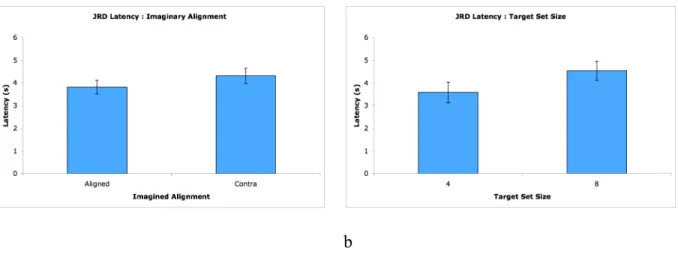
2.2.2.1Latency RMANOVA analysis on latency showed no significant effect for body position, F(1,36)=0.6, p>0.05, or visualization type, F(1,36)=0.7, p>0.05. There was a significant main effect for imaginary alignment, F(1,36)=33.6, p<0.001, with aligned judgments averaging 0.5s faster (figure 2.3, a). Set size also showed a significant main effect, F(1,36)=9.5, p<0.005, with set size 4 averaging 1s faster than set size 8 (figure 2.3, b).
a b
Figure 2.3 Main effects of alignment (a) and set size (b) for JRD latencies. Error bars are 95% CI.
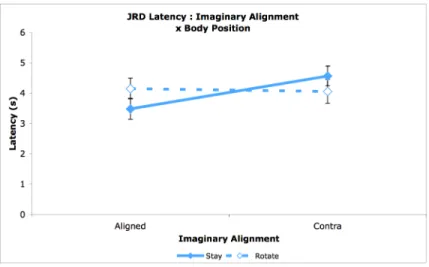
The interaction of body position and imaginary alignment was significant, F(1,36)=45.6, p<0.001. When standing still the alignment effect was strong, however, after rotation it vanishes
entirely (figure 2.4). All other first order interactions were non-significant or marginal and will not be discussed further.
Figure 2.4 Interaction of imaginary alignment and body position for JRD latencies. Error bars are 95% CI.
The three-way interaction of body position, imaginary alignment, and visualization was also significant, F(1,36)=22.6, p<0.001. While both allocentric and egocentric visualizers showed the standard alignment effect when stationary, after rotation allocentric visualizers s