Component Importance Measures for Complex Repairable System
G. Feng & E. Patelli
Institute for Risk and Uncertainty, School of Engineering, University of Liverpool, Liverpool, United Kingdom
M. Beer
Institute for Risk and Reliability, Leibniz University Hannover, Hannover, Germany
Institute for Risk and Uncertainty, School of Engineering, University of Liverpool, Liverpool, United Kingdom School of Civil Engineering & Shanghai Institute of Disaster Prevention and Relief, Tongji University, China
F. P.A. Coolen
Department of Mathematical Sciences, Durham University, Durham, United Kingdom
ABSTRACT: Survival signature is a summary of structure function, which has been presented to perform reliability analysis on system with multiple component types. However, it is pretty intractable and difficult to use analytical methods to perform reliability analysis on repairable system, therefore, numerical simulation method for the analyse of such systems is required. Importance measures in system reliability engineering are applied to find the weakest component in a system. In many practical situation it is a necessary to know the importance of a set of components. The existing component importance measures are calculated through analytical ways which mainly focus on a specific component, however, there are few applications of these measures to repairable systems. In this paper, survival signature-based simulation method has been proposed to analyse reliability on repairable systems. This approach is efficient since the survival signature of the system only need to be calculated once while Monte Carlo simulation is used to generate component transition times. What is more, two component importance measures which based on survival signature are also introduced to estimate the importance degree of a specific component or a set of components. In order to quantify the importance degree of the component, the relative criticality index is presented. Numerical examples are presented to show the applicability of the approaches.
1 INTRODUCTION
In recent years, the system signature has been rec-ognized as an important tool to quantify the reliabil-ity of systems consist of independent and identically distributed (iid) or exchangeable components with respect the random failure times (Samaniego 2007). System signature separates the system structure from the component probabilistic failure distribution. How-ever, when it is adopted to solve a complex system with more than one component type, it requires the computation of the probabilities of all possible differ-ent ordering statistics of each compondiffer-ent failure life-time distributions (Coolen & Coolen-Maturi 2015), which is often an intractable procedure.
In order to overcome the limitations of the sys-tem signature, Coolen & Coolen-Maturi (2012) pro-posed the use of survival signature. Survival signa-ture method not only reserves the merits of the sys-tem signature, but it has been shown to be an effective
tool for analysing complex system consisting of more than one single component type. In essence, it does not have the assumption that components of different types areiid, which overcome the long-standing lim-itation of system signature. Therefore, survival signa-ture is a promising method for application to complex systems and networks.
Recently, Aslett (2012) developed a package to cal-culate the survival signature. Coolen et al. (2014) proposed a non-parametric predictive inference for system reliability using the survival signature. Aslett et al. (2015) did system reliability within the Bayesian framework of statistics. Based on the above concepts, Feng et al. (2016) developed an analytical method to calculate survival function of systems with uncer-tain components parameters which belong to expo-nential distribution. These methods are efficient, how-ever, they do not take the repairable system into con-sideration.
following the occurrence of a failure; rather, they are repaired and put into operation again. The use of sim-ulation methods for repairable system reliability has attractive features, especially for large or complex systems (Patelli et al. 2012). Moreover, if there exist imprecise probabilities, it is even more complicated to deal with the imprecision (Beer et al. 2013). Most of the current simulation methods for system reliabil-ity are based on Monte Carlo simulation and structure function. By generating the state evolution of each component, the structure function is computed to de-termine the state of the system. However, the calcula-tion of the structure funccalcula-tion usually requires the cal-culation of all the path sets or cut sets. Therefore, it is a difficult task for complex repairable systems.
The survival signature is a summary of the system structure functions, which is not only good for de-termining the system reliability function, but efficient for complex system with repairable components. This is because it just needs to store survival signature in-stead of the whole structure functions of the system.
Risk are unavoidable and as such the key challenge in engineering risk analysis is to identify the com-ponents of the system that contribute most to risk (Modarres 1992). Component importance measure is a very useful method for the designers and manufac-tures experts to find how the failure of one compo-nent affects the functioning of the system and iden-tify the weakest components in the system. The def-inition of component importance measure is first in-troduced by Birnbaum (1968) in 1968, which is ob-tained by partial differentiation of the system reliabil-ity with respect to the given component reliabilreliabil-ity. An improvement or decline in reliability of the compo-nent with the highest importance will cause the great-est increase or decrease in system reliability. Based on this achievement, many other component importance measures have been introduced. e.g., structure impor-tance measure (Borgonovo 2007), Fussell-Vesley im-portance measure (Vesely 1970, Fussell 1975), fail-ure criticality index (Wang et al. 2004), risk reduc-tion worth and risk achievement worth (Borgonovo and Apostolakis 2001). Dutuit & Rauzy (2014) gave a review for importance factors of coherent systems, which contributes to clarify mathematical and algo-rithmic foundations of importance factors.
However, the traditional importance measures mainly focus on non-repairable systems, and mainly concern reliability importance of an individual com-ponent. In many practical situation it is of interest to evaluate the importance of a set of components in-stead of just individual component.
A survival signature-based method is proposed in this paper, which is efficient to analysis repairable system reliability. This is essential when dealing with complex repairable systems since they can only be analysed through simulation method. In order to find out the most “critical” component in the system, new component importance measures which based on
sur-vival signature are introduced to analysis individual component and component sets respectively. What is more, a new relative criticality index is used to quan-tify the importance degree of the component. The ap-plicability of the proposed approach is demonstrated by solving the numerical examples.
This paper is organized as follows. Section 2 presents the definition and advantages of survival sig-nature for system with multiple component types. The reliability analytical method for repairable systems which based on survival signature is introduced in Section 3. In Section 4, the component importance measures both for a specific component and compo-nent sets are presented. The applicability of the pro-posed methods is shown by analysing one numerical example in Section 5 and Section 6 closes the paper with conclusions.
2 SURVIVAL SIGNATURE FOR SYSTEM WITH MULTIPLE COMPONENT TYPES
For a system with m components, let state vector x= (x1, x2, ..., xm)∈ {0,1}m, withxi = 1 if theith
component works and xi = 0 if not. The structure functionφ:{0,1}m→ {0,1}, defined for all possible x, takes the value 1 if the system functions and 0 if not for state vectorx. In this paper, attention is restricted to coherent systems, for whichφ(x)is not decreasing in any of the components of x, so system function-ing cannot be improved by worse performance of one or more of its components. It is further assumed that
φ(0) = 0 and φ(1) = 1, so the system fails if all its
components fail and functions if all its components function.
Now consider a system with K ≥ 2 types of components, with mk components of type k ∈
{1,2, ..., K} and PK
k=1mk = m. Assume that the random failure times of components of the system type are exchangeable, while full independence is is assumed for the random failure times of com-ponents of different types. The comcom-ponents of the same type can be grouped together due to the arbi-trary ordering of the components in the sate vector, which leads to a state vector can be presented asx= (x1, x2, ..., xK), with xk = (xk
1, xk2, ..., xkmk) illustrat-ing the states of the components of typek. Coolen and Coolen-Maturi (2012) introduced the survival signa-ture for such a system, denoted by Φ(l1, l2, ..., lK), withlk = 0,1, ..., mkfork = 1,2, ..., K, which is de-fined to be the probability that the system functions given thatlkof itsmkcomponents of typekwork, for eachk ∈ {1,2, ..., K}.
There aremklkstate vectors xk withPmk
i=1xki =lk (k = 1,2, ..., K), and let Sl1,l2,...,lK denote the set of
all state vectors for the whole system. Due to inde-pendent and identical distributed (iid) assumption, all the state vectorsxk ∈Slk
so the survival signature can be written as Φ(l1, ..., lK) = [ K Y k=1 mk lk !−1 ]× X x∈Sl1,...,lK φ(x) (1) Ck(t) ∈ {0,1, ..., mk} denotes the number of k components working at timet. Assume that the com-ponents of the same type have a known CDF,Fk(t)for typek. Moreover, the failure times of different com-ponent types are assumed independent, then:
P( K \ k=1 {Ck(t) =lk}) = K Y k=1 P(Ck(t) =lk) = (2) K Y k=1 mk lk ! [Fk(t)]mk−lk[1−Fk(t)]lk
Hence, the survival function of the system withK types of components becomes:
P(Ts > t) = m1 X l1=0 ... mK X lK=0 φ(l1, ..., lK)∗ (3) P( K \ k=1 {Ck(t) =lk})
It is obvious from Equation 3 that the survival sig-nature can separate the structure of the system from the failure time distribution of its components, which is the main advantage of the system signature. What is more, the survival signature only need to be calculated once for any system, which is similar to the system signature for systems with only single type of compo-nents. It is easily seen that survival signature is closely related with system signature. For a special case of a system with only one type (K = 1) of components, the survival signature and the Samaniego’s signature (Samaniego 2007) are directly linked to each other through a simple equation, however, the latter cannot be easily generalized for systems with multiple types (K ≥ 2) of components (Coolen & Coolen-Maturi 2012).
This implies that all attractive properties of the sys-tem signature also hold for the method using the sur-vival signature, also the sursur-vival signature is easy to apply for systems with multiple types of components, and one could argue it is much easier to interpret than the system signature.
3 REPAIRABLE SYSTEM RELIABILITY ANALYSIS BASED ON SURVIVAL SIGNATURE
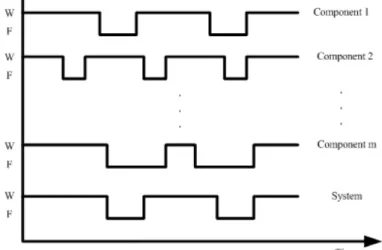
If the system with m components is repairable, a schematic diagram of components status and the cor-responding system performance are presented in fig-ure 1.
Figure 1: Schematic diagram of components status and the cor-responding system performance.
For structure function method, it is a necessary to identify whether the system works or not at each criti-cal time point. The criticriti-cal time point is the beginning time for each component fails and the finish time for each component repairs.
In this paper, a survival signature-based method is proposed to analyse the repairable system relia-bility. This method is based on the system produc-tion idea proposed by Zio et al. (2006) and Patelli et al. (2016). Assume that there are jk possible tran-sition for the components of type k. The probability of going from state s=i to states0 =j in given by
pkji= Pr(Xk=i|Xk=j). For simplicity, let assume
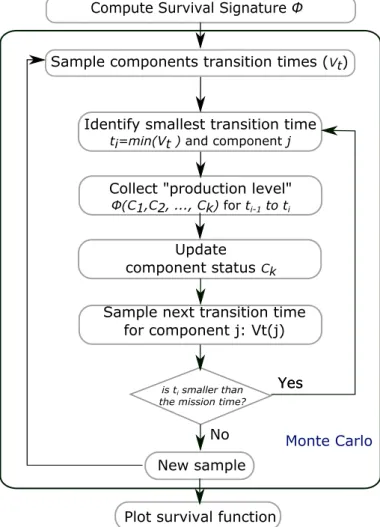
there is only one possible transition to exit from the states=i. For instance, a component in working sta-tuss= 1can fail and entering in the states0 = 2; the component in the states= 2can only be repaired and returning in the statuss0= 1. LetFkj= Pr(· |Xk=j) represents the CDF of the component of typekin the statej to undergo a transition. The Monte Carlo sim-ulation is performed as follows and the evaluation of the survival function of a system are performed using the procedure shown in figure 2.
Step 1. Sample the transition times ti for i =
1,2, . . . , mfor each component from the cor-responding CDF Fkj and stored in a vector V t={t1, t2, . . . , tm}, settold= 0;
Step 2. Identify the first transition timemin(V t)and the corresponding component z. Hence, t1
represents the first transition of a system, t2
the second transition and so on;
Step 3. At each transition time, the number of com-ponents in working status is computed:C = (C1, C2, . . . , CK)and the corresponding “pro-duction level” by evaluating the survival sig-natureΦC;
Step 4. Collect the value of the survival signature
ΦC in the vector V r representing the sur-vival function as follows:V r(j) =V r(j) +
Compute Survival Signature Φ Sample components transition times (Vt)
Update component status Ck
is ti smaller than
the mission time?
Identify smallest transition time ti=min(Vt ) and component j Collect "production level"
Φ(C1,C2, ..., Ck) for ti-1 to ti
Yes Sample next transition time
for component j: Vt(j) Yes No
New sample
Monte Carlo
Plot survival function
Figure 2: Flow chart of survival signature based survival function evaluation method for repairable system.
Φti ∀j :told≤j·dt < min(V t), Settold= min(V t).
Step 5. Update the statusj of componentz;
Step 6. Update the vector of transition time V t by sampling the next transition time t0z of the componentzfromFkjwherekis the compo-nent type of the compocompo-nentzandj its status. Hence:V t(z) =tz+t0z;
Step 7. Ifmin(V t)< TM ission, return to point 2.
4 COMPONENT IMPORTANCE MEASURES
4.1 Importance measure of a specific component
Based on the results of Feng et al. (2016), the rela-tive important index (RIi(t)) of theith component at time t can be used to analyse repairable component importance. It is the survival function probability dif-ferences between the repairable system works if the ith component functions and the repairable ith com-ponent failures. The mathematical expression formula ofRIi(t)is
RIi(t) =P(TS > t|Ti> t)−P(TS > t|Ti≤t)(4)
Where,P(TS > t|Ti> t)represents the probabil-ity that the repairable system works knowing that the ith component functions; P(TS > t|Ti ≤t)denotes the probability that the repairable system functions if theith component has failed.
4.2 Importance measure of a set of components
It is sometimes important to evaluate the importance of a set of components instead of a specific one in real engineering world. Therefore, the relative impor-tance index for a specific component can be extended for components of type k, which can be denoted by RIk(t). It is the probability difference values between the repairable system functions if the components of type k are repairable and the components of type k cannot be repaired. RIk(t) can be expressed as fol-lows
RIk(t) =P(TS> t|Tk> t)−P(TS > t|Tk≤t)(5) Where, P(TS > t | Tk > t) represents the proba-bility that the repairable system works if the compo-nents of typekare repairable;P(TS> t|Tk≤t) de-notes the probability that the repairable system func-tions knowing that the components in type k cannot be repaired.
Both RIi(t) and RIk(t) is a function of time and they reveals the trend of the importance degree of a specific component or a set of components within the repairable system. The bigger the value of RIi(t) or RIk(t), the more “critical” of the ith component or the set of components on the repairable system relia-bility at a specific timet, and vice versa. This helps to allocate resources, which might including resources for reliability improvement, surveillance and mainte-nance, design modification, security, operating pro-cedure, training, quality control requirements, and a wide variety of other resource expenditures. By us-ing the importance of a specific component or a set of components, resources expenditure can be properly optimized to reduce the total life-cycle resource ex-penditures while keeping the risk as low as possible. In other words, for a given resource expenditure such as for maintenance, the importance measure of a spe-cific component or set of components can be used to allocate resources to minimize the total system risk. This approach allows the risk manager to offer the “biggest bang for the buck” (Modarres 2006).
4.3 Quantify importance degree of the component
In order to quantify importance degree of the com-ponent, a new index which called relative criticality index (RC) is introduced in this paper. The numeri-cally obtained index for a repairable system is through Monte Carlo simulation which based on Section 3. The failure times of the system can be got through each trial, after having simulated many histories of
1 1 2 2 2 2 1 3 3 1 4 6 5 1 1 2 3 4 5 6 7 8 9 10 11 12 13 14
Figure 3: The complex repairable system with six types of com-ponents. The numbers inside the component boxes indicate the component type. The numbers above the component boxes indi-cate the component indices.
the system, estimates are made of the desired rela-tive criticality index statistically. For a system with m components, given componenti, this index is ex-pressed as
RCi= N
f i
max{N1f,...,m} (6)
Where, Nif represents average number of sys-tem failures if the ith component cannot repair; and max{N1f,...,m}denotes the maximum average number of system failures if the each component cannot repair respectively.
This index can quantify the importance degree of each component, and the relative criticality index val-ues of all the components are compared with the biggestRC value. Therefore, the bigger the value is, the bigger influence of theith component on the re-pairable system.
5 NUMERICAL EXAMPLE
The purpose of this numerical example is to show the efficiency of the survival signature-based reliability analysis on repairable system. What is more, the com-ponent importance measures presented in this paper are also used to analyse the same system. The reli-ability block diagram representation of a simplified auxiliary feedwater system can be seen in figure 3, it consists of fourteen components which belong to six component types.
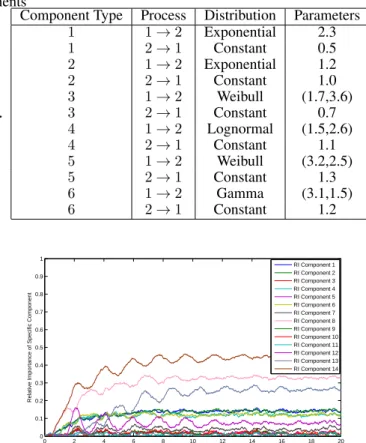
Table 1 shows the distribution for failure process (1→2) and repair process (2→1) of components.
Let first perform importance measure of a specific component. The results can be seen in figure 4.
It is clear that component 14 always has higher rel-ative importance index than the other thirteen ponents, which means it is the most “critical” com-ponent in the repairable system. Then it comes to component 8. Component 13 has litter relative im-portance index values at the first time, however, its relative importance index values become bigger and bigger as time goes on, which just follows the com-ponents 14 and 8. Component 1 and component 2 has similar relative importance values, which are some-times crossover. The same circumstance occurs on
Table 1: Distribution for failure and repair process of compo-nents
.
Component Type Process Distribution Parameters
1 1→2 Exponential 2.3 1 2→1 Constant 0.5 2 1→2 Exponential 1.2 2 2→1 Constant 1.0 3 1→2 Weibull (1.7,3.6) 3 2→1 Constant 0.7 4 1→2 Lognormal (1.5,2.6) 4 2→1 Constant 1.1 5 1→2 Weibull (3.2,2.5) 5 2→1 Constant 1.3 6 1→2 Gamma (3.1,1.5) 6 2→1 Constant 1.2 0 2 4 6 8 10 12 14 16 18 20 0 0.1 0.2 0.3 0.4 0.5 0.6 0.7 0.8 0.9 1 Time t
Relative Importance of Specific Component
RI Component 1 RI Component 2 RI Component 3 RI Component 4 RI Component 5 RI Component 6 RI Component 7 RI Component 8 RI Component 9 RI Component 10 RI Component 11 RI Component 12 RI Component 13 RI Component 14
Figure 4: Relative importance index of the specific component in system.
components 4 and 6. The relative importance of the five components (3, 5, 7, 9, 10) always within within 0.1, which means they has less importance influence degree than other components on the repairable sys-tem.
For application in the real world, sometimes people want to know the importance degree of a set of com-ponents. i.e., the relative importance index of compo-nents of set 1 to set 6 in this repairable system. Fig-ure 5 shows the results of them.
It can be seen that the relative importance index val-ues of component sets 1 and 2 are bigger than other component sets, therefore, components of type 1 and 2 are more important than components of other types in this repairable system. On the contrary, component set 4 is the least important within the system because it has the smallest values of relative importance index. The values of component set 1 are higher than 2 at the beginning time, however, their values are the same as
0 2 4 6 8 10 12 14 16 18 20 0 0.1 0.2 0.3 0.4 0.5 0.6 0.7 0.8 0.9 1 Time t
Relative Importance of Component Set
RI Component Set 1 RI Component Set 2 RI Component Set 3 RI Component Set 4 RI Component Set 5 RI Component Set 6
Figure 5: Relative importance index of the component sets in system.
1 2 3 4 5 6 7 8 9 10 11 12 13 14 0 0.1 0.2 0.3 0.4 0.5 0.6 0.7 0.8 0.9 1
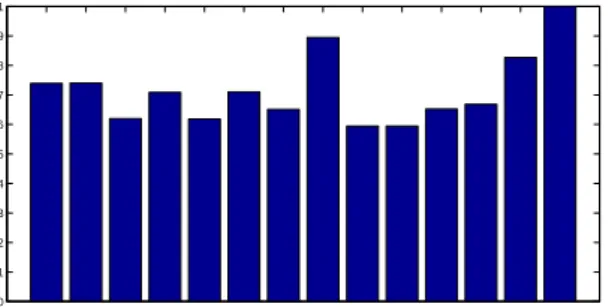
Figure 6: Relative criticality index of the component in system.
time goes on. Component set 6 has lower relative im-portance values than component sets 3 and 5, but the values go up and rank the third within the six compo-nent sets in the last. Compocompo-nent set 3 and 5 has the similar relative importance values trend, although the value of set 5 is bigger than set 3.
If using the relative criticality index to quantify the importance degree, theRCof each component can be seen in figure 6.
It shows that component 14 has the highest im-portance degree to the repairable system, then comes component 8 and 13. The components 9 and 10 has the similar relative criticality index and they are also the “critical” ones.
6 CONCLUSIONS
Survival signature is an efficient approach for analysing complex system with more than one com-ponent type, and it is just need to be calculated once when perform reliability analysis on a specific sys-tem, which represents a significant computational ad-vantage. Sensitivity analysis is an important concept in system reliability, it helps to quantify the impor-tance of the component and identify the weakest com-ponent, also it gives guidance on how to allocate the resources. Some of the component importance measures can be calculated through analytical meth-ods, while for complex systems or repairable systems, simulation ways are much more efficient and useful.
In this paper, survival signature-based methods for repairable system reliability analysis and component importance measures have been presented. The effi-cient simulation method which based on survival sig-nature has been used for reliability analysis on re-pairable system, and survival signature only need to be calculated once for the same system whether it is repairable or not. What is more, the proposed impor-tance measures can not only find out the imporimpor-tance degree of the exact component, but can be used for analysing importance of a set of components. In order to quantify the importance degree of the component within the repairable system, a new relative criticality index is introduced in this paper. The application of these approaches presented in this paper is illustrated by performing an analysis on a complex repairable system.
REFERENCES
Aslett, L. J. (2012). Reliabilitytheory: Tools for structural relia-bility analysis. r package.
Aslett, L. J., F. P. Coolen, & S. P. Wilson (2015). Bayesian in-ference for reliability of systems and networks using the sur-vival signature.Risk Analysis 35(3), 1640–1651.
Beer, M., S. Ferson, & V. Kreinovich (2013). Imprecise probabil-ities in engineering analyses.Mechanical systems and signal processing 37(1), 4–29.
Birnbaum, Z. W. (1968). On the importance of different compo-nents in a multicomponent system. Technical report, DTIC Document.
Borgonovo, E. (2007). A new uncertainty importance measure.
Reliability Engineering & System Safety 92(6), 771–784. Borgonovo, E. & G. E. Apostolakis (2001). A new importance
measure for risk-informed decision making.Reliability En-gineering & System Safety 72(2), 193–212.
Coolen, F. P. & T. Coolen-Maturi (2012). Generalizing the signa-ture to systems with multiple types of components. In Com-plex Systems and Dependability, pp. 115–130. Springer. Coolen, F. P. & T. Coolen-Maturi (2015). Modelling uncertain
aspects of system dependability with survival signatures. In
Dependability Problems of Complex Information Systems, pp. 19–34. Springer.
Coolen, F. P., T. Coolen-Maturi, & A. H. Al-Nefaiee (2014). Nonparametric predictive inference for system reliability us-ing the survival signature.Proceedings of the Institution of Mechanical Engineers, Part O: Journal of Risk and Reliabil-ity 228(5), 437–448.
Dutuit, Y. & A. Rauzy (2014). Importance factors of coherent systems: a review.Proceedings of the Institution of Mechani-cal Engineers, Part O: Journal of Risk and Reliability 228(3), 313–323.
Feng, G., E. Patelli, M. Beer, & F. P. Coolen (2016). Imprecise system reliability and component importance based on sur-vival signature.Reliability Engineering & System Safety 150, 116–125.
Fussell, J. (1975). How to hand-calculate system reliability and safety characteristics. Reliability, IEEE Transactions on 3, 169–174.
Modarres, M. (1992).What every engineer should know about reliability and risk analysis, Volume 30. CRC Press. Modarres, M. (2006).Risk analysis in engineering: techniques,
tools, and trends. CRC press.
Patelli, E., G. Feng, F. P. Coolen, & T. Coolen-Maturi (2016). Simulation methods for system reliability using the survival signature.(submitted).
Patelli, E., H. M. Panayirci, M. Broggi, B. Goller, P. Beaurepaire, H. J. Pradlwarter, & G. I. Schu¨eller (2012). General purpose software for efficient uncertainty management of large finite element models.Finite elements in analysis and design 51, 31–48.
Samaniego, F. J. (2007).System signatures and their applica-tions in engineering reliability, Volume 110. Springer Sci-ence & Business Media.
Vesely, W. (1970). A time-dependent methodology for fault tree evaluation.Nuclear engineering and design 13(2), 337–360. Wang, W., J. Loman, & P. Vassiliou (2004). Reliability impor-tance of components in a complex system. InReliability and Maintainability, 2004 Annual Symposium-RAMS, pp. 6–11. IEEE.
Zio, E., P. Baraldi, & E. Patelli (2006). Assessment of the avail-ability of an offshore installation by monte carlo simulation.
International Journal of Pressure Vessels and Piping 83(4), 312–320.