S73 The authors are with the School of Population Health, The University of Western Australia, Crawley, WA 6009, Australia.
Physical Activity Behavior of Dog Owners:
Development and Reliability of the Dogs
and Physical Activity (DAPA) Tool
Hayley E. Cutt, Billie Giles-Corti, Matthew W. Knuiman, and Terri J. Pikora
Background: This study aimed to develop a reliable instrument, the Dogs and
Physical Activity (DAPA) tool, for measuring important attributes and scales relating to the dog-walking behavior of dog owners. Methods: Items measuring dog-specific individual, social environmental, physical environmental, and policy-related factors that affect dog owners’ walking with their dogs were assessed for test–retest reliability. Factor analysis was undertaken to demonstrate that the collection of test items had underlying constructs consistent with the theoreti-cal framework. Results: DAPA-tool items had test–retest reliability scores >.7, indicating a high level of stability. Distinct general and dog-specific constructs of subscales measuring dog-supportive features of parks, barriers to dog walking, and behavioral beliefs about the outcomes of regular dog walking were demonstrated through factor analysis. Conclusions: The DAPA tool is the first comprehensive, reliable tool for measuring important attributes and scales relating to dog owners’ physical activity and the context-specific factors that affect owners’ walking with their dogs.
Keywords: walking, exercise, pet ownership, environment, reproducibility of
results
Increasing levels of overweight and obesity accompanied by low levels of physi-cal activity are a major public health concern in many industrialized countries.1-3
The link between physical inactivity and disease has been shown for a number of diseases, including cardiovascular disease, type 2 diabetes, and some cancers.4
Social support is one variable that has consistently been associated with physical activity.5-8 Social support is usually a measure of the support provided
by family, friends, and coworkers. Another form of instrumental and emotional support, which has received less attention, however, is the suppport provided by companion animals. One study that included pets as a form of social support found that women who reported no company or pet to walk with were 31% less likely to walk for exercise or recreation.9 There is a large potential for dogs to provide
S74 Cutt et al
an important form of social support for regular walking because almost half of all households in both the United States and Australia own dogs.10,11
A handful of studies have compared dog owners’ and nonowners’ levels of physical activity.12 Most of these studies have found that dog owners engage in
more physical activity than nonowners and are more likely to exercise at the rec-ommended level of 150 minutes per week.1,13 Other studies, however, found that
up to half of dog owners in Australia do not walk their dogs.14,15 Declining levels
of physical activity, coupled with high levels of dog ownership in industrialized countries, highlight the need to examine the potential of dog ownership to increase physical activity levels in the community and the importance of investigating the individual, social environmental, physical environmental, and policy-related factors that affect owners’ walking with their dogs.
Considering the fact that a large proportion of the community owns dogs but up to half do not walk their dogs, the public health implications of increasing the physical activity level of even a small percentage of dog owners could be sig-nificant.14 Thus, understanding the factors that affect owners’ walking with their
dogs is important for developing appropriate interventions. Although a number of instruments have been developed to measure physical activity in general16 and the
exercise behavior of dogs,17 none of these use dog-specific variables or take into
account the owner–dog relationship or the wider built environment and policy-related factors that might influence owners’ walking with their dogs. The aim of this study was to develop and test the reliability of a tool for measuring owners’ dog-walking behavior and the individual, social, and physical environmental factors that affect dog owners’ walking with their dogs in public places.
Methods
Theoretical Model Used to Guide Development of the DAPA Tool
The theory of planned behavior (TPB) was used as a theoretical framework in designing items to measure the factors that relate to walking with a dog. The TPB18
is well established19 and has been successfully used to predict general physical
activity behavior.20-23 A recent study found that the constructs of intention and
perceived behavioral control explained 13% of the variance in walking behavior, with dog obligation adding another 11%.24 Dog obligation measured the level of
obligation or responsibility for walking a dog. This study was the first to use the TPB to examine individual factors affecting dog owners’ walking and was the first to have identified a dog-specific factor, dog obligation, as important in explaining owners’ walking behavior. It is likely, however, that the predictive capacity of the TPB could be improved if behavior-specific (dog walking) and context-specific (walking the dog for recreation in the neighborhood) variables were measured.25
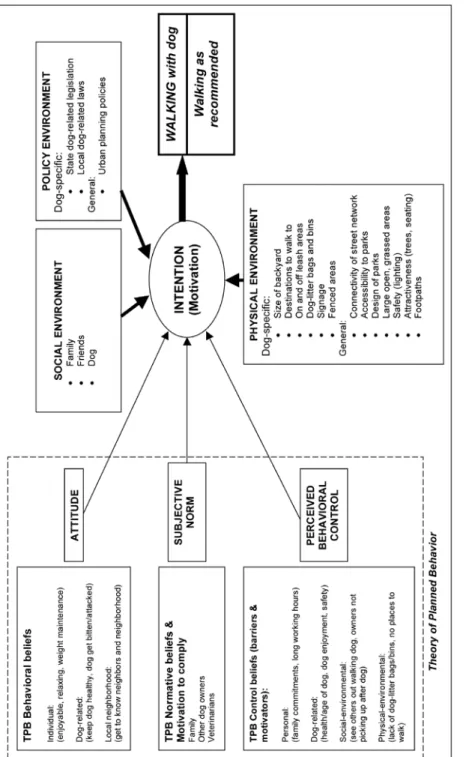
This current research combined the TPB with the social-ecological model to provide a holistic framework to guide the development of items measuring important attributes and subscales relating to the walking behavior of dog owners (Figure 1). Recently there has been a considerable effort to look beyond the individual determi-nants of physical activity and explore the effect of the environment. Interventions
S75
Figure 1
—
Theoretical model of the relationship between dog o
S76 Cutt et al
that focus on the environmental influences on physical activity have the potential to reach a much wider audience.26 Social-ecological models27,28 are being used in
physical activity research to explain the direct effect of the environment on people’s behavior and its interaction with individual factors such as those in the TPB.29,30
Although there is evidence to show that walking is positively correlated with the social support provided by dogs, it is likely that the effect of the physical31,32 and
local-policy environment33 might also be important in predicting dog-walking
behavior. Figure 1 shows how the social, policy, and physical environment interact independently of and indirectly through dog-specific TPB constructs to predict dog-walking behavior. This theoretical model was used as the basis for developing items to measure factors affecting dog-walking behavior.
The DAPA Tool
The DAPA (Dogs and Physical Activity) tool consists of 12 questions relating to dog ownership and physical activity. It was developed as a supplementary tool for the second RESIDE (RESIDential Environments) survey. RESIDE is a 5-year longitu-dinal study of the physical activity levels of people building homes in new housing estates in Western Australia.34 The DAPA items were developed after reviewing
relevant literature12 and examining the results of recent qualitative research. Seven
focus groups (n = 60) were conducted with dog owners to explore factors affect-ing people’s walkaffect-ing with their dog. The results of qualitative research, as well as the theoretical model shown in Figure 1, were used to guide the development of items for inclusion in the DAPA tool. A copy of the DAPA tool is available from the first author on request.
The DAPA tool asks about the type of pets owned, and for those who own a dog, the tool asks about the dog’s size and weight and the level of attachment of the owner to the dog. A 6-item measure of pet attachment (α = .58) developed by Garrity and others35 was included and reworded to be specific to dogs. Research focusing
on the relationship between companion animals and families regularly uses 1 item (eg, “my pet (dog) is considered part of the family”) to measure pet attachment.36
Thus, this item along with Garrity’s 6 items of attachment was used in the current questionnaire to measure the level of owner attachment to his or her dog.
The DAPA tool also includes items measuring participants’ physical activity undertaken with their dog(s), who in the household usually walks the dog, and the physical environmental features of parks in the neighborhood. The TPB constructs of attitude (behavioral beliefs), subjective norm (normative beliefs and motivation to comply), and perceived behavioral control (control beliefs) were included and modified to be relevant to walking with a dog daily.
Questions used by Saelens and colleagues37 to measure social support provided
by family and friends for walking and other physical activity were modified to add an item measuring the social support provided by dogs.
Sample and Procedure
Before recruitment, the research was approved by the University of Western Aus-tralia (UWA) Human Research Ethics Committee (No: RA/4/1/479). Participants were recruited via an e-mail sent to subscribers to the Events list.
UWA-Events is coordinated by the UWA public-affairs unit and is used to advertise future events to staff and students. It was evident that the original e-mail was forwarded to friends and family members beyond UWA. Within 72 hours of the sending of the recruitment e-mail, 197 current dog owners age 18 years or older who were willing to complete 2 postal surveys had responded. This was deemed a sufficient sample size for the purposes of a test–retest reliability assessment and factor analysis.38 Between July and August 2004, 189 people gave their written
informed consent, and the first survey was mailed to participants (8 were ineligible). A total of 173 (91.5%) responded, and approximately 1 week later, 168 second surveys (5 withdrew) were sent by post to participants. Because recruitment was stopped once a sufficient sample size had been obtained (after only 3 days), cal-culation of the response rate is inappropriate. Of the 197 participants, however, 150 completed both surveys.
Statistical Analysis
SPSS version 12 was used to analyze the data from the test–retest reliability sur-veys.39 Categorical responses were assessed for reliability using the kappa statistic
(κ), and intraclass correlations (ICCs) were used to determine the reliability of quantitative responses. Estimates of reliability were considered to have moderate agreement if the value was from .40 to .60, good agreement if the value was from .61 to .80, and excellent agreement if the value was >.80.40
Although the primary aim of this study was to test the reliability of the DAPA tool, there was opportunity to undertake factor analysis to assess the factor structure of subscales containing multiple items41 and to determine if individual items formed
underlying constructs as hypothesized in Figure 1. Factor analysis is considered an appropriate method of assessing the construct validity of scales.38,42 After cleaning
the data and checking for outliers, items that loaded high on a common factor and in the same direction were considered to be assessing a similar construct. The principal-axis factoring method with varimax rotation was used in all factor analyses.
Results
Participants ranged in age from 22 to 70 years (mean = 42 years, SD = 12). Most participants were women (84%) with a bachelor’s degree or higher (75%). The DAPA items were assessed by experts such as veterinarians, animal behaviorists, and fellow researchers on the relevance of questions to the research aims and objec-tives. The items were deemed to have good face validity.
General DAPA Items
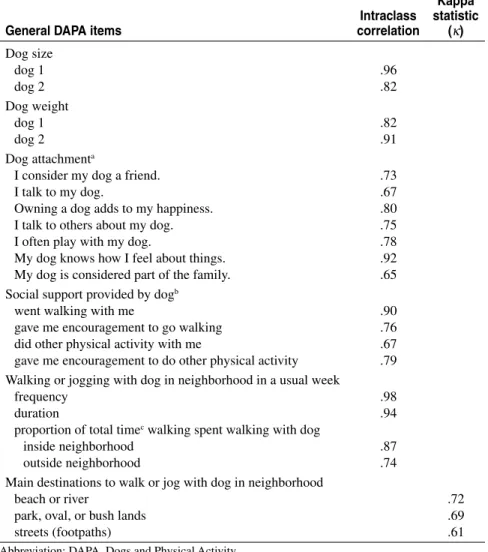
As shown in Table 1, participants could reliably recall both the size and the weight of their dogs (ICC = .82–.96). The 7 items measuring owners’ levels of attachment to their dogs had good to excellent ICC values (ICC = .65–.92). The modified social support question that included support provided by dogs for walking or other physi-cal activity also had good to excellent reliability (ICC = .67–.90).
Participants very reliably recalled the number of times (ICC = .98) and total time (ICC = .94) they walked or jogged with their dogs in a usual week. Recall of
S78 Cutt et al
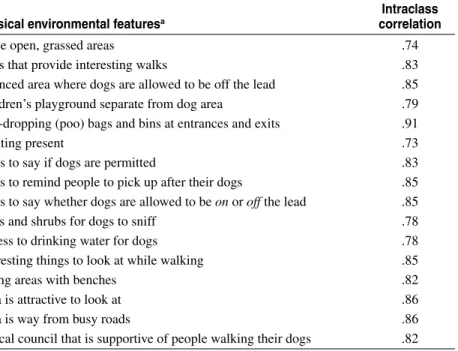
the proportion of total time in a usual week spent walking with a dog was reliable for inside (ICC = .87) and outside (ICC = .74) the local neighborhood. In addition, there was good agreement between the test and retest surveys for the main neighbor-hood destinations to which respondents usually walked or jogged with their dogs (κ = .61–.72). Participants were asked to indicate whether they had access to areas (eg, parks, beaches, bush land) in their neighborhoods with certain features. All 16 items had good to excellent agreement (ICC = .73–.91, Table 2).
Table 1 Test–Retest Reliability Results of General DAPA Tool Items
General DAPA items correlationIntraclass
Kappa statistic (κ) Dog size dog 1 .96 dog 2 .82 Dog weight dog 1 .82 dog 2 .91 Dog attachmenta
I consider my dog a friend. .73
I talk to my dog. .67
Owning a dog adds to my happiness. .80 I talk to others about my dog. .75
I often play with my dog. .78
My dog knows how I feel about things. .92 My dog is considered part of the family. .65 Social support provided by dogb
went walking with me .90
gave me encouragement to go walking .76 did other physical activity with me .67 gave me encouragement to do other physical activity .79 Walking or jogging with dog in neighborhood in a usual week
frequency .98
duration .94
proportion of total timec walking spent walking with dog
inside neighborhood .87
outside neighborhood .74
Main destinations to walk or jog with dog in neighborhood
beach or river .72
park, oval, or bush lands .69
streets (footpaths) .61
Abbreviation: DAPA, Dogs and Physical Activity.
a 1 = strongly disagree; 5 = strongly agree.
b 1 = never; 5 = very often.
TPB DAPA Items
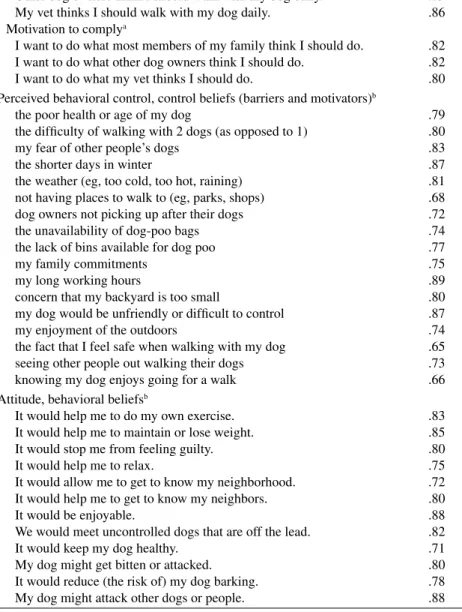
Table 3 shows the reliability of items measuring constructs based on the TPB. Items measuring normative beliefs (ICC = .79–.86) and motivation to comply (ICC = .80–.82) had excellent test and retest agreement. Both the barriers (ICC = .68–.89) and motivators (ICC = .65–.80) affecting people’s daily walking with their dogs had acceptable reliability. Items measuring behavioral beliefs associated with walking with a dog daily were similarly found to be reliable (ICC = .71–.88).
Factor-Analysis Results
Factor analysis was performed on both the test and the retest data and the factor solutions were found to be similar. Thus, factor-analysis results for only the first test survey are presented here. Tables 4 through 7 show the rotated-factor structure of each subscale, including the items that loaded onto each of the main factors and the variation in those items accounted for by each factor. Only factors that had eigenvalues greater than 1 and were dominant after examination of the scree plot are presented.38,43 To assess the construct validity of DAPA subscales, we used the
theoretical model to predict that items would load onto single factors for subscales measuring dog attachment, normative beliefs, and motivation to comply and onto general and dog-specific factors for subscales measuring the physical features of dog-walking areas, behavioral beliefs about the outcomes of dog walking, and the Table 2 Test–Retest Reliability Results for Physical Environmental Features of Local Areas
Physical environmental featuresa correlationIntraclass
Large open, grassed areas .74
Paths that provide interesting walks .83 A fenced area where dogs are allowed to be off the lead .85 Children’s playground separate from dog area .79 Dog-dropping (poo) bags and bins at entrances and exits .91
Lighting present .73
Signs to say if dogs are permitted .83 Signs to remind people to pick up after their dogs .85 Signs to say whether dogs are allowed to be on or off the lead .85 Trees and shrubs for dogs to sniff .78 Access to drinking water for dogs .78 Interesting things to look at while walking .85
Sitting areas with benches .82
Area is attractive to look at .86
Area is way from busy roads .86
A local council that is supportive of people walking their dogs .82
S80
Table 3 Test–Retest Reliability Results of TPB Constructs
TPB construct correlationIntraclass
Subjective norm Normative beliefa
Members of my family think I should walk with my dog daily. .83 Other dog owners think I should walk with my dog daily. .79 My vet thinks I should walk with my dog daily. .86 Motivation to complya
I want to do what most members of my family think I should do. .82 I want to do what other dog owners think I should do. .82 I want to do what my vet thinks I should do. .80 Perceived behavioral control, control beliefs (barriers and motivators)b
the poor health or age of my dog .79 the difficulty of walking with 2 dogs (as opposed to 1) .80 my fear of other people’s dogs .83
the shorter days in winter .87
the weather (eg, too cold, too hot, raining) .81 not having places to walk to (eg, parks, shops) .68 dog owners not picking up after their dogs .72 the unavailability of dog-poo bags .74 the lack of bins available for dog poo .77
my family commitments .75
my long working hours .89
concern that my backyard is too small .80 my dog would be unfriendly or difficult to control .87
my enjoyment of the outdoors .74
the fact that I feel safe when walking with my dog .65 seeing other people out walking their dogs .73 knowing my dog enjoys going for a walk .66 Attitude, behavioral beliefsb
It would help me to do my own exercise. .83 It would help me to maintain or lose weight. .85 It would stop me from feeling guilty. .80
It would help me to relax. .75
It would allow me to get to know my neighborhood. .72 It would help me to get to know my neighbors. .80
It would be enjoyable. .88
We would meet uncontrolled dogs that are off the lead. .82
It would keep my dog healthy. .71
My dog might get bitten or attacked. .80 It would reduce (the risk of) my dog barking. .78 My dog might attack other dogs or people. .88
Abbreviation: TPB, theory of planned behavior.
a 1 = strongly disagree; 5 = strongly agree.
barriers and motivators for walking with a dog daily. Items that did not load onto a dominant factor were kept in the subscale because they had strong face validity in terms of the theoretical model being tested.
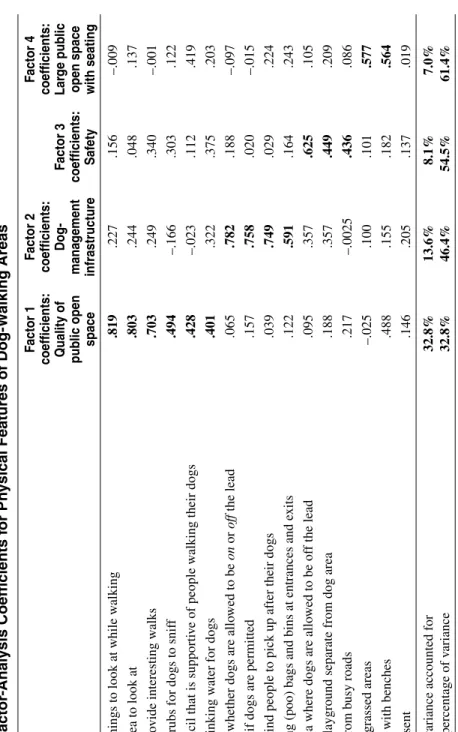
A single factor explained 55.8% of the variance in the dog-attachment items, 66.6% of the variance in the normative-beliefs items, and 68.3% of the variance in the motivation-to-comply items (Table 4). The 16 items used to measure the physical features of dog-walking areas loaded onto 4 factors and explained 61.4% of the total variance in those items (Table 5). The first factor included 6 items measuring the quality of public open space, the second factor included 4 items measuring the presence of dog-related infrastructure in the public open space, the third factor (3 items) related to safety issues for dog owners walking in the public open space, and the final factor included 2 items measuring access to a large, public open space and seating. Only 1 item (presence of lighting) did not load onto any of the main factors.
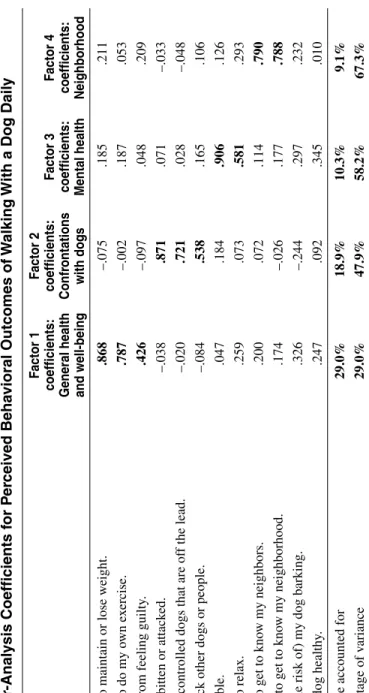
Items measuring the behavioral beliefs associated with the outcomes of walk-ing with a dog daily also loaded onto 4 factors and explained 67.3% of the total variance in those items (Table 6). The first factor included 3 items measuring the general health and well-being outcomes of walking with a dog daily. The second factor was dog specific and included 3 items measuring the possible negative con-sequences of coming into contact with antisocial dogs when walking. The third factor (2 items) related to the mental-health benefits of regular dog walking, and Table 4 Factor-Analysis Coefficients for Dog-Attachment
and Subjective-Norm Subscales
Item coefficientFactor
Percentage variance accounted
for
Dog attachment 55.8%
Owning a dog adds to my happiness. .820 My dog is considered part of the family. .722 I consider my dog to be a friend. .722 I talk to others about my dog. .702
I talk to my dog. .685
My dog knows how I feel about things. .627 I often play with my dog. .579
Normative beliefs 66.6%
Other dog owners think I should walk with my dog daily. .786 My vet thinks I should walk with my dog daily. .727 Members of my family think I should walk with my dog
daily. .608
Motivation to comply 68.3%
I want to do what other dog owners think I should do. .797 I want to do what most members of my family think I
should do. .759
S82 Tab le 5 Factor -Anal ysis Coefficients f or Ph
ysical Features of Dog-W
alking Areas
Item
Factor 1
coefficients: Quality of pub lic open space
Factor 2 coefficients: Dog-mana gement infrastructure Factor 3 coefficients: Saf ety Factor 4 coefficients: Lar ge pub lic
open space with seating
Interesting things to look at while w
alking .819 .227 .156 –.009 Attracti ve area to look at .803 .244 .048 .137
Paths that pro
vide interesting w alks .703 .249 .340 –.001 T
rees and shrubs for dogs to snif
f
.494
–.166
.303
.122
A local council that is supporti
ve of people w
alking their dogs
.428
–.023
.112
.419
Access to drinking w
ater for dogs
.401
.322
.375
.203
Signs to say whether dogs are allo
wed to be on or of f the lead .065 .782 .188 –.097
Signs to say if dogs are permitted
.157
.758
.020
–.015
Signs to remind people to pick up after their dogs
.039
.749
.029
.224
Dog-dropping (poo) bags and bins at entrances and e
xits
.122
.591
.164
.243
A fenced area where dogs are allo
wed to be of f the lead .095 .357 .625 .105 Children’
s playground separate from dog area
.188 .357 .449 .209 Area a w ay from b usy roads .217 –.0025 .436 .086 Lar
ge open, grassed areas
–.025
.100
.101
.577
Sitting areas with benches
.488 .155 .182 .564 Lighting present .146 .205 .137 .019 Percentage v
ariance accounted for
32.8% 13.6% 8.1% 7.0% Cumulati ve percentage of v ariance 32.8% 46.4% 54.5% 61.4% Note . Boldf
ace coefficient = an item that best measures a particular construct/f
actor
S83 Tab le 6 Factor -Anal ysis Coefficients f or P er ceived Beha vioral Outcomes of W alking
With a Dog Dail
y
Item
Factor 1
coefficients: General health and well-being
Factor 2
coefficients: Confr
ontations
with dogs
Factor 3
coefficients: Mental health
Factor 4
coefficients: Neighborhood
It w
ould help me to maintain or lose weight.
.868 –.075 .185 .211 It w ould help me to do my o wn e xercise. .787 –.002 .187 .053 It w
ould stop me from feeling guilty
.
.426
–.097
.048
.209
My dog might get bitten or attack
ed. –.038 .871 .071 –.033 W e w
ould meet uncontrolled dogs that are of
f the lead.
–.020
.721
.028
–.048
My dog might attack other dogs or people.
–.084 .538 .165 .106 It w ould be enjo yable. .047 .184 .906 .126 It w
ould help me to relax.
.259
.073
.581
.293
It w
ould help me to get to kno
w my neighbors. .200 .072 .114 .790 It w ould allo w me to get to kno w my neighborhood. .174 –.026 .177 .788 It w
ould reduce (the risk of) my dog barking.
.326 –.244 .297 .232 It w ould k
eep my dog health
y. .247 .092 .345 .010 Percentage v
ariance accounted for
29.0% 18.9% 10.3% 9.1% Cumulati ve percentage of v ariance 29.0% 47.9% 58.2% 67.3% Note . Boldf
ace coefficient = an item that best measures a particular construct/f
actor
S84 Tab le 7 Factor -Anal ysis Coefficients f or Barrier s and Motiv ator s f or W alking
With a Dog Dail
y
Items
Factor 1
coefficients: Weather and
w ork- or famil y-commitment barrier s Factor 2
coefficients: Dog-litter barrier
s
Factor 3
coefficients: Enjo
yment
for self and dog,
saf ety motiv ator s Factor 4
coefficients: Negative- dog-beha
vior barrier s Factor 5 coefficients: Ph ysical and social en vir onmental motiv ator s
The shorter days in winter
.836 .142 .148 .185 –.064 The weather (e
g, too cold, too hot, raining)
.768 .086 .074 .262 –.169 My long w orking hours .742 .090 –.065 .036 –.078 My f amily commitments .594 .232 –.139 .112 –.151 The una
vailability of dog-poo bags
.205
.915
.027
.144
.030
The lack of bins a
vailable for dog poo
.185 .912 –.002 .128 –.036 Dog o
wners not picking up after their dogs
.087 .700 –.057 .077 –.247 The f
act that I feel safe when w
alking with my dog
–.042 –.122 .600 –.074 .247 My enjo
yment of the outdoors
.005 .019 .583 .016 .062 Kno
wing my dog enjo
ys going for a w alk .079 .072 .396 .039 .293
The poor health or age of my dog
.030 .020 –.370 .147 .166 Difficulty of w
alking with 2 dogs (as opposed to 1)
.140
.104
–.118
.566
–.038
My fear of other people’
s dogs .060 .075 –.140 .549 –.083 My dog w
ould be unfriendly or difficult to control
.147 .068 .108 .519 –.005 Not ha ving places to w alk to (e g, parks, shops) .211 .305 –.204 .153 –.476
Concern that my back
yard is too small
–.099
–.020
.008
–.021
.466
Seeing other people out w
alking their dogs
–.289 –.193 .236 –.115 .439 Percentage v
ariance accounted for
26.0% 11.8% 10.3% 8.3% 6.9% Cumulati ve percentage of v ariance 26.0% 37.8% 48.1% 56.4% 63.1% Note . Boldf
ace coefficient = an item that best measures a particular construct/f
actor
the final factor (2 items) measured neighborhood benefits of walking with a dog daily. Two dog-specific outcomes of walking with a dog daily (keeping the dog healthy and reducing risk of barking) did not load onto any of the main factors. These items were kept in the subscale because they were of theoretical importance and had face validity.
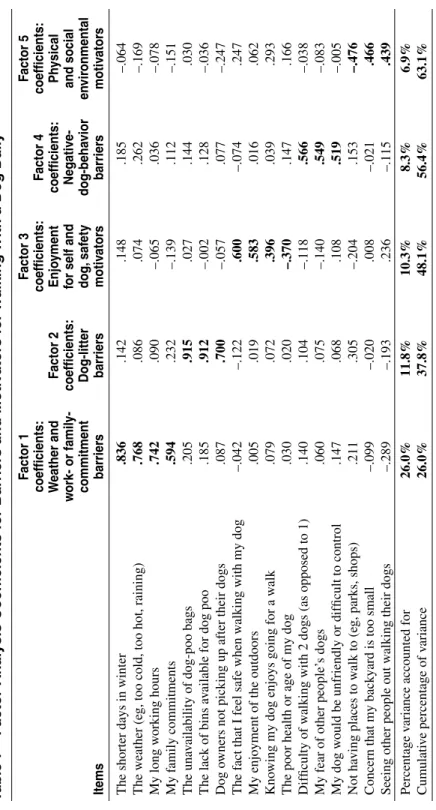
Finally, the barriers and motivators for walking with a dog daily loaded onto 5 main factors and explained 63.1% of the total variance in those items (Table 7). Four items loaded onto a factor measuring common barriers to physical activity generally, such as poor weather and work commitments. Dog litter barriers included 3 items and loaded onto the second factor. The third factor included 4 items related to motivators for walking with a dog, and the fourth factor (3 items) related to negative-dog-behavior barriers. The final factor (3 items) captured aspects of the physical environment, such as having destinations to walk to, and social norms in relation to seeing other people out walking their dogs.
Discussion
To the best of our knowledge, the DAPA tool is the first attempt to develop a com-prehensive instrument to measure the dog-walking behavior of dog owners within and outside their neighborhoods and the factors that have the potential to influence whether dog owners walk with their dogs. This study is important because physical activity is declining globally, dog ownership is high in many countries, and dogs are now being recognized as a major source of social support that might assist owners in increasing their levels of physical activity.9,12,44 Furthermore, little is known about
why such a large proportion of dog owners do not walk their dogs and what might motivate them to do so regularly. The results show that the DAPA-tool items are reliable and form general and dog-specific constructs associated with the theoreti-cal model of dog-walking behavior. Most items in the DAPA tool had test–retest reliability scores >.70, suggesting a high level of stability.
The results confirm that dog owners can reliably recall the weight and size of their dogs, the level of attachment to their dogs, and the amount of walking they do with their dogs in a usual week. A number of instruments measuring general physical activity at the population level have been found to be reliable.16,34 This
study demonstrates that general measures of physical activity can be modified to be specific to dog walking and can be reliably used to assess the physical activity behavior of a subgroup of the population (dog owners).
The TPB was used to guide the development of dog-specific questions measur-ing the individual determinants of walkmeasur-ing with a dog.18 The overall utility of the
TPB for predicting general physical activity behavior is supported in the litera-ture.20,22,23,45 Attitude, subjective norm, and perceived behavioral control together
explain up to 42% of the variation in intention to exercise.20 Furthermore, a study by
Brown and Rhodes24 found that the constructs of intention and perceived behavioral
control explained 13% of the variance in walking behavior with an additional 11% variance being explained by dog obligation. Although these results are promising, the predictive capacity of the TPB could be improved if behavior-specific (dog walking) TPB constructs were used to predict dog-walking behavior rather than walking in general.
S86 Cutt et al
The results of the current study suggest that the TPB constructs of attitude, subjective norm, and perceived behavioral control are reliable and have face validity. The factor-analysis results showed that a number of general and dog-specific key factors emerged and were similar to those predicted in Figure 1, thus confirming the construct validity of these subscales.
Finally, items measuring the potential social and physical environmental fac-tors affecting dog owners’ walking with their dogs were found to be reliable and to have face and construct validity. Items that were specific to dog walking were just as reliable as those relating to physical activity in general. These results are important because a mix of both general and dog-specific environmental factors might be important in predicting dog-walking behavior. The social-ecological model is increasingly being used in research and practice to predict and influence physical activity behavior.25,46-48 The results of the current study highlight the importance of
including such factors so that we might better understand dog-walking behavior. Study Limitations
Women were overrepresented in the sample, and this might limit the generalizability of some of the exploratory factor-analysis results. For example, the overrepresenta-tion of women might have influenced the inclusion of the “feelings of being safe when walking with a dog” item in the factor “enjoyment for self and dog motiva-tors.” The representativeness of the study was enhanced by the fact that nearly one-third (31%) of participants recruited were from outside the university setting after the recruitment message was forwarded by UWA employees to family and friends. Nevertheless, by general-population standards, the sample was relatively highly educated. Future studies might wish to assess the reliability and validity of the DAPA tool with other subgroups of the dog-owning population (eg, children, elderly, socially isolated).
Conclusions
In summary, the DAPA tool is the first questionnaire of its kind and is a reliable tool for measuring the amount of physical activity people do with their dogs and the potential individual and environmental factors that might affect walking with a dog in public. The predictive capacity of the DAPA tool is enhanced because the items are both behavior specific (dog walking) and context specific (eg, walking with a dog for recreation in the neighborhood). The results of factor analysis sug-gest that there are distinct subscales relating to the physical features of parks that are conducive to dog walking, the barriers to regular dog walking, and the behav-ioral beliefs about the outcomes of regular dog walking. In view of the high level of dog ownership in the community, this tool could be used to understand factors that influence people to walk with their dogs and develop innovative and effective interventions to increase physical activity levels.
Acknowledgments
This research was funded by an Australian Research Council Linkage grant (Grant No. LPO455453). The first author (Hayley Cutt) is supported by an Australian Research Council, Australian Postgraduate Award—Industry, which has Petcare Information
and Advisory Service as the industry partner. The second author is supported by a NHMRC/NHF Career Development Award (Grant No. 254688). Julie Pheasant is gratefully acknowledged for her illustrations, which were used for the dog size and weight survey items.
References
1. US Department of Health and Human Services. Physical activity and health: a report
of the Surgeon General. Atlanta, GA: US Dept of Health and Human Services, Centers
for Disease Control and Prevention, National Center for Chronic Disease Prevention and Health Promotion; 1996.
2. Australian Institute of Health and Welfare. Chronic Disease and Associated Risk
Fac-tors in Australia, 2001. Canberra: Australian Institute of Health and Welfare; 2003.
3. Rutten A, Abel T, Kannas L, et al. Self reported physical activity, public health, and perceived environment: results from a comparative European study. J Epidemiol
Com-munity Health. 2001;55:139-146.
4. World Health Organization. World Health Report: Reducing Risks, Promoting Healthy
Life. Geneva, Switzerland: World Health Organization; 2002.
5. Trost SG, Owen N, Bauman AE, Sallis JF, Brown W. Correlates of adults’ participa-tion in physical activity: review and update. Med Sci Sports Exerc. 2002;32:1996-2001.
6. Stahl T, Rutten A, Nutbeam D, et al. The importance of the social environment for physically active lifestyle—results from an international study. Soc Sci Med. 2001;52:1-10.
7. Wilcox S, Castro C, King A, Housemann R, Brownson R. Determinants of leisure time physical activity in rural compared with urban older and ethnically diverse women in the United States. J Epidemiol Community Health. 2000;54:667-672.
8. Lian WM, Gan GL, Pin CH, Wee S, Ye HC. Correlates of leisure-time physical activity in an elderly population in Singapore. Am J Public Health. 1999;89:1578-1580. 9. Ball K, Bauman A, Leslie E, Owen N. Perceived environmental aesthetics and
conve-nience and company are associated with walking for exercise among Australian adults.
Prev Med. 2001;33:434-440.
10. Petcare Information and Advisory Service. Australian Pet Ownership Statistics. Mel-bourne, Australia: Petcare Information and Advisory Service; 2002.
11. BIS Shrapnel Pty Limited, Australian Companion Animal Council. Contribution of the
Pet Care Industry to the Australian Economy. North Sydney: Australian Companion
Animal Council Inc; 2003.
12. Cutt H, Giles-Corti B, Knuiman M, Burke V. Dog ownership, health and physical activity: a critical review of the literature. Health Place. 2007;13:261-272.
13. Commonwealth Department of Health and Aged Care. National Physical Activity
Guidelines for Australians. Canberra, Australia: Commonwealth Dept of Health and
Aged Care; 1999.
14. Bauman AE, Russell SJ, Furber SE, Dobson AJ. The epidemiology of dog walking: an unmet need for human and canine health. Med J Aust. 2001;175:632-634.
15. Schofield G, Mummery K, Steele R. Dog ownership and human health-related physical activity: an epidemiological study. Health Promot J Aust. 2005;16:15-19.
16. Brown W, Trost S, Bauman A, Mummery K, Owen N. Test–retest reliability of four physical activity measures used in population surveys. J Sci Med Sport. 2004;7:205-215.
17. Sallander MH, Hedhammar A, Rundgren M, Lindberg JE. Repeatability and validity of a combined mail and telephone questionnaire on demographics, diet, exercise and health status in an insured-dog population. Prev Vet Med. 2001;50:35-51.
S88 Cutt et al
18. Ajzen I. The theory of planned behavior. Organ Behav Hum Decis Process. 1991;50:179-211.
19. Hagger M, Chatzisararantis N, Biddle S. A meta-analytic review of the theories of reasoned action and planned behavior in physical activity: predictive validity and the contribution of additional variables. J Sport Exerc Psychol. 2002;24:1-12.
20. Godin G, Kok G. The theory of planned behavior: a review of its applications to health-related behaviors. Am J Health Promot. 1996;11:87-95.
21. Aarts H, Paulussen T, Schaalma H. Physical exercise habit: on the conceptualization and formation of habitual health behaviors. Health Educ Res. 1997;12:363-374. 22. Courneya KS, Plotnikoff RC, Hotz SB, Birkett NJ. Social support and the theory of
planned behavior in the exercise domain. Am J Health Behav. 2000;24:300-308. 23. Conn VS, Tripp-Reimer T, Maas ML. Older women and exercise: theory of planned
behavior beliefs. Public Health Nurs. 2003;20:153-163.
24. Brown SG, Rhodes RE. Relationship among dog ownership and leisure-time walking in western Canadian adults. Am J Prev Med. 2006;30:131-136.
25. Giles-Corti B, Timperio A, Bull F, Pikora T. Understanding physical activity environ-mental correlates: increased specificity for ecological models. Exerc Sport Sci Rev. 2005;33:175-181.
26. Sallis JF, Bauman A, Pratt M. Environmental and policy interventions to promote physical activity. Am J Prev Med. 1998;15:379-397.
27. Stokols D. Establishing and maintaining healthy environments: toward a social ecology of health promotion. Am Psychol. 1992;47:6-22.
28. McLeroy KR, Bibeau D, Steckler A, Glanz K. An ecological perspective on health promotion programs. Health Educ Q. 1988;15:351-377.
29. Duncan M, Mummery K. Psychosocial and environmental factors associated with physical activity among city dwellers in regional Queensland. Prev Med. 2005;40:363-372.
30. Li F, Fisher K, Bauman A, et al. Neighborhood influences on physical activity in middle-aged and older adults: a multilevel perspective. J Aging Phys Act. 2005;13:87-114. 31. Jackson V. Domestic pets in new urban areas. Aust Plann. 1994;31:148-152. 32. Jackson V. Public open spaces and dogs. Aust Parks Recr. 1995;31:11-14.
33. Jackson H. Companion Animals in the City. Fitzroy, Australia: Urban Animal Manage-ment, Australian Veterinary Association; 1998.
34. Giles-Corti B, Timperio A, Cutt H, et al. Development of a reliable measure of walking within and outside the local neighborhood: RESIDE’s Neighborhood Physical Activity Questionnaire. Prev Med. 2006;42:455-459.
35. Garrity TF, Stallones L, Marx MB, Johnson TP. Pet ownership and attachment as sup-portive factors in the health of the elderly. Anthrozoos. 1989;3:35-44.
36. Albert A, Bulcroft K. Pets, families, and the life course. J Marriage Fam. 1988;50:543-552.
37. Saelens BE, Sallis JF, Black JB, Chen D. Neighborhood-based differences in physical activity: an environment scale evaluation. Am J Public Health. 2003;93:1552-1558. 38. Fabrigar LR, MacCallum RC, Wegener DT, Strahan EJ. Evaluating the exploratory
factor analysis in psychological research. Psychol Methods. 1999;4:272-299. 39. SPSS 12.0.1 (for Windows). Chicago, IL: SPSS Inc; 2003.
40. Landis J, Koch G. The measurement of observer agreement for categorical data.
Bio-metrics. 1977;33:159-174.
41. Dawson B, Trapp RG. Basic and Clinical Biostatistics. Singapore: McGraw-Hill; 2001.
42. Aday LA. Designing and Conducting Health Surveys: A Comprehensive Guide. 2nd ed. San Fransisco, CA: Jossey-Bass; 1996.
43. Coakes SJ, Steed LG. SPSS: Analysis Without Anguish Using SPSS Version 11.0 for
44. Ham SA, Epping J. Dog walking and physical activity in the United States. Prev Chronic Dis. 2006;3(2):A47.
45. Blue CL. The predictive capacity of the theory of reasoned action and the theory of planned behavior in exercise research: an integrated literature review. Res Nurs Health. 1995;18:105-121.
46. Dishman RK, Sallis JF. Determinants and interventions for physical activity and exer-cise. In: Bouchard C, Shephard RJ, Stephens T, eds. Physical Activity, Fitness, and
Health: International Proceedings and Consensus Statement. Champaign, IL: Human
Kinetics; 1994.
47. King AC. Environmental and policy approaches to cardiovascular disease prevention through physical activity: issues and opportunities. Health Educ Q. 1995;22:499-511.
48. Humpel N, Owen N, Leslie E. Environmental factors associated with adults’ participa-tion in physical activity: a review. Am J Prev Med. 2002;22:188-198.