UC Irvine
UC Irvine Electronic Theses and Dissertations
Title
The Role of Family Household Composition and Household Transitions in the Educational Performance of Latina/o Children of Immigrants
Permalink https://escholarship.org/uc/item/09s0s97p Author Millán, Daniel Publication Date 2019 Peer reviewed|Thesis/dissertation
eScholarship.org Powered by the California Digital Library
UNIVERSITY OF CALIFORNIA, IRVINE
The Role of Family Household Composition and Household Transitions in the Educational Performance of Latina/o Children of Immigrants
DISSERTATION
submitted in partial satisfaction of the requirements for the degree of DOCTOR OF PHILOSOPHY
in Sociology by Daniel Millán
Dissertation Committee: Associate Professor Kristin Turney, Chair
Professor Stanley R. Bailey Professor Rubén G. Rumbaut
ii
DEDICATION
iii TABLE OF CONTENTS Page LIST OF TABLES iv ACKNOWLEDGEMENTS v CURRICULUM VITAE vi ABSTRACT OF DISSERTATION x CHAPTER 1: Introduction 1
CHAPTER 2: Latina/o Children of Immigrant Parents Family Household Composition 16
in Early Childhood: Single-Parent and Extended Family Household Membership CHAPTER 3: Family Household Composition and the Academic Performance of 44
Latina/o Children of Immigrant Parents in Kindergarten CHAPTER 4: Household Disruptions and the Academic Performance of 88
Latina/o Children of Immigrant Parents CHAPTER 5: Conclusion 123
iv
LIST OF TABLES
Page
Table 2.1 Weighted Descriptive Statistics for all Children and by Group 38
Table 2.2 Weighted Logistic Regression Model for Children’s Membership in a Single-Parent Household in the Spring of Kindergarten 39
Table 2.3 Weighted Logistic Regression Predicting Membership in any Extended Household 40
Table 2.4 Weighted Logistic Regression Predicting Membership in a Vertically Extended Household 41
Table 2.5 Weighted Logistic Regression Predicting Membership in a Horizontally Extended Household 42
Table 2.6 Weighted Logistic Regression Predicting Membership in a Mixed Extended Household 43
Table 3.1 Weighted Descriptive Statistics in Kindergarten 77
Table 3.2 Weighted Math and Reading Scores by the Number of Parents in the Home 78 Table 3.3 Weighted Math and Reading Scores by the Type of Extended Household Member(s) in the Home 79
Table 3.4 Weighted Regression Results for Math Scores in Spring K 80
Table 3.5 Weighted Regression Results for Reading Scores in Spring K 84
Table 4.1 Weighted Descriptive Statistics 114
Table 4.2 Household Disruptions from K to 4th Grade by Race/Ethnicity and Immigrant Generation 115
Table 4.3 Disruptions from K-4th Grade and Children’s Math and Reading Scores in 4th Grade 116
Table 4.4 OLS Regression for Math Scores in the Spring of Fourth Grade 117
v
ACKNOWLEDGEMENTS
I owe many thanks to people that have helped me along this journey. I want to first acknowledge my parents, Araceli and Martin, and grandmother, Maria, who supported along every phase of my education. Andreea, Alondra, Alfonso, and Erika have been a source of strength and have pushed me to become a better person and ask difficult questions. So much of who I am and what I care about is inspired by family. Special thanks to Asbeidy Solano who provided inspiration and motivation in the most difficult moments.
Living in Santa Ana during graduate school meant being close to family and friends. Thank you, Albert, AJ, Brian, Christine, Long, Lorena, Mario, Pamela, Victor, Vinnie, Sammy, and Tony for your support. I’m proud to say that I've known you more than half my life. I thank the amazing people in Santa Barbara who made me feel at home. We faced many struggles but also shared laughs. Special thanks to IDEAS, the work we did and the community we built led on this path. Many thanks to Madelin, Gloria, Cecilia, Christina, Diana, Laura, Aurea Gomez, Talia, Karla, Pedro, Damian, Aurea Martinez, Aurora, Norma, Nayra, Ricardo, Mario, Victor and many more. Thank you, Cuca Acosta, for being one of the first people to create a supportive space. Thank you to Teresa Figueroa Sanchez for encouraging me to pursue graduate school. Your support was crucial and your message to look no further than our own communities for research projects has stuck. Thank you, Marla Ramirez, for paving the way and Ricardo Ortega for helping me switch to Chicana/o Studies. I was fortunate to attend college with my brother Alfonso who provided endless motivation. I am grateful that we shared this part of our lives.
Special thanks to Laura E. Enriquez who was always willing to listen and who provided countless opportunities. Thank you to Rocío Rosales, whose encouragement and support was always present. You both pushed me to create spaces for projects that I could not undertake on my own. Anita Casavantes Bradford, for believing in the role of community and for reminding me why both research and our work in the classroom is important. Thank you to Kristin Turney who served as my dissertation chair and who helped guide me from the very early stages in a class on research methods to completing a dissertation. Thank you to Rubén Rumbaut and Stan Bailey for serving on my dissertation committee. My work has improved because of your comments and feedback. Thank you to UC MEXUS and the Center for U.S.-Mexico Studies for providing the support to begin and complete my dissertation.
Special thanks to Martha Morales Hernandez, Daisy Vasquez Vera, Miroslava Guzman, and Edelina Burciaga. We started what we thought would be a summer project, but it snowballed into much more with the crucial support of Laura E. Enriquez. Our work has kept me going even in moments that seem hopeless. Thank you to Tania DoCarmo, Genilson DoCarmo, Vania Agama-Ramirez, Guillermo Paez, Jessica Resendez, Brianda Ruiz, and Judith Sanchez. We listened to many people, shared laughs, tears, and sometimes feelings of anger. I am glad we were present and recognized the importance of our work. Thank you to SAFIRE, Orange County Immigrant Youth United, and Friends of Orange County Immigrant Detainees. You all reminded me that research should serve a larger purpose. Thank you to all of the immigrants that have shared their stories, from students across the UC system to people from all over the world who have
experienced detention. I am grateful for these moments and my work is for you. Many people asked me to do something meaningful with what they shared. I will do my best to keep my word.
vi
CURRICULUM VITAE Daniel Millán Education
Ph.D. University of California, Irvine, Sociology with an Emphasis in Chicano/Latino Studies,
2019
Dissertation: The Role of Household Composition and Household Transitions in the Educational Performance of Latina/o Children of Immigrants
Committee: Kristin Turney (Chair), Stanley Bailey, Rubén Rumbaut Field Exams: Immigration, Social Networks
M.A. University of California, Irvine, Sociology, 2016
B.A. University of California, Santa Barbara, Chicana/o Studies, 2012
Research Interests
Immigration, Family, Detention, Undocumented Youth, Race & Ethnicity Publications
Enriquez, Laura E., Martha Morales Hernandez, Daniel Millán,Daisy Vasquez Vera.
2019. “Mediating Illegality: Federal, State, and Institutional Policies in the Educational Experiences of Undocumented College Students.” Law & Social Inquiry.
Grants, Awards, and Fellowships
2018 – 2019 UC San Diego USMEX Center Fellow
2017 – 2018 UC California Immigration Research Initiative Fellowship
2012 – 2017 UC MEXUS/CONACYT Fellow
2016 UC Global Health Institute – Center of Expertise on Migration
and Health Fellowship
2016, 2018 Miguel Velez Scholarship
2015 – 2016 UC MEXUS Small Research Grant
2015 UCI Data Science Initiative Summer Fellow
2015 – 2016 University of California Humanities Research Institute
Graduate Working Group Award 2013, 2014, 2017,
2018
UCI Sociology Summer Research Fellowship
2012 UCSB Senior Co-Curricular Excellence Award
vii
2010 – 2012 TELACU Scholarship
2009 – 2011 IDEAS Scholarship
2010 Spanish American Institute Scholarship
2010 LI Alumni Scholarship
Presentations
“Latina/o Children of Immigrants Household Compositions in Early Childhood: Single-Parent and Extended Family Household Membership.” at the American Sociological Association Annual Meeting. Philadelphia, PA. August 2018.
“Mediating Illegality: The Role of Federal, State, and Institutional Policies in the Educational Incorporation of Undocumented College Students.” With Laura E. Enriquez, Martha Morales Hernandez, and Daisy Vasquez Vera at the American Sociological Association Annual Meeting. Philadelphia, PA. August 2018.
“Developing Legal Consciousness in Immigrant Detention.” With Rocío Rosales and Tania DoCarmo at the Society for the Study of Social Problems Annual Meeting. Philadelphia, PA. August 2018.
“Immigrant Detainee Narratives and the Immigration Proceedings Process.” With Rocío Rosales and Tania DoCarmo at the Society for the Study of Social Problems Annual Meeting. Philadelphia, PA. August 2018.
“Household Compositions and Transitions: Latina/o Children’s Academic Outcomes from
Kindergarten through 5th Grade” at the American Educational Research Association Annual
Meeting. New York City, NY. April 2018.
“Academic Inequality: Cumulative Disadvantages Limiting the Academic Engagement of Undocumented College Students.” at Migrant Illegality Across Uneven Legal Geographies. Denver, CO. April 2018.
“Conceptualizing Deportability in the Lives of 1.5-Generation Undocumented Young Adults.” With Laura E. Enriquez at Socio-Legal Workshop. UC Irvine School of Law. February 2018.
““I’ve Never Really Thought About It”: Challenging Deportability as the Primary Experience of Illegality.” With Laura E. Enriquez. At Law and Society Association Conference. Mexico City, MX. June 2017.
“Mediating Illegality: The Role of Federal, State, and Institutional Policies in the Educational Incorporation of Undocumented College Students.” With Laura E. Enriquez, Martha Morales Hernandez, and Daisy Vasquez Vera. UC International Migration Conference. Berkeley, CA. May 2017.
viii
“Immigrant Detention: Divergent Experiences Among African, Latino, Transgender, and Gay Detainees in the United States.” With Tania DoCarmo. Pacific Sociological Association. Portland, OR. April 2017.
“Understanding the Impact of Mass Immigrant Detention and Deportation: An Analysis of Migrant Health among Gay and Transgender Immigrants in Detention.” California
Sociological Association. Riverside, CA. November 2016.
“Filling Remaining Gaps: Lessons from Across the University of California System.” With Laura E. Enriquez, Vanessa Delgado, and Martha Morales Hernandez. At the Incorporating Undocumented Students and Youth: A UC-Wide Workshop of Research and Policy
Recommendations. Irvine, CA. October 2016.
“Best Practices to Promote the Educational Equity of Undocumented Students.” With Laura E. Enriquez, Vanessa Delgado, Miroslava Guzman, Martha Morales Hernandez, and Daisy Vasquez Vera. Landscapes of Displacement: Borderlands in Comparative Perspective Symposium. San Diego, CA. September 2016.
“The Early Educational Performance of Children in Single-Parent Immigrant Households.” At the American Sociological Association Conference. Seattle, WA. August 2016.
“The Educational Performance of Children in Single-Parent Immigrant Households.” UCI Data Science Initiative. Irvine, CA. September 2015.
“Latina/o Immigrant Representation and the Detention Industrial Complex.” UCI Comparative Latino Studies Workshop. Irvine, CA. May 2013.
Research Experience
June 2015 - Present The Undocumented Student Educational Equity Project
Collaborator
Have developed survey instruments, conducted focus groups, written reports, and engaged in project management.
October 2015 -
Present Detention Research Project Collaborator
Have conducted interviews with immigrants in detention across Southern California, developed interview guides, and trained undergraduate students in interview methods.
Teaching Experience
Fall 2015 UCI, Sociology, “Social Problems,” TA
Fall 2014, Fall 2013 UCI, Introduction to Chicana/o and Latina/o Studies, TA
Summer 2013 and 2014
ix
Spring 2013 UCI, Introduction to Chicana/o and Latina/o Studies, TA
Service
2013 – 2019 Friends of Orange County Detainees Leadership Board Member
2013 – present UCI SAFIRE Member
2015 – 2016 UCI Graduate Division DECADE PLUS Mentor
2014 – 2015 UCI SAFIRE Outreach Co-Chair
Summer 2014 UCI Dreamers Coordinator Search Committee Member
Summer 2013 UCI Graduate Student Mentor
Policy Reports
Millán, Daniel. 2018 “Undocumented and Distracted: How Immigration Laws Shape the
Academic Experiences of Undocumented Students.” California Immigration Research Initiative Brief, UCSD Center for Comparative Immigration Studies.
Enriquez, L. E., E. M. Burciaga, T. Cardenas, B. Cha, V. Delgado, M. Guzman Perez, D. Millán and et al. 2019. "How Can Universities Foster Educational Equity for Undocumented College Students: Lessons from the University of California." UCLA Institute for Research on Labor and Employment.
Membership in Professional Organizations
American Sociological Association (ASA); National Association of Chicana and Chicano Studies (NACCS); Pacific Sociological Association (PSA); American Educational Research Association (AERA)
x
ABSTRACT OF THE DISSERTATION
The Role of Family Household Composition and Household Transitions in the Educational Performance of Latina/o Children of Immigrants
By Daniel Millán
Doctor of Philosophy in Sociology University of California, Irvine, 2019 Associate Professor Kristin Turney, Chair
Latina/o children of immigrant parents are a growing proportion of the population, yet we know little about the association between family household composition and their academic performance. Family household composition encompasses the number of parents and the types of extended relatives in a household. Children now spend more time in a single-parent household and live with extended relatives such as grandparents, aunts, or uncles at greater rates. Family household composition is important because who children live with has implications for their early academic performance. I draw on resource deprivation and instability-stress theories to explore how family household composition and household transitions shape the educational performance of Latina/o children of immigrants. Using the nationally representative ECLS-K:2011 data for children enrolled in kindergarten in the spring of 2011, I find key differences in children’s membership in single-parent and extended households when considering
race/ethnicity, immigrant generation, and socioeconomic status. I also examine the impact of family household composition on mathematics and reading outcomes and find that Latina/o children of immigrant parents perform lower than White children of native-born parents. Lastly, I analyze the role of household disruptions involving the exit or entry of either a parent or
xi
extended relative between kindergarten and fourth grade and find that they can be at times detrimental for children’s later academic performance. Household compositions and transitions explain differences in academic outcomes by race/ethnicity and immigrant generation with Latina/o children of immigrant parents underperforming compared to Latina/o children of native-born parents. I contribute to further understanding the detrimental role family household
composition and household transitions can play in the academic performance of Latina/o children of immigrants.
1 Chapter 1 Introduction
Family household composition encompass the number of parents in the household and the types of extended relatives in the home, including grandparents, aunts, uncles, and other relatives. Households in the United States have undergone a contemporary shift in composition resulting in a greater likelihood of children living with one parent in the home (Amato and Patterson 2017, Sun and Li 2013) and a higher likelihood of living with extended relatives (Pilkauskas and Cross 2018). These trends are partially due to demographic and economic changes, alongside the growing importance of children’s ties with extended relatives (Dunifon 2013). Shifts in family household composition prompt research on the consequences of children living with a single parent (Gibson-Davis and Gassman-Pines 2010, Hummer and Hamilton 2010) and extended relatives (Keene and Batson 2010). Children in a single-parent household typically perform lower academically compared to peers in two-parent households (Lee and McLanahan 2015). Similarly, living with extended relatives can have negative or positive implications for children’s’ academic performance, depending on the type of extended relative and the outcome measured (Keene and Batson 2010). Despite a focus on family household composition and its consequences, little contemporary work has explored these issues among Latina/o children with immigrant parents, including 1.5th generation immigrant children and 2nd generation U.S.-born children.
In addition to understanding family household composition, it is important to recognize that households are dynamic and children can experience household disruptions, involving the entries or exits of a parent or extended relatives (Mollborn, Fomby and Dennis 2012, Sun and Li 2013). Disruptions are potentially harmful and can produce stress, trauma, and insecurity among
2
household members and result in adverse academic outcomes (Ackerman et al. 1999, Adam 2004, Ziol-Guest and McKenna 2014). For example, children who experience disruptions from a two-parent household can be academically disadvantaged compared to children who remain in two-parent households (Brown, Stykes and Manning 2016). Yet, children who remain in a single-parent household can perform as well or better compared to children who experience multiple disruptions (Sun and Li 2013). Disruptions involving an extended relative are less understood, but can also have negative implications for children’s academic outcomes if they lose a member who provided care and support or other benefits (Mollborn, Fomby and Dennis 2012). However, most work on household disruptions among Latina/o children of immigrant has focused on family separation tied to immigration laws and policies (Dreby 2012, Enchautegui and Menjívar 2015, Hagan, Eschbach and Rodriguez 2008), without analyzing disruptions broadly or disruptions involving extended relatives.
Researchers have explored the family household composition of Latina/o immigrant households (Hall, Musick and Yi 2019, Landale, Thomas and Van Hook 2011) and children’s experiences with family separation (Dreby 2012, Hagan, Eschbach and Rodriguez 2008); however, these studies often rely on non-representative data, do not analyze households with children, or lack assessments of the association between family household composition and academic outcomes. Yet, these studies set a foundation for analyzing family household composition since it is consequential for members in the household and differences between immigrant and non-immigrant households exist.
The family is a focus of immigration research, particularly children’s wellbeing and outcomes since they can reflect incorporation patterns and intergenerational mobility (Crosnoe and Turley 2011, Suárez-Orozco, Rhodes and Milburn 2009). Latina/o children are a growing
3
proportion of students, representing 25% of K-12th grade students in the United States in 2016, an increase from 16% in 2000 (Lopez, Krogstad and Flores 2018). Further, in 2014, 17.5 million children under 18 lived with at least one immigrant parent, accounting for 25% of the 69.9 million children under 18 in the United States (Batalova and Zong 2016). The size and growth of this population warrant analyzing Latina/o family household composition and its consequences for children’s academic performance.
To fill a gap in understanding family household composition among Latina/o children with immigrant parents, I analyze how race/ethnicity and immigrant generation shape the likelihood of children living with one or two parents and with different types of extended relatives. I then assess the association between family household composition and academic performance during kindergarten by race/ethnicity and immigrant generation. Lastly, I analyze the role of household disruptions between kindergarten and fourth grade on children’s fourth grade academic performance. I use the nationally representative ECLS-K:2011 dataset (Tourangeau et al. 2015) and draw on resource deprivation and instability-stress theories to explore the association between family household composition, household disruptions, and children’s math and reading test scores. I present three contributions to the literature:
1) I assess factors associated with a child’s likelihood of living with a single parent or with different types of extended relatives, including children who live with vertical and horizontal relatives. I consider difference in family household composition by race/ethnicity and immigrant generation.
2) I explore the consequences of family household composition for Latina/o children of
4
3) I explore the role of household disruptions beginning in kindergarten on children’s
academic performance in later grades and consider the role of race/ethnicity and immigrant generation.
Family Household Composition and Long-term Consequences
Understanding the family household composition of Latina/o children of immigrant parents is important since households are a child’s first site of socialization, shape children’s wellbeing, and can reproduce inequality (Lee and McLanahan 2015). As a key developmental period, young children are heavily dependent on family during early childhood (Crosnoe 2007). Further, early childhood can have lasting implications for children’s educational performance along the life course (Entwisle, Alexander and Olson 2005). For instance, Alexander, Entwisle and Olson (2014) argue that family origins cast a “long shadow,” based on whether children grow up in a positive or negative environment, which follows children from early schooling, adolescence, and into adulthood.
The family is central in mobility and the reproduction of inequality for a child’s
educational trajectories and life course outcomes (Coltrane, Parke and Adams 2004, McLanahan and Percheski 2008). Children who live in a single-parent household for an extended time can be at an academic disadvantage with negative implications for successful transitions into adulthood (Deleire and Kalil 2002, Frisco, Muller and Frank 2007, Garg, Melanson and Levin 2006). Similarly, Amato and Patterson (2017) found that children who are raised in a single-parent household are more likely to also become single parents, further reproducing inequality. Therefore, a focus on family household composition can highlight how Latina/o children with immigrant parents fare academically in differing household arrangements as they begin schooling with lasting implications.
5 Comparing Latina/o Children to White Children
Researchers typically compare Latina/o children to White children because there are key structural differences shaping children’s academic performance (Crosnoe and Ansari 2015, Suárez-Orozco, Rhodes and Milburn 2009). For instance, Latina/o children are a fast growing group of children in the United States (Patten 2016). Yet, their needs are not met since they tend to lag academically compared to White native-born children in early childhood and across different points in the educational pipeline (Crosnoe and Turley 2011, Suárez-Orozco, Rhodes and Milburn 2009). Latina/o students face discrimination, tracking, and a lack of access to educational opportunities (Crosnoe and Turley 2011, Yosso 2005). In terms of educational disparities, Latina/o children of immigrant parents perform lower academically, access extracurricular activities at lower rates, graduate from high school at lower rates, and attend college at lower rates compared to White children with native-born parents (Michel and Durdella 2018). Persisting issues of educational access and equity motivate comparisons between Latina/o children and White children.
White children with native-born parents tend to belong to socioeconomically advantaged households compared to Latina/o children with immigrant parents (Foster and Kalil 2007, Kochhar and Cilluffo 2017). This position can translate to a greater availability of resources inside the home, access to higher quality schools, and reflect parents who can more easily navigate U.S. educational systems (Crosnoe and Kalil 2010, Crosnoe and Turley 2011). Yet, we understand relatively little about how family household composition may be associated with educational disadvantaged in early childhood (Dunifon and Bajracharya 2012). Disparate family household composition may further compound the relatively disadvantaged positions Latina/o children of immigrant parents occupy if living with a single parent or with extended relatives
6
translates to academic disadvantages. Therefore, analyzing a range of factors, including family household composition, may highlight which factors contribution to differences in academic performance during early childhood.
Latino Ethnic Groups
Comparing Latina/o children to White children is useful, however variability among Latino ethnic groups exists with distinct family household composition patterns. Mexican children with immigrant parents represent the largest Latino ethnic group in the United States with the highest enrollment in K-12th grade and are the most represented in the sample of Latina/o children in the ECLS-K:2011. Restrictive social and economic policies increased the likelihood of Mexican immigrants settling in the United States, rather than cyclically migrating (Jiménez 2008, Parrado, MacDonald and Sampson 2012). Further, the children of immigrants are growing up in a context where a significant number have parents who are undocumented with
approximately 8% of children in K-12th grade in 2016 residing in a mixed-status household with
at least one undocumented parent (Passel and Cohen 2018). Growing up in a mixed-status household can have negative implications for the wellbeing of children and their access to educational opportunities (Castañeda 2019, Enriquez 2015). Therefore, results from the ECLS-K:2011 may be skewed given the overrepresentation of Mexican children of immigrant parents – however they can also reflect a population disproportionally vulnerable to parental separation (Gulbas et al. 2016, Hagan, Eschbach and Rodriguez 2008) and with a larger network of extended relatives in the United States (Jiménez 2008). Both are factors which may be linked with single-parenthood and greater membership in extended households.
However, it is difficult to represent heterogeneity among Latina/o ethnic groups given the relatively small sample sizes of children by ethnic groups. This is a key limitation of even
7
nationally representative datasets (Raleigh and Kao 2010), especially when considering children who belong to a single-parent household or to different types of extended households. Subgroups for these combinations can be too small to use in logistic or regression models. Yet, we can gain theoretical leverage by knowing more about the relationship between family household
composition and academic performance when accounting for a child’s race/ethnicity, immigrant generation, and additional factors that may be associated with academic performance.
Family Household Composition Children Living with a Single Parent
A range of factors contribute to children living with a single parent at higher rates than in earlier periods. For instance, increases in cohabitation over marriage have resulted in
partnerships with a higher likelihood of dissolving compared to marriages, resulting in a greater proportion of children residing with one parent (Amato 2010). Partners who are married are more likely to remain together since ties in these unions are more difficult to sever (Brown, Van Hook and Glick 2008, Brown, Manning and Payne 2017, Hummer and Hamilton 2010).
Similarly, delays in marriage also contribute to children living with cohabiting parents for longer periods, placing children at a higher risk of experiencing parental separation (Osborne and Mclanahan 2007). Additional pathways include birth into a single-parent household, separation through a parent’s divorce, or the incarceration of a parent (Amato 2010, Amato, Patterson and Beattie 2015, Mitchell et al. 2015). Overall, shifts in cohabitation, marriage, and external factors have contributed to a greater number of children living in single-parent households.
Children Living with Extended Relatives
A recent rise in the number of extended households is primarily driven by an increase in the number of children living with a grandparent (Dunifon, Ziol-Guest and Kopko 2014), with
8
9.8% of children living in a vertically extended household, representing a 4% growth from 1996 to 2016 (Pilkauskas and Cross 2018). Researchers also point to economic changes and the
importance of ties with extended relatives as explanations behind a rise in the number of children living in an extended household (Brown 2004). For instance, the 2008 economic recession was associated with an increase in the number of extended households as parents co-resided with extended relatives to manage costs (Dunifon, Ziol-Guest and Kopko 2014, Keene and Batson 2010). Similarly, the high cost of housing in some regions in the United States have driven an increase in parents living with extended relatives to mitigate costs (Mutchler and Baker 2009).
The importance of ties with extended relatives for care, discipline, and financial support is another explanation behind the rise of children living in extended households (Augustine and Raley 2013, Dunifon, Ziol-Guest and Kopko 2014, Messing 2006). Parents may ask a
grandparent to co-reside to provide childcare (Goodman and Silverstein 2006). Further,
grandparents can play a key role in children’s cognitive development if they represent positive attachment figures (Sun and Li 2013). However, little work has explored whether living with horizontal or both vertical and horizontal of relatives is preceded by similar needs. Therefore, living with a horizontal relative may be out of structural constraints, reciprocity, or a
combination that drive parents and relatives to form extended households. Family Household Composition and Children’s Academic Performance
Resource deprivation theories provide an explanation behind why living with a single parent or with extended relatives can be negatively associated with children’s academic performance (Leach 2012, McLanahan, Tach and Schneider 2013, Wagmiller et al. 2010). Children in single-parent families generally have access to fewer resources with only one parent in the home to economically contribute to the household (Amato, Patterson and Beattie 2015).
9
As a result, they have less access to material resources that may translate to educational gains such as books in the home, a computer, or access to extracurricular activities (Brand and Thomas 2014). Children in single-parent households may live in homes with less physical space,
experience more residential moves, live in neighborhoods with less access to activities, or attend lower quality schools (Amato and Patterson 2017, Elliott et al. 2017, Fowler, Henry and Marcal 2015, Riina, Lippert and Brooks-Gunn 2016). In all, living with a single parent is tied to
children’s lower access to material resources which may limit their educational performance in comparison to children living with two parents.
Resources deprivation theories also provide an explanation behind why living with extended relatives may be negatively associated with children’s academic performance, though less research has explored the consequences of children living with different types of extended relatives. Children living with extended relatives may be in disadvantaged positions with parents who are supporting extended relatives in financially constrained positions, which may imply that these children have fewer access to material resources (Pilkauskas 2014, Reyes 2018). For
instance, living with a grandparent can sometimes result in no disadvantage compared to children living in a non-extended household (Dunifon 2013). Yet, we know much less about the
educational consequences of children who live with a horizontal relative or with both vertical and horizontal relatives. The implications of these households may differ if horizontal relatives have distinct relationships with children compared to grandparents.
Instability-stress theories suggest that household disruptions, such as parent, sibling, or extended family household entities or exits, negatively impact children’s academic outcomes (Sun and Li 2011). For instance, children who remain in a stable single-parent household may be better off than children who being schooling in a two-parent household and experience one or
10
more transitions (Fomby and Cherlin 2016). However, children who experience instability may improve academically if a second parent joins the household and they have more access to material resources (Wagmiller et al. 2010). Yet, children may be more likely to have a strained relationship with their resident parent since there is no second parent to mediate conflict which can negatively shape their wellbeing and academic performance (Ackerman et al. 1999, McCoy and Cybele Raver 2014). Therefore, household disruptions involving a parent tend to have a negative impact on children’s academic performance but can also have positive implications if they result in a nurturing environment or increase the availability of material resources.
Household disruptions involving extended relatives can also have negative implications for children’s academic performance (Mollborn, Fomby and Dennis 2012). For instance, a child may lose a connection to a relative who exits the home if they provided daily care and emotional support, negatively shaping their academic performance (Sun and Li 2013). Similarly, a
disruption from an extended household might involve a residential move or an adjustment period with negative implications for a child’s academic performance, particularly if a parent and their child reside at a grandparent’s home (Adam 2004). Disruptions involving extended relatives may also have material consequences if a child loses access to resources that helped them perform well academically (Dunifon and Bajracharya 2012, Mollborn, Fomby and Dennis 2012). Though disruptions involving extended relatives may not be as impactful as parent disruptions, they may still have an impact on children’s academic performance and are worth considering.
Latina/o Children of Immigrants and Family Household Composition
Prior work has analyzed the family household composition of Latina/os and found differences between children of immigrant parents and children of native-born parents, with children of immigrant parents belonging to single-parent households at lower rates and extended
11
households at higher rates (Cross 2018, Landale and Oropesa 2007, Landale, Thomas and Van Hook 2011, Perkins 2019, Reyes 2018). Higher marriage rates among immigrant parents may be a key factor reducing the likelihood of children experiencing single-parenthood (Brown, Van Hook and Glick 2008). Dual frames of reference provide an additional explanation, marriage rates in Latin American countries are typically higher than in the United States - while overall children belong to more two-parent households than single-parent households in countries like Mexico (Landale, Oropesa and Noah 2014). Yet, Latina/o children of immigrant parents belong to households with lower socioeconomic status and have parents with lower educational
attainment and lower earnings (Crosnoe and Turley 2011), all factor which typically increase the likelihood that a child will experience parental separation (Amato and Patterson 2017).
Explanations behind a higher number of Latina/o children of immigrant parents living in extended households may rest on immigrant adults relying on familial networks prior to
migrating to secure housing and precede the formation of horizontally extended households (Kamo 2000, Landale and Oropesa 2007). Economic needs may also drive immigrant relatives to co-reside, particularly in locations with high housing costs (Amorim, Dunifon and Pilkauskas 2017, Angel and Tienda 1982, Kamo 2000). This may be a key explanation since members in extended households may enact reciprocal relationships that coincide with sharing a household (Reyes 2018). Further, family reunification may be tied to the formation of vertically extended households if a grandparent from the home country migrates through processes with a
naturalized parent (Gubernskaya and Tang 2017). However, relatively few studies have explored variations in the association between the family household composition of Latina/o children of immigrant parents compared to White children of native-born parents.
12
Factors differentiating Latina/o immigrant family household composition also rest on cultural preferences that may prevent children from living in a single-parent household and may drive parents to co-reside with extended relatives (Angel and Tienda 1982, Mendoza et al. 2017). Familism claims are based on the idea that immigrant adults prefer close family ties over
individualism (Zeiders et al. 2016), therefore they tend to remain married (Brown, Van Hook and Glick 2008) while simultaneously relying on extended relatives for support at higher rates than native-born adults (Fuller-Thomson and Minkler 2007). Yet, children of immigrant parents do reside in single-parent households and scholars have found that extended households may consist of adult immigrants in financially constrained positions, unable to provide assistance (Menjívar 2000, Reyes 2018). Familism can offer a partial explanation but does not fully capture a range of reasons associated with children living in single-parent or extended households.
Research on the consequences of family household composition and household
disruptions has focused on Latina/o families in transnational contexts (Enchautegui and Menjívar 2015, Landale, Thomas and Van Hook 2011) while uncovering their role on the academic
performance of children (Gindling and Poggio 2012). For instance, Dreby (2012) analyzed the experiences of Latino families who were no longer intact with a parent in the United States and a child in the home country and found that children experience adverse effects in school following disruptions. Similarly, Abrego (2014) argues that “family separation has life-altering
repercussions for countless Latino immigrant families” for parents who immigrate to the United States while their children remain in the home country, often in the care of extended relatives. Yet, we know little of family dynamics related to household composition and disruptions post migration, including for reasons that may not be tied to immigration laws and policies.
13
A shift to the study of children of immigrants who experience family transitions while a parent and child are in the United States may reveal parallel consequences. Latina/o children of immigrants occupy unique positions compared to their native-born peers which may shift how household composition and transitions shape their academic performance. For instance, Latina/o children of immigrants on average belong to lower socioeconomic households compared to native-born children (Lee and Kao 2009, Suárez-Orozco, Rhodes and Milburn 2009). Further, Latina/o children of immigrants who experience single-parenthood also tend to belong to
household with lower resources compared to Latina/o native-born children or White native-born children (Karberg et al. 2017). Therefore, Latina/o children of immigrants may be in precarious situations compared to native-born children. Living with an extended relative may offer negative or positive benefits may depend on a child’s race/ethnicity, immigrant generation, and
socioeconomic status (Kang and Cohen 2017, Klocker, Gibson and Borger 2012, Mollborn, Fomby and Dennis 2012).
Overview of Methodology
I rely on data from the Early Childhood Longitudinal Study, 2011 cohort (ECLS-K:2011) (Tourangeau et al. 2015). The ECLS-K:2011 is well suited for analyzing family household compositions, household disruptions, and children’s long-term academic performance. The ECLS-K:2011 relies on a stratified random sample, spanning kindergarten through fifth grade with children enrolled in over one thousand private or public schools across the United States. Data collection was accomplished in the Spring of 2016, however only the kindergarten through fourth grade public data was available as of this writing. A substantive number of cases of children of immigrants are included in the same. Children of immigrant parents in the
ECLS-14
K:2011 are either 2nd generation, born in the United States to at least one immigrant parent, or 1.5th generation, having arrived prior to beginning kindergarten.
Information about each household member was collected in all waves of the ECLS-K:2011, including the exits or entries of any person from the household. This allowed me to capture the number of parents a child lives with and the types of extended relatives in the home, if any, for each grade. The ECLS-K:2011 also includes academic measures suitable for exploring the association between family household composition, household disruptions, and academic performance. Primary measures of academic performance are continuous reading and
mathematics Item Response Theory (IRT) scores collected through child assessments in each wave of the ECLS-K:2011. IRT scores are useful in measuring the academic performance of students since they take into account a child’s ability with a series of questions that differ in difficulty and facilitate comparisons across different time points. IRT scores provide a standard way of comparing the academic performance between immigrant and non-immigrant groups while controlling for factors that are either time-independent or contextual.
Outline of Dissertation
Living in a single-parent or extended household or experiencing household disruptions can place children at a disadvantage in academic performance. Latina/o children of immigrants may experience distinct patterns of household composition and household disruptions which may in turn have implications for their academic performance compared to native-born children. I ask research questions that assess the relationship between household composition and household disruption on children’s short and long-term academic performance varies on their race/ethnicity and immigrant generation. In Chapter 2, I analyzed children’s household composition and how the likelihood of a child living with a single parent or different types of extended relatives differs
15
by race/ethnicity and immigrant generation using logistic regression models. This chapter provided a foundation to understand how the household composition of Latina/o children of immigrants differs from Latina/o native-born children and White native-born children. I then analyzed the association between household composition and academic performance during kindergarten in Chapter 3 using multivariate regression models. Lastly, in Chapter 4, I analyzed the association between household disruptions occurring from kindergarten through fourth grade on children’s academic performance in fourth grade.
16 Chapter 2
Latina/o Children of Immigrant Parents Family Household Composition in Early Childhood: Single-Parent and Extended Family Household Membership
Children in the United States are more likely than ever to live with a single parent (Sun and Li 2011) and are increasingly living with extended relatives (Deleire and Kalil 2002,
Dunifon, Ziol-Guest and Kopko 2014).1 Analyzing family household composition involves
considering the number of parents and the types of extended relatives in a household, defined as vertically extended for households with one or more grandparent and horizontally extended for households with aunts, uncles, and other types of relatives (Mollborn, Fomby and Dennis 2012). Family household composition is consequential for a range of outcomes and the reproduction of inequality, including children’s cognitive development, academic performance, and overall wellbeing across the life course (Amato and Patterson 2017, Gindling and Poggio 2012, McLanahan and Percheski 2008). Previous studies include analyses of Latina/o household composition (Foster and Kalil 2007, Landale, Thomas and Van Hook 2011). However, relatively few contemporary studies focus on the family household composition of Latina/o children of immigrant parents and correlates associated with their membership in a single-parent or extended households.
Family household composition is important since the number of parents in the home and the types of extended relatives is consequential for children’s wellbeing and outcomes (Dunifon, Ziol-Guest and Kopko 2014, Foster and Kalil 2007). For instance, children who live with a single parent are typically academically disadvantaged (McLanahan and Percheski 2008). Further, negative associations exist when children live with extended relatives, depending on the outcome and the type of extended relative in the home (Deleire and Kalil 2002, Dunifon,
Ziol-17
Guest and Kopko 2014). Therefore, understanding how family household composition differs can better inform studies that explore their consequences for children’s outcomes.
Explanations behind Latina/o family household composition include structural and cultural explanations. For instance, scholars have relied on familism, defined as a preference for maintaining close ties with extended relatives, as an explanation behind a higher prevalence of two-parent and extended households among immigrant families (Angel and Tienda 1982, Mendoza et al. 2017, Pilkauskas and Cross 2018). In contrast, scholars have also explored structural explanations, such as immigrant networks and socioeconomic need, which may function as drivers in the formation of extended households (Kamo 2000, Pilkauskas and Michelmore 2019, Pilkauskas and Cross 2018). Yet, studies on either camp often fail to distinguish between children across immigrant generations or account for what contributes to differences by children who live with a single or two parents, different types of extended households, or the link between single-parenthood and extended household membership.
I fill a gap in analyzing what accounts for differences in family household composition by analyzing the nationally representative Early Childhood Longitudinal Study, 2011 cohort (ECLS-K:2011) including children in kindergarten in the 2010-2011 academic year (Tourangeau et al. 2015) to answer: 1) How does family household composition – children’s single-parent and extended household membership – differ by race/ethnicity and immigrant generation between Latina/o children of immigrant parents, Latina/o children of native-born parents, White children
of immigrant parents, and White children of native-born parents?2) How does household
socioeconomic status and the interaction between race/ethnicity, immigrant generation, and socioeconomic status shape family household composition? I contribute to understanding factors
18
shaping Latina/o children of immigrant parents household composition in single-parent, vertical, horizontal, and a combination of vertical and horizontal households.
Explanations for Differing Family Household Composition
Research on Latino family household composition tends to focus on familism (Haxton and Harknett 2009, Mendoza et al. 2017), missing how structural factors shape family household composition. For instance, researchers establish common two-parent or extended households because of familism, defined as a preference for maintaining intact families and living with extended relatives (Fuller-Thomson and Minkler 2007, Mendoza et al. 2017). Familism
explanations are limiting since they lack structural explanations (Landale and Oropesa 2007) and additional social locations, such as immigrant generation, are overlooked, resulting in narrow or partial explanations.
Exploring a range of social locations, including overlapping social locations, can provide nuanced explanations behind family household composition. For instance, socioeconomic status can shape whether extended relatives reside (Pilkauskas 2012). Latina/o children of native-born parents belong to households in precarious economic situations compared to White children of native-born parents and tend to belong to extended households at higher rates (Cross 2018). Yet, Latina/o children of immigrant parents, on average, belong to households with lower
socioeconomic status compared to Latina/o children of native-born parents or White children of native-born parents (Crosnoe and Ansari 2016).
Membership in Single-Parent Households
Social locations shape the likelihood of a child living with a single parent (McLanahan and Percheski 2008), however research has focused on the children of native-born parents. For instance, parents with higher educational attainment and who work in better paying occupations
19
are less likely to separate than parents with lower attainment and lower paying occupations (Amato 2010). Latina/o children of native-born parents have parents who are disadvantaged in both areas compared to White children of native-born parents.
Researchers point to an immigrant advantage as a factor mediating membership in single-parent households for Latina/o children of immigrant single-parents (Brown, Van Hook and Glick 2008, Raley, Sweeney and Wondra 2015). Latina/o immigrant parents are married at higher rates (Brown, Van Hook and Glick 2008) and separation is generally less prevalent in home countries compared to the United States (Landale, Oropesa and Noah 2014). Yet, Landale, Thomas and Van Hook (2011) found that a substantive 24% of Latina/o children of immigrant parents belong to a single-parent household in the United States compared to 32.3% of Latina/o children of native-born parents and 19% of White children of native-born parents. However, these analyses do not explore how a range of social locations shapes the likelihood of a child living with a single parent or focus on young children.
Membership in Vertically Extended Households
Researchers note demographic changes, including declining birthrates, have increased the likelihood of a child living with a grandparent (Dunifon, Ziol-Guest and Kopko 2014). Further, ties with grandparents are increasingly valued, incentivizing parents to co-reside with a child’s grandparents (Deleire and Kalil 2002). Similarly, changes in the economy have added pressure for parents to co-reside with a child’s grandparent to mediate housing costs (Keene and Batson 2010).
However, social locations may explain differing rates of living with grandparents. For instance, immigrant generation and race/ethnicity may shape the likelihood of a child living with a grandparent. Hernandez (2004) analyzed census data from the year 2000 for children between
20
birth and age 17 and found a greater proportion of children of immigrant parents with a grandparent and children of color lived with grandparents at higher rates than White children. Yet, Landale, Thomas and Van Hook (2011) analyzed the 2005-2009 Current Population Survey, for children between birth and age 17, and found 8.3% of Latina/o children of immigrant parents lived with a grandparent compared to 14% of Latina/o children of native-born parents and 5.9% of White children of native-born parents. Differences behind the likelihood of living with a grandparent may be based on a range of factors, obscured when only demographic differences are analyzed.
Membership in Horizontally Extended Households
Analyzing vertical and horizontal households separately is important since the likelihood of a child living with a grandparent versus a horizontal relative may be shaped differently. For instance, children living with grandparents may be more common since this represents a
conventional household arrangement and ties with grandparents are often reciprocal and valued (Dunifon, Ziol-Guest and Kopko 2014). Horizontal relatives might not contribute similarly, but may be more likely to contribute financially (Reyes 2018). Therefore, social locations may operate differently in shaping the likelihood of a child living with a vertical relative over a horizontal relative.
Research on horizontally extended households has highlighted immigrant generation as a social location (Menjívar 2000, Van Hook and Glick 2007). Immigrants are a selective group and people with existing family networks in the United States are more likely to immigrate (Menjívar 2000, Van Hook and Glick 2007). Landale, Thomas and Van Hook (2011) analyzed the 2005-2009 Current Population Survey, including children between birth and age 17, and found 23% of Latina/o children of immigrant parents lived with a horizontal relative compared to 14.5% of
21
Latina/o children of native-born parents and 12.2% of White children of native-born parents. As such, race/ethnicity may also be a social location shaping the likelihood of a child living with horizontal relatives.
Membership in Mixed Extended Households
We know little about the likelihood of children living with both vertical and horizontal relatives; however, race/ethnicity, immigrant generation, and socioeconomic status may be relevant social locations. For instance, Reyes (2018) finds typically unidirectional economic support in Latino extended households; parents tend to economically support extended relatives. Therefore, higher socioeconomic status may be associated with parents and extended relatives who can afford housing. Altogether, race/ethnicity and immigrant generation, alongside
socioeconomic status, may shape the likelihood of a child living with both vertical and horizontal relatives.
HYPOTHESES
Prior research has not considered how a range of social locations shape the family household composition of Latina/o children of immigrant parents. When Latina/o children of immigrant parents are included and compared (Hernandez 2004, Landale, Thomas and Van Hook 2011), demographic differences are presented without considering how a range of social locations shape a child’s likelihood of living with a single parent or living with different types of extended relatives. I hypothesize that social locations, particularly race/ethnicity and immigrant generation, in conjunction with socioeconomic status, including the interaction between
race/ethnicity and socioeconomic status, are associated with differing family household composition:
22
1. Latina/o children of immigrant parents will be less likely to live with a single parent compared to Latina/o children of native-born parents and White children of native-born parents. Latina/o children of native-born parents will be more likely to live with a single parent compared to White children of native-born parents.
2a. Latina/o children of immigrant parents will be less likely to live with vertical relatives compared to Latina/o children of native-born parents and White children of native-born parents. Latina/o children of native-born parents will be more likely to live with vertical relatives compared to White children of native-born parents.
2b. Latina/o children of immigrant parents will be more likely to live with horizontal relatives compared to Latina/o children of native-born parents and White children of native-born parents. Latina/o children of native-born parents will be more likely to live with horizontal relatives compared to White children of native-born parents.
2c. Latina/o children of immigrant parents will be more likely to live with both vertical and horizontal relatives compared to White children of native-born parents. Latina/o native-born children will be more likely to live with both vertical and horizontal relatives compared to Latina/o children of immigrant parents and White children of native-born parents.
3. Children who belong to households with lower socioeconomic status will be more likely to live with a single parent and more likely to live with all types of extended relatives.
METHODS
The ECLS-K:2011 is a National Center for Education Statistics (NCES) nationally representative random sample of children enrolled in more than one thousand schools across the
23
United States beginning in kindergarten over the 2010-2011 academic year and ending in 5th
grade (Tourangeau et al. 2015). The ECSL-K:2011 is ideal since it includes a substantive number of Latina/o children of immigrant parents and information on all household members. The full sample includes 18,170 children. After restricting analyses to Latina/o or White children, the sample size became 13,080, excluding 50 children whose race/ethnicity was undetermined. I dropped 3,051 cases where information on parents in the household was missing, 50 cases where the types of parents in the household was not ascertained, and 291 cases where one or both parents were identified as “other guardians,” including grandparents. I utilized a sample size of n = 9,733.
I identified Latina/o children and White children in immigrant families with the nativity of parent(s) in the home using fall and spring of kindergarten measures. I used a parent nativity variable and a child’s race/ethnicity to create four groupings: Latina/o children of immigrant parents, Latina/o children of native-born parents, White children of immigrant parents, and White children of native-born parents. These groupings do not include children who are
multiracial. I combined 1.5th generation and 2nd generation children since both are socialized in similar contexts at this age (Portes and Rumbaut 2014). Cases for Latina/o children of native-born parents is n = 1,518, n = 1,605 for Latina/o children of immigrant parents, n = 6,091 for White children of native-born parents, and n = 519 for White children of immigrant parents. Living with a Single Parent
I derived single parenthood measures from household rosters including all members living in the home and NCES designated parent roles (Tourangeau et al. 2015). Although
previous research has considered cohabiting or stepparent families (Brown, Van Hook and Glick 2008), there were too few Latina/o immigrant cohabiting or stepparent families in the data to
24
separately include in analyses. Therefore, I consider all cohabiting or step-parent families as two-parent families. Two-two-parent families are the reference group.
Living with Extended Relatives
I captured membership in extended households using four types: any extended relative, vertical (one or more grandparent), horizontal (aunt(s), uncle(s), or other extended relatives), and mixed (both vertical and horizontal members). Each person in a household is assigned a unique roster number. Adult survey respondents identified the relationship to the focal child for all enumerated people. If at least one person is classified as a vertical member, the household is a vertically extended household. Similarly, with at least one horizontal member, the household is considered horizontally extended. Households with both a horizontal and vertical relative are mixed. Given my scope, I considered children who lived with other adult non-relatives to live in non-extended households. Children not living in an extended household are the reference group. Control Variables
I rely on an NCES composite measure of socioeconomic status in the fall and spring of kindergarten capturing: parent(s) educational attainment, parent(s) occupational prestige score, and the total household income (Tourangeau et al. 2015). SES ranged from -2.88 to 2.99 with higher positive values representing higher SES. This measure relies on five components (four for a possible two parents and one for the total household income) and can be calculated with
missing components. In single-parent households, SES is an average score for available components. However, I could not construct income contributions to test if parent’s or an extended relative’s income are tied to family household composition.
I use a continuous variable to capture the number of siblings at home in the spring of kindergarten. Further, I include the focal child’s gender and age in the spring of kindergarten. I
25
include the age of the main resident parent identified in the home during the spring of
kindergarten since parent’s age may be associated with single parenthood or co-residence with extended relatives. Lastly, I measure a child’s school location in the spring of kindergarten as a proxy since locations may be tied to whether a child lives with a single parent or extended relatives. This includes four locations: city, suburban, rural, and town. Cities are the reference category.
Analytic Strategy
To analyze the likelihood of a child living with a single parent, I utilized logistic
regression with two-parent families as the reference category and White children of native-born parents as the reference group. I analyzed the likelihood of a child living with extended relatives with four logistic regression models for each type of extended relative (any, vertical, horizontal, and mixed). I used Stata 14’s multiple imputation commands to impute missing data and
preserve cases: 0.3% of cases were missing data for parent’s age, 2.7% for a child’s age at survey assessment, and 2.1% of a child’s school location. Ninety-six percent of all cases had complete data for included variables; results with or without imputed data did not differ substantively. Model 1 includes explanatory variables to capture baseline differences. I added controls to Model 2. In Model 3, I adjusted for membership in an extended household as a predictor for living with a single parent and membership in a single-parent household as a predictor for living with different types of extended relatives. Model 4 includes SES interaction terms. I used survey weights to maintain representativeness for children enrolled in kindergarten over 2010-2011. RESULTS
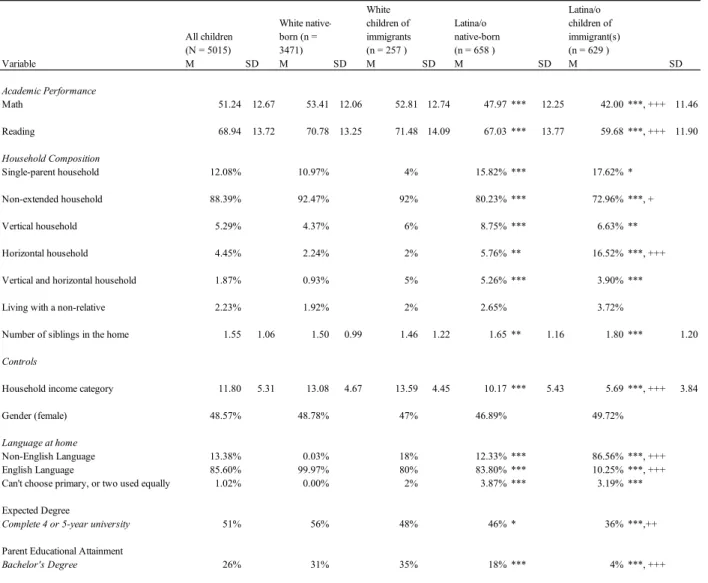
Weighted descriptive statistics in Table 2.1 indicate that approximately 16% of children belong to a single-parent household. However, 21% of Latina/o children of native-born parents
26
belong to a single-parent household, a greater proportion (p < .001) than 14% of White children of native-born parents. Compared to White children of native-born parents, Latina/o children of immigrant parents do not differ in their membership in a single-parent household and 22% belong to a single-parent household. A lower proportion (p < .001) of White children of
immigrant parents, only 4%, belong to a single-parent household compared to White children of native-born parents.
(Table 2.1 about here.)
Living with an extended relative is more common among Latina/o children of immigrant parents with 27% living in an extended household (p < .001) and Latina/o children of native-born parents with 23% living in an extended household (p < .001) compared to only 10% of White children of native-born parents. In contrast, 8% of White children of immigrant parents belong to an extended household and do not differ compared to White children of native-born parents. Compared to 6% of White native-born children, 11% of Latina/o children of native-born parents belong to vertically extended households (p < .001). In contrast, 6% of Latina/o children of immigrant parents belong to a vertically extended household, a non-significant difference. Further, 6% of Latina/o children of native-born parents belong to a horizontally extended household, a higher proportion than 3% of White children of native-born parents (p < .001). Similarly, 16% of Latina/o children of immigrant parents belong to a horizontally extended household, also a higher proportion than White children of native-born parents (p < .001). Lastly, Latina/o children of native-born parents and Latina/o children of immigrant parents belong to a greater portion of mixed extended households, 7% and 5% respectively, compared to 2% of White children of native-born parents (p < .001).
27
Latina/o children of native-born parents belong to households with lower SES (p < .001) compared to White children of native-born parents. Latina/o children of immigrant parents belong to households with a lower (p < .001) SES compared to White children of native-born parents and their average SES is lower than Latina/o children of native-born parents. In contrast, White children of immigrant parents belong to households with an average SES higher than for White children of native-born parents (p < .001). Latina/o children are on average younger during survey assessment compared to White children of native-born parents (p < .001). Latina/o children of native-born parents and Latina/o children of immigrant parents have parents who are younger (p < .001) compared to White children of native-born parents. Latina/o children of immigrant parents have more siblings in the home compared to White children of native-born parents (p < .001) while Latina/o children of native-born parents and White children of immigrant parents are on par with White children of native-born parents. For all groups, most children attend school in a city or suburban setting. However, Latina/o children of native-born parents and Latina/o children of immigrant parents are more likely to attend schools in cities compared to White children of native-born parents (p < .001).
Membership in a Single-Parent Household
Table 2.2 presents coefficients and odds ratios from weighted logistic regression models predicting children’s membership in a single-parent household. White children of native-born parents are the reference group.
(Table 2.2 about here.)
Results from Model 1 indicate that Latina/o children of native-born parents are 1.62 times more likely (p < .001) to belong to a single-parent household than White children of native-born parents. Covariates in Model 2 reduced the magnitude of this odds ratio to nearly 1 compared to
28
White children of native-born parents, indicating a non-significant difference. In Model 1, Latina/o children of immigrant parents are 1.65 times more likely (p < .001) to belong to a single-parent household compared to White children of native-born parents. Yet, in Model 2, Latina/o children of immigrant parents are .52 times less likely (p < .001) to belong to a single-parent household compared to White children of native-born single-parents. In Model 1, White children of immigrant parents are .23 times less likely (p < .001) to belong to a single-parent household compared to White children of native-born parents. This holds with covariates in Model 2.
Model 3 results suggest that race/ethnicity and immigrant generation are factors
associated with the likelihood of a child living with a single parent. I assess differences between groups with adjusted Wald tests. Latina/o children of immigrant parents differ in their likelihood of belonging to a single-parent household compared to Latina/o children of native-born parents (p < .001). Latina/o children of immigrant parents are .47 times less likely to live with a single parent (p < .001) than White children of native-born parents while White children of immigrant parents are .24 times less likely (p < .001). However, the difference in membership in a single-parent household is non-significant when comparing Latina/o children of immigrant single-parents to White children of immigrant parents. Latina/o children of native-born parents are .91 times less likely to belong to a single-parent household compared to White children of native-born parents, however the difference is non-significant.
In Model 3, socioeconomic status is associated with membership in a single-parent household, children are .38 times less likely to belong in a single-parent household (p < .001) for each unit increase in SES. I tested an interaction between SES and each group in Model 4. However, each interaction term was statistically non-significant and group differences between Model 3 and Model 4 were consistent.
29
Model 3 also adjusts for children’s membership in any extended household. Children who reside in an extended household are 3.08 times more likely (p < .001) to belong to a single-parent household. For control variables, children older in age are 1.02 times more likely (p < .05) to belong to a single-parent household for each month increase in age. Children with siblings are .68 times less likely (p < .001) to belong to a single-parent household. Lastly, children who attend school in a rural setting are .70 times less likely (p < .001) to belong to a single-parent household compared to children attending school in cities.
Membership in Extended Households
Table 2.3 presents coefficients and odds ratios from weighted logistic regression results for extended household types. Differences between children’s membership in extended
households emerge when predicting membership in any, vertical, horizontal, or mixed extended households. White children of immigrant parents do not differ compared to White children of native-born parents. Therefore, I focus on comparisons between Latina/o children of immigrant parents, Latina children of native-born parents, and White children of native-born parents.
(Table 2.3 about here.) Any Extended Household
Results from Model 1 indicate that Latina/o children of native-born parents are 2.64 times more likely (p < .001) to belong to any extended household than White children of native-born parents. However, with covariates in Model 2 the magnitude is reduced, Latina/o children of native-born parents are 1.84 times more likely (p < .001). Similarly, Model 1 indicates that Latina/o children of immigrant parents are 3.22 times more likely (p < .001) to belong to any extended household. In Model 2 the magnitude is diminished, Latina/o children of immigrant parents are 1.48 times more likely (p < .01) to belong to any extended household compared to