Jurnal Sains Kesihatan Malaysia Isu Khas 2018: 113-117 DOI : http://dx.doi.org./10.17576/JSKM-2018-16
The Effectiveness of a Motivation Camp Programme Among Second and Third Year
Students of Biomedical Science
(Keberkesanan Program Kem Motivasi terhadap Pelajar Sains Bioperubatan Tahun Dua dan Tiga Pengajian)
SITI FAThIAh MASrE, Nurul FArhANA JuFrI, Nur ZAKIAh MOhD SAAT, SYArIF huSIN luBIS & ISMArulYuSDA IShAK
ABSTrACT
Motivation camp is one of the learning interventions to assist underperform students in improving their academic performances in term of GPA (Grade Point Average). An intervention study was carried out to know the effectiveness of
a motivation campin improving the academic performances among the biomedical science students at the Universiti Kebangsaan Malaysia, Kuala Lumpur. Total of 44 respondents were involved in this study from year 2 and year 3 and had been categorized into control and intervention groups (n = 22 per group). The intervention group was given motivational
talks followed by a group discussion and self-reflection. The students in the intervention group were also assigned with
academicians to facilitate and guide them throughout the motivational camp. The students were interested in motivational talks activity the most. The average GPA showed a significant improvement after the motivation camp with 3.01 ± 0.30
(p < 0.05) for the intervention group. Yet, control group also displayed a significant increment in the average GPA, 3.24
± 0.06 (p < 0.05). In conclusion, motivation camp is one of the many learning intervention tools that strategize to help
students in improving their academic performances but it should be complemented with other intervention methods. Keywords:Motivation camp; learning intervention; biomedical science; university; academic
ABSTrAK
Kem motivasi merupakan salah satu daripada langkah intervensi pembelajaran untuk membantu para pelajar memperbaiki keputusan akademik (Purata Nilai Gred). Kajian intervensi ini telah dilaksanakan untuk mengenalpasti keberkesanan kem motivasi dalam memperbaiki keputusan akademik pelajar-pelajar Sains Bioperubatan, Universiti Kebangsaan Malaysia, Kuala Lumpur. Seramai 44 pelajar yang meliputi daripada tahun 2 dan 3 telah terlibat untuk kajian ini dan mereka telah dikategorikan kepada kumpulan kawalan dan intervensi (n = 22 setiap kumpulan). Kumpulan intervensi untuk kajian ini menerima ceramah motivasi diikuti dengan perbincangan kumpulan dan sesi muhasabah diri. Pelajar-pelajar di dalam kumpulan intervensi juga telah dipertanggungjawabkan di bawah para akademik untuk membantu dan membimbing mereka sepanjang kem motivasi. Aktiviti ceramah motivasi merupakan aktiviti yang paling digemari oleh pelajar. Data purata GPA bagi kumpulan intervensi menunjukkan peningkatan signifikan kepada 3.01 ± 0.30 (p <
0.05) setelah menghadiri kem motivasi. Walaubagaimanapun, purata GPA bagi kumpulan kawalan turut menunjukkan
peningkatan signifikan kepada 3.24 ± 0.06 (p < 0.05) tanpa menyertai kem motivasi. Kesimpulannya, kem motivasi
ialah salah satu daripada beberapa pelan intervensi pembelajaran yang dapat membantu pelajar-pelajar memperbaiki keputusan akademik, namun demikian, ia perlu disusuli dengan beberapa kaedah intervensi yang lain.
Kata kunci:Kem motivasi; intervensi pembelajaran; sains bioperubatan; universiti; akademik
INTrODuCTION
underperformance students in higher institutions can result in students becoming demotivated. hence, student support in higher institutions has to ensure that students have adequate support to reduce stress, solve problems and deal the weaknesses that may give negative effects on their academic performance (DuFour 2004). Student support can be formal, where the management creates system for this particular purpose such as motivational talk by professional and consultation. At the same time, it can also be informal by using existing social support networks among students or between students and instructors. Peers, faculty members or professionals can administer their
support (Burk & Bender 2005). For instance, a group of underperformance students may be assigned to the academic of the department, who followed their academic progress through regular meeting in which their problems and concerns are discussed.
It is reported that measuring students’ improvement in their academic achievements is the best way to evaluate learning effectiveness (Cashin 1990). Thus, students’ performance in the universities is recorded as Grade Point Average (GPA) that will be measured at the end of each semester. Faculty members have allocated time and put various efforts to assist students in recovering academic difficulty, yet little is known on the effectiveness of motivational camp as a learning intervention programme
For alumni sharing session, biomedical science alumni who has completed PhD in 3 years and already in the working industry was invited to share their experience to the students. In addition, during self-reflection session, students in the intervention group have to express each obstacle and problem that they faced in their study and at the same time they have to mention the solution for every problem. This session was also conducted by senior academicians and assisted by junior academicians.
The students were given a brief information about the motivation camp and consent was obtained from the students for ethical purpose. A questionnaire related to demography factors and satisfactory level was given to each student that participated in the camp. The demography factors that consist of gender, year of study and GPA were obtained from the participants. Whilst students’ satisfactory towards the motivation camp in term of the general evaluation of the camp, management and modules or activities of the motivation camp was also collected on the last day of the camp. The students’ GPA in the final semester session 2015/2016 will be recorded as an outcome after the motivation camp.
STATISTICAl ANAlYSIS
IBM SPSS Statistics version 22 was used for data analysis. Mixed model ANOVA test was used to compare the GPA before and after the motivation camp among intervention and control groups after the assumptions for parametric test were not violated. The level of significance was set at p < 0.05.
rESulTS
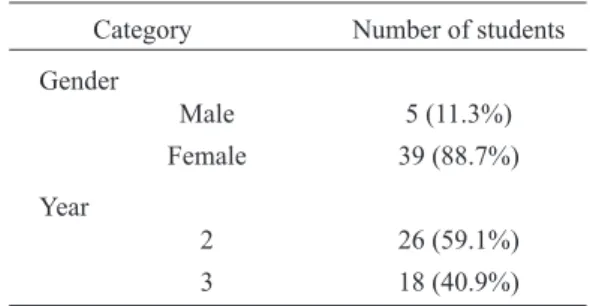
The demographic data of the students according to year and gender were summarized in this study (Table 1). From the data, total of 26 second year students including 3 males (6.8%) and 23 females (52.3%); whilst a total of 18 third year students that consist of 2 males (4.5%) and 16 females (36.4%) were participated in this study. Based on the responses from the questionnaire, 99% of the students in the intervention group who attended the motivation camp was satisfied and agreed with the course management (Table 2). Whilst only 1% of the participants that showed disagreement with the camp (Table 2).
among university students. Motivation camp that is believed to inspire and influence students to have higher motivation and interest in their studies was a programme that most frequently held in primary and secondary schools (Norbaiti 2016; Yvette 2014). It has been revealed that students benefited a lot from the motivation camp as they gained new experiences and developed various skills such as self-management, creative self-expression and positive social interactions (American Camp Association 2017).
The aim of this study is to evaluate the effectiveness of motivation camp programme to help underperformed second and third year undergraduate students of Biomedical Science programme, universiti Kebangsaan Malaysia (uKM) in improving their GPA. hence, the GPA before and after the motivation camp between control and intervention groups will be compared in this study. The idea for motivation camp was designed by the academicians of the Department of Biomedical Science Programme to help underperformed students to improve in their academic performances.
METhODOlOGY
First of all, this motivational camp programme was an annual event that has been conducted by the Biomedical Science programme as a tool to boost students’ motivation and interest in their study. The sample population of this study were second and third year students who studied in the Biomedical Science programme, uKM of 2015. Purposive sampling was conducted in this study. Sample size in this study was calculated by using G power 3.0.10 software (power: 0.8; f: 0.22). Total of 44 students were selected in this study based on their final GPA in the semester 2, session 2014/2015 starting from below 3.30. These students were divided into two groups: 1) intervention group (n: 22 students) participated in the motivation camp with range of GPA: below 3.00; and 2) control group (n: 22 students) that did not participate in the motivation camp with range of GPA 3.29 to 3.00. The inclusion criteria was year 2 and year 3 biomedical students with GPA below 3.30. Whilst the exclusion criteria was students that did not attend the motivation camp (for intervention group).
Motivation camp for the intervention group had been conducted at the National Civics Bureau, Tanjung rhu, Sepang on 12-14 November 2015. The students (n: 22) were divided into six small groups with 4 groups have n:4 students per group and 2 groups have n: 3 students per group. The small groups were handled by six senior academicians who have experienced in conducting motivational camp programme for more than five years. Throughout the camp, the students were given an intervention by giving motivational talks, alumni sharing session, self-reflection session as well as outdoor activities such as aerobic and treasure hunt. There were 3 motivational talks included in the camp that covered the aspect of ways to success (talk 1), self-reflection (talk 2) and time management (talk 3).
TABlE 1. Distributions of respondents according to gender and
year of study
Category Number of students Gender Male 5 (11.3%) Female 39 (88.7%) Year 2 26 (59.1%) 3 18 (40.9%)
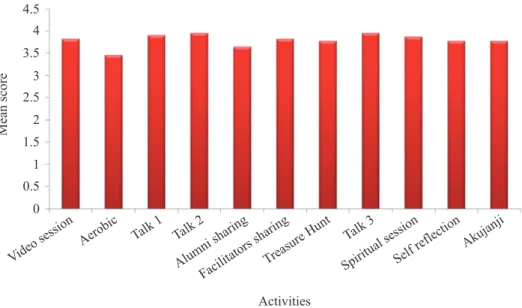
The mean score of 11 activities during the motivation camp was shown in Figure 2. Students in the intervention
group have given their scores ranging from 0 (very disatisfied) to 5 (very satisfied) at the end of the motivation camp. Data showed that two talking sessions (talk 2 and talk 3) demonstrated the highest mean score (3.95 for each activity), followed closely by a spiritual session (3.87) where the students were given a religious talk about the importance of responsibility as a human. Whilst aerobic session that was done in the morning showed the lowest mean score (3.45) as compared to other activities (Figure 2).
TABlE 2. Satisfaction level toward course management in the
intervention group
Category Number of students Strongly agree 15 (69%)
Agree 6 (30%)
Disagree 1 (1%)
Strongly disagree 0 (0%)
FIGurE 2. Mean score of satisfaction towards activities in the motivation camp among students in the intervention group
4.5 4 3.5 3 2.5 2 1.5 1 0.5 0 Activities Mean score
Mean score of statisfaction towards activities in the motivation camp
Video session Aerobic T
alk 1 Talk 2 Alumni sharing
Facilitators sharingTreasure
hunt Talk 3
Spiritual sessionSelf reflection Akujanji
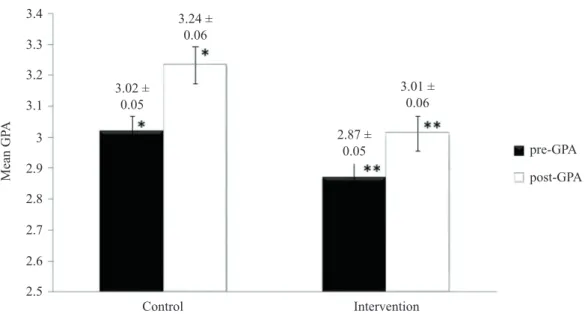
Mixed model ANOVA test was used to compare the effect of motivation camp on academic performance: pre-GPA (before the motivation camp) and post-pre-GPA (after the motivation camp) between control and intervention groups. The main effect between pre-GPA and post-GPA showed significant result [F (1, 42) = 18.96, p = 0.001]. Whilst the main effect for participation in motivation camp was also significant [F (1, 42) = 8.45, p = 0.006]. however, the interaction between time (pre- and post-GPA) and participation in motivation camp showed no significant different [F(1, 42) = 0.823, p = 0.361]. Both intervention and control groups demonstrated mean pre-GPA of 2.87 ± 0.05 and 3.02 ± 0.05; and interestingly, the mean post-GPA showed significant increment to 3.01 ± 0.06 and 3.24 ± 0.06 (p < 0.05) for intervention and control groups respectively (Figure 3). This data indicates that both intervention and control groups showed improvement in the academic performance despite the motivation camp.
DISCuSSION
Academic performance that is being determined by GPA is one of the most important concerns among students in
higher educational level. A good GPA is not only acts as a key determinant for student’s performance but it also warrants a secure career path to the students (hidayatulfathi et al. 2011). Motivation camp is a part of learning intervention methods that offering an opportunity for students to comprehend their academic difficulties. Though several motivational camp events have been organized in the past by the Biomedical Science programme, yet this is the first evaluation study to see its effectiveness among the second and third year undergraduate students. This camp was compulsory towards all the second and third year Biomedical Science students who have a GPA below 3.00.
From this camp, students in the intervention group showed their high interest towards the two talking sessions as compared to the aerobic activity. The outcome of this data indicated that participants were more favorable in conversing and exchanging ideas rather than getting physical and sweating. Study in the past has shown that the involvement of students in physical activity such as sport participation and exercise is getting decline from high school to college or university (Douglas et al. 1997; Grunbaum et al. 2002; Kilpatrick et al. 2005). Moreover, the number of students that involve in physical activity
programmes will drop even more following students’ graduation from the university (Calfas et al. 1994).
This study showed that there is a significant improvement in students’ academic performance (GPA) after participation in the motivation camp program. Yet, significant increment in GPA among students in the control group seemed to rule out the importance of motivation camp. The interaction between the factor of pre- and post-GPA and participation in motivation camp demonstrated a no different between these two factors. Both control and intervention groups displayed significant improvement in their academic performance among two consecutive semesters and this progress showed no relation to the effectiveness of participation in motivation camp. This study is opposite to the findings of hidayatulfathi et al. (2011) in which the learning intervention programme was found to be really suitable in improving among the first year students of Biomedical Science. This may be due to an early intervention plan for the underperformed students was made as compared to this study. Besides, there was no control group for the intervention study in hidayatulfathi et al. (2011) as compared to this study that included a group of students who did not participate in the motivation camp as a control. Moreover, the range of GPA in the control group was already slightly higher in the beginning as compared to the GPA in the intervention group. There is no doubt that GPA acts as a key role to convey students’ successes on paper. however, GPA alone may not be the best measurement of future achievement. Though students in both groups showed a significant increment in their GPA, yet the students who attended the camp may earn a lifelong learning experience that was not even measurable via GPA.
Motivation camp can be applied as one of the intervention programmes to improve the academic performance of students. Moreover, it is transpired that motivation camp is beneficial to students in term of strengthening their relationship with academicians and peers, and promote students’ autonomy that contribute to positive perceptions (Fields 2009; Bhattacharyya et al. 2011). however, motivation camp is not the instant remedy to boost up the GPA of students in limited time. In this study, the involvement in motivation camp may be one of the factors that contribute to the significant improvement of GPA, but the inadequacy of follow-up activities after the camp lead the non-significant interaction of pre-GPA and post-GPA with participation in motivation camp. The facilitators or academicians may need to follow up the students after motivation camp thus the impact can be magnified in term of prolonged period. Meanwhile, it is the students’ responsibility to take an active role in their learning; therefore, the improvement of academic performance is highly possible to be achieved. One of limitations in this study was that no measurement on the level of stress among all the respondents. In addition, the study design was not randomized and both intervention and control groups also were not well-matched.
CONCluSION
As a conclusion, this study showed significant differences between pre-GPA and post-GPA of both control and intervention groups despite the motivational camp programme. Although motivation camp can be considered as one of the many intervention tools that is beneficial to
FIGurE 3. Comparison of mean GPA before and after motivation camp between control and intervention groups. (*: significant
differences (p < 0.05) between pre-GPA and post-GPA in control group; **: significant differences (p < 0.05) between pre-GPA and post-GPA in intervention group)
3.4 3.3 3.2 3.1 3 2.9 3.02 ± 0.05 2.87 ± 0.05 3.24 ± 0.06 3.01 ± 0.06 pre-GPA post-GPA Intervention Control 2.8 2.7 2.6 2.5 Mean GP A
Comparison of mean GPA Before and After Motivation Camp between Control and Intervention Groups
students, yet it could be amended with an early detection plan to underperformed students, and additional follow-up activities from the academicians and peers could be done to the students after the motivation camp. For future studies, comparison of different intervention strategies can be done to achieve the best plan to help the underperformed students. Moreover, stress factor may also be included in the future research as one of the key measurement to student’s achievement.
rEFErENCES
American Camp Association. 2017. Benefits of camp: skill development. https://www.acacamps.org/press-room/ benefits-of-camp/skill-development [1 December 2017]. Bhattacharyya, S., Mead, T.P. & Nathaniel, r. 2011. The influence
of science summer camp on African-american high school students’ career choices. Social Science and Mathematics 111(7): 345-353.
Burk, D.T. & Bender., D.J. 2005. use and perceived effectiveness of student support services in a first-year dental student population. Journal of Dental Education 69(10): 1148-1160.
Calfas, K.J., Sallis, J.F., lovato, C.Y. & Campbell, J. 1994. Physical activity and its determination before and after college graduation. Medicine, Exercise, Nutrition and Health 3: 323-334.
Cashin, W.E. 1990. Student ratings of Teaching: The research revisited, Idea Paper No. 32, Centre for Faculty Education and Development, Kansas State university.
Douglas, K.A., Collins, J.l. & Warren, C. 1997. results from the 1995 National college risk behavior survey. Journal of American College Health 46: 55-66.
DuFour, r. 2004. What is a “professional learning community”?. Schools as Learning Communities 61(8): 6-11.
Field, D.A. 2009. What students gain from a week at science camp? Youth perceptions and the design of an immersive, research-oriented astronomy camp. International Journal of Science Education 31(2): 151-171.
Grunbaum, J.A., Kann, l. & Kinchen, S. 2002. Youth rish behavior surveillance-united States 2001. Morbidity and Mortality Weekly Report 51: 1-64.
hidayatulfathi, O., Asmah, h., Budin, S.B. & rajab, N.F. 2011. The Effectiveness of learning Intervention Program among First Year Students of Biomedical Science Program. Procedia Social and Behavioral Science 18(3): 67-371. Kilpatrick, M., hebert, E. & Bartholomew, J. 2005. College
students’s motivation for physical activity: differentiating men’s and women’s motives for sport participation and exercise. Journal of American College Health 54(2): 87-94.
Norbaiti, P. 2016. 120 students participate in motivational camp. The Star Online https://www.thestar.com.my/metro/ community/2016/03/31/driven-to-succeed-120-students-participate-in-motivational-camp/ [1 December 2017]. Yvette. 2014. Motivational camp for students. Ipohecho http://
www.ipohecho.com.my/v4/article/2014/07/01/motivational-camp-for-students [1 December 2017].
Siti Fathiah Masre Nurul Farhana Jufri Nur Zakiah Mohd Saat Syarif husin lubis Ismarulyusda Ishak
Biomedical Science Programme
School of Diagnostic and Applied health Sciences Faculty of health Sciences
universiti Kebangsaan Malaysia (uKM) Jalan raja Muda Aziz
50300 Kuala lumpur
Corresponding author: Ismarulyusda Ishak Email: [email protected]
Tel: +603-92897615 Fax: +603-26929032 received: August 2017