J
ENA
E
CONOMIC
R
ESEARCH
P
APERS
# 2014 – 009
Financing Higher Education when Students and Graduates
are Internationally Mobile
by
Marcel Gérard
Silke Übelmesser
www.jenecon.de
ISSN 1864-7057
The J
ENAE
CONOMICR
ESEARCHP
APERSis a joint publication of the Friedrich
Schiller University and the Max Planck Institute of Economics, Jena, Germany.
For editorial correspondence please contact [email protected].
Impressum:
Friedrich Schiller University Jena Max Planck Institute of Economics
Carl-Zeiss-Str. 3 Kahlaische Str. 10
D-07743 Jena D-07745 Jena
www.uni-jena.de
www.econ.mpg.de
Financing Higher Education when
Students and Graduates are
Internationally Mobile
Marcel Gérard and Silke Uebelmesser
1Abstract
This paper aims at linking cross border mobility of students and graduates with the financing of higher education. Against the background of institutional features and empirical evidence of the European Union and Northern America, a theoretical framework is developed. This allows analyzing the optimal financing regimes for different migration scenarios, comparing them with the regimes in place and discussing possible remedies. In particular, the (optimal) sharing of education costs between students / graduates and payers is studied as well as the (optimal) sharing of the tax-payers’ part between the various countries involved: the country which provides higher education (the host country), the country of previous education (the origin country) and possibly the countries which benefit from the improved skills of the workers. Alternative designs exhibiting potentially desirable properties are developed and policy recommendations derived.
Key words: Mobility of students; Mobility of graduates; Financing of higher education JEL: F22, H52, I23.
1 Respectively professor at the University of Louvain, Belgium, and professor at the University of Jena, Germany. Both are also affiliated with CESifo, Munich, Germany. Marcel Gérard is indebted to IAP Program 6/09 of the Belgium Federal Authorities. This paper is based on our own contribution to Gérard and Uebelmesser (eds., 2014); several references to other contributions to that volume are made in the paper. Some material we use might also be found in Gérard and Uebelmesser (2013).
1. Introduction and background
Globalization and student and graduate mobility have important consequences for fiscal policy. The scope to generate public revenues becomes more limited while the need for public expenditure does not necessarily decrease (see in particular Wildasin, 2014). In this paper, we focus on the consequences of international mobility of students and graduates for one specific aspect of fiscal policy, the financing of higher education.
The point of view adopted might be regarded as typically European. The European features highlighted, however, simply reinforce the more general argument developed below. Those features are the following: First, in the European Union (EU) mobility of students and graduates is not only a fact that we have to live with, but it is also something desirable for the building of the EU. Second, and for that latter reason, two key instruments to favor mobility of students have been set up and deserve further examination. Finally the EU legislative framework introduces legal constraints as to the education policy in EU member states.
Let us provide some details about those three features which are relevant for understanding the European higher education system and related issues, especially those which differ from the United States (US).
1.1. Politically desirable mobility
Sharing a common set of values, a common culture and a common lingua franca, being related to each other through cross border networks, and visiting each other beyond the barriers of psychological, linguistic and historical distances, are all powerful instruments for turning a set of separated people and territories into a unified entity of peace, efficiency and fairness. This is true for both sides of the Atlantic Ocean.
However, in the US, that process was facilitated by the fact that, say, people of Irish and Italian descent settled in the same cities on the East coast and moved to the West coast progressively, but together. This is different in Europe where Italian and Irish people are linked to different territories separated by seas and some fifteen hundred kilometers; and they have nearly no common history. Moreover, while the goal of the founders of the US was the creation of a country, today’s objective of the EU is definitely much less ambitious: creating a union, a poorly defined concept, the upper bound of which is a true country and the lower bound an efficient and fair single market. Let us adopt that latter option, though it is just a minimal position. As a consequence we assume that the goal of EU leaders is to build a single market for highly qualified EU-wide mobile workers and that mobility of students deserves EU incentives because it feeds further mobility of graduates and
workers with researchers as a particular segment among the highly skilled people. Mobility of labor, and thus a single market for labor, facilitates the functioning of a monetary union.2 However,
compared with the US, the EU experiences a lack of mobility of its workforce. As pointed out by the EU commission, “People in the US are much more likely to move to a different US state than people in the EU are to move to another EU region. In the EU, those of working age who changed their region of residence in 2008 amounted to only 1.2% of total working age population as against 2.8% in the US.” (European Commission, 2010, p.11).
Another objective of the EU is to make that area the most advanced one in research, development and innovation – see the Lisbon Agenda (European Council, 2000), the Sapir Report (Sapir et al., 2003) and more recently the Europe 2020 Strategy (European Commission, 2010a), especially the flagship program “Youth on the move”. That objective can serve as a justification for the European Commission to stimulate the mobility of researchers.
1.2. Two instruments to support mobility within the EU
It is impossible to deal with the mobility of students in Europe without mentioning the two main instruments which were launched and/or supported by the EU Commission to foster that mobility: the Erasmus program on the one hand and the Bologna process on the other hand.
1.2.1. Erasmus students
The Erasmus Program, launched in 1987, is probably the best known instrument to facilitate students’ mobility within the EU (and a series of partner countries). Over 25 years, the program has enabled more than 2,300,000 students to spend at least one semester studying at the tertiary level in a country different from the one where they will receive their degree. For example, a German or an Austrian student enrolled in an Austrian university with the aim of obtaining a degree from that university might spend a term or a year as an Erasmus student at a Polish university.
This program is an exchange program. The student enrolls in the university which will grant the degree, pays her tuition fee to that university and visits, at no additional tuition cost, the other country’s university where she will receive credits for courses and exams to be recognized in her own university curriculum. There is no transfer of money between the universities or countries in that process. However, a double agreement lies at the basis. The first agreement is between the universities to set up the general framework of the exchange. The second one is between the
2 When the exchange rate can no longer be adapted in order to absorb asymmetric shocks, which is the case when a series of countries decide to join together within a monetary union such as the US or the Eurozone, and, further, wages are rigid and especially not permitted to vary much across the area, then mobility of labor is needed to face the shocks.
student and her own country’s university which has to approve the content of the curriculum that she will follow abroad. For the stay abroad, the students may receive a grant from their own university, financed by the EU, to cover the cost of living abroad.
Though extremely successful, this program is unbalanced. For the academic year 2010-2011, Spain sent about 31,500 students abroad3, which represents 2% of that country’s student population, and
received nearly 30,600 foreign students in the framework of the Erasmus program. In contrast, the United Kingdom (UK) sent only around 8,600 students abroad, a figure which is about half a per cent of the UK student population, and received 17,500 foreign students in the framework of the program. Even though the numbers of outgoing and incoming UK students are much smaller (relatively and absolutely) than for Spain, the UK’s in- and outflows are much more unbalanced as that country receives twice as many students as it sends abroad.
Leaving aside the obvious attraction of the Spanish sun and ambience, there are at least two other reasons that explain this discrepancy. On the one hand, unlike other EU citizens, UK students are probably less motivated in going abroad: they have no need to learn another language since they speak the lingua franca of Europe and the world, and they also have access to the best European universities; as a consequence there is little room for exchange. On the other hand, UK universities, and especially universities located in England, have no interest in welcoming European students for free when they can easily attract non-EU students and charge them high tuition fees.
That peculiarity of England is further examined by Murphy (2014), where he states that “the total number of overseas students in UK universities has increased by 91% from 2000/2001 to 2008/2009 and by 170% since 1994/1995. The postgraduate sector has seen the highest growth in overseas students in terms of proportions and absolute numbers. There are now quintuple the number of overseas taught postgraduates than there were in 1995, increasing from 15,000 to 77,000. These overseas students are also typically paying higher tuition fees than domestic students, approximately £10k for non-laboratory subjects on average. Thus, overseas students are now a major source of income for the HE sector, currently contributing 8.6% of the total income of the sector.”
Note that since England has made itself less attractive for European exchange students, and since learning English is one of the motivations for student exchange, non-UK universities have deliberately decided to propose substitute programs entirely taught in English, as is the case in Poland and the Czech Republic.
The fact that the EU budget – which is small compared to the US Federal one – amounting to around one percent of EU – wide GDP, finances Erasmus fellowships to foster mobility of students, and to a smaller extent, of professors and clerical staff, illustrates the differences in the advancement of the integration process between the two sides of the Atlantic Ocean. There is no such federal program in the USA. For an observer from the EU, putting together students from different US states no longer seems to be a policy goal since the process has become natural in a geographically integrated nation; though possibly putting together students from different socio-economic backgrounds or ethnic origins is the true challenge for the US. In contrast, in Europe, the challenge is still to mix students from different nations and, thus, to set up a peaceful entity through, among other things, a single labor market for skilled people.
1.2.2. Bologna students
Unlike in the Erasmus program, within the Bologna framework, a student enrolls in the school where she actually attends classes for a term or a year or more, pays the tuition fee for that institution and is permitted to have the credits obtained abroad – the so-called ECTS (European Credit Transfer System) – recognized in the program that she follows in her original country.4
The Bologna Process was not an initiative of the EU itself when launched in 1999; its initial goal was to build up a European educational space by 2010. Although it was signed in the Italian city of Bologna by the Ministers in charge of higher education in 46 European countries, this process does not rest on an intergovernmental arrangement. Its philosophy is well summarized in the Bologna’s Declaration (Bologna Declaration, 1999). That declaration states that “A Europe of Knowledge is now widely recognized as an irreplaceable factor for social and human growth and as an indispensable component to consolidate and enrich the European citizenship, capable of giving its citizens the necessary competences to face the challenges of the new millennium, together with an awareness of shared values and belonging to a common social and cultural space”.
It further recognizes the “Importance of education and educational cooperation in the development and strengthening of stable, peaceful and democratic societies” and the “Universities’ central role in developing European cultural dimensions”; and calls for the “creation of the European area of higher education as a key way to promote citizens’ mobility and employability and the Continent’s overall development”. In line with this philosophy six main goals were to be implemented, (1) adoption of a system of easily readable and comparable degrees in order to promote European citizens employability and the international competitiveness of the European higher education system; (2)
adoption of a system essentially based on two main cycles – undergraduate studies leading to a bachelor degree and graduate studies leading to a master degree; (3) establishment of a system of credits as a proper means of promoting the most widespread student mobility; (4) promotion of mobility by overcoming obstacles to the effective exercise of free movement; (5) promotion of European co-operation in quality assurance; and (6) promotion of the necessary European dimensions in higher education.
The promotion of those six main goals might seem obvious to a US reader, again since the organization of higher education has become homogenous across the whole nation over time and without central government intervention or agreements between states.5 The Bologna goals have
been turned into action lines, work plans and objectives which have evolved with time, as well as into legislative acts. We present evidence related to Bologna students’ movements and the ensuing imbalances in Section 2.3 below.
1.3. EU principles of non-discrimination and subsidiarity
In most EU countries, with the noticeable exception of England, higher education tuition fees are low, if not zero, for domestic and EU students.6 Moreover, two principles at the roots of the EU
construction are at work. On the one hand, EU principles forbid a member state to discriminate against citizens of another member state.7 This implies that a Spanish university has to charge the
same fee to non-Spanish EU residents as to Spanish ones. In contrast, though a university located in Scotland needs to accept a Belgian applicant under the same conditions as a Scottish one, including the tuition fees, the Scottish university may discriminate against English students because they come from the same EU member state, namely the UK. In other words, a situation where the University of California charges a higher tuition fee to students from Nevada than from California could not occur in the EU: it would be against EU law provided we compare the US and the EU and consider Nevada and California as different member states of the US.8
Note that recently Belgium and Austria have departed from the non-discrimination principle, imposing quotas on foreign students in medical and paramedical studies on the basis that the number of applicants from abroad, expected to return home after completion of their studies, was a threat for the future of public health in those two countries. The European Court of Justice permitted
5 For a short description of the US system, see, e.g., http://www.fulbright.be/study-in-the-us/undergraduate-studies/us-higher-education-info/
6 See http://www.studyineurope.eu/tuition-fees.
7 Notice that this is also the case between France and Québec.
8 See http://registrar.berkeley.edu/Default.aspx?PageID=feesched.html; the undergraduate tuition costs per semester amount to almost $ 7,500 for residents of California against almost $ 19,000 for non-residents of California.
the use of such quotas provided the governments prove that such measures are necessary for the protection of public health in the future and that they are proportionated (European Court of Justice, 2010).
On the other hand, the principle of subsidiarity (Pelkmans, 2005) permits to transfer a competence from the level of the member states to that of the EU if and only if that competence might be better performed at that upper level. Education raises questions in that respect. If the education system is considered globally, from nursing school to university, there are serious arguments for keeping education a national – e.g., in France – or a sub-national – e.g., in Belgium, Germany or the UK – competence. If one focuses on tertiary education, the case is less clear, as will be elaborated on in the remainder of this paper. But all in all, the opinion of the majority of EU citizens is still to keep that competence at the national or sub-national level. In such a context a challenge for economists and designers of higher education systems is to portray a decentralized system which exhibits the same properties as a centralized one.
Note that (largely) publicly funded higher education does not mean that university studies are free goods. Indeed, graduates are expected to earn higher wages than less skilled people and, therefore, to pay higher taxes, especially in those countries where labor income tax is progressive. In that sense, students receive implicit loans from the government during the time of their studies that they later repay, possibly with interest, contingent upon the income generated with skills acquired through their studies. One could conclude from that reasoning that the current system of financing higher education is close to a contingent loan mechanism9, namely, a system where the students receive
money covering the cost of studies and sometimes the cost of living, and pay back that amount after their graduation, in line with their income.
That reasoning holds in a world where the graduates pay their tax in the country where they graduated, and on which they have imposed a sacrifice in terms of GDP – the opportunity cost of studies. This is what we name later in this paper the old paradigm. However, it no longer holds in a setting where people coming from a first jurisdiction (their jurisdiction of origin), graduate in a second jurisdiction (their jurisdiction of studies), and then spend their career in one or several other ones (their jurisdiction of work). This is the new paradigm. In such a setting, the first two countries have contributed to the cost of studies and the other ones benefit from the skill of the graduate, as well as from the contribution to the local GDP and tax revenue, if no correction mechanism is introduced.
9 Economic issues associated to contingent loans are dealt with, e.g., by Barr (2014) and Del Rey and Racionero (2014).
In today’s European Union we are in some sense moving from the first to the second setting, or from the old to the new paradigm, even if the first one still clearly dominates. However, the second setting may no longer be ignored; on the one hand, it corresponds to an emerging single market for high – skill labor, and on the other hand, it creates spillover effects or externalities which call for internalization if one wants to improve the efficiency of the higher education system in Europe. However, the issue related to those spillover effects is only of importance if mobility is unbalanced. This will be further elaborated on in the next section.
The implications of the above mentioned spillover effects are addressed here from two perspectives. Our research question can be stated as “who is to pay for mobile students?” By “who” we mean, on the one hand, which jurisdiction – the country of origin (also called the “origin country”), that of studies (also called the “host country” since it hosts the students during her studies) or that of work (the “destination country”). On the other hand, we are interested in who in each jurisdiction contributes to the financing, i.e., the individual (the student or the graduate) or the local society. That latter distinction raises the question of social costs and benefits versus private ones.
Let us add that, although in higher education the competencies are basically limited to the issue of norms, the EU Commission has real competencies in research with financial means and important framework projects. Especially, the European Research Council (ERC) plays a role quite similar to that of the National Science Foundation (NSF) in the United States, though in the EU, each country also has its own research foundation, such as the CNRS in France and the DFG in Germany (see Gérard, Gilson and Ruiz, 2012).
The rest of the paper is organized as follows. In Section 2 we set forth evidence of mobility of students and graduates, referring to the literature and current research: first that mobility of labor increases with the skill level of the worker; second that the mobility of graduates is incentivized by the mobility before and during tertiary education; and finally that the mobility for the purposes of study is unbalanced. That imbalance, however, is not homogeneous, at least in Europe. In Section 3, we address a first issue related to the imbalance of the mobility of students: the distribution of (social) benefits and costs of higher education between the society as a whole and the students, or their families, or later the graduates. Finally in Section 4, we focus on the move from the old to the new paradigm and investigate how a decentralized design of higher education financing may replicate an outcome generated centrally, i.e., designed at the level of the mobility area. A short conclusion follows in Section 5.
2. Mobility of students and graduates: challenge for (public) financing?
In this section we provide evidence on the mobility of students and graduates, referring to the literature and new pieces of research.
2.1. Mobility of labor increases with the skill of the workers
That mobility increases with the skill level is well established, going back to Sjaastad (1962) - see also Borjas (1987, 1991), Ehrenberg and Smith (1994), and Uebelmesser (2006).10 Here we highlight it
using Canadian data collected on the occasions of the 2001 and 2006 censuses.11 The interest in
using Canadian data for this illustrative computation resides in their homogeneity: we have comparable figures for a series of jurisdictions belonging to the same union or federation.12
If we consider the entire Canadian population, we observe that the fraction of the population living in one province in 2001, but in another province in 2006 amounts to 2.7% of the whole Canadian 2001 population. But if we compute similar statistics for the holders of a bachelor degree, the fraction goes up to 4.4% and similarly for holders of a master degree while the figure is even slightly higher for Ph.D. holders. If we include in the computation people who were not living in Canada in 2001 but migrated to that country between 2001 and 2006, the figures, respectively, are 6.4% for the entire population, 12.4% for holders of a bachelor degree, 17.4% for holders of a master degree and 18.2% for Ph.D. holders.
Though this evidence justifies the frequently issued hypothesis that high-skill workers are more mobile than low-skill workers (see Wildasin, 2014) , it also deserves at least two caveats: some high-skill people, such as doctors who spend many years acquiring a set of patients, or auditors bound to residence by their customer base, can face a very high cost of migration; and conversely many low-skill people can face a rather low migration cost when economic conditions are especially bad in their origin country, increasing therefore the expected gain from migration.
In line with the notion that mobility increases with skill level, Gagliardi (2014) sets forth the role of highly skilled immigrants in the economic development of UK areas.
10 See also, as one of the early contributions, Greenwood (1972).
11 For this section, and particularly in regard to the Canadian data, we acknowledge useful comments from François Vaillancourt and the valuable assistance of Véronique Laramée, both from the University of Montreal.
12Studies on migration in other national contexts are, e.g., Faggian, McCannand Sheppard (2007) who focus on
Scottish and Welsh students and Venhorst, van Dijk and van Wissen (2011)for an analysis of Dutch graduates. Backman and Bjerke (2010) study mobility of individuals with different educational backgrounds for Sweden and Waldorf (2011) looks at related issues for the US. See also some of the contributions in Poot, Waldorf and van Wissen (2009) and Varga (2009).
2.2. Mobility of graduates is incentivized by mobility before and during tertiary education
The second observation, that graduate mobility can be positively linked to mobility before and during the studies, is well supported by the analysis of Felbermayr and Reczkowski (2014). Van Bouwel and Veugelers (2014) complement this by studying the migration pattern of Europeans who received their PhD from a US university. Around 70% decide to stay in the US for their first job and that stay rate is a good predictor of the location of those researchers ten years later. This is also confirmed by, e.g., Di Pietro (2012), Dreher and Poutvaara (2011), King and Ruiz-Gelices (2003), Oosterbeek and Webbink (2011), Parey and Waldinger (2011) and Voin and Gérard (2013).
In particular, Voin and Gérard (2013) conducted a questionnaire survey on the alumni of a series of Belgian French-speaking universities. They ended up with more than 500 respondents, including mainly graduates from economic departments and business schools, providing them with data about the graduates themselves, their personal history and their family profile excluding personal and parents’ income. The analyses aimed at answering the following two questions: First, “what drives the expatriation of graduates?” in particular, “have stays abroad during tertiary education influenced careers abroad?” i.e., “is mobility of graduates driven by mobility during tertiary education?” and second, “what determines students’ mobility?” The answer to the first question is especially important in justifying the spending of European public money. Results were obtained through a probit model with average marginal effects (AME) calculated.
Among the plausible determinants of graduates’ expatriation, two emerged as statistically significant: studies abroad without Erasmus support, and participation in the Erasmus program. There is, thus, evidence of the contribution of studies abroad, and especially of the Erasmus program, to the mobility of graduates and the construction of the single EU-wide market for high skill workers. Obviously, however, this doesnot mean that the Erasmus program is causal tograduates’ mobility; but at least it has accompanied and facilitated that mobility.
Regarding the second question on determinants of students’ mobility, the level of education of the mother dominates the other determinants.This is not a surprise knowing that many studies in education economics report that the education of the mother is the first driver of education of the children. Itis, however, surprising, at first glance, to find the same also with respect to the mobility of the students. Education of the father is significant as well. Taken together, those variables also are a proxy for family income. One can argue that the Erasmus program is not a redistributive one, facilitating studies abroad especially by those who are most favored by their family environment. But experience abroad prior to entering university is also significant, either as such, or further specified as stays abroad for the purpose of learning a foreign language or to repeat the last year of
secondary education.13 Those students are already “internationally minded” when entering at
university and it is no surprise that they are more likely to study abroad. In contrast, living abroad at the time of childhood is not significant.
To sum up, one is more likely to expatriate if onehas stayed abroad during one’s university studies, has some experience abroad between secondary and tertiary education, and is an economist or management scientist by which it is meant that one has a degree in a field whose expertise is least country-specific.
Let us add that among the many contributions devoted to students’ mobility,14 the work of Parey and
Waldinger (2011) seems to be especially in line with the findings above. Their first conclusion is that additional subsidies involve larger student mobility and increasing professional mobility. Then, using a large database of German students, they investigate the causality between student mobility and professional mobility; they show that studying abroad increases the probability of working abroad by about 15-20%. Moreover, it seems that students tend to migrate to the countries where they resided during their studies.
2.3. Mobility is unbalanced
Although it is an increasing phenomenon, the mobility of students is unbalanced, as illustrated in Table 1. The figures reported document the fraction of students coming from abroad.The balance of mobility is obtained by taking the number of outgoing students minus the number of incoming students, divided by the total number of students. The number of outgoing students does not include the Erasmus students, but only those who enroll in a foreign university. Incoming students taken into account are those coming from other member states of the EU, also excluding Erasmus students. A negative sign means that the country is a net importer of young people – or raw human capital – and a net exporter of graduates – or enriched human capital since in today’s non-Anglo-Saxon Europe most intra - EU migrant students return home after their studies. Another interpretation of that negative sign is that those countriesare net exporters of higher education services.
13 It is a long established tradition that some students, after completion of their secondary education, devote a year to repeat their last year of study, e.g., in the US being hosted by a US family or working as an au pair in such a family, or to serve in a humanitarian project.
Table 1 – Unbalanced mobility of students, European Union Countries Foreign students
(%)
Balance of mobility (%)
Countries Foreign students (%) Balance of mobility (%) Austria 11.36 -8.02 Hungary 1.20 0.36 Belgium 6.98 -4.62 Italy 0.54 1.06 United Kingdom 4.06 -3.63 Finland 0.74 1.37 Czech Rep. 5.21 -3.01 Poland 0.11 1.43 Netherlands 4.17 -2.41 Portugal 0.68 2.50 Denmark 2.70 -1.18 Greece 0.15 4.06 Sweden 2.03 0.11 Ireland 1.92 7.47 Germany 2.61 0.26 Slovak Rep. 1.59 9.73 Spain 0.75 0.30 Luxembourg 37.00 232.70 France 1.60 0.33
Source: Gérard (2012) based on Eurostat and own calculation.
When examining those negatively signed countries, three groups need to be distinguished. The first one consists of Austria, Belgium, the Czech Republic and the Netherlands; the second one consists of the United Kingdom alone, and the last one of includes only Denmark.
The members of the first group have in common large neighboring countries – France for Belgium, Germany for the other countries – which are quite selective regarding admissions to medical and paramedical studies. Then, students who fail at the entrance examination level in their own country, either France or Germany, enroll in the equivalent programs of their small neighboring countries where language is the same or similar, access to studies is formally easier – no entrance examination, and tuition fees are generally low – they are nil in Austria and in the Czech Republic (in the Czech Republic, a 1,000 euro per term extra fee is charged to students following courses taught in another language than Czech), they amount to 830 euro per year in Belgium and up to about 2,500 euro in the Netherlands.15 And as a consequence of the EU laws the nationality of the degree does not
preclude practice in another country. Therefore, one may conclude that France and Germany free-ride on their small attractive neighbors; and that the foreign students attracted by those small countries are not the best students in their field and cohort.
That conclusion is reinforced by the fact that, according to Felbermayr and Reczkowski (2014), the retention rate in countries like Austria or Belgium does not reach 5%. Using the terminology of the previous section, France - to take that case - is both the country of origin of the students and that of work once they have graduated, supporting the opportunity cost and getting all the benefits, while
Belgium, the host country during the studies, bears the cost of the studies of those foreign students. That reality reduces Belgium’s enthusiasm to welcome EU students, a reason why that country – and Austria also – introduced quota in some fields of studies, which is per se inefficient.
The second group comprises the UK alone. In that country, the language is country-specific but used in the entire world as lingua franca, access to studies is intellectually demanding – admission is very selective and based on documented files, and tuition fees are very high by European standards – up to £9,000 a year for residents of England and of the EU (Murphy, 2014). Moreover, again according to Felbermayr and Reczkowski (2014), the retention rate amounts to more than 35%. And using again the terminology of the previous section, the cost of the studies is supported by the country of origin while a larger part of benefits go to the host country during the studies, which is also that of work for 35% of the graduates. Here the externality benefits UK.
Finally the case of Denmark, another singleton, deserves particular interest. Its attractiveness as a place to work is probably limited, as for other non-Anglo-Saxon countries. However, Denmark welcomes many students from Nordic countries. These countries partially compensate Denmark for the provision of higher education. We come back to that mechanism in Section 4 of this contribution. We can conclude from the stylized facts presented in this sub-section that, among skilled people, studies abroad and thus, mobility during higher education, is an important driver of expatriation and thus of mobility during their career. The former mobility, in turn, is incentivized by an international experience between secondary and tertiary education as well as by the level of education of the parents, especially of the mother. Nevertheless, the cross border flows of students are unbalanced. Therefore in a decentralized world like the EU, where higher education is extensively financed by the government of the jurisdictions which host the students, and tuition fees must not discriminate between EU residents on the basis of their country of origin, unbalanced transfers, and thus externalities, undermine the efficient functioning of that otherwise appealing system called the Bologna process.
This is per se an argument to allocate the responsibility of higher education to the level of the EU, something which is already the case when it comes to the definition of cursus norms but which seems to be impossible for the financing. One can say that the challenge is to find a decentralized system of financing tertiary education such that its outcome is as close as possible to that of a centralized one. That will be precisely the topic of Section 4. Note that the problem is different for research where some funding has been already set at the level of the EU and complements funding by national and sub-national authorities.
Imbalance in student migration is not a characteristic of the EU alone. If we look at US figures we may notice that 90%, 68% and 59% of freshman university students in Washington DC, Vermont and Rhode Island, respectively, are from out of state, while those figures amount to 9%, 11% and 12%for Michigan, California and Alaska, respectively.16 However, the first group consists of very small
jurisidctions whose universities might be oversized with respect to the resident population so that interpretation of these figures is difficult.
Also, we may replicate Table 1 for interprovincial students’ migration in Canada – see Table 2. Nova Scotia is historically a net exporter of university services (an importer of students) due to the large number of undergraduate-oriented student-friendly campuses. English speaking universities attract numerous Canadians and foreigners to the attractive city of Montreal; and the University of Prince Edward Island offers a limited range of programs so that many students have to study in other provinces.
Table 2 – Interprovincial migration for higher education purposes in Canada Provinces Out of Province students (%) Balance of mobility (%) Provinces Out of Province students (%) Balance of mobility (%) Nova Scotia 29.3 -17.2 Manitoba 4.3 2.7 Quebec 7.8 -4.1 Saskatchewan 4.6 4.1 N-Brunswick 23.0 -1.9 Newfoundland 8.2 8.1 Alberta 7.7 0.4 British. Co. 3.4 11.3 Ontario 5.0 0.5 Prince Edward 18.7 31.4 Source: Own calculation based on Junor and Usher (2008) using data from the Association of Universities and Colleges of Canada for the year 2003-2004. Those authors notice that the number of students currently labeled as having home residence of “unknown” or “not applicable” is quite high. The problem is particularly noticeable in the provinces of Alberta and British Columbia, where the University of Alberta and Simon Fraser University report significant segments of data under these categories in 2003-2004.
3. How should the costs of education be shared between the individual and the government?
With unbalanced mobility, the financing system is thus very important. In this section and the following one, we will discuss the question of which party should contribute to the financing of higher education. Is there a convincing argument for pure tax-financing by the government of the country who provides higher education or, more precisely, by all tax-payers no matter whether they
16 See Junor and Usher (2008) based on data for the year 2003-2004 from the National Center for Education Statistics.
(or their children) have obtained a university education? Or should governments of other countries – and for that matter tax-payers – also contribute, notably governments of countries where the graduates then work? Or are there, on the contrary, reasons why higher education should be purely fee-financed, possibly with the support of contingent loans, by those who study? In this section, we focus on the distribution of the cost of studies between the student, through tuition fees, and the government, via the state budget. The question of the payment of that cost by the country of origin, by that of studies or by that of work after graduation, either through the public budget directly or via students or graduates, is left for Section 4.
3.1 Some observations
On average, private returns amount to 64% of total returns when the latter is measured by summing up private and public returns (see Table 3). We observe that private and public benefits from higher education are significant in all countries with private ones ranging from 82,000 euro in Denmark to 320,000 euro in Portugal and public ones from being as low as 26,000 euro (Estonia) and amounting up to 215,000 euro (Hungary). With the exception of Belgium and Hungary, private benefits exceed public benefits in all countries.
Comparing public and private benefits could provide a first indication about the relative contributions to the financing of higher education by the public and the student. The observations deserve, however, two remarks. First, one should note that among other limitations the public benefits as displayed in the table only comprise the additional tax revenues from individuals with tertiary education relative to those with non-tertiary education as well as saved transfer payments. Indeed, tertiary education graduates are less likely to be unemployed or sick. So, the positive effects of a more educated population for, e.g., economic growth, would have to be added to the public return.17 Second, we implicitly assume here the absence of any market failure. Governmental
interventions, however, are called for independently of benefit considerations when there are market imperfections, e.g., related to borrowing constraints (see the next section as well as Barr, 2014).
In a closed economy, we would expect the fee-tax ratio to roughly reflect the ratio of total benefits as they accrue to the individual and to the public, respectively. The question is then whether these conclusions have to be adjusted in an open economy, by which is meant, in our context, mobility of students and / or of graduates.
17 Many other positive (causal) effects of education have been established, e.g., a reduction of crime (Lochner, Moretti, 2004) and an improvement of the health status (Webbink, Martin, Visscher, 2010).
Table 3 – Private and public benefits in 2008 (or latest available year) in net-present value in equivalent USD converted using PPPs for GDP (mean of men and women)
Country Private Benefits Public Benefits Private Index* Public Index* (Private – Public) / Total Private / Total Australia 166171 93958 87.0 83.5 27.8 % 63.9 % Austria 236476 159110 123.8 141.4 19.6 % 59.8 % Belgium 140903 177439 73.8 157.7 -11.5 % 44.3 % Canada 183575 86318 96.1 76.7 36.0 % 68.0 % Czech Republic 222826 107484 116.7 95.5 34.9 % 67.5 % Denmark 106617 89239 55.8 79.3 8.9 % 54.4 % Estonia 90610 26723 47.5 23.8 54.5 % 77.2 % Finland 173811 113999 91.0 101.3 20.8 % 60.4 % France 196484 101687 102.9 90.4 31.8 % 65.9 % Germany 184918 177091 96.8 157.4 2.2 % 51.1 % Hungary 174960 215674 91.6 191.7 -10.4 % 44.8 % Ireland 263123 162856 137.8 144.7 23.5 % 61.8 % Israel 168558 88638 88.3 78.8 31.1 % 65.5 % Italy 173002 148338 90.6 131.8 7.7 % 53.8 % Japan 219138 75263 114.8 66.9 48.9 % 74.4 % Korea 239529 47196 125.4 41.9 67.1 % 83.5 % Netherlands 226635 177804 118.7 158.0 12.1 % 56.0 % New Zealand 99297 50303 52.0 44.7 32.8 % 66.4 % Norway 149158 92805 78.1 82.5 23.3 % 61.6 % Poland 210093 106521 110.0 94.7 32.7 % 66.4 % Portugal 320627 117196 167.9 104.2 46.5 % 73.2 % Slovak Republic 187571 70037 98.2 62.2 45.6 % 72.8 % Slovenia 222633 165223 116.6 146.8 14.8 % 57.4 % Spain 167788 72709 87.9 64.6 39.5 % 69.8 % Sweden 114866 69956 60.2 62.2 24.3 % 62.2 % Turkey 82176 38000 43.0 33.8 36.8 % 68.4 % United Kingdom 260237 115103 136.3 102.3 38.7 % 69.3 % United States 365591 204132 191.4 181.4 28.3 % 64.2 % Average 190978 112529 100.0 100.0 27.4 % 63.7 % Source: OECD (2012, Tables A9.3 and A9.4). *The private (public) index relates the private (public) benefits compared to their respective average over countries. Private and public benefits refer to the difference between people who attained a tertiary education compared with those who attained an upper secondary or post‑secondary non-tertiary education. Private benefits include
differences (positive or negative) in net earnings, transfers and grants; public benefits comprise differences in income tax and social contribution payments, transfers and grants.
Without going into the analytical details, it is obvious that a financial regime which relies very much on taxes is not sustainable in the presence of significant mobility of graduates, i.e., high-skilled and high-wage tax-payers (Wildasin, 2014). With tax-financing, students receive their education free of charge at the time of studying as it is financed by tax revenues from those working at that time. Implicit in this is, however, the understanding that in the next period those
former-students-and-now-workers finance the next student generation with their tax-payments. But this requires that those graduates – or for that matter, other graduates – be present in sufficient numbers.
Taking all this into consideration, it is interesting to see to what extent the financing-mix of higher education reflects these observations. What can be said is that the systems differ in a significant way across countries as to the relative importance of public and private financing – see Table 4.
Table 4 – Relative proportions of public and private expenditure for higher education Country Public Sources Private Sources Country Public Sources Private Sources Australia 45 55 Japan 35 65 Austria 88 12 Korea 26 74 Belgium 90 10 Mexico 69 31 Canada 63 37 Netherlands 72 28 Chile 23 77 New Zealand 68 32 Czech Republic 80 20 Norway 96 4 Denmark 95 5 Poland 70 30 Estonia 80 20 Portugal 71 29 Finland 96 4 Slovak Republic 70 30 France 83 17 Slovenia 85 15 Germany 84 16 Spain 79 21 Iceland 92 8 Sweden 90 10 Ireland 84 16 United Kingdom 30 70 Israel 58 42 United States 38 62 Italy 69 31
Source: OECD (2012, Table B3.2b). Private sources refer mostly to tuition fees paid by private households; public sources are subsidies. Data are after transfers from public sources, i.e., subsidies attributable to payments to educational institutions received from public sources are included as private sources.
At one end of the spectrum, we find the Nordic countries with a public share of close to 90% and above. In Germany, the share is 84% and in France 83%. At the other end, there are the UK, Korea and Chile each with a public share of less than 30% followed by Japan with 35% and the US with 38%. Comparing public expenditure for higher education as a share of total expenditure between 2000 and 2009, a trend towards more private contributions can be identified (OECD, 2012, Table B3.3). This holds, in particular, for the UK where the public share in 2009 is less than half of what it was in 2000. Exceptions are the US, Ireland and Spain where the private share decreased by more than 5 percentage points.18
18 Of course, nothing is said here about the relevance of special schemes, scholarships, etc. deemed to alleviate the burden and guarantee equality of chances independent from individual financial resources.
So, the financing schemes differ across countries, but do they also differ in a systematic way? We have discussed above that we would expect a positive association between the tax-fee mix and the ratio of public and private benefits on the one hand and a negative association between the tax-fee mix and graduate mobility on the other hand. Of course, there are many additional relevant factors which we do not take into account here. The correlations below are, therefore, mainly intended to highlight some basic relations which can be observed in a cross-country perspective.
Figure 1 – Relation of public benefits to public expenditure (as shares of respective totals)
Source: OECD (2012, Tables B3.2b, A9.3 and A9.4). Note for the regression results: constant 0.197 (t-value 3.357), slope coefficient 0.233 (t-value 3.122)
Considering first the relation of public benefits from and public expenditure for higher
education (both as shares of the respective totals), we find a positive and highly significant
association (Figure 1). So, a larger share of public benefits goes hand in hand with a larger
share of public expenditure. Despite this, the shares are only (roughly) balanced for Korea
where the public benefit share amounts to 16% and the public expenditure share to 22%,
Japan (26% and 32%), the UK (31% and 35%) and the US (36% and 37%). Larger shares of
public expenditure do not translate, however, into proportionally larger shares of public
benefits and vice versa.
19In Germany, e.g., the public benefit share is 49% and the public
19 Remember that public benefits do not include (positive) externalities and are, therefore, underestimated. 0% 20% 40% 60% 80% 100% 0% 20% 40% 60% 80% 100% S ha re o f publ ic be ne fit s on to ta l b en efi ts
expenditure share almost twice as large with 85% and in France, the difference is even greater
with a public benefit share of 34% and a public expenditure share of 81%.
Turning to the relation between student mobility and the share of public expenditure, we find
a negative association which is, however, not significant (Figure 2). So, a country with a
larger share of international students does not have a regime which relies more heavily on
private contributions via tuition fees. This is in contrast to what one would expect: as outlined
above there is a positive relationship between student mobility and the migration decision
after graduation. So, more mobile students and thus more mobile graduate tax-payers might
put some pressure on the public budget for higher education. One would then expect the
government or the voters, respectively, to react by increasing the private contributions. At
least this would be the conclusion when one pursues a causal interpretation from student
mobility to the decisions about the financing regime.
A more direct way would be to relate graduate mobility to the public share of total
expenditure for higher education. As data about graduate mobility are not available, we make
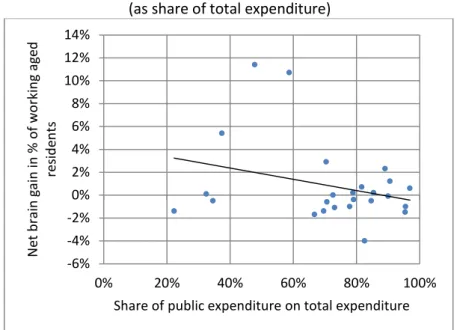
use of data about the net brain gain (see Docquier and Marfouk, 2005). Figure 6.3 confirms
our previous insights: there is a negative, but insignificant relation. A negative brain gain, i.e.,
a net outflow of highly educated workers is not associated, on average, with a larger share of
private expenditure on total expenditure for higher education. Countries with comparable net
outflows of between 0.4% and 0.6% have very different financing regimes with only the UK
relying much on private contributions (public share of 35%), while Italy, the Czech Republic
and Austria have large public shares of, respectively, 70%, 79% and 85%. On the other hand,
the importance of public expenditure in immigration countries is relatively modest. Australia
with a net brain gain of 11.4% relies on private and public financing in a very balanced way
(public share of 48%). The public contributions to the financing of higher education are
slightly larger for Canada with 59% and a net inflow of highly educated migrants of 10.7%
while the US with a net inflow of 5.4% have the smallest public expenditure share of these
three immigration countries with 37%.
Figure 2 – Relation of student mobility to public expenditure (as share of total expenditure)
Source: OECD (2012, Tables B3.2b and C4.1). Note that for the Czech Republic (8.0), France (11.6), Greece (4.2), Italy (3.5), Korea (1.8) and Turkey (0.7), the data refer to non-native students as defined on the basis of their country of citizenship (“foreign student”). Note for the regression results: constant 8.416 (t-value 2.166) and slope coefficient -2.687 (t-value -0.516) and – when foreign students are excluded – constant 11.624 (t-value 2.401) and slope coefficient -6.159 (t-value -0.984).
Figure 3 – Relation of graduate mobility to public expenditure (as share of total expenditure)
Source: OECD (2012, Tables B3.2b), Docquier and Marfouk (2005, Tables 5.1). Note for the regression results: constant 4.321 (t-value 1.747), slope coefficient -4.901 (t-value -1.474). 0% 5% 10% 15% 20% 25% 0% 20% 40% 60% 80% 100% In te rn at ion al st ud en ts as a % of al l ter tia ry en ro lmen t
Share of public expenditure on total expenditure
-6% -4% -2% 0% 2% 4% 6% 8% 10% 12% 14% 0% 20% 40% 60% 80% 100% N et b ra in ga in in % o f w or ki ng a ge d res id en ts
3.2 Theoretical considerations
Looking at the data presented in the last section, several points stand out. Let us comment just on one, which is particularly illustrative for the following exposition: Some small countries, in particular Austria and Belgium, face a large number of students from their large neighbors, i.e., Germany and France, respectively, where the majority of these students returns after their graduation. At the same time, higher education in Austria and Belgium is primarily tax-financed. So these students, who come for their degree and leave afterwards, do not contribute in any significant way to the financing of higher education.
Taking these observations as a starting point, we want to look more closely at the question of how higher education should be financed and how the financing regime is chosen by the government. For the sake of the argument, we assume here that the quality level of education is given.20 The choice of
the financing regime is the policy variable, i.e., the mix between private financing via tuition fees and public financing via taxes.
We start with a closed economy setting to derive the optimal mix which can then serve as a benchmark when considering an open economy.
We consider a two-period general-equilibrium model with two ex-ante identical countries.21
Individuals differ in their innate abilities, which are not observable. At the first stage, governments choose the educational policy. At the second stage, individuals make their education decision and – if the economy is open – their migration decision given the education policy as implemented by the government. Unskilled individuals are assumed to be immobile throughout.
So, in the first period, individuals decide whether or not – and where, if borders are open – to acquire higher education, which will affect labor supply in the second period. For this, they compare the lifetime income with higher education to the lifetime income when uneducated. If individuals choose not to study, they work and receive the wage income of an unskilled worker in both periods in their home country. If individuals decide to acquire higher education at home or abroad, they receive no wage income in the first period. In the second period, if they are mobile, they decide in
20 Justman and Thisse (1997, 2000), Mechtenberg and Strausz (2008) and Kemnitz (2010) are examples of papers which focus on the quality level, while Thum and Uebelmesser (2003) and Poutvaara (2004, 2008) study the structure, i.e. the relative importance of internationally and domestically applicable contents of higher education. Other papers analyze the financing-side of educational policy in the presence of fiscal competition. In the general-equilibrium setting of Wildasin (2000), e.g., tax level and tax structure are the choice variables while the simultaneous competition in the tax rate and a further fiscal instrument is central in Andersson and Konrad (2003), Haupt and Janeba (2009) and Krieger and Lange (2010).
which country to work and earn the wage income of a skilled worker there.22 Fees are paid according
to the financial regime in place in the country that provides education, while taxes are paid in the country where the graduates work. In a closed economy, both countries trivially are the same while this will no longer necessarily be the case in an open economy with mobile graduates. For simplicity, the population is assumed to be constant. We only concentrate on steady state situations.
For production, labor supplied by individuals with and without higher education, i.e., skilled and unskilled labor, is needed. Production takes place according to a neoclassical production function with constant returns to scale where both types of labor enter as complements. So, importantly, we abstract for the time being from any externalities apart from these technology-related interpersonal links. We will comment later on this. Furthermore, we assume competitive labor markets. So, the optimal demand for labor is such that productivities of skilled and unskilled workers are equal to their respective wage rates, which are endogenously determined.
Due to individual-specific ability levels, it will turn out that only some individuals of a generation with high enough abilities decide to study while the rest starts working as unskilled. This decision is obviously affected by the financing regime in place which changes the costs borne by the individuals and thus the attractivity of the education investment. In general, quite intuitively, the higher the share of education costs financed by taxes, the more attractive it is to study. This allows on the one hand escaping the tax duties during the first period when studying, and above all it implies a reduced total financial burden as part of the costs are co-financed by the unskilled via their tax payments.
3.2.1 Closed economy
In the absence of any market imperfections, in particular with a perfect credit market, and abstracting from any social or public benefits, it is straightforward that there is no justification for public intervention: higher education should be financed via tuition fees only. On the contrary, if there was partial or full tax financing, this would lead to too many individuals who would decide to study and who would possess too low an ability level at the margin.
It is certainly more appropriate, however, to allow for some market imperfections. In the following, credit market imperfections are considered. There is a mark-up to the interest rate which reflects, e.g., the moral hazard problems (see von Weizsäcker and Wigger, 2001, and Jacobs and van der Ploeg, 2006) or the riskiness of the human capital investment. What would then be the optimal financial regime? If the distortions on the credit market are not too large, there is still a positive fee level (albeit smaller than the total costs of higher education), which induces the optimal number of
22 This approach has been introduced by Borjas (1987) where the prospective migrant compares wage abroad with wage at home plus migration cost.
individuals with the optimal ability levels to study. Only if the distortions are very important is it possible that a pure tax-financing regime results. So, distortions on the credit market justify a (partial) intervention of the government via tax-financing. In this case, a pure fee-regime would lead to too few students.
Of course, when, in addition, benefits of higher education arising for society are taken into account (see Table 6.3 above for the relation of private and public benefits), a larger optimal tax-share would result. Still, a financing policy where higher education is (almost) totally financed by taxes appears to be hard to justify.
So, in a general equilibrium framework we establish that the optimal solution as to the number of students (and their ability) can be reached with the right financing-mix (if credit market imperfections are not too large) – even if ability cannot be observed by the government.
3.2.2 Open borders
With open borders, however, it is no longer clear that this policy can be implemented. As the next step, therefore, we study in which direction and to what extent the results (financing mix and number of students) deviate from the optimal levels when governments take migration into account. For this, we consider two symmetric countries. It turns out that it matters who is mobile or, respectively, who is relatively more mobile: graduates, i.e., tax-payers, or students. The question is how the policy of one country changes when taking the policy of the other country into account. Let us first look at the scenario where only graduates are mobile at no cost. In our framework, this leads to an equalization of net wages across countries. The place of study, which is the place of birth in this scenario, does not affect the earnings opportunities in the second period. So, if countries choose a different tax-fee mix to finance higher education (for a given quality level), this will lead to migration from the high-tax to the low-tax country until marginal productivities and thus gross wages have adjusted sufficiently such that net wages are equal again. As a consequence, countries have an incentive to lower taxes and to increase fees starting from the closed-economy optimal tax-fee mix. A too high fee level, however, discourages some individuals from studying. In this sense, open borders with mobile students lead to an under-provision of education.23
If not only graduates but also students are mobile at no cost, the situation is different. A marginal deviation of the optimal tax-fee mix leads now to a non-marginal reaction of the student population. If a country contemplates increasing its fee level without changing the quality level of education, this reduces the attractiveness of this country as a place to study compared to the other country. It
follows that all individuals will study in the country with the lower fee if they decide to study. These changes are far from marginal. On the contrary, as a result of the large inflow of students, the destination country has to change its financing policy: the tax rate or the fee level has to be raised. In particular, when the tax rate is already rather high, the country has to increase fees up to the same level as in the country which first raised its fee level. So, this would result in the same financing policy with the same number of students in both countries. But one should note that the financing-mix would again be sub-optimal and so would be the number of students. If countries anticipate the respective reaction of the other country, they should abstain from increasing the level of fees in the first place. A symmetric situation would thus emerge with no migration. Taking this into account, the countries would optimize as if in a closed economy and the optimal finance mix of the closed economy could be sustained.
The scenario with full and costless migration of students and graduates is, admittedly, not very realistic in the short-run – also in the light of the data provided in the previous section. Still, if one takes the Erasmus-Program or the Bologna Process, which are intended to foster stays abroad for students by facilitating the recognition of qualifications and periods of study (see Section 1.2 above), they can all be seen as promoting migration by reducing migration costs in the medium- to long-run. So, what can be said when we look at the more realistic scenario with positive migration cost for both students and graduates? Can we then again talk about marginal reactions? There will be no longer a full net-of-tax wage arbitrage. This implies that the decision of where to study also becomes (to some extent) a decision on where to work as there are cost advantages when one stays in the country of education after graduation. It then becomes harder to attract graduates by (marginally) lowering taxes. At the same time, students are more valuable as future tax-payers. So, the relative mobility of students and graduates matters (see Lange, 2009). If graduates are relatively more mobile, there is still a tendency towards underprovision of higher education, i.e., towards too high fees and too few students. If students’ mobility is, however, relatively high, it is even possible that an overprovision of higher education results.
Finally, if we bring the different scenarios together, there seems to be a possible U-shaped relation between the migration costs of students and graduates and the intensity of the tax-fee competition: a closed economy without migration and an open economy with costless migration of both students and graduates both result in the optimal (closed-economy) financing regime and the optimal number of students. An open economy with limited migration, on the contrary, leads to incentives for the countries to underprovide higher education and to free-ride on the higher education provided by other countries – at least when the (return) migration of graduates dominates students’ migration.
This at least holds for the financing system considered so far where the costs of higher education are (possibly) shared between the students and the (host) country which provides higher education. The country of previous education, or alternatively the country of work – if not identical to the country of higher education, is left out of the picture.
So, a two-step procedure is called for to arrive at the optimal financing regime with open borders. In a first step, the private and social benefits and the corresponding share of costs borne via fees and taxes have to be determined. Then, in a second step, the specific implementation of the regime has to be considered. This involves the private part and the question of whether tuition fees should be levied at the time of studying or after graduation (as graduate taxes or income-contingent loans). The contributions by Barr (2014) and Del Rey and Racionero (2014) explicitly analyze this. This also concerns the public cost share and how it has to be allocated between the country of education and the country where indeed the social benefits arise. In fact, with migration, the financing would have to be split up among four parties: the graduates, according to their private returns, the country of higher education, that of previous education (possibly identical to that of birth), and the working-country (or countries), according to the respective social returns which those countries benefit from. This will be analyzed in detail in Section 4.
3.2.3. Asymmetric countries
Before moving on, we want to briefly comment on two of our assumptions: symmetric countries and the given (and identical) quality level of higher education. Within this framework, we have considered the options a country B has if it faces a policy change by another country A. At least with rather low mobility costs, we have argued that it is plausible to expect that country B matches this policy. But what happens when country B is not able to adjust its policy accordingly - or more precisely, when country B cannot introduce fees even if it faces positive tuition fees in country A?24
If A increases the fee level and B cannot match this because it continues to face constraints which restrict the financing instruments to pure tax-financing, B might contemplate changing the quality level of education. A migration equilibrium in the presence of different taxes and fees in the two countries can only exist, however, if the quality levels of education differ such that the quality is higher in country A (with high fees) than in country B (with low fees). Otherwise, why should students go, e.g., to the UK or the US despite the higher fees charged there by some (prestigious) universities? Country A, i.e., the UK or the US, then specializes in attracting high-ability students while country B focuses on the low-ability ones and an asymmetric equilibrium (possibly) results.
Otherwise, all students would go to country B where the given educational quality is provided most cheaply (for zero fees).25
Whether this constitutes an equilibrium when general equilibrium effects are taken into account depends on the specific functional forms. The relative importance of student and graduate mobility will be essential for the financial regime as well as the quality level of education and the cost function.26
4. How should the costs of higher education be shared between the affected countries?
We may now discuss the current system of financing higher education of cross border students in the EU and investigate alternative avenues which fit aspects of the challenges mentioned above. Comparisons with alternative devices, like the Bhagwati tax and the instrument of Contingent Loans will be conducted including a discussion of US policies.27 As basic setting for this section we use the
old and new paradigms already mentioned and depicted in Section 1.
4.1. The old paradigm
In that setting the resident is born in one country, she studies in that country and after graduation she works in that country, too. Therefore the countries of origin, studies and work are identical. That corresponds to a closed economy but also to an open one; let us call it a union, provided that education policy, especially tertiary education, is centrally designed.
The objective of the country is to maximize a Social Welfare Function based on its own benefits and costs. Benefits are basically the contribution of graduates to GDP. However those benefits might be split in two sets: one consists of private benefits like a better pay, better working conditions, smaller risk of unemployment, and better health; the other conveys social benefits which include spillover effects on the quality of the working force in the area, taxes paid on higher wages, possibly levied in a progressive way, larger contributions to social security, and simultaneously fewer costs in terms of social benefits like unemployment benefits and health-related expenditure.
25 Another, related example of an intentional differentiation strategy within countries concerns the Russell Group in the UK. This association of 20 major research-intensive universities strives at maintaining the highest standards of research, education and knowledge transfer. By doing so, the universities which belong to this group clearly want to differentiate themselves with respect to other British and possibly European and North-American universities in terms of quality and in terms of tuition fees. Fees are limited to formerly £3,000 and now £9,000 per year for full-time British and EU undergraduates, whereas there is no limit for fees for students coming from outside the European Union (Murphy, 2014).
26 See Demange and Fenge (2009) for a model which deals with this question - albeit in a simplified version of the model presented here.
Costs basically include the cost of providing students with higher education, and the opportunity cost of no contribution to GDP during the period of studies. Those costs may also be split into private and social costs.
Taking into account all these benefits and costs the country or the union decides on an optimal amount of tertiary education. A formal value for that amount is provided by equation (3) below. However, even though the centralized outcome makes sense in a country, it does not at the level of a union like the EU where provision and financing of higher education is a competence that countries or subdivisions of countries are not ready to transfer to the center. Therefore, at that level, one may seek for a decentralized design which reproduces the centralized outcome.
4.2. The new paradigm
Let us now introduce the distinction between the country of origin, that which hosts the students and the country of work or the destination country, respectively – Table 5. In that framework, we investigate a series of education policy devices in order to assess their respective capacity of approximating the centralized one, i.e.to assess their efficiency in terms of internalization of cross border spillover effects.
Table 5 – Benefit and cost for the origin, host and destination countries Country j (origin) i (host of higher
education) kworking purposes) (third destination for Host Country Pr. Benefit = returning
graduates Cost = Opportunity Benefit = remaining graduates Cost = Studies Benefit = attracted graduates No cost Origin Country Pr. Benefit = returning
graduates All costs Benefit = remaining graduates No cost Benefit = attracted graduates No cost Origin Country + Bhagwati tax (BT) or Contingent loan Benefit = returning graduates Cost = All - BT Benefit = remaining graduates Cost = BT on remaining Benefit = attracted graduates Cost = BT on attracted Benefits of a country primarily consist of the contribution to domestic GDP of graduates who, after their graduation, decide to settle there. In addition, benefits also consist of the net local expenditures by foreign students during their stay in that (host) country and possibly of the money they bring from home to finance their tuition fees. Finally, the last component of the benefits is not the least: it relates to the opportunity cost. Indeed, during their period of tertiary education, students do not belong to the workforce of their origin country and they do not contribute to the GDP of that country; that creates an opportunity cost. When a country keeps or attracts a foreign student after her graduation, it not only gets the contribution of that person to GDP, but also avoids