Statistics Netherlands
Division of Economic Statistics Support and Development Department P.O.Box 24500
2490 HA Den Haag The Netherlands
The Export Market Positioning System
Daan Zult and Floris van Ruth
T
HEE
XPORTM
ARKETP
OSITIONINGS
YSTEMSummary:
Statistics Netherlands is developing a new type of system which aims to give early warning of developments influencing Dutch exports. The key idea is identifying the sectors of the main trading partners most relevant for the demand for Dutch exports. Relevant sentiment indicators, mostly production expectations, from the DG-ECFIN sentiment surveys are then used to monitor developments in these sectors. The aggregate of the indicator set is leading when compared to the growth rate of Dutch exports. The structure of the system results in important additional analytical properties, as it can be seen how (broadly) observed developments are diffused among countries and industries
Keywords: Business cycles, leading indicators, sentiment indicators, exports, trade, production expectations
1.
Introduction
Policymakers and analysts require accurate information on current and future economic developments. In the past decades, a whole range of indicators and econometric techniques have been developed to meet these needs. Sentiment, or confidence, indicators like the DG-ECFIN producer and consumer surveys play an important role in analysing current and near-term economic conditions. These can also be used for accurate assessments of the current stance of the business cycle, thus yielding insight into medium-term developments as well. Leading indicators, as produced by for example the OECD and the conference board, are constructed to pick up signals of relevant future developments as soon as these become visible in economic indicators.
To this already impressive array of leading or early warning indicators, Statistics Netherlands intends to add a new type, the export market positioning system (XPS) indicator. It differs in several crucial aspects from most traditional leading and sentiment based indicators. Most composite (leading) indicators focus on general economic conditions, though there are interesting exceptions such as the Conference Board’s employment trends index, several of the ECRI indicators, of course its leading indicator for exports, but also for example their future inflation gauge, and finally Statistics Netherlands’ vacancy indicator [“a monthly employers’ sentiment indicator; doing more with business survey data”, Van Ruth, F.J. and Wekker, R. (2009) Statistics Netherlands discussion paper 09009]. The export market positioning system, as its name suggests, traces exports towards its next destination. The Netherlands is a small, open economy where the business cycle is very much determined by exports and developments in (world) trade. This means that accurate and quick information on trends in trade is crucial for policy makers and business alike, especially as trade has been shown to be very sensitive to the economic climate. However, there is no single clear-cut optimal approach for monitoring (world) trade. An obvious and existing example is the monthly world trade statistics as provided by the Netherlands Bureau for Economic Policy Analysis (CPB), which provides monthly data on total world trade. This highly aggregated statistic provides us with a quick glance on the current state of world trade. However, this level of aggregation comes at a price, since the statistic is largely deprived of economic meaning. In other words, it does not tell us why world trade is as it is or acts as it
sophisticated and not very transparent, as illustrated by the 1750 equations that belong to the SAFFIER II model that is currently in use and developed by CPB (2010). Moreover, these sophisticated models, as applied by public forecasting agencies, did not foresee the great collapse in world trade that occurred at the end of 2008 (Baldwin, 2010). An important reason is that these models did not take account of both the impact of ‘soft’ variables such as (financial) sentiments (Baldwin, 2010) and the high level of integration and synchronization of global supply chains (Araujo, 2009). These shortcomings create precedence for other, more basic approaches where simplicity, transparency and sentiment/financial/other (e.g. internet search behaviour) variables are more prominent. Combined with the importance of trade for The Netherlands, this means that there is demand for a leading indicator which focuses specifically on exports. The XPS aims to give current information on (near) future developments in exports, but also with a high information content.
This approach forms another major difference between existing leading indicators and the XPS. The construction of the indicator system is based on structural economic data and the demand side as export’s driving force. Most composite indicators are constructed using what can be termed a statistical approach. An existing reference or target indicator, such as GDP-growth or industrial production, is chosen. From a list of plausible component indicators, an optimal set is chosen using quantitative criteria such as correlation, lead profile or predictive content. The causal link between leading indicator and reference indicator can be rather loose. As a consequence, the leading indicators are sometimes perceived as a “black box”. It can be difficult for users to ascertain why the indicator is giving a positive or negative signal, and what this means. The structure of the XPS is meant to remedy this, since it simply identifies and monitors the developments in the main markets (i.e. branches/demand categories within the economies of the major trading partners) for Dutch exports. The thesis here is that identifying these markets, finding corresponding leading indicators and then aggregating should yield a leading indicator for Dutch exports.
This is a new approach to constructing leading indicators. It is inspired by the ECRI approach to constructing business cycle indicators, most notably their Export Leading Indicators [“A leading indicator for India’s exports”, Dua, P and Banerji, A. (2001) Centre for development economics, Delhi school of economics, “An index to forecast U.S. exports of goods and services” Hiris, L., Banerji, A., and Taubman, B.W. (1995) International trade and the new economic order R. Moncarz ed. Pergamon Elsevier Science]. ECRI constructs leading indicators for exports by combining data on real exchange rates with leading indicators of major trading partners. Our approach differs mainly in the fact that we focus on end users within the major trading partners, and use only sentiment indicators. Our system is by design constructed using and showing structural economic information. An indicator constructed in a related fashion is the leading indicator of the Netherlands’ centre for policy analysis [“A leading indicator for the Dutch economy; methodological and empirical revision of the CPB system” Kranendonk, H., Bonenkamp, J. and and
Verbruggen, J. (2004) CPB discussion paper 32], which is constructed using sub indicators representing developments in major sectors and demand categories. The component indicators of the XPS have a direct and intuitive connection to the development of exports, making the system of greater value to the users. It also means that a disaggregate representation can be as informative as the composite indicator, which our proposed visualisation will show. This approach is easily applicable to other countries, but also to other aspects of economic activity such as consumption expenditure or fixed capital formation. We have limited ourselves to sentiment indicators in our search for leading indicators. This was partly due to time considerations, but also because of the excellent properties of sentiment indicators. Some possess the required leading character, and these are then available at a monthly frequency, with little or no publication lag, and all are free of data revisions.
In the first section of this paper, the concept will be explained in further detail, and it will be shown how the structural economic data are used to identify the major export markets. Next, indicator selection is described and its results presented. Finally, the full system plus visualisation is presented and its performance evaluated.
2.
Export Market Positioning System, the Concept
A standard approach in monitoring a country’s export prospects is to look at a country’s export order book assessments. This focuses on information from the supply side of exports. In order to improve on this (supply-side) type of monitoring we suggest the XPS as an alternative approach that looks one step further into the trade chain and focusses on the demand side(s) of an export flow. It is a general technique that is designed to monitor a country’s export in an economically meaningful and insightful way. With meaningful and insightful we mean that the result is relatively non-technical and easy to interpret using basic economic insights. This is important as the analysis is meant to serve a broad audience. XPS builds upon the simple fact that an export flow is the sum of different products that go from one country to various countries. I.e. one countries export flow is another countries demand. The fundamental idea behind our concept is that by monitoring developments in the major export markets, we can get early information on the supplying countries export development. As such it is related to the bullwhip concept in business cycle analysis, see for example Banerji and Dua [A. Banerji and P. Dua (2010) “Synchronization of Recessions in Major Developed and Emerging
flows towards their destinations/purchasers (i.e. the demand side) and monitor the developments that occur there, we can hope to foresee developments earlier as we are observing earlier in the trade chain. This early signal function is one of the main goals of the XPS. Moreover, in contrast to a nation’s export order book level assessments or other leading indicators, the XPS system also yields important insights into the structure and drivers of an export flow. For instance, a country might import energy mainly for consumption while another might import energy mainly for industrial use. It also becomes visible how a certain development is diffuse among trading partners and sectors of the economy. The setup allows for different types of economic analysis. In short, the XPS builds upon the simple logic that we can see further when we walk further down the trade chain road. Whether this is of any value depends on its applicability and its (statistical) performance in practice. But before we investigate this, we first discuss some minimum data requirements needed to construct the XPS.
I. Export data suited to construct an export portfolio, where on the product level a degree of aggregation is allowed (e.g. the Standard International Trade Classification (SITC) 1-digit level should suffice).
II. Data that links an export flow to its actual users, in general this implies there should be use-tables of the importing countries available.
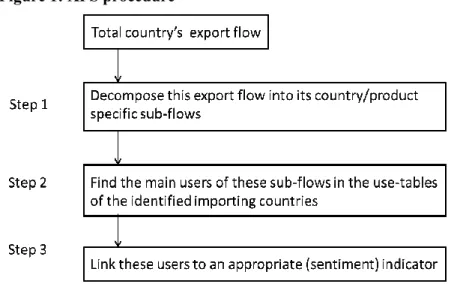
III.High frequent data with low publication lag that indicates, and preferably leads, developments in the ‘customer’ sectors, e.g. business survey data. Unfortunately, in practice these data requirements are not met by a large number of countries, which makes the XPS not globally applicable. However, the EU member states do largely meet these requirements and since they trade on large scale among each other, it is possible to apply the XPS to them. Now to summarise, for any country that meets the minimum data requirements, we can perform the procedure as presented in figure 1.
Figure 1: XPS procedure
Step 3 in figure 1 concerns the collection of indicators that are preferably leading. This implies that simply collecting some indicators is insufficient. Further analysis is required in order to detect and select indicators that are leading. We will discuss this issue in the next section. After the execution of this procedure one acquires a set of indicators that are linked to the various purchasers of a country’s export flows. Before we continue we will discuss some common issues that can occur during the execution of the XPS procedure:
First, during step 1 it is likely that we find a rather diverse export portfolio. This implies that the resulting set of indicators will be too large for a clear and meaningful analysis. For instance, in 2010 the Netherlands had 2312 sub-flows towards 244 countries, which of course is too much data to present in a meaningful and insightful way. Therefore, in order to prevent ending up in an inscrutable jungle of data it makes sense to restrict our dataset by focussing on the major export sub-flows. Here, the definition of insignificant sub-flows can vary for each country, depending on practical and statistical conditions. For instance, in the case study of Dutch exports we present in the next section we apply the (arbitrary) rule that we only consider sub-flows that represent over 1% of the total Dutch export portfolio. This can be done since it leaves us with a sufficient number of indicators.
A second issue that arises during step 2 is when we want to link the export sub-flows to the use-tables of the receiving countries. Here we encounter two problems. The first is a nomenclature problem. Exports are defined in different types of nomenclature like the SITC or the Harmonized Commodity Description and Coding System (HS), while in the EU member states use-tables, the input products are defined by the Statistical Classification of Products by Activity (CPA). There is no
Table 1: The SITC codes linked to CPA codes
The CPA code descriptions can be found in appendix A. Table 1 allows us to execute step 2 of the XPS for any EU member state. The second problem is similar to the problem encountered in step 1. Namely, most industries seem to use as input goods from many different export sub-flows. This implies that all of a country’s industries can be considered a customer of any sub-flow, which is an undesirable outcome. A simple solution is to select, for each sub-flow, only the industries that are major users..
With respect to step 3 we should note that the nomenclature of industries that is used in the EU member state use-tables is the Statistical Classification of Economic Activities in the European Community (NACE). This implies that the customers of the export flow will eventually be defined in NACE as well. This has a major practical advantage when we want to link these industries to indicators. Namely, it allows us to link them directly to the business survey data that is collected by the Directorate General European Commission of Economic and Financial Affairs (DG ECFIN), since this is defined within a similar nomenclature. This clear connection, plus the fact that these business survey indicators have a high publication frequency (once a month), low publication lags (before the end of a month) and are not subject to revisions, makes them valuable indicators for the XPS. In order to see whether the XPS has any practical value, we will apply it to Dutch exports in the next section.
3.
Case study, XPS in the Netherlands
The Netherlands is a small open economy and therefore strongly affected by developments in international trade. For instance, in 2009 total exports equalled 54.1% of total GDP while total imports were equal to 47.9%. The development of international trade is therefore of major interest to investors, companies and policymakers in the Netherlands and is therefore worth monitoring. In this section we first apply the XPS to the Netherlands and next analyse and discuss the results.
! " # # #
$ " % %
& " % '
(
3.1 XPS for the Netherlands
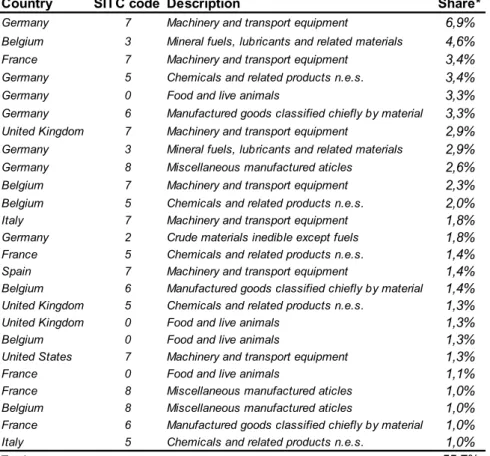
We start with the analysis of the Dutch export portfolio. We use Eurostat data of Dutch exports of goods over the years 2008-2010 and decompose it into country and SITC 1-digit level sub-flows, as described under step 1 in figure 1. The result can be seen in table 1.
Table 1: Dutch export sub-flows, separated on the country and SITC 1-digit level.
Country SITC code Description Share*
Germany 7 Machinery and transport equipment 6,9%
Belgium 3 Mineral fuels, lubricants and related materials 4,6%
France 7 Machinery and transport equipment 3,4%
Germany 5 Chemicals and related products n.e.s. 3,4%
Germany 0 Food and live animals 3,3%
Germany 6 Manufactured goods classified chiefly by material 3,3%
United Kingdom 7 Machinery and transport equipment 2,9%
Germany 3 Mineral fuels, lubricants and related materials 2,9%
Germany 8 Miscellaneous manufactured aticles 2,6%
Belgium 7 Machinery and transport equipment 2,3%
Belgium 5 Chemicals and related products n.e.s. 2,0%
Italy 7 Machinery and transport equipment 1,8%
Germany 2 Crude materials inedible except fuels 1,8%
France 5 Chemicals and related products n.e.s. 1,4%
Spain 7 Machinery and transport equipment 1,4%
Belgium 6 Manufactured goods classified chiefly by material 1,4%
United Kingdom 5 Chemicals and related products n.e.s. 1,3%
United Kingdom 0 Food and live animals 1,3%
Belgium 0 Food and live animals 1,3%
United States 7 Machinery and transport equipment 1,3%
France 0 Food and live animals 1,1%
France 8 Miscellaneous manufactured aticles 1,0%
Belgium 8 Miscellaneous manufactured aticles 1,0%
France 6 Manufactured goods classified chiefly by material 1,0%
Italy 5 Chemicals and related products n.e.s. 1,0%
Total 55,7%
*Equal for export value and volume
In table 1 we can see that the Dutch export flow is dominated by sub-flows towards Germany, Belgium, France and the United Kingdom, i.e. the countries geographically closest to the Netherlands. Italy, Spain and the United States receive a substantial share as well. Furthermore, table 1 reveals that ‘machinery and transport equipment’ (SITC 7) is an important export product category, while also SITC 3, 5 and 0 occur frequently. We should also note that these export sub-flows together represent a substantial part (i.e. 55.7%) of total Dutch exports of goods.
Table 2: The major users of Dutch exports in important Dutch trade partner countries.
The data in table 1 are required for step 2 of the XPS, where we use structural information from the receiving countries National Accounts to link the export sub-flows to their customers (by the SITC-CPA connection as defined in table 2). In order to keep the analysis meaningful and insightful we limit our scope and select, for each country, only the 5 major users/destinations of the Dutch export inflow. The result is in table 2.
Germany Share of Dutch export inflow processed by:
Final consumption expenditure by households 26.8%
Fixed capital formation 11.1%
Manufacture of motor vehicles, trailers and semi-trailers 6.0%
Manufacture of machinery and equipment n.e.c. 4.0%
Construction 3.7%
Total: 51.6%
Belgium Share of Dutch export inflow processed by:
Final consumption expenditure by households 20.5%
Fixed capital formation 13.0%
manufacture of coke and refined petroleum products 9.7%
manufacture of basic metals 7.8%
manufacture of motor vehicles, trailers and semi-trailers 6.3%
Total: 57.3%
France Share of Dutch export inflow processed by:
Final consumption expenditure by households 32.2%
Fixed capital formation 13.0%
manufacture of motor vehicles, trailers and semi-trailers sentiment 5.1%
manufacture of chemicals and chemical products 4.8%
Construction sector 4.6%
Total: 59.7%
United Kingdom Share of Dutch export inflow processed by:
Final consumption expenditure by households 31.0%
Service of land transport and transport via pipelines 9.5%
Fixed capital formation 9.1%
manufacture of chemicals and chemical products 4.2%
manufacture of coke and refined petroleum products 4.2%
Total: 58.0%
United States of America Share of Dutch export inflow processed by:
Final consumption expenditure by households 23.5%
Fixed capital formation 17.6%
manufacture of motor vehicles, trailers and semi-trailers sentiment 8.8%
manufacture of chemicals and chemical products 7.4%
Construction 6.0%
Total: 63.3%
Italy Share of Dutch export inflow processed by:
Final consumption expenditure by households 21.8%
Fixed capital formation 20.5%
manufacture of chemicals and chemical products 7.1%
Construction 6.4%
manufacture of machinery and equipment n.e.c. 5.5%
Total: 61.3%
Spain Share of Dutch export inflow processed by:
Producer sentiment 32.2%
Fixed capital formation 19.5%
manufacture of motor vehicles, trailers and semi-trailers sentiment 13.1%
Construction 6.2%
Wholesale and retail trade and repair of motor vehicles and motorcycles sector 4.3%
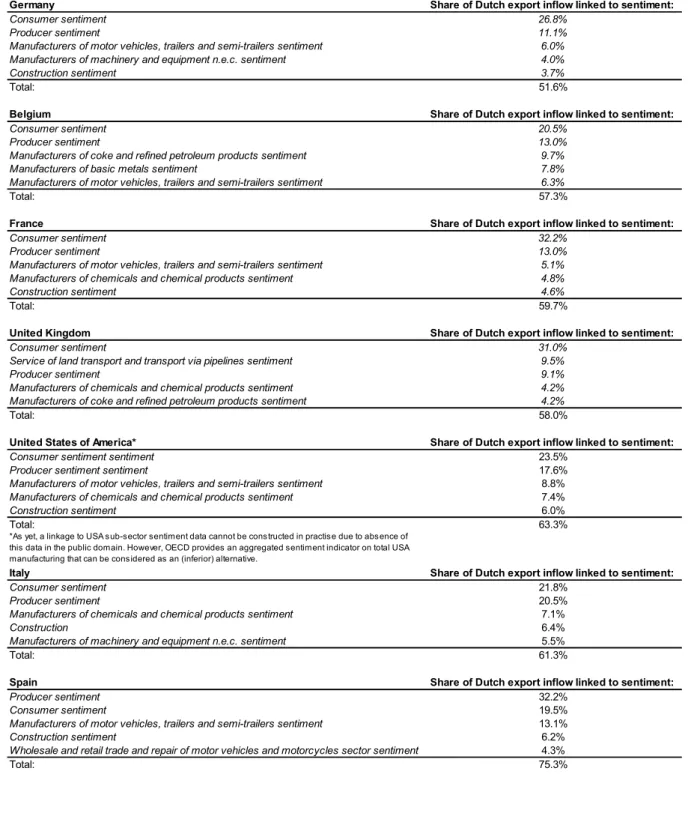
Table 2 allows us to execute step 3 of the XPS, where we attempt to find a leading indicator for the economic sectors identified, using the relevant business or consumer survey. As said, these indicators have a clear link with the industries as defined in the use-tables. For instance, there are business survey questions for ‘manufacturers of machinery and equipment n.e.c.’ and ‘manufacturers of chemicals and chemical products’, which are directly linked to economic sectors that are written in table 2. The only exception is ‘fixed capital formation’, which is important but cannot be linked to any specific subsector. Our ‘solution’ is to link this to the general industry sentiment indicator, since it is likely that the total industry is an important source of fixed capital formation, and that the rate of fixed capital formation is linked to the general development of business conditions as experienced by industry. The resulting indicator set is shown in table 3.
So far we collected a number of sentiment indicators that, according to the XPS, are connected to Dutch exports. However, before we can transform this set of indicators into a useful monitoring tool we need to take some practical and technical issues into account. First, each survey consists of a number of different questions, yielding different indicators.. For instance, consumers are asked twelve different questions that vary from ‘assessing their financial situation over the last 12 months’ to ‘plans they have on doing major purchases over the next 12 months’. It is not evident which survey question serves our purpose best. Therefore, we must perform some empirical analysis, testing different compositions of the indicator set. A second practical issue is that in order to translate the set of indicators into a monitoring tool that is of value for users without to much economic background, we need to consider elements such as data visualisation. The aim is to communicate the information present in the system as effectively as possible. This implies we need to take issues like parsimoniousness and symmetry into account. For instance, as can be seen in table 3, for the United States there is no public access to data similar to the ECFIN business survey data. This implies we cannot present subsector specific indicators for the US, which needs to be taken into account in the context of visualisation. Finally we should consider these issues in relation to the statistical properties of a monitoring system. These issues will be part of the empirical analysis we present in the next section.
Table 3: Sentiment indicators linked to major destinations and users of Dutch exports.
Germany Share of Dutch export inflow linked to sentiment:
Consumer sentiment 26.8%
Producer sentiment 11.1%
Manufacturers of motor vehicles, trailers and semi-trailers sentiment 6.0% Manufacturers of machinery and equipment n.e.c. sentiment 4.0%
Construction sentiment 3.7%
Total: 51.6%
Belgium Share of Dutch export inflow linked to sentiment:
Consumer sentiment 20.5%
Producer sentiment 13.0%
Manufacturers of coke and refined petroleum products sentiment 9.7%
Manufacturers of basic metals sentiment 7.8%
Manufacturers of motor vehicles, trailers and semi-trailers sentiment 6.3%
Total: 57.3%
France Share of Dutch export inflow linked to sentiment:
Consumer sentiment 32.2%
Producer sentiment 13.0%
Manufacturers of motor vehicles, trailers and semi-trailers sentiment 5.1% Manufacturers of chemicals and chemical products sentiment 4.8%
Construction sentiment 4.6%
Total: 59.7%
United Kingdom Share of Dutch export inflow linked to sentiment:
Consumer sentiment 31.0%
Service of land transport and transport via pipelines sentiment 9.5%
Producer sentiment 9.1%
Manufacturers of chemicals and chemical products sentiment 4.2% Manufacturers of coke and refined petroleum products sentiment 4.2%
Total: 58.0%
United States of America* Share of Dutch export inflow linked to sentiment:
Consumer sentiment sentiment 23.5%
Producer sentiment sentiment 17.6%
Manufacturers of motor vehicles, trailers and semi-trailers sentiment 8.8%
Manufacturers of chemicals and chemical products sentiment 7.4%
Construction sentiment 6.0%
Total: 63.3%
Italy Share of Dutch export inflow linked to sentiment:
Consumer sentiment 21.8%
Producer sentiment 20.5%
Manufacturers of chemicals and chemical products sentiment 7.1%
Construction 6.4%
Manufacturers of machinery and equipment n.e.c. sentiment 5.5% Total: 61.3%
Spain Share of Dutch export inflow linked to sentiment:
Producer sentiment 32.2%
Consumer sentiment 19.5%
Manufacturers of motor vehicles, trailers and semi-trailers sentiment 13.1%
Construction sentiment 6.2%
Wholesale and retail trade and repair of motor vehicles and motorcycles sector sentiment 4.3% Total: 75.3%
*As yet, a linkage to USA sub-sector sentiment data cannot be constructed in practise due to absence of this data in the public domain. However, OECD provides an aggregated sentiment indicator on total USA manufacturing that can be considered as an (inferior) alternative.
3.2 Empirical analysis of the Dutch XPS indicator set
In the first part of this empirical analysis we investigate whether, which and what type of relation the sentiment indicators presented in table 3 have with the development of Dutch exports. We aim to use the indicators such that they provide us with an early signal on developments in Dutch exports. Here our reference series will be year on year (YoY) growth in Dutch export volume, because sentiment indicators are generally related to changes in production and sales volumes. We should further note that the total of number business survey questions selected initially, of which a sufficiently long time series is available, is 277. For the majority of these survey questions, data are available over the period January 1985 - October 2011. In order to derive a clear and meaningful picture we need to reduce or summarise this set of variables. Of course we could select series solely based on their statistical properties, but this introduces the risk of cherry picking and overfitting. We therefore start by reducing the set of variables by distinguishing three types of business survey questions, each supposedly with a forward looking character.
The first category we define is simply the general confidence indicator, as defined in the business surveys. The second category consists of questions that relate to the assessment of order positions. The third category consists of the questions that relate to production expectations. This gives us the three categories ‘general confidence’, ‘order assessment’ and ‘production plans’. In table 4 below we present the questions we connect to each type. This categorisation procedure severely limits the number of variables in each category. In fact, when we use the OECD data for the United States and consider all seven countries from table 3, we are left with 3 datasets that each consists of only 31 business survey questions. Next, we investigate whether there is any important difference between the 3 types.
Table 4: The business survey questions linked to each question category and economic sector ! -. / 0 " " " " ! 1 " " 0 % / 2 " " " 0 " " " 3 " ! % " " 0 % / 4
*Same as under 'order assessment'.
In figure 2 we present the three series that are simply (rescaled) summations of the 31 sentiment indicators. Due to some data limitations we restrict ourselves to the period January 2002 – October 2011.
Figure 2: Time series of general confidence, order assessment and production plans indicator series and YoY growth of total Dutch exports (volume)
At first sight figure 2 reveals two things. First, the indicator series seem to follow a similar pattern that is also present in the reference series. Second, the ‘production
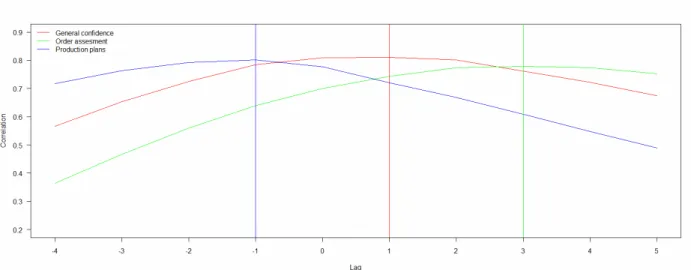
expectations indicator series seems to lead the other series. This observation is confirmed in figure 3 below, in which we present the correlation spectrum of the indicator series with the export series.
Figure 3: Correlation spectrum of indicators with reference series
The vertical lines in figure 3 indicate for which lead/lag a series correlates maximally, where a minus sign on the horizontal-axis represents a lead. This implies that figure 3 confirms that the production expectations indicator, on average, leads the other series, including the export series, by one month. We should further note that the maximum correlations of the three series are around 0.8, which indicates quite a strong relation between the series. Therefore we conclude that the indicator set, as derived by the XPS, has indeed a strong relation with Dutch exports. Furthermore, in order to detect developments early we can look at the questions that are related to production expectations.
Next, we should address some issues relating to the monitoring tool in which we want to present the data. This tool should give users a quick, insightful and easy to interpret picture of the Dutch export situation. Moreover, it should invite users to use the tool for statistical story telling. Thus, the size of the indicator set becomes an important issue. We feel that in this perspective, the set of 31 variables that were until now included in the indicator series is inappropriate. Therefore we will investigate what the effect is of reducing the number of variables. With the visualisation of the data in mind, we consider 3 scenarios, i.e.:
- We present 3 major countries with its 3 major industries (i.e. 9 variables) - We present 4 major countries with its 4 major industries (i.e. 16 variables)
whether the superiority of the production expectations indicator is robust to our choice of the number countries and industries, we also perform the size analysis for the general confidence and order assessment indicator sets. In appendix B we present the figures similar to figure 2 and 3 for the three scenarios. From these figures we can conclude that all three indicator series perform reasonably well, but that the 3 x 3 and 4 x 4 series provide earlier signals (max correlation at 2 months lead instead of 1 month). So it seems that the 5 x 5 series does not improve upon the 4 x 4 series. Furthermore, the superior performance of the production expectations indicator compared to the other two indicator sets, as observed in figures 2 and 3, seems robust over the three size scenarios.
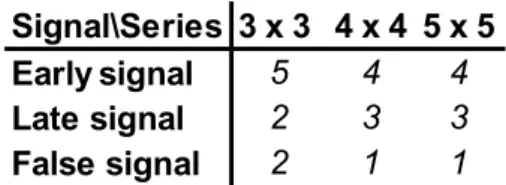
Since the outcomes of this analysis (figures in appendix B), are inconclusive when comparing the 3 x 3 and 4 x 4 scenarios, we perform a second analysis in which we compare the series with respect to the quality of their turning-point signals. Turning point signalling is a major function of an analysis system such as this. A turning point in the reference series is defined here as a local minimum or maximum in the filtered growth rate of exports, i.e. we are considering a growth rate cycle. Ideally, our indicator should give early warning of the occurrence of turning points in exports growth. Another issue is the presence of false signals, i.e. turning points in the indicator which are not followed by turning points in the reference series. These can greatly diminish the value of an early warning system. In this analysis, we restrict ourselves to the production expectations indicator. In appendix C we present the reference series and the production expectations indicator series, after we have filtered them with a Christiano-Fitzgerald (CF) filter (Christiano & Fitzgerald, 1999) with a minimum period of oscillation of 12 months and a maximum period of 180 months. Filtering was performed because of the volatile nature of the export growth rate series and some sentiment indicators. Consecutively we can easily identify major turning points in the indicator series, marking them as a signal. This allows us to count the number of early, late and false signals. The results are summarised in table 5 below.
Table 5: summary of the signals as provided by the different indicator system sizes
Signal\Series 3 x 3 4 x 4 5 x 5
Early signal 5 4 4
Late signal 2 3 3
False signal 2 1 1
As we can see the quality of the signals of the 4 x 4 and 5 x 5 size indicator sets do not differ. Furthermore, table 5 indicates that although the 3 x 3 set provides more early signals, it also gives an additional false signal. Since we consider false signals more undesirable than late signals, we are inclined to reject the 3 x 3 set as the preferred indicator set. Combining the outcomes of these two analyses, we come to the conclusion that the 4 x 4 set has the overall most desirable properties. It offers a
good balance of quality of information and parsimony. Therefore, in the remaining text we select the 4 x 4 production expectations set as our final XPS indicator set.
3.3 Comparison of the XPS indicator with competing alternatives
Now that we have selected a series of indicators and analysed the properties of its simple summation, we should compare its properties with alternative (leading) indicators. We consider two main alternatives. The first is the export order book assessment (DOPA) from the Dutch manufacturing industry survey. The second is the unrevised composite leading indicator (UCLI) of the Netherlands, as published by the Organisation for Economic Co-operation and Development (OECD). We present these time series in figure 4 below.
Figure 4: YoY growth in Dutch export volume, the DOPA, the UCLI and the XPS indicator
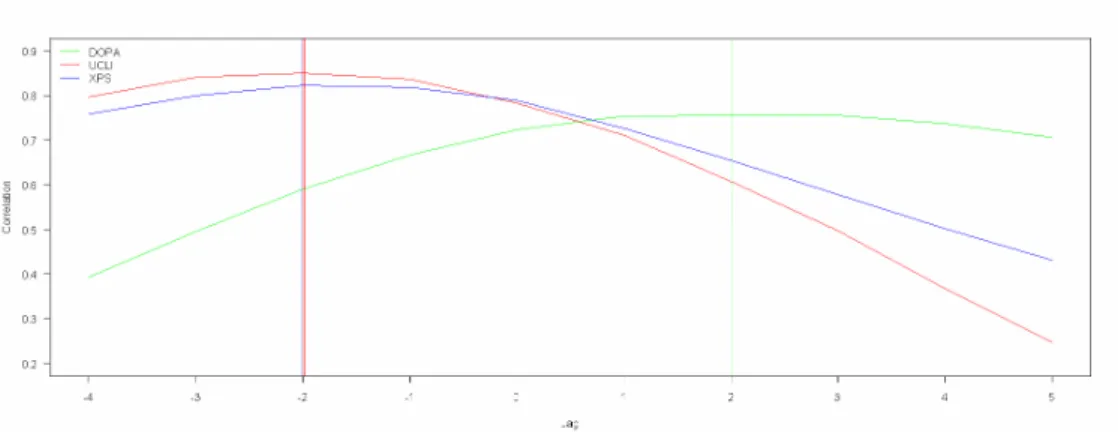
In figure 4 we can see that the OECD leading indicator is, like the export data itself, published 2 months later than the Export Order book assessment. This is because it uses data that is not immediately available. This is good news for the XPS, since it can potentially be published at the same time as the Export orders. This gives the XPS and the Export orders a ‘head start’ over the OECD leading indicator of two months. We further see that the Export orders are more or less lagging both the XPS indicator and the export series itself. This observation is confirmed by figure 5, where we present the correlation spectrum of these indicators together with the YoY growth in volume of Dutch’ exports.
Figure 5: Correlations of lagged indicators with reference series
Figure 5 reveals a few things. First, it seems that the Export order book is not a leading indicator but instead lags the reference series by two months on average. Thus it loses the advantage it possesses due to its publication speed. Second, the assessment of the Export Order Book has a lower overall correlation with the reference series than the OECD leading indicator and the XPS. This implies that, as a leading indicator, the Export Order Book is on average inferior to both the OECD indicator and the XPS. Third we see that the OECD leading indicator and the XPS are close to equivalent in terms of lead and magnitude of correlation. It is therefore interesting to perform the turning point analysis we performed in section 3.2 here as well. We will compare both series with respect to their reference date and their publication data (shifted), which implies that the OECD leading indicator loses its head start. The filtered series are presented in appendix B and the results are summarised in table 6 below.
Table 6: Comparison of quality of turning point signals of both the OECD leading indicator and XPS series
Reference Date Signal/Series UCLI XPS
Earliest 5 1
Equal 0 0
False Signal 1 1
Publication Date Signal/Series Shifted UCLI XPS
Earliest 4 2
Equal 1 1
False Signal 1 1
Table 6 indicates that the OECD leading indicator should, despite its publication lag, still be preferred over the XPS. In particular is seems to provide earlier warnings. This is not surprising, since the XPS has not been subject to any statistical optimisation procedure; it is simply the sum of a set of indicators. It is therefore tempting to perform some type of statistical optimisation procedure on the XPS indicator set, such that its leading indicator properties are improved. We will not go into this subject extensively, but in order to see whether the XPS has some latent lead potential, we will perform one basic analysis. For this analysis we start with the
complete dataset of 31 production expectations questions. On this dataset we perform a factor analysis and command the factor analysis procedure to provide us with 3 factors. Here we should note that it seems that 65% of the variance in the data can be described by these 3 factors. In order to pick the best factor we plot the 3 factors in figure 6 below.
Figure 6: The three latent factors derived from complete XPS indicator set
As we can see, both the 1st (blue) and 2nd (green) factor are more or less leading while the 3rd (red) behaves differently. In order to keep things simple we simply add the blue and green factor together, rescale them and filter the results by a CF filter. We then get figure 7.
Figure 7 shows that the ‘optimized’ XPS indicator is also clearly a leading indicator for Dutch export growth. In order to compare its turning point detecting abilities with the UCLI we summarise figure 7 in table 7.
Table 7: Summary of figure 7
Signal/Series Shifted UCLI XPS
Earliest 4 3
Equal 0 0
Figure 7: The ‘optimised’ XPS indicator, the UCLI and YoY export growth after a CF filter
Table 7 shows that, after only a relatively simple and unsophisticated optimisation procedure (i.e. picking the latent factors that look best), the statistical properties of the UCLI and ‘optimised’ XPS are already comparable.
We can conclude that, with respect to its statistical properties, the XPS indicator survives the comparison with alternative leading indicators. Especially, it seems that when we are not restricted by limitations that evolve from our desired data visualisation, we can use the XPS procedure to collect valuable leading indicators from which we can construct leading indicators that might outperform the OECD leading indicator. This exercise could be part of further research. For the moment we conclude that the 4 x 4 set, additional to its ‘statistical story telling capabilities’, has decent statistical properties as well. The value of the much lower “black box” character of the XPS is hard to quantify, but should not be underestimated. Therefore, in the next section we continue with the discussion of the 4 x 4 XPS dataset, and how it can serve as a tool to monitor Dutch exports.
4.
Visualising the XPS
So far we collected and analysed a set of sentiment indicators that are related to economic sectors which are important purchasers of Dutch exports. In this section we will discuss issues that are related to the visualisation of this data. We first discuss some important visualisation considerations and consecutively we analyse how the visualisations are affected by these considerations.
4.1 Visualisation considerations
The dataset we want to visualise consists of 16 variables that represent the 4 most important export countries with its 4 most important users. We explicitly write these indicators and their ECFIN codes in table 8.
Table 8: The variables included in the 4 x 4 XPS dataset
Our intention is to show the most recent developments that occur in all 16 sectors. Moreover, we want it to be easy to understand the presented information. Ideally they should be able to correctly interpret the main message within a glance. This implies visitors should be able to retrieve both a general picture of the current status of Dutch exports (e.g. strong/weak demand, weakening/recovering) and understand the reason for this status (e.g. German car industry is strong/weak, UK consumers are gaining faith, etc.).
A common technique to simplify messages is to use colours, where different colours correspond to different states. In this case, an obvious choice of colours is to use the same as in the CBS’s business cycle tracer1 (van Ruth et al., 2005). Here green indicates above trend and strengthening, orange indicates above trend but weakening, red indicates below trend and weakening and yellow indicates below trend but strengthening. In order to utilise this concept, we first need to specify the concepts ‘above/below trend’ and ‘strengthening /weakening’. First, a standard technique to define ‘above/below trend’ is to compare any data point with its historical average. Then the question remains what longitude is appropriate. In the visualisation we present here we calculate and define the average over the preceding 3 years as trend. A similar choice is involved in the definition of ‘strengthening
Country Economic sector Question ECFIN code
Germany Consumers Major purchases at present CONS.DE.TOT.8.BS.M
Germany Total industry Production expectations for the months ahead INDU.DE.TOT.5.BS.M
Germany Manufacture of motor vehicles, trailers and semi-trailers Production expectations for the months ahead INDU.DE.29.5.BS.M
Germany Manufacture of machinery and equipment n.e.c. Production expectations for the months ahead INDU.DE.28.5.BS.M
Belgium Consumers Major purchases at present CONS.BE.TOT.8.BS.M
Belgium Total industry Production expectations for the months ahead INDU.BE.TOT.5.BS.M
Belgium Manufacture of coke and refined petroleum products Production expectations for the months ahead INDU.BE.19.5.BS.M
Belgium Manufacture of basic metals Production expectations for the months ahead INDU.BE.24.5.BS.M
France Consumers Major purchases at present CONS.FR.TOT.8.BS.M
France Total industry Production expectations for the months ahead INDU.FR.TOT.5.BS.M
France Manufacture of motor vehicles, trailers and semi-trailers Production expectations for the months ahead INDU.FR.29.5.BS.M
France Manufacture of chemicals and chemical products Production expectations for the months ahead INDU.FR.20.5.BS.M
United Kingdom Consumers Major purchases at present CONS.UK.TOT.8.BS.M
United Kingdom Land transport and transport via pipelines Expectation of the demand over the next 3 months SERV.UK.49.3.BS.M
United Kingdom Total industry Production expectations for the months ahead INDU.UK.TOT.5.BS.M
should assure that the state of an indicator is kept slightly stable. This might be important when, for instance, an indicator is decreasing substantially for a number of months. Then, when the indicator suddenly stops decreasing and increases marginally, it might be inappropriate to define this development as ‘strengthening’. This stickiness is established by the introduction of some boundaries that mathematically can be written as:
1
=
it itS
S
ifX
it 1B
i1<
X
it<
X
it 1+
B
i1 (1a)0
=
itS
ifX
it<
X
it 1B
i1 (1b)1
=
itS
ifX
it>
X
it 1+
B
i1 (1c) and 1=
it itT
T
ifX
iB
i2<
X
it<
X
i+
B
i2 (2a)0
=
itT
ifX
it<
X
iB
i2 (2b)1
=
itT
ifX
it>
X
i+
B
i2 (2c)where
X
itrepresents the indicator series, X its 3 year average,S
itis a phase indicator that tells whether a series is strengthening or weakening,T
it is a phase indicator that tells whether a series is above or below trend andB
i1 andB
i2represent some boundaries. We defineB
i1andB
i2in terms of the standard deviation of the seriesX
i. This can be written as:sd i i BX B1= 1 (3a) sd i i B X B2 = 2 (3b) where sd i
X represents the standard deviation in
X
itover the preceding 3 years. Now given (1), (2) and (3), for every t we can calculateS
itandT
it, where every combination ofS
itandT
itcorresponds to one of the phase colours. This implies that for every indicator at every moment in time, we can express all 16 series in terms of their phase colour. Here we should note that this process still depends on the free boundary parametersB
1 andB
2. We will therefore investigate what the effect is of different values forB
1 andB
2.Before we continue, we should realise that a visualisation is easier to interpret when it includes some type of summarising statistic. Here we consider two options. First we consider the 4 x 4 XPS series that we analysed in section 3, which can be written as:
= = 16 1 i i X Y (4)
For Ywe can define the same phase indicators as with the individual indicator series
X
i, which should represent a summarising statistic. A second option is to simply look at the majority phase inX
iat time t. This implies that when the majority of phases at time t is represented by colour A, than we summarise the phase by colour A as well. When two colours are represented in equal amounts, we simply pick the colour closest to the colour from the previous period. The difference between the two methods is that for the ‘summation method’, the summarising statistic can be largely affected by developments that occur in one sector. In contrast, the ‘majority method’ is less sensitive to developments that occur in a single sector. In the next section we will analyse what method should be preferred.4.2 Visualisation options and alternatives of the XPS
In this section we will simply present and compare some visualisations under different conditions. We vary the visualisation results with respect to the boundaries as defined in (3) and the different types of summarising statistic (i.e. the summation and majority method) we discussed in section 4.1. We start by presenting a visualisation where we set
B
1=
B
2=
0
(i.e. no stickiness) and use the majority method to generate summarising phase colours. In figure 8 we present the results over the period January 2005 till October 2011 (we need the years 2002 – 2005 to calculate an historic trend).summarizing phase statistics over time, together with the black line that represents the YoY Dutch export growth realisations. As we can see, the summarising phase statistic for October 2011 is ‘weak demand’. Moreover, we can immediately answer the question ‘why?’. Because the circles representing the economic sectors show us that there are also signs of weakness in German industry, Belgian consumers, Belgian manufacturers of basic metals, French manufacturers of chemicals, UK consumers, UK industry and UK manufacturers of chemicals. Furthermore we can see that the majority summarising phase statistic provides us with early warning signals. For instance, already in February 2008 we encounter a negative signal that is consistently negative until February 2009. It was not until November 2008 that the Netherlands encountered the first case of negative growth in Dutch exports. Of course we should not overstate this result, since also in 2005 the signals where negative while there was no negative growth during that period. In this period the signal only indicated that export wasn’t doing as well as in the preceding years. Of course, in the light of the 2008 export collapse, this period wasn’t that bad.
Figure 8 is, to a large degree, an arbitrary visualisation option. But as we can see it is already quite informative. Next we will perform some sensitivity analysis where we vary
B
1,B
2and the summarising statistic. In appendix D we present the visualisation results for different scenarios. When we compare the visualisations that evolve under the different scenarios, it seems that forB
1=
0
.
1
,B
2=
0
.
2
and the majority summarising method (figure 14d) provides the best picture with respect to the accuracy and stability of the signals.5.
Conclusions
For trade oriented economies like The Netherlands, timely and preferably early information on developments influencing exports is of great value. Traditionally, there are two ways to achieve this, quantitative forecasts and leading indicators. This paper presents a novel way of constructing leading indicators, sacrificing some lead profile for informational content. Traditional leading indicators have a certain amount of “black box” character. Component indicators are selected on their lead properties, less so on their economic content. As a result, it is often somewhat unclear why a positive or negative development is signalled. To remedy this but still retain a leading character, we use the export market positioning system (XPS). The idea is that the export of one country is the result of demands in other countries. By monitoring developments in major export markets, it is shown here that early signals of developments in Dutch exports can be found. The analysis is actually taken one step further, as we propose to monitor developments in the major receiving sectors of the main trading partners. By analysing trade flows and using structural economic data from the receiving countries’ National Accounts, we identified the most important destinations for the Dutch exports of goods. These were linked to relevant sentiment indicators from business and consumer surveys, thus resulting in a highly
structured monitoring system. We found that production expectations performed better than general confidence indicators and than order book information. In the aggregate, the system has a high degree of correlation with the development of Dutch exports, with an actual lead of two months. In practice, the lead will be greater, as sentiment indicators suffer neither from publication lags nor from revisions. Disaggregated, the system is more useful still. It communicates important structural information on the composition and destinations of Dutch exports. But is also shows whether, and how, certain developments diffuse among trading partners and industries.
REFERENCES
Araujo S., Oliveira Martins J. (2009). ‘The Great Synchronisation: What do high-frequency statistics tell us about the trade collapse?’ VoxEU.org.
Baldwin, R. (2010). ‘The Great Trade Collapse: Causes, Consequences and Prospects.’A VoxEU.org publication, Center for Economic Policy Research (CEPR).
Dua, P and Banerji, A. (2001) “A leading indicator for India’s exports”, Centre for development economics, Delhi school of economics
Banerji, A. and Dua, P. (2010) “Synchronization of Recessions in Major Developed and Emerging Economies” The journal of applied economic research (4) p.197-223 Christiano, L.J., Fitzgerald, T.J. (2003). ‘The Band Pass Filter.’ International Economic Review, v44, 435-465.
Dua, P., Banerji, A. (2001). ‘A Leading Index for India's Exports.’ Development Research Group Study No. 23 under the aegis of the Reserve Bank of India.
Kranendonk H., Bonenkamp J. and Verbruggen J. (2004) ‘A Leading Indicator for the Dutch Economy’ CPB discussion paper No.32.
Hiris, L., Banerji A. and Taubman, B.W. (1995). ‘An Index to Forecast U.S. Exports of Goods and Services’ International Trade and the New Economic Order. R. Moncarz, Pergamon: Elsevier Science.
Netherlands Bureau for Economic Policy Analysis (CPB) (2010). ‘SAFFIER II, 1 model for the Dutch economy, in 2 qualities, for 3 uses.’ (only in Dutch), CPB document No. 217.
Van Ruth, F.J., Schouten, B. and Wekker, R. (2005). “The Statistics Netherlands Business Cycle Tracer. Methodological aspects; concept, cycle computation and indicator selection”, Statistics Netherlands Methodology Paper.
Van Ruth, F.J. and Wekker, R. (2009). “a monthly employers’ sentiment indicator; doing more with business survey data”, Statistics Netherlands discussion paper 09009
Appendix A
CPA code Description
01 Products of agriculture, hunting and related services 02 Products of forestry, logging and related services
05 Fish and other fishing products; services incidental of fishing 10 Coal and lignite; peat
11 Crude petroleum and natural gas; services incidental to oil and gas extraction excluding surveying 12 Uranium and thorium ores
13 Metal ores
14 Other mining and quarrying products 15 Food products and beverages
16 Tobacco products
17 Textiles
18 Wearing apparel; furs 19 Leather and leather products
20 Wood and products of wood and cork (except furniture); articles of straw and plaiting materials 21 Pulp, paper and paper products
22 Printed matter and recorded media
23 Coke, refined petroleum products and nuclear fuels 24 Chemicals, chemical products and man-made fibres 25 Rubber and plastic products
26 Other non-metallic mineral products
27 Basic metals
28 Fabricated metal products, except machinery and equipment 29 Machinery and equipment n.e.c.
30 Office machinery and computers 31 Electrical machinery and apparatus n.e.c.
32 Radio, television and communication equipment and apparatus 33 Medical, precision and optical instruments, watches and clocks 34 Motor vehicles, trailers and semi-trailers
35 Other transport equipment
36 Furniture; other manufactured goods n.e.c. 37 Secondary raw materials
40 Electrical energy, gas, steam and hot water
41 Collected and purified water, distribution services of water
45 Construction work
50 Trade, maintenance and repair services of motor vehicles and motorcycles; retail sale of automotive fuel 51 Wholesale trade and commission trade services, except of motor vehicles and motorcycles
52 Retail trade services, except of motor vehicles and motorcycles; repair services of personal and household goods 55 Hotel and restaurant services
60 Land transport; transport via pipeline services 61 Water transport services
62 Air transport services
63 Supporting and auxiliary transport services; travel agency services 64 Post and telecommunication services
65 Financial intermediation services, except insurance and pension funding services 66 Insurance and pension funding services, except compulsory social security services 67 Services auxiliary to financial intermediation
70 Real estate services
71 Renting services of machinery and equipment without operator and of personal and household goods 72 Computer and related services
73 Research and development services 74 Other business services
75 Public administration and defence services; compulsory social security services 80 Education services
85 Health and social work services
90 Sewage and refuse disposal services, sanitation and similar services 91 Membership organisation services n.e.c.
92 Recreational, cultural and sporting services
93 Other services
Appendix B
Figure 12a, 12b and 12c: CF filtered series for different numbers of countries and consuming sectors
Appendix C
Figure 13a: Filtered series of the YoY export growth, UCLI and XPS, for 3 countries and 3 sectors.
Figure 13b: Filtered series of the YoY export growth, shifted UCLI and XPS, for 4 countries and 4 sectors.
Figure 13c: Filtered series of the YoY export growth, shifted UCLI and optimised XPS, for 5 countries and 5 sectors.
Appendix D
Figure 14a:
B
1=
0
,B
2=
0
and summation summarising methodFigure 14c:
B
1=
0
.
1
,B
2=
0
.
1
and summation summarising methodFigure 14e: