The 2014 Victorian State Election
No. 1, June 2015
Bella Lesman
Rachel Macreadie
Dr Catriona Ross
Paige Darby
Parliamentary Library & Information Service
Department of Parliamentary Services
Parliament of Victoria
Parliamentary Library & Information Service
Department of Parliamentary Services
Parliament of Victoria
Research Paper
Research Paper
ISSN 2204-4752 (Print) 2204-4760 (Online)
© 2015 Parliamentary Library & Information Service, Parliament of Victoria
Research Papers produced by the Parliamentary Library & Information Service, Department of Parliamentary Services, Parliament of Victoria are released under a Creative Commons 3.0 Attribution-NonCommercial-NoDerivs licence.
By using this Creative Commons licence, you are free to share - to copy, distribute and transmit the work under the following conditions:
Attribution - You must attribute the work in the manner specified by the author or licensor (but not in any way that suggests that they endorse you or your use of the work).
Non-Commercial - You may not use this work for commercial purposes without our permission.
No Derivative Works - You may not alter, transform, or build upon this work without our permission.
Acknowledgments
The authors would like to thank their colleagues in the Research & Inquiries Service, Alice Jonas and Marianne Aroozoo for their checking of the statistical tables, proof-reading and suggestions and Debra Reeves for proof-reading. Thanks also to Paul Thornton-Smith and the Victorian Electoral Commission for permission to re-produce their election results maps, for two-party preferred results and swing data based on the redivision of electoral boundaries, and for their advice. Thanks also to Professor Brian Costar, Associate Professor Paul Strangio, Nathaniel Reader, research officer from the Parliament of Victoria’s Electoral Matters Committee, and Bridget Noonan, Deputy Clerk of the Victorian Legislative Assembly for reading a draft of this paper and for their suggestions and comments.
PARLIAMENTARY LIBRARY & INFORMATION SERVICE | The 2014 Victorian State Election
Executive Summary
This paper examines the 2014 Victorian state election, providing description and analysis of the results in three main sections.
Part A of the paper provides some context to the outcome of the election by examining the redistribution of Victoria’s state electoral boundaries, and key issues during the life of the 57th Parliament. Part B provides an overview of the election campaign, key policies, news coverage and the polling data. Part C provides statistical tables of the results for each district and region. Key Results
The Labor Party, led by Daniel Andrews, won the election. In the Legislative Assembly:
Labor won a total of 47 seats
the Coalition won 38 seats (30 to the Liberal Party and eight to the Nationals)
the Greens won two seats (Melbourne and Prahran)
an Independent won one seat (Suzanna Sheed for the seat of Shepparton), and
another Independent (former Liberal), Geoff Shaw, lost his seat of Frankston to Labor. In the Legislative Council:
Labor won a total of 14 seats
the Coalition won 16 seats (14 to the Liberal Party and two to the Nationals)
the Greens won five seats
the Shooters and Fishers Party of Victoria won two seats
the Democratic Labour Party (DLP) won one seat
the Australian Sex Party won one seat, and
Vote 1 Local Jobs won one seat. The Labor Party:
won four seats in the Legislative Assembly since the 2010 election (the results of the seats which changed notionally due to the redivision of electoral boundaries are discussed later in the publication)
lost the electoral district of Melbourne to the Greens, and
lost two seats in the Legislative Council to the Greens. The Coalition:
lost seven seats in the Legislative Assembly since the 2010 election including Prahran to the Greens and Shepparton to an Independent
lost a total of five seats in the Legislative Council to the micro parties, and
the Nationals lost the status of ‘third party’ in the Parliament by failing to win 11 seats, they won a total of ten seats.
The Greens:
won two seats in the Legislative Assembly giving them representation in the lower house for the first time, and
Contents
Executive Summary ...
Victorian State Election 2014: Overview of Results ... 1
Introduction ... 2
PART A: THE CONTEXT FOR THE 2014 ELECTION ... 3
1. The redistribution of electoral boundaries ... 3
1.1 Old boundaries ... 3
1.2 New boundaries... 3
2. The 57th Parliament ... 4
2.1 Instability ... 4
PART B: THE CAMPAIGN ... 7
3. The campaign ... 7
3.1 Coalition three-cornered contests ... 7
3.2 Grassroots campaigning ... 8
3.4 Preference deals ... 8
3.3 The Leaders’ debate ... 9
3.5 The East West Link project ... 9
3.6 Parties and personalities ... 11
3.7 Social media ... 12
4. Key policies of the parties ... 13
4.1 The Liberal Nationals Coalition ... 13
4.2 The Labor Party ... 15
4.3 The Greens ... 16
4.4 Shooters and Fishers Party ... 19
4.5 Australian Sex Party ... 19
4.6 Democratic Labour Party ... 20
4.7 Vote 1 Local Jobs ... 21
4.8 Independent – Suzanna Sheed ... 22
5. News coverage and the polls ... 23
5.1 Editorials ... 23
5.2 Alternative news ... 23
5.3 Opinion polls ... 23
6. Campaign snapshot ... 28
7. Outcome in the Legislative Assembly ... 29
7.1 Summary of the election result ... 29
7.2 The Labor Party ... 29
PARLIAMENTARY LIBRARY & INFORMATION SERVICE | The 2014 Victorian State Election
7.4 The Nationals ... 32
7.5 The Greens ... 33
7.6 Independents ... 34
7.7 Primary vote performance of parties ... 35
8. Outcome in the Legislative Council ... 37
8.1 Summary of the result ... 37
8.2 The Labor Party ... 37
8.3 The Liberal Party ... 37
8.4 The Nationals ... 38
8.5 The Greens ... 38
8.6 The Shooters and Fishers Party ... 38
8.7 The Democratic Labour Party (DLP) ... 38
8.8 Australian Sex Party ... 38
8.9 Vote 1 Local Jobs ... 39
8.10 Composition of the Legislative Council ... 39
9. Further results ... 42
9.1 Women Parliamentarians ... 42
9.2 New and departing MPs ... 43
9.3 Voter turnout ... 45
9.5 Number of candidates contesting the election ... 47
10. Tables and results ... 50
Charts
Chart A: The Legislative Assembly — Seat Results Chart B: The Legislative Council — Seat Results
Tables and Graphs
Table A: The Legislative Assembly — Proportion of first preference vote received by party Table B: The Legislative Council — Proportion of first preference vote received by party Table 1a: Party composition of Legislative Assembly
Table 5.3a: Two-party preferred as predicted by major polling groups Graph 5.3a: Two-party preferred vote, Newspoll 2010-2014
Table 5.3b: Primary voting intentions as predicted by major polling organisations Graph 5.3b: Primary voting intentions, Newspoll
Table 5.3c: Preferred Premier as indicated by major polling organisations Table 5.3d: Newspoll results on ‘Preferred Premier’
Graph 5.3c: Preferred Premier, Newspoll
Table 5.3e: Satisfaction and dissatisfaction with Premier/Leader of the Opposition (Newspoll) Table 7.1a: Overall Legislative Assembly result by party
Table 7.2a: Seats gained by Labor at the 2014 election
Table 7.2b: Primary votes in the seat of Melbourne between Labor and the Greens Table 7.3a: Preference flows in the four sand-belt seats
Table 7.3b: Total seats lost by the Liberal Party at the 2014 election Table 7.3c: Preference flows in Ripon
Table 7.4a: Shepparton
Table 7.5a: Preference flows in Melbourne Table 7.5b: Preference flows in Prahran
Table 7.7a: Primary vote performance of parties – Legislative Assembly Table 8.1a: Legislative Council composition by party and region
Table 8.9a: First preference votes for selected parties in Western Victoria region Table 8.9b: First preference vote by Legislative Council region
Table 8.10a: First preference votes and composition of the Legislative Council Table 9.1a: Women in Parliament
Table 9.1b: Number and percentage of women elected by party Table 9.1c: The Andrews Ministry
Table 9.2a: New Members in the Legislative Assembly Table 9.2b: New Members in the Legislative Council Table 9.2c: Members who retired at the election Table 9.4a: Trend in early voting
Table 9.4b: By-elections in the 57th Parliament Table 9.4c: Melbourne by-election result
PARLIAMENTARY LIBRARY & INFORMATION SERVICE | The 2014 Victorian State Election
Table 9.4d: Percentage of informal votes in the Assembly and Council Table 9.5a: Percentage of candidates contesting the election
Table 9.5b: Number of candidates contesting Legislative Assembly districts 1999-2014
Table 9.5c: Average number of candidates contesting Legislative Assembly seats at state elections since 1999
Table 9.5d: Average number of candidates contesting vacancies in the Legislative Council Table 10a: Overall Legislative Assembly result by party
Table 10b: Legislative Assembly result by seat: first preference vote (number) Table 10c: Legislative Assembly result by seat: first preference vote (per cent)
Table 10d: Legislative Assembly result by seat: two-party preferred/two candidate preferred vote and swing to/from ALP
Table 10e: Overall Legislative Council result by party Table 10f: Legislative Council result by region
Table 10g: Legislative Assembly and Legislative Council voting statistics Table 10h: Victorian election results 1988 – 2014
Maps
Map 1: State Results Map – Legislative Assembly Districts 2010 Map 2: State Results Map – Legislative Council Regions 2010
Pendulum
2014 Post Election Victorian Pendulum
List of Abbreviations
AJP Animal Justice Party
CA Australian Country Alliance
DLP Democratic Labor Party of Australia
EWL East West Link
Labor/ALP Australian Labor Party – Victorian Branch Family First/FF Family First Victoria Inc.
Greens/GRN The Australian Greens – Victoria
Lib Dems Liberal Democrats
Liberal/Lib Liberal Party of Australia – Victorian Division Nationals National Party of Australia – Victoria
PUP Palmer United Party
Sex Party/SP/ASP Australian Sex Party – Victoria Shooters and Fishers/SFPV Shooters and Fishers Party of Victoria
VEC Victorian Electoral Commission
V1LJ Vote 1 Local Jobs
Notes
Figures included in this publication were derived from the Victorian Electoral Commission website, www.vec.com.au and were correct at the time of writing.
1
PARLIAMENTARY LIBRARY & INFORMATION SERVICE | The 2014 Victorian State Election
Victorian State Election 2014: Overview of Results
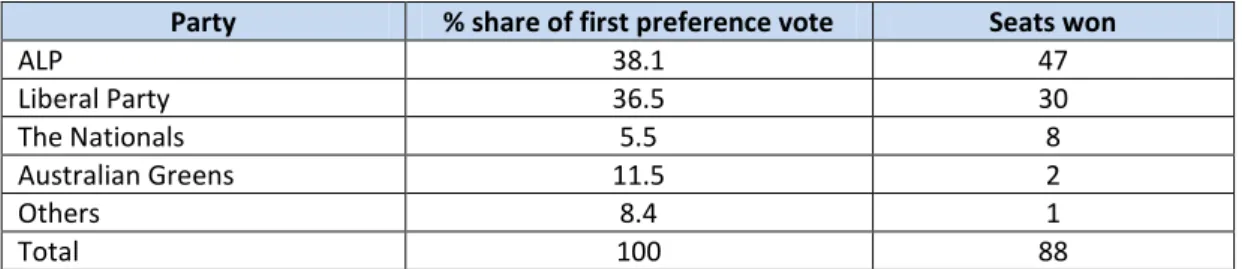
The following charts and tables show the proportion of first preference votes received by the parties which won seats in Parliament, and the composition of the Parliament’s two chambers following the 2014 state election:
Table A: The Legislative Assembly — Proportion of first preference vote received by party
Party ALP Liberal Nationals Greens Others
% 38.10 36.46 5.53 11.48 8.42
Source: VEC website.
Chart A: The Legislative Assembly — Seat Results
Table B: The Legislative Council — Proportion of first preference vote received by party
Party ALP Coalition Greens Sex Party DLP Shooters &
Fishers
Vote 1 Local
Jobs Others
% 33.46 36.14 10.75 2.63 2.32 1.65 0.21 12.84
Source: VEC website.
Introduction
Victoria is earning a reputation for producing surprising election results. According to political commentators and the opinion polls, the 1999 election was expected to return the Coalition Government and the 2010 election was expected to return the Labor Government, yet neither did.
Even though the polls had long placed Labor ahead of the Coalition, the party’s election to office at the 2014 election was still regarded as a significant outcome.
This was because of the removal of the Coalition Government after only one term in power, when history has shown us that governments in Victoria are often likely to consolidate their position at their first return to the ballot box. It had been more than half a century since Victoria experienced a single term government, in 1952-55, and it was a casualty of the split of the Australian Labor Party.
It should be noted however, that the close numbers in the Legislative Assembly in the last Parliament — 44 Coalition, 43 Labor and one Independent, and the redistribution of the state’s electoral boundaries, meant that Labor required a notional uniform swing of only around 1 per cent to gain government.
The election result was that Labor secured government by obtaining a total of 47 seats in the 88 seat Parliament with a swing of 3.6 per cent on a two-party preferred basis.
This election is also historic for the election of two representatives of the Greens Party into the Legislative Assembly: the first time the party has won seats in the Lower House in Victoria. Also, notable, was the election of an Independent in what had been a very safe National Party seat (Shepparton).
The make-up of the Legislative Council after the election was also significantly changed. Neither of the major parties won a majority in the Upper House, and the Greens and four other minor parties won ten seats between them.
As stated earlier, this paper provides a description and analysis of the results the 2014 Victorian state election, set out in three main sections.
Part A of the paper provides some context to the outcome of the election by examining the redistribution of Victoria’s state electoral boundaries, and key issues during the life of the 57th Parliament.
Part B of the paper provides an overview of the election campaign, the leaders’ debate, preference deals, social media, key policies, and polls data in the lead up to, and during the campaign. This section also includes a brief overview of the minor parties.
Part C of the paper examines the outcomes of the election in both houses and how the parties fared. It also contains a short section on women MPs, new and departing MPs, voter turnout, and the number of candidates contesting the election. Part C also provides statistical tables for each district and region and additional tables and information on relevant voter statistics.
3
PARLIAMENTARY LIBRARY & INFORMATION SERVICE | The 2014 Victorian State Election
PART A: THE CONTEXT FOR THE 2014 ELECTION
1. The redistribution of electoral boundaries
In 2013, the Victorian Electoral Commission (VEC) conducted a redistribution of Victoria’s state electorates. The application of the 2010 election results to the new boundaries indicated some notable consequences.
The ABC’s election analyst, Antony Green’s analysis of the results of the 2010 election based on the new boundaries, revealed some notable changes to the results.1 The redistribution of electoral boundaries abolished two Coalition seats and created two notionally Labor-held seats. Major changes to other boundaries, however, converted several Labor seats into notionally-held Liberal ones.2 According to Antony Green, Bellarine, Monbulk, Ripon, Wendouree and Yan Yean became notionally Liberal held seats on very small margins.
The VEC’s analysis of the new seats, based on the 2010 election results, suggested different effects. According to the VEC, Wendouree and Yan Yean remained notionally Labor held seats, on the smallest of margins.3
Taking into account the VEC’s analysis, the redistribution meant that Labor now had to win three seats rather than two, in order to win government. Paradoxically, the redistribution also made it easier for the Labor Party to win government by reducing the uniform swing it required to win, from 1.2 per cent to 0.8 per cent.4
Table 1a: Party composition of Legislative Assembly5
After 2010 election
After the resignation of the Member for Frankston from the Parliamentary Liberal Party and the redivision of
electoral boundaries Liberal 35 36 Nationals 10 9 Labor 43 42 Independent - 1 Total 88 88
1.1 Old boundaries
Labor needed a uniform swing of 1.2 per cent to win two seats, and
there were 16 seats with a margin of 2.5 per cent or under — five Liberal, 11 Labor.
1.2 New boundaries
Labor needed a uniform swing of 0.8 per cent to win three seats, and
there were 16 seats with a margin of 2.5 per cent or under — seven Liberal (three with sitting Labor members), nine Labor.
1
A. Green (2013) ‘2013 Victorian redistribution: analysis of new electoral boundaries’, Prepared for the Department of Parliamentary Services, Victorian Parliamentary Library.
2 ibid., p. 4. 3
P. Thornton-Smith, email, 24 March 2015. Wendouree = 50.1, Yan Yean = 50.0.
4 Compare the 2010 pendulum with the revised ‘redistribution’ pendulum. Please overlook that Mackerras’s
2014 redistribution pendulum also lists Wendouree and Yan Yean as notional Liberal held seats.
5
2. The 57
thParliament
The last time a Victorian government was defeated after one term was in 1955 (John Cain Snr’s 1952-55 administration) as a result of the Labor Party split. A look back at the 57th Parliament, however, goes some way to explain the election results of 2014.
The 2010 election left the Coalition with 45 seats in the Legislative Assembly and the Labor Party with 43 seats. The provision of a Speaker by the Coalition reduced the majority on the floor of the House of Government, to just one seat.
Such close numbers in the House demand reliable party discipline over the life of a Parliament to ensure the success of the Government’s business program. This was not what transpired during the 57th Parliament.
Instead the business of the Legislative Assembly chamber was hampered by instability. While a detailed account of all that transpired is beyond the scope of this paper, some of the major events are outlined below.
2.1 Instability
Much of the instability in the Legislative Assembly during the 57th Parliament was related in some way to the actions of Geoff Shaw, the Member for Frankston. After the Herald Sun revealed to the Premier, Ted Baillieu, in May 2012 that they had allegations that Mr Shaw had allegedly misused his parliamentary entitlements, the Premier asked the Speaker, Ken Smith to conduct an investigation.6 On 5June 2012 the Speaker informed the House that he had received a disclosure
under the Whistleblowers Protection Act 2001 alleging improper conduct by the member for Frankston, which he then referred to the Ombudsman, as required under the Act.7
A recommendation of the Ombudsman’s report tabled in Parliament on 11 October 2012 led to further investigations by the Legislative Assembly’s Privileges Committee and Victoria Police (the latter at the request of Opposition Leader, Daniel Andrews).8
On 6 March 2013, Mr Shaw resigned from the Parliamentary Liberal Party to sit as an Independent on the crossbenches, thereby obtaining the balance of power in the Lower House. Releasing a brief statement to the media, he cited dissatisfaction with the Leadership of the Government as a reason for his resignation.9 This contributed to Mr Baillieu resigning as Premier later the same
day.10
Mr Shaw was also critical of Speaker Smith. He stated to the media that he did not have confidence in the Speaker to manage the security of the parliamentary precinct.11 This related to
an incident on the steps of Parliament House in which Mr Shaw was caught up in a scuffle with taxi licence owners demonstrating against the Government’s changes to the taxi industry.12
6 D. Hurley & P. Rolfe (2012) ‘Taken for a ride’,Sunday Herald Sun, 20 May, p. 1. 7
K. Smith (2012) ‘Disclosure: improper conduct’, Debates, Victoria, Legislative Assembly, 5 June, p. 2400.
8
Charges were dropped by the DPP on 3 December 2013. S. Donovan (2013) ‘All charges dropped against Geoff Shaw’, The World Today, ABC News, 3 December.
9 M. Dunckley & L. Keen (2012) ‘Embattled Baillieu forced out’, Australian Financial Review, 7 March, p. 1. 10
ibid. See the next page for further discussion on Premier Baillieu’s resignation.
11 J. Ferguson (2014) ‘Speaker has spoken: Smith won’t quit’ The Australian, 7 January, p. 5.
12 J. Campbell & M. Ainsworth (2013) ‘Shaw’s asking price’, Herald Sun, 16 November, p. 7; H. Cook & J.
5
PARLIAMENTARY LIBRARY & INFORMATION SERVICE | The 2014 Victorian State Election
Mr Shaw selectively voted with the Opposition to leverage his ability to influence the Government and to bring about the removal of Speaker Smith.13
The effects in the Legislative Assembly included:
the resignation of the former Premier, Baillieu on 6 March 2013 and his replacement by Denis Napthine
the resignation of the former Minister for Gaming Regulation and Minister responsible for Independent Broad-based Anti-corruption Commission (IBAC), Andrew McIntosh on 16 April 2013 (who said he was the member of the Privileges Committee who had ‘leaked’ information about Mr Shaw to a newspaper)14
the Member for Frankston voting with the Opposition to defeat the Government’s Business Program for the sitting week beginning 12 November 2013
the suspension of Opposition members for six sitting days on 26 November 2013
the resignation of former Speaker Smith, on 4 February 2014
the suspension of the Member for Frankston for 11 sitting days on 11 June 2014.
Premier Baillieu and the Coalition were polling poorly in early 2013. According to political commentators, this was partly due to perceptions that it was under-performing; because of the Herald Sun police tapes scandal;15 and because of ongoing disputes with teachers, nurses and
paramedics.16 It was reported in the media that Baillieu had lost the confidence of a section of the
parliamentary Liberal Party and was forced to resign.17
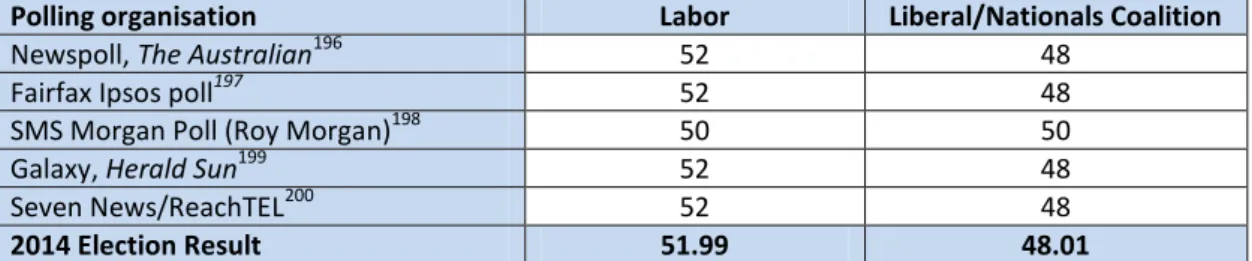
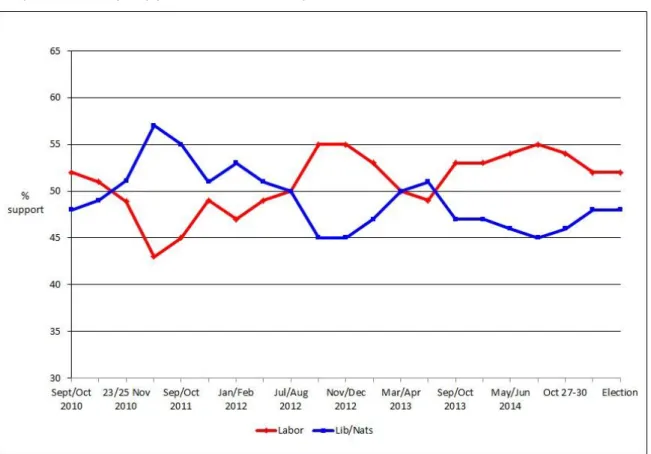
The polls improved initially after Denis Napthine became Premier in February 2013 and resolved the teachers pay dispute in April.18 According to Newspoll, opinion poll results for the Coalition
rose in Mar/April 2013 and May/Jun 2013, but by September/October of 2013 they had shifted back in favour of the Labor Party and stayed there until the election.19 (A more in-depth polling
discussion is provided later in this publication).
Other issues that attracted wide media attention during the 57th Parliament included:
demonstrations about cuts to TAFE funding20
protests about changes to taxi licences21
the teachers’ salary dispute ‘broken promise’22
protests and blockades by inner Melbourne residents against the East West Link23
13 H. Cook (2014) ‘Geoff Shaw saga: How the most recent chapter unfolded’, The Age, 4 June; J. Ferguson
(2014) ‘Shaw deals Napthine’s Liberals an election year embarrassment’, The Australian, 5 February, p. 1; J. Campbell (2013) ‘Your taxes at work: With a paralysed government, the time has come for some hard choices’, Sunday Herald Sun, 17 November, p. 23.
14
J. Ferguson (2013) ‘Napthine minister falls on his sword over media leak’, The Australian, 17 April, p. 8.
15
For further information on the Herald Sun tapes scandal see J. Campbell (2013) ‘Secret tapes bombshell’,
Herald Sun, 4 March, pp. 1, 4-7.
16
H. Ewart (2013) ‘What’s gone wrong: critics size up Victoria’s government’, 7.30 Report, ABC Television, 21 February; M. Dunckley (2013) ‘Baillieu’s exit leaves bigger issues unsolved’, Australian Financial Review, 7 March.
17
J. Campbell (2013) ‘In the end: Ted had no choice’, Herald Sun, 10 March, p. 15.
18
J. Topsfield & B. Preiss (2013) ‘Teachers win big pay deal’, The Age, 18 April.
19
Based on two-party preferred poll data. Newspoll did not publish a poll in July/August 2013.
20 E. Barry (2012) ‘TAFE cuts protest’, Herald Sun, 19 September, p. 6. 21
(2013) ‘Taxi protest over cost of licence’, The Australian, 26 June, p. 2; J. Dagge (2013) ‘Cabbies protest fee cut’, Sunday Herald Sun, 10 June, p. 19.
22 D. Kemp (2015) 'Review of the 2014 State Election: Interim report’, Liberal Party of Australia (Victorian
the unresolved pay dispute with paramedics24
the health issues of residents in the region of the Hazelwood mine fire25
the threatened closure of SPC Ardmona in Shepparton26
the announced closures of local car manufacturing companies General Motors Holden, Ford and Toyota in 201727
the loss of jobs at Alcoa’s aluminium smelting plant at Point Henry and QANTAS maintenance at Avalon28
the unpopularity of some of the Federal Coalition government’s 2014 budget measures29, and
a rise in the state’s unemployment level.30
23
L. Quinn (2014) ‘Protestors march against link’, Herald Sun, 31 March, p. 8.
24
D. Kemp (2015) op cit., p. 6.
25 (2014) ‘Vic: Reopen Vic mine fire inquiry: Locals’, AAP Newswire, 18 November 2014. 26
L. Keen (2014) ‘Sour taste for Shepparton’, Australian Financial Review, 1 February, p. 6; (2014) ‘SPC Ardmona, Shepparton lifeline’, Warrnambool Standard, 14 February, p. 18.
27
N. Toscano (2014) ‘State’s west bearing brunt of jobs decline’, The Age, 1 July, p. 8.
28 G. Dundas & C. Crane (2014) ‘800 axed: Alcoa to shut’, Geelong Advertiser, 19 February, p. 1; D. Lannen
(2014) ‘Qantas flies into sunset’, Geelong Advertiser, 14 March, p. 3.
29 S. Green (2014) ‘Abbott: Napthine’s nightmare’, Saturday Age, 24 May, p. 35.
30 H. Aston, G. Hutchens & M. Mason (2014) ‘Political blame flies as jobless rate rises’, The Age, 8 August,
7
PARLIAMENTARY LIBRARY & INFORMATION SERVICE | The 2014 Victorian State Election
PART B: THE CAMPAIGN
3. The campaign
Political commentators tended to describe the election campaign as ‘lacklustre’ and ‘uninspiring’.31 Even so, much of the news media declared that Daniel Andrews had been the
better campaigner, and that his wife proved to be a campaign asset.32
Commentators discussed the transformation of Daniel Andrews in the media and the polls over the election campaign. Labor’s advertising campaign presented him as a positive and engaging family man.33 Over this period his ratings as ‘preferred Premier’ in the polls climbed several
percentage points. While he started significantly behind Denis Napthine as ‘preferred Premier’ in the polls at the beginning of the campaign, by election day he was only four percentage points behind in the Newspoll.34
Dr Napthine was personally well regarded, and campaigned with his son Tom and wife, Peggy, often alongside in support. The body of political commentators felt, however, that the Coalition was beaten by Labor’s ‘youthful’ campaign.35
3.1 Coalition three-cornered contests
There were tensions between the Coalition partners about the running of three-cornered contests. In 2008 National Party leader Peter Ryan and then Leader of the Opposition, Ted Baillieu, reached a ten-year agreement that the Coalition partners would not stand against each other in seats held by either of the parties in the Lower House.36 Six years later, however, in
February 2014, Liberal members were said to be unhappy that they were unable to field candidates in seats to be vacated by the retirement of Nationals MPs, Bill Sykes, Jeanette Powell and Hugh Delahunty.37
By June 2014, the Liberal Party stated that it was intending to field a candidate in the new seat of Euroa, even though the seat was notionally held by the Nationals. Mr Ryan was reported to have asked them not to stand a candidate.38
The parties disagreed about who should rightfully claim Euroa following the redrawing of its electoral boundaries.39 The Nationals then fielded a candidate in the new seat of Eildon, which
was largely made up of the former seat of Seymour, held by Liberal MP, Cindy McLeish.40
Both parties also fielded candidates in the newly created seats of Buninyong and Ripon. Buninyong was notionally Labor and Ripon notionally Liberal.
31
See, for example: M. Iaria (2014) ‘Victorian poll race expected to be close’, AAP Newswire, 28 November.
32
See, for example: F. Tomazin (2014) ‘Campaign supernova: how Labor’s strategy outgunned the Coalition and delivered victory to Daniel Andrews’, The Sunday Age, 7 December, p. 34.
33
F. Tomazin (2014) ‘Rebranding Dan’, The Sunday Age, 10 November, p. 16.
34
J. Ferguson (2014) ‘Labor on brink of victory: Newspoll’, The WeekendAustralian, 29 November, p. 1.
35
See, for example: Editorial (2014) ‘Liberal brand on the nose’, Warrnambool Standard, 1 December, p. 8.
36 J. Wagstaff (2014) ‘Three-way is the best way’, Weekly Times, 5 March, p. 10 37
ibid.; Editorial (2014) ‘Libs get political lesson’, Weekly Times, 26 February, p. 24.
38 F. Tomazin (2014) ‘Coalition under pressure from within’,The Sunday Age, 22 November, p. 39. 39 ibid.; R. Willingham & J. Gordon (2014) ‘State Coalition set for poll bush battle’The Age, 18 June, p. 16. 40
The results of the three-cornered contests were: the Nationals retained Euroa, the Liberal Party retained Eildon, Buninyong was retained by Labor and Ripon was won by the Liberal Party.
3.2 Grassroots campaigning
Following the election, commentary suggested that one of the elements of Labor’s victory had been its successful grassroots campaign of phone calls and door knocking in marginal seats by teams of volunteers and unions. This strategy was based on a model adopted by the US Democratic Party to support President Obama’s campaign.41 According to several articles, the field
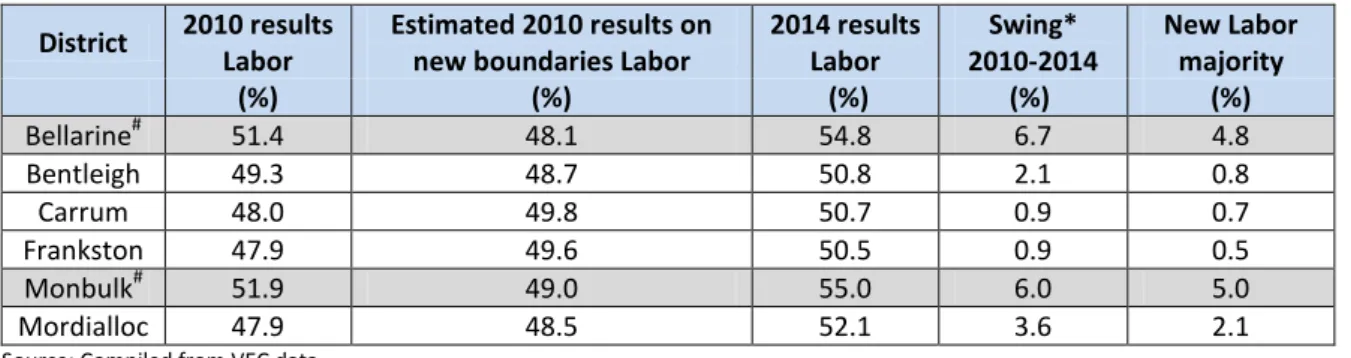
campaign was initially launched in 25 marginal seats but narrowed its focus to just six key seats in the last weeks of the campaign (Bentleigh, Carrum, Mordialloc, Frankston, Bellarine and Monbulk).42
Labor’s advertising and direct mail campaigns which had featured heavily in previous election campaigns were restricted and targeted. Direct mail, for example, was tailored to the particular issues identified by undecided voters during the field program.43
Some unions in dispute with the Government also campaigned against it at various venues. The paramedics union undertook grassroots activities in the field such as handing out leaflets, holding up banners and speaking directly to members of the public.44
The Victorian Greens were also noted for mounting a strong grassroots campaign based on the successful one run by the federal Member, Adam Bandt for the House of Representatives.45 In the
seat of Prahran, for example, 20,000 homes were doorknocked.46
3.4 Preference deals
Following the precedent set by the then Opposition Leader Baillieu in 2010, Premier Napthine announced to the media that the Liberal Party would preference the Greens last in all Lower House seats. For the group tickets in the Upper House, he stated that the Greens would be put last in most cases, but that he would consider putting them above candidates that he regarded as too extreme.47
Opposition leader, Daniel Andrews rejected the Greens offer of a formal preference deal, but said that they could swap preferences on a seat-by-seat basis. It was also reported that Labor would not make a preference deal with the Rise Up Australia Party.48
According to The Australian newspaper, the Greens and the Palmer United Party (PUP) struck a preference deal. The article stated that PUP agreed to give its preferences to the Greens above the Labor Party in all eight Upper House regions and above the Liberal Party in four of the seats. In
41 R. Wallace (2014) ‘The secret weapon that outmanoeuvred the Coalition’, The Australian, 1 December,
p. 9.
42
Chanticleer (2014) ‘Lessons from Victoria’, Australian Financial Review, 2 December, p. 40; Wallace (2014) op. cit.; Tomazin (2014) ‘Campaign supernova’ op. cit.
43
ibid.
44
J. Medew (2014) ‘Paramedics taken to court for campaigning in uniform’, The Age, 21 November, p. 6.
45
L. Stickels (2014) ‘Grassroots groundwork’, The Greens website.
46 H. Cook (2014) ‘Prahran new face of Victorian politics with Green victory’, The Age, 9 December. 47
J. Ferguson (2014) ‘Huge blow for Greens, as Libs decide to preference them last’, The Australian, 14 November, p. 2.
48 (2014) ‘Vic Labor says no to formal Greens deal’, AAP Newswire, 7 November; D. Moss (2014) ‘Shifting alliances and bitter distrust as Vic preference deals go down to the wire’, Crikey, 14 November, p. 1.
9
PARLIAMENTARY LIBRARY & INFORMATION SERVICE | The 2014 Victorian State Election
turn, it was said that the Greens would place PUP above Labor in four regions and above the Liberals in seven.49
There was also speculation in the media that the minor parties were doing preference deals with each other to leverage their chances of winning an Upper House seat. Glenn Druery, the so-called ‘preference whisperer’ who helped Ricky Muir of the Australian Motoring Enthusiast Party win a seat in the Senate in Victoria at the 2013 federal election, stated on the ABC’s 7.30 that he was working with the smaller parties.50 Elsewhere in the media it was reported that he advised the
Shooters and Fishers Party.51
The Sex Party was reported to have exchanged preferences with the Basics Rock ‘N’ Roll Party, the Voluntary Euthanasia Party, the Animal Justice Party and the Australian Cyclists Party.52
3.3 The Leaders’ debate
There was some discussion in the media about the fact that there was only one debate by the party leaders and that it was not televised on free-to-air television.53 Instead, the debate between
the leaders was a ‘people’s forum’ in front of 100 undecided voters selected by Galaxy Research, in the marginal seat of Frankston. It was televised by Sky News and the questions were unscripted and asked from the floor. The debate was described as ‘fiery’ in some news reports, as questions on medical marijuana, the Melbourne airport rail link and the East West Link, were tackled by the leaders. Both leaders ruled out increases to taxes and charges.54
In his final submission to the audience, Dr Napthine focussed on the issue of trust: asking who do you trust to manage the economy, maintain Victoria’s AAA credit status, and to deliver budget surpluses that fund hospitals and schools, and 200,000 new jobs, 60,000 apprenticeships and 850,000 training places. He compared the previous Labor government’s track record of the desalination plant, the north-south pipeline and myki compared to the current Coalition government’s AAA credit rating, budget surpluses and record investment to build a better Victoria.55
Mr Andrews’ final submission focussed on Labor’s plans for removing 50 dangerous level crossings, repairing the TAFE system, ending the war on paramedics, finding hospital beds for a better health system, giving every child a better chance to improve the education system and getting Victoria back to work.56
A poll of the audience members after the debate gave Mr Andrews a narrow victory. Thirty-nine audience members said that they would vote for Mr Andrews, 38 said they would vote for Dr Napthine and 23 remained undecided.57
3.5 The East West Link project
The election was widely described by the media and politicians as a referendum on the East West Link project. It was a clear point of difference in the policies of the major parties.58
49
J. Ferguson & R. Wallace (2014) ‘Greens, PUP in upper house deal’,The Australian, 18 November, p. 1.
50 S. Farnsworth (2014) ‘Interview with Glenn Druery’, 7.30 Victoria, ABC Television, 7 November. 51
J. Heath (2015) ‘Druery sees ‘minor’ role’, Australian Financial Review, 8 January, p. 5.
52
L. Keen (2014) ‘Sex, drugs and payroll tax’,Australian Financial Review, 3 December, p. 7.
53
Editorial (2014) ‘State leaders script debate’, Warrnambool Standard, 21 November, p. 8.
54 D. Speers (2014) ‘2014 Victorian election ‘people’s forum’’, Sky News, 19 November. 55
ibid.
56 ibid.
57 J. Ferguson & R. Baxendale (2014) ‘All even as leaders’ fail to land a killer punch’, The Australian, 20
In May 2013, the Coalition Government announced that it would fund the eastern part of the East West Link (EWL) as the first stage of the proposed 18-kilometre toll road that would run from the western suburbs of Melbourne to the Eastern Freeway in Clifton Hill.59
The Coalition Government estimated that the eastern-section of the EWL would cost $6-8 billion. It stated that the project would be built via a public private partnership (PPP) arrangement, with financing sourced from the State Government, the Commonwealth Government and the private sector. The Federal Coalition pledged $1.5 billion for the building of stage one of the EWL (and a further $1.5 billion for the future building of stage two).60
In June 2013, the Coalition Government released the executive summary or ‘short form business case’ for the project and submitted it to Infrastructure Australia.61
Some groups – such as the Greens, local governments in the project area, transport academics and community organisations – called for the full business case for the project to be released for public scrutiny. Concerns also centred on the acquisition of residential properties, and the impact on Royal Park and Melbourne Zoo.62
Leader of the Opposition, Daniel Andrews stated in the media in August 2013 that he did not support the EWL project and that it should be put to the people at the election. He further stated that the contracts for the EWL should not be signed eight weeks before the election, but said if the contracts were signed prior to the election he would not seek to cancel them because of sovereign risk.63
On 19 November 2013, Labor announced its alternative infrastructure project to the EWL. Labor’s Project 10,000 which was to be funded by the sale of the Port of Melbourne, would remove 50 of the most dangerous level crossings, build Melbourne Metro Rail, remove 5,000 trucks daily from the Westgate Bridge, invest $2 billion on roads and create 10,000 construction jobs.64
In June 2014, the Coalition Planning Minister approved the building of the eastern section of the EWL. In July 2014, Moreland and Yarra Councils began legal proceedings opposing the decision on the basis that the planning process had been flawed.65 A number of protest groups had also been
demonstrating against the project.66
An Age/Neilson poll of 1000 voters in mid-2014 reported that 45 per cent favoured the removal of 50 level crossings as the most important infrastructure project, 30 per cent favoured the building of the Melbourne Metro Tunnel, ahead of the 20 per cent who were in favour of the building of the EWL.67
58
(2014) ‘Vic election an infrastructure referendum’, AAP Newswire, 9 November; (2014) ‘Transport centre stage in Vic’, The New Daily, 11 November; J. Gordon ‘Labor stakes all on dislike of project’, The Age, 11 September, p. 4.
59
Victorian Parliamentary Library (2015) 2015 Briefing Book: Key Issues from the 57th Parliament, Melbourne, Victorian Parliamentary Library, pp. 138-139.
60 ibid. 61 ibid. 62 ibid.
63 G. Stayner (2013) ‘Interview with Daniel Andrews’, ABC 7.30 Report, 2 August. 64
Editorial (2013) ‘Labor’s bid for power’, Herald Sun, 19 November, p. 20.
65 Victorian Parliamentary Library (2015) op. cit., p. 139. 66 (2015) ‘Protest earns gong’,Herald Sun, 27 January, p. 2. 67
11
PARLIAMENTARY LIBRARY & INFORMATION SERVICE | The 2014 Victorian State Election
On 11 September 2014, Daniel Andrews announced in an interview on morning radio that Labor would not honour the EWL contract because he did not accept that it would be legally binding. Rather, he would proceed with Labor’s own transport plan for improvements in public transport and local roads.68
It was also speculated in the media that this policy by Labor was meant to appeal to potential Greens voters in the inner Melbourne seats of Melbourne, Richmond, Brunswick and Northcote.69
On 29 September, the Coalition Government signed a contract with the East West Connect consortium to build stage one of the EWL. The Government stated that if the contracts were not honoured after a change of government, Commonwealth grants for the project would have to be repaid, in addition to contract termination costs.70
Three weeks before election day, Prime Minister Tony Abbott stated that the election was a referendum on the EWL.71
Further polling on the subject of the EWL showed increasing support for the project. A Herald Sun/Seven News survey or more than 2,500 Victorians found 45 per cent now favoured the EWL ahead of 23 per cent who favoured the removal of 50 level crossings.72 The ABC’s Vote Compass
online poll of its 30,000 participants, found that 46 per cent disagreed with the cancelling of the EWL, 35 per cent supported the cancelling of the project and 20 per cent were neutral or unsure.73
On 20 November 2014, Moonee Valley Council lodged a separate legal action against the project.74
There was considerable media discussion questioning the Government’s decision to sign a contract so close to an election as well as critical reporting of the Opposition for declaring that it would not honour the contract if elected to office.75
3.6 Parties and personalities
The 2014 election set a new record for the number of parties fielding candidates. A total of 21 parties fielded candidates, compared to 10 at the previous Victorian election in 2010.
The parties which fielded candidates for the first time in the 2014 election were: Animal Justice Party, Australian Christians, Australian Cyclists Party, Liberal Democratic Party, Palmer United Party, People Power Victoria – No Smart Meters, Rise Up Australia Party, Shooters and Fishers Party of Victoria, The Basics Rock‘N’Roll Party, Voice for the West, Voluntary Euthanasia Party (Victoria) and Vote 1 Local Jobs.
68 N. Mitchell (2014) ‘Interview with Daniel Andrews’, 3AW Mornings, 11 November. 69
E. Hastings (2014) ‘Greens picked to falter’, Moreland Leader, 10 November, p. 3.
70
Victorian Parliamentary Library (2015) op. cit., p. 40.
71 (2014) ‘Vic election referendum on EW link: PM’AAP Newswire, 8 November; F. Tomazin (2014) ‘This election is built on roads: Abbott’, Sunday Age, 9 November, p. 5.
72
A. Devic (2014) ‘Voters swinging behind east west’, Herald Sun, 13 November, p. 6.
73
(2014) ‘Most in Vic support East West Link: poll’, AAP Newswire, 13 November.
74 Victorian Parliamentary Library (2015) op. cit., p. 40. 75
See: M. West (2014) ‘Secrecy is the real road toll scandal’, The Age, 12 September, p. 32; J. Menzies & A. Tiernan (2014) ‘Politicians not comfortable being mere caretakers’, The Age, 11 November, p. 20; M. Johnston, J. Campbell & M. Ainsworth (2014) ‘Backflip Dan falls for trap’, Herald Sun, 12 September, p. 6; H. Cook, S. Johanson & J. Gordon (2014) ‘Napthine tunnel pledge disarray’, The Age, 12 September, p. 2.
Musician Tex Perkins attracted media attention when he announced that he would stand as a candidate for the marginal seat of Albert Park on the single issue of saving the Palais Theatre. The Labor Party subsequently pledged up to $13.4 million to work with the Port Phillip Council and the theatre’s operators to restore the theatre in the event that it gained government. In response, Perkins made a statement rarely heard from political candidates, ‘You don’t have to vote for me’.76
Tex Perkins was not the only musician standing at the election. Band members of The Basics formed the Basics Rock’n’Roll Party to lobby for music, education and Indigenous issues.77
Coburg football identity and the former federal Independent member for Wills, Phil Cleary, known for his anti-violence activism, stood for Voice for the West on a ticket of addressing family violence, renewable energy and public transport.78
3.7 Social media
The uptake and integration of social media grew significantly between the 2010 and 2014 election campaigns, to the point that it was a central feature of candidates’ campaigns, electoral education, and news reporting during the 2014 election.79
For example, the VEC actively engaged social media to promote the election. Its ‘Driving Votes’ roadshow toured historically under-represented districts to encourage young people to register to vote, and ran an online competition to post photos from the roadshow on the VEC website.80 A
new smartphone app, ‘Vote Victoria’, was developed to remind people to vote, provide information on candidates and voting centres, and monitor the vote count after the polls closed.81
Further, the VEC live-tweeted results as they were declared during the weeks after the election.82
Twitter was widely used throughout the campaign to report from the hustings. The hashtag #SpringSt and #vicpol continued to be used throughout the campaign for posts on Victorian politics, but the hashtag #vicvotes became popular for campaign related material. Tweets reached their peak on election day, with #vicvotes used more than 23,000 times by 5.30pm.83 While most
candidates engaged through online profiles, there were also many anonymous and fake accounts used to attack party policies.84
Social media was also employed by candidates to target particular demographics. For example, in what was reported as an Australian first, the Greens appealed to the gay male population in Prahran by placing advertisements on the mobile phone dating application ‘Grindr’.85
Given this engagement with social media, candidates’ online presence was highly scrutinised. Two candidates resigned from standing in the election as a result of comments they made on social media.86 Campaign volunteers were also reprimanded for offensive posts.87
76 H. Cook (2014) ‘Half way to saved’, The Age, 19 November, p. 1. 77
S. Whyte (2014) ‘They built this party on rock’n’roll’, Crikey, 30 October, p. 1.
78
N. Filmer (2014) ‘Phil re-enters politics to give community a voice’, Moreland Leader, 17 November, p. 5.
79 See: Electoral Matters Committee (2014) Inquiry into the Impact of Social Media on Victorian Elections and Victoria’s Electoral Administration, discussion paper, Melbourne, Parliament of Victoria, August.
80
VEC (2014) 2014 Victorian State Election: Media Handbook, Melbourne, VEC, p. 8.
81
VEC (2014) Victorian Voters to Get a Truly ‘appy Election, media release, 14 November.
82 See: VEC (2015) ‘@electionsvic’, Twitter. 83
M. Singer (2014) ‘How bratwursts and pony rides kept the tweeps happy’, Sunday Age, 30 November, p. 8.
84 T. Doutre (2014) ‘Agenda hides in plain sight on social media’, Melbourne Times Weekly, 9 July, p. 9. 85
13
PARLIAMENTARY LIBRARY & INFORMATION SERVICE | The 2014 Victorian State Election
4. Key policies of the parties
A comprehensive catalogue of the Coalition, Labor and Greens policy platforms for the 2014 state election is beyond the scope of this paper. However, a selection of key policies put forward by the Coalition, Labor and the Greens are summarised below. The policies of the minor parties who were elected and the successful independent candidate Suzanna Sheed are also provided.
4.1 The Liberal Nationals Coalition
Source: Photo: A. Wylie (2014) The Age88
The Coalition’s main policies included: major transport projects; a $100 million infrastructure fund for regional cities; education initiatives; and incentives to employ long-term unemployed young people.89 The key message of the Coalition’s election campaign was that only the Coalition could be trusted to manage the economy and deliver surpluses to invest in infrastructure and services.90 The Coalition’s campaign slogans included ‘Building a Better Victoria’ and ‘Strong Economy, Helping Families, Creating Jobs’.91
The Coalition officially launched its campaign on 9 November 2014 in Ballarat. The regional city takes in the three marginal electorates of Buninyong, Wendouree and Ripon. Prime Minister Tony Abbot did not attend the launch but former premiers Jeff Kennett and Ted Baillieu and federal senators, including Mitch Fifield and Scott Ryan, attended.92
Investment in transport infrastructure was a main plank of the Coalition policy platform. In addition to the building of the East West Link, the Coalition planned to widen the CityLink and Tullamarine Freeway at a cost of $1.1 billion.93 The Coalition also pledged to build the ‘Melbourne Rail Link’ which it said would comprise of ‘a new underground rail link from Southern Cross to 86 R. Willingham (2014) ‘Liberal candidate Aaron Lane resigns after offensive tweets’, The Age, 1 August;
R. Willingham (2014) ‘Libs’ second candidate quits in disgrace’, The Age, 4 August.
87
J. Ferguson (2014) ‘Campaigner under fire for “neo-Nazi” retweet’, The Australian, 17 November, p. 2.
88 R. Willingham (2014) ‘Victorian state election: Napthine offers cash to kindergarten parents’, The Age,
9 November. Photo: A. Wylie.
89
T. Wright (2014) ‘Easy, tiger. Napthine bids to claw his way back’, The Age, 10 November.
90
Liberal Victoria (2014) Liberal Victoria website, Election 2014.
91 ibid. 92
L. Keen (2014) ‘Napthine sets votes in train’, Australian Financial Review, 10 November; Willingham (2014) ‘Victorian state election: Napthine offers cash to kindergarten parents’, op. cit.
93 Liberal Victoria (2014) Widening CityLink and the Tullamarine Freeway, Liberal Victoria policy document,
South Yarra via Fishermans Bend’ and a rail link to Melbourne Airport.94 It also promised to upgrade the Cranbourne-Pakenham rail corridor to allow ‘a 30 per cent boost in capacity’ on those lines.95
The Coalition announced at the campaign launch that it would invest $3.9 billion in 170 new trains and trams, which would see a new train delivered ‘every month for the next decade’, and create 3,500 jobs in the rail manufacture, supply and construction industries.96
The campaign launch also emphasised rural and regional initiatives. The Coalition announced a new $100 million ‘Regional Cities Infrastructure Fund’ for Victoria’s ten largest regional cities. It was explained that the Regional Cities Infrastructure Fund would come from the $1 billion Regional Growth Fund to finance projects that would enable regional cities to keep up with population growth.97 The Coalition also pledged to invest $178.1 million to provide an extra 79 V/Line train trips per week on eight country rail lines and to duplicate part of the Traralgon line,98 and to upgrade and standardise the rail link to Mildura.99
In regard to education, the Coalition pledged to reduce cost of living expenses for families through a $100 rebate for each child attending kindergarten.100 They also announced that they would increase the number of ‘primary welfare officers to cover all state schools’.101 Coalition policy also included the investment of $1.2 billion in new schools and school upgrades over four years, with additional funding of $4.2 billion for education to be delivered over the next term through the Better Schools Agreement with the Commonwealth Government.102
Coalition policy also encompassed the $75 million ‘Youth Employment Strategy’. The strategy would support young people aged 15 to 24, who had been unemployed for more than six months and were not enrolled in full-time study or training, to assist them obtain the skills and experience needed to gain employment.103
In the area of health, Coalition policies included $15 billion for hospitals and health services, a new hospital in Bendigo, major upgrades at Ballarat and Geelong, building the new Box Hill Hospital, the new Victorian Comprehensive Cancer Centre and Monash Children’s Hospital, and
94 Liberal Victoria (2014) Melbourne Rail Link, Liberal Victoria policy document, Election 2014.
The Melbourne Rail Link was the Coalition’s alternative to the previously bi-partisan policy to build the Melbourne Metro, see: J. Dowling & R. Willingham (2014) ‘State Government ‘strongly backed’ first Melbourne Metro line’, The Age, 17 May.
95
Liberal Victoria (2014) Cranbourne-Pakenham Rail Corridor Upgrade, Liberal Victoria policy document, Election 2014.
96 Liberal Victoria (2014) Our $3.9 Billion Plan for a rail state, Liberal Victoria policy document, Election
2014.
97
Liberal Victoria (2014) Regional Cities Infrastructure Fund, Liberal Victoria policy document, Election 2014.
98 Liberal Victoria (2014) 79 Extra Long Distance V/Line Train Trips Each Week, Liberal Victoria policy
document, Election 2014.
99
Liberal Victoria (2014) Building a Better Regional Victoria, Liberal Victoria policy document, Election 2014.
100
Liberal Victoria (2014) Coalition Pledges Policy Initiatives to Benefit Victorian Families, Liberal Victoria policy document, Election 2014.
101
ibid.
102 Liberal Victoria (2014) Building a Smarter Victoria, Liberal Victoria policy document, Election 2014. 103 Liberal Victoria (2014) Coalition Invests $75 Million to Give Young Victorians the Start they Need, Liberal
15
PARLIAMENTARY LIBRARY & INFORMATION SERVICE | The 2014 Victorian State Election
building Australia’s first dedicated Cardiac Hospital – Monash Heart – at the Monash Medical Centre.104
4.2 The Labor Party
During the 2014 election campaign, Victorian Labor launched its policies through Daniel Andrews’ Leader of the Opposition website. The Labor campaign ran on six main themes: ‘skills and knowledge’, ‘jobs and growth’, ‘health and wellbeing’, ‘world class transport’, ‘a safe and just society’, ‘sustainable and liveable communities’, and ‘backing rural and regional Victoria’.105
The official Labor campaign was launched on 26 October 2014 in Geelong.106 Former premiers
John Cain Jr, Joan Kirner, Steve Bracks and John Brumby were in attendance, with Federal Leader of the Opposition Bill Shorten delivering the opening speech.107 Labor’s campaign slogan was
‘Victorian Labor Putting People First’.108
The policy focus of the campaign launch was education, with Mr Andrews’ speech marking the launch of the ‘Education State’ platform. Mr Andrews announced a number of education initiatives, including reinvigorating technical schools and the TAFE system, which were linked to a broader jobs and skills platform throughout the campaign.109 In addition, Labor pledged to help
create 100,000 full-time jobs through its ‘Back to Work’ plan, including 10,000 construction jobs as part of its ‘Project 10,000’ transport plan.110
The ‘Back to Work’ plan also included the introduction of the Back to Work Act, which would create a $100 million fund to give payroll tax concessions to companies that hire unemployed youth, the long-term unemployed and re-trenched workers. The ‘Back to work’ plan additionally included the creation of a Jobs and Investment Panel to advise the Premier on employment expenditure, a Future Industries Fund, and a Regional Jobs Fund.111
‘Project 10,000’ was the Labor alternative to building East West Link and it detailed initiatives such as: removing 50 level crossings across the metropolitan rail network; building Melbourne Metro Rail; building the West Gate Distributor to remove trucks from the West Gate Bridge; $2 billion in funding for suburban and regional roads; and upgrading strategic roads such as the Tullamarine Freeway and Hoddle Street.112 A number of public transport initiatives were
104
Liberal Victoria (2014) Our Plan for 21st Century Hospitals and Schools, Liberal Victoria policy document, Election 2014.
105
Victorian Labor (2014) Labor’s Financial Statement 2014, prepared by Moore Stephens Accounts & Advisors for Victorian Labor, Melbourne, 28 November, p. 6.
106
D. Andrews (2014) Daniel Andrews: Campaign Launch Speech, media release, 26 October.
107
R. Willingham (2014) ‘Victorian Labor Party state election campaign launch: Daniel Andrews’ pitch to parents’, The Age, 26 October.
108
See, for example: Victorian Labor (2014) Labor’s Financial Statement 2014, op. cit., p. 1.
109
Andrews (2014) Campaign Launch Speech, op. cit. See also: D. Andrews (2014) The Education State, Victorian Labor, 1 November; D. Andrews (2014) Back to School: Skills for our Future. Support for our Kids,
Melbourne, Victorian Labor, 2 November; D. Andrews (2014)Labor Will Bring Back Tech Schools, media release, 27 October; D. Andrews (2014) Labor’s $100 million Plan to Re-Build and Re-Open TAFE Campuses, media release, 16 November.
110
D. Andrews (2014) Back to Work: Labor’s Plan for 100,000 Jobs, Melbourne, Victorian Labor, 2 November.
111
ibid., pp. 3-7.
112 D. Andrews (2014) Project 10,000: Trains, Roads, Jobs, Melbourne, Victorian Labor, 2 November.
See also: D. Andrews (2014) Only Labor Will Remove 50 Level Crossings, media release, 20 November; D. Andrews (2014) More Victorian Trains, More Victorian Jobs Under Labor, media release, 29 October; D. Andrews (2014) $1 Billion for Country Roads, media release, 27 August; D. Andrews (2014) $1 Billion for Suburban Roads, media release, 27 August;D. Andrews (2014) Only Labor Will Build the West Gate
announced including: $100 million to improve bus services in growth areas;113 implementing an
extra 22 train services between Geelong and Melbourne per day;114 extending the South Morang
line to Mernda;115 opening Flagstaff station on the weekends;116 building the Huntingdale bus
interchange at the Monash University Clayton campus;117 and 24-hour public transport on Fridays
and Saturdays through the Homesafe program.118
In regard to health, Labor’s primary policy was to address the paramedics pay dispute and improve ambulance services. It pledged to remove the board of Ambulance Victoria, fund new ambulance infrastructure, and reduce ambulance response times.119 Hospital investments were
also announced including: an expansion of Casey Hospital;120 investment in medical technology
through the Aikenhead Centre for Medical Discovery at St Vincent’s Hospital;121 and building the
Western Women’s and Children’s Hospital in Sunshine.122
Labor’s platform also encompassed rural and regional policy initiatives, in particular, ‘Back on Track’ plans were announced for Geelong, Bendigo, Ballarat, the Latrobe Valley, and Regional Victoria, as well as the establishment of a $500 million Regional Jobs and Investment Fund.123
As part of its ‘Our Environment, Our Future plan’, Labor said it would support wind farms through a New Energy Jobs Fund,124 undertake a State of the Bay report ever five years, introduce a Yarra
River Protection Act, and reintroduce the ban on cattle grazing in the Alpine and River Red Gum National Parks.125 Labor prepared its election commitments financial statement independently of
Treasury, and released it on 28 November 2014.126
4.3 The Greens
The Greens presented a comprehensive policy platform that addressed health, justice, the economy, education, the environment and other major areas of state governance.127 Key election
campaign policies included: the rejection of the East West Link in favour of easing congestion through improved public transport; action on climate change through increasing the use of renewable energies; health and education initiatives; and measures to increase political integrity. Distributor, media release, 7 August; D. Andrews (2014) Only Labor Will Build Melbourne Metro Rail, media release, 7 August.
113
J. Hennessy (2014) Labor’s $100 million Bus Boost to Fill the Gaps in Growth Areas, media release, 20 November.
114
D. Andrews (2014) Geelong-Melbourne Trains Every 20 Minutes under Labor, media release, 14 August.
115 D. Andrews (2014) Only Labor Will Extend the Rail Line to Mernda, media release, 25 September. 116
D. Andrews (2014) Only Labor Will Reopen Flagstaff Station on Weekends, media release, 22 September.
117
D. Andrews (2014) Labor to Build Huntingdale Bus Interchange, media release, 8 September.
118 D. Andrews (2014) Homesafe: 24-Hour Public Transport, media release, 1 November. 119
D. Andrews (2014) Ending the Ambulance Crisis, Melbourne, Victorian Labor, 24 November.
120
D. Andrews (2014) Labor Announces Major Expansion of Casey Hospital, media release, 11 November.
121 D. Andrews (2014) New Jobs, Better Lives: Victoria to Lead the World, media release, 3 November. 122
D. Andrews (2014) Labor to Build Women’s and Children’s Hospital for the West, media release, 13 November.
123 See: D. Andrews (2014) Back on Track: Labor’s Plan for Geelong, Melbourne, Victorian Labor,
27 November; D. Andrews (2014) Back on Track: Labor’s Plan for Ballarat, Melbourne, Victorian Labor, 25 November; D. Andrews (2014)Back on Track: Labor’s Plan for the Latrobe Valley, Melbourne, Victorian Labor, 18 November; D. Andrews (2014) Back on Track: Labor’s Plan for Regional Victoria, Melbourne, Victorian Labor, 17 November.
124
D. Andrews (2014) Labor Will Save Wind Industry and Create Local Jobs, media release, 13 November.
125 D. Andrews (2014) Our Environment, Our Future, Melbourne, Victorian Labor, 25 November. 126 Victorian Labor (2014) Labor’s Financial Statement 2014, op. cit.
127
17
PARLIAMENTARY LIBRARY & INFORMATION SERVICE | The 2014 Victorian State Election
The Greens launched their official election campaign on 15 November 2014 in Melbourne’s Flinders Lane. The Greens election campaign slogan was ‘For a plan you can trust’.128 At the
campaign launch, the then National leader of the Greens, Christine Milne, said the party was focussed on re-engaging voters through a door knocking campaign, which would work ‘door by door, meeting by meeting, person by person, conversation by conversation’. She emphasised that having Greens in Parliament helped to hold governments to account and aid transparency.129 The
Greens contrasted their campaign message that ‘You can trust us to tackle the big issues in smart, sustainable ways’, with a perceived lack of action by the major parties on issues such as public transport, renewable energy and the environment.130
A key plank of the Greens policy platform was that the $18 billion projected to be spent on (both sections of) the East West Link, would be better invested in improving the public transport system.131 Victorian Greens leader Greg Barber stated that building more roads has been shown
not to cure traffic congestion, whereas public transport helps to take people off the road and enhance the liveability of the city.132 Specific public transport policies included initiatives to:
increase investment in Melbourne’s train network immediately and run more trains at busy times133
fast-track investment in new signalling to increase capacity and efficiency of the train system, by investing $300-$400 million in the next four years134
purchase 50 additional E-class trams (which would further secure 500 Dandenong manufacturing jobs) at an estimated cost of $350 million135
extend existing tram routes to areas that do not have connected public transport, by investing up to $840 million in 17 low-cost tram extensions136
improve V/Line bus services by increasing the operational budget of V/Line buses by 50 per cent at an estimated cost of $16 million a year137
re-open the Geelong to Bendigo train service via Ballarat and Maryborough138
128 A. Schetzer (2014) ‘Greens launch election campaign by taking swipes at ALP’, The Age, 15 November;
A. Worrall (2014) ‘Greens campaigning hard on East West Link in Melbourne inner-city seats’, The Age, 18 October.
129 ABC News (2014) ‘Victorian election 2014: Greens want to “re-engage” voters as it launches campaign’,
ABC News website, 15 November.
130
Victorian Greens (2014) ‘Home: Issues’, Victorian Greens website; Schetzer (2014) ‘Greens launch election campaign by taking swipes at ALP’, op. cit.; ABC News (2014) ‘Victorian election 2014: Greens want to “re-engage” voters as it launches campaign’, op. cit.
131
Victorian Greens (2014) Beat the Crush: The Greens’ plan to cut overcrowding on our trams, Victorian Greens policy document, Election 2014; G. Barber (2014) ‘East West toll road – All roads lead to
congestion’, Victorian Greens website, 24 June; Victorian Greens (2014) Greens Vow to Stand with Community to Stop East West Tollway, media release, 30 June; L. Keen (2013) ‘Traffic figures kept secret’,
Australian Financial Review, 14 May.
132 Barber (2014) ‘East West toll road – All roads lead to congestion’, op. cit.; Victorian Greens (2014)
‘Greens vow to stand with community to stop East West tollway’, op. cit.
133
Victorian Greens (2014) We Won’t Stand for It: The Greens’ plan to reduce overcrowding on our trains, Victorian Greens policy document, Election 2014.
134
ibid.
135
Victorian Greens (2014) Beat the Crush, op. cit.
136
Victorian Greens (2014) Connecting Melbourne’s Trams: The Greens’ plan for tram route extensions, Victorian Greens policy document, Election 2014.
137
Victorian Greens (2014) Better Connections for Regional Victoria: The Greens’ plan for 50% more V/Line bus services, Victorian Greens policy document, Election 2014.
138 Victorian Greens (2014) Geelong to Bendigo Train Service: The Greens’ plan to revive the Goldfields rail line, Victorian Greens policy document, Election 2014.