Social Sciences Today
Edited by
Academic Days of Timişoara: Social Sciences Today, Edited by Georgeta RaŃă and Maria Palicica
This book first published 2011 Cambridge Scholars Publishing
12 Back Chapman Street, Newcastle upon Tyne, NE6 2XX, UK
British Library Cataloguing in Publication Data
A catalogue record for this book is available from the British Library
Copyright © 2011 by Georgeta RaŃă and Maria Palicica and contributors
All rights for this book reserved. No part of this book may be reproduced, stored in a retrieval system, or transmitted, in any form or by any means, electronic, mechanical, photocopying, recording or
otherwise, without the prior permission of the copyright owner. ISBN (10): 1-4438-3335-5, ISBN (13): 978-1-4438-3335-6
List of Illustrations ... x List of Tables... xii Foreword ... xiv
Chapter One: Economics
Impact of the Global Financial and Economic Crisis on Labour Market for Young People
Mariana Bălan, Valentina Vasile and Liviu Vasile ... 2 Strategic Alliance-Reliance Communications and GTL Infrastructure Ltd. Yatin Bhagwat ... 11 Employees’ Contentment: A Key Factor in Designing and Projecting Total Quality Management Systems in Macedonian Educational Institutions Elizabeta Mitreva and Vesna Prodanovska ... 22 Applying the Total Quality Management Strategy in Macedonian
Higher Education Institutions
Elizabeta Mitreva and Vesna Prodanovska ... 28
Chapter Two: Education
Systems of Formal Education
Role of Principals in Preparing Students for Life
Hasan Arslan ... 42 Evaluation of Adult Instructors in the Context of Lifelong Learning in Greece
Table of Contents vi
Interethnic Class Level-Composition as a Predictor for Teacher’s Recommendation for the Secondary School
Robert Birkelbach... 67 Aspects of the Pedagogical Process as Point of Departure for Its
Improvement
Lucie Cviklová ... 87 Reflexotherapy: A Complement of Physical Exercise in the Treatment of Cervical Spondylosis
Iasmina Egri... 93 An Educational Approach of School Failure
CodruŃa Gavrilă... 101 Perception of Health and Medical Education in Manipur (India)
Joann Rosangpuii... 107 Gymnastics Performances, Food and Financial Assessment
of the Situation
Margit Schaub ... 121 Remedial Exercise Programme for School Children
Margit Schaub ... 128 Process of Education
Understanding University Students’ Learning Styles: A Canadian Perspective
Marsha Barber ... 140 The Role of Interactive Teaching Strategies in Students’ Motivation and Achievement of Educational Goals in Biology Lessons
Narcisa-Georgeta Crista, Marian Rada and Iasmina-Cecilia Savescu ... 148 Methodological Perspectives in the Pedagogical Practice
Marius-Costel Eşi ... 154 Department of Ruthenian Studies
Teacher: Facilitator Status and Roles in the Teaching Profession
Nadezhda A. Kaloyanowa ... 173 Personal Experience in Alternative Teaching and Assessment Method in Geography
Helena-Maria Sabo ... 189 Subjectivity and Assessment: Reality or Chimera?
Helena-Maria Sabo ... 195 Teaching the Concepts of Carpe Diem and Memento Mori
Elena Tuparevska ... 201 Using Visual Art in a Literature Class
Elena Tuparevska ... 208 Educational Theory
Alternative Education for Rural People: Validation of a Planning Model for Alternating Cycle Schools in Peru
Roberto García-Marirrodriga... 218 Ethics in Education and Training
Daniela Jeder ... 232 The Status and Significance of Reassessing Education within the
New Knowledge Society
Georgeta Pustiu ... 240 L’éducation physique et le sport: la perspective de l’éducation
non-formelle et de l’éducation permanente
Florentina UŃă... 255 The Education System’s Ambivalence towards Political Correctness Sara Zamir ... 261
Chapter Three: Philosophy
The Semiology of Normality in the Education of the FutureTable of Contents viii
Orthodoxy and Nationalism in Eliade’s Inter-War Journalism
Marius-Robert Lungu ... 284 Saint Augustine or the Christian Philosophy of History
Marius-Robert Lungu ... 292 Islamic Tourism: What Kind of Tourism?
Cornelia Petroman and Ioan Petroman ... 299 Medicinal, Aromatic and Spice Plants in Romanians’ Rites and Beliefs Cornelia Petroman and Mircea-IonuŃ Petroman ... 304 Metaphysical Aesthetics
Dana łabrea... 313 Michael Oakeshott and the Idea of Education
Dana łabrea... 318
Chapter Four: Psychology
On Family Imaginary in Institutionalised and Non-Institutionalised Teenage Girls
CodruŃa Gavrilă and Maria Palicica... 326 Parents’ Autonomy Supportiveness and Adolescents’ Self-Esteem
Ercan Kocayörük ... 334 Main Stress Sources and How to Reduce Them
Alina-Lidia Mărghitan ... 342 Motivation for Learning in Undergraduates
Alina-Lidia Mărghitan and Maria Palicica ... 349 Sports Camps: A Way to Educate through Sports and to Develop
Children’s Personality and Behaviour
Petru-Eugen Mergheş, Mihaela Pascu and Narcis Văran ... 360 Psycho-Emotional and Sport Behavioural Factors in Lawn Tennis Players Mihaela Pascu, Petru-Eugen Mergheş and Narcis Văran ... 367
Emotional Intelligence in Undergraduates in the First and Fourth Years Elena-Mirela Samfira and Mihaela Beu ... 374 The Role of the Counsellor in Domestic Violence (Case Studies)
Elena-Mirela Samfira, Diana Brânzei and Mihaela Beu... 381 Positive Psychological Effect on Sporting Performance
Attila Szabó ... 391 Therapeutic Communication: Speaking the Patient’s Language
Mona Vintilă and Cosmin Goian ... 400
Chapter Five: Sociology
The Long Shadow of Teachers’ Evaluations onto Students’ Life Courses Klaus Birkelbach ... 408 Values and Rules Transmitted Through Verbal Communication
in the Professional Help Process
Cosmin Goian and Mona Vintilă... 432 The “Arminden” Tree: Social Ritual of Fertility in the Traditional
Community of Orăştiei Mountains
Maria Lungu ... 440 The Wedding Flag and the Integrating Ritual of Marriage
in the Traditional Community of Orăştiei Mountains
Maria Lungu ... 448 Practicing Non-Formal Education: Designing and Delivering Activities for Intercultural Learning
Ana-Maria Mateescu ... 458 List of Contributors ... 467
L
IST OF
T
ABLES
Table 1-1. Table 1-1. Average spectrum in different countries ... 14
Table 2-1. Path Model 1: Meritocracy... 84
Table 2-2. Path Model 1: Background Variables ... 84
Table 2-3. Path Model 1: Immigrant Rate on the Class Level... 85
Table 2-4. Logistic Regression on secondary school recommendation (not Gymnasium)... 85
Table 2-5. Socio-economic status of the family and fields of study of Czech students ... 90
Table 2-6. Initial and final values of cervical pain related to VAS (The Pain Scale) ... 100
Table 2-7. Scales of the Felder-Soloman learning styles index ... 143
Table 2-8. Overview... 145
Table 2-9. Active-Reflective, overall percentage for each dimension... 146
Table 2-10. Sensing-Intuitive, overall percentage for each dimension... 146
Table 2-11. Visual-Verbal, overall percentage for each dimension... 146
Table 2-12. Sequential-Global, overall percentage for each dimension ... 146
Table 2-13. Comparison between journalism and engineering students... 146
Table 2-14. Frequencies of the marks obtained by students in written evaluations ... 153
Table 2-15. Most unwanted professional roles... 181
Table 2-16. Ranging professional roles by indexes ... 182
Table 2-17. Professional roles in the status of facilitator... 182
Table 2-18. Frequency and ranking of the descriptions of traditional and support functions... 185
Table 2-19. Frequency and rank of teachers’ competence-roles... 186
Table 2-20. Frequency and rank of competence-roles in students... 187
Table 2-21. Role characteristics of teachers according to students ... 188
Table 2-22. Positive and negative qualities of teachers as students... 189
Table 4-1. Young girls’ opinion on marriage ... 331
Table 4-2. Opinion of the young girls on the quality of the future partner ... 332
Table 4-3. Young girls’ marriage intention ... 333
Table 4-4. Young girls’ perception of marriage ... 334
Table 4-5. Mean of the scores in the component “Self-regulation”... 379
Table 4-6. Mean of the scores in the component “Self-awareness”... 380
Table 4-7. Mean of the scores in the component “Motivation”... 380
Table 4-8. Mean of the scores in the component “Empathy” ... 381
Table 4-9. Mean of the scores in the component “Social abilities” ... 382
Table 5-11. Teachers’ evaluations and cognitive capabilities (IST)... 421
Table 5-12. Success in the educational course and in the occupational career ... 424
Table 5-13. Multivariate analysis ... 427
L
IST OF
I
LLUSTRATIONS
Figure 1-1. Change in total subscribers ... 21
Figure 1-2. Change in total GSM subscriber base ... 21
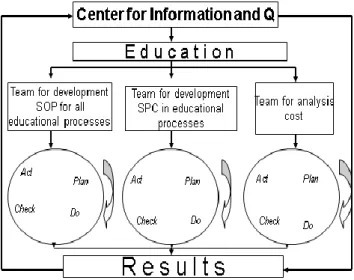
Figure 1-3. Proposal for an integral methodology for designing and implementing of TQM system within the higher educational systems... 32
Figure 2-1. Meritocratic Model: Theory... 71
Figure 2-2. Social Background Model: Theory ... 71
Figure 2-3. Big Fish Little Pond/Reflected Glory Model: Theory... 73
Figure 2-4. Meritocratic Model: Path Analysis ... 79
Figure 2-5. Social Background Model: Path Analysis... 80
Figure 2-6. Big Fish Little Pond/ Reflected Glory Model: Path Analysis ... 82
Figure 2-7. Reflex points... 97
Figure 2-8. The Pain Scale ... 97
Figure 2-9. Distribution of the patients per age groups ... 98
Figure 2-10. Distribution of female patients per age groups ... 99
Figure 2-11. Distribution of male patients per age groups ... 99
Figure 2-12. Results of the students’ questionnaire... 105
Figure 2-13. Results of the parents’ questionnaire ... 106
Figure 2-14. Results of the teachers’ questionnaire... 107
Figure 2-15. The diagram of the relation between the education of the parents and the school performance of the student... 128
Figure 2-16. Regularity of eating per day... 128
Figure 2-17. Pilates exercises ... 137
Figure 2-18. Competency-role model of a teacher-facilitator... 179
Figure 2-19. A Planning Model for CEFFAs ... 223
Figure 4-1. Young girls’ opinion on marriage... 331
Figure 4-2. Opinion of the young girls on the quality of the future partner... 332
Figure 4-3. Young girls’ marriage intention... 333
Figure 4-4. Young girls’ perception of marriage... 334
Figure 4-5. The model ... 342
Figure 4-6. Factors impacting learning... 354
Figure 4-7. Factors with negative impact on learning ... 355
Figure 4-8. Motives for learning ... 355
Figure 4-9. Needs involved in learning ... 356
Figure 4-10. Feelings engendered by school success ... 357
Figure 4-11. Causes determining school success or failure ... 357
Figure 4-12. Family’s attitude towards learning... 358
Figure 4-13. Family factors involved in learning ... 358
Figure 4-14. Personal factors involved in school success/failure ... 359
Figure 4-16. Elements moulding personal convictions and life’s ideal ... 360
Figure 4-17. Life’s model... 361
Figure 4-18. Significant outcomes of the 4 factors... 401
F
OREWORD
This collection of essays gathers papers from the following fields: economics, education, philosophy, psychology, and sociology.
The first chapter is dedicated to Economics. The authors of the study
Impact of the Global Financial and Economic Crisis on Labour Market for Young People, Mariana BĂLAN, Valentina VASILE & Liviu VASILE, shed light upon the issue of unemployment in Romania. The research presents the main features of youth labour market in Romania to determine few possible ways of increasing employability of youth on short-/medium-/long-term and attempts at answering the question whether the impact of the crisis on economic growth has been larger than originally anticipated. Another paper that focuses on financial studies pertains to Yatin BHAGWAT who analyses the case of a merger involving students in considering the economic factors that favoured the financing of this merger, namely, the seller who wished to lower its debt level and the buyer who had to be innovative in devising new ways of hybrid financing. A paper written by Elizabeta MITREVA & Vesna PRODANOVSKA presents the issue of the employee’s contentment, a key factor in designing and projecting a TQM System within Macedonian educational institutions. The paper Applying the Total Quality Management: Strategy of Macedonian
Higher Education Institutions examines a given integral methodology for
designing a TQM system within higher education institutions and its implementation in higher education as well as the activities that ought to be undertaken to build a system in order to provide quality. The author claims that the efficiency of the TQM implementation depends on the involvement of academic and administrative staff and their motivation.
Education is, by far, the most consistent chapter. The section dedicated to the Systems of Formal Education covers a wide range of topics. Hasan ARSLAN’s study of Roles of School Leaders in Preparing Students for
Life explores the impact of school leaders on school curricula. Having in
view that school leaders play an important role in improving and implementing the curricula, a qualitative research was conducted based on semi-structure interviews to collect data. The research concludes that, apparently, school curricula are inadequate in developing social skills. George ASPRIDIS’ paper, The Evaluation of Adults Instructors in the
intervening in the improvement of the evaluation program, via the evaluator’s experience, taking into account a series of criteria that include the process of beginning and ending of micro-teaching, target setting, the clarity of the micro-teaching plan and the affinity of content with the educational objectives. Any exploitation of the conclusions of this research contributes to the upgrade of life training. The study carried out by Robert BIRKELBACH aims at showing the class room composition on the teacher’s recommendation for the secondary school of German 4th grade pupils. The empirical assessment is done with the “Young Immigrant Children in the German and Israeli Educational Systems” data set and it establishes the impact, which can be either a big fish little pond effect or a reflected glory effect, and which can lead to the increase or decrease of an individual’s chance of getting recommended for the German Gymnasium, controlling for primary and secondary effects of social inequality and for objective measures of competences. Lucie CVIKLOVÁ’s paper presents the issue of communication in public and private institutions of higher education in the post-communism Czech Republic. The methodological approach of data collection is based on analyses of questionnaires with various respondents (including current students of private and public institutions) and it compares types of relations, content and structure of communication related to chosen private and public institutions of higher education to other ones. Iasmina EGRI’s research is trying to demonstrate the benefits of reflexotherapy associated to physical exercise on a group of patients with cervical spondylosis. It introduces plantar reflexotherapy, a digital massage made on the foot with the purpose of rebalancing the energetic and blood circulation determining at the same time the increase of the body immune system. The study shows improvement in sleep, work, driving, weight lifting, recreational activities, headache, and the ability to focus. The paper An Educational Approach of School Failure, written by CodruŃa GAVRILĂ, revolves around a common phenomenon in all education systems – that of school failure. Its aspects are complex, since it reaches not only the educational field, but also cultural, economic, political, and social areas, as well as the fundamental options of a society since, on the long run, the effects of school failure are social failure. The paper presents the factors that determine school failure by surveying the answers of 50 students. An Indian perspective on health and medical education in Manipur is brought forth by Joann ROSANGPUII. The content of the study encompasses the traditional practice of healing up to the modern method of healing incorporating its history of the foundation of both. It mainly seeks to identify the role and place of traditional doctors or physicians known as the Maibis and the Maibas and unearth their
Foreword xvi
approach of practicing treatment for various kinds of diseases. In her research about the relationship between gymnastic performances and food and financial factors, Margit SCHAUB finds out that even though the financial situation of the families may not have a great impact on the food habits of teenagers, their outdoor activities may suffer from it. She conducts a survey on the social background and nutrition habits among primary school students. The paper focuses less on measures taken up to the present, concerned with the effects of the environment on childhood development, but it attaches more importance to the factors that trigger or modify these effects.Family is not a role model to children. It is an actual and important task for teachers to get the students to be interested in practicing sports, and to have the need for regular sporting activities. In continuing her research on children sport activities, the researcher conducts a study on a Remedial Exercise Programme for School Children. Her primary objectives are to design materials for courses focusing on educating recreation professionals and coaches to support their students with up to date methods, techniques and authentic materials. The section dedicated to the Process of Education starts with a paper by Marsha BARBER who puts under scrutiny learning styles as tools to improve learning outcomes in higher education. The research uses the Learning Styles and Strategies Inventory developed by Felder and Soloman to better understand student learning styles. The paper explores the findings and then suggests the pedagogical implications for faculty working in higher education: ways in which curriculum design and classroom practice might better reflect learning styles of a wide range of university students. An article that scrutinizes the process of teaching belongs to Narcisa-Georgeta CRISTA, Rada MARIAN & Iasmina-Cecilia SAVESCU. It renders perspicuous the way in which the chosen teaching strategy applied by the teacher in order to achieve the learning objectives influences the students’ attitude towards activities, learning motivation and the quality of learning. This paper presents the results and conclusions from the application of teaching strategies in teaching secondary school biology lessons. Marius-Costel EŞI‘s analysis, Methodological Perspectives in the Pedagogical
Practices, emphasizes the importance of teachers to know the didactics of
the subject they teach and, on the other hand, to be able to put theory into practice. The focus of Mihajlo FEJSA’s analysis is on the uniqueness of the Department of Ruthenian Studies and its curriculum, on the background of minority problems in Vojvodina. The Department is involved in minority problem-solving opportunities in cooperation with local and state authorities. In addition, the paper describes the processes of designing research subjects that have been subsequently taught at university level to
a relatively small number of students because of small Ruthenian population both in Vojvodina and in the world. The study Teacher: Facilitator Status
and Roles in the Teaching Profession lays emphasis on the study of
institutional models of the teacher’s status as facilitator. The research carried out by Nadezhda KALOYANOWA concludes that teachers need training and qualification to reconsider their position in the teaching profession. Maria-Helena SABO’s project represents an efficient method of education and self-education, but it is also an alternative method of evaluation with multiple formative effects. The themes included in the Geography syllabus for high-school classes provide numerous opportunities to use this method: types of geographic environments, the present geopolitical world system, and the countries neighbours to Romania, etc. Another article written by the aforementioned researcher pinpoints the issue of subjectivity in the evaluation process. The results of the feedback Motivation Evaluation both determine us to bring change to the teaching strategy and to produce material used in the teaching-learning process. The article outlines the degrees of subjectivity that resulted from a research carried out in some universities in BistriŃa, Zalău, and Sighet (Romania).
Teaching the Concepts of carpe diem and memento mori Using Paintings
is an article by Elena TUPAREVSKA, which discusses the benefits of an art-centred or art-enriched curriculum focusing on 16th and 17th century paintings, mostly by Dutch and Flemish painters. Both vanitas still life paintings and memento mori paintings are discussed in order to illustrate the ‘carpe diem’ and ‘memento mori’ concepts which can be found in poems such as Spenser’s Amoretti, sonnet 70, Marlowe’s The Passionate
Shepherd to His Love and Marvell’s To His Coy Mistress. Another
scrutiny on the interlocking relation between art and literature elicits the effectiveness of using paintings in an undergraduate English literature course. Elena TUPAREVSKA’s paper suggests that visual art can be used in a classroom not only as an illustration of a particular idea or point, but also to motivate students to discuss literature, to help them get a better understanding of the historical context, to encourage them to think metaphorically, to improve their critical thinking and to help them develop their multiple intelligences which are usually neglected in school. Finally, the section dedicated to Educational Theory contains five papers. A research on alternative education pertains to Roberto GARCÍA-MARIRRODRIGA, underscoring the importance of alternative education for rural people in Peru. The paper briefly describes the planning model that underlies the type of schools applying the alternating cycle between periods of learning concept, with special reference to the Viability phase. Each step of this phase is reviewed and applied in a rural context: the
Foreword xviii
Andean zone of southern Peru. The results show two crucial points: the awareness-building with local actors and the presence of committed Associations to take up responsibility for the schools. Daniela JEDER’s article, Ethics in Education and Training, draws attention to the ethical and professional culture, the importance of forming a sense of responsibility for and during the training. Opening to the field of ethics offers opportunities to understand the deeper meanings of the moral implications of the educational act, the interiorisation of values, norms and ethical principles and also forming the ethical beliefs and training skills necessary to conduct the practice of teaching. The research The Status and
Significance of Reassessing Education within the New Knowledge Society
completed by Georgeta PUSTIU highlights the theoretical approach and the practical application of a new learning technology which involves a judicious assessment of the knowable structures. Therefore, an assessment through practice, which includes values from different areas, could be precisely what is missing for strengthening the educational system, representing an involvement of the educational process. Florentina UłĂ carries out a study concerning physical education and sports and their prospects of non-formal education and permanent education. The focus is on exploiting all forms and dimensions of education, projected and realized during the lifetime of an individual. From this perspective, physical education is a vital component of permanent education. Due to their accessibility, sports and physical education take the most varied forms throughout one’s life span, providing developmental strategies and methods of application for the achievement of objectives in each age category. The aim of Sara Zamir’s survey, The Education System’s
Ambivalence towards Political Correctness, is to expose the ambivalence
of the Israeli education system toward political correctness, which may be characterized as an attitude of “respectful suspicion.” The article examines the opposing outlooks within the Israeli education system and analyzes their implications on the system’s conduct.
The third chapter contains papers in Philosophy. Marius-Costel EŞI carries out a research on The Semiology of Normality in the Education of
the Future, claiming that speaking about normality in a world which
sometimes we consider abnormal means taking into consideration the idea of a paradigm of normality in the context of an education of the future. In addition, the author elicits that terms such as handicap, adaptation, or interpretation must be re-evaluated from the human consciousness’ point of view and also related to both the new scientific discoveries and the state-of-the-art technologies. In his paper Orthodoxy and Nationalism in
the budding scientific ideas Eliade would advance after 1945. The examination of Eliade’s inter-war journalistic work in recent times leaves several unapproached aspects that this paper will give answer to by tracing Eliade’s Christian-orthodox vision to its makeover into a nationalistic view upon history. A further study of the same author focuses on Saint Augustine and the Christian philosophy of history, disinterring the two central concepts of this work, The City of God (belonging to which required loving God beyond self) and The City of Humans (where loving oneself and forgetting God prevailed) remain pivotal in the history and philosophy of Western civilization. The article Islamic Tourism: What
Kind of Tourism? by Cornelia PETROMAN & Ioan PETROMAN
attempts to answer a series of queries, such as: Where could we range Islamic Tourism? Is it a form of cultural tourism? a form of eco-tourism? of health tourism? of lake tourism? of recreational tourism? or of religious tourism? The paper attempts to establish the share of each of the types of tourism in Islamic Tourism, which is a novelty for the Christian world. The purpose of Cornelia PETROMAN & Mircea-IonuŃ PETROMAN’s research, Medicinal, Aromatic and Spice Plants in Romanians’ Rites and
Beliefs, is to establish whether these plants used by the Romanians in their
rites and beliefs hundreds of years ago could still be of any use nowadays in such fields as pharmaceutics and/or food industry. The corpus of the paper consists of medicinal, aromatic and spice plant common names. Dana łABREA’s paper Metaphysical Aesthetics tries to illustrate the title concept which is a self-invented concept. After defining the concept, aesthetic experience cannot be separated from the way in which reality is assumed and conceived by the artist or the spectator (contemplator of the work of art), the researcher proceeds in applying it to the case study of the abstract British painter Francis Bacon. The focus of her further research
Michael Oakeshott and the Idea of Education lays emphasis on the idea of
education as Oakeshott considers it. The papers underscores that extrapolating from university or school to culture, Oakeshott establishes an ideal of liberal learning from the standpoint of which a culture is not a diversity of ideas, beliefs, sentiments, perceptions, and engagements, but a variety of distinct languages of understanding or modes of understanding or voices.
The fourth chapter is dedicated to Psychology. The paper On Family
Imaginary in Institutionalised and Non-Institutionalised Teenage Girls by
CodruŃa GAVRILĂ & Maria PALICICA presents a comparative analysis of the opinions on family life of 30 institutionalised and 31 non-institutionalised teenage girls. Data supplied by a questionnaire show that with institutionalised girls there is a relationship between the environment
Foreword xx
they grew in and the low interest in having a family and children, while among non-institutionalised girls this interest reaches 96.66%, i.e. almost the double of the former. Perforce, the authors firmly believe it is necessary to implement the family model in institutions so that the children benefit from a complete cycle of psycho-social development. The study by Ercan KOCAYÖRÜK examines whether parents’ attachment emerges solely directly effected on adolescents’ psychological well-being (i.e., positive affect and negative affect) or whether these effects were mediated through the Basic Psychological Needs (BPN), i.e. competence, relatedness and autonomy. A matter of utmost concern is tackled by Alina-Lidia MĂRGHITAN, namely that of the main sources of stress that can impact the learning process: personal factors (degree of vulnerability, low tolerance of frustration, irrational cognition, global assessment, absolutist thinking style, etc.), pedagogical factors (improper teaching communication, improper language, lack of climate proper to teaching communication, teacher’s personality features, etc.). The conclusion that the author draws raises awareness on main sources of stress in the process of education as well as training the teachers to manage stress and increase life quality.
Motivation for Learning among Students by Alina-Lidia MĂRGHITAN & Maria PALICICA draws attention upon the motivation issues that occur in the learning process among students. Having as a vantage point that motivation is the main condition for learning, since it appeals to both cognitive and affective and volitive processes, the paper analyses the results of questionnaires filled in by 1st year students of the BUASVM in Timişoara (Romania). The paper Sports Camps: A Way to Educate through
Sports and to Develop Children’s Personality and Behaviour by
Petru-Eugen MERGHEŞ, Mihaela PASCU & Narcis VĂRAN examines the determining role of playing sports in the child’s harmonious development with specific effects on his/her psychological and anatomical and functional development. In addition, sports camps facilitate the integration and assimilation of psycho-motor behaviour allowing the knowledge and exploration in a diversified way of the child’s personality and ensuring a balanced development of the child. A further analysis reiterating the importance of sports in child development belongs to Mihaela PASCU, Petru-Eugen MERGHEŞ and Narcis VĂRAN. The authors claim that tennis is a special way of developing the creative ability of moving and acting mentally under the impact of space and time and of speed and focus, eliciting the effectiveness of applying personalised programmes depending on the children’s features and specific to their personal and sports needs. Mirela SAMFIRA & Mihaela BEU conduct a research aimed at identifying the level of emotional intelligence in two special categories of undergraduates:
the 1st year (when they need to adapt to the new style of work, learning, and assessing) and the terminal year (when, after graduation, they acquire a new status, employee or free lancer). Apart from the year of study, the study focuses on the other main coordinate – gender. The paper titled Role
of Counsellor in Domestic Violence Cases by Elena-Mirela SAMFIRA,
Diana BRÂNZEI & Mihaela BEU deals with an issue that apart from having old roots, it also represents a barrier in the way of personal development. The paper lays emphasis on the role of the counsellor who is emotionally uninvolved and knows how to help the victim “escape” from the abuser’s influence and how to make the victim understand what happened to her/him and how abusers think and act. The subject tackled by Attila SZABÓ makes reference to the importance of positive psychology in practicing sports. The analysis of the survey conducted, which involved 50 kayak-canoe sportsmen and 50 former sportsmen, shows that many young talented competitors give up on account of incapacity to endure the everyday duplicate trainings based on performance and the stressful situations coming from the determinant personality of the class competitor. One of the most important tasks in the process of becoming a therapist is to find one’s own way of interacting with one’s clients/patients. The effectiveness of therapeutic communication depends upon the active way in which the therapist conducts their interaction with the patient, as the researchers Mona VINTILĂ & Cosmin GOIAN state in their paper. They underline the fact that being supportive, positive and empathetic will be much more helpful to the therapeutic process than displaying a negative attitude towards the client/patient.
The last chapter deals with Sociology. Klaus Birkelbach’s paper tries to answer a recurrent question in teaching: Teacher Evaluations over the
Life Course: Valid Prognosis or Self-Fulfilling Prophecy? His longitudinal
study of former German high school students aged 15 to 43 shows that teachers’ evaluations with prognostic claims may influence the students’ educational decisions by shaping their success expectations. His analysis offers prospects in terms of fruitfully connecting the longitudinal perspective of life course research to the action-theoretical perspective of a theory of subjective expected utility. A further study of Cosmin GOIAN & Mona VINTILĂ deepens the study of the importance of verbal communication, by taking therapy a step further, family therapy that is, governed by rules based on values that are transmitted by the family or the social environment. The results of the study imply that being a functional part of a family is a matter of equilibrium, the right amount of being alone and being together, of autonomy and dependency, of having someone to rely on and being able to cope alone. Maria LUNGU’s paper brings forth a
Foreword xxii
cultural subject referring to an old Romanian tradition in the Orăştie Mountains: a social ritual of fertility using the “arminden” tree. The paper presents the various roles of the “arminden“ tree: its function of influencing meteorological phenomena, its apotropaic role of protecting the family, the animals, and the entire household from “evil”, its symbolical function of fertilization, of promoting domestic wellbeing and prosperity, as well as its protective role. In a further paper the researcher studies the role of the wedding flag as well as the integrating ritual of marriage in the same traditional community of Orăştie Mountains. Apart from representing the values and good traits of the bridegroom, the flag also symbolises the connection to the divine and mystic forces, as well as a proof of the impetus towards superior values. Finally, in her article
Practicing Non-Formal Education: Designing and Delivering Activities for Intercultural Learning, Ana-Maria MATEESCU approaches the
concept of lifelong learning and the constant need of acquiring new skills and competences from the point of view of non-formal learning. In order to achieve this, one needs to achieve intercultural dialogue, inclusion and developing active citizenship. As such, her article discusses the interdisciplinary approaches involved in designing and delivering non-formal activities for a youth exchange project focused on cultural values, highlighting the subtle yet complex process of bringing theory into practice.
APPLYING THE TQM (TOTAL QUALITY
MANAGEMENT) STRATEGY OF
MACEDONIAN HIGHER EDUCATION
INSTITUTIONS
E
LIZABETA
M
ITREVA
AND
V
ESNA
P
RODANOVSKA
Introduction
Globalization enables providing “European” space of the higher education in order to allocate a mutual conception of competence and increased mobility of the students and the academic staff as well.
Therefore Europe has become the crossing point in the higher education, with already set regulations and principles for common collaboration and usage of mutual outcomes.
Through the National Strategy for Development of Education in Macedonia the tendency of the state to conduct reforms in the education that would enable compatibility in the study programmes, recognition of the diplomas acquired to all educational degrees in each part of Europe and increased capability for employment within the European labor market, has being offered.
The system structure for providing quality into the institutions of higher education comprehends with the regulation even though there is a huge gap between the quality management and the attitude of performing quality. Higher education institutions are aware of the necessity of redesigning the study progammes profiles and the curricula quality would be depending from the obligation to reassess values, whether the study environment is tempting and etc, which all depends of the institutional leadership.
1. The core of TQM strategy
TQM philosophy has been accepted in many higher educational institutions worldwide, and its usage refers to new key adjustments into
the quality approach within the educational process. The very first alteration refers to the establishing of processes of continuing improvement in all segments of higher educational institutions by involving of the academic staff, and the second by gratification of the needs to all users (students, teachers, Ministry of Education and Science, employments and professional bodies, the society as a whole and the international forum) together with the outcomes of the institution.
What’s the core of TQM strategy?
As of the interpretation that has been provided by the European Foundation for Quality Management (EFQM, 1992) the significance of the total quality management (TQM) is defined as it follows: “Management strategy for flawless achievement of an institution and its outcomes”. The Ministry of Education and Science of Republic of Macedonia (Cepujnoska et al. 2005) carries out its own gauge for quality efficiency within the higher education and it is usually expressed in the following manner: number of students that are completing the study programme on time with an international recognition.
The quality itself within the higher education is being accomplished through many activities as part of the education and research and includes all the factors: students and teachers (the human factor), educational technology, methods for quality assessment, equipment, premises, management, and finance, motivation and labor market. As for that, the quality is being evaluated through a system for providing quality within an educational institution.
2. Factors for Successful Implementation of TQM Strategy
within Higher Education Institutions
As a condition for a successful accomplishment of TQM strategy within the higher education institutions is the presence of a contemporary management especially a strong leadership (Ciamna, 2005). The leadership includes an initiative that comes from the top executives, consent of the academic staff, break-through of opinions, proactive working style, teamwork, training, and support during successful actions and achievements.
Expansion of TQM concept within the higher institutions seeks a solid social and cultural level of the environment (habits and mentality of the employees), creating an infrastructure and development of a corporative attitude into those institutions.
In this paper the effort to develop a universal, integral methodology for designing and implementing TQM system for higher
Elizabeta Mitreva and Vesna Prodanovska 3
education through TQM principles has been presented. This methodology is to help out and produce useful directions to all institutions of higher education that tend to become “world’s class” institutions.
The model-methodology that is implied (Mitreva, 2010) is integral and universal, meaning that it’s applicable to all higher educational institutions regardless of their nature, and the success of its usage will depend only if the integration with the informative technology is achieved together with the following: internal standardization, methods and techniques for quality improvement, system for costs analyses etc, but all of these along with continuing education and motivation of the employees.
The integral methodology for designing and implementing the TQM system has a reflective contact as an outcome from the necessity of the permanent promoting of the education processes. Repetition or even a spiral one of such cycles could enable to see the assets of the usage of them thus the organization attitude towards those initiatives is being changed and depicts stimulation towards higher aims of perfection.
This methodology would not only present a success into the implementation for improvement of the educational processes into Macedonian institution of higher education but will also raise the awareness of the academic and the administrative staff regarding quality and their tendency towards the increasing contentment of the students and teachers, Ministry of Education and Science, employment and professional bodies, the society as a whole and the international forum. But, without the support of the leadership and without the involvement of the academic staff, all the efforts for improvement would be in vain.
Integral methodology for designing and implementing of TQM systems within Macedonian institutions of higher education
The basic within the designing of such model is the redesign after which a new phase of a business-continuous improvement, cycling the Deming’s quality circle (Plan-Do-Check-Act) is followed.
The necessity of redesign/ reengineering could arouse among those institutions that are willing to abandon the traditional approach by introduction of a new one, modern approach of education and science. Both approaches are based on same postulates: competences, abilities and knowledge but all those differently implemented according the technological development of the country and the higher educational systems in it.
The integral methodology for designing and implementing the TQM system is consisted of a number of methodologies (Mitreva, 2010): Methodology for the subsystem - internal standardization; Methodology for subsystem- statistical process control (SPC); Methodology for analyzing total costs within a process; Methodology for subsystem- education; Methodology for assessment of success as of the designed and the implemented system according TQM (Audit), fig.1.
Figure 1-3. Proposal for an integral methodology for designing and implementing of TQM system within the higher educational systems
1. Methodology for the subsystem - internal standardization
The system for quality providing into the higher education is a whole of mechanisms, activities and gauges that are being conducted into higher educational institutions in order to create a well-educated cadres, fully professionally trained and responsible for work in each societal environment.
Each institution makes own system for quality providing according the curricula field that is being cultivated and according the conditions in which this is being implemented and in the framework of the European standards for higher education.
Elizabeta Mitreva and Vesna Prodanovska 5
Each higher educational institution functions according the acts through which every step of the curricula and the research activities have been defined. The acts are being adopted according the necessities of the academic staff, students or the administrative wards. The acts contain the obligations and responsibilities of each and every employee, but before all the ones regarding the senior and junior academic staff and the students within the accomplishment of the higher educational process.
The procedure of the designing and the implementing process for internal standardization is done through few steps:
- (Plan) 1 step: Plan for designing and implementing of the subsystem- internal standardization.
- 2 step: Election of team members.
- 3 step: Education of the team members of the system for designing and implementation of quality providing within higher education.
- 4 step: Designing of SOP (Standard Operative Procedures) according the actual condition into the higher educational institution through preparation of a number of documents that will be useful to the employees in the higher education, the students and the society. The best way to depict the SOP with a block diagram in which every phase of the educational process will be marked, then the people that perform the activities as well as the incoming and outgoing documentation. In this way each lack can be seen and therefore able to react immediately into the eliminating them. The block diagram is the most simple and most practical manner of describing the business process.
- 5 step: Examining the possibilities for improvement of quality and efficiency of the processes.
- 6 step: Establishing the control points of the processes where the data could be collected.
- 7 step: Defining of documents – incoming and outgoing in each process.
- (Do) 8 step: Usage of the gained competences and experience into the implementation of the designed subsystem for standardization? The processes ought to be done in accordance with the provided conditions and we-llplanned optimal exploitation of all resources. The checkup (evaluation) is organized inside the institution (self-evaluation) and out of the institution by the Evaluation Agency.
- (Check) 9 step: Checkup and evaluation of the outcomes of the
newly implemented SOP.
The Commission for self-evaluation is appointed to make a critical analyzing of the institution, to submit a report to the management board and then in a role of monitoring request an implementation of its their own suggestions and remarks into the problem-solving of the failures meaning to remove the obstacles into providing the planned quality.
After adopting four of the given activities in the circle of qualities they need to be used in practice though continuously. That refers to the adopting of standards, SOP and normative for all processes into the higher education and research by which the levels of possible measuring and achievement will be described.
The very first circle for providing quality is the hardest and most durable because it is linked with building the infrastructure, creating legislation, academic training for conduction of self-evaluation and external evaluation processes in a lack of professional experience towards that.
2. Methodology of the sub-system- statistical process control (SPC)
Measuring quality into the educational process is done by using adequate methods and techniques by which data collecting of the current condition is being provided. According the data and information the bases level of the work indicator are being evaluated and selecting of the problems that demand a special attention.
The identifying of the fundamental problems causers for quality providing can be done thought the analyses (data checkups, implementing special methods and techniques for data analyzing etc).
The procedure for establishing the subsystem for statistical process control is done through the following activities:
- (Plan) 1 step: Plan for designing and implementing the subsystem for statistical process control.
- 2 step: Team members selection.
- 3 step: Training of the team members on the methods and techniques for providing quality
- (Do)4 step: Application of different methods and techniques for a given task and established aim into the higher educational institution. The usage of the software packages as a fast and easy to use is even more emphasized.
- 5 step: Preparation of forms for SPC data collection.
- 6 step: Designing a subsystem for SPC within a higher educational institution. Within the subsystem for SPC managing in an institution the following ought to be defined:
Elizabeta Mitreva and Vesna Prodanovska 7 what needs to be controlled;
where will the outcomes be collected, filed and analyzed; persons appointed for collecting, filing and analyzing of results; manner of presentation of outcomes,
the path of the outcomes;
establishing and realization of policies for quality checkup;
preparation, operationalising and realization of the plan and programme for quality checkup;
determining and realization of the manner, procedure and the means for quality control in education.
(Check) 7 step: Checkup and evaluation of the effect of SPC usage (Act) 8 step: Evaluation of the necessity of corrective measures within the designed SPC subsystem.
And the circle starts spinning again.
3. Methodology for analyzing of total costs in a given process
Management with total amount of costs is done in few steps:
- (Plan) 1 step: Plan for designing and implementing the subsystem for quality costs.
- 2 step: Selection of team members.
- 3 step: Establishing teams and their education for different possibilities (methods) for costs analyses.
- Often, the software solutions for optimization of educational processes meaning a work performance with least costs are used.
- (Do) 4 step: Usage of different methods for analyzing of total amount of costs within a process in a higher educational institution.
- 5 step: Preparation of a proper documentation for a simplified usage of methods for costs analyses.
- 6 step: Designing a subsystem for cost analyses.
- (Check) 7 step: Checkup and evaluation of the effects of the implemented subsystem.
- Analysis of the outcomes is done with a revision of the starting relation of the costs of adjustment and discrepancy in the business process.
- (Act) 8 step: Assessment of the necessity of corrective measures.
The system for providing TQM should not only be well designed but it is necessary to be solidly implemented into practice. Therefore it is necessary to follow a continuous education, training of management board and well as the academic staff, training of the students and the administrative staff, through which the system for providing quality and its maintenance will be strengthen.
Planning the educational process is a task for the top management dulled to establish an education ward. This ward would have to prepare the plans and programmes in different levels for providing quality, in accordance with the functions and tasks that are being realized into an institution of higher education using the methodology and usage of Deming’s circle of quality.
The education of the employees into the whole structure of the higher educational institution is aiming to gain skills and experience into the realization of the educational processes in accordance with the quality demands of the educational process, legal responsibilities and adequacy criteria as well as appointing the academic staff because the quality demands an involvement of each (everyone with their own work obligations).
The educational process need to me dome through a usage of a quality circle in few steps:
In the planning phase it is necessary to make the following steps:
(Plan) 1 step: Plan for education/training of the academic and administrative staff.
2 step: Election of teaching staff (experts, specialists) from the employees or externally in order to realize the training.
3 step: Election of participants in the training- employees from different sectors and schools/ departments.
(Do) 4 step: Realization of the course.
(Check) 5 step: Competence checkup.
(Act) 6 step: Amending the programme for education and training.
As with the new amendments the second quality circle begins (Plan-Do-Check-Act). This working mode continues spirally in direction of a constant improvement in all functions of the work performance within a given institution of higher education.
5. Methodology for evaluation of the outcomes from the designed
and implemented TQM system (Audit)
The aim of the fifth phase – control, is an evaluation and monitoring of the results from the previous phases. In this phase the modification of the
Elizabeta Mitreva and Vesna Prodanovska 9
system and the establishing of new rules, procedures and instructions, as well as other norms are being verified.
The process procedure of the checkup is done through the following activities:
- (Plan) 1 step: Plan for evaluating the success of the designed and implemented TQM system.
- 2 step: Election of the evaluation board.
- 3 step: Training of the evaluation board.
- 4 step: Preparation and analyzing the needs, standards and documentation that is necessary for the assessment.
- (Do) 5 step: Evaluating the educational institution regarding the success of the designed TQM system.
- (Check) 6 step: Processing and analyses of the outcomes.
- The results are to present: what have the higher educational institution achieved and the possibilities present how those results have been achieved.
- (Act) 7 step: Submitting a report from the evaluation to the top management in cased of undertaking corrective measures.
The integral methodology for designing and implementing of TQM system has a feedback as a result of the necessity of permanent improvement of the educational processes.
In order for this methodology to be efficient, it is necessary to implement an information technology.
Conclusion
The benefits of the proposal- methodology for designing and implementing a TQM system into higher education institutions
The benefits from the methodology for designing and implementing the TQM system into higher education institutions are:
- by the usage of the internal standardization the responsibility of the academic and administrative staff improves during the accomplishment of the educational processes;
- With the usage od the statistical methods and techniques of quality in education is provided;
- with the usage of the software packages the efficiency of the usage of statistical methods and techniques is being increased;
- through the analyses of costs for quality the loss can be easily controlled and therefore be reduced to minimum.
Besides those it is expected that other significant effects could be achieved, such as:
- involvement of all employees into the accomplishing quality within the educational process;
- dedication of the employees towards the improvement od the quality of education;
- total dedication of top management towards the system according the TQM and its continuous improvement;
- ability to solve problems at all levels;
- minor but significant improvements of the educational processes and services;
- optimization of the educational processes;
- eliminating the responsibility for decision-making on a lower lever. Without a dedication of the top management towards the set goals for quality of the educational process and consistency within its implementation, all those efforts will be just a simple waste of money and time which will at the same time reduce the possibility for success into a following initiative of such type.
It should be emphasized that the benefits from the introduction of this model cannot be immediately seen as it takes more time. But this oughtn’t to be a reason to give up the starting initiative because the quality is a long-term process.
The assets of the usage of such model is not only an increase of the dedication from the top management and the academic staff towards the improvement of the educational processes but achieving a contentment of students, parents, teachers and the society which will further on serve as a moving power for continuous improvements.
Yet, the conclusion remains that there is a clear determination of the Macedonian higher educational institutions regarding the care and the responsibility to provide and promote the quality in education and as a result the interest for cooperation among the universities in the country and Europe has increased as well.
References
Beardwell, I., Holden, L., Claydon, T. (2004). Human Resource
Management; A Contemporary Approach, Prentice Hall, Fourth Edition, pp.124-387.
Ciampa, D. (2005). Almost Ready: How Leaders Move Up, Harvard Business Review 83, No.1.
Cepujnoska, V., Donevski, B., (2005). Quality providing in higher education – View of Macedonia, Skopje-Bitola, pg. 39-150.
Elizabeta Mitreva and Vesna Prodanovska 11
EFQM, (1992). Total Quality Management: The European Model for Self-Appraisal, European Foundation for Quality Management.
Harung, H.S. (1996). A world-leading learning organization: A case study of Tomra Systems, Oslo, Norway. The Learning Organization: an
International Journal, Vol. 3, No. 4, 22-34.
Ishikawa, K. (1995). President Touka Henkau Sozo Gakkai, “Thoughts on risk management “Creativity and risk management”, JUSE, Societas Qualitatis, Vol.9 No.3 July/Aug, 5.
Kratsu, H. (1995). Tokai University, “Concept engineering points in developing hit products”, JUSE, Societas Qualitatis, Vol.9, No.2 May/June, 3.
Kano, N. (1996). Business Strategies for the 21 sr Century and Attractive Quality Creation, ICQ, Yokohama, pp.105.
Latzko, W. & Saunders, D., (1995). Four Days with Dr. Deming, Addison-Wesley Publishing Company, USA, Canada.
Mitreva, E. (2010). Integral Methodology for Designing and Implementing of TQM System within Companies, Doctoral Dissertation, Skopje. Sasaoka, H. (1995). The QC circle evolution from TQC to TQM, a management perpective, JUSE, Societas Qualitatis, Vol.9, No.4 Sept/Okt, 5.
Woodall, J. & Winstanley, D., (1998). Management development: Purposes, processes and prerequisites. In Management development: Strategy and practice, Oxford: Blackwell, pp. 3-17.
Zairi, M. (1999b). Мanaging excellence: policy and strategy, The TQM Magazine, Vol. 11, No. 2, 74-79.