Effects of Human Needs Based on the Integration of Needs as Stipulated in
Maqasid Syariah and Maslow’s Hierarchy of Needs on Zakah Distribution
Efficiency of Asnaf Assistance Business Program
(Kesan Keperluan Asas Manusia Berdasarkan Penggabungan antara Keperluan Maqasid Syariah dengan Hiraki Keperluan Asas Maslow terhadap Keberkesanan Agihan Zakat bagi Program
Bantuan Perniagaan Asnaf) Maheran Zakaria
(Accounting Research Institute, Universiti Teknologi MARA)
Nur Ain Abdul Malek
(Academy of Language Studies, Universiti Teknologi MARA) ABSTRACT
This study examines the effects of human needs based on the integration of needs as stipulated in Maqasid Syariah and
Maslow’s hierarchy of needs on zakah distribution efficiency. Human needs in this study are evaluated based on the integration of 5 elements of human needs as stipulated in Maqasid Syariah and Maslow’s hierarchy of needs. The elements are religion and self-actualization, physical-self and safety, knowledge and social, family and self-esteem, and finally, wealth and physiology. Approximately 300 sets of questionnaires were sent to zakah recipients of Asnaf Assistance Business
Program conducted by Majlis Agama Islam Kelantan (MAIK). From this number, 270 people return their responses. Data were analysed using Structural Equation Modelling of AMOSS 20. The findings indicate that the integration of 5 elements
of human needs as stipulated in Maqasid Syariah and Maslow’s hierarchy of needs positively affects zakah distribution efficiency. Hence, the study provides an insight to zakah institutions that the distribution of zakah should not confine to fulfilling recipients’ monetary needs but also on non-monetary needs such as enhancing level of religiosity, fostering socialization, training and motivation as well as uplifting living status.
Keywords: Maqasid Syariah; Maslow’s hierarchy of needs; zakah distribution efficiency; asnaf
ABSTRAK
Kajian ini menguji kesan keperluan asas manusia berdasarkan penggabungan antara keperluan Maqasid Syariah
dengan hiraki keperluan asas Maslow terhadap keberkesanan agihan zakat. Keperluan manusia dalam kajian ini
dinilai berdasarkan penggabungan antara 5 elemen keperluan manusia seperti yang tercatit dalam Maqasid Syariah
dan hierarki keperluan asas Maslow. Elemen-elemen tersebut adalah agama dan kepuasan kendiri, fisikal-diri dan keselamatan, pengetahuan dan sosial, keluarga dan harga diri, serta harta dan fisiologi. Sebanyak 300 soal selidik telah
dihantar kepada penerima zakat bagi program Bantuan Perniagaan Asnaf yang dikendalikan oleh Majlis Agama Islam Kelantan (MAIK). Daripada jumlah tersebut 270 orang memberi maklum balas. Data dianalisis menggunakan Pemodelan Persamaan Berstruktur AMOSS 20. Hasil kajian menunjukkan penggabungan antara keperluan manusia yang terdapat
dalam Maqasid Syariah dan hierarki keperluan Maslow memberi kesan positif terhadap keberkesanan agihan zakat.
Sehubungan itu, penemuan memberi petunjuk kepada institusi zakat bahawa bantuan zakat tidak seharusnya terhad kepada bentuk kewangan tetapi boleh juga diagihkan dalam bentuk keperluan lain seperti yang mempertingkatkan tahap
keagamaan, mempereratkan hubungan sosial, memberi kursus dan motivasi serta menambah baik taraf kehidupan. Kata kunci: Maqasid syariah; hierarki keperluan asas Maslow; keberkesanan agihan zakat; zakat.
INTRODUCTION
Giving zakah or alms is one of the five tenets of Islam and has become the obligatory act of worship of all practicing Muslims who possess surplus wealth and earnings. It ranks in importance immediately after the prayers. The amount of zakah to be paid is ascertained based on a fixed proportion of a certain amount of wealth possessed in a certain period of time. The zakah fund is then distributed to eight prescribed beneficiaries known as asnaf. The general principle of zakah distribution has
been laid down clearly in the Quran as underlined in Surah Al-Taubah verse 60 that states:
Alms are for the poor and the needy, and those employed to administer the (funds) for those whose hearts have been (recently) reconciled (to Truth) for those in bondage and in debt in the cause of Allah and for the wayfarer: (thus is it) ordained by Allah, and Allah is full of knowledge and wisdom.
There two main objectives of zakah. Firstly, it aims to purify and clean one’s wealth and soul by giving away a part his or her wealth to the needy and the poor. The system keeps economic inequalities among the people within just
and equitable limit so that the rich may not grow richer by exploiting the less fortunate members of the community and the poor grower poorer through the exploitation by the rich. In other words, it helps to narrow down economic disparity in the community to the minimum possible level. The second objective is the eradication of poverty altogether by spending on the welfare of the poor and the destitute. This would give every individual in a society a guaranteed standard of living that is humane and respectable by at least fulfilling one basic need. As such, paying zakah helps to purify one’s soul and encourages a Muslim to have gratitude towards God’s bounties.
Issues of zakah distribution have spurred the interest of many scholars and researchers thus triggering them to examine its ability in fulfilling human needs using income as an indicator (Ibrahim & Salleh 2006; Mohamad 2008; Mujani 2005; Zakariah, Amini & Ahmad Fahme 2010). The results of these prior studies indicate that if the level of income of the poor and needy increases, the distribution of zakah is judged to be efficient in meeting its objective of uplifting the socio economic status of these groups. Despite being widely used, the income has been criticised because of its uni-dimensional measurement that evaluates human need based on one perspective only. Nevertheless, apart from money, people also need other non-monetary elements such as knowledge, spiritual, comfortable living and recognition among others (Wagle 2005, 2007, 2008). Therefore, focusing on income alone may not produce an accurate and fair assessment and thus unable to capture the holistic perspective of human needs.
According to Rosbi and Sanep (2010), the measurement of needs should be assessed in the wider context. Instead, they suggest that it should be evaluated according to the integration of human needs as stipulated in Maqasid Syariah and Maslow’s hierarchy of needs. Human needs according to Maqasid Syariah consist of 5 elements namely religion, physical self, knowledge, family and wealth. Similarly, Maslow’s hierarchy of needs postulates that humans are motivated by 5 elements stated namely physiological, safety, social, self-esteem and self-actualization. This prior study adds that the evaluation that integrates the human needs of Maqasid Syariah and Maslow’s Hierarchy of Needs is expected to provide an accurate and fair assessment or even a more holistic view of the poverty.
Although most previous researchers acknowledge the importance of income in influencing zakah distribution efficiency, very few studies evaluate needs based on multi-dimensional measurements. In fact, the inclusion of non-monetary indicators is expected to improve the measurement and thus foster understanding of needs (Nolan & Whelan 2010). Being aware of the advantage of multidimensional measurements and following Rosbi and Sanep (2010), the objective of this study is to examine the effect of needs evaluated based on the integration of 5 elements of human needs as stipulated in Maqasid Syariah and Maslow’s hierarchy of needs on zakah distribution efficiency.
PRIOR STUDIES AND HYPOTHESIS DEVELOPMENT
ZAKAH DISTRIBUTION EFFICIENCY
In Malaysia, all aspects pertaining to the administration of zakah are under the jurisdiction of the states through the State Islamic Religious Council (SIRC). At present, every state has its own institution, totalling to 14 zakah institutions. SIRCs are empowered by the government on the matter of collection and distribution of zakah fund in those particular states. Being public service organizations, these zakah institutions are accountable to the stakeholders and Muslim public at large and thus they have been subjected to intense scrutiny and criticism. Among the main issues surrounding the zakah institutions is the efficiency of managing zakah especially from the perspective of distribution of zakah funds.
In this study, the efficiency of zakah institutions is evaluated by using a performance tool, namely Balanced Score Card (Kaplan & Norton 1996). Balanced Score Card is a performance measurement framework that assesses the efficiency of a program based on non-financial and non-financial indicators. The assessment is expected to provide a more balanced view of organizational performance. In addition, this assement is a comprehensive measurement that looks at multiple measures of performance. Hence, Balanced Score Card concept is based on four dimensions namely customer satisfaction, internal process, knowledge worker and financial performance.
Customer satisfaction (CS) concept emphasizes on identifying the potential customers in the targeted segments and consequently chooses the required values to be delivered to customers. Meanwhile, knowledge worker (KW) stresses on innovation, creativity, competency and capability. The objectives of this perspective are to identify the human capital, information capital and the organizational ethical climate required to support the internal processes (Cohen et al. 2008). In addition, it also focuses on people and their attitude, knowledge, development and ability to learn and improve. Internal process (IP), on the other hand, identifies the critical process, skills, competencies and technologies that will deliver a value proposition to customers as well as to the current and future organizational success (Atkinson 2000). Finally, the last dimension is financial performance (FP). The financial performance of the program is assessed based on its ability in uplifting the livelihood of zakah recipients.
Previous studies have documented that zakah distribution efficiency is judged based on its ability in alleviating zakah recipients’ income (Fuadah 2006; Hairunizam et al. 2004; Ibrahim & Salleh 2006; Mohamad 2008; Mujani 2005; Rosbi & Sanep 2011; Zakariah et al. 2010). As noted, human needs have been evaluated by various measurements consisting monetary and non-monetary indicators. As far as this study is concerned, one
of the comprehensive and holistic measurements was proposed by Rosbi and Sanep (2010). This prior study integrates the 5 elements of human needs as stipulated in Maqasid Syariah and Maslow’s hierarchy of needs and evaluates zakah efficiency based on the fulfilment of these needs.
HUMAN NEEDS AS STIPULATED IN MAQASID SYARIAH Maqasid refers to purpose, objective, principle, intent, goal and end. Meanwhile, Maqasid of Syariah is the objectives or purposes behind Islamic laws. Mohamad Saladin et al. (2010) propose that human needs be evaluated based on Islamic Poverty Index (IPI), which is based on human needs according to Maqasid Syariah. The IPI is in accordance with the principles suggested by JAWHAR (Department of Zakah, Wakaf and Hajj, Prime Minister’s Department of Malaysia 2007) and Islamic Relief World (2008). Indeed, the IPI is formulated based on human requirements to fulfil 5 basic needs namely religion ( al-din), physical life (al-nafs), knowledge (al-aql), family (an-nasb) and wealth (al-mal).
RELIGION
The utmost important basic need of humans in syariah is religion and Muslims are not supposed to commit any conduct against the syariah. Therefore, all aspects of a Muslim’s life; economic, political, religious and social should seek the blessing of Allah. The need is inclusive of commitment to carry out religious obligations such as performing daily prayers, fasting in the month of Ramadhan, paying zakah and performing hajj. Those who are unable to perform the required basic need are classified as spiritually poor.
PHYSICAL LIFE
The second basic need is physical self, which refers to the daily needs of humans such as healthcare and nutrition, quality of dwelling or living place, amnesties, utilities as well as clothing and transportation. In general, humans strive to ensure that they meet this physical basic need. Apart from that, all of the humans’ actions are to protect themselves and their families. Furthermore, they would not commit any harm that might jeopardize themselves and other parties.
KNOWLEDGE
The third basic need is knowledge or mind development, of which people need to develop their intellectual levels and skills. This need is inclusive of psychological factors such as stress management, education attainment and participation in social activities. Thus, humans need to work hard by acquiring knowledge and use their intellectuality for the benefits of themselves, family and society.
FAMILY
The forth basic need is family or offspring. People need family, besides possessing parenting skills as well as nurturing knowledge of skills in children. In addition, humans should also protect the pride and dignity of the family as well as their ancestors. Indeed, this need is essential in current socio-economic settings.
WEALTH
The fifth and the last basic need is wealth whereby humans need to possess fixed assets and durable goods. They also need to have the ability to generate income or revenue from economic activities. Furthermore, wealth is also spent on food and non-durable goods. In fact, humans can possess wealth and assets as much as they can, as long as the way of possession is not prohibited by Syariah. In fact, Al Syatibi’s theory of the level of needs of Maqasid Syariah is quite similar to Abraham Maslow’s hierarchy of need (Zulkarnain 2008). Maslow (1970) proposed 5 levels of needs, ranging from basic physiological requirements and safety, to love and esteem and finally self-actualization.
MASLOW’S HIERARCHY OF NEEDS
The basis of Maslow’s hierarchy of needs is that human beings are motivated by unsatisfied needs and they would satisfy lower needs before addressing higher needs. Once they satisfy the lower needs, it no longer motivates them. They attempt to accomplish higher needs. In total, the theory addresses five levels of hierarchy of needs comprising physiology, safety, social, esteem and self-actualization.
PHYSIOLOGY
At the bottom of the hierarchy is the basic need or physiological needs of human beings such as food, water and sex. Once they have attained the needs for basic nutrition, shelter and safety, they attempt to accomplish more. Maslow believes that these needs are the most basic and instinctive needs in the hierarchy because all needs become secondary until these physiological needs are met.
SAFETY
Humans need safety and security. Security needs are important for survival but they are not as demanding as the physiological needs. Examples of security needs include a desire for a steady employment, health insurance, safe neighbourhoods and shelter from the environment.
SOCIAL
Humans also need love, belonging and affection. Maslow considers these needs to be less basic than physiological and security needs. Relationship such as friendships,
romantic attachments and families help fulfil this needs for companionship and acceptance, as does involvement in social, community or religious group.
SELF-ESTEEM
The forth level of need is self-esteem. Humans will achieve this level when they feel comfortable with what they have accomplished. This is also the success level or status from self and others.
SELF ACTUALIZATION
This is the highest level of Maslow’s hierarchy of needs. Those who achieve this level of needs are aware and concerned with personal growth and these attributes drive them to fulfil their potential. However, they are less concerned of the opinion of others. Figure 1 depicts Maslow’s hierarchy of needs.
PHYSICAL (LIFE) AND SAFETY
The physical (life) is combined with the safety needs of Maslow’s hierarchy of needs. All humans including Muslims need safety in life, in which they should be protected under rules and regulations. In addition, humans should not commit any conduct that could harm life and society. This dimension is important for physical survival of a human.
KNOWLEDGE AND SOCIAL
The needs for knowledge are combined with the social needs of Maslow’s hierarchy of needs. Basically, humans need knowledge to share and to socialize with others in the family as well as in the society.
FAMILY AND SELF-ESTEEM
The needs to protect the family and offspring are combined with self-esteem needs of Maslow’s hierarchy of needs. Indeed, humans need confidence, ability, effort and success in protecting their family and these attributes are essential for them to be accepted and respected by the society.
WEALTH AND PHYSIOLOGY
The needs for wealth are combined with the physiology needs of Maslow’s hierarchy of needs. According to this theory, the basic needs of humans or physiological needs are food, water, shelter and sex. To fulfil these needs, humans should possess wealth. On this regard, Islam encourages wealth from halal source to meet the basic needs of every human. The integration of the 5 elements of humans needs as stipulated in Maqasid Syariah with 5 levels of Maslow’s hierarchy of needs depicted in Figure 2.
INTEGRATION OF FIVE ELEMENTS OF HUMAN NEEDS AS STIPULATED IN MAQASID SYARIAH
AND MASLOW’S HIERARCHY OF NEEDS Rosbi and Sanep (2010) integrate the 5 elements of humans needs as stipulated in Maqasid Syariah with Maslow’s hierarchy of needs as follows:
RELIGION AND SELF-ACTUALIZATION
In syariah, religion is considered as the important dimension of human needs. The needs to uphold the religion (ad-din) is combined with the top hierarchy of needs of Maslow’s theory namely self-actualization. According to this theory, every human has a strong desire to realize his or her full potential to reach the highest stage of needs or self-actualization (Maslow 1970). The integration of these two dimensions has led to the needs being combined. In other words, the needs of fulfilling religious obligation to seek blessing from Allah are integrated with ones needed to fulfil their potential to the fullest. Consequently, the integration of these needs is vital to reach harmony in life, today and here after.
Self-actualization Esteem needs Social needs Safety needs Physiological Needs
FIGURE 1. Maslow’s hierarchy of needs (Maslow 1970)
Religion Physical-self Knowledge Family Wealth Self-actualization Self-Esteem Social Safety Physiology
FIGURE 2. Integration of Maqasid Syariah and Maslow’s
hierarchy of needs (Rosbi & Sanep 2010) STUDIES OF HUMAN NEEDS ON ZAKAH
DISTRIBUTION EFFICIENCY
It has been noted that prior studies that examine the effects of human needs on zakah distribution efficiency have evaluated needs in relation to various indicators. Ibrahim and Salleh (2006) assess the fulfilment of
needs based on income and living status. Mahyudin and Abdullah (2011) only look at the life quality. There are also studies that evaluated needs based on monetary indicator only namely income (Fuadah 2004; Mohamad 2008; Mujani 2005; Zakariah et al. 2010). These prior studies indicate that the distribution of zakah is classified as efficient if the income of zakah recipients’ increases. Meanwhile, a study conducted by Ismail and Rogayah (1980) find that various zakah distribution channels play a more efficient role as they are more likely satisfying all the recipients’ need. Similarly, a study carried out by Zulkarnain (2008) reveals that zakah distribution is judged efficient due to the fulfilment of recipients’ needs measured by increasing in their income. Patmawati (2008) also finds that zakah distribution is efficient due to its bility in reducing the income gap among the members of the society in Selangor. However, focusing on income alone can only fulfil recipients’ needs in the short run (Rosbi & Sanep 2010). In fact, the scope of needs is not only confined to monetary, other non-monetary indicators should also be considered which perhaps could fulfil needs in the long run and in a more holistic perspective.
Hairunnizam et al. (2004) articulate that needs should be evaluated based on socio economic factors such as education, health, water and electric supplies as well as many other development indicators. In addition, the results of this prior study indicated that the distribution of zakah in terms of monetary to the recipients can only give a significant effect to their level of income but least effect to the quality of life especially education, comfortable living and social relationship. According to Mohamad Saladin et al. (2010), needs should not only be evaluated based on a uni-dimensional factor such as income, but proposed other factors of human needs as stipulated by Maqasid Syariah. Maqasid Syariah stresses on 5 elements of basic needs that are essential to humans that are religion, physical self, knowledge, family and wealth. Meanwhile, Rosbi and Sanep (2010) proposed another measurement of needs, by integrating the 5 elements of human needs as stipulated in Maqasid Syariah and Maslow’s Hierarchy of Needs. According to this prior study, the evaluation provides a comprehensive, fair and holistic assessment. Furthermore, this prior study also examined the effects of needs on zakah distribution efficiency of a program run by Lembaga Zakat Selangor by evaluating whether zakah recipients fulfil the 5 elements of human needs as stipulated in Maqasid Syariah and Maslow Hierarchy of Needs. Using Change Assessment and Scoring Tool (CAST) analysis, the study found that zakah distribution is only efficient in fulfilling 2 elements of basic needs namely religion and self-actualization as well as physical self and security. Meanwhile, for the remaining 3 elements of basic needs that are knowledge and social, family and self esteem as well as physical self and security, zakah distribution efficiency is rated average. In total¸ zakah distribution efficiency of the program is judged as average.
As noted, majority of the previous studies examined zakah distribution efficiency based on its ability in fulfilling human’s basic needs. As far as the author is concerned, none of the studies have examined zakah distribution efficiency by using its own indicator and investigated its relationship with human needs. In addition, scarce of studies are found to examine the effects of human needs (based on the integration of 5 elements of humans’ needs as stipulated in Maqasid Syariah and Maslow’s Hierarchy of Needs) on zakah distribution efficiency. To fill this literature gap, this study aims to examine the effects of human needs (evaluated based on the integration of 5 elements of humans’ needs as stipulated in Maqasid Syariah and Maslow’s Hierarchy of Needs) on zakah distribution efficiency. Further, the study will evaluate zakah distribution efficiency based on the dimensions proposed by a performance indicator namely Balanced Score Card. As such, considering all the issues above the following hypothesis is formulated:
H Human needs evaluated by the integration of 5 elements of human needs as stipulated in Maqasid Syariah and Maslow’s hierarchy of needs has positive effects on zakah distribution efficiency.
PROPOSED MODEL The proposed model is depicted in Figure 3.
METHODOLOGY QUESTIONNAIRE AND SAMPLE
The focus of this study is to examine the effects of human needs based on the integration of 5 elements of human needs as stipulated in Maqasid Syariah and Maslow’s hierarchy of needs on zakah distribution efficiency. The study is conducted in the state of Kelantan and the state is chosen because more than 90 percent of its population are Malays who are Muslims (Statistic 2010). Due to this fact, it is assumed that zakah fund plays an important role in reducing the social economic differences in the state. Meanwhile, respondents of this study are selected from Asnaf Assistance Business Program run by MAIK. This program was chosen because it is expected to accelerate positive economic values and thus have significant impacts in uplifting the zakah recipients’ living standard in the long run. The remaining zakah programs are only able to fulfil the needs in short term basis. Once given, the funds are dispensed off by the recipients to make their ends meet.
FIGURE 3. Proposed model
Human needs/ Maqasid Syariah & Maslow’s
hierarchy of needs
Zakah distribution efficiency
The sampling frame for the business assistance program is based on zakah recipients listing provided by MAIK. The listing indicates that there are 311 zakah recipients from 1 September 2010 to 1 February 2012. In relation to this, approximately 300 sets of questionnaires are personally sent to the respondents. From this amount 270 people responded, accumulating to 80% response rate. The sample size is considered sufficient as suggested by Roscoe rule of thumb (1975) that an appropriate sample size for any research ranges from 50 to 500.
MEASUREMENTS
The measurements are adapted from previous studies. The questionnaire consists of three parts. The first part assesses the respondent profile. Meanwhile, the second part measures zakah distribution efficiency. The dimensions of zakah distribution efficiency namely customer satisfaction, internal process, knowledge worker and financial performance are adapted from Salwana, Siti Shafrina, Kamarul Hayati (2012). Finally, the third part measures human needs based on the integration of 5 elements of human needs as stipulated in Maqasid Syariah
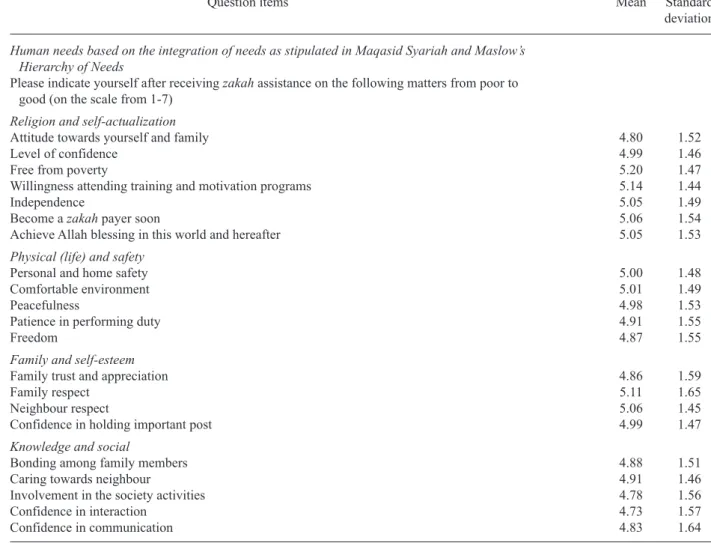
and Maslow hierarchy of needs were adapted from Rosbi and Sanep (2010). Constructs were operationalized using 7-point Likert scales, ranging from strongly disagree (1) to strongly agree (7). In total, 30 items are used to measure human needs as stipulated in Maqasid Syariah and Maslow’s hierarchy of needs adapted from Rosbi and Sanep (2010). Out of 30 items, 7 items measure religion and self-actualization, 5 items measure physical life and safety, 5 items measured knowledge and social, 5 items measured family and self-esteem as well as 8 items measured wealth and physiology. The final measurements are summated and analyzed using path analysis to investigate whether the path is statistically related. Meanwhile, zakah distribution efficiency was measured by 21 items. Out of this total item, 6 items measured customer satisfaction, 5 items measured internal process, 5 items measured learning and growth perspective and finally 5 items measured financial performance. The question items, Cronbach’s alpha and standard deviations for the constructs are reported in Table 1.
The study employs SPSS 20 to analyse the preliminary data and provide descriptive analyses about samples such as frequencies, analyzing quantitative data as well as data
TABLE 1. Question items, means and standard deviation
Question items Mean Standard
deviation
Human needs based on the integration of needs as stipulated in Maqasid Syariah and Maslow’s Hierarchy of Needs
Please indicate yourself after receiving zakah assistance on the following matters from poor to good (on the scale from 1-7)
Religion and self-actualization
Attitude towards yourself and family 4.80 1.52
Level of confidence 4.99 1.46
Free from poverty 5.20 1.47
Willingness attending training and motivation programs 5.14 1.44
Independence 5.05 1.49
Become a zakah payer soon 5.06 1.54
Achieve Allah blessing in this world and hereafter 5.05 1.53
Physical (life) and safety
Personal and home safety 5.00 1.48
Comfortable environment 5.01 1.49
Peacefulness 4.98 1.53
Patience in performing duty 4.91 1.55
Freedom 4.87 1.55
Family and self-esteem
Family trust and appreciation 4.86 1.59
Family respect 5.11 1.65
Neighbour respect 5.06 1.45
Confidence in holding important post 4.99 1.47
Knowledge and social
Bonding among family members 4.88 1.51
Caring towards neighbour 4.91 1.46
Involvement in the society activities 4.78 1.56
Confidence in interaction 4.73 1.57
screening. Next, the study adopts a two stage approach of Structural Equation Modelling (SEM) recommended by Anderson and Gerbing (1988) using AMOS (Analysis of Moment Structure). The first stage assessed the measurement model using Confirmatory Factor Analysis (CFA). The measurement was conducted in two steps. This involved the assessment of the unidimensionality, followed by the assessment of reliability and validity of the underlying constructs.
In CFA, there are three measurements to assess validity that are construct, convergent and discriminant. Construct validity is prerequisite for theory testing of which the goodness of fit indices of a model should meet the suggested values of 0.9 or greater while RMSEA value is closer to 0 (Hair et al. 2013). On the other hand, convergent validity requires all factor loadings for items measuring the same construct should be statistically significant (p < 0.01) and have high loadings of greater than 0.50 (Anderson & Gerbing 1988). In addition, the value of construct reliability (CR) should be 0.60 or greater while average variance extract (AVE) should be 0.50 or
greater (Bagozzi & Yi 1988). Meanwhile, discriminant validity is assessed using estimated correlation between factors of which the value should not be higher than 0.85 as recommended by Kline (2005), indicating that the items do not measuring two different constructs. Once the scale has been developed in stage one, the hypothesis is then tested in stage two (the structural model).
RESULTS
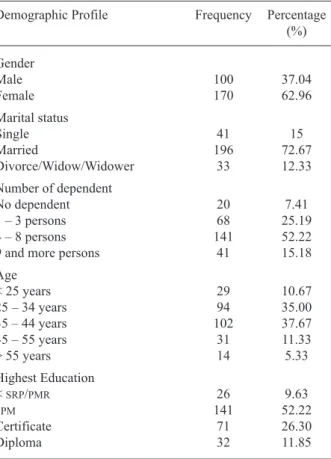
The results revealed that majority of the respondents are females (170 or 62.96%), while males are 100 or 37.04%. Additionally, 205 or 40% of the respondents are married, 180 or 45.6% are single and the remaining 55 or 14.4% are divorcee, widow and widower. In terms of age, 29 or 10.67% are below 25 years, 94 or 35.00% are between 25 to 34 years, 102 or 37.67% are between 35 to 44 years, 50 or 11.1% are between 25 to 34 years, 113 or 25.1% are between 35 to 44 years, 31 or 11.33% are between 45 to 55 years and finally 14 or 5.33% are more than 55
Wealth and physiology
Sufficient or better food 4.90 1.57
Sufficient or better groceries 4.89 1.57
Sufficient or better clothes 5.02 1.49
Sufficient or better sleep/rest 4.96 1.45
Sufficient or better house needs 4.94 1.52
Sufficient or better water facility 5.01 1.44
Affordable or better education financing 5.08 1.45
Affordable or better medical financing 5.08 1.42
Zakah Distribution Efficiency
Please indicate your satisfaction with the following matters from fully dissatisfied to fully satisfied on the scale from (1-7)
Customer satisfaction
Amount of zakah received 4.99 1.46
Method of zakah distribution 4.96 1.50
Zakah institutions role in freeing recipients from poverty 4.96 1.49
Zakah assistance could fulfil recipients needs and wants 4.98 1.55
Dealing with zakah institution 4.92 1.49
The role of zakah institution as an agent for zakah collection and distribution 4.94 1.52
Internal process
Transparent in zakah application 4.99 1.49
Zakah application procedure 5.04 1.57
Bureaucracy in zakah application 4.98 1.52
Time taken to approve zakah application 4.92 1.55
Knowledge worker
Services of zakah institutions’ employees when dealing with customers 4.89 2.06 Knowledge of zakah institutions’ employees in relation to zakah distribution 4.83 1.53 Knowledge of zakah institutions’ employees in relation to zakah collection 4.89 1.54
Integrity of zakah institutions’ employees 4.91 1.54
Efficiency of zakah institutions’ employees 4.96 1.51
Financial management
Please indicate your agreement with the following matters from fully disagree to fully agree (1-7). 4.92 1.52
Zakah institution has sufficient fund for distribution 4.96 1.54 The fund given by zakah institution is sufficient to start or continue the business 5.02 3.66 The fund given by zakah distribution able to reduce recipients’ financial burden 4.86 1.48
Zakah institution would not misused zakah fund 4.92 1.45
years. Further, it is found that the minimum education of the respondents is SPM (141 or 52.22 %), followed by certificate (71 or 26.30 %), diploma (32 or 11.85%) and SRP/ PMR or below (26 or 9.63%). Meanwhile, in terms of number of dependents, majority of the respondents have dependents ranging from 4 to 8 persons (141 or 52.22%) followed by dependents ranging from 1 person to 3 people (68 or 25.19%), dependents more than 9 people (41 or 15.18%) and those who has no dependent (20 or 7.41%).
TABLE 2. Profile of respondents
Demographic Profile Frequency Percentage (%) Gender Male 100 37.04 Female 170 62.96 Marital status Single 41 15 Married 196 72.67 Divorce/Widow/Widower 33 12.33 Number of dependent No dependent 20 7.41 1 – 3 persons 68 25.19 4 – 8 persons 141 52.22
9 and more persons 41 15.18
Age < 25 years 29 10.67 25 – 34 years 94 35.00 35 – 44 years 102 37.67 45 – 55 years 31 11.33 > 55 years 14 5.33 Highest Education < SRP/PMR 26 9.63 SPM 141 52.22 Certificate 71 26.30 Diploma 32 11.85
Note: N = 270. SRP or later known as PMR is the junior high school
certificate whereas SPM is the high school certificate.
The initial results of the confirmatory factor analysis (CFA) of zakah distribution efficiency indicate that they need to be re-specified due to low fitted indexes values, even though all standardized parameter estimates are significant (p < 0.001). As many as 12 question items are then deleted due to low standard loading (less than 0.50) and the CFA is performed again. The model indicates that the chi-square is significant (χ2 = 1450.45, df = 48, p =
.000, N = 270). The results also indicate that the fitted indexes meet the suggested values (TLI = .916, NFI = .913, CFI = .932 and RMSEA = .064). The values of fitted indexes suggest that the model fits adequately to the data (Hair et al. 2013). In addition, the inter correlations among the constructs are lesser than .85, demonstrating a lack of discriminant validity or no multi correlation problem exists between constructs (Kline 2005).
Similarly, the CFA of human needs based on the integration of the needs as stipulated in Maqasid Syariah and Maslow’s hierarchy of needs are also re-specified due to the low fitted indexes values. Consequently, 9 question items with low factor loadings of less than 0.50 are removed and the CFA is performed again. After deleting the items, the modified model shows a better fit
to the data (χ2 =231.620, df = 80, p =.203, χ2/df = 2.894,
TLI = .911, NFI = .920, CFI = .932, RMSEA = .056). Even though the chi-square is significant, these values suggest that the model fits adequately to the data. Furthermore, it is commonly accepted that the chi-square estimate would potentially reject valid models in large sample size (Bagozzi & Yi 1988). The results also indicate that the correlation between the underlying factors is less than .85. All the standardized factor loadings for these measures are higher than the recommended level of .50 (Anderson & Gerbing 1988). The reliability for all the variables are above the recommended value of .70 (Sekaran 2000). The construct reliability (CR) is above 0.60 and average variance extracted (AVE) are all above .50. Meanwhile, the standardized parameter estimate for these measures is statistically significant (p < .001) and thus providing uni-dimensionality scales for each of these factors. Based on these assessments, measures used within this study are within the acceptable levels supporting the reliability of the constructs.
The data then are tested in the second stage. The results reveal that, the chi-square statistics are insignificant (p = .810) of 16.915. The results also indicate that the correlation between the underlying factors is less than .85. All the standardized factor loadings for these measures are higher than the recommended level of .50. The reliability for all the variables is above .70 (Sekaran 2000), the construct reliability (CR) is greater than 0.60 and average variance extracted (AVE) values are all above .50. Meanwhile, the fitted indices are all above the recommended value (AGFI = .974, GFI = .963, NFI = .970, CFI = .990, RMSEA = .030). Based on these assessments, measures used within this study are within the acceptable levels supporting the reliability of the constructs. The results are reported in Table 3 and Figure 4.
With regards to the importance of each dimension, standardized coefficients are useful indicators for manifested dimensions. From all 5 dimensions of human needs based on the integration of needs as stipulated in Maqasid Syariah and Maslow hierarchy of needs, religion and self actualization are the strongest, followed by wealth and physiology, physical self and safety¸ family and self esteem and finally knowledge and social.
Meanwhile, the results that answered the hypothesis for the effects of human needs based on the integration of needs as stipulated in Maqasid Syariah and Maslow’s hierarchy of needs on zakah distribution efficiency is indicated in Table 4. The results show that human needs based on the integration of needs as stipulated in Maqasid Syariah and Maslow’s hierarchy of needs have strong positive effect on zakah distribution efficiency,
with .862. In addition, the R2 also shows a high value
of .822.
DISCUSSION
The analysis shows that human needs based on the integration of needs as stipulated in Maqasid Syariah and Maslow hierarchy of needs have a strong positive effect on zakah distribution efficiency. The results support the prediction as the coefficient of determination is high for all dimensions, of which about 82 % of humans needs as stipulated in Maqasid Syariah and Maslow’s hierarchy of needs could predict zakah distribution efficiency (R2= .822).
The analysis reports that every dimension has a different degree of intensity in influencing the human needs. Religion and self-actualization appear to be the most important dimension of human needs. The results are in tandem with the study carried out by Rosbi and Sanep (2011) that find religion and self-actualization are the utmost important needs contributed to the efficiency of the zakah program run by Lembaga Zakat Selangor.
The analysis further indicates that wealth and physiology is the second important dimension. Meanwhile, the third important dimension of human basic needs is physical-self and safety. Family and self-esteem is ranked as the forth important dimension. Finally, the fifth and weakest dimension of human needs is knowledge and social.
TABLE 3. Results of the proposed model
Endogenous Standardized t-value Cronbach’s Alpha CR AVE
Religion & self-actualization (R & S) .681 11.765 .800 .814 .579 Physical (life) & safety (P&S) .639 10.939 .782 .801 .564
Knowledge & social (K&S) .582 8.628 .734 .732 .586
Family & self-esteem (F&E) .601 10.722 .752 .745 .563
Wealth & physiology (W&P) .639 - .765 .726 .533
χ ; p = .81
AGFI = .974; GFI = .963
CFI = .990; NFI = .970; RMSEA = .03
FIGURE 4. Results for the effect of human needs based on the integration of needs as stipulated in Maqasid Syariah and Maslow’s
Hierarchy of Needs on zakah distribution efficiency. R & S P & S K & S F & E W & P CS e6 e5 e4 e3 e2 e1 e7 e10 .38 .45 .36 .25 .34 .43 .68 .86 .63 .58 .60 .64 .33 .44 .42 .82 .60 .54 .69 .65 e8 e9 IP KW FM Zakah distribution efficiency Maqasid Syariah
& Maslow’s hierarchy of needs
TABLE 4. Results of the hypothesis
Casual Path Hypothesis Expected Path t-value R2 Assessment
Sign Coefficient
Human needs based on the integration H + 0.862 9.931 0.822 Support of needs as stipulated in Maqasid
Syariah & Maslow’s hierarchy of needs
IMPLICATION TO MANAGEMENT
The results provide implications to zakah institutions to formulate strategies for the purpose of fulfilling all the 5 elements of human needs (based on the integration of 5 elements of human needs as stipulated in Maqasid Syariah and Maslow’s hierarchy of needs) if they intend to meet the efficiency in distributing zakah.
To fulfil the first needs namely religion and self-actualization, zakah institution is recommended to create programs with the purpose of reminding and educating zakah recipients of their obligations to the religion besides motivating them for personal growth. For the fulfilment of the second needs namely physical life and safety, zakah institution is suggested to focus on the programs that could increase and generate the zakah recipients’ income. This program is expected to fulfil recipients’ physiological needs pertaining to the expenses of shelter, clothes, education and health.
Meanwhile, for the fulfilment of knowledge and social needs, zakah institution management is suggested to expose the recipients to motivation programs. The programs are expected to instil the awareness of their potential, strength and opportunities. Apart from that, the institutions could also organize events that foster and promote socialization not only among the zakah recipients but also with the society.
Looking further to fulfil family and self-esteem needs, zakah institution should focus on uplifting the livelihood and welfare of zakah recipients’ family by providing them protection and assistance especially when they are in despair due to financial and emotional problems. In addition, zakah insitutions should provide training to groom and educate them and thus boosting their self-confidence. Finally, for the fulfilment of wealth and physiology needs, zakah institutions should educate zakah recipients on how to excel in their business as well as imparting them with the required skills. These attributes are essential for successful entrepreneurs. Apart from that, the institutions should continually provide sustainable assistance especially in monetary form for the recipients to start or continue their business.
Nevertheless, cooperation from both parties namely zakah institutions and zakah recipeints is crucial to the fulfilment of the needs of zakah recipients and thus leading to zakah distribution efficiency.
IMPLICATION TO ACADEMIC
The main contribution of this study is the development of multi-dimensional evaluation of human needs based on the integration of human needs as stipulated in Maqasid Syariah and Maslow’s hierarchy of needs. It is hoped that this multi-dimensional evaluation would lead to a more realistic, fair and holistic measurement. In addition, the results contribute to the body of knowledge of zakat literature of the importance of these multi-dimensional
evaluations of human needs in relation to zakah distribution efficiency.
LIMITATION AND SUGGESTION FOR FUTURE RESEARCH One limitation of this study is that it only examines the perceptions of Asnaf Assistance Business Program recipients managed by Majlis Agama Islam Kelantan (MAIK). In order to increase the validity of the results, it is suggested that similar studies using similar measurement items to be conducted on recipients of other zakah programs conducted by other zakah institutions in all states in Malaysia. This is because, it would be interesting to analyse the consistency or differences of the results that provides a better understanding on human needs based on the integration of needs as stipulated in Maqasid Syariah and Maslow’s hierarchy of needs in relation to zakah distribution efficiency.
CONCLUSION
This study concludes that human needs based on the integration of humans needs as stipulated in Maqasid Syariah and Maslow’s hierarchy of needs have strong effects on zakah distribution efficiency. In addition, all 5 dimensions of human needs (evaluated based on the integration of human needs as stipulated in Maqasid Syariah and Maslow’s hierarchy of needs) are found to be significant in contributing to zakah distribution efficiency. Among all dimensions, religion and self-actualization are the most important needs, follow by wealth and physiology, physical self and safety and finally family and self-esteem. Meanwhile, the weakest dimension is knowledge and social. Further, this multi-dimensional evaluation provides useful insights to zakah institutions to not limit the distribution of zakah in monetary form but also can be in other non-monetary forms. Last but not least, the results of the study provide useful insight to zakah institutions to be more pro-active in formulating programs that enhance the recipients’ level of religiosity, uplift their livelihood, foster socialization, train and motivate them as well as promoting them a comfortable life.
ACKNOWLEDGEMENT
The author would like to express appreciation to Accounting Research Institute, Universiti Teknologi MARA and Ministry of Higher Learning for funding the research.
REFERENCES Al- Quran al Karim. Al-Taubah: 60.
Anderson, J.C. & Gerbing, D.W. 1988. Structural equation modeling in practice: A review and recommended two-step approach. Psychological Bulletin 103(3): 411-423.
Atkinson, R. 2000. Combating social exclusion in Europe. The New Urban Policy Challenge, Urban Studies 37: 67-79. Auda, J. 2008. Maqasid Al-Shariah as Philosophy of Islamic
Law: A System Approach. London: The International Institute of Advanced Islamic Studies.
Bagozzi, R.P. & Yi, Y. 1988. On the evaluation of structural equation models. Journal of the Academy of Marketing Science 16(1): 74 -94.
Cohen S., Thuiraasi D. & Kandilarou M. 2008. Performance parameters interrelations from a balanced scorecard perspective: An analysis of Greek companies. Managerial Auditing Journal 23(5): 485:503.
Department of Statistics Malaysia. 2010. Population distribution and basic demographic characteristics. Available at http:// www.statistic.gov.my/portal/download_population/ files/cencus2010/Taburan_penduduk_dan_ciri-ciri asas demographi.pdf.
Economic Planning Unit. 2013. The highest hardcore poor 2009. http://www.epu.gov.my.
Fuadah, J. 2004. Keberkesanan zakat dalam mengatasi masalah kemiskinan di Negeri Melaka. Unpublished Master Dissertation. Universiti Malaya, Kuala Lumpur, Malaysia.
Hair, J.F., Bush, R.B. & Ortinau, D.J. 2013. Marketing Research within a Changing Information Environment. New York: McGraw-Hill.
Hairunizam, W., Sanep, A. & Mohd Ali M.N. 2004. Kesan Bantuan Zakat Terhadap Kualiti Hidup Asnaf Fakir dan Miskin. Petaling Jaya: Intel Multimedia & Publication. Ibrahim, F. & Salleh, M.F.M. 2006. Stochastic frontier estimation:
An application to local government in Malaysia. Malaysian Journal of Economic Studies 43(1): 168-170.
Islamic Relief Worldwide. 2008. Definition of poverty. Birmingham, UK. Available at http://www.islamic-relief. com/indepth/downloads/Islamic%20Relief%20%20 Definitions%20of%20Poverty%20-%20Jan08.pdf. Ismail, S. & Rogayah, N. 1980. Distribution of the zakat burden
on padi producers in Malaysia. In Some Aspects of the Economics of Zakat, edited by M.Raquibuiz Zaman, 80-153. New York: American Trust Publication.
JAWHAR. 2007. Manual Pengurusan Pengiraan Zakat. Department of Wakaf, Zakat and Haj (JAWHAR), Prime Ministers Department of Malaysia.
Kamali, M.H. 2008. Maqasid Al-Shariah Made Simple. London: The International Institute of Islamic Thought.
Kaplan, R.S. & Norton D.P. 1996. The Balanced Score Card: Translating Strategy into Action. Boston: HBS Press. Kline, P.B. 2005. Principles and Practice of Structural Equation
Modelling. 2nd edition. New York: The Guilford Press. Laporan Ekonomi – Negeri Kelantan Darul Naim
2010-2011. 2012. Kelantan: Unit Perancang Ekonomi Negeri Kelantan.
Mahyudin, A.B. & Abdullah, A.G. 2011. Towards achieving the quality of life in the management of zakat distribution to the rightful recipients (the poor and needy). International Journal of Business and Social Sciences 2(4): 237-245. Rancangan Malaysia Ke-Sembilan2006-2010. 2006. Kuala
Lumpur: Percetakan Nasional.
Maslow, A.H. 1970. Motivation and Personality. 2nd edition. New York: Harper & Row.
Mohamad, A. 2008. Perception of academicians towards zakat administration particularly zakat distribution: The case of Selangor and Kelantan. Unpublished Master
Thesis, International Islamic University Malaysia, Kuala Lumpur.
Mohamad Saladin, A.R., Ariffin, M.S. & Mohd Fauzi, M.H. 2010. Poverty measurement in Malaysia zakat institutions: non-Monetary indicators. Zakat Transformation: From Subsistence to productive. Proceeding of the 4th ISDEV
International Islamic Development. 21-22 September 2010. Universiti Sains Malaysia.
Mujani, T. 2005. Golongan Penerima Zakat: Agihan Dana Zakat Secara Lebih Berkesan. Shah Alam: Pusat Penerbitan Universiti (UPENA), Universiti Teknologi MARA, Nolan B. & Whelan, C.T. 2010. Using non-monetary deprivation
indicators to analyse poverty and social exclusions: Lesson from Europe. Journal of Policy Analysis and Management Spring 14(2): 123-140.
Norazlina, A.W. & Abdul Rahim, A.R. 2012. Productivity growth of zakat institutions in Malaysia: An Application of data envelopment analysis. Studies in Economic and Finance
29(3): 197-210.
Patmawati, I. 2008. Pembangunan ekonomi melalui agihan zakat: Tinjuan Empirikal. Syariah Journal 16(2): 223-244. Pelan Strategik JAWHAR 2007-2011. 2007. Putrajaya Prime
Minister Office Available at: http://www.jawhar.gov.my. Rosbi, A.R. & Sanep, A. 2011. Kesan kerohanian program
bantuan modal asnaf oleh Lembaga Zakat Selangor (LZS).
Proceedings The World Universities 1st Conference,
22-24 November. Zakat Research Institute of Malaysia of Malaysia (IKaZ), Universiti Teknologi MARA.
Rosbi, A.R. & Sanep, A. 2010. Keperluan asas berdasarkan Maqasid Al-Syariah: Ke arah pencapaian matlamat dan penilaian komprehensif agihan zakat. Zakat Transformation: From Subsistence to productive. Proceeding of The 4th
ISDEV International Islamic Development Management Conference (IDMAC 2010), 21-22 December. Universiti Sains Malaysia.
Roscoe, J.T. 1975. Fundamental Research Statistics for the Behavioural Sciences. 2nd edition. New York, Holt: Rihehart and Winston.
Salwana, I., Siti Shafrina, M.S. & Kamarul Hayati, M.Y. 2012.
The use of balanced scorecard in school project to reduce absenteeism: A case of SMK Tanah Merah 2, Kelantan. Unpublished Project Paper. Universiti Teknologi MARA, Kelantan.
Sekaran, U. 2000. Research Methods for Business: A Skill-Building Approach. 3rd edition. New York: John Wiley & Sons Inc.
Unit Perancang Ekonomi Negeri Kelantan. 2011. Laporan Ekonomi Negeri Kelantan. Kota Bharu: Pejabat Setiausaha Kerajaan Negeri Kelantan Darulnaim.
Wagle, U. 2005. Multidimensional poverty measurement with economic well-being, capability and social inclusion: A case from Katmandu Nepal. Journal of Human Development
6(1): 210-225.
Wagle, U. 2007. Poverty in Katmandu: What do subjective and objective economic welfare concepts suggest. Journal of Economic Inequality 5(1): 96-113.
Wagle, U. 2008. Multidimensional poverty: Alternative measurement approach for the United States. Social Science Research 37(2): 50-64.
Zakariah, A.R., Amini A.A. & Ahmad Fahme, M.A. 2010. Peranan agihan zakat dalam mengurangkan jurang kemiskinan: Satu kajian di Kelantan. Proceedings The ISDEV International Islamic Development Management
Conference (IDMAC 2010).Zakat Transformation: From Subsistence to productive, 21-22 December. Universiti Sains Malaysia.
Zulkarnain, Y. 2008. Pengurusan zakat dan peranannya dalam menangani kemiskinan di Kelantan. In The Power of Zakat Studi Perbandingan Pengelolaan Zakat Asia Tenggara, edited by D. Hafidhudin. Kota Bharu: UIN Malang Press. Maheran Zakaria (corresponding author)
Accounting Research Institute Universiti Teknologi MARA
40450 Shah Alam, Selangor, MALAYSIA.
E-Mail: [email protected] Nur Ain Abdul Malek
Academy of Language Studies Universiti Teknologi MARA Kelantan
18500 Machang, Kelantan, MALAYSIA.