GIDR- ICRISAT
Policy Brief 1
Rudra N Mishra, P. K. Viswanathan,
Madhusudan Bhattarai and Hema Iyengar
Abstract
Despite growing double digit level of annual growth for the last one and half decades, the lack of regular employment a n d m a s s p r e v a l e n c e o f u n d e r employment is still a major factor of persistent rural poverty and vulnerability in India, especially among certain ethnic communities and in rural hinterlands. In 2006, the Government of India i m p l e m e n te d t h e N a t i o n a l Ru ra l Employment Guarantee Scheme (NREGS) to address the growing rural distress and vulnerabilities. Based on synthesis of research findings and several case studies across the states of India that were presented at the national workshop on MGNREGS organized in Ahmadabad on 10-11 December 2013, this policy brief summarizes the key messages and policy level challenges emerge while improving the performances of the MGNREGS program. The employment guarantee schemes like MGNREGS have provided meaningful employment to the poor and vulnerable sections of the society. In many respect, the scheme is successful in bringing marginalized sections and women to mainstream labour force, reducing vulnerability in rural areas, and in integrating a vast section of neglected rural population to formal financial institutions like banks and postal offices saving schemes, especially of rural
agricultural labor forces of women and backward communities. The implemen-tation of MGNREGS in areas with higher agricultural wage seems a problem due to better opportunities for labor in other sectors of the economy than the MGNREGS work activities. Therefore, better targeting of the schemes to backward districts and in those rural areas where seasonal unemployment is rampant, and where overall agricultural wage rate is at staggering low level for a long time. Likewise, better convergence of the MGNREGS activities at the community level with the other on-going rural development and livelihood improvement activities will provide better synergy effects of the programs and high impact on the ground in terms of long term livelihood improvement, and long-run sustainability of the program activities.
1. Introduction
In the context of growing unemployment and social unrest in wider area of rural India, in year of 2006, to tackle rural unemployment, the central government of India launched a major initiative through an act by parliament, called as 'National Rural Employment Guarantee Scheme' (NREGS). Initially, it was launched in 200 selected districts and then the programme was expanded to almost all the districts of the country. In 2009, the NREGS programs
was redesigned and implemented across all parts of India, with a new name as “ M a h a t m a G a n d h i N a t i o n a l Ru r a l E m p l o y m e n t G u a r a n t e e S c h e m e s (MGNREGS).” The scheme provides a constitutional guarantee of ensuring 100 days of employment to any rural household in a year, who demands work at local Panchayat. The scheme has turned a universal one and any household/ member demanding work can be provided a manual work in the neared locality within 15 days of the demand (MoRD/ GOI).
The central government bears the major share of expenditure (over 80%), remaining expenses for administration and related activities to be borne by the concerned state governments. The scheme mandates 60% of the expenditure for wage payment for the labour force engaged in the work. For MGNREGS work, there is one restriction that the local bodies cannot use contractor services to complete the work. The works under MGNREGS are implemented mostly during the summer months, i.e., February to June, when unemployment/ under-employment levels are at high levels in large parts of rural India. Seasonal migration from rural to urban is also at high scale during the s u m m e r s e a s o n . T h u s , p r o v i d i n g employment or social safety nets to unskilled labor force is the main factor for implementation of MGNREGS in a locality. Under the NREGA scheme, the community as well as household level assets have been created in several parts of rural India. At community level, the assets created includes the assets to harvest and storage rain water, to maintain and expand village community forests, land development
programmes, construction/renovation of village roads, schools, drainage and buildings used for community events, etc. At household level, farm ponds/wells are constructed, as well as, farm walls and toilets are constructed where ever it is necessary. Over the years, many of the states authority implementing the program have done their own innovations to implement the scheme, which resulted in convergence of various rural development works and activities undertaken by different government departments across states. This includes work for rural development, as well as inclusion of the women self-help groups, like 'Kudumbashree' in state of Kerala to implements the programmes.
2. Achievement of MGNREGS
The most innovative approach followed by the programme under MGNREGS (or NREGS) is that job has to be demanded by the beneficiary as part of his/ her constitutional rights and not the benevolent act of the state. The state is supposed to pay unemployment allowance incase the job is not provided as demanded by the household. Till date, nearly 130 millions of job cards have been issued and the annual budget allocation had increased almost threefold from Rs. 110 billion in 2005-06 to Rs. 330 billion in 2013-14 (MoRD/GOI). In fact, the actual governmental expenditure for MGNREG activities over the years had greatly increased, and more sharply after 2009/10, when the program has been expended to all districts of the country. The actual expenditure for MGNREGS work increased over 2.5 times within a year after during the period of 2008/9 to 2009/10.
Figure 1: Total expenditure for MGNREGS work activities at all India over the years (in 2010 constant value of Indian Rs.)
Source: MGNREGS official web site http://www.nrega.nic.in/netnrega/home.aspx
However, the performances of MGNREGS, in terms of expenditure of fund as per allocation to state greatly vary across the states (Figure 1). Many of the states with inadequate implementation institutions have been not able to spend the central government allocated fund under the public work schemes. This has affected overall
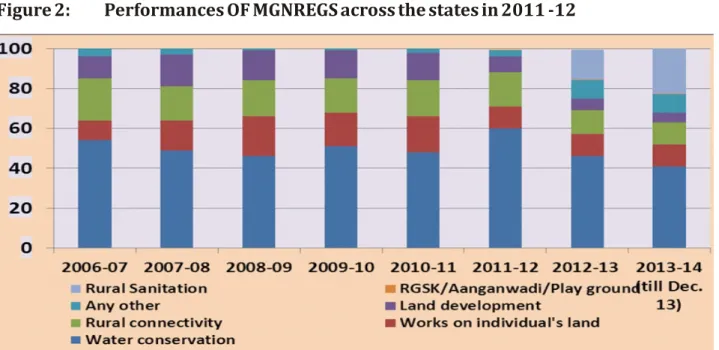
performance and number of days of work carried out in a year, or number of works provided in a year in those states (Figure 2). The states with strong administrative set up have even over spent the government fund in 2012/13 than actually allocated for the year by the central government.
Figure 2: Performances OF MGNREGS across the states in 2011 -12
On an average, the scheme has been providing employment to around 50 million rural households every year in the last few years, which come to one-fourth of the total rural households in India. During 2009-10 and 2010-11, the rural spending had outpaced the urban consumption in India, which happened after 25 years: MGNREGS could be one of the major factors behind such push. Since inception till today, the MGNREGS had infused Rs. 1,550 billion as wage payments into rural economy. The real rural daily agricultural wages increased from on an average of Rs. 65 in 2005-06 to Rs. 124 in 2012-13, what factors led to this rise on agricultural wage rate is still one of the debated issues in the public policy forum.
MGNREGS has created lot of community assets, which play pivotal role in agrarian economics across villages in India. The work wise break up for MGNREGS works undertaken so far show that the water conservation structures had a major share starting from 54% in 2006-07 and going up to 60% in 2011-12, though in last couple of
years the share had declined (NEGC, 2010). Similarly share of construction of village roads have come down from 21% in 2006-07 to 11% in 2013-14. The decline in creation of physical assets do have saturation point, so one has to be careful to draw any conclusion from this trend. In last couple of years, the share for rural sanitation schemes using MGNREGS funds have increased from 15% to 23% at all India level (ibid). This is a good development as nearly 50% of rural households are without toilets and most of the villages do not have drainage facility.
If the MGNREGS fund is spent on building toilets, drainage and sewage facility in future, it will be a major boost to 'Swachch B h a r a t ' c a m p a i g n , a n d w i l l h a v e tremendous impact on the morbidity profile and hygienic behavior of rural population. In fact, the works on the individual land has come down to 10% in 2014 from highest of 20% in 2008-09. Similar is the case with land development, its share is 5% of the total works undertaken till December 2014 (Figure 3)
Figure 2: Performances OF MGNREGS across the states in 2011 -12
Since many poor and marginal farmers could not afford to upgrade their land, the declining shares of these 2 items in the number of works created in MGNREGS over the years are of concern. More of such work will help to boost agriculture in the given villages which will have better linkages to overall economy of the country. The heads like construction of rural drinking water network and Anganwadi centers are introduced in last 2 years but less than 0.5% of total works under MGNREGS for the respective years were seen in the above items.
Recent literature on MGNREGS has suggested that the MGNREGS work activities have significantly increased job availability during slack agricultural seasons (dry season), along with increased rural wage earnings, which has helped in improving economic conditions of the rural poor and vulnerable households, whose large share of annual income comes from rural labor markets. (Basu, 2013; Kareemulla et al., 2013). These additional activities have in fact also facilitated creation of community level assets and local infrastructure in rural India, increased spending of rural poor on education and health, improved connectivity and basic rural infrastructure in the rural India. MGNREGS is currently regarded as one of the most important and feasible 'preventive social protection scheme' in India (IRDP 2012-13:92-93), which might have also contributed in reduction of rural poverty and vulnerability. Rural poverty in India had declined from 37 percent in 2004/05 to 24 percent in 20012/13 and one of the major factor contributing to this reduction could be the implementation and success of MGNREGS program as argued by Sen (Sen 2014). The additional wage income of
the rural households from the schemes we re h e l p f u l t o m e e t t h e i r d a i ly expenditure in agricultural slack season, reducing their regular consumption related debt burden from informal financial sources with very high interest rate (Kareemulla et al., 2013). One of notable impact found was also increased financing for children's education by the program participating households (Young Lives, 2013: 2).
Some of the case studies and Evidences also suggest that the MGNREGS interventions in the villages have also positively impacted in terms of improving the soil fertility through land development programmes and water harvesting/ recharging programmes, specially of poor households and socially backwards classes of households (Reddy et al., 2014). From it's inception around 50% of the total works under MGNREGS were related to water conservation measures, and another 10% were related to land development (author's calculation from data given in MGNREGS official web site). The poor and marginalized farmers who o t h e r w i s e c o u l d n o t a f f o r d l a n d development in their agricultural plots were now able to do so. Thereby, the additional investments have helped in small-scale water management and land development (IRDR 2012-13, pp. 239-278).
From the governance perspective, despite several allegations about the lack of transparency and the attendant evils of financial mis-management, several case studies have demonstrated that the MGNREGS also helped in the creation of rural asset along with strengthening the local democratic institutions or Gram Sabhas (IRDR 2012-13: 209-236).
The flexibility of the programme in terms of working hours, and its uniform wage rate for both male and female workers, have encouraged women to participate in large numbers. It is not surprising that share of women in total person days created in all India level has increased from 40% in 2006-07 to 54% in 2013-14 (MoRD/GOI,). Some of the other major gender outcomes include: creation of opportunities for more equitable distribution of wages and employment to w o m e n a n d s o c i a l l y b a c k w a r d communities; improvement in working conditions of women labor, increased access to formal financial institutions to the women agricultural labor, etc (IRDR 2012-13: 239-278, MoRD/GOI, MGNREGA SAMEEKSHA).
3. Recently Observed Issues with MGNREGA
However, of late, there have been increasing evidences suggesting that all is not very rosy with the MGNREGS implementations, when compare its performances across the states. Where the program has been successfully implemented in the last few years, the community members want to diversify the work under MGNREGS to new sectors, but are limited by the stick guidelines in its implementations, and in practices, only limited sectors of activities allowed by the local level implementation bodies. It was observed that over the years there has been gradual reduction in the number of days of employment generated, a decline in financial allocations from the government for various works, and a growing lethargy among the rural people, especially, the male workers to be enrolled into the scheme. On the other hand, the increase in food prices, shortage of labour for routine farm management operations, and huge amount of financial leakages, delay in wage
payments also have been widely reported, raising serious issues about the continuity and sustainability of the programme (IRDR 2012-13: 239-278).
The government statistics suggests that over the years, the average days of employment per person per year had declined from 43 days in 2005-06 to 35 days in 2012-13, which is a major deviation from the targeted minimum goal of 100 days per household per year. At the same time, the share of marginalized sections like scheduled castes and scheduled tribes in the workforce engaged in MGNREGs had declined from 61% in 2006-07 to 49% in 2013-14 (MoRD 2014: 9). Partially, this may be due to expansion of programme from 200 most backward districts in 2006-07, most of which are overwhelmingly inhabited by people belonging to scheduled castes and scheduled tribes and other marginalized communities, to all the 659 districts of India from 2009/10 onward.
H o weve r, t h e s h a re o f wo m e n i n participation for MGNREGS at India level had increased from 40% in 2006-07 to 54% in 2013-14. Interestingly, the trend also seem to have taken a different turn altogether as more number of households in 'other' category (mainly non SC/ST households) have started participating in the programme, though the reasons are unknown (ibid).
The total financial outlay for the programme at all India level has come down from Rs. 400, billion in 2011-12 to Rs. 330 billion in 2012-13 and 2013-14 and the recent budget outlay for 2014-15 has yet to give any concrete figure for the current financial year's outlay. The decline in budget outlay is amply reflected in decline of households provided with employment by MGNREGS
from 54.9 million in 2010-11 to 38.1 millions in 2013/14 year (ibid). At present, the MGNREGS activities are being reviewed and redesign of the programs both at the center and at several state governments that are responsible for implementation of the activities in local level. There are also public policy debates on realignment of the MGNREGS program activities more closely with the farm operation and agricultural activities in a location, and supporting for wage payments even for regular farming operation in the rural areas. Some of the state governments have been redesigning the schemes in this direction. There is also public policy discussion in to restrict the implementation of MGNREGS and work activities to original 200 districts, where the programs were initiated first in 2006 (Srivastava, 2014).
Some of the recent studies have found that in many places, over the recent years, the delay in wage payment is more than two months instead of 15 days as mandated under the M G N R E G S i m p l e m e n t a t i o n a c t . Malpractices are also rampant, and social audit has never done in large part of rural India (IRDP 2014, pp. 239-278). In fact, several studies have noted that the delay in wage payment and lack of transparency, and uncertainty, in allotment of work in village are some of the major factors for declining interest of rural households towards the program, and continue to search for other employment options, even they are lower paying than the wage rate of MGNREGS (Varma and Shah, 2014).
At present, certain nature of work can be undertaken in MGNREGS scheme. Over the years in states like Kerala and Andhra Pradesh have added few more activities like coir making or land upgradation, etc. But, in majority of states, the MGNREGS projects
are based on the list recommended by the central government, which is also the major financial contributor to the scheme. In recent years, there is growing consensus in favour of adapting the schemes under MGNREGS to more suitable to the needs of the local labor market, and also linking the MGNREGS activities with the crop production operation of farmers, even by sharing of cost across the programme. In face in 2010, a task force was set up to look at the possibility to converge different rural development schemes by various agencies and developing activities that leads to holistic development in Indian agriculture. The central focus of the suggested approach was to both intensify and diversifying the agriculture in which MGNREGS will play a pivotal role (Report Works on Individual Land in MGNREGS, pp. 6-20).
Due to all of these concerns about the future course of the MGNREGS, and continuing sustaining its contributions towards welfare of the economically vulnerable sections, future course of action of the central government for implementation of the MGNREGS is in questions. Thus, it is may be a time to search new perspectives and the strategies to make the NREGA more effective and robust in terms of responding to the emerging dynamics in the rural labour market across the Indian states. A critical question that needs an immediate attention on the topic is 'what course of action is required to make the MGNREGS more compatible and robust with the changing facets of the agricultural labour markets across the states in India?'
4. The National Workshop on MGNREGS:
In this regard, Gujarat Institute of D eve l o p m e n t Re s e a rc h ( G I D R ) , i n collaboration with the International Crop
i m p l e m e n te d i n t h e c o u n t r y. T h e discussions at the workshop also revolved around subject-areas as shown in Box 1: Research Institute for Semi Arid Tropics
(ICRISAT), organized a Two Day workshop during 10-11 December 2013 at GIDR, Ahmedabad. The two day workshops brought about 15 scholars of national and international reputed institutions from various parts of the country, and scholars presented the status of implementation of MGNREGS in the select states of India, and provided a critical review of the major challenges facing the sustainable future of the programme (Figure 4). All together, about 20 research articles dealing with from
micro-case studies in various states of Andhra Pradesh, Tamil Nadu, Karnataka, Kerala, Maharashtra, Madhya Pradesh, Gujarat, Odisha, West Bengal and Rajasthan were presented and critically discussed and debated in the workshop. The workshop was a meeting point for seasoned scholars and practitioners working on MGNREGS and social safety nets from various research institutions and universities in India, non government organizations, and government research agencies.
Figure 4: Workshop participants in GIDR, Ahmedabad, Gujarat during 10-11
December 2013
The workshop participants presented several case studies focusing following aspects of MGNREGS activities being
Organized by:
Organized by: Supported by:Supported by: Other Partners:Other Partners:
Gujarat Institute of Development Research Ahmedabad
International Crops Research Institute for the Semi–Arid Tropics, Hyderabad
South Asia Consortium for Interdisciplinary Water Resources Studies,
Hyderabad
University of Agricultural Sciences, Bangalore
Indian Council of Social Science Research
Western Regional Centre, Mumbai Research Program on Market
Policy and Institutions, ICRISAT, Hyderabad
National Workshop
on
MGNREGA and the Emerging Rural Context:
Learnings from Indian States
December 10–11, 2013
Gujarat Institute of Development Research, Ahmedabad
Box 1: Subject areas of the workshop
1. How MGNREGS has unfolded itself since its inception
2. How the programme contributed towards strengthening rural livelihoods 3. NREGS and its interface with the rural labour market in India
4. The emerging challenges for the future of NREGS in the changing rural scenario
5. Use of rigorous analytical approaches and methodologies in understanding the impacts of the MGNREGS Programme and its welfare implications at various scales of economy.
5. Some of the major findings presented and discussed at the Workshop
Following are major observations and findings presented and discussed at the workshop.
1. Studies from Madhya Pradesh and Maharashtra demonstrated that the M G N R E G S i m p l e m e n t a t i o n i s inadequate in views of beneficiaries' expectation annually. The beneficiary households hardly got 30 days of work in any given year. The payment of wages from MGNREGS agency was delayed by several months, and in at least 10% of cases, beneficiaries are yet to receive the payments even after 6 months of completion of the MGNREGS work. 2. In some of the villages the work has not
taken place at all or only for a year or two in the last 6 years of implementation of the program. In some cases, the job cards are with the village Sarpanch.
3. Large numbers of rural households are not aware of their rights guaranteed under the MGNREG Act. Seldom, they are aware of gram Sabha meetings on deciding nature of work under MGNREGS, and those attended felt a few persons taking all of the decisions regarding the work to be undertaken in their villages.
4. A micro-study study from the 16 states of India reported that a staggeringly low and declining levels of performance in MGNREGS across the places over the time. However, some positive impacts in terms of increase in expenses by the participant for education of their children, increased female participation, and good quality of assets created in the villages were worth mentioning, albeit, with a critical review.
5. A study from Odisha and West Bengal found overlapping of works in many cases has led to mismanagement and poor output; this pattern may need to be curtailed in the future.
6. A study from four southern states; Andhra Pradesh, Tamil Nadu, Karnataka and Kerala, found each of these states had different strategies to implement the scheme which has a bearing on the outcome in each of them. In some of the case study sites in the surveyed states, the Panchayats were found to be manipulating the MGNREGS funding; and the funds allocated for MGNREGS work activities were either misused or usurped. Effecting monitoring and punitive mechanisms are absent in many of these states. Though women's participation is higher in all of these states, still many of them find it difficult to participate in the programme meaningfully.
7. A study from Gujarat highlights the fact that MGNREGS was strategically conceptualized as a demand driven program but in reality functioned as a supply driven program, which also affected its implementation mode and impact on the ground. This study points out that lack of mechanism to fix responsibility, absence of clear policy on renovation of existing assets and poor Panchayati Raj Institutions are the hurdles in MGNREGS implementation across large numbers research papers presented.
8. A s t u d y f r o m A n d h r a P r a d e s h highlighted the fact that though people are getting regular work, they have complain of various malpractices in it's implementation in their village. The common village also lack means to report it to higher authorities. In the study areas, there is large scope to undertake construction of water harvesting structures but the land development programmes given more emphasis.
9. One of the voices was to downsize the MGNREGS work activities to selected districts where it is needed most. Giving example from Punjab and Haryana, where the migrant labourers from Bihar were enrolled for the work, the researchers suggested that MGNAREGS could do better in areas where there is lack of opportunity for regular work, and surplus labour is available in the village for the period when the MGNREGS work takes place. The scholars also suggested for the MGNREGS to be oriented to accommodate more of non-farm works, as well.
10. An expert from Gujarat pointed out MGNREGS should be linked with other
livelihood programmes like National R u r a l L i v e l i h o o d M i s s i o n . T h e re s e a rc h e r s u g g e s t e d fo r g iv i n g opportunity to women Self-Help groups (SHGs) to play an active role in the implementation of MGNREGS activities in the local level. This will help the women to get better deal from the programme and they could also check the mal practices in a better ways. It will also help rural women to get some sort of collective voice for better bargaining under the scheme. The researcher is also of the opinion that MGNREGS could be link to the programmes dedicated to the women and children for better human capital formation and improving the education and health outcomes among them.
11. Another expert from Northern India, having rich experience from various states, argued that the strategies followed at present in MGNREGS to focus exclusively on on-farm work and creating selected durable assets may not be practical in the long run. Instead, in the future, the MGNREGS work and the scheme should be expanded to include more non-farm works and also to address urban unemployment and poverty.
12. A study from Rajasthan highlighted the fact those households having only one income earning member were not preferring MGNREGS work as the work provided is of short duration. In addition, work under MGNREGS was not provided regularly, the payment was delayed, average wage in MGNREGS is often lower than the otherwise prevailing market prices and the works are strenuous in nature.
13. Couple of papers also highlighted use of a dva n c e t e c h n i q u e s l i ke S o c i a l Accounting Matrix (SAM) to understand the forward and backward linkages of the programme interventions for better capturing total impact of the program intervention rather than only providing narratives and descriptive, alone.
14. Likewise, the participant also felt a need of rigorous impact assessment of the MGNREGS covering key aspect of the rural economy, and on tacking the welfare indicators and the sectors where the participant households actually spend their wage earnings from the program. As much feasible, also explore using panel household data for rigorous impact assessment exercises.
15. The scholars also highlighted the fact that the states need to be innovative in finalizing strategies to implement the scheme to suit local requirements. In this sense, the present mechanism of MGNREGS across the place is quite rigid.
6. Policy Suggestions
The scholars and practitioner at the workshop forwarded following policy suggestions to restructure the functioning of MGNREGS to meet the changing dynamics of the rural labor markets, and better targeting the program for addressing the growing rural underemployment and vulnerability in the rural India (Box 2).
Box 2: Policy Suggestions
1. The MGNREGS activities, besides its several shortcomings at present, still could be evolved for better social outcome. Several case studies presented at the workshop clearly demonstrated that the assets created in MGNREGS (both the communal and private asset) are in fact appreciated by the surveyed households at several of the study sites in India.
2. The MGNREGS should also provide the guaranteed minimum 100 days of employment as promised in the act. Recently in couple of states Odisha, Bihar and Andhra Pradesh have in fact increased the number of days per year, linking with drought relief and other social safety net program. But, the work should be provided at the earliest when demanded by the household.
3. The payment mechanism under MGNREGS should ensure the wage rates are comparable to the prevailing wages in the respective rural areas. The payment of wages should be done within 1-2 weeks of completion of the work.
4. There should be convergence of various other schemes that provides livelihood and employment generation and that of the MGNREGS work activities. The convergence should also be on functioning of suck social safety net program across various departments like rural development, agriculture, public works, forest and skill development.
5. Considering the growing importance of rural non-farm sector activities in rural India, the MGNREGS ambit should be increased to accommodate more non-farm work, as well.
6. The governance part of MGNREGS needs restructuring, social audit and monitoring of work activities should be done more frequently.
7. Gram Sabhas procedures to be revised to ensure participation of all willing people in the village to decide about the nature and kind of works to be undertaken under MGNREGS scheme in a year and time of operation.
8. Given the convergence between rural and urban geographies, MGNREGS should be evolved to provide employment in nearby peri-urban areas and in small towns, as well.
9. The women led self-help groups could be empowered and encouraged for implementation of selected MGNREGS activities in a community, which would enhance performances of the program.
10. The MGNREGS should have also a plan to maintain and renovate the assets created under it.
Considering the dynamics nature of rural economy, the MGNREGS should also consider graduation of participants to different type of skill development training and non-farm workshop that that in the long-run, the participants would not trapped into low payment unskilled wage market alone.
7. Conclusion and Implications
Overall, the national workshop on MGNREGS in Ahmadabad was very useful in bringing together experts and scholars working on MGNREGS from across different states of India to share their study and research findings on MGNREGS and formulate workable policy suggestions for future courses on sustainability of MGNREGS. The workshop highlighted need for more empirical assessments on performances and impacts of MGNREGS with rigorous statistical assessment, and
also to cover different scale factors direct and secondary benefits as well as spillover benefits of the program on farming as well as non-farm sector of the economy. Rather than simple narratives and case studies reporting of impact of MGNREGS as usually done in the literature, the workshop emphasizes on application of sound statistical sampling and analytical tools to study the impact and performances of MGNREGS on village economy as a whole, covering direct labor wage beneficiaries as well as other indirect beneficiaries in the local economy.
The scholars agreed that, in a country like I n d i a , w h e r e u n e m p l o y m e n t a n d underemployment are still a major macroeconomic policy issues employment schemes like MGNREGS are of very important public policy tools to provide meaningful employment to the mass population, specially poor and vulnerable
and those who needs such social safety nets supports as a last resort of employment, who cannot be absorbed from the regular labor markets in the local economy. So far, the scheme is successful in also integrating a vast section of rural population to formal financial institutions like banks, postal offices and other formal financial institutions. It has also demonstrated a tremendous potential to bring marginalized sections and women to mainstream labour force. The implementation of MGNRGS in areas with higher agricultural wage seems a problem due to unavailability of labor force to work on lower mass-scale wage rate under in MGNREGS. Bringing more population under is in fact not be the objective and norms of MGNREGS, but to
provide as a last resorts to all, who cannot be absorbed into the normal labour markets, i.e., to work as social safety nets measures in a society. In this context, better targeting of the schemes to backward districts and in rural areas where seasonal unemployment is rampant, and overall all agricultural wage rate is also at low level, may be better options for optimum allocation of resources and better targeting the limited financial resources to those poor and vulnerable and neglected sections of the society who deserve must this kind of social safety net supports of conditional cash transferred by guarantying 10o days of employment to those who are willing to do unskilled manual work in their localities.
References
Basu, A. (2013). 'Impact of Rural Employment Guarantee Schemes on Seasonal Labor Markets: Optimum Compensation and Workers' Welfare,' Journal of Economic Inequality, 11(1), 1–34.
IDFC Rural Development Network (2013). India Rural Development Report 2012|13. Delhi: Orient Black Swan.
Kareemulla, K., P. Ramasundaram, S. and Kumar, C. A. (2013). 'Impact of National Rural Employment Guarantee Scheme in India on Rural Poverty and Food Security', Current Agricultural Research, Vol. 1(1):13-28. Available from:
Ministry of Rural Development, Government of India (2012). MGNREGA Sameeksha, An Anthology of Research Studies on the Mahatma Gandhi National Rural Employment Guarantee Act, 2005, 2006–2012, edited and compiled by Mihir Shah, Neelakshi Mann and Varad Pande, New Delhi: Orient Blackswan.
Ministry of Rural Development, government of India (2014). 'Mahatma Gandhi National Rural Employment Guarantee Act, 2005, Report to the People', available on
Ministry of Rural Development, Government of India MGNREGS official web site
National Employment Guarantee Council (NEGC) (2010). Report Works on Individual Land in MGNREGS,, 'Prepared and submitted by the Committee on Works on Individual Lands', NEGC, Ministry of Rural Development, Government of India.
Reddy D. Narasimha, Reddy Amarender A, Nagaraj N and Bantilan Cynthia (2014). Impact of Mahatma Gandhi National Rural Employment Guarantee Act (MGNREGA) on Rural Labour Markets. Working paper series no 58. Patancheru 502 324, Telangana, India: International Crops Research Institute for the Semi-Arid Tropics. pp. 40
Srivastava, Arun (2014). 'Black Diwali for Rural Daily Wage Earners', Mainstream, VOL LII,
No 49, November 29, 2014,
Varma, Shilp and Tushaar Shah (2012). 'Labor Market Dynamics in Post-MGNREGA Rural India', IWMI-TATA Water Policy Programme,
Young Lives (2013). Social Protection and Poverty Reduction: Increasing the benefits of MGNREGS for children, India Policy brief No 2. Young Lives in India. Available at:
http://www.agriculturejournal.org/?p=388 http://nrega.nic.in/netnrega/writereaddata/circulars/report_people_eng_jan_2014.pdf http://www.nrega.nic.in/netnrega/home.aspx http://nrega.nic.in/circular/minutes_working_groups.pdf http://www.mainstreamweekly.net/article5359.html http://www.iwmi.cgiar.org/iwmi-tata/PDFs/2012_Highlight-08.pdf www.younglives-india.org
About the authors:
Rudra N Mishra is Assistant Professor at Gujarat Institute of Development Research,
Ahmedabad, Gujarat, India. (E-mail: )
P K Viswanathan is Associate Professor at Gujarat Institute of Development Research,
Ahmedabad, Gujarat, India (E-mail: )
Madhusudan Bhattarai is Principal Scientist (Economics), Markets, Institutions and
Policies, International Crops Research Institute for Semi-Arid Tropics (ICRISAT), Patancheru – 502 324, Andhra Pradesh, India. (E-mail: )
Hema Iyengar is Research Associate at Gujarat Institute of Development Research,
Ahmedabad, Gujarat, India (E-mail: )
Note: This Policy Brief is largely based on the research papers presented at the National Workshop on “The Future of MGNREGS in The Emerging Context of Rural India: Learning from selected States” held in the Gujarat Institute of Development Research (GIDR), Ahmadabad on 10-11 December 2013. The workshop was jointly organized by GIDR and International Crop Research Institute for Semi-Arid Regions and Tropics (ICRISAT), Hyderabad, India. The issues summarized in this policy brief are supplemented and updated incorporating the recent changes on policies on MGNREGS implementation by the central government and selected state governments in relation to implementing the program.
Acknowledgements: The research findings and policy issues presented in this paper was made possible through financial support from CGIAR Research Program on Policies, Institutions and Markets (or CRP- PIM) and also co-funded from Village Dynamics Studies in South Asia (VDSA) project sponsored by the Bill & Melinda Gates Foundation to ICRISAT and consortium of its partners in South Asia. The workshop was also co-funded by Indian Council of Social Science Research (ICSSR)-Western Zone office in Mumbai, India, through GIDR part of the activities.
Disclaimer: The views and policy prescriptions provided in this document are of the authors own views and opinion, and they do not reflect in any of the views and perspectives of the organizations where they are affiliated with.