Ch 3 – L3.2
Mediator, as well as a number of coactivator complexes, are multi-subunit proteins.
Interaction of individual subunits with a series of Transcription Factors was demonstrated
Cells or tissue
Nuclei
Nuclear extract (high salt)
Immunoprecipitation using anti-TF Ab (or other component)
or
using Tagged proteins and Ab against Tag (e.g. FLAG or HA epitope)
Agarose
bead Mass spectrometry (identify)
Immunoblotting (validate) 2000-2005
Interactcs with CTD
Both activator and repressor signal Transmitter to Pol
Role in contacting trans-activators
CTD
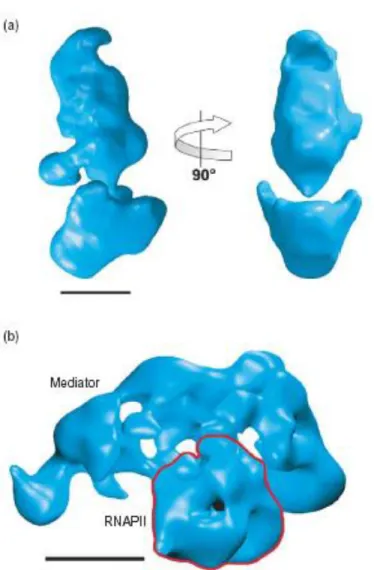
Figure 1. Structure of the yeast Mediator and holoenzyme complexes.
(a) A 3D reconstruction of the yeast Mediator structure was calculated from images of individual particles imaged in an electron microscope after preservation in stain. Mediator has a compact, roughly triangular shape. A large domain at the bottom is linked by a thin connection to the top portion of the structure. The resolution of the reconstruction is 35- A° , and the scale bar represents 100 A° .
(b) (b) Structure of the Mediator–RNA polymerase II holoenzyme complex calculated from electron
microscope images of individual particles preserved in stain. Previous characterization of the polymerase and Mediator structures led to identification of the Mediator and RNA polymerase II (red outline) portions of the
holoenzyme structure. In the holoenzyme, Mediator adopts an extended conformation, embracing the central polymerase density. The resolution of the reconstruction is w35 A° , and the scale bar represents 100 A° .
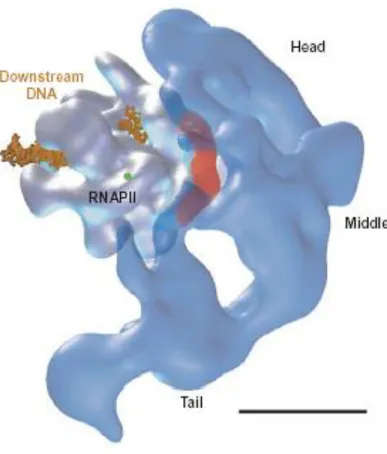
Figure 3. Interaction of Mediator and RNA polymerase II (RNAPII) in the holoenzyme complex. The precise
orientation of RNAPII in the holoenzyme complex was established by 2D cross-correlation analysis between holoenzyme and RNAPII projections. The figure shows a cryoelectron microscopy reconstruction of polymerase fitted into the extended Mediator structure in the orientation determined by cross-correlation analysis. Multiple contacts between Mediator and RNAPII are established in the holoenzyme complex, involving mostly the head and middle domains, and distributed around the Rpb3–Rpb11 polymerase subunits (highlighted in red). The small green circle indicates the point where the
carboxyterminal domain of Rpb1 (the largest polymerase subunit), crucial for Mediator polymerase interaction, emanates from the surface of the enzyme. The bacterial homolog of the Rpb3–Rpb11 complex, the a2 homodimer, is involved in transcription regulation in bacteria,
suggesting a conservation between prokaryotes and eukaryotes of the RNA polymerase surface involved in regulation. The scale bar represents 100 A° .
Different forms of Mediator exist in different cell types/developmental stage and possibly gene context, depending on the kind of TFs bound.
Take-home message
:
Mediator is a large, multi-subunit protein complex.
showing both common and facutative subunits.
The composition, shape and MW is dictated by the
context where Mediator operates, i.e. TFs bound to
Enhancers and Promoters involved in any specific
interaction.
P
Transcribed sequence Sequence element Transcription factor Pol II+Basal complex CoActivators Proximal regulatory elements Possibly neededCoactivators and Corepressors:
Large protein complexes exhibiting several functions:
- Interaction with Transcription Factors ( sequence-specific TF )
- Histone PTM writers/erasers (in particular, HAT histone acetyl transferase) - Chromatin remodeling factors
- (ATP-dependent chromatin remodelers are a class of proteins that «remodel» nucleosomes over DNA, usually in ATP-dependent fashion)
CoA and CoR may be recruited:
a) directly by Transcription Factors
Histone acetylation
Prototype Coactivator: CBP
CBP = CREB binding protein (265KDa) and p300 are in fact general coactivators
CBP/p300
(encoded by different genes)
From: Perissi & Rosenfed, 2005, Nature Rev Mol Cell Biol, 6: 542-554 Co-activators participating in transcriptional activation by Nuclear Receptors
- do TFs induce any change in chromatin ?
p300
Enhancer activation.
Markers of enhancer activation: (discussed in Heinz 2015) TF binding
H3K4me1/me2 (see Henriques et al.) H3K27ac
eRNA
co-regulators (co-activator and co-repressor) including the HAT enzymes p300/CBP (binds directly to several TFs)
Among others, the Mediator, BRG1, MLL, BRD4 are also found at active enhancers
Activation of eRNA transcription (example in macrophages) Heinz et al., 2015 NF-kB Transcription elongation Factor b contains CTD kinase CDK8 and bromodomain protein 4
Enhancer transcription
Production of unstable short trancripts in both directions from the Enhancer (called eRNA) is considered today as an essential mark of enhancer activity.
In the nervous system, hundreds of genes are induced in response to sensory experience-dependent neuronal activation.
Exposure of primary neuronal cultures to an elevated level of potassium chloride (KCl) leads to membrane depolarization and an influx of calcium through L-type voltage-sensitive calcium channels.
The resulting increase in intracellular calcium level then triggers several calcium dependent signalling pathways that ultimately lead to changes in gene expression.
We used this in vitro neuronal culture system to characterize neuronal activity-regulated enhancers
• Enhancers identified using ChIP-Seq with CBP antibodies
Figure 4 | Enhancers bind RNA polymerase II (RNAPII) and produce eRNAs.
In c, F and R denote forward (1) and reverse (2) genomic strands. In d, enhancers are aligned oriented relative to the gene in which they reside to allow for sense and antisense RNA-Seq reads to be shown separately. Although sense eRNAs cannot be detected due to overlapping mRNA transcription, the red arrow indicates a local increase in antisense RNA expression attributable to eRNAs. Note different scales on the y axis in c and d.
eRNA are induced after stimulation
eRNA transcription confirmed by subsequent studies including ENCODE (described in one of the 2012 ENCODE articles by Djebali et al., Nature 2012)
eRNA unstable
Difficult to map using common RNA-Seq technologies «Nascent» RNA methods required (such as GRO-seq).
eRNA are unstable, long noncoding transcripts in both directions around enhancers
eRNA are mainly poly(A-)
eRNA transcription is increased in active enhancers, i.e. when the enhancer contacts a promoter and activates transcription
There is indication that knockdown of eRNA can influence enhancer function ?
Do eRNAs have any functional role ?
One approach is to knock them down and see if transcription of the connected genes is affected
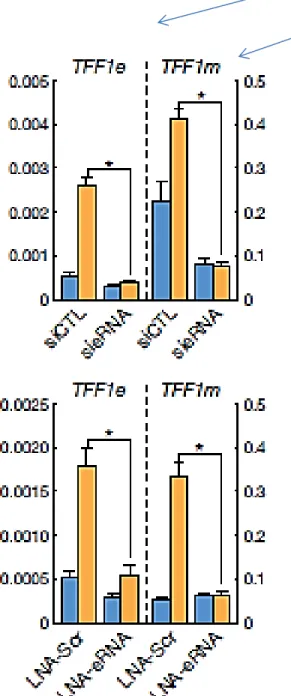
Figure 2 | Importance of eRNA for target gene activation. a, b, siRNA/LNA knockdown of eRNAs. Efficacy and effects on coding gene transcription
were assessed by qPCR for the TFF1, FOXC1 and CA12 eRNAs and corresponding coding transcription units. Lower case ‘e’ and ‘m’ after gene names denote
eRNA and gene mRNA, respectively. CTL, control; Scr, scramble. (Li et al., 2013)
eRNA knock-out using siRNA/LNA abrogates the enhancer effect on transcription
LNA= Locked Nucleic Acid eRNA at enhancer
Figure 1. Schematics of lncRNA-Directed cis-Regulatory Mechanisms
Model of ncRNA-a function as described by Lai et al. (2013).
An ncRNA-a interacts with the multisubunit Mediator complex to facilitate the formation of a long-range DNA loop, bringing the enhancer-like ncRNAa locus into
physical proximity with its target locus. This then leads to robust expression of the target gene.
RNA in the loop ?
In previous work they found lncRNAs with enhancer-like properties:
A class of lncRNAs, termed ncRNA-activating (ncRNA-a), that function to activate their neighbouring genes using a cis-mediated mechanism.
They systhematically siRNA noncoding RNAs and identified neighbouring down-regulated genes
HEK293 cells
(Human embryonal kidney)
1st question: is activation ncRNA dependent ?
MED12 is the only protein, among those tested, that affects RNA-a function Screening protein components for function in gene activity
2nd question: which component of the transcriptional machinery is involved ?
3° question: is this effect reproducible on the endogenous loci ?
sincRNA-a7
siMED1
siMED12 affected
RIP (RNA
immunoprecipitation) performed using IgG or MED1-Ab or MED12-Ab, using in vitro
transcribed ncRNA-a7 and controls.
Mediator purified using FLAG-tagged Med12
Controllo: FLAG-GFP
Conclusions
A new action of ncRNA was discovered ncRNA-a binds to Mediator
These ncRNAs are involved in looping interactions