Key Management Scheme for Smart Grid
Bashar Ahmed Alohali
A thesis submitted in partial fulfilment of the requirements of Liverpool John Moores University for the degree of Doctor of Philosophy
2
Acknowledgements
First, great thanks to my Almighty God, Allah, the most merciful and the most beneficent, for his blessings—which have given me the ability, strength and determination to complete a PhD at this prestigious institution—and for everything else he has given me.
I would like to take this opportunity to give thanks to many people for their help, in completing this thesis. Without their support and contributions, the successful completion of my thesis would not have been possible. I would like to express special thanks and gratitude for my director of studies, Dr Kashif Kifayat, for his continuous support, excellent supervision, significant feedback and encouragement, as well as for allowing me to share in his experience.
I would also like to give special thanks to my second supervisor, Professor Qi Shi, for his significant feedback and for the valuable time he spent helping me during many stages of my research. Furthermore, I am deeply thankful to my third supervisor, Dr William Hurst, for his kind support and advice during my PhD studies.
I would also like to express my appreciation to my previous director of studies, Professor Madjid Merabti, the Dean of the College of Sciences at University of Sharjah. I gratefully acknowledge his enthusiastic supervision, support, encouragement and invaluable suggestions during this research.
My thanks also go to the researchers, administration staff and technicians in the School of Computing and Mathematical Sciences at Liverpool John Moores University for their support over the past years.
I am grateful and appreciative toward the government of Saudi Arabia for supporting me financially during my PhD; this allowed this research to continue unimpeded. This support is gratefully acknowledged.
I am also very thankful to my beloved mother, brothers, sisters and wife; their prayers, encouragement and unconditional support enabled me to successfully complete my PhD.
3 I want to dedicate this thesis to dearly beloved mother; to the spirit of my father (may Allah have mercy on him); and to my wife.
4
Abstract
A Smart Grid (SG) is a modern electricity supply system. It uses information and communication technology (ICT) to run, monitor and control data between the generation source and the end user. It comprises a set of technologies that uses sensing, embedded processing and digital communications to intelligently control and monitor an electricity grid with improved reliability, security, and efficiency.
SGs are classified as Critical Infrastructures. In the recent past, there have been cyber-attacks on SGs causing substantial damage and loss of services. A recent cyber-attack on Ukraine's SG caused over 2.3 million homes to be without power for around six hours. Apart from the loss of services, some portions of the SG are yet to be operational, due to the damage caused. SGs also face security challenges such as confidentiality, availability, fault tolerance, privacy, and other security issues. Communication and networking technologies integrated into the SG require new and existing security vulnerabilities to be thoroughly investigated.
Key management is one of the most important security requirements to achieve data confidentiality and integrity in a SG system. It is not practical to design a single key management scheme/framework for all systems, actors and segments in the smart grid, since the security requirements of various sub-systems in the SG vary. We address two specific sub-systems categorised by the network connectivity layer – the Home Area Network (HAN) and the Neighbourhood Area Network (NAN). Currently, several security schemes and key management solutions for SGs have been proposed. However, these solutions lack better security for preventing common cyber-attacks such as node capture attack, replay attack and Sybil attack. We propose a cryptographic key management scheme that takes into account the differences in the HAN and NAN segments of the SG with respect to topology, authentication and forwarding of data. The scheme complies with the overall performance requirements of the smart grid.
The proposed scheme uses group key management and group authentication in order to address end-to-end security for the HAN and NAN scenarios in a smart grid, which fulfils data confidentiality, integrity and scalability requirements. The security scheme is implemented in a multi-hop sensor network using TelosB motes and ZigBee OPNET simulation model. In addition, replay attack, Sybil attack and node capture attack scenarios have been implemented and evaluated in a NAN scenario. Evaluation results show that the
5 scheme is resilient against node capture attacks and replay attacks. Smart Meters in a NAN are able to authenticate themselves in a group rather than authenticating one at a time. This significant improvement over existing schemes is discussed with comparisons with other security schemes.
6
Abbreviations
AMI Advanced Metering Infrastructure AES Advanced Encryption Standard BAN Business Area Network
CA Certificate Authority CoT Cloud of Things
DER Distributed Energy Resources DR Demand Response
DoS Denial of Service
ECC Elliptic Curve Cryptography ESI Energy Service Interface FAN Field Area Network HAN Home Area Network HMS Home Management System HMI Human Machine Interface
ICT Information and Communication Technology IAN Industrial Area Network
IED Intelligent Electronic Devices IoT Internet of Things
PK Public Key
QoS Quality of Service RTT Round Trip Time or Ping RTU Remote Terminal Unit
SCADA Supervisory Control And Data Acquisition SG Smart Grid
SM Smart Meter
MDMSs Meter Data Management Systems MTU Master Terminal Unit
SHA Secure Hash Algorithm LMN Last Mile Network MITM Man-in-the-middle attack MAC Message Authentication Codes MDMSs Meter Data Management Systems NAN Neighbor Area Network
7 NCA Node Capture Attack
VPP Virtual Power Plant WAN Wide Area Network
WAMS Wide Area Measurement System WoT Web of Things
WBAN Wearable Wireless Body Area Network WSNs Wireless Sensor Networks
8
Table of Contents
CHAPTER ONE: INTRODUCTION ... 15
1 INTRODUCTION ... 15
1.1 SMART GRID OVERVIEW AND CHARACTERISTICS ... 15
1.2 SECURITY CHALLENGES AND ATTACKS IN SMART GRID ... 17
1.2.1 Smart Grid security challenges ... 19
1.2.2 Attacks on Smart Grids ... 20
1.3 SECURITY REQUIREMENTS FOR A SMART GRID ... 22
1.4 PROBLEM DEFINITION ... 23
1.4.1 Key Management in Smart Grid ... 23
1.4.2 Node capture attack ... 25
1.4.3 Scalability ... 26
1.5 RESEARCH AIMS AND OBJECTIVES ... 26
1.6 CONTRIBUTIONS... 27
1.7 THESIS STRUCTURE ... 30
1.8 SUMMARY ... 31
CHAPTER TWO: SMART GRID BACKGROUND ... 32
2. BACKGROUND ... 32
2.1 SMART GRID TECHNOLOGIES ... 33
2.1.1 Advanced Metering Infrastructure (AMI) ... 33
2.2 SMART GRID ARCHITECTURE ... 35
2.2.1 Application Layer ... 37
2.2.2 Communication Layer ... 37
2.2.2.1 Home Area Network (HAN) ... 38
2.2.2.2 Neighbourhood Area Network (NAN) ... 38
2.2.2.3 Wide Area Network (WAN) ... 39
2.3 INTERNET OF THINGS (IOT) ... 40
2.3.1 Role of IoT in the Smart Grid ... 41
2.3.1.1 Cloud of Things (CoT) ... 42
2.4 SECURITY IN THE SMART GRID ... 43
2.5 SECURITY CHALLENGES IN THE SMART GRID... 44
2.5.1 Data Confidentiality ... 46
2.5.2 Integrity ... 46
2.5.3 Availability ... 47
2.5.4 Privacy ... 47
2.5.5 Key Management ... 47
2.5.5.1 Key Management Issues in the Smart Grid ... 48
2.5.5.2 Meta-system Interconnections ... 49
2.6 ATTACKS ON THE SMART GRID ... 50
2.6.1 Node Capture Attack ... 50
2.6.2 Denial of Service (DoS) ... 52
9
2.6.4 Replay Attacks and Data Injections ... 55
2.6.5 Repudiation Attack ... 56
2.6.6 Eavesdropping Attack ... 57
2.7 SUMMARY ... 57
CHAPTER THREE: LITERATURE REVIEW ... 60
3. INTRODUCTION ... 60
3.1 KEYMANAGEMENTINTHE HOMEAREANETWORK (HAN) INA SMARTGRID ... 62
3.2 KEY MANAGEMENT FOR NAN ... 64
3.3 KEY MANAGEMENT IN THE IOT ... 65
3.4 GROUP-BASED KEYMANAGEMENT ... 65
3.5 AUTHENTICATION AND KEY MANAGEMENT FOR AMI ... 70
3.6 COMPARING SCHEMES AVAILABLE FOR HAN AND NAN ... 75
3.7 SUMMARY ... 77
CHAPTER FOUR: KEY MANAGEMENT SCHEME FOR COMMUNICATION LAYER IN THE SMART GRID (KMS-CL-SG)... 79
4. INTRODUCTION ... 79
4.1 THE KEY MANAGEMENT SCHEME FOR THE SMART GRID HOME AREA NETWORK (KM-HAN) 79 4.1.1 Network Architecture ... 79
4.1.2 Notations and Assumptions ... 80
4.1.3 Proposal Overview ... 81
4.1.4 A Group Key Management Scheme for HAN ... 82
4.1.5 Pre-deployment Phase ... 82
4.1.6 The High Source Devices H Group ... 82
4.1.7 The Low Sources Devices - L Group ... 83
4.1.8 Communication phase ... 83
4.1.9 The High Source Devices H Group ... 84
4.1.10 The L Group ... 84
4.1.11 Security Analysis ... 85
4.2 THE KEY MANAGEMENT SCHEME FOR THE SMART GRID NEIGHBOURHOOD AREA NETWORK (NAN)(KM-NAN) ... 86
4.2.1 The Smart Grid Network Model ... 86
4.2.2 Threat Model and Assumptions ... 88
4.2.3 Notations ... 91
4.2.4 Key management and authentication of Group Gateway GW ... 92
4.2.5 Case 1- Star-Star Topology ... 93
4.2.6 Case Two - Multi-Hop (mesh) ... 95
4.2.7 Network Discovery and Registration ... 95
4.2.8 Authentication of the Smart Meters, SMng ... 95
4.2.9 Updating of MKGW ... 98
4.3 SECURITY ANALYSIS ... 100
4.3.1 Node capture attack ... 101
4.3.2 Replay Attack ... 101
10
4.4 SUMMARY ... 105
CHAPTER FIVE: IMPLEMENTATION AND EVALUATION ... 107
5. INTRODUCTION ... 107
5.1 TEST BED DEVELOPMENT ... 107
5.1.1 TinyOS ... 107
5.1.2 NesC... 108
5.1.3 Selection of Hardware ... 108
5.2 HOME AREA NETWORK (HAN) ... 109
5.2.1 Development of the group controller ... 111
5.2.2 Development Platform & Devices ... 111
5.2.3 Energy Consumption ... 115
5.2.4 Implementation of replay attack ... 116
5.2.5 Implementation of node capture attack ... 117
5.2.6 Implementation of Sybil attack ... 118
5.3 NEIGHBOURHOOD AREA NETWORK (NAN) ... 118
5.4 REPLAY ATTACKS IN A NAN ... 126
5.4.1 Sybil attack ... 129
5.5 SUMMARY ... 131
CHAPTER SIX: SIMULATION STUDY AND PROTOCOL VERIFICATION... 133
6. INTRODUCTION ... 133
6.1 THE NEED FOR SIMULATION ... 133
6.2 TOOLS, LIMITATIONS & METHODOLOGY ... 133
6.3 MODELLING THE HAN WITH THE RIVERBED MODELLER ... 134
6.3.1 Simulation set up ... 134
6.3.2 End-to-end delays ... 134
6.3.3 Simulation of Replay Attack ... 136
6.4 MODELLING THE NAN WITH THE RIVERBED MODELLER ... 136
6.4.1 Results ... 137
6.4.2 Node capture attack ... 139
6.5 PERFORMANCE STUDY OF THE KM-NAN AND ILLUSTRATION OF THE KM-NAN’S RESILIENCE ON DIFFERENT COMMUNICATION NETWORK TOPOLOGIES IN THE NAN ... 139
6.5.1 Network Security Model ... 141
6.5.2 Network Threat Model and Performance Metrics... 142
6.5.3 Network Topology and Simulation Setup ... 142
6.6 SUMMARY OF SIMULATIONS ... 143
6.7 VERIFYING SECURITY PARAMETERS ... 143
6.7.1 Language of Scyther ... 144
6.7.2 Specifying security requirements in Scyther ... 145
6.7.3 Executing the security protocol in Scyther ... 146
6.7.4 Verification of KM-HAN and KM-NAN ... 146
6.8 SUMMARY ... 148
CHAPTER SEVEN: CONCLUSION AND FUTURE WORK ... 150
11
7.1 CONTRIBUTIONS... 150
7.2 FUTURE WORK ... 152
7.2.1 Prevention in the Wide Area Network (WAN) ... 152
7.2.2 Economics and Energy Storage Technology issues ... 152
7.2.3 Big Data Challenges ... 153
7.2.4 Substation Distribution/Automation System ... 153
7.3 CONCLUSION ... 154
12
List of Figures
FIGURE 1-1:COMMUNICATION DOMAINS IN A SMART GRID ... 16
FIGURE 1-2:SMART GRID - A HETEROGENEOUS NETWORK ... 17
FIGURE 1-3:LAYERED FUNCTIONAL VIEW OF THE SMART GRID ... 18
FIGURE 2-1:THE AMI NETWORK ... 34
FIGURE 2-2:FOUR MAJOR COMPONENTS OF THE AMI[10] ... 34
FIGURE 2-3:SMART GRID ARCHITECTURE -OVERVIEW [60] ... 35
FIGURE 2-4:AN OVERVIEW OF SMART GRID COMMUNICATION DOMAINS ... 37
FIGURE 2-5:HAN COMMUNICATION TECHNOLOGIES ... 39
FIGURE 2-6:ROLE OF IOT IN SMART GRIDS [79] ... 41
FIGURE 2-7:COT FOR A SMART GRID ... 43
FIGURE 2-8:SECURITY REQUIREMENTS ... 45
FIGURE 2-9:TAXONOMY OF SECURITY CHALLENGES IN THE SMART GRID [101] ... 46
FIGURE 2-10:NAN TOPOLOGIES - IMPACT OF COMPROMISED NODES ... 51
FIGURE 2-11:NAN TOPOLOGIES (TREE,MESH AND STAR) ... 52
FIGURE 2-12:TYPES OF SYBIL ATTACKS [117] ... 54
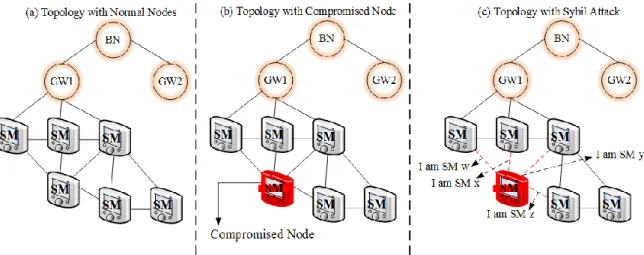
FIGURE 2-13:SYBIL ATTACK DUE TO COMPROMISED NODE IN THE NAN ... 55
FIGURE 2-14:REPLAY AND DATA INJECTION ATTACKS DUE TO A COMPROMISED NODE IN THE NAN ... 56
FIGURE 4-1:PRE-DEPLOYMENT STEPS FOR THE HAN ... 83
FIGURE 4-2SMART GRID NETWORK MODEL ... 88
FIGURE 4-3AUTHENTICATION FOR GROUP GATEWAY ... 93
FIGURE 4-4:PRE-DEPLOYMENT OF A NAN IN STAR TOPOLOGY ... 94
FIGURE 4-5:AUTHENTICATION OF AN END DEVICE IN A NAN WITH STAR TOPOLOGY ... 94
FIGURE 4-6PRE-DEPLOYMENT FOR A MULTI-HOP NAN TOPOLOGY ... 96
FIGURE 4-7PROTOCOL FOR NAN IN A CASE 2 ... 99
FIGURE 5-1TELOSB SENSOR MOTE ...109
FIGURE 5-2 THE IMPLEMENTATION OF HAN IN TELOSB MOTES ...110
FIGURE 5-3:TOPOLOGY OF A HAN ...110
FIGURE 5-4:THE SENDMSG() TASK ON THE END DEVICE ...112
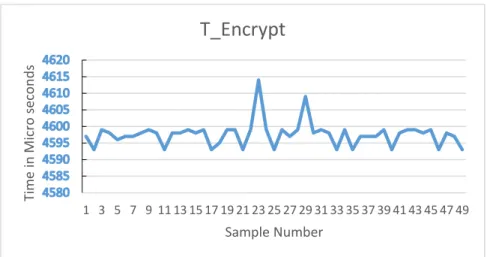
FIGURE 5-5:TOTAL TIME TAKEN FOR ENCRYPTION AND DECRYPTION AT SENDER AND RECEIVER NODES ...113
FIGURE 5-6:THE RECEIVE() TASK ON THE END DEVICE ...113
FIGURE 5-7:OUTPUTS OF SSENDER AND RECEIVER MOTES INDICATING TIMESTAMPS IN MU-SECS (COL 1), TIME TO ENCRYPT/DECRYPT (COL 2) AND TIME TO SIGN/VERIFY (COL 3) ...114
FIGURE 5-8:TOTAL TIME TAKE FOR SIGNING AND VERIFYING AT THE SOURCE AND DESTINATION NODES ...114
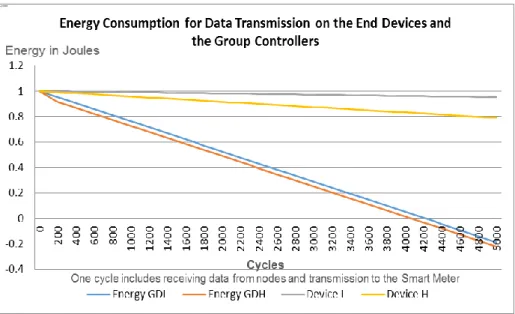
FIGURE 5-9:ENERGY CONSUMPTION DURING THE COMMUNICATIONS PHASE ...115
FIGURE 5-10:THE REPLAY ATTACK PROGRAM WITH PROMISCUOUS RECEIVE AND RESEND ...117
FIGURE 5-11RECORDING THE RECEIVED TIME STAMPS AND STORING THEM FOR COMPARISON ...118
FIGURE 5-12DIFFERENT AM TYPES FOR PACKETS DESTINED UPSTREAM AND DOWNSTREAM WITH REFERENCE TO THE END DEVICE ...119
FIGURE 5-13:APPLICATION PACKET TYPES FOR THE AUTHENTICATION PROCESS ...119
FIGURE 5-14:OUTPUT OF THE MOTES FROM L-SM TO NOC AND BACK ...120
FIGURE 5-15:THE TOPOLOGY OF THE NAN IMPLEMENTATION USING TELOSB MOTES ...121
FIGURE 5-16:OUTPUT OF THE MOTE LABELED NOC ...121
FIGURE 5-17:OUTPUT AT THE MOTE LABELED GW ...122
FIGURE 5-18:OUTPUT AT THE MOTE LABELED H-SM ...122
FIGURE 5-19:OUTPUT AT THE NODE LABELED L-SM ...123
FIGURE 5-20:TIME TAKEN FOR AES DENCRYPTION OF A 16-BYTE BLOCK ON MOTES IN A MESH TOPOLOGY .124 FIGURE 5-21:TIME TAKEN FOR AES ENCRYPTION OF A 16-BYTE BLOCK ON MOTES IN A MESH TOPOLOGY ....124
13
FIGURE 5-23:RTT FROM L-SM TO NOC IN STAR TOPOLOGY (1-HOP) ...125
FIGURE 5-24:SCREEN CAPTURE OF THE OUTPUT OF THE PACKET REPLY PROGRAM (SNIFF AND REPLAY) ...127
FIGURE 5-25:MODELING REPLAY ATTACK WITH THE TELOSB ...128
FIGURE 5-26:FLAGGING A DUPLICATE AUTHENTICATION PACKET FROM THE SAME NODE ...128
FIGURE 5-27:OUTPUT OF THE MOTE LABELED NOC INDICATING DUPLICATE AUTHENTICATION REQUESTS FROM THE SAME NODE ...129
FIGURE 5-28:OUTPUT AT A NODE LABELED NOC WHEN A NODE ASSUMES ANOTHER NODE'S ID(SYBIL ATTACK)...130
FIGURE 5-29:OUTPUT AT THE NODE LABELED NOC, TO A SYBIL ATTACK ...131
FIGURE 6-1:THE SIMULATED HAN SCENARIO ...134
FIGURE 6-2:THROUGHPUTS IN THE HAN SEGMENT ...135
FIGURE 6-3:END-TO-END DELAY IN HAN SCENARIO (SECONDS) ...135
FIGURE 6-4:INCREASE IN END-TO-END DELAY IN THE HAN(DEVICE TO GC) DURING A REPLAY ATTACK ...136
FIGURE 6-5:INFORMATION TRANSFER %AGE DURING NODE CAPTURES IN THE HAN ...136
FIGURE 6-6:MODELING THE NAN IN THE MESH TOPOLOGY...137
FIGURE 6-7:MODELING THE NAN IN A STAR TOPOLOGY ...138
FIGURE 6-8:END-TO-END DELAY IN THE NAN SCENARIO ...138
FIGURE 6-9:THROUGHPUTS IN THE NAN SCENARIO ...139
FIGURE 6-10:COMPARING THE NUMBER OF COMPROMISED NODES IN [50],[51], COMPARED TO KM-NAN...140
FIGURE 6-11:NETWORK TOPOLOGY FOR SIMULATING A NODE CAPTURE ATTACK ...141
FIGURE 6-12:REACHABILITY OF NODES AFTER NODE CAPTURES/FAILURES ...143
FIGURE 6-13:EXAMPLE SCYTHER CODE SHOWING A TWO-AGENT PROTOCOL USING SYMMETRIC KEYS ...145
FIGURE 6-14:OUTPUT OF UNBOUNDED RUNS FOR THE H-GROUP IN THE HAN ...147
FIGURE 6-15:OUTPUT OF UNBOUNDED RUNS FOR THE L-GROUP IN THE HAN ...147
14
List of Tables
TABLE 2-1DIFFERENT COMMUNICATION TECHNOLOGIES IN A SMART GRID ... 40
TABLE 2-2:DOS ATTACKS IN POWER SYSTEMS [107] ... 52
TABLE 2-3:ATTACKS ON A HAN AND THEIR IMPACT ... 57
TABLE 2-4:SECURITY REQUIREMENTS FOR A HAN ... 58
TABLE 2-5:SECURITY REQUIREMENTS FOR A NAN ... 58
TABLE 3-1:MAJOR DIFFERENCES BETWEEN WSN AND SG NETWORKS ... 61
TABLE 3-2:GAP IN EXISTING SOLUTIONS FOR THE HAN ... 74
TABLE 3-3:GAPS IN EXISTING LITERATURE FOR NAN ... 76
TABLE 4-1:NOTATIONS USED TO REPRESENT THE SCHEME ... 80
TABLE 4-2:NOTATIONS USED FOR KMS-NAN ... 92
TABLE 4-3:KEY MANAGEMENT ISSUES RESOLVED IN KM-HAN,KM-NAN ...105
TABLE 4-4:COMPARISON OF THE OVERHEADS OF THE SECURITY SCHEMES ...105
TABLE 5-1 COMPARES THE CHARACTERISTICS OF THESE MOTES ...109
TABLE 5-2MEASUREMENT OF THE SCHEME ENCRYPTION AND DECRYPTION TIMES IN MICRO-SECONDS AND RTT IN CASE1 ...123
TABLE 5-3MEASUREMENT OF THE SCHEME ENCRYPTION AND DECRYPTION TIMES IN MICRO-SECONDS AND RTT IN CASE2 ...123
15
Chapter One: Introduction
1
INTRODUCTION
In the last decade the term “Smart Grid” has been used to indicate the fulfilment of typical requirements of energy systems, such as conservation of resources, saving operational expenditure (OPEX) and effective control. The term Smart Grid generally refers to an advanced electricity grid in which the distribution, transmission, generation, and control of power systems are better coordinated, monitored and controlled by the integration of the Smart Grid infrastructure with an advanced information and communication technologies (ICT) infrastructure for improving the reliability, efficiency, economics, security and safety of the electricity grid. It enables a two-way digital communication between utility company and consumer, to communicate to/from smart meters and similar intelligent monitoring systems [2]. However, research on Smart Grids is currently at a fairly early stage; therefore, there are several issues being researched. An essential issue is that Smart Grids must be operationally secure in order to withstand security threats from malicious elements. Secure end-to-end communication is crucial. A fundamental requirement for a secure Smart Grid is to use a key management scheme for secure communication. This thesis addresses key management in secure schemes for the Smart Grid.
This chapter is organised as follows. First, the topic of the thesis is presented and the aims and objectives of the study are enumerated. Second, the novel contributions of the new approach to security in the Smart Grid in the thesis are presented. Third, an overview of the thesis chapters is presented and followed by a summary of the chapter.
1.1 Smart Grid overview and characteristics
A Smart Grid comprises a set of technologies that uses sensing, embedded processing and digital communications to intelligently control and monitor an electricity grid with improved reliability, security, and efficiency. It is a meta-system that, unlike current wireless or other computer networks, uses a complex network to communicate with many heterogeneous devices and systems with different sub-systems [3]. The complexity of the network is a consequence of the services provided by the Smart Grid and the roles played by each of its functional components. It is divided into seven functional components, namely, Customer,
16 Service Provider, Power Generation, Transmission, Distribution, Operations and Markets. Each of these components serves a specific role and needs to communicate with other components to be able to provide an efficient service. The typical characteristics of a Smart Grid are listed below:
Improved reliability, efficiency, security and environment by increasing use of
digital information and control systems.
Grid operation and resources in dynamic optimisation with cyber security.
Integrate distributed resources and generation.
Integrate distributed demand response.
Distribution of intelligent technologies for communication, meter, AMI and
substation automation [4] .
Integration of intelligent applications and real-time pricing.
Figure 1-1: Communication domains in a smart grid
The Smart Grid is a modern power electricity system. It operates with sensors, communications, monitoring, automation and computer to achieve safety and security, flexibility, efficiency and reliability in the electricity system. It is an electricity system, which deals with a large number of customers and has an intelligent communications
17 infrastructure. It enables timely, safe, secure and adaptable information flow needed to provide power to the
evolving digital economy. There are many benefits of the Smart Grid, such as operation based on real-time data, two-way power flow and renewable power generation.
Figure 1-2: Smart Grid - a heterogeneous network
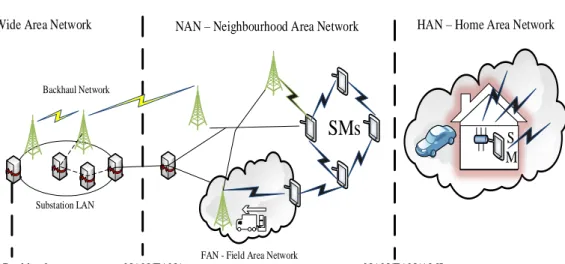
A Smart Grid can be considered as a heterogeneous network, as shown in Figure 1-2, based on the integration of multiple networks such as the Home Area Networks (HANs) for effective energy monitoring, control and management at the consumer end; the Neighbourhood Area Network (NAN) for providing advance metering infrastructure to meter and monitor the HANs; and the Wide Area Network (WAN) to integrate automation on to the Smart Grid backbone [5]. The HAN interconnects to the WAN via a Smart Meter (SM), which is part of the NAN. The majority of the devices in the HAN and NAN are wireless communication nodes. The interconnectivity of SMs into the NAN is collectively referred to as advanced metering infrastructure (AMI) and is the focus of this thesis. The NAN is an interconnection of SMs creating a network (with different topologies), consisting of smart meters and gateways that relay data. The functional layered model is indicated in Figure 1-3. Our focus is on the communication layer in this model.
1.2 Security Challenges and Attacks in Smart Grid
Recently cyber-attacks on critical infrastructure have highlighted security as a major requirement for Smart Grids [6]. Despite its numerous advantages, there are many security
HAN – Home Area Network
S M
SMs
Substation LAN Backhaul Network
NAN – Neighbourhood Area Network
FAN - Field Area Network WAN – Wide Area Network
NAN/FAN/AMI Demarcation NAN/FAN/ AMI Demarcation Core -Backhaul Demarcation
18 challenges and issues in the Smart Grid, such as access control and identity management, connectivity, privacy, data analysis issues and minimizing cost [7].
Figure 1-3: Layered functional view of the smart grid
The Smart Grid is classified as a critical infrastructure that provides an essential service to users. The challenge in securing the Smart Grid is that the security solutions should be easily deployable, integrate-able and useable without affecting the performance requirements. Many security solutions have been proposed to fulfil the security requirements of a Smart Grid. However, these solutions are specifically designed for specific security issues, based on a varied set of assumptions, and limited to portions of the functional Smart Grid infrastructure.
Deploying a Smart Grid without adequate security might result in serious consequences such as grid instability, utility fraud, and loss of user information and energy-consumption data [8]. According to a report published by Krebson Security [9], the FBI investigated the hacking of Smart Grid meters in Puerto Rico, Brazil. The bureau distributed an intelligence alert about its findings to select industry personnel and law enforcement officials. The FBI said that it believed former employees of the meter manufacturer and employees of the utility company were altering the meters in exchange for cash, and training others to do so because of “the ease of exploitation and economic advantage to the hacker and the electric customer”
Therefore, it is important to ensure that the data carried by the Smart Grid system is kept confidential and that no one but the right receiver can access the data [9].
19 In this section we explain the major challenges faced in securing Smart Grids and then we relate the challenges to factors that caused recent attacks on Smart Grids.
1.2.1 Smart Grid security challenges
We list six major challenges faced in securing a Smart Grid. Note that these challenges eventually map on to the three major security requirements, namely, Confidentiality, Integrity and Availability.
a. Access control and identity management: There are several challenges with the existing protocol including efficiency, delay, lower overhead and privacy
[10]. It is a challenge to ensure that data transmitted via Smart Grids is kept
confidential and that no one but the intended receiver is able to see the message. In addition, the Smart Grid contains many components that are interconnected [11]. Because of security concerns related to this, authentication is needed to verify the identity of the receiver in order to avoid any disruption or exploitation [12]. Access to the control centre, transmission, and distribution grids is allowed only for authenticated users, groups, and services [13].
b. Privacy and security policies: There is a challenge for suitable security policies to establish relationships among consumers, utilities, and third parties, although applying security and privacy policies should not result in unsatisfactory operational latencies. Information security policies define the guiding rules that security controls are applied to secure data, communication routing, processes and systems. In various cases, the information and network protection policies used by utilities need to update [14].
c. Threat defence: There are several vulnerabilities inherent in Smart Grids; therefore, it is a challenge to protect the grids from defined threats by building an effective, layered defence system to function broadly across the entire grid infrastructure. Threat defence provides network segmentation and access control to defend against denial-of-service (DoS) attack. In addition, it provides a suite of security technologies such as firewall, IPS and VPN [13].
20
d. Physical security: Smart Grid systems can have thousands, and often even millions, of remote points and field area networks. This makes it challenging to maintain the physical security of the Smart Grid. The geographical dispersion of these systems also means that it may be difficult to access all of the terminals for maintenance [15].
e. Connectivity: Communications connectivity in Smart Grids implies a transition towards an Internet-like distributed environment in which huge numbers of devices are interconnected. This is one of the emerging challenges in this area and as such the application of protective techniques is important [13].
1.2.2 Attacks on Smart Grids
Assailants with different motives and skills can take advantage of weaknesses in the security of a Smart Grid system, and can cause different levels of damage to the system. Attackers at the top level include online hackers, terrorists, workers, opponents, clients, and so on. For example, a client may change data or information, and obtain power without paying for it.
According to Rautmare et al. [16] “the exploitation of the network control system may result in disruption and breaks in operation. That may lead to disruption of service and loss of manufacturing, neither of which is allowable”.
a. Cyber-attack on Ukraine's power grid: In 2016, when more than 100,000 people in and around the Ukrainian city of Ivano-Frankivsk were left without power for six hours, the Ukrainian energy ministry accused Russia of launching a cyber-attack on the country's national energy grid [17].
b. Stuxnet: In 2010, Stuxnet was discovered. It is an advanced and sophisticated malware program that targets industrial control systems. Industrial control systems targeted by Stuxnet are reprogrammed to hide any changes made by a Stuxnet attack. In the early days of Stuxnet attack infection, Iran was the most affected country [18]. However, since Stuxnet can self-replicate, other countries were affected, including Indonesia and India. Security specialists have found that Stuxnet is able to control the speed of motors, and is thus able to send nuclear centrifuges out of control [13]. It is a modern weapon in the cyber war. It was
21 used to transfer a payload for the target control system. It is the first industrial control system rootkit. It can self-update; in addition, it can inject code into the ladder logic of PLCs, and at that point alter the operations of the PLC, as well as hide itself by alarming false information back to the HMI. Moreover, it adapts to its circumstances [3].
c. Night Dragon: In 2011, McAfee reported the discovery of a series of coordinated attacks against energy, petrochemical and oil control systems. The attacks, which mainly began in China, were supposed to have commenced in 2009, functioning ceaselessly and covertly with regard to data extraction [16]. It did not expand its influence and harm as far as the Stuxnet attack; however, it did involve the theft of sensitive and important data. Furthermore, it alarms and evidence of how outside attackers can possibility infiltrate critical systems. At that period, the intended use of the stolen data was unknown, and it could have been used for many motives [3].
d. Slammer Worm: Security Focus reported in 2003 that the Slammer Worm had passed through a computer network and targeted a nuclear power plant in Ohio. For almost five hours, the safety monitoring system at the plant was disabled. The infection did not cause any harm, but it alarmed the control system, due to it being under possible attack [13].
e. Node capture attack: On Smart Grid application by malicious users such as decrease the reading of meters “electricity bills” or to break the services on people life and so on. Since the Smart Grid reaches each building as well as the complex of communications [19], therefore, it makes it difficult to guarantee physical protection for all the components in the system [6].
f. Other possible attacks: One of the well-known attack is the man-in-the-middle (MITM), which is a type of attack whereby the attackers break into an existing connection to interrupt the exchanged data and insert false information into the Smart Grid [20, 21]. This involves eavesdropping on a connection, intruding into a connection, interrupting messages, and carefully modifying data. In addition, Denial-of-Service (DoS) takes place when a system denies service to authorised clients. This may be caused due to resource exhaustion by
22 unauthorised clients. It is difficult to avoid the DoS in a Smart Grid. Also, it is difficult to stop an on-going attack since the victim and its client may not catch the attack. In this kind of attack, the attacker prevents legal users from having access to information and services by targeting the victim’s device and the network connection; this attack stops the user from making outgoing connections on the Smart Grid. Jamming is a DoS attack which targets wireless communication frequency in the Smart Grid [22]. When they are in close range, large amounts of noise may be generated in these appliances. The communication can be jammed so as to make the signal noise very low, and this could lead to the Smart Grid not functioning [23].
1.3 Security requirements for a Smart Grid
In this section, a general and brief review about security requirements in the Smart Grid will be presented including availability, data confidentiality, data integrity and authentication.
In the Smart Grid, the security requirements are one of the main considerations that should be addressed, as malicious users and attackers can modify customers’ data or cause any type of attack on an unsecured Smart Grid. Therefore, we should take into account the following factors when considering the security requirements of a Smart Grid:
a. Availability: Availability is one of the primary requirements for a Smart Grid. It
is the availability of data in the entire network. The best way to achieve this aim is to have network management and supervision by implementing a reliable and suitable transport layer solution. Therefore, resources should be available in the nodes throughout the whole network. All components should have the capability of self-healing in case any of them fails [24-26]. For example, in the case where power to a node is lost, the other nodes need to reorganise themselves to maintain availability [27].
b. Confidentiality: to make sure that data is not changed or lost. Only permitted and
authorised entities should be given access to the data. One of the best ways to achieve confidentiality in a Smart Grid is by using a key management solution [1, 8, 28-30] for encrypting data and establishing a shared secret key among nodes.
23
c. Integrity: the authenticity of the data received must be confirmed; during the
transfer, it must be protected from attackers who are trying to manipulate it. Identity should be confirmed through strong verification. It should implement an implied refusal policy such that access to the network is granted only through precise access permissions [31, 32].
d. Security Weaknesses: Checks must be carried out to ensure that components that
interface with the border are protected. In some situations, customer activities can start possible security weaknesses [33]. As such, awareness applications should be put in place to inform the system’s customers about the best protection methods when using network resources and applications [27].
e. Devices must know the resources and destinations with which they connect. This
is achieved through common verification methods, applying Transport Layer Security (TLS) or Internet Protocol Security (IPSec) [34]. A reliable authentication method is needed while interacting between Smart Grid events. The authentication protocol must function in real-time adhering to restrictions such as lowest computational cost, low interaction expense, and sturdiness to withstand strikes especially Denial-of Service strikes.
f. Authorisation: Authorization is another key requirement for a Smart Grid. It is
important that the components of the HAN, NAN and WAN get authorised and is thus allowed to connect with other components. Moreover, it is a good way to make sure that Smart Grids are protected and no malicious node exists in the communication session, as such a node can obtain important information such as the cryptographic key or the secure ID [35].
1.4 Problem definition
1.4.1 Key Management in Smart Grid
Key management is crucial process to achieve data confidentiality (secure communication and information protection) for smart grid. Therefore, many key management schemes are proposed for smart grid. A smart grid comprises several distinct functional segments, which require exchanging data. Secure accesses as well as secure data transportation are two key
24 requirements for smart grid services. Most key management [8, 28-30, 36-45] schemes available are proposed for specific part of the Smart Grid. Those cannot be integrated due to different security requirements. Therefore, any schemes meant for the Smart Grid as a whole require being able to scale to the size of the network and handle a large concurrency of authentication and/or data transfer and/or command control requests. Bulk command control requests are necessary when addressing demand response situations or an emergency situation on the smart grid network. In addition to such situations, the scheme in place requires to scale in size when new segments of smart meters are added to the network. Such segment sizes can be considerably large (connecting a high-rise residential building or connecting an industrial estate). The security schemes require being able to scale to accommodate such additions and should not impact the storage and processing resources of the devices. These resources are typically used for storing shared keys and generating new hashes or keys. Therefore, scalability is an issue when considering key management for a secure scheme in a smart grid.
A consequence of scalability is the topology of the network. Quite often, the key management schemes are affected by the topology of the network of devices. For example, a tree based hierarchical topology provides a simple means of generating keys for downstream nodes in the sub-trees, whereas, for a mesh network, the key distribution can become a significant overhead, depending upon the degree of connectivity of the nodes. When the network is scaled, it is not unusual to resort to a clustered-tree approach (a mix of tree and mesh, aka partial-mesh) where a cluster head is responsible for the downstream nodes and requires relatively higher storage, if not processing resources. Topology is therefore a significant issue in terms of impact on the resource availability on the devices in smart grid networks. A good key management scheme must therefore be able to have the least impact on the resource requirement on the devices, regardless of the topology of the network.
The data flow within the smart grid extends from the home devices up to the NOC of the provider. A single security scheme that can cover the entire path of the data flow is an ideal requirement. However, while the technology limitations exist, the more important limitations are due to the two different administrative domains that the devices belong to. The devices in the home and the associated group controllers are the private domain of the householder whereas the smart meter and associated devices up until the NOC are the private
25 domain of the provider. The smart meter interfaces, these two domains and there is a sufficient cooperative action necessary to be able communicate across these two domains. Each domain is viewed as a security risk to another, necessitating a clear boundary between the operations within the home, within the smart grid and between the home and the smart grid. There are no instances of such security schemes that operate across these two domains, in literature. Therefore, designing an integrated security scheme that is interoperable across the domains is a challenging issue until there are regulatory guidelines in place for such communications.
Smart Grid is meta-system where many of systems and applications are integrated using highly complexity connectivity to handle huge amount of sensitive data and information figure 1-1. We should consider node capture attacks as a high threat for communication and data confidentiality. Moreover, ignoring security requirements related to sub-systems in Smart Grid can result in significant damage of data confidentiality or network performance to a Smart Grid. Where it is not practical to design a single key management scheme/framework for all systems, parties and segments in the Smart Grid, it is necessary to consider the security requirements of various sub-systems in the Smart Grid and design the security for the specific sub-system. A secure routing protocol on a smart grid builds logical connectivity among the nodes to form a network.
1.4.2 Node capture attack
A node capture attack involves physically capturing a node, extracting the stored information, use the node to send invalid data on the network or incapacitate it. This may lead to compromise of the entire Smart Grid communication. Moreover, the primary impact of a node capture is providing the attacker a means to launch other types of attack such as DoS, Sybil, Blackhole and other such attacks which affect of providing the proper services. Data confidentiality and customer privacy can be compromised, and that can be led by expansion of the huge amount of data that will be collected. The security of the HAN is not compatible with the security of the NAN.
Therefore, in the event of one of the nodes being compromised, it should not cause the entire security process to break down. The rest of the services should remain secure and available. These requirements should be fulfilled over the available computing and storage resources of the Smart Grid components. Thus, data confidentiality and data integrity are critical
26 requirements in Smart Grid. Compromise of data confidentiality has a significant effect on users’ privacy, which is important consideration that should be addressed.
There are various cryptographic key management solutions that have been proposed to deliver secure communication and decrease the impact of threat of node capture attacks on the Smart Grid. However, these solutions still suffer from its effects.
1.4.3 Scalability
The large-scale network in NAN poses far more challenges for the NAN’s nodes compared to nodes in HAN. The network topology in NAN is highly dynamic as nodes regularly join or leave the network session. The communication channel is also subject to many errors and interferences which illuminating unstable characteristics in terms of bandwidth and delay. In terms of solutions to these security challenges HAN and NAN, researchers have proposed different key management schemes [46-52] for secure communications. In the Smart Grid, these schemes try to provide better resilience against node capture attacks, However there is still a chance of the entire Smart Grid being compromised.
Another main issue in key management is to design an adaptable and independent scheme, which can be applicable in different Smart Grid scenarios. Therefore, the solution has to take into account the practical and real network and the requirements for the Smart Grid. Giving this challenge, our intention is to develop a secure end-to-end communication solution for HAN and for large scale NAN. The specific objectives for the solution and the aims on the study are detailed in the next section.
1.5 Research Aims and Objectives
The aim of this thesis is to present an integrated key management scheme that satisfies the communication layer (Figure 1-3) in Smart Grid (HAN, NAN) security requirements. Therefore, the integrated key management approach must be considered based on the communication network and associated security requirements. Thus, scheme should take into account the specific requirements of the Smart Grid system (HAN, NAN), such as availability, resilient to node capture attack, resilient to replay attack, resilient to Sybil attack, scalability, key freshness, and other related properties, such as low-energy consumption on devices. The scheme will secure the communication in the Smart Grid and
27 prevent any breaches due to malicious attacks. In the event of an attack or a compromise, the impact must be minimal and the operation of the rest of the Smart Grid infrastructure must not be affected in any manner.
To achieve the above-mentioned aim, we have identified the following objectives:
1. Design a key management scheme that offers secure communication for the
HAN in the Smart Grid
2. Implement the proposed key management scheme using TelosB motes in HAN
3. Design a key management scheme that offers secure communication for the
NAN in the Smart Grid
4. Implement the proposed key management scheme using TelosB motes in NAN
5. Design a secure authentication protocol that supports different communication
topologies in the NAN
6. A replay attack and Sybil attack scenarios have been implemented and evaluated
in a HAN and NAN scenario.
7. Implement the HAN and NAN network scenarios in a simulation environment
using Riverbed simulation to measure performance.
8. Evaluate the developed schemes for HAN and NAN by comparing them with
existing solutions.
1.6 Contributions
In completing the above objectives, we have made the following contributions in this thesis:
1. Key management scheme for a HAN:
Our proposed key management solution is designed for fulfilling HAN security requirements. We identify the various devices in a home, which are networked. After that we group the devices based on operational/functional factors such as their power consumption and the control functions required. Then, we identify the resource availability
28 on each device and assess the impact of an attack on the device type. We then list the security requirements of each device group. Based on that we design a secure key management interaction scheme for the groups in HAN. The protocol has been evaluated using TelosB motes and Riverbed simulation. The evaluation results show an improvement in terms of data confidentiality and resilience against node capture attacks. The security analysis is detailed in in chapter five.
2. Key management scheme for a NAN:
The main components in NAN segment are smart meters, which form a large-scale network. Therefore, to manage a large scale NAN, organising the NAN into groups of SMs is considered in our scheme. Group key management for NAN has been proposed. In order to achieve a secure end-to-end communication we assign a unique key to each node in the group. This unique key is shared only with the utility company server, and sends encrypted data through other nodes to the utility company Server without decryption at any non-utility company server. We have shown in chapter 6 that using this technique we achieve end-to-end confidentiality.
3. A light-weight authentication scheme for devices in the NAN:
In a large-scale environment such as the smart grid, network scalability and availability are two crucial design parameters for a secure scheme. Thus, organising the NAN into groups of SMs is necessary to with the obvious need for grouping SMs in a smart grid, group management is a necessary function within the smart grid. Identification of a group member, members joining/leaving the group is typical group management functions that require authentication. The group members in NAN need to be validated as part of the group. Such validated members can communicate between themselves, primarily for purposes of forwarding data to/from the group head. Therefore, we have proposed a new, secure, group authentication scheme for NAN for Smart Grid. The scenario of a multi-hop network is considered where the nodes require multiple hops to communicate with the NOC, which is the entity that issues the keys. Two topology scenarios, star-star and mesh are considered and separate authentication processes are defined for their operation. The main feature of our scheme is the ability to address security of all communication, which takes place in the network. Moreover, the scheme is specifically designed for NAN and centralized authentication. A detailed of the scheme found in chapter 5 of this thesis.
29
4. Development of HAN and NAN Test bed using TelosB motes
The secure schemes on a Smart Grid build a logical connectivity among the nodes and components. To evaluate our proposed scheme by launching Replay, Sybil and node capture attacks. Therefore, presents an analysis of the impact of the replay attack and Sybil attack when the scheme uses multi-hop forwarding with the intermediate nodes re-encrypting it for a specific upstream node.
a. Replay attack
We choose to perform the implementation of replay attack on TelosB mote, for launching replay attacks. Which was programmed to capture data packets sent from a smart meter and re-sending them at a later point in time, expecting to authenticate and gain entry into the network. The implementation comprises of four programs done by a nesc program in a TinyOS, one each for the three SMs and the NOC. These programs communicate with each other using the packet content and packet format used by the secure scheme in Fig 3.
The following steps are performed for the implementation of replay attack:
L-SM authenticates with NOC
Malicious node captures the authentication packets
Malicious node sends captured packets to NOC and attempts to authenticate
GW initially receives the packets, processes them and sends them to the NOC
NOC receives packets and processes them, identifies them as duplicate packets and
discards them.
b. Sybil attack
The Sybil attack was done using a TelosB mote, which was programmed to change its ID randomly, between IDs 110 and 115 and attempt to authenticate with the NOC. The NOC key and the gateway key were stored in the memory of the mote, emulating a capture of an authenticated mote. The first two pairs of messages show successful authentications from node IDs 111 and 112. Node 110 is already authenticated. The captured node attempts to authenticate as node 110 in the third pair of messages.
30 Node capture attacks in the proposed KM-NAN can significantly threaten network security as well as degrade performance. Based on the simulation results in figure 6-34, it is identified that partial mesh topology is more resilient topology as compared to star topology for KM-NAN against node capture attacks. As compared to KM-KM-NAN star, KM-KM-NAN mesh topology is more flexible as it can allow smart nodes to choose between multiple routes to transmit/receive data to the target location, if one of the node(s) compromised. Due to the flexibility offered by mesh topology, it is not only resilient but also an ideal solution with easy to deploy in KM-NAN.
1.7 Thesis Structure
Chapter one introduction: This chapter is organised as follows. First, the topic of the thesis is presented with its aims. Second, the novel contribution of the new approach posited in the thesis is presented. Third, an overview of the thesis chapters is presented. Finally, the chapter is summarised.
Chapter two Smart Grid Background: In this chapter, Smart Grid technology has been discussed followed by Smart Grid architectural layers. The communication layer (HAN, NAN and WAN) has been of great interest as this layer play a crucial role in the deployment of a Smart Grid based on the integration of HAN, NAN and WAN. This chapter introduces different Smart Grid technologies including AMI, WAMS, and substation distribution systems and so on. We then discussed in detail the Smart Grid architecture including an application layer, communication layer and power control system layer. Finally, we describe the IoT and its role of in the Smart Grid.
Chapter Three Security in the Smart Grid in this chapter discussed the main security issues in Smart Grid. We have explained general challenges related to communication and management where must be considered before Smart Grid benefits can be achieved. Moreover, this chapter provide a general and brief review about security requirement in Smart Grid will be presented including availability, data confidentiality, data integrity and authentication.
Chapter Four Literature Review. This chapter presents a critical overview on literature review and research works relating to key management, authentication. It also includes
31 discussions on the existing solutions of key management for HAN, NAN, WSN, SCADA and other.
Chapter Five Key Management Scheme for Communication Layer in the Smart Grid (KMS-CLSG). This chapter introduces our proposed solution. We have classified the solutions based on communication layer in Smart Grid networks, including Key
management in HAN and NAN.The chapter provide detail of security analyses.
Chapter Six Implementation and Evaluation. In this chapter we have explained the implementation and evaluation phase in our proposed solution. We have described the methodologies of the implementation including the attacks that have been addressing the in order to evaluate the proposed scheme such as replay attack, Sybil attack.
Chapter Seven Conclusion and Future Work. This chapter provides a summary of our contributions. We highlight some issues that may be addressed in future including security of WAN, integration of Smart Grid with cloud and design of a simulation tool for Smart Grid communications security. The thesis concludes by highlighting the work have been achieved and summary of results.
1.8 Summary
Over the last decade, the computer network, Internet of Things (IoT) and Wireless Sensor Networks (WSNs) have brought revolutionary changes to the means and forms of communication for a large number of applications including Smart Grids. The traditional energy networks have been modernised to Smart Grid to boost the energy industry in the context of efficient and effective power management, performance, real-time control and information flow using two-way communication between utility providers and end-users. However, integration of smart two-way communication in Smart Grids comes at the cost of cyber security vulnerabilities and challenges. It is a solution to such vulnerabilities that we address in proposing a secure end-to-end communication scheme for the HAN and NAN segments of the Smart Grid.
32
Chapter Two: Smart Grid Background
2.
Background
The advancement in information and communication technology (ICT) has not only given the world a smart and high-quality life but also an efficient power system, energy solutions and intelligent homes to live in. Energy is one of the fundamental requirements to fuel the smart technology and so a ‘smart’ way of living, and electricity is generally used as the primary source of energy.
According to a report by [53], worldwide energy consumption is predicted to increase annually by 1.6% from 2011 to 2030, adding 36% to the global energy consumption by the year 2030. In addition to the continuous growing demand for energy and the environmental concerns, efficient and effective power performance and management and pricing are becoming more and more critical requirements. The traditional 20th century power grids are not designed to handle rising power demand, increasing proportion of renewable, fluctuating energy generation, electricity blackout, integration with advanced communication and controls, and smart metering infrastructure. The continually growing dependence on electricity and demand for efficient and reliable energy distribution have been constantly addressed to provide a modernised electric system to ensure efficient and effective power performance and management, real-time bidirectional control and information flow between utility providers and end-users and active monitoring. Therefore, the Smart Grid is the future of the power grid; it is designed to meet the future energy requirements that entail capacity, reliability, efficiency, security, sustainability and safety.
To overcome the limitations and challenges experienced by traditional 20th century power grids and to fulfil the requirements of the 21st century, 20th century power grids have started to be replace by a modernised electricity system integrated with advanced communication and controls to enable responsive and resilient energy delivery. This modernised electricity system is known as a Grid System and is also defined as “electricity with a brain”, “the energy internet”, and “the electronet” [54].
33 In this chapter, we present an overview of the various aspects of the Smart Grid including Smart Grid technologies, architecture and IoT. The chapter concludes with a summary of the important points.
2.1 Smart Grid Technologies
The market for Smart Grid technologies is growing rapidly as the demand for more responsive and resilient energy delivery rises across the globe. The fundamental technology to integrate intelligence into the grid has been in place for decades. However, recent times have seen fast-tracking technological developments and shifting priorities among utility companies. The integration of ICT and Smart Grid has shown various technologies such as advanced metring system (AMI), wide area measurement system (WAMS), substation automation system and common information models (CIF), which are discussed in the following sub-sections.
2.1.1 Advanced Metering Infrastructure (AMI)
Advanced metering infrastructure (AMI) is core technology to deliver the operational and business benefits towards the implementation of the Smart Grid system. AMI plays a major role in providing the necessary communication and control functions required to deploy energy management services such as pricing schemes, meter readings, demand response and power quality. The deployment of AMI ensures a granular control for consumers to monitor the utilisation of energy in addition to growing distributed energy resources (DER). Ensuring a secure AMI is crucial to satisfy both the consumers and service owners that Smart Grids are reliable and trustworthy [55] .
It is a system that manages, gathers data, measures, analyses electricity usage and involves smart meters and service providers via two-way communication. AMI enables service providers to inform their users of electricity pricing at any time, and allow monitoring of demand in real time. Therefore, AMI is different from advanced meter reading (AMR) technology as it allows bi-directional meter communications [30]. According to the authors in [56], an AMI system involves different technologies and applications including smart meters, user gateways, home area network, wide-area communications infrastructure, and meter data management systems (MDMSs), which are integrated to perform as one system. Similarly, the authors in [57] state that AMI is a system used to collect, store, analyse, and
34 measure electricity usage data, which provides a fitting gateway between the consumer and electricity supply. Figure 2-1 below provides an illustration of the AMI network and how the components of this network communicate.
Figure 2-1: The AMI network
Figure 2-2: Four major components of the AMI [10]
SMs are installed in domestic and commercial establishments, and have to be interconnected to communicate with upstream management entities [55]. They require a topology to be formed, and the topology depends upon how they are distributed within a specific wireless range. Ideally, a single hop to the upstream node, typically performing ‘gatewaying’, ‘security/authentication’ and ‘data aggregation’ functions, is desired. This may be possible largely in dense areas such as structured high-rise buildings or shopping centres. In a sparsely inhabited area or condominiums, the limited wireless range of the SMs might require a multiple hop path to the upstream node in the NAN (Figure 2-2). This implies that the intermediate nodes in the hop path must provide an authenticated forwarding of data from the downstream nodes. The security mechanisms deployed must ensure that each node is authenticated centrally as well as by the group. The focus of this thesis is on a
A.Utility Company WAN Collector Event Manager Meter Data C. Smart Meter Metrology Board Communication Board Remote Disconnection Function B. Concentrator NAN Interface Short-term Storage Wireless Area Network Interface D. Home Home Gateway Display Controllers Portals
35 secure authentication scheme for such multi-hop networks formed by SMs in the NAN. The SMs in a group in the NAN need to authenticate within the group, and the group should be aware of SMs joining and leaving the group so as to ensure that the security assets distributed reach only the intended members of the group [55]. This aspect of security in NANs will be further discussed in subsequent sections of this chapter.
2.2 Smart Grid Architecture
In this sub-section, Smart Grid architecture is introduced. A discussion is put forward on the functionalities of each layer and related communication technologies are highlighted. Smart Grids heavily rely on high-speed, intelligent, reliable and secure bi-directional communication and control between utilities and consumers to coordinate the generation, distribution and consumption of energy effectively and intelligently. Due to a variety of communication components, the Smart Grid has been considered as a heterogeneous network infrastructure and generalised into four layers: application layer, communication layer, power control layer and power system layer, as shown in Figure 2-3.
Figure 2-3: Smart Grid architecture - Overview [60]
The power system layer involves electricity generation, distribution and customer premise. The power control layer is comprised of sensors, control systems (such as SCADA) and the power control system. The communication layer consists of WAN, NAN (field area
36 network), HAN/BAN. Finally, the application layer includes power transmission, customer application, and real-time pricing.
The application layer can generally be categorised into customer-side applications and grid-side applications. It provides Smart Grid applications for customers (such as information on energy usage or real-time pricing, critical peak pricing, automated controls for appliances and smart devices) and for the utility provider (such as substation monitoring, fault detection, integrated volt-VAR control [60].
The communication layer provides a network for the transport of data and information in a two-way, efficient, reliable and secure manner between the power systems and the data centre. As part of the communication layer, the HAN is initially a multi-supplier environment composed of smart appliances that need to be set-up together continuously using suitable standards such as ZigBee, and HomePlug NANs are employed for covering large geographical areas and distributed field devices. Typically, NANs use Wi-MAX (Worldwide Interoperability for Microwave Access) or 3G/4G for wide-range communication. Table 2.1 presents a comparison of different communication protocols and standards.
The WAN performs as the core network. It consists of the backbone network and the backhaul network. In the WAN, the backbone network connects the utility backbone and substation to provide high-capacity communication with minimal latency, and commonly uses optical fibres. To provide broadband connectivity to the NAN, the backhaul network is the link between the WAN and the NAN. In addition, it interconnects distributed systems such as sensors, SCADA, remote terminal units (RTU) and mobile workforces. The main task of the WAN is to transport the smart grid’s data to distant sites in an efficient and reliable way. Utility control centres have been operating WANs and managing the operations and processes in the grid for many applications, such as grid monitoring and SCADA [61].
The major components in Smart Grid architecture are Electric Household Appliances, Renewable Energy Resources, Smart Meter, Power utility Centre and Service provider [62], as illustrated in Figure 2-4.
37 Electrical Household Appliances (smart and legacy) are expected to be able to communicate with smart meters via a House Area Network (HAN), assisting efficient energy intake control to all home devices. The Smart Grid uses renewable energy resources such as solar and wind power to provide power to home devices. Smart meters contain a microcontroller that has memory, digital ports, timers, real-time, and serial communication facilities [63]. Smart meters sign-up the power intake generally and transmit it to the utility server, connect or detach a customer’s source of energy and send out alarms in case of a problem. The power utility communicates with the smart meters to control energy intake [62].
2.2.1 Application Layer
The application layer of a Smart Grid generally consists of consumer-end and grid-end applications. At the consumer-end it provides energy usage information, real-time cost, critical peak cost, and automated control for smart devices. At the grid-end, it provides substation monitoring and fault detection, etc. [60].
2.2.2 Communication Layer
Figure 2-4: An overview of smart grid communication domains
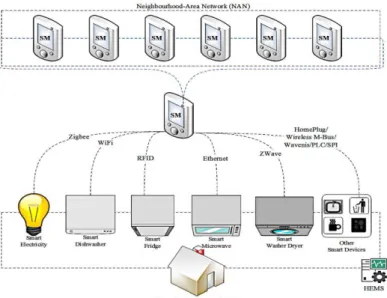
The Smart Grid is considered to be an intelligent network of meta-systems and subsystems providing energy cost-effectively and reliably. Figure 2-5 illustrates the communication network of a smart grid. It has a hierarchical structure, comprising three areas, Home Area Network (HAN), Neighbourhood Area Network (NAN) or Field Area Network (FAN) and Wide Area Network (WAN). Smart Grids derive benefit from the fact that homes can be automated using ubiquitous computing and such automation can help in
38 energy monitoring. It is the embedded Internet of Things that provides several services linked to physical devices or resource monitors and enables the management of the energy consumption of devices and appliances. The communication layer consists of three major IP-based and field-level communication networks: wide area networks (WAN), local area networks (LAN) and consumer area networks (CAN). The communication networks are further divided/categorised into more sub-communication networks, as listed below [60].
2.2.2.1 Home Area Network (HAN)
A home area network (HAN) is a sub-communication network at the CAN end, which helps to extend the Smart Grid capabilities into a home by exploiting various network technologies/protocols such as IEEE 802.15.4/ZigBee, Wi-Fi, RFID, Ethernet, Z-Wave, HomePlug, Wireless M-Bus, Wavenis [64], as shown in Figure 2-5. The HAN is sometimes referred as a Business Area Network (BAN) or Industrial Area Network (IAN), as these networks share many common characteristics and design disciplines. A HAN, integrated with sensors and actuators, enables the consumer end to remotely interconnect as well as control various automated smart devices ranging from smart meters to in-house displays, renewable energy sources and storage, to smart appliances such as washing machine, refrigerators, TVs, oven, lights, heating, ventilating, and air conditioning (HVAC), and plugs for electrical cars [64]. One of the important components of a HAN is the home energy management system (HEMS), which enables consumers to monitor how much power their household has consumed. The HAN enables dedicated demand side management (DSM) such as energy efficiency management and demand response through active involvement of power users and consumers [65]. A HEMS is the backbone of communication between SM and home appliance. To facilitate the interconnectivity in the HAN with external networks such as neighbourhood area network (NAN), which interconnects smart meters, an energy service interface (ESI) as a HAN gateway has been developed as part of the Utility AMI Open HAN Energy Services Interface.
2.2.2.2 Neighbourhood Area Network (NAN)
A Neighbourhood Area Network (NAN – sometimes referred to as a Field Area Network (FAN) or Last Mile Network (LMN)) is a sub-communication network at the LAN end. A NAN, as shown in Figure 2-6, consists of multiple HANs between the individual service connections to distribute electricity and information [66]. A data-aggregator unit (DAU)
![Figure 2-9: Taxonomy of security challenges in the smart grid [101]](https://thumb-us.123doks.com/thumbv2/123dok_us/1359457.2681906/46.892.164.752.106.411/figure-taxonomy-security-challenges-smart-grid.webp)
![Figure 2-12: Types of Sybil attacks [117]](https://thumb-us.123doks.com/thumbv2/123dok_us/1359457.2681906/54.892.147.781.215.475/figure-types-of-sybil-attacks.webp)