Contents
Department of the TreasuryInternal Revenue Service What’s New for 2009 . . . . 1
What’s New for 2010 . . . . 2
Publication 575
Reminders . . . . 2Cat. No. 15142B Introduction . . . . 2
General Information . . . . 3
Pension
Variable Annuities . . . .4Section 457 Deferred Compensation Plans . . . .5
Disability Pensions . . . .5
and Annuity
Insurance Premiums for Retired Public Safety Officers . . . 5Railroad Retirement Benefits . . . .6
Income
Withholding Tax and Estimated Tax . . . .8Cost (Investment in the Contract) . . . . 9
For use in preparing
Taxation of Periodic Payments . . . 10Fully Taxable Payments . . . .11
2009
Returns
Partly Taxable Payments . . . .11Taxation of Nonperiodic Payments . . . 14
Figuring the Taxable Amount . . . 15
Loans Treated as Distributions . . . .17
Transfers of Annuity Contracts . . . .18
Lump-Sum Distributions . . . .19
Rollovers . . . 26
Special Additional Taxes . . . 30
Tax on Early Distributions . . . .30
Tax on Excess Accumulation . . . .32
Survivors and Beneficiaries . . . 33
Hurricane-Related Relief . . . 34
Repayment of Qualified Hurricane Distributions . . . 34
Relief for Kansas Disaster Area . . . 35
Qualified Recovery Assistance Distribution . . . .35
Relief for Midwestern Disaster Areas . . . 36
Qualified Disaster Recovery Assistance Distribution . . . 36
Taxation of Qualified Disaster Recovery Assistance Distributions . . . 37
Repayment of Qualified Disaster Recovery Assistance Distributions . . . 37
Amending Your Return . . . .38
Loans From Qualified Plans . . . .38
How To Get Tax Help . . . 38
Simplified Method Worksheet . . . 41
Index . . . 42
What’s New for 2009
Get forms and other information
faster and easier by:
Waiver of required minimum distribution (RMD) rules for certain retirement plans and IRAs for 2009. NoInternet
www.irs.gov
RMD is required from your defined contribution plan or IRA for 2009. For more information, see Waiver of requiredminimum distributions (RMDs) for 2009, under Rollovers, lump-sum distributions from pension, stock bonus,
later. and profit-sharing plans.
•
How to roll over certain distributions from a retire-ment plan into another retireretire-ment plan or IRA.What’s New for 2010
•
How to report disability payments, and howbenefi-ciaries and survivors of employees and retirees must report benefits paid to them.
Rollovers to Roth IRAs. For tax years starting in 2010,
the $100,000 modified AGI limit on rollovers from eligible
•
How to report railroad retirement benefits. retirement plans to Roth IRAs is eliminated and married•
When additional taxes on certain distributions may taxpayers filing a separate return can now roll overapply (including the tax on early distributions and the amounts to a Roth IRA.
tax on excess accumulation). Also, for any 2010 rollover from an eligible retirement
plan (other than a Roth IRA) to a Roth IRA, any amounts
that would be included as income will be included in in- For additional information on how to report pen-come in equal amounts in 2011 and 2012. You can choose sion or annuity payments on your federal income to include the entire amount in income in 2010.
TIP
tax return, be sure to review the instructions on the back of Copies B, C, and 2 of the Form 1099-R that you received and the instructions for Form 1040, lines 16a and 16b (Form 1040A, lines 12a and 12b or Form 1040NR,Reminders
lines 17a and 17b).A “corrected” Form 1099-R replaces the corre-Hurricane and disaster-related tax relief. Special rules
sponding original Form 1099-R if the original apply to retirement funds received by qualified individuals
Form 1099-R contained an error. Make sure you who suffered an economic loss as a result of Hurricane CAUTION
!
use the amounts shown on the corrected Form 1099-R Katrina, Rita, or Wilma; the storms that began on May 4,
when reporting information on your tax return. 2007 in the Kansas disaster area; and the severe storms in
the Midwestern disaster areas. For more information on
these special rules see Hurricane-Related Relief, Relief for What is not covered in this publication? The following Kansas Disaster Area, and Relief for Midwestern Disaster topics are not discussed in this publication.
Areas.
The General Rule. This is the method generally used to
determine the tax treatment of pension and annuity income Photographs of missing children. The Internal
Reve-from nonqualified plans (including commercial annuities). nue Service is a proud partner with the National Center for
For a qualified plan, you generally cannot use the General Missing and Exploited Children. Photographs of missing
Rule unless your annuity starting date is before November children selected by the Center may appear in this
publica-19, 1996. Although this publication will help you determine tion on pages that would otherwise be blank. You can help
whether you can use the General Rule, it will not help you bring these children home by looking at the photographs
use it to determine the tax treatment of your pension or and calling 1-800-THE-LOST (1-800-843-5678) if you
rec-annuity income. For that and other information on the ognize a child.
General Rule, see Publication 939, General Rule for Pen-sions and Annuities.
Individual retirement arrangements (IRAs).
Informa-Introduction
tion on the tax treatment of amounts you receive from anThis publication discusses the tax treatment of distribu- IRA is in Publication 590, Individual Retirement Arrange-tions you receive from pension and annuity plans and also ments (IRAs).
shows you how to report the income on your federal
in-Civil service retirement benefits. If you are retired
come tax return. How these distributions are taxed
de-from the federal government (either regular or disability pends on whether they are periodic payments (amounts
retirement) or are the survivor or beneficiary of a federal received as an annuity) that are paid at regular intervals
employee or retiree who died, get Publication 721, Tax over several years or nonperiodic payments (amounts not
Guide to U.S. Civil Service Retirement Benefits. Publica-received as an annuity).
tion 721 covers the tax treatment of federal retirement benefits, primarily those paid under the Civil Service Re-What is covered in this publication? This publication tirement System (CSRS) or the Federal Employees’ Re-contains information that you need to understand the fol- tirement System (FERS). It also covers benefits paid from
lowing topics. the Thrift Savings Plan (TSP).
•
How to figure the tax-free part of periodic payments Social security and equivalent tier 1 railroad retire-under a pension or annuity plan, including using a ment benefits. For information about the tax treatment of simple worksheet for payments under a qualified these benefits, see Publication 915, Social Security andplan. Equivalent Railroad Retirement Benefits. However, this
•
How to figure the tax-free part of nonperiodic pay- publication (575) covers the tax treatment of the non-social ments from qualified and nonqualified plans, and security equivalent benefit portion of tier 1 railroad retire-how to use the optional methods to figure the tax on ment benefits, tier 2 benefits, vested dual benefits, andsupplemental annuity benefits paid by the U.S. Railroad ❏ 721 Tax Guide to U.S. Civil Service Retirement
Retirement Board. Benefits
Tax-sheltered annuity plans (403(b) plans). If you ❏ 915 Social Security and Equivalent Railroad work for a public school or certain tax-exempt organiza- Retirement Benefits
tions, you may be eligible to participate in a 403(b)
retire-❏ 939 General Rule for Pensions and Annuities ment plan offered by your employer. Although this
publication covers the treatment of benefits under 403(b) ❏ 4492 Information for Taxpayers Affected by plans, it does not cover other tax provisions that apply to Hurricanes Katrina, Rita, and Wilma these plans. For that and other information on 403(b)
❏ 4492-A Information for Taxpayers Affected by the plans, see Publication 571, Tax-Sheltered Annuity Plans
May 4, 2007, Kansas Storms and Tornadoes (403(b) Plans) For Employees of Public Schools and
Cer-tain Tax-Exempt Organizations. ❏ 4492-B Information for Affected Taxpayers in the
Midwestern Disaster Areas Comments and suggestions. We welcome your
com-ments about this publication and your suggestions for Form (and Instructions) future editions.
❏ W-4P Withholding Certificate for Pension or Annuity You can write to us at the following address:
Payments
❏ 1099-R Distributions From Pensions, Annuities, Internal Revenue Service
Retirement or Profit-Sharing Plans, IRAs, Individual Forms and Publications Branch
Insurance Contracts, etc. SE:W:CAR:MP:T:I
1111 Constitution Ave. NW, IR-6526 ❏ 4972 Tax on Lump-Sum Distributions
Washington, DC 20224
❏ 5329 Additional Taxes on Qualified Plans (Including IRAs) and Other Tax-Favored Accounts We respond to many letters by telephone. Therefore, it
would be helpful if you would include your daytime phone ❏ 8915 Qualified Hurricane Retirement Plan number, including the area code, in your correspondence. Distributions and Repayments
You can email us at *[email protected]. (The asterisk
❏ 8930 Qualified Disaster Recovery Assistance must be included in the address.) Please put “Publications
Retirement Plan Distributions and Comment” on the subject line. Although we cannot
re-Repayments spond individually to each email, we do appreciate your
See How To Get Tax Help near the end of this publica-feedback and will consider your comments as we revise
tion for information about getting publications and forms. our tax products.
Ordering forms and publications. Visit www.irs.gov/ formspubs to download forms and publications, call
1-800-829-3676, or write to the address below and receive
General Information
a response within 10 days after your request is received.Definitions. Some of the terms used in this publication
Internal Revenue Service are defined in the following paragraphs.
1201 N. Mitsubishi Motorway
Pension. A pension is generally a series of definitely
Bloomington, IL 61705-6613
determinable payments made to you after you retire from work. Pension payments are made regularly and are
Tax questions. If you have a tax question, check the based on such factors as years of service and prior
com-information available on www.irs.gov or call pensation. 1-800-829-1040. We cannot answer tax questions sent to
Annuity. An annuity is a series of payments under a
either of the above addresses.
contract made at regular intervals over a period of more than one full year. They can be either fixed (under which
Useful Items
you receive a definite amount) or variable (not fixed). YouYou may want to see:
can buy the contract alone or with the help of your em-ployer.
Publication
Qualified employee plan. A qualified employee plan is
❏ 524 Credit for the Elderly or the Disabled
an employer’s stock bonus, pension, or profit-sharing plan
❏ 525 Taxable and Nontaxable Income that is for the exclusive benefit of employees or their
beneficiaries and that meets Internal Revenue Code re-❏ 560 Retirement Plans for Small Business (SEP,
quirements. It qualifies for special tax benefits, such as tax SIMPLE, and Qualified Plans)
deferral for employer contributions and capital gain treat-❏ 571 Tax-Sheltered Annuity Plans (403(b) Plans) ment or the 10-year tax option for lump-sum distributions (if For Employees of Public Schools and Certain participants qualify). To determine whether your plan is a Tax-Exempt Organizations qualified plan, check with your employer or the plan admin-❏ 590 Individual Retirement Arrangements (IRAs) istrator.
Qualified employee annuity. A qualified employee an- forfeitures) made for the participant and the earnings from nuity is a retirement annuity purchased by an employer for those contributions. Under the pension plan, however, a an employee under a plan that meets Internal Revenue formula determines the amount of the pension benefits.
Code requirements. The amount of contributions is the amount necessary to
provide that pension.
Designated Roth account. A designated Roth account
Each plan is a separate program and a separate is a separate account created under a qualified Roth
con-tract. If you get benefits from these plans, you must ac-tribution program to which participants may elect to have
count for each separately, even though the benefits from part or all of their elective deferrals to a 401(k) or 403(b)
both may be included in the same check. plan designated as Roth contributions. Elective deferrals
that are designated as Roth contributions are included in Distributions from a designated Roth account are your income. However, qualified distributions are not in- treated separately from other distributions from cluded in your income. You should check with your plan CAUTION
!
the plan.administrator to determine if your plan will accept desig-nated Roth contributions.
Qualified domestic relations order (QDRO). A QDRO is
Tax-sheltered annuity plan. A tax-sheltered annuity a judgment, decree, or order relating to payment of child plan (often referred to as a 403(b) plan or a tax-deferred support, alimony, or marital property rights to a spouse, annuity plan) is a retirement plan for employees of public former spouse, child, or other dependent of a participant in schools and certain tax-exempt organizations. Generally, a retirement plan. The QDRO must contain certain specific a tax-sheltered annuity plan provides retirement benefits information, such as the name and last known mailing by purchasing annuity contracts for its participants. address of the participant and each alternate payee, and the amount or percentage of the participant’s benefits to be Types of pensions and annuities. Pensions and annui- paid to each alternate payee. A QDRO may not award an ties include the following types.
amount or form of benefit that is not available under the
Fixed-period annuities. You receive definite amounts plan.
at regular intervals for a specified length of time. A spouse or former spouse who receives part of the benefits from a retirement plan under a QDRO reports the
Annuities for a single life. You receive definite
payments received as if he or she were a plan participant. amounts at regular intervals for life. The payments end at
The spouse or former spouse is allocated a share of the death.
participant’s cost (investment in the contract) equal to the
Joint and survivor annuities. The first annuitant re- cost times a fraction. The numerator of the fraction is the
ceives a definite amount at regular intervals for life. After present value of the benefits payable to the spouse or he or she dies, a second annuitant receives a definite former spouse. The denominator is the present value of all amount at regular intervals for life. The amount paid to the benefits payable to the participant.
second annuitant may or may not differ from the amount A distribution that is paid to a child or other dependent
paid to the first annuitant. under a QDRO is taxed to the plan participant.
Variable annuities. You receive payments that may
vary in amount for a specified length of time or for life. The
Variable Annuities
amounts you receive may depend upon such variables asprofits earned by the pension or annuity funds, The tax rules in this publication apply both to annuities that cost-of-living indexes, or earnings from a mutual fund. provide fixed payments and to annuities that provide pay-ments that vary in amount based on investment results or
Disability pensions. You receive disability payments other factors. For example, they apply to commercial
varia-because you retired on disability and have not reached ble annuity contracts, whether bought by an employee
minimum retirement age. retirement plan for its participants or bought directly from
More than one program. You may receive employee the issuer by an individual investor. Under these contracts, plan benefits from more than one program under a single the owner can generally allocate the purchase payments trust or plan of your employer. If you participate in more among several types of investment portfolios or mutual than one program, you may have to treat each as a sepa- funds and the contract value is determined by the perform-rate pension or annuity contract, depending upon the facts ance of those investments. The earnings are not taxed in each case. Also, you may be considered to have re- until distributed either in a withdrawal or in annuity pay-ceived more than one pension or annuity. Your former ments. The taxable part of a distribution is treated as employer or the plan administrator should be able to tell ordinary income.
you if you have more than one contract. For information on the tax treatment of a transfer or exchange of a variable annuity contract, see Transfers of
Example. Your employer set up a noncontributory Annuity Contracts under Taxation of Nonperiodic Pay-profit-sharing plan for its employees. The plan provides ments, later.
that the amount held in the account of each participant will
be paid when that participant retires. Your employer also Withdrawals. If you withdraw funds before your annuity set up a contributory defined benefit pension plan for its starting date and your annuity is under a qualified retire-employees providing for the payment of a lifetime pension ment plan, a ratable part of the amount withdrawn is tax to each participant after retirement. free. The tax-free part is based on the ratio of your cost The amount of any distribution from the profit-sharing (investment in the contract) to your account balance under plan depends on the contributions (including allocated the plan.
If your annuity is under a nonqualified plan (including a section 457 plans, see Retirement Plan Contributions contract you bought directly from the issuer), the amount under Employee Compensation in Publication 525. withdrawn is allocated first to earnings (the taxable part)
and then to your cost (the tax-free part). However, if you Is your plan eligible? To find out if your plan is an eligible bought your annuity contract before August 14, 1982, a plan, check with your employer. Plans that are not eligible different allocation applies to the investment before that section 457 plans include the following:
date and the earnings on that investment. To the extent the
•
Bona fide vacation leave, sick leave, compensatory amount withdrawn does not exceed that investment andtime, severance pay, disability pay, or death benefit earnings, it is allocated first to your cost (the tax-free part)
plans. and then to earnings (the taxable part).
If you withdraw funds (other than as an annuity) on or
•
Nonelective deferred compensation plans for non-after your annuity starting date, the entire amount with- employees (independent contractors).drawn is generally taxable.
•
Deferred compensation plans maintained by The amount you receive in a full surrender of yourchurches. annuity contract at any time is tax free to the extent of any
cost that you have not previously recovered tax free. The
•
Length of service award plans for bona fidevolun-rest is taxable. teer firefighters and emergency medical personnel.
For more information on the tax treatment of withdraw- An exception applies if the total amount paid to a als, see Taxation of Nonperiodic Payments, later. If you volunteer exceeds $3,000 for any year of service. withdraw funds from your annuity before you reach age
591/2, also see Tax on Early Distributions under Special
Additional Taxes, later.
Disability Pensions
Annuity payments. If you receive annuity payments If you retired on disability, you generally must include in under a variable annuity plan or contract, you recover your income any disability pension you receive under a plan that cost tax free under either the Simplified Method or the is paid for by your employer. You must report your taxable General Rule, as explained under Taxation of Periodic disability payments as wages on line 7 of Form 1040 or Payments, later. For a variable annuity paid under a quali- Form 1040A or on line 8 of Form 1040NR until you reach fied plan, you generally must use the Simplified Method. minimum retirement age. Minimum retirement age gener-For a variable annuity paid under a nonqualified plan ally is the age at which you can first receive a pension or (including a contract you bought directly from the issuer), annuity if you are not disabled.
you must use a special computation under the General
Rule. For more information, see Variable annuities in Pub- You may be entitled to a tax credit if you were lication 939 under Computation Under the General Rule. permanently and totally disabled when you re-tired. For information on this credit, see
Publica-TIP
Death benefits. If you receive a single-sum distribution tion 524.
from a variable annuity contract because of the death of Beginning on the day after you reach minimum retire-the owner or annuitant, retire-the distribution is generally taxable ment age, payments you receive are taxable as a pension only to the extent it is more than the unrecovered cost of or annuity. Report the payments on Form 1040, lines 16a the contract. If you choose to receive an annuity, the and 16b; Form 1040A, lines 12a and 12b; or on Form payments are subject to tax as described above. If the 1040NR, lines 17a and 17b.
contract provides a joint and survivor annuity and the
Disability payments for injuries incurred as a di-primary annuitant had received annuity payments before
rect result of a terrorist attack directed against the death, you figure the tax-free part of annuity payments you
United States (or its allies) are not included in receive as the survivor in the same way the primary
annui-TIP
income. For more information about payments to survivors tant did. See Survivors and Beneficiaries, later.
of terrorist attacks, see Publication 3920, Tax Relief for Victims of Terrorist Attacks.
Section 457 Deferred
Compensation Plans
Insurance Premiums for Retired
If you work for a state or local government or for a
Public Safety Officers
tax-exempt organization, you may be able to participate ina section 457 deferred compensation plan. If your plan is If you are an eligible retired public safety officer (law an eligible plan, you are not taxed currently on pay that is enforcement officer, firefighter, chaplain, or member of a deferred under the plan or on any earnings from the plan’s rescue squad or ambulance crew), you can elect to ex-investment of the deferred pay. You are generally taxed on clude from income distributions made from your eligible amounts deferred in an eligible state or local government retirement plan that are used to pay the premiums for plan only when they are distributed from the plan. You are accident or health insurance or long-term care insurance. taxed on amounts deferred in an eligible tax-exempt or- The premiums can be for coverage for you, your spouse, ganization plan when they are distributed or otherwise or dependents. The distribution must be made directly from
made available to you. the plan to the insurance provider. You can exclude from
This publication covers the tax treatment of benefits income the smaller of the amount of the insurance premi-under eligible section 457 plans, but it does not cover the ums or $3,000. You can only make this election for treatment of deferrals. For information on deferrals under amounts that would otherwise be included in your income.
The amount excluded from your income cannot be used to RRB-1099-R is used for U.S. citizens, resident aliens, and nonresident aliens.
claim a medical expense deduction.
An eligible retirement plan is a governmental plan that Nonresident aliens. A nonresident alien is an individual
is: who is not a citizen or a resident alien of the United States.
Nonresident aliens are subject to mandatory U.S. tax
with-•
a qualified trust,holding unless exempt under a tax treaty between the
•
a section 403(a) plan, United States and their country of legal residency. A taxtreaty exemption may reduce or eliminate tax withholding
•
a section 403(b) annuity, orfrom railroad retirement benefits. See Tax withholding
•
a section 457(b) plan. next, for more information.If you are a nonresident alien and your tax withholding If you make this election, reduce the otherwise taxable rate changed or your country of legal residence changed amount of your pension or annuity by the amount ex- during the year, you may receive more than one Form cluded. The amount shown in box 2a of Form 1099-R does RRB-1042S or Form RRB-1099-R. To determine your total not reflect this exclusion. Report your total distributions on benefits paid or repaid and total tax withheld for the year, Form 1040, line 16a; Form 1040A, line 12a; or Form you should add the amounts shown on all forms you 1040NR, line 17a. Report the taxable amount on Form received for that year. For information on filing require-1040, line 16b; Form 1040A, line 12b; or Form 1040NR, ments for aliens, see Publication 519, U.S. Tax Guide for line 17b. Enter “PSO” next to the appropriate line on which Aliens. For information on tax treaties between the United you report the taxable amount. States and other countries that may reduce or eliminate If you are retired on disability and reporting your disabil- U.S. tax on your benefits, see Publication 901, U.S. Tax ity pension on line 7 of Form 1040 or Form 1040A, or line 8 Treaties.
of Form 1040NR, include only the taxable amount on that
Tax withholding. To request or change your income tax line and enter “PSO” and the amount excluded on the withholding from SSEB payments, U.S. citizens should dotted line next to the applicable line. contact the IRS for Form W-4V, Voluntary Withholding Request, and file it with the RRB. To elect, revoke, or
Railroad Retirement Benefits
change your income tax withholding from NSSEB, tier 2,VDB, and supplemental annuity payments received, use Benefits paid under the Railroad Retirement Act fall into Form RRB W-4P, Withholding Certificate for Railroad Re-two categories. These categories are treated differently for tirement Payments. If you are a nonresident alien or a U.S.
income tax purposes. citizen living abroad, you should provide Form RRB-1001,
The first category is the amount of tier 1 railroad retire- Nonresident Questionnaire, to the RRB to furnish citizen-ment benefits that equals the social security benefit that a ship and residency information and to claim any treaty railroad employee or beneficiary would have been entitled exemption from U.S. tax withholding. Nonresident U.S. to receive under the social security system. This part of the citizens cannot elect to be exempt from withholding on tier 1 benefit is the social security equivalent benefit payments delivered outside of the U.S.
(SSEB) and you treat it for tax purposes like social security
Help from the RRB. To request an RRB form or to get benefits. If you received, repaid, or had tax withheld from
help with questions about an RRB benefit, you should the SSEB portion of tier 1 benefits during 2009, you will
contact your nearest RRB field office if you reside in the receive Form RRB-1099, Payments by the Railroad Re- United States (call 1-877-772-5772 for the nearest field tirement Board (or Form RRB-1042S, Statement for
Non-office) or U.S. consulate/Embassy if you reside outside the resident Alien Recipients of Payments by the Railroad United States. You can visit the RRB on the Internet at Retirement Board, if you are a nonresident alien) from the www.rrb.gov.
U.S. Railroad Retirement Board (RRB).
Form RRB-1099-R. The following discussion explains the For more information about the tax treatment of the
items shown on Form RRB-1099-R. The amounts shown SSEB portion of tier 1 benefits and Forms RRB-1099 and
on this form are before any deduction for: RRB-1042S, see Publication 915.
The second category contains the rest of the tier 1
•
Federal income tax withholding, railroad retirement benefits, called the non-social security•
Medicare premiums, equivalent benefit (NSSEB). It also contains any tier 2benefit, vested dual benefit (VDB), and supplemental an-
•
Legal process garnishment payments, nuity benefit. Treat this category of benefits, shown on•
Recovery of a prior year overpayment of an NSSEB, Form RRB-1099-R, as an amount received from a qualifiedtier 2 benefit, VDB, or supplemental annuity benefit, employee plan. This allows for the tax-free (nontaxable)
or recovery of employee contributions from the tier 2 benefits
and the NSSEB part of the tier 1 benefits. (The NSSEB and
•
Recovery of Railroad Unemployment Insurance Act tier 2 benefits, less certain repayments, are combined into benefits received while awaiting payment of your one amount called the Contributory Amount Paid on Form railroad retirement annuity.RRB-1099-R.) Vested dual benefits and supplemental
an-nuity benefits are non-contributory pensions and are fully The amounts shown on this form are after any offset for: taxable. See Taxation of Periodic Payments, later, for
•
Social Security benefits,information on how to report your benefits and how to
Sample
PAYER’S NAME, STREET ADDRESS, CITY, STATE, AND ZIP CODEUNITED STATES RAILROAD RETIREMENT BOARD
844 N RUSH ST CHICAGO IL 60611-2092
2009
ANNUITIES OR PENSIONS BY THERAILROAD RETIREMENT BOARD
PAYER’S FEDERAL IDENTIFYING NO. 36-3314600
FORM RRB-1099-R
COPY B
-REPORT THIS INCOME ON YOUR FEDERAL TAX RETURN. IF THIS FORM SHOWS FEDERAL INCOME TAX WITHHELD IN BOX 9 ATTACH THIS COPY TO YOUR RETURN.
THIS INFORMATION IS BEING FURNISHED TO THE INTERNAL REVENUE SERVICE.
1.
2.
Claim Number and Payee Code
Recipient’s Identification Number
Recipient’s Name, Street Address, City, State, and Zip Code 3. 4. 5. 6. 7. 8. 9. 10. 11. Employee Contribution Amount
Contributory Amount Paid
Vested Dual Benefit
Supplemental Annuity
Total Gross Paid
Repayments
Federal Income Tax Withheld
Rate of Tax Country 12. Medicare Premium Total
•
Public Service pensions or public disability benefits, your correspondence with the RRB, be sure to use the claim number and payee code shown in this box.•
Dual railroad retirement entitlement under anotherRRB claim number, Box 2—Recipient’s Identification Number. This is
the recipient’s U.S. taxpayer identification number. It is the
•
Work deductions,social security number (SSN), individual taxpayer
identifi-•
Legal process partition deductions, cation number (ITIN), or employer identification number (EIN), if known, for the person or estate listed as the•
Actuarial adjustment,recipient.
•
Annuity waiver, orIf you are a resident or nonresident alien who
•
Recovery of a current-year overpayment of NSSEB, must furnish a taxpayer identification number to tier 2, VDB, or supplemental annuity benefits.TIP
the IRS and are not eligible to obtain an SSN, use Form W-7, Application for IRS Individual Taxpayer Identifi-The amounts shown on Form RRB-1099-R do not reflect cation Number, to apply for an ITIN. The instructions for any special rules, such as capital gain treatment or the Form W-7 explain how and when to apply.special 10-year tax option for lump-sum payments, or
tax-free rollovers. To determine if any of these rules apply Box 3—Employee Contribution Amount. This is the to your benefits, see the discussions about them later. amount of taxes withheld from the railroad employee’s Generally, amounts shown on your Form RRB-1099-R earnings that exceeds the amount of taxes that would have are considered a normal distribution. Use distribution code been withheld had the earnings been covered under the “7” if you are asked for a distribution code. Distribution social security system. This amount is the employee’s cost codes are not shown on Form RRB-1099-R. that you use to figure the tax-free part of the NSSEB and There are three copies of this form. Copy B is to be tier 2 benefit you received (the amount shown in box 4). included with your income tax return if federal income tax is (For information on how to figure the tax-free part, see withheld. Copy C is for your own records. Copy 2 is filed Partly Taxable Payments under Taxation of Periodic Pay-with your state, city, or local income tax return, when ments, later.) The amount shown is the total employee required. See the illustrated Copy B (Form RRB-1099-R) contribution amount, not reduced by any amounts that the
above. RRB calculated as previously recovered. It is the latest
amount reported for 2009 and may have increased or Each beneficiary will receive his or her own Form
decreased from a previous Form RRB-1099-R. If this RRB-1099-R. If you receive benefits on more
than one railroad retirement record, you may get amount has changed, the change is retroactive. You may
TIP
more than one Form RRB-1099-R. So that you get your need to refigure the tax-free part of your NSSEB/tier 2 form timely, make sure the RRB always has your current benefit for 2009 and prior tax years. If this box is blank, it
mailing address. means that the amount of your NSSEB and tier 2
pay-ments shown in box 4 is fully taxable.
Box 1—Claim Number and Payee Code. Your claim
If you had a previous annuity entitlement that number is a six- or nine-digit number preceded by an
ended and you are figuring the tax-free part of alphabetical prefix. This is the number under which the
your NSSEB/tier 2 benefit for your current annuity RRB paid your benefits. Your payee code follows your CAUTION
!
entitlement, you should contact the RRB for confirmation of claim number and is the last number in this box. It is used
Box 4—Contributory Amount Paid. This is the gross Box 10—Rate of Tax. If you are taxed as a U.S. citizen
or resident alien, this box does not apply to you. If you are a amount of the NSSEB and tier 2 benefit you received in
nonresident alien, an entry in this box indicates the rate at 2009, less any 2009 benefits you repaid in 2009. (Any
which tax was withheld on the NSSEB, tier 2, VDB, and benefits you repaid in 2009 for an earlier year or for an
supplemental annuity payments that were paid to you in unknown year are shown in box 8.) This amount is the total
2009. If you are a nonresident alien whose tax was with-contributory pension paid in 2009. It may be partly taxable
held at more than one rate during 2009, you will receive a and partly tax free or fully taxable. If you determine you are
separate Form RRB-1099-R for each rate change during eligible to compute a tax-free part as explained later in
2009. Partly Taxable Payments under Taxation of Periodic
Pay-ments, use the latest reported employee contribution Box 11—Country. If you are taxed as a U.S. citizen or
resident alien, this box does not apply to you. If you are a amount shown in box 3 as the cost.
nonresident alien, an entry in this box indicates the country
Box 5—Vested Dual Benefit. This is the gross amount of which you were a resident for tax purposes at the time
of vested dual benefit (VDB) payments paid in 2009, less you received railroad retirement payments in 2009. If you any 2009 VDB payments you repaid in 2009. It is fully are a nonresident alien who was a resident of more than taxable. VDB payments you repaid in 2009 for an earlier one country during 2009, you will receive a separate Form year or for an unknown year are shown in box 8. RRB-1099-R for each country of residence during 2009.
Box 12—Medicare Premium Total. This is for
infor-Note. The amounts shown in boxes 4 and 5 may
repre-mation purposes only. The amount shown in this box sent payments for 2009 and/or other years after 1983.
represents the total amount of Part B Medicare premiums
Box 6—Supplemental Annuity. This is the gross deducted from your railroad retirement annuity payments
amount of supplemental annuity benefits paid in 2009, less in 2009. Medicare premium refunds are not included in the any 2009 supplemental annuity benefits you repaid in Medicare total. The Medicare total is normally shown on 2009. It is fully taxable. Supplemental annuity benefits you Form RRB-1099 (if you are a citizen or resident alien of the repaid in 2009 for an earlier year or for an unknown year United States) or Form RRB-1042S (if you are a nonresi-dent alien). However, if Form RRB-1099 or Form are shown in box 8.
RRB-1042S is not required for 2009, then this total will be
Box 7—Total Gross Paid. This is the sum of boxes 4, shown on Form RRB-1099-R. If your Medicare premiums
5, and 6. The amount represents the total pension paid in were deducted from your social security benefits, paid by a 2009. Include this amount on Form 1040, line 16a; Form third party, refunded to you, and/or you paid the premiums 1040A, line 12a; or Form 1040NR, line 17a. by direct billing, your Medicare total will not be shown in
this box.
Box 8—Repayments. This amount represents any
NSSEB, tier 2 benefit, VDB, and supplemental annuity
benefit you repaid to the RRB in 2009 for years before Repayment of benefits received in an earlier year. If 2009 or for unknown years. The amount shown in this box you had to repay any railroad retirement benefits that you has not been deducted from the amounts shown in boxes had included in your income in an earlier year because at 4, 5, and 6. It only includes repayments of benefits that that time you thought you had an unrestricted right to it, you can deduct the amount you repaid in the year in which you were taxable to you. This means it only includes
repay-repaid it. ments in 2009 of NSSEB benefits paid after 1985, tier 2
and VDB benefits paid after 1983, and supplemental annu- If you repaid $3,000 or less in 2009, deduct it on Sched-ity benefits paid in any year. If you included the benefits in ule A (Form 1040), line 23. The 2%-of-adjusted-gross-your income in the year you received them, you may be income limit applies to this deduction. You cannot take this able to deduct the repaid amount. For more information deduction if you file Form 1040A.
about repayments, see Repayment of benefits received in If you repaid more than $3,000 in 2009, you can either an earlier year, later. take a deduction for the amount repaid on Schedule A (Form 1040), line 28 or you can take a credit against your You may have repaid an overpayment of benefits
tax. For more information, see Repayments in Publication by returning a payment, by making a payment, or
525. by having an amount withheld from your railroad
TIP
retirement annuity payment.
Withholding Tax
Box 9—Federal Income Tax Withheld. This is the
and Estimated Tax
total federal income tax withheld from your NSSEB, tier 2
benefit, VDB, and supplemental annuity benefit. Include Your retirement plan distributions are subject to federal this on your income tax return as tax withheld. If you are a income tax withholding. However, you can choose not to nonresident alien and your tax withholding rate and/or have tax withheld on payments you receive unless they are country of legal residence changed during 2009, you will eligible rollover distributions. (These are distributions, de-receive more than one Form RRB-1099-R for 2009. Deter- scribed later under Rollovers, that are eligible for rollover mine the total amount of U.S. federal income tax withheld treatment but are not paid directly to another qualified from your 2009 RRB NSSEB, tier 2, VDB, and supplemen- retirement plan or to a traditional IRA.) If you choose not to tal annuity payments by adding the amounts in box 9 of all have tax withheld or if you do not have enough tax with-original 2009 Forms RRB-1099-R, or the latest corrected held, you may have to make estimated tax payments. See or duplicate Forms RRB-1099-R you receive. Estimated tax, later.
The withholding rules apply to the taxable part of pay-
•
You do not give the payer your social securitynum-ments you receive from: ber (in the required manner), or
•
An employer pension, annuity, profit-sharing, or•
The IRS notifies the payer (before any payment isstock bonus plan, made) that you gave an incorrect social security
number.
•
Any other deferred compensation plan,•
A traditional individual retirement arrangement (IRA), You must file a new withholding certificate to change theor amount of withholding.
•
A commercial annuity.Nonperiodic distributions. Unless you choose no with-For this purpose, a commercial annuity means an annuity, holding, the withholding rate for a nonperiodic distribution endowment, or life insurance contract issued by an insur- (a payment other than a periodic payment) that is not an
ance company. eligible rollover distribution is 10% of the distribution. You
can also ask the payer to withhold an additional amount There will be no withholding on any part of a using Form W-4P. The part of any loan treated as a distribution that (it is reasonable to believe) will distribution (except an offset amount to repay the loan), not be includible in gross income. explained later, is subject to withholding under this rule.
TIP
Eligible rollover distribution. If you receive an eligible Choosing no withholding. You can choose not to have
rollover distribution, 20% of it generally will be withheld for income tax withheld from retirement plan payments unless
income tax. You cannot choose not to have tax withheld they are eligible rollover distributions. You can make this
from an eligible rollover distribution. However, tax will not choice on Form W-4P for periodic and nonperiodic
pay-be withheld if you have the plan administrator pay the ments. This choice generally remains in effect until you
eligible rollover distribution directly to another qualified revoke it.
plan or an IRA in a direct rollover. For more information The payer will ignore your choice not to have tax
with-about eligible rollover distributions, see Rollovers, later. held if:
•
You do not give the payer your social security num- Estimated tax. Your estimated tax is the total of your ber (in the required manner), or expected income tax, self-employment tax, and certain other taxes for the year, minus your expected credits and•
The IRS notifies the payer, before the payment iswithheld tax. Generally, you must make estimated tax made, that you gave an incorrect social security
payments for 2010 if you expect to owe at least $1,000 in number.
tax (after subtracting your withholding and credits) and you expect your withholding and credits to be less than the To choose not to have tax withheld, a U.S. citizen or
smaller of: resident alien must give the payer a home address in the
United States or its possessions. Without that address, the
1. 90% of the tax to be shown on your 2010 return, or payer must withhold tax. For example, the payer has to
withhold tax if the recipient has provided a U.S. address for 2. 100% of the tax shown on your 2009 return. a nominee, trustee, or agent to whom the benefits are
If your adjusted gross income for 2009 was more than delivered, but has not provided his or her own U.S. home
$150,000 ($75,000 if your filing status for 2010 is married address.
filing separately), substitute 110% for 100% in (2) above. If you do not give the payer a home address in the
For more information, get Publication 505, Tax Withhold-United States or its possessions, you can choose not to
ing and Estimated Tax. have tax withheld only if you certify to the payer that you
are not a U.S. citizen, a U.S. resident alien, or someone In figuring your withholding or estimated tax, re-who left the country to avoid tax. But if you so certify, you member that a part of your monthly social security may be subject to the 30% flat rate withholding that applies
TIP
or equivalent tier 1 railroad retirement benefits to nonresident aliens. This 30% rate will not apply if you are may be taxable. See Publication 915. You can choose to exempt or subject to a reduced rate by treaty. For details, have income tax withheld from those benefits. Use Formget Publication 519. W-4V to make this choice.
Periodic payments. Unless you choose no withholding, your annuity or similar periodic payments (other than
eligi-ble rollover distributions) will be treated like wages for
Cost (Investment
withholding purposes. Periodic payments are amountspaid at regular intervals (such as weekly, monthly, or
in the Contract)
yearly) for a period of time greater than one year (such asDistributions from your pension or annuity plan may in-for 15 years or in-for life). You should give the payer a
clude amounts treated as a recovery of your cost (invest-completed withholding certificate (Form W-4P or a similar
ment in the contract). If any part of a distribution is treated form provided by the payer). If you do not, tax will be
as a recovery of your cost under the rules explained in this withheld as if you were married and claiming three
with-publication, that part is tax free. Therefore, the first step in holding allowances.
figuring how much of a distribution is taxable is to deter-Tax will be withheld as if you were single and were
mine the cost of your pension or annuity. claiming no withholding allowances if:
In general, your cost is your net investment in the your income as wages subject to applicable withholding contract as of the annuity starting date (or the date of the requirements.
distribution, if earlier). To find this amount, you must first
figure the total premiums, contributions, or other amounts Foreign employment contributions. If you worked you paid. This includes the amounts your employer con- abroad, your cost includes amounts contributed by your tributed that were taxable to you when paid. (However, see employer that were not includible in your gross income. Foreign employment contributions, later.) It does not in- This applies to contributions that were made either: clude amounts withheld from your pay on a tax-deferred
1. Before 1963 by your employer for that work, basis (money that was taken out of your gross pay before
taxes were deducted). It also does not include amounts 2. After 1962 by your employer for that work if you you contributed for health and accident benefits (including performed the services under a plan that existed on any additional premiums paid for double indemnity or disa- March 12, 1962, or
bility benefits).
3. After 1996 by your employer on your behalf if you From this total cost you must subtract the following
performed the services of a foreign missionary (a amounts.
duly ordained, commissioned, or licensed minister of 1. Any refunded premiums, rebates, dividends, or un- a church or a lay person).
repaid loans that were not included in your income
and that you received by the later of the annuity Foreign employment contributions while a nonresi-starting date or the date on which you received your dent alien. In determining your cost, special rules apply if
first payment. you are a U.S. citizen or resident alien who received
distributions in 2009 from a plan to which contributions 2. Any other tax-free amounts you received under the
were made while you were a nonresident alien. Your con-contract or plan by the later of the dates in (1).
tributions and your employer’s contributions are not in-3. If you must use the Simplified Method for your annu- cluded in your cost if the contribution:
ity payments, the tax-free part of any single-sum
pay-•
Was made based on compensation which was for ment received in connection with the start of theannuity payments, regardless of when you received services performed outside the United States while it. (See Simplified Method, later, for information on its you were a nonresident alien, and
required use.)
•
Was not subject to income tax under the laws of theUnited States or any foreign country, but only if the 4. If you use the General Rule for your annuity
pay-ments, the value of the refund feature in your annuity contribution would have been subject to income tax contract. (See General Rule, later, for information on if paid as cash compensation when the services its use.) Your annuity contract has a refund feature if were performed.
the annuity payments are for your life (or the lives of you and your survivor) and payments in the nature of a refund of the annuity’s cost will be made to your
beneficiary or estate if all annuitants die before a
Taxation of
stated amount or a stated number of payments arePeriodic Payments
made. For more information, see Publication 939.
The tax treatment of the items described in (1) through (3) This section explains how the periodic payments you re-is dre-iscussed later under Taxation of Nonperiodic Pay- ceive from a pension or annuity plan are taxed. Periodic
ments. payments are amounts paid at regular intervals (such as
weekly, monthly, or yearly) for a period of time greater than
Form 1099-R. If you began receiving periodic
one year (such as for 15 years or for life). These payments payments of a life annuity in 2009, the payer
are also known as amounts received as an annuity. If you should show your total contributions to the plan in
TIP
receive an amount from your plan that is not a periodic box 9b of your 2009 Form 1099-R.
payment, see Taxation of Nonperiodic Payments, later. Annuity starting date defined. Your annuity starting In general, you can recover the cost of your pension or date is the later of the first day of the first period for which annuity tax free over the period you are to receive the you received a payment or the date the plan’s obligations payments. The amount of each payment that is more than
became fixed. the part that represents your cost is taxable (however, see
Insurance Premiums for Retired Public Safety Officers,
Example. On January 1, you completed all your pay- earlier). ments required under an annuity contract providing for
monthly payments starting on August 1 for the period Designated Roth accounts. If you receive a qualified beginning July 1. The annuity starting date is July 1. This is distribution from a designated Roth account, the distribu-the date you use in figuring distribu-the cost of distribu-the contract and tion is not included in your gross income. This applies to selecting the appropriate number from Table 1 for line 3 of both your cost in the account and income earned on that the Simplified Method Worksheet. account. A qualified distribution is generally a distribution
that is: Designated Roth accounts. Your cost in these accounts
•
Made after a 5-tax-year period of participation, and is your designated Roth contributions that were included in•
Made on or after the date you reach age 591/2, made (a qualified employee plan, a qualified employee an-to a beneficiary or your estate on or after your death, nuity, or a tax-sheltered annuity plan or contract). or attributable to your being disabled. You cannot use this method if your annuity is paidunder a nonqualified plan.
If the distribution is not a qualified distribution, the rules
•
General Rule. You must use this method if your discussed in this section apply. The designated Roth ac- annuity is paid under a nonqualified plan. You gener-count is treated as a separate contract. ally cannot use this method if your annuity is paidPeriod of participation. The 5-tax-year period of par- under a qualified plan.
ticipation is the 5-tax-year period beginning with the first You determine which method to use when you first begin tax year for which the participant made a designated Roth receiving your annuity, and you continue using it each year contribution to the plan. Therefore, for designated Roth that you recover part of your cost.
contributions made in 2009, the first year for which a
If you had more than one partly taxable pension or qualified distribution can be made is 2014.
annuity, figure the tax-free part and the taxable part of However, if a direct rollover is made to the plan from a
each separately. designated Roth account under another plan, the
5-tax-year period for the recipient plan begins with the first
Qualified plan annuity starting before November 19, tax year for which the participant first had designated Roth
1996. If your annuity is paid under a qualified plan and contributions made to the other plan.
your annuity starting date (defined earlier under Cost (In-vestment in the Contract)) is after July 1, 1986, and before
Fully Taxable Payments
November 19, 1996, you could have chosen to use eitherthe Simplified Method or the General Rule. If your annuity The pension or annuity payments that you receive are fully starting date is before July 2, 1986, you use the General taxable if you have no cost in the contract because any of Rule unless your annuity qualified for the Three-Year Rule. the following situations applies to you (however, see Insur- If you used the Three-Year Rule (which was repealed for ance Premiums for Retired Public Safety Officers, earlier). annuities starting after July 1, 1986), your annuity
pay-•
You did not pay anything or are not considered to ments are generally now fully taxable. have paid anything for your pension or annuity.Exclusion limit. Your annuity starting date determines
•
Your employer did not withhold contributions from the total amount of annuity payments that you can exclude your salary.from income over the years. Once your annuity starting
•
You got back all of your contributions tax free in prior date is determined, it does not change. If you calculate the years (however, see Exclusion not limited to cost taxable portion of your annuity payments using the simpli-under Partly Taxable Payments, later). fied method worksheet, the annuity starting date deter-mines the recovery period for your cost. That recovery Report the total amount you got on Form 1040, line 16b; period begins on your annuity starting date and is not Form 1040A, line 12b; or on Form 1040NR, line 17b. You affected by the date you first complete the worksheet. should make no entry on Form 1040, line 16a; FormExclusion limited to cost. If your annuity starting date
1040A, line 12a; or Form 1040NR, line 17a.
is after 1986, the total amount of annuity income that you can exclude over the years as a recovery of the cost Deductible voluntary employee contributions. Distri- cannot exceed your total cost. Any unrecovered cost at butions you receive that are based on your accumulated your (or the last annuitant’s) death is allowed as a miscella-deductible voluntary employee contributions are generally neous itemized deduction on the final return of the dece-fully taxable in the year distributed to you. Accumulated dent. This deduction is not subject to the deductible voluntary employee contributions include net 2%-of-adjusted-gross-income limit.
earnings on the contributions. If distributed as part of a
lump sum, they do not qualify for the 10-year tax option or Example 1. Your annuity starting date is after 1986, and
capital gain treatment. you exclude $100 a month ($1,200 a year) under the
Simplified Method. The total cost of your annuity is
Partly Taxable Payments
$12,000. Your exclusion ends when you have recoveredyour cost tax free, that is, after 10 years (120 months). If you have a cost to recover from your pension or annuity After that, your annuity payments are generally fully tax-plan (see Cost (Investment in the Contract), earlier), you able.
can exclude part of each annuity payment from income as
a recovery of your cost. This tax-free part of the payment is Example 2. The facts are the same as in Example 1, figured when your annuity starts and remains the same except you die (with no surviving annuitant) after the eighth each year, even if the amount of the payment changes. year of retirement. You have recovered tax free only The rest of each payment is taxable (however, see Insur- $9,600 (8 × $1,200) of your cost. An itemized deduction for ance Premiums for Retired Public Safety Officers, earlier). your unrecovered cost of $2,400 ($12,000 – $9,600) can
You figure the tax-free part of the payment using one of be taken on your final return.
the following methods. Exclusion not limited to cost. If your annuity starting
•
Simplified Method. You generally must use this date is before 1987, you can continue to take your monthly method if your annuity is paid under a qualified plan exclusion for as long as you receive your annuity. If youchose a joint and survivor annuity, your survivor can con- annuity for 2009. Be sure to keep the completed work-tinue to take the survivor’s exclusion figured as of the sheet; it will help you figure your taxable annuity next year. annuity starting date. The total exclusion may be more To complete line 3 of the worksheet, you must
deter-than your cost. mine the total number of expected monthly payments for
your annuity. How you do this depends on whether the annuity is for a single life, multiple lives, or a fixed period.
Simplified Method
For this purpose, treat an annuity that is payable over thelife of an annuitant as payable for that annuitant’s life even Under the Simplified Method, you figure the tax-free part of
if the annuity has a fixed-period feature or also provides a each annuity payment by dividing your cost by the total
temporary annuity payable to the annuitant’s child under number of anticipated monthly payments. For an annuity
age 25. that is payable for the lives of the annuitants, this number is
based on the annuitants’ ages on the annuity starting date You do not need to complete line 3 of the work-and is determined from a table. For any other annuity, this sheet or make the computation on line 4 if you number is the number of monthly annuity payments under received annuity payments last year and used
TIP
the contract. last year’s worksheet to figure your taxable annuity.
In-stead, enter the amount from line 4 of last year’s worksheet Who must use the Simplified Method. You must use the on line 4 of this year’s worksheet.
Simplified Method if your annuity starting date is after
November 18, 1996, and you meet both of the following Single-life annuity. If your annuity is payable for your
conditions. life alone, use Table 1 at the bottom of the worksheet to
determine the total number of expected monthly pay-1. You receive your pension or annuity payments from ments. Enter on line 3 the number shown for your age on any of the following plans. your annuity starting date. This number will differ depend-ing on whether your annuity startdepend-ing date is before Novem-a. A qualified employee plan.
ber 19, 1996, or after November 18, 1996. b. A qualified employee annuity.
Multiple-lives annuity. If your annuity is payable for
c. A tax-sheltered annuity plan (403(b) plan). the lives of more than one annuitant, use Table 2 at the bottom of the worksheet to determine the total number of 2. On your annuity starting date, at least one of the expected monthly payments. Enter on line 3 the number following conditions applies to you. shown for the annuitants’ combined ages on the annuity starting date. For an annuity payable to you as the primary
a. You are under age 75. annuitant and to more than one survivor annuitant,
com-bine your age and the age of the youngest survivor annui-b. You are entitled to less than 5 years of
guaran-tant. For an annuity that has no primary annuitant and is teed payments.
payable to you and others as survivor annuitants, combine the ages of the oldest and youngest annuitants. Do not
Guaranteed payments. Your annuity contract provides treat as a survivor annuitant anyone whose entitlement to
guaranteed payments if a minimum number of payments payments depends on an event other than the primary or a minimum amount (for example, the amount of your annuitant’s death.
investment) is payable even if you and any survivor annui- However, if your annuity starting date is before 1998, do tant do not live to receive the minimum. If the minimum not use Table 2 and do not combine the annuitants’ ages. amount is less than the total amount of the payments you Instead, you must use Table 1 at the bottom of the work-are to receive, barring death, during the first 5 years after sheet and enter on line 3 the number shown for the primary payments begin (figured by ignoring any payment in- annuitant’s age on the annuity starting date. This number creases), you are entitled to less than 5 years of guaran- will differ depending on whether your annuity starting date
teed payments. is before November 19, 1996, or after November 18, 1996.
Annuity starting before November 19, 1996. If your Fixed-period annuity. If your annuity does not depend
annuity starting date is after July 1, 1986, and before in whole or in part on anyone’s life expectancy, the total November 19, 1996, and you chose to use the Simplified number of expected monthly payments to enter on line 3 of Method, you must continue to use it each year that you the worksheet is the number of monthly annuity payments recover part of your cost. You could have chosen to use under the contract.
the Simplified Method if your annuity is payable for your life
(or the lives of you and your survivor annuitant) and you Example. Bill Smith, age 65, began receiving retire-met both of the conditions listed earlier under Who must ment benefits in 2009 under a joint and survivor annuity. use the Simplified Method. Bill’s annuity starting date is January 1, 2009. The benefits are to be paid for the joint lives of Bill and his wife, Kathy, Who cannot use the Simplified Method. You cannot
age 65. Bill had contributed $31,000 to a qualified plan and use the Simplified Method if you receive your pension or
had received no distributions before the annuity starting annuity from a nonqualified plan or otherwise do not meet
date. Bill is to receive a retirement benefit of $1,200 a the conditions described in the preceding discussion. See
month, and Kathy is to receive a monthly survivor benefit of General Rule, later.
$600 upon Bill’s death.
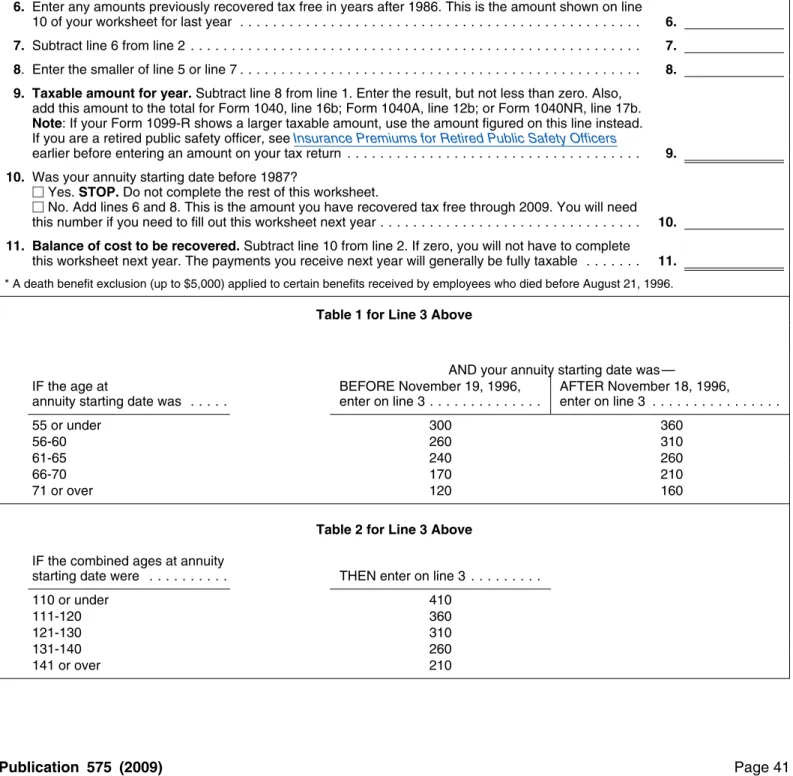
How to use the Simplified Method. Complete Work- Bill must use the Simplified Method to figure his taxable sheet A in the back of this publication to figure your taxable annuity because his payments are from a qualified plan
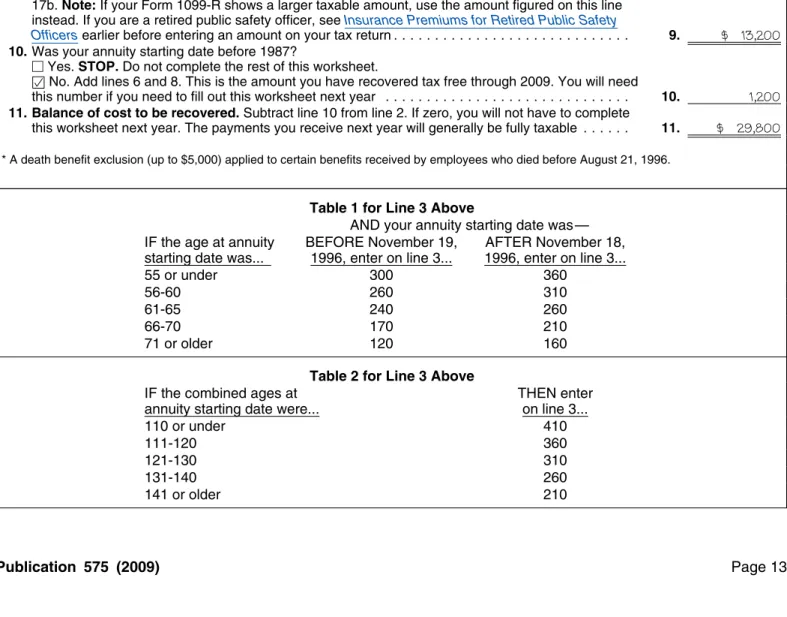
and he is under age 75. Because his annuity is payable will also exclude $100 from her $600 monthly payment. over the lives of more than one annuitant, he uses his and The full amount of any annuity payments received after Kathy’s combined ages and Table 2 at the bottom of 310 payments are paid must be included in gross income. Worksheet A in completing line 3 of the worksheet. His If Bill and Kathy die before 310 payments are made, a completed worksheet is shown below. miscellaneous itemized deduction will be allowed for the Bill’s tax-free monthly amount is $100 ($31,000 ÷ 310) unrecovered cost on the final income tax return of the last as shown on line 4 of the worksheet. Upon Bill’s death, if to die. This deduction is not subject to the 2%-of-adjusted-Bill has not recovered the full $31,000 investment, Kathy gross-income limit.
Worksheet A.
Simplified Method Worksheet for Bill Smith
Keep for Your Records 1. Enter the total pension or annuity payments received this year. Also, add this amount to the total forForm 1040, line 16a; Form 1040A, line 12a; or Form 1040NR, line 17a . . . 1. $ 14,400
2. Enter your cost in the plan (contract) at the annuity starting date plus any death benefit exclusion.*
See Cost (Investment in the Contract) earlier . . . 2. 31,000
Note. If your annuity starting date was before this year and you completed this worksheet last year,
skip line 3 and enter the amount from line 4 of last year’s worksheet on line 4 below (even if the amount of your pension or annuity has changed). Otherwise, go to line 3.
3. Enter the appropriate number from Table 1 below. But if your annuity starting date was after 1997
and the payments are for your life and that of your beneficiary, enter the appropriate number from
Table 2 below . . . 3. 310
4. Divide line 2 by the number on line 3 . . . . 4. 100
5. Multiply line 4 by the number of months for which this year’s payments were made. If your annuity
starting date was before 1987, enter this amount on line 8 below and skip lines 6, 7, 10, and 11.
Otherwise, go to line 6 . . . 5. 1,200
6. Enter any amount previously recovered tax free in years after 1986. This is the amount shown on line
10 of your worksheet for last year . . . 6.
-0-7. Subtract line 6 from line 2 . . . . 7. 31,000
8. Enter the smaller of line 5 or line 7 . . . . 8. 1,200
9. Taxable amount for year. Subtract line 8 from line 1. Enter the result, but not less than zero. Also,
add this amount to the total for Form 1040, line 16b; Form 1040A, line 12b; or Form 1040NR, line 17b. Note: If your Form 1099-R shows a larger taxable amount, use the amount figured on this line
instead. If you are a retired public safety officer, see Insurance Premiums for Retired Public Safety
Officers earlier before entering an amount on your tax return . . . 9. $ 13,200
10. Was your annuity starting date before 1987?
M Yes. STOP. Do not complete the rest of this worksheet.
ú No. Add lines 6 and 8. This is the amount you have recovered tax free through 2009. You will need
this number if you need to fill out this worksheet next year . . . 10. 1,200
11. Balance of cost to be recovered. Subtract line 10 from line 2. If zero, you will not have to complete
this worksheet next year. The payments you receive next year will generally be fully taxable . . . 11. $ 29,800 * A death benefit exclusion (up to $5,000) applied to certain benefits received by employees who died before August 21, 1996.
Table 1 for Line 3 Above
AND your annuity starting date was— IF the age at annuity BEFORE November 19, AFTER November 18, starting date was... 1996, enter on line 3... 1996, enter on line 3...
55 or under 300 360
56-60 260 310
61-65 240 260
66-70 170 210
71 or older 120 160
Table 2 for Line 3 Above
IF the combined ages at THEN enter
annuity starting date were... on line 3...
110 or under 410
111-120 360
121-130 310
131-140 260