Critical Issues in Establishing a Viable
Supply Chain/Reverse Logistics Management Program
Jade Lee, MBA
Supply-Chain Services Inc. (SSI) Lombard, IL, USA [email protected]
Paper published and presented at the Annual Conference of IEEE, May, 2002, San Francisco, CA.
Abstract
In this paper, we intend to analyze the complex issues that OEM’s face in managing their worse nightmare – Reverse Logistics. Viable solutions will be proposed to solve the problems, streamline the operation and ultimately enhance the bottom line. Since our com-pany, Supply-Chain Services Inc. (SSI) is a 3rd party reverse logistic service provider for major corpora-tions from a variety of industries, the numbers used and scenario described are based on our own experi-ence and data. However, a number of published re-search papers are also used as references and ap-propriately noted.
Keywords
Supply Chain/Reverse Logistic Management INTRODUCTION
In today’s competitive business environment, it is critical for OEMs to focus all their energies and core competence into the execution of an efficient and effective forward supply chain. However, after the OEMs sell the products to their distributors, major retail chain stores, or consumers directly, their supply chain process does not stop there. There is an entire part of the business they cannot ignore. OEM’s eventually are forced to face the enormous amount of problems at the back end of their business which can create the biggest headaches.
• Problem # 1: Field and Customer Returns
As dealers and retailers compete for the attention of consumers, lenient return policies have left stores and OEMs’ warehouses flooded with returned goods in-ventories. On average, the typical return rate for all products in the U.S. Market is about 6%. However, the average return rate for some national brand consumer electronics is around 8.46%[1].
There are a wide variety of reasons for end-users’ re-turns. According to SSI and its clients’ experience, predominately, the reasons could include:
True Product Defects (major or minor)
Perceived defects due to the complexity level of the product or unclear operation manual. When cus-tomers are not able to operate the product properly, they normally perceive the product to be defective.
Pricing: find better price elsewhere
Broken or damaged during shipping and handling
Not as expected when compared to the images or functions shown on the packaging carton
Decide not to own the product
Wrong size or model
Recalls or Warranties
Bad intention: for example, returning a printer after taking the new cartridge out.
In business-to-business (B2B) situation, returns from wholesalers, distributors, retail stores, etc. can also be the results of the following scenarios:
Errors in ordering, picking or shipping
Damages due to transportation and handling
Cancellation of orders
Trade-in’s
Overstock items due to seasonal business cycle The myriads of reasons make the Reverse Logistic no less a complicated issue than Forward Logistic in the complete Supply Chain Process. It would be simpler if only “defective products” need to be dealt with. How-ever, based on SSI and its clients’ data, the “non-defective returns” can actually account for 55% or more of the total returns. An ill-managed Reverse Lo-gistic operation can have substantial adverse affect on the profit margin that a company works so hard to achieve during the Forward Supply Chain process. Therefore, it is critical for the OEMs to institute an ef-fective and efficient Reverse Logistic Program. In other words, Reverse Logistics should be considered as a set of Supply Chain processes that adds value to the OEMs. However, unfortunately, not many OEMs realize the impact that the Reverse Logistic may play and do not view Reverse Logistics as a value-added business process because it is not their core compe-tence.
• Problem #2: Excess and Obsolete Inventories SSI’s clients often tell us that the financial loss in this area has been statistically significant due to rapid prod-uct obsolescence rate and inaccurate sales forecast both at the OEM’s and their business customers’ side. For example, a major retail chain may place a substan-tial order for Christmas related items. However, they fail to move the products and would negotiate with the OEM to return the overstock inventory. If this retail chain is an important client, in an effort to keep the client and assure future sales, the OEM may have no choice but to accept returns on certain items and terms. Other reason for excess inventory may have resulted from OEM’s own promotional program, such as spe-cial volume discount. The OEM’s sales team may push the business customers to purchase more than what they can sell. In the end, costs on returning excess in-ventories would have to be absorbed by the OEM.
• Problem #3: Costs Associated with Managing
Reverse Logistics
The costs associated with reverse logistics could be quite intricate due to the enormous amount of details involved. It is clear that whether an OEM possesses the ability to control the costs could have a positive or negative impact on the company’s bottom line.
The tangible and intangible costs borne by OEMs could include the followings:
Return Merchandize Authorization (RMA) process
Transportation: This is a major cost of the reverse logistic process. Everyday, we receive many LTL (less than trailer load) shipments on behalf of our corporate clients from places as far as Washington State, Florida and New Mexico. (SSI is located in Chicago which is considered a central location in the country). It could be costly. Depending on con-tractual agreement, the transportation cost is either entirely borne by OEMs or subsidized by consumer or business customers.
Receiving and inventory control management
Credit reconciliation and issuance
Dispute resolution: disputes occur in the process may tarnish business relationship and impact future sales revenue.
Labor: This is the heart of the Reverse Logistics cost activities. It involves multiple tasks including unpacking, inspection, testing, repair, refurbish, parts retrieval/replacement, cleaning, repackaging, reshelfing, re-deployment, recording, reporting and communication.
Equipment: barcode scanners, test equipment, in-formation software & systems, warehouse equip-ment, repair equipequip-ment, package materials.
Space: Depending on the volume of return goods, excess/obsolete inventories and scrap material, OEMs are forced to allocate certain warehouse
spaces for their reverse logistic operations. This is the cost that OEMs need to calculate to see if it is worthwhile to perform the tasks in house or out-sourcing.
• Problem #4: Managing the Disposal of
Prod-ucts and Production Scrap Material
In order to avoid risks in product and environmental liabilities, OEMs realize the need to institute strict policies in handling scrap material. Non-functional and non-remarketable items need to be sent to reliable re-cyclers for product destruction and material reclama-tion. If the OEM’s products are composed of valuable material such as precious metal, aluminum and copper, it is likely that the OEM is able to receive payments from recyclers even after transportation costs are de-ducted. However, if their material was mostly steel or contaminated plastic, disposal of scrap material would become a cost issue and should be calculated into the product cost.
KEY ELEMENTS OF REVERSE LOGISTIC MANAGEMENT
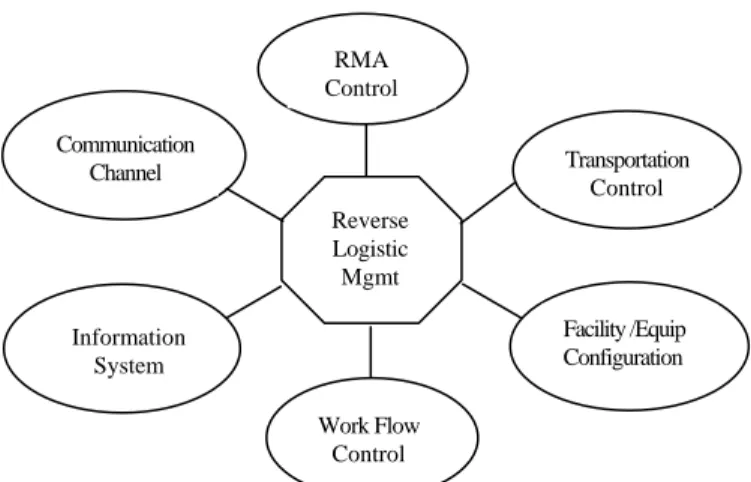
As analyzed above, the Reverse Logistic Management is not an easy task. It involves multiple parties and complex tasks. A well-organized and effective Reverse Logistic Program should be a well-integrated system of the follow-ing key elements:
Table 1. Reverse Logistic Key Elements
RMA Control Communication Channel Transportation Control Reverse Logistic Mgmt Facility /Equip Configuration Information System Work Flow Control
How to interweave these elements and make them work profi-ciently will be further discussed in the following sections.
INHOUSE OR OUTSOURCING
Whether to perform the Reverse Logistic operation in house or subcontract it to a professional service provider is a debatable issue which exists in almost every OEM head-quarters. Based on our experience and discussions with OEM clients, the decision is usually dependent upon several factors:
• Volume: If return goods volume is low, there is no
pressing need to use subcontractors.
• Cost Control: If subcontractors can perform the
tasks more cost effectively, then there is a need to out-source. The cost refers to all the items listed in Prob-lem #3: Costs Associated with Managing Reverse Lo-gistic in page 2 of this article.
Based on our experience, the predominate cost factors that prompt OEMs to use professional service provid-ers such as SSI are:
1) Reverse Logistic is not OEMs’ core competency. It is hard to achieve the efficiency of outsourced service vendors specialized in reverse logistics.
2) The valuable warehouse space should be utilized for forward selling activities in lieu of returns.
3) OEM’s Overhead costs are higher than outsourced service vendors who, while servicing multiple cli-ents, will only allocate a portion of the overhead to each client.
• Complexity of Tasks: If the reverse logistic
pro-gram involves a wide variety of tasks ranging from in-spection, testing, repair/refurbish, parts retrieval and order fulfillment, labeling, repackaging, re-deployment, etc., OEMs tend to be very selective in determining a subcontractor. Only a service provider who has adequate facility, trained staff and capable of providing in-depth tasks will be chosen.
• Accuracy and Data Control: It is quite important
for OEMs to gain accurate information on the flow of the products in the entire reverse logistic process be-cause it has significant impact on accounting, tax, in-ventory and sales/marketing issues. Even though using an outsourced service provider may prove to be cost effective, OEM management will not make a final de-cision until they are sure that the service provider can perform tasks accurately and its information system is sophisticated enough to seamlessly communicate with the OEM’s system.
• Security: This is a major and valid concern of many
OEMs. Unless they can find reliable service providers, OEMs usually act prudently in relinquishing the man-agement capacity.
MANAGING THE KEY ELEMENTS OF REVERSE SUPPLY CHAIN LOGISTICS AND ESTABLISHING A VIABLE PROGRAM
No matter if the reverse logistic operation is performed in house or by an outsourced professional service vendor, it is clear that the efficiency and effectiveness of this operation will have a positive or negative impact on the bottom line of OEMs. Cost and efficiency control are crucial factors to the following key elements.
• RMA Control
Effectively controlling the RMA process is a first step; it serves as a doorkeeper to the rest of the reverse lo-gistic pipeline. Multiple sales agreements (such as cli-ent specific return allowances) and various product packages (i.e. some with certain accessories and some without) further complicate the operation. The staff as-signed to this function has to be well trained to identify and assess the followings:
1) Legitimate Return Cause:
Some of our OEM clients experience disagree-ment on the return goods sent back from distribu-tors. For example, the damages might have been caused by the distributor staff’s negligence while moving or unpacking products. In order to mini-mize unnecessary disagreement and potential loss, OEMs may send local 3rd party service providers to inspect the goods on-site and authorize the re-turn goods before distributors can ship.
It is also important to record legitimate return reasons in the database. It is valuable information to design engineers, plant and sales/marketing management.
2) Assure Clients Return What They Ordered According to SSI’s experience, 5-10% of the re-turn goods are not the products that the OEM cli-ents ordered. An OEM may carry over a thousand product assortments in its catalog. Different ac-cessory combinations may be included in differ-ent packages. Clidiffer-ents (including direct and indi-rect clients) may return the wrong package (nor-mally from commercial clients) or take certain accessories out before they return (normally from consumer clients).
3) Assure Clients Return As Per Sales Agree-ment
This is particularly true when dealing with excess or obsolete inventories sent back from business clients such as wholesalers, distributors and retail chains. The RMA staff must be trained to understand the terms of the sales agreement and assure the correct allowable quantity and model are returned. This could be difficult to execute if the client is a major distributor or powerful national chain store.
• Transportation Control
Transportation is a major component of the reverse lo-gistic cost. There are several ways to control the cost:
1) Use Regional Consolidation Depots: All the regional returns are sent to a regional consolida-tion depot first. Examples would be transporta-tion companies or OEMs’ regional warehouses. However, if the depot is not a dedicated return goods processing center, the drawback is double handling and prone to more errors. For this rea-son, OEMs may use various 3rd party reverse lo-gistic service providers as regional return centers. If for management control purpose, a centralized national return center is preferred, OEMs may use the following criteria to select a location from a transportation cost saving perspective:
Select a region where higher percentage of re-turns normally take place;
If the return percentage is similar in most of the regions, then a location situated in the center of the nation, such as Chicago, Indian-apolis and Atlanta may be a better choice. 2) Negotiate Preferred Rates with Several
Trans-portation Carriers
The return size could range from one small par-cel, several skids, to half or whole trailer loads. There is a need to negotiate preferred rates with different carriers specialized in particular size of shipment.
SSI learned from its clients that one of the rea-sons we were chosen as their national or regional service provider is due to our capability to use our own fleet of trucks to perform regional or na-tional trailer load pick ups. The rate is relatively lower than commercial carriers.
3) Use Automated Systems for Shipping Documen-tation
In order to reduce shipping errors and facilitate shipping efficiency, web-based automated sys-tems should be used. Once the RMA is generated, the client (shipper) should be able to automati-cally print a bill of lading and schedule a pick-up with the selected carriers. The RMA number, corresponding bar codes and recipient’s informa-tion should be also printed on the shipping document.
• Facility and Equipment Configuration
Facility and equipment configuration could be a very challenging task, particularly for 3rd party reverse lo-gistic service providers. There may be clients of differ-ent industries (i.e. telecommunication vs consumer electronics) or product type (i.e. components vs fin-ished products; or consumer products vs industrial products). The nature of tasks as well as requirements and equipment called for could be drastically different. There are several basic principles dictating the facility and equipment set up for an ideal reverse logistic op-eration:
1) Every major project should have a dedicated processing area
This principle is essential particularly if there are several major clients or projects in the same facil-ity; otherwise confusion and errors are prone to take place.
Each client or project’s processing area should be well segregated so incoming, in-process and out-going work flow will not be interrupted or mixed with other client’s or project’s. Inventories should be kept in the same work area to eliminate any possible errors.
As for smaller projects (i.e. smaller daily incom-ing volume), under space availability considera-tion, can be grouped together in one processing area. However, it is a good idea to separate the work schedule to avoid confusion. For example, X company’s tasks are scheduled in the morning while Y’s in the afternoon.
Since each client or project’s products and task requirements are different, each set up should be unique and needs to be customized. For example, some projects may require a full process, from inspection, testing, parts retrieval, all the way to repackaging. Some projects may only require in-spection, cleaning, repackaging and recycle. The space required and the configuration of the proc-essing area would be quite different.
2) Every major project should have an assigned loading dock
According to our experience, controlling the in-coming and outgoing flow at the loading dock area is the first and last step to assure total accu-racy. The loading dock area is usually the busiest area in the plant while, comparing with the proc-essing area, the smallest in terms of square foot-age. For projects where daily incoming and out-going volume is large, an assigned loading dock may be necessary.
SSI is fortunate to have a facility that has multi-ple loading areas in different parts of the plant. This further helps streamline the operation and eliminate the likelihood of mix-up.
If space allowed, a temporary holding area in the loading dock area would be ideal so checking and recording of incoming goods can take place immediately while the truck driver is present. This not only makes accurate receiving possible, it also could reduce the discrepancies between a trucking company and the receiving party. This proved quite essential to one of our corporate cli-ents known for its small and large copiers, cam-eras, printer, as well as other office equipment. SSI’s accurate receiving data helps the client to oversee its carrier to reduce all types of ware-housing and shipping problems. If we do not per-form the receiving task immediately while the truck driver is present, it is very difficult to make the trucking company admit their mistakes. 3) Similar Task or Project Can be Located Near
Each Other
If two projects require similar procedures and the products involved are alike, the processing area can be placed close to each other. The benefit is to share some of the equipment, such as testing, packaging equipment and bailer to save cost and space.
4) Traffic and Processing Flow Consideration: Facility configuration should also consider traffic flow as well as each task’s processing flow so greater efficiency can be attained.
If space allows, it is ideal to have a dedicated traffic route for each of the major projects from loading dock directly to the processing area. The entrance of the project processing area should be the shortest distance to the loading dock or load-ing area. The end of the project processload-ing area should have easy access to the inventory shelves. A dedicated traffic route from loading dock to the work processing area can also minimize traffic jam that leads to time lost and chaos.
At the entrance and inventory zone of a given process area, sufficient space should also be re-served for forklift truck movement.
5) Tasks Requires More Electricity Should be Closer to the Power Supply
Some of the projects require more electrical en-ergy due to testing, repair/refurbish, repackaging and bailing needs. It is better to place the projects near a main power supply to assure an uninter-rupted supply of electricity.
6) Lighting
Adequate lighting is quite necessary, particularly to more complicated projects that require good il-lumination for working staff. In addition to ceil-ing lights, workstation lights should be well placed.
• Work Flow Management Control
The heart of the Reverse Logistic activities takes place in the processing area. Whether the workflow is managed in an effective manner has a pivotal impact on the bottom line of the reverse logistic operation. There are many issues dictating the success of work-flow management. The key elements can be summa-rized as follows:
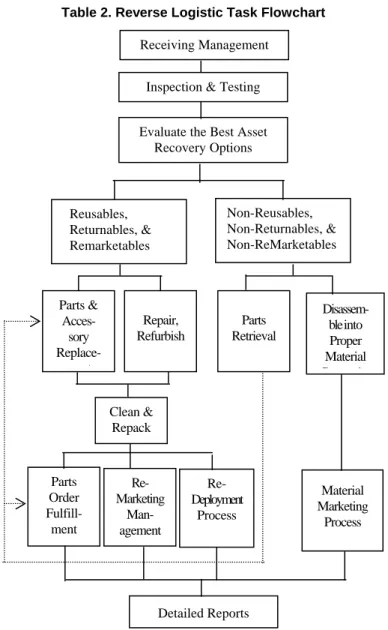
1) Follow the Logical Flow of the Project Tasks For a comprehensive Reverse Logistic Manage-ment Program, the workflow is in general as fol-lows:
Table 2. Reverse Logistic Task Flowchart
Receiving Management
Inspection & Testing
Evaluate the Best Asset Recovery Options Non-Reusables, Non-Returnables, & Non-ReMarketables Reusables, Returnables, & Remarketables Parts & Acces-sory Replace-t Repair, Refurbish Clean & Repack Parts Order Fulfill-ment Re-Marketing Man-agement Re-Deployment Process Disassem-ble into Proper Material C i Parts Retrieval Material Marketing Process Detailed Reports
As to the layout configuration for each project workstation depends on the complexity of tasks required. The most common one is a vertical or horizontal layout with workstations along the two sides of a conveyor. Sometimes, it could be a square, rectangle or U shape. Nonetheless, inter-relation between task components is a major con-sideration so double handling and time lost could be avoided.
2) Computer and Recording
It is crucial to use scanning or other recording devices to record information at the critical point throughout the reverse logistic process. For ex-ample, recording the inspection and testing re-sults, recording when a product is being repaired, refurbished, cleaned, repacked or recycled. Accu-rate recording assures a good tracking system which is very important to the OEMs. More de-tails on the information system will be discussed in the next section.
3) Personnel and Staff
Adequate and quality staff plays a pivotal role in the reverse logistic management process. While overstaffing will make the operation costly, un-derstaffing will result in inefficiency, error and delay. It is an art and science to balance the staff requirement.
For major projects, a dedicated project manager or supervisor is essential. This project manager shall determine and adjust work schedule, allo-cate the workforce as necessary, confirm all the required tasks are performed in a precise and timely manner, communicate with clients and generate regular reports. He/she also needs to confirm all data created at each step of the proc-ess is accurately recorded.
To achieve cost effectiveness, each project should be comprised of staff with different skills and pay levels. For some of the routine and sim-ple tasks, a well-trained laborer can easily per-form them. As to tasks such as repair, refurbish and parts replacement, higher level of technicians would be used. Based on our experience, utiliz-ing a conscientious and diligent work force is more important than cost because one person can be used to perform multiple tasks and their accu-racy level is greater.
In addition, constant job training is essential to enhance and strengthen worker’s skill. It is also important to brief them on the reason behind their tasks. Once they understand the importance and consequences of their tasks, they can deliver higher performance.
Clear step-by-step instruction for each of the pro-cedure is another key factor for high productivity assurance. Each workstation should have task specific instructions in both English and Spanish
in front of the worker. In this way, no matter which worker is assigned to that workstation, they will not forget or omit any part of the proc-ess.
4) Scheduling
Receiving/Pick-Up Scheduling
There are normally two sources of incoming shipment: UPS or Fedex for smaller parcels, freight carriers for larger deliveries on skids. Shippers may use a wide variety of carriers, this could make the receiving task a night-mare. However, with proper scheduling aided by good software, this challenging job can be under control. Better scheduling can assure each incoming shipment arrives at the appro-priate time allocated for the corresponding project. It also avoids all carriers arriving at the same time which can cause chaos. The same rules apply to outgoing shipments.
Work Scheduling
Project managers or supervisors are responsi-ble for work scheduling based upon activity sequence and duration. The Critical Path Method (CPM) often used by the construction industry can be used to calculate the optimal daily work schedules.
Operation Director or Vice President to whom project managers report should review all the project schedule and help make necessary ad-justments in view of daily fluctuations of multiple projects with various activities and volume.
• Information System Management
Information system is a crucial thread that interweaves and connects every aspect of the reverse logistic proc-ess. Without it, errors will be made and efficiency can-not be achieved. More importantly, management relies upon it to make right strategic decisions in both for-ward and reverse supply chain planning. However, one of the most serious problems exist in the industry is lack of a good information system dedicated for re-verse logistics.
It is not easy to develop an ideal information system for reverse logistics given the diverse issues involved as discussed above. In addition, there are so many ex-ceptions and variables in the process. Some of our large corporate clients use SAP system to manage its supply chain operations; however, reverse logistic is only an insignificant part of that program initially writ-ten for the forward supply chain.
In our experience of developing and constantly modi-fying reverse logistic and recycling programs due to rapid changes or realization of problems that were not addressed in an earlier version, several considerations for database development need to be taken into ac-count:
1) Flexibility and Easy Integration:
This is especially challenging for a 3rd party ser-vice provider because its system needs to be flexi-ble enough to communicate with so many different players in the pipeline, such as OEMs and their wholesalers, distributors, retailers, transportation carriers and their regional warehouses.
The system should be also scalable to accommo-date the expansion needs in the future.
2) Comprehensiveness:
The system needs to be as comprehensive as possi-ble so every aspect of the process can be tracked. Important data components should include:
Return Party’s company name, location, con-tact person and number
Return reason
RMA number generation
Sales and Marketing Agreement terms and al-lowances
Warranty terms
Volume, Product, Model, Serial Number
Receiving date
BOL number or transportation carrier track number
“Return to” location
Credit conciliation
Records on inspection, testing, parts retrieval, parts replacement, parts order fulfillment, pair, refurbish, packaging and re-deployment.
Ability to analyze all pertinent data and diag-nose the reasons for defectiveness and mal-function. This capability will allow OEMs to apply the information to their core business such as product design improvement, tighter supplier control, better production quality control, budgeting and forecasting.
3) Real-Time Capability
If some of the functions can be on web/real time basis, efficiency and accuracy can be greatly en-hanced. For example, a shipper can print a bill of lading with MRA number, carrier and recipient’s info from a dedicated website. OEM clients can also access the process status and report on line.
• Communication Channel Management
Keeping the communication channel open is the key to a successful Reverse Logistic Management Program, particularly when a 3rd party service vendor is used. The service vendor needs to:
1) Assign a dedicated project manager for each OEM’s program. He/she needs to keep constant communication with OEM’s designated personnel.
2) Enter data in a timely manner so the OEM can obtain up-to-date information.
3) Alert OEM of any unusual circumstances so im-mediate actions or adjustments can be made. On the other hand, the OEM needs to inform its ser-vice vendors any changes that take place in the follow-ing areas:
1) addition or deletion of its clients
2) product specification
3) recall information
4) sales or promotional agreement
5) special allowances
6) return policies SUMMARY
As discussed and demonstrated throughout this paper, Re-verse Logistic, in fact, plays more of a strategic role in the Total Supply Chain Management Process than many peo-ple realize. The compeo-plexity of tasks and contribution to an OEM or retailer’s bottom line are no less intricate or im-portant than those in the Forward Logistic process.
In this paper, we have addressed some of the critical issues in establishing a viable Reverse Logistic Management Pro-gram based on SSI’s actual experience. However, since this is a relatively new field, more in-depth research is needed. We hope this paper serves as a catalyst for the continuing growth of this industry.
REFERENCES
[1] Drs. Rogers, Dale S. and Tibben-Lembke, Ronald,
Going Backwards: Reverse Logistics Trends and Prac-tices, University of Nevada, Reno (1998)